10-12B/A
As filed with the U.S. Securities and Exchange Commission on August 14, 2026
File No. 001-43376
UNITED STATES
SECURITIES AND EXCHANGE COMMISSION
Washington, D.C. 20549
AMENDMENT NO. 1 TO
FORM 10
GENERAL FORM FOR REGISTRATION OF SECURITIES
PURSUANT TO SECTION 12(b) OR 12(g) OF
THE SECURITIES EXCHANGE ACT OF 1934
VYLOR INC.
(Exact name of registrant as specified in its charter)
|
|
Delaware |
41-2930124 |
(State or other jurisdiction of |
(I.R.S. Employer |
incorporation or organization) |
Identification No.) |
|
|
7100 NW 62nd Avenue |
|
Johnston, Iowa |
50131 |
(Address of principal executive offices) |
(Zip Code) |
Registrant’s telephone number, including area code: (833) 267-8382
Securities to be registered pursuant to Section 12(b) of the Act:
|
|
|
|
Title of each class |
Name of each exchange on which |
to be so registered |
each class is to be registered |
|
|
|
|
Common Stock, par value $0.01 per share |
New York Stock Exchange |
Securities to be registered pursuant to Section 12(g) of the Act: None
Indicate by check mark whether the registrant is a large accelerated filer, an accelerated filer, a non-accelerated filer, smaller reporting company, or an emerging growth company. See the definitions of “large accelerated filer,” “accelerated filer,” “smaller reporting company” and “emerging growth company” in Rule 12b-2 of the Exchange Act.
|
|
|
|
|
Large accelerated filer |
☐ |
Accelerated filer |
☐ |
Non-accelerated filer |
☒ |
Smaller reporting company |
☐ |
|
|
Emerging growth company |
☐ |
If an emerging growth company, indicate by check mark if the registrant has elected not to use the extended transition period for complying with any new or revised financial accounting standards provided pursuant to Section 13(a) of the Exchange Act. ☐
VYLOR INC.
INFORMATION REQUIRED IN REGISTRATION STATEMENT
CROSS-REFERENCE SHEET BETWEEN INFORMATION STATEMENT AND ITEMS OF FORM 10
Certain information required to be included in this Form 10 is incorporated by reference to specifically-identified portions of the body of the information statement filed herewith as Exhibit 99.1 and which will be made available to stockholders. None of the information contained in the information statement shall be incorporated by reference herein or deemed to be a part hereof unless such information is specifically incorporated by reference.
Item 1. Business.
The information required by this item is contained under the sections of the information statement entitled “Information Statement Summary,” “Risk Factors,” “Cautionary Statement Concerning Forward-Looking Statements,” “The Spin-Off,” “Management’s Discussion and Analysis of Financial Condition and Results of Operations of Corteva,” “Management’s Discussion and Analysis of Financial Condition and Results of Operations of the Seed Business (Supplemental),” “Business,” “Certain Relationships and Related Person Transactions,” “Our Relationship with New Corteva Following the Spin-Off” and “Where You Can Find More Information.” Those sections are incorporated herein by reference.
Item 1A. Risk Factors.
The information required by this item is contained under the sections of the information statement entitled “Information Statement Summary—Summary of Risk Factors”, “Risk Factors” and “Cautionary Statement Concerning Forward-Looking Statements”. Those sections are incorporated herein by reference.
Item 2. Financial Information.
The information required by this item is contained under the sections of the information statement entitled “Risk Factors,” “Capitalization,” “Unaudited Pro Forma Consolidated Financial Statements,” “Notes to Unaudited Pro Forma Consolidated Financial Statements,” “Management’s Discussion and Analysis of Financial Condition and Results of Operations of Corteva” and “Management’s Discussion and Analysis of Financial Condition and Results of Operations of the Seed Business (Supplemental),” and “Index to the Financial Statements” (and the financial statements and related notes referenced therein). Those sections are incorporated herein by reference.
Item 3. Properties.
The information required by this item is contained under the section of the information statement entitled “Business—Facilities.” That section is incorporated herein by reference.
Item 4. Security Ownership of Certain Beneficial Owners and Management.
The information required by this item is contained under the section of the information statement entitled “Security Ownership of Certain Beneficial Owners and Management.” That section is incorporated herein by reference.
Item 5. Directors and Executive Officers.
The information required by this item is contained under the section of the information statement entitled “Management.” That section is incorporated herein by reference.
Item 6. Executive Compensation.
The information required by this item is contained under the sections of the information statement entitled “Compensation Discussion and Analysis” and “Executive Compensation.” Those sections are incorporated herein by reference.
Item 7. Certain Relationships and Related Transactions, and Director Independence.
The information required by this item is contained under the sections of the information statement entitled “Information Statement Summary—Summary of Risk Factors,” “Risk Factors,” “Management,” “Executive Compensation,” “Certain Relationships and Related Person Transactions” and “Our Relationship with New Corteva Following the Spin-Off.” Those sections are incorporated herein by reference.
Item 8. Legal Proceedings.
The information required by this item is contained under the section of the information statement entitled “Management’s Discussion and Analysis of Financial Condition and Results of Operations of Corteva,” “Management’s Discussion and Analysis of Financial Condition and Results of Operations of the Seed Business (Supplemental)” and “Business—Environmental and Other Legal Proceedings.” Those sections are incorporated herein by reference.
Item 9. Market Price of, and Dividends on, the Registrant’s Common Equity and Related Stockholder Matters.
The information required by this item is contained under the sections of the information statement entitled “Risk Factors,” “The Spin-Off,” “Dividend Policy,” “Capitalization” and “Description of Our Capital Stock.” Those sections are incorporated herein by reference.
Item 10. Recent Sales of Unregistered Securities.
The information required by this item is contained under the section of the information statement entitled “Description of Our Capital Stock.” That section is incorporated herein by reference.
Item 11. Description of Registrant’s Securities to be Registered.
The information required by this item is contained under the sections of the information statement entitled “Risk Factors,” “The Spin-Off,” “Dividend Policy,” “Capitalization” and “Description of Our Capital Stock.” Those sections are incorporated herein by reference.
Item 12. Indemnification of Directors and Officers.
The information required by this item is contained under the section of the information statement entitled “Description of Our Capital Stock.” That section is incorporated herein by reference.
Item 13. Financial Statements and Supplementary Data.
The information required by this item is contained under the sections of the information statement entitled “Unaudited Pro Forma Consolidated Financial Statements,” “Notes to Unaudited Pro Forma Consolidated Financial Statements” and “Index to the Financial Statements” (and the financial statements and related notes referenced therein). Those sections are incorporated herein by reference.
Item 14. Changes in and Disagreements with Accountants on Accounting and Financial Disclosure.
None.
Item 15. Financial Statements and Exhibits.
The information required by this item is contained under the sections of the information statement entitled “Unaudited Pro Forma Consolidated Financial Statements,” “Notes to the Unaudited Pro Forma Consolidated Financial Statements” and “Index to the Financial Statements” (and the financial statements and related notes referenced therein). Those sections and such financial statements and related notes are incorporated herein by reference.
The following documents are filed as exhibits hereto:
|
|
|
Exhibit
Number |
|
Exhibit Description |
|
|
|
2.1 |
|
Form of Separation and Distribution Agreement by and among Corteva, Inc., Vylor Inc., and solely for the purposes set forth therein, EIDP, Inc.† |
|
|
|
3.1 |
|
Form of Amended and Restated Certificate of Incorporation of Vylor Inc. |
|
|
|
3.2 |
|
Form of Amended and Restated Bylaws of Vylor Inc. |
|
|
|
10.1 |
|
Form of Tax Matters Agreement by and among Corteva, Inc. and Vylor Inc. |
|
|
|
10.2 |
|
Form of Employee Matters Agreement by and between Corteva, Inc. and Vylor Inc. |
|
|
|
10.3 |
|
Form of Transition Services Agreement by and between Corteva, Inc. and Vylor Inc.† |
|
|
|
10.4 |
|
Form of Intellectual Property Matters Agreement by and between Corteva, Inc. and Vylor Inc.† |
|
|
|
10.5 |
|
Form of Global Master Seed Treatment Supply Agreement by and between Corteva Agriscience, LLC. and Pioneer Hi-Bred International, Inc.† |
|
|
|
21.1 |
|
Subsidiaries of Vylor Inc.* |
|
|
|
99.1 |
|
Information Statement of Vylor Inc., preliminary and subject to completion, dated , 2026. |
|
|
|
99.2 |
|
Form of Notice Regarding the Internet Availability of Information Statement Materials. |
* To be filed by amendment.
† Certain information in this exhibit has been redacted in accordance with Item 601(b)(10)(iv) of Regulation S-K.
SIGNATURES
Pursuant to the requirements of Section 12 of the Securities Exchange Act of 1934, the registrant has duly caused this registration statement to be signed on its behalf by the undersigned, thereunto duly authorized.
|
|
Vylor Inc. |
By: |
/s/ David P. Johnson |
|
Name: David P. Johnson |
|
Title: Chief Financial Officer |
|
|
Date: August 14, 2026
EX-2.1
Exhibit 2.1
**Certain information in this exhibit has been redacted in accordance with Item 601(b)(10)(iv) of Regulation S-K. Such information is both (i) not material and (ii) customarily and actually treated by the registrant as private or confidential. [***] indicates that information has been redacted.**
SEPARATION AND DISTRIBUTION AGREEMENT
by and among
CORTEVA, INC.,
VYLOR INC.
and
solely for purposes of Sections 3.2 and 3.7, EIDP, INC.
Dated as of [ ]
TABLE OF CONTENTS
|
|
|
|
Article I
DEFINITIONS AND INTERPRETATION |
|
Section 1.1 |
|
General |
2 |
Section 1.2 |
|
References; Interpretation |
35 |
|
Article II
THE SEPARATION |
|
Section 2.1 |
|
General |
36 |
Section 2.2 |
|
Internal Reorganization; Transfer of Assets; Allocation of Liabilities |
39 |
Section 2.3 |
|
Intergroup Accounts |
39 |
Section 2.4 |
|
Limitation of Liability; Intergroup Contracts |
39 |
Section 2.5 |
|
Transfers Not Effected at or Prior to the Effective Time; Transfers Deemed Effective as of the Effective Time |
40 |
Section 2.6 |
|
Wrong Pockets; Mail & Other Communications; Payments |
42 |
Section 2.7 |
|
Conveyancing and Allocation Instruments |
43 |
Section 2.8 |
|
Further Assurances |
44 |
Section 2.9 |
|
Novation of Liabilities |
44 |
Section 2.10 |
|
Guarantees |
45 |
Section 2.11 |
|
Bank Accounts; Cash Balances |
47 |
Section 2.12 |
|
Payment of Specified Transaction Expenses |
47 |
Section 2.13 |
|
Disclaimer of Representations and Warranties |
47 |
|
Article III
OTHER TRANSACTIONS AND ACTIONS |
|
Section 3.1 |
|
SpinCo Financing Arrangements |
48 |
Section 3.2 |
|
Transactions Prior to the Effective Time |
48 |
Section 3.3 |
|
Certificate of Incorporation; Bylaws |
48 |
Section 3.4 |
|
Directors |
48 |
Section 3.5 |
|
Officers |
48 |
Section 3.6 |
|
Resignations |
48 |
Section 3.7 |
|
Ancillary Agreements |
49 |
|
Article IV
THE DISTRIBUTION |
|
Section 4.1 |
|
The Distribution |
49 |
Section 4.2 |
|
Fractional Shares |
49 |
Section 4.3 |
|
Sole Discretion of RemainCo |
49 |
Section 4.4 |
|
Conditions to Distribution |
49 |
Section 4.5 |
|
Effectiveness of Distribution |
51 |
|
Article V
CERTAIN COVENANTS |
|
Section 5.1 |
|
Auditors and Audits; Annual and Quarterly Financial Statements and Accounting |
51 |
Section 5.2 |
|
Separation of Information |
53 |
Section 5.3 |
|
Nonpublic Information |
54 |
Section 5.4 |
|
Cooperation |
54 |
Section 5.5 |
|
Permits and Financial Assurance |
55 |
Section 5.6 |
|
Non-Competition |
56 |
|
|
|
|
Section 5.7 |
|
Inventor Remuneration |
61 |
|
Article VI
PRIOR TRANSACTION AGREEMENTS |
|
Section 6.1 |
|
No Assignment |
61 |
Section 6.2 |
|
SpinCo Enforcement |
61 |
Section 6.3 |
|
Obligations |
63 |
Section 6.4 |
|
Access to Accessible DWDP Insurance Policies for Pre-Distribution Matters |
64 |
Section 6.5 |
|
SpinCo Status |
66 |
Section 6.6 |
|
Tax Matters |
66 |
|
Article VII
LEGACY LIABILITIES |
|
Section 7.1 |
|
Management of Legacy Liabilities |
66 |
Section 7.2 |
|
Access to Information; Certain Services; Expenses |
67 |
Section 7.3 |
|
Notice Relating to Legacy Liabilities |
67 |
Section 7.4 |
|
Cooperation with Governmental Entity |
68 |
Section 7.5 |
|
Conflict |
68 |
Section 7.6 |
|
Legacy Liability Actions |
68 |
|
Article VIII
INDEMNIFICATION |
|
Section 8.1 |
|
Release of Pre-Distribution Claims |
68 |
Section 8.2 |
|
Indemnification by RemainCo |
70 |
Section 8.3 |
|
Indemnification by SpinCo |
70 |
Section 8.4 |
|
Procedures for Third Party Claims |
70 |
Section 8.5 |
|
Procedures for Direct Claims |
73 |
Section 8.6 |
|
Cooperation in Defense and Settlement |
73 |
Section 8.7 |
|
Indemnification Payments |
75 |
Section 8.8 |
|
Indemnification Obligations Net of Insurance Proceeds and Other Amounts |
75 |
Section 8.9 |
|
Additional Matters; Survival of Indemnities |
76 |
Section 8.10 |
|
Environmental Matters |
76 |
Section 8.11 |
|
Closure of Discontinued Operations |
80 |
|
Article IX
PRESERVATION OF CORPORATE RECORDS; ACCESS TO INFORMATION; CONFIDENTIALITY; PRIVILEGED MATTERS |
|
Section 9.1 |
|
Preservation of Corporate Records |
81 |
Section 9.2 |
|
Provision of Corporate Records |
82 |
Section 9.3 |
|
Disposition of Information |
84 |
Section 9.4 |
|
Witness Services; Litigation Support |
85 |
Section 9.5 |
|
Reimbursement; Other Matters |
85 |
Section 9.6 |
|
Confidentiality; Non-Use |
85 |
Section 9.7 |
|
Privileged Matters |
87 |
Section 9.8 |
|
Conflicts Waiver |
90 |
Section 9.9 |
|
Ownership of Information |
90 |
Section 9.10 |
|
Personal Data |
90 |
|
Article X
DISPUTE RESOLUTION |
|
Section 10.1 |
|
Negotiation and Arbitration |
91 |
|
|
|
|
Section 10.2 |
|
Continuity of Service and Performance |
94 |
|
Article XI
INSURANCE |
|
Section 11.1 |
|
Insurance Matters |
94 |
Section 11.2 |
|
Fiduciary Liability Insurance |
97 |
Section 11.3 |
|
Directors and Officers Indemnification and Insurance |
97 |
Section 11.4 |
|
Insurance for Post-Distribution Matters |
98 |
Section 11.5 |
|
No Assignment of Entire Insurance Policies |
98 |
Section 11.6 |
|
Agreement for Waiver of Conflict and Shared Defense |
98 |
Section 11.7 |
|
Cooperation |
98 |
Section 11.8 |
|
Accessible DWDP Insurance Policies |
98 |
Section 11.9 |
|
Rights to Existing Credit Insurance Policies |
98 |
|
Article XII
MISCELLANEOUS |
|
Section 12.1 |
|
Complete Agreement; Construction |
98 |
Section 12.2 |
|
Ancillary Agreements |
99 |
Section 12.3 |
|
Counterparts |
99 |
Section 12.4 |
|
Survival of Agreements |
99 |
Section 12.5 |
|
Notices |
99 |
Section 12.6 |
|
Waivers |
100 |
Section 12.7 |
|
Amendments |
100 |
Section 12.8 |
|
Assignment |
100 |
Section 12.9 |
|
Successors and Assigns |
101 |
Section 12.10 |
|
Certain Termination and Amendment Rights |
101 |
Section 12.11 |
|
Payment Terms |
101 |
Section 12.12 |
|
No Circumvention |
102 |
Section 12.13 |
|
Subsidiaries |
102 |
Section 12.14 |
|
Third Party Beneficiaries |
102 |
Section 12.15 |
|
Title and Headings |
102 |
Section 12.16 |
|
Exhibits and Schedules |
102 |
Section 12.17 |
|
Governing Law |
102 |
Section 12.18 |
|
Specific Performance |
102 |
Section 12.19 |
|
Severability |
103 |
Section 12.20 |
|
No Duplication; No Double Recovery |
103 |
Section 12.21 |
|
Public Announcements |
103 |
Section 12.22 |
|
Tax Treatment of Payments |
103 |
|
|
|
Exhibits |
|
|
Exhibit A |
|
Steps Plan |
Exhibit B |
|
Industrial Real Property Restrictions |
INDEX OF DEFINED TERMS
|
|
Term |
Section |
AAA |
Section 10.1(c) |
Acceptable Alternative Arrangement |
Section 2.2(d)(i) |
Accessible DWDP Insurance Policy |
Section 1.1(3) |
Action |
Section 1.1(4) |
Affiliate |
Section 1.1(5) |
Agent |
Section 1.1(6) |
Agreement |
Preamble |
Allocated |
Section 1.1(8) |
Allocation Action |
Section 8.6(a) |
Ancillary Agreements |
Section 1.1(10) |
Animal Health Field |
Section 5.6(k)(iii)(A) |
Animal Nutrition Field |
Section 5.6(k)(iv)(C) |
Applicable Percentage |
Section 1.1(12) |
Applicable RemainCo Percentage |
Section 1.1(13) |
Applicable SpinCo Percentage |
Section 1.1(14) |
Appropriate Remediation Standard |
Section 8.10(d) |
Arbitral Tribunal |
Section 10.1(c)(i) |
Assets |
Section 1.1(17) |
Audited Party |
Section 5.1(c) |
Biofuels Field |
Section 5.6(k)(iv)(A) |
Biologicals Field |
Section 5.6(k)(iii)(B) |
Board |
Recitals |
Business |
Section 1.1(20) |
Business Day |
Section 1.1(21) |
Cash and Cash Equivalents |
Section 1.1(22) |
Change of Control |
Section 1.1(23) |
Chemours SDA |
Section 1.1(24) |
Code |
Section 1.1(25) |
Collective Benefit Services |
Section 9.7(a) |
Commercially Reasonable Expenditures |
Section 8.10(f)(ii) |
Commission |
Section 1.1(28) |
Confidential Information |
Section 1.1(29) |
Consents |
Section 1.1(30) |
Continuing Arrangements |
Section 1.1(31) |
Contract |
Section 1.1(32) |
Controller |
Section 1.1(33) |
Conveyancing and Allocation Instruments |
Section 1.1(34) |
Copyrights |
Section 1.1(35) |
Corporate Trade Payables |
Section 1.1(192)(xii)(a) |
Corrective Action Performing Party |
Section 8.10(f)(i) |
Corteva Counsel |
Section 9.8 |
Credit Support Instruments |
Section 1.1(39) |
Crop Protection Field |
Section 5.6(k)(iii)(C) |
Damages |
Section 1.1(40) |
Data Protection Laws |
Section 1.1(41) |
Data Subject |
Section 1.1(42) |
Decision on Interim Relief |
Section 10.1(c)(ix) |
Demolition Party |
Section 8.11(a) |
Designated Ancillary Agreements |
Section 1.1(45) |
Determination |
Section 1.1(46) |
Discontinued Buildings and Related Improvements |
Section 8.11(a) |
|
|
Discontinued Business Liabilities |
Section 1.1(48) |
Discontinued Businesses |
Section 1.1(49) |
Discontinued Closely Linked Product |
Section 1.1(50) |
Dispute |
Section 10.1(a) |
Dispute Notice |
Section 1.1(52) |
Distribution |
Recitals |
Distribution Date |
Section 1.1(54) |
Distribution Disclosure Documents |
Section 1.1(55) |
Distribution Ratio |
Section 1.1(56) |
Distribution Record Date |
Section 1.1(57) |
DWDP EMA |
Section 1.1(58) |
DWDP Letter Agreement |
Section 1.1(59) |
DWDP Liabilities |
Section 1.1(60) |
DWDP PFAS MOU |
Section 1.1(61) |
DWDP RemainCo Liabilities |
Section 1.1(62) |
DWDP SDA |
Section 1.1(63) |
DWDP SpinCo Liabilities |
Section 1.1(64) |
DWDP TMA |
Section 1.1(65) |
Effective Time |
Section 4.5 |
EIDP |
Preamble |
EIDP Distribution |
Recitals |
Emergency Arbitrator |
Section 1.1(69) |
Employee Matters Agreement |
Section 1.1(70) |
Employee Records |
Section 1.1(71) |
Employee Related Liabilities |
Section 1.1(122) |
[***] |
Section 5.6(k)(i) |
Engineering Models and Databases |
Section 1.1(73) |
Environmental Laws |
Section 1.1(74) |
Environmental Liabilities |
Section 1.1(75) |
Environmental Permit |
Section 1.1(76) |
Exchange Act |
Section 1.1(77) |
Financial Advisory Firm |
Section 4.4(d) |
Financing Disclosure Documents |
Section 1.1(78) |
First Non-Compete Discussion Period |
Section 5.6(i) |
Force Majeure Event |
Section 1.1(81) |
Form 10 |
Section 1.1(82) |
GAAP |
Section 1.1(83) |
GDPR |
Section 1.1(41) |
General Dispute Notice |
Section 10.1(b)(i) |
General Negotiation Period |
Section 10.1(b)(i) |
Governmental Entity |
Section 1.1(87) |
Ground Leases |
Section 1.1(88) |
Group |
Section 1.1(89) |
Guaranty Release |
Section 2.10(b) |
Hazardous Substances |
Section 1.1(91) |
In Planta |
Section 5.6(k)(ii) |
Indebtedness |
Section 1.1(92) |
Indemnifiable Loss |
Section 1.1(93) |
Indemnifiable Losses |
Section 1.1(93) |
Indemnification Notice |
Section 1.1(94) |
Indemnifying Party |
Section 8.4(a) |
Indemnitee |
Section 8.4(a) |
Indemnity Payment |
Section 1.1(97) |
|
|
Industrial Biosciences Field |
Section 5.6(k)(iii)(D) |
Industrial Purpose |
Section 1.1(98) |
Industrial Real Property Restrictions |
Section 2.7(b) |
Information |
Section 1.1(100) |
Information Statement |
Section 1.1(101) |
Insurance Policies |
Section 1.1(102) |
Insurance Proceeds |
Section 1.1(103) |
Insurer |
Section 1.1(104) |
Intellectual Property |
Section 1.1(105) |
Intended Tax Treatment |
Section 1.1(106) |
Intergroup Accounts |
Section 2.3 |
Intergroup Leases |
Section 1.1(108) |
Interim Relief |
Section 10.1(c)(ix) |
Internal Control Audit and Management Assessments |
Section 5.1(b) |
Internal Reorganization |
Section 1.1(111) |
Inventor Remuneration |
Section 1.1(112) |
IP Matters Agreement |
Section 1.1(113) |
IT Assets |
Section 1.1(114) |
Joint IP |
Section 1.1(115) |
Joint Studies |
Section 1.1(116) |
Know-How |
Section 1.1(117) |
Law |
Section 1.1(118) |
Legacy Liabilities |
Section 1.1(119) |
Legacy Liability Action |
Section 7.6(a) |
Liabilities |
Section 1.1(122) |
Liable Party |
Section 2.9(b) |
Litigation Hold |
Section 9.1(b) |
Mixed Contract |
Section 1.1(125) |
Negotiation Period |
Section 1.1(126) |
Non-Assumable Third Party Claims |
Section 8.4(b) |
Non-Compete Dispute Notice |
Section 5.6(i) |
Non-Compete Escalation Notice |
Section 5.6(i) |
Non-Compete Period |
Section 5.6(a) |
Non-Performing Impacted Party |
Section 8.10(c)(i) |
Non-Performing Site Controller |
Section 8.10(c)(ii) |
Non-Shared Contract |
Section 1.1(133) |
Non-Transferred Permit |
Section 5.5(a) |
Notice Recipient |
Section 2.2(d)(vi) |
Notifying Party |
Section 2.2(d)(vi) |
NYSE |
Section 1.1(137) |
Off-Site Environmental Liabilities |
Section 1.1(138) |
Other Party |
Section 2.9(a) |
Other Party’s Auditors |
Section 5.1(a) |
Other Shared Liabilities |
Section 1.1(141) |
Other Surviving Intergroup Accounts |
Section 2.3 |
Partial Assignment |
Section 2.2(d)(i) |
Parties |
Preamble |
Party |
Preamble |
Patent |
Section 1.1(145) |
Performing Party |
Section 8.10(b)(iv) |
Permit Transferee |
Section 1.1(147) |
Permit Transferor |
Section 1.1(148) |
Permits |
Section 1.1(149) |
|
|
Permitted Courts |
Section 10.1(d) |
Person |
Section 1.1(151) |
Personal Data |
Section 1.1(152) |
Personal Data Breach |
Section 1.1(153) |
Plant Genetics Field |
Section 5.6(k)(iv)(B) |
Plant Operating Documents |
Section 1.1(154) |
Policies |
Section 1.1(155) |
Pre-Acquisition RemainCo Business |
Section 5.6(b)(i) |
Pre-Acquisition RemainCo Entities |
Section 5.6(c) |
Pre-Acquisition SpinCo Business |
Section 5.6(e)(i) |
Pre-Acquisition SpinCo Entities |
Section 5.6(f) |
Prior AgCo Claim |
Section 6.4(a)(ii) |
Prior Transaction Agreement Notice Recipient |
Section 6.2(d) |
Prior Transaction Agreement Notifying Party |
Section 6.2(d) |
Prior Transaction Agreements |
Section 1.1(163) |
Privilege |
Section 9.7(a) |
Privilege Waiver Dispute |
Section 9.7(c)(iii) |
Privilege Waiver Negotiation Period |
Section 9.7(c)(iv) |
Privilege Waiver Request |
Section 9.7(c) |
Privileged Information |
Section 9.7(a) |
Processing |
Section 1.1(169) |
Public Reports |
Section 5.1(d) |
Record Holders |
Recitals |
Records |
Section 1.1(172) |
Registrations |
Section 1.1(173) |
Regulatory Data |
Section 1.1(174) |
Related |
Section 1.1(175) |
Release |
Section 1.1(176) |
Relevant Site Party |
Section 1.1(177) |
RemainCo |
Preamble |
RemainCo Accounts |
Section 2.11(a) |
RemainCo Ancillary Real Property |
Section 1.1(181)(xiii)(a) |
RemainCo Assets |
Section 1.1(181) |
RemainCo Business |
Section 1.1(182) |
RemainCo Closing 8-K |
Section 1.1(183) |
RemainCo Common Stock |
Section 1.1(184) |
RemainCo Contracts |
Section 1.1(185) |
RemainCo CSIs |
Section 2.10(d) |
RemainCo Discontinued Businesses |
Section 1.1(187) |
RemainCo Environmental Liabilities |
Section 1.1(188) |
RemainCo Fields |
Section 5.6(k)(iii) |
RemainCo Group |
Section 1.1(189) |
RemainCo Indemnitees |
Section 1.1(190) |
RemainCo Inventory |
Section 1.1(191) |
RemainCo Liabilities |
Section 1.1(192) |
RemainCo Managed Shared Liabilities |
Section 1.1(141)(ii)(d) |
RemainCo Non-Compete Acquirers |
Section 5.6(c) |
RemainCo Non-Compete Target |
Section 5.6(b)(i) |
RemainCo Prohibited Activities |
Section 5.6(a) |
RemainCo Real Property |
Section 1.1(181)(xiii)(a) |
RemainCo Shared Contracts |
Section 1.1(198) |
RemainCo Specified Corporate Contracts |
Section 1.1(185)(ii) |
RemainCo Specified Leased Real Property |
Section 1.1(181)(iv) |
|
|
RemainCo Specified Leases |
Section 1.1(181)(iv) |
RemainCo Specified Owned Real Property |
Section 1.1(181)(iv) |
RemainCo Specified Permitted Activities |
Section 1.1(203) |
RemainCo Specified Prior Transaction Agreements |
Section 1.1(204) |
RemainCo Specified Transaction Expenses |
Section 1.1(205) |
RemainCo Tax Opinion |
Section 1.1(206) |
Response Action |
Section 8.10(b)(i) |
Rules |
Section 10.1(c) |
SAT Field |
Section 5.6(k)(iii)(E) |
Second Non-Compete Discussion Period |
Section 5.6(i) |
Security Interest |
Section 1.1(210) |
Separation Disclosure Related Liabilities |
Section 1.1(211) |
Severable Prior Transaction Agreements |
Section 1.1(212) |
Shared Contract |
Section 1.1(213) |
Shared Discontinued Business Liabilities |
Section 1.1(214) |
Shared Liabilities |
Section 1.1(215) |
Shared Liability Manager |
Section 8.4(b) |
Shared Permit |
Section 5.5(a) |
Shared Prior Transaction Agreements |
Section 1.1(218) |
Shared Specified Transaction Expenses |
Section 1.1(219) |
Shared Third Party Real Property |
Section 1.1(220) |
Shared Third Party Real Property Liabilities |
Section 1.1(221) |
Shared Transaction Expenses |
Section 1.1(222) |
Site Services Agreements |
Section 1.1(223) |
SOFR |
Section 1.1(224) |
Software |
Section 1.1(225) |
Sole Benefit Services |
Section 9.7(a) |
Space Leases |
Section 1.1(227) |
Specified RemainCo Assets |
Section 1.1(181) |
Specified RemainCo Liabilities |
Section 1.1(192) |
Specified SpinCo Assets |
Section 1.1(235) |
Specified SpinCo Liabilities |
Section 1.1(250) |
SpinCo |
Preamble |
SpinCo Accounts |
Section 2.11(a) |
SpinCo Ancillary Real Property |
Section 1.1(235)(xiii)(a) |
SpinCo Assets |
Section 1.1(235) |
SpinCo Business |
Section 1.1(236) |
SpinCo Cash Distribution |
Section 1.1(237) |
SpinCo Closing 8-K |
Section 1.1(238) |
SpinCo Common Stock |
Recitals |
SpinCo Contracts |
Section 1.1(240) |
SpinCo Contribution |
Section 1.1(241) |
SpinCo CSIs |
Section 2.10(d) |
SpinCo Discontinued Businesses |
Section 1.1(243) |
SpinCo Environmental Liabilities |
Section 1.1(244) |
SpinCo Fields |
Section 5.6(k)(iv) |
SpinCo Financing Arrangements |
Section 1.1(245) |
SpinCo Group |
Section 1.1(246) |
SpinCo Indemnitees |
Section 1.1(247) |
SpinCo Inventory |
Section 1.1(248) |
SpinCo Issuance |
Recitals |
SpinCo Liabilities |
Section 1.1(250) |
SpinCo Non-Compete Acquirers |
Section 5.6(f) |
|
|
SpinCo Non-Compete Target |
Section 5.6(e)(i) |
SpinCo Prohibited Activities |
Section 5.6(d) |
SpinCo Real Property |
Section 1.1(235)(xiii)(a) |
SpinCo Shared Contracts |
Section 1.1(255) |
SpinCo Specified Corporate Contracts |
Section 1.1(240)(ii) |
SpinCo Specified Leased Real Property |
Section 1.1(235)(iv) |
SpinCo Specified Leases |
Section 1.1(235)(iv) |
SpinCo Specified Owned Real Property |
Section 1.1(235)(iv) |
SpinCo Specified Permitted Activities |
Section 1.1(260) |
SpinCo Specified Prior Transaction Agreements |
Section 1.1(261) |
SpinCo Specified Transaction Expenses |
Section 1.1(262) |
SpinCo Vested Prior Transaction Rights |
Section 1.1(263) |
Steps Plan |
Section 1.1(264) |
Subsidiary |
Section 1.1(265) |
Tax |
Section 1.1(266) |
Tax Contest |
Section 1.1(267) |
Tax Matters Agreement |
Section 1.1(268) |
Tax Records |
Section 1.1(269) |
Tax Return |
Section 1.1(270) |
Taxes |
Section 1.1(266) |
Taxing Authority |
Section 1.1(271) |
Third Party Claim |
Section 8.4(a) |
Third Party Proceeds |
Section 8.8(a) |
Third Party Real Property Liabilities |
Section 1.1(274) |
Trademarks |
Section 1.1(275) |
Transactions |
Section 1.1(276) |
Transfer |
Section 2.2(b)(i) |
Transfer Taxes |
Section 1.1(278) |
Transferred Industrial Real Property |
Section 2.7(b) |
Transition Services Agreements |
Section 1.1(280) |
UK GDPR |
Section 1.1(41) |
Umbrella Secrecy Agreement |
Section 1.1(282) |
SEPARATION AND DISTRIBUTION AGREEMENT
This SEPARATION AND DISTRIBUTION AGREEMENT, dated as of [ ] (this “Agreement”), is entered into by and among CORTEVA, INC., a Delaware corporation (“RemainCo”), VYLOR INC., a Delaware corporation (“SpinCo”), and, solely for purposes of Sections 3.2 and 3.7, EIDP, INC., a Delaware corporation (“EIDP”). Each of RemainCo and SpinCo is sometimes referred to herein as a “Party”, and collectively, as the “Parties”.
W I T N E S S E T H:
WHEREAS, RemainCo, acting through its direct and indirect Subsidiaries, currently conducts (a) the SpinCo Business and (b) the RemainCo Business;
WHEREAS, the Board of Directors of RemainCo (the “Board”) has determined that it is appropriate, desirable and in the best interests of RemainCo and its stockholders to separate RemainCo into two separate, publicly traded companies, one for each of (a) the SpinCo Business, which will be owned and conducted, directly or indirectly, by SpinCo, and (b) the RemainCo Business, which will be owned and conducted, directly or indirectly, by RemainCo;
WHEREAS, in furtherance of the foregoing, the Board has determined that it is appropriate, desirable and in the best interests of RemainCo and its stockholders for RemainCo to effect the Transactions;
WHEREAS, SpinCo (and certain members of the SpinCo Group) will undertake the SpinCo Financing Arrangements;
WHEREAS, prior to the Effective Time, RemainCo will undertake the Internal Reorganization;
WHEREAS, following the Internal Reorganization and certain SpinCo Financing Arrangements, but prior to the Effective Time, in exchange for the SpinCo Contribution, SpinCo will (i) issue to EIDP such number of shares of common stock, par value $0.01 per share, of SpinCo (“SpinCo Common Stock”) as will be required so that the total number of shares of SpinCo Common Stock held by RemainCo immediately after the EIDP Distribution is equal to the total number of shares of SpinCo Common Stock distributable in the Distribution (such issuance, the “SpinCo Issuance”) and (ii) make the SpinCo Cash Distribution;
WHEREAS, following the completion of the SpinCo Cash Distribution, but prior to the Effective Time, EIDP will distribute to RemainCo all of the outstanding shares of common stock, par value $0.01 per share, of SpinCo (the “EIDP Distribution”);
WHEREAS, following the completion of the EIDP Distribution, RemainCo will distribute to the holders of record of RemainCo Common Stock as of the close of business on the Distribution Record Date (the “Record Holders”), by way of a pro rata dividend (without consideration being paid by such stockholders) and in accordance with the Distribution Ratio, all of the then issued and outstanding shares of SpinCo Common Stock (the “Distribution”);
WHEREAS, it is the intention of the Parties that certain of the Transactions qualify for the Intended Tax Treatment; and
WHEREAS, each of RemainCo and SpinCo has determined that it is necessary and desirable to agree to the Transactions and to agree to other agreements that will govern certain other matters following the Effective Time.
NOW, THEREFORE, in consideration of the foregoing and the mutual agreements, provisions and covenants contained in this Agreement, the Parties hereby agree as follows:
Article I
DEFINITIONS AND INTERPRETATION
Section 1.1 General. As used in this Agreement, the following terms shall have the following meanings:
(1) “AAA” shall have the meaning set forth in Section 10.1(c).
(2) “Acceptable Alternative Arrangement” shall have the meaning set forth in Section 2.2(d)(i).
(3) “Accessible DWDP Insurance Policy” shall mean all insurance policies, including any insurance policies issued by any captive insurer, for which access has been provided pursuant to Article XI of the DWDP SDA, subject to the terms and conditions set forth therein.
(4) “Action” shall mean any demand, action, claim, cause of action, suit, countersuit, arbitration, inquiry, case, litigation, subpoena, proceeding or investigation (whether civil, criminal or administrative) by or before any court or grand jury, any Governmental Entity or any arbitration or mediation tribunal or authority.
(5) “Affiliate” shall mean, when used with respect to a specified Person, a Person that directly or indirectly, through one or more intermediaries, controls, is controlled by, or is under common control with such specified Person. For the purposes of this definition, “control” (including the terms “controlled by” and “under common control with”), when used with respect to any specified Person shall mean the possession, directly or indirectly, of the power to direct or cause the direction of the management and policies of such Person, whether through the ownership of voting securities or other interests, by Contract or otherwise. It is expressly agreed that no Party or any member of either Group shall be deemed to be an Affiliate of the other Party or member of such other Party’s Group solely by reason of having one or more directors in common or by reason of having been under common control of RemainCo or RemainCo’s stockholders prior to, or in the case of SpinCo’s stockholders, after the Effective Time.
(6) “Agent” shall mean Computershare Trust Company, N.A.
(7) “Agreement” shall have the meaning set forth in the preamble hereto.
(8) “Allocated” shall mean, in respect of any Liability and any Party, that (a) the Liability shall be allocated to the Party (or a member of the Party’s Group) by the other Party (or a member of the other Party’s Group) pursuant to an applicable Conveyancing and Allocation Instrument and the Internal Reorganization and (b) such Party shall perform, discharge and fulfill (or cause such member of its Group to perform, discharge and fulfill) in accordance with its terms such allocated Liability, and “Allocation” shall have its correlative meaning.
(9) “Allocation Action” shall have the meaning set forth in Section 8.6(a).
(10) “Ancillary Agreements” shall mean all of the written Contracts, instruments, assignments or other arrangements (other than this Agreement) entered into in connection with the Transactions, including the Tax Matters Agreement, Transition Services Agreements, Employee Matters Agreement, IP Matters Agreement, Umbrella Secrecy Agreement, Ground Leases, Space Leases and agreements set forth on Schedule 1.1(10) and any other agreements to be entered into by and between any member of the SpinCo Group and any member of the RemainCo Group, at, prior to or after the Effective Time in connection with the Distribution, but shall exclude the Conveyancing and Allocation Instruments.
(11) “Applicable Party” shall have the meaning set forth in Section 9.7(b).
(12) “Applicable Percentage” of a particular Group shall mean the (a) Applicable SpinCo Percentage or (b) Applicable RemainCo Percentage, as applicable.
(13) “Applicable RemainCo Percentage” shall mean [ ]%.
(14) “Applicable SpinCo Percentage” shall mean [ ]%.
(15) “Appropriate Remediation Standard” shall have the meaning set forth in Section 8.10(d).
(16) “Arbitral Tribunal” shall have the meaning set forth in Section 10.1(c)(i).
(17) “Assets” shall mean all right, title and interests in and to all properties, claims, Contracts, Permits (including Environmental Permits), businesses or assets (including goodwill), wherever located (including in the possession of vendors or other third parties or elsewhere), of every kind, character and description, whether real, personal or mixed, tangible or intangible, whether accrued, contingent or otherwise, in each case, whether or not recorded or reflected or required to be recorded or reflected on the books and records or financial statements of any Person; provided, that pursuant to Section 12.2, except as otherwise specifically set forth herein or in the Tax Matters Agreement or the Employee Matters Agreement, the rights and obligations of the Parties with respect to (a) Taxes shall be governed by the Tax Matters Agreement and (b) any assets of the nature described in this sentence (without giving effect to this proviso) that are Transferred pursuant to the Employee Matters Agreement shall be governed by the Employee Matters Agreement, and, therefore, Taxes (including any Tax assets) and such assets shall not be treated as Assets governed by this Agreement.
(18) “Audited Party” shall have the meaning set forth in Section 5.1(c).
(19) “Board” shall have the meaning set forth in the recitals hereto.
(20) “Business” shall mean (a) with respect to SpinCo, the SpinCo Business, or (b) with respect to RemainCo, the RemainCo Business.
(21) “Business Day” shall mean any day that is not a Saturday, a Sunday or any other day on which banks are required or authorized by Law to be closed in New York, New York.
(22) “Cash and Cash Equivalents” shall mean (a) cash and (b) checks, certificates of deposit having a maturity of less than one year, money orders, marketable securities, money market funds, commercial paper, short-term instruments, funds in time and demand deposits or similar accounts, and any evidence of indebtedness issued or guaranteed by any Governmental Entity, minus the amount of any outbound checks, plus the amount of any deposits in transit.
(23) “Change of Control” shall mean, with respect to a Party, (a) the sale, conveyance, transfer or other disposition (however accomplished), in one or a series of related transactions, of all or substantially all of the assets of such Party to a third party that is not an Affiliate of such Party prior to such transaction or the first of such related transactions; (b) the consolidation, merger or other business combination of such Party with or into any other entity, immediately following which the stockholders of such Party immediately prior to such transaction fail to own in the aggregate at least a majority of the voting power in the election of directors of all the outstanding voting securities of the surviving party in such consolidation, merger or business combination or of its ultimate publicly traded parent entity; (c) any “person” or “group” (within the meaning of Sections 13(d) and 14(d) of the Exchange Act of 1934, as amended) becoming the “beneficial owner” (within the meaning of Rules 13d-3 and 13d-5 promulgated under the Securities Exchange Act of 1934, as amended), directly or indirectly, of at least thirty-five percent (35%) of the outstanding voting securities of such Party and effective control of such Party (other than (i) a reincorporation, holding company merger or similar corporate transaction in which each of such Party’s stockholders owns, immediately thereafter, interests in the new parent company in substantially the same percentage as such stockholder owned in such Party immediately prior to such transaction or (ii) in connection with a transaction described in clause (b), which shall be governed by such clause (b)); or (d) a majority of the board of directors of such Party ceasing to consist of individuals who have become directors as a result of being nominated or elected by a majority of such Party’s directors. For the avoidance of doubt, a previous determination that a “Change of Control” has occurred shall not prejudice the determination as to whether any other subsequent events, on one or more occasions, meet the definition of “Change of Control.”
(24) “Chemours SDA” shall mean that certain Separation Agreement, dated as of June 26, 2015, by and between E. I. du Pont de Nemours and Company and The Chemours Company, as modified, amended and/or supplemented from time to time.
(25) “Code” shall have the meaning set forth in the Tax Matters Agreement.
(26) “Collective Benefit Services” shall have the meaning set forth in Section 9.7(a).
(27) “Commercially Reasonable Expenditures” shall have the meaning set forth in Section 8.10(f)(ii).
(28) “Commission” shall mean the United States Securities and Exchange Commission.
(29) “Confidential Information” shall mean all non-public, confidential or proprietary Information concerning a Party and/or its Subsidiaries or with respect to SpinCo, the SpinCo Business, any SpinCo Asset or any SpinCo Liabilities, or with respect to RemainCo, the RemainCo Business, any RemainCo Assets or any RemainCo Liabilities, which, prior to or following the Effective Time, has been disclosed by a Party or its Subsidiaries to the other Party or its Subsidiaries, or otherwise has come into the possession of the other, including pursuant to the access provisions of Sections 9.1 or 9.2 or any other provision of this Agreement, including any data or documentation resident, existing or otherwise provided in a database or in a storage medium, permanent or temporary, intended for confidential, proprietary and/or privileged use by a Party (except to the extent that such Information can be shown to have been (a) in the public domain or known to the public through no fault of the receiving Party or its Subsidiaries, (b) lawfully acquired by the receiving Party or its Subsidiaries from other sources not known to be subject to confidentiality obligations with respect to such Confidential Information or (c) independently developed by the receiving Party or its Affiliates after the Effective Time without reference to or use of any Confidential Information). As used herein, by example and without limitation, Confidential Information shall mean any Information of a Party marked as confidential, proprietary and/or privileged.
(30) “Consents” shall mean any consents, waivers, notices, reports or other filings obtained, made or to be obtained from or made, including with respect to any Contract, or any registrations, licenses, permits, approvals, authorizations obtained or to be obtained from, or approvals from, or notification requirements to, any Person including a Governmental Entity.
(31) “Continuing Arrangements” shall mean those arrangements set forth on Schedule 1.1(31).
(32) “Contract” shall mean any agreement, contract, subcontract, obligation, note, indenture, instrument, option, lease, sublease, promise, arrangement, release, warranty, license, sublicense, insurance policy, purchase order or legally binding commitment or undertaking of any nature (whether written or oral and whether express or implied).
(33) “Controller” shall mean, in addition to any definition for any corollary term provided by Data Protection Laws, the Person who or that determines the purposes and means of the Processing of Personal Data.
(34) “Conveyancing and Allocation Instruments” shall mean, collectively, the various Contracts and other documents entered into, or to be entered into, to effect the Transfer of Assets and the Allocation of Liabilities in the manner contemplated by this Agreement and the Internal Reorganization, or otherwise relating to, arising out of or resulting from the Transfer of Assets and/or Allocation of Liabilities between members of the two Groups, in such form or forms as the Parties shall reasonably agree, which shall be on an “as is”, “where is” and “with all faults” basis, and, in the case of Conveyancing and Allocation Instruments relating to real property, subject to the further provisions of Section 2.7.
(35) “Copyrights” shall mean copyrightable works, copyrights (including in product label or packaging artwork or templates), moral rights, mask work rights, database rights and design rights, in each case, whether or not registered, and registrations and applications for registration thereof.
(36) “Corporate Trade Payables” shall have the meaning set forth in Section 1.1(192)(xii)(a).
(37) “Corrective Action Performing Party” shall have the meaning set forth in Section 8.10(f)(i).
(38) “Corteva Counsel” shall have the meaning set forth in Section 9.8.
(39) “Credit Support Instruments” shall mean any letters of credit, performance bonds, surety bonds, bankers acceptances or other similar arrangements.
(40) “Damages” shall mean any loss, damage, injury, claim, demand, payments (including those arising out of any settlement or judgment relating to any proceeding), award, fine, penalty, Tax, fee (including reasonable out of pocket attorneys’ or advisors’ fees and disbursements incurred in the defense thereof), charge, cost (including reasonable costs of investigation) or expense of any nature, excluding, except as set forth in Section 10.1(c)(v), any incidental, indirect, special, exemplary, punitive or consequential damages (including lost revenues or profits), but including amounts paid or payable to third parties in respect of any third-party claim for which indemnification hereunder is otherwise required (including components of such third-party claim relating to incidental, indirect, special, exemplary, punitive or consequential damages (including lost revenues or profits)).
(41) “Data Protection Laws” shall mean the following to the extent applicable from time to time: (a) the California Consumer Privacy Act, as amended by the California Privacy Rights Act; (b) the General Data Protection Regulation (2016/679) (“GDPR”), the GDPR as transposed into the national laws of the United Kingdom (“UK GDPR”) and any national law supplementing the GDPR and UK GDPR; (c) the Swiss Federal Act on Data Protection; (d) the Canadian Personal Information Protection and Electronic Documents Act, the Canadian Anti-Spam Legislation, SC 2010 c 23; (e) the Singapore Personal Data Protection Act 2012; (f) the Brazilian Lei Geral de Proteção de Dados Pessoais; (g) the Personal Information Protection Law of the People’s Republic of China and any laws, administrative regulations, or departmental rules which supplement its provisions; and (h) any other data protection or privacy Laws or binding codes of practice issued by or with the approval of a relevant data protection authority or other Governmental Entity applicable to the Processing of Personal Data (as amended and/or replaced from time to time).
(42) “Data Subject” shall mean, in addition to any definition for any corollary term provided by Data Protection Laws, any identified or identifiable natural person to whom the Personal Data Processed pursuant to this Agreement or any Ancillary Agreement relates.
(43) “Decision on Interim Relief” shall have the meaning set forth in Section 10.1(c)(ix).
(44) “Demolition Party” shall have the meaning set forth in Section 8.11(a).
(45) “Designated Ancillary Agreements” shall mean the Employee Matters Agreement, the IP Matters Agreement, the Tax Matters Agreement and the agreements set forth on Schedule 1.1(45).
(46) “Determination” shall have the meaning set forth in the Tax Matters Agreement.
(47) “Discontinued Buildings and Related Improvements” shall have the meaning set forth in Section 8.11(a).
(48) “Discontinued Business Liabilities” shall mean any and all Liabilities to the extent arising out of, related to or resulting from (including any indemnification Liabilities arising under Contracts related to) any Discontinued Businesses, including any such Liabilities set forth on Schedule 1.1(48); provided that, notwithstanding anything to the contrary in this Agreement, in no event shall the Discontinued Business Liabilities include any Legacy Liabilities or any DWDP SpinCo Liabilities.
(49) “Discontinued Businesses” shall mean any (a)(v) company, (w) business, (x) business unit, (y) product line or (z) business operation operated or conducted, and (b) any facility, site or plant (and, in the case of each of the foregoing clauses (a) and (b), any portion thereof) that was owned, leased, occupied or otherwise used by (or on behalf of) any member of either Group (or any predecessor thereto) or any former Subsidiary thereof (or for which any member of either Group has become liable other than to the extent related to the conduct of the SpinCo Business
and RemainCo Business) at any time prior to the Effective Time and that was not owned, operated or conducted or, with respect to facilities, plants and sites, used by (or on behalf of) a member of either Group in the active conduct of the SpinCo Business or RemainCo Business as of the Distribution, in each case, whether as a result of sale, transfer, conveyance or other disposition or abandonment, closure, discontinuation or other cessation (other than (i) any temporary cessation or closure set forth on Schedule 1.1(49) and any other temporary cessation or closure of a facility, plant or site (or any portion thereof) that has been resolved by the placement of such facility, plant or site or portion thereof back into active use by the Group to which such Asset has been Transferred pursuant to this Agreement (but in the case of Assets subject to an Intergroup Lease, by the lessee party) prior to the Effective Time (as evidenced in writing prior to the Effective Time) of any (I)(v) company, (w) business, (x) business unit, (y) product line or (z) business operation operated or conducted and (II) any facility, site or plant (and in the case of each of clauses (I) and (II), any portion thereof) and (ii) any Discontinued Closely Linked Product).
(50) “Discontinued Closely Linked Product” shall mean any product that (a) was sold, manufactured or otherwise commercialized by (or on behalf of) any member of either Group (or any predecessor thereto) or any former Subsidiary thereof (or for which any member of either Group has become liable other than to the extent related to the conduct of the SpinCo Business and RemainCo Business) at any time prior to the Effective Time, (b) was not sold, manufactured or otherwise commercialized by (or on behalf of) a member of either Group in the conduct of the SpinCo Business or RemainCo Business as of the Effective Time as a result of any abandonment, closure, discontinuation or other cessation (other than (x) from a sale, transfer, conveyance or other disposition and (y) any temporary cessation or closure set forth on Schedule 1.1(50)) of such product and (c) with respect to which another product was sold, manufactured or otherwise commercialized in the conduct of the SpinCo Business or RemainCo Business as of the Effective Time that (as of the Effective Time) was (i) identical in composition (other than immaterial differences), (ii) sold in substantially similar end markets for substantially similar uses, (iii) had the equivalent environment, health and safety characteristics and risk profiles (other than immaterial differences) and (iv) had the equivalent risk profile for unintentional material damage to tangible property (other than immaterial differences).
(51) “Dispute” shall have the meaning set forth in Section 10.1(a).
(52) “Dispute Notice” shall mean (a) the General Dispute Notice or (b) the Indemnification Notice, as applicable.
(53) “Distribution” shall have the meaning set forth in the recitals hereto.
(54) “Distribution Date” shall mean [ ].
(55) “Distribution Disclosure Documents” shall mean any registration statement (including any registration statement on Form 10 and all exhibits thereto (including the Information Statement) or on Form S-8 related to securities to be offered under any employee benefit plan) and any current reports on Form 8-K filed or furnished with the Commission by SpinCo or by RemainCo solely to the extent such documents relate to the Distribution, but excluding the Financing Disclosure Documents.
(56) “Distribution Ratio” shall mean [ ] share[s] of SpinCo Common Stock for every [ ] outstanding share[s] of RemainCo Common Stock.
(57) “Distribution Record Date” shall mean [ ].
(58) “DWDP EMA” shall mean that certain Employee Matters Agreement, dated as of April 1, 2019, by and among DuPont de Nemours, Inc. (then known as DowDuPont Inc.), Dow Inc. and RemainCo, as modified, amended and/or supplemented pursuant to the DWDP Letter Agreement and at or prior to the Effective Time.
(59) “DWDP Letter Agreement” shall mean that certain letter agreement, dated as of June 1, 2019, by and between DuPont de Nemours, Inc. (then known as DowDuPont Inc.) and RemainCo.
(60) “DWDP Liabilities” shall mean any and all AgCo Group Excess DuPont Discontinued and/or Divested Operations and Business Liabilities, AgCo Group Specified DuPont Discontinued and/or Divested Operations and Business Liabilities, Agriculture Related DuPont Discontinued and/or Divested Operations and
Business Liabilities and Shared Historical DuPont Liabilities (as each such term is defined in the DWDP SDA), including in each case any and all indemnification obligations to any MatCo Indemnitee and/or any SpecCo Indemnitee (as each such term is defined in the DWDP SDA) pursuant to the DWDP SDA, DWDP EMA, DWDP TMA and/or the DWDP Letter Agreement for Indemnifiable Losses, in each such case, to the extent related to, arising out of or resulting from the foregoing.
(61) “DWDP PFAS MOU” shall mean that Memorandum of Understanding, dated as of January 22, 2021, by and among RemainCo, EIDP, DuPont de Nemours, Inc. and The Chemours Company, as modified, amended and/or supplemented at, prior to or following the Effective Time.
(62) “DWDP RemainCo Liabilities” shall mean any and all DWDP Liabilities other than the DWDP SpinCo Liabilities.
(63) “DWDP SDA” shall mean that certain Separation and Distribution Agreement, dated as of April 1, 2019, by and among DuPont de Nemours, Inc. (then known as DowDuPont Inc.), Dow Inc. and RemainCo, as modified, amended and/or supplemented pursuant to the DWDP Letter Agreement and at or prior to the Effective Time.
(64) “DWDP SpinCo Liabilities” shall mean (i) any and all DWDP Liabilities set forth on Schedule 1.1(64) and (ii) any and all other DWDP Liabilities that were accepted or assumed (or, as applicable, retained) by RemainCo pursuant to the DWDP SDA and, as of such time, were Related to the SpinCo Business.
(65) “DWDP TMA” shall mean that certain Amended and Restated Tax Matters Agreement, dated as of June 1, 2019, by and among DuPont de Nemours, Inc. (then known as DowDuPont Inc.), Dow Inc. and RemainCo, as modified, amended and/or supplemented at or prior to the Effective Time.
(66) “Effective Time” shall have the meaning set forth in Section 4.5.
(67) “EIDP” shall have the meaning set forth in the preamble hereto.
(68) “EIDP Distribution” shall have the meaning set forth in the recitals hereto.
(69) “Emergency Arbitrator” shall mean an emergency arbitrator appointed by the AAA in accordance with the Rules, as specified in Section 10.1.
(70) “Employee Matters Agreement” shall mean the Employee Matters Agreement, dated as of the date hereof, by and between SpinCo and RemainCo.
(71) “Employee Records” shall have the meaning set forth in the Employee Matters Agreement.
(72) “Employee Related Liabilities” shall have the meaning set forth in the definition of “Liabilities”.
(73) “Engineering Models and Databases” shall mean (a) physical property databases, (b) empirical or mathematical dynamic or steady state models of processes, equipment and/or reactions and databases containing data resulting from such models, (c) computations of equipment or unit operation operating conditions including predictive or operational behavior and (d) databases with historical operational data.
(74) “Environmental Laws” shall mean all Laws relating to pollution or protection of the environment or, as such relates to exposure to Hazardous Substances, to human health or safety, including all Laws relating to the Release, threatened Release or the presence of Hazardous Substances, or otherwise relating to the manufacture, processing, distribution, use, treatment, storage, transport, handling or disposal of, or recordkeeping, notification, disclosure and reporting in respect of, Hazardous Substances and all Laws relating to endangered or threatened species of fish, wildlife and plants and damage to and the protection of natural resources.
(75) “Environmental Liabilities” shall mean any Liabilities arising out of or resulting from any Environmental Law or Environmental Permit, including (a) any indemnification liabilities arising under Contracts to the extent such liabilities are related to the environment or human exposure to Hazardous Substances, (b) judgments, awards, settlements, complaints or Damages, whether or not arising out of, relating to or in connection with any Actions, (c) costs of defense and other responses to any administrative or judicial action (including notices, claims, complaints, suits and other assertions of liability), (d) responsibility for any investigation, remediation, monitoring or cleanup costs, response costs, removal costs, injunctive relief, natural resource damages, and any other environmental compliance or remedial measures and (e) costs and expenses relating to compliance with applicable Environmental Laws and Environmental Permits.
(76) “Environmental Permit” shall mean any Permit required under any applicable Environmental Law or otherwise by any Governmental Entity that relates to Environmental Laws or Hazardous Substances.
(77) “Exchange Act” shall mean the United States Securities Exchange Act of 1934, as amended, and the rules and regulations of the Commission promulgated thereunder, all as the same shall be in effect at the time that reference is made thereto.
(78) “Financial Advisory Firm” shall have the meaning set forth in Section 4.4(d).
(79) “Financing Disclosure Documents” shall mean any prospectus, offering memorandum, offering circular (including franchise offering circular or any similar disclosure statement) or similar disclosure document, whether or not filed with the Commission or any other Governmental Entity, which offers for sale or registers the Transfer or distribution of securities or indebtedness of the SpinCo Group or RemainCo Group, as applicable.
(80) “First Non-Compete Discussion Period” shall have the meaning set forth in Section 5.6(i).
(81) “Force Majeure Event” shall mean, with respect to a Party, an event beyond the reasonable control and without the fault or negligence of such Party (or any Person acting on its behalf), which by its nature could not have been foreseen by such Party (or such Person), or, if it could have been foreseen, was unavoidable, and includes acts of God, storms, floods, riots, pandemics, fires, sabotage, civil commotion or civil unrest, interference by civil or military authorities, acts of war (declared or undeclared) or armed hostilities or other national or international calamity or one or more acts of terrorism or failure of energy sources or distribution facilities.
(82) “Form 10” shall mean the registration statement on Form 10, of which the Information Statement forms a part, filed by SpinCo with the Commission in connection with the Distribution, including any amendment or supplement thereto.
(83) “GAAP” shall mean United States generally accepted accounting principles.
(84) “GDPR” shall have the meaning set forth in the definition of “Data Protection Laws”.
(85) “General Dispute Notice” shall have the meaning set forth in Section 10.1(b)(i).
(86) “General Negotiation Period” shall have the meaning set forth in Section 10.1(b)(i).
(87) “Governmental Entity” shall mean any nation or government, any state, municipality or other political subdivision thereof and any entity, body, agency, commission, department, board, bureau or court, whether domestic, foreign, multinational or supranational exercising executive, legislative, judicial, regulatory, self-regulatory or administrative functions of or pertaining to government and any executive official thereof.
(88) “Ground Leases” shall mean the Ground Leases set forth on Schedule 1.1(88).
(89) “Group” shall mean (a) with respect to SpinCo, the SpinCo Group and (b) with respect to RemainCo, the RemainCo Group.
(90) “Guaranty Release” shall have the meaning set forth in Section 2.10(b).
(91) “Hazardous Substances” shall mean (a) any chemicals, substances, materials or wastes that are defined, listed, classified or regulated as “hazardous substances”, “hazardous wastes”, “hazardous materials”, “extremely hazardous wastes”, “restricted hazardous wastes”, “toxic substances”, “pollutants”, “solid wastes”, “contaminants”, “radioactive materials”, “petroleum”, “oils” or designations of similar import under any Environmental Law or (b) any other chemical, material, waste or substance for which standards of conduct are, or liability can be, imposed under any Environmental Law.
(92) “Indebtedness” shall mean, with respect to any Person, (a) the principal value, prepayment and redemption premiums and penalties and other breakage costs (if any), unpaid fees and other monetary obligations (including interest) in respect of any indebtedness for borrowed money, whether short term (including overdrawn bank accounts) or long term, and all obligations evidenced by bonds, debentures, notes, other debt securities or similar instruments, (b) any indebtedness arising under any capital leases (excluding, for the avoidance of doubt, any real estate leases), whether short term or long term, (c) all liabilities secured by any Security Interest on any assets of such Person, (d) all liabilities under any interest rate protection agreement, interest rate future agreement, interest rate option agreement, interest rate swap agreement or other similar agreement designed to protect such Person against fluctuations in interest rates, (e) all interest bearing indebtedness for the deferred purchase price of property or services, (f) all liabilities under any Credit Support Instruments, (g) all interest, fees and other expenses owed with respect to indebtedness described in the foregoing clauses (a) through (f) and (h) without duplication, all guarantees of indebtedness referred to in the foregoing clauses (a) through (g).
(93) “Indemnifiable Loss” and “Indemnifiable Losses” shall mean any and all Damages, losses, deficiencies, Liabilities, obligations, penalties, judgments, settlements, claims, payments, fines, interest, costs and expenses (including the costs and expenses of any and all Actions and demands, assessments, judgments, settlements and compromises relating thereto and the reasonable costs and expenses of attorneys’, accountants’, consultants’ and other professionals’ fees and expenses incurred in the investigation or defense thereof or the enforcement of rights hereunder).
(94) “Indemnification Notice” shall mean any notice delivered to the Indemnifying Party by the Indemnitee pursuant to Section 8.4(a) or Section 8.5.
(95) “Indemnifying Party” shall have the meaning set forth in Section 8.4(a).
(96) “Indemnitee” shall have the meaning set forth in Section 8.4(a).
(97) “Indemnity Payment” shall mean a payment required by this Agreement or any Ancillary Agreement from an Indemnifying Party to an Indemnitee in respect of any Indemnifiable Loss.
(98) “Industrial Purpose” shall mean any of the following purposes: (a) manufacturing or fabrication of any nature (whether or not with respect to chemicals), (b) distribution, sale or use of chemicals or chemical products, (c) treatment, storage or disposal of hazardous waste or industrial waste or wastewater, (d) production, refining or sale of petroleum or its products (or any component of such activities), (e) servicing, refueling or maintenance of motorized vehicles (or any component of such activities), (f) agricultural use (including any use of chemicals or fuels in a manner consistent with normal agricultural activities) or (g) research in respect of any of the activities described in the foregoing clauses (a) through (f); provided, however, that, for the avoidance of doubt, office use (including use of custodial chemicals or office or consumer chemicals in a manner consistent with normal office activities) shall not be considered an Industrial Purpose.
(99) “Industrial Real Property Restrictions” shall have the meaning set forth in Section 2.7(b).
(100) “Information” shall mean information, content, and data in written, oral, electronic, computerized, digital or other tangible or intangible media, including (a) books and records, whether accounting, legal or otherwise; ledgers, studies, reports, surveys, designs, specifications, drawings, blueprints, diagrams, models, prototypes, samples and flow charts; marketing plans, customer names and information (including prospects); technical information,
including such information relating to the design, operation, maintenance, testing, test results, development, and manufacture of any Party’s or its Group’s products or facilities (including product or facility specifications and documentation; engineering, design, and manufacturing drawings, diagrams, layouts, maps and illustrations; formulations and material specifications; laboratory studies and benchmark tests; quality assurance policies procedures and specifications; maintenance and inspection procedures and records; evaluation and/validation studies; process control and/or shop-floor control strategy, logic or algorithms; assembly code, Software, firmware, programming data, databases, and all information referred to in the same); product costs, margins and pricing; product marketing studies and strategies; product stewardship and safety; all other Know-How related to research, engineering, development and manufacturing; communications, correspondence, materials, product literature, artwork, files and documents; (b) information contained in Patents and Know-How; and (c) financial and business information, including earnings reports and forecasts, macro-economic reports and forecasts, all cost information (including supplier records and lists), sales and pricing data, business plans, market evaluations, surveys, credit-related information, and other such information as may be needed for reasonable compliance with reporting, disclosure, filing or other requirements, including under applicable securities laws or regulations of securities exchanges.
(101) “Information Statement” shall mean the Information Statement attached as an exhibit to the Form 10, to be sent to the holders of shares of RemainCo Common Stock in connection with the Distribution, including any amendment or supplement thereto.
(102) “Insurance Policies” shall mean all Policies of the Parties and their respective Subsidiaries.
(103) “Insurance Proceeds” shall mean those monies (a) received by an insured from an insurer or (b) paid by an insurer on behalf of an insured, in either case net of any applicable premium adjustment, retrospectively-rated premium, deductible, retention or cost of reserve paid or held by or for the benefit of such insured.
(104) “Insurer” shall mean the insuring entity issuing and/or subscribing to one or more Insurance Policies.
(105) “Intellectual Property” shall mean any and all rights (created or arising in any jurisdiction anywhere in the world, whether statutory, common law, or otherwise) to the extent arising from or related to intellectual property, including (a) Patents, (b) Trademarks, (c) Copyrights, (d) rights in Know-How, (e) rights in Software, (f) Regulatory Data, (g) all other intellectual property or proprietary rights, (h) all registrations and applications for registration of any of the foregoing clauses (a) through (g) and (i) all actions and rights to sue at law or in equity for any past, present or future infringement, misappropriation or other violation of any of the foregoing clauses (a) through (h).
(106) “Intended Tax Treatment” shall have the meaning set forth in the Tax Matters Agreement.
(107) “Intergroup Accounts” shall have the meaning set forth in Section 2.3.
(108) “Intergroup Leases” shall mean the Ground Leases and the Space Leases.
(109) “Interim Relief” shall have the meaning set forth in Section 10.1(c)(ix).
(110) “Internal Control Audit and Management Assessments” shall have the meaning set forth in Section 5.1(b).
(111) “Internal Reorganization” shall mean the Transfer of Assets and Allocation of Liabilities, prior to the SpinCo Contribution and including by means of the Conveyancing and Allocation Instruments, resulting in, except as provided in any Ancillary Agreement, (a) the SpinCo Group owning and operating the SpinCo Business and SpinCo Assets and assuming the SpinCo Liabilities and (b) the RemainCo Group owning and operating the RemainCo Business and the RemainCo Assets and assuming the RemainCo Liabilities, in each case, as described in the Steps Plan.
(112) “Inventor Remuneration” shall mean any employee inventor consideration, remuneration or compensation that is required under applicable Law for work-for-hire inventions acquired by the employer. Examples may include employee inventions arising in Germany, France, China, Japan and Korea.
(113) “IP Matters Agreement” shall mean that certain Intellectual Property Matters Agreement, dated as of the date hereof, by and among members of the RemainCo Group and members of the SpinCo Group.
(114) “IT Assets” shall mean all Software, computer systems, telecommunications equipment, databases, internet protocol addresses, data rights, and documentation, reference, resource and training materials to the extent relating thereto, and all Contracts (including Contract rights) relating to any of the foregoing (including software license agreements, source code escrow agreements, support and maintenance agreements, electronic database access contracts, domain name registration agreements, website hosting agreements, software or website development agreements, outsourcing agreements, service provider agreements, interconnection agreements, Permits, radio licenses and telecommunications agreements), other than, in each case, Know-How contained therein that is not intrinsically related to the operation or maintenance of such IT Assets.
(115) “Joint IP” shall mean any and all Intellectual Property that is listed as Joint IP on Schedule 1.1(115).
(116) “Joint Studies” shall mean the defined list of studies set forth in Schedule 1.1(174) and the data contained therein.
(117) “Know-How” shall mean all confidential or proprietary information, including trade secrets, know-how and technical data, including any that comprise financial, business, scientific, technical, economic or engineering information and instructions, including any confidential or proprietary raw materials, material lists, raw material specifications, manufacturing or production files or specifications, plans, drawings, blueprints, design tools, quality assurance and control procedures, simulation capability, research data, manuals, compilations, reports, including technical reports and research reports, analyses, formulas, formulations, designs, prototypes, methods, techniques, processes, rights in research, development, manufacturing, financial, marketing and business data, pricing and cost information, customer and supplier lists and information, procedures, inventions and invention disclosure documents, as well as Plant Operating Documents, and Engineering Models and Databases, in each case, other than Patents.
(118) “Law” shall mean any U.S. or non-U.S. federal, national, supranational, state, provincial, local or similar statute, constitution, law, ordinance, regulation, rule, code, income Tax treaty, order, requirement or rule of law (including common law) or other binding directives promulgated, issued, entered into or taken by any Governmental Entity.
(119) “Legacy Liabilities” shall mean (i) any and all DWDP RemainCo Liabilities, (ii) any and all Liabilities of RemainCo (before giving effect to the Distribution) or EIDP under the DWDP PFAS MOU, including with respect to the funding of the escrow account thereunder and (iii) to the extent relating to, arising out of or brought in connection with any Liability described in clause (i) or (ii) of this definition, any and all Liabilities relating to (A) indemnification obligations to any current or former director or officer of a member of the RemainCo Group in their capacity as such in respect of occurrences prior to the Effective Time or (B) any claims for breach of fiduciary duties brought against any current or former director or officer of a member of the RemainCo Group, in their capacities as such in respect of occurrences prior to the Effective Time, in the case of each of the foregoing clauses (A) and (B), to the extent relating to any acts, omissions or events on or prior to the Effective Time.
(120) “Legacy Liability Action” shall have the meaning set forth in Section 7.6(a).
(121) “Legal Counsel” shall have the meaning set forth in Section 9.7(a).
(122) “Liabilities” shall mean any and all Indebtedness, liabilities, costs, expenses, interest and obligations, whether accrued or fixed, absolute or contingent, matured or unmatured, known or unknown, foreseen or unforeseen, reserved or unreserved, or determined or determinable, including those arising under any Law (including any Environmental Law), Action, whether asserted or unasserted, or order, writ, judgment, injunction, decree, stipulation, determination or award entered by or with any Governmental Entity and those arising under any Contract
or any fines, Damages or equitable relief which may be imposed and including all costs and expenses related thereto; provided that, pursuant to Section 12.2, except as otherwise specifically set forth herein, the rights and obligations of the Parties with respect to Taxes and with respect to liabilities of the nature described in this sentence (without giving effect to this proviso) that are Transferred pursuant to the Employee Matters Agreement (“Employee Related Liabilities”) shall be governed by the Tax Matters Agreement and Employee Matters Agreement, respectively, and, therefore, Taxes and Employee Related Liabilities shall not be treated as Liabilities governed by this Agreement other than for purposes of indemnification related to the Distribution Disclosure Documents.
(123) “Liable Party” shall have the meaning set forth in Section 2.9(b).
(124) “Litigation Hold” shall have the meaning set forth in Section 9.1(b).
(125) “Mixed Contract” shall mean any Contract that is related to any of (a) the SpinCo Business or RemainCo Business (other than in a de minimis respect), on the one hand, and (b) the other Business, on the other hand (other than in a de minimis respect); provided, however, that no Prior Transaction Agreement shall constitute a Mixed Contract unless it constitutes a Severable Prior Transaction Agreement.
(126) “Negotiation Period” shall mean (a) the General Negotiation Period or (b) the Privilege Waiver Negotiation Period, as applicable.
(127) “Non-Assumable Third Party Claims” shall have the meaning set forth in Section 8.4(b).
(128) “Non-Compete Period” shall have the meaning set forth in Section 5.6(a).
(129) “Non-Compete Dispute Notice” shall have the meaning set forth in Section 5.6(i).
(130) “Non-Compete Escalation Notice” shall have the meaning set forth in Section 5.6(i).
(131) “Non-Performing Impacted Party” shall have the meaning set forth in Section 8.10(c)(i).
(132) “Non-Performing Site Controller” shall have the meaning set forth in Section 8.10(c)(ii).
(133) “Non-Shared Contract” shall mean any Mixed Contract that is an IT Asset or set forth on Schedule 1.1(133).
(134) “Non-Transferred Permit” shall have the meaning set forth in Section 5.5(a).
(135) “Notice Recipient” shall have the meaning set forth in Section 2.2(d)(vi).
(136) “Notifying Party” shall have the meaning set forth in Section 2.2(d)(vi).
(137) “NYSE” shall mean the New York Stock Exchange.
(138) “Off-Site Environmental Liabilities” shall mean any and all Environmental Liabilities arising out of or associated with any Hazardous Substance transported, or arranged to be transported, in each case, to any third-party location for treatment, storage or disposal and where such third-party location is not, as of immediately prior to the Effective Time nor has ever been, owned, leased or operated by RemainCo or SpinCo or any of their respective Subsidiaries.
(139) “Other Party” shall have the meaning set forth in Section 2.9(a).
(140) “Other Party’s Auditors” shall have the meaning set forth in Section 5.1(a).
(141) “Other Shared Liabilities” shall mean:
(i) any and all Liabilities set forth on Schedule 1.1(141)(i) (any and all Liabilities under this clause (i), “Scheduled Other Shared Liabilities”); and
(ii) unless constituting a Specified SpinCo Liability or Specified RemainCo Liability, any and all Liabilities to the extent relating to, arising out of or resulting from a general corporate matter of RemainCo related to occurrences on or prior to the Effective Time, including any such Liabilities (including under applicable federal and state securities Laws) to the extent relating to, arising out of or resulting from:
(a) claims made by or on behalf of holders of any securities of RemainCo, in their capacities as such;
(b) any (x) form, report, statement, certifications or other document (including all exhibits, amendments and supplements thereto) (other than a Distribution Disclosure Document or Financing Disclosure Document) filed by RemainCo with the Commission on or prior to the Effective Time, including the financial statements included therein (other than for Liabilities related to any such forms, reports, statements, certifications or other documents, in each case filed in connection with the Internal Reorganization, specifically relating to the SpinCo Business or the RemainCo Business, as the case may be), (y) Financing Disclosure Documents of RemainCo or a member of the RemainCo Group in respect of occurrences prior to the Effective Time or (z) the RemainCo Closing 8-K;
(c) the maintenance of the books and records, corporate compliance and other corporate-level actions and oversight of RemainCo; and
(d) (x) indemnification obligations to any current or former director or officer of a member of the RemainCo Group in their capacity as such in respect of occurrences prior to the Effective Time or (y) any claims for breach of fiduciary duties brought against any current or former director or officer of a member of the RemainCo Group, in their capacities as such in respect of occurrences prior to the Effective Time, in each case, relating to any acts, omissions or events on or prior to the Effective Time (any and all Other Shared Liabilities under this clause (ii), “RemainCo Managed Shared Liabilities”).
For clarity, Other Shared Liabilities shall not include any Liabilities described under (i) clause (iii) of the definition of “Legacy Liabilities” (which Liabilities are Specified RemainCo Liabilities) and (ii) clause (iii)(B) of the definition of “SpinCo Liabilities” (which Liabilities are Specified SpinCo Liabilities). In the case of any Liability a portion of which relates to occurrences on or prior to the Effective Time and a portion of which relates to occurrences after the Effective Time, only that portion that relates to occurrences on or prior to the Effective Time shall be considered an Other Shared Liability; and with respect to the portion of such Liability that relates to occurrences after the Effective Time, such Liability shall be Allocated in accordance with the definitions of SpinCo Liability or RemainCo Liability, as the case may be. For purposes of clarification of the foregoing, the Parties agree that no Liability relating to, arising out of or resulting from any obligation of any Person to perform the executory portion of any Contract existing as of the Effective Time shall be deemed to be an Other Shared Liability.
Notwithstanding anything to the contrary herein, Other Shared Liabilities shall not include (i) any Separation Disclosure Related Liabilities, (ii) Employee Related Liabilities or (iii) any Liabilities that are related or attributable to or arising in connection with Taxes or Tax Returns.
(142) “Other Surviving Intergroup Accounts” shall have the meaning set forth in Section 2.3.
(143) “Partial Assignment” shall have the meaning set forth in Section 2.2(d)(i).
(144) “Party” or “Parties” shall have the meaning set forth in the preamble hereto.
(145) “Patent” shall mean patents, patent applications (including patents issued thereon) and statutory invention registrations, patents of importation, patents of improvement, certificates of addition, design patents and utility models, including reissues, divisionals, continuations, continuations-in-part, extensions, renewals and reexaminations thereof.
(146) “Performing Party” shall have the meaning set forth in Section 8.10(b)(iv).
(147) “Permit Transferee” shall mean SpinCo or RemainCo, or another member of their respective Groups, that requires a Permit, including any Environmental Permit, or Registration to be transferred or issued to it with respect to the properties, businesses, and operations being Transferred to it pursuant to this Agreement.
(148) “Permit Transferor” shall mean each of SpinCo or RemainCo or another member of its respective Groups, as applicable, that currently holds a Permit, including any Environmental Permit, or Registration that must be transferred, or in respect of which a new Permit or Registration must be issued, to a member of the SpinCo Group or RemainCo Group, or a relevant subsidiary, in connection with the Transfer of any properties, businesses, or operations of the SpinCo Group or RemainCo Group, respectively, pursuant to this Agreement.
(149) “Permits” shall mean permits, approvals, authorizations, consents, licenses, registrations, exemptions or certificates issued or required by any Governmental Entity (other than Registrations, which are addressed separately).
(150) “Permitted Courts” shall have the meaning set forth in Section 10.1(d).
(151) “Person” shall mean any natural person, firm, individual, corporation, business trust, joint venture, association, bank, land trust, trust company, company, limited liability company, partnership or other organization or entity, whether incorporated or unincorporated, or any Governmental Entity.
(152) “Personal Data” shall mean (a) any information that can identify, relate to, describe, be associated with, or be reasonably capable of being associated with a particular individual and (b) any information that constitutes “personal information”, “personal data”, “personally identifiable information” or other corollary term under Data Protection Laws.
(153) “Personal Data Breach” shall mean the accidental, unauthorized or unlawful destruction, loss, alteration, disclosure, exfiltration or theft of, or access to, Personal Data, or other corollary terms under Data Protection Laws.
(154) “Plant Operating Documents” shall mean (a) plot plans, (b) construction, technical, engineering, electrical, instrument drawings, as-built or as-modified drawings including piping and instrument diagrams, 3-D (three-dimensional) models, wiring diagrams, flowsheets, structural designs, map and physical layouts, (c) process flow diagrams, (d) process control schematics, process control and/or shop-floor control strategies, logic or algorithms, (e) standard operating procedures, maintenance and inspection procedures and records, safety audit reports, investigations, safety incident investigation reports, process hazard reviews, capital projects, upgrades, improvements, designs for such projects, upgrades and/or improvements and (f) standard operating instructions and operating data (including product quality and safety data and maintenance and inspection data).
(155) “Policies” shall mean insurance policies and insurance Contracts of any kind (other than life and benefits policies or Contracts), including primary, excess and umbrella policies, comprehensive general liability policies, director and officer liability, fiduciary liability, automobile, aircraft, property and casualty, workers’ compensation and employee dishonesty insurance policies and bonds, together with the rights, benefits and privileges thereunder (which, for the avoidance of doubt, includes insurance policies and insurance Contracts issued, executed or otherwise in effect both before and after the Effective Time).
(156) “Pre-Acquisition RemainCo Business” shall have the meaning set forth in Section 5.6(b)(i).
(157) “Pre-Acquisition RemainCo Entities” shall have the meaning set forth in Section 5.6(c).
(158) “Pre-Acquisition SpinCo Business” shall have the meaning set forth in Section 5.6(e)(i).
(159) “Pre-Acquisition SpinCo Entities” shall have the meaning set forth in Section 5.6(f).
(160) “Prior AgCo Claim” shall have the meaning set forth in Section 6.4(a)(ii).
(161) “Prior Transaction Agreement Notice Recipient” shall have the meaning set forth in Section 6.2(d).
(162) “Prior Transaction Agreement Notifying Party” shall have the meaning set forth in Section 6.2(d).
(163) “Prior Transaction Agreements” shall mean the DWDP SDA, DWDP Letter Agreement, DWDP EMA, DWDP TMA, DWDP PFAS MOU, and the agreements set forth on Schedule 1.1(163).
(164) “Privilege” shall have the meaning set forth in Section 9.7(a).
(165) “Privilege Waiver Dispute” shall have the meaning set forth in Section 9.7(c)(iii).
(166) “Privilege Waiver Negotiation Period” shall have the meaning set forth in Section 9.7(c)(iv).
(167) “Privilege Waiver Request” shall have the meaning set forth in Section 9.7(c).
(168) “Privileged Information” shall have the meaning set forth in Section 9.7(a).
(169) “Processing” (and its cognates) shall mean, in addition to any definition for any corollary term provided by Data Protection Laws, any operation or set of operations which is performed on Personal Data or on sets of Personal Data, whether or not by automated means, such as collection, recording, organization, structuring, storage, adaptation or alteration, retrieval, consultation, use, disclosure by transmission, dissemination or otherwise making available, alignment or combination, restriction, erasure or destruction.
(170) “Public Reports” shall have the meaning set forth in Section 5.1(d).
(171) “Record Holders” shall have the meaning set forth in the recitals hereto.
(172) “Records” shall mean any Contracts, documents, books, records or files.
(173) “Registrations” shall mean all registrations, consents, approvals, licenses or other authorizations required by applicable Law and/or granted by or from any Governmental Entity which permit the manufacture for commercial sale, sale or distribution of a product.
(174) “Regulatory Data” means data and information submitted to, or generated for submission but not submitted to, or received from, a Governmental Entity, including summaries, applications, dossiers, study reports, study protocols, analytical methods, method validations, data tables, literature compilations, residue data, regulatory correspondence, additional studies supporting safety assessments and similar items, in each case, including modifications and updates of any of the foregoing.
(175) “Related” shall mean, with respect to any Business or Discontinued Business, (i) in the case of an Asset, primarily or exclusively related to, used in or held for use in, and (ii) in the case of a Liability, primarily or exclusively related to, arising out of or resulting from, the conduct of such Business or Discontinued Business.
(176) “Release” shall mean any release, spill, emission, discharge, leaking, pumping, injection, deposit or disposal at, on, under or from, or dispersal, leaching or migration into or through, the indoor or outdoor environment (including indoor or ambient air, surface water, groundwater and surface or subsurface strata) or any real property.
(177) “Relevant Site Party” shall mean, as between members of the RemainCo Group and SpinCo Group, the member of either Group that, as of the Distribution, holds fee title or the highest priority lease from a third party that is not a member of the RemainCo Group or the SpinCo Group.
(178) “RemainCo” shall have the meaning set forth in the preamble hereto.
(179) “RemainCo Accounts” shall have the meaning set forth in Section 2.11(a).
(180) “RemainCo Ancillary Real Property” shall have the meaning set forth in the definition of “RemainCo Assets”.
(181) “RemainCo Assets” shall mean any and all right, title and interest in and to the following Assets of (x) any member of the SpinCo Group at the Effective Time and (y) any member of the RemainCo Group at the Effective Time (provided, however, that RemainCo Assets shall not include Tax assets, which shall be governed by the Tax Matters Agreement, or Assets (without giving effect to the proviso in the definition of “Assets”) Transferred pursuant to the Employee Matters Agreement, which shall be governed thereby) (the following clauses (i) through (xi), collectively, the “Specified RemainCo Assets”):
(i) Specified Equity Interests. (A) all interests in the capital stock of, or any other equity interests in, the members of the RemainCo Group (other than RemainCo), including those set forth on Schedule 1.1(189), and (B) the capital stock and other equity interests set forth on Schedule 1.1(181)(i)(B) of certain other Persons and, in the case of each of the foregoing clauses (A) and (B), any and all rights related thereto;
(ii) Specified Scheduled Assets. the Assets set forth on Schedule 1.1(181)(ii);
(iii) Specified Rights Under this Agreement. any and all rights and interests of the RemainCo Group under this Agreement, including any payments owed to RemainCo pursuant to Section 2.12;
(iv) Specified Real Property. (A) all rights, title and interest in and to the owned real property set forth on Schedule 1.1(181)(iv)(A), including, in each case, all land and land improvements, structures, buildings and building improvements, tidelands or other marine leases, other improvements, fixtures, rights of ingress and egress, rights under any covenants, conditions and/or restrictions, all contract rights, if any, relating to the operation of the land or any improvements thereon, all riparian rights, surface and underground water rights and reservations, and any and all other rights and reservations pertaining to the land and subsurface minerals, and any and all licenses, permits, registrations, approvals and authorizations which have been issued by any Governmental Entity related to the land and all easements and rights of way pertaining thereto or accruing to the benefit thereof and appurtenances located thereon or associated therewith (except to the extent otherwise set forth on Schedule 1.1(181)(iv)(A) under the heading “Other Parties in Possession”) (the “RemainCo Specified Owned Real Property”) and (B) all rights, title and interest in, and to and under the leases, subleases or licenses of the real property set forth on Schedule 1.1(181)(iv)(B) (the “RemainCo Specified Leases”), including, in each case, to the extent provided for in such leases, subleases or licenses, any land and land improvements, structures, buildings and building improvements, tidelands or other marine leases, other improvements, fixtures, rights of ingress and egress, rights under any covenants, conditions and/or restrictions, all contract rights, if any, relating to the operation of the land or any improvements thereon, all riparian rights, surface and underground water rights and reservations, and any and all other rights and reservations pertaining to the land and subsurface minerals, and any and all licenses, permits, registrations, approvals and authorizations which have been issued by any Governmental Entity related to the land and all easements and rights of way pertaining thereto or accruing to the benefit thereof and appurtenances located thereon or associated therewith (except to the extent otherwise set forth on Schedule 1.1(181)(iv)(B) under the heading “Other Parties in Possession”) (the “RemainCo Specified Leased Real Property”);
(v) Specified Shared Contracts. any and all RemainCo Shared Contracts; provided, however, that any such RemainCo Shared Contracts shall be subject to Section 2.2(d);
(vi) Specified Intellectual Property. (A) any and all Intellectual Property (excluding IT Assets, which for clarity is governed by Section 1.1(181)(viii)) owned by RemainCo or SpinCo, or any of their respective Affiliates, that is (I) listed as a RemainCo Asset on Schedule 1.1(181)(vi), including any Patent claiming priority to, or sharing priority with, or from which priority is claimed by, any Patent set forth on Schedule 1.1(181)(vi), or (II) Related to the RemainCo Business (excluding Intellectual Property listed as a SpinCo Asset on Schedule 1.1(235)(vii), any Patent claiming priority to, or sharing priority with, or from which priority is claimed by, any Patent set forth on Schedule 1.1(235)(vii), SpinCo’s and its Subsidiaries’ interest in Intellectual Property that is listed as Joint IP on Schedule 1.1(115), and SpinCo’s and its Subsidiaries’ and any third parties’ interest in studies that are listed as Joint Studies on Schedule 1.1(174) and the data contained therein) and (B) RemainCo’s and its Subsidiaries’ interest in any and all Intellectual Property that is listed as Joint IP on Schedule 1.1(115) and RemainCo’s and its Subsidiaries’ interest in any and all studies that are listed as Joint Studies on Schedule 1.1(174) and the data contained therein;
(vii) Specified Claims. any and all Assets in respect of accruals, counterclaims, insurance claims, rights to coverage under applicable insurance policies, warranties, contractual indemnities, control rights and other rights similar to the foregoing, in each case, to the extent related to any RemainCo Liability, including those set forth on Schedule 1.1(181)(vii) (subject, in each case, to Article VI);
(viii) Specified IT Assets. any and all IT Assets owned, licensed to or by, or held by RemainCo or SpinCo, or any of their respective Affiliates, that are (A) not Related to the SpinCo Business (excluding IT Assets set forth on Schedule 1.1(235)(ix)) or (B) set forth on Schedule 1.1(181)(viii);
(ix) Specified Contracts. all RemainCo Contracts;
(x) Specified Information. other than Intellectual Property and IT Assets, any and all Information exclusively related to the RemainCo Business, and to the extent not exclusively related to the RemainCo Business, any and all (I) Information to the extent related to any RemainCo Asset or RemainCo Liability, (II) Information to the extent related to any Legacy Liability or any Asset Transferred or Liability Allocated between the RemainCo Group and the SpinCo Group based on their respective Applicable Percentages, (III) books and records held at any RemainCo Real Property (unless held at a portion of any such site leased to a member of the SpinCo Group pursuant to an Intergroup Lease) and (IV) corporate or similar legal entity books and records of any Person described in clause (i) of this definition of “RemainCo Assets”;
(xi) Specified SpinCo Cash Distribution. the right to receive the SpinCo Cash Distribution;
(xii) Not Specified Assets. unless constituting a Specified SpinCo Asset or a Specified RemainCo Asset:
(a) Corporate or Enterprise-wide Assets. any and all rights, title and interest in, and to, any Asset (excluding IT Assets and Intellectual Property) of RemainCo or any of its Subsidiaries as of immediately prior to the Effective Time that is not related to any Business (other than in a de minimis respect) (e.g., corporate or enterprise-wide Assets), including those set forth on Schedule 1.1(181)(xii)(a), and excluding those set forth on Schedule 1.1(235)(xii)(a);
(b) Cash. (I) all Cash and Cash Equivalents, notes, interest receivables and other financial assets owned by any member of the RemainCo Group and (II) all derivative instruments owned by any member of the RemainCo Group;
(c) Accounts Receivable. (I) all accounts and notes receivable to the extent related to the RemainCo Business (provided, however, that any such accounts receivable represented by an invoice of less than $500,000 shall not constitute RemainCo Assets pursuant to this clause (c) if the accounts receivable represented by such invoice is Related to the SpinCo Business), (II) all accounts and notes receivable represented by an invoice of less than $500,000 if the accounts receivable represented by such invoice is Related to the RemainCo Business and (III) all accounts and notes
receivable represented by an invoice of less than $500,000, owned by any member of the RemainCo Group and that are not Related to either Business;
(d) Credits and Prepaid Expenses. all credits, prepaid expenses, rebates, deferred charges, advance payments, security deposits and prepaid items, in each case to the extent they are (I) used or held for use in, or arise out of, the operation or conduct of the RemainCo Business (including, for the avoidance of doubt, such portion of any credits, prepaid expenses, rebates, deferred charges, advance payments, security deposits and prepaid items of the SpinCo Group to the extent they are used or held for use in, or arise out of, the operation or conduct of the RemainCo Business), and/or (II) owned by a member of the RemainCo Group, and are not related to any Business (other than in a de minimis respect), including those set forth on Schedule 1.1(181)(xii)(d)(II);
(e) Unrelated Tangible Property. except for furniture, all tangible personal property and interests therein (including machinery, tools, equipment and vehicles), in each case, that is not related to any Business (other than in a de minimis respect) and that is (I) set forth on Schedule 1.1(181)(xii)(e) or (II) legally owned or held by a member of the RemainCo Group immediately prior to the Effective Time and not otherwise set forth on Schedule 1.1(235)(xii)(e);
(f) Unrelated Furniture. all furniture that is not related to any Business (other than in a de minimis respect) if, at the Effective Time, such furniture is held at (I) any RemainCo Real Property, except as may be provided pursuant to the terms of any RemainCo Specified Lease or any Intergroup Lease, in each case, other than any site set forth on Schedule 1.1(235)(xii)(f), or (II) any site set forth on Schedule 1.1(181)(xii)(f);
(g) Unrelated Information. any and all Information (other than (x) Intellectual Property and (y) IT Assets) that is not related to any Business (other than in a de minimis respect) and that is legally owned or held by RemainCo or any of its Subsidiaries immediately prior to the Effective Time, including Information set forth on Schedule 1.1(181)(xii)(g); and
(h) Unrelated Claims. all rights, claims, causes of action and credits to the extent relating to any RemainCo Asset that do not relate to any Business (other than in a de minimis respect) and do not relate to any SpinCo Liability (other than in a de minimis respect), including those arising under any guaranty, warranty, indemnity, right of recovery, right of set-off or similar right, including those set forth on Schedule 1.1(181)(xii)(h) (subject, in each case, to Article VI);
(i) Unrelated Inventory. any and all raw materials, works-in-process, supplies, ingredients, inputs, parts, packaging, finished goods and products and other inventories, in each case, that are not related to any Business in more than a de minimis respect and that are legally owned or held by a member of the RemainCo Group immediately prior to the Effective Time;
(j) Unrelated Regulatory Assets. any and all Consents and Registrations, in each case, that are not related to any Business in more than a de minimis respect and that are legally owned or held by a member of the RemainCo Group immediately prior to the Effective Time;
(xiii) Other Related Assets. if and to the extent not addressed by the Assets described in clauses (i) through (xii) of this definition, any and all Assets Related to the RemainCo Business, including in the following categories, but, in each case, excluding Intellectual Property, IT Assets, the Specified SpinCo Assets and the Assets described in clause (xiii) of the definition of “SpinCo Assets”:
(a) Other Related Real Property. all real property interests other than the RemainCo Specified Owned Real Property and the RemainCo Specified Leased Real Property that are, in each case, Related to the RemainCo Business (the “RemainCo Ancillary Real Property”, and together with the RemainCo Specified Owned Real Property and the RemainCo Specified Leased Real Property, the “RemainCo Real Property”);
(b) Other Related Tangible Property. except for IT Assets and RemainCo Inventory, any and all tangible personal property and interests therein, including machinery, furniture, tools, equipment, vehicles, in each case that are Related to the RemainCo Business;
(c) Other Related Inventory. any and all raw materials, works-in-process, supplies, ingredients, inputs, parts, packaging, finished goods and products and other inventories, in each case, that are Related to the RemainCo Business;
(d) Other Related Regulatory Assets. any and all Permits (including Environmental Permits), Consents and Registrations, in each case, that is Related to the RemainCo Business;
(e) Other Related Information. any and all Information (other than Intellectual Property and IT Assets) that is Related to the RemainCo Business; and
(f) Other Related Equity Interests. any and all interests in the capital stock of, or other equity interests in, any Person that is not a member of the SpinCo Group or RemainCo Group that is Related to the RemainCo Business.
In the event of any inconsistency or conflict which may arise in the application or interpretation of any of the foregoing provisions and the provisions of the definition of “SpinCo Assets”, such inconsistency shall be resolved using the following order of precedence:
(a) any Specified RemainCo Asset listed on Schedules 1.1(189) (RemainCo Group), 1.1(181)(i)(B) (Specified Equity Interests), 1.1(181)(ii) (Specified Scheduled Assets), 1.1(181)(iv)(A) and (B) (Specified Real Property) (except to the extent otherwise set forth on Schedules 1.1(181)(iv)(A) and (B) under the heading “Other Parties in Possession”), 1.1(235)(vii) (Specified Intellectual Property) (solely with respect to RemainCo’s and its Subsidiaries’ interest in Intellectual Property that is listed as Joint IP on Schedule 1.1(115)) 1.1(181)(vi) (Specified Intellectual Property), 1.1(181)(vii) (Specified Claims) and 1.1(181)(viii) (Specified IT Assets) constitutes a RemainCo Asset;
(b) any Contract listed on Schedule 1.1(204) (RemainCo Specified Prior Transaction Agreements) constitutes a RemainCo Asset;
(c) any Shared Contract listed on Schedule 1.1(198) (RemainCo Shared Contracts) or 1.1(212) (Severable Prior Transaction Agreements) constitutes a RemainCo Asset (subject to Section 2.2(d)); and
(d) (I) any Asset listed on Schedule 1.1(181)(xii)(a) (Corporate or Enterprise-wide Assets) shall give rise to a rebuttable presumption in favor of RemainCo that such Asset is owned by RemainCo or any of its Subsidiaries as of immediately prior to the Effective Time and is not related to any Business (other than in a de minimis respect), (II) any Asset listed on Schedule 1.1(181)(xii)(c) (Accounts Receivable) shall give rise to a rebuttable presumption in favor of RemainCo that such Asset is not related to any Business (other than in a de minimis respect), (III) any Asset listed on Schedule 1.1(181)(xii)(d)(II) (Credits and Prepaid Expenses) shall give rise to a rebuttable presumption in favor of RemainCo that such Asset is owned by a member of the RemainCo Group and is not related to any Business (other than in a de minimis respect), (IV) any Asset listed on Schedule 1.1(181)(xii)(e) (Unrelated Tangible Property) shall give rise to a rebuttable presumption in favor of RemainCo that such Asset is not related to any Business (other than in a de minimis respect), (V) any furniture at any site set forth on Schedule 1.1(181)(xii)(f) (Unrelated Furniture) shall give rise to a rebuttable presumption in favor of RemainCo that such furniture is not related to any Business (other than in a de minimis respect), (VI) any Asset listed on Schedules 1.1(181)(xii)(g) (Unrelated Information) shall give rise to a rebuttable presumption in favor of RemainCo that such Asset is of RemainCo or any of its Subsidiaries as of immediately prior to the Effective Time and is not related to any Business (other than in a de minimis respect) and
(VII) any Asset listed on Schedule 1.1(181)(xii)(h) (Unrelated Claims) shall give rise to a rebuttable presumption in favor of RemainCo that such Asset is not related to any Business (other than in a de minimis respect) and is not related to any SpinCo Liability (other than in a de minimis respect).
Notwithstanding anything to the contrary herein, this Agreement and the Ancillary Agreements do not purport to transfer ownership of any of the Parties’ insurance policies, and any assignment of rights to coverage under such insurance policies is governed by Article XI.
(182) “RemainCo Business” shall mean (a) the businesses, operations and activities of the crop protection reporting segment of RemainCo and (b) the businesses, operations and activities set forth on Schedule 1.1(182), in the case of each of the foregoing clauses (a) and (b), (i) whether conducted independently or in association with one or more third parties through a partnership, joint venture or other mutual enterprise and (ii) as conducted at any time prior to the Effective Time by any member of the SpinCo Group or RemainCo Group (or any of their respective predecessors); provided that the RemainCo Business shall not include any product for use in the SpinCo Fields.
(183) “RemainCo Closing 8-K” shall mean the Current Report on Form 8-K filed with the Commission by RemainCo in connection with the consummation of the Distribution, setting forth carve-out financial statements relating to the RemainCo Business.
(184) “RemainCo Common Stock” shall mean the issued and outstanding shares of common stock, par value $0.01 per share, of RemainCo.
(185) “RemainCo Contracts” shall mean any and all Contracts to which RemainCo or any of its Subsidiaries is a party or by which it or any of its Subsidiaries or any of their respective Assets is bound, whether or not in writing, which fall within any of the following categories:
(i) (A) any and all Contracts that are Related to the RemainCo Business, RemainCo Assets and/or RemainCo Liabilities, including RemainCo Specified Leases, and that are not Mixed Contracts and (B) all Prior Transaction Agreements other than the SpinCo Specified Prior Transaction Agreements; provided, however, that (x) any RemainCo Shared Contracts (including the Severable Prior Transaction Agreements) shall be subject to Section 2.2(d) and (y) any Shared Prior Transaction Agreements shall be subject to Article VI;
(ii) any and all Contracts to which RemainCo or any of its Subsidiaries was a party as of the Effective Time (and any amendments, extensions or replacements thereof) that are not related in any respect (other than in a de minimis respect) to any Business, other than the SpinCo Specified Corporate Contracts (the “RemainCo Specified Corporate Contracts”)
(186) “RemainCo CSIs” shall have the meaning set forth in Section 2.10(d).
(187) “RemainCo Discontinued Businesses” shall mean any Discontinued Business that, at the time of ceasing to be owned, leased, occupied or otherwise used by (or on behalf of) any member of either Group (or any predecessor thereto) or any former Subsidiary thereof, was Related to the RemainCo Business as conducted at any time prior to the Effective Time, including the Discontinued Businesses set forth on Schedule 1.1(187).
(188) “RemainCo Environmental Liabilities” shall mean:
(i) any and all Environmental Liabilities set forth on Schedule 1.1(188)(i);
(ii) other than with respect to Third Party Real Property Liabilities (which for clarity are addressed in Section 1.1(188)(iii), Section 1.1(188)(iv), Section 1.1(244)(iii) and Section 1.1(244)(iv)), any and all Environmental Liabilities of any member of the RemainCo Group or the SpinCo Group, including any and all Off-Site Environmental Liabilities, to the extent relating to, arising out of or resulting from the (A) RemainCo Business; (B) operations and activities of any member of the RemainCo Group or (C) ownership, lease or occupancy of, or operations at, any RemainCo Real Property by any member of the RemainCo Group;
(iii) other than with respect to Shared Third Party Real Property Liabilities (which for clarity are addressed in Section 1.1(188)(iv) and Section 1.1(244)(iv)), any and all Third Party Real Property Liabilities that are primarily or exclusively related to, arising out of or resulting from the business, operations or activities of the RemainCo Group at the applicable Shared Third Party Real Property; and
(iv) the Applicable RemainCo Percentage of any and all Shared Third Party Real Property Liabilities;
provided that, notwithstanding anything to the contrary in this Agreement, in no event shall the RemainCo Environmental Liabilities include any DWDP SpinCo Liabilities (which for clarity shall be Allocated to SpinCo), any Legacy Liabilities or any Discontinued Business Liabilities.
(189) “RemainCo Group” shall mean (a) RemainCo, (b) each Person that is a Subsidiary of RemainCo immediately after the Distribution (including EIDP) and (c) each Person that becomes a Subsidiary of RemainCo after the Distribution, which, for the avoidance of doubt, shall include those Persons identified as such on Schedule 1.1(189) (and shall not include the Persons on Schedule 1.1(246)).
(190) “RemainCo Indemnitees” shall mean each member of the RemainCo Group and each of their Affiliates from and after the Effective Time and each member of the RemainCo Group’s and their respective current, former and future Affiliates’ respective directors, officers, employees and agents and each of the heirs, executors, successors and assigns of any of the foregoing.
(191) “RemainCo Inventory” shall mean the Assets described in Section 1.1(181)(xii)(i) and Section 1.1(181)(xiii)(c).
(192) “RemainCo Liabilities” shall mean any and all Liabilities of (x) any member of the SpinCo Group as constituted at the Effective Time and/or (y) any member of the RemainCo Group as constituted at the Effective Time, in the following categories, in each case, regardless of (1) whether such Liabilities arise or occur prior to, as of or after the Effective Time (except where expressly limited by the terms of this Agreement to the period prior to the Effective Time), (2) where or against whom such Liabilities are asserted or determined, (3) regardless of whether arising from or alleged to arise from negligence, gross negligence, recklessness, violation of Law, fraud or misrepresentation by any member of the SpinCo Group or RemainCo Group, as the case may be, or any of their past or present respective directors, officers, employees, agents, Subsidiaries or Affiliates and (4) which entity is named in any Action associated with any Liability (except for Liabilities related to Taxes and Employee Related Liabilities which are governed exclusively by the Tax Matters Agreement and the Employee Matters Agreement, respectively) (the following clauses (i) through (xi) of this Section 1.1(192), collectively, the “Specified RemainCo Liabilities”):
(i) Expressly Allocated Liabilities. without duplication of Section 1.1(192)(iii) through Section 1.1(192)(xi), any and all Liabilities that are expressly Allocated to the RemainCo Group pursuant to this Agreement or any Ancillary Agreement, including any obligations and Liabilities of any member of the RemainCo Group under this Agreement or any Ancillary Agreement;
(ii) Inventor Remuneration Liabilities. any and all Liabilities arising out of Inventor Remuneration to the extent related to (A) the Intellectual Property constituting a RemainCo Asset (other than any discrete and reasonably identifiable part thereof solely attributable to the use or sublicense of such Intellectual Property by any member of the SpinCo Group as Licensee (as such term is defined in the IP Matters Agreement) under the IP Matters Agreement) or (B) the discrete and reasonably identifiable part of the Intellectual Property constituting a SpinCo Asset solely attributable to the use or sublicense of such Intellectual Property by any member of the RemainCo Group as Licensee (as such term is defined in the IP Matters Agreement) under the IP Matters Agreement;
(iii) Separation Disclosure Related Liabilities. the Applicable RemainCo Percentage of any and all Separation Disclosure Related Liabilities;
(iv) Transaction Expenses. (A) the Applicable RemainCo Percentage of any and all Shared Transaction Expenses, except as otherwise provided in this Agreement or any Ancillary Agreement, and (B) any and all RemainCo Specified Transaction Expenses;
(v) Scheduled Liabilities. any and all Liabilities set forth on Schedule 1.1(192)(v);
(vi) Specified Contract Liabilities. any and all Liabilities (other than Corporate Trade Payables) primarily related to, arising out of or resulting from the RemainCo Specified Corporate Contracts;
(vii) Service Provider Liabilities. any and all Liabilities relating to, arising out of or resulting from any services provided or being provided to, on behalf of or for the benefit of the RemainCo Group, regardless of whether a member of the RemainCo Group or SpinCo Group, or their respective personnel, procured or provided or is procuring or providing such services, including, for the avoidance of doubt, (A) any services provided in connection with the audit, preparation, printing, filing, delivery and/or public dissemination of any financial statements of the RemainCo Group and (B) those services set forth on Schedule 1.1(192)(vii) (provided that any such services being provided pursuant to a Transition Services Agreement or another Ancillary Agreement shall be governed thereby);
(viii) Indebtedness Liabilities. any and all Liabilities for Indebtedness of the type described in clauses (a), (d) and (g) (but in case of clause (g) solely with respect to clauses (a) and (d)) of the definition of “Indebtedness” of RemainCo or any of its Subsidiaries that was incurred by any member of the RemainCo Group (and any such Indebtedness guaranteed by any of RemainCo’s Subsidiaries that is a member of the RemainCo Group), including those set forth on Schedule 1.1(192)(viii);
(ix) Legacy Liabilities. any and all Legacy Liabilities;
(x) Discontinued Business Liabilities. (A) any and all Liabilities Related to the RemainCo Discontinued Businesses and (B) the Applicable RemainCo Percentage of any and all Shared Discontinued Business Liabilities;
(xi) Environmental Liabilities. any and all RemainCo Environmental Liabilities;
(xii) Not Specified Liabilities. unless constituting a Specified SpinCo Liability or a Specified RemainCo Liability:
(a) Accounts Payable. (I) any and all checks issued but not drawn and accounts payable (the “Corporate Trade Payables”) to the extent related (other than in de minimis respects) to the RemainCo Business (provided, however, that any such Corporate Trade Payable represented by an invoice of less than $500,000 shall not constitute RemainCo Liabilities pursuant to this clause (I) if the Corporate Trade Payable represented by such invoice is Related to the SpinCo Business), (II) any and all Corporate Trade Payables represented by an invoice of less than $500,000 if the Corporate Trade Payable represented by such invoice is Related to the RemainCo Business and (III) any and all Corporate Trade Payables of RemainCo or any of its Subsidiaries as of immediately
prior to the Effective Time, which are represented by an invoice of less than $500,000 and are not Related to either Business; and
(b) Other Shared Liabilities. the Applicable RemainCo Percentage of any and all Other Shared Liabilities;
(xiii) Other Primarily Related Liabilities. if and to the extent not addressed by the Liabilities described in clauses (i) through (xii) of this definition or in clauses (i) through (xii) of the definition of “SpinCo Liabilities”, any and all Liabilities Related to the RemainCo Business or the RemainCo Discontinued Businesses, including in the following categories:
(a) Litigation Related Liabilities. any and all Liabilities related to, arising out of or resulting from any Action Related to the RemainCo Business or the RemainCo Discontinued Businesses, including such Actions listed on Schedule 1.1(192)(xiii)(a);
(b) Contract Related Liabilities. any and all Liabilities Related to any of the RemainCo Contracts; and
(c) Asset Related Liabilities. any and all Liabilities Related to any of the RemainCo Assets.
(xiv) Unrelated Liabilities. if and to the extent not addressed by the Liabilities described in clauses (i) through (xiii) of this definition or in clauses (i) through (xiii) of the definition of “SpinCo Liabilities”, any and all Liabilities of RemainCo or any of its Subsidiaries as constituted immediately prior to the Effective Time, which are not Related to either Business.
In the event of any inconsistency or conflict which may arise in the application or interpretation of any of the foregoing provisions and the provisions of the definition of “SpinCo Liabilities”, such inconsistency shall be resolved using the following order of precedence:
(a) any Legacy Liability constitutes a RemainCo Liability;
(b) any Specified RemainCo Liability listed on Schedules 1.1(188)(i) (RemainCo Environmental Liabilities), 1.1(192)(v) (Scheduled Liabilities), 1.1(192)(vii) (Service Provider Liabilities) and 1.1(192)(viii) (Indebtedness Liabilities) constitutes a RemainCo Liability; and
(c) any Liability listed on Schedule 1.1(192)(xiii)(a) (Litigation Related Liabilities) shall give rise to a rebuttable presumption in favor of SpinCo that such Liability relates to the RemainCo Business and/or RemainCo Assets.
In addition, the Allocation provided for in this definition of “RemainCo Liabilities” is not intended to affect or impact the share of any such Liability attributable to third parties.
(193) “RemainCo Managed Shared Liabilities” shall have the meaning set forth in Section 1.1(141).
(194) “RemainCo Non-Compete Acquirers” shall have the meaning set forth in Section 5.6(c).
(195) “RemainCo Non-Compete Target” shall have the meaning set forth in Section 5.6(b)(i).
(196) “RemainCo Prohibited Activities” shall have the meaning set forth in Section 5.6(a).
(197) “RemainCo Real Property” shall have the meaning set forth in the definition of “RemainCo Assets”.
(198) “RemainCo Shared Contracts” shall mean any and all Shared Contracts that are not SpinCo Shared Contracts, SpinCo Specified Corporate Contracts or any RemainCo Specified Corporate Contracts.
(199) “RemainCo Specified Corporate Contracts” shall have the meaning set forth in the definition of “RemainCo Contracts”.
(200) “RemainCo Specified Leased Real Property” shall have the meaning set forth in the definition of “RemainCo Assets”.
(201) “RemainCo Specified Leases” shall have the meaning set forth in the definition of “RemainCo Assets”.
(202) “RemainCo Specified Owned Real Property” shall have the meaning set forth in the definition of “RemainCo Assets”.
(203) “RemainCo Specified Permitted Activities” shall mean the matters set forth on Schedule 1.1(203).
(204) “RemainCo Specified Prior Transaction Agreements” shall mean (a) the DWDP PFAS MOU and (b) any and all Prior Transaction Agreements exclusively related to the RemainCo Business, RemainCo Assets and/or RemainCo Liabilities, including those set forth on Schedule 1.1(204).
(205) “RemainCo Specified Transaction Expenses” shall mean those costs, premiums, fees and expenses set forth on Schedule 1.1(205), regardless of whether paid as of the Effective Time.
(206) “RemainCo Tax Opinion” shall mean the Tax opinion, in form and substance satisfactory to RemainCo (in its sole discretion), of Cravath, Swaine & Moore LLP issued to RemainCo with respect to the qualification of certain steps of the Transactions for their Intended Tax Treatment.
(207) “Response Action” shall mean any environmental investigation, monitoring, remediation or other action with respect to any Environmental Liability, including any Environmental Liability that constitutes a Legacy Liability or a DWDP SpinCo Liability.
(208) “Rules” shall have the meaning set forth in Section 10.1(c).
(209) “Second Non-Compete Discussion Period” shall have the meaning set forth in Section 5.6(i).
(210) “Security Interest” shall mean any mortgage, security interest, pledge, lien, charge, claim, option, right to acquire, voting or other restriction, right-of-entry, covenant, condition, easement, encroachment, restriction on transfer, or other encumbrance of any nature whatsoever, excluding restrictions on transfer under securities Laws and licenses of Intellectual Property.
(211) “Separation Disclosure Related Liabilities” shall mean any and all Liabilities (including under applicable federal and state securities Laws) relating to, arising out of or resulting from any untrue statement or alleged untrue statement of a material fact or omission or alleged omission to state a material fact required to be stated therein or necessary to make the statements therein not misleading, with respect to all information contained in or incorporated by reference into (A) the Distribution Disclosure Documents filed or furnished with the Commission in connection with the Distribution (including the Form 10, the RemainCo Closing 8-K and the SpinCo Closing 8-K) or (B) the Financing Disclosure Documents in connection with the SpinCo Financing Arrangements.
(212) “Severable Prior Transaction Agreements” shall mean the Prior Transaction Agreements set forth on Schedule 1.1(212).
(213) “Shared Contract” shall mean any Mixed Contract that (a) is not a Non-Shared Contract and (b) is not a Prior Transaction Agreement (other than the Severable Prior Transaction Agreements).
(214) “Shared Discontinued Business Liabilities” shall mean any and all Discontinued Business Liabilities, other than any Liabilities Related to any RemainCo Discontinued Business or any SpinCo Discontinued Business.
(215) “Shared Liabilities” shall mean any and all Shared Third Party Real Property Liabilities, Separation Disclosure Related Liabilities, Shared Discontinued Business Liabilities, Shared Transaction Expenses and Other Shared Liabilities.
(216) “Shared Liability Manager” shall mean (i) RemainCo with respect to any Third Party Claim in respect of a RemainCo Managed Shared Liability (other than any Allocation Action or Response Action), (ii) with respect to any Third Party Claim in respect of a Scheduled Other Shared Liability, the Party identified as the “Shared Liability Manager” for such Scheduled Other Shared Liability on Schedule 1.1(141)(i) and (iii) SpinCo with respect to any Third Party Claim in respect of a Shared Liability that is not a RemainCo Managed Shared Liability or a Scheduled Other Shared Liability (other than any Allocation Action or Response Action).
(217) “Shared Permit” shall have the meaning set forth in Section 5.5(a).
(218) “Shared Prior Transaction Agreements” shall mean the Prior Transaction Agreements that are not (a) SpinCo Specified Prior Transaction Agreements, (b) RemainCo Specified Prior Transaction Agreements or (c) Severable Prior Transaction Agreements, including those set forth on Schedule 1.1(218).
(219) “Shared Specified Transaction Expenses” shall mean those costs, premiums, fees and expenses set forth on Schedule 1.1(219), regardless of whether paid as of the Effective Time.
(220) “Shared Third Party Real Property” shall mean the real property set forth on Schedule 1.1(220) .
(221) “Shared Third Party Real Property Liabilities” shall mean any and all Third Party Real Property Liabilities that are not (or that cannot feasibly or cost-effectively be determined to be) primarily or exclusively related to, arising out of or resulting from the business, operations or activities of the RemainCo Group, on one hand, or the SpinCo Group, on the other hand, at the applicable Shared Third Party Real Property.
(222) “Shared Transaction Expenses” shall mean any and all out-of-pocket costs and expenses incurred, by any member of the RemainCo Group or the SpinCo Group (solely to the extent unpaid at or prior to the Effective Time) (A) directly related to the consummation of the transactions contemplated hereby, including third party professional fees (e.g., outside legal and accounting fees) and other fees and expenses incurred in connection with the preparation, execution and delivery and implementation of this Agreement, (B) directly related to the Distribution Disclosure Documents and the Distribution (including printing, mailing and filing fees), (C) directly related to the listing of SpinCo’s common stock on a stock exchange in connection with the Distribution or (D) in connection with the Internal Reorganization; provided that the Shared Transaction Expenses shall include the Shared Specified Transaction Expenses, but shall exclude the SpinCo Specified Transaction Expenses and the RemainCo Specified Transaction Expenses.
(223) “Site Services Agreements” shall mean the Site Services Agreements set forth on Schedule 1.1(223).
(224) “SOFR” shall mean the Secured Overnight Financing Rate published by the Federal Reserve Bank of New York.
(225) “Software” shall mean all computer programs (whether in source code, object code, or other form), software implementations of algorithms, and related documentation, including flowcharts and other logic and design diagrams, technical, functional and other specifications, and user and training materials to the extent related to any of the foregoing.
(226) “Sole Benefit Services” shall have the meaning set forth in Section 9.7(a).
(227) “Space Leases” shall mean the Space Leases set forth on Schedule 1.1(227).
(228) “Specified RemainCo Assets” shall have the meaning set forth in the definition of “RemainCo Assets”.
(229) “Specified RemainCo Liabilities” shall have the meaning set forth in the definition of “RemainCo Liabilities”.
(230) “Specified SpinCo Assets” shall have the meaning set forth in the definition of “SpinCo Assets”.
(231) “Specified SpinCo Liabilities” shall have the meaning set forth in the definition of “SpinCo Liabilities”.
(232) “SpinCo” shall have the meaning set forth in the preamble hereto.
(233) “SpinCo Accounts” shall have the meaning set forth in Section 2.11(a).
(234) “SpinCo Ancillary Real Property” shall have the meaning set forth in the definition of “SpinCo Assets”.
(235) “SpinCo Assets” shall mean any and all right, title and interest in and to the following Assets of (x) any member of the SpinCo Group at the Effective Time and (y) any member of the RemainCo Group at the Effective Time (provided, however, that SpinCo Assets shall not include Tax assets, which shall be governed by the Tax Matters Agreement, or Assets (without giving effect to the proviso in the definition of “Assets”) Transferred pursuant to the Employee Matters Agreement, which shall be governed thereby) (the following clauses (i) through (xi), collectively, the “Specified SpinCo Assets”):
(i) Specified Equity Interests. (A) all interests in the capital stock of, or any other equity interests in, the members of the SpinCo Group (other than SpinCo), including those set forth on Schedule 1.1(246), and (B) the capital stock and other equity interests set forth on Schedule 1.1(235)(i)(B) of certain other Persons and, in the case of each of the foregoing clauses (A) and (B), any and all rights related thereto;
(ii) Specified Scheduled Assets. the Assets set forth on Schedule 1.1(235)(ii);
(iii) Specified Rights Under this Agreement. any and all rights and interests of the SpinCo Group under this Agreement, including any payments owed to SpinCo pursuant to Section 2.12;
(iv) Specified Real Property. (A) all rights, title and interest in and to the owned real property set forth on Schedule 1.1(235)(iv)(A), including, in each case, all land and land improvements, structures, buildings and building improvements, tidelands or other marine leases, other improvements, fixtures, rights of ingress and egress, rights under any covenants, conditions and/or restrictions, all contract rights, if any, relating to the operation of the land or any improvements thereon, all riparian rights, surface and underground water rights and reservations, and any and all other rights and reservations pertaining to the land and subsurface minerals, and any and all licenses, permits, registrations, approvals and authorizations which have been issued by any Governmental Entity related to the land and all easements and rights of way pertaining thereto or accruing to the benefit thereof and appurtenances located thereon or associated therewith (except to the extent otherwise set forth on Schedule 1.1(235)(iv)(A) under the heading “Other Parties in Possession”) (the “SpinCo Specified Owned Real Property”) and (B) all rights, title and interest in, and to and under the leases, subleases or licenses of the real property set forth on Schedule 1.1(235)(iv)(B) (the “SpinCo Specified Leases”), including, in each case, to the extent provided for in such leases, subleases or licenses, any land and land improvements, structures, buildings and building improvements, tidelands or other marine leases, other improvements, fixtures, rights of ingress and egress, rights under any covenants, conditions and/or restrictions, all contract rights, if any, relating to the operation of the land or any improvements thereon, all riparian rights, surface and underground water rights and reservations, and any and all other rights and reservations pertaining to the land and subsurface minerals, and any and all licenses, permits, registrations,
approvals and authorizations which have been issued by any Governmental Entity related to the land and all easements and rights of way pertaining thereto or accruing to the benefit thereof and appurtenances located thereon or associated therewith (except to the extent otherwise set forth on Schedule 1.1(235)(iv)(B) under the heading “Other Parties in Possession”) (the “SpinCo Specified Leased Real Property”);
(v) Specified Shared Contracts. any and all SpinCo Shared Contracts; provided, however, that any such SpinCo Shared Contracts shall be subject to Section 2.2(d);
(vi) Specified Vested Prior Transaction Rights. any and all SpinCo Vested Prior Transaction Rights;
(vii) Specified Intellectual Property. (A) any and all Intellectual Property (excluding IT Assets, which for clarity is governed by Section 1.1(235)(ix)) owned by RemainCo or SpinCo, or any of their respective Affiliates, that is (I) listed as a SpinCo Asset on Schedule 1.1(235)(vii), including any Patent claiming priority to, or sharing priority with, or from which priority is claimed by, any Patent set forth on Schedule 1.1(235)(vii), or (II) Related to the SpinCo Business (excluding Intellectual Property listed as a RemainCo Asset on Schedule 1.1(181)(vi), any Patent claiming priority to, or sharing priority with, or from which priority is claimed by, any Patent set forth on Schedule 1.1(235)(vii), RemainCo’s and its Subsidiaries’ interest in Intellectual Property that is listed as Joint IP on Schedule 1.1(115), and RemainCo’s and its Subsidiaries’ and any third parties’ interest in studies that are listed as Joint Studies on Schedule 1.1(174) and the data contained therein) and (B) SpinCo’s and its Subsidiaries’ interest in any and all Intellectual Property that is listed as Joint IP on Schedule 1.1(115) and SpinCo’s and its Subsidiaries’ interest in any and all studies that are listed as Joint Studies on Schedule 1.1(174) and the data contained therein;
(viii) Specified Claims. any and all Assets in respect of accruals, counterclaims, insurance claims, rights to coverage under applicable insurance policies, warranties, contractual indemnities, control rights and other rights similar to the foregoing, in each case, to the extent related to any SpinCo Liability, including those set forth on Schedule 1.1(235)(viii) (subject, in each case, to Article VI);
(ix) Specified IT Assets. any and all IT Assets owned, licensed to or by, or held by RemainCo or SpinCo, or any of their respective Affiliates, that are (A) Related to the SpinCo Business (excluding IT Assets set forth on Schedule 1.1(181)(viii)) or (B) set forth on Schedule 1.1(235)(ix);
(x) Specified Contracts. all SpinCo Contracts;
(xi) Specified Information. other than Intellectual Property, IT Assets and any and all Information to the extent related to any Legacy Liability or any Asset or Liability Allocated between the RemainCo Group and the SpinCo Group based on their respective Applicable Percentages, (A) any and all Information exclusively related to the SpinCo Business, and (B) to the extent not exclusively related to the SpinCo Business, any and all (I) Information to the extent related to any SpinCo Asset or SpinCo Liability, (II) books and records held at any SpinCo Real Property (unless held at a portion of any such site leased to a member of the RemainCo Group pursuant to an Intergroup Lease) and (III) corporate or similar legal entity books and records of any Person described in clause (i) of this definition of “SpinCo Assets”;
(xii) Not Specified Assets. unless constituting a Specified RemainCo Asset or a Specified SpinCo Asset:
(a) Corporate or Enterprise-wide Assets. any and all rights, title and interest in, and to, any Asset (excluding IT Assets and Intellectual Property) of RemainCo or any of its Subsidiaries as of immediately prior to the Effective Time that is not related to any Business (other than in a de minimis respect) (e.g., corporate or enterprise-wide Assets) and set forth on Schedule 1.1(235)(xii)(a);
(b) Cash. (I) all Cash and Cash Equivalents, notes, interest receivables and other financial assets owned by any member of the SpinCo Group and (II) all derivative instruments owned by any member of the SpinCo Group;
(c) Accounts Receivable. (I) all accounts and notes receivable to the extent related to the SpinCo Business (provided, however, that any such accounts receivable represented by an invoice of less than $500,000 shall not constitute SpinCo Assets pursuant to this clause (c) if the accounts receivable represented by such invoice is Related to the RemainCo Business), (II) all accounts and notes receivable represented by an invoice of less than $500,000 if the accounts receivable represented by such invoice is Related to the SpinCo Business and (III) all accounts and notes receivable represented by an invoice of less than $500,000, owned by any member of the SpinCo Group and that are not Related to either Business;
(d) Credits and Prepaid Expenses. all credits, prepaid expenses, rebates, deferred charges, advance payments, security deposits and prepaid items, in each case to the extent they are (I) used or held for use in, or arise out of, the operation or conduct of the SpinCo Business (including, for the avoidance of doubt, such portion of any credits, prepaid expenses, rebates, deferred charges, advance payments, security deposits and prepaid items of the RemainCo Group to the extent they are used or held for use in, or arise out of, the operation or conduct of the SpinCo Business), and/or (II) owned by a member of the SpinCo Group, and are not related to any Business (other than in a de minimis respect), including those set forth on Schedule 1.1(235)(xii)(d)(II);
(e) Unrelated Tangible Property. except for furniture, all tangible personal property and interests therein (including machinery, tools, equipment and vehicles), in each case, that is not related to any Business (other than in a de minimis respect) and that is (I) set forth on Schedule 1.1(235)(xii)(e) or (II) legally owned or held by a member of the RemainCo Group immediately prior to the Effective Time and not otherwise set forth on Schedule 1.1(181)(xii)(e);
(f) Unrelated Furniture. all furniture that is not related to any Business (other than in a de minimis respect) if, at the Effective Time, such furniture is held at (I) any SpinCo Real Property, except as may be provided pursuant to the terms of any SpinCo Specified Lease or any Intergroup Lease, in each case, other than any site set forth on Schedule 1.1(181)(xii)(f), or (II) any site set forth on Schedule 1.1(235)(xii)(f);
(g) Unrelated Information. any and all Information (other than (x) Intellectual Property and (y) IT Assets) that is not related to any Business (other than in a de minimis respect) and that is legally owned or held by SpinCo or any of its Subsidiaries immediately prior to the Effective Time, including Information set forth on Schedule 1.1(235)(xii)(g); and
(h) Unrelated Claims. all rights, claims, causes of action and credits to the extent relating to any SpinCo Asset that do not relate to any Business (other than in a de minimis respect) and do not relate to any RemainCo Liability (other than in a de minimis respect), including those arising under any guaranty, warranty, indemnity, right of recovery, right of set-off or similar right, including those set forth on Schedule 1.1(235)(xii)(h) (subject, in each case, to Article VI);
(i) Unrelated Inventory. any and all raw materials, works-in-process, supplies, ingredients, inputs, parts, packaging, finished goods and products and other inventories, in each case, that are not related to any Business in more than a de minimis respect and that are legally owned or held by a member of the SpinCo Group immediately prior to the Effective Time;
(j) Unrelated Regulatory Assets. any and all Consents and Registrations, in each case, that are not related to any Business in more than a de minimis respect and that are legally owned or held by a member of the SpinCo Group immediately prior to the Effective Time;
(xiii) Other Related Assets. if and to the extent not addressed by the Assets described in clauses (i) through (xii) of this definition, any and all Assets Related to the SpinCo Business, including in the following categories, but, in each case, excluding Intellectual Property, IT Assets, the Specified RemainCo Assets and the Assets described in clause (xiii) of the definition of “RemainCo Assets”:
(a) Other Related Real Property. all real property interests other than the SpinCo Specified Owned Real Property and the SpinCo Specified Leased Real Property that are, in each case, Related to the SpinCo Business (the “SpinCo Ancillary Real Property”, and together with the SpinCo Specified Owned Real Property and the SpinCo Specified Leased Real Property, the “SpinCo Real Property”);
(b) Other Related Tangible Property. except for IT Assets and SpinCo Inventory, any and all tangible personal property and interests therein, including machinery, furniture, tools, equipment, vehicles, in each case that are Related to the SpinCo Business;
(c) Other Related Inventory. any and all raw materials, works-in-process, supplies, ingredients, inputs, parts, packaging, finished goods and products and other inventories, in each case, that are Related to the SpinCo Business;
(d) Other Related Regulatory Assets. any and all Permits (including Environmental Permits), Consents and Registrations, in each case, that is Related to the SpinCo Business;
(e) Other Related Information. any and all Information (other than Intellectual Property and IT Assets) that is Related to the SpinCo Business; and
(f) Other Related Equity Interests. any and all interests in the capital stock of, or other equity interests in, any Person that is not a member of the SpinCo Group or RemainCo Group that is Related to the SpinCo Business.
In the event of any inconsistency or conflict which may arise in the application or interpretation of any of the foregoing provisions and the provisions of the definition of “RemainCo Assets”, such inconsistency shall be resolved using the following order of precedence:
(a) any Specified SpinCo Asset listed on Schedules 1.1(246) (SpinCo Group), 1.1(235)(i)(B) (Specified Equity Interests), 1.1(235)(ii) (Specified Scheduled Assets), 1.1(235)(iv)(A) and (B) (Specified Real Property) (except to the extent otherwise set forth on Schedules 1.1(235)(iv)(A) and (B) under the heading “Other Parties in Possession”), 1.1(235)(vii) (Specified Intellectual Property) (except RemainCo’s and its Subsidiaries’ interest in Intellectual Property that is listed as Joint IP on Schedule 1.1(115)), 1.1(235)(viii) (Specified Claims) and 1.1(235)(ix) (Specified IT Assets) constitutes a SpinCo Asset;
(b) any Contract listed on Schedules 1.1(240)(ii) (SpinCo Specified Corporate Contracts) or 1.1(261) (SpinCo Specified Prior Transaction Agreements) constitutes a SpinCo Asset;
(c) any Shared Contract listed on Schedule 1.1(255) (SpinCo Shared Contracts) or 1.1(212) (Severable Prior Transaction Agreements) constitutes a SpinCo Asset (subject to Section 2.2(d)); and
(d) (I) any Asset listed on Schedule 1.1(235)(xii)(a) (Corporate or Enterprise-wide Assets) shall give rise to a rebuttable presumption in favor of SpinCo that such Asset is not related to any Business (other than in a de minimis respect), (II) any Asset listed on Schedule 1.1(235)(xii)(d)(II) (Credits and Prepaid Expenses) shall give rise to a rebuttable presumption in favor of SpinCo that such Asset, is owned by a member of the SpinCo Group and is not related to any Business (other than in a de minimis respect), (III) any Asset listed on Schedule 1.1(235)(xii)(e)
(Unrelated Tangible Property) shall give rise to a rebuttable presumption in favor of SpinCo that such Asset is not related to any Business (other than in a de minimis respect), (IV) any furniture at any site set forth on Schedule 1.1(235)(xii)(f) (Unrelated Furniture) shall give rise to a rebuttable presumption in favor of SpinCo that such furniture is not related to any Business (other than in a de minimis respect), (V) any Asset listed on Schedules 1.1(235)(xii)(e) (Unrelated Information) shall give rise to a rebuttable presumption in favor of RemainCo that such Asset is of SpinCo or any of its Subsidiaries as of immediately prior to the Effective Time and is not related to any Business (other than in a de minimis respect) and (VI) any Asset listed on Schedule 1.1(235)(xii)(h) (Unrelated Claims) shall give rise to a rebuttable presumption in favor of SpinCo that such Asset is not related to any Business (other than in a de minimis respect) and is not related to any RemainCo Liability (other than in a de minimis respect).
Notwithstanding anything to the contrary herein, this Agreement and the Ancillary Agreements do not purport to transfer ownership of any of the Parties’ insurance policies, and any assignment of rights to coverage under such insurance policies is governed by Article XI.
(236) “SpinCo Business” shall mean (a) the businesses, operations and activities of the seed reporting segment of RemainCo and (b) the businesses, operations and activities set forth on Schedule 1.1(236), in the case of each of the foregoing clauses (a) and (b), (i) whether conducted independently or in association with one or more third parties through a partnership, joint venture or other mutual enterprise and (ii) as conducted at any time prior to the Effective Time by any member of the SpinCo Group or RemainCo Group (or any of their respective predecessors); provided that the SpinCo Business shall not include any product for use in the RemainCo Fields.
(237) “SpinCo Cash Distribution” shall mean the cash distribution to be made by SpinCo to EIDP as set forth on Schedule 1.1(237).
(238) “SpinCo Closing 8-K” shall mean the Current Report on Form 8-K filed with the Commission by SpinCo in connection with the consummation of the Distribution.
(239) “SpinCo Common Stock” shall have the meaning set forth in the recitals hereto.
(240) “SpinCo Contracts” shall mean Contracts to which RemainCo or any of its Subsidiaries is a party or by which it or any of its Subsidiaries or any of their respective Assets is bound, whether or not in writing, which fall within any of the following categories:
(i) (A) any and all Contracts that are Related to the SpinCo Business, the SpinCo Assets and/or the SpinCo Liabilities, including the SpinCo Specified Leases, and that are not Mixed Contracts and (B) the SpinCo Specified Prior Transaction Agreements (which are subject to Section 2.5); and
(ii) any and all Contracts to which RemainCo or any of its Subsidiaries was a party as of the Effective Time (and any amendments, extensions or replacements thereof) that are not related in any respect (other than in a de minimis respect) to any Business and are set forth on Schedule 1.1(240)(ii) (the “SpinCo Specified Corporate Contracts”).
(241) “SpinCo Contribution” shall mean the contribution of all of EIDP’s interest in Pioneer Hi-Bred International, Inc., an Iowa corporation, to SpinCo in connection with, and in anticipation of, the Distribution.
(242) “SpinCo CSIs” shall have the meaning set forth in Section 2.10(d).
(243) “SpinCo Discontinued Businesses” shall mean any Discontinued Business that, at the time of ceasing to be owned, leased, occupied or otherwise used by (or on behalf of) any member of either Group (or any predecessor thereto) or any former Subsidiary thereof, was Related to the SpinCo Business as conducted at any time prior to the Effective Time, including the Discontinued Businesses set forth on Schedule 1.1(243).
(244) “SpinCo Environmental Liabilities” shall mean:
(i) any and all Environmental Liabilities set forth on Schedule 1.1(244)(i);
(ii) other than with respect to Third Party Real Property Liabilities (which for clarity are addressed in Section 1.1(188)(iii), Section 1.1(188)(iv), Section 1.1(244)(iii) and Section 1.1(244)(iv)), any and all Environmental Liabilities of any member of the RemainCo Group or the SpinCo Group, including any and all Off-Site Environmental Liabilities, to the extent relating to, arising out of or resulting from the (A) SpinCo Business; (B) operations and activities of any member of the SpinCo Group or (C) ownership, lease or occupancy of, or operations at, any SpinCo Real Property by any member of the SpinCo Group;
(iii) other than with respect to Shared Third Party Real Property Liabilities (which for clarity are addressed in Section 1.1(188)(iv) and Section 1.1(244)(iv)), any and all Third Party Real Property Liabilities that are primarily or exclusively related to, arising out of or resulting from the business, operations or activities of the SpinCo Group at the applicable Shared Third Party Real Property; and
(iv) the Applicable SpinCo Percentage of any and all Shared Third Party Real Property Liabilities;
provided that, notwithstanding anything to the contrary in this Agreement, in no event shall the SpinCo Environmental Liabilities include any Legacy Liabilities (which for clarity shall be Allocated to RemainCo), any DWDP SpinCo Liabilities or any Discontinued Business Liabilities.
(245) “SpinCo Financing Arrangements” shall mean the financing arrangements described on Schedule 1.1(245).
(246) “SpinCo Group” shall mean (a) SpinCo, (b) each Person that is a Subsidiary of SpinCo immediately after the Distribution and (c) each Person that becomes a Subsidiary of SpinCo after the Distribution, which, for the avoidance of doubt, shall include those Persons identified as such on Schedule 1.1(246) (and shall not include the Persons on Schedule 1.1(189)).
(247) “SpinCo Indemnitees” shall mean each member of the SpinCo Group and each of their Affiliates from and after the Effective Time and each member of the SpinCo Group’s and their respective current, former and future Affiliates’ respective directors, officers, employees and agents and each of the heirs, executors, successors and assigns of any of the foregoing.
(248) “SpinCo Inventory” shall mean the Assets described in Section 1.1(235)(xii)(i) and Section 1.1(235)(xiii)(c).
(249) “SpinCo Issuance” shall have the meaning set forth in the recitals hereto.
(250) “SpinCo Liabilities” shall mean any and all Liabilities of (x) any member of the SpinCo Group as constituted at the Effective Time and/or (y) any member of the RemainCo Group as constituted at the Effective Time, in the following categories, in each case, regardless of (1) whether such Liabilities arise or occur prior to, as of or after the Effective Time (except where expressly limited by the terms of this Agreement to the period prior to the Effective Time), (2) where or against whom such Liabilities are asserted or determined, (3) regardless of whether arising from or alleged to arise from negligence, gross negligence, recklessness, violation of Law, fraud or misrepresentation by any member of the SpinCo Group or RemainCo Group, as the case may be, or any of their past or present respective directors, officers, employees, agents, Subsidiaries or Affiliates and (4) which entity is named in any Action associated with any Liability (except for Liabilities related to Taxes and Employee Related Liabilities which are governed exclusively by the Tax Matters Agreement and the Employee Matters Agreement, respectively) (the following clauses (i) through (xi) of this Section 1.1(250), collectively, the “Specified SpinCo Liabilities”):
(i) Expressly Allocated Liabilities. without duplication of Section 1.1(250)(iii) through Section 1.1(250)(xi), any and all Liabilities that are expressly Allocated to the SpinCo Group pursuant to this Agreement or any Ancillary Agreement, including any obligations and Liabilities of any member of the SpinCo Group under this Agreement or any Ancillary Agreement;
(ii) Inventor Remuneration Liabilities. any and all Liabilities arising out of Inventor Remuneration to the extent related to (A) the Intellectual Property constituting a SpinCo Asset (other than any discrete and reasonably identifiable part thereof solely attributable to the use or sublicense of such Intellectual Property by any member of the RemainCo Group as Licensee (as such term is defined in the IP Matters Agreement) under the IP Matters Agreement) or (B) the discrete and reasonably identifiable part of the Intellectual Property constituting a RemainCo Asset solely attributable to the use or sublicense of such Intellectual Property by any member of the SpinCo Group as Licensee (as such term is defined in the IP Matters Agreement) under the IP Matters Agreement;
(iii) Separation Disclosure and Financing Related Liabilities. (A) the Applicable SpinCo Percentage of any and all Separation Disclosure Related Liabilities and (B) any and all Liabilities (including under applicable federal and state securities Laws) relating to, arising out of or resulting from the SpinCo Financing Arrangements; provided that the foregoing clause (B) shall not include any Separation Disclosure Related Liabilities;
(iv) Transaction Expenses. (A) the Applicable SpinCo Percentage of any and all Shared Transaction Expenses, except as otherwise provided in this Agreement or any Ancillary Agreement, and (B) any and all SpinCo Specified Transaction Expenses;
(v) Scheduled Liabilities. any and all Liabilities set forth on Schedule 1.1(250)(v);
(vi) Specified Contract Liabilities. any and all Liabilities (other than Corporate Trade Payables) primarily related to, arising out of or resulting from the SpinCo Specified Corporate Contracts;
(vii) Service Provider Liabilities. any and all Liabilities relating to, arising out of or resulting from any services provided or being provided to, on behalf of or for the benefit of the SpinCo Group, regardless of whether a member of the RemainCo Group or SpinCo Group, or their respective personnel, procured or provided or is procuring or providing such services, including, for the avoidance of doubt, (A) any services provided in connection with the audit, preparation, printing, filing, delivery and/or public dissemination of any financial statements of the SpinCo Group and (B) those services set forth on Schedule 1.1(250)(vii) (provided that any such services being provided pursuant to a Transition Services Agreement or another Ancillary Agreement shall be governed thereby);
(viii) Indebtedness Liabilities. any and all Liabilities for Indebtedness of the type described in clauses (a), (d) and (g) (but in case of clause (g) solely with respect to clauses (a) and (d)) of the definition of “Indebtedness” of RemainCo or any of its Subsidiaries that was incurred by any member of the SpinCo Group (and any such Indebtedness guaranteed by any of RemainCo’s Subsidiaries that is a member of the SpinCo Group), including those set forth on Schedule 1.1(250)(viii);
(ix) DWDP Liabilities. any and all DWDP SpinCo Liabilities;
(x) Discontinued Business Liabilities. (A) any and all Liabilities Related to the SpinCo Discontinued Businesses and (B) the Applicable SpinCo Percentage of any and all Shared Discontinued Business Liabilities;
(xi) Environmental Liabilities. any and all SpinCo Environmental Liabilities;
(xii) Not Specified Liabilities. unless constituting a Specified RemainCo Liability or a Specified SpinCo Liability:
(a) Accounts Payable. (I) any and all Corporate Trade Payables to the extent related (other than in de minimis respects) to the SpinCo Business (provided, however, that any such Corporate Trade Payable represented by an invoice of less than $500,000 shall not constitute SpinCo Liabilities pursuant to this clause (I) if the Corporate Trade Payable represented by such invoice is Related to the RemainCo Business), (II) any and all Corporate Trade Payables represented by an
invoice of less than $500,000 if the Corporate Trade Payable represented by such invoice is Related to the SpinCo Business and (III) any and all Corporate Trade Payables of SpinCo or any of its Subsidiaries as of immediately prior to the Effective Time, which are represented by an invoice of less than $500,000 and are not Related to either Business; and
(b) Other Shared Liabilities. the Applicable SpinCo Percentage of any and all Other Shared Liabilities;
(xiii) Other Primarily Related Liabilities. if and to the extent not addressed by the Liabilities described in clauses (i) through (xii) of this definition or in clauses (i) through (xii) of the definition of “RemainCo Liabilities”, any and all Liabilities Related to the SpinCo Business or the SpinCo Discontinued Businesses, including in the following categories:
(a) Litigation Related Liabilities. any and all Liabilities related to, arising out of or resulting from any Action Related to the SpinCo Business or the SpinCo Discontinued Businesses, including such Actions listed on Schedule 1.1(250)(xiii)(a);
(b) Contract Related Liabilities. any and all Liabilities Related to any of the SpinCo Contracts; and
(c) Asset Related Liabilities. any and all Liabilities Related to any of the SpinCo Assets.
(xiv) Unrelated Liabilities. if and to the extent not addressed by the Liabilities described in clauses (i) through (xiii) of this definition or in clauses (i) through (xiii) of the definition of “RemainCo Liabilities”, any and all Liabilities of SpinCo or any of its Subsidiaries as constituted immediately prior to the Effective Time, which are not Related to either Business.
In the event of any inconsistency or conflict which may arise in the application or interpretation of any of the foregoing provisions and the provisions of the definition of “RemainCo Liabilities”, such inconsistency shall be resolved using the following order of precedence:
(a) any DWDP SpinCo Liability constitutes a SpinCo Liability;
(b) any Specified SpinCo Liability listed on Schedules 1.1(244)(i) (SpinCo Environmental Liabilities), 1.1(250)(v) (Scheduled Liabilities), 1.1(250)(vii) (Service Provider Liabilities) and 1.1(250)(viii) (Indebtedness Liabilities) constitutes a SpinCo Liability; and
(c) any Liability listed on Schedule 1.1(250)(xiii)(a) (Litigation Related Liabilities) shall give rise to a rebuttable presumption in favor of RemainCo that such Liability relates to the SpinCo Business and/or SpinCo Assets.
In addition, the Allocation provided for in this definition of “SpinCo Liabilities” is not intended to affect or impact the share of any such Liability attributable to third parties.
(251) “SpinCo Non-Compete Acquirers” shall have the meaning set forth in Section 5.6(f).
(252) “SpinCo Non-Compete Target” shall have the meaning set forth in Section 5.6(e)(i).
(253) “SpinCo Prohibited Activities” shall have the meaning set forth in Section 5.6(d).
(254) “SpinCo Real Property” shall have the meaning set forth in the definition of “SpinCo Assets”.
(255) “SpinCo Shared Contracts” shall mean any and all Shared Contracts that are Related to the SpinCo Business, including those set forth on Schedule 1.1(255), but excluding any SpinCo Specified Corporate Contract or any RemainCo Specified Corporate Contract.
(256) “SpinCo Specified Corporate Contracts” shall have the meaning set forth in the definition of “SpinCo Contracts”.
(257) “SpinCo Specified Leased Real Property” shall have the meaning set forth in the definition of “SpinCo Assets”.
(258) “SpinCo Specified Leases” shall have the meaning set forth in the definition of “SpinCo Assets”.
(259) “SpinCo Specified Owned Real Property” shall have the meaning set forth in the definition of “SpinCo Assets”.
(260) “SpinCo Specified Permitted Activities” shall mean the matters set forth on Schedule 1.1(260).
(261) “SpinCo Specified Prior Transaction Agreements” shall mean the Prior Transaction Agreements set forth on Schedule 1.1(261).
(262) “SpinCo Specified Transaction Expenses” shall mean those costs, premiums, fees and expenses set forth on Schedule 1.1(262), regardless of whether paid as of the Effective Time.
(263) “SpinCo Vested Prior Transaction Rights” shall mean any and all rights of any member of the SpinCo Group as a third-party beneficiary under the Prior Transaction Agreements, including pursuant to its status as an indemnitee under any such Prior Transaction Agreements.
(264) “Steps Plan” shall mean the steps plan set forth on Exhibit A hereto, as updated from time to time by RemainCo in its sole discretion prior to the Effective Time.
(265) “Subsidiary” shall mean with respect to any Person (a) a corporation, fifty percent (50%) or more of the voting or capital stock of which is, as of the time in question, directly or indirectly owned by such Person and (b) any other partnership, joint venture association, joint stock company, trust, unincorporated organization or other entity in which such Person, directly or indirectly, owns fifty percent (50%) or more of the equity or economic interest thereof or has the power to elect or direct the election of fifty percent (50%) or more of the members of the governing body of such entity or otherwise has control over such entity (e.g., as the managing partner of a partnership); provided that (i) any Person set forth on Schedule 1.1(265)(i) shall be deemed to be a Subsidiary of RemainCo and (ii) any Person set forth on Schedule 1.1(265)(ii) shall be deemed to be a Subsidiary of SpinCo.
(266) “Tax” or “Taxes” shall have the meaning set forth in the Tax Matters Agreement.
(267) “Tax Contest” shall have the meaning set forth in the Tax Matters Agreement.
(268) “Tax Matters Agreement” shall mean the Tax Matters Agreement, dated as of the date hereof, by and between the RemainCo and SpinCo.
(269) “Tax Records” shall have the meaning set forth in the Tax Matters Agreement.
(270) “Tax Return” shall have the meaning set forth in the Tax Matters Agreement.
(271) “Taxing Authority” shall have the meaning set forth in the Tax Matters Agreement.
(272) “Third Party Claim” shall have the meaning set forth in Section 8.4(a).
(273) “Third Party Proceeds” shall have the meaning set forth in Section 8.8(a).
(274) “Third Party Real Property Liabilities” shall mean (A) any and all Environmental Liabilities of any member of the RemainCo Group or the SpinCo Group to the extent relating to, arising out of or resulting from any Shared Third Party Real Property and (B) any and all Off-Site Environmental Liabilities of any member of the RemainCo Group or the SpinCo Group to the extent relating to, arising out of or resulting from the operations and activities at a Shared Third Party Real Property, in the case of each of the foregoing clauses (A) and (B), that is related to or arising out of occurrences prior to the Effective Time.
(275) “Trademarks” shall mean trademarks, certification marks, service marks, trade names, domain names, favicons, social media addresses, service names, trade dress and logos, including all goodwill associated therewith, in each case whether or not registered, and registrations and applications for registration thereof, and all reissues, extensions and renewals of any of the foregoing.
(276) “Transactions” shall mean the Internal Reorganization, the SpinCo Financing Arrangements, the SpinCo Contribution, the SpinCo Issuance, the SpinCo Cash Distribution, the EIDP Distribution and the Distribution.
(277) “Transfer” shall have the meaning set forth in Section 2.2(b)(i) and the term “Transferred” shall have its correlative meaning.
(278) “Transfer Taxes” shall have the meaning set forth in the Tax Matters Agreement..
(279) “Transferred Industrial Real Property” shall have the meaning set forth in Section 2.7(b).
(280) “Transition Services Agreements” shall mean those certain Transition Services Agreements, dated as of the date hereof, by and between (a) RemainCo, as provider, and SpinCo, as recipient, and (b) RemainCo, as recipient, and SpinCo, as provider.
(281) “UK GDPR” shall have the meaning set forth in the definition of “Data Protection Laws”.
(282) “Umbrella Secrecy Agreement” shall mean that certain Umbrella Secrecy Agreement, dated as of [ ], by and among RemainCo, SpinCo and the other signatories thereto.
Section 1.2 References; Interpretation. For the purposes of this Agreement, (a) words in the singular shall be held to include the plural and vice versa, and words of one gender shall be held to include the other gender as the context requires; (b) references to the terms Article, Section, paragraph, clause, Exhibit and Schedule are references to the Articles, Sections, paragraphs, clauses, Exhibits and Schedules to this Agreement unless otherwise specified; (c) references to this Agreement and the terms “hereof”, “herein”, “hereby”, “hereto”, and derivative or similar words refer to this entire Agreement, including the Schedules and Exhibits hereto; (d) references to “$” shall mean U.S. dollars; (e) the word “including” and words of similar import when used in this Agreement shall mean “including without limitation”, unless otherwise specified; (f) the word “or” shall not be exclusive (unless the context indicates otherwise); (g) references to “written” or “in writing” include in electronic form; (h) the Parties have each participated in the negotiation and drafting of this Agreement, and except as otherwise stated herein, if an ambiguity or question of interpretation should arise, this Agreement shall be construed as if drafted jointly by the Parties and no presumption or burden of proof shall arise favoring or burdening any Party by virtue of the authorship of any of the provisions in this Agreement; (i) a reference to any Person includes such Person’s successors and permitted assigns; (j) any reference to “days” means calendar days unless Business Days are expressly specified; (k) when calculating the period of time before which, within which or following which any act is to be done or step taken pursuant to this Agreement, the date that is the reference date in calculating such period shall be excluded and if the last day of such period is not a Business Day, the period shall end on the next succeeding Business Day; (l) any statute or Contract defined or referred to herein means such statute or Contract as from time to time amended, modified or supplemented, unless otherwise specifically indicated; (m) the use of the phrases “the date of this Agreement”, “the date hereof”, “of even date herewith” and terms of similar import shall be deemed to refer to the date set forth in the preamble to this Agreement; (n) the phrase “ordinary course of business” shall be deemed to be followed by the words “consistent with past practice” whether or not such words actually follow such phrase; (o) where a word or phrase is defined herein, each of its other grammatical forms shall have a corresponding meaning; and (p) any consent given by any Party pursuant to this Agreement shall be valid only if contained in a written instrument signed by such Party.
Unless the context requires otherwise, references in this Agreement to “SpinCo” shall also be deemed to refer to the applicable member of the SpinCo Group, references to “RemainCo” shall also be deemed to refer to the applicable member of the RemainCo Group and, in connection therewith, any references to actions or omissions to be taken, or refrained from being taken, as the case may be, by SpinCo or RemainCo shall be deemed to require SpinCo or RemainCo, as the case may be, to cause the applicable members of the SpinCo Group or the RemainCo Group, respectively, to take, or refrain from taking, any such action.
Article II
THE SEPARATION
Section 2.1 General. Subject to the terms and conditions of this Agreement, each Party shall use, and shall cause the other members of its Group and its respective then-Affiliates to use, their respective reasonable best efforts to consummate the Transactions, a portion of which have already been implemented prior to the date hereof.
Section 2.2 Internal Reorganization; Transfer of Assets; Allocation of Liabilities.
(a) Internal Reorganization. Prior to the Effective Time, each Party shall, and shall cause the other members of its Group to, complete the Internal Reorganization, including by taking the actions referred to in Section 2.2(b) and Section 2.2(c).
(b) Transfer of Assets. Prior to the Effective Time and, in each case, pursuant to the Conveyancing and Allocation Instruments and the Internal Reorganization:
(i) Subject to Section 2.2(e) and Section 2.5, RemainCo shall, and shall cause other members of its Group to, as applicable, transfer, contribute, assign and/or convey (“Transfer”) to SpinCo or another member of the SpinCo Group all of its and the other members of its Group’s right, title and interest in and to the SpinCo Assets, and the applicable member(s) of the SpinCo Group shall accept from RemainCo and the applicable members of the RemainCo Group, all of RemainCo’s and the other members of the RemainCo Group’s respective direct or indirect rights, title and interest in and to the SpinCo Assets; and
(ii) Subject to Section 2.2(e) and Section 2.5, SpinCo shall, and shall cause other members of its Group to, as applicable, Transfer to RemainCo or another member of the RemainCo Group all of its and the other members of its Group’s right, title and interest in and to the RemainCo Assets, and the applicable member(s) of the RemainCo Group shall accept from SpinCo and the applicable members of the SpinCo Group, all of SpinCo’s and the other members of the SpinCo Group’s respective direct or indirect rights, title and interest in and to the RemainCo Assets.
(c) Allocation of Liabilities. Prior to the Effective Time and, in each case, pursuant to the Conveyancing and Allocation Instruments and the Internal Reorganization:
(i) Subject to Section 2.2(e) and Section 2.5, RemainCo, or a member of the RemainCo Group, shall be Allocated all of the RemainCo Liabilities; and
(ii) Subject to Section 2.2(e) and Section 2.5, SpinCo, or a member of the SpinCo Group, shall be Allocated all of the SpinCo Liabilities.
For avoidance of doubt, any Allocation of Liabilities pursuant to this Agreement relating to, arising under or resulting from the Prior Transaction Agreements shall not be construed as, or be deemed to be providing any Person who is not a member of the RemainCo Group or the SpinCo Group with a right or claim against any member of the RemainCo Group or the SpinCo Group in respect of any such Liability (or other Liability underlying or related to such Liability).
(d) Treatment of Shared Contracts. Without limiting the generality of the obligations set forth in Section 2.2(b):
(i) Unless the Parties otherwise agree or the benefits of a Shared Contract are expressly conveyed to the applicable Party (or member of its Group) pursuant to an Ancillary Agreement, (A) any Contract that is a Shared Contract shall be assigned in part to the applicable member(s) of the applicable Group, if so assignable, or appropriately amended, bifurcated, replicated or otherwise modified prior to, at or after the Effective Time, so that each Party or the members of their respective Groups as of the Effective Time shall be entitled to the rights and benefits, and shall be Allocated the related portion of any Liabilities, inuring to their respective Businesses (each, a “Partial Assignment”); provided, however, that (x) in no event shall any member of either Group be required to assign (or amend) any Shared Contract in its entirety or to assign a portion of any Shared Contract (including any Policy) which is not assignable (or cannot be amended or otherwise modified) by its terms (including any terms imposing Consents or conditions on an assignment where such Consents or conditions have not been obtained or fulfilled) (including those set forth on Schedule 2.2(d)) or under applicable Law and (y) if any Shared Contract cannot be so partially assigned by its terms or otherwise, cannot be amended, bifurcated, replicated or otherwise modified, or if such assignment or amendment, bifurcation, replication or modification would impair the benefit the parties thereto derived from such Shared Contract, the Parties shall, and shall cause each of their respective Subsidiaries to, take such other reasonable and permissible actions to cause a member of the RemainCo Group or the SpinCo Group, as the case may be, to, in each case, (I) receive the benefit of that portion of each Shared Contract that relates to the SpinCo Business or the RemainCo Business, as the case may be (in each case, to the extent so related) as if such Shared Contract had been assigned to (or amended or otherwise modified for the benefit of) a member of the applicable Group pursuant to this Section 2.2(d) (including enforcing on the applicable Group’s behalf any and all of such Group’s rights against such third party under such Shared Contract solely to the extent related to the applicable Group’s respective Business (or applicable portion thereof)), (II) bear the burden of the corresponding Liabilities (including any Liabilities that may arise by reason of such arrangement) as if such Liabilities had been Allocated to a member of the applicable Group pursuant to this Section 2.2(d), including expenses related to enforcing rights under such Shared Contract against the third party counterparty thereto solely to the extent related to the applicable Group’s respective Business (or applicable portion thereof) and (III) indemnify the other Group against all Indemnifiable Losses to the extent arising out of any actions (or omissions to act) taken by such other Group with respect to such Shared Contract at the direction of such first Party (except to the extent arising out of or related to gross negligence, fraud or willful misconduct by such other Group) (for the avoidance of doubt, in the event that any rights in connection with a Force Majeure Event or similar event are exercised under a Shared Contract, the benefits and burdens with respect to such Shared Contract (as modified by such Force Majeure Event or similar event) shall, if reasonably practicable, be shared proportionally or, if not reasonably practicable, in such other manner as would be most equitable, among the Groups related to such Contract (or in any other manner as may be agreed in good faith and in writing by the relevant Parties whose Group is related to such contract), in each case, to the extent so related to the SpinCo Business or the RemainCo Business) and (B) to the extent that the Parties cannot effect a Partial Assignment in accordance with this Section 2.2(d), or cannot implement the arrangements set forth in clause (A) within one hundred and eighty (180) days of the Distribution Date, RemainCo and SpinCo shall use commercially reasonable efforts to, if requested by the other Party, seek mutually acceptable alternative arrangements (including subcontracting, sublicensing, subleasing or back-to-back agreement) for the purpose of allocating rights, liabilities and obligations to each Group under such Shared Contract reflecting the principles set forth in clause (A) of this provision (an “Acceptable Alternative Arrangement”).
(ii) Each Party shall, and shall cause the other members of its Group to, use its commercially reasonable efforts to obtain the required Consents to complete a Partial Assignment of any Shared Contract as contemplated by this Agreement. Notwithstanding anything herein to the contrary, no Partial Assignment of any Shared Contract or Acceptable Alternative Arrangement shall be completed if it would violate any applicable Law or the rights of any third party to such Shared Contract.
(iii) To the extent permitted by applicable Law, each of RemainCo and SpinCo shall, and shall cause the members of its Group to, (A) treat for all Tax purposes the portion of each Shared Contract inuring to its respective Businesses as Assets owned by, and/or Liabilities of, as applicable, such Party or the members of such Party’s Group, as applicable, not later than the Effective Time and (B) neither report nor take any Tax position (on a Tax Return or otherwise) inconsistent with such treatment, except to the extent otherwise required by applicable Law.
(iv) With respect to Liabilities pursuant to, under or relating to a Shared Contract to the extent relating to occurrences from and after the Effective Time, such Liabilities shall, unless otherwise Allocated pursuant to this Agreement or any Ancillary Agreement, be Allocated among RemainCo and SpinCo as follows:
(A) If such Liability is incurred (x) exclusively in respect of the SpinCo Business, such Liability shall be Allocated to SpinCo or the applicable member of its Group, or (y) exclusively in respect of the RemainCo Business, such Liability shall be Allocated to RemainCo or the applicable member of its Group;
(B) If such Liability cannot be so Allocated under clause (A) above, such Liability shall be Allocated to RemainCo or SpinCo, as the case may be, based on the relative proportions of total benefit received (over the term of the Shared Contract remaining as of the date of the Effective Time) by the SpinCo Business or the RemainCo Business, respectively, under the relevant Shared Contract after the Effective Time; and
(C) Notwithstanding the foregoing in clauses (A) and (B) above, each of SpinCo or RemainCo shall be responsible for any and all such Liabilities to the extent arising from its (or its Subsidiary’s) breach of the relevant Shared Contract after the Effective Time.
(v) None of RemainCo, SpinCo, any of the members of their respective Groups or any of their respective Affiliates shall be required to commence any litigation or offer or pay any money or otherwise grant any accommodation (financial or otherwise) to any third party to (x) obtain any new Contract or Partial Assignment with respect to any Shared Contract, as the case may be, or (y) obtain any Consent necessary to enter into an Acceptable Alternative Arrangement; provided, however, any Party to which the benefit of a new Contract, Partial Assignment or Acceptable Alternative Arrangement would inure pursuant to this Section 2.2(d) may request that the Party that is Allocated such Shared Contract as a SpinCo Asset or RemainCo Asset commence litigation, which request shall be considered in good faith by such Party; provided, further, that such Party’s good faith determination not to commence litigation shall not in and of itself constitute a breach of this Section 2.2(d)(v), but the foregoing shall not preclude consideration of a Party’s good faith for purposes of determining compliance with this Section 2.2(d)(v).
(vi) From and after the Effective Time, the Party to whose Group a Shared Contract has been Allocated shall not (and shall cause the other members of its Group not to), without the consent of the other Party (such consent not to be unreasonably withheld, conditioned or delayed), (x) waive any rights under such Shared Contract to the extent related to the Business, Assets or Liabilities of such other Party, (y) terminate (or consent to be terminated by the counterparty) such Shared Contract except in connection with (A) the expiration of such Shared Contract in accordance with its terms (it being understood, for the avoidance of doubt, that sending a notice of non-renewal to the counterparty to such Shared Contract in accordance with the terms of such Shared Contract is expressly permitted) or (B) a partial termination of such Shared Contract that would not reasonably be expected to impact any rights under such Shared Contract related to the Business, Assets or Liabilities of such other Party or any of its Subsidiaries or (z) amend, modify or supplement such Shared Contract in a manner material (relative to the existing rights and obligations related to such other Party’s Business, Assets or Liabilities under such Shared Contract) and adverse to the Business, Assets or Liabilities of such other Party or any of its Subsidiaries. From and after the Effective Time, if a member of a Group (the “Notice Recipient”) receives from a counterparty to a Shared Contract a formal notice of breach of such Shared Contract that would reasonably be expected to impact the other Group, the Notice Recipient shall provide written notice to the other Party as soon as reasonably practicable (and in no event later than five (5) Business Days following receipt of such notice) and the Parties shall consult with respect to the actions proposed to be taken regarding the alleged breach. If a member of a Group (the “Notifying Party”) sends to a counterparty to a Shared Contract a formal notice of breach of such
Shared Contract that would reasonably be expected to impact the other Group, the Notifying Party shall provide written notice to the other Party as soon as reasonably practicable (and in any event no less than five (5) Business Days prior to sending such notice of breach to the counterparty), and the Parties shall consult with each other regarding such alleged breach. From and after the Effective Time, no Party shall (and shall cause the other members of its Group not to) breach any Shared Contract to the extent such breach would reasonably be expected to result in a loss of rights, or acceleration of obligations, of any member of the other Party’s Group (or related to its Business, Assets or Liabilities under such Shared Contract) pursuant to (I) such Shared Contract, (II) any Partial Assignment related to such Shared Contract or (III) any other Contract with the counterparty to such Shared Contract (or any of its Affiliates) in existence at the Effective Time that contains cross-default or similar provisions related to such Shared Contract.
(e) Consents. Notwithstanding anything herein to the contrary, no Contract, Permit or other Asset shall be transferred if it would violate applicable Law or, in the case of any Contract or Permit, the rights of any third party to such Contract or Permit; provided that Section 2.2(d), to the extent provided therein, shall apply thereto.
(f) Prior Transfers and Allocations. Each Party understands and agrees on behalf of itself and each member of its Group that certain of the Transfers referenced in Section 2.2(b) or Allocations referenced in Section 2.2(c) have heretofore occurred and, as a result, no additional Transfers or Allocations by any member of the RemainCo Group or SpinCo Group, as applicable, shall be deemed to occur upon the execution of this Agreement with respect thereto. To the extent that a member of the RemainCo Group or the SpinCo Group, as applicable, owns a RemainCo Asset or SpinCo Asset, respectively, immediately prior to the Effective Time, there shall be no need for such member to Transfer such Asset in connection with the operation of Section 2.2(b). Moreover, to the extent that a member of the RemainCo Group or the SpinCo Group, as applicable, is liable for any RemainCo Liability or SpinCo Liability, respectively, immediately prior to the Effective Time, there shall be no need for such member to be Allocated such Liability in connection with the operation of Section 2.2(c).
Section 2.3 Intergroup Accounts. Except as set forth in Section 8.1(b), any and all intercompany receivables, payables, loans and balances (other than (x) as specifically provided for under this Agreement, under any Ancillary Agreement or under any Continuing Arrangement or (y) as otherwise set forth on Schedule 2.3 (the matters set forth on Schedule 2.3, the “Other Surviving Intergroup Accounts”)) between any member of the RemainCo Group, on the one hand, and any member of the SpinCo Group, on the other hand, which exist as of immediately prior to the Effective Time (the “Intergroup Accounts”), shall, prior to the Effective Time, be satisfied and/or settled in full by means of a cash payment, dividend, capital contribution, a combination of the foregoing, or otherwise canceled and terminated or extinguished, and, if not settled prior to such time, shall be deemed terminated and released at such time. For the avoidance of doubt, the Other Surviving Intergroup Accounts (a) shall be an obligation of the relevant Party (or the relevant member of such Party’s Group), each responsible for fulfilling its (or a member of such Party’s Group’s) obligations in accordance with the terms and conditions applicable to such obligation or if such terms and conditions are not set forth in writing, such obligation shall be satisfied within the payment terms set forth therefor on Schedule 2.3 or thirty (30) days of a written request by the beneficiary of such obligation given to the corresponding obligor thereunder, and (b) shall be for each relevant Party (or the relevant member of such Party’s Group) an obligation to a third party and shall no longer be an intercompany account.
Section 2.4 Limitation of Liability; Intergroup Contracts.
(a) No Party shall have any Liability to the other Party in the event that any information exchanged or provided pursuant to this Agreement (but excluding any such information included in a Distribution Disclosure Document or Financing Disclosure Document) which is an estimate or forecast, or which is based on an estimate or forecast, is found to be inaccurate.
(b) Except as set forth in Section 2.4(c), no Party or any other member of its Group shall be liable to the other Party or any other member of such other Party’s Group based upon, arising out of or resulting from any Contract, arrangement, course of dealing or understanding existing at or prior to the Effective Time and each Party (on behalf of itself and each other member of its Group) hereby terminates any and all Contracts, arrangements, courses of dealing and understandings between or among it or any of its other Group members, on the one hand, and the other Party or any of its Group members, on the other hand, effective as of the Effective Time. No such terminated Contract, arrangement, course of dealing or understanding (including any provision thereof which purports to survive
termination) shall be of any further force or effect after the Effective Time. Each Party shall, and shall cause the other members of its Group to, execute and deliver such agreements, instruments and other papers as may be required to terminate any such Contract, arrangement, course of dealing or understanding pursuant to this Section 2.4(b) if so requested by the other Party.
(c) The provisions of Section 2.4(b) shall not apply to any of the following Contracts, arrangements, courses of dealing or understandings (or to any of the provisions thereof): (x) this Agreement, the Ancillary Agreements, the Continuing Arrangements, the Other Surviving Intergroup Accounts, the Conveyancing and Allocation Instruments and such Contracts, arrangements, courses of dealing or understandings with respect to goods in transit for which title has not transferred to the RemainCo Group (if in respect of assets that would otherwise be RemainCo Assets) or the SpinCo Group (if in respect of assets that would otherwise be SpinCo Assets) as of the Effective Time) and (y) any Contracts, arrangements, courses of dealing or understandings to which any Person other than the Parties and their respective Affiliates is a party (it being understood, in case of this clause (y), that (A) to the extent that the rights and obligations of the Parties and the members of their respective Groups under any such Contracts, arrangements, courses of dealing or understandings constitute SpinCo Assets, SpinCo Liabilities, RemainCo Assets or RemainCo Liabilities, such Contracts, arrangements, courses of dealing or understandings shall be Transferred or Allocated pursuant to this Article II and (B) the obligations of any member of a Group to any member of the other Group shall be deemed terminated as of the Effective Time with no further liability to any member of such other Group as a result thereof (except to the extent otherwise provided in this Agreement).
(d) If any Contract, arrangement, course of dealing or understanding is terminated pursuant to Section 2.4(b), and, but for the mistake or oversight of any Party, would have been listed as continuing and is reasonably necessary for such affected Party to be able to continue to operate its Business in substantially the same manner in which such Businesses were operated prior to the Effective Time, then, at the request of such affected Party made within fifteen (15) months following the Effective Time, the Parties shall negotiate in good faith to determine whether and to what extent (including the terms and conditions relating thereto), if any, notwithstanding such termination, such Contract, arrangement, course of dealing or understanding should continue, or, as appropriate, be re-instated, following the Effective Time; provided, however, that any Party may determine, in its sole discretion, not to re-instate or otherwise continue any such Contract, arrangement, course of dealing or understanding.
Section 2.5 Transfers Not Effected at or Prior to the Effective Time; Transfers Deemed Effective as of the Effective Time.
(a) To the extent that any Transfers or Allocations contemplated by this Article II shall not have been consummated at or prior to the Effective Time, from and after the Effective Time, (i) the Parties shall comply with the obligations set forth in Sections 5.4 and 5.5, (ii) the Party (or relevant member of its Group) Allocated such Asset shall thereafter hold (or shall cause such member of its Group to hold) such Asset in trust for the use and benefit of the Party entitled thereto (at the expense of the Party entitled thereto) and (iii) the Party intended to be Allocated such Liability shall, or shall cause the applicable member of its Group to, pay or reimburse the Party Allocated such Liability for all amounts paid or incurred in connection with the retention of such Liability. To the extent the foregoing applies to any Contracts (other than Shared Contracts, which shall be governed solely by Section 2.2(d)) to be assigned for which any necessary Consents are not received prior to the Effective Time, the treatment of such Contracts shall, for the avoidance of doubt, also be subject to Section 2.9 and Section 2.10, to the extent applicable. In addition, the Party Allocated such Asset or Liability (or relevant member of its Group) shall (or shall cause such member of its Group to) treat, insofar as reasonably possible and to the extent permitted by applicable Law, such Asset or Liability in the ordinary course of business and take such other actions as may be reasonably requested by the Party to which such Asset is to be Transferred or by the Party Allocated such Liability in order to place such Party, insofar as reasonably possible and to the extent permitted by applicable Law, in the same position as if such Asset or Liability had been Transferred or Allocated as contemplated hereby and so that all the benefits and burdens relating to such Asset or Liability, including possession, use, risk of loss, potential for income and gain, and dominion, control and command over such Asset or Liability, are to inure from and after the Effective Time to the relevant member or members of the RemainCo Group or SpinCo Group entitled to the receipt of such Asset or required to be Allocated such Liability. In furtherance of the foregoing, each Party agrees (on behalf of itself and each other member of its Group) that, as of the Effective Time, subject to Section 2.2(c) and Section 2.9(b), each Party and/or each member of its Group shall (A) be deemed to have acquired complete and sole beneficial ownership over all of the Assets, together with all rights, powers and privileges incident thereto, and shall be deemed to have been Allocated
in accordance with the terms of this Agreement all of the Liabilities, and all duties, obligations and responsibilities incident thereto, which such Party is entitled to acquire or required to Allocate pursuant to the terms of this Agreement and (B)(I) enforce at the other Party’s (or relevant member of its Group’s) request, or allow the other Party’s Group to enforce in a commercially reasonable manner, any rights of the Party or its Group under such Assets and Liabilities against any other Persons, (II) not waive any rights related to such Assets or Liabilities to the extent related to the Business, Assets or Liabilities of the other Party’s Group, (III) not terminate (or consent to be terminated by the counterparty) any Contract that constitutes such Asset except in connection with the expiration of such Contract in accordance with its terms, (IV) not amend, modify or supplement any Contract that constitutes such Asset and (V) provide written notice to the other Party as soon as reasonably practicable (and in no event later than five (5) Business Days following receipt) after receipt of any formal notice of breach received from a counterparty to any Contract that constitutes such Asset, or as otherwise reasonably necessary to permit the other Party to have sufficient time to exercise any express right to cure under such Contract; provided that the costs and expenses incurred by the responding Party or its Group in respect of any request by the other Party in respect of such Assets or Liabilities shall be borne solely by the requesting Party or its Group.
(b) If and when the Consents and/or conditions, the absence, non-satisfaction, existence or potential violation of which caused the deferral of Transfer of any Asset or deferral of the Allocation of any Liability pursuant to Section 2.5(a), are obtained or satisfied, the Transfer, assignment, Allocation or novation of the applicable Asset or Liability shall be effected as promptly as reasonably practicable without further consideration in accordance with and subject to the terms of this Agreement (including Sections 2.2 and 2.5) and/or the applicable Ancillary Agreement, and shall, to the extent possible without the imposition of any undue or otherwise unreasonable cost on any Party, be deemed to have become effective as of the Effective Time.
(c) The Party (or relevant member of its Group) Allocated any Asset or Liability due to the deferral of the Transfer of such Asset or the deferral of the Allocation of such Liability pursuant to Section 2.5(a) or otherwise shall (i) not be obligated, in connection with the foregoing, to expend any money unless the necessary funds are advanced, assumed, or agreed (in writing) in advance to be reimbursed by the Party (or relevant member of its Group) entitled to such Asset or the Person intended to be subject to such Liability, other than reasonable attorneys’ fees and recording or similar or other incidental fees, all of which shall be promptly reimbursed by the Party (or relevant member of its Group) entitled to such Asset or the Person intended to be subject to such Liability and (ii) be indemnified for all Indemnifiable Losses or other Liabilities arising out of any actions (or omissions to act) of such Allocated Party taken at the direction of the other Party (or relevant member of its Group) in connection with and relating to such Allocated Asset or Liability, as the case may be. Except as otherwise expressly provided herein, none of RemainCo or SpinCo or any of their respective Affiliates shall be required to commence any litigation or offer or pay any money or otherwise grant any accommodation (financial or otherwise) to any third party with respect to any Assets or Liabilities not Transferred as of the Effective Time; provided, however, that any Party to which such Asset or Liability has not been Transferred or Allocated, respectively, due to the deferral of the Transfer of such Asset or the deferral of the Allocation of such Liability, may request that the Party Allocated such Asset or Liability commence litigation, which request shall be considered in good faith by the Party Allocated such Asset or Liability; provided, further, that a Party’s good faith determination not to commence litigation shall not in and of itself constitute a breach of this Section 2.5(c), but the foregoing shall not preclude consideration of a Party’s good faith for purposes of determining compliance with this Section 2.5(c).
(d) Notwithstanding anything else set forth in this Section 2.5 to the contrary, (i) neither RemainCo nor any of its Subsidiaries shall be required by this Section 2.5 to take any action that may, in the good faith judgment of RemainCo, (x) result in a violation of any obligation which RemainCo or any such Subsidiary has to any third party or (y) violate applicable Law and (ii) neither SpinCo nor any of its Subsidiaries shall be required by this Section 2.5 to take any action that may, in the good faith judgment of SpinCo, (x) result in a violation of any obligation which SpinCo or any such Subsidiary has to any third party or (y) violate applicable Law.
(e) The failure to obtain a Consent shall not in and of itself constitute a breach of this Agreement; provided that the foregoing shall not preclude consideration of a Party’s efforts in pursuing such Consent for purposes of determining compliance with this Section 2.5.
(f) To the extent permitted by applicable Law, with respect to Assets and Liabilities described in Section 2.5(a), each of RemainCo and SpinCo shall, and shall cause the members of its Group to, (i) treat for all Tax purposes (A) the deferred Assets as assets having been Transferred to and owned by the Party entitled to such Assets as of the Effective Time and (B) the deferred Liabilities as liabilities having been Allocated to and owned by the Person intended to be subject to such Liabilities as of the Effective Time and (ii) neither report nor take any Tax position (on a Tax Return or otherwise) inconsistent with such treatment, except to the extent otherwise required by applicable Law.
Section 2.6 Wrong Pockets; Mail & Other Communications; Payments.
(a) Subject to Section 2.5 and Section 2.2(d), (i) if at any time within twenty-four (24) months after the Effective Time, any Party discovers that any SpinCo Asset is held by any member of the RemainCo Group or any of its respective then-Affiliates, RemainCo shall, and shall cause the other members of its Group and its and their then-Affiliates to, use its reasonable best efforts to promptly procure the Transfer (including by executing and delivering all documents necessary to reflect the Transfer) of the relevant SpinCo Asset to SpinCo or an Affiliate of SpinCo designated by SpinCo for no additional consideration; or (ii) if at any time within twenty-four (24) months after the Effective Time, any Party discovers that any RemainCo Asset is held by any member of the SpinCo Group or any of its then-Affiliates, SpinCo shall, and shall cause the other members of its Group and its and their respective then-Affiliates to, use its reasonable best efforts to promptly procure the Transfer (including by executing and delivering all documents necessary to reflect the Transfer) of the relevant RemainCo Asset to RemainCo or an Affiliate of RemainCo designated by RemainCo for no additional consideration; provided that, in the case of clause (i), neither RemainCo nor any of its Affiliates or, in the case of clause (ii), neither SpinCo nor any of its Affiliates, shall be required to commence any litigation or offer or pay any money or otherwise grant any accommodation (financial or otherwise) to any third party. If reasonably practicable and permitted under applicable Law, such Transfer may be effected by rescission of the applicable portion of a Conveyancing and Allocation Instrument as may be agreed in writing by the Parties.
(b) On and prior to the twenty-four (24) month anniversary following the Effective Time, if either Party or any member of its Group or (or any of its or their respective then-Affiliates) owns any Asset, that, although not Transferred pursuant to this Agreement, is agreed in writing by such Party and the other Party in their good faith judgment to be an Asset that more properly belongs to such other Party or a member of its Group, or is an Asset that such other Party or a member of its Group was intended to have the right to continue to use (other than (for the avoidance of doubt) any Asset acquired from an unaffiliated third party by a Party or member of such Party’s Group following the Effective Time), then the Party or a member of its Group (or applicable then-Affiliate) owning such Asset shall, as applicable, (i) Transfer any such Asset to the Party or a member of its Group identified as the appropriate transferee and following such Transfer, such Asset shall be a SpinCo Asset or RemainCo Asset, as the case may be, or (ii) grant such mutually agreeable rights with respect to such Asset to permit such continued use, subject to, and consistent with, this Agreement, including with respect to the Allocation of associated Liabilities. If reasonably practicable and permitted under applicable law, such Transfer may be effected by rescission of the applicable portion of a Conveyancing and Allocation Instrument as may be agreed in writing by the relevant Parties.
(c) After the Effective Time, each Party (or any member of its Group and any of its or their respective then-Affiliates) may receive mail, packages and other communications properly belonging to the other Party (or any member of its Group). Accordingly, at all times after the Effective Time, each Party (or any member of its Group and any of its or their respective then-Affiliates) is hereby authorized to receive and, to the extent reasonably necessary to identify the proper recipient in accordance with this Section 2.6(c), open all mail, packages and other communications received by such Party (or member of its Group or its or their then-Affiliate) that belongs to such other Party (or member of such other Party’s Group), and to the extent that they do not relate to the business of the receiving Party, the receiving Party shall as promptly as reasonably practicable deliver or cause to be delivered such mail, packages or other communications (or, in case the same also relates to the business of the receiving Party, copies thereof) to such other Party as provided for in Section 12.5; provided that, if a Party (or any member of its Group and any of its or their respective then-Affiliates) receives any claim or demand against the other Party (or any member of
such other Party’s Group), or any notice or other communication regarding any Action involving the other Party (or any member of such other Party’s Group), such Party shall, and shall cause the other members of its Group to, as promptly as practicable (and, in any event, use commercially reasonable efforts to do so within fifteen (15) days after receipt thereof) notify such other Party (including such other Party’s legal department) of the receipt of such claim, demand, notice or other communication, and shall promptly deliver such claim, demand, notice or other communication (or, in case the same also relates to the business of the receiving Party or the other Party, copies thereof) to such other Party; provided, however, that the failure to provide such notice shall not constitute a breach of this Section 2.6(c) except to the extent that any such Party shall have been actually prejudiced as a result of such failure. The provisions of this Section 2.6(c) are not intended to, and shall not, be deemed to constitute an authorization by any Party or any other member of either Group (or any of their respective Affiliates from time to time) to permit any member of the other Group to accept service of process on its behalf and no Party is or shall be deemed to be the agent of any member of the other Party’s Group or any of their respective then-Affiliates for service of process purposes.
(d) After the Effective Time, SpinCo shall, or shall cause the other members of its Group and its and any of its respective then-Affiliates to, promptly pay or deliver to RemainCo (or its designee; provided that such designee shall not result in any member of the SpinCo Group bearing additional Taxes) any monies or checks that have been received by SpinCo (or another member of its Group or its or its respective then-Affiliates) after the Effective Time to the extent they are (or represent the proceeds of) a RemainCo Asset (it being understood and agreed that any such amounts shall be paid and delivered on a monthly basis, in each case to the applicable members of the RemainCo Group; provided that if the aggregate amount not yet paid or delivered exceeds $100,000 before such monthly payment and delivery, such amount shall be paid and delivered to the applicable members of the RemainCo Group within seven (7) days).
(e) After the Effective Time, RemainCo shall, or shall cause the other members of its Group and its and any of its respective then-Affiliates to, promptly pay or deliver to SpinCo (or its designee; provided that such designee shall not result in any member of the RemainCo Group bearing additional Taxes) any monies or checks that have been received by RemainCo (or another member of its Group or its or its respective then-Affiliates) after the Effective Time to the extent they are (or represent the proceeds of) any SpinCo Asset (it being understood and agreed that any such amounts shall be paid and delivered on a monthly basis, in each case to the applicable members of the SpinCo Group; provided that if the aggregate amount not yet paid or delivered exceeds $100,000 before such monthly payment and delivery, such amount shall be paid and delivered to the applicable members of the SpinCo Group within seven (7) days).
Section 2.7 Conveyancing and Allocation Instruments.
(a) In connection with, and in furtherance of, the Transfers of Assets and the Allocation of Liabilities contemplated by this Agreement, the Parties shall execute or cause to be executed, at or prior to the Effective Time, by the appropriate entities, the Conveyancing and Allocation Instruments necessary to evidence the valid and effective Allocation to the applicable Party of the Liabilities Allocated to it and the valid and effective Transfer to the applicable Party or member of such Party’s Group of all right, title and interest in and to its accepted Assets for Transfers to be effected pursuant to Delaware Law or the Laws of one of the other states of the United States or for Transfers of Assets and Allocation of Liabilities to be effected pursuant to non-U.S. Laws, in such form or forms as the Parties shall reasonably agree and in compliance with such non-U.S. Laws; provided that Section 8.4(f) shall apply to each Transfer of Assets and Allocation of Liabilities contemplated by this Agreement, and provided further, that all Conveyancing and Allocation Instruments pertaining to real property (or any portion thereof) that are customarily recorded, filed or registered with any local office, land records or Governmental Entity, shall be in the form required for such recordation, filing or registration, and the Parties shall arrange for such recordation, filing or registration to occur upon, or promptly following, the Effective Time.
(b) With respect to the Transfer, directly or indirectly, in connection with the Transactions, of any real property (or any portion thereof) that is, or at any time prior to the Effective Date has been, used for any Industrial Purpose, whether or not of record (the portion of such real property that is or has been used for an Industrial Purpose, the “Transferred Industrial Real Property”), the restrictions set forth on Exhibit B attached hereto (the “Industrial Real Property Restrictions”) shall apply unless the transferee and transferor of such Transferred Industrial Real Property mutually and reasonably determine that one or more of the Industrial Real Property Restrictions should
not apply to the Transferred Industrial Real Property, and would not be required under applicable law or otherwise, based on the facts and circumstances existing at the time. If any such mutual and reasonable determination is made, in furtherance of the foregoing, prior to the Effective Time, the transferor of any Transferred Industrial Real Property shall, as applicable, exclude or modify to be less stringent the relevant Industrial Real Property Restrictions from (or to be included in) the respective Conveyancing and Allocation Instrument. Unless and until any such Industrial Real Property Restrictions have been so excluded or modified in the applicable Conveyancing and Allocation Instrument, each Party shall, and shall cause the other members of its Group and its and their respective Affiliates to, comply with the Industrial Real Property Restrictions.
Section 2.8 Further Assurances.
(a) In addition to and without limiting the actions specifically provided for elsewhere in this Agreement and subject to the limitations expressly set forth in this Agreement, including Section 2.5, each of the Parties shall, and shall cause the other members of its Group to, cooperate with each other and use commercially reasonable efforts, on and after the Effective Time, to take, or to cause to be taken, all actions, and to do, or to cause to be done, all things reasonably necessary on its part under applicable Law or contractual obligations to consummate and make effective the Transactions.
(b) Without limiting the foregoing, on and after the Effective Time, each Party shall, and shall cause the other members of its Group to, cooperate with the other Party (or the relevant member of its Group), and without any further consideration, but at the expense (unless Allocated to the Group of the requested Party pursuant to the other terms of this Agreement) of the requesting Party (or the relevant member of its Group) (except as provided in Sections 2.2(d)(v) and 2.5(c)) from and after the Effective Time, to execute and deliver, or use commercially reasonable efforts to cause to be executed and delivered, all instruments, including instruments of Transfer, and to make all filings with, and to obtain all Consents, any permit, license, Contract, indenture or other instrument (including any Consents), and to take all such other actions as such Party (or the relevant member of its Group) may reasonably be requested to take by the other Party (or the relevant member of its Group) from time to time, consistent with the terms of this Agreement, in order to effectuate the provisions and purposes of this Agreement and the Transfers of the applicable Assets and the Allocation of the applicable Liabilities and the other transactions contemplated hereby. Without limiting the foregoing, each Party shall, and shall cause the other members of its Group to, at the reasonable request, cost and expense (unless Allocated to the Group of the requested Party (or other member of its Group) pursuant to the other terms of this Agreement) of the other Party, take such other actions as may be reasonably necessary to vest in such other Party (or other member of its Group) such title and such rights as possessed by the transferring Party (or its Group) to the Assets Transferred to such Party (or member of its Group) under this Agreement, free and clear of any Security Interest.
Section 2.9 Novation of Liabilities.
(a) Each Party, at the request of the other Party (such other Party, the “Other Party”), shall use commercially reasonable efforts to obtain, or to cause to be obtained, any Consent, release, substitution or amendment required to novate or assign to the fullest extent permitted by Law all obligations under Contracts (other than Shared Contracts, which shall be governed by Section 2.2(d)), and other obligations or Liabilities (other than with regard to guarantees or Credit Support Instruments, which shall be governed by Section 2.10), in each case for which a member of such Party’s Group and a member of the Other Party’s Group are jointly or severally liable and that do not constitute Liabilities of the Other Party as provided in this Agreement, or to obtain in writing the unconditional release of the Other Party to such arrangements (other than any member of the Group who was Allocated such Liability as set forth in this Agreement), so that, in any such case, the members of such Party’s Group will be solely responsible for such Liabilities; provided, however, that no Party shall be obligated to pay any consideration therefor to any third party from whom any such Consent, substitution or amendment is requested (unless such Party is fully reimbursed by the requesting Party). For the purposes of complying with the terms set forth in this Section 2.9, not more than thirty (30) Business Days after the end of each of the first six (6) fiscal quarters after the Effective Time, each of SpinCo and RemainCo shall deliver to the other Party a list of the Consents, releases, substitutions or amendments required to novate or assign to the fullest extent permitted by Law all obligations under Contracts (other than Shared Contracts, which shall be governed by Section 2.2(d)), and other obligations or Liabilities (other than with regard to guarantees or Credit Support Instruments, which shall be governed by Section 2.10) for which a member of such Party’s Group and a member of the Other Party’s Group are jointly or severally liable and that do not constitute Liabilities of the
Other Party as provided in this Agreement, along with the status and anticipated timing for obtaining such Consents, releases, substitutions or amendments required.
(b) If the Parties are unable to obtain, or to cause to be obtained, any such required Consent, release, substitution or amendment, the applicable member of the Other Party’s Group shall continue to be bound by such Contract or other obligation that does not constitute a Liability of the Other Party and, unless not permitted by Law or the terms thereof, as agent or subcontractor for such Party, the Party for whom such Contract or other obligation does constitute a Liability (the “Liable Party”) shall, or shall cause a member of its Group to, directly pay, perform and discharge fully all the obligations or other Liabilities of the Other Party or other member of the Other Party’s Group thereunder from and after the Effective Time. The Other Party shall, without further consideration, promptly pay and remit, or cause to be promptly paid or remitted, to the Liable Party or to another member of the Liable Party’s Group, all money, rights and other consideration received by it or any other member of its Group in respect of such performance by the Liable Party (unless any such consideration is an Asset of the Other Party pursuant to this Agreement). If and when any such Consent, release, substitution or amendment shall be obtained or such agreement, lease or other rights or obligations shall otherwise become assignable or able to be novated, the Other Party shall promptly Transfer all rights, obligations and other Liabilities thereunder of any member of the Other Party’s Group to the Liable Party, or to another member of the Liable Party’s Group, without payment of any further consideration and the Liable Party, or another member of such Liable Party’s Group, without the payment of any further consideration, shall be Allocated such rights and Liabilities. Each of the Parties shall, and shall cause their respective Subsidiaries to, take all actions and do all things reasonably necessary on its part, or such Subsidiaries’ part, under applicable Law or contractual obligations to consummate and make effective the transactions contemplated by this Section 2.9(b).
Section 2.10 Guarantees.
(a) (i) RemainCo shall, and shall cause the other members of its Group to, (with the reasonable cooperation of SpinCo) use commercially reasonable efforts to (A) cause a member of the RemainCo Group to be substituted in all respects for a member of the SpinCo Group with respect to, and/or (B) have all members of the SpinCo Group removed or released as guarantor of or obligor for, in each case of (A) and (B), any RemainCo Liability (including any credit agreement, guarantee, indemnity, surety bond, letter of credit, banker acceptance and letter of comfort given or obtained by any member of the SpinCo Group for the benefit of any member of the RemainCo Group) to the fullest extent permitted by applicable Law, including in respect of the guarantees set forth on Schedule 2.10(a)(i) and, with respect to the RemainCo Environmental Liabilities, on Schedule 5.5(b), and (ii) SpinCo shall, and shall cause the other members of its Group to, (with the reasonable cooperation of RemainCo) use commercially reasonable efforts to (A) cause a member of the SpinCo Group to be substituted in all respects for a member of the RemainCo Group with respect to, and/or (B) have all members of the RemainCo Group removed or released as guarantor of or obligor for, in each case of (A) and (B), any SpinCo Liability (including any credit agreement, guarantee, indemnity, surety bond, letter of credit, banker acceptance and letter of comfort given or obtained by any member of the RemainCo Group for the benefit of any member of the SpinCo Group) to the fullest extent permitted by applicable Law, including in respect of those guarantees set forth on Schedule 2.10(a)(ii) and, with respect to the SpinCo Environmental Liabilities, on Schedule 5.5(b), in the case of each of clauses (i) and (ii), at or prior to the Effective Time or as soon as reasonably practicable thereafter. Except as otherwise provided in Section 2.10(b), no member of the SpinCo Group or RemainCo Group or any of their respective Affiliates from time to time shall be required to commence any litigation or offer or pay any money or otherwise grant any accommodation (financial or otherwise) to any third party with respect to any such guarantees.
(b) At or prior to the Effective Time or as soon as reasonably practicable thereafter, to the extent required to obtain a release from a guaranty (a “Guaranty Release”) (i) of any member of the RemainCo Group, SpinCo shall, and shall cause the other members of the SpinCo Group to, as applicable, execute a guaranty agreement in the form of the existing guaranty, except to the extent that such existing guaranty contains representations, covenants or other terms or provisions which any member of the SpinCo Group (A) would be reasonably unable to comply with or (B) would be reasonably expected to breach, and (ii) of any member of the SpinCo Group, RemainCo shall, and shall cause the other members of the RemainCo Group to, as applicable, execute a guaranty agreement in the form of the existing guaranty, except to the extent that such existing guaranty contains representations, covenants or other
terms or provisions which any member of the RemainCo Group (A) would be reasonably unable to comply with or (B) would be reasonably expected to breach.
(c) If either of RemainCo or SpinCo is unable to obtain, or to cause to be obtained, any such required substitution, removal or release as set forth in Section 2.10(a) and Section 2.10(b), (i) the Party whose Group is the relevant beneficiary shall indemnify and hold harmless the guarantor or obligor for any Indemnifiable Loss arising from or relating thereto (in accordance with the provisions of Article VIII) and shall, or shall cause one of the other members of its Group, as agent or subcontractor for such guarantor or obligor, to pay, perform and discharge fully all of the obligations or other Liabilities of such guarantor or obligor thereunder, (ii) each of RemainCo and SpinCo agrees not to (and to cause the members of their respective Groups not to) renew or extend the term of, increase its obligations under, or Transfer to a third party, any guarantees or Credit Support Instruments, for which the other Party is or may be liable, without the prior written consent of such other Party (such consent not to be unreasonably withheld, delayed or conditioned), unless all obligations of such other Party and the other members of such Party’s Group with respect thereto are thereupon terminated by documentation reasonably satisfactory in form and substance to such Party; provided, however, with respect to guarantees included in leases for real property, in the event a Guaranty Release is not obtained and such Party wishes to extend the term of such guaranteed lease, then such Party shall have the option of extending the term until the fourth (4th) anniversary of the Effective Time if it provides such security as is reasonably satisfactory to the guarantor under such guaranteed lease and (iii) the relevant beneficiary shall pay to the guarantor or obligor a fee payable at the end of each calendar quarter based on the prevailing market interest rate in the applicable jurisdiction for similarly situated beneficiaries on the average outstanding amount of the obligation underlying such guarantee or obligation during such quarter.
(d) Each Party shall, and shall cause the other members of their respective Groups to cooperate and (i) SpinCo shall, and shall cause the other members of its Group to, use reasonable best efforts to replace all Credit Support Instruments issued by RemainCo or other members of the RemainCo Group, on behalf of or in favor of any member of the SpinCo Group or the SpinCo Business, including in respect of those Credit Support Instruments set forth on Schedule 2.10(d)(i) (the “SpinCo CSIs”), as promptly as practicable with Credit Support Instruments from SpinCo or a member of the SpinCo Group as of the Effective Time, and (ii) RemainCo shall, and shall cause the other members of its Group to, use reasonable best efforts to replace all Credit Support Instruments issued by SpinCo or other members of the SpinCo Group, on behalf of or in favor of any member of the RemainCo Group or the RemainCo Business, including in respect of those Credit Support Instruments set forth on Schedule 2.10(d)(ii) (the “RemainCo CSIs”), as promptly as practicable with Credit Support Instruments from RemainCo or a member of the RemainCo Group as of the Effective Time:
(i) With respect to any SpinCo CSIs that remain outstanding after the Effective Time (x) SpinCo shall, and shall cause the other members of the SpinCo Group to, jointly and severally, indemnify and hold harmless the RemainCo Indemnitees for any Liabilities arising from or relating to such SpinCo CSIs, including any fees in connection with the issuance and maintenance thereof and any funds drawn by (or for the benefit of), or disbursements made to, the beneficiaries of such SpinCo CSIs in accordance with the terms thereof, (y) SpinCo shall pay to RemainCo a fee payable at the end of each calendar quarter based on the prevailing market interest rate in the applicable jurisdiction for similarly situated beneficiaries on the average outstanding balance (which, for the avoidance of doubt, shall mean any amount where the guarantor or obligor has not been released from the obligation or liability), during such quarter of any outstanding SpinCo CSIs issued by RemainCo or any other member of the RemainCo Group, respectively, and (z) without the prior written consent of RemainCo, SpinCo shall not, and shall not permit any other member of the SpinCo Group to, enter into, renew or extend the term of, increase its obligations under, or Transfer to a third party, any loan, lease, Contract or other obligation in connection with which RemainCo or any other member of the RemainCo Group has issued any Credit Support Instruments which remain outstanding. No member of the RemainCo Group will have any obligation to renew any Credit Support Instruments issued on behalf of or in favor of any member of the SpinCo Group or the SpinCo Business after the expiration of such SpinCo CSI.
(ii) With respect to any RemainCo CSIs that remain outstanding after the Effective Time (x) RemainCo shall, and shall cause the members of the RemainCo Group to, jointly and severally, indemnify and hold harmless the SpinCo Indemnitees for any Liabilities arising from or relating to such RemainCo CSIs, including any fees in connection with the issuance and maintenance thereof and any funds
drawn by (or for the benefit of), or disbursements made to, the beneficiaries of such RemainCo CSIs in accordance with the terms thereof, (y) RemainCo shall pay to SpinCo a fee payable at the end of each calendar quarter based on the prevailing market interest rate in the applicable jurisdiction for similarly situated beneficiaries on the average outstanding balance (which, for the avoidance of doubt, shall mean any amount where the guarantor or obligor has not been released from the obligation or liability) during such quarter of any outstanding RemainCo CSIs issued by SpinCo or any other member of the SpinCo Group, respectively, and (z) without the prior written consent of SpinCo, RemainCo shall not, and shall not permit any other member of the RemainCo Group to, enter into, renew or extend the term of, increase its obligations under, or Transfer to a third party, any loan, lease, Contract or other obligation in connection with which SpinCo or any other member of the SpinCo Group has issued any Credit Support Instruments which remain outstanding. No member of the SpinCo Group will have any obligation to renew any Credit Support Instruments issued on behalf of or in favor of any member of the RemainCo Group or the RemainCo Business after the expiration of such RemainCo CSI.
Section 2.11 Bank Accounts; Cash Balances.
(a) Each of RemainCo and SpinCo shall, and shall cause the other members of its Group to, use commercially reasonable efforts to take all actions necessary to amend all Contracts governing each bank and brokerage account owned by any member of the SpinCo Group (collectively, the “SpinCo Accounts”), so that, from and after the Effective Time, the SpinCo Accounts, if currently linked (whether by automatic withdrawal, automatic deposit or any other authorization to transfer funds from or to, hereinafter “linked”) to any bank or brokerage account owned by any member of the RemainCo Group (collectively, the “RemainCo Accounts”), are de-linked from such SpinCo Accounts.
(b) Each of RemainCo and SpinCo shall, and shall cause the other members of its Group to, use commercially reasonable efforts to take all actions necessary to amend all Contracts governing the RemainCo Accounts so that, from and after the Effective Time, the RemainCo Accounts, if currently linked to any SpinCo Account, are de-linked from such SpinCo Accounts.
(c) With respect to any outstanding checks issued by any member of the RemainCo Group or the SpinCo Group prior to the Effective Time, such outstanding checks shall be honored from and after the Effective Time by the Person or Group owning the account on which the check is drawn, without modifying in any way the Allocation of Liability (and rights to reimbursement) for such amounts under this Agreement or any Ancillary Agreement.
Section 2.12 Payment of Specified Transaction Expenses.
(a) Within sixty (60) days following the Distribution Date, RemainCo shall provide SpinCo with a statement of the amounts paid to date by RemainCo (or any other member of the RemainCo Group) in respect of the Shared Specified Transaction Expenses and the SpinCo Specified Transaction Expenses. Promptly following receipt of such statement (and, in any event, within ten (10) days), SpinCo shall make a payment by wire transfer of immediately available funds to one or more accounts designated by RemainCo of an amount equal to (i) the Applicable SpinCo Percentage, multiplied by such amounts paid by RemainCo (or any other member of the RemainCo Group) with respect to the Shared Specified Transaction Expenses plus (ii) such amounts paid by RemainCo (or any other member of the RemainCo Group) with respect to the SpinCo Specified Transaction Expenses.
(b) Any payment made pursuant to this Section 2.12 shall be treated, for U.S. federal income Tax purposes, in a manner similar to the treatment described in Section 2.10 of the Tax Matters Agreement.
Section 2.13 Disclaimer of Representations and Warranties. EACH OF REMAINCO (ON BEHALF OF ITSELF AND EACH OTHER MEMBER OF THE REMAINCO GROUP) AND SPINCO (ON BEHALF OF ITSELF AND EACH OTHER MEMBER OF THE SPINCO GROUP) UNDERSTANDS AND AGREES THAT, EXCEPT AS EXPRESSLY SET FORTH HEREIN OR IN ANY ANCILLARY AGREEMENT, NO PARTY TO THIS AGREEMENT, ANY ANCILLARY AGREEMENT OR ANY OTHER AGREEMENT OR DOCUMENT CONTEMPLATED BY THIS AGREEMENT, ANY ANCILLARY AGREEMENT OR OTHERWISE, IS REPRESENTING OR WARRANTING IN ANY WAY AS TO THE ASSETS, BUSINESSES,
INFORMATION OR LIABILITIES CONTRIBUTED, TRANSFERRED OR ALLOCATED AS CONTEMPLATED HEREBY OR THEREBY, AS TO ANY CONSENTS REQUIRED IN CONNECTION HEREWITH OR THEREWITH, AS TO THE VALUE OR FREEDOM FROM ANY SECURITY INTERESTS OF, AS TO NONINFRINGEMENT, VALIDITY OR ENFORCEABILITY OR ANY OTHER MATTER CONCERNING, ANY ASSETS OF SUCH PARTY, OR AS TO THE ABSENCE OF ANY DEFENSES OR RIGHT OF SETOFF OR FREEDOM FROM COUNTERCLAIM WITH RESPECT TO ANY ACTION OR OTHER ASSET, INCLUDING ACCOUNTS RECEIVABLE, OF ANY PARTY, OR AS TO THE LEGAL SUFFICIENCY OF ANY CONTRIBUTION, ASSIGNMENT, DOCUMENT, CERTIFICATE OR INSTRUMENT DELIVERED HEREUNDER TO CONVEY TITLE TO ANY ASSET OR THING OF VALUE UPON THE EXECUTION, DELIVERY AND FILING HEREOF OR THEREOF. EXCEPT AS MAY EXPRESSLY BE SET FORTH HEREIN OR THEREIN, ALL SUCH ASSETS ARE BEING TRANSFERRED ON AN “AS IS”, “WHERE IS” AND “WITH ALL FAULTS” BASIS AND THE RESPECTIVE TRANSFEREES SHALL BEAR THE ECONOMIC AND LEGAL RISKS THAT (I) ANY CONVEYANCE SHALL PROVE TO BE INSUFFICIENT TO VEST IN THE TRANSFEREE GOOD TITLE, FREE AND CLEAR OF ANY SECURITY INTEREST OR OTHER MATTER WHETHER OR NOT OF RECORD AND (II) ANY NECESSARY CONSENTS ARE NOT OBTAINED OR THAT ANY REQUIREMENTS OF LAWS OR JUDGMENTS ARE NOT COMPLIED WITH.
Article III
OTHER TRANSACTIONS AND ACTIONS
Section 3.1 SpinCo Financing Arrangements. SpinCo (and certain members of the SpinCo Group) will undertake the SpinCo Financing Arrangements.
Section 3.2 Transactions Prior to the Effective Time.
(a) SpinCo Contribution. Following the Internal Reorganization, but prior to the Effective Time, EIDP shall make the SpinCo Contribution.
(b) SpinCo Issuance; SpinCo Cash Distribution. In exchange for the SpinCo Contribution, SpinCo shall make, or cause to be made, the SpinCo Issuance and the SpinCo Cash Distribution. The SpinCo Cash Distribution shall be made by wire payment of immediately available funds to one or more accounts designated by EIDP.
(c) EIDP Distribution. Following the completion of the SpinCo Cash Distribution, but prior to the Effective Time, EIDP shall make the EIDP Distribution.
Section 3.3 Certificate of Incorporation; Bylaws. At or prior to the Effective Time, all necessary actions shall be taken to adopt the form of Amended and Restated Certificate of Incorporation and Amended and Restated Bylaws filed by SpinCo with the Commission as exhibits to the Form 10.
Section 3.4 Directors. At or prior to the Effective Time, RemainCo shall take all necessary action to cause the Board of Directors of SpinCo to consist of the individuals identified in the Information Statement as directors of SpinCo as of the Effective Time.
Section 3.5 Officers. At or prior to the Effective Time, RemainCo shall take all necessary action to cause the individuals identified as such in the Information Statement to be officers of SpinCo as of the Effective Time.
Section 3.6 Resignations. At or prior to the Effective Time, each of RemainCo and SpinCo shall cause all of its employees and all employees of any other member of its Group to resign, effective as of the Distribution, from all positions as officers or directors of any member of the other Group (and any other Person where such position is as a designee or representative of any member of the other Group) in which they serve.
Section 3.7 Ancillary Agreements. At or prior to the Effective Time, each of RemainCo, EIDP and SpinCo shall enter into, and/or (where applicable) shall cause a member or members of its Group to enter into, the Ancillary Agreements and any other Contracts in respect of the Distribution reasonably necessary or appropriate in connection with the transactions contemplated hereby and thereby.
Article IV
THE DISTRIBUTION
Section 4.1 The Distribution. On the Distribution Date, subject to the conditions and other terms set forth in this Article IV, RemainCo shall cause the Agent to make the Distribution, including to credit the appropriate class and number of such shares of SpinCo Common Stock to book-entry accounts, for each Record Holder or designated transferee or transferees of such Record Holder. For Record Holders who own RemainCo Common Stock through a broker or other nominee, their shares of SpinCo Common Stock will be credited to their respective accounts by such broker or nominee. No action by any such Record Holder (or such Record Holder’s designated transferee or transferees) shall be necessary for such Record Holder (or such Record Holder’s designated transferee or transferees) to receive the applicable number of shares of (and, if applicable, cash in lieu of any fractional shares) SpinCo Common Stock such Record Holder is entitled to in the Distribution.
Section 4.2 Fractional Shares. Fractional shares of SpinCo Common Stock will not be distributed in the Distribution nor credited to book-entry accounts. Record Holders holding a number of shares of RemainCo Common Stock as of close of business on the Distribution Record Date which would entitle such Record Holder to receive a fraction of a share of SpinCo Common Stock in the Distribution will receive cash in lieu of any fractional shares. As soon as practicable after the Distribution Date, RemainCo shall direct the Agent to (a) determine the number of whole shares and fractional shares of SpinCo Common Stock allocable to each Record Holder, (b) aggregate all such fractional shares into whole shares and sell the whole shares obtained thereby in open market transactions, in each case, at then prevailing trading prices on behalf of Record Holders who would otherwise be entitled to fractional share interests, and (c) distribute to each such Record Holder (or such Record Holder’s designated transferee or transferees) such Record Holder’s ratable share of the net proceeds of such sale, based upon the average gross selling price per share of SpinCo Common Stock after making appropriate deductions for any amount required to be withheld under applicable Tax Law (including applicable Transfer Taxes) and for the costs and expenses of such sale and distribution, including brokers fees and commissions. None of RemainCo, SpinCo or the Agent will guarantee any minimum sale price for the fractional shares of SpinCo Common Stock. Neither RemainCo nor SpinCo will pay any interest on the proceeds from the sale of fractional shares. The Agent will have the sole discretion in consultation with SpinCo to select the broker-dealers through which to sell the aggregated fractional shares and to determine when, how and at what price to sell such shares. Neither the Agent nor the broker-dealers through which the aggregated fractional shares are sold shall be Affiliates of RemainCo or SpinCo.
Section 4.3 Sole Discretion of RemainCo. RemainCo shall, in its sole and absolute discretion, determine the Distribution Date and all other terms of the Distribution, including the form, structure and terms of any transactions and/or offerings to effect the Distribution and the timing of and conditions to the consummation thereof. In addition, RemainCo may, in accordance with Section 12.10, at any time and from time to time until the completion of the Distribution, decide to abandon the Distribution or modify or change the terms of the Distribution, including by accelerating or delaying the timing of the consummation of all or part of the Distribution. Without limiting the foregoing and notwithstanding anything to the contrary in this Agreement, RemainCo shall have the right not to complete the Distribution if, at any time prior to the Distribution, the Board shall have determined, in its sole discretion, that the Distribution is not in the best interests of RemainCo or its stockholders, that a sale or other alternative is in the best interests of RemainCo or its stockholders or that it is not advisable at that time for the SpinCo Business to separate from RemainCo.
Section 4.4 Conditions to Distribution. Subject to Section 4.3, the obligation of RemainCo to consummate the Distribution is subject to the prior or simultaneous satisfaction, or, to the extent permitted by applicable Law, waiver by RemainCo in its sole and absolute discretion, of the following conditions. None of SpinCo or any other member of the SpinCo Group with respect to the Distribution or any third party shall have any right or claim to require the consummation of the Distribution, which shall be effected at the sole discretion of RemainCo. Any determination made by RemainCo prior to the Distribution concerning the satisfaction or waiver of any or all of
the conditions set forth in this Section 4.4 shall be conclusive and binding on the Parties. The conditions are for the sole benefit of RemainCo and shall not give rise to or create any duty on the part of RemainCo or the Board to waive or not waive any such condition. Each Party will use its commercially reasonable efforts to keep the other Party apprised of its efforts with respect to, and the status of, each of the following conditions:
(a) the Commission shall have declared effective the Form 10 under the Exchange Act (or the Form 10 having become effective pursuant to and in accordance with Section 12(d) of the Exchange Act), and no stop order relating to the Form 10 shall be in effect, no proceedings seeking such stop order shall be pending before or threatened by the Commission, and the Information Statement (or the Notice of Internet Availability of the Information Statement) shall have been distributed to holders of RemainCo Common Stock;
(b) the shares of SpinCo Common Stock to be delivered in the Distribution shall have been approved for listing on the NYSE, subject to official notice of issuance;
(c) RemainCo shall have received the RemainCo Tax Opinion;
(d) (A) the Board, the Board of Directors of EIDP and the Board of Directors of SpinCo shall have received an opinion from the independent financial advisory firm set forth on Schedule 4.4(d) or another independent financial advisory firm as determined by the Board (the “Financial Advisory Firm”), in form and substance satisfactory to the Board, the Board of Directors of EIDP and the Board of Directors of SpinCo (in the sole discretion of each), confirming that (I) assuming the Transactions are consummated, SpinCo would be solvent, SpinCo should be adequately capitalized and SpinCo should be able to pay its debts as they become due and (II) SpinCo would have adequate surplus to declare the SpinCo Cash Distribution, in each of clauses (I) and (II), after giving effect to the Transactions, (B) the Board and the Board of Directors of EIDP shall have received an opinion from the Financial Advisory Firm, in form and substance satisfactory to the Board and the Board of Directors of EIDP (in the sole discretion of each), confirming that (I) assuming the Transactions are consummated, EIDP would be solvent, EIDP should be adequately capitalized and EIDP should be able to pay its debts as they become due and (II) EIDP would have adequate surplus to declare the EIDP Distribution, in each of clauses (I) and (II), after giving effect to the Transactions, and (C) the Board shall have received an opinion from the Financial Advisory Firm, in form and substance satisfactory to the Board (in its sole discretion), confirming that (I) assuming the Transactions are consummated, RemainCo would be solvent, RemainCo should be adequately capitalized and RemainCo should be able to pay its debts as they become due and (II) RemainCo would have adequate surplus to declare the Distribution, in each of clauses (I) and (II), after giving effect to the Transactions;
(e) no order, injunction or decree issued by any Governmental Entity of competent jurisdiction, or other legal restraint or prohibition preventing the consummation of all or any portion of the Distribution or any of the related transactions shall be pending, threatened, issued or in effect, and no other event outside the control of RemainCo shall have occurred or failed to occur that prevents the consummation of all or any portion of the Distribution;
(f) the Internal Reorganization shall have been effectuated;
(g) the SpinCo Contribution and the SpinCo Issuance shall have been completed;
(h) (i) the SpinCo Financing Arrangements shall be available on terms acceptable to RemainCo and (ii) the SpinCo Financing Arrangements that are contemplated to be completed prior to the Distribution shall have been completed;
(i) the SpinCo Cash Distribution shall have been completed;
(j) the EIDP Distribution shall have been completed;
(k) the Board shall have declared the Distribution and approved all related transactions, which approval may be given or withheld at its absolute and sole discretion (and such declaration or approval shall not have been withdrawn);
(l) RemainCo shall have caused the Board of Directors of SpinCo to consist of the individuals identified in the Information Statement as directors of SpinCo, effective as of the Effective Time;
(m) the directors of RemainCo set forth on Schedule 4.4(m) shall have resigned from the Board, effective as of the Effective Time;
(n) (i) SpinCo shall have, and shall have caused its applicable Subsidiaries to have, entered into all Ancillary Agreements to which it and/or such Subsidiary is contemplated to be a party, and (ii) RemainCo shall have, and shall have caused its applicable Subsidiaries to have, entered into all Ancillary Agreements to which they and/or such Subsidiary are contemplated to be a party;
(o) no events or developments shall have occurred or shall exist that, in the sole and absolute judgment of the Board, make it inadvisable to effect the Distribution or would result in the Distribution and related transactions not being in the best interest of RemainCo or its stockholders.
Section 4.5 Effectiveness of Distribution. Unless otherwise determined by RemainCo prior to the Distribution, the Distribution shall be deemed to occur at [ ], New York City Time, on the Distribution Date (the “Effective Time”).
Article V
CERTAIN COVENANTS
Section 5.1 Auditors and Audits; Annual and Quarterly Financial Statements and Accounting. Each Party agrees (on behalf of itself and each other member of its Group) that, following the Distribution until the completion of each Party’s audit for the fiscal year ending December 31 of the calendar year in which the third (3rd) anniversary of the Distribution occurs, it shall provide, and cause each member of its Group to provide, reasonable access and assistance with respect to (i) any statutory audit with respect to any fiscal year ending prior to the Distribution or for any portion of a fiscal year prior to the Distribution, in each case, in respect of which the Party requesting such reasonable assistance and access was an Affiliate (or relevant member of its Group) of the other Party’s Group, (ii) the preparation and audit of each of the Party’s financial statements for the fiscal year ending December 31 of the calendar year in which the Distribution occurs (and, if the Distribution occurs in the first quarter of a calendar year, also for the previous fiscal year) or amendments thereto, or the printing, filing and public dissemination thereof, and (iii) the audit of each Party’s internal controls over financial reporting and management’s assessment thereof and management’s assessment of each Party’s disclosure controls and procedures in respect of the fiscal year ending December 31 of the calendar year in which the Distribution occurs (and, if the Distribution occurs in the first quarter of a calendar year, also for the previous fiscal year); provided that in the event that any Party changes its auditors within one (1) year of the completion of each Party’s audit for the fiscal year ending December 31 of the calendar year in which the third (3rd) anniversary of the Distribution occurs, then such Party may request reasonable access on the terms set forth in this Section 5.1 for a period of up to one hundred and eighty (180) days from such change; provided, further, that, notwithstanding the foregoing, access of the type described in this Section 5.1 shall be afforded by and to each of the Parties (from time to time following the Distribution), as applicable, to the extent reasonably necessary to respond (and for the limited purpose of responding) to any written request or official comment from a Governmental Entity, such as in connection with responding to a comment letter from the Commission, or as reasonably necessary to meet a filing, reporting or similar obligation required under applicable Law (including under Public Reports):
(a) Date of Auditors’ Opinion. each party shall use commercially reasonable efforts to enable its auditors to complete their audit for the fiscal year ending December 31 of the calendar year in which the Distribution occurs such that they shall date their opinion on the audited annual financial statements on the same date that the other Party’s auditors (the “Other Party’s Auditors”) date their opinion on such other Party’s audited annual financial statements, and to enable such other Party to meet its timetable for the printing, filing and public dissemination of its annual financial statements for such fiscal year;
(b) Annual Financial Statements. (i) each Party shall provide or provide access to the other Party on a timely basis all Information reasonably required to meet such other Party’s schedule for the preparation, printing, filing, and public dissemination of such other Party’s annual financial statements for the fiscal year ending December 31 of the calendar year in which the Distribution occurs (and, if the Distribution occurs in the first quarter of a calendar year, also for the previous fiscal year) and for management’s assessment of the effectiveness of such Party’s disclosure controls and procedures and its internal controls over financial reporting in accordance with Items 307 and 308, respectively, of Regulation S-K and, to the extent applicable to such Party, its auditor’s audit of its internal controls over financial reporting and management’s assessment thereof in accordance with Section 404 of the Sarbanes-Oxley Act of 2002 and the Commission’s and Public Company Accounting Oversight Board’s rules and auditing standards thereunder, if required (such assessments and audit being referred to as the “Internal Control Audit and Management Assessments”) for the fiscal year ending December 31 of the calendar year in which the Distribution occurs (and, if the Distribution occurs in the first quarter of a calendar year, also for the previous fiscal year), and (ii) without limiting the generality of the foregoing clause (i), each Party shall provide all required financial and other Information with respect to itself and its Subsidiaries to its auditors in a sufficient and reasonable time and in sufficient detail to permit its auditors to take all steps and perform all reviews necessary to provide sufficient assistance to the Other Party’s Auditors with respect to Information to be included or contained in such other Party’s annual financial statements for the fiscal year ending December 31 of the calendar year in which the Distribution occurs (or, if the Distribution occurs in the first quarter of a calendar year, the previous fiscal year) and to permit the Other Party’s Auditors and management to complete the Internal Control Audit and Management Assessments, if required;
(c) Access to Personnel and Records. subject to the confidentiality provisions of this Agreement (including, for the avoidance of doubt, those set forth in Article IX) and to the extent it relates to the time prior to the Effective Time, (i) each Party shall authorize and request its auditors to make reasonably available to the Other Party’s Auditors both the personnel who performed or are performing the annual audits of such Party (each Party with respect to its own audit, the “Audited Party”) and work papers related to the annual audits of such Audited Party, in all cases within a reasonable time prior to such Audited Party’s auditors’ opinion date, so that the Other Party’s Auditors are able to perform the procedures they reasonably consider necessary to take responsibility for the work of the Audited Party’s auditors as it relates to their auditors’ report on such other Party’s financial statements, all within sufficient time to enable such other Party to meet its timetable for the printing, filing and public dissemination of its annual financial statements with the Commission for the fiscal year ending December 31 of the calendar year in which the Distribution occurs (or, if the Distribution occurs in the first quarter of a calendar year, the previous fiscal year), and (ii) each Party shall use commercially reasonable efforts to make reasonably available to the Other Party’s Auditors and management its personnel and Records in a reasonable time prior to the Other Party’s Auditors’ opinion date and other Party’s management’s assessment date so that the Other Party’s Auditors and other Party’s management are able to perform the procedures they reasonably consider necessary to conduct the Internal Control Audit and Management Assessments;
(d) Current, Quarterly and Annual Reports. (i) at least three (3) Business Days prior to the earlier of public dissemination or filing with the Commission, to the extent permitted under applicable Law, each Party shall deliver to the other Party a reasonably complete draft of any earnings news release or any filing with the Commission containing financial statements for the related year in which the Distribution occurs (or, if the Distribution occurs in the first quarter of a calendar year, the previous fiscal year) and the calendar year preceding such year, including current reports on Form 8-K, quarterly reports on Form 10-Q and annual reports on Form 10-K or any other annual report purporting to fulfill the requirements of 17 CFR 240-14c-3 (such reports, collectively, the “Public Reports”); provided, however, that each Party may continue to revise its Public Report prior to the filing thereof, which changes will be delivered to the other Party as soon as reasonably practicable; provided, further, that each Party’s personnel will actively and reasonably consult with the other Party’s personnel regarding any proposed changes to its Public Report and related disclosures prior to the anticipated filing with the Commission, with particular focus on any changes which would reasonably be expected to have an effect upon the other Party’s financial statements or related disclosures; (ii) each Party shall notify the other Party, as soon as reasonably practicable after becoming aware thereof, of any material accounting differences between the financial statements to be included in such Party’s annual report on Form 10-K and the pro forma financial statements included, as applicable, in the Form 10 or the Form 8-K to be filed by RemainCo with the Commission on or about the time of the Distribution; and (iii) if any such differences are notified by any Party, the Parties shall confer and/or meet as soon as reasonably practicable thereafter, and in any event prior to the filing of any Public Report, to consult with each other in respect of such differences and the effects thereof on the Parties’ applicable Public Reports; and
(e) Compensation Programs. (i) SpinCo agrees that, to the extent that SpinCo’s proxy statement for the 2027 annual meeting of its stockholders or Form 10-K for the fiscal year ended December 31, 2026 discusses compensation programs of RemainCo, it shall substantially conform such discussion to the corresponding discussion in RemainCo’s proxy statement and/or Form 10-K for the applicable period; and (ii) RemainCo agrees that, to the extent that RemainCo’s proxy statement for the 2027 annual meeting of its stockholders or Form 10-K for the fiscal year ended December 31, 2026 discusses compensation programs of SpinCo, it shall substantially conform such discussion to the corresponding discussion in SpinCo’s proxy statement and/or Form 10-K for the applicable period.
Nothing in this Section 5.1 shall require any Party to violate any agreement with any unaffiliated third party regarding the confidentiality of confidential and proprietary Information relating to that third party or its business; provided, however, that in the event that a Party is required under this Section 5.1 to disclose any such Information, such Party shall use commercially reasonable efforts to seek to obtain such third party’s written consent to the disclosure of such Information.
Section 5.2 Separation of Information.
(a) Except as set forth on Schedule 5.2(a), SpinCo shall, and shall cause the other members of the SpinCo Group to, use commercially reasonable efforts to deliver to RemainCo (or its designee) as promptly as practicable (and, in any event, no later than twelve (12) months following the Distribution) all Information that constitutes a RemainCo Asset but is commingled in any member of the SpinCo Group’s current records or archives (whether stored with a third party or directly by any member of the SpinCo Group) (for the avoidance of doubt, SpinCo may redact Information that is a SpinCo Asset to which a member of the RemainCo Group does not have a license pursuant to any Ancillary Agreement (to the extent such Information is not reasonably necessary to exercise a license pursuant to any Ancillary Agreement) or access thereto pursuant to any Designated Ancillary Agreement, or that is not otherwise related to the RemainCo Business); provided that with respect to any Information to which a member of the RemainCo Group has a license pursuant to any Ancillary Agreement (or such Information is reasonably necessary to exercise such license) or access thereto pursuant to any Designated Ancillary Agreement, such Information shall be delivered only to the extent of such license (or such reasonable need for related Information) or access thereto and otherwise subject to the terms of the applicable Ancillary Agreement or Designated Ancillary Agreement.
(b) If RemainCo identifies in writing particular Information (whether in written, electronic documentary or other archival documentary form) that RemainCo reasonably believes constitutes a RemainCo Asset (or to which a member of its Group has a license pursuant to an Ancillary Agreement (or such Information is reasonably necessary to exercise such license) or access thereto pursuant to a Designated Ancillary Agreement) or is otherwise related to the RemainCo Business but is held by or on behalf of any member of the SpinCo Group (or any transferee thereof), SpinCo shall, and shall cause any other applicable member of the SpinCo Group to, request that the archive holder deliver such item to SpinCo for review as soon as reasonably practicable, and SpinCo shall review such request and deliver the requested material to RemainCo as promptly as reasonably practicable and in any event within fifteen (15) Business Days of receiving the material from the archive holder; provided that if the requested material is not specific and requires a longer period of review in light of the breadth of the request, SpinCo shall deliver the material to RemainCo as promptly as reasonably practicable and shall notify RemainCo of the expected timeframe to allow RemainCo to narrow such request if desired; provided, further, that with respect to any Information to which a member of the RemainCo Group has a license pursuant to any Ancillary Agreement (or such Information is reasonably necessary to exercise such license) or access thereto pursuant to any Designated Ancillary Agreement, such Information shall be delivered only to the extent of such license (or such reasonable need for related Information) or access thereto and otherwise subject to the terms of the applicable Ancillary Agreement or Designated Ancillary Agreement; provided, further, that if such requested material does not constitute a RemainCo Asset (and a member of the RemainCo Group is not otherwise granted a license pursuant to an Ancillary Agreement (and such Information is not reasonably necessary to exercise such license) or access thereto pursuant to a Designated Ancillary Agreement) or is not otherwise related to the RemainCo Business, SpinCo shall not deliver the material to RemainCo, but shall provide RemainCo with an explanation in reasonable detail of such determination and discuss with RemainCo in good faith.
(c) Except as set forth on Schedule 5.2(c), RemainCo shall, and shall cause the other members of the RemainCo Group to, use commercially reasonable efforts to deliver to SpinCo (or its designee) as promptly as
practicable (and, in any event, no later than twelve (12) months following the Distribution) all Information that constitutes a SpinCo Asset but is commingled in any member of the RemainCo Group’s current records or archives (whether stored with a third party or directly by any member of the RemainCo Group) (for the avoidance of doubt, RemainCo may redact Information that is a RemainCo Asset to which a member of the SpinCo Group does not have a license pursuant to any Ancillary Agreement (to the extent such Information is not reasonably necessary to exercise a license pursuant to any Ancillary Agreement) or access thereto pursuant to any Designated Ancillary Agreement or that is not otherwise related to the SpinCo Business); provided that with respect to any Information to which a member of the SpinCo Group, as applicable, has a license pursuant to any Ancillary Agreement (or such Information is reasonably necessary to exercise such license) or access thereto pursuant to any Designated Ancillary Agreement, such Information shall be delivered only to the extent of such license (or such reasonable need for related Information) or access thereto and otherwise subject to the terms of the applicable Ancillary Agreement or Designated Ancillary Agreement.
(d) If SpinCo identifies in writing particular Information (whether in written, electronic documentary or other archival documentary form) that SpinCo reasonably believes constitutes a SpinCo Asset (or to which a member of its Group has a license pursuant to an Ancillary Agreement (or such Information is reasonably necessary to exercise such license) or access thereto pursuant to a Designated Ancillary Agreement) or is otherwise related to the SpinCo Business but is held by or on behalf of any member of the RemainCo Group (or any transferee thereof), RemainCo shall, and shall cause any other applicable member of the RemainCo Group to, request that the archive holder deliver such item to RemainCo for review as soon as reasonably practicable, and RemainCo shall review such request and deliver the requested material to SpinCo as promptly as reasonably practicable and in any event within fifteen (15) Business Days of receiving the material from the archive holder; provided that if the requested material is not specific and requires a longer period of review in light of the breadth of the request, RemainCo shall deliver the material to SpinCo as promptly as reasonably practicable and shall notify SpinCo of the expected timeframe to allow SpinCo to narrow such request if desired; provided, further, that with respect to any Information to which a member of the SpinCo Group has a license pursuant to any Ancillary Agreement (or such Information is reasonably necessary to exercise such license) or access thereto pursuant to any Designated Ancillary Agreement, such Information shall be delivered only to the extent of such license (or such reasonable need for related Information) or access thereto and otherwise subject to the terms of the applicable Ancillary Agreement or Designated Ancillary Agreement; provided, further, that if such requested material does not constitute a SpinCo Asset (and a member of the SpinCo Group is not otherwise granted a license pursuant to an Ancillary Agreement (and such Information is not reasonably necessary to exercise such license) or access thereto pursuant to a Designated Ancillary Agreement) or is not otherwise related to the SpinCo Business, RemainCo shall not deliver the material to SpinCo, but shall provide SpinCo with an explanation in reasonable detail of such determination and discuss with SpinCo in good faith.
Section 5.3 Nonpublic Information. Each Party acknowledges on behalf of itself and the other members of its Group that Information provided under Section 5.1 may constitute material, nonpublic information, and trading in the securities of a member of either Group (or the securities of such Person’s Affiliates, or partners) while in possession of such material, nonpublic information may constitute a violation of the U.S. federal securities Laws.
Section 5.4 Cooperation. For a period of three (3) years following the Distribution Date, and subject to the terms and limitations contained in this Agreement and the Ancillary Agreements, each Party shall, and shall cause the other members of its Group, each of its and their respective then-Affiliates and its and their respective employees, to (a) use commercially reasonable efforts to effect as promptly as practicable any Transfer of Assets or Allocation of Liabilities contemplated by Article II that have not been consummated at or prior to the Effective Time, including (i) seeking and obtaining all necessary Consents for such Transfer of Assets and Allocation of Liabilities, including the Consents set forth on Schedule 2.2(e) and (ii) gathering, preparing and submitting any Information or documentary material that may be requested by any Governmental Entity or other third party in connection with obtaining such Consents, (b) to provide reasonable cooperation and assistance to the other Party (any member of such other Party’s Group) in connection with the completion of the transactions contemplated hereby or by any Ancillary Agreement (including assisting in the preparation of the Distribution), (c) provide knowledge transfer in reasonable detail at the request of the other Party regarding the Business, Assets or Liabilities of such other Party (for the avoidance of doubt, knowledge transfer is not required pursuant to this Section 5.4 with respect to Intellectual Property or Information constituting an Asset of the requested Party’s Group (unless a license or access thereto has been granted to a member of the requesting Party’s Group pursuant to an Ancillary Agreement or Designated Ancillary Agreement
(but in such case, Information shall be delivered only to the extent of such license (or to the extent reasonably necessary to exercise such license) or access and otherwise subject to the terms of the applicable Ancillary Agreement or Designated Ancillary Agreement))), (d) provide reasonable cooperation and assistance to the other Party (or member of its Group) in the orderly and efficient transition in becoming an independent company and (e) reasonably assist the other Party (or member of its Group) to the extent such Party (or member of such Party’s Group) is providing or has provided services, as applicable, pursuant to the Transition Services Agreement or the applicable Site Services Agreements, in connection with requests for Information from, audits or other examinations of, such other Party (or member of such Party’s Group) by a Governmental Entity, in the case of each of the foregoing clauses (a) through (e), at no additional cost to the Party (or member of such Party’s Group) requesting such assistance other than for the actual out-of-pocket costs (which shall not include the costs of salaries and benefits of employees of such Party (or any member of its Group) or any pro rata portion of overhead or other costs of employing such employees which would have been incurred by such employees’ employer regardless of the employees’ service with respect to the foregoing) incurred by any such Party (or any member of its Group), if applicable. Notwithstanding the foregoing, for a period of ten (10) years following the Distribution Date, each Party shall, and shall cause the other members of its Group, each of its and their respective then-Affiliates and its and their respective employees to, provide reasonable cooperation and assistance to the other Party and the members of its Group in connection with any regulatory matters before or involving any Governmental Entity to the extent relating to Regulatory Data in the possession, custody or control of such Party, any member of its Group or any of its or their respective then-current Affiliates, including by providing copies of any such Regulatory Data as mutually agreed between the Parties in good faith. The cooperation and assistance provided for in this Section 5.4 shall not be required to the extent such cooperation and assistance would result in an undue burden on any Party (or any member of its Group) or would unreasonably interfere with any of its employees’ normal functions and duties. In furtherance of, and without limiting, the foregoing, each Party shall, and shall cause the other members of its Group (and its and their respective then-current Affiliates) to, make reasonably available those employees with particular knowledge of any function or service of which the other Party was not Transferred the employees involved in such function or service in connection with the Internal Reorganization (including employee benefits functions, risk management, etc.).
Section 5.5 Permits and Financial Assurance.
(a) Without limitation of any provision in Section 5.4, prior to the Effective Time, the Permit Transferor shall be responsible for preparing and submitting, on a timely basis, all filings required to effect, as applicable, (i) the Transfer to the applicable Permit Transferee of all Permits, including Environmental Permits, and Registrations that constitute Assets that are Transferred to the Permit Transferee’s Group pursuant to this Agreement and (ii) the issuance or reissuance of all Permits, including Environmental Permits, and Registrations necessary for the conduct of the Business of the Permit Transferee’s Group as it is conducted as of the Effective Time after giving effect to the Ancillary Agreements. The Permit Transferee shall use its commercially reasonable efforts to cooperate with the Permit Transferor with respect to the filing of such transfer, issuance or reissuance requests, including executing and delivering any necessary forms as required and providing Information in the Permit Transferee’s possession to the Permit Transferor that is necessary for any such transfer, issuance or reissuance request. Following the Effective Time, notwithstanding anything to the contrary in Section 2.5, the Permit Transferor shall, and shall cause the other members of its Group to, use commercially reasonable efforts to (A) assist the Permit Transferee to the extent that any such request submitted prior to the Effective Time pursuant to this Section 5.5(a) has not received Consent for transfer, issuance or reissuance as of the Effective Time, and (B) maintain each Permit, including any Environmental Permit, and Registration that was not Transferred, issued or reissued to the Permit Transferee prior to the Effective Time (a “Non-Transferred Permit”), in full force and effect in all material respects in the ordinary course of business consistent with past practice (or, if greater, the level of effort agreed to maintain and administer its own Permits, including any Environmental Permit, and Registrations) and taking into account the Transactions, until such time as such Permit or Registration has been transferred, issued or reissued to the Permit Transferee; provided that the Permit Transferor’s obligation hereunder is conditioned on the Permit Transferee undertaking prompt action to apply for and prosecute the issuance, reissuance or a transfer of said Non-Transferred Permit, (C) cooperate in any reasonable and lawful arrangement designed to provide to the Permit Transferee the benefits arising under each Non-Transferred Permit, including accepting such reasonable direction as the Permit Transferee shall request of the Permit Transferor, and (D) enforce at the Permit Transferee’s reasonable request, or allow the Permit Transferee to enforce in a commercially reasonable manner, any rights of the Permit Transferor under such Non-Transferred Permit (to the extent related to the Business of the Permit Transferee); provided that (x) the costs and expenses incurred by the Permit Transferor related to the foregoing clauses (A) and (B) shall be borne solely by the Permit Transferor and (y) the costs
and expenses incurred by the Permit Transferor related to the foregoing clauses (C) and (D) shall be borne solely by the Permit Transferee. Following the Effective Time, the Permit Transferee shall be responsible for compliance by the Business of its Group with all of the terms and conditions of any Permit, including any Environmental Permit, and Registration which is a Non-Transferred Permit. The Permit Transferee shall be responsible for all Liabilities related thereto and relating to the period after the Effective Time and shall indemnify the Permit Transferor pursuant to Article VIII for all Indemnifiable Losses to the extent relating to or arising in connection with or resulting from a Permit, including any Environmental Permit, or Registration which is a Non-Transferred Permit due to the Business of its Group, including fines or penalties arising from violations by its Group of any terms and/or conditions of the Non-Transferred Permit. The covenants and agreements set forth in this Section 5.5(a) of a Permit Transferor or Permit Transferee that (x) is a member of the RemainCo Group shall constitute RemainCo Liabilities, and (y) is a member of the SpinCo Group shall constitute SpinCo Liabilities. Notwithstanding Section 2.5 or Section 2.6, but in furtherance of the foregoing, in the case of any Permits (including Environmental Permits) or Registrations which are related to both of the RemainCo Business and SpinCo Business (a “Shared Permit”), the holder of such Shared Permit shall be entitled to elect whether to (I) Transfer the applicable Shared Permit to a member of the other Party’s Group (as designated by such Party) and procure for itself any new Permits and Registrations or (II) procure the issuance for the other Party of such new Permits, including Environmental Permits, and Registrations related to the existing Shared Permits (to the extent necessary for the conduct of the Business of such other Party’s Group as it is conducted as of the Effective Time after giving effect to the Ancillary Agreements); provided that, in each case, and for the avoidance of doubt, if there is any delay in the Transfer or procurement of such Permit or Registration, clauses (A) through (D) of this Section 5.5(a) shall continue to apply.
(b) Subject to Article VIII, and in furtherance of Section 2.10, as required by applicable Law and at or prior to the Effective Time or as soon as reasonably practicable thereafter, each of SpinCo and RemainCo, as the case may be, shall, or shall cause another member of its Group to, submit to the appropriate regulatory agencies documentation satisfactory to such agencies that it has procured financial assurance, in compliance with applicable Laws, to replace the financial assurance provided by members of the other Party’s Group in respect of the RemainCo Environmental Liabilities or the SpinCo Environmental Liabilities, respectively, pursuant to such Laws. A schedule of the financial assurance related to the SpinCo Environmental Liabilities and the RemainCo Environmental Liabilities required to be obtained by the SpinCo Group and RemainCo Group, respectively, as of the date of this Agreement is set forth on Schedule 5.5(b). Subject to Article VIII, and notwithstanding anything to the contrary in Section 2.10, to the extent that such financial assurance relates to a RemainCo Environmental Liability or a SpinCo Environmental Liability, RemainCo or SpinCo, respectively, shall remain liable for the costs and expenses associated with maintaining such financial assurance, even in circumstances where an Indemnitee is required as a matter of applicable Law to obtain such financial assurance.
Section 5.6 Non-Competition.
(a) For a period of twelve (12) months from the Distribution Date (the “Non-Compete Period”), no member of the RemainCo Group shall, directly or indirectly, own, manage, operate or engage in (including by licensing or otherwise granting a third party rights to engage in, or by causing or directing any third party to, on behalf of any member of the RemainCo Group, own, manage, operate or engage in) the business of developing, designing, manufacturing, marketing, distributing or selling any product for use in the SpinCo Fields (the “RemainCo Prohibited Activities”).
(b) Notwithstanding the foregoing RemainCo Prohibited Activities, the Parties agree that nothing herein shall:
(i) prohibit RemainCo or any of its Affiliates from acquiring (whether by merger, consolidation, stock or asset purchase, joint venture or other similar transaction) or investing in any Person, or the assets thereof, if less than fifteen percent (15%) of each of the gross revenues, assets and income of such Person (based on such Person’s latest annual audited consolidated financial statements prior to such acquisition or investment) were derived from (or in the case of assets, primarily related to) any of the RemainCo Prohibited Activities (the “RemainCo Non-Compete Target”); provided that, during the Non-Compete Period, RemainCo shall, and shall cause its Affiliates to, (A) hold separate the business and Assets of RemainCo and its Affiliates immediately prior to the time of such acquisition or investment (the “Pre-Acquisition RemainCo Business”) from the portions of the RemainCo Non-Compete Target’s business
engaged directly or indirectly in the RemainCo Prohibited Activities, (B) not otherwise integrate the RemainCo Non-Compete Target’s business engaged in the RemainCo Prohibited Activities into its business and (C) not in any way use or accept for use, or otherwise allow access to any Assets or Information of the Pre-Acquisition RemainCo Business by the portion of the RemainCo Non-Compete Target’s business engaged in the RemainCo Prohibited Activities;
(ii) prohibit RemainCo or any of its Affiliates from acquiring (x) passive ownership, solely as an investment, of five percent (5%) or less of the securities or other outstanding equity interests of any Person, or (y) any interest in any Person, regardless of the relative size of the ownership interest or revenues derived from RemainCo Prohibited Activities, through any pension trust or similar benefit plan investment vehicle (or agent thereof in their capacity as such) of RemainCo or any of its Affiliates, as applicable, so long as such investments are passive investments in securities in the ordinary course of its respective operations;
(iii) prohibit RemainCo or any of its Affiliates from conducting any RemainCo Specified Permitted Activities; or
(iv) apply with respect to any actions by (x) customers or distributors of RemainCo or (y) any other Person that is not a member of the RemainCo Group (other than as set forth in Section 5.6(b)(i) and Section 5.6(c), as applicable), in each case, so long as no member of the RemainCo Group has (A) induced any such Person to own, manage, operate or engage in or (B) caused or directed any such Person to, on behalf of any member of the RemainCo Group, own, manage, operate or engage in, in each case, any activity that, if conducted by RemainCo, would constitute a RemainCo Prohibited Activity.
(c) Notwithstanding anything to the contrary contained herein, if RemainCo undergoes a Change of Control after the Distribution and prior to the end of the Non-Compete Period, then in connection with the entry into an agreement providing for such Change of Control, RemainCo shall cause the acquiring third party to enter into an agreement that subjects the acquired operations and activities of RemainCo and its Affiliates (other than the third party and its Affiliates prior to such acquisition to the extent not already Affiliates of RemainCo) (the “Pre-Acquisition RemainCo Entities”) to the restrictions set forth in this Section 5.6 to the same extent as they apply to Pre-Acquisition RemainCo Entities immediately prior to the consummation of such Change of Control for the remainder of the Non-Compete Period. For the avoidance of doubt, the acquiring third party or surviving entity or parent of such acquiring third party or its Subsidiaries and Affiliates (but not Pre-Acquisition RemainCo Entities or any of their respective Subsidiaries) (the “RemainCo Non-Compete Acquirers”) may engage in the RemainCo Prohibited Activities to the extent not Affiliates of RemainCo prior to such acquisition; provided, that, during the Non-Compete Period, the RemainCo Non-Compete Acquirers shall (A) hold separate the business and Assets of Pre-Acquisition RemainCo Entities immediately prior to such time from the portions of the RemainCo Non-Compete Acquirers’ business engaged directly or indirectly in the RemainCo Prohibited Activities, (B) not otherwise integrate Pre-Acquisition RemainCo Entities’ business into the portions of its business engaged directly or indirectly in any RemainCo Prohibited Activity and (C) not in any way use or accept for use, or otherwise allow access to any Assets or Information of Pre-Acquisition RemainCo Entities’ business by the portion of the RemainCo Non-Compete Acquirers’ business engaged in the RemainCo Prohibited Activities.
(d) For the Non-Compete Period, no member of the SpinCo Group shall, directly or indirectly, own, manage, operate or engage in (including by licensing or otherwise granting a third party rights to engage in, or by causing or directing any third party to, on behalf of any member of the SpinCo Group, own, manage, operate or engage in) the business of developing, designing, manufacturing, marketing, distributing or selling any product for use in the RemainCo Fields (the “SpinCo Prohibited Activities”).
(e) Notwithstanding the foregoing SpinCo Prohibited Activities, the Parties agree that nothing herein shall:
(i) prohibit SpinCo or any of its Affiliates from acquiring (whether by merger, consolidation, stock or asset purchase, joint venture or other similar transaction) or investing in any Person, or the assets thereof, if less than fifteen percent (15%) of each of the gross revenues, assets and income of such Person (based on such Person’s latest annual audited consolidated financial statements prior to such acquisition or investment) were derived from (or in the case of assets, primarily related to) any of the SpinCo Prohibited Activities (the “SpinCo Non-Compete Target”); provided that, during the Non-Compete Period, SpinCo shall, and shall cause its Affiliates to, (A) hold separate the business and Assets of SpinCo and its Affiliates immediately prior to the time of such acquisition or investment (the “Pre-Acquisition SpinCo Business”) from the portions of the SpinCo Non-Compete Target’s business engaged directly or indirectly in the SpinCo Prohibited Activities, (B) not otherwise integrate the SpinCo Non-Compete Target’s business engaged in the SpinCo Prohibited Activities into its business and (C) not in any way use or accept for use, or otherwise allow access to any Assets or Information of the Pre-Acquisition SpinCo Business by the portion of the SpinCo Non-Compete Target’s business engaged in the SpinCo Prohibited Activities;
(ii) prohibit SpinCo or any of its Affiliates from acquiring (x) passive ownership, solely as an investment, of five percent (5%) or less of the securities or other outstanding equity interests of any Person, or (y) any interest in any Person, regardless of the relative size of the ownership interest or revenues derived from SpinCo Prohibited Activities, through any pension trust or similar benefit plan investment vehicle (or agent thereof in their capacity as such) of SpinCo or any of its Affiliates, as applicable, so long as such investments are passive investments in securities in the ordinary course of its respective operations;
(iii) prohibit SpinCo or any of its Affiliates from conducting any SpinCo Specified Permitted Activities; or
(iv) apply with respect to any actions by (x) customers or distributors of SpinCo or (y) any other Person that is not a member of the SpinCo Group (other than as set forth in Section 5.6(e)(i) and Section 5.6(f), as applicable), in each case, so long as no member of the SpinCo Group has (A) induced any such Person to own, manage, operate or engage in or (B) caused or directed any such Person to, on behalf of any member of the SpinCo Group, own, manage, operate or engage in, in each case, any activity that, if conducted by SpinCo, would constitute a SpinCo Prohibited Activity.
(f) Notwithstanding anything to the contrary contained herein, if SpinCo undergoes a Change of Control after the Distribution and prior to the end of the Non-Compete Period, then in connection with the entry into an agreement providing for such Change of Control, SpinCo shall cause the acquiring third party to enter into an agreement that subjects the acquired operations and activities of SpinCo and its Affiliates (other than the third party and its Affiliates prior to such acquisition to the extent not already Affiliates of SpinCo) (the “Pre-Acquisition SpinCo Entities”) to the restrictions set forth in this Section 5.6 to the same extent as they apply to Pre-Acquisition SpinCo Entities immediately prior to the consummation of such Change of Control for the remainder of the Non-Compete Period. For the avoidance of doubt, the acquiring third party or surviving entity or parent of such acquiring third party or its Subsidiaries and Affiliates (but not Pre-Acquisition SpinCo Entities or any of their respective Subsidiaries) (the “SpinCo Non-Compete Acquirers”) may engage in the SpinCo Prohibited Activities to the extent not Affiliates of SpinCo prior to such acquisition; provided that, during the Non-Compete Period, the SpinCo Non-Compete Acquirers shall (A) hold separate the business and Assets of Pre-Acquisition SpinCo Entities immediately prior to such time from the portions of the SpinCo Non-Compete Acquirers’ business engaged directly or indirectly in the SpinCo Prohibited Activities, (B) not otherwise integrate Pre-Acquisition SpinCo Entities’ business into the portions of its business engaged directly or indirectly in any SpinCo Prohibited Activity and (C) not in any way use or accept for use, or otherwise allow access to any Assets or Information of Pre-Acquisition SpinCo Entities’ business by the portion of the SpinCo Non-Compete Acquirers’ business engaged in the SpinCo Prohibited Activities.
(g) Each Party agrees (on behalf of itself and each member of its Group) that, notwithstanding anything herein to the contrary, (i) the provisions of Section 5.6 shall not prohibit RemainCo or any member of the RemainCo Group from performing its (and their, as applicable) obligations under this Agreement, any Ancillary Agreement or any Continuing Arrangement as in effect on the Distribution Date or as may be amended after the Distribution Date in a writing executed by a member of the SpinCo Group and (ii) the provisions of Section 5.6 shall not prohibit SpinCo or any member of the SpinCo Group from performing its (and their, as applicable) obligations under this Agreement, any Ancillary Agreement or any Continuing Arrangement as in effect on the Distribution Date or as may be amended after the Distribution Date in a writing executed by a member of the RemainCo Group;
(h) Each of RemainCo and SpinCo, on behalf of itself and of each member of its Group, acknowledges and agrees that this Section 5.6 constitutes an independent covenant and shall not be affected by performance or nonperformance of any other provision of this Agreement by the other Party. Each of SpinCo and RemainCo further acknowledges and agrees on behalf of itself and of each member of its Group that the restrictive covenants and other agreements contained in this Section 5.6 are an essential part of this Agreement and the transactions contemplated hereby. It is the intent of SpinCo and RemainCo that the provisions of this Section 5.6 shall be enforced to the fullest extent permissible under the Laws and public policies applied in each jurisdiction in which enforcement is sought. Each of SpinCo and RemainCo has independently consulted with its counsel and after such consultation agrees that the covenants set forth in this Section 5.6 are intended to be reasonable and proper in scope, duration and geographical area and in all other respects. Subject to the terms of Article XII, each of SpinCo and RemainCo acknowledges and agrees on behalf of itself and of each member of its Group that irreparable harm would occur in the event that the SpinCo or any member of the SpinCo Group or RemainCo or any member of the RemainCo Group, as applicable, does not perform, or cause to be performed, any provision of this Section 5.6 in accordance with its specific terms or otherwise breach this Section 5.6 and the remedies at law for any breach or threatened breach of this Section 5.6, including monetary damages, are inadequate compensation for any Indemnifiable Loss. Accordingly, from and after the Effective Time, in the event of any actual or threatened default in, or breach of, any of the terms and provisions of this Section 5.6, each of SpinCo and RemainCo agrees on behalf of itself and of each member of its Group that the Party (or its Group) who is or is to be thereby aggrieved shall, subject and pursuant to the terms of Article X (including for the avoidance of doubt, after compliance with all notice and negotiation provisions in Article X), have the right to specific performance and injunctive or other equitable relief of its or their rights under this Agreement, in addition to any and all other rights and remedies at law or in equity, and all such rights and remedies shall be cumulative. Each of SpinCo and RemainCo agrees on behalf of itself and each member of its Group that any defense in any action for specific performance that a remedy at law would be adequate is hereby waived, and that any requirements for the securing or posting of any bond with such remedy are hereby waived. If any such covenant is found to be invalid, void or unenforceable in any situation in any jurisdiction by a final determination of the Arbitral Tribunal, Emergency Arbitrator and the court or any other Governmental Entity of competent jurisdiction, each of SpinCo and RemainCo agrees on behalf of itself and each member of its Group that: (i) such determination shall not affect the validity or enforceability of (x) the offending term or provision in any other situation or in any other jurisdiction, or (y) the remaining terms and provisions of this Section 5.6 in any situation in any jurisdiction; (ii) the offending term or provision shall be reformed rather than voided and the Arbitral Tribunal, Emergency Arbitrator and court or Governmental Entity making such determination shall have the power to reduce the scope, duration or geographical area of any invalid or unenforceable term or provision, to delete specific words or phrases, or to replace any invalid or unenforceable term or provision with a term or provision that is valid and enforceable and that comes closest to expressing the intention of the invalid or unenforceable provision, in order to render the restrictive covenants set forth in this Section 5.6 enforceable to the fullest extent permitted by applicable Law; and (iii) the restrictive covenants set forth in this Section 5.6 shall be enforceable as so modified.
(i) If (i) RemainCo believes in good faith that one of its ongoing activities prior to the Distribution was inadvertently omitted from RemainCo Specified Permitted Activities or if RemainCo believes the SpinCo Group has breached its obligations pursuant to this Section 5.6 or (ii) SpinCo believes in good faith that one of its ongoing activities prior to the Distribution was inadvertently omitted from SpinCo Specified Permitted Activities or if SpinCo believes that the RemainCo Group has breached its obligations pursuant to this Section 5.6, either RemainCo or SpinCo may deliver a written notice (a “Non-Compete Dispute Notice”) to the other. As soon as reasonably practicable after the date of receipt by the relevant Party of the Non-Compete Dispute Notice, the general counsels and applicable business presidents of RemainCo and SpinCo shall discuss such matter in good faith for a reasonable period of time; provided, however, that such reasonable period shall not, unless otherwise agreed by RemainCo and SpinCo in writing, exceed fifteen (15) days from the date of receipt by the relevant Party of the
Non-Compete Dispute Notice (the “First Non-Compete Discussion Period”). If (x) the notifying Party has determined (in its reasonable discretion) that any such breach has caused, or would reasonably be expected to cause, such Party to suffer irreparable harm and includes a statement to that effect in the Non-Compete Dispute Notice and (y) the matter has not been resolved for any reason as of the expiration of the First Non-Compete Discussion Period, then such matter shall be escalated to the chief executive officers of RemainCo and SpinCo by the delivery of a written notice from either RemainCo or SpinCo to the other (the “Non-Compete Escalation Notice”), and such chief executive officers shall, as soon as reasonably practicable after the date of receipt by the relevant Party of the Non-Compete Escalation Notice, discuss such matter in good faith for a reasonable period of time; provided, however, that such reasonable period of time shall not exceed fifteen (15) days from the date of receipt by the relevant Party of the Non-Compete Escalation Notice (the “Second Non-Compete Discussion Period”). If, for any reason, the matter has not been resolved, such disagreement shall be submitted to final and binding arbitration pursuant to the procedures set forth in Article X of this Agreement.
(j) Each of the Parties acknowledges and agrees on behalf of itself and each other member of its Group that this Section 5.6 (i) is solely for the benefit of, and enforceable by, RemainCo and SpinCo and (ii) shall not be deemed to confer upon any other Person any remedy, benefit, claim, liability, reimbursement, claim of Action or other right of any nature whatsoever.
(k) For the purposes of this Section 5.6, the following terms shall have the following meanings:
(i) [***]
(ii) “In Planta” means use in plants, plant cells or plant tissues by integration into plants, plant cells or plant tissues through genetic engineering, gene editing or other means. Notwithstanding the foregoing, “In Planta” use expressly excludes [***].
(iii) “RemainCo Fields” shall mean collectively, the Animal Health Field, the Biologicals Field, the Crop Protection Field, the Industrial Biosciences Field or the SAT Field, each as defined below:
(A) pharmaceutical, biological and medicinal (including in-feed) products intended to enhance the health or performance, including through diagnosis, treatment, palliation, control, mitigation or prevention of any disease or condition, of non-human animals (including livestock, aquaculture species, companion animals and other commercially or domestically managed animals); provided that, notwithstanding the foregoing, the foregoing expressly excludes treatments deployed In Planta, the Industrial Biosciences Field, the SAT Field and the Crop Protection Field (the “Animal Health Field”);
(B) use of microbial strains, microbial consortia or microbial-derived products (including microbial metabolites, fermentation products, peptides, proteins, nucleic acids, enzymes or other naturally-occurring or bio-developed biological agents) for external plant, seed or soil applications, including foliar or other spray applications, in-furrow applications, seed treatments, [***] and improvements to Agrobacterium for transformation purposes; provided that, notwithstanding the foregoing, the foregoing expressly excludes In Planta uses (the “Biologicals Field”);
(C) use of a product to control, deter or prevent the growth of or kill pests affecting agricultural crops (including insects, nematodes, fungi and weed plants) in any developmental forms and in any application modes during one or more of (1) production of agricultural crops, including burn down, pre-emergent and post-emergent applications, (2) range and pasture management, (3) fruit and vegetable management and (4) turf and ornamental management; provided that, notwithstanding the foregoing, the foregoing expressly excludes products deployed In Planta, the Animal Health Field, Industrial Biosciences Field and the SAT Field (the “Crop Protection Field”);
(D) use of biological systems, biological materials, microorganisms, enzymes, metabolites or biologically derived molecules to manufacture, convert or process materials, chemicals, intermediates or energy‑related products through fermentation, biocatalysis, bioprocessing or other biological production methods (the “Industrial Biosciences Field”); and
(E) chemical, biological or other materials applied directly to seeds prior to or concurrently with such seeds being sown into or onto a field, seedbed or growth medium (the “SAT Field”).
(iv) “SpinCo Fields” shall mean, collectively, the Biofuels Field, the Plant Genetics Field and the Animal Nutrition Field, each as defined below:
(A) plants, plant parts or grain (including meal or oils derived from plants, plant parts or grain) to produce fuel (the “Biofuels Field”);
(B) seeds to grow plants, including (1) breeding and other seed product development, (2) transgenic, non-transgenic and gene-edited traits deployed In Planta, (3) use of digital tools for planting and maintenance of plants (including variable rate seeding and recommendations for crop input application timing) and (4) improvements to Agrobacterium for transformation purposes (the “Plant Genetics Field”); and
(C) silage inoculants, and improvement of animal feed by In Planta modification of crops that are used for animal feed or forage (the “Animal Nutrition Field”).
Section 5.7 Inventor Remuneration. Each Party shall, and shall cause the other members of its Group to, reasonably cooperate with each other and use commercially reasonable efforts, on and after the Effective Time, to provide assistance and deliver, or cause to be delivered, without any further consideration, all Information, Contracts, reports, records and other materials reasonably necessary to determine and pay Inventor Remuneration to each applicable inventor, including (a) the Inventor Remuneration due to such inventor, (b) the calculation of such Inventor Remuneration, (c) the last available contact information of such inventor, (d) when such Inventor Remuneration is or was due to be paid, (e) the milestones at which such inventor was or is owed such Inventor Remuneration and the payments due at such milestones and (f) materials regarding any pending or threatened Action arising out of or relating to such Inventor Remuneration. From and after the Effective Time, at the request of a Party, the other Party shall, and shall cause the other members of its Group to, reasonably cooperate to maintain such information as confidential, including by permitting such information to be provided directly to the inventor and permitting a Party or a member of its Group to directly compensate such inventor, and permitting such inventor to be subject to reasonable confidentiality arrangements.
Article VI
PRIOR TRANSACTION AGREEMENTS
Section 6.1 No Assignment. For the avoidance of doubt, notwithstanding anything to the contrary set forth in this Agreement, no member of the RemainCo Group shall have any obligation pursuant to this Agreement or the Ancillary Agreements to Transfer or use any level of effort to attempt to Transfer any Prior Transaction Agreement, in full or in part, or any rights thereunder to any member of the SpinCo Group other than (a) the SpinCo Specified Prior Transaction Agreements (which are subject to Section 2.5) and (b) the Severable Prior Transaction Agreements (which are subject to Section 2.2(d)). For the avoidance of doubt, RemainCo may elect in its reasonable discretion and with the consent of SpinCo to partially assign any Prior Transaction Agreement to effectuate the intent of this Article VI (but at all times subject to the terms of this Article VI, including the limitations set forth in Section 6.2(b)).
Section 6.2 SpinCo Enforcement.
(a) Subject to Section 6.2(b) , unless the benefits of a Shared Prior Transaction Agreement are conveyed to SpinCo (or a member of the SpinCo Group) pursuant to an Ancillary Agreement, from and after the Effective Time, RemainCo shall (or shall cause the applicable member of the RemainCo Group to), at RemainCo’s
election, either (i) enforce, or shall cause the applicable member of the RemainCo Group to enforce, at SpinCo’s request, or (ii) allow SpinCo or another member of the SpinCo Group to enforce in a commercially reasonable manner, any and all rights of any member of the RemainCo Group (after giving effect to the Distribution) under any and all Shared Prior Transaction Agreements to the extent related to the SpinCo Business, SpinCo Assets or SpinCo Liabilities, as applicable (and SpinCo shall (A) directly bear the out-of-pocket costs and expenses of such enforcement to the extent related to the rights being enforced for the benefit of the SpinCo Group, (B) indemnify the RemainCo Indemnitees against any Indemnifiable Losses arising out of such enforcement to the extent related to the rights being enforced for the benefit of the SpinCo Group and (C) for the avoidance of doubt, be entitled to any recovery to the extent (I) related to the SpinCo Business, SpinCo Assets or SpinCo Liabilities, as applicable, and (II) related to, arising out of or resulting from such enforcement). To the extent RemainCo elects to enforce (or to cause the applicable member of the RemainCo Group to enforce) any such rights at SpinCo’s request, RemainCo shall, and shall cause the applicable members of the RemainCo Group to, act in coordination with and at the commercially reasonable direction of SpinCo with respect thereto, including by executing and delivering all documents and permitting SpinCo or any other member of the SpinCo Group to enforce the matter relating to such rights in the name of the applicable member of the RemainCo Group, in each case to the extent reasonably necessary to enforce such rights. Notwithstanding anything in this Agreement to the contrary (including the definition of “SpinCo Assets”), under no circumstances will SpinCo or any member of the SpinCo Group be entitled to any right, interest or benefit under any Shared Prior Transaction Agreement or to compel any enforcement thereof except, in each case, (x) the SpinCo Vested Prior Transaction Rights and (y) as set forth in this Section 6.2.
(b) Notwithstanding Section 6.2(a):
(i) no member of the RemainCo Group shall have any obligation to any SpinCo Indemnitee or any of their respective then-Affiliates to offer or pay any money or otherwise grant any accommodation (financial or otherwise) to any third party to enforce any Shared Prior Transaction Agreement; and
(ii) no member of the SpinCo Group shall have any right to, and no member of the RemainCo Group shall have any obligation to any member of the SpinCo Group (or any other SpinCo Indemnitee) to, exercise any rights or enforce any obligations under any Shared Prior Transaction Agreements, including by commencing or maintaining any Action against any third party to enforce (or to allow any member of the SpinCo Group to enforce) any Shared Prior Transaction Agreement if, in the good faith judgment of RemainCo (or if such member of RemainCo Group is not an Affiliate of RemainCo at such time, such member of the RemainCo Group), exercising any such rights or enforcing any such obligations (including, with respect to any Action, the commencement, maintenance or resolution thereof by order, judgment, settlement or otherwise) would reasonably be expected to (A) materially and adversely impact the conduct of the RemainCo Business or result in a material adverse change to any member of the RemainCo Group at shared locations where any member of the “MatCo Group” (as defined in the DWDP SDA) and any member of the “SpecCo Group” (as defined in the DWDP SDA) or any member of the RemainCo Group, as applicable, have operating agreements, governmental permits or joint obligations to a Governmental Entity with interdependencies or (B) result in a material adverse effect on the financial condition or results of operations of RemainCo and its Subsidiaries (or if such member of RemainCo Group is not an Affiliate of RemainCo at such time, such member of the RemainCo Group and its then-Affiliates) at such time or the RemainCo Business conducted thereby at such time, taken as a whole, and in the case of the foregoing clauses (A) and (B), such material adverse effect would reasonably be expected to be greater with respect to the RemainCo Group, taken as a whole, than the effect on the SpinCo Group, taken as a whole; provided, however, that SpinCo may request that RemainCo commence or maintain an Action (and/or cause the applicable member of the RemainCo Group party to such Shared Prior Transaction Agreement to commence or maintain an Action), which request shall be considered in good faith by RemainCo; provided, further, that RemainCo’s good faith determination not to commence or maintain an Action shall not in and of itself constitute a breach of this Section 6.2, but the foregoing shall not preclude consideration of RemainCo’s good faith for purposes of determining compliance with this Section 6.2.
(c) From and after the Effective Time, RemainCo shall not, and shall cause the other applicable members of the RemainCo Group not to, without the consent of SpinCo (such consent not to be unreasonably withheld, conditioned or delayed), as applicable, (i) waive any rights under such Shared Prior Transaction Agreement to the
extent related to the SpinCo Business, SpinCo Assets or SpinCo Liabilities, as applicable, of such other Party, (ii) terminate (or consent to be terminated by the counterparty) such Shared Prior Transaction Agreement except in connection with (A) the expiration of such Shared Prior Transaction Agreement in accordance with its terms (it being understood, for the avoidance of doubt, that sending a notice of non-renewal to the counterparty to such Shared Prior Transaction Agreement in accordance with the terms of such Shared Prior Transaction Agreement is expressly permitted) or (B) a partial termination of such Shared Prior Transaction Agreement that would not reasonably be expected to impact any rights under such Shared Prior Transaction Agreement related to the SpinCo Business, SpinCo Assets or SpinCo Liabilities, as applicable, or (iii) amend, modify or supplement such Shared Prior Transaction Agreement in a manner (A) material (relative to the existing rights and obligations related to the SpinCo Business, SpinCo Assets or SpinCo Liabilities, as applicable, under such Shared Prior Transaction Agreement) and adverse to the SpinCo Business, SpinCo Assets or SpinCo Liabilities, as applicable, and (B) disproportionate in the impact incurred by the SpinCo Business, SpinCo Assets or SpinCo Liabilities, as applicable, under such Shared Prior Transaction Agreement (relative to the existing rights and obligations related to the SpinCo Business, SpinCo Assets or SpinCo Liabilities, as applicable, under such Shared Prior Transaction Agreement) compared to the impact incurred by the RemainCo Business, RemainCo Assets or RemainCo Liabilities under such Shared Prior Transaction Agreement (relative to the existing rights and obligations related to the RemainCo Business, RemainCo Assets or RemainCo Liabilities under such Shared Prior Transaction Agreement).
(d) From and after the Effective Time, if a member of a Group (the “Prior Transaction Agreement Notice Recipient”) receives from a counterparty to a Shared Prior Transaction Agreement a formal notice of breach of such Shared Prior Transaction Agreement that would reasonably be expected to impact the other Group, the Prior Transaction Agreement Notice Recipient shall provide written notice to the other Party as soon as reasonably practicable (and in no event later than five (5) Business Days following receipt of such notice), and the Parties shall consult with respect to the actions proposed to be taken regarding the alleged breach. If RemainCo or another member of the RemainCo Group (the “Prior Transaction Agreement Notifying Party”) sends to a counterparty to a Shared Prior Transaction Agreement a formal notice of breach of such Shared Prior Transaction Agreement that would reasonably be expected to impact the SpinCo Group, the Prior Transaction Agreement Notifying Party shall provide written notice to SpinCo as soon as reasonably practicable (and in any event no less than five (5) Business Days prior to sending such notice of breach to the counterparty), and the Parties shall consult with each other regarding such alleged breach. From and after the Effective Time, no Party shall (and each Party shall cause the other members of its Group not to) breach any Shared Prior Transaction Agreement to the extent such breach would reasonably be expected to result in a loss of rights, or acceleration of obligations, of any member of the other Party’s Group (or related to its Business, Assets or Liabilities under such Shared Prior Transaction Agreement) pursuant to (x) such Shared Prior Transaction Agreement or (y) any other Contract with an unaffiliated third-party counterparty to such Shared Prior Transaction Agreement (or any of its Affiliates) in existence at the Effective Time that contains cross-default or similar provisions related to such Shared Prior Transaction Agreement.
Section 6.3 Obligations.
(a) RemainCo shall, or shall cause the applicable member of its Group to, pay, perform and discharge fully all of the obligations and Liabilities of any member of any Party’s Group under the Prior Transaction Agreements to the extent constituting a RemainCo Liability (including any Legacy Liabilities), and shall otherwise use commercially reasonable efforts to pay, perform and discharge such obligations and Liabilities related to the RemainCo Business or a RemainCo Asset, as applicable, or any obligation that SpinCo is obligated to cause its Affiliates to perform as if it were a party thereto.
(b) SpinCo shall, or shall cause the applicable member of its Group to, pay, perform and discharge fully all of the obligations and Liabilities of any member of any Party’s Group under the Shared Prior Transaction Agreements to the extent constituting a SpinCo Liability (including any DWDP SpinCo Liabilities), and shall otherwise use commercially reasonable efforts to pay, perform and discharge such obligations and Liabilities related to the SpinCo Business or a SpinCo Asset, as applicable, or any obligation that RemainCo is obligated to cause its Affiliates to perform as if it were a party thereto. To the extent any such performance by SpinCo is not permitted by any applicable counterparty under the terms of any applicable Shared Prior Transaction Agreement, and subject to any separate arrangement reached in any Ancillary Agreement, RemainCo shall continue to pay, perform and discharge fully all such obligations in coordination with and at SpinCo’s commercially reasonable direction, and any and all costs, expenses and Liabilities incurred by RemainCo or its Affiliates in connection with the performance by
RemainCo or its Affiliates of its obligations under this Section 6.3 shall be borne solely by SpinCo. To the extent RemainCo is required to continue to pay, perform and discharge such obligations, RemainCo shall, and shall cause the applicable members of the RemainCo Group to, act in coordination with and at the commercially reasonable direction of SpinCo with respect thereto, including by executing and delivering all documents and permitting SpinCo or any other member of the SpinCo Group to pay, perform and discharge such obligations in the name of the applicable member of the RemainCo Group, in each case to the extent reasonably necessary to pay, perform and discharge such obligations.
Section 6.4 Access to Accessible DWDP Insurance Policies for Pre-Distribution Matters.
(a) In furtherance and not in limitation of this Article VI, with respect to Liabilities of RemainCo and its Subsidiaries immediately prior to the Effective Time that (x) constitute SpinCo Liabilities (other than those incurred by a member of the RemainCo Group) or (y) are otherwise incurred by a member of the SpinCo Group, in each case to the extent relating to, accruing, arising out of or resulting from occurrences, acts, omissions or other matters prior to the Effective Time, and to the extent any rights to insurance coverage applicable to those Liabilities are available under any Accessible DWDP Insurance Policy and access to such Accessible DWDP Insurance Policy is available to “AgCo” (as defined in the DWDP SDA) and/or members of the “AgCo Group” (as defined in the DWDP SDA) pursuant to Article XI of the DWDP SDA, and subject to the terms and conditions of the Accessible DWDP Insurance Policy:
(i) any rights to such insurance coverage earlier assigned to the RemainCo Group pursuant to the DWDP SDA are hereby partially assigned by RemainCo (on behalf of itself and the applicable members of its Group) to the applicable members of the SpinCo Group on that same date, to the extent permissible under applicable Law, the DWDP SDA and any Accessible DWDP Insurance Policy, as applicable, to enable such insurance rights to respond to corresponding liabilities that become the financial responsibility of SpinCo by virtue of this Agreement; and
(ii) to the extent permitted under such Accessible DWDP Insurance Policy, applicable Law and the DWDP SDA, RemainCo shall, or shall cause the applicable member of its Group to, provide the applicable member of the SpinCo Group with, from and after the Effective Time, access to and the right to make claims under, the applicable Accessible DWDP Insurance Policy; provided that such access to, and the right to make claims under, the applicable Accessible DWDP Insurance Policy shall be subject to the terms, conditions and exclusions of such policy, including any notice or reporting requirements under the occurrence-reported excess general liability insurance policies, any limits on coverage or scope, any claims made by “AgCo” (as defined in the DWDP SDA) and/or members of the “AgCo Group” (as defined in the DWDP SDA) under an Accessible DWDP Insurance Policy prior to the Effective Time (each, a “Prior AgCo Claim”), and any deductibles, retentions, retrospective premiums, and other chargeback amounts, fees, costs and expenses and subject to the terms of the DWDP SDA , and shall be subject further to the following:
(A) to the extent permitted under such Accessible DWDP Insurance Policy and the DWDP SDA, the applicable member of the SpinCo Group shall be responsible for the submission, administration and management of any such claims under such Accessible DWDP Insurance Policy; provided that SpinCo shall provide reasonable written notice to RemainCo, or the applicable member of its Group, prior to submitting any such claim;
(B) if such Accessible DWDP Insurance Policy or the DWDP SDA, as applicable, does not permit the applicable members of the SpinCo Group to directly submit claims thereunder, SpinCo shall, or shall cause the applicable member of its Group to, report any such claims under such Accessible DWDP Insurance Policy as soon as reasonably practicable to RemainCo, and RemainCo shall, or shall cause the applicable member of its Group to, submit such claims directly to the applicable insurer(s) on behalf of the applicable member of the SpinCo Group, to the extent permitted by applicable Law, the DWDP SDA and the Accessible DWDP Insurance Policy, as applicable; provided that with respect to any such claims, SpinCo (or the applicable member of its Group) shall (I) be responsible for (1) the preparation of any documents that are required for the submission of such claims and (2) the administration and management of such claims after submission, and (II) provide RemainCo, or the applicable member
of its Group, with such documents or other information necessary for the submission of such claims by RemainCo, or the applicable member of its Group, on behalf of SpinCo or the applicable member of its Group;
(C) the members of the RemainCo Group shall reasonably cooperate with the applicable members of the SpinCo Group in the pursuit of any such claims under such Accessible DWDP Insurance Policies, including by providing the applicable members of the SpinCo Group with commercially reasonable access to the applicable Accessible DWDP Insurance Policy(ies) upon the written request of SpinCo and promptly remitting insurance proceeds to the applicable members of the SpinCo Group;
(D) SpinCo (or the applicable member of its Group) shall be responsible for any payments to the applicable Accessible DWDP Insurance Policy insurer(s) under such Accessible DWDP Insurance Policy relating to SpinCo’s (or the applicable member of its Group’s) claims submissions, and shall indemnify, hold harmless and reimburse RemainCo (and the applicable member of its Group) for any losses, liabilities, costs or expenses incurred or payable by RemainCo (or any member of its Group) to the extent resulting from any access to, or any claims made by SpinCo (or any member of its Group) under, any such Accessible DWDP Insurance Policy in accordance with this Article VI and the DWDP SDA, including any deductibles, retentions, retrospective premiums and other chargeback amounts, fees, costs and expenses, indemnity payments, settlements, judgments, attorneys’ fees, Allocated claims expenses and claim handling fees, whether such claims are submitted directly or indirectly by SpinCo (or a member of its Group), or its or their employees or third parties;
(E) SpinCo (or the applicable member of its Group) shall bear (and none of the RemainCo Group shall have any obligation to repay or reimburse the SpinCo Group for) and shall be liable for all excluded, uninsured, uncovered, unavailable or uncollectible amounts of all such claims directly or indirectly made by SpinCo (or any members of its Group) under such Accessible DWDP Insurance Policy (unless otherwise constituting a RemainCo Liability); and
(F) no member of the SpinCo Group, in connection with making a claim under any such Accessible DWDP Insurance Policy pursuant to this Article VI and Section 6.4, shall take any action or fail to take any action that the SpinCo Group member reasonably determines would be reasonably likely to (I) have a material adverse impact on the then-current relationship between any member of the RemainCo Group, “SpecCo Group” or “MatCo Group” (other than the “Dow Insurer”) (as each such term is defined in the DWDP SDA), on the one hand (as applicable), and the applicable Insurer(s), on the other hand; (II) result in the applicable Insurer(s) terminating or reducing coverage for, or increasing the amount of any premium owed by, any member of the RemainCo Group, “SpecCo Group” or “MatCo Group” (other than the “Dow Insurer”) (as each such term is defined in the DWDP SDA) under such policy (as applicable); (III) otherwise materially compromise, jeopardize or interfere with the rights of any member of the RemainCo Group, “SpecCo Group” or “MatCo Group” (other than the “Dow Insurer”) (as each such term is defined in the DWDP SDA) (as applicable) under such policy; or (IV) otherwise materially compromise or impair the ability of RemainCo, “SpecCo” or “MatCo” (other than the “Dow Insurer”) (as each such term is defined in the DWDP SDA) to enforce its rights with respect to any indemnification under or arising out of this Agreement or the DWDP SDA, as applicable, and RemainCo shall have the right to cause SpinCo to desist, or cause any other member of the SpinCo Group to desist, from any action that RemainCo reasonably determines would compromise or impair its rights in accordance with this clause (IV) or the rights of “SpecCo” or “MatCo” (other than the “Dow Insurer”) (as each such term is defined in the DWDP SDA), as applicable.
(b) Nothing contained in this Agreement or Section 6.4 shall be considered an assignment or attempted assignment of any insurance policy in its entirety (as opposed to an assignment of rights and proceeds under a policy) or of the DWDP SDA, in whole or in part, nor is it considered to be itself a contract of insurance, and further, this Agreement shall not be construed to waive any right or remedy of any Party or any members of their respective Groups under or with respect to any Accessible DWDP Insurance Policy and related programs, or any other contract or policy of insurance, and any Party or any member of their respective Groups reserve all their rights thereunder.
(c) In the event of any Action by or against members of both Groups to recover Insurance Proceeds under an Accessible DWDP Insurance Policy with respect to claims that relate to the same or related occurrences, acts, omissions or other matters, to the extent permitted by the DWDP SDA and applicable Law, RemainCo or SpinCo (or the applicable member of their respective Groups), as applicable, may jointly prosecute or
defend any such Action, in which case each Party shall, and shall cause the other members of its Group to, waive any conflict of interest to the extent necessary to conduct such joint prosecution or defense.
(d) Notwithstanding the foregoing in this Article VI and Section 6.4, and for the avoidance of doubt, at no time shall RemainCo or any member of the RemainCo Group be required or obligated to provide any benefit to SpinCo or any member of its Group under, or otherwise take any action under this Agreement with respect to, any Accessible DWDP Insurance Policy to the extent not otherwise permitted or available to RemainCo under the DWDP SDA.
(e) Prior AgCo Claims shall take priority over any claims made by any member of the SpinCo Group from and after the Effective Time.
Section 6.5 SpinCo Status. SpinCo and each member of the SpinCo Group as of the Distribution Date shall be, for all purposes of the Prior Transaction Agreements, members of the “AgCo Group” and “AgCo Indemnitees” (each, as defined in the DWDP SDA), and shall continue to be members of the AgCo Group and AgCo Indemnitees following the Distribution Date; provided, however, that SpinCo shall, and shall cause each member of the SpinCo Group to, exercise any rights as a member of the AgCo Group or an AgCo Indemnitee under the Prior Transaction Agreements only in accordance with this Article VI.
Section 6.6 Tax Matters. To the extent of any conflict between this Article VI and the Tax Matters Agreement, the Tax Matters Agreement shall govern.
Article VII
LEGACY LIABILITIES
Section 7.1 Management of Legacy Liabilities.
(a) Subject to Section 7.1(b), RemainCo has and shall have, on behalf of (x) itself and the other members of the RemainCo Group and (y) SpinCo and the other members of the SpinCo Group and its and their past, present and future Affiliates, and SpinCo, on behalf of itself and the other members of the SpinCo Group (and its and their past, present and future Affiliates), hereby agrees that RemainCo has and shall have such sole and exclusive authority to (i) commence, notice, prosecute, manage, control, conduct, administer, handle, manage, defend (or assume the defense of), litigate, arbitrate, mediate, settle, resolve, dispose of, cover or otherwise determine all matters whatsoever (including, as applicable, litigation strategy and choice of legal counsel or other professionals and any amendment, modification or supplement to any Contract (including Contracts with third parties and those Contracts listed on Schedule 7.1(a)) related to Legacy Liabilities) with respect to any Action or Third Party Claim related to, arising out of or resulting from any Legacy Liability; (ii) cover, make, submit, notice, control, conduct, administer, handle, manage, settle, prosecute, litigate, arbitrate, mediate, resolve, dispose of or otherwise determine all matters whatsoever with respect to any insurance claims or any other matters under or relating to any Policies (whether any such Policy is in existence or in effect, prior to, at or following the time of the Distribution) related to, arising out of or resulting from any Legacy Liability; and (iii) cover, make, submit, notice, control, conduct, administer, handle, manage, settle, prosecute, litigate, arbitrate, mediate, resolve, dispose of or otherwise determine claims against third parties who have agreed to indemnify any members of the RemainCo Group, the SpinCo Group, or any of their respective past, present or future Affiliates, against any Indemnifiable Losses or other Liabilities related to, arising out of or resulting from any Legacy Liability, including any claims against third parties pursuant to the indemnification provisions of the Prior Transaction Agreements, in each of clauses (i), (ii) and (iii), including any Action or Third Party Claim related to, arising out of or resulting from (A) any alleged Liability that, if determined to be true, would constitute a Legacy Liability and (B) any other Liability that RemainCo believes in good faith would constitute a Legacy Liability, in each case, until such time as an Arbitral Tribunal finally determines (in accordance with Article X) that such Liability does not constitute a Legacy Liability pursuant to this Agreement. For the avoidance of doubt, the consent of SpinCo or the other members of the SpinCo Group shall not be required in respect of the matters or actions (or inactions) described in this Section 7.1(a).
(b) SpinCo shall, and shall cause the other members of its Group (and its and their respective then-Affiliates) to, cooperate fully with RemainCo in its management of any of such Legacy Liability, including with respect to any action (including the commencement of any Action) by RemainCo (or any member of its Group and its and their respective then-Affiliates) and omitting from taking any action that would be reasonably likely to interfere with or adversely affect the rights and powers of RemainCo pursuant to this Article VII, and shall take such actions in connection therewith that RemainCo reasonably requests (including providing access to SpinCo’s Records and employees (and those of the other members of its Group and its and their respective then-Affiliates) as set forth in Section 7.3).
(c) In the event RemainCo disputes whether any Liability constitutes a Legacy Liability, RemainCo may, but shall not be obligated to, commence prosecution or other assertion of such claim or right pending resolution of such dispute. In the event that RemainCo commences any such prosecution or assertion and, upon resolution of the dispute (pursuant to Article X), it is determined that such Liability does not constitute a Legacy Liability and that such Liability constitutes a SpinCo Liability pursuant to the provisions of this Agreement, RemainCo shall cease the prosecution or assertion of such right or claim and the applicable Parties shall cooperate to transfer the control thereof to SpinCo (unless otherwise agreed in writing by SpinCo and RemainCo). In such event, SpinCo shall promptly indemnify or reimburse, as applicable, RemainCo for all out-of-pocket costs and expenses incurred by the RemainCo Indemnitees to such date in connection with the prosecution or assertion of such claim or right.
Section 7.2 Access to Information; Certain Services; Expenses.
(a) Access to Information and Employees by RemainCo. In connection with the matters set forth in Section 7.1, SpinCo shall make readily available to and afford to RemainCo and its authorized accountants, counsel and other designated representatives reasonable access during normal business hours upon reasonable prior notice, subject to appropriate restrictions for classified, privileged or confidential information, to the employees (including, if applicable, as witnesses in any Action), properties and Information of SpinCo and the members of its Group insofar as such access relates to the relevant Legacy Liability; it being understood by the Parties that such access as well as any services provided pursuant to Section 7.2(b) may require a significant time commitment on the part of SpinCo’s employees and that any such commitment shall not otherwise limit any of the rights or obligations set forth in this Article VII. Nothing in this Section 7.2(a) shall require SpinCo to violate any Law or any Contract with any third party regarding the confidentiality of confidential and proprietary information relating to that third party or its business; provided, however, that in the event that access to or the provision of any such Information would violate a Contract with a third party, SpinCo shall use commercially reasonable efforts to seek to obtain such third party’s Consent to the disclosure of such Information.
(b) Certain Services. SpinCo shall make available to RemainCo, upon reasonable written request, SpinCo’s and its Subsidiaries’ officers, directors, employees and agents to assist in the management (including, if applicable, as witnesses in any Action) of any Legacy Liabilities to the extent that such Persons may reasonably be required in connection with the prosecution, defense or day-to-day management of any Legacy Liability.
(c) Costs and Expenses Relating to Access by RemainCo. Except as otherwise provided in any Ancillary Agreement, any actual out-of-pocket costs and expenses incurred directly or indirectly by SpinCo affording access and other services pursuant to this Section 7.2 shall be the responsibility of RemainCo.
Section 7.3 Notice Relating to Legacy Liabilities.
(a) In the event that SpinCo or any member of its Group (or any of their respective then-Affiliates), obtains knowledge of any matter reasonably relevant to RemainCo’s ongoing or future management, prosecution, defense and/or administration of any Legacy Liability, SpinCo shall promptly (but in any event within fifteen (15) days of obtaining such knowledge, unless, by its nature the subject matter of such notice would require earlier notice) notify RemainCo of any such matter (setting forth in reasonable detail the subject matter thereof); provided, however, that the failure to provide such notice shall not release any Party from any of its obligations under this Article VII or under Article VIII except and solely to the extent that such Party (or a member of its Group) shall have been actually prejudiced as a result of such failure.
(b) In the event that any of the Parties disagrees whether a claim, obligation or Liability is a Legacy Liability or whether such claim, obligation or Liability constitutes a Liability Allocated to one of the Parties (or its Group) pursuant to this Agreement, then (i) such matter shall be resolved pursuant to and in accordance with the dispute resolution provisions set forth in Article X and (ii) neither Party shall be required to indemnify the other Party in accordance with Article VIII until such matter has been so resolved.
Section 7.4 Cooperation with Governmental Entity. If, in connection with any Legacy Liability, SpinCo (or any member of its Group or its or their respective then-Affiliates) is required by Law to respond to and/or cooperate with a Governmental Entity, SpinCo (and/or any applicable member of its Group and any of its or their respective and applicable then-Affiliates) shall be entitled to cooperate and respond to such Governmental Entity after, to the extent practicable under the specific circumstances, SpinCo has consulted with the RemainCo regarding such Legacy Liability, and provided RemainCo meaningful opportunity for review and given due consideration to reasonable comment by RemainCo; provided that to the extent such consultation and meaningful opportunity for review was not practicable, SpinCo shall promptly inform RemainCo of such cooperation and/or response to the Governmental Entity and the subject matter thereof; provided, further, that, in connection with such cooperation and/or response, SpinCo shall in good faith use its reasonable best efforts to avoid adverse effects on RemainCo.
Section 7.5 Conflict. In the event of any conflict between Article VII, on the one hand, and Article VI, Article VIII, Article IX or Article XI, on the other hand, with respect to the matters therein, the terms and conditions of Article VII shall govern, except for Section 8.6(a), Section 8.10 and Section 8.11.
Section 7.6 Legacy Liability Actions.
(a) Each of RemainCo and SpinCo agrees on behalf of itself and the other members of its Group that at all times from and after the Effective Time, if any Action (other than an Allocation Action) relating to, arising out of or resulting from any Legacy Liability (and not any Assets or Liabilities that the SpinCo Group has been Allocated pursuant to this Agreement) is commenced by any Person who is not a member of the SpinCo Group or the RemainCo Group (each, a “Legacy Liability Action”) naming SpinCo (or member of its Group or their respective then-Affiliates) a defendant, then, for the avoidance of doubt, Section 8.6(d) shall apply to such Legacy Liability Action; provided that nothing in this Section 7.6(a) shall require RemainCo or any member of the RemainCo Group to take any action that would, in RemainCo’s reasonable judgment, prejudice in any material respect the defense of such Legacy Liability Action.
(b) If any member of the SpinCo Group or any of its respective Affiliates incurs any Indemnifiable Losses to the extent related to, arising out of or resulting from any Legacy Liability Action, RemainCo shall, and shall cause the applicable members of the RemainCo Group to, indemnify the applicable SpinCo Group member for all such Indemnifiable Losses in accordance with Article VIII.
Article VIII
INDEMNIFICATION
Section 8.1 Release of Pre-Distribution Claims.
(a) Except (i) as provided in Section 8.1(b), (ii) as may be otherwise expressly provided in this Agreement or in any Ancillary Agreement and (iii) for any matter for which any Indemnitee is entitled to indemnification pursuant to this Article VIII, each Party, on behalf of itself and each member of its Group, and to the extent permitted by Law, all Persons who at any time prior to the Effective Time were directors, officers, agents or employees of any member of its Group (in their respective capacities as such), in each case, together with their respective heirs, executors, administrators, successors and assigns, do hereby irrevocably, but effective at the Effective Time and conditioned upon the occurrence of the Distribution, remise, release and forever discharge the other Party and the other members of such other Party’s Group and their respective successors and all Persons who at any time prior to the Effective Time were shareholders, directors, officers or employees of any member of such other Party’s Group (in their capacity as such), in each case, together with their respective heirs, executors, administrators, successors and assigns, from any and all Liabilities whatsoever, whether at Law or in equity, whether arising under any Contract, by operation of Law or otherwise, in each case, existing or arising from any acts or events occurring or
failing to occur or alleged to have occurred or to have failed to occur or any conditions existing or alleged to have existed on or before the Effective Time, including in connection with the Transactions and any of the other transactions contemplated hereunder and under the Ancillary Agreements; provided, however, that no employee shall be remised, released and discharged to the extent that such Liability relates to, arises out of or results from intentional misconduct by such employee.
(b) Nothing contained in this Agreement, including Section 8.1(a) or Section 2.4, shall impair or otherwise affect any right of any Party, any member of either Group, or any Party’s or member of a Group’s respective heirs, executors, administrators, successors and assigns to enforce this Agreement, any Ancillary Agreement or any agreements, arrangements, commitments or understandings that continue in effect after the Effective Time pursuant to the terms of this Agreement or any Ancillary Agreement. In addition, nothing contained in Section 8.1(a) shall release any Person from:
(i) any Liability Allocated to a Party or a member of such Party’s Group pursuant to or as contemplated by, or any other Liability of any member of such Group under, this Agreement or any Ancillary Agreement, including (A) with respect to SpinCo, any SpinCo Liability, and (B) with respect to RemainCo, any RemainCo Liability;
(ii) any Liability under any Continuing Arrangements or any Other Surviving Intergroup Account;
(iii) any Liability that the Parties may have with respect to indemnification pursuant to this Agreement or any Ancillary Agreement or otherwise for claims or Actions brought against any Indemnitee by third parties, which Liability shall be governed by the provisions of this Agreement and, in particular, this Article VIII, or, in the case of any Liability arising out of an Ancillary Agreement, the applicable provisions of such Ancillary Agreement; or
(iv) any Liability the release of which would result in a release of any Person other than the Persons released pursuant to Section 8.1(a); provided that the Parties agree not to bring any Action or permit any other member of their respective Groups to bring any Action against a Person released pursuant to Section 8.1(a) with respect to such Liability.
In addition, nothing contained in Section 8.1(a) shall release (x) RemainCo from indemnifying any director, officer or employee of SpinCo who was a director, officer or employee of RemainCo or any of its Subsidiaries on or prior to the Effective Time, to the extent such director, officer or employee is or becomes a named defendant in any Action with respect to which he or she was entitled to such indemnification pursuant to obligations existing prior to the Effective Time; it being understood that if the underlying obligation giving rise to such Action is a SpinCo Liability, SpinCo shall indemnify RemainCo for such Liability (including RemainCo’s costs to indemnify the director, officer or employee) in accordance with the provisions set forth in this Article VIII, and (y) SpinCo from indemnifying any director, officer or employee of RemainCo who was a director, officer or employee of SpinCo or any of its Subsidiaries at or prior to the Effective Time, as the case may be, to the extent such director, officer or employee is or becomes a named defendant in any Action with respect to which he or she was entitled to such indemnification pursuant to obligations existing prior to the Effective Time; it being understood that if the underlying obligation giving rise to such Action is a RemainCo Liability, RemainCo shall indemnify SpinCo for such Liability (including SpinCo’s costs to indemnify the director, officer or employee) in accordance with the provisions set forth in this Article VIII.
(c) From and after the Effective Time, each Party shall not, and shall not permit any member of its Group, or any of their respective Affiliates, to, make any (or fail to withdraw any previously existing) claim, demand or offset, or commence any (or fail to withdraw any previously existing) Action asserting any claim, demand or offset, including any claim for indemnification, against the other Party or any member of such other Party’s Group, or any other Person released pursuant to Section 8.1(a) or their respective successors with respect to any Liabilities released pursuant to Section 8.1(a).
(d) It is the intent of each Party, by virtue of the provisions of this Section 8.1, to provide for, at the Effective Time, a full and complete release and discharge of all Liabilities existing or arising from all acts and events occurring or failing to occur or alleged to have occurred or to have failed to occur and all conditions existing or alleged to have existed at or before the Effective Time, whether known or unknown, between any Party (and/or a member of such Party’s Group), on the one hand, and the other Party (and/or a member of such Party’s Group), on the other hand (including any contractual agreements or arrangements existing or alleged to exist between or among any such members at or before the Effective Time), except as specifically set forth in Sections 8.1(a) and 8.1(b). At any time, at the reasonable request of the other Party, each Party shall cause each member of its Group and, to the extent practicable, each other Person on whose behalf it released Liabilities pursuant to this Section 8.1 to execute and deliver releases reflecting the provisions hereof.
Section 8.2 Indemnification by RemainCo. In addition to any other provisions of this Agreement requiring indemnification and except as otherwise specifically set forth in any provision of this Agreement, following the Effective Time, RemainCo shall, and shall cause the other members of the RemainCo Group to, indemnify, defend and hold harmless the SpinCo Indemnitees from and against any and all Indemnifiable Losses of the SpinCo Indemnitees, to the extent relating to, arising out of or resulting from (a) the RemainCo Liabilities or any Third Party Claim that would, if resolved in favor of the claimant, constitute a RemainCo Liability or (b) any breach by RemainCo of any provision of this Agreement, in each case, excluding any payment obligations of any SpinCo Indemnitee arising out of self-insurance policies, fronted insurance policies or captive insurance policies maintained by the SpinCo Group to which any member of the RemainCo Group has access pursuant to Section 11.1(b).
Section 8.3 Indemnification by SpinCo. In addition to any other provisions of this Agreement requiring indemnification and except as otherwise specifically set forth in any provision of this Agreement, following the Effective Time, SpinCo shall, and shall cause the other members of the SpinCo Group to, indemnify, defend and hold harmless the RemainCo Indemnitees from and against any and all Indemnifiable Losses of the RemainCo Indemnitees, to the extent relating to, arising out of or resulting from (a) the SpinCo Liabilities or any Third Party Claim that would, if resolved in favor of the claimant, constitute a SpinCo Liability or (b) any breach by SpinCo of any provision of this Agreement, in each case, excluding any payment obligations of any RemainCo Indemnitee arising out of self-insurance policies, fronted insurance policies or captive insurance policies maintained by the RemainCo Group to which any member of the SpinCo Group has access pursuant to Section 11.1(a).
Section 8.4 Procedures for Third Party Claims.
(a) Subject to Section 8.4(g) (Pending Third Party Claims) and Section 8.4(h) (Shared Liability Third Party Claims), if an Action is made against a RemainCo Indemnitee or a SpinCo Indemnitee (each, an “Indemnitee”) by any Person who is not a member of the SpinCo Group or the RemainCo Group (a “Third Party Claim”) as to which such Indemnitee is or may be entitled to indemnification pursuant to this Agreement, such Indemnitee shall notify the Party which is or may be required pursuant to this Article VIII to make such indemnification (the “Indemnifying Party”) in writing, and in reasonable detail, of such Third Party Claim as promptly as practicable (and in any event within fifteen (15) days) after receipt by such Indemnitee of written notice of such Third Party Claim; provided, however, that the failure to provide notice of any such Third Party Claim pursuant to this sentence shall not release the Indemnifying Party from any of its obligations under this Article VIII except and solely to the extent the Indemnifying Party shall have been actually materially prejudiced as a result of such failure. Thereafter, the Indemnitee shall deliver to the Indemnifying Party, as promptly as practicable (and in any event within five (5) Business Days) after the Indemnitee’s receipt thereof, copies of all notices and documents (including court papers) received by the Indemnitee relating to such Third Party Claim.
(b) Other than in the case of (i) a Shared Liability Third Party Claim or an Allocation Action (the defense of which shall be separately but cooperatively managed by the Parties as provided in Section 8.4(h) and Section 8.6(a), respectively), (ii) a Legacy Liability (the defense of which shall be controlled by RemainCo as provided in Article VII), (iii) a Response Action (the defense of which shall be controlled by RemainCo or SpinCo as provided in Section 8.10) or (iv) indemnification by a beneficiary Party of a guarantor Party pursuant to Section 2.10(c) (the defense of which shall be controlled by the beneficiary Party), (A) an Indemnifying Party shall be entitled (but shall not be required) to assume and control the defense of any Third Party Claim and (B) if an Indemnifying Party does not assume and control the defense of such Third Party Claim, such Indemnifying Party shall be entitled (but shall not be required) to participate in the defense of such Third Party Claim, in each case, at such Indemnifying Party’s own
cost and expense and by such Indemnifying Party’s own counsel that is reasonably acceptable to the applicable Indemnitees (after consultation in good faith with the applicable Indemnitees), if it gives prior written notice of its intention to do so to the applicable Indemnitees within thirty (30) days of the Indemnifying Party’s receipt of notice of the relevant Third Party Claim from the applicable Indemnitees pursuant to Section 8.4(a); provided, however, that the Indemnifying Party shall not be entitled to assume and control the defense of any such Third Party Claim pursuant to this Section 8.4(b) to the extent such Third Party Claim (x) is an allegation of a criminal violation, (y) seeks injunctive, equitable or other relief other than monetary damages against the Indemnitee (provided that such Indemnitee shall reasonably cooperate with the Indemnifying Party, at the request of the Indemnifying Party, in seeking to separate any such claims from any related claim for monetary damages if this clause (y) is the sole reason that such Third Party Claim is a Non-Assumable Third Party Claim) or (z) is made by a Governmental Entity (the foregoing clauses (x), (y) and (z), the “Non-Assumable Third Party Claims”). After notice from an Indemnifying Party to an Indemnitee of the Indemnifying Party’s election to assume and control the defense of such Third Party Claim pursuant to this Section 8.4(b), such Indemnitee shall have the right to employ separate counsel and to participate in (but not control) the defense, compromise, or settlement thereof, at its own expense and, in any event, shall cooperate with the Indemnifying Party in such defense and make available to the Indemnifying Party, at the Indemnifying Party’s expense, all witnesses, pertinent Information, materials and other information in such Indemnitee’s possession or under such Indemnitee’s control relating thereto as are reasonably required by the Indemnifying Party; provided, however, that in the event a conflict of interest exists, or is reasonably likely to exist, that would make it inappropriate in the reasonable judgment of the applicable Indemnitee(s) for the same counsel to represent both the Indemnifying Party and the applicable Indemnitee(s), such Indemnitee(s) shall be entitled to retain, at the Indemnifying Party’s expense, separate counsel as required by the applicable rules of professional conduct with respect to such matter. In the event that the Indemnifying Party exercises the right to assume and control the defense of any such Third Party Claim as provided in this Section 8.4(b), (I) the Indemnifying Party shall keep the Indemnitee(s) apprised of all material developments in such defense, (II) the Indemnifying Party shall not withdraw from the defense of such Third Party Claim without providing advance notice to the Indemnitee(s) reasonably sufficient to allow the Indemnitee(s) to prepare to assume and control the defense of such Third Party Claim, and (III) the Indemnifying Party shall conduct the defense of such Third Party Claim actively and diligently, including the posting of any bonds or other security required in connection with the defense of such Third Party Claim. Notwithstanding anything in this Section 8.4 to the contrary, for the avoidance of doubt, the defense of any Third Party Claims in respect of Legacy Liabilities shall be controlled by RemainCo in accordance with, and subject to, Article VII.
(c) Other than in the case of a Legacy Liability or a Non-Assumable Third Party Claim, if an Indemnifying Party elects not to assume and control the defense a Third Party Claim or fails to notify an Indemnitee of its election as provided in Section 8.4(b), or if the Indemnifying Party fails to actively and diligently defend such Third Party Claim (including by withdrawing or threatening to withdraw from the defense thereof), the applicable Indemnitee(s) may defend such Third Party Claim at the cost and expense of the Indemnifying Party. If the Indemnitee is conducting the defense of any such Third Party Claim, the Indemnifying Party shall cooperate with the Indemnitee in such defense and make available to the Indemnitee, at the Indemnifying Party’s expense, all witnesses, pertinent Information, material and information in such Indemnifying Party’s possession or under such Indemnifying Party’s control relating thereto as are reasonably required by the Indemnitee pursuant to a joint defense agreement to be entered into by Indemnitee and the Indemnifying Party.
(d) Other than any Third Party Claim that is in respect of a Legacy Liability, which with respect to the subject matter of this Section 8.4(d) shall be governed by Article VII, no Indemnitee may admit any liability with respect to, consent to entry of any judgment of, or settle, compromise or discharge any Third Party Claim without the prior written consent of the Indemnifying Party, which consent shall not be unreasonably withheld, conditioned or delayed. If an Indemnifying Party has failed to assume the defense of any such Third Party Claim, it shall not be a defense to any obligation to pay any amount in respect of such Third Party Claim that the Indemnifying Party was not consulted in the defense thereof, that such Indemnifying Party’s views or opinions as to the conduct of such defense were not accepted or adopted, that such Indemnifying Party does not approve of the quality or manner of the defense thereof or that such Third Party Claim was incurred by reason of a settlement rather than by a judgment or other determination of liability.
(e) In the case of a Third Party Claim (except for any Third Party Claim that is in respect of a Legacy Liability, which with respect to the subject matter of this Section 8.4(e) shall be governed by Article VII), the Indemnifying Party shall not admit any liability with respect to, consent to entry of any judgment of, or settle, compromise or discharge, the Third Party Claim without the prior written consent of the Indemnitee (which consent shall not be unreasonably withheld, conditioned or delayed) unless such settlement or judgment (i) completely and unconditionally releases the Indemnitee in connection with such matter, (ii) provides relief consisting solely of money damages borne by the Indemnifying Party and (iii) does not involve any admission by the Indemnitee of any wrongdoing or violation of Law.
(f) Notwithstanding anything herein or in any Ancillary Agreement or any Conveyancing and Allocation Instrument to the contrary, other than (x) actions for specific performance or injunctive or other equitable relief pursuant to Section 12.18 and (y) the indemnification provisions in Section 2.2(d), Section 2.5(c), Section 2.10, Section 5.5, Section 6.2 and Section 6.4, (i) the indemnification provisions of this Article VIII shall be the sole and exclusive remedy of the Parties, the parties to the Conveyancing and Allocation Instruments and any Indemnitee for any breach of this Agreement or any Conveyancing and Allocation Instrument and for any failure to perform and comply with any covenant or agreement in this Agreement or in any Conveyancing and Allocation Instrument; (ii) each Party and each Indemnitee expressly waives and relinquishes any and all rights, claims or remedies it may have with respect to the foregoing other than under this Article VIII against any Indemnifying Party; (iii) none of the Parties, the members of their respective Groups or any other Person may bring a claim under any Conveyancing and Allocation Instrument; (iv) any and all claims arising out of, resulting from, or in connection with the Internal Reorganization or the other transactions contemplated in this Agreement must be brought under and in accordance with the terms of this Agreement; and (v) no breach of this Agreement or any Conveyancing and Allocation Instrument shall give rise to any right on the part of any Party or party thereto, after the consummation of the Distribution, to rescind this Agreement, any Conveyancing and Allocation Instrument or any of the transactions contemplated hereby or thereby, except as expressly provided in Section 2.6(a) and Section 2.6(b); provided, however, that with respect to the Transactions the Parties may also bring claims arising under the Tax Matters Agreement under and in accordance with the Tax Matters Agreement and claims arising under the Employee Matters Agreement under and in accordance with the Employee Matters Agreement. Each Party shall cause the members of its Group to comply with this Section 8.4(f).
(g) The provisions of this Article VIII shall apply to Third Party Claims that are already pending or asserted as well as Third Party Claims brought or asserted after the date of this Agreement. There shall be no requirement under this Section 8.4 to give a notice with respect to the existence of any Third Party Claim that exists as of the Effective Time. Each Party on behalf of itself and each other member of its Group acknowledges that Liabilities for Actions (regardless of the parties to the Actions) may be partly RemainCo Liabilities and partly SpinCo Liabilities. If the Parties cannot agree on the Allocation of Liabilities for any such Actions, they shall resolve the matter of such Allocation pursuant to the procedures set forth in Article X. No Party shall, nor shall any Party permit the other members of its Group (or their respective then-Affiliates) to, file Third Party Claims or cross-claims against the other Party or any members of the other Group in an Action in which a Third Party Claim is being resolved.
(h) Subject to Section 8.4(g) (Pending Third Party Claims), if a Third Party Claim is made against any Party, or a member of such Party’s Group, in respect of a Shared Liability (a “Shared Liability Third Party Claim”), such Party shall notify the other Party in writing, and in reasonable detail, of such Shared Liability Third Party Claim as promptly as practicable (and in any event within fifteen (15) days) after receipt by such Party of written notice of such Shared Liability Third Party Claim; provided, however, that the failure to provide notice of any such Shared Liability Third Party Claim pursuant to this sentence shall not release the other Party from any of its obligations under this Article VIII in respect of such Shared Liability Claim except and solely to the extent the other Party shall have been actually materially prejudiced as a result of such failure. Unless the Parties otherwise agree in writing, the applicable Shared Liability Manager shall assume and control the defense of any Shared Liability Third Party Claim, conduct such defense actively and diligently and keep the other Party apprised of all material developments in such defense. The other Party shall be entitled (but shall not be required) to employ separate counsel and to participate in (but not control) the defense, compromise, or settlement thereof and shall have the reasonable opportunity to consult, advise and comment in all preparation, planning and strategy regarding any such Shared Liability Third Party Claim, including with regard to any drafts of notices and other conferences and communications, to the extent that such Party’s participation does not affect any Privilege in a material and adverse manner. The other Party, in any event, shall cooperate with the Shared Liability Manager in such defense and make available to the Shared Liability Manager all witnesses, pertinent Information, materials and other information in the other Party’s possession or under the other
Party’s control relating thereto as are reasonably required by the Shared Liability Manager pursuant to a joint defense agreement to be entered into by the Parties. Any amounts owed by either Party in respect of any Shared Liability Third Party Claim (including reimbursement for their respective out-of-pocket costs and expenses of counsel and of defending, or providing assistance to the Shared Liability Manager with respect to, any Shared Liability Third Party Claim, which shall include any out-of-pocket amounts with respect to a bond, prepayment or similar security or obligation required (or determined to be advisable by either Party) to be posted by either Party in respect of any claim) shall be shared by the Parties based on their respective Applicable Percentages. The Shared Liability Manager shall not admit any liability with respect to, consent to entry of any judgment of, or settle, compromise or discharge such Shared Liability Third Party Claim without the prior written consent of the other Party, which consent shall not be unreasonably withheld, conditioned or delayed. Similarly, the other Party shall not admit any liability with respect to, consent to entry of any judgment of, or settle, compromise or discharge, such Shared Liability Third Party Claim without the prior written consent of the Shared Liability Manager (which consent shall not be unreasonably withheld, conditioned or delayed).
(i) The provisions of this Article VIII shall not require either Party (or any member of its Group) to disclose any Information the disclosure of which would, in the reasonable judgment of such Party, (i) result in the loss or waiver of any attorney-client privilege, attorney work-product protection, joint defense privilege, common interest privilege or other Privilege (other than any Privilege that is a shared Privilege between the Parties pursuant to Section 9.7, which shall be governed by Section 9.7), (ii) violate any applicable Law, fiduciary duty or any binding obligation of confidentiality owed to an unaffiliated third party or (iii) waive any defense or protection from disclosure available under applicable Law; provided that such Party shall, and shall cause the other members of its Group to, use commercially reasonable efforts to provide such Information, or substantially equivalent Information, in a manner that does not give rise to any of the foregoing concerns (including by entering into joint defense or common interest agreements, redacting protected portions, or seeking the consent of the relevant third party).
Section 8.5 Procedures for Direct Claims. An Indemnitee shall give the Indemnifying Party written notice of any matter that an Indemnitee has determined has given or would reasonably be expected to give rise to a right of indemnification under this Agreement (other than a Third Party Claim which shall be governed by Section 8.4(a)), within thirty (30) days of such determination, stating the amount of the Indemnifiable Loss claimed, if known, and method of computation thereof, and containing a reference to the provisions of this Agreement in respect of which such right of indemnification is claimed by such Indemnitee or arises; provided, however, that the failure to provide such written notice shall not release the Indemnifying Party from any of its obligations except and solely to the extent the Indemnifying Party shall have been actually materially prejudiced as a result of such failure.
Section 8.6 Cooperation in Defense and Settlement.
(a) Subject to Section 8.10 (Environmental Matters), any Third Party Claim in respect of the Allocation of Assets and Liabilities (other than any Liabilities described in clause (iii) of the definition of “Legacy Liabilities”) pursuant to this Agreement, the DWDP SDA or the Chemours SDA shall be separately but cooperatively managed by the Parties (as opposed to a Third Party Claim in respect of the underlying Asset and/or Liability itself) (any such Action, an “Allocation Action”). The Parties shall, and shall cause the members of such Parties’ respective Groups to, use reasonable best efforts to cooperate fully (including providing signatures required in connection with the resolution of any such Allocation Action in accordance with Section 8.4 and this Section 8.6) and maintain a joint defense (in a manner that will preserve for all Parties any Privilege). Notwithstanding anything to the contrary herein, the Parties may jointly retain counsel (in which case the cost of counsel shall be shared equally, or as otherwise reasonably agreed in writing, by the Parties) or retain separate counsel (in which case each Party shall bear the cost of its separate counsel) with respect to any such Allocation Action; provided that the Parties shall share equally any discovery costs and joint litigation costs. In any Allocation Action, each Party may pursue separate defenses, claims, counterclaims or settlements to those claims relating to their respective Business; provided that each Party shall in good faith use its reasonable best efforts to avoid adverse effects on the other Party. In the event that a member of each of the RemainCo Group and the SpinCo Group are not both named as parties to any Allocation Action, at the request of either Party, each Party shall, and shall cause the other members of its Group to, endeavor to add that Party that is not so named a party to such Allocation Action.
(b) With respect to any Third Party Claim (other than any Allocation Action or in respect of a Legacy Liability) that implicates both Parties (or any member of such Parties’ respective Groups or their respective then-Affiliates) in a material respect (taking into account the provisions of this Article VIII), including due to the reasonably foreseeable impact on the Businesses of the relief sought or the responsibilities for management of defense and related indemnities pursuant to this Agreement, the Parties shall, and shall cause the members of such Parties’ respective Groups to, use reasonable best efforts to cooperate fully (including providing signatures required in connection with the resolution of any such Third Party Claim in accordance with Section 8.4 and this Section 8.6) and maintain a joint defense (in a manner that will preserve for all Parties any Privilege). The Party that is not responsible for managing the defense of any such Third Party Claim shall be consulted with respect to significant matters relating thereto and may, if necessary or helpful, retain counsel to assist in the defense of such claims. Notwithstanding the foregoing, nothing in this Section 8.6(b) shall derogate from any Party’s rights to control the defense of any Action in accordance with Section 8.4 or Section 8.6(a).
(c) (i) Notwithstanding anything to the contrary in this Agreement, with respect to any Third Party Claim where the resolution of such Third Party Claim by order, judgment, settlement or otherwise, would reasonably be expected to include any condition, limitation or other stipulation that would, in the reasonable judgment of RemainCo, significantly and adversely impact the conduct of the RemainCo Business or result in a significant adverse change to any member of the RemainCo Group at shared locations where any member of the SpinCo Group and any member of the RemainCo Group have operating agreements, governmental permits or joint obligations to a Governmental Entity with interdependencies, RemainCo shall have, at RemainCo’s expense, the reasonable opportunity to consult, advise and comment in all preparation, planning and strategy regarding any such Third Party Claim, including with regard to any drafts of notices and other conferences and communications to be provided or submitted by any member of the SpinCo Group to any third party involved in such Third Party Claim (including any Governmental Entity), to the extent that RemainCo’s participation does not affect any Privilege in a material and adverse manner; provided that to the extent that any such Third Party Claim requires the submission by any member of the SpinCo Group of any Information relating to any current or former officer or director of any member of the RemainCo Group, such Information will only be submitted in a form approved by RemainCo in its reasonable discretion and (ii) notwithstanding anything to the contrary in this Agreement, with respect to any Third Party Claim where the resolution of such Third Party Claim by order, judgment, settlement or otherwise, would reasonably be expected to include any condition, limitation or other stipulation that would, in the reasonable judgment of SpinCo, significantly and adversely impact the conduct of the SpinCo Business or result in a significant adverse change to any member of the SpinCo Group at shared locations where any member of the SpinCo Group and any member of the RemainCo Group have operating agreements, governmental permits or joint obligations to a Governmental Entity with interdependencies, SpinCo shall have, at SpinCo’s expense, the reasonable opportunity to consult, advise and comment in all preparation, planning and strategy regarding any such Third Party Claim, including with regard to any drafts of notices and other conferences and communications to be provided or submitted by any member of the RemainCo Group to any third party involved in such Third Party Claim (including any Governmental Entity), to the extent that SpinCo’s participation does not affect any Privilege in a material and adverse manner; provided that to the extent that any such Third Party Claim requires the submission by any member of the RemainCo Group of any Information relating to any current or former officer or director of any member of the SpinCo Group, such Information will only be submitted in a form approved by SpinCo in its reasonable discretion. (A) With regard to the matters specified in the preceding clause (i), RemainCo shall have a right to consent to any compromise or settlement related thereto by any member of the SpinCo Group to the extent that the effect on any member of the RemainCo Group would reasonably be expected to result in a significant adverse effect on the financial condition or results of operations of RemainCo and its Subsidiaries at such time or the RemainCo Business conducted thereby at such time, taken as a whole, and such significant adverse effect would reasonably be expected to be greater with respect to the RemainCo Group, taken as a whole, than the effect on the SpinCo Group, taken as a whole, and (B) with regard to the matters specified in the preceding clause (ii), SpinCo shall have a right to consent to any compromise or settlement related thereto by any member of the RemainCo Group to the extent that the effect on any member of the SpinCo Group would reasonably be expected to result in a significant adverse effect on the financial condition or results of operations of SpinCo and its Subsidiaries at such time or the SpinCo Business conducted thereby at such time, taken as a whole, and such significant adverse effect would reasonably be expected to be greater with respect to the SpinCo Group, taken as a whole, than the effect on the RemainCo Group, taken as a whole.
(d) Each of RemainCo and SpinCo agrees on behalf of itself and the other members of its Group that at all times from and after the Effective Time, if an Action is commenced by any Person who is not a member of the SpinCo Group or the RemainCo Group with respect to which any named RemainCo Indemnitee or SpinCo Indemnitee is a nominal defendant and/or such Action is otherwise not a Liability Allocated to RemainCo (or the RemainCo Group) or SpinCo (or the SpinCo Group), respectively, under this Agreement, the Tax Matters Agreement or the Employee Matters Agreement, then the other Party shall use, and shall cause the other members of its Group to use, commercially reasonable efforts to cause such nominal defendant to be removed from such Action, as soon as reasonably practicable (including using commercially reasonable efforts to petition the applicable court to remove such Indemnitee as a defendant) to the extent such Action relates solely to Assets or Liabilities that the other Party (or Group) has been Allocated pursuant to this Agreement, the Tax Matters Agreement or the Employee Matters Agreement. In the event of an Action in which the Indemnifying Party is not a named defendant, if either the Indemnitee or Indemnifying Party shall so request, each Party shall, and shall cause the other members of its Group to, endeavor to substitute the Indemnifying Party for the named defendant or add the Indemnifying Party as a defendant, if at all practicable and advisable under the circumstances. If such substitution or addition cannot be achieved for any reason or is not requested, management of the Action shall be determined as set forth in this Article VIII.
Section 8.7 Indemnification Payments. Indemnification required by this Article VIII shall be made by periodic payments of the amount of Indemnifiable Loss in a timely fashion during the course of the investigation or defense, as and when bills are received or an Indemnifiable Loss or Liability is incurred. The applicable Indemnitee shall deliver to the Indemnifying Party, upon request, reasonably satisfactory documentation setting forth the basis for the amount of such payments, including documentation with respect to calculations made and consideration of any Insurance Proceeds or Third Party Proceeds that actually reduce the amount of such Indemnifiable Losses; provided that the delivery of such documentation shall not be a condition to the payments described in the first sentence of this Section 8.7, but the failure to deliver such documentation may be the basis for the Indemnifying Party to contest whether the applicable Indemnifiable Loss or Liability was incurred by the applicable Indemnitee. Except as expressly provided to the contrary in this Agreement, any amount not paid when due pursuant to this Article VIII (and any amount billed or otherwise invoiced or demanded and properly payable that is not paid within thirty (30) days of such bill, invoice or other demand) shall bear interest at a rate per annum equal to SOFR (in effect on the date on which such payment was due) plus 3% calculated for the actual number of days elapsed, accrued from the date on which such payment was due up to the date of the actual receipt of payment; provided, however, in the event that SOFR is no longer commonly accepted by market participants, then an alternative floating rate index that is commonly accepted by market participants, which SpinCo and RemainCo shall jointly determine, each acting in good faith.
Section 8.8 Indemnification Obligations Net of Insurance Proceeds and Other Amounts.
(a) Any Indemnifiable Loss subject to indemnification pursuant to this Article VIII, including in respect of any Legacy Liability, shall be calculated (i) net of Insurance Proceeds that actually reduce the amount of the Indemnifiable Loss and (ii) net of any proceeds received by the Indemnitee from any third party (net of any deductible, retention amount or increased insurance premiums incurred by the Indemnifying Party in obtaining such recovery) for such Liability that actually reduce the amount of the Indemnifiable Loss (“Third Party Proceeds”). Accordingly, the amount which any Indemnifying Party is required to pay pursuant to this Article VIII to any Indemnitee pursuant to this Article VIII shall be reduced by any Insurance Proceeds or Third Party Proceeds theretofore actually recovered by or on behalf of the Indemnitee in respect of the related Indemnifiable Loss. If an Indemnitee receives an Indemnity Payment and subsequently receives Insurance Proceeds or Third Party Proceeds, then the Indemnitee shall pay to the Indemnifying Party an amount equal to the excess of the Indemnity Payment received over the amount of the Indemnity Payment that would have been due if the Insurance Proceeds or Third Party Proceeds had been received, realized or recovered before the Indemnity Payment was made.
(b) The Parties hereby agree that an insurer or other third party who would otherwise be obligated to pay any amount shall not be relieved of the responsibility with respect thereto and, solely by virtue of the indemnification provisions hereof, shall not have any subrogation rights with respect thereto, and that no insurer or any other third party shall be entitled to a “windfall” (e.g., a benefit they would not otherwise be entitled to receive, or the reduction or elimination of an insurance coverage obligation that they would otherwise have, in the absence of the indemnification or release provisions) by virtue of any provision contained in this Agreement. Each Party shall,
and shall cause the other members of its Group to, use commercially reasonable efforts to collect or recover, or allow the Indemnifying Party to collect or recover, or cooperate with each other in collecting or recovering, any Insurance Proceeds or any Third Party Proceeds to which the Indemnitee is entitled in connection with any Indemnifiable Loss for which the Indemnitee seeks indemnification pursuant to this Article VIII. Notwithstanding the foregoing, an Indemnifying Party may not delay making any indemnification payment required under the terms of this Agreement, or otherwise satisfying any indemnification obligation, pending the outcome of any efforts to collect or recover any such Insurance Proceeds or Third Party Proceeds, and an Indemnitee need not attempt to collect any such Insurance Proceeds or Third Party Proceeds prior to making a claim for indemnification or receiving any Indemnity Payment otherwise owed to it under this Agreement.
(c) No Indemnitee shall be entitled to any payment or indemnification more than once with respect to the same Indemnifiable Loss.
Section 8.9 Additional Matters; Survival of Indemnities.
(a) The indemnity agreements contained in this Article VIII shall remain operative and in full force and effect, regardless of (i) any investigation made by or on behalf of any Indemnitee, (ii) the knowledge by the Indemnitee of Indemnifiable Losses for which it might be entitled to indemnification hereunder and (iii) any termination of this Agreement. The indemnity agreements contained in this Article VIII shall survive the Distribution.
(b) The rights and obligations of any member of the RemainCo Group or any member of the SpinCo Group, in each case, under this Article VIII shall survive (i) the sale or other Transfer by either Party or its respective Subsidiaries of any Assets or businesses or the assignment by it of any Liabilities, with respect to any Indemnifiable Loss of any Indemnitee related to such Assets, businesses or Liabilities, and (ii) any merger, consolidation, business combination, restructuring, recapitalization, reorganization or similar transaction involving either Party or any of its Subsidiaries.
Section 8.10 Environmental Matters.
(a) Substitution. Except with respect to any Environmental Liability that constitutes a Legacy Liability, SpinCo and RemainCo, as the case may be, shall use reasonable best efforts (i) to obtain any Consents, transfers, assignments, assumptions, waivers or other legal instruments necessary to cause such Party or a member of its Group to be fully substituted for any member of the Group of the other Party or (ii) if full substitution is not permitted by any Governmental Entity with jurisdiction over the matter, to obtain any consents, assumptions, amendments, modifications or other legal instruments necessary to cause such Party or a member of its Group to be added as a responsible party, party or defendant, in each such case of the foregoing clauses (i) and (ii), with respect to any order, decree, judgment, agreement or Action that is in effect as of immediately prior to the Effective Time in connection with any Environmental Liability Allocated to by SpinCo or RemainCo, respectively, under this Agreement (including as relates to the DWDP SDA). SpinCo or RemainCo, as the case may be, shall inform third parties associated with such matter, including Governmental Entities, about the responsibility of the Party to which such Liability has been Allocated pursuant to this Agreement and request that such Persons direct all communications, requirements, notifications and/or official letters related to such matters to the Party to which such Liability has been Allocated. The members of such other Group (and their successors) shall use commercially reasonable efforts to provide necessary assistance or signatures to SpinCo or RemainCo, as the case may be, to achieve the purposes of this Section 8.10(a). With respect to any Environmental Liability that constitutes a Legacy Liability, RemainCo (or its designated Affiliate) or SpinCo (or its designated Affiliate) shall be the Performing Party (as defined below) in accordance with Section 8.10(b) and SpinCo and RemainCo shall use their reasonable best efforts to effect such substitutions and obtain such consents as may be required to have such Performing Party assume the control and performance of such matter in accordance with Section 8.10(b) and to inform any associated third parties consistent with this paragraph.
(b) Remediation Procedures.
(i) Other than as provided in Section 8.10(b)(ii), RemainCo shall be responsible for undertaking and controlling the response to any Environmental Liability that constitutes a Legacy Liability, including by undertaking and controlling any Response Action, subject to any right of (x) any member of the “SpecCo Group” or “MatCo Group” (as each such term is defined in the DWDP SDA) to undertake such Response Action pursuant to the DWDP SDA or (y) any other third parties to the extent that the right to undertake such Response Action was given to such third party pursuant to an agreement existing prior to the Effective Time.
(ii) With respect to any Environmental Liability that constitutes a Legacy Liability arising out of, resulting from or relating to those sites where a member of the SpinCo Group is the Relevant Site Party as of the Effective Time, SpinCo shall be responsible for undertaking the Response Action, at the direction of RemainCo (subject to RemainCo’s sole and exclusive authority and other rights over or related to such matters pursuant to Section 7.1), subject to any right of any third parties to the extent that the right to undertake such Response Action was given to such third party pursuant to an agreement existing prior to the Distribution.
(iii) With respect to any Environmental Liability that does not constitute a Legacy Liability, except as provided below, the Parties shall follow the general procedures for indemnification set forth in this Article VIII with respect to any claim for indemnification pursuant to Sections 8.2 or 8.3; provided that, to the extent of any Environmental Liability relating to investigation or remediation of any contaminated environmental media, where the owner or primary tenant of the impacted property is not a member of the Group of the Party to which such liability for investigation or remediation has been Allocated, then, assuming the Indemnifying Party has acknowledged in writing that it is obligated to provide indemnification pursuant to Section 8.2 or Section 8.3 with respect to such liability, such Indemnifying Party (and members of its Group) shall be entitled (but shall not be required) to undertake and control the Response Action, subject to any right of any other third parties to the extent that the right to undertake such Response Action was given to such third party pursuant to an agreement existing prior to the Effective Time.
(iv) The Party (and members of its Group) undertaking and controlling the Response Action pursuant to the foregoing clauses (i) through (iii) shall be referred to as the “Performing Party”.
(c) If the Performing Party is not both (x) the Relevant Site Party and (y) the only Party whose Group is using such real property, the following conditions shall apply to the performance of any Response Action:
(i) the Performing Party shall take reasonable precautions to minimize any interference with or disruption of the operations of the property owners and/or any other parties that have operations at the site (including third-parties) (each such party that is a member of either Group, a “Non-Performing Impacted Party”), including obtaining the owner’s and/or the other operating parties’, as applicable, prior written Consent to any Response Action that would reasonably be expected to substantially interfere with or disrupt the operations of such Person at the affected real property, which Consent shall not be unreasonably withheld, conditioned or delayed;
(ii) if a member of a Group other than that of the Performing Party is the owner of the real property (or, if such real property is leased or sub-leased from a Person who is not a member of the SpinCo Group or RemainCo Group, the primary tenant (or sub-tenant) of such real property as between the SpinCo Group or RemainCo Group) or otherwise has operational control of the impacted property (a “Non-Performing Site Controller”), such Non-Performing Site Controller shall, and shall cause the other members of the Group to, provide reasonable access to, and reasonably cooperate with, the Performing Party in its performance of such Response Action, it being understood that such cooperation shall in no event in and of itself require any Non-Performing Impacted Party or Non-Performing Site Controller to incur any out-of-pocket expenses;
(iii) the Performing Party shall use reasonable efforts to avoid and minimize any harm to any persons or damage to real or personal property, and shall be responsible for any harm or damages resulting from the performance of any such Response Action, except to the extent such harm or damage results from the negligence or willful misconduct of such other Party or any member of its Group or any of their respective representatives; and
(iv) all required Response Actions shall be diligently and expeditiously performed in compliance with all applicable Laws, including Environmental Laws and worker health and safety Laws.
(v) the Performing Party shall (i) notify each Non-Performing Impacted Party and Non-Performing Site Controller prior to commencing or performing any Response Actions (other than for any such Response Action that the Performing Party reasonably deems necessary to prevent the occurrence of, or mitigate the existence of, emergency conditions or to address an imminent or substantial risk to human health or safety, in which case notification will be made as promptly as practicable), (ii) keep each Non-Performing Impacted Party and Non-Performing Site Controller reasonably informed of the progress of any Response Actions and provide copies of any final, proposed response, remediation, investigation or sampling plans and the results of sampling and analysis (including any final status reports of work in progress or other final reports), in each case required to be submitted to any Governmental Entity or third party, (iii) provide each Non-Performing Impacted Party and Non-Performing Site Controller, at such Non-Performing Impacted Party and Non-Performing Site Controller’s sole cost and expense, with a reasonable opportunity to review and comment on any material proposed response, remediation, investigation or sampling plans prior to submission to a Governmental Entity, (iv) provide each Non-Performing Impacted Party and Non-Performing Site Controller with the opportunity to attend, as an observer, at such Non-Performing Impacted Party and Non-Performing Site Controller’s sole cost and expense, any planned meeting with any Governmental Entity regarding a Response Action (provided that the Governmental Entity does not object) and (v) provide each Non-Performing Impacted Party and Non-Performing Site Controller an opportunity to observe, at such Non-Performing Impacted Party and Non-Performing Site Controller’s sole cost and expense, any Response Action (other than Response Actions consisting of routine sampling, monitoring, maintenance or similar activities performed in the ordinary course) and to obtain, at such Non-Performing Impacted Party and Non-Performing Site Controller’s sole cost and expense, splits of any samples obtained in the course of conducting any Response Action.
(d) Subject to Section 8.10(e), all Response Actions subject to indemnification under this Article VIII shall meet the least stringent applicable standards, regulations, or requirements of Law, including Environmental Law, applicable at the time of such Response Action or, where an applicable Governmental Entity with or asserting jurisdiction is supervising such Response Action, required by such Governmental Entity, that are consistent with the industrial or commercial use of the property as of immediately prior to the Effective Time and any applicable terms of the relevant lease or similar site-specific agreement, in each such case, as of the time of such Response Action (the “Appropriate Remediation Standard”). In furtherance of and to the extent consistent with the foregoing, each Party (on behalf of itself and the other members of their respective Groups) agrees to utilize institutional controls and engineering controls (including capping, signs, fences and deed restrictions on the use of real property, soils or groundwater) permitted by the applicable Governmental Entity to satisfy the Appropriate Remediation Standard and to cooperate in obtaining all necessary approvals of the use of such controls; provided that such controls do not prevent or materially interfere with the continued operation or reasonable future expansion of the operations on such real property. Once a notice of no further action or equivalent determination with respect to such matter has been issued by a Governmental Entity (or, if the Governmental Entity has delegated authority to conduct and certify the completion of a Response Action to a licensed professional, upon notice of the applicable Governmental Entity’s receipt and acceptance of such licensed professional’s certification), the Indemnifying Party shall have no further obligations with respect to such matter, other than with respect to any Indemnifiable Losses arising out of (i) any Third Party Claims relating to such matter and (ii) the performance of and any costs associated with any ongoing operations and maintenance, if any, required with respect to the Response Action, including inspections and repair of any engineering controls, ongoing pumping and treating of impacted groundwater (including any material equipment or system repairs, replacements or required upgrades), ongoing groundwater monitoring and related reporting, and the provision of any required financial assurance; provided that the Indemnitee shall be responsible for the performance of and any costs associated with any and all ongoing operations and maintenance relating to the following obligations: (A) any institutional controls, including any deed restrictions or land use controls and reporting obligations related to
the same; (B) monitoring, maintenance, repair and reporting associated with a cap used as part of the remedy, but only to the extent that the cap consists of (x) the buildings at the site, (y) asphalt or similar materials already present at the site or that are used at the site for purposes in addition to the Response Action (i.e., parking) or (z) landscaping and (C) groundwater monitoring associated with a natural monitored attenuation remedy. The Indemnifying Party shall have the right to transfer to the Indemnitee (upon payment of the amount set forth in this sentence as mutually agreed in writing by the Indemnifying Party and Indemnitee or determined pursuant to the procedures set forth in Article X) its obligations for its ongoing operations and maintenance costs, if any, with respect to engineering controls approved as part of a no further action, equivalent determination or certification if the Indemnifying Party agrees to pay to the Indemnitee a sum equal to the present value of the reasonably estimated future costs of said engineering controls (where the period of time used for such present value calculation shall be the entire period for which it is reasonably anticipated that such continuing obligations will be performed, but no more than thirty (30) years, and the discount rate shall be reasonable). For the avoidance of doubt, if the Indemnifying Party and the Indemnitee cannot mutually agree in writing on the amount set forth in the preceding sentence, such disagreement shall be resolved in accordance with the procedures set forth in Article X of this Agreement. In the event that any Governmental Entity reopens or otherwise modifies any determination related to the notice of no further action or equivalent determination, or notice of receipt and acceptance of the licensed professional’s certification, such that additional Response Actions are required, the Indemnifying Party shall indemnify the Indemnitee for any Liabilities associated with the reopening or modification of such determination that would have otherwise constituted Indemnifiable Losses of such Indemnitee.
(e) The Indemnifying Party shall not be responsible or liable to the Indemnitee for any Indemnifiable Losses associated with any Response Action to the extent such Indemnifiable Losses:
(i) are incurred by or on behalf of the Indemnitee to achieve compliance with standards in excess of the Appropriate Remediation Standards;
(ii) are incurred by or on behalf of the Indemnitee for Response Actions that are not required under or to achieve compliance with applicable Laws or required by a Governmental Entity with or asserting jurisdiction, unless undertaken (x) as a result of a reasonable belief that there exists a condition that, if unabated, poses a risk of reasonable possibility of harm to human health and safety, or to property of any third party or (y) reasonably in response to a Third Party Claim and with the prior written consent, not to be unreasonably withheld, conditioned or delayed, of the Indemnifying Party;
(iii) are incurred by or on behalf of the Indemnitee in connection with (x) a change of use after the Effective Time of the real property subject to such Response Action from industrial use to commercial or residential use or otherwise for a use that is inconsistent with an industrial use of such real property or (y) any cessation of operations, or demolition or removal after the Effective Time of any building, equipment or fixture by or on behalf of the Indemnitee at the real property subject to such Response Action;
(iv) result from any surface or subsurface repairs, construction, excavation or other ground-disturbing activities conducted by or on behalf of the Indemnitee after the Effective Time for which prior written consent, not to be unreasonably withheld, to conduct such activities had not been received from the Indemnifying Party; or
(v) result from the exacerbation by or on behalf of any party other than the Indemnifying Party of any liability for any Release or threat of Release of or exposure to Hazardous Substances for which the Indemnifying Party is obligated to provide indemnification to the Indemnitee under Section 8.2 or 8.3 of this Agreement; provided that this clause (v) shall in no way relieve the Indemnifying Party of any liability for Indemnifiable Losses associated with a Response Action to the extent such exacerbation arises from or relates to surface or subsurface repairs, construction, excavation or other ground-disturbing activities described in clause (iv) above, prior written consent to conduct such activities was received from the Indemnifying Party.
(f) Corrective Actions for Compliance-Related Liabilities Subject to Indemnity. If a Party is providing indemnification pursuant to this Agreement in connection with an ongoing business operation of the other Party, which (x) involves a violation of applicable Environmental Law or the terms of any Environmental Permit, (y) requires a capital project (or series of capital projects) to bring the facility into compliance with applicable Environmental Law or the terms of any Environmental Permit, and (z) does not involve a Response Action, the following shall apply:
(i) the Party that owns and operates the business operation after the Effective Time will conduct and control the capital project (or series of capital projects), including the implementation thereof (the “Corrective Action Performing Party”);
(ii) all expenditures shall be commercially reasonable taking into account the obligation to bring the business operation into compliance with applicable Environmental Law or the terms of any Environmental Permit (“Commercially Reasonable Expenditures”), and the Indemnifying Party shall not be liable for additional expenditures, if any, in excess of Commercially Reasonable Expenditures, including any such additional expenditures that are made for the purpose of providing an economic benefit to the Corrective Action Performing Party, such as expanding the business operation;
(iii) the Indemnifying Party shall have no further obligation with respect to the matter subject to indemnification hereunder once the capital project (or series of capital projects) has been implemented and compliance has been achieved to the satisfaction of the relevant Governmental Entity; and
(iv) the Corrective Action Performing Party shall promptly provide the Indemnifying Party with: (A) copies of any proposed corrective action plan to be submitted to the relevant Governmental Entity, including the proposed cost of the corrective action; (B) a reasonable opportunity to review and suggest comments to the corrective action plan prior to submission to the relevant Governmental Entities; (C) the opportunity to attend, at the Indemnifying Party’s sole cost and expense, any planned meeting with any Governmental Entity regarding the corrective action (provided that the Governmental Entity does not object); (D) material correspondence between the relevant Governmental Entities and the Corrective Action Performing Party relating to the corrective action; and (E) the final corrective action plan approved by or agreed to with the relevant Governmental Entities and the budget for implementation of said plan.
Section 8.11 Closure of Discontinued Operations.
(a) Notwithstanding anything in this Agreement to the contrary and except with respect to indemnification for (x) Environmental Liabilities, (y) Third Party Claims or (z) Indemnifiable Losses to the extent related to, resulting from or arising out of the Demolition Party’s failure to perform its obligations pursuant to this Section 8.11 or its negligent or willful misconduct in performing such obligations, the following obligations set forth in this Section 8.11 shall be the exclusive obligations pursuant to this Agreement of the Parties for any Liabilities to the extent arising from actions required to execute demolition and removal of any buildings, improvements, facilities, equipment or other fixtures that (i) are Discontinued Businesses which give rise to Shared Discontinued Business Liabilities and (ii) are located at a property owned by or within the leasehold interest of RemainCo, SpinCo or a member of their respective Groups as of the Effective Time (such buildings, improvements, facilities, equipment or other fixtures, the “Discontinued Buildings and Related Improvements”). For purposes of this section, the term “Demolition Party” shall mean the Party on whose property or leasehold the Discontinued Buildings and Related Improvements are located, including, where relevant, the other members of such Party’s Group.
(b) The Demolition Party shall undertake the demolition and removal of the Discontinued Buildings and Related Improvements if or to the extent (and in each case, subject to the terms of the underlying lease if the Discontinued Buildings and Related Improvements are located within either Party’s leasehold interest): (i) required by applicable Law, including an applicable permit issued by a Governmental Entity; (ii) demolition or removal is ordered by a Governmental Entity; (iii) the Discontinued Buildings and Related Improvements constitute a nuisance that unreasonably and significantly harms or threatens to unreasonably and significantly harm the health and safety of other persons at the Demolition Party’s properties or members of the public; (iv) necessary to address the presence, Release or threatened Release of Hazardous Substances occurring at or related to any Discontinued Building or Related Improvements or (v) the Discontinued Buildings and Related Improvements unreasonably
interfere with the current, or would unreasonably interfere with the planned operations (such operations being determined as of the Effective Time, after giving effect to the Ancillary Agreements) by the Demolition Party.
(c) If demolition and removal is required pursuant to Section 8.11(b), the Demolition Party shall undertake the demolition and removal of the Discontinued Buildings and Related Improvements in accordance with all applicable Laws, applicable site-specific safety requirements and the provisions of any applicable lease, without disturbing any equipment or other structures that are needed for an ongoing Response Action, and the Demolition Party’s decommissioning plan.
(d) The Demolition Party shall take reasonable precautions to minimize any interference with or disruption of the operations of the property owners, landlords and/or any other parties that have operations at the site (including third parties). The Demolition Party shall restore its premises to a level grade; provided, however, that the Demolition Party shall only be required to decommission, remove or demolish the Discontinued Buildings and Related Improvements down to, but not through, the subsurface.
(e) If the Demolition Party and RemainCo cannot mutually agree in writing whether the Demolition Party has completed its demolition and removal obligations pursuant to Section 8.11, such disagreement shall be resolved in accordance with the procedures set forth in Article X of this Agreement. If the disagreement is so resolved in favor of RemainCo, and the Demolition Party fails to complete such required work, RemainCo may undertake any such work, at the sole cost and expense of the Demolition Party to be paid by the Demolition Party upon demand, excluding any costs and expenses that relate to liabilities that have been otherwise Allocated to RemainCo pursuant to the terms of this Agreement.
Article IX
PRESERVATION OF CORPORATE RECORDS; ACCESS TO INFORMATION; CONFIDENTIALITY; PRIVILEGED MATTERS
Section 9.1 Preservation of Corporate Records.
(a) Except to the extent otherwise contemplated by any Ancillary Agreement, a Party providing (or causing to be provided) Records or access to Information to the other Party under this Article IX shall be entitled to receive from the recipient, upon the presentation of invoices therefor, payments for such amounts, relating to supplies, disbursements and other out-of-pocket expenses (which shall not include the costs of salaries and benefits of employees of such Party (or any member of its Group or any of its or their respective then-Affiliates) or any pro rata portion of overhead or other costs of employing such employees which would have been incurred by such employees’ employer regardless of the employees’ service with respect to the foregoing), as are reasonably incurred in providing such Records or access to Information.
(b) Except as otherwise required or agreed to in writing, or as otherwise provided in any Ancillary Agreement, with regard to any Information referenced in Section 9.2, each Party shall, and shall cause the other members of its Group (and any of their respective successors and assigns) to, use commercially reasonable efforts, at such Party’s sole cost and expense, to retain, until the latest of, as applicable, (i) ten (10) years after the Effective Time (unless an earlier date is specified for such Information on Schedule 9.1(b)(ii)), (ii) the date on which such Information is no longer required to be retained pursuant to Schedule 9.1(b)(ii), (iii) the date on which such Information is no longer required to be retained pursuant to any “Litigation Hold” issued by RemainCo or any of its Subsidiaries prior to the Effective Time, including those set forth on Schedule 9.1(b)(iii), (iv) the concluding date of any period as may be required by any applicable Law, (v) with respect to any pending or threatened Action arising after the Effective Time, to the extent that any member of the Group in possession of such Information has been notified in writing pursuant to a “Litigation Hold” by the other Party of such pending or threatened Action, the concluding date of any such “Litigation Hold” and (vi) the concluding date of any period during which the destruction of such Information would reasonably be expected to interfere with a pending or threatened investigation by a Governmental Entity which is known to any member of the Group in possession of such Information at the time any retention obligation with regard to such Information would otherwise expire. The Parties agree that upon reasonable written request from the other Party that certain Information relating to the SpinCo Business, the RemainCo Business, the SpinCo Assets, the RemainCo Assets, the SpinCo Liabilities, the RemainCo Liabilities or the transaction
contemplated hereby be retained in connection with an Action, each Party shall, and shall cause the other members of its Group (and any of their respective then-Affiliates) to use reasonable efforts (at the requesting Party’s sole cost and expense) to preserve and not to destroy or dispose of such Information without the consent (such consent not to be unreasonably withheld, conditioned or delayed) of the requesting Party (for the avoidance of doubt, reasonable efforts shall include issuing a “Litigation Hold”).
(c) RemainCo and SpinCo intend, and acknowledge that each member of their respective Groups intends, that any Transfer of Information that would otherwise be within the attorney-client or attorney work product privileges shall not operate as a waiver of any potentially applicable Privilege.
Section 9.2 Provision of Corporate Records. Other than in circumstances in which indemnification is sought pursuant to Article VIII (in which event the provisions of such Article VIII will govern) or for matters related to the provision of Tax Records (in which event the Tax Matters Agreement will govern) or for matters related to the provision of Employee Records (in which event the Employee Matters Agreement will govern) or for matters related to the separation of Information (which shall be governed by Section 5.2), and without limiting the applicable provisions of Article VI and Article VII, and subject to appropriate restrictions for Privileged Information (as defined below) or Confidential Information:
(a) After the Effective Time and until the date on which RemainCo was required to retain, or cause to be retained, the Information requested pursuant to this Section 9.2(a) in accordance with RemainCo’s obligations under Section 9.1(b), and subject to compliance with the terms of the Ancillary Agreements, upon the prior written reasonable request by, and at the expense of, SpinCo for specific and identified Information (i) which (x) constitutes an Asset of the SpinCo Group and the Transfer of such Asset has not been consummated as of the Effective Time or (y) relates to the SpinCo Group or the conduct of the SpinCo Business, as the case may be, up to the Effective Time, solely to the extent reasonably necessary for the Parties to complete the separation of Assets (including Records) as contemplated hereby (or for such other reasonable purposes as may be agreed in writing by the Parties), RemainCo shall, and shall cause the other members of the RemainCo Group (and each of its and their respective then-Affiliates) to, provide, as soon as reasonably practicable following the receipt of such request, SpinCo and its designated representatives reasonable access during normal business hours to the written or electronic documentary Information or appropriate copies of such Information (or the originals thereof if the applicable member of the SpinCo Group has a reasonable need for such originals) in the possession or control of any member of the RemainCo Group (or any of their respective then-Affiliates), but only to the extent such items (or copies thereof) so relate and are not already in the possession or control of SpinCo (or any member of its Group, or any of their respective then-Affiliates); provided that, except in the case of clause (x) of this Section 9.2(a)(i), to the extent any originals are delivered to SpinCo pursuant to this Agreement or the Ancillary Agreements, SpinCo shall, and shall cause the other members of its Group (and each of its and their respective then-Affiliates) to, at its own expense, return such Information to RemainCo within a reasonable time after the need to retain such originals has ceased; provided, further, that, in the event that RemainCo, in its sole discretion, determines that any such access or the provision of any such Information would reasonably be expected to be significantly commercially detrimental to any member of the RemainCo Group or would violate any Law or Contract with an unaffiliated third party or would reasonably be expected to result in the waiver of any Privilege (unless the Privilege with respect to any such Privileged Information is solely related (other than in any de minimis respect) to a SpinCo Asset, a SpinCo Liability and/or the SpinCo Business), RemainCo shall not be obligated to, and shall not be obligated to cause the other members of the RemainCo Group (and each of its and their respective then-Affiliates) to, provide such Information requested by SpinCo; provided, further, that in the event access or the provision of any such Information would reasonably be expected to be significantly commercially detrimental or violate a Contract with an unaffiliated third party, RemainCo shall, and shall cause the other members of the RemainCo Group (and any of its or their respective then-Affiliates) to, use commercially reasonable efforts to seek to mitigate any such harm or consequence of, or to obtain the Consent of such third party to, the disclosure of such Information or (ii) that (x) is required by any member of the SpinCo Group with regard to reasonable compliance with reporting, disclosure, filing or other requirements imposed on such Person (including under applicable securities Laws) by a Governmental Entity having jurisdiction over such Person or (y) is for use in any other judicial, regulatory, administrative or other proceeding or in order to satisfy audit, accounting, claims, regulatory, litigation, Action or other similar requirements, as applicable, RemainCo shall, and shall cause the other members of the RemainCo Group (and each of its and their respective then-Affiliates) to, provide, as soon as reasonably practicable following the receipt of such request, SpinCo and its designated representatives reasonable access during normal business hours to the written or electronic documentary Information or appropriate copies of such Information (or the originals thereof if
the applicable member of the SpinCo Group has a reasonable need for such originals) in the possession or control of any member of the RemainCo Group (or any of its or their respective then-Affiliates), but only to the extent such items (or copies thereof) so relate and are not already in the possession or control of SpinCo (or any member of its Group, or any of their respective then-Affiliates); provided that, to the extent any originals are delivered to SpinCo pursuant to this Agreement or the Ancillary Agreements, SpinCo shall, and shall cause the other members of its Group (and each of its and their respective then-Affiliates) to, at its own expense, return such Information to RemainCo within a reasonable time after the need to retain such originals has ceased; provided, further, that, in the event that RemainCo, in its sole discretion, determines that any such access or the provision of any such Information (including Information requested under Section 5.1) would violate any Law or Contract with an unaffiliated third party or would reasonably be expected to result in the waiver of any Privilege (unless the application of such Privilege with respect to any such Privileged Information is solely related (other than in any de minimis respect) to the Assets, Business and/or Liabilities of SpinCo or any member of its Group), RemainCo shall not be obligated to, and shall not be obligated to cause the other members of the RemainCo Group (and each of its and their respective then-Affiliates) to, provide such Information requested by SpinCo; provided, further, that in the event access or the provision of any such Information would violate a Contract with an unaffiliated third party, RemainCo shall, and shall cause the other members of the RemainCo Group (and any of its or their respective then-Affiliates) to, use commercially reasonable efforts to seek to obtain the Consent of such third party to the disclosure of such Information.
(b) After the Effective Time and until the date on which SpinCo was required to retain, or cause to be retained, the Information requested pursuant to this Section 9.2(b) in accordance with SpinCo’s obligations under Section 9.1(b), and subject to compliance with the terms of the Ancillary Agreements, upon the prior written reasonable request by, and at the expense of, RemainCo for specific and identified Information (i) which (x) constitutes an Asset of the RemainCo Group and the Transfer of such Asset has not been consummated as of the Effective Time or (y) relates to the RemainCo Group or the conduct of the RemainCo Business, as the case may be, up to the Effective Time, solely to the extent reasonably necessary for the Parties to complete the separation of Assets (including Records) as contemplated hereby (or for such other reasonable purposes as may be agreed in writing by the Parties), SpinCo shall, and shall cause the other members of the SpinCo Group (and each of its and their respective then-Affiliates) to, provide, as soon as reasonably practicable following the receipt of such request, RemainCo and its designated representatives reasonable access during normal business hours to the written or electronic documentary Information or appropriate copies of such Information (or the originals thereof if the applicable member of the RemainCo Group has a reasonable need for such originals) in the possession or control of any member of the SpinCo Group (or any of their respective then-Affiliates), but only to the extent such items (or copies thereof) so relate and are not already in the possession or control of RemainCo (or any member of its Group, or any of their respective then-Affiliates); provided that, except in the case of clause (x) of this Section 9.2(b)(i), to the extent any originals are delivered to RemainCo pursuant to this Agreement or the Ancillary Agreements, RemainCo shall, and shall cause the other members of its Group (and each of its and their respective then-Affiliates) to, at its own expense, return such Information to SpinCo within a reasonable time after the need to retain such originals has ceased; provided, further, that, in the event that SpinCo, in its sole discretion, determines that any such access or the provision of any such Information would reasonably be expected to be significantly commercially detrimental to SpinCo or any member of the SpinCo Group or would violate any Law or Contract with an unaffiliated third party or would reasonably be expected to result in the waiver of any Privilege (unless the Privilege with respect to any such Privileged Information is solely related (other than in any de minimis respect) to a RemainCo Asset, a RemainCo Liability and/or the RemainCo Business), SpinCo shall not be obligated to, and shall not be obligated to cause the other members of the SpinCo Group (and each of its and their respective then-Affiliates) to, provide such Information requested by RemainCo; provided, further, that in the event access or the provision of any such Information would reasonably be expected to be significantly commercially detrimental or violate a Contract with an unaffiliated third party, SpinCo shall, and shall cause the other members of the SpinCo Group (and any of its or their respective then-Affiliates) to, use commercially reasonable efforts to seek to mitigate any such harm or consequence of, or to obtain the Consent of such third party to, the disclosure of such Information or (ii) that (x) is required by any member of the RemainCo Group with regard to reasonable compliance with reporting, disclosure, filing or other requirements imposed on such Person (including under applicable securities Laws) by a Governmental Entity having jurisdiction over such Person or (y) is for use in any other judicial, regulatory, administrative or other proceeding or in order to satisfy audit, accounting, claims, regulatory, litigation, Action or other similar requirements, as applicable, SpinCo shall, and shall cause the other members of the SpinCo Group (and each of its and their respective then-Affiliates) to, provide, as soon as reasonably practicable following the receipt of such request, RemainCo and its designated representatives reasonable access during normal business hours to the written or electronic documentary Information or appropriate
copies of such Information (or the originals thereof if the applicable member of the RemainCo Group has a reasonable need for such originals) in the possession or control of any member of the SpinCo Group (or any of its or their respective then-Affiliates), but only to the extent such items (or copies thereof) so relate and are not already in the possession or control of RemainCo (or any member of its Group, or any of their respective then-Affiliates); provided that, to the extent any originals are delivered to RemainCo pursuant to this Agreement or the Ancillary Agreements, RemainCo shall, and shall cause the other members of its Group (and each of its and their respective then-Affiliates) to, at its own expense, return such Information to SpinCo within a reasonable time after the need to retain such originals has ceased; provided, further, that, in the event that SpinCo, in its sole discretion, determines that any such access or the provision of any such Information (including Information requested under Section 5.1) would violate any Law or Contract with an unaffiliated third party or would reasonably be expected to result in the waiver of any Privilege (unless the application of such Privilege with respect to any such Privileged Information is solely related (other than in any de minimis respect) to the Assets, Business and/or Liabilities of RemainCo or any member of its Group), SpinCo shall not be obligated to, and shall not be obligated to cause the other members of the SpinCo Group (and each of its and their respective then-Affiliates) to, provide such Information requested by RemainCo, provided, further, that in the event access or the provision of any such Information would violate a Contract with an unaffiliated third party, SpinCo shall, and shall cause the other members of the SpinCo Group (and any of its or their respective then-Affiliates) to, use commercially reasonable efforts to seek to obtain the Consent of such third party to the disclosure of such Information.
(c) Any Information provided by or on behalf of or made available by or on behalf of any Party (or any other member of either Group) pursuant to this Article IX shall be on an “as is”, “where is” basis and no Party (or any other member of either Group) is making any representation or warranty with respect to such Information or the completeness thereof.
(d) Each of RemainCo and SpinCo shall, and shall cause each other member of its Group to, inform its and their respective officers, employees, agents, consultants, advisors, authorized accountants, counsel and other designated representatives who have or have access to the Confidential Information or other Information of any member of any other Group provided pursuant to Section 5.1 or this Article IX of their obligation to hold such Information confidential in accordance with the provisions of this Agreement.
Section 9.3 Disposition of Information.
(a) Each Party, on behalf of itself and each other member of its Group, acknowledges that Information in its or in a member of its Group’s possession, custody or control as of the Effective Time may include Information owned by the other Party or a member of such other Party’s Group and not related to (i) it or its Business or (ii) any Ancillary Agreement to which it or any member of its Group is a Party.
(b) Notwithstanding such possession, custody or control, such Information shall remain the property of such other Party or member of such other Party’s Group. Each Party agrees, on behalf of itself and each other member of its Group, subject to legal holds and other legal requirements and obligations, (i) that any such Information is to be treated as Confidential Information of the Party or Parties to which it relates and (ii) subject to Section 9.1, to use commercially reasonable efforts to within a reasonable time (A) purge such Information from its databases, files and other systems and not retain any copy of such Information (including, if applicable, by transferring such Information to the Party to which such Information belongs) or (B) if such purging is not practicable, to encrypt or otherwise make unreadable or inaccessible such Information; provided that each Party shall, and shall cause each other member of its Group to, provide reasonable advance notice to the other Party prior to taking any action described in this Section 9.3(b) with respect to any Information related to the matters set forth on Schedule 9.3.
Section 9.4 Witness Services; Litigation Support.
(a) At all times from and after the Effective Time, each of RemainCo and SpinCo shall use its commercially reasonable efforts to make available to the other Party, upon reasonable written request, its and any member of its Group’s respective officers, directors, employees and agents (taking into account the business demands of such individuals) as witnesses (in the presence of counsel for such officer, director, employee or agent, if any, and, if requested by the providing Group, counsel or other representatives designated by the providing Group) to the extent that (a) such Persons may reasonably be required to testify, or the testimony of such Persons would reasonably be expected to be beneficial to the requesting Party (or any member of its Group), in connection with the prosecution or defense of any Action in which the requesting Party may from time to time be involved and (b) there is no conflict in the Action between the requesting Party (or any member of its Group) and the requested Party (or any member of its Group). A Party providing, or causing to be provided, a witness to the other Party (or member of such other Party’s Group) under this Section 9.4(a) shall be entitled to receive from the recipient of such services, upon the presentation of invoices therefor, payments for all reasonable out-of-pocket costs and expenses incurred by such Party or a member of its Group in connection therewith (which shall not include the costs of salaries and benefits of employees who are witnesses or any pro rata portion of overhead or other costs of employing such employees which would have been incurred by such employees’ employer regardless of the employees’ service as witnesses), as may be properly paid under applicable Law.
(b) At all times from and after the Effective Time, each of RemainCo and SpinCo shall cooperate with the other Party in connection with any Action to the extent relating to, arising out of or resulting from any Liability (other than a Legacy Liability, which shall be governed by Article VII to the extent provided therein) relating to, arising out of or resulting from occurrences, acts, omissions or other matters and/or claims accruing prior to the Effective Time, regardless of which Party (or member of either Group) is the Indemnifying Party, the Indemnitee or the named party in such proceeding.
(c) The obligations under Section 9.4(a) and Section 9.4(b) shall not require either Party (or any member of its Group) to disclose any Information the disclosure of which would, in the reasonable judgment of such Party, (i) result in the loss or waiver of any attorney-client privilege, attorney work-product protection, joint defense privilege, common interest privilege or other Privilege (other than any Privilege that is a shared Privilege between the Parties pursuant to Section 9.7, which shall be governed by Section 9.7), (ii) violate any applicable Law, fiduciary duty or any binding obligation of confidentiality owed to an unaffiliated third party or (iii) waive any defense or protection from disclosure available under applicable Law; provided that the requested Party shall, and shall cause the other members of its Group to, use commercially reasonable efforts to provide such Information, or substantially equivalent Information, in a manner that does not give rise to any of the foregoing concerns (including by entering into joint defense or common interest agreements, redacting protected portions, or seeking the consent of the relevant third party).
(d) Nothing in this Section 9.4 shall limit, modify or supersede the defense, control and indemnification provisions of Article VIII with respect to any Third Party Claim.
Section 9.5 Reimbursement; Other Matters. Except to the extent otherwise contemplated by this Agreement or any Ancillary Agreement, a Party (or a member of such Party’s Group) providing, or causing to be provided, Information or access to Information to the other Party (or a member of such other Party’s Group) under this Article IX shall be entitled to receive from the recipient, upon the presentation of invoices therefor, payments for such amounts, relating to supplies, disbursements and other out-of-pocket expenses (which shall not include the costs of salaries and benefits of employees of such Party or any other member of its Group or any pro rata portion of overhead or other costs of employing such employees which would have been incurred by such employees’ employer regardless of the employees’ service with respect to the foregoing), as may be reasonably incurred in providing such Information or access to such Information.
Section 9.6 Confidentiality; Non-Use.
(a) Notwithstanding any termination of this Agreement and except as otherwise provided in the Umbrella Secrecy Agreement, each Party shall, and shall cause each of the other members of its Group to, hold, and cause each of their respective officers, employees, agents, consultants and advisors to hold, in strict confidence,
and not to disclose or release or, except as otherwise permitted by this Agreement or as otherwise provided in the Umbrella Secrecy Agreement, use, including for any ongoing or future commercial purpose, without the prior written consent of each Party to whom (or to whose Group) the Confidential Information relates (which may be withheld in each such Party’s sole and absolute discretion), any and all Confidential Information concerning or belonging to the other Party or any member of its Group; provided that each Party may disclose, or may permit disclosure of, such Confidential Information (i) to its (or any member of its Group’s) auditors, attorneys and other appropriate consultants and advisors who have a need to know such Confidential Information for auditing and other non-commercial purposes and are informed of the confidentiality and non-use obligations to the same extent as is applicable to the Parties and in respect of whose failure to comply with such obligations, the applicable Party will be responsible, (ii) if any Party or any member of its Group is required or compelled to disclose any such Confidential Information by judicial or administrative process or by other requirements of Law or stock exchange rule, (iii) to the extent required in connection with any Action by one Party (or a member of its Group) against the other Party (or member of such other Party’s Group) or in respect of claims by one Party (or member of its Group) against the other Party (or member of such other Party’s Group) brought in an Action, (iv) to the extent necessary in order to permit a Party (or member of its Group) to prepare and disclose its financial statements in connection with any regulatory filings or Tax Returns, (v) to the extent necessary for a Party (or member of its Group) to enforce its rights or perform its obligations under this Agreement and except as otherwise provided in the Umbrella Secrecy Agreement with respect to the Ancillary Agreements, (vi) to Governmental Entities in accordance with applicable procurement regulations and contract requirements or (vii) to other Persons in connection with their evaluation of, and negotiating and consummating, a potential strategic transaction, to the extent reasonably necessary in connection therewith, provided an appropriate and customary confidentiality agreement has been entered into with such other person receiving such Confidential Information. Notwithstanding the foregoing, in the event that any demand or request for disclosure of Confidential Information is made by an unaffiliated third party that relates to any of the foregoing clauses (ii), (iii), (v) or (vi), each Party, as applicable, shall promptly notify (to the extent permissible by Law) the Party to whom (or to whose Group) the Confidential Information relates of the existence of such request, demand or disclosure requirement and shall provide such Party (and/or any applicable member of its Group) a reasonable opportunity to seek an appropriate protective order or other remedy, which such Parties shall, and shall cause the other members of their respective Groups to, cooperate in obtaining to the extent reasonably practicable. In the event that such appropriate protective order or other remedy is not obtained, the Party who is (or whose Group’s member is) required to make such disclosure shall, or shall cause the applicable member of its Group to, furnish, or cause to be furnished, only that portion of the Confidential Information that is legally required to be disclosed and shall take commercially reasonable steps to ensure that confidential treatment is accorded to such Confidential Information (at the expense of the Party seeking (or whose Group’s member is seeking) to limit such request, demand or disclosure requirement).
(b) Notwithstanding anything to the contrary set forth herein, (i) a Party shall be deemed to have satisfied its obligations hereunder with respect to Confidential Information if it exercises, and causes the other members of its Group to exercise, at least the same degree of care (but no less than a commercially reasonable degree of care) as such Party takes to preserve confidentiality for its own similar Information and (ii) confidentiality obligations provided for in any agreement between each Party or another member of its Group and its or their respective past and/or present employees as of the Effective Time shall remain in full force and effect. Notwithstanding anything to the contrary set forth herein, Confidential Information (other than Intellectual Property (which shall exclusively be governed by the IP Matters Agreement and other applicable Ancillary Agreements) and Personal Data (which shall exclusively be governed by Section 9.10 and other applicable Ancillary Agreements)) of any Party (or another member of its Group) rightfully in the possession of and used by the other Party (or another member of its Group) in the operation of its Business as of the Effective Time may continue to be used by such Party (and/or the applicable members of its Group) in possession of such Confidential Information in and only in the operation of the SpinCo Business or the RemainCo Business, as the case may be; provided that, except as otherwise provided in the Umbrella Secrecy Agreement, such Confidential Information may only be used by such Party and/or the applicable members of its Group and its and their respective officers, employees, agents, consultants and advisors in the specific manner and for the specific purposes for which it is used as of the date of this Agreement and may only be shared with additional officers, employees, agents, consultants and advisors of such Party (or Group member) on a need-to-know basis exclusively with regard to such specified use; provided, further, that such use is not competitive in nature, and may be used only so long as the Confidential Information is maintained in confidence and not disclosed in violation of Section 9.6(a), except that such Confidential Information may be disclosed to third parties other than those listed in Section 9.6(a) so long as such disclosure to such other third parties and any associated use of such Information is made pursuant to a written agreement containing confidentiality obligations at least as protective of the Parties’ rights
to such Confidential Information as those contained in this Agreement. Such continued right to use may not be transferred (directly or indirectly) to any third party without the prior written consent (not to be unreasonably withheld, conditioned or delayed) of the applicable Party, except pursuant to Section 12.8.
(c) Each of RemainCo and SpinCo acknowledges, on behalf of itself and each other member of its Group, that it and the other members of its Group may have in their possession confidential or proprietary Information of third parties that was received under confidentiality or non-disclosure agreements with each such third party at or prior to the Effective Time. Each of RemainCo and SpinCo shall, and shall cause the other members of its Group to, hold and cause its and their respective representatives, officers, employees, agents, consultants and advisors (or potential buyers) to hold, in strict confidence the confidential and proprietary Information of third parties to which they or any other member of their respective Groups has access, in accordance with the terms of any agreements entered into at or prior to the Effective Time between one or more members of the RemainCo Group and/or SpinCo Group (whether acting through, on behalf of, or in connection with, the separated Businesses) and such third parties.
(d) For the avoidance of doubt and notwithstanding any other provision of this Section 9.6, (i) the disclosure and sharing of Privileged Information shall be governed solely by Section 9.7, and (ii) to the extent that an Ancillary Agreement is governed by the Umbrella Secrecy Agreement or another Contract pursuant to which a Party or its Affiliate is bound that specifically provides that certain information covered under this Section 9.6 shall be held confidential on a basis that is more protective of such information or for a longer period of time than provided for in this Section 9.6, then the applicable provisions contained in such Ancillary Agreement or other Contract shall control with respect thereto.
Section 9.7 Privileged Matters.
(a) Pre-Separation Services. The Parties recognize that legal and other professional services that have been and will be provided prior to the Effective Time have been and will be rendered for the collective benefit of each of the members of the RemainCo Group and the SpinCo Group and that each of the members of the RemainCo Group and the SpinCo Group shall be deemed the client with respect to such services for purposes of asserting all privileges, immunities or other protections from disclosure which may be asserted under applicable Law, including attorney-client privilege, business strategy privilege, joint defense privilege, common interest privilege, and protection under the work-product doctrine (“Privilege”) and to all Information subject to Privilege (“Privileged Information”). With respect to Privileged Information arising from such services provided prior to the Effective Time, (A) RemainCo shall be entitled, in perpetuity, to control the assertion or waiver of all Privileges in connection with such Privileged Information which relates solely to a RemainCo Asset, RemainCo Liability and/or the RemainCo Business, whether or not the Privileged Information is in the possession of or under the control of or otherwise considered to be the property of any member of the RemainCo Group or SpinCo Group, (B) SpinCo shall be entitled, in perpetuity, to control the assertion or waiver of all Privileges in connection with such Privileged Information which relates solely to a SpinCo Asset, SpinCo Liability and/or the SpinCo Business, whether or not the Privileged Information is in the possession of or under the control of or otherwise considered to be the property of any member of the RemainCo Group or SpinCo Group and (C) the Parties shall, with respect to Privileged Information to the extent not allocated pursuant to the foregoing clauses (A) and (B), be entitled to control the assertion or waiver of all Privileges in connection with such Privileged Information consistent with Section 9.7(b). For the avoidance of doubt, Privileged Information includes services rendered by legal counsel retained or employed by any Party (or any member of such Party’s Group), including outside counsel and in-house counsel (collectively, “Legal Counsel”). Notwithstanding anything to the contrary in this Agreement, all Privileged Information to the extent related to (A) Legacy Liabilities or (B) legal and other professional advice provided to the members of the board of directors of RemainCo shall be deemed solely related to a RemainCo Liability and/or the RemainCo Business and RemainCo shall control the assertion or waiver of Privilege for such Privileged Information.
(b) Post-Separation Services. Each Party, on behalf of itself and each other member of its Group, acknowledges that legal and other professional services will be provided following the Effective Time which will be rendered solely for the benefit of RemainCo (or a member of its Group) or SpinCo (or a member of its Group), as the case may be, while other such post-separation services following the Effective Time may be rendered with respect to claims, proceedings, litigation, disputes, or other matters which involve members of both Groups. With
respect to such post-separation services and related Privileged Information, each of the Parties, on behalf of itself and each other member of its Group, agrees as follows:
(i) RemainCo shall be entitled, in perpetuity, to control the assertion or waiver of all Privileges in connection with such Privileged Information which relates solely to the RemainCo Business, whether or not the Privileged Information is in the possession of or under the control of or otherwise considered to be the property of any member of the RemainCo Group or SpinCo Group. RemainCo shall also be entitled, in perpetuity, to control the assertion or waiver of all Privileges in connection with such Privileged Information that relates solely to the subject matter of any claims constituting RemainCo Liabilities (including, notwithstanding anything to the contrary in this Agreement, Legacy Liabilities), now pending or which may be asserted in the future, in any matters, claims, disputes, lawsuits or other proceedings initiated against or by any member of the RemainCo Group, whether or not the Privileged Information is in the possession of or under the control of or otherwise considered to be the property of any member of the RemainCo Group or SpinCo Group; and
(ii) SpinCo shall be entitled, in perpetuity, to control the assertion or waiver of all Privileges in connection with Privileged Information which relates solely to the SpinCo Business, whether or not the Privileged Information is in the possession of or under the control of or otherwise considered to be the property of any member of the RemainCo Group or SpinCo Group. SpinCo shall also be entitled, in perpetuity, to control the assertion or waiver of all Privileges in connection with Privileged Information that relates solely to the subject matter of any claims constituting SpinCo Liabilities, now pending or which may be asserted in the future, in any matters, claims, disputes, lawsuits or other proceedings initiated against or by any member of the SpinCo Group, whether or not the Privileged Information is in the possession of or under the control of or otherwise considered to be the property of any member of the RemainCo Group or SpinCo Group.
Notwithstanding anything to the contrary in this Agreement, all legal and other professional services rendered after the Effective Time by Legal Counsel for RemainCo or Legal Counsel for SpinCo, as applicable, with respect to any Allocation Action shall be, unless otherwise agreed by the Parties, for the sole benefit of RemainCo or SpinCo, as applicable (the “Applicable Party”), the Applicable Party shall be deemed the client in respect of such services and the Applicable Party shall control the assertion or waiver of Privilege for Privileged Information to the extent related thereto.
(c) Each Party, on behalf of itself and each other member of its Group, agrees as follows in this Section 9.7(c) regarding all Privileges not individually allocated to a Party pursuant to the terms of Section 9.7(a) or Section 9.7(b), with respect to which the Parties shall have a shared Privilege.
(i) Subject to Sections 9.7(c)(ii), 9.7(c)(iv) and 9.7(c)(v), no Party (or any member of its Group) may waive, nor allege or purport to waive, any Privilege which could be asserted under any applicable Law, and in which the other Party (or member of its Group) has a shared Privilege, without the consent of such other Party, which shall not be unreasonably withheld, conditioned or delayed. Any Party (or member of its Group) requesting the consent of the other Party (or member of its Group) to waive a shared Privilege shall make such request in writing (a “Privilege Waiver Request”). Consent shall be in writing.
(ii) In the event of any Action or Dispute solely between or among any of the Parties, or any members of their respective Groups, (A) a Party may withhold, condition or delay a consent to a Privilege Waiver Request in its sole discretion and (B) a Party’s decision to so withhold, condition or delay its consent shall not be subject to Dispute, and such shared Privilege may not be waived by the requesting Party, pursuant to Section 9.7(c)(v). If a Privilege Waiver Request is granted by the other Party in such an Action or Dispute, such waiver of a shared Privilege shall be effective only as to the use of Information with respect to the Action or Dispute between or among the relevant Parties and/or the applicable members of their respective Groups, and shall not operate as a waiver of the shared Privilege with respect to third parties.
(iii) In the event of any Action or Dispute involving an unaffiliated third party, if a Dispute arises between or among the Parties (or members of their respective Groups) regarding whether a Privilege should be waived to protect or advance the interest of any Party or its Group (a “Privilege Waiver Dispute”), each Party agrees that it shall, and shall cause each other member of its Group to, negotiate in good faith, endeavor to minimize any prejudice to the rights of the other Party (or members of its Group), and shall not, and shall cause each other member of its Group not to, unreasonably withhold consent to any request for waiver by the other Party. Each Party specifically agrees that it shall not, and shall cause each other member of its Group to not, withhold consent to waiver for any purpose except to protect its (or its Group’s) own legitimate interests.
(iv) In the event of a Privilege Waiver Dispute, such Privilege Waiver Dispute shall be referred to the general counsels of the relevant Parties, and/or such other executive officer designated in writing by a relevant Party, for negotiations for a period of fifteen (15) days (the “Privilege Waiver Negotiation Period”). All offers, promises, conduct and statements, whether oral or written, made in the course of the discussions and negotiations related to the Privilege Waiver Negotiation Period by any of the Parties (or the other members of their respective Groups), their respective agents, employees, experts and attorneys are confidential, privileged and inadmissible for any purpose, including impeachment, in any arbitration or other proceeding involving the Parties (or any other member of their respective Groups) and, in any Action, shall not be admissible in any future Action between the Parties, any member of their respective Groups and/or any Indemnitee; provided that evidence that is otherwise admissible or discoverable shall not be rendered inadmissible or non-discoverable as a result of its use in the negotiation or discussion.
(v) Subject to Section 9.7(c)(i), if such Privilege Waiver Dispute has not been resolved in writing for any reason within the Privilege Waiver Negotiation Period, and the requesting Party determines that a Privilege should nonetheless be waived to protect or advance its interest, the requesting Party shall be entitled to provide the objecting Party written notice and thereafter to submit such Privilege Waiver Dispute to final and binding arbitration pursuant to the procedures set forth in Section 10.1(c) of this Agreement. Any such Privilege shall not be waived by any Party (or any member of their respective Groups) until the final determination of such Privilege Waiver Dispute in accordance with Section 10.1(c).
(vi) Upon receipt by any Party or any other member of its Group of any subpoena, discovery or other request which, upon a good faith reading, would reasonably be construed as calling for the production or disclosure of Information subject to a shared Privilege or as to which the other Party has the sole right hereunder to assert a Privilege, or if any Party (or other member of its Group) obtains knowledge that any of its or member of its Group’s current or former directors, officers, agents or employees have received any subpoena, discovery or other requests which arguably, upon a good faith reading, could reasonably be construed as calling for the production or disclosure of such Privileged Information, such Party shall promptly notify the other Party of the existence of the request and shall provide the other Party (and the relevant members of its or their respective Groups) a reasonable opportunity to review the Information and to assert any rights it or they may have under this Section 9.7 or otherwise to prevent, restrict or otherwise limit the production or disclosure of such Privileged Information.
(d) For the avoidance of doubt, the Parties acknowledge and agree that in any Action or Dispute with respect to this Agreement, the Ancillary Agreements, any other agreement related to the transactions contemplated hereby or thereby and/or the negotiations, structuring and transactions contemplated hereby and thereby, in each case, in which RemainCo, on the one hand, is adverse to SpinCo, on the other hand: (i) any and all Privileged Information with respect to such matters belonging to or possessed by the RemainCo Group or the SpinCo Group prior to the Effective Time shall be deemed to relate to both the RemainCo Business and the SpinCo Business; (ii) any advice given by or communications with Legal Counsel for RemainCo or SpinCo prior to the Effective Time, to the extent it relates to this Agreement, the Ancillary Agreements or any other agreement related to the transactions contemplated hereby or thereby, and/or the negotiations, structuring and transactions contemplated hereby or thereby, shall be deemed subject to a shared Privilege and shall be deemed to relate to both the RemainCo Business and the SpinCo Business; and (iii) any advice given by or communications with in-house Legal Counsel of RemainCo or SpinCo prior to the Effective Time, to the extent it relates to this Agreement, the Ancillary Agreements, any other agreement related to the transactions contemplated hereby or thereby and/or the negotiations, structuring and
transactions contemplated hereby or thereby, shall be deemed subject to a shared Privilege and shall be deemed to relate to both the RemainCo Business and the SpinCo Business.
(e) The transfer of all Information pursuant to this Agreement is made in reliance on the agreement of RemainCo and SpinCo as set forth in Sections 9.6 and 9.7, to maintain and cause to be maintained the confidentiality of Privileged Information and to assert and maintain, and cause to be asserted and maintained, all applicable Privileges, including attorney-client or attorney work product privileges. The access to Information being granted pursuant to Sections 5.1 and 9.2 hereof, the agreement to provide witnesses and individuals pursuant to Sections 5.1 and 9.4 hereof, the furnishing of notices and documents and other cooperative efforts contemplated by Sections 5.1 hereof, and the transfer of Privileged Information between and among the Parties and the members of their respective Groups pursuant to this Agreement shall not be deemed a waiver of any Privilege that has been or may be asserted under this Agreement or otherwise.
Section 9.8 Conflicts Waiver. Each Party hereby agrees, on behalf of itself and each of its past, present and future Affiliates, that the counsel(s) set forth on Schedule 9.8 (“Corteva Counsel”) has acted prior to the Effective Time as counsel to both RemainCo and SpinCo in connection with the preparation, execution and delivery of this Agreement and the Ancillary Agreements and the consummation of the transactions contemplated hereby and thereby. Each of RemainCo and SpinCo, on behalf of itself and each of its past, present and future Affiliates, agrees that, following consummation of the transactions contemplated hereby and thereby, such representation by Corteva Counsel shall not preclude Corteva Counsel from serving as counsel to RemainCo, any of its then-Affiliates or any directors, officers, employees, agents, representatives, limited partners, members, shareholders or other equityholders of RemainCo or such then-Affiliate opposite SpinCo (even if there exists at any time a separate attorney-client relationship between Corteva Counsel, on the one hand, and SpinCo or any of its past, present or future Affiliates, on the other hand, pursuant to which Corteva Counsel has obtained confidential information relating to SpinCo, the SpinCo Business, the SpinCo Assets or the SpinCo Liabilities); provided that in no event shall Corteva Counsel serve as counsel to either RemainCo or SpinCo in connection with any Action arising out of or relating to this Agreement, the Ancillary Agreements or the transactions contemplated hereby or thereby without the written waiver and consent of the other Party. SpinCo shall not, and shall cause any and all of its past, present and future Affiliates not to, seek to have Corteva Counsel disqualified from any such permitted representation. SpinCo, on behalf of itself and each of its past, present and future Affiliates, hereby consents thereto and waives any such conflict of interest, and SpinCo shall cause any and all of its past, present and future Affiliates to consent to and waive any such conflict of interest. SpinCo, on behalf of itself and each of its past, present and future Affiliates, acknowledges that such consent and waiver is voluntary, that it has been carefully considered, and that each of RemainCo and SpinCo, on behalf of itself and each of its past, present and future Affiliates, has consulted with counsel or has been advised it should do so in connection herewith. The covenants, consent, and waiver contained in this Section 9.8 shall not be deemed exclusive of any other rights to which Corteva Counsel is entitled whether pursuant to Law, Contract, or otherwise.
Section 9.9 Ownership of Information. Any Information owned by one Party or any member of its Group that is provided to a requesting Party pursuant to this Article IX shall be deemed to remain the property of the providing Party (or member of its Group). Unless expressly and specifically set forth herein, nothing contained in this Agreement shall be construed as granting or conferring rights to any Party (or member of its Group) of license or otherwise in any such Information, whether by implication, estoppel or otherwise.
Section 9.10 Personal Data.
(f) Each Party and its Affiliates shall at all times comply, and ensure that their Processing of Personal Data hereunder and under any Ancillary Agreement complies, with Data Protection Laws (including by taking commercially reasonable technical and organizational measures to prevent Personal Data Breaches) and shall use commercially reasonable efforts to avoid acts or omissions that place the other Party in breach of its obligations under any applicable Data Protection Laws.
(g) The Parties acknowledge that after the Effective Time, each Party and its Affiliates shall act as a separate and independent Controller with respect to the Processing of any Personal Data pursuant to this Agreement or any Ancillary Agreement (subject to the express terms thereof).
(h) To the extent that a Party or its Affiliate transfers Personal Data included in the RemainCo Assets (with respect to transfers by SpinCo or its Affiliates) or SpinCo Assets (with respect to transfers by RemainCo or its Affiliates) following the Effective Time, the transferring Party shall ensure that such transfer is effected in compliance with applicable Data Protection Laws.
(i) To the maximum extent permitted under applicable Law, each Party shall (i) promptly (and in any event within five (5) Business Days) notify the other Party if it or any of its Affiliates receive a complaint, notice or communication (including request from a Data Subject to exercise their rights under Data Protection Laws) in relation to any Personal Data Processed pursuant to this Agreement or any Ancillary Agreement and (ii) without undue delay (and in any event within forty-eight (48) hours) if it becomes aware of, or reasonably suspects, a Personal Data Breach affecting the Personal Data of the other Party or its Affiliates.
Article X
DISPUTE RESOLUTION
Section 10.1 Negotiation and Arbitration.
(a) In the event of a controversy, dispute or Action between the Parties arising out of, in connection with, or in relation to this Agreement or any of the transactions contemplated hereby, including with respect to the interpretation, performance, nonperformance, validity or breach thereof, and including any question of the arbitral tribunal’s jurisdiction, the existence, scope or validity of this Article X or the arbitrability of any claim, and any controversy, dispute or Action related to Section 9.7 concerning Privilege issues (a “Dispute”), the following provisions shall apply, unless expressly specified herein.
(b) Negotiation. The following procedures shall apply with respect to Disputes, except in cases of Disputes related to Section 9.7 concerning Privilege issues (in which case the procedure in Section 9.7(c) shall apply):
(i) At such time as a Dispute arises, (A) any Party shall deliver written notice of such Dispute to the other Party (a “General Dispute Notice”) and (B) the general counsels of the Parties and/or such other executive officer designated by a Party in writing shall thereupon negotiate for a reasonable period of time to settle such Dispute; provided, however, that such reasonable period shall not, unless otherwise agreed by each Party in writing, exceed ninety (90) days from the date of receipt by the relevant Party of the General Dispute Notice (the “General Negotiation Period”); provided that if the notifying Party has determined (in its reasonable discretion) that any such Dispute has caused, or would reasonably be expected to cause, such Party to suffer irreparable harm and includes a statement to that effect in the General Dispute Notice, then the General Negotiation Period shall not exceed fifteen (15) days from the date of receipt of the General Dispute Notice by the notified Party.
(ii) With respect to a Dispute, no Party shall be entitled to rely upon the expiry of any limitations period or contractual deadline during the period between the date of receipt of the relevant General Dispute Notice and the earlier to occur of (A) the date of any arbitration being commenced under this Section 10.1 with respect to the Dispute and (B) the later to occur of (x) one hundred and eighty (180) days after the date of receipt of the relevant General Dispute Notice and (y) the expiration of the applicable General Negotiation Period.
(iii) All offers, promises, conduct and statements, whether oral or written, made during the relevant General Negotiation Period and related to such Dispute by any Party or the members of their respective Groups (and its and their respective Affiliates), their respective agents, employees, experts and attorneys are confidential, privileged and inadmissible for any purpose, including impeachment, in any arbitration or other proceeding involving the Parties or the members of their respective Groups (and their respective Affiliates) and, in any Action, shall not be admissible in any future Action between the Parties, any member of their respective Groups and/or any Indemnitee; provided that evidence that is otherwise admissible or discoverable shall not be rendered inadmissible or non-discoverable as a result of its use in the negotiation or discussion.
(c) Arbitration. If the Dispute has not been resolved in writing for any reason as of the expiration of the applicable Negotiation Period, such Dispute shall be submitted, at the request of any Party, to final and binding arbitration administered by the American Arbitration Association (the “AAA”) in accordance with its International Arbitration Rules then in effect (the “Rules”), except as modified herein.
(i) The arbitration shall be conducted by a three-member arbitral tribunal (the “Arbitral Tribunal”). The claimant or claimants, collectively, shall appoint one arbitrator in the notice of arbitration and the respondent or respondents, collectively, shall appoint one arbitrator within fourteen (14) days after the appointment of the first arbitrator. The third arbitrator, who shall serve as chair of the Arbitral Tribunal, shall be jointly appointed by the two party-nominated arbitrators, in consultation with the Parties, within twenty-one (21) days of the appointment of the second arbitrator. Any arbitrator not timely appointed shall be appointed by the AAA according to its Rules, unless otherwise agreed in writing.
(ii) In resolving any Dispute to the extent it involves contractual issues under this Agreement, the arbitrators shall apply the governing law specified herein.
(iii) Arbitration under this Article X shall be the sole and exclusive remedy for any Dispute, and any award rendered by the arbitrators shall be final and binding on the Parties and judgment thereupon may be entered in any court of competent jurisdiction having jurisdiction thereof, including any court having jurisdiction over the relevant Party or its Assets.
(iv) The Arbitral Tribunal shall be entitled, if appropriate, to award any remedy, including monetary damages, specific performance and all other forms of legal and equitable relief that is in accordance with the terms of this Agreement; provided, however, that the Arbitral Tribunal shall have no authority or power to (A) limit, expand, alter, modify, revoke or suspend any condition or provision of this Agreement, (B) award punitive, exemplary, treble or similar damages or (C) review, resolve or adjudicate, or render any award or grant any relief in respect of, any issue, matter, claim or Dispute other than the specific Dispute or Disputes submitted by the parties to such Arbitral Tribunal for final and binding arbitration, including any Disputes consolidated therewith in accordance with Section 10.1(c)(viii).
(v) Each Party shall bear its own costs and attorneys’ fees in any arbitration conducted under this Article X, and each party to any such arbitration shall bear an equal portion of the fees and expenses of the arbitration including the Arbitral Tribunal’s fees and the fees and expenses of the AAA; provided, however, that the Arbitral Tribunal shall have the power to award the prevailing party its documented out-of-pocket costs and attorneys’ fees reasonably incurred in the arbitration (including the fees and expenses of the arbitration, the Arbitral Tribunal’s fees and the fees and expenses of the AAA) if the Arbitral Tribunal finds that any of the claims or defenses of the non-prevailing party were frivolous or made in bad faith; provided, further, that if any parties to the arbitration are Affiliates of each other, they shall be counted as a single party to the arbitration for purposes of apportioning such fees and expenses. If either Party (or any member of its Group) files an Action in contravention of this Article X, the other Party shall be entitled to an award of any costs they may incur in defending such an Action, including a fee in an amount equal to $25,000,000, multiplied by 1.05 raised to the power of the number of years elapsed since the Distribution Date (expressed in decimal form), as well as such additional punitive, exemplary, treble or similar damages as may be awardable under applicable Law. Each of the Parties acknowledges and agrees that if any Party (or any member of its Group) files an Action in contravention of this Section 10.1, the non-breaching Party shall suffer reputational loss as a direct consequence of such Action for which it is entitled to damages.
(vi) Any arbitration pursuant to this Article X shall be seated in, and the award shall be rendered, in New York County, New York, in the English language.
(vii) This Article X and any arbitration pursuant thereto shall be governed by the Federal Arbitration Act (9 U.S.C. § 1 et seq.).
(viii) The Arbitral Tribunal may consolidate an arbitration under this Agreement with any arbitration arising under or relating to the Ancillary Agreements or any other agreement between the Parties entered into pursuant hereto, as the case may be, if the subject of the Disputes thereunder arises out of or relates essentially to the same set of facts or transactions. Such consolidated arbitration shall be determined by the Arbitral Tribunal appointed for the arbitration proceeding that was commenced first in time.
(ix) The Arbitral Tribunal (and, if applicable, Emergency Arbitrator) shall have the full authority to grant any pre-arbitral injunction, pre-arbitral attachment, interim or conservatory measure or other order in aid of arbitration proceedings (“Interim Relief”). The Parties shall exclusively submit any application for Interim Relief to only: (A) the Arbitral Tribunal or (B) prior to the constitution of the Arbitral Tribunal, an Emergency Arbitrator appointed in the manner provided for in the Rules. Any Interim Relief so issued shall, to the extent permitted by applicable Law, be deemed a final arbitration award for purposes of enforceability, and, moreover, shall also be deemed a term and condition of this Agreement subject to specific performance in Section 12.18. The foregoing procedures shall constitute the exclusive means of seeking Interim Relief; provided, however, that (I) the Arbitral Tribunal shall have the power to continue, review, vacate or modify any Interim Relief granted by an Emergency Arbitrator, and the Arbitral Tribunal shall apply a de novo standard of review to the factual and legal findings of the Emergency Arbitrator and conduct any such proceeding with respect to the actions of the Emergency Arbitrator on an expedited basis and (II) in the event an Emergency Arbitrator or the Arbitral Tribunal issues an order granting, denying or otherwise addressing Interim Relief (a “Decision on Interim Relief”), any Party may apply to enforce or require specific performance of such Decision on Interim Relief in any court of competent jurisdiction.
(d) Jurisdiction. The Parties consent and submit to the exclusive jurisdiction of the Court of Chancery of the State of Delaware or, if (and only if) the Court of Chancery of the State of Delaware finds it lacks subject matter jurisdiction, the federal court of the United States sitting in the State of Delaware or, if (and only if) the federal court of the United States sitting in the State of Delaware finds it lacks subject matter jurisdiction, the Superior Court of the State of Delaware, and appellate courts thereof (together, the “Permitted Courts”), to enforce the dispute resolution provisions in this Section 10.1, or to enforce any award, relief or decision issued by an Arbitral Tribunal (or, if applicable, Emergency Arbitrator). In any such action: (A) each of the Parties irrevocably waives, to the fullest extent it may effectively do so, any objection, including any objection to the laying of venue or based on the grounds of forum non conveniens or any right of objection to jurisdiction on account of its place of incorporation or domicile, which it may now or hereafter have to the bringing of any such action or proceeding in any Permitted Court and (B) each of the Parties irrevocably consents to service of process by the mailing of copies of the process to the Parties as provided in Section 12.5, with service effected in this manner becoming effective five (5) days after the mailing of the process.
(e) Waiver of Jury Trial. EACH PARTY HEREBY IRREVOCABLY AND UNCONDITIONALLY WAIVES ANY RIGHT SUCH PARTY MAY HAVE TO A TRIAL BY JURY IN RESPECT OF ANY LITIGATION DIRECTLY OR INDIRECTLY ARISING OUT OF OR RELATING TO THIS AGREEMENT. EACH PARTY CERTIFIES AND ACKNOWLEDGES THAT (A) NO REPRESENTATIVE, AGENT OR ATTORNEY OF THE OTHER PARTY HAS REPRESENTED, EXPRESSLY OR OTHERWISE, THAT SUCH OTHER PARTY WOULD NOT, IN THE EVENT OF LITIGATION, SEEK TO ENFORCE THE FOREGOING WAIVER, (B) EACH SUCH PARTY UNDERSTANDS AND HAS CONSIDERED THE IMPLICATIONS OF THIS WAIVER, (C) EACH SUCH PARTY MAKES THIS WAIVER VOLUNTARILY AND (D) EACH SUCH PARTY HAS BEEN INDUCED TO ENTER INTO THIS AGREEMENT BY, AMONG OTHER THINGS, THE MUTUAL WAIVERS AND CERTIFICATIONS IN THIS SECTION 10.1.
(f) Confidentiality. Without limiting the provisions of the Rules, unless otherwise agreed in writing by or among the Parties or permitted by this Agreement, the Parties shall keep, and shall cause the members of their applicable Group to keep, confidential all matters relating to the arbitration (including the existence of the proceeding and all of its elements and including any pleadings, briefs or other documents submitted or exchanged, any testimony or other oral submissions) or the award, and any negotiations, conferences and discussions pursuant to this Article X shall be treated as compromise and settlement negotiations; provided that such matters may be disclosed (i) to the extent reasonably necessary in any proceeding brought to enforce this Article X or the award or for entry of a judgment upon the award and (ii) to the extent otherwise required by Law. Nothing said or disclosed, nor any
document produced, in the course of any negotiations, conferences and discussions pursuant to this Article X that is not otherwise independently discoverable shall be offered or received as evidence or used for impeachment or for any other purpose in any current or future arbitration. In the event any Party makes application to any court in connection with this Section 10.1(f) (including any proceedings to enforce a final award or any Interim Relief), that Party shall (x) take all steps reasonably within its power to cause such application, and any exhibits (including copies of any award or decisions of the Arbitral Tribunal or Emergency Arbitrator), to be filed under seal, (y) shall oppose any challenge by any third party to such sealing and (z) shall give the other Party immediate notice of such challenge.
Section 10.2 Continuity of Service and Performance. Unless otherwise agreed in writing, the Parties will continue to provide service and honor all other commitments under this Agreement and each Ancillary Agreement during the course of dispute resolution pursuant to the provisions of this Article X with respect to all matters not subject to such dispute resolution.
Article XI
INSURANCE
Section 11.1 Insurance Matters.
(a) With respect to Liabilities of RemainCo that (x) constitute SpinCo Liabilities (other than those incurred by a member of the RemainCo Group) or (y) are otherwise incurred by a member of the SpinCo Group, in each case to the extent relating to, arising out of or resulting from occurrences, acts, omissions or other matters and/or claims accruing prior to the Effective Time, any rights to insurance coverage applicable to such Liabilities under Insurance Policies issued to any members of the RemainCo Group, are hereby assigned, partially or wholly as the case may be, by RemainCo (on behalf of itself and the applicable members of its Group) to the applicable members of the SpinCo Group as of the Effective Time. RemainCo shall (or shall cause the applicable member of its Group to) provide the applicable member of the SpinCo Group with, from and after the Effective Time, access to, and the right to make claims under, the applicable Insurance Policy; provided that such access to, and the right to make claims under, such Insurance Policy shall be subject to the terms, conditions and exclusions of such Insurance Policy, including any notice or reporting requirements under the occurrence reported excess general liability Insurance Policies, any limits on coverage or scope, and any deductibles, retentions, retrospective premiums, and other chargeback amounts, fees, costs and expenses, and shall be subject to the following:
(i) To the extent permitted under such Insurance Policy, the applicable members of the SpinCo Group shall be responsible for the submission, administration and management of any such claims under such Insurance Policy; provided that SpinCo shall provide reasonable written notice to the applicable member of the RemainCo Group prior to submitting any such claims;
(ii) If such Insurance Policy does not permit the applicable members of the SpinCo Group to directly submit claims thereunder, SpinCo shall, or shall cause the applicable member of its Group to, report any such claims under such Insurance Policy as soon as practicable to RemainCo, and RemainCo shall, or shall cause the applicable member of its Group to, submit such claims directly to the applicable Insurer(s); provided that SpinCo (or the applicable member of its Group) shall (x) be responsible for (A) the preparation of any documents that are required for the submission of such claims and (B) the administration and management of such claims after submission, and (y) provide RemainCo or the applicable member of its Group with such documents or other information necessary for the submission of such claims by RemainCo or the applicable member of its Group, on behalf of SpinCo or the applicable member of its Group;
(iii) The members of the RemainCo Group shall reasonably cooperate with the applicable members of the SpinCo Group in the pursuit of any such claims under such Insurance Policies, including by providing the applicable members of the SpinCo Group with commercially reasonable access to the applicable Insurance Policy(ies) upon the written request of SpinCo and promptly remitting insurance proceeds to the applicable members of the SpinCo Group;
(iv) SpinCo (or the applicable members of its Group) shall be responsible for any payments to the applicable Insurer under such Insurance Policy relating to its claims submissions and shall indemnify, hold harmless and reimburse RemainCo (and the applicable members of its Group) for any losses, liabilities, costs or expenses incurred or payable by RemainCo (or any members of its Group), as applicable, to the extent resulting from any access to, or any claims made by SpinCo (or any members of its Group) under, any such Insurance Policy in accordance with this Section 11.1(a) (with respect to SpinCo Liabilities), including any deductibles, retentions, retrospective premiums and other chargeback amounts, fees, costs and expenses, indemnity payments, settlements, judgments, attorneys’ fees, Allocated claims expenses and claim handling fees, whether such claims are submitted directly or indirectly by SpinCo, a member of the SpinCo Group, its or their respective employees or third parties;
(v) SpinCo (or the applicable members of its Group) shall bear (and none of the RemainCo Group shall have any obligation to repay or reimburse the SpinCo Group for) and shall be liable for all excluded, uninsured, uncovered, unavailable or uncollectible amounts of all such claims made by SpinCo or any members of the SpinCo Group under such Insurance Policy (unless otherwise constituting a RemainCo Liability);
(vi) RemainCo shall not be liable to SpinCo for insurance claims not reimbursed by insurers for any reason not within the reasonable control of RemainCo, including co-insurance provisions, quota share deductibles, exhaustion of aggregates, self-insured retentions, bankruptcy or insolvency of and insurer, insurance policy limitations or restrictions, any coverage disputes, any failure to timely assert a claim by SpinCo or any defect in such claim or its processing; and
(vii) No member of the SpinCo Group, in connection with making a claim under any such Insurance Policy pursuant to this Section 11.1(a), shall take any action or fail to take any action that would be reasonably likely to (w) have an adverse impact on the then-current relationship between any member of the RemainCo Group, on the one hand, and the applicable Insurer(s), on the other hand, (x) result in the applicable Insurer(s) terminating or reducing coverage for, or increasing the amount of any premium owed by, any member of the RemainCo Group under such Insurance Policy, (y) otherwise compromise, jeopardize or interfere with the rights of any member of the RemainCo Group under such Insurance Policy or (z) otherwise compromise or impair the ability of RemainCo to enforce its rights with respect to any indemnification under or arising out of this Agreement, and RemainCo shall have the right to cause SpinCo to desist, or cause any other member of the SpinCo Group to desist, from any action that RemainCo reasonably determines would compromise or impair its rights in accordance with this clause (z); provided that this Section 11.1(a)(vii) shall not preclude or otherwise restrict any member of the SpinCo Group from reporting claims to Insurers in the ordinary course of business.
(b) With respect to Liabilities of SpinCo that (x) constitute RemainCo Liabilities (other than those incurred by a member of the SpinCo Group) or (y) are otherwise incurred by a member of the RemainCo Group, in each case to the extent relating to, arising out of or resulting from occurrences, acts, omissions or other matters and/or claims accruing prior to the Effective Time, any rights to insurance coverage applicable to such Liabilities under Insurance Policies issued to any members of the SpinCo Group, are hereby assigned, partially or wholly as the case may be, by SpinCo (on behalf of itself and the applicable members of its Group) to the applicable members of the RemainCo Group as of the Effective Time. SpinCo shall (or shall cause the applicable member of its Group to) provide the applicable member of the RemainCo Group with, from and after the Effective Time, access to, and the right to make claims under, the applicable Insurance Policy; provided that such access to, and the right to make claims under, such Insurance Policy shall be subject to the terms, conditions and exclusions of such Insurance Policy, including any notice or reporting requirements under the occurrence reported excess general liability Insurance Policies, any limits on coverage or scope, and any deductibles, retentions, retrospective premiums, and other chargeback amounts, fees, costs and expenses, and shall be subject to the following:
(i) To the extent permitted under such Insurance Policy, the applicable members of the RemainCo Group shall be responsible for the submission, administration and management of any such claims under such Insurance Policy; provided that RemainCo shall provide reasonable written notice to the applicable member of the SpinCo Group prior to submitting any such claims;
(ii) If such Insurance Policy does not permit the applicable members of the RemainCo Group to directly submit claims thereunder, RemainCo shall, or shall cause the applicable member of its Group to, report any such claims under such Insurance Policy as soon as practicable to SpinCo, and SpinCo shall, or shall cause the applicable member of its Group to, submit such claims directly to the applicable Insurer(s); provided that RemainCo (or the applicable member of its Group) shall (x) be responsible for (A) the preparation of any documents that are required for the submission of such claims and (B) the administration and management of such claims after submission, and (y) provide SpinCo or the applicable member of its Group with such documents or other information necessary for the submission of such claims by SpinCo or the applicable member of its Group, on behalf of RemainCo or the applicable member of its Group;
(iii) The members of the SpinCo Group shall reasonably cooperate with the applicable members of the RemainCo Group in the pursuit of any such claims under such Insurance Policies, including by providing the applicable members of the RemainCo Group with commercially reasonable access to the applicable Insurance Policy(ies) upon the written request of RemainCo and promptly remitting insurance proceeds to the applicable members of the RemainCo Group;
(iv) RemainCo (or the applicable members of its Group) shall be responsible for any payments to the applicable Insurer under such Insurance Policy relating to its claims submissions, and shall indemnify, hold harmless and reimburse SpinCo (and the applicable member of its Group) for any losses, liabilities, costs or expenses incurred or payable by SpinCo (or any members of its Group), as applicable, to the extent resulting from any access to, or any claims made by RemainCo (or any members of its Group) under, any such Insurance Policy in accordance with this Section 11.1(b) (with respect to RemainCo Liabilities), including any deductibles, retentions, retrospective premiums and other chargeback amounts, fees, costs and expenses, indemnity payments, settlements, judgments, attorneys’ fees, Allocated claims expenses and claim handling fees, whether such claims are submitted directly or indirectly by RemainCo, a member of the RemainCo Group, its or their respective employees or third parties;
(v) RemainCo (or the applicable members of its Group) shall bear (and none of the SpinCo Group shall have any obligation to repay or reimburse the RemainCo Group for) and shall be liable for all excluded, uninsured, uncovered, unavailable or uncollectible amounts of all such claims made by RemainCo or any members of the RemainCo Group under such Insurance Policy (unless otherwise constituting a SpinCo Liability);
(vi) SpinCo shall not be liable to RemainCo for insurance claims not reimbursed by insurers for any reason not within the reasonable control of SpinCo, including co-insurance provisions, quota share deductibles, exhaustion of aggregates, self-insured retentions, bankruptcy or insolvency of and insurer, insurance policy limitations or restrictions, any coverage disputes, any failure to timely assert a claim by RemainCo or any defect in such claim or its processing; and
(vii) No member of the RemainCo Group, in connection with making a claim under any such Insurance Policy pursuant to this Section 11.1(b), shall take any action or fail to take any action that would be reasonably likely to (w) have an adverse impact on the then-current relationship between any member of the SpinCo Group, on the one hand, and the applicable Insurer(s), on the other hand, (x) result in the applicable Insurer(s) terminating or reducing coverage for, or increasing the amount of any premium owed by, any member of the SpinCo Group under such Insurance Policy, (y) otherwise compromise, jeopardize or interfere with the rights of any member of the SpinCo Group under such Insurance Policy or (z) otherwise compromise or impair the ability of SpinCo to enforce its rights with respect to any indemnification under or arising out of this Agreement, and SpinCo shall have the right to cause RemainCo to desist, or cause any other member of the RemainCo Group to desist, from any action that SpinCo reasonably determines would compromise or impair its rights in accordance with this clause (z); provided that this Section 11.1(b)(vii) shall not preclude or otherwise restrict any member of the RemainCo Group from reporting claims to Insurers in the ordinary course of business.
(c) With respect to any Insurance Policies whose rights are shared between RemainCo and SpinCo (or any member of their respective Groups), claims shall be paid, any self-insurance pertaining thereto shall be applied, and the applicable limits under such Insurance Policies shall be reduced, in each case, in accordance with the terms of such Insurance Policies; provided, however, (i) in the event that there are claims under any such Insurance Policy by both a member of the RemainCo Group and a member of the SpinCo Group, then the limits of such Insurance Policy and any applicable deductible or retention under such Insurance Policy shall be Allocated between the applicable members of the RemainCo Group and the SpinCo Group in accordance with their respective bona fide losses covered under such Insurance Policy and (ii) none of RemainCo or SpinCo (or any member of their respective Groups) shall accelerate or delay the notification, submission, adjustment, handling or resolution of claims or the receipt of Insurance Proceeds in a manner that would differ from that which each would follow in the ordinary course when acting without regard to sufficiency of limits or the terms of self-insurance.
(d) The members of each Group shall use commercially reasonable efforts not to take any action or fail to take any action that would be reasonably likely to eliminate or substantially reduce the coverage of any member of the other Group under any Insurance Policy in respect of occurrence, act, omission or other matter taking place prior to the Effective Time without the Consent of any such member of the other Group (or the Consent of RemainCo or SpinCo, as applicable, on behalf of such member); provided that (i) the expiration of any such Insurance Policies in accordance with their respective terms (including sending a notice of non-renewal) is expressly permitted; and (ii) the submission of a claim by any member of one Group shall not constitute an action that is reasonably likely to eliminate or substantially reduce the coverage of any member of the other Group
Section 11.2 Fiduciary Liability Insurance. At or prior to the Effective Time, to be effective as of the Effective Time, RemainCo shall purchase and obtain fiduciary liability “tail” insurance with a six (6)-year reporting period covering the RemainCo Group and the SpinCo Group and their respective insured persons with respect to acts, omissions or other matters occurring at or prior to the Effective Time; provided that the financial responsibility for the purchase of such “tail” shall be shared equally by each Group.
Section 11.3 Directors and Officers Indemnification and Insurance.
(a) For a period of six (6) years from and after the Distribution Date, (i) the Second Amended and Restated Certificate of Incorporation and Second Amended and Restated Bylaws of RemainCo, in each case, as amended and restated or otherwise modified from time to time, shall contain provisions no less favorable with respect to indemnification than are set forth in the Second Amended and Restated Certificate of Incorporation and Second Amended and Restated Bylaws of RemainCo immediately before the Effective Time, which provisions shall not be amended, repealed or otherwise modified for a period of six (6) years from and after the Distribution Date in any manner that would affect adversely the rights thereunder of individuals who, at or prior to the Effective Time, were indemnified under such Second Amended and Restated Certificate of Incorporation and Second Amended and Restated Bylaws, unless such amendment, repeal, or modification shall be required by Law and then only to the minimum extent required by Law or approved by RemainCo’s stockholders, and (ii) the Amended and Restated Certificate of Incorporation and Amended and Restated Bylaws of SpinCo, in each case, as amended and restated or otherwise modified from time to time, shall contain provisions no less favorable with respect to indemnification than are set forth in the Amended and Restated Certificate of Incorporation and Amended and Restated Bylaws of SpinCo immediately before the Effective Time, which provisions shall not be amended, repealed or otherwise modified for a period of six (6) years from and after the Distribution Date in any manner that would affect adversely the rights thereunder of individuals who, at or prior to the Effective Time, were indemnified under such Amended and Restated Certificate of Incorporation and Amended and Restated Bylaws, unless such amendment, repeal, or modification shall be required by Law and then only to the minimum extent required by Law or approved by SpinCo’s stockholders.
(b) At or prior to the Effective Time, to be effective as of the Effective Time, RemainCo shall purchase and obtain directors and officers liability “tail” insurance with a six (6)-year reporting period covering the RemainCo Group and the SpinCo Group and their respective insured persons with respect to acts, omissions or other matters occurring at or prior to the Effective Time; provided that the financial responsibility for the purchase of such “tail” shall be shared equally by each Group.
Section 11.4 Insurance for Post-Distribution Matters. Except as provided in this Article XI, from and after the Effective Time, each Group shall be responsible, at its sole cost and expense, for securing all insurance it deems appropriate for the operation of its Group and all of its Assets and Liabilities with respect to occurrences, acts, omissions or other matters occurring and/or accruing from and after the Effective Time.
Section 11.5 No Assignment of Entire Insurance Policies. This Agreement, or the assignments of insurance rights hereunder, shall not be considered as an attempted assignment of any Insurance Policy in its entirety (as opposed to an assignment of rights and proceeds under an Insurance Policy), nor is it considered to be itself a contract of insurance. The assignments of insurance rights hereunder do not increase the risk underwritten by any insurer, but rather are intended to align, after the Effective Time, pre-existing insurance rights with liabilities and losses that have already accrued and/or occurred as of the Effective Time. This Agreement shall not be construed to waive any right or remedy of any Party under or with respect to any Insurance Policy, and the Parties reserve all their rights thereunder.
Section 11.6 Agreement for Waiver of Conflict and Shared Defense. In the event of any Action by or against members of both Groups to recover Insurance Proceeds under an Insurance Policy with respect to claims that relate to the same or related occurrences, acts, omissions or other matters, then the Parties (or the applicable member of such Party’s Group) may jointly prosecute or defend any such Action, and be represented by joint counsel, in which case each Party shall, or shall cause the applicable members of its Group to, waive any conflict of interest to the extent necessary to conduct such joint prosecution or defense.
Section 11.7 Cooperation. The Parties agree to use their commercially reasonable efforts to cooperate with respect to the various insurance matters contemplated by this Agreement. If any Liabilities involve claims against members of both Groups accruing and/or occurring before and after the Effective Time, such members may jointly make claims for coverage under the applicable Insurance Policies, and such members will cooperate with each other in pursuit of such coverage, with the insurance proceeds relating thereto first used to reimburse the Parties for their respective costs, legal and consulting fees, and other out-of-pocket expenses incurred in pursuing such insurance recovery, and the remaining amounts to be allocated among the Parties in an equitable manner.
Section 11.8 Accessible DWDP Insurance Policies. For the avoidance of doubt, this Article XI shall not apply to Accessible DWDP Insurance Policies, which shall be governed by Section 6.4.
Section 11.9 Rights to Existing Credit Insurance Policies. Each Party agrees to the covenants and agreements set forth on Schedule 11.9.
Article XII
MISCELLANEOUS
Section 12.1 Complete Agreement; Construction. This Agreement, including the Exhibits and Schedules, the Ancillary Agreements and, solely to the extent and for the limited purpose of effecting the Internal Reorganization, the Conveyancing and Allocation Instruments shall constitute the entire agreement between the Parties with respect to the subject matter hereof and shall supersede all previous negotiations, commitments, course of dealings and writings with respect to such subject matter. In the event and to the extent that there shall be any inconsistency between this Agreement and any Exhibit or Schedule hereto, the Exhibit or Schedule shall prevail. In the event and to the extent that there shall be any inconsistency between the provisions of (a) this Agreement and the provisions of any Ancillary Agreement, such Ancillary Agreement shall control (except with respect to any provisions relating to the Transfer of Assets to, or the Allocation of Liabilities by, a Party or a member of its Group, the Internal Reorganization, the SpinCo Contribution, the EIDP Distribution, the Distribution, the covenants and obligations set forth in Article V, Article VI, Article VII, Article VIII, Article IX, Article X and Article XI or the application of Article XII to the terms of this Agreement (or, in each case, any indemnification rights pursuant to this Agreement in respect thereof and/or any other remedies pursuant to this Agreement in respect of any breach of any covenant or obligation under this Agreement), in which case this Agreement shall control), (b) this Agreement and any Conveyancing and Allocation Instrument, this Agreement shall control and (c) this Agreement and any agreement which is not an Ancillary Agreement (other than a Conveyancing and Allocation Instrument), this Agreement shall control unless both (x) it is specifically stated in such agreement that such agreement controls and (y) such agreement
has been executed by a member of the Group that it is to be enforced against. Except as expressly set forth in this Agreement or any Ancillary Agreement, (i) all matters relating to Taxes, Tax assets and Tax Returns of the Parties and their respective Subsidiaries shall be governed exclusively by the Tax Matters Agreement and (ii) for the avoidance of doubt, in the event and to the extent that there shall be any inconsistency between this Agreement or any Ancillary Agreement, on the one hand, and the Tax Matters Agreement, on the other hand, with respect to such matters, the terms and conditions of the Tax Matters Agreement shall govern. Except as expressly set forth in this Agreement or any Ancillary Agreement, (i) all Assets (without giving effect to the proviso in the definition of “Assets”) of the Parties and their respective Subsidiaries that are Transferred pursuant to the Employee Matters Agreement and all Employee Related Liabilities shall be governed exclusively by the Employee Matters Agreement and (ii) for the avoidance of doubt, in the event and to the extent that there shall be any inconsistency between this Agreement or any Ancillary Agreement, on the one hand, and the Employee Matters Agreement, on the other hand, with respect to such matters, the terms and conditions of the Employee Matters Agreement shall govern.
Section 12.2 Ancillary Agreements. Except as expressly set forth in this Agreement or any Ancillary Agreement, (a) the Tax Matters Agreement shall exclusively govern all matters relating to Taxes between the Parties (except to the extent that Tax matters are expressly addressed in any other Ancillary Agreement), (b) the Employee Matters Agreement shall exclusively govern all matters related to employees and employee benefits between the parties thereto, including matters related to workers’ compensation benefits, (c) the Transition Services Agreements shall exclusively govern all matters relating to the provision of certain services identified therein to be provided by each Party to the other on a transitional basis following the Distribution Date, (d) IP Matters Agreement shall exclusively govern all matters relating to the sharing and licensing of Intellectual Property (except to the extent that such Intellectual Property matters are expressly addressed in any other Ancillary Agreement) and (e) any other Ancillary Agreement shall exclusively govern all matters expressly addressed by such Ancillary Agreement.
Section 12.3 Counterparts. This Agreement may be executed and delivered (including by facsimile or other means of electronic transmission, such as by electronic mail in “pdf” form) in more than one counterpart, all of which shall be considered one and the same agreement, each of which when executed shall be deemed to be an original, and shall become effective when one or more such counterparts have been signed by each of the Parties and delivered to each of the Parties.
Section 12.4 Survival of Agreements. Except as otherwise contemplated by this Agreement or any Ancillary Agreement, all covenants and agreements of the Parties contained in this Agreement and each Ancillary Agreement shall survive the Effective Time and remain in full force and effect in accordance with their applicable terms.
Section 12.5 Notices. Notices, requests, instructions or other documents to be given under this Agreement shall be in writing and shall be deemed to have been properly delivered, given and received, (a) on the date of transmission if sent via email (provided, however, that a Party may supplementally (and shall supplementally, if an automatic failure of delivery notice is received in response to the applicable email) deliver a notice by delivery in person or by national courier service)), (b) when delivered, if delivered personally to the intended recipient, and (c) one (1) Business Day later, if sent by overnight delivery via a national courier service (providing proof of delivery), and in each case, addressed to a Party at the address for such Party set forth on a schedule to be delivered by each Party to the address set forth below (or at such other address for a Party as shall be specified in a notice given in accordance with this Section 12.5):
|
|
|
To RemainCo: |
9330 Zionsville Road |
Indianapolis, Indiana 46268 |
Attention: |
|
[ ] |
|
|
[ ] |
Email: |
|
[ ] |
|
|
[ ] |
|
|
|
with a copy (which shall not constitute notice) to: |
|
|
Cravath, Swaine & Moore LLP |
Two Manhattan West |
375 Ninth Avenue |
New York, New York 10001 |
Attention: |
|
Thomas E. Dunn Matthew L. Ploszek Jihyun Chung |
Email: |
|
tdunn@cravath.com mploszek@cravath.com jchung@cravath.com |
|
|
|
To |
|
SpinCo: |
|
7100 NW 62nd Avenue |
Johnston, Iowa |
Attention: |
|
[ ] |
|
|
[ ] |
Email: |
|
[ ] |
|
|
[ ] |
|
|
|
with a copy (which shall not constitute notice) to: |
|
|
Cravath, Swaine & Moore LLP |
Two Manhattan West |
375 Ninth Avenue |
New York, New York 10001 |
Attention: |
|
Thomas E. Dunn Matthew L. Ploszek Jihyun Chung |
Email: |
|
tdunn@cravath.com mploszek@cravath.com jchung@cravath.com |
Section 12.6 Waivers. Any provision of this Agreement may be waived, if and only if, such waiver is in writing and signed by the Party against whom the waiver is to be effective. Notwithstanding the foregoing, no failure to exercise and no delay in exercising, on the part of any Party, any right, remedy, power or privilege hereunder shall operate as a waiver hereof; nor shall any single or partial exercise of any right, remedy, power or privilege hereunder preclude any other or further exercise thereof or the exercise of any other right, remedy, power or privilege. Any consent required or permitted to be given by any Party to the other Party under this Agreement shall be in writing and signed by the Party giving such consent and shall be effective only against such Party (and the members of its Group).
Section 12.7 Amendments. Subject to the terms of Section 12.10 hereof, this Agreement may not be modified or amended except by an agreement in writing specifically designated as an amendment hereto signed by each of the Parties.
Section 12.8 Assignment. Except as otherwise provided for in this Agreement, neither this Agreement nor any right, interest or obligation shall be assignable, in whole or in part, directly or indirectly, by any Party without the prior written consent of the other Party (not to be unreasonably withheld, conditioned or delayed),
and any attempt to assign any rights, interests or obligations arising under this Agreement without such consent shall be void; except, that a Party may assign this Agreement or any or all of the rights, interests and obligations hereunder in connection with a merger, reorganization or consolidation transaction in which such Party is a constituent party but not the surviving entity or the sale by such Party of all or substantially all of its Assets; provided that the surviving entity of such merger, reorganization or consolidation transaction or the transferee of such Assets shall assume all the obligations of the relevant Party by operation of law or pursuant to an agreement in writing, reasonably satisfactory to the other Party, to be bound by the terms of this Agreement as if named as a “Party” hereto; provided, however, that in the case of each of the preceding clauses, no assignment permitted by this Section 12.8 shall release the assigning Party from Liability for the full performance of its obligations under this Agreement, unless agreed to in writing by the non-assigning Party.
Section 12.9 Successors and Assigns. The provisions of this Agreement and the obligations and rights hereunder shall be binding upon, inure to the benefit of and be enforceable by (and against) the Parties and their respective successors and permitted transferees and assigns.
Section 12.10 Certain Termination and Amendment Rights. This Agreement (including Article VIII) may be terminated at any time prior to the Effective Time by and in the sole discretion of the Board without the approval of SpinCo or the stockholders of RemainCo and, in the event of such termination, no Party shall have any liability of any kind to the other Party or any other Person. The Distribution may be amended, modified or abandoned at any time prior to the Effective Time by and in the sole discretion of the Board without the approval of SpinCo or the stockholders of RemainCo. After the Effective Time, this Agreement may not be terminated or amended except by an agreement in writing signed by each of the Parties. Notwithstanding the foregoing, Article VIII, Section 11.2 or Section 11.3 shall not be terminated or amended after the Effective Time in a manner adverse to the third party beneficiaries thereof without the Consent of any such Person.
Section 12.11 Payment Terms.
(a) Except as set forth in Article VIII or as otherwise expressly provided to the contrary in this Agreement, any amount to be paid or reimbursed by a Party (and/or a member of such Party’s Group), on the one hand, to the other Party (and/or a member of such other Party’s Group), on the other hand, under this Agreement shall be paid or reimbursed hereunder within ninety (90) days after presentation of an invoice or a written demand therefor and setting forth, or accompanied by, reasonable documentation or other reasonable explanation supporting such amount.
(b) Except as set forth in Article VIII or as expressly provided to the contrary in this Agreement, any amount not paid when due pursuant to this Agreement (and any amount billed or otherwise invoiced or demanded and properly payable that is not paid within ninety (90) days of such bill, invoice or other demand) shall bear interest at a rate per annum equal to SOFR (in effect on the date on which such payment was due) plus 3% calculated for the actual number of days elapsed, accrued from the date on which such payment was due up to the date of the actual receipt of payment; provided, however, in the event that SOFR is no longer commonly accepted by market participants, then an alternative floating rate index that is commonly accepted by market participants, which SpinCo and RemainCo shall jointly determine, each acting in good faith.
(c) In the event of a dispute or disagreement with respect to all or a portion of any amounts requested by any Party (and/or a member of such Party’s Group) as being payable, the payor Party shall in no event be entitled to withhold payments for any such amounts (and any such disputed amounts shall be paid in accordance with Section 12.11(a), subject to the right of the payor Party to dispute such amount following such payment); provided that in the event that following the resolution of such dispute it is determined that the payee Party (and/or a member of the payee Party’s Group) was not entitled to all or a portion of the payment made by the payor Party (and/or a member of the payor Party’s Group), the payee Party shall repay (or cause to be repaid) such amounts to which it was not entitled, including interest, to the payor Party (or its designee), which amounts shall bear interest at a rate per annum equal to SOFR (in effect on the date on which such payment was due) plus 3%, calculated for the actual number of days elapsed, accrued from the date on which such payment was made by the payor Party to the payee Party.
(d) Without the Consent of the Party receiving any payment under this Agreement specifying otherwise, all payments to be made by RemainCo or SpinCo under this Agreement shall be made in U.S. dollars. Except as expressly provided herein, any amount which is not expressed in U.S. dollars shall be converted into U.S. dollars by using the Bloomberg fixing rate at 5:00 p.m. New York City Time on the day before the date the payment is required to be made or, as applicable, on which an invoice is submitted (provided, however, that with regard to any payments in respect of Indemnifiable Losses for payments made to third parties, the date shall be the day before the relevant payment was made to the third party) or in the Wall Street Journal on such date if not so published on Bloomberg. Except as expressly provided herein, in the event that any indemnification payment required to be made hereunder may be denominated in a currency other than U.S. dollars, the amount of such payment shall be converted into U.S. dollars on the date in which notice of the claim is given to the Indemnifying Party.
Section 12.12 No Circumvention. The Parties agree not to directly or indirectly take any actions, act in concert with any Person who takes an action, or cause or allow any member of any such Party’s Group to take any actions (including the failure to take a reasonable action) such that the resulting effect is to materially undermine the effectiveness of any of the provisions of this Agreement (including adversely affecting the rights or ability of any Party to successfully pursue indemnification or payment pursuant to Article VIII).
Section 12.13 Subsidiaries. Each of the Parties shall cause to be performed, and hereby guarantees the performance of, all actions, agreements and obligations set forth herein to be performed by any Subsidiary of such Party or by any entity that becomes a Subsidiary of such Party at and after the Effective Time.
Section 12.14 Third Party Beneficiaries. Notwithstanding anything herein to the contrary, except (a) as provided in Article VIII relating to Indemnitees and for the release under Section 8.1 of any Person provided therein, (b) as provided in Section 11.2 relating to insured persons and Section 11.3 relating to the directors, officers, employees, fiduciaries or agents provided therein, (c) as provided in Section 9.8 relating to Corteva Counsel and (d) as specifically provided in any Ancillary Agreement, this Agreement is solely for the benefit of, and is only enforceable by, the Parties and their permitted successors and assigns and should not be deemed to confer upon third parties any remedy, benefit, claim, liability, reimbursement, claim of Action or other right of any nature whatsoever, including any rights of employment for any specified period, in excess of those existing without reference to this Agreement.
Section 12.15 Title and Headings. Titles and headings to articles, sections and paragraphs herein are inserted for the convenience of reference only and are not intended to be a part of or to affect the meaning or interpretation of this Agreement.
Section 12.16 Exhibits and Schedules. The Exhibits and Schedules shall be construed with and as an integral part of this Agreement to the same extent as if the same had been set forth verbatim herein. Nothing in the Exhibits or Schedules constitutes an admission of any Liability or obligation of any member of the RemainCo Group or the SpinCo Group or any of their respective Affiliates to any third party, nor, with respect to any third party, an admission against the interests of any member of the RemainCo Group or the SpinCo Group or any of their respective Affiliates. The inclusion of any item or Liability or category of item or Liability on any Exhibit or Schedule is made solely for purposes of Allocating potential Liabilities among the Parties and shall not be deemed as or construed to be an admission that any such Liability exists or is reasonably estimable or foreseeable.
Section 12.17 Governing Law. This Agreement and any dispute arising out of, in connection with or relating to this Agreement shall be governed by and construed in accordance with the Laws of the State of Delaware, without giving effect to the conflicts of laws principles thereof.
Section 12.18 Specific Performance. The Parties acknowledge and agree that irreparable harm would occur in the event that the Parties do not perform any provision of this Agreement in accordance with its specific terms or otherwise breach this Agreement and the remedies at law for any breach or threatened breach of this Agreement, including monetary damages, are inadequate compensation for any Indemnifiable Loss. Accordingly, from and after the Effective Time, in the event of any actual or threatened default in, or breach of, any of the terms, conditions and provisions of this Agreement, the Parties agree that the Parties to this Agreement who are or are to be thereby aggrieved shall, subject and pursuant to the terms of Article X, have the right to specific performance and injunctive or other equitable relief of its or their rights under this Agreement, in addition to any and all other rights
and remedies at law or in equity, and all such rights and remedies shall be cumulative. The Parties agree that any defense in any action for specific performance that a remedy at law would be adequate is hereby waived, and that any requirements for the securing or posting of any bond with such remedy are hereby waived.
Section 12.19 Severability. If any term, provision, covenant or restriction of this Agreement is held by a court of competent jurisdiction or other authority to be invalid, illegal, void or unenforceable, the remainder of the terms, provisions, covenants and restrictions of this Agreement shall remain in full force and effect and shall in no way be affected, impaired or invalidated so long as the economic or legal substance of the transactions contemplated hereby is not affected in any manner materially adverse to either Party. Upon a determination that any term, provision, covenant or restriction is invalid, illegal, void or unenforceable, the Parties shall negotiate in good faith to modify to the fullest extent permitted by applicable Law this Agreement so as to effect the original intent of the Parties as closely as possible in a mutually acceptable manner in order that the Transactions be consummated as originally contemplated to the fullest extent possible.
Section 12.20 No Duplication; No Double Recovery. Nothing in this Agreement is intended to confer to or impose upon any Party a duplicative right, entitlement, obligation or recovery with respect to any matter arising out of the same facts and circumstances (including with respect to the rights, entitlements, obligations and recoveries that may arise out of one or more of the following Sections: Section 8.2, Section 8.3 and Section 8.4).
Section 12.21 Public Announcements. From and after the Effective Time, RemainCo and SpinCo hereby agree (a) to coordinate with the other Party on the Parties’ initial press releases with respect to the transactions contemplated hereby and (b) that no press release or similar public announcement or external communication shall, if prior to, or after, the Effective Time, be made or be caused to be made (including by such Party’s Affiliates) concerning the execution or performance of this Agreement until such Party has consulted with the other Party, and provided meaningful opportunity for review and given due consideration to reasonable comment by the other Party, except (x) as may be required by applicable Law, court process or by obligations pursuant to any listing agreement with any national securities exchange or national securities quotation system, (y) for disclosures made that are substantially consistent with disclosure contained in any Distribution Disclosure Document and (z) as may pertain to disputes between one Party or any member of its Group, on the one hand, and the other Party or any member of its Group, on the other hand; provided that in the case of clause (z), any Party that intends to issue a press release or similar public announcement or external communication regarding such dispute shall provide reasonable advance written notice to the other Party in accordance with Section 12.5, which notice shall include a copy of the press release or similar public announcement or external communication, or where no such copy is available, a description of the press release or similar public announcement or external communication.
Section 12.22 Tax Treatment of Payments. Any Indemnity Payment shall be treated in accordance with Section 2.10 of the Tax Matters Agreement.
* * * * *
[End of page left intentionally blank]
IN WITNESS WHEREOF, the Parties have caused this Agreement to be duly executed as of the day and year first above written.
|
|
CORTEVA, INC. |
|
|
|
By: |
|
Name: |
[ ] |
Title: |
[ ] |
|
|
VYLOR INC. |
|
|
|
By: |
|
Name: |
[ ] |
Title: |
[ ] |
|
|
Solely for purposes of Sections 3.2 and 3.7: |
|
EIDP, INC. |
|
|
|
By: |
|
Name: |
[ ] |
Title: |
[ ] |
[Signature Page to the Separation and Distribution Agreement]
Exhibit B
Industrial Real Property Restrictions
[***]
EX-3.1
Exhibit 3.1
AMENDED AND RESTATED
CERTIFICATE OF INCORPORATION
OF
VYLOR INC.
(a Delaware corporation)
[ ], 2026
Vylor Inc. (hereinafter called the “Company”), a corporation organized and existing under the laws of the State of Delaware, does hereby certify as follows:
FIRST: The original Certificate of Incorporation of the Company was filed with the Secretary of State of the State of Delaware on November 13, 2025 under the name Seed External Spinco Inc.
SECOND: This Amended and Restated Certificate of Incorporation has been duly adopted by the Board of Directors of the Company (the “Board of Directors”) and approved by the written consent of its sole stockholder in accordance with the provisions of Sections 228, 242 and 245 of the General Corporation Law of the State of Delaware, and is to become effective as of [ ], New York City Time, on [ ], 2026.
THIRD: The text of the Certificate of Incorporation of the Company is hereby amended and restated to read in its entirety as follows:
ARTICLE I
NAME
The name of the Company is Vylor Inc.
ARTICLE II
REGISTERED OFFICE AND AGENT
The address of the registered office of the Company in the State of Delaware is Corporation Trust Center, 1209 Orange Street, in the City of Wilmington, County of New Castle 19801. The name of its registered agent at that address is The Corporation Trust Company.
ARTICLE III
PURPOSE AND POWERS
The purpose of the Company is to engage in any lawful act or activity for which a corporation may now or hereafter be organized under the General Corporation Law of the State of Delaware. The Company shall have all powers that may now or hereafter be lawful for a corporation to exercise under the General Corporation Law of the State of Delaware.
ARTICLE IV
CAPITAL STOCK
A.Classes of Stock. The total number of shares of stock of all classes of capital stock that the Company is authorized to issue is [ ] shares. The authorized capital stock is divided into: (i) [ ] shares of common stock having a par value of $0.01 per share (hereinafter, the “Common Stock”) and (ii) [ ] shares of preferred stock having a par value of $0.01 per share (hereinafter, the “Preferred Stock”).
B.Common Stock. All shares of Common Stock of the Company shall be of one and the same class, shall be identical in all respects and shall have equal rights, powers and privileges.
1.Except as otherwise provided for by resolution or resolutions of the Board of Directors pursuant to this Article IV with respect to the issuance of any series of Preferred Stock or by the General Corporation Law of the State of Delaware, the holders of outstanding shares of Common Stock shall have the exclusive right to vote on all matters requiring stockholder action. On each matter on which holders of Common Stock are entitled to vote, each outstanding share of such Common Stock will be entitled to one vote.
2.Subject to the rights of holders of any series of outstanding Preferred Stock, holders of shares of Common Stock shall have equal rights of participation in the dividends and other distributions in cash, stock or property of the Company when, as and if declared thereon by the Board of Directors from time to time out of assets or funds of the Company legally available therefor and shall have equal rights to receive the assets and funds of the Company available for distribution to stockholders in the event of any liquidation, dissolution or winding up of the affairs of the Company, whether voluntary or involuntary.
1.Shares of Preferred Stock of the Company may be issued from time to time in one or more series, the shares of each series to have such voting powers, full or limited, if any, and such designations, preferences and relative, participating, optional or other special rights, and qualifications, limitations or restrictions thereof, as are stated and expressed herein or in the resolution or resolutions providing for the issue of such series, adopted by the Board of Directors as hereinafter provided.
2.Authority is hereby expressly granted to the Board of Directors, subject to the provisions of this Article IV and to the limitations prescribed by the General Corporation Law of the State of Delaware, to authorize by resolution or resolutions from time to time the issuance of one or more series of Preferred Stock out of the authorized but unissued shares of Preferred Stock and with respect to each such series to fix, by filing a certificate of designation pursuant to the General Corporation Law of the State of Delaware setting forth such resolution or resolutions and providing for the issuance of such series, the voting powers, full or limited, if any, of the shares of such series and the designations, preferences and relative, participating, optional or other special rights, and qualifications, limitations or restrictions thereof. The authority of the Board of Directors with respect to each series shall include, but not be limited to, the determination or fixing of the following:
i.the designation of such series;
ii.the number of shares of such series, which number the Board of Directors may thereafter (except where otherwise provided in the certificate of designation for such series) increase or decrease (but not below the number of shares of such series then outstanding);
iii.the dividend rate, if any, payable to holders of shares of such series, any conditions and dates upon which such dividends shall be payable, the relation which such dividends shall bear to the dividends payable on any other class or classes of stock or any other series of any class of stock of the Company, and whether such dividends shall be cumulative or non-cumulative;
iv.whether the shares of such series shall be subject to redemption by the Company, in whole or in part, at the option of the Company or of the holder thereof, and, if made subject to such redemption, the times, prices, form of payment and other terms and conditions of such redemption;
v.the terms and amount of any sinking fund provided for the purchase or redemption of the shares of such series;
vi.whether or not the shares of such series shall be convertible into or exchangeable for shares of any other class or classes of any stock or any other series of any class of stock of the Company or any other security, and, if provision is made for conversion or exchange, the times, prices, rates, adjustments, and other terms and conditions of such conversions or exchanges;
vii.the extent, if any, to which the holders of shares of such series shall be entitled to vote generally, with respect to the election of members of the Board of Directors (each member, a “Director”), upon specified events or otherwise;
viii.the restrictions, if any, on the issue or reissue of any additional Preferred Stock; and
ix.the rights and preferences of the holders of the shares of such series upon any voluntary or involuntary liquidation or dissolution of, or upon the distribution of assets of, the Company.
Without limiting the generality of the foregoing, the resolutions providing for issuance of any series of Preferred Stock may provide that such series shall be superior to, rank equally with or be junior to any other series of Preferred Stock to the extent permitted by law and the terms of any other series of Preferred Stock.
ARTICLE V
BOARD OF DIRECTORS
A.Power of the Board of Directors. The business and affairs of the Company shall be managed by or under the direction of the Board of Directors. In furtherance, and not in limitation, of the powers conferred by the laws of the State of Delaware, the Board of Directors shall be expressly authorized to:
1.determine the rights, powers, duties, rules and procedures that affect the power of the Board of Directors to manage and direct the business and affairs of the Company;
2.establish one or more committees of the Board of Directors, by the affirmative vote of a majority of the entire Board of Directors, to which may be delegated any or all of the powers and duties of the Board of Directors to the fullest extent permitted by law; and
3.exercise all such powers and do all such acts as may be exercised by the Company, subject to the provisions of the laws of the State of Delaware, this Amended and Restated Certificate of Incorporation, and the Bylaws of the Company (as the same may be amended and/or restated from time to time, the “Bylaws”).
B.Number of Directors. The number of Directors constituting the entire Board of Directors shall be fixed from time to time exclusively by a vote of a majority of the entire Board of Directors in the manner provided in the Bylaws. As used in this Amended and Restated Certificate of Incorporation, the term “entire Board of Directors” means the total authorized number of Directors that the Company would have if there were no vacancies.
C.Vacancies. Except as otherwise required by law and subject to the rights of the holders of any class or series of Preferred Stock to elect Directors, any vacancies on the Board of Directors for any reason, including from the death, resignation, disqualification or removal of any Director, and any newly created directorships resulting by reason of any increase in the number of Directors, shall be filled exclusively by the Board of Directors, acting by the affirmative vote of a majority of the remaining Directors then in office, even if less than a quorum, or by a sole remaining Director, and shall not be filled by the stockholders of the Company. Any Director elected to fill a vacancy shall hold office until the next annual meeting of stockholders or until such Director’s successor is duly elected and qualified, or the earlier of such Director’s death, resignation or removal.
D.Removal of Directors. Except as otherwise required by law and subject to the rights of the holders of any class or series of Preferred Stock, any Director or the entire Board of Directors may be removed from office at any time, with or without cause, only by the affirmative vote of the holders of a majority of the voting power of all of the shares of capital stock of the Company then entitled to vote generally in the election of Directors, voting as a single class.
ARTICLE VI
LIMITATION OF LIABILITY AND INDEMNIFICATION
A.Limitation of Liability of Directors and Officers. A director or officer of the Company shall not be personally liable to the Company or its stockholders for monetary damages for breach of fiduciary duty as a director or officer to the fullest extent permitted by the General Corporation Law of the State of Delaware as the same now exists or hereafter may be amended. No repeal or modification of this Article VI shall apply or have any adverse effect on any right or protection of, or any limitation of the liability of, any person entitled to any right or protection under this Article VI existing at the time of such repeal or modification with respect to acts or omissions occurring prior to such repeal or modification. If the General Corporation Law of the State of Delaware is hereafter amended to authorize corporate action further eliminating or limiting the personal liability of directors or officers, then the liability of a director or officer of the Company shall be eliminated or limited to the fullest extent permitted by the General Corporation Law of the State of Delaware, as so amended. For purposes of this Article VI, “director” and “officer” shall have the meaning ascribed to such terms in Section 102(b)(7) of the General Corporation Law of the State of Delaware, as the same exists or may hereafter be amended.
B.Indemnification. Directors, officers, employees and agents of the Company may be indemnified by the Company to the fullest extent as is permitted by the laws of the State of Delaware as it presently exists or may hereafter be amended and as the Bylaws may from time to time provide.
ARTICLE VII
STOCKHOLDER ACTION
Any action required or permitted to be taken by the stockholders of the Company must be effected at a duly called annual or special meeting of stockholders of the Company and may not be effected by any written consent of the stockholders of the Company; provided, however, that any action required or permitted to be taken by the holders of any series of Preferred Stock, voting separately as a series or separately as a class with one or more other such series, may be taken without a meeting, without prior notice and without a vote, to the extent expressly so provided by the applicable certificate of designation for such series of Preferred Stock.
ARTICLE VIII
AMENDMENT OF BYLAWS
A.Amendment by the Board of Directors. In furtherance, and not in limitation, of the powers conferred upon it by law, the Board of Directors is expressly authorized and empowered to amend, alter, change, adopt or repeal the Bylaws of the Company; provided, however, that no Bylaws hereafter adopted shall invalidate any prior act of the Directors that would have been valid if such Bylaws had not been adopted.
B.Amendment by Stockholders. In addition to any requirements of the General Corporation Law of the State of Delaware (and notwithstanding the fact that a lesser percentage may be specified by the General Corporation Law of the State of Delaware), unless otherwise specified in the Bylaws, the affirmative vote of the holders of a majority of the voting power of all the shares of capital stock of the Company then entitled to vote generally in the election of Directors, voting together as a single class, shall be required for the stockholders of the Company to amend, alter, change or repeal or to adopt any provision of the Bylaws of the Company.
ARTICLE IX
AMENDMENT OF AMENDED AND RESTATED CERTIFICATE OF INCORPORATION
The Company hereby reserves the right at any time and from time to time to amend, alter, change or repeal any provision contained in this Amended and Restated Certificate of Incorporation, and any other provisions authorized by the General Corporation Law of the State of Delaware may be added or inserted, in the manner now or hereafter prescribed by the General Corporation Law of the State of Delaware, and all rights, preferences and privileges of whatsoever nature conferred on stockholders, Directors or any other persons whomsoever therein granted are subject to this reservation.
IN WITNESS WHEREOF, the undersigned has duly executed this Amended and Restated Certificate of Incorporation as of this [ ] day of [ ], 2026.
|
|
VYLOR INC. |
|
|
By: |
|
Name: |
[ ] |
Title: |
[ ] |
[Signature Page to Amended and Restated Certificate of Incorporation]
EX-3.2
AMENDED AND RESTATED
BYLAWS
OF
VYLOR INC.
(a Delaware corporation)
EFFECTIVE AS OF [ ], 2026
|
|
|
|
TABLE OF CONTENTS ARTICLE I
CAPITAL STOCK |
|
1.1 |
Certificates |
4 |
1.2 |
Record Ownership |
4 |
1.3 |
Transfer of Record Ownership |
4 |
1.4 |
Lost Certificates |
4 |
1.5 |
Transfer Agents; Registrars; Rules Respecting Certificates |
4 |
1.6 |
Record Date |
4 |
|
ARTICLE II
MEETINGS OF STOCKHOLDERS |
2.1 |
Annual Meeting |
5 |
2.2 |
Special Meetings |
5 |
2.3 |
Notice |
6 |
2.4 |
List of Stockholders |
6 |
2.5 |
Quorum |
6 |
2.6 |
Organization |
6 |
2.7 |
Voting |
6 |
2.8 |
Inspectors of Election |
7 |
2.9 |
Notification of Stockholder Nominations and Other Business |
7 |
2.10 |
Proxy Access for Director Nominations |
11 |
|
ARTICLE III
BOARD OF DIRECTORS |
3.1 |
Number and Qualifications |
19 |
3.2 |
Election |
19 |
3.3 |
Term |
19 |
3.4 |
Resignation |
19 |
3.5 |
Vacancies |
19 |
3.6 |
Regular Meetings |
19 |
3.7 |
Special Meetings |
19 |
3.8 |
Notice of Special Meetings |
20 |
3.9 |
Place of Meetings |
20 |
3.10 |
Participation in Meetings by Conference Telephone or Other Communications Equipment |
20 |
3.11 |
Quorum |
20 |
3.12 |
Chairperson of the Board of Directors |
20 |
3.13 |
Organization |
20 |
3.14 |
Compensation of Directors |
20 |
3.15 |
Action by Written Consent |
20 |
3.16 |
Interested Transactions |
20 |
3.17 |
Committees of the Board of Directors |
21 |
|
ARTICLE IV
OFFICERS |
4.1 |
Positions and Election |
21 |
4.2 |
Term |
22 |
|
|
|
4.3 |
Resignation |
22 |
4.4 |
Vacancies |
22 |
4.5 |
Chief Executive Officer; President |
22 |
4.6 |
Vice Presidents |
22 |
4.7 |
Secretary; Assistant Secretary |
22 |
4.8 |
Treasurer; Assistant Treasurer |
22 |
4.9 |
Delegation of Authority |
22 |
4.10 |
Voting Securities Owned by the Company |
22 |
|
ARTICLE V
INDEMNIFICATION |
5.1 |
Mandatory Indemnification |
23 |
5.2 |
Permitted Indemnification |
23 |
5.3 |
Expenses Payable in Advance |
23 |
5.4 |
Judicial Determination of Mandatory Indemnification or Mandatory Advancement of Expenses |
24 |
5.5 |
Nonexclusivity |
24 |
5.6 |
Insurance |
24 |
5.7 |
Definitions |
24 |
5.8 |
Survival |
25 |
5.9 |
Repeal, Amendment or Modification |
25 |
|
ARTICLE VI
MISCELLANEOUS |
6.1 |
Seal |
25 |
6.2 |
Waiver of Notice |
25 |
6.3 |
Forum for Adjudication of Certain Disputes |
25 |
6.4 |
Offices |
25 |
6.5 |
Fiscal Year |
25 |
6.6 |
Contracts |
25 |
6.7 |
Checks, Notes, Drafts, Etc |
26 |
6.8 |
Dividends |
26 |
6.9 |
Conflict with Applicable Law or Certificate of Incorporation |
26 |
|
ARTICLE VII
AMENDMENT OF BYLAWS |
7.1 |
Amendment of Bylaws |
26 |
ARTICLE I
CAPITAL STOCK
1.1.Certificates. Shares of the capital stock of VYLOR INC. (the “Company”) may be certificated or uncertificated in accordance with the General Corporation Law of the State of Delaware; provided that, commencing on or prior to the date of these Bylaws, the shares of common stock, par value $0.01 per share, of the Company shall be uncertificated, as provided by resolutions adopted by the Board of Directors of the Company (the “Board of Directors” and each member thereof, a “Director”). To the extent any certificates are ever issued with respect to any class or series of a class of capital stock of the Company, every holder of stock represented by certificates shall be entitled to have a certificate, in such form as may be prescribed by law and the Board of Directors, signed in the name of the Company by the Chairperson of the Board of Directors (the “Chairperson”) or the Chief Executive Officer or a Vice President of the Company, and by the Treasurer or an Assistant Treasurer of the Company or the Secretary or an Assistant Secretary of the Company, representing the number of shares registered in certificate form held by such holder. Any or all the signatures on a certificate may be a facsimile. In case any officer, transfer agent or registrar who has signed or whose facsimile signature has been placed upon a certificate shall have ceased to be such officer, transfer agent or registrar before such certificate is issued, it may be issued by the Company with the same effect as if such person were such officer, transfer agent or registrar at the date of issue.
1.2.Record Ownership. A record of the name and address of the holder of each certificate, the number of shares represented thereby and the date of issue thereof shall be made on the Company’s books. The Company shall be entitled to treat the holder of record of any share of stock as the holder in fact thereof, and accordingly shall not be bound to recognize any equitable or other claim to or interest in any share on the part of any other person, whether or not it shall have express or other notice thereof, except as required by the laws of the State of Delaware. If certificated, the certificates of each class or series of a class of stock shall be numbered consecutively.
1.3.Transfer of Record Ownership. Subject to applicable laws, transfers of shares of stock of the Company shall be made on the books of the Company only by direction of the registered holder thereof or such person’s attorney, lawfully constituted in writing, and, if such shares are represented by a certificate, only upon the surrender to the Company or its transfer agent or other designated agent of the certificate representing such shares properly endorsed or accompanied by a properly executed written assignment of the shares evidenced thereby, which certificate shall be canceled before a new certificate or uncertificated shares are issued.
1.4.Lost Certificates. Any person claiming a stock certificate in lieu of one lost, stolen or destroyed shall give the Company an affidavit as to such person’s ownership of the certificate and of the facts which go to prove its loss, theft or destruction. Such person shall also, if required by policies adopted by the Board of Directors, give the Company a bond sufficient to indemnify the Company against any claim that may be made against it on account of the alleged loss of the certificate or the issuance of a new certificate or of uncertificated shares.
1.5.Transfer Agents; Registrars; Rules Respecting Certificates. The Board of Directors may appoint, or authorize any officer or officers to appoint, one or more transfer agents and one or more registrars. The Board of Directors may make such further rules and regulations as it may deem expedient concerning the issue, transfer and registration of shares of stock of the Company.
1.6.Record Date. The Board of Directors may fix in advance a date, not more than sixty (60) days or less than ten (10) days preceding the date of an annual or special meeting of stockholders and not more than sixty (60) days preceding the date of payment of a dividend or other distribution, allotment of rights or the date when any change, conversion or exchange of capital stock shall go into effect or for the purpose of any other lawful action, as the record date for determination of the stockholders entitled to notice of and
to vote at any such meeting and any adjournment thereof, or to receive any such dividend or other distribution or allotment of rights, or to exercise the rights in respect of any such change, conversion or exchange of capital stock, or to participate in any such other lawful action. Such stockholders and only such stockholders as shall be stockholders of record on the date so fixed shall be entitled to such notice of and to vote at such meeting and any adjournment thereof, or to receive such dividend or other distribution or allotment of rights, or to exercise such rights, or to participate in any such other lawful action, as the case may be, notwithstanding any transfer of any stock on the books of the Company after any such record date fixed as aforesaid.
ARTICLE II
MEETINGS OF STOCKHOLDERS
2.1.Annual Meeting. The annual meeting of stockholders for the election of Directors and the transaction of such other business as may properly be brought before the meeting shall be held annually on a date and at a time and place, within or without the State of Delaware, as determined by the Board of Directors. The Board of Directors may postpone, reschedule or adjourn any previously scheduled annual meeting of stockholders.
(a)Purpose. Special meetings of stockholders for any purpose or purposes (i) may be called by the Board of Directors, pursuant to a resolution adopted by a majority of the entire Board of Directors upon motion of a Director, and (ii) shall be called by the Chairperson or the Secretary of the Company upon a written request from stockholders of the Company holding at least twenty-five percent (25%) of the voting power of all the shares of capital stock of the Company then entitled to vote on the matter or matters to be brought before the proposed special meeting that complies with the procedures for calling a special meeting of stockholders as set forth in these Bylaws. Any such request by stockholders shall (A) be delivered to, or mailed to and received by, the Secretary of the Company at the Company’s principal executive offices, (B) be signed by each stockholder, or a duly authorized agent of such stockholder, requesting the special meeting, (C) set forth the purpose or purposes of the meeting and (D) include the information required by Section 2.9 as applicable, and a representation by the stockholder(s) that within five (5) business days after the record date for any such special meeting it will provide such information as of the record date for such special meeting to the extent not previously provided.
(b)Date, Time and Place. A special meeting, whether called by the Board of Directors or called at the request of stockholders shall be held at such date, time and place, within or without the State of Delaware, as determined by the Board of Directors; provided, however, that the date of any such special meeting shall be not more than ninety (90) days after the request to call the special meeting by one or more stockholders who satisfy the requirements of this Section 2.2 is delivered to or received by the Secretary, unless a later date is required in order to allow the Company to file the information required under Item 8 (or any comparable or successor provision) of Schedule 14A under the Securities Exchange Act of 1934, as amended (the “Exchange Act”), if applicable. Notwithstanding the foregoing, a special meeting requested by stockholders shall not be held if: (i) the stated business to be brought before the special meeting is not a proper subject for stockholder action under applicable law or (ii) the Board of Directors has called or calls for an annual meeting of stockholders to be held within ninety (90) days after the request for the special meeting is delivered to or received by the Secretary and the Board of Directors determines in good faith that the business of such annual meeting includes (among any other matters properly brought before the annual meeting) the business specified in the stockholders’ request. A stockholder may revoke a request for a special meeting at any time by written revocation delivered to, or mailed to and received by, the Secretary. If, at any time after receipt by the Secretary of the Company of a proper request for a special meeting of stockholders, there are no
longer valid requests from stockholders holding in the aggregate at least the requisite number of shares entitling the stockholders to request the calling of a special meeting, whether because of revoked requests or otherwise, the Board of Directors, in its discretion, may cancel the special meeting (or, if the special meeting has not yet been called, may direct the Chairperson or the Secretary of the Company not to call such a meeting).
(c)Conduct of Meeting. At any such special meeting, only such business may be transacted as is set forth in the notice of special meeting. Business transacted at a special meeting requested by stockholders shall be limited to the matters described in the special meeting request; provided, however, that nothing herein shall prohibit the Board of Directors from submitting matters to the stockholders at any special meeting requested by stockholders. If none of the stockholders who submitted the request for a special meeting appears or sends a qualified representative to present the nominations proposed to be presented or other business proposed to be conducted at the special meeting, the Company need not present such nominations or other business for a vote at such meeting. The chairperson of a special meeting shall determine all matters relating to the conduct of the meeting, including, but not limited to, determining whether any nomination or other item of business has been properly brought before the meeting in accordance with these Bylaws, and if the chairperson of the meeting should so determine and declare that any nomination or other item of business has not been properly brought before the special meeting, then such business shall not be transacted at such meeting.
2.3.Notice. Notice (either written or as otherwise permitted by the General Corporation Law of the State of Delaware) of each meeting of stockholders, whether annual or special, stating the date, time, place and, with respect to a special meeting, purpose thereof, shall be distributed (either by the U.S. Postal Service or as otherwise permitted by the General Corporation Law of the State of Delaware) by the Secretary or Assistant Secretary not less than ten (10) days nor more than sixty (60) days before the date of such meeting to every stockholder entitled to vote thereat.
2.4.List of Stockholders. A complete list of the stockholders entitled to vote at any meeting of stockholders, arranged in alphabetical order, and showing the address of each stockholder and the number of shares registered in the name of each stockholder, shall be prepared by the Secretary at least ten (10) days before every meeting of stockholders and shall be open to the examination of any stockholder for any purpose germane to the meeting for a period of at least ten (10) days before the meeting during ordinary business hours at the principal place of business of the Company.
2.5.Quorum. The holders of a majority of the voting power of all of the shares of capital stock of the Company then entitled to vote with respect to the purposes for which the meeting is called, present in person or represented by proxy, shall constitute a quorum, except as otherwise required by the General Corporation Law of the State of Delaware. For the avoidance of doubt, abstentions and broker non-votes will be considered for the purposes of establishing a quorum. If a quorum does not exist, the chairperson of the meeting or a majority in interest of the stockholders present in person or represented by proxy may adjourn the meeting from time to time without notice other than announcement at the meeting, until a quorum shall be obtained. At any such adjourned meeting at which there is a quorum, any business may be transacted that might have been transacted at the meeting originally called.
2.6.Organization. The Chairperson, or, in the absence of the Chairperson, a chairperson designated by the Board of Directors, shall preside at meetings of stockholders (including special meetings of stockholders) as chairperson of the meeting and shall determine the order of business for such meeting. The Secretary of the Company shall act as secretary at all meetings of stockholders, but in the absence of the Secretary, the chairperson of the meeting may appoint a secretary of the meeting. Rules governing the procedures and conduct of meetings of stockholders shall be determined by the chairperson of the meeting.
2.7.Voting. Subject to all of the rights of the preferred stock provided for by resolution or resolutions of the Board of Directors pursuant to Article IV of the Certificate of Incorporation of the Company (as the same
may be amended and/or restated from time to time, the “Certificate of Incorporation”) or by the General Corporation Law of the State of Delaware, each stockholder entitled to vote at a meeting shall be entitled to one vote, in person or by proxy (either written or as otherwise permitted by the General Corporation Law of the State of Delaware), for each voting share held of record by such stockholder. The votes for the election of Directors and, upon the demand of any stockholder, the vote upon any matter before the meeting, shall be by written ballot. Except as otherwise required by the General Corporation Law of the State of Delaware or as specifically provided for in the Certificate of Incorporation or these Bylaws, in any question or matter brought before any meeting of stockholders (other than the election of Directors), the affirmative vote of the holders of voting shares present in person or by proxy representing a plurality of the votes actually cast on any such question or matter at a meeting where there is a quorum shall be the act of the stockholders. Directors shall be elected by the vote of a majority of the votes cast at a meeting of stockholders where there is a quorum; except that, notwithstanding the foregoing, Directors shall be elected by a plurality of the votes cast at a meeting where there is a quorum if as of the record date for such meeting the number of nominees exceeds the number of Directors to be elected (the election of Directors at any such meeting, a “contested election”). For purposes of the foregoing sentence, a majority of the votes cast means that the number of shares voted “for” a Director nominee must exceed the number of shares voted “against” that Director nominee.
2.8.Inspectors of Election. In advance of any meeting of stockholders, the Board of Directors or the chairperson of the meeting shall appoint one or more inspectors to act at the meeting and make a written report thereof. The chairperson of the meeting may designate one or more persons as alternate inspectors to replace any inspector who fails or is unable to act. Each inspector, before entering upon the discharge of his or her duties, shall take and sign an oath faithfully to execute the duties of inspector with strict impartiality and according to the best of his or her ability. At each meeting of stockholders, the inspector(s) shall ascertain the number of shares outstanding and the voting power of each, determine the shares represented at the meeting and the validity of proxies and ballots, count all votes and ballots, determine and retain for a reasonable period a record of the disposition of any challenges made to any determination by the inspector(s), and certify the inspectors’ determination of the number of shares represented at the meeting and the count of all votes and ballots. The inspector(s) may appoint or retain other persons or entities to assist the inspector(s) in the performance of the duties of the inspector(s). Any report or certificate made by the inspector(s) shall be prima facie evidence of the facts stated therein.
2.9.Notification of Stockholder Nominations and Other Business.
(i)Nominations of persons for election to the Board of Directors and the proposal of business other than nominations to be considered by the stockholders may be made at an annual meeting of stockholders only (A) by or at the direction of the Board of Directors, (B) by any stockholder of the Company who is a stockholder of record at the time the notice provided for in this Section 2.9 is delivered to, or mailed to and received by, the Secretary of the Company, who is entitled to vote at such annual meeting and who complies (x) with the notice procedures and disclosure requirements set forth in this Section 2.9 and (y) in the case of nominations, the requirements of Rule 14a-19 under the Exchange Act or (C) in the case of stockholder nominations to be included in the Company’s proxy statement for an annual meeting of stockholders, by an Eligible Stockholder (as defined below) who satisfies the notice, ownership and other requirements of Section 2.10 of these Bylaws.
(ii)For nominations or other business to be properly brought before an annual meeting by a stockholder pursuant to clause (B) of Section 2.9(a)(i) (and to the extent applicable to a special meeting of stockholders pursuant to Section 2.9(b)), such stockholder must have given timely written notice thereof in proper form to the Secretary of the Company and such proposed business must be a proper subject for stockholder action. To be timely, a
stockholder’s notice must be delivered to, or mailed to and received by, the Secretary at the principal executive offices of the Company: not later than the close of business on the ninetieth (90th) day or earlier than the close of business on the one hundred twentieth (120th) day prior to the anniversary date on which the Company first distributed its proxy materials for the prior year’s annual meeting of stockholders of the Company; provided, however, that in the event that the annual meeting is called for a date that is not within thirty (30) days before or after the first anniversary of the prior year’s annual meeting, notice by the stockholder in order to be timely must be so delivered, or so mailed and received, not earlier than the close of business on the one hundred twentieth (120th) day prior to such annual meeting and not later than the close of business on the later of (A) the ninetieth (90th) day prior to such annual meeting and (B) the tenth (10th) day following the date on which public disclosure (as defined below) of the date of the annual meeting is first made by the Company. In no event shall the public disclosure of an adjournment or postponement of an annual meeting commence a new time period (or extend any time period) for the giving of a stockholder’s notice as described above. Such stockholder’s notice shall set forth:
(A)as to each person, if any, whom such stockholder proposes to nominate for election or re-election as a Director: (1) all information relating to such person that would be required to be disclosed in a proxy statement soliciting proxies for the election of such nominee as a Director in an election contest (even if an election contest is not involved) or that is otherwise required to be disclosed, under Section 14(a) of the Exchange Act and the rules and regulations promulgated thereunder, (2) the written consent of the nominee to being named as a nominee in any proxy statement relating to the annual meeting or special meeting, as applicable, and to serving as a Director if elected and a representation by the nominee to the effect that, if elected, the nominee will agree to and abide by all policies of the Board of Directors as may be in place at any time and from time to time and (3) any information that such person would be required to disclose pursuant to paragraph (ii)(C) of this Section 2.9(a), if such person were a stockholder purporting to make a nomination or propose business pursuant thereto;
(B)as to any other business that such stockholder proposes to bring before the meeting: (1) a brief description of the proposed business desired to be brought before the meeting, (2) the text of the proposal or proposed business (including the text of any resolutions proposed for consideration and in the event that such business includes a proposal to amend the Bylaws of the Company, the language of the proposed amendment), (3) the reasons for conducting such business at the meeting, (4) any substantial interest (within the meaning of Item 5 of Schedule 14A under the Exchange Act) in such business of such stockholder and the beneficial owner (within the meaning of Section 13(d) of the Exchange Act), if any, on whose behalf the business is being proposed, (5) any other information relating to such stockholder and beneficial owner, if any, on whose behalf the proposal is being made, required to be disclosed in a proxy statement or other filings required to be made in connection with solicitations of proxies for the proposal and pursuant to and in accordance with Section 14(a) of the Exchange Act and the rules and regulations promulgated thereunder, (6) a description of all agreements, arrangements, or understandings between or among such stockholder, or any of its affiliates (as defined in Rule 12b-2 under the Exchange Act) or associates (as defined in Rule 12b-2 under the Exchange Act) or others acting in concert therewith (each, a “Shareholder Associated Person”), and any other person or persons (including their names) in connection with the proposal of such business and any material interest of such stockholder or any of its
Shareholder Associated Persons, in such business, including any anticipated benefit therefrom to such stockholder or any of its Shareholder Associated Persons, and (7) the information required by Section 2.9(a)(ii)(A) above; and
(C)as to the stockholder giving the notice and the beneficial owner, if any, on whose behalf the nomination is made or the other business is proposed: (1) the name and address of such stockholder, as they appear on the Company’s books, and the name and address of the beneficial owner, if any, on whose behalf the nomination is made, (2) the class and number of shares of capital stock of the Company which are beneficially owned (as defined below) and owned of record by such stockholder and owned by the beneficial owner, if any, on whose behalf the nomination is made as of the date of the notice, and a representation that such stockholder shall notify the Company in writing within five (5) business days after the record date for such meeting of the class and number of shares of capital stock of the Company beneficially owned by such stockholder or beneficial owner as of the record date for the meeting, (3) a written representation (from the stockholder giving notice) that such stockholder is the holder of record of shares of the Company entitled to vote at the meeting and intends to appear in person or by proxy at the meeting to propose such nomination or nominations or other business specified in the notice, (4) a description of any agreement, arrangement or understanding with respect to the nomination or other business between or among such stockholder or the beneficial owner, if any, on whose behalf the nomination is made and any other person, including without limitation any agreements that would be required to be disclosed pursuant to Item 5 or Item 6 of Exchange Act Schedule 13D (regardless of whether the requirement to file a Schedule 13D is applicable to such stockholder or the beneficial owner, if any, on whose behalf the nomination is made) and a representation that such stockholder shall notify the Company in writing within five (5) business days after the record date for such meeting of any such agreement, arrangement or understanding in effect as of the record date for the meeting, (5) a description of any agreement, arrangement or understanding (including any derivative or short positions, profit interests, options, hedging transactions, and borrowed or loaned shares) that has been entered into as of the date of such stockholder’s notice by, or on behalf of, such stockholder or the beneficial owner, if any, on whose behalf the nomination is made or any of its Shareholder Associated Persons, the effect or intent of which is to mitigate loss to, manage risk or benefit of share price changes of any class of the Company’s capital stock for, or maintain, increase or decrease the voting power of such stockholder or the beneficial owner, if any, on whose behalf the nomination is made or any of its Shareholder Associated Persons with respect to shares of stock of the Company and a representation that such stockholder shall notify the Company in writing within five (5) business days after the record date for such meeting of any such agreement, arrangement or understanding in effect as of the record date for the meeting, (6) in the case of a nomination, a representation that such stockholder intends to (x) deliver a proxy statement and/or form of proxy to holders of at least 67% of the voting power of the Company’s outstanding capital stock entitled to vote in the election of directors, (y) include a statement to that effect in its proxy statement and/or form of proxy and (z) otherwise comply with the requirements Rule 14a‐19 promulgated under the Exchange Act, and (7) in the case of a nomination, all other information required under Rule 14a-19 under the Exchange Act.
(iii)The Company may require any proposed nominee to furnish such other information as may reasonably be required by the Company to determine the eligibility of such proposed nominee to serve as a Director of the Company, including information relevant to a
determination of whether such proposed nominee can be considered an independent Director or that could be material to a reasonable stockholder’s understanding of the independence, or lack thereof.
(iv)A stockholder providing a notice of nomination shall further update and supplement such notice to provide evidence that the stockholder has (1) solicited proxies from holders of at least 67% of the voting power of the Company’s outstanding capital stock entitled to vote in the election of Directors and (2) otherwise complied with the requirements of Rule 14a-19 under the Exchange Act, and such update and supplement shall be delivered to, or mailed to and received by, the Secretary at the principal executive offices of the Company not later than five (5) business days after the stockholder files a definitive proxy statement in connection with the annual meeting or special meeting, as applicable.
(v)This Section 2.9(a) shall not apply to a proposal proposed to be made by a stockholder if the stockholder has notified the Company of his or her intention to present the proposal at an annual or special meeting only pursuant to and in compliance with the requirements of Rule 14a-8 under the Exchange Act and such proposal has been included in a proxy statement that has been prepared by the Company to solicit proxies for such meeting.
(b)Special Meeting. Only such business shall be conducted at a special meeting of stockholders as shall have been brought before the meeting pursuant to the Company’s notice of meeting. Nominations of persons for election to the Board of Directors may be made at a special meeting of stockholders called by the Board of Directors at which Directors are to be elected pursuant to the Company’s notice of meeting (i) by or at the direction of the Board of Directors or (ii) provided that the Board of Directors has determined that Directors shall be elected at such meeting, by any stockholder of the Company who is a stockholder of record at the time the notice provided for in this Section 2.9(b) is delivered to, or mailed to and received by, the Secretary of the Company and at the time of the special meeting, who is entitled to vote at the special meeting and upon such election, and who complies with (x) the notice procedures set forth in this Section 2.9 as to such nomination and (y) the requirements of Rule 14a-19 under the Exchange Act. In the event the Board of Directors calls a special meeting of stockholders for the purpose of electing one or more Directors to the Board of Directors, any such stockholder entitled to vote in such election of Directors may nominate a person or persons (as the case may be) for election to such position(s) as specified in the Company’s notice of meeting, if the notice required by Section 2.9(a)(ii) shall be delivered to, or mailed to and received by, the Secretary at the principal executive offices of the Company not earlier than the close of business on the one hundred twentieth (120th) day prior to such special meeting and not later than the close of business on the later of the ninetieth (90th) day prior to such special meeting or the tenth (10th) day following the day on which public disclosure of the date of the special meeting and of the nominees proposed by the Board of Directors to be elected at such meeting is first made by the Company. Such stockholder’s notice shall set forth the information required by Section 2.9(a)(ii) and be updated and supplemented as required by Section 2.9(a)(iv). In no event shall the public announcement of an adjournment or postponement of a special meeting commence a new time period (or extend any time period) for the giving of a stockholder’s notice as described above.
(i)Only such persons who are nominated in accordance with the procedures set forth in this Section 2.9 or Section 2.10 shall be eligible to be elected at any meeting of stockholders of the Company to serve as Directors and only such other business shall be conducted at a meeting of stockholders as shall have been properly brought before the meeting in accordance with the procedures set forth in this Section 2.9 or Section 2.10, as applicable. The chairperson of the special meeting, as determined pursuant to Section 2.6, shall have the power and duty to determine whether a nomination or any other business proposed to
be brought before the meeting was made or proposed, as the case may be, in accordance with the procedures set forth in this Section 2.9. If any proposed nomination or other business was not made or proposed in compliance with this Section 2.9 or Section 2.10, as applicable, or the solicitation in support of the nominees other than the Company’s nominees was not conducted in compliance with the requirements of Rule 14a-19 under the Exchange Act then, except as otherwise provided by law, the chairperson of the meeting shall have the power and duty to declare that such nomination shall be disregarded or that such proposed other business shall not be transacted. Notwithstanding the foregoing provisions of this Section 2.9, unless otherwise required by law, if the stockholder does not provide the information required under clauses (2), (4) and (5) of Section 2.9(a)(ii)(C) to the Company within five (5) business days following the record date for an annual or special meeting of stockholders, or if the stockholder does not provide the update and supplement required by Section 2.9(a)(iv) within five (5) business days of filing a definitive proxy statement, or if the stockholder (or a qualified representative of the stockholder) does not appear at the annual or special meeting of stockholders of the Company to present a nomination or proposed other business, such nomination shall be disregarded and such proposed other business shall not be transacted, notwithstanding that proxies in respect of such vote may have been received by the Company. In the event the Company receives proxies for a disregarded nominee or disregarded proposal, any votes for such disqualified nominee or disregarded proposal shall be treated as abstentions. For purposes of this Section 2.9, to be considered a qualified representative of the stockholder, a person must be a duly authorized officer, manager or partner of such stockholder or authorized by a writing executed by such stockholder (or a reliable reproduction or electronic transmission of such writing) delivered to the Company prior to the making of such nomination or proposal at such meeting by such stockholder stating that such person is authorized to act for such stockholder as proxy at the meeting of stockholders.
(ii)For purposes of this Section 2.9, “public disclosure” shall mean disclosure in a press release reported by the Dow Jones News Service, Associated Press, or comparable national news service or any document publicly filed by the Company with the Securities and Exchange Commission (the “Commission”) pursuant to Section 13, 14 or 15(d) of the Exchange Act. For purposes of clause (2) of Section 2.9(a)(ii)(C), shares shall be treated as “beneficially owned” by a person if the person beneficially owns such shares, directly or indirectly, for purposes of Section 13(d) of the Exchange Act and Regulations 13D and 13G thereunder or has or shares pursuant to any agreement, arrangement or understanding (whether or not in writing): (A) the right to acquire such shares (whether such right is exercisable immediately or only after the passage of time or the fulfillment of a condition or both), (B) the right to vote such shares, alone or in concert with others and/or (C) investment power with respect to such shares, including the power to dispose of, or to direct the disposition of, such shares.
2.10.Proxy Access for Director Nominations.
(a)Eligibility. Subject to the terms and conditions of these Bylaws, in connection with an annual meeting of stockholders at which Directors are to be elected, the Company (A) shall include in its proxy statement and on its form of proxy the names of, and (B) shall include in its proxy statement the “Additional Information” (as defined below) relating to, a number of nominees specified pursuant to Section 2.10(b)(i) for election to the Board of Directors submitted pursuant to this Section 2.10 (each, a “Stockholder Nominee”), if:
(i)the Stockholder Nominee satisfies the eligibility requirements in this Section 2.10;
(ii)the Stockholder Nominee is identified in a timely notice (the “Stockholder Notice”) that satisfies this Section 2.10 and is delivered by a stockholder that qualifies as, or is acting on behalf of, an Eligible Stockholder (as defined below); and
(iii)the Eligible Stockholder satisfies the requirements in this Section 2.10 and expressly elects at the time of the delivery of the Stockholder Notice to have the Stockholder Nominee included in the Company’s proxy materials.
(i)The maximum number of Stockholder Nominees appearing in the Company’s proxy materials with respect to an annual meeting of stockholders (the “Authorized Number”) shall not exceed the greater of (x) two or (y) twenty percent (20%) of the number of Directors in office as of the last day on which a Stockholder Notice may be delivered pursuant to this Section 2.10 with respect to the annual meeting, or if such amount is not a whole number, the closest whole number (rounding down) below twenty percent (20%); provided that the Authorized Number shall be reduced by (A) the number of individuals (if any) included in the Company’s proxy materials as nominees recommended by the Board of Directors pursuant to an agreement, arrangement or other understanding with a stockholder or group of stockholders (other than any such agreement, arrangement or other understanding entered into in connection with an acquisition of stock from the Company by such stockholder or group of stockholders) and (B) the number of nominees (if any) who were previously elected to the Board of Directors as Stockholder Nominees at any of the preceding two annual meetings and who are nominated for election at the annual meeting by the Board of Directors as a Board of Directors nominee. For purposes of determining when the Authorized Number has been reached, any individual nominated by an Eligible Stockholder for inclusion in the Company’s proxy materials pursuant to this Section 2.10 whose nomination is subsequently withdrawn or whom the Board of Directors decides to nominate for election to the Board of Directors shall be counted as one of the Stockholder Nominees. In the event that one or more vacancies for any reason occurs after the date of the Stockholder Notice but before the annual meeting and the Board of Directors resolves to reduce the size of the Board of Directors in connection therewith, the Authorized Number shall be calculated based on the number of Directors in office as so reduced.
(ii)To qualify as an “Eligible Stockholder,” a stockholder or a group as described in this Section 2.10 must:
(A)Own and have Owned (as defined below), continuously for at least three (3) years as of the date of the Stockholder Notice, a number of shares (as adjusted to account for any stock dividend, stock split, subdivision, combination, reclassification or recapitalization of shares of the Company that are entitled to vote generally in the election of Directors) that represents at least three percent (3%) of the outstanding shares of the Company that are entitled to vote generally in the election of Directors as of the date of the Stockholder Notice (the “Required Shares”), and
(B)thereafter continue to Own the Required Shares through such annual meeting of stockholders.
For purposes of satisfying the ownership requirements of this Section 2.10(b)(ii), a group of not more than twenty (20) stockholders and/or beneficial owners may aggregate the number of shares of the Company that are entitled to vote generally in the election of Directors that each group member has individually Owned continuously for at least three
(3) years as of the date of the Stockholder Notice if all other requirements and obligations for an Eligible Stockholder set forth in this Section 2.10 are satisfied by and as to each stockholder or beneficial owner comprising the group whose shares are aggregated. No shares may be attributed to more than one Eligible Stockholder, and no stockholder or beneficial owner, alone or together with any of its Shareholder Associated Persons, may individually or as a member of a group qualify as or constitute more than one Eligible Stockholder under this Section 2.10. A group of any two or more funds shall be treated as only one stockholder or beneficial owner for this purpose if they are (1) under common management and investment control, (2) under common management and funded primarily by a single employer or (3) part of a family of funds, meaning a group of publicly offered investment companies (whether organized in the U.S. or outside the U.S.) that hold themselves out to investors as related companies for purposes of investment and investor services.
(iii)For purposes of this Section 2.10:
(A)A stockholder or beneficial owner is deemed to “Own” only those outstanding shares of the Company that are entitled to vote generally in the election of Directors as to which the person possesses both (1) the full voting and investment rights pertaining to the shares and (2) the full economic interest in (including the opportunity for profit and risk of loss on) such shares, except that the number of shares calculated in accordance with clauses (1) and (2) shall not include any shares (a) sold by such person in any transaction that has not been settled or closed, (b) borrowed by the person for any purposes or purchased by the person pursuant to an agreement to resell, or (c) subject to any option, warrant, forward contract, swap, contract of sale, or other derivative or similar agreement entered into by the person, whether the instrument or agreement is to be settled with shares or with cash based on the notional amount or value of outstanding shares of the Company that are entitled to vote generally in the election of Directors, if the instrument or agreement has, or is intended to have, or if exercised would have, the purpose or effect of (x) reducing in any manner, to any extent or at any time in the future, the person’s full right to vote or direct the voting of the shares, and/or (y) hedging, offsetting or altering to any degree any gain or loss arising from the full economic ownership of the shares by the person. The terms “Owned,” “Owning” and other variations of the word “Own,” when used with respect to a stockholder or beneficial owner, have correlative meanings. For purposes of clauses (a) through (c), the term “person” includes its affiliates.
(B)A stockholder or beneficial owner “Owns” shares held in the name of a nominee or other intermediary so long as the person retains both (1) the full voting and investment rights pertaining to the shares and (2) the full economic interest in the shares. The person’s Ownership of shares is deemed to continue during any period in which the person has delegated any voting power by means of a proxy, power of attorney, or other instrument or arrangement that is revocable at any time by the stockholder.
(C)A stockholder or beneficial owner’s Ownership of shares shall be deemed to continue during any period in which the person has loaned the shares if the person has the power to recall the loaned shares on not more than five (5) business days’ notice.
(iv)For purposes of this Section 2.10, the “Additional Information” referred to in Section 2.10(a) that the Company will include in its proxy statement is:
(A)the information set forth in the Schedule 14N provided with the Stockholder Notice concerning each Stockholder Nominee and the Eligible Stockholder that is required to be disclosed in the Company’s proxy statement by the applicable requirements of the Exchange Act and the rules and regulations thereunder; and
(B)if the Eligible Stockholder so elects, a written statement of the Eligible Stockholder (or, in the case of a group, a written statement of the group), not to exceed five hundred words, in support of its Stockholder Nominee(s), which must be provided at the same time as the Stockholder Notice for inclusion in the Company’s proxy statement for the annual meeting (the “Statement”).
Notwithstanding anything to the contrary contained in this Section 2.10, the Company may omit from its proxy materials any information or Statement that it, in good faith, believes is untrue in any material respect (or omits a material fact necessary in order to make the statements made, in light of the circumstances under which they are made, not misleading) or would violate any applicable law, rule, regulation or listing standard. Nothing in this Section 2.10 shall limit the Company’s ability to solicit against and include in its proxy materials its own statements relating to any Eligible Stockholder or Stockholder Nominee.
(c)Stockholder Notice and Other Informational Requirements.
(i)The Stockholder Notice shall set forth all information, representations and agreements required under Section 2.9(a)(ii)(C) above (other than those required under Sections 2.9(a)(ii)(C)(6) and (7)), including the information required with respect to (i) any nominee for election as a Director, (ii) any stockholder giving notice of an intent to nominate a candidate for election, and (iii) any stockholder, beneficial owner or other person on whose behalf the nomination is made under this Section 2.10. In addition, such Stockholder Notice shall include:
(A)a copy of the Schedule 14N that has been or concurrently is filed with the Commission under the Exchange Act;
(B)a written statement of the Eligible Stockholder (and in the case of a group, the written statement of each stockholder or beneficial owner whose shares are aggregated for purposes of constituting an Eligible Stockholder), which statement(s) shall also be included in the Schedule 14N filed with the Commission, (i) setting forth and certifying to the number of shares of the Company entitled to vote generally in the election of Directors that the Eligible Stockholder Owns and has Owned (as defined in Section 2.10(b)(iii) of these Bylaws) continuously for at least three (3) years as of the date of the Stockholder Notice, (ii) agreeing to continue to Own such shares through the annual meeting and (iii) indicating whether it intends to continue to Own such shares for at least one year following the annual meeting;
(C)the written agreement of the Eligible Stockholder (and in the case of a group, the written agreement of each stockholder or beneficial owner whose shares are aggregated for purposes of constituting an Eligible Stockholder) addressed to the Company, setting forth the following additional agreements, representations, and warranties:
(1)it shall provide (a) within five (5) business days after the date of the Stockholder Notice, one or more written statements from the record holder(s) of the Required Shares and from each intermediary through which the Required Shares are or have been held, in each case during the
requisite three-year holding period, specifying the number of shares that the Eligible Stockholder Owns, and has Owned continuously in compliance with this Section 2.10, (b) within five (5) business days after the record date for the annual meeting both the information required under Section 2.9(a)(ii)(C) (other than that required under Sections 2.9(a)(ii)(C)(6) and (7)) and notification in writing verifying the Eligible Stockholder’s continuous Ownership of the Required Shares, in each case, as of such date, and (c) immediate notice to the Company if the Eligible Stockholder ceases to own any of the Required Shares prior to the annual meeting;
(2)it (a) acquired the Required Shares in the ordinary course of business and not with the intent to change or influence control at the Company, and does not presently have this intent, (b) has not nominated and shall not nominate for election to the Board of Directors at the annual meeting any person other than the Stockholder Nominee(s) being nominated pursuant to this Section 2.10, (c) has not engaged and shall not engage in, and has not been and shall not be a participant (as defined in Item 4 of Exchange Act Schedule 14A) in, a solicitation within the meaning of Exchange Act Rule 14a-1(l), in support of the election of any individual as a Director at the annual meeting other than its Stockholder Nominee(s) or any nominee(s) of the Board of Directors, and (d) shall not distribute to any stockholder any form of proxy for the annual meeting other than the form distributed by the Company; and
(3)it will (a) assume all liability stemming from any legal or regulatory violation arising out of the Eligible Stockholder’s communications with the stockholders of the Company or out of the information that the Eligible Stockholder provided to the Company, (b) indemnify and hold harmless the Company and each of its Directors, officers and employees individually against any liability, loss or damages in connection with any threatened or pending action, suit or proceeding, whether legal, administrative or investigative, against the Company or any of its Directors, officers or employees arising out of the Eligible Stockholder’s communications with the stockholders of the Company or out of the information that the Eligible Stockholder provided to the Company, (c) comply with all laws, rules, regulations and listing standards applicable to its nomination or any solicitation in connection with the annual meeting, (d) file with the Commission any solicitation or other communication by or on behalf of the Eligible Stockholder relating to the Company’s annual meeting of stockholders, one or more of the Company’s Directors or Director nominees or any Stockholder Nominee, regardless of whether the filing is required under Regulation 14A of the Exchange Act, or whether any exemption from filing is available for the materials under Regulation 14A of the Exchange Act, and (e) at the request of the Company, promptly, but in any event within five (5) business days after such request (or by the day prior to the day of the annual meeting, if earlier), provide to the Company such additional information as reasonably requested by the Company; and
(D)in the case of a nomination by a group, the designation by all group members of one group member that is authorized to act on behalf of all members of the group with respect to the nomination and matters related thereto, including withdrawal of the nomination, and the written agreement, representation, and warranty of the
Eligible Stockholder that it shall provide, within five (5) business days after the date of the Stockholder Notice, documentation reasonably satisfactory to the Company demonstrating that the number of stockholders and/or beneficial owners within such group does not exceed twenty (20), including whether a group of funds qualifies as one stockholder or beneficial owner within the meaning of Section 2.10(b)(ii).
All information provided pursuant to this Section 2.10(c)(i) shall be deemed part of the Stockholder Notice for purposes of this Section 2.10.
(ii)To be timely under this Section 2.10, the Stockholder Notice must be delivered to, or mailed to and received by, the Secretary at the principal executive offices of the Company not later than the close of business on the one hundred twentieth (120th) day or earlier than the close of business on the one hundred fiftieth (150th) day prior to the anniversary date on which the Company first distributed its definitive proxy materials for the prior year’s annual meeting of stockholders; provided, however, that in the event that the annual meeting is called for a date that is not within thirty (30) days before or after the first anniversary of the prior year’s annual meeting, notice by the stockholder in order to be timely must be so delivered, or so mailed and received, not earlier than the close of business on the one hundred fiftieth (150th) day prior to such annual meeting and not later than the close of business on the later of the one hundred twentieth (120th) day prior to such annual meeting or the tenth (10th) day following the date on which public disclosure (as defined in Section 2.9(c)(ii) above) of the date of the annual meeting is first made by the Company. In no event shall the public disclosure of an adjournment or a postponement of an annual meeting commence a new time period (or extend any time period) for the giving of the Stockholder Notice as described above.
(iii)Within the time period for delivery of the Stockholder Notice, a written representation and agreement of each Stockholder Nominee shall be delivered to the Secretary of the Company at the principal executive offices of the Company, which shall be signed by each Stockholder Nominee and shall represent and agree (A) as to the matters set forth in Section 2.9(a)(ii)(A), and (B) that such Stockholder Nominee consents to being named as a nominee any proxy statement and form of proxy relating to the annual meeting and to serving as a Director if elected. At the request of the Company, the Stockholder Nominee must promptly, but in any event within five (5) business days after such request, submit all completed and signed questionnaires required of the Company’s nominees and provide to the Company such other information as it may reasonably request. The Company may request such additional information as necessary to permit the Board of Directors to determine if each Stockholder Nominee satisfies the requirements of this Section 2.10.
(iv)In the event that any information or communications provided by the Eligible Stockholder or any Stockholder Nominees to the Company or its stockholders is not, when provided, or thereafter ceases to be, true, correct and complete in all material respects (including omitting a material fact necessary to make the statements made, in light of the circumstances under which they were made, not misleading), such Eligible Stockholder or Stockholder Nominee, as the case may be, shall promptly notify the Secretary and provide the information that is required to make such information or communication true, correct, complete and not misleading; it being understood that providing any such notification shall not be deemed to cure any defect or limit the Company’s right to omit a Stockholder Nominee from its proxy materials as provided in this Section 2.10.
(d)Proxy Access Procedures.
(i)Notwithstanding anything to the contrary contained in this Section 2.10, the Company may omit from its proxy materials any Stockholder Nominee, and such nomination shall be disregarded and no vote on such Stockholder Nominee shall occur, notwithstanding that proxies in respect of such vote may have been received by the Company, if:
(A)the Eligible Stockholder or Stockholder Nominee breaches any of its agreements, representations or warranties set forth in the Stockholder Notice or otherwise submitted pursuant to this Section 2.10, any of the information in the Stockholder Notice or otherwise submitted pursuant to this Section 2.10 was not, when provided, true, correct and complete (or omitted a material fact necessary to make the statements made, in light of the circumstances under which they were made, not misleading), or the Eligible Stockholder or applicable Stockholder Nominee otherwise fails to comply with its obligations pursuant to these Bylaws, including, but not limited to, its obligations under this Section 2.10;
(B)the Stockholder Nominee (1) is not independent under any applicable listing standards, any applicable rules of the Commission or any publicly disclosed standards used by the Board of Directors in determining and disclosing the independence of the Company’s Directors, (2) is or has been, within the past three (3) years, an officer or director of a competitor, as defined in Section 8 of the Clayton Antitrust Act of 1914, as amended, (3) is a named subject of a pending criminal proceeding (excluding traffic violations and other minor offenses) or has been convicted in a criminal proceeding (excluding traffic violations and other minor offenses) within the past ten (10) years, (4) is subject to any order of the type specified in Rule 506(d) of Regulation D promulgated under the Securities Act of 1933, as amended (the “Securities Act”) or (5) shall have provided any information to the Company or its stockholders that was untrue in any material respect or that omitted to state a material fact necessary to make the statements made, in light of the circumstances in which they were made, not misleading;
(C)the Company has received a notice (whether or not subsequently withdrawn) that a stockholder intends to nominate any candidate for election to the Board of Directors pursuant to the advance notice requirements for stockholder nominees for Director in Section 2.9(a); or
(D)the election of the Stockholder Nominee to the Board of Directors would cause the Company to violate the Certificate of Incorporation of the Company, these Bylaws, or any applicable law, rule, regulation or listing standard.
(ii)An Eligible Stockholder submitting more than one Stockholder Nominee for inclusion in the Company’s proxy materials pursuant to this Section 2.10 shall rank such Stockholder Nominees based on the order that the Eligible Stockholder desires such Stockholder Nominees to be selected for inclusion in the Company’s proxy materials and include such assigned rank in its Stockholder Notice submitted to the Company. In the event that the number of Stockholder Nominees submitted by Eligible Stockholders pursuant to this Section 2.10 exceeds the Authorized Number, the Stockholder Nominees to be included in the Company’s proxy materials shall be determined in accordance with the following provisions: one Stockholder Nominee who satisfies the eligibility requirements in this Section 2.10 shall be selected from each Eligible Stockholder for inclusion in the Company’s proxy materials until the Authorized Number is reached, going in order of the amount (largest to smallest) of shares of the Company each Eligible Stockholder
disclosed as Owned in its Stockholder Notice submitted to the Company and going in the order of the rank (highest to lowest) assigned to each Stockholder Nominee by such Eligible Stockholder. If the Authorized Number is not reached after one Stockholder Nominee who satisfies the eligibility requirements in this Section 2.10 has been selected from each Eligible Stockholder, this selection process shall continue as many times as necessary, following the same order each time, until the Authorized Number is reached. Following such determination, if any Stockholder Nominee who satisfies the eligibility requirements in this Section 2.10 thereafter is nominated by the Board of Directors, thereafter is not included in the Company’s proxy materials or thereafter is not submitted for Director election for any reason (including the Eligible Stockholder’s or Stockholder Nominee’s failure to comply with this Section 2.10), no other nominee or nominees shall be included in the Company’s proxy materials or otherwise submitted for election as a Director at the applicable annual meeting in substitution for such Stockholder Nominee.
(iii)Any Stockholder Nominee who is included in the Company’s proxy materials for a particular annual meeting of stockholders but either (A) withdraws from or becomes ineligible or unavailable for election at the annual meeting for any reason, including for the failure to comply with any provision of these Bylaws (provided that in no event shall any such withdrawal, ineligibility or unavailability commence a new time period (or extend any time period) for the giving of a Stockholder Notice) or (B) does not receive in favor of such Stockholder Nominee’s election at least twenty-five percent (25%) of the votes cast with respect to such Stockholder Nominee’s election, shall be ineligible to be a Stockholder Nominee pursuant to this Section 2.10 for the next two annual meetings.
(iv)Notwithstanding the foregoing provisions of this Section 2.10, unless otherwise required by law or otherwise determined by the chairperson of the meeting or the Board of Directors, if the stockholder delivering the Stockholder Notice (or a qualified representative of the stockholder, as defined in Section 2.9(c)(i)) does not appear at the annual meeting of stockholders of the Company to present its Stockholder Nominee or Stockholder Nominees, such nomination or nominations shall be disregarded, notwithstanding that proxies in respect of the election of the Stockholder Nominee or Stockholder Nominees may have been received by the Company.
(v)The Board of Directors (and any other person or body authorized by the Board of Directors) shall have the power and authority to interpret this Section 2.10 and to make any and all determinations necessary or advisable to apply this Section 2.10 to any persons, facts or circumstances, including, without limitation, the power to determine (1) whether one or more stockholders or beneficial owners qualifies as an Eligible Stockholder, (2) whether a Stockholder Notice complies with this Section 2.10 and has otherwise met the requirements of this Section 2.10, (3) whether a Stockholder Nominee satisfies the qualifications and requirements in this Section 2.10, and (4) whether any and all requirements of this Section 2.10 (or any applicable requirements of Section 2.9) have been satisfied. Any such interpretation or determination adopted in good faith by the Board of Directors (or any other person or body authorized by the Board of Directors) shall be binding on all persons, including, without limitation, the Company and its stockholders (including, without limitation, any beneficial owners).
(vi)For the avoidance of doubt, nothing in this Section 2.10 shall limit the Company’s ability to solicit against any Stockholder Nominee or include in its proxy materials the Company’s own statements or other information relating to any Eligible Stockholder or Stockholder Nominee, including any information provided to the Company pursuant to this Section 2.10.
(vii)Other than pursuant to Rule 14a-19 under the Exchange Act, this Section 2.10 shall be the exclusive method for stockholders to include Director nominees for election in the Company’s proxy materials.
ARTICLE III
BOARD OF DIRECTORS
3.1.Number and Qualifications. The business and affairs of the Company shall be managed by or under the direction of its Board of Directors. The number of Directors constituting the entire Board of Directors shall be not less than six (6) nor more than sixteen (16), as fixed from time to time exclusively by resolution of a majority of the entire Board of Directors. As used in these Bylaws, the term “entire Board of Directors” means the total authorized number of Directors that the Company would have if there were no vacancies.
3.2.Election. Directors shall be elected in accordance with Section 2.7; provided, however, that in the case of an election of Directors that is not a contested election (a “uncontested election”), any incumbent Director who does not receive a majority of the votes cast shall continue to serve as a holdover Director and shall submit an irrevocable offer of resignation for consideration by the Governance and Compliance Committee within ninety (90) days following the date of the election. The Governance and Compliance Committee shall consider all relevant facts and circumstances and recommend to the Board of Directors the action to be taken with respect to such offer of resignation, including whether to accept such offer.
3.3.Term. Subject to Section 3.2 and any rights of holders of preferred stock to elect Directors, each Director shall hold office until the next annual meeting for the election of Directors and until the Director’s successor is duly elected and qualified, or the earlier of such Director’s death, resignation or removal.
3.4.Resignation. A Director may resign at any time by giving written notice to the Chairperson, to the Chief Executive Officer or the Secretary. Unless otherwise stated in such notice of resignation, the acceptance thereof shall not be necessary to make it effective; and such resignation shall take effect at the time or upon the happening of an event specified therein or, in the absence of such specification, it shall take effect upon the receipt thereof.
3.5.Vacancies. Subject to the provisions of the Certificate of Incorporation and the rights of the holders of any class or series of preferred stock to elect Directors, any vacancies on the Board of Directors for any reason, including from the death, resignation, disqualification or removal of any Director, and any newly created directorships resulting by reason of any increase in the number of Directors shall be filled exclusively by the Board of Directors, acting by the affirmative vote of a majority of the remaining Directors then in office, even if less than a quorum, or by a sole remaining Director, and shall not be filled by stockholders. Subject to Section 3.2, any Director elected to fill a vacancy shall hold office until the next annual meeting of stockholders or until such Director’s successor is duly elected and qualified, or the earlier of such Director’s death, resignation or removal.
3.6.Regular Meetings. Regular meetings of the Board of Directors may be held without further notice on such date and at such time and place as shall from time to time be determined by the Board of Directors. A meeting of the Board of Directors for the election of officers and the transaction of such other business as may come before it may be held without notice immediately following the annual meeting of stockholders.
3.7.Special Meetings. Special meetings of the Board of Directors may be called by the Chairperson or the Chief Executive Officer or at the request in writing or by the affirmative vote of a majority of the Directors then in office.
3.8.Notice of Special Meetings. Notice of the time and place of each special meeting of the Board of Directors shall be mailed to each Director at least two (2) days before the meeting at his or her residence or usual place of business, or telegraphed, telecopied or electronically transmitted or delivered personally or by telephone to such Director at least one (1) day before the meeting but such notice may be waived by such Director. The notice need not state the purposes of the special meeting and, unless indicated in the notice thereof, any and all business may be transacted at a special meeting.
3.9.Place of Meetings. The Directors may hold their meetings and have an office or offices within or outside of the State of Delaware as the Board of Directors may from time to time determine.
3.10.Participation in Meetings by Conference Telephone or Other Communications Equipment. Members of the Board of Directors, or of any committee thereof, may participate in a meeting of the Board of Directors or committee by means of conference telephone or other communications equipment by means of which all persons participating in the meeting can hear each other, and such participation shall constitute presence in person at the meeting.
3.11.Quorum. A majority of the total number of Directors then holding office shall constitute a quorum. If a quorum does not exist, a majority of the Directors present may adjourn the meeting from time to time without notice, other than announcement at the meeting, until a quorum shall be obtained.
3.12.Chairperson of the Board of Directors. The Board of Directors, in its discretion, may choose a Chairperson (who shall be a Director but need not be elected as an officer). The Chairperson shall preside at all meetings of the stockholders and the Board of Directors. The Chairperson shall perform such other duties and may exercise such other powers as may from time to time be assigned by these Bylaws or by the Board of Directors.
3.13.Organization. The Chairperson, or, in the absence of the Chairperson, a member of the Board of Directors selected by the members present, shall preside at meetings of the Board of Directors. The Secretary or an Assistant Secretary of the Company shall act as secretary, but in the absence of the Secretary or an Assistant Secretary, the presiding officer may appoint a secretary.
3.14.Compensation of Directors. Directors shall receive such compensation for their services on the Board of Directors and any committee thereof and such reimbursement for their expenses of attending meetings of the Board of Directors and any committee thereof as the Board of Directors may determine from time to time.
3.15.Action by Written Consent. Any action required or permitted to be taken at any meeting of the Board of Directors or of any committee thereof may be taken without a meeting, if all members of the Board of Directors or committee, as the case may be, consent to the action in writing or by electronic transmission, and the writing or writings or electronic transmission or transmissions are filed with the minutes of proceedings of the Board of Directors or committee thereof. Such filing shall be in paper form if the minutes are maintained in paper form and shall be in electronic form if the minutes are maintained in electronic form.
3.16.Interested Transactions. No contract or transaction between the Company and one or more of its Directors or officers, or between the Company and any other corporation, partnership, association or other organization in which one or more of the Company’s Directors or officers are directors or officers or have a financial interest, shall be void or voidable solely for this reason, or solely because the Director or officer is present at or participates in the meeting of the Board of Directors or committee thereof that authorizes the contract or transaction, or solely because any such Director’s or officer’s vote is counted for such purpose if: (a) the material facts as to the Director’s or officer’s relationship or interest and as to the contract or transaction are disclosed or are known to the Board of Directors or the committee and the Board of Directors or committee in good faith authorizes the contract or transaction by the affirmative vote of a majority of the disinterested Directors, even though the disinterested Directors be less than a
quorum; (b) the material facts as to the Director’s or officer’s relationship or interest and as to the contract or transaction are disclosed or are known to the stockholders entitled to vote thereon and the contract or transaction is specifically approved in good faith by vote of the stockholders; or (c) the contract or transaction is fair as to the Company as of the time it is authorized, approved or ratified by the Board of Directors, a committee thereof or the stockholders. Common or interested directors may be counted in determining the presence of a quorum at a meeting of the Board of Directors or of a committee that authorizes the contract or transaction.
3.17.Committees of the Board of Directors. The Board of Directors may designate one or more committees, each committee to consist of one or more of the Directors of the Company. The Board of Directors may designate one or more Directors as alternate members of any committee, who may replace any absent or disqualified member at any meeting of the committee. Subject to the rules and regulations of any securities exchange or quotation system on which the securities of the Company are listed for trading, if a member of a committee shall be absent from any meeting, or disqualified from voting thereat, the remaining member or members present at the meeting and not disqualified from voting, whether or not such member or members constitute a quorum, may unanimously appoint another member of the Board of Directors to act at the meeting in the place of any such absent or disqualified member. Any such committee, to the extent permitted by applicable law and provided in the resolution establishing such committee, shall have and may exercise all the powers and authority of the Board of Directors in the management of the business and affairs of the Company and may authorize the seal of the Company to be affixed to all papers that may require it to the extent so authorized by the Board of Directors. Unless the Board of Directors provides otherwise, at all meetings of such committee, a majority of the then authorized members of the committee shall constitute a quorum for the transaction of business, and the vote of a majority of the members of the committee present at any meeting at which there is a quorum shall be the act of the committee. Each committee shall keep regular minutes of its meetings. Unless the Board of Directors provides otherwise, each committee designated by the Board of Directors may make, alter and repeal rules and procedures for the conduct of its business. In the absence of such rules and procedures each committee shall conduct its business in the same manner as the Board of Directors conducts its business pursuant to this Article III. Notwithstanding anything to the contrary contained in this Article III, any resolution of the Board of Directors establishing or directing any committee of the Board of Directors or establishing or amending the charter of any such committee may establish requirements or procedures relating to the governance and/or operation of such committee that are different from, or in addition to, those set forth in these Bylaws and, to the extent that there is any inconsistency between these Bylaws and any such resolution or charter, the terms of such resolution or charter shall be controlling. No committee of the Board of Directors shall have the power or authority to (a) approve or adopt, or recommend to stockholders, any action or matter expressly required by the General Corporation Law of the State of Delaware to be submitted to stockholders for approval; or (b) adopt, amend, or repeal these Bylaws. No committee of the Board of Directors shall take any action that is required by these Bylaws, the Certificate of Incorporation or the General Corporation Law of the State of Delaware to be taken by a vote of a specified proportion of the entire Board of Directors.
ARTICLE IV
OFFICERS
4.1.Positions and Election. The officers of the Company shall consist of a Chief Executive Officer, a President, a Secretary, a Treasurer and such other officers with such other titles as the Board of Directors shall determine, including one or more Vice Presidents, Assistant Treasurers and Assistant Secretaries. The Board of Directors may appoint such other officers as it may deem appropriate. Any two or more offices may be held by the same person. Officers may, but need not, be Directors or stockholders of the Company. The salaries of all officers shall be fixed by the Board of Directors.
4.2.Term. Each officer of the Company shall hold office until such officer’s successor is duly elected and qualified or until such officer’s earlier death, resignation or removal. The Board of Directors may remove any officer at any time with or without cause by the majority vote of the members of the Board of Directors.
4.3.Resignation. Any officer of the Company may resign at any time by giving written notice of his or her resignation to the Chief Executive Officer, the President or the Secretary. Such resignation shall be effective upon receipt unless such notice provides that the resignation is effective at some later time or upon the occurrence of some later event.
4.4.Vacancies. A vacancy occurring in any office shall be filled in the same manner as provided for the election or appointment to such office.
4.5.Chief Executive Officer; President. Unless the Board of Directors has designated another person as the Company’s Chief Executive Officer, the President shall be the Chief Executive Officer of the Company. The Chief Executive Officer shall have general charge and supervision of the business of the Company subject to the direction of the Board of Directors, and shall perform all duties and have all powers that are commonly incident to the office of chief executive or that are delegated to such officer by the Board of Directors. The President shall perform such other duties and shall have such other powers as the Board of Directors or the Chief Executive Officer (if the President is not the Chief Executive Officer) may from time to time prescribe.
4.6.Vice Presidents. Each Vice President shall have such powers and perform such duties as may be assigned to him or her from time to time by the Board of Directors or the Chief Executive Officer (or the President if there is no Chief Executive Officer). The Board of Directors may assign to any Vice President the title of Executive Vice President, Senior Vice President or any other title selected by the Board of Directors.
4.7.Secretary; Assistant Secretary. The Secretary, or an Assistant Secretary, shall attend all sessions of the Board of Directors and all meetings of the stockholders and record all votes and the minutes of all proceedings in a book to be kept for that purpose, and shall perform like duties for committees when required. He or she shall give, or cause to be given, notice of all meetings of the stockholders and meetings of the Board of Directors, and shall perform such other duties as may be assigned by the Board of Directors. The Secretary, or an Assistant Secretary, shall keep in safe custody the seal of the Company and have authority to affix the seal to all documents requiring it and attest to the same.
4.8.Treasurer; Assistant Treasurer. The Treasurer, or an Assistant Treasurer, shall have the custody of the corporate funds and other property of the Company, except as otherwise provided by the Board of Directors, and shall keep full and accurate accounts of receipts and disbursements in books belonging to the Company and shall deposit all moneys and other valuable effects in the name and to the credit of the Company in such depositories as may be designated by the Board of Directors. The Treasurer, or an Assistant Treasurer, shall disburse the funds of the Company as may be ordered by the Board of Directors, taking proper vouchers for such disbursements, and whenever requested by the Board of Directors, shall render an account of all his or her transactions as treasurer and of the financial condition of the Company, and shall perform such other duties as may be assigned by the Board of Directors.
4.9.Delegation of Authority. The Board of Directors may from time to time delegate the powers or duties of any officer to any other officer or agent, notwithstanding the provisions herein.
4.10.Voting Securities Owned by the Company. Powers of attorney, proxies, waivers of notice of meeting, consents and other instruments relating to securities owned by the Company may be executed in the name of and on behalf of the Company by the Chief Executive Officer or any other officer authorized to do so by the Board of Directors and any such officer may, in the name of and on behalf of the Company, take all such action as any such officer may deem advisable to vote in person or by proxy at any meeting of security holders of any corporation in which the Company may own securities and at any such meeting
shall possess and may exercise any and all rights and power incident to the ownership of such securities and which, as the owner thereof, the Company might have exercised and possessed if present. The Board of Directors may, by resolution, from time to time confer like powers upon any other person or persons.
ARTICLE V
INDEMNIFICATION
5.1.Mandatory Indemnification. The Company shall indemnify, to the fullest extent permitted by Delaware law, any person who was or is a party or is threatened to be made a party to any threatened, pending or completed action, suit or proceeding, whether civil, criminal, administrative or investigative, by reason of the fact that such person:
(a)is or was a Director, officer or employee of the Company; or
(b)is or was serving at the request of the Company as a director, officer, employee or agent of another corporation, partnership, joint venture, trust or other enterprise
against expenses (including attorneys’ fees), judgments, fines and amounts paid in settlement actually and reasonably incurred by such person in connection with such action, suit or proceeding if such person acted in good faith and in a manner such person reasonably believed to be in or not opposed to the best interests of the Company, and, with respect to any criminal action or proceeding, had no reasonable cause to believe such person’s conduct was unlawful. The termination of any action, suit or proceeding by judgment, order, settlement, conviction, or upon a plea of nolo contendere or its equivalent, shall not, of itself, create a presumption that the person did not act in good faith and in a manner which such person reasonably believed to be in or not opposed to the best interests of the Company, and, with respect to any criminal action or proceeding, had reasonable cause to believe that such person’s conduct was unlawful.
5.2.Permitted Indemnification. The Company may indemnify, to the fullest extent permitted by Delaware law, any person who was or is a party or is threatened to be made a party to any threatened, pending or completed action, suit or proceeding, whether civil, criminal, administrative or investigative, by reason of the fact that such person is or was an agent of the Company against expenses (including attorneys’ fees), judgments, fines and amounts paid in settlement actually and reasonably incurred by such person in connection with such action, suit or proceeding if such person acted in good faith and in a manner such person reasonably believed to be in or not opposed to the best interests of the Company, and, with respect to any criminal action or proceeding, had no reasonable cause to believe such person’s conduct was unlawful. The termination of any action, suit or proceeding by judgment, order, settlement, conviction, or upon a plea of nolo contendere or its equivalent, shall not, of itself, create a presumption that the person did not act in good faith and in a manner which such person reasonably believed to be in or not opposed to the best interests of the Company, and, with respect to any criminal action or proceeding, had reasonable cause to believe that such person’s conduct was unlawful.
5.3.Expenses Payable in Advance. Expenses (including attorneys’ fees) incurred by any person who is or was a Director or officer of the Company, or any person who is or was serving at the request of the Company as a director, trustee, member, member representative or officer of another corporation, partnership, limited liability company, joint venture, trust or other enterprise, in defending or investigating a threatened or pending action, suit or proceeding, whether civil, criminal, administrative or investigative, shall be paid by the Company to the fullest extent permitted by Delaware law in advance of the final disposition of such action, suit or proceeding, upon receipt of an undertaking by or on behalf of such person to repay such amount if it ultimately shall be determined that such person is not entitled to be indemnified by the Company as authorized in this Article V. Such expenses (including attorneys’ fees) incurred by any person who is or was an employee or agent of the Company, or any person who is or was serving at the request of the Company as an employee or agent of another corporation, partnership,
limited liability company, joint venture, trust or enterprise may be so paid upon such terms and conditions, if any, as the Board of Directors deems appropriate.
5.4.Judicial Determination of Mandatory Indemnification or Mandatory Advancement of Expenses. Any person may apply to any court of competent jurisdiction in the State of Delaware to order indemnification or advancement of expenses to the extent mandated under Sections 5.1 or 5.3 above. The basis of such order of indemnification or advancement of expenses by a court shall be a determination by such court that indemnification of, or advancement of expenses to, such person is proper in the circumstances. Notice of any application for indemnification or advancement of expenses pursuant to this Section 5.4 shall be given to the Company promptly upon the filing of such application. The burden of proving that such person is not entitled to such mandatory indemnification or mandatory advancement of expenses, or that the Company is entitled to recover the mandatory advancement of expenses pursuant to the terms of an undertaking, shall be on the Company. If successful in whole or in part in obtaining an order for mandatory indemnification or mandatory advancement of expenses, or in a suit brought by the Company to recover an advancement of expenses pursuant to the terms of an undertaking, such person shall also be entitled to be paid all costs (including attorneys’ fees and expenses) in connection therewith.
5.5.Nonexclusivity. The indemnification and advancement of expenses mandated or permitted by, or granted pursuant to, this Article V shall not be deemed exclusive of any other rights to which those seeking indemnification or advancement of expenses may be entitled under the Certificate of Incorporation, any Bylaw, agreement, contract, vote of stockholders or disinterested Directors, or pursuant to the direction (howsoever embodied) of any court of competent jurisdiction or otherwise both as to action by the person in an official capacity and as to action in another capacity while holding such office; it being the policy of the Company that indemnification of the persons specified in Section 5.1 and Section 5.3 shall be made to the fullest extent permitted by law. The provisions of this Article V shall not be deemed to preclude the indemnification of any person who is not specified in Section 5.1 or 5.3, but whom the Company has the power or obligation to indemnify under Delaware law or otherwise.
5.6.Insurance. The Company may, but shall not be obligated to, purchase and maintain insurance at its expense on behalf of any person who is or was a Director, officer, employee or agent of the Company, or is or was a director or officer of the Company serving at the request of the Company as a director, officer, trustee, member, member representative, employee or agent of another corporation, partnership, limited liability company, joint venture, trust or other enterprise against any liability asserted against and incurred by such person in any such capacity, or arising out of the person’s status as such, whether or not the Company would have the power or the obligation to indemnify such person against such liability under the provisions of this Article V.
5.7.Definitions. For the purposes of this Article V references to “the Company” shall include, in addition to the resulting company, any constituent company (including any constituent of a constituent) absorbed in a consolidation or merger which, if its separate existence had continued, would have had power and authority to indemnify its directors, trustees, members, member representatives, officers, employees or agents, so that any person who is or was a director, trustee, member, member representative, officer, employee or agent of such constituent company, or is or was serving at the request of such constituent company as a director, trustee, member, member representative, officer, employee or agent of another corporation, partnership, limited liability company, joint venture, trust or other enterprise, shall stand in the same position under the provisions of this Article V with respect to the resulting or surviving company as such person would have with respect to such constituent company if its separate existence had continued. The term “other enterprise” as used in this Article V shall include employee benefit plans. References to “fines” in this Article V shall include excise taxes assessed on a person with respect to an employee benefit plan. The phrase “serving at the request of the Company” shall include any service as a director, trustee, member, member representative, officer, employee or agent that imposes duties on, or involves services by, such director, trustee, member, member representative, officer, employee or agent with respect to any employee benefit plan, its participants or beneficiaries.
5.8.Survival. The indemnification and advancement of expenses provided by, or granted pursuant to, this Article V shall continue as to a person who has ceased to be a Director, officer, employee or agent of the Company, and to a person who has ceased to serve at the request of the Company as a director, trustee, member, member representative, officer, employee or agent of another corporation, partnership, limited liability company, joint venture, trust or other enterprise, and, in each case, shall inure to the benefit of the heirs, executors and administrators of such person.
5.9.Repeal, Amendment or Modification. Any repeal, amendment or modification of this Article V shall not affect any rights or obligations then existing between the Company and any person referred to in this Article V with respect to any state of facts then or theretofore existing or any action, suit or proceeding theretofore or thereafter brought based in whole or in part upon such state of facts.
ARTICLE VI
MISCELLANEOUS
6.1.Seal. The corporate seal shall have inscribed upon it the name of the Company, the year “2026” and the words “Seal” and “Delaware.” The Secretary shall be in charge of the seal and may authorize a duplicate seal to be kept and used by any other officer or person.
6.2.Waiver of Notice. Whenever any notice is required to be given to any stockholder or Director of the Company, a waiver thereof in writing, signed by the person or persons entitled to the notice, whether before or after the time stated therein, shall be deemed equivalent thereto.
6.3.Forum for Adjudication of Certain Disputes. Unless the Company consents in writing to the selection of an alternative forum, the Court of Chancery of the State of Delaware shall be the sole and exclusive forum for (i) any derivative action or proceeding brought on behalf of the Company, (ii) any action asserting a claim of breach of a fiduciary duty owed by any director, officer or other employee of the Company to the Company or the Company’s stockholders, (iii) any action asserting a claim arising pursuant to any provision of the General Corporation Law of the State of Delaware, or (iv) any action asserting a claim governed by the internal affairs doctrine. Notwithstanding the foregoing, unless the Company consents in writing to the selection of an alternative forum, the federal district courts of the United States of America shall, to the fullest extent permitted by law, be the sole and exclusive forum for the resolution of any complaint asserting a cause of action arising under the Securities Act or any rules or regulations promulgated thereunder. Any person or entity purchasing or otherwise acquiring any interest in shares of capital stock of the Company shall be deemed to have notice of and consented to the provisions of this Section 6.3. Failure to enforce the foregoing provisions would cause the Company irreparable harm and the Company shall be entitled to equitable relief, including injunction and specific performance, to enforce the foregoing provisions. The provisions of this Section 6.3 shall not preclude or contract the scope of exclusive federal jurisdiction for actions brought under the Exchange Act or any rules or regulations promulgated thereunder.
6.4.Offices. The address of the registered office of the Company in the State of Delaware is Corporation Trust Center, 1209 Orange Street, in the City of Wilmington, County of New Castle 19801. The name of its registered agent at that address is The Corporation Trust Company. The Company may also have offices at such other places within or without the State of Delaware as the Board of Directors may from time to time determine or the business of the Company may from time to time require.
6.5.Fiscal Year. Except as from time to time otherwise designated by the Board of Directors, the fiscal year of the Company shall end on December 31.
6.6.Contracts. Except as otherwise provided in these Bylaws, the Board of Directors may authorize any officer or officers to enter into any contract or to execute or deliver any instrument on behalf of the Company and such authority may be general or limited to specific instances. Any officer so authorized
may, unless the authorizing resolution otherwise provides, delegate such authority to one or more subordinate officers, employees or agents, and such delegation may provide for further delegation.
6.7.Checks, Notes, Drafts, Etc. All checks, notes, drafts or other orders for the payment of money of the Company shall be signed, endorsed or accepted in the name of the Company by such officer, officers, person or persons as from time to time may be designated by the Board of Directors or by an officer or officers authorized by the Board of Directors to make such designation.
6.8.Dividends. Dividends upon the capital stock of the Company, subject to the requirements of the General Corporation Law of the State of Delaware and the provisions of the Certificate of Incorporation, if any, may be declared by the Board of Directors at any regular or special meeting of the Board of Directors (or any action by written consent in lieu thereof in accordance with Section 3.15), and may be paid in cash, in property, or in shares of the Company’s capital stock. Before payment of any dividend, there may be set aside out of any funds of the Company available for dividends such sum or sums as the Board of Directors from time to time, in its absolute discretion, deems proper as a reserve or reserves to meet contingencies, or for purchasing any of the shares of capital stock, warrants, rights, options, bonds, debentures, notes, scrip or other securities or evidences of indebtedness of the Company, or for equalizing dividends, or for repairing or maintaining any property of the Company, or for any proper purpose, and the Board of Directors may modify or abolish any such reserve.
6.9.Conflict with Applicable Law or Certificate of Incorporation. These Bylaws are adopted subject to any applicable law and the Certificate of Incorporation. Whenever these Bylaws may conflict with any applicable law or the Certificate of Incorporation, such conflict shall be resolved in favor of such law or the Certificate of Incorporation.
ARTICLE VII
AMENDMENT OF BYLAWS
7.1.Amendment of Bylaws. The Board of Directors is expressly authorized and shall have the power to amend, alter, change or repeal or to adopt any provision of these Bylaws at any regular or special meeting of the Board of Directors at which there is a quorum by the affirmative vote of a majority of the total number of directors present at such meeting, or by unanimous written consent in accordance with Section 3.15. The stockholders also shall have the power to amend, alter, change or repeal or to adopt any provision of these Bylaws of the Company at any annual or special meeting subject to the requirements of these Bylaws and the Certificate of Incorporation by the affirmative vote of the holders of a majority of the voting power of all the shares of capital stock of the Company then entitled to vote generally in the election of Directors, voting together as a single class.
EX-10.1
Exhibit-10.1
TAX MATTERS AGREEMENT
by and between
CORTEVA, INC.
and
VYLOR INC.
Dated as of [ ], 2026
TABLE OF CONTENTS
|
|
ARTICLE I
DEFINITIONS |
Section 1.1. Definition of Terms |
1 |
ARTICLE II
ALLOCATION OF TAX LIABILITIES AND BENEFITS |
Section 2.1. Indemnity by RemainCo |
5 |
Section 2.2. Indemnity by SpinCo |
6 |
Section 2.3. Allocation of Ordinary Taxes |
6 |
Section 2.4. Allocation of Transfer Taxes |
6 |
Section 2.5. Allocation of Transaction Taxes |
7 |
Section 2.6. Miscellaneous Taxes |
7 |
Section 2.7. Refunds |
7 |
Section 2.8. Apportioned Tax Attributes |
8 |
Section 2.9. Payment for Certain Attributes |
8 |
Section 2.10. Treatment of Indemnity Payments |
8 |
ARTICLE III
PREPARATION AND FILING OF TAX RETURNS |
Section 3.1. Filing of Returns |
9 |
Section 3.2. Review of Tax Returns |
9 |
Section 3.3. Payment of Taxes |
9 |
Section 3.4. Amendments |
9 |
Section 3.5. Carrybacks |
9 |
ARTICLE IV
TAX MATTERS RELATING TO THE DISTRIBUTION |
Section 4.1. Mutual Representations |
9 |
Section 4.2. Mutual Covenants |
10 |
Section 4.3. Restricted Actions |
10 |
Section 4.4. Notification Regarding Certain Acquisition Transactions |
12 |
Section 4.5. Reporting |
12 |
Section 4.6. Protective Section 336(e) Elections |
12 |
Section 4.7. Actions after the Distribution on the Distribution Date |
13 |
Section 4.8. Termination of Tax Sharing Agreements |
13 |
ARTICLE V
AUDITS AND CONTESTS |
Section 5.1. Control of Tax Contests |
13 |
Section 5.2. Expenses |
13 |
ARTICLE VI
GENERAL COOPERATION, DOCUMENT RETENTION AND CONFIDENTIALITY |
Section 6.1. Cooperation and Good Faith |
14 |
Section 6.2. Document Retention; Access to Tax Records and Use of Personnel |
14 |
Section 6.3. Disputes |
15 |
Section 6.4. Confidentiality |
15 |
|
|
ARTICLE VII
MISCELLANEOUS PROVISIONS |
Section 7.1. Timing of Indemnity Payments |
15 |
Section 7.2. Payment Terms |
15 |
Section 7.3. No Duplication of Payment |
15 |
Section 7.4. Assignment |
16 |
Section 7.5. Successors and Assigns |
16 |
Section 7.6. Governing Law; Jurisdiction |
16 |
Section 7.7. Titles and Headings |
16 |
Section 7.8. Counterparts |
16 |
Section 7.9. Notice |
16 |
Section 7.10. Severability |
17 |
Section 7.11. Termination |
17 |
Section 7.12. Successor Provisions |
17 |
Section 7.13. Subsidiaries |
17 |
Section 7.14. Survival |
17 |
Section 7.15. Integration; Amendments |
17 |
Section 7.16. Third-Party Beneficiaries |
18 |
Section 7.17. Waivers |
18 |
Section 7.18. Interpretation |
18 |
SCHEDULES
Schedule A - Active Trades or Businesses
Schedule B - Internal Restricted Entities
Schedule C - Ordinary Taxes, Refunds and Tax Attributes
Schedule D - Cooperation
Schedule E - Refund Principles
Schedule F - Apportioned Tax Attributes
Schedule G - Returns
Schedule H - Principal Company
Schedule I - Dispute Resolution
Schedule J - Intended Tax Treatment
Schedule K - Chief Tax Officers
Schedule L - Gain Recognition Agreements and Domestic Use Agreements
Schedule M - Permitted Actions
Schedule N - Overpayment Principles
Schedule O - Financing Transactions
INDEX OF DEFINED TERMS
|
|
Term |
Section |
25% Acquisition Transaction Action |
Section 4.4(b) Section 1.1 |
Active Trade or Business |
Section 1.1 |
Affiliate |
Section 1.1 |
Agreement |
Preamble |
Ancillary Agreement |
Section 1.1 |
Applicable RemainCo Percentage |
Section 1.1 |
Applicable SpinCo Percentage |
Section 1.1 |
Business Day |
Section 1.1 |
Chemours TMA |
Section 1.1 |
Claiming Group |
Section 2.9 |
Code |
Section 1.1 |
Consolidated Group |
Section 1.1 |
Conveyancing and Allocation Instrument |
Section 1.1 |
Determination |
Section 1.1 |
Dispute |
Section 6.3(a) |
Dispute Resolution Firm |
Section 6.3(b) |
Distribution |
Section 1.1 |
Distribution Date |
Section 1.1 |
Domestic Use Agreement |
Section 1.1 |
DWDP TMA |
Section 1.1 |
Effective Time |
Section 1.1 |
EIDP Distribution |
Section 1.1 |
Entitled Group |
Section 2.9 |
Escalation Notice |
Section 6.3(a) |
Financing Transactions |
Section 1.1 |
Gain Recognition Agreement |
Section 1.1 |
Governmental Entity |
Section 1.1 |
Group |
Section 1.1 |
Indemnifying Party |
Section 1.1 |
Indemnitee |
Section 1.1 |
Indemnity Payment |
Section 1.1 |
Information |
Section 1.1 |
Intended Tax Treatment |
Section 1.1 |
Internal Reorganization |
Section 1.1 |
Internal Restricted Entity |
Section 1.1 |
Internal Restricted Entity SAG |
Section 4.3(a)(iii) |
IRS |
Section 1.1 |
Law |
Section 1.1 |
Net Payable Amount |
Section 7.1 |
Ordinary Course of Business |
Section 1.1 |
Ordinary Taxes |
Section 1.1 |
Parties |
Preamble |
Party |
Preamble |
Payee Party |
Section 1.1 |
Paying Party |
Section 1.1 |
Person |
Section 1.1 |
Post-Distribution Period |
Section 1.1 |
Pre-Distribution Period Prior TMA Prior TMA Payable Prior TMA Receivable Privilege |
Section 1.1 Section 1.1 Section 1.1 Section 1.1 Section 1.1 |
Proposed Acquisition Transaction |
Section 4.3(b)(i) |
Protective Section 336(e) Election |
Section 1.1 |
Refund |
Section 1.1 |
|
|
Term |
Section |
Refund Recipient |
Section 2.7(c) |
Regulations |
Section 1.1 |
RemainCo |
Preamble |
RemainCo Business |
Section 1.1 |
RemainCo Group |
Section 1.1 |
RemainCo Tax Opinion |
Section 1.1 |
RemainCo Tax Policy |
Section 1.1 |
RemainCo Transaction Tax Percentage |
Section 1.1 |
Representations |
Section 1.1 |
Return Items |
Section 1.1 |
Ruling |
Section 1.1 |
Satisfactory Guidance |
Section 4.3(c)(ii) |
Separation Agreement |
Section 1.1 |
SpinCo |
Preamble |
SpinCo Business |
Section 1.1 |
SpinCo Cash Distribution |
Section 1.1 |
SpinCo Contribution |
Section 1.1 |
SpinCo Group |
Section 1.1 |
SpinCo Issuance |
Section 1.1 |
SpinCo SAG |
Section 4.3(a)(iii) |
Straddle Period Stock |
Section 1.1 Section 1.1 |
Subject Tax Return |
Section 3.2 |
Subsidiary |
Section 1.1 |
Tax |
Section 1.1 |
Tax Advisor |
Section 1.1 |
Tax Attributes |
Section 1.1 |
Tax Contest |
Section 1.1 |
Tax Notice |
Section 5.1(a) |
Tax Officer |
Section 1.1 |
Tax Records |
Section 6.2 |
Tax Return |
Section 1.1 |
Tax Return Filer |
Section 3.3 |
Tax Return Preparer |
Section 1.1 |
Taxes |
Section 1.1 |
Taxing Authority |
Section 1.1 |
Transaction Tax Contest |
Section 1.1 |
Transaction Taxes |
Section 1.1 |
Transactions |
Section 1.1 |
Transfer Pricing Documentation |
Section 1.1 |
Transfer Taxes |
Section 1.1 |
Unqualified Tax Opinion |
Section 4.3(c)(iii) |
|
|
TAX MATTERS AGREEMENT
This TAX MATTERS AGREEMENT, dated as of [ ], 2026 (this “Agreement”), by and between CORTEVA, INC., a Delaware corporation (“RemainCo”), and VYLOR INC., a Delaware corporation (“SpinCo”). Each of RemainCo and SpinCo is sometimes referred to herein as a “Party”, and collectively as the “Parties”.
W I T N E S S E T H:
WHEREAS, RemainCo is the common parent of an affiliated group of corporations, within the meaning of Section 1504(a) of the Code, that has elected to file consolidated U.S. federal income Tax Returns, and SpinCo is a member of that group;
WHEREAS, pursuant to, and subject to the terms of, the Separation Agreement, the Parties have effected, or agreed to effect, the Transactions;
WHEREAS, the Parties intend that certain of the Transactions qualify for the Intended Tax Treatment; and
WHEREAS, SpinCo will cease to be a member of the Consolidated Group of which RemainCo is the common parent after the Distribution.
NOW, THEREFORE, in consideration of the foregoing and the mutual agreements, provisions and covenants contained in this Agreement, the Parties hereby agree as follows:
ARTICLE I
DEFINITIONS
Section 1.1. Definition of Terms. As used in this Agreement, the following terms shall have the following meanings. Capitalized terms used but not defined in this Agreement shall have the meanings ascribed to them in the Separation Agreement.
(1) “25% Acquisition Transaction” shall have the meaning set forth in Section 4.4(b).
(2) “Action” shall have the meaning set forth in the Separation Agreement.
(3) “Active Trade or Business” shall mean the active conduct (determined in accordance with Section 355(b) of the Code and the Regulations thereunder) of any trade or business described in Schedule A for purposes of satisfying the requirements of Section 355(b) of the Code.
(4) “Affiliate” shall have the meaning set forth in the Separation Agreement.
(5) “Agreement” shall have the meaning set forth in the preamble hereto.
(6) “Ancillary Agreement” shall mean an Ancillary Agreement, as defined in the Separation Agreement, other than this Agreement.
(7) “Applicable RemainCo Percentage” shall have the meaning set forth in the Separation Agreement.
(8) “Applicable SpinCo Percentage” shall have the meaning set forth in the Separation Agreement.
(9) “Business Day” shall have the meaning set forth in the Separation Agreement.
(10) “Chemours TMA” shall mean that certain Tax Matters Agreement, dated as of June 26, 2015, by and among E.I. du Pont de Nemours and Company and The Chemours Company, as modified, amended and/or supplemented at or prior to the Effective Time.
(11) “Claiming Group” shall have the meaning set forth in Section 2.9.
(12) “Code” shall mean the Internal Revenue Code of 1986, as amended.
(13) “Consolidated Group” shall mean a group of Persons reporting and paying Taxes on a consolidated, combined or unitary Tax basis that includes at least one member of the RemainCo Group and at least one member of the SpinCo Group.
(14) “Conveyancing and Allocation Instrument” shall have the meaning set forth in the Separation Agreement.
(15) “Determination” shall mean the final resolution of liability for any Tax for any taxable period by or as a result of (a) a final and unappealable decision, judgment, decree or other order by any court of competent jurisdiction; (b) a final settlement, compromise or other agreement with the relevant Taxing Authority, an agreement that constitutes a determination under Section 1313(a)(4) of the Code, an agreement contained in an IRS Form 870‑AD, a closing agreement or accepted offer in compromise under Section 7121 or 7122 of the Code or a comparable agreement under state, local or non-U.S. Law; (c) the expiration of the applicable statute of limitations; or (d) the payment of the Tax by a Party (or its Affiliate) that is responsible for payment of that Tax under applicable Law, including with respect to any item disallowed or adjusted by a Taxing Authority; provided that, in the case of the foregoing clause (d), both Parties agree that no action should be taken to recoup that payment.
(16) “Dispute” shall have the meaning set forth in Section 6.3(a).
(17) “Dispute Resolution Firm” shall have the meaning set forth in Section 6.3(b).
(18) “Distribution” shall have the meaning set forth in the Separation Agreement.
(19) “Distribution Date” shall have the meaning set forth in the Separation Agreement.
(20) “Domestic Use Agreement” shall mean a domestic use agreement as described in Section 1.1503(d)-6(d) of the Regulations.
(21) “DWDP TMA” shall have the meaning set forth in the Separation Agreement.
(22) “Effective Time” shall have the meaning set forth in the Separation Agreement.
(23) “EIDP Distribution” shall have the meaning set forth in the Separation Agreement.
(24) “Entitled Group” shall have the meaning set forth in Section 2.9.
(25) “Escalation Notice” shall have the meaning set forth in Section 6.3(a).
(26) “Financing Transactions” shall have the meaning set forth in Schedule O.
(27) “Gain Recognition Agreement” shall mean a gain recognition agreement as described in Section 1.367(a)-8 of the Regulations.
(28) “Governmental Entity” shall have the meaning set forth in the Separation Agreement.
(29) “Group” shall mean (a) with respect to SpinCo, the SpinCo Group and (b) with respect to RemainCo, the RemainCo Group.
(30) “Indemnifying Party” shall mean a Party that has any obligation to indemnify an Indemnitee pursuant to this Agreement, the Separation Agreement or any Ancillary Agreement.
(31) “Indemnitee” shall mean a Person entitled to indemnification by an Indemnifying Party pursuant to this Agreement, the Separation Agreement or any Ancillary Agreement.
(32) “Indemnity Payment” shall have the meaning set forth in the Separation Agreement.
(33) “Information” shall have the meaning set forth in the Separation Agreement.
(34) “Intended Tax Treatment” shall mean the Tax treatment set forth in Schedule J.
(35) “Internal Reorganization” shall have the meaning set forth in the Separation Agreement.
(36) “Internal Restricted Entity” shall mean the entities listed in Schedule B.
(37) “Internal Restricted Entity SAG” shall have the meaning set forth in Section 4.3(a)(iii).
(38) “IRS” shall mean the United States Internal Revenue Service.
(39) “Law” shall have the meaning set forth in the Separation Agreement.
(40) “Net Payable Amount” shall have the meaning set forth in Section 7.1.
(41) “Ordinary Course of Business” shall mean, with respect to an action taken (or to be taken) by a Person, that the action is taken in the ordinary course of the normal day-to-day operations of that Person.
(42) “Ordinary Taxes” shall mean Taxes other than (i) Transfer Taxes and (ii) Transaction Taxes.
(43) “Party” or “Parties” shall have the meaning set forth in the preamble hereto.
(44) “Payee Party” shall mean any Party that is seeking payment from a Party pursuant to the provisions of this Agreement.
(45) “Paying Party” shall mean any Party from which payment is being sought pursuant to the provisions of this Agreement.
(46) “Person” shall have the meaning set forth in the Separation Agreement.
(47) “Post-Distribution Period” shall mean a taxable period (or portion thereof) beginning after the Distribution Date.
(48) “Pre-Distribution Period” shall mean a taxable period (or portion thereof) ending on or before the Distribution Date.
(49) “Prior TMA” shall mean the DWDP TMA or the Chemours TMA.
(50) “Prior TMA Payable” shall mean any obligation of any Party to make payments pursuant to a Prior TMA.
(51) “Prior TMA Receivable” shall mean any right of any Party to receive payments pursuant to a Prior TMA.
(52) “Privilege” shall mean any privilege that may be asserted under applicable Law, including any privilege arising under or relating to the attorney-client relationship (including the attorney-client and work-product privileges) and the accountant-client privilege.
(53) “Proposed Acquisition Transaction” shall have the meaning set forth in Section 4.3(b)(i).
(54) “Protective Section 336(e) Election” shall mean, with respect to an entity, a protective election under Section 336(e) of the Code and Section 1.336‑2(j) of the Regulations (and any similar provision of U.S. state or local Law) to treat the disposition of the Stock of such entity, pursuant to certain of the Transactions, as a deemed sale of the assets of such entity in accordance with Section 1.336‑2(h) of the Regulations (or any similar provision of U.S. state or local Law).
(55) “Refund” shall mean any refund, credit or offset of Taxes (including any overpayment of Taxes that can be refunded), including any interest paid on or with respect to such refund of Taxes.
(56) “Refund Recipient” shall have the meaning set forth in Section 2.7(c).
(57) “Regulations” shall mean the U.S. Treasury regulations promulgated under the Code or any successor Treasury regulations.
(58) “RemainCo” shall have the meaning set forth in the preamble hereto.
(59) “RemainCo Business” shall have the meaning set forth in the Separation Agreement.
(60) “RemainCo Group” shall have the meaning set forth in the Separation Agreement.
(61) “RemainCo Tax Opinion” shall mean the Tax opinion, in form and substance satisfactory to RemainCo (in its sole discretion), of Cravath, Swaine & Moore LLP issued to RemainCo with respect to the qualification of certain of the Transactions for their Intended Tax Treatment.
(62) “RemainCo Tax Policy” shall mean the document titled “Our Approach to Taxes”, available as of the date of this Agreement at https://investors.corteva.com/corporate-governance/corporate-governance-documents.
(63) “RemainCo Transaction Tax Percentage” shall mean, with respect to any Transaction Tax, the fraction, expressed as a percentage, the numerator of which is the amount of such Transaction Tax allocated to RemainCo pursuant to Section 2.5 and the denominator of which is the total amount of such Transaction Tax.
(64) “Representations” shall mean any representations provided to Cravath, Swaine & Moore LLP and Ernst & Young LLP by the Parties in connection with the Transactions, including those that serve as a basis for the RemainCo Tax Opinion.
(65) “Return Items” shall mean any item of income, gain, loss, deduction or credit.
(66) “Ruling” shall mean any ruling (including any supplemental ruling) issued by a Taxing Authority in connection with the Transactions, whether granted prior to, on or after the date hereof.
(67) “Satisfactory Guidance” shall have the meaning set forth in Section 4.3(c)(ii).
(68) “Separation Agreement” shall mean that certain Separation and Distribution Agreement, dated as of [ ], by and among RemainCo, SpinCo and, solely for the purposes set forth therein, EIDP, Inc.
(69) “SpinCo” shall have the meaning set forth in the preamble hereto.
(70) “SpinCo Business” shall have the meaning set forth in the Separation Agreement.
(71) “SpinCo Cash Distribution” shall have the meaning set forth in the Separation Agreement.
(72) “SpinCo Contribution” shall have the meaning set forth in the Separation Agreement.
(73) “SpinCo Group” shall have the meaning set forth in the Separation Agreement.
(74) “SpinCo Issuance” shall have the meaning set forth in the Separation Agreement.
(75) “SpinCo SAG” shall have the meaning set forth in Section 4.3(a)(iii).
(76) “Straddle Period” shall mean a taxable period beginning on or before the Distribution Date and ending after the Distribution Date.
(77) “Stock” shall mean (i) any share of any class or series of stock or any other equity interest and (ii) all other instruments properly treated as stock for U.S. federal income Tax purposes.
(78) “Subject Tax Return” shall have the meaning set forth in Section 3.2.
(79) “Subsidiary” shall have the meaning set forth in the Separation Agreement.
(80) “Tax” or “Taxes” shall mean all taxes, assessments, duties or similar charges of any kind whatsoever imposed by a Taxing Authority (or required by any Taxing Authority to be collected or withheld), in each case, in the nature of a tax, whether direct or indirect, together with any related interest, penalties or additional amounts; provided that Taxes shall not include escheat, tariffs or custom duties.
(81) “Tax Advisor” shall mean a Tax counsel or accounting firm of recognized national standing, including Cravath, Swaine & Moore LLP and Ernst & Young LLP.
(82) “Tax Attributes” shall mean any net operating loss, net capital loss, unused investment credit, unused foreign Tax credit, excess charitable contribution, unused general business credit, unused research and development credit, Tax basis, earnings and
profits (including previously taxed income and earnings and profits) and any other similar Tax attributes that could reduce a Tax liability or create a Tax benefit, as determined for U.S. federal, state, local or non-U.S. Tax purposes.
(83) “Tax Contest” shall mean any audit, review, claim, examination, inquiry or any other administrative or judicial proceeding, in each case, in respect of Taxes by a Taxing Authority or Prior TMA Payables or Prior TMA Receivables.
(84) “Tax Notice” shall have the meaning set forth in Section 5.1(a).
(85) “Tax Officer” shall mean (i) for RemainCo, the chief tax officer and (ii) for SpinCo, the chief tax officer. The Tax Officers as of the Effective Time are set forth in Schedule K.
(86) “Tax Records” shall have the meaning set forth in Section 6.2.
(87) “Tax Return” shall mean any return, declaration, statement, report, form, estimate or information return relating to Taxes, including any amendments thereto and any related or supporting information, required or permitted to be filed under applicable Tax Law.
(88) “Tax Return Filer” shall have the meaning set forth in Section 3.3.
(89) “Tax Return Preparer” shall mean, with respect to any Tax Return that a member of the RemainCo Group is responsible for preparing under Section 3.1, RemainCo and, with respect to any Tax Return that a member of the SpinCo Group is responsible for preparing under Section 3.1, SpinCo.
(90) “Taxing Authority” shall mean any Governmental Entity charged with the determination, collection or imposition of Taxes.
(91) “Transaction Tax Contest” shall mean any Tax Contest with the purpose or effect of determining or redetermining Transaction Taxes.
(92) “Transaction Taxes” shall mean all (i) Taxes imposed on RemainCo, SpinCo or any of their respective Subsidiaries resulting from the failure of any step of the Transactions to qualify for the Intended Tax Treatment; (ii) Taxes imposed on any third party resulting from the failure of any step of the Transactions to qualify for the Intended Tax Treatment for which RemainCo, SpinCo or any of their respective Subsidiaries is or becomes liable for any reason; and (iii) reasonable out-of-pocket legal, accounting and other advisory or court fees incurred in connection with liability for Taxes described in clause (i) or (ii).
(93) “Transactions” shall mean the Internal Reorganization, the Financing Transactions, the SpinCo Contribution, the SpinCo Cash Distribution, the SpinCo Issuance, the EIDP Distribution and the Distribution.
(94) “Transfer Pricing Documentation” shall mean any return, declaration, statement, report, claim, schedule, form or other documentation and any associated workpapers required for purposes of establishing any position with respect to transfer pricing purposes with any Taxing Authority (including documentation described in Section 6662(e) of the Code or the Organisation for Economic Co-operation and Development transfer pricing guidelines), as determined based on the past practice of the applicable member of the RemainCo Group or the SpinCo Group.
(95) “Transfer Taxes” shall mean all transfer, sales, use, excise, stock, stamp, stamp duty, stamp duty reserve, stamp duty land, documentary, filing, recording, registration, value-added or other similar Taxes incurred in connection with the Transactions.
(96) “Unqualified Tax Opinion” shall have the meaning set forth in Section 4.3(c)(iii).
ARTICLE II
ALLOCATION OF TAX LIABILITIES AND BENEFITS
Section 2.1. Indemnity by RemainCo. RemainCo shall be liable for, and shall indemnify and hold SpinCo harmless from, the following Taxes, whether incurred directly by SpinCo or indirectly through a member of the SpinCo Group, without duplication:
(a) Ordinary Taxes allocated to RemainCo under Section 2.3;
(b) Transfer Taxes allocated to RemainCo under Section 2.4;
(c) Transaction Taxes allocated to RemainCo under Section 2.5;
(d) Taxes allocated to RemainCo under Section 2.6; and
(e) Taxes allocated to RemainCo under Section 6.1(e)(iii);
excluding, in each case, any Tax described in Section 2.2.
Section 2.2. Indemnity by SpinCo. SpinCo shall be liable for, and shall indemnify and hold RemainCo harmless from, the following Taxes, whether incurred directly by RemainCo or indirectly through a member of the RemainCo Group, without duplication:
(a) Ordinary Taxes allocated to SpinCo under Section 2.3;
(b) Transfer Taxes allocated to SpinCo under Section 2.4;
(c) Transaction Taxes allocated to SpinCo under Section 2.5;
(d) Taxes allocated to SpinCo under Section 2.6; and
(e) Taxes allocated to SpinCo under Section 6.1(e)(iii).
Section 2.3. Allocation of Ordinary Taxes.
(a) All Ordinary Taxes for any Pre-Distribution Period shall be allocated:
(i) to RemainCo, to the extent such Taxes relate exclusively to the RemainCo Business;
(ii) to SpinCo, to the extent such Taxes relate exclusively to the SpinCo Business; and
(iii) if not allocated under Section 2.3(a)(i) or Section 2.3(a)(ii), to RemainCo in accordance with the Applicable RemainCo Percentage and to SpinCo in accordance with the Applicable SpinCo Percentage.
(b) Notwithstanding Section 2.3(a), the following Taxes shall be allocated in accordance with Section 2.3(a)(iii):
(i) Ordinary Taxes of a Consolidated Group for any Pre-Distribution Period that become due and payable, or are paid, after the Distribution Date (other than any Taxes resulting from a Tax Contest);
(ii) Ordinary Taxes for any Straddle Period (including, for the avoidance of doubt, Ordinary Taxes of a Consolidated Group for any Straddle Period); and
(iii) Ordinary Taxes arising from the Transactions, whether resulting from a Tax Contest or otherwise.
(c) Notwithstanding Sections 2.3(a) through (b), RemainCo and SpinCo shall each be allocated all Ordinary Taxes allocated to it pursuant to Schedule C.
(d) Prior TMA Payables and Prior TMA Receivables shall be treated as Ordinary Taxes or Refunds of Ordinary Taxes, respectively, for purposes of this Agreement.
Section 2.4. Allocation of Transfer Taxes.
(a) All Transfer Taxes that become due and payable, or are paid, after the Distribution Date shall be allocated to RemainCo in accordance with the Applicable RemainCo Percentage and to SpinCo in accordance with the Applicable SpinCo Percentage.
(b) Notwithstanding Section 2.4(a), any Transfer Taxes that are recoverable by SpinCo after the Distribution Date using commercially reasonable efforts shall be allocated to SpinCo.
Section 2.5. Allocation of Transaction Taxes.
(a) All Transaction Taxes shall be allocated to a Party to the extent such Transaction Taxes would not have been imposed but for:
(i) the failure of any of the Representations or the representations contained in Section 4.1, in each case, made by such Party or members of its Group to be true, correct or complete when made;
(ii) the breach by such Party of any covenant herein (including those set forth in Section 4.3(a) without regard for Section 4.3(c)) or in the Separation Agreement or any Ancillary Agreement;
(iii) (A) the application of Sections 355(a)(1)(B), 355(e) or 355(f) of the Code to any of the Transactions intended to qualify as tax-free under Section 355 of the Code by virtue of any acquisition (or deemed acquisition) of Stock or assets of such Party or members of its Group or (B) the failure to satisfy the requirements of Section 355(a)(1)(C) of the Code with respect to any of the Transactions intended to qualify as tax-free under Section 355 of the Code, in each case, by virtue of any act or omission by such Party or members of its Group after the date hereof; or
(iv) any other act or omission by such Party or members of its Group that it knows or reasonably should have expected, if it had consulted with a Tax Advisor, is reasonably likely to give rise to Transaction Taxes (except if such act or omission is otherwise expressly required or permitted by this Agreement (other than under Section 4.3(c)), the Separation Agreement or any Ancillary Agreement).
(b) If any Transaction Taxes would be allocated both to RemainCo and SpinCo under Section 2.5(a), such Transaction Taxes shall be allocated between RemainCo and SpinCo in proportion to the relative contribution of the members of the RemainCo Group, on the one hand, and the members of the SpinCo Group (and counterparties to any consummated Proposed Acquisition Transactions, if applicable), on the other hand, to the circumstances giving rise to such Transaction Taxes; provided that, if any Transaction Taxes would be allocated to one Party under Section 2.5(a)(iii) and to the other Party under Sections 2.5(a)(i), 2.5(a)(ii) or 2.5(a)(iv), such Transaction Taxes shall be allocated solely to the Party to which such Transaction Taxes would be allocated under Section 2.5(a)(iii).
(c) If any Transaction Tax is not allocated under Sections 2.5(a) through (b), such Transaction Tax shall be allocated to RemainCo in accordance with the Applicable RemainCo Percentage and to SpinCo in accordance with the Applicable SpinCo Percentage.
Section 2.6. Miscellaneous Taxes. RemainCo and SpinCo shall each be allocated all Taxes allocated to it pursuant to Schedule H.
Section 2.7. Refunds.
(a) All Refunds of Taxes shall be allocated:
(i) to RemainCo, to the extent such Refunds are of Taxes described in Section 2.1; and
(ii) to SpinCo, to the extent such Refunds are of Taxes described in Section 2.2;
provided that (A) allocations pursuant to this Section 2.7 shall be made in accordance with the principles and examples set forth in Schedule E and (B) the Parties agree to interpret this Section 2.7(a) consistent with the understanding that Refunds shall be treated as negative Tax liabilities.
(b) Notwithstanding Section 2.7(a), and except as set forth in Section 2.7(e), RemainCo and SpinCo shall each be allocated all Refunds allocated to it pursuant to Schedule C.
(c) If a Party or any members of its Group receives any Refund of any Taxes that the other Party is allocated under Section 2.7(a) or (b) (the Party receiving, or whose Group member receives, such Refund, a “Refund Recipient”), the Refund Recipient shall pay to the other Party the amount of the Refund to which the other Party is allocated (net of any Taxes imposed and
reasonable costs and expenses incurred with respect to the receipt of such Refund) as soon as reasonably practicable (and in no event later than thirty (30) Business Days of receipt); provided that the other Party, upon the request of the Refund Recipient, shall repay the amount paid to Refund Recipient (plus any penalties, interest or other charges imposed by the relevant Taxing Authority) in the event the Refund Recipient or any members of its Group is required to repay such Refund.
(d) If a Party or any members of its Group would be a Refund Recipient but for the fact it applied a Refund to which it would otherwise have been allocated against a Tax liability arising in a subsequent taxable period, then for purposes of this Section 2.7, (i) such Party or Group member shall be treated as a Refund Recipient, (ii) the Tax benefit of so applying the Refund shall be treated as a Refund and (iii) such Party or Group member shall be treated as receiving such Refund on the due date of the Tax Return to which the Refund is applied to reduce the subsequent Tax liability.
(e) Notwithstanding anything to the contrary in this Section 2.7, (i) each Party shall be allocated any Refund that is attributable to, and would not have arisen but for, a carryback of a Tax Attribute by such Party (or a member of its Group) pursuant to Section 3.5 and (ii) the principles of Schedule N shall apply to the Refunds referenced therein.
Section 2.8. Apportioned Tax Attributes.
(a) The Tax Officers shall cooperate in good faith to determine the allocation of Tax Attributes between the RemainCo Group and the SpinCo Group (or members thereof); provided that such allocation shall be consistent with (i) applicable Law, including (A) the principles of the “percentage method” described in Section 1.1502-33(d)(3) of the Regulations, (B) in the case of Tax Attributes other than earnings and profits, as applicable, Sections 1.46-1, 1.1502-4, 1.1502-9(c), 1.1502-21, 1.1502-21T, 1.1502-22, 1.1502-24, 1.1502-79 and 1.1502-79A of the Regulations (and any corresponding state, local and Tax Laws) and (C) in the case of earnings and profits, in accordance with Section 312(h) of the Code and Sections 1.312-10(a) and 1.1502-33(e) of the Regulations and (ii) the principles and examples set forth in Schedule F.
(b) Notwithstanding Section 2.8(a), RemainCo and SpinCo shall each be allocated all Tax Attributes allocated to it pursuant to Schedule C.
Section 2.9. Payment for Certain Attributes. To the extent that a Tax Attribute allocated under Section 2.8 to a member of one Group and claimed by a member of such Group on a Tax Return (such Group, the “Claiming Group”) is, pursuant to a Determination, properly allowable only on a Tax Return of a member of the other Group (such other Group, the “Entitled Group”), (a) the Parties shall file an amended Tax Return for such member of the Entitled Group to claim such Tax Attribute to the extent permitted under applicable Law and (b) the Party whose Group is the Entitled Group shall, or shall cause a member of the Entitled Group to, pay to the other Party an amount equal to the actual reduction in Taxes of such Party or member of its Group (including reductions in Taxes allocated under this Agreement), calculated on a “with and without” basis, to the extent that payment for such reduction in Taxes is not otherwise required pursuant to this Agreement.
Section 2.10. Treatment of Indemnity Payments.
(a) Character. Any Indemnity Payment (other than any portion of a payment that represents interest) shall be treated by the Parties (and members of their respective Groups) for all Tax purposes by reference to the relationship of the payor and payee immediately before the Distribution (or, if the Indemnity Payment relates to a Transaction other than the Distribution, immediately before such other Transaction) and, accordingly, shall be treated, if made by SpinCo, as a distribution by SpinCo (or, as appropriate, a member of the SpinCo Group) to RemainCo (or, as appropriate, a member of the RemainCo Group) and, if made by RemainCo, as a contribution from RemainCo (or, as appropriate, a member of the RemainCo Group) to SpinCo (or, as appropriate, a member of the SpinCo Group), in each case, except to the extent otherwise required by applicable Law. If any such Indemnity Payment is made after the Distribution (or such other Transaction), such distribution or contribution shall be treated as made immediately before the Distribution (or, as appropriate, another relevant Transaction), except to the extent otherwise required by applicable Law.
(b) Net of Taxes. The amount of any Indemnity Payment shall be (i) increased to take account of any Tax cost actually incurred by the Indemnitee resulting from the receipt of the Indemnity Payment, including any Tax cost arising from such Indemnity Payment having resulted in income or gain to either Party, for example, under Section 1.1502‑19 of the Regulations (in each case, including Taxes imposed on payments of such additional amounts pursuant to this clause (i)) and (ii) reduced to take account of any cash Tax benefit arising from the incurrence or payment of the loss in respect of which the Indemnity Payment is made that is actually realized by the Indemnitee in the taxable year in which such loss is incurred.
ARTICLE III
PREPARATION AND FILING OF TAX RETURNS
Section 3.1. Filing of Returns. Each Party shall prepare and timely file (or cause to be prepared and timely filed) any Tax Return as set forth under Schedule G. Unless otherwise provided under Schedule G, RemainCo and SpinCo shall prepare and timely file (or cause to be prepared and timely filed) any Tax Return required to be filed by it or a member of its Group under applicable Law. All Tax Returns for the Pre-Distribution Period shall be prepared and filed in a manner consistent with past practices of the applicable member of the RemainCo Group or SpinCo Group, as applicable.
Section 3.2. Review of Tax Returns. To the extent any Tax Return of a Party relates to Taxes for which another Party may be liable pursuant to this Agreement or is (i) attributable to the Pre-Distribution Period or a Straddle Period or (ii) allocated to such Party pursuant to Schedule G (any such Tax Return, a “Subject Tax Return”), the Tax Return Preparer shall (A) promptly, but in any event within ninety (90) Business Days of the due date (including extensions) of any Subject Tax Return, notify the other Party in writing of any amount (or any portion of any such amount) shown as due on that Tax Return for which the non-filing Party must indemnify the Tax Return Filer under this Agreement, (B) make drafts of such Subject Tax Return or relevant portions thereof and related workpapers available for review by the other Party at least sixty (60) Business Days prior to the due date (including any available extensions) for filing such Tax Return and (C) provide a final copy of any Subject Tax Return (as soon as reasonably available); provided that any failure by the preparing Party to provide notice or make available a Subject Tax Return (or relevant portions thereof) as provided in this Section 3.2 shall not relieve the other Party’s indemnification obligations under this Agreement, except to the extent that the other Party shall have been actually and materially prejudiced by such failure. The Tax Return Preparer shall consider in good faith any reasonable comments made by such other Party at least thirty (30) Business Days prior to the due date (including any available extensions) for filing any Subject Tax Return. No Party shall file a Subject Tax Return in which the amount the other Party may be liable for exceeds one million dollars ($1,000,000.00) without the prior written consent (such consent not to be unreasonably withheld, conditioned or delayed) of the responsible Party. For the avoidance of doubt, any Tax Returns of a Consolidated Group for the Pre-Distribution Period shall be Subject Tax Returns.
Section 3.3. Payment of Taxes. The Party responsible under Section 3.1 for filing (or causing to be filed) a Tax Return (the “Tax Return Filer”) shall timely pay (or cause to be paid) any Taxes shown as due on that Tax Return to the relevant Taxing Authority. The obligation to make payments pursuant to this Section 3.3 shall not affect a Party’s right, if any, to be indemnified with respect to the applicable Taxes.
Section 3.4. Amendments.
(a) Except as otherwise required by applicable Law, no Party shall (or shall cause members of its Group to) refile, amend, withdraw, revoke or otherwise alter any Tax Return if doing so would reasonably be expected to (i) obligate the other Party to make an Indemnity Payment under this Agreement, (ii) cause the other Party or any members of its Group to incur any Taxes for which it is not indemnified under this Agreement or (iii) adversely affect a Refund or other Tax Attribute to which the other Party or any members of its Group is entitled, in each case of clauses (i) through (iii), without the prior written consent (such consent not to be unreasonably withheld, conditioned or delayed) of the other Party.
(b) No Party shall be obligated to amend any Tax Return, except as required by applicable Law or as necessary to preserve the Intended Tax Treatment.
Section 3.5. Carrybacks. Notwithstanding Section 3.4(a), each Party shall be permitted (but not required) to carryback (or to cause members of its Group to carryback), to the extent permitted under applicable Law, any Tax Attribute realized in a Post-Distribution Period (including the portion of any Straddle Period beginning after the Distribution Date) to a Pre-Distribution Period (including the portion of any Straddle Period ending on or before the Distribution Date); provided that no Party shall (or shall cause any member of its Group to) effect any such carryback without the prior written consent (such consent not to be unreasonably withheld, conditioned or delayed) of the other Party.
ARTICLE IV
TAX MATTERS RELATING TO THE DISTRIBUTION
Section 4.1. Mutual Representations. Each Party represents on behalf of itself and the other members of its Group that as of the date of this Agreement:
(a) it knows of no fact, and has no plan or intention to take any action, that it knows or reasonably should expect, assuming it had consulted with a Tax Advisor, is inconsistent with the qualification of any of the Transactions for the Intended Tax Treatment; and
(b) all Representations made by it or members of its Group are true, correct and complete.
Section 4.2. Mutual Covenants. Neither Party shall take or fail to take, or permit the respective members of its Group to take or fail to take, any action, if such action or omission (a) would be inconsistent with the Representations made by it or members of its Group, (b) would cause any such Representations to be untrue when made, (c) would be inconsistent with the qualification of any of the Transactions for the Intended Tax Treatment or (d) would be inconsistent with Schedule J.
Section 4.3. Restricted Actions.
(a) Subject to Section 4.3(b), from the date hereof until the first day after the two-year anniversary of the Distribution Date, SpinCo shall not (and shall not cause or permit any members of its Group to), in a single transaction or a series of transactions:
(i) cause or allow the SpinCo Group to cease to engage in any Active Trade or Business;
(ii) liquidate or partially liquidate SpinCo or any Internal Restricted Entity by way of a merger, amalgamation, consolidation, conversion or otherwise (except as provided by the Separation Agreement) (in each case, other than a combination of a member of the SpinCo Group, including SpinCo, with another member of the SpinCo Group);
(iii) sell or transfer 40% or more of the gross assets of any Active Trade or Business or 40% or more of the consolidated gross assets of the “separate affiliated group” (within the meaning of Section 355(b)(3)(B) of the Code) of (1) SpinCo (the “SpinCo SAG”) or (2) any Internal Restricted Entity (an “Internal Restricted Entity SAG”), in each case, held immediately before the Distribution (other than (A) sales, transfers or dispositions of assets to any member of the SpinCo SAG or such entity’s Internal Restricted Entity SAG, respectively, (B) sales, transfers or dispositions of assets in the Ordinary Course of Business, (C) payments of cash to acquire assets from an unrelated Person in an arm’s-length transaction, (D) sales, transfers or dispositions of assets to a Person that is disregarded as an entity separate from the transferor for U.S. federal income Tax purposes or (E) any mandatory or optional repayments (or prepayments) in cash of any indebtedness of SpinCo, any Internal Restricted Entity, or any of their respective Subsidiaries); provided that, for purposes of this Section 4.3(a)(iii), (x) the value of the “gross assets” of an Active Trade or Business shall be the fair market value, without reduction for liabilities, of the assets of the relevant Active Trade or Business, determined as of immediately before the Distribution and consistently with the valuations, financial data and assumptions set forth in the Representations, and (y) the percentage of such gross assets treated as sold or transferred shall be equal to a fraction, the numerator of which is the value of the gross assets sold or transferred that were held as part of such Active Trade or Business immediately before the Distribution and the denominator of which is the value of all gross assets of such Active Trade or Business immediately prior to the Distribution;
(iv) redeem or otherwise repurchase (directly or indirectly) any Stock of SpinCo or any Internal Restricted Entity, except if such redemptions or repurchases satisfy Section 4.05(1)(b) of Revenue Procedure 96‑30 (as in effect prior to its amendment by Revenue Procedure 2003‑48);
(v) amend the certificate of incorporation (or other organizational documents) of SpinCo or any Internal Restricted Entity, or take any other action, whether through a stockholder vote or otherwise, affecting the voting rights of SpinCo or any Internal Restricted Entity (including, without limitation, through (A) the conversion of one class of Stock of SpinCo or any Internal Restricted Entity into another class of Stock of SpinCo or such Internal Restricted Entity, respectively, or (B) the declassification of the board of directors (or analogous supervisory or managing body) of SpinCo or any Internal Restricted Entity);
(vi) enter into a Proposed Acquisition Transaction; or
(vii) take any affirmative action that permits a Proposed Acquisition Transaction to occur by means of an agreement to which it is not a party (including by (A) redeeming rights under a shareholder rights plan, (B) finding a tender offer to be a “permitted offer” under any such plan or otherwise causing any such plan to be inapplicable or neutralized with respect to any Proposed Acquisition Transaction or (C) approving any Proposed Acquisition Transaction, whether for purposes of Section 203 of the Delaware General Corporate Law or any similar corporate statute, or any “fair price” or other provision of its charter or bylaws or otherwise).
(b) Definition of Proposed Acquisition Transaction.
(i) “Proposed Acquisition Transaction” shall mean a transaction or series of transactions (or any agreement, understanding or arrangement to enter into a transaction or series of transactions) as determined for purposes of Section 355(e) of the Code, in connection with which one or more Persons would (directly or indirectly) acquire, or have the right to acquire (including pursuant to an option, warrant or other conversion right), from any other Person or Persons, Stock of SpinCo or any Internal Restricted Entity that, when combined with any other acquisitions of the Stock of SpinCo or such Internal Restricted Entity, respectively, that occur on or after the Distribution, comprises 40% or more of the value or the total combined voting power of all interests that are treated as outstanding equity in SpinCo or such Internal Restricted Entity, respectively, for U.S. federal income Tax purposes immediately after such transaction or, in the case of a series of transactions, immediately after any transaction in such series. For this purpose, any recapitalization, repurchase or redemption of the Stock of, and any amendment to the certificate of incorporation (or other organizational documents) of, SpinCo or any Internal Restricted Entity shall be treated as an indirect acquisition of the Stock of SpinCo or such Internal Restricted Entity, respectively, by any shareholder to the extent such shareholder’s percentage interest in interests that are treated as outstanding equity in SpinCo or such Internal Restricted Entity, respectively, for U.S. federal income Tax purposes increases by vote or value.
(ii) Notwithstanding Section 4.3(b)(i), a Proposed Acquisition Transaction shall not include (A) the adoption of a shareholder rights plan that meets the requirements of IRS Revenue Ruling 90‑11, 1990‑1 C.B. 10; (B) any acquisition of Stock that satisfies Safe Harbor VII (relating to acquisitions of stock listed on an established market) of Section 1.355‑7(d) of the Regulations; or (C) issuances of Stock that satisfy Safe Harbor VIII (relating to acquisitions in connection with a person’s performance of services) or Safe Harbor IX (relating to acquisitions by a retirement plan of an employer) of Section 1.355‑7(d) of the Regulations.
(iii) The provisions of this Section 4.3(b), including the definition of “Proposed Acquisition Transaction”, are intended to monitor compliance with Section 355(e) of the Code and shall be interpreted accordingly. Any clarification of, or change in, Section 355(e) of the Code or the Regulations thereunder shall be incorporated in this Section 4.3(b) and its interpretation.
(c) Consent to Take Certain Restricted Actions.
(i) SpinCo may (and may cause or permit members of the SpinCo Group to) take an action otherwise prohibited under Section 4.3(a) if RemainCo consents in writing; provided that RemainCo may not withhold its consent if SpinCo has received (and provided RemainCo with) Satisfactory Guidance. In all other cases, RemainCo’s consent shall be at its sole discretion.
(ii) “Satisfactory Guidance” shall mean either a Ruling or an Unqualified Tax Opinion, at the election of SpinCo, concluding that the proposed action will not cause any of the Transactions to fail to qualify for the Intended Tax Treatment. Such Ruling or Unqualified Tax Opinion will constitute Satisfactory Guidance only if it is reasonably satisfactory in both form and substance to RemainCo in its reasonable discretion. In determining whether an Unqualified Tax Opinion is reasonably satisfactory, RemainCo may consider, among other factors, the appropriateness of any underlying assumptions or representations and RemainCo’s views on the substantive merits of the legal analysis contained therein. For the avoidance of doubt, any Transaction whose qualification for the Intended Tax Treatment is set forth in Schedule M need not be addressed by such Satisfactory Guidance.
(iii) “Unqualified Tax Opinion” shall mean an unqualified “will” opinion of a Tax Advisor that permits reliance by RemainCo. The Tax Advisor, in issuing its opinion, shall be permitted to rely on the validity and correctness, as of the date given, of any previously issued Rulings and any Tax opinions previously issued by a Tax Advisor, unless such reliance would be unreasonable under the circumstances, and shall assume that each of the Transactions would have qualified for the Intended Tax Treatment if the action in question did not occur.
(d) Procedures Regarding Opinions and Rulings.
(i) If SpinCo notifies RemainCo that it desires to take a restricted action described in Section 4.3(a) and seeks Satisfactory Guidance for purposes of Section 4.3(c), RemainCo, at the request of SpinCo, shall, (A) in the case of a Ruling, use commercially reasonable efforts to expeditiously obtain such Satisfactory Guidance, or, (B) in the case of an Unqualified Tax Opinion, use commercially reasonable efforts to assist SpinCo in obtaining such Satisfactory Guidance. Notwithstanding the foregoing, RemainCo shall not be required to take any action pursuant to this Section 4.3(d) if, upon request, SpinCo fails to certify that all information and representations relating to SpinCo or any members of the SpinCo Group in the relevant documents are true, correct and complete or fails to obtain certification from any counterparty to any Proposed Acquisition
Transaction that all information and representations relating to such counterparty in the relevant documents are true, correct and complete. SpinCo shall reimburse RemainCo for all reasonable out-of-pocket costs and expenses, documented in reasonable detail, incurred by RemainCo or any members of the RemainCo Group in obtaining Satisfactory Guidance within sixty (60) Business Days after receiving an invoice from RemainCo therefor.
(ii) RemainCo shall have the right to obtain a Ruling, any other guidance from any Taxing Authority or an opinion of a Tax Advisor relating to the Transactions at any time in RemainCo’s sole discretion. SpinCo, at the request of RemainCo, shall use commercially reasonable efforts to expeditiously obtain, or assist RemainCo in obtaining, any such Ruling, other guidance or opinion; provided that SpinCo shall not be required to make any representation or covenant that it does not reasonably believe is (and will continue to be) true, accurate and consistent with historical facts. RemainCo shall reimburse SpinCo for all reasonable out-of-pocket costs and expenses, documented in reasonable detail, incurred by SpinCo or members of the SpinCo Group in obtaining any such Ruling, other guidance or opinion requested by RemainCo within sixty (60) Business Days after receiving an invoice from SpinCo therefor.
(iii) RemainCo shall have exclusive control over the process of obtaining any Ruling or other guidance from any Taxing Authority concerning the Transactions, and SpinCo shall not independently seek any Ruling or other guidance from a Taxing Authority concerning the Transactions at any time. In connection with any Ruling requested by a Party pursuant to Section 4.3(d) or that can reasonably be expected to affect the other Party’s liabilities under this Agreement, the requesting Party shall (A) keep the other Party informed of all material actions taken or proposed to be taken by the requesting Party; (B) reasonably in advance of the submission of any ruling request provide the other Party with a draft thereof, consider the other Party’s comments on such draft and provide the other Party with a final copy thereof; and (C) provide the other Party with notice reasonably in advance of, and (subject to the approval of the IRS or other applicable Taxing Authority) permit the other Party to attend, any formally scheduled meetings with the IRS or other applicable Taxing Authority that relate to such Ruling.
(iv) SpinCo shall not seek a Ruling or any other guidance from a Taxing Authority with respect to a Pre-Distribution Period (whether or not relating to the Transactions) without obtaining RemainCo’s prior written consent (such consent not to be unreasonably withheld, conditioned or delayed).
Section 4.4. Notification Regarding Certain Acquisition Transactions.
(a) If SpinCo proposes to enter into any 25% Acquisition Transaction or takes any affirmative action to permit any 25% Acquisition Transaction to occur at any time from the date hereof until the first day after the two-year anniversary of the Distribution Date, SpinCo shall undertake in good faith to provide RemainCo, no later than sixty (60) Business Days following the signing of any written agreement with respect to such 25% Acquisition Transaction or obtaining knowledge of the occurrence of any such 25% Acquisition Transaction that takes place without a written agreement, with a written description of such transaction (including the type and amount of Stock to be issued) and an explanation as to why such transaction does not result in the application of Sections 355(a)(1)(B), 355(e) or 355(f) of the Code to the Transactions intended to qualify as tax-free under Section 355 of the Code.
(b) “25% Acquisition Transaction” shall mean any transaction or series of transactions that would be a Proposed Acquisition Transaction if the percentage specified in the definition of Proposed Acquisition Transaction were 25% instead of 40%.
Section 4.5. Reporting. RemainCo and SpinCo (a) shall timely file (or cause to be filed) any appropriate information and statements (including as required by Section 6045B of the Code and Section 1.355‑5 of the Regulations and, as applicable, Section 1.368‑3 of the Regulations) to report the applicable Transactions as qualifying for the Intended Tax Treatment and (b) absent a change of Law or a Determination in respect of the Transactions, shall not take any position on any Tax Return, financial statement or other document that is inconsistent with the Transactions qualifying for the Intended Tax Treatment.
Section 4.6. Protective Section 336(e) Elections.
(a) The Parties shall, at RemainCo’s election, timely enter into a written, binding agreement (within the meaning of Section 1.336‑2(h)(1)(i) of the Regulations) to make a Protective Section 336(e) Election with respect to the EIDP Distribution, the Distribution or the relevant step(s) of the Internal Reorganization, as RemainCo chooses. RemainCo shall timely make such Protective Section 336(e) Elections and timely file such forms as may be contemplated by applicable Tax Law or administrative practice to effect such Protective Section 336(e) Elections and shall have the exclusive right to prepare and file (i) the relevant purchase price allocation and any corresponding IRS Form 8883 (or any successor thereto) and (ii) any similar forms required or permitted to be filed under U.S.
state or local Law in connection with such Protective Section 336(e) Elections. SpinCo shall cooperate with RemainCo to facilitate the making of such election.
(b) If RemainCo makes any Protective Section 336(e) Elections, the Parties shall not, and shall not permit any members of their respective Groups to, take any position for Tax purposes inconsistent with any of the Protective Section 336(e) Elections, except as may be required pursuant to a Determination.
(c) If SpinCo realizes a Tax benefit from the step-up in Tax basis resulting from a failure of one or more of the Transactions to qualify (in whole or in part) for the Intended Tax Treatment and a Protective Section 336(e) Election, SpinCo shall make quarterly payments to RemainCo equal to (i) the actual Tax savings, as and when realized, arising from such step-up in Tax basis, determined on a “with and without” basis (treating any deductions or amortization attributable to such step-up in Tax basis resulting from such Protective Section 336(e) Election as the last items claimed for any taxable period, including after the utilization of any available net operating loss carryforwards), net of any reasonable administrative costs and other reasonable out-of-pocket costs and expenses necessary to secure the Tax savings multiplied by (ii) the RemainCo Transaction Tax Percentage of any Transaction Taxes resulting from such failure of one or more of the Transactions to qualify (in whole or in part) for the Intended Tax Treatment; provided, however, that this Section 4.6(c) shall not apply to the extent that SpinCo is allocated the Tax liability associated with such step-up in Tax basis.
Section 4.7. Actions after the Distribution on the Distribution Date. All “extraordinary items” (as defined in Section 1.1502-76(b)(2)(ii)(C) of the Regulations) arising after the Distribution on the Distribution Date shall be reported in accordance with the “next day rule” provided in Section 1.1502-76(b)(ii)(B) of the Regulations.
Section 4.8. Termination of Tax Sharing Agreements. Prior to the Distribution, the Parties shall terminate all Tax allocation or sharing agreements that are exclusively between one or more members of the SpinCo Group, on the one hand, and one or more members of the RemainCo Group, on the other hand (other than this Agreement).
ARTICLE V
AUDITS AND CONTESTS
Section 5.1. Control of Tax Contests.
(a) If a Payee Party or any members of its Group receives any notice, letter, correspondence, claim or decree from any Taxing Authority (a “Tax Notice”) and, upon receipt of such Tax Notice, believes it has suffered or potentially could suffer any Tax liability for which it is expected to be indemnified pursuant to this Agreement, the Payee Party shall promptly deliver such Tax Notice to the Paying Party, but in any event within thirty (30) Business Days (or such shorter period as may be necessary to permit the Paying Party to timely consider and respond to such Tax Notice) of the receipt of such Tax Notice; provided that the failure of the Payee Party to provide the Tax Notice to the Paying Party shall not affect the indemnification rights of the Payee Party pursuant to this Agreement, except to the extent that the Paying Party is actually and materially prejudiced by the Payee Party’s failure to deliver such Tax Notice. Subject to Section 5.1(b) below, (i) the Paying Party shall have the right to participate in all proceedings with respect to such Tax Contest and (ii) if the Paying Party so participates, in good faith, in all proceedings with respect to such Tax Contest, the Payee Party (or a member of its Group) shall not settle any such Tax Contest without the prior written consent (such consent not to be unreasonably withheld, conditioned or delayed) of the Paying Party.
(b) Notwithstanding Section 5.1(a), the Parties shall have the right to jointly control any Transaction Tax Contest and no Party shall compromise or settle any such Tax Contest without the prior written consent (such consent not to be unreasonably withheld, conditioned or delayed) of the other Party entitled to jointly control such Tax Contest.
Section 5.2. Expenses. Each Paying Party shall reimburse the applicable Payee Party for all reasonable out-of-pocket costs and expenses (including legal, consulting and accounting fees), documented in reasonable detail, incurred by such Payee Party in the course of any Tax Contest to the extent those expenses relate to matters for which the Paying Party is (or would be) required to indemnify the Payee Party under this Agreement; provided that such reimbursement shall be made within sixty (60) Business Days after receiving an invoice from such Payee Party therefor. For the avoidance of doubt, (i) no Party shall bear any out-of-pocket costs and expenses (including legal, consulting and accounting fees) incurred in the course of a Tax Contest (or any aspect thereof) relating to Taxes (or potential Taxes) that would be allocated to, or otherwise borne by, the other Party under this Agreement and (ii) the Parties agree to interpret this Section 5.2 consistent with the understanding that all costs and expenses incurred in the course of any Tax Contest shall be shared in the same manner, and in the same proportion, as the underlying Taxes or Refunds.
ARTICLE VI
GENERAL COOPERATION, DOCUMENT RETENTION AND CONFIDENTIALITY
Section 6.1. Cooperation and Good Faith.
(a) General. RemainCo and SpinCo shall (and shall cause the members of the RemainCo Group and the SpinCo Group, respectively, to) cooperate fully with all reasonable requests from the other Party in connection with all matters relating to or arising out of this Agreement. Such cooperation shall include the actions listed on Schedule D.
(b) Tax Return Assistance. Without limiting the generality of Section 6.1(a), and notwithstanding the allocation of filing responsibilities set forth in Section 3.1, the Parties shall cooperate in good faith to determine whether, based on available resources, relevant expertise, access to information or similar considerations, a Party other than the Party responsible for filing a Tax Return under Section 3.1 is better positioned to prepare or assist in the preparation or filing of such Tax Return, and if so, such other Party shall provide such assistance as the Parties mutually agree is appropriate; provided that if one Party requests the cooperation of the other Party pursuant to this Section 6.1(b), the requesting Party shall reimburse such other Party for all reasonable out-of-pocket costs and expenses incurred by such other Party in complying with the requesting Party’s request.
(c) Tax Policy. SpinCo shall have the right to adopt and use as its own the RemainCo Tax Policy (or any document, policy or file substantially similar thereto).
(d) Privilege Limitation. Notwithstanding anything in this Agreement to the contrary, no Party shall be required to provide the other Party or any of such other Party’s Subsidiaries access to or copies of information, documents or personnel if such action could reasonably be expected to result in the waiver of any Privilege. In the event that either Party determines that the provision of any information or documents to the other Party or any of such other Party’s Subsidiaries could be commercially detrimental, violate any Law or agreement or waive any Privilege, the Parties shall use commercially reasonable efforts to permit compliance with its obligations hereunder in a manner that avoids any such harm or consequence.
(e) Gain Recognition Agreements; Domestic Use Agreements.
(i) Neither Party shall, and neither Party shall cause or permit any member of its Group to, take any action (including, but not limited to, the sale or disposition of any Stock or other assets) that would cause the other Party or any member of the other Party’s Group to recognize gain or recapture any income under any Gain Recognition Agreement or Domestic Use Agreement, in each case, without the prior written consent of the other Party (not to be unreasonably withheld, conditioned or delayed).
(ii) Prior to any event that is reasonably expected to result in recognition or recapture of income under any Gain Recognition Agreement or Domestic Use Agreement, RemainCo or SpinCo shall use (and shall cause the members of its respective Group to use) all commercially reasonable efforts to eliminate such recognition or recapture of income or otherwise avoid or minimize the impact thereof. Without limiting the foregoing, RemainCo and SpinCo shall take such actions set forth in Schedule L.
(iii) Any Taxes arising as a result of an action or omission by a Party (or a member of its respective Group) in breach of this Section 6.1(e) shall be allocated to that Party to the extent such Taxes would not have been imposed but for that act or omission.
Section 6.2. Document Retention; Access to Tax Records and Use of Personnel. Notwithstanding anything to the contrary in the Separation Agreement or any Ancillary Agreement, each of RemainCo and SpinCo shall (i) until the expiration of the relevant statute of limitations (including extensions), retain all records, documents, accounting data, computer data and other information in respect of any Pre-Distribution Period and Straddle Period, which information is necessary for the preparation, filing, review, audit or defense of all Tax Returns for any Pre-Distribution Period and Straddle Period (including all Transfer Pricing Documentation) or relevant to any Tax Contest or an obligation, right or liability of either Party under this Agreement (collectively, the “Tax Records”) and (ii) give each other reasonable access to such Tax Records (including, for the avoidance of doubt, all Transfer Pricing Documentation) and to its personnel (ensuring their cooperation) and premises during normal business hours if relevant to any Tax Contest or an obligation, right or liability of either Party under this Agreement or otherwise reasonably required by the other Party to complete any Tax Return or to compute the amount of any payment contemplated by this Agreement. Prior to disposing of any such Tax Records, each of RemainCo and SpinCo shall notify the other Party in writing of such intention and afford the other Party the opportunity to take possession or make copies of such Tax Records at its discretion.
Section 6.3. Disputes.
(a) General. Notwithstanding Section 7.6, this Section 6.3 shall govern the resolution of any disputes arising under this Agreement (a “Dispute”). The Tax Officers shall negotiate in good faith to resolve any Dispute for sixty (60) days (unless earlier resolved). If the Tax Officers are unable to resolve such Dispute, the matter will be referred to a senior executive of each Party, who shall negotiate in good faith for sixty (60) days (unless earlier resolved). Upon written notice of either Party following the foregoing negotiation periods (an “Escalation Notice”), the matter will be referred to a Dispute Resolution Firm (as defined in Section 6.3(b)). The Dispute Resolution Firm may, in its discretion, obtain the services of any third party necessary to assist it in resolving the Dispute. The Parties shall instruct the Dispute Resolution Firm to resolve the Dispute consistent with Schedule I. Any such resolution by the Dispute Resolution Firm will be binding on the Parties and the Parties shall take, or cause to be taken, any action necessary to implement the resolution. The fees and expenses of the Dispute Resolution Firm shall be borne equally by the Parties to the dispute, and each Party shall bear its own fees in connection with the Dispute.
(b) Dispute Resolution Firm. Consistent with this Section 6.3, the Parties shall refer disputes arising under this Agreement to an accounting or law firm, depending on the nature of the Dispute, of recognized national standing in the relevant jurisdiction reasonably acceptable to both Parties (the “Dispute Resolution Firm”). Unless otherwise agreed in writing, the Parties shall select the Dispute Resolution Firm from among either the top twenty-five (25) accounting firms as listed by Inside Public Accounting among the top United States accounting firms or the law firms listed by Chambers and Partners ranking table for Tax: Corporate & Finance, using the lists that are most recent as of the date of the Escalation Notice. From among such firms, the Parties shall (i) identify non-conflicted firms, (ii) each rank their top five (5) choices of non-conflicted firms and (iii) engage the firm that both Parties ranked and that was best-ranked collectively by the Parties. If there is no firm ranked by both Parties that accepts the engagement, the Parties shall rank additional firms as necessary to identify and engage a mutually ranked firm willing to accept the engagement. The Parties shall engage a Dispute Resolution Firm within thirty (30) days of the Escalation Notice.
(c) Failure to Engage the Dispute Resolution Firm. Unless otherwise agreed in writing, in the event that a Dispute Resolution Firm is not engaged within thirty (30) days of the Escalation Notice, at either Party’s election such Dispute shall be resolved in accordance with Article X (Dispute Resolution) and Section 12.18 (Specific Performance) of the Separation Agreement, mutatis mutandis.
(d) Disputes Arising Under Section 2.8. Notwithstanding anything to the contrary in this Agreement, the Parties shall use commercially reasonable efforts to resolve any Dispute arising under Section 2.8 prior to the due date for the applicable Tax Return of the Consolidated Group, and, if applicable, the Parties shall direct the Dispute Resolution Firm to issue a report resolving the Dispute prior to such due date, unless otherwise agreed by the Parties.
Section 6.4. Confidentiality. Each Party hereby acknowledges that confidential and proprietary Information of such Party and the other members of its Group may be exposed to employees and agents of the other Party and the other members of its Group as a result of the activities contemplated by this Agreement. Accordingly, the Parties acknowledge and agree that Section 9.6 (Confidentiality; Non-Use) of the Separation Agreement is hereby incorporated into this Agreement and shall apply to the transactions contemplated by this Agreement to the extent applicable, mutatis mutandis.
ARTICLE VII
MISCELLANEOUS PROVISIONS
Section 7.1. Timing of Indemnity Payments. The Parties shall cooperate in good faith to calculate the net amount of any payments owed from each Party to the other under this Agreement (the “Net Payable Amount”). Within thirty (30) Business Days of the end of each calendar year, the Party owing the Net Payable Amount shall make a single payment to the other Party in an amount equal to the Net Payable Amount. Notwithstanding the foregoing, (i) if at any time during a calendar year, the Net Payable Amount exceeds five million dollars ($5,000,000.00), the Party owing such Net Payable Amount shall pay to the other Party an amount equal to the Net Payable Amount within thirty (30) Business Days of written demand therefor and (ii) payments under Section 2.7(c), Section 4.3(d) or Section 5.2 shall be made in accordance with the timelines set forth therein and shall not be subject to the netting provisions of this Section 7.1.
Section 7.2. Payment Terms. Except as otherwise provided by this Agreement, the Parties acknowledge and agree that Section 12.11 (Payment Terms) of the Separation Agreement is hereby incorporated into this Agreement and shall apply to the transactions contemplated by this Agreement to the extent applicable, mutatis mutandis.
Section 7.3. No Duplication of Payment. Notwithstanding anything to the contrary herein, nothing in this Agreement shall require RemainCo or SpinCo, as the case may be, to make any payment to the extent that the payment is attributable
to a Tax Attribute, Return Item or any other amount for which the applicable Party or its Affiliate has previously made a payment under this Agreement, the Separation Agreement or any of the Ancillary Agreements.
Section 7.4. Assignment. Neither this Agreement nor any right, interest or obligation shall be assignable, in whole or in part, directly or indirectly, by any Party without the prior written consent of the other Party (not to be unreasonably withheld, conditioned or delayed), and any attempt to assign any rights, interests or obligations arising under this Agreement without such consent shall be void; except, that a Party may assign this Agreement or any or all of the rights, interests and obligations hereunder in connection with a merger, reorganization or consolidation transaction in which such Party is a constituent party but not the surviving entity or the sale by such Party of all or substantially all of its assets; provided that the surviving entity of such merger, reorganization or consolidation transaction or the transferee of such assets shall assume all the obligations of the relevant Party by operation of law or pursuant to an agreement in writing, reasonably satisfactory to the other Party, to be bound by the terms of this Agreement as if named as a “Party” hereto; provided, however, that in the case of each of the preceding clauses, no assignment permitted by this Section 7.4 shall release the assigning Party from liability for the full performance of its obligations under this Agreement, unless agreed to in writing by the non-assigning Party.
Section 7.5. Successors and Assigns. The provisions of this Agreement and the obligations and rights hereunder shall be binding upon, inure to the benefit of and be enforceable by (and against) the Parties and their respective successors and permitted transferees and assigns.
Section 7.6. Governing Law; Jurisdiction. This Agreement shall be governed by, and construed in accordance with, the Laws of the State of Delaware, without giving effect to the conflicts of laws principles thereof. EACH PARTY HEREBY IRREVOCABLY AND UNCONDITIONALLY WAIVES ANY RIGHT SUCH PARTY MAY HAVE TO A TRIAL BY JURY IN RESPECT OF ANY LITIGATION DIRECTLY OR INDIRECTLY ARISING OUT OF OR RELATING TO THIS AGREEMENT. EACH PARTY CERTIFIES AND ACKNOWLEDGES THAT (A) NO REPRESENTATIVE, AGENT OR ATTORNEY OF THE OTHER PARTY HAS REPRESENTED, EXPRESSLY OR OTHERWISE, THAT SUCH OTHER PARTY WOULD NOT, IN THE EVENT OF LITIGATION, SEEK TO ENFORCE THE FOREGOING WAIVER, (B) EACH SUCH PARTY UNDERSTANDS AND HAS CONSIDERED THE IMPLICATIONS OF THIS WAIVER, (C) EACH SUCH PARTY MAKES THIS WAIVER VOLUNTARILY AND (D) EACH SUCH PARTY HAS BEEN INDUCED TO ENTER INTO THIS AGREEMENT BY, AMONG OTHER THINGS, THE MUTUAL WAIVERS AND CERTIFICATIONS IN THIS SECTION 7.6.
Section 7.7. Titles and Headings. Titles and headings to articles, sections and paragraphs herein are inserted for the convenience of reference only and are not intended to be a part of or to affect the meaning or interpretation of this Agreement.
Section 7.8. Counterparts. This Agreement may be executed and delivered (including by facsimile or other means of electronic transmission, such as by electronic mail in “pdf” form) in more than one counterpart, all of which shall be considered one and the same agreement, each of which when executed shall be deemed to be an original, and shall become effective when one or more such counterparts have been signed by each of the Parties and delivered to each of the Parties.
Section 7.9. Notice. Notices, requests, instructions or other documents to be given under this Agreement shall be in writing and shall be deemed to have been properly delivered, given and received (a) on the date of transmission if sent via email (provided, however, that a Party may supplementally (and shall supplementally, if an automatic failure of delivery notice is received in response to the applicable email) deliver a notice by delivery in person or by national courier service), (b) when delivered, if delivered personally to the intended recipient and (c) one (1) Business Day later, if sent by overnight delivery via a national courier service (providing proof of delivery), and in each case, addressed to a Party at the address for such Party set forth below (or at such other address for a Party as shall be specified in a notice given in accordance with this Section 7.9):
To RemainCo:
9330 Zionsville Road
Indianapolis, Indiana 46268
|
|
|
|
Attention: |
[ ] |
|
|
[ ] |
|
Email: |
[ ] |
|
|
[ ] |
with a copy (which shall not constitute notice) to:
Cravath, Swaine & Moore LLP
Two Manhattan West
375 Ninth Avenue
New York, NY 10001
Attention: J. Leonard Teti II
Email: lteti@cravath.com
To SpinCo:
Vylor Inc.
7100 NW 62nd Avenue, PO Box 1000
Johnston, Iowa 50131
|
|
|
|
Attention: |
[ ] |
|
|
[ ] |
|
Email: |
[ ] |
|
|
[ ] |
with a copy (which shall not constitute notice) to:
Cravath, Swaine & Moore LLP
Two Manhattan West
375 Ninth Avenue
New York, NY 10001
Attention: J. Leonard Teti II
Email: lteti@cravath.com
Section 7.10. Severability. If any term, provision, covenant or restriction of this Agreement is held by a court of competent jurisdiction or other authority to be invalid, illegal, void or unenforceable, the remainder of the terms, provisions, covenants and restrictions of this Agreement shall remain in full force and effect and shall in no way be affected, impaired or invalidated so long as the economic or legal substance of the transactions contemplated hereby is not affected in any manner materially adverse to either Party. Upon a determination that any term, provision, covenant or restriction is invalid, illegal, void or unenforceable, the Parties shall negotiate in good faith to modify to the fullest extent permitted by applicable Law this Agreement so as to effect the original intent of the Parties as closely as possible in a mutually acceptable manner in order that the Transactions be consummated as originally contemplated to the fullest extent possible.
Section 7.11. Termination. This Agreement shall terminate without further action at any time prior to the Effective Time upon termination of the Separation Agreement. If terminated, no Party shall have any liability of any kind to the other Party or any other Person on account of this Agreement.
Section 7.12. Successor Provisions. Any reference herein to any provisions of the Code or Regulations shall be deemed to include any amendments or successor provisions thereto as appropriate.
Section 7.13. Subsidiaries. Each of the Parties shall cause to be performed, and hereby guarantees the performance of, all actions, agreements and obligations set forth herein to be performed by any Subsidiary of such Party or by any entity that becomes a Subsidiary of such Party at and after the Effective Time.
Section 7.14. Survival. Except as otherwise contemplated by this Agreement, all covenants and agreements of the Parties contained in this Agreement shall survive the Effective Time and remain in full force and effect in accordance with their applicable terms.
Section 7.15. Integration; Amendments.
(a) Except as explicitly stated herein, this Agreement, the Separation Agreement, the other Ancillary Agreements and the Exhibits and Schedules hereto and thereto contain the entire agreements between the Parties with respect to the subject matter hereof and supersede all previous agreements, negotiations, discussions, writings, understandings, commitments and conversations with respect to such subject matter, and there are no agreements or understandings between the Parties with respect to the subject matter hereof other than those set forth or referred to herein or therein. If there is a conflict between any specific provision of this Agreement and any provision of the Separation Agreement or any Ancillary Agreement (except to the extent that Tax matters are expressly addressed in any such Ancillary Agreement other than a Conveyancing and Allocation Instrument), this Agreement shall control.
(b) No provision of this Agreement shall be deemed amended, supplemented or modified, unless such amendment, supplement or modification is in writing and signed by the authorized representative of each Party, and no waiver of any provision of this Agreement shall be effective unless in writing and signed by the authorized representative of the Party sought to be bound.
Section 7.16. Third-Party Beneficiaries. The provisions of this Agreement are solely for the benefit of the Parties and are not intended to confer upon any Person except the Parties any rights or remedies hereunder, and there are no third-party beneficiaries of this Agreement, and this Agreement shall not provide any third Person with any remedy, claim, liability, reimbursement, cause of action or other right in excess of those existing without reference to this Agreement.
Section 7.17. Waivers. Any provision of this Agreement may be waived if, and only if, such waiver is in writing and signed by the Party against whom the waiver is to be effective. Notwithstanding the foregoing, except as explicitly stated herein, no failure to exercise and no delay in exercising, on the part of any Party, any right, remedy, power or privilege hereunder shall operate as a waiver hereof; nor shall any single or partial exercise of any right, remedy, power or privilege hereunder preclude any other or further exercise thereof or the exercise of any other right, remedy, power or privilege. Any consent required or permitted to be given by any Party to the other Party under this Agreement shall be in writing and signed by the Party giving such consent and shall be effective only against such Party (and the members of its Group).
Section 7.18. Interpretation. The rules of interpretation set forth in Section 1.2 of the Separation Agreement shall be incorporated by reference into this Agreement, mutatis mutandis. NOTWITHSTANDING THE FOREGOING, THE PURPOSE OF ARTICLE IV IS TO ENSURE THAT EACH OF THE APPLICABLE TRANSACTIONS QUALIFIES FOR THE INTENDED TAX TREATMENT AND, ACCORDINGLY, THE PARTIES AGREE THAT THE LANGUAGE THEREOF SHALL BE INTERPRETED IN A MANNER THAT SERVES THIS PURPOSE TO THE GREATEST EXTENT POSSIBLE.
IN WITNESS WHEREOF, the Parties have caused this Agreement to be executed by their duly authorized representatives as of the date first set forth above.
CORTEVA, INC.
VYLOR INC.
EX-10.2
EMPLOYEE MATTERS AGREEMENT
by and between
VYLOR INC.
and
CORTEVA, INC.
Dated as of [ ]
TABLE OF CONTENTS
Page
|
|
ARTICLE I
GENERAL PRINCIPLES |
Section 1.01. Employees |
1 |
Section 1.02. Employment of Impacted Employees |
2 |
Section 1.03. SpinCo Benefit Plans and RemainCo Benefit Plans as of the Effective Time |
3 |
Section 1.04. Length of Service Crediting |
3 |
Section 1.05. Vacation |
4 |
Section 1.06. Severance |
4 |
Section 1.07. Annual Cash Incentives |
5 |
Section 1.08. Equity Awards |
5 |
Section 1.09. Pension/OPEB/Welfare Benefit Claims |
10 |
Section 1.10. Labor Matters |
11 |
Section 1.11. Expatriate Assignments |
11 |
Section 1.12. Non-Solicitation |
12 |
Section 1.13. Employee Records |
13 |
Section 1.14. HR Liabilities |
13 |
Section 1.15. Indemnification |
14 |
Section 1.16. Compliance with Applicable Laws |
15 |
Section 1.17. Transition Services |
15 |
Section 1.18. Good-Faith Negotiations |
15 |
Section 1.19. Third-Party Beneficiaries |
15 |
Section 1.20. Effective Time |
15 |
Section 1.21. Assignment of Employment Agreements |
15 |
ARTICLE II
UNITED STATES |
Section 2.01. U.S. Defined Benefit Pension Plans |
16 |
Section 2.02. U.S. Qualified Defined Contribution Plans |
16 |
Section 2.03. U.S. Welfare Benefits |
17 |
Section 2.04. U.S. Non-Qualified Deferred Compensation Plans |
17 |
Section 2.05. Workers’ Compensation Claims |
17 |
Section 2.06. Payroll and Related Taxes |
18 |
Section 2.07. COBRA |
18 |
Section 2.08. Flexible Spending Accounts |
18 |
ARTICLE III
ADDITIONAL DEFINED TERMS |
Section 3.01. Certain Defined Terms |
19 |
Section 3.02. Other Defined Terms in this Agreement |
23 |
|
|
ARTICLE IV
GENERAL PROVISIONS |
Section 4.01. General |
24 |
Section 4.02. Limitation of Liability |
24 |
Section 4.03. Transfers Not Effected on or Prior to the Effective Time; Transfers Deemed Effective as of the Effective Time |
24 |
Section 4.04. Wrong Pockets |
24 |
Section 4.05. Novation of Liabilities |
24 |
Section 4.06. Negotiation and Arbitration |
24 |
Section 4.07. Insurance |
25 |
Section 4.08. Confidentiality |
25 |
Section 4.09. Complete Agreement; Construction |
25 |
Section 4.10. Miscellaneous 31 |
EMPLOYEE MATTERS AGREEMENT
This EMPLOYEE MATTERS AGREEMENT (this “Agreement”), dated as of [ ], is entered into by and between CORTEVA, INC., a Delaware corporation (“RemainCo”), and VYLOR INC., a Delaware corporation (“SpinCo”). Each of RemainCo and SpinCo is sometimes referred to herein as a “Party” and, together, as the “Parties”.
WHEREAS, the Board of Directors of RemainCo (the “RemainCo Board”) has determined that it is appropriate, desirable and in the best interests of RemainCo and its stockholders to separate RemainCo into two separate, publicly traded companies, one for each of (a) the SpinCo Business, which will be owned and conducted, directly or indirectly, by SpinCo, and (b) the RemainCo Business, which will be owned and conducted, directly or indirectly, by RemainCo;
WHEREAS, in furtherance of the foregoing, RemainCo and SpinCo have entered into that certain Separation and Distribution Agreement, dated as of [ ] (the “Separation Agreement”);
WHEREAS, in connection with the transactions contemplated by the Separation Agreement, the Parties wish to enter into this Agreement in respect of certain employee matters.
NOW, THEREFORE, in consideration of the foregoing and the mutual covenants and agreements contained herein, and intending to be legally bound hereby, the Parties hereby agree as follows:
Capitalized terms used herein but not defined in Section 3.01 or elsewhere in this Agreement shall have the meaning ascribed to such terms in the Separation Agreement.
ARTICLE I
GENERAL PRINCIPLES
Except as set forth otherwise in this Agreement, the following terms and conditions shall apply:
Section 1.01. Employees.
(a) Prior to June 1, 2026, RemainCo Ring-Fenced the SpinCo Employees and RemainCo Employees pursuant to an internal organization design and talent selection process and as approved by RemainCo. Until the Effective Time, updates to the Ring-Fence shall only be made to reflect: (i) any SpinCo or RemainCo Employee who became a Non-Consenting Employee on or following the commencement of the Internal Reorganization; (ii) any new hires; (iii) any terminations (including terminations for cause, resignations, retirements or terminations due to death or disability); (iv) employees returning from expatriate assignment; (v) corrections of good-faith errors or omissions by RemainCo; and (vi) any other change approved in writing by the Chief People Officer of RemainCo.
(b) For a period of ninety (90) days following the Effective Time, if either of RemainCo or SpinCo determines that a RemainCo or SpinCo Employee was selected for alignment to the wrong Party (a “Ring-Fence Error”), then the Chief People Officer of RemainCo or SpinCo, as applicable, shall notify the Chief People Officer of the other Party of such Ring-Fence Error. Thereafter, the respective Chief People Officers shall cooperate in good faith to resolve the Ring-Fence Error, including by facilitating the transfer of employment of any improperly Ring-Fenced employee to the employment of the appropriate Party. The Parties will share equally the cost of any severance Liabilities incurred in relation to the transfer of employment of an improperly
Ring-Fenced employee. For all purposes under this Agreement (including Section 1.04), any employee transferred pursuant to this Section 1.01(b) shall be treated as if such employee had been properly Ring-Fenced to the receiving Party and had transferred to such Party at the Effective Time.
Section 1.02. Employment of Impacted Employees.
(a) Except to the extent otherwise required by applicable Law, as otherwise provided in this Agreement or with respect to any Non-Consenting Employees or Delayed Employment Employees, prior to the Effective Time, the applicable Parties caused, or caused the applicable members of their Groups to cause: (i) RemainCo Employees to be employed by (or continue to be employed by) RemainCo or a member of the RemainCo Group and to cease to be employed by SpinCo or a member of the SpinCo Group; and (ii) SpinCo Employees to be employed by (or continue to be employed by) SpinCo or a member of the SpinCo Group and to cease to be employed by RemainCo or a member of the RemainCo Group.
(b) To the extent any applicable Law, Governmental Entity, Employee Representative Body or consultation obligation, administrative error, or immigration application prevented the Parties or the members of the applicable Groups from carrying out the transfers of employment set forth in Section 1.02(a) prior to the Effective Time, or otherwise as set forth on Schedule 1.02(b) to this Agreement, with respect to any Impacted Employee (each such employee, a “Delayed Employment Employee”), the applicable Parties shall, or shall cause the members of the applicable Groups to, carry out the transfers of employment (including by offers of employment, employer substitution, entry into tripartite agreements or similar methods of transfers of employment) under Section 1.02(a) with respect to such employee on the earliest permissible date following the Effective Time (the “Delayed Employment Date”). The obligations under this Agreement of the Party that will become the employer (directly or indirectly) of a Delayed Employment Employee shall not commence until the Delayed Employment Date. For the avoidance of doubt, such delay shall not constitute a breach of obligations under Section 1.03.
(c) Notwithstanding anything to the contrary in Section 1.02 or Section 1.03, it shall not constitute a breach of this Agreement for RemainCo or the applicable member of the RemainCo Group, or SpinCo or the applicable member of the SpinCo Group, that employs a Delayed Employment Employee as of immediately prior to the Effective Time to not effect the change of such Person’s employment pursuant to Section 1.02 until the Delayed Employment Date.
(d) Except to the extent otherwise required by applicable Law or a Labor Agreement, immediately after the Effective Time, SpinCo or RemainCo, as applicable, shall, or shall cause the applicable member of its respective Group to, continue to employ any SpinCo Employee or RemainCo Employee, as applicable, who is an STD Employee and will provide such employee with a leave of absence and an amount equivalent to the disability or income replacement benefits such employee received immediately before the Effective Time; provided, however, that to the extent such individual, as of the Effective Time, is receiving or is entitled to receive short-term disability benefits, and subsequent to the Effective Time and before returning to active employment with SpinCo or RemainCo, as applicable, or a member of its respective Group, becomes eligible to receive long-term disability benefits under a Benefit Plan sponsored by the other Party (and is not eligible to receive such long-term disability benefits under a Benefit Plan sponsored by such individual’s employing entity), then, except as set forth on Schedule 1.02(d) to this Agreement, (i) such STD Employee shall be transferred to a member of the other Party’s Group and (ii) the other Party shall permit such individual to continue to receive long-term disability benefits under the applicable Benefit Plan until such individual is no longer disabled or is no longer eligible for such benefits (each such individual, an “LTD Employee”). If any such LTD Employee returns to active employment within twelve (12) months following the Effective Time, or such
longer period if required by applicable Law, SpinCo or RemainCo, as applicable, shall offer employment to such individual who is a SpinCo Employee or RemainCo Employee, as applicable, on the terms and conditions set forth herein.
Section 1.03. SpinCo Benefit Plans and RemainCo Benefit Plans as of the Effective Time.
(a) Except to the extent otherwise required by applicable Law, applicable Labor Agreement or as otherwise provided in this Agreement, including as set forth on Schedule 1.03(a) to this Agreement and Section 1.02(d):
(i) (x) RemainCo shall, or shall have caused the applicable member of the RemainCo Group to, take all actions required to cause, as of no later than the Effective Time, each SpinCo Employee to cease to be an active participant in any Benefit Plan that will not be a SpinCo Benefit Plan as of the Effective Time; and (y) SpinCo shall, or shall have caused the applicable member of the SpinCo Group to, take all actions required to cause, each SpinCo Employee who is employed by SpinCo or a member of the SpinCo Group to commence participation, as of no later than the Effective Time, in all SpinCo Benefit Plans for which he or she is eligible;
(ii) SpinCo shall, or shall have caused the applicable member of the SpinCo Group to, take all actions required to cause, as of no later than the Effective Time, each RemainCo Employee to cease to be an active participant in any Benefit Plan that will not be a RemainCo Benefit Plan as of the Effective Time; and
(iii) for the avoidance of doubt, with respect to any Delayed Employment Employees, the obligations under this Agreement of any Party (or its applicable Affiliate) by which such Delayed Employment Employee will ultimately be employed shall commence upon the Delayed Employment Date.
(b) Effective as of no later than the Effective Time, SpinCo shall, and shall have caused the members of the SpinCo Group to, and where applicable shall have used best efforts to cause other Persons to: (i) waive any limitations as to preexisting conditions, evidence of insurability, exclusions and waiting periods with respect to participation and coverage requirements for each Impacted Employee under his or her respective plans and (ii) credit such Impacted Employee, for the plan year in which the Effective Time occurs, with the amount of any coinsurance, deductibles and out-of-pocket maximums he or she paid prior to the applicable Effective Time during the plan year in which the Effective Time occurs.
Section 1.04. Length of Service Crediting. Except to the extent otherwise required by applicable Law, applicable Labor Agreement or as otherwise provided in this Agreement, effective as of no later than the Effective Time, SpinCo shall, or shall have caused the applicable member of the SpinCo Group to, recognize all service of any SpinCo Employee with RemainCo or any of its Affiliates and with any predecessor employer (to the extent such predecessor employer service was taken into account under the applicable Benefit Plan) for all purposes (including, for purposes of vesting, eligibility to participate and receive benefits, benefit forms, premium subsidies or credits, early retirement and waiver of any reduction factors, and benefit calculations and accruals) under any SpinCo Benefit Plans, or SpinCo Future Benefit Plans in which such SpinCo Employee is, or becomes, eligible to participate on, or after, the Effective Time (provided that vacation attributable to imputed or pre-employment service may be credited as other paid time off); provided, however, that, notwithstanding the foregoing, SpinCo and each member of the SpinCo Group shall not be required to recognize such service for purposes of benefit accruals under any SpinCo Benefit Plans or SpinCo Future Benefit Plans that (i) are defined
benefit pension plans, (ii) are other post-employment benefit plans (for the avoidance of doubt, exclusive of Severance) or (iii) would result in the duplication of any benefits thereunder or the funding thereof. In the event that any employee of a member of the RemainCo Group or SpinCo Group is subsequently rehired by a member of the other Party’s Group within twelve (12) months following the Effective Time, such rehiring Party shall recognize such employee’s prior service with the other Party’s Group for all purposes described in this Section 1.04 (with the exception of severance or any other end of service retirement/termination indemnity benefit for which the rehire date will be used), subject to the limitations set forth herein.
Section 1.05. Vacation. Except to the extent otherwise required by applicable Law or applicable Labor Agreement, and notwithstanding anything to the contrary in this Agreement, as of no later than the Effective Time, each of RemainCo and SpinCo shall have been Allocated, or caused the applicable member of its respective Group to be Allocated, all Liabilities for earned but unused vacation benefits of the RemainCo Employees or SpinCo Employees, respectively (the “Allocated Vacation Liabilities”), and all members of the RemainCo Group or SpinCo Group, as applicable, were relieved of, and shall have no Liabilities with respect to, such Allocated Vacation Liabilities of the other Party’s Group as of the date of such Assumption. To the extent that any earned but unused vacation benefits are required to be paid in cash at the Effective Time by applicable Law or applicable Labor Agreement and cannot be Allocated between RemainCo or SpinCo pursuant to the prior sentence, RemainCo or SpinCo, as applicable, shall be solely responsible for any cash payments required to be made to a RemainCo Employee or SpinCo Employee, as applicable, in respect of earned but unused vacation benefits (the “Vacation Payout Liabilities”). If either Party is unable to make cash payments to their respective employees in respect of the Vacation Payout Liabilities and the other Party is required to discharge such Vacation Payout Liabilities, the other Party, or the applicable member of the Party’s Group, shall reimburse and indemnify the other Party or the applicable member of the other Party’s Group for all such Vacation Payout Liabilities.
Section 1.06. Severance.
(a) Severance for Terminations on or Prior to Effective Time. Except to the extent otherwise required by applicable Law, applicable Labor Agreement or as otherwise provided in this Agreement, if Severance was paid or became payable to any individual on or before the Effective Time, the applicable entity that was the employing legal entity of such individual shall remain responsible for any remaining payment of such Severance pursuant to the applicable Benefit Plan and otherwise pursuant to the applicable Labor Agreement or applicable Law.
(b) Severance for Terminations Following the Effective Time. Except to the extent otherwise required by applicable Law, applicable Labor Agreement or as otherwise provided in this Agreement, if RemainCo or any member of the RemainCo Group, or SpinCo or any member of the SpinCo Group, as applicable, terminates the employment of any RemainCo Employee or SpinCo Employee, respectively, within twelve (12) months following the Effective Time for any reason that entitles such employee to cash Severance under the applicable RemainCo Severance Plan or SpinCo Severance Plan, as applicable, RemainCo or SpinCo, as applicable, shall pay to such employee at least the amount of cash Severance such employee would have received under the applicable Benefit Plan, as in effect immediately prior to the Effective Time. The calculation of cash Severance shall factor in his or her additional length of service and changes in his or her eligible pay between the Effective Time and the date of his or her termination, but without regard to any period of service before the
Effective Time that was taken into account in determining the amount of cash Severance actually previously paid or provided by any Party before the Effective Time.
Section 1.07. Annual Cash Incentives. Annual cash incentive compensation earned or accrued by or in respect of any RemainCo Employee or SpinCo Employee for the fiscal year in which the Effective Time occurs shall be paid by a member of the applicable Group, in the year following the year in which the Effective Time occurs, pursuant to the terms and conditions of the applicable Group annual cash incentive plan or policy in place at the Effective Time.
Section 1.08. Equity Awards.
(a) Conversion of Certain Performance Stock Units. Prior to the Effective Time, each Performance Stock Unit granted prior to 2026 will have been adjusted and converted into a Restricted Stock Unit, as determined by the RemainCo Board or a committee thereof, based on attainment of the actual level of performance immediately prior to the Effective Time (each such award, a “Converted PSU”).
(b) Conversion of Shareholder Method Awards. Each Shareholder Method Award that is outstanding as of immediately prior to the Distribution shall be converted, effective as of the Effective Time, into a SpinCo Equity Award and a RemainCo Equity Award, so that, immediately following such conversion, (i) the number of shares of SpinCo Common Stock subject to such SpinCo Equity Award (an “Adjusted SpinCo Shareholder Method Award”) shall be equal to the number of shares of SpinCo Common Stock that would have been received in the Distribution had the RemainCo Common Stock underlying the Shareholder Method Award been issued and outstanding immediately prior to the Distribution, and (ii) the number of shares of RemainCo Common Stock subject to such RemainCo Equity Award (an “Adjusted RemainCo Shareholder Method Award”) shall be equal to the number of shares of RemainCo Common Stock subject to the Shareholder Method Award immediately prior to the Distribution, in each case, with such resulting number of shares rounded up to the nearest number of whole shares (but with shares in respect of dividend equivalent units rounded to four decimal places).
(c) Conversion of Employer Method Awards held by SpinCo Employees.
(i) 2026 RSU Awards held by SpinCo Employees. Each 2026 RSU Award that is outstanding as of immediately prior to the Distribution and that is held by a SpinCo Employee shall be converted, as of the Effective Time, into a time-based restricted stock unit (an “Adjusted SpinCo RSU”) with respect to a number of shares of SpinCo Common Stock equal to (x) the number of shares of RemainCo Common Stock subject to such 2026 RSU Award, multiplied by (y) the SpinCo Conversion Ratio, with such resulting number of shares of SpinCo Common Stock rounded up to the nearest number of whole shares (but with shares in respect of dividend equivalent units rounded to four decimal places).
(ii) Stock Options held by SpinCo Employees. Each Stock Option, whether vested or unvested, that is outstanding as of immediately prior to the Distribution and that is held by a SpinCo Employee shall be converted, as of the Effective Time, into an option (an “Adjusted SpinCo Option”), with respect to a number of shares of SpinCo Common Stock, rounded down to the nearest number of whole shares, equal to the product of the number of shares subject to such Stock Option multiplied by the SpinCo Conversion Ratio, and with a per-share exercise price, rounded up to the nearest whole cent, equal to such Stock Option’s per share exercise price divided by the SpinCo Conversion Ratio.
(iii) 2026 PSU Awards held by SpinCo Employees. Each 2026 PSU Award that is outstanding as of immediately prior to the Distribution and that is held by a SpinCo Employee shall be converted, as of the Effective Time, into a performance-based restricted stock unit (an “Adjusted SpinCo PSU”) with respect to a number of shares of SpinCo Common Stock (at target) equal to (x) the target number of shares of RemainCo Common Stock subject to such 2026 PSU Award, multiplied by (y) the SpinCo Conversion Ratio, with such resulting number of shares of SpinCo Common Stock rounded up to the nearest number of whole shares (but with shares in respect of dividend equivalent units rounded to four decimal places). Each such Adjusted SpinCo PSU shall have substantially the same terms and conditions (including vesting schedule) as the corresponding 2026 PSU Award to which it relates; provided that the performance conditions applicable to each Adjusted SpinCo PSU shall be adjusted by the Board of Directors of SpinCo or a committee thereof following the Distribution.
(d) Conversion of Other Employer Method Awards.
(i) Restricted Stock Units. Each (x) 2026 RSU Award that is outstanding as of immediately prior to the Distribution and that is not converted pursuant to Section 1.08(c)(i), (y) Restricted Stock Unit granted during 2024 or 2025 that is outstanding as of immediately prior to the Distribution and that is held by a Former Employee and (z) Converted PSU that is outstanding as of immediately prior to the Distribution and that is held by a Former Employee shall be converted, as of the Effective Time, into a time-based restricted stock unit (an “Adjusted RemainCo RSU”) with respect to a number of shares of RemainCo Common Stock equal to (x) the number of shares of RemainCo Common Stock subject to such award, multiplied by (y) the RemainCo Conversion Ratio, with such resulting number of shares of RemainCo Common Stock rounded up to the nearest number of whole shares (but with shares in respect of dividend equivalent units rounded to four decimal places).
(ii) Stock Options. Each Stock Option that is outstanding as of immediately prior to the Distribution and that is not converted pursuant to Section 1.08(c)(ii) shall be converted, as of the Effective Time, into an option (an “Adjusted RemainCo Option”), in respect of a number of shares of RemainCo Common Stock, rounded down to the nearest number of whole shares, equal to the product of the number of shares subject to such Stock Option multiplied by the RemainCo Conversion Ratio, and with a per-share exercise price, rounded up to the nearest whole cent, equal to such Stock Option’s per share exercise price divided by the RemainCo Conversion Ratio.
(iii) 2026 PSU Awards. Each 2026 PSU Award that is outstanding as of immediately prior to the Distribution and that is not converted pursuant to Section 1.08(c)(iii) shall be converted, as of the Effective Time, into a performance-based restricted stock unit (an “Adjusted RemainCo PSU”) with respect to a number of shares of RemainCo Common Stock (at target) equal to (x) the target number of shares of RemainCo Common Stock subject to such 2026 PSU Award, multiplied by (y) the RemainCo Conversion Ratio, with such resulting number of shares of RemainCo Common Stock rounded up to the nearest number of whole shares (but with shares in respect of dividend equivalent units rounded to four decimal places). Each such Adjusted RemainCo PSU shall have substantially the same terms and conditions (including vesting schedule) as the corresponding 2026 PSU Award to which it relates; provided that the performance conditions applicable to each Adjusted RemainCo PSU shall be adjusted by the RemainCo Board or a committee thereof following the Distribution.
(e) RemainCo Equity Awards held by Former Employees. Notwithstanding anything to the contrary in this Agreement, RemainCo shall be Allocated all Liabilities with respect to any RemainCo Equity Award held by a Former Employee that is outstanding as of immediately prior to the Distribution.
(f) Award Terms; Vesting; Treatment of Service. Except as otherwise provided in this Section 1.08, the terms and conditions applicable to the Adjusted SpinCo Shareholder Method Awards, Adjusted RemainCo Shareholder Method Awards, Adjusted SpinCo RSUs, Adjusted SpinCo Options, Adjusted SpinCo PSUs, Adjusted RemainCo RSUs, Adjusted RemainCo Options and Adjusted RemainCo PSUs shall be substantially identical to the terms and conditions applicable to the applicable underlying RemainCo Equity Award (as set forth in the applicable plan, award agreement or in any otherwise applicable agreement with RemainCo or its Affiliates). All SpinCo Equity Awards shall become vested upon the date the underlying RemainCo Equity Award would have otherwise vested in accordance with the existing terms and vesting schedule. For the avoidance of doubt, each Converted PSU that becomes a SpinCo Equity Award shall be subject to solely service-based vesting conditions but shall otherwise remain subject to the same terms, conditions and vesting schedule as applied to such RemainCo Equity Award prior to the Distribution. For purposes of determining continued vesting in SpinCo Equity Awards and RemainCo Equity Awards, as applicable, each Party shall take into account all employment and service with both SpinCo and RemainCo, and their respective Subsidiaries and Affiliates, for purposes of determining when such SpinCo Equity Awards or RemainCo Equity Awards, as applicable, vest or terminate.
(g) Certain Additional Considerations. Notwithstanding anything to the contrary in this Section 1.08:
(i) To the extent the RemainCo Board determines before the Effective Time that the treatment of an award as a Shareholder Method Award is not practicable due to applicable Laws or the potential imposition of adverse Taxes or penalties, such awards shall be treated as Employer Method Awards.
(ii) The Parties shall cooperate in good faith, in respect of jurisdictions outside the United States, to treat Shareholder Method Awards as Employer Method Awards where Tax or regulatory considerations render the treatment of Shareholder Method Awards unduly burdensome to the holder thereof.
(iii) All of the adjustments described in this Section 1.08 shall be effected in accordance with Sections 409A and 424 of the Code.
(iv) The Parties hereby acknowledge that the provisions of this Section 1.08 are intended to achieve certain Tax, legal and accounting objectives and, in the event such objectives are not achieved, the Parties agree to negotiate in good faith regarding such other actions that may be necessary or appropriate to achieve such objectives.
(h) Employee Stock Purchase Plan.
(i) RemainCo ESPP. As of the Effective Time, the SpinCo Employees shall cease to be Eligible Employees (as defined in the RemainCo ESPP), in each case, in accordance with the terms of the RemainCo ESPP. In accordance with the terms of the RemainCo ESPP, on account of ceasing to be Eligible Employees thereunder, as of the Effective Time, the SpinCo Employees shall (i) cease to be eligible to contribute to the RemainCo ESPP and (ii) be entitled to receive a refund of their payroll deductions in accordance with the terms of the RemainCo ESPP.
(ii) SpinCo ESPP. As of no later than the Effective Time, SpinCo shall adopt an employee stock purchase plan within the meaning of Section 423 of the Code (the “SpinCo ESPP”). The terms and conditions of the SpinCo ESPP, including eligibility requirements, participating jurisdictions, and commencement dates, shall be determined by SpinCo in its sole discretion and may vary by country, jurisdiction, or employee population as necessary to comply with applicable Law, regulatory requirements, tax considerations, and administrative feasibility.
(i) Equity Plan Adoption; Registration Statement.
(i) Effective as of the Effective Time, SpinCo shall have adopted an equity incentive plan (the “SpinCo Stock Plan”), which permits the issuance of SpinCo Equity Awards as described in this Section 1.08. The SpinCo Stock Plan shall be approved before the Effective Time by RemainCo as SpinCo’s sole stockholder.
(ii) SpinCo shall use commercially reasonable efforts to maintain effective registration statements with the Securities and Exchange Commission with respect to the SpinCo Equity Awards and the SpinCo ESPP described in this Section 1.08, to the extent any such registration statement is required by applicable Law.
(j) Settlement, Delivery; Tax Reporting and Withholding.
(i) From and after the applicable Effective Time, (x) SpinCo shall have sole responsibility for the settlement of and/or delivery of shares of SpinCo Common Stock pursuant to SpinCo Equity Awards to any holder of such award and shall be solely entitled to any exercise price payable in respect of SpinCo Options, and except as otherwise provided in this Section 1.08(j), SpinCo shall do so without compensation from RemainCo, and (y) RemainCo shall have sole responsibility for the settlement of and/or delivery of shares of RemainCo Common Stock pursuant to RemainCo Equity Awards that remain denominated in RemainCo Common Stock to any holder of such award and shall be solely entitled to any exercise price payable in respect of RemainCo Options, and except as otherwise provided in this Section 1.08(j), RemainCo shall do so without compensation from SpinCo.
(ii) Upon the vesting, payment or settlement, as applicable, of SpinCo Equity Awards (in each case including with respect to dividends and dividend equivalents), SpinCo shall be solely entitled to a Tax deduction in respect of, and shall be solely responsible for ensuring the satisfaction of all applicable Tax withholding requirements on behalf of, each holder thereof who is or, upon their last employment termination, was employed by a member of the SpinCo Group (or who holds the award in respect of any such individual), and for ensuring the collection and remittance of applicable employee withholding Taxes to the applicable Governmental Entity. To the extent shares of SpinCo Common Stock are withheld and/or delivered to satisfy Tax withholding obligations in respect of the vesting, payment or settlement of SpinCo Equity Awards, to the extent the issuer is not responsible pursuant to this clause (ii) for satisfying the applicable Tax withholding and remittance requirements, the issuer shall remit to the responsible Party cash in an amount sufficient to satisfy such requirements.
(iii) The Parties shall establish an appropriate administration system in order to handle in an orderly manner exercises of SpinCo Options and the settlement of other SpinCo Equity Awards and RemainCo Equity Awards, and to effect the Tax benefits and obligations contemplated by this Section 1.08. Each of the Parties shall provide the other with such records and information as reasonably necessary or appropriate (including payroll and employment information on regular timetables) and make certain that each applicable entity’s data and records in respect of such awards are correct and updated on a timely basis. Each Party shall be responsible for the accuracy of records and information provided to the other Party pursuant to this Section 1.08 and shall indemnify such other Party for any losses caused by inaccurate information that it has provided (including failure to timely provide such records and information). The foregoing shall include employment status and information required for Tax withholding/remittance, compliance with trading windows and compliance with the requirements of applicable Laws. In the event of a subsequent acquisition, divestiture, spinoff or other corporate transaction involving either Party, such Party shall use best efforts to ensure comparable cooperation from such Party’s successor.
(k) Definitions. For purposes of this Section 1.08:
(i) “2026 PSU Award” means each Performance Stock Unit granted during 2026.
(ii) “2026 RSU Award” means each Restricted Stock Unit granted during 2026.
(iii) “Employer Method Award” means each RemainCo Equity Award as of immediately prior to the Effective Time that is (i) a Stock Option, (ii) a 2026 PSU Award, (iii) a 2026 RSU Award, (iv) a Restricted Stock Unit granted during 2024 or 2025 held by a Former Employee or (v) a Converted PSU held by a Former Employee.
(iv) “Performance Stock Unit” means a RemainCo Equity Award that is a performance-based restricted stock unit award.
(v) “Post-Spin RemainCo Share Price” means the one-day volume weighted average price of RemainCo Common Stock on the New York Stock Exchange, on the trading date immediately following the Effective Time (or, if none, on the first trading day thereafter).
(vi) “Post-Spin SpinCo Share Price” means the one-day volume weighted average price of SpinCo Common Stock on the New York Stock Exchange, on the trading date immediately following the Effective Time (or, if none, on the first trading day thereafter).
(vii) “Pre-Spin Share Price” means the closing per-share price of RemainCo Common Stock, trading on a “regular way with due bills” basis, on the New York Stock Exchange on the day immediately prior to the Effective Time (or, if none, on the first trading day prior thereto).
(viii) “RemainCo Conversion Ratio” means a fraction, the numerator of which is the Pre-Spin Share Price, and the denominator of which is the Post-Spin RemainCo Share Price.
(ix) “RemainCo Equity Award” means (i) prior to the Effective Time, each Performance Stock Unit, Restricted Stock Unit or Stock Option outstanding immediately prior to the Effective Time and originally granted under the RemainCo Equity Plan and (ii) following the Effective Time, each Performance Stock Unit, Restricted Stock Unit or Stock Option that, after the application of Section 1.08, remains denominated in RemainCo Common Stock.
(x) “RemainCo ESPP” means the Corteva, Inc. Global Omnibus Employee Stock Purchase Plan (as may be amended from time to time).
(xi) “RemainCo Option” means each RemainCo Equity Award that is a Stock Option.
(xii) “Restricted Stock Unit” means a RemainCo Equity Award that is a time-based restricted stock unit award.
(xiii) “Shareholder Method Award” means each RemainCo Equity Award that, as of immediately prior to the Effective Time, is (i) held by a non-employee member of the RemainCo Board or a Former Director, (ii) a Restricted Stock Unit granted during 2024 or 2025 (other than those held by a Former Employee) or (iii) a Converted PSU (other than those held by a Former Employee).
(xiv) “SpinCo Conversion Ratio” means a fraction, the numerator of which is the Pre-Spin Share Price, and the denominator of which is the Post-Spin SpinCo Share Price.
(xv) “SpinCo Equity Award” means a RemainCo Equity Award that, after application of this Section 1.08, is denominated in SpinCo Common Stock.
(xvi) “SpinCo Option” means each SpinCo Equity Award that is a Stock Option.
(xvii) “Stock Option” means a RemainCo Equity Award that is an option to acquire common stock.
Section 1.09. Pension/OPEB/Welfare Benefit Claims.
(a) Non-U.S. Defined Benefit Pension Plans or Defined Contribution Plans.
(i) Except to the extent required by applicable Law or as otherwise provided in subsection (a)(ii) below, there shall be no Transfer of Assets or Liabilities (including, without limitation, with respect to Actions) between, or otherwise among the Parties in respect of, any Benefit Plan maintained by any of them or their respective Affiliates that is a non-U.S. defined benefit pension plan or defined contribution plan. For the avoidance of doubt, Schedule 1.09(a)(i) to this Agreement identifies those arrangements where there shall be a Transfer of Assets or Liabilities or both as required by applicable Law, and any arrangement not identified on such Schedule 1.09(a)(i) shall be deemed for purposes of this Agreement to be one for which such a Transfer of Assets or Liabilities is not required by applicable Law.
(ii) To the extent provided in Schedule 1.09(a)(ii) to this Agreement, the Parties shall cause the Transfer of Assets or Liabilities between, or otherwise among them in respect of, any Benefit Plan maintained by any of them or their respective Affiliates that are non-U.S. defined benefit pension plans or defined contribution plans, notwithstanding that such Transfer of Assets or Liabilities is not otherwise required by applicable Law.
(b) Other Post-Employment Benefits.
(i) Except to the extent required by applicable Law or as otherwise provided in subsection (b)(ii) below, there shall be no Transfer of Assets or Liabilities (including, without limitation, with respect to Actions) between, or otherwise among the Parties in respect of, any OPEB Plan. For the avoidance of doubt, Schedule 1.09(b)(i) to this Agreement identifies those OPEB Plans where there shall be a Transfer
of Assets or Liabilities or both as required by applicable Law. Any OPEB Plan not identified on such Schedule 1.09(b)(i) shall be deemed for purposes of this Agreement to be one for which such a Transfer of Assets or Liabilities is not required by applicable Law.
(ii) The Benefit Plans identified on Schedule 1.09(b)(ii) to this Agreement shall be Allocated as indicated therein.
(c) Welfare Benefit Claims. Except as explicitly provided in this Agreement, the sponsoring entity of each Benefit Plan that is a welfare benefits plan shall remain responsible for any claims under any such Benefit Plan that were incurred prior to the Effective Time; provided, however, that, with respect to any such claims within the United States, RemainCo shall remain responsible for such claims. Except in the event of any claim for workers’ compensation benefits for purposes of Section 2.05, any claims shall be deemed to be incurred pursuant to the terms and conditions of the Benefit Plans that are welfare benefits plans; provided that the Parties shall use their best efforts to ensure that there is no failure to cover any claim that otherwise would have been covered under any Benefit Plans that are welfare benefits plans but for the provisions of this Agreement.
Section 1.10. Labor Matters. As of no later than the Effective Time, (i) RemainCo, or the applicable members of the RemainCo Group, shall have been Allocated, in accordance with its terms, each of the RemainCo Labor Agreements covering RemainCo Employees immediately prior to the commencement of the Internal Reorganization; provided, however, that, with respect to any such RemainCo Labor Agreement that also covers SpinCo Employees, (1) RemainCo or the applicable member of the RemainCo Group shall have been Allocated such RemainCo Labor Agreement only with respect to the RemainCo Employees, and (2) SpinCo or a member of the SpinCo Group, as applicable, shall have been Allocated such RemainCo Labor Agreement only with respect to the SpinCo Employees, as applicable; and (ii) SpinCo or the applicable members of the SpinCo Group shall have been Allocated, in accordance with its terms, each of the SpinCo Labor Agreements covering SpinCo Employees immediately prior to the commencement of the Internal Reorganization; provided, however, that, with respect to any such SpinCo Labor Agreement that also covers RemainCo Employees, SpinCo or the applicable member of the SpinCo Group shall have been Allocated such SpinCo Labor Agreement only with respect to SpinCo Employees and RemainCo, or a member of the RemainCo Group, as applicable, shall have been Allocated such SpinCo Labor Agreement only with respect to RemainCo Employees, as applicable. Notwithstanding anything to the contrary in this Agreement, as of the Effective Time, except as agreed with the applicable union or labor organization: (i) RemainCo shall continue to honor, or cause the applicable members of the RemainCo Group to continue to honor, in accordance with their terms, each of the RemainCo Labor Agreements; and (ii) SpinCo shall continue to honor, or cause the applicable members of the SpinCo Group to continue to honor, in accordance with their terms, each of the SpinCo Labor Agreements. As of no later than the Effective Time, each Party complied, or caused the applicable member of its Group to comply, with any obligations it had under applicable Laws and applicable Labor Agreements to inform and/or consult with any Employee Representative Body or group of employees in connection with this Agreement, the arrangements proposed in this Agreement, the Internal Reorganization and/or the Distribution.
Section 1.11. Expatriate Assignments.
(a) Allocation of Liabilities for Concluded Expatriate Assignments. Except to the extent otherwise required by applicable Law, and notwithstanding anything to the contrary in Section 1.14: (i) RemainCo shall, or shall cause the applicable member of the RemainCo Group to, be Allocated (1) all Liabilities (including obligations, if any, to administer, or provide post-repatriation benefits or services under, RemainCo’s expatriate programs) arising from or relating to each RemainCo Employee whose expatriate assignment ended as of no later than the Effective Time (without regard to which Party or Group member initiated such expatriate
assignment), and (2) all rights to receive any repayment or reimbursement (including repayment or reimbursement of any trailing tax reconciliation or tax equalization by the applicable RemainCo Employee) from such RemainCo Employee; and (ii) SpinCo shall, or shall cause the applicable member of the SpinCo Group to, be Allocated (1) all Liabilities (including obligations, if any, to administer, or provide post-repatriation benefits or services under, RemainCo’s expatriate programs) arising from or relating to each SpinCo Employee whose expatriate assignment ended as of no later than the Effective Time (without regard to which Party or Group member initiated such expatriate assignment), and (2) all rights to receive any repayment or reimbursement (including repayment or reimbursement of any trailing tax reconciliation or tax equalization by the applicable SpinCo Employee) from such SpinCo Employee.
(b) Allocation of Liabilities for Ongoing Expatriate Assignments. Except to the extent otherwise required by applicable Law, and notwithstanding anything to the contrary in Section 1.14: (i) RemainCo shall, or shall cause the applicable member of the RemainCo Group to, be Allocated all (1) Liabilities (including obligations, if any, to provide post-repatriation benefits or services under RemainCo’s expatriate programs; provided that, except as otherwise required by applicable Law or applicable Labor Agreement, there shall be no obligation to continue such benefits or services) arising from or relating to each RemainCo Employee whose expatriate assignment began prior to the Effective Time and which expatriate assignment is still in progress at the Effective Time (without regard to which Party or Group member initiated such expatriate assignment); and (2) rights to receive any repayment or reimbursement (including repayment or reimbursement of any trailing tax reconciliation or tax equalization by the applicable RemainCo Employee) from such RemainCo Employee; and (ii) SpinCo shall, or shall cause the applicable member of the SpinCo Group to, be Allocated all (1) Liabilities (including obligations, if any, to provide post-repatriation benefits or services under RemainCo’s expatriate programs, as applicable; provided that, except as otherwise required by applicable Law or applicable Labor Agreement, there shall be no obligation to continue such benefits or services) arising from or relating to each SpinCo Employee whose expatriate assignment began prior to the Effective Time, and which expatriate assignment is still in progress at the Effective Time (without regard to which Party or Group member initiated such expatriate assignment); and (2) rights to receive any repayment or reimbursement (including repayment or reimbursement of any trailing tax reconciliation or tax equalization by the applicable SpinCo Employee) from such SpinCo Employee.
Section 1.12. Non-Solicitation.
(a) The Parties acknowledge that RemainCo has invested significant time, costs and resources to select the employees for their proper roles within their respective workforces. To ensure that each Party receives the benefit of such efforts and retains skilled employees necessary to conduct its business, for a period commencing at the Effective Time and ending twelve (12) months following the Effective Time, without the prior written consent of the other Party’s Chief Human Resources Officer (or, if no such position exists, an officer with similar authority), neither Party shall, and each Party shall cause the members of its Group not to, directly or indirectly, solicit, or otherwise hire for employment or engage to provide services: (1) any employee of any member of the other Party’s Group (excluding with respect to any RemainCo Employee or SpinCo Employee, as applicable, who is a Delayed Employment Employee, subject to the terms of Section 1.02(b)); or (2) within six (6) months of the applicable termination of employment, any former employee of any member of the other Party’s Group; provided, however, that this Section 1.12(a) shall not apply to an employee who was involuntarily terminated by the other Party. Notwithstanding the foregoing, the restrictions on solicitation in this Section 1.12(a) shall not apply to hiring for employment or engaging to provide services following response to a
solicitation made to the public generally through a bona fide public advertisement or job posting that is not targeted at employees of the other Party or of any member of the other Party’s Group.
(b) If, at the time of enforcement of this Section 1.12, a court shall hold that the duration, scope or other restrictions stated herein are unreasonable under circumstances then existing, the Parties agree that the maximum duration, scope or other restrictions reasonable under such circumstances shall be substituted for the stated duration, scope or other restrictions and that the court shall be allowed to revise the restrictions contained herein to cover the maximum duration, scope and other restrictions then permitted by applicable Law.
Section 1.13. Employee Records. To the extent required by applicable Law or as reasonably required in order for the Parties to perform their obligations under this Agreement or as provided in Schedule 1.13 to this Agreement, as of no later than the Effective Time, each Party shall have transferred, and shall have caused the applicable member of its Group to transfer, copies of all applicable employee records, data or information, and compliance-related training documents, with respect to each Impacted Employee to the applicable Party or applicable member of its Group (“Employee Records”) in a manner compliant with applicable Law and Section 9.10 of the Separation Agreement and, with respect to medical records (which shall not include “protected health information” as described in the following sentence), in accordance with the treatment of employee medical records provided in Schedule 1.13 to this Agreement; provided, however, that no transfers were made to the extent such employee records were already in the possession and control of the applicable member of its Group. For the avoidance of doubt, Employee Records do not include “protected health information” under the Health Insurance Portability and Accountability Act of 1996, as amended, or any similar state, local or foreign Law (or, if later, at least as long as such records, data or information is reasonably necessary for the other Party to comply with applicable Law or to administer benefits or fulfill obligations under this Agreement). Except as provided in Schedule 1.13 to this Agreement, any employee records, data or information not transferred pursuant to this Section 1.13, including in respect of Former Employees, shall be preserved by the Party in control of such records, data or information for at least as long as required by applicable Law, and the Party in control of such records, data or information shall provide the other Party access to such records, data and information in accordance with and subject to the terms of Section 1.17 hereof and Section 9.1 and Section 9.2 of the Separation Agreement.
Section 1.14. HR Liabilities.
(a) In General. Except to the extent otherwise required by applicable Law, as otherwise provided in this Agreement or with respect to Liabilities specifically allocated under Sections 1.05 through 1.11, Sections 1.14(b), (c) or (d) or Article II: (i) RemainCo shall, or shall cause a member of the RemainCo Group to, be Allocated all of the RemainCo HR Liabilities; and (ii) SpinCo shall, or shall cause a member of the SpinCo Group to, be Allocated all of the SpinCo HR Liabilities, in each case, regardless of (A) when or where such Liabilities arose or arise, (B) whether the facts upon which they are based occurred prior to, on, or subsequent to the Effective Time, (C) where or against whom such Liabilities are asserted or determined, (D) regardless of whether arising from or alleged to arise from negligence, gross negligence, recklessness, violation of Law, fraud or misrepresentation by any member of the RemainCo Group or SpinCo Group, as the case may be, or any of their past or present respective directors, officers, employees, agents, Subsidiaries or Affiliates and (E) which entity is named in any Action associated with any Liability.
(b) Liabilities for Non-Consenting Employees. Except to the extent otherwise required by applicable Law or as otherwise provided in this Agreement, including Section 1.06(b):
(i) RemainCo shall, or shall cause a member of the RemainCo Group to, be Allocated all of the HR Liabilities related to any Non-Consenting Employee who was Ring-Fenced to be a RemainCo
Employee, regardless of (A) when or where such Liabilities arose or arise, (B) whether the facts upon which they are based occurred prior to, on, or subsequent to the Effective Time, (C) where or against whom such Liabilities are asserted or determined, (D) regardless of whether arising from or alleged to arise from negligence, gross negligence, recklessness, violation of Law, fraud or misrepresentation by any member of the RemainCo Group or SpinCo Group, as the case may be, or any of their past or present respective directors, officers, employees, agents, Subsidiaries or Affiliates and (E) which entity is named in any Action associated with any Liability;
(ii) SpinCo shall, or shall cause a member of the SpinCo Group to, be Allocated all of the HR Liabilities related to any Non-Consenting Employee who was Ring-Fenced to be a SpinCo Employee, regardless of (A) when or where such Liabilities arose or arise, (B) whether the facts upon which they are based occurred prior to, on, or subsequent to the Effective Time, (C) where or against whom such Liabilities are asserted or determined, (D) regardless of whether arising from or alleged to arise from negligence, gross negligence, recklessness, violation of Law, fraud or misrepresentation by any member of the RemainCo Group or SpinCo Group, as the case may be, or any of their past or present respective directors, officers, employees, agents, Subsidiaries or Affiliates and (E) which entity is named in any Action associated with any Liability.
(c) Liabilities for Former Employees. Except to the extent otherwise provided in this Agreement (including as provided in Schedule 1.14(c) to this Agreement) or the Separation Agreement, as otherwise provided in Section 1.14(b) with respect to Non-Consenting Employees, or as required by applicable Law, the applicable entity that was the employing legal entity of a Former Employee at the time any HR Liability was incurred with respect to such Former Employee shall be Allocated such HR Liability in respect of such Former Employee; provided that any HR Liability in respect of any Former Employee or Former Director who was employed or serving in the United States at the time of such person’s termination of employment or service shall be a RemainCo HR Liability unless explicitly Allocated to SpinCo pursuant to this Agreement.
(d) Joint and Several Liabilities. With respect to HR Liabilities that, under applicable Law or Labor Agreement, result in joint and several liability between two or more Parties, such HR Liabilities, to the extent not otherwise addressed herein, shall be apportioned among the Parties based on the principles of Article VIII (Indemnification) of the Separation Agreement in respect of shared liabilities.
Section 1.15. Indemnification. Except to the extent otherwise required by applicable Law or as otherwise provided in this Agreement:
(a) RemainCo Indemnification. RemainCo shall, and shall cause each member of the RemainCo Group to, indemnify, defend and hold harmless the SpinCo Indemnitees from and against any and all Indemnifiable Losses of the SpinCo Indemnitees to the extent relating to, arising out of, by reason of or otherwise in connection with any failure of RemainCo or any member of the RemainCo Group to discharge any of their respective obligations (including such obligations of RemainCo that may arise prior to the Effective Time) under this Agreement, including failure to be Allocated any HR Liability in accordance with this Agreement.
(b) SpinCo Indemnification. SpinCo shall, and shall cause each member of the SpinCo Group to, indemnify, defend and hold harmless the RemainCo Indemnitees from and against any and all Indemnifiable Losses of the RemainCo Indemnitees to the extent relating to, arising out of, by reason of or otherwise in connection with any failure of SpinCo or any member of the SpinCo Group to discharge any of their respective obligations (including such obligations of SpinCo that may arise prior to the Effective Time) under this Agreement, including failure to be Allocated any HR Liability in accordance with this Agreement.
(c) The following sections of the Separation Agreement shall apply mutatis mutandis to this Agreement as if such provisions had been set out expressly in this Agreement: Section 8.4 (Procedures for Third-Party Claims), excluding Section 8.4(f) thereof, Section 8.5 (Procedures for Direct Claims), Section 8.6 (Cooperation in Defense and Settlement), Section 8.7 (Indemnification Payments), Section 8.8 (Indemnification Obligations Net of Insurance Proceeds and Other Amounts) and Section 8.9 (Additional Matters; Survival of Indemnities).
Section 1.16. Compliance with Applicable Laws. Notwithstanding any obligation set forth in this Agreement, on and following the Effective Time, each Party shall, and shall cause each member of its Group to, comply with all applicable Laws with respect to the hiring, employment, or termination of employment of any Impacted Employee. For the avoidance of doubt, if any Party or member of its Group fails to discharge its obligations under this Section 1.16, any Indemnifiable Losses suffered by the other Party or any members of its Group arising from such failure shall be subject to indemnification pursuant to Section 1.15.
Section 1.17. Transition Services. Except as otherwise provided in the Transition Services Agreement, the Parties agree that no member of any Group shall provide, or shall cause to be provided at or after the Effective Time, any transition services in respect of employee benefits or human resources services for any Impacted Employees. Notwithstanding anything to the contrary herein, following the Effective Time, each Party shall, and shall cause the applicable members of its Group to, provide to the other Party or its Group, upon reasonable request, any historical records, documents or information relating to any Impacted Employee or Former Employee that are in such Party’s or its Group’s possession or control and that do not transfer to the requesting Party as part of the transactions contemplated by this Agreement, including historical payroll records, employment records, benefit plan records and other employee-related documentation, to the extent reasonably necessary for the requesting Party to comply with applicable Law or to administer benefits or fulfill obligations under this Agreement, unless prohibited by applicable Law.
Section 1.18. Good-Faith Negotiations. Notwithstanding anything in this Agreement to the contrary (including the treatment of outstanding equity awards and annual incentive awards as described herein), the Parties agree to negotiate in good faith regarding the need for any treatment different from that provided herein.
Section 1.19. Third-Party Beneficiaries. Notwithstanding anything in this Agreement to the contrary, no provision of this Agreement is intended to, or does, require any Party to keep any Person employed for any period of time or constitute the establishment or adoption of, or amendment to, any Benefit Plan. This Agreement is solely for the benefit of, and is only enforceable by, the Parties and their permitted successors and assigns and should not be deemed to confer upon third parties any remedy, benefit, claim, liability, reimbursement, claim of Action or other right of any nature whatsoever, including any rights of employment for any specified period, in excess of those existing without reference to this Agreement.
Section 1.20. Effective Time. This Agreement shall be effective as of the Effective Time and shall cease to be of any force or effect if the Separation Agreement is terminated.
Section 1.21. Assignment of Employment Agreements. RemainCo agrees that, notwithstanding the terms of any Employment Agreement between any member of RemainCo Group and any SpinCo Employee, to the extent assignable under the terms of the Employment Agreement, applicable Law, and any applicable Labor Agreement, RemainCo (or the applicable member of the RemainCo Group) hereby assigns all Employment Agreements between any SpinCo Employee and any member of the RemainCo Group to SpinCo (and, to the extent that any such Employment Agreements cannot be assigned under the terms of the Employment Agreement,
applicable Law, or an applicable Labor Agreement, RemainCo (or the applicable member of the RemainCo Group) hereby recognizes SpinCo (and any applicable member of the SpinCo Group) as a third-party beneficiary with respect to any Employment Agreements). SpinCo agrees that, notwithstanding the terms of any Employment Agreement between any member of SpinCo Group and any RemainCo Employee, to the extent assignable under the terms of the Employment Agreement, applicable Law, and any applicable Labor Agreement, SpinCo (or the applicable member of the SpinCo Group) hereby assigns all Employment Agreements between any RemainCo Employee and any member of the SpinCo Group to RemainCo (and, to the extent that any such Employment Agreements cannot be assigned under the terms of the Employment Agreement, applicable Law, and any applicable Labor Agreement, SpinCo (or the applicable member of the SpinCo Group) hereby recognizes RemainCo (and any applicable member of the RemainCo Group) as a third-party beneficiary with respect to any Employment Agreements).
ARTICLE II
UNITED STATES
The provisions of this Article II shall apply only with respect to matters that arise out of the employment of individuals within the United States or the termination thereof.
Section 2.01. U.S. Defined Benefit Pension Plans.
(a) U.S. Qualified Defined Benefit Pension Plans. Except to the extent provided in Schedule 2.01(a) to this Agreement, there shall be no Transfer of Assets or Liabilities (including, without limitation, with respect to Actions) between, or otherwise among the Parties in respect of, any Benefit Plan maintained by any of them or their respective Affiliates that is a U.S. defined benefit pension plan intended to satisfy the requirements of Section 401(a) of the Code. For the avoidance of doubt, RemainCo shall be Allocated all Assets and Liabilities relating to any such U.S. tax-qualified pension plan.
(b) U.S. Nonqualified Defined Benefit Pension Plans. Except to the extent required by applicable Law, SpinCo shall be Allocated all Liabilities (including, without limitation, with respect to Actions) with respect to SpinCo Employees under any U.S. nonqualified defined benefit pension plan, but there shall be no Transfer of Assets between the Parties with respect to such U.S. nonqualified defined benefit pension plan.
Section 2.02. U.S. Qualified Defined Contribution Plans.
(a) Effective as of the Effective Time, contributions under the RemainCo Retirement Savings Plan (the “RemainCo 401(k) Plan”) shall cease in respect of SpinCo Employees who participated in the RemainCo 401(k) Plan (each, a “SpinCo 401(k) Participant”). Effective as of no later than the Effective Time, SpinCo shall have adopted, or shall have caused the applicable member of the SpinCo Group to adopt, a defined contribution retirement plan that satisfies the requirements of Sections 401(a) and 401(k) of the Code (the “SpinCo 401(k) Plan”) and permit SpinCo 401(k) Participants to participate therein effective as of the Effective Time. RemainCo Employees who participate in the RemainCo 401(k) Plan as of the Effective Time shall continue to participate in the RemainCo 401(k) Plan following the Effective Time.
(b) SpinCo 401(k) Participants shall be given credit under the SpinCo 401(k) Plan for all service with the RemainCo Group and its respective predecessors as if it were service with the SpinCo Group for purposes of determining eligibility and vesting under the SpinCo 401(k) Plan.
(c) RemainCo and SpinCo agree to cooperate in good faith to cause a trustee-to-trustee transfer of all assets and liabilities (including plan loans in-kind) under the RemainCo 401(k) Plan in respect of SpinCo Employees who are participants to the RemainCo 401(k) Plan as of the Effective Time to the SpinCo 401(k) Plan, which transfer shall occur as soon as practicable following the Effective Time and shall be conducted in accordance with Section 414(l) of the Code, Treasury Regulation Section 1.414(l)-1 and Section 208 of the Employee Retirement Income Security Act of 1974, as amended.
Section 2.03. U.S. Welfare Benefits.
(a) U.S. Non-Retiree Welfare Benefits. As of no later than the Effective Time, (i) SpinCo shall have designated welfare benefit plans that are not OPEB Plans for the U.S. SpinCo Employees (the “SpinCo Group U.S. Welfare Plans”); and (ii) RemainCo shall have designated welfare benefit plans that are not OPEB Plans for the U.S. RemainCo Employees (the “RemainCo Group U.S. Welfare Plans” and, together with the SpinCo Group U.S. Welfare Plans, the “Group U.S. Welfare Plans”), in each case, in compliance with this Agreement, any applicable Law and any applicable Labor Agreement.
(b) U.S. Retiree Welfare Benefits. Except as otherwise provided in Section 1.09(b)(ii), any Assets or Liabilities that relate to any OPEB Plan for individuals employed in the United States shall be allocated to RemainCo in accordance with Section 1.09(b)(i).
Section 2.04. U.S. Non-Qualified Deferred Compensation Plans.
(a) In General. Except as provided in subsection (b) below, prior to the Effective Time, SpinCo shall, or shall have caused the applicable member of the SpinCo Group to, (i) establish non-qualified deferred compensation plans with terms that are substantially similar to the non-qualified deferred compensation plans identified on Schedule 2.04(a) to this Agreement and (ii) be Allocated the Liabilities (but shall not receive any Transfer of Assets) in respect of the deferred compensation plan obligations pertaining to each SpinCo Employee or SpinCo Non-Employee Director who is a participant in the non-qualified deferred compensation plans identified on Schedule 2.04(a) to this Agreement. For the avoidance of doubt, Liabilities in respect of the deferred compensation plan obligations pertaining to (A) any member or former member of the RemainCo Board who does not become a SpinCo Non-Employee Director, (B) Former Employees and (C) any RemainCo Employee who does not become a SpinCo Employee will remain with RemainCo.
(b) Except as provided in Section 2.04(a), there shall be no Transfer among the Parties or their Affiliates of Assets or Liabilities in respect of non-qualified deferred compensation plans maintained by any of them or their respective Subsidiaries. Effective as of no later than the Effective Time, the active participation of each SpinCo Employee or SpinCo Non-Employee Director who is a participant in a non-qualified deferred compensation plan (each, a “SpinCo NQ Participant”) with an account (a “Plan Account”) under the deferred compensation plans identified on Schedule 2.04(a) to this Agreement shall cease. The Parties acknowledge that none of the transactions contemplated by the Separation Agreement will trigger a payment or distribution of any Plan Account and, consequently, that the payment or distribution of any such participant who is entitled will occur upon such participant’s separation from service from a member of the applicable Group or such other time as provided in the applicable non-qualified deferred compensation plan and such participant’s deferral election.
Section 2.05. Workers’ Compensation Claims. Without limiting Section 1.15, Section 4.03 or Section 4.04, and without regard to the legal entity obligated to discharge such Liabilities under applicable Law, (i) RemainCo shall be responsible for all claims for workers’ compensation benefits which are incurred at any time (x) by RemainCo Employees or Former Employees whose employing entity was RemainCo or any of its
Affiliates or any of their respective predecessors or former Affiliates (excluding SpinCo or any of its Affiliates or any of their respective predecessors or former Affiliates) or (y) not related to the SpinCo Business; and (ii) SpinCo shall be responsible for all claims for workers’ compensation benefits that are incurred at any time (x) by SpinCo Employees or Former Employees whose employing entity was a member of the SpinCo Group or any of its Affiliates or any of their respective predecessors or former Affiliates or (y) related to the SpinCo Business; provided, however, that (A) if RemainCo is unable to be Allocated any such Liabilities or the administration of any such claim because of applicable Law or Contract, SpinCo, or the applicable member of the SpinCo Group, shall administer and/or discharge such Liabilities, as applicable, and RemainCo, or the applicable member of the RemainCo Group, shall reimburse and indemnify SpinCo or the applicable member of the SpinCo Group for all such Liabilities, and (B) if SpinCo is unable to be Allocated any such Liabilities or the administration of any such claim because of applicable Law or Contract, RemainCo, or the applicable member of the RemainCo Group, shall administer and/or discharge such Liabilities, as applicable, and SpinCo, or the applicable member of the SpinCo Group, shall reimburse and indemnify RemainCo or the applicable member of the RemainCo Group for all such Liabilities. In the event that SpinCo is responsible for any claims for workers’ compensation benefits under this Section 2.05 and such claim relates to an event occurring prior to the Distribution, (A) SpinCo shall have access to, and may seek recovery under, RemainCo’s applicable workers’ compensation insurance policies (or self-insurance program), subject to the terms and conditions of such insurance or self-insurance arrangements, and (B) SpinCo shall post collateral to the applicable insurer(s) (or self-insurance program) in respect of such historical claims, in each case in such amounts and in such form and manner as may be reasonably required by such insurer(s) (or self-insurance program) to support such access. For purposes of this Section 2.05, a claim for workers’ compensation benefits shall be deemed to be incurred when the event giving rise to the claim occurs, and all Liabilities attributable thereto (regardless of when payable) shall be deemed to relate back to such event.
Section 2.06. Payroll and Related Taxes. The Parties agree to follow the standard procedure set forth in Section 4 of Rev. Proc. 2004-53, I.R.B. 2004-34, whereby each entity that is the employing legal entity of any RemainCo Employee or SpinCo Employee during any portion of the year in which the Effective Time occurs shall, in respect of the period of its employment, be responsible in respect of such employee for all payroll obligations, Tax withholdings, other applicable payroll deductions (including garnishments and union dues) and Tax reporting obligations (including delivery of a Form W-2 or similar earnings statement covering the tax year in which the Effective Time occurs), and the applicable employer shall separately account for any such withholdings or deductions and apply them exclusively in satisfaction of the obligation in respect of which they were withheld or deducted.
Section 2.07. COBRA. In the event that any RemainCo Employee or Former Employee (or his or her qualified beneficiary) was receiving, or was eligible to receive, continuation health coverage pursuant to COBRA prior to the Effective Time, RemainCo shall be responsible for all such Liabilities to such employee (or his or her eligible dependents) in respect of COBRA. No Benefit Plan shall treat the Distribution as a COBRA-qualifying event for any SpinCo Employee (or any eligible dependent of a SpinCo Employee). Following the Effective Time, SpinCo shall be solely responsible for all Liabilities for any SpinCo Employee (or his or her eligible dependents) who experiences a COBRA-qualifying event.
Section 2.08. Flexible Spending Accounts. As of no later than the Effective Time, SpinCo shall have adopted, established and maintained a flexible spending account plan for the benefit of SpinCo Employees (the “SpinCo FSA”). As of the Effective Time, each SpinCo Employee shall become eligible to participate in the SpinCo FSA, subject to the terms of such plan. Effective as of the Effective Time, the SpinCo FSA shall credit or debit the applicable account of each SpinCo Employee who, as of the Effective Time, was a participant in the flexible spending account plan maintained by RemainCo (the “RemainCo FSA”) with an amount equal to the
balance of his or her account under the RemainCo FSA as of the Effective Time and shall continue his or her elections thereunder. If the claims made against a SpinCo Employee’s RemainCo FSA account prior to the Effective Time exceed the amounts credited to such account at the Effective Time, SpinCo shall reimburse the RemainCo Group for the aggregate amount of such difference. If the amounts credited to a SpinCo Employee’s SpinCo FSA account at the Effective Time exceed the claims made against such account prior to the Effective Time, the RemainCo Group shall reimburse SpinCo for the aggregate amount of such difference. As of the Effective Time, the SpinCo FSA and the SpinCo Group shall be responsible for all outstanding dependent care and medical care claims under the SpinCo FSA of each SpinCo Employee and shall assume and perform the obligations from and after the Effective Time. From and after the Effective Time, the RemainCo Group shall provide SpinCo with such information within the RemainCo Group’s possession that SpinCo may reasonably request to enable SpinCo to verify any claims or contribution information pertaining to the SpinCo FSA.
ARTICLE III
ADDITIONAL DEFINED TERMS
Section 3.01. Certain Defined Terms. Except as noted in Section 3.02, terms used herein shall have the meanings defined below:
“Action” shall have the meaning ascribed to it in Section 1.1 of the Separation Agreement.
“Affiliate” shall have the meaning ascribed to it in Section 1.1 of the Separation Agreement.
“Ancillary Agreements” shall have the meaning ascribed to it in Section 1.1 of the Separation Agreement.
“Assets” shall have the meaning ascribed to it in Section 1.1 of the Separation Agreement.
“Allocated” shall mean, in respect of any Liability and any Party, that (a) the Liability shall be allocated to the Party (or a member of the Party’s Group) by the other Party (or a member of the other Party’s Group) and (b) such Party shall perform, discharge and fulfill (or cause such member of its Group to perform, discharge and fulfill) in accordance with its terms such allocated Liability, and “Allocation” shall have its correlative meaning.
“Benefit Plans” means all compensation and benefit plans, including any health and welfare plans, medical, dental and vision plans, life insurance plans, cafeteria plans, employment, consulting, incentive compensation, retention, change in control, severance, retirement, pension and other deferred compensation plans.
“Benefits” means all benefits offered to new hires under the Benefit Plans of the applicable Party or member of the applicable Group.
“COBRA” means the Consolidated Omnibus Budget Reconciliation Act of 1985, as amended.
“Code” shall have the meaning ascribed to it in Section 1.1 of the Separation Agreement.
“Consents” shall have the meaning ascribed to it in Section 1.1 of the Separation Agreement.
“Contract” shall have the meaning ascribed to it in Section 1.1 of the Separation Agreement.
“Distribution” shall have the meaning ascribed to it in Section 1.1 of the Separation Agreement.
“Effective Time” shall have the meaning ascribed to it in Section 1.1 of the Separation Agreement.
“Employee Representative Body” means any union, works council or other agency or representative body certified or otherwise recognized for the purposes of bargaining collectively or established for the purposes of notification of or consultation on behalf of any Impacted Employees.
“Employment Agreement” means any agreements or contract between any SpinCo Employee or RemainCo Employee with a member of the SpinCo Group or a member of the RemainCo Group, including, but not limited to, restrictive covenant agreements, nondisclosure agreements, intellectual property agreements, work product agreements, confidentiality agreements, offer letters, employment agreements, executive compensation agreements (such as long-term or short-term incentive agreements, or other incentive agreements), bonus or incentive agreements, settlement agreements, separation agreements, release agreements, consents or assignment agreements.
“Former Director” means each former non-employee director of RemainCo whose service on the RemainCo Board terminated at or prior to the Effective Time.
“Former Employee” means each former employee whose employment with the RemainCo Group or SpinCo Group or any of their respective predecessors or former Affiliates terminated at or prior to the Effective Time.
“Governmental Entity” shall have the meaning ascribed to it in Section 1.1 of the Separation Agreement.
“Group” shall have the meaning ascribed to it in Section 1.1 of the Separation Agreement.
“HR Liabilities” means all Liabilities arising out of, by reason of, or otherwise in connection with, the hiring of, employment of, or termination of the employment of, any employee by the applicable Party or applicable member of its Group or predecessor thereof.
“Impacted Employee” means each RemainCo Employee and SpinCo Employee, as applicable (other than any such employee who ceases employment with RemainCo and its Subsidiaries prior to the Effective Time).
“Indemnifiable Loss” shall have the meaning ascribed to it in Section 1.1 of the Separation Agreement.
“Internal Reorganization” shall have the meaning ascribed to it in Section 1.1 of the Separation Agreement.
“Labor Agreement” means any agreement with any Employee Representative Body that pertains to any Impacted Employees.
“Law” shall have the meaning ascribed to it in Section 1.1 of the Separation Agreement.
“Liabilities” shall have the meaning ascribed to it in Section 1.1 of the Separation Agreement.
“Non-Consenting Employee” means: any (i) RemainCo Employee or (ii) SpinCo Employee, in either case, who has the right under applicable Law or applicable Labor Agreement to legally object to, opt out of, refuse to Consent to, or otherwise fail to acquiesce to, and who has (x) validly objected to, opted out of, refused to Consent to, or otherwise failed to acquiesce to, the automatic transfer of their employment to the applicable Party or a member of its Group by operation of applicable Law, in cases where such employee is subject to automatic transfer by operation of applicable Law, (y) validly refused to Consent to, refused to accept the offer to, refused to execute a tripartite agreement or otherwise failed to acquiesce to, become an employee of the applicable Party or member of its Group or (z) validly objected to, opted out of, refused to Consent to, or otherwise failed to acquiesce to, changes in his or her compensation or employee benefits by validly resigning or terminating his or her employment with, validly withdrawing his or her Consent to employment with or validly rejecting his or her transfer to, the applicable Party or a member of its Group, in accordance with and to the extent permitted by applicable Law or an applicable Labor Agreement.
“OPEB Plan” means any Benefit Plan that is considered an other post-employment benefit plan, including retiree medical, retiree life insurance arrangements and self-funded long-term disability plans. For the avoidance of doubt, OPEB Plan shall not include any Benefit Plan that is a pension or other defined benefit retirement plan, Severance plan or deferred compensation plan.
“Person” shall have the meaning ascribed to it in Section 1.1 of the Separation Agreement.
“RemainCo Benefit Plan” means any Benefit Plan that RemainCo or any member of the RemainCo Group sponsors, maintains or contributes to at or after the Effective Time (and which is not a SpinCo Benefit Plan).
“RemainCo Business” shall have the meaning ascribed to it in Section 1.1 of the Separation Agreement.
“RemainCo Common Stock” shall have the meaning ascribed to it in Section 1.1 of the Separation Agreement.
“RemainCo Employee” means each employee of RemainCo and its Subsidiaries who has been Ring-Fenced to the RemainCo Business, as memorialized in accordance with Section 1.01. For the avoidance of doubt, “RemainCo Employee” includes any employee transferred to RemainCo or a member of the RemainCo Group pursuant to Section 1.01(b).
“RemainCo Equity Plan” means the Corteva, Inc. 2019 Omnibus Incentive Plan (as may be amended from time to time).
“RemainCo Group” shall have the meaning ascribed to it in Section 1.1 of the Separation Agreement.
“RemainCo HR Liabilities” means all HR Liabilities for any RemainCo Employee, and any HR Liability allocated to RemainCo pursuant to Section 1.14 (including in respect of Former Employees), but excluding any HR Liability allocated to SpinCo pursuant to Section 1.14.
“RemainCo Indemnitees” shall have the meaning ascribed to it in Section 1.1 of the Separation Agreement.
“RemainCo Labor Agreement” means any agreement with any Employee Representative Body that pertains to any RemainCo Employees.
“RemainCo Severance Plan” means any RemainCo Benefit Plan that provides Severance, as determined as of the Effective Time.
“Ring-Fence” or “Ring-Fenced” means the process for allocating each Employee of RemainCo or its Subsidiaries to the RemainCo Business or the SpinCo Business, as applicable, in accordance with Section 1.01.
“Severance” means any severance, redundancy or other similar separation benefit.
“SpinCo Benefit Plan” means any Benefit Plan that SpinCo or any member of the SpinCo Group sponsors, maintains or contributes to as of the Effective Time.
“SpinCo Business” shall have the meaning ascribed to it in Section 1.1 of the Separation Agreement.
“SpinCo Common Stock” shall have the meaning ascribed to it in the Recitals to the Separation Agreement.
“SpinCo Employee” means any employee of RemainCo and its Subsidiaries who has been Ring-Fenced to the SpinCo Business, as memorialized in accordance with Section 1.01. For the avoidance of doubt, “SpinCo Employee” includes any employee transferred to SpinCo or a member of the SpinCo Group pursuant to Section 1.01(b).
“SpinCo Future Benefit Plan” means any Benefit Plan that SpinCo or any member of the SpinCo Group assumes, adopts, establishes or begins sponsoring, maintaining or contributing to at or after the Effective Time.
“SpinCo Group” shall have the meaning ascribed to it in Section 1.1 of the Separation Agreement.
“SpinCo HR Liabilities” means all HR Liabilities for any SpinCo Employee (including any SpinCo Employee who ceases employment with any member of the SpinCo Group prior to the Internal Reorganization or the Effective Time, as applicable), and any HR Liability allocated to SpinCo pursuant to Section 1.14, but excluding any HR Liability allocated to RemainCo pursuant to Section 1.14.
“SpinCo Indemnitees” shall have the meaning ascribed to it in Section 1.1 of the Separation Agreement.
“SpinCo Labor Agreement” means any agreement with any Employee Representative Body that pertains to any SpinCo Employees.
“SpinCo Non-Employee Director” means each non-employee director of RemainCo as of immediately prior to the Effective Time who, immediately following the Effective Time, becomes a non-employee director of SpinCo.
“SpinCo Severance Plan” means any SpinCo Benefit Plan that provides Severance, as determined as of the applicable Effective Time.
“STD Employee” means any SpinCo Employee or RemainCo Employee who (i) is not able to work because of a serious health condition and (ii) is receiving (or who has applied for and then receives) short-term disability or income replacement benefits from RemainCo or a member of the RemainCo Group or SpinCo or a member of the SpinCo Group.
“Subsidiary” shall have the meaning ascribed to it in Section 1.1 of the Separation Agreement.
“Tax” shall have the meaning ascribed to it in Section 1.1 of the Separation Agreement.
“Transfer” shall have the meaning ascribed to it in Section 1.1 of the Separation Agreement.
Section 3.02. Other Defined Terms in this Agreement. The following terms have the meanings set forth in the sections of this Agreement set forth below:
|
|
Definition |
Location in Agreement |
2026 PSU Award |
Section 1.08(k)(i) |
2026 RSU Award |
Section 1.08(k)(ii) |
Adjusted RemainCo Option |
Section 1.08(d)(ii) |
Adjusted RemainCo PSU |
Section 1.08(d)(iii) |
Adjusted RemainCo RSU |
Section 1.08(d)(i) |
Adjusted RemainCo Shareholder Method Award |
Section 1.08(b) |
Adjusted SpinCo Option |
Section 1.08(c)(ii) |
Adjusted SpinCo PSU |
Section 1.08(c)(iii) |
Adjusted SpinCo RSU |
Section 1.08(c)(i) |
Adjusted SpinCo Shareholder Method Award |
Section 1.08(b) |
Agreement |
Preamble |
Allocated Vacation Liabilities |
Section 1.05 |
Converted PSU |
Section 1.08(a) |
Delayed Employment Date |
Section 1.02(b) |
Delayed Employment Employee |
Section 1.02(b) |
Employee Records |
Section 1.13 |
Employer Method Award |
Section 1.08(k)(iii) |
Group U.S. Welfare Plans |
Section 2.03(a) |
LTD Employee |
Section 1.02(d) |
Parties |
Preamble |
Party |
Preamble |
Performance Stock Unit |
Section 1.08(k)(iv) |
Plan Account |
Section 2.04(b) |
Post-Spin RemainCo Share Price |
Section 1.08(k)(v) |
Post-Spin SpinCo Share Price |
Section 1.08(k)(vi) |
Pre-Spin Share Price |
Section 1.08(k)(vii) |
RemainCo |
Preamble |
RemainCo 401(k) Plan |
Section 2.02(a) |
RemainCo Board |
Recitals |
RemainCo Conversion Ratio |
Section 1.08(k)(viii) |
RemainCo Equity Award |
Section 1.08(k)(ix) |
RemainCo ESPP |
Section 1.08(k)(x) |
RemainCo FSA |
Section 2.08 |
RemainCo Group U.S. Welfare Plans |
Section 2.03(a) |
RemainCo Option |
Section 1.08(k)(xi) |
Restricted Stock Unit |
Section 1.08(k)(xii) |
Ring-Fence Error |
Section 1.01(b) |
Separation Agreement |
Recitals |
Shareholder Method Award |
Section 1.08(k)(xiii) |
|
|
Definition |
Location in Agreement |
SpinCo |
Preamble |
SpinCo 401(k) Participant |
Section 2.02(a) |
SpinCo 401(k) Plan |
Section 2.02(a) |
SpinCo Conversion Ratio |
Section 1.08(k)(xiv) |
SpinCo Equity Award |
Section 1.08(k)(xv) |
SpinCo ESPP |
Section 1.08(h)(ii) |
SpinCo FSA |
Section 2.08 |
SpinCo Group U.S. Welfare Plans |
Section 2.03(a) |
SpinCo NQ Participant |
Section 2.04(b) |
SpinCo Option |
Section 1.08(k)(xvi) |
SpinCo Stock Plan |
Section 1.08(i)(i) |
Stock Option Vacation Payout Liabilities |
Section 1.08(k)(xvii) Section 1.05 |
ARTICLE IV
GENERAL PROVISIONS
Section 4.01. General. Subject to the terms and conditions of this Agreement, each of the Parties shall, and shall cause the other members of its Group to, cooperate with each other and use commercially reasonable efforts, on and after the Effective Time, to take, or to cause to be taken, all actions, and to do, or to cause to be done, all things reasonably necessary on their respective parts under applicable Law or contractual obligations to consummate and make effective the transactions contemplated by this Agreement.
Section 4.02. Limitation of Liability. No Party shall have any Liability to any other Party in the event that any information exchanged or provided pursuant to this Agreement which is an estimate or forecast, or which is based on an estimate or forecast, is found to be inaccurate.
Section 4.03. Transfers Not Effected on or Prior to the Effective Time; Transfers Deemed Effective as of the Effective Time. Section 2.5 (Transfers Not Effected at or Prior to the Effective Time; Transfers Deemed Effective as of the Effective Time) of the Separation Agreement shall apply mutatis mutandis to this Agreement as if such provisions had been set out expressly in this Agreement.
Section 4.04. Wrong Pockets. Subject to Section 4.03, Sections 2.6(a) and (b) (Wrong Pockets) of the Separation Agreement shall apply mutatis mutandis to this Agreement as if such provisions had been set out expressly in this Agreement.
Section 4.05. Novation of Liabilities. Section 2.9 (Novation of Liabilities) of the Separation Agreement shall apply mutatis mutandis to this Agreement as if such provisions had been set out expressly in this Agreement.
Section 4.06. Negotiation and Arbitration. In the event of a controversy, dispute or Action between the Parties arising out of, in connection with, or in relation to this Agreement or any of the transactions contemplated hereby or thereby, the following sections of the Separation Agreement shall apply mutatis mutandis to this Agreement as if such provisions had been set out expressly in this Agreement: Section 10.1 (Negotiation and Arbitration) and Section 10.2 (Continuity of Service and Performance).
Section 4.07. Insurance. Subject to Section 2.05, Article XI (Insurance) of the Separation Agreement shall apply mutatis mutandis to this Agreement as if such provisions had been set out expressly in this Agreement.
Section 4.08. Confidentiality. Each Party hereby acknowledges that confidential and proprietary information of such Party and the other members of its Group may be exposed to employees and agents of the other Party and the other members of its Group as a result of the activities contemplated by this Agreement. Accordingly, the Parties acknowledge and agree that Section 9.6 (Confidentiality; Non-Use) is hereby incorporated into this Agreement and shall apply to the transactions contemplated by this Agreement to the extent applicable, mutatis mutandis.
Section 4.09. Complete Agreement; Construction. This Agreement, including the Schedules hereto, shall constitute the entire agreement between the Parties with respect to the subject matter hereof and shall supersede all previous negotiations, commitments, course of dealings and writings with respect to such subject matter. In the event and to the extent that there shall be any inconsistency between this Agreement and any Schedule hereto, the Schedule shall prevail. In the event and to the extent that there shall be any inconsistency between the provisions of this Agreement and any Conveyancing and Allocation Instrument (as defined in the Separation Agreement), this Agreement shall control. Except as expressly set forth in this Agreement or any Ancillary Agreement, (i) all Assets (without giving effect to the proviso in the definition of “Assets” in the Separation Agreement) of the Parties and their respective Subsidiaries that are Transferred pursuant to this Agreement and all Employee Related Liabilities (as defined in the Separation Agreement) shall be governed exclusively by this Agreement and (ii) for the avoidance of doubt, in the event and to the extent that there shall be any inconsistency between the Separation Agreement or any Ancillary Agreement, on the one hand, and this Agreement, on the other hand, with respect to such matters, the terms and conditions of this Agreement shall govern.
Section 4.10. Miscellaneous. The provisions set forth in Sections 12.2 (Ancillary Agreements), 12.3 (Counterparts), 12.4 (Survival of Agreements), 12.5 (Notices), 12.6 (Waivers), 12.7 (Amendments), 12.8 (Assignment), 12.9 (Successors and Assigns), 12.10 (Certain Termination and Amendment Rights), 12.11 (Payment Terms), 12.12 (No Circumvention), 12.13 (Subsidiaries), 12.15 (Title and Headings), 12.16 (Exhibits and Schedules), 12.17 (Governing Law), 12.18 (Specific Performance), 12.19 (Severability), 12.20 (No Duplication; No Double Recovery), 12.21 (Public Announcements) and 12.22 (Tax Treatment of Payments) of the Separation Agreement are hereby incorporated mutatis mutandis to this Agreement as if such provisions had been set out expressly in this Agreement.
[SIGNATURE PAGE FOLLOWS]
IN WITNESS WHEREOF, each of the Parties has caused this Agreement to be executed as of the date first written above by its respective officers thereunto duly authorized.
|
|
CORTEVA, INC. |
by |
|
|
|
Name: |
|
Title: |
|
|
VYLOR INC. |
by |
|
|
|
Name: |
|
Title: |
[Signature Page to Employee Matters Agreement]
EX-10.3
**Certain information in this exhibit has been redacted in accordance with Item 601(b)(10)(iv) of Regulation S-K. Such information is both (i) not material and (ii) customarily and actually treated by the registrant as private or confidential. [***] indicates that information has been redacted.**
TRANSITION SERVICES AGREEMENT
by and between
CORTEVA, INC.
and
VYLOR INC.
Dated as of [ ]
TABLE OF CONTENTS
Page
|
|
ARTICLE I
Definitions |
SECTION 1.1. Defined Terms |
1 |
ARTICLE II
Services to be Provided |
SECTION 2.1. Provision of Services |
4 |
SECTION 2.2. Service Amendments and Additions |
4 |
SECTION 2.3. Additional Terms of Services; SpinCo Inventory |
6 |
SECTION 2.4. Transition Committee; Lead Coordinators |
6 |
SECTION 2.5. Performance Standard |
7 |
SECTION 2.6. Warranty Disclaimer |
7 |
SECTION 2.7. Consents |
7 |
SECTION 2.8. Migration Plans; Transition |
7 |
ARTICLE III
Term; Fees |
SECTION 3.1. Service Term; Extensions |
8 |
SECTION 3.2. Termination |
9 |
SECTION 3.3. Service Fees |
11 |
ARTICLE IV
Invoices; Taxes; Payment |
SECTION 4.1. Invoices |
11 |
SECTION 4.2. Taxes |
12 |
SECTION 4.3. Withholding Taxes |
12 |
SECTION 4.4. Cooperation |
12 |
SECTION 4.5. RemainCo Designation of Affiliates and Service Providers |
13 |
|
|
ARTICLE V
Suspensions; Operation and Use of RemainCo Facilities |
SECTION 5.1. RemainCo Suspensions |
13 |
SECTION 5.2. Governmental Suspension |
13 |
SECTION 5.3. Additional Facilities Required by Law |
13 |
ARTICLE VI
IT Assets; Data Protection |
SECTION 6.1. Additional Protections |
13 |
SECTION 6.2. SpinCo-Requested Modifications |
14 |
ARTICLE VII
SpinCo’s Operations |
ARTICLE VIII
Intellectual Property; Confidentiality |
SECTION 8.1. Intellectual Property Ownership |
14 |
SECTION 8.2. Intellectual Property Licenses |
15 |
SECTION 8.3. License Grant |
16 |
SECTION 8.4. Confidentiality; Privileged Information |
17 |
ARTICLE IX
Documentation of Authority; Assistance |
SECTION 9.1. SpinCo Assistance |
17 |
SECTION 9.2. Documents and Forms |
17 |
SECTION 9.3. Misdirected Receipts |
17 |
SECTION 9.4. Audits |
18 |
|
|
ARTICLE X
Limitation of Liability and Indemnification |
SECTION 10.1. Limitation on Liability |
18 |
SECTION 10.2. Indemnification |
19 |
SECTION 10.3. Exclusivity |
20 |
ARTICLE XI
Force Majeure |
ARTICLE XII
Miscellaneous |
SECTION 12.1. Notices |
20 |
SECTION 12.2. Assignment |
20 |
SECTION 12.3. Amendments and Waivers |
20 |
SECTION 12.4. Books and Records |
21 |
SECTION 12.5. Governing Law; Dispute Resolution |
21 |
SECTION 12.6. Independent Contractors |
21 |
SECTION 12.7. Non-Exclusivity |
22 |
SECTION 12.8. No Third Party Beneficiaries |
22 |
SECTION 12.9. Severability |
22 |
SECTION 12.10. Titles and Headings |
22 |
SECTION 12.11. Counterparts |
22 |
SECTION 12.12. References; Interpretation |
22 |
SECTION 12.13. Survival |
22 |
SECTION 12.14. Entire Agreement |
23 |
SECTION 12.15. Further Assurances |
23 |
This TRANSITION SERVICES AGREEMENT, dated as of [ ] (this “Agreement”), is entered into by and between CORTEVA, INC., a Delaware corporation (“RemainCo”), and VYLOR INC., a Delaware corporation (“SpinCo”). Each of RemainCo and SpinCo is sometimes referred to herein as a “Party”, and collectively, as the “Parties”.
W I T N E S S E T H:
WHEREAS, pursuant to the Separation and Distribution Agreement, dated as of [ ], by and among RemainCo, SpinCo and, solely for the purposes set forth therein, EIDP, Inc. (the “Separation Agreement”), RemainCo intends, among other things, to separate into two separate, publicly traded companies, one for each of (a) the SpinCo Business, which will be owned and conducted, directly or indirectly, by SpinCo, and (b) the RemainCo Business, which will be owned and conducted, directly or indirectly, by RemainCo; and
WHEREAS, effective upon the Effective Time, SpinCo desires to purchase from RemainCo, and RemainCo is willing to provide to SpinCo, the Services, in order (i) to facilitate SpinCo’s operation of the SpinCo Business after the Effective Time and (ii) to provide SpinCo the opportunity to obtain alternate sources of such services within a reasonable time after the Effective Time.
NOW, THEREFORE, in consideration of the mutual covenants and undertakings contained herein, and subject to and on the terms and conditions herein set forth, the Parties agree as follows:
ARTICLE I
Definitions
SECTION 1.1. Defined Terms. (a) Each capitalized term used but not otherwise defined in this Agreement shall have the meaning assigned to it in the Separation Agreement. For purposes of this Agreement, the following terms shall have the following meanings:
“Background IP” shall mean, with respect to a particular Party and its Affiliates, any and all Intellectual Property (excluding Trademarks) that is (a) owned by such Party (or its Affiliates) as of the Effective Time or (b) developed, improved, modified or acquired by or on behalf of such Party (or its Affiliates) (other than New IP); provided, that for clarity, any Intellectual Property acquired by either Party or any of its Affiliates pursuant to the Separation Agreement shall be deemed such Party’s or its Affiliates’ Background IP, as applicable.
“Change of Control” shall mean, with respect to a Party, (a) the sale, conveyance, transfer or other disposition (however accomplished), in one or a series of related transactions, of all or substantially all of the assets of such Party to a Restricted Party; (b) the consolidation, merger or other business combination of such Party with or into a Restricted Party, immediately following which the stockholders of such Party immediately prior to such transaction fail to own in the aggregate at least a majority of the voting power in the election of directors of all the outstanding voting securities of the surviving party in such consolidation, merger or business combination or of its ultimate publicly traded parent entity; (c) any “person” or “group” (within the meaning of Sections 13(d) and 14(d) of the Exchange Act) that is or includes a Restricted Party becoming the
1
IF " DOCVARIABLE "SWDocIDLocation" 1" = "1" " DOCPROPERTY "SWDocID" [[8452107v.7]]" "" [[8452107v.7]]
“beneficial owner” (within the meaning of Rules 13d-3 and 13d-5 promulgated under the Exchange Act), directly or indirectly, of at least thirty-five percent (35%) of the outstanding voting securities of such Party and effective control of such Party (other than (i) a reincorporation, holding company merger or similar corporate transaction in which each of such Party’s stockholders owns, immediately thereafter, interests in the new parent company in substantially the same percentage as such stockholder owned in such Party immediately prior to such transaction or (ii) in connection with a transaction described in clause (b), which shall be governed by such clause (b)); or (d) as a result of a Restricted Party nominating or electing directors, a majority of the board of directors of such Party ceasing to consist of individuals who have become directors as a result of being nominated or elected by a majority of such Party’s directors. For the avoidance of doubt, a previous determination that a “Change of Control” has occurred shall not prejudice the determination as to whether any other subsequent events, on one or more occasions, meet the definition of “Change of Control.”
“Early Termination Cost” means, with respect to the termination of any Service pursuant to Section 3.2(c), (i) any costs or expenses expressly set forth as an early termination cost of such Service on Exhibit A hereto or (ii) if no costs or expenses are expressly set forth as an early termination cost of such Service on Exhibit A hereto, then (x) any and all reasonable and documented out-of-pocket costs or expenses incurred or due for payment by RemainCo or its Affiliates that are reasonably incurred prior to delivery of an Early Termination Notice with respect to the terminated Service that would have been reimbursed or paid by SpinCo pursuant to this Agreement if such Service was not being terminated that cannot, after receipt of such Early Termination Notice, be avoid or recovered and (y) any and all reasonable and documented compensation that is paid or payable to, and any and all reasonable and documented costs or expenses associated with any benefits provided or to be provided to, any personnel or Service Provider of RemainCo or any of its Affiliates that is or would have been paid, payable or provided during the period on or following the date of such termination.
“Early Termination Notice” means any notice from SpinCo to RemainCo delivered pursuant to and in accordance with Section 3.2(c).
“Licensed Field” shall mean, with respect to each Transitional Mark, the products and services of the SpinCo Business in connection with which such Transitional Mark was used in the ordinary course of business in the twelve (12) months prior to the Effective Time (and natural evolutions thereof).
“Willful Misconduct” means a deliberate act, or deliberate failure to act, undertaken by a Person with the actual knowledge that the taking of such act, or failure to act, would, or would reasonably be expected to, cause a breach of this Agreement. “Willful Misconduct” shall include fraud.
“Reference Period” means the twelve (12)-month period immediately preceding the Effective Time.
“Restricted Party” means (a) with respect to RemainCo, [***], any of their respective Affiliates and any successor of the foregoing and (b) with respect to SpinCo, [***], any of their respective Affiliates and any successor of the foregoing.
“Service Period Deadline” means, with respect to any Service, the date that is twenty-four (24) months following the Effective Time (unless a later date is set forth with respect to such Service on Exhibit A hereto).
“Taxing Authority” has the meaning set forth in the Tax Matters Agreement.
“Territory” shall mean, with respect to each Transitional Mark, the territory set forth opposite such Transitional Mark in Exhibit E.
“Transitional Marks” has the meaning set forth in Section 8.3(a).
“Transitional Trademark Sublicensee” has the meaning set forth in Section 8.3(b).
(b) The following terms used in this Agreement shall have the meanings assigned to them in the respective Sections set forth below:
|
|
Term |
Section |
Additional Services |
Section 2.2(b) |
Agreement |
Preamble |
Assigning Party |
Section 12.2 |
Acquired Group |
Section 3.2(d) |
Acquired Party |
Section 3.2(d) |
Consent |
Section 2.7 |
Dispute |
Section 12.5(b) |
Intentionally Omitted Services |
Section 2.2(a) |
Lead Coordinators |
Section 2.4 |
Local Services Agreement |
Section 2.3(a) |
Migration Plans |
Section 2.8(a) |
New IP |
Section 8.1 |
Non-Acquired Party |
Section 3.2(d) |
Omitted Services |
Section 2.2(a) |
One-Time Costs |
Section 3.3 |
Parties |
Preamble |
Party |
Preamble |
RemainCo |
Preamble |
RemainCo New IP |
Section 8.1 |
Sales Taxes |
Section 4.2(a) |
Separation Agreement |
Recitals |
Service |
Section 2.2(c) |
Service Contacts |
Section 12.5(b) |
Service Contract Period |
Section 12.5(b) |
Service Extension |
Section 3.1 |
Service Fee |
Section 3.3 |
Service Period |
Section 3.1 |
Service Provider |
Section 2.1(c) |
Service Suspensions |
Section 5.1 |
|
|
Term |
Section |
Services |
Section 2.1(a) |
SpinCo |
Preamble |
SpinCo New IP |
Section 8.1 |
Transition |
Section 2.8(b) |
Transition Committee |
Section 2.4 |
Transitional Trademark Sublicensee |
Section 8.3(b) |
VAT |
Section 4.2(a) |
ARTICLE II
Services to be Provided
SECTION 2.1. Provision of Services. (a) Services. Pursuant to the terms and conditions of this Agreement (including the Exhibits hereto), RemainCo shall provide, directly or through one or more Affiliates or Service Providers (as defined below), and SpinCo shall purchase, the services described in Exhibit A hereto (subject to the limitations set forth therein and excluding any actions or services that are designated as a responsibility of SpinCo) (the “Services”). RemainCo shall, directly or through one or more Affiliates or Service Providers, provide each Service consistent with the performance standard set forth in Section 2.5 (Performance Standard) and only with respect to the countries or regions designated in Exhibit A hereto as receiving such Service.
(b) Designation of Affiliates. SpinCo may designate, upon not less than ten (10) days’ prior written notice and in any event prior to the execution of any applicable Local Services Agreement, one or more Affiliates to purchase Services, in each case related to an applicable country or region, in which event all references herein to SpinCo will be deemed to refer to such Affiliates, as appropriate; provided, however, that no such designation will in any event limit or affect the obligations of SpinCo under this Agreement to the extent not performed by such Affiliates.
(c) Service Providers. RemainCo may, at its option and from time to time, delegate any of its obligations to perform Services under this Agreement to any one or more of its Affiliates or engage the services of other professionals, consultants or other third parties (each, a “Service Provider”) in connection with the performance of the Services; provided, however, that RemainCo shall remain ultimately responsible for ensuring that its obligations with respect to the manner, scope, time frame, nature, quality and other aspects of the Services are satisfied with respect to any Services provided by any such Affiliate or Service Provider and shall be liable for any failure of an Affiliate or Service Provider to so satisfy such obligations (or if any such Affiliate or Service Provider otherwise breaches any provision hereof).
SECTION 2.2. Service Amendments and Additions.
(a) Omitted Services. Within twelve (12) months following the Effective Time, SpinCo may request that RemainCo provide additional services that are not Services that (i) were provided to the SpinCo Business during the Reference Period and (ii) are reasonably necessary for the operation of the SpinCo Business, as conducted during the Reference Period (“Omitted Services”); provided that, except as expressly set forth on Exhibit A, no service set forth on Exhibit
B hereto shall be an Omitted Service without RemainCo’s prior written consent in its sole discretion (“Intentionally Omitted Services”). In the event that SpinCo requests an Omitted Service, RemainCo shall use commercially reasonable efforts to provide such Omitted Service to SpinCo.
(b) Additional Services. From time to time, SpinCo may also request that RemainCo provide additional services that are not Services, Omitted Services or Intentionally Omitted Services (“Additional Services”). In the event that SpinCo requests an Additional Service, RemainCo may elect in its sole discretion to provide such Additional Service.
(c) Amendments to Service Exhibit. Any request for an Omitted Service or an Additional Service shall be in writing and shall specify the type and scope of the requested service, whether such requested service constitutes an Omitted Service or an Additional Service and the proposed term for the requested service. If RemainCo is to provide an Omitted Service or an Additional Service pursuant to this Section 2.2, RemainCo and SpinCo shall in good faith negotiate an amendment to Exhibit A hereto, which will describe in detail the type and scope of the service, the countries or regions in which such service is to be provided and the applicable Service Period and Service Fee; provided, that the Service Fee payable for any Omitted Service shall be calculated in a manner consistent with the methodology used to calculate the Service Fees payable for the Services included on Exhibit A hereto. Once agreed to in writing, such amendment shall be deemed part of this Agreement as of such date and the applicable Omitted Service or Additional Service shall be deemed to be a “Service” hereunder.
(d) Recipient-Requested Changes to Existing Services. If SpinCo requests that the level or volume of any Service be increased in scope beyond that provided to the SpinCo Business during the Reference Period or that the manner in which any Service is provided be changed from that provided to the SpinCo Business during the Reference Period, RemainCo will use commercially reasonable efforts to increase the level or volume of such Service or change the manner in which such Service is provided to the extent commercially practicable; provided, that in no event shall RemainCo be required to materially increase the level or volume of any Service or, unless required for such Service to be in compliance with applicable Law, materially change the manner in which any Service is provided. If RemainCo increases the level or volume of such Service or changes the manner in which such Service is provided pursuant to this Section 2.2(d), any and all fees associated with such increase or change shall be negotiated in good faith and agreed upon between SpinCo and RemainCo.
(e) Provider-Directed Changes to Existing Services. RemainCo may, from time to time, make changes in the manner of providing a Service (i) if RemainCo is making similar changes in performing the same or substantially similar service for itself or its Affiliates or (ii) to the extent required for the provision of such Service to be in compliance with applicable Law; provided, however, that, except as otherwise expressly set forth in this Section 2.2(e) or in Exhibit A hereto, any such changes may not decrease the scope, Service Period, nature, quality or level of any such Service or increase the Service Fee for any such Service; provided, further, that if any such changes actually increase the cost of providing such Service, RemainCo may increase the Service Fee to the extent of such increase in cost. For the avoidance of doubt, if changes in the manner of providing a Service are required for the provision of such Service to be in compliance
with applicable Law, the provisions of Section 5.2 (Governmental Suspension) shall apply with respect to such Service until and unless RemainCo effects such changes.
SECTION 2.3. Additional Terms of Services; SpinCo Inventory. (a) Local Services Agreements. The provision of Services in all applicable jurisdictions will be subject to the terms and conditions of this Agreement. To the extent required by applicable Law or as otherwise deemed necessary by the Parties, the provision of the Services in any applicable country or region will be effected pursuant to an agreement substantially in the form of Exhibit C hereto with only such changes as are necessitated by local Law or the operations of any local Affiliate of RemainCo or SpinCo (each, a “Local Services Agreement”). The Parties shall enter (or shall cause their respective applicable Affiliates to enter) into any required Local Services Agreement as soon as reasonably practicable after the date of this Agreement.
(b) SpinCo Inventory; Risk of Loss. To the extent that any SpinCo Inventory in a particular country or region is required for the provision of any Service, such SpinCo Inventory shall remain with and in the possession of RemainCo or one or more of its Affiliates or Service Providers to the extent reasonably necessary for the performance of the Services. From the date of this Agreement, unless attributable to the Willful Misconduct or gross negligence of, or any failure to comply with applicable Law by, RemainCo or any of its Affiliates or Service Providers, the risk of loss of any such SpinCo Inventory will be for the account of SpinCo and to the extent desired by SpinCo, SpinCo shall be solely responsible for arranging insurance, including property insurance, with respect to such SpinCo Inventory in the possession of RemainCo (or any of its Affiliates or Service Providers). Any such insurance arranged for, obtained or maintained by SpinCo shall include a waiver of subrogation in favor of RemainCo. SpinCo, for itself and its insurers, waives any right of recourse or subrogation against RemainCo. SpinCo shall be financially responsible for the processing and disposition of damaged or unsaleable SpinCo Inventory.
SECTION 2.4. Transition Committee; Lead Coordinators. RemainCo and SpinCo shall establish and maintain a committee to oversee, manage and coordinate the provision of Services pursuant to this Agreement (the “Transition Committee”). The Transition Committee shall be comprised of representatives from each of RemainCo and SpinCo with the requisite skills, knowledge and experience to perform such tasks, including (i) a lead coordinator from each Party to act as the primary contact person with respect to all issues relating to the provision of Services pursuant to this Agreement (such persons, the “Lead Coordinators”) and (ii) such other representatives from each Party as may be designated by such Party’s Lead Coordinator. The Transition Committee shall hold review meetings by telephone, video conference or in person, as mutually agreed upon by the Lead Coordinators, approximately once per month to discuss matters related to this Agreement, including (i) any issues relating to the provision of the Services, (ii) to the extent Service changes are to be implemented, the implementation of such changes and (iii) any measures to be taken to provide that the employees of the Parties responsible for providing the Services in accordance with Section 2.5 (Performance Standard) or enabling the Transition in accordance with Section 2.8 (Migration Plans; Transition) view such responsibilities as a required part of their job functions. The names and contact information of each Party’s initial Lead Coordinator are set forth in Exhibit D hereto. Each Party may replace its appointed Lead Coordinator or other Transition Committee representatives at any time upon written notice to the other Party. Each Party’s Lead Coordinator may, by written notice to his or her counterpart
hereunder, appoint one or more subordinate representatives for the responsibility of individual Services and delegate such Lead Coordinator’s authority under this Agreement to such delegated individual(s). No such Lead Coordinator or delegate shall have the authority to amend this Agreement or any exhibit attached hereto in any respect.
SECTION 2.5. Performance Standard. RemainCo shall perform, or shall cause its applicable Affiliates or Service Providers to perform, the Services in compliance with applicable Laws, in a professional and workmanlike manner and at a quality level and in a manner consistent with that provided to the SpinCo Business during the Reference Period (except as otherwise set forth in Exhibit A hereto under “Service Level”).
SECTION 2.6. Warranty Disclaimer. EXCEPT AS SET FORTH IN SECTION 2.5 (PERFORMANCE STANDARD), REMAINCO, ON BEHALF OF ITSELF AND ITS AFFILIATES AND SERVICE PROVIDERS, MAKES NO EXPRESS OR IMPLIED REPRESENTATION OR WARRANTY CONCERNING THE SERVICES, INCLUDING ANY APPLICABLE IMPLIED WARRANTY OF MERCHANTABILITY OR FITNESS FOR A PARTICULAR PURPOSE, AND REMAINCO, ON BEHALF OF ITSELF AND ITS AFFILIATES AND SERVICE PROVIDERS, HEREBY EXPRESSLY DISCLAIMS ANY APPLICABLE IMPLIED WARRANTY OF MERCHANTABILITY OR FITNESS FOR A PARTICULAR PURPOSE WITH RESPECT TO THE SERVICES.
SECTION 2.7. Consents. RemainCo and SpinCo shall, and shall cause their respective Affiliates to, use commercially reasonable efforts to promptly obtain any third party consents, approvals, licenses or authorizations that the Parties mutually agree are required for the provision of any Service (each, a “Consent”); provided, that neither RemainCo nor SpinCo shall be obligated to incur any out-of-pocket fees, costs or expenses to obtain any Consent; provided, further, that if any out-of-pocket fees, costs or expenses must be incurred in order to obtain a Consent, and SpinCo wishes that such Consent be obtained, such fees, costs and expenses shall be borne by SpinCo. Neither RemainCo nor any of its Affiliates shall have any liability whatsoever to SpinCo or any of its Affiliates arising out of or relating to the failure to obtain any Consent. If any Consent is not obtained promptly after the date of this Agreement and the absence thereof shall prevent or limit RemainCo or any of its Affiliates or Service Providers in providing or arranging for any Service, then, in any such event RemainCo shall not be required to provide (or arrange for the provision of), and SpinCo shall not be required to pay for, the relevant Services to the extent so limited, restricted or regulated. RemainCo shall give SpinCo prompt notice of any such event, and thereafter the Parties shall cooperate in good faith to minimize any adverse consequences to SpinCo (and its Affiliates) resulting therefrom, including by seeking alternative arrangements for the provision of such Service. RemainCo shall perform such mutually satisfactory alternative arrangement and SpinCo shall bear any additional costs and expenses incurred in the performance of such alternative arrangement.
SECTION 2.8. Migration Plans; Transition. (a) Migration Plans. Each Party acknowledges that the purpose of this Agreement is to provide the Services on an interim basis, until SpinCo can perform the Services for itself, either through its own personnel or through third-party service providers. Accordingly, RemainCo and SpinCo shall cooperate to prepare migration plans necessary to complete the Transition of each Service, in each case, within ninety (90) days following the Effective Time (such migration plans, the “Migration Plans”). The Migration Plans
shall include details of any projects required to complete the Transition of each Service, including the parameters, timelines and responsibilities of each Party in connection therewith.
(b) Transition. RemainCo and SpinCo shall, and shall cause their respective Affiliates (and, with respect to RemainCo, shall cause its Service Providers) to, use commercially reasonable efforts to exit, transition, migrate and integrate each Service as reasonably required to allow SpinCo to operate the business processes that form part of each such Service on a standalone basis (“Transition”) as soon as reasonably practicable following the date hereof and, in any event, prior to the end of the relevant Service Period, including by using commercially reasonable efforts to implement the Migration Plans. SpinCo shall use commercially reasonable efforts to establish its own functions (including IT Assets) to enable timely Transition; provided, that if SpinCo requests RemainCo’s assistance therewith, RemainCo shall use commercially reasonable efforts to provide such assistance pursuant to the terms of a statement of work, to be negotiated in good faith between SpinCo and RemainCo, setting forth the scope of the work to be performed by RemainCo and the amounts payable by SpinCo with respect thereto. RemainCo and SpinCo shall, and shall cause their respective Affiliates (and, with respect to RemainCo, shall cause its Service Providers) to, provide to the other such documentation, information and assistance as reasonably required to enable the other to complete its responsibilities with respect to the Transition of the Services in accordance with the applicable Migration Plans.
ARTICLE III
Term; Fees
SECTION 3.1. Service Term; Extensions. The term of provision of each Service shall begin as of the Effective Time and continue for the period set forth in Exhibit A (for each Service, as may be extended pursuant to this Section 3.1, the “Service Period”), and, notwithstanding anything to the contrary herein (including on Exhibit A), shall not extend beyond the applicable Service Period Deadline. If, notwithstanding SpinCo’s compliance with Section 2.8 (Migration Plans; Transition), SpinCo reasonably determines that it will require a Service to continue beyond the end of the applicable Service Period (or a subsequent extension period) in order to complete the Transition of such Service without business interruption, SpinCo may request that RemainCo extend the Service Period for such Service for a desired extension period (each, a “Service Extension”) by written notice to RemainCo no less than sixty (60) days prior to the end of the then-current Service Period (unless a different notice period is expressly set forth with respect to such Service in Exhibit A hereto). RemainCo shall respond to any such request for a Service Extension within fifteen (15) days of receipt and shall use commercially reasonable efforts to grant such Service Extension request; provided, that (i) RemainCo shall not be required to grant any Service Extension that would result in a Service Period extending beyond the Service Period Deadline and (ii) RemainCo shall be required to grant any Service Extension that is expressly contemplated with respect to an applicable Service in Exhibit A hereto and that does not extend beyond the Service Period Deadline. If a Service Extension is so granted with respect to a Service, the applicable Service Fee for such Service during the period of each such Service Extension shall be increased by a surcharge of 10% (applied cumulatively, such that each surcharge is calculated on the Service Fee in effect for such Service immediately prior to the commencement of the applicable Service Extension), unless a different amount is expressly set forth with respect to such Service Extension in Exhibit A hereto or otherwise agreed by the Parties. Subject to Section 3.2(g) and Section 12.13, this Agreement shall automatically terminate in its
entirety on the date on which the Service Provider has no continuing obligation to perform any Services hereunder, including as a result of the expiration of all Service Periods or the earlier termination of all Services contemplated hereunder in accordance with the terms hereof.
SECTION 3.2. Termination.
(a) Termination for Breach. If any Party hereto materially breaches any of its obligations under this Agreement, the non-breaching Party may terminate this Agreement with respect to the Service or Services to which such obligations apply, so long as (i) the non-breaching Party shall have delivered written notice of such breach to the breaching Party, (ii) the periods for resolution of any Dispute relating to such breach set forth in Section 12.5(b) (Dispute Resolution) and in Article X (Dispute Resolution) of the Separation Agreement shall have expired and (iii) such breach shall not have been cured within thirty (30) days following the end of such periods. The termination of this Agreement with respect to any Service pursuant to this Section 3.2(a) shall not affect the Parties’ rights or obligations under this Agreement with respect to any other Service.
(b) Termination for Insolvency Event. Notwithstanding anything to the contrary contained herein, if a Party (a) files for bankruptcy, (b) becomes or is declared insolvent, or is the subject of any proceedings (not dismissed, stayed or vacated within sixty (60) days) related to its liquidation, insolvency or the appointment of a receiver or similar officer, (c) enters into any reorganization, composition or arrangement with its creditors (other than relating to a solvent restructuring), (d) makes an assignment for the benefit of all or substantially all of its creditors, (e) takes any corporate action for its winding-up, dissolution, liquidation or administration (other than for the purpose of or in connection with any solvent amalgamation or reconstruction) or (f) enters into an agreement for the extension or readjustment of substantially all of its obligations or if it suffers any foreign equivalent of the foregoing, then RemainCo (in the case of SpinCo) or SpinCo (in the case of RemainCo) may, without prejudice to its other rights hereunder, terminate this Agreement forthwith by written notice. In the event that RemainCo terminates this Agreement in accordance with this Section 3.2(b), SpinCo shall be liable for any Early Termination Costs.
(c) Early Termination of Services. Except as otherwise agreed to by the Parties, as set forth in Exhibit A hereto or as otherwise provided by Law, SpinCo may terminate any Service in whole or in part (it being understood that the termination of any Service (in whole or in part) will also result in the termination of those Services that are identified on Exhibit A hereto as a “Dependent Service” with respect to such Service, unless otherwise agreed to by the Parties in writing). SpinCo must provide RemainCo with at least ninety (90) days’ prior written notice of such early termination (unless a different notice period is expressly set forth with respect to such Service on Exhibit A hereto), which, unless otherwise set forth with respect to such Service on Exhibit A hereto, shall become effective on the last day of the calendar month in which such ninety (90) day prior written notice period concludes. In the event that SpinCo terminates any Service (in whole or in part) in accordance with this Section 3.2(c), SpinCo shall be liable for any Early Termination Costs (unless otherwise set forth in Exhibit A hereto). In the event that SpinCo terminates any Service (in part but not in whole) in accordance with this Section 3.2(c), the Lead Coordinators shall mutually agree to a reasonable reduction to the Service Fee for such Service (unless otherwise set forth in Exhibit A hereto).
(d) Termination for Change of Control. In addition to either Party’s right to terminate this Agreement as set forth above, either Party may terminate this Agreement, in whole or part, in the event the other Party undergoes a Change of Control or the other Party has transferred or assigned, or attempted to transfer or assign, this Agreement or any rights, interests or obligations hereunder in breach of Section 12.2. If either Party (the “Acquired Party” and, such other Party, the “Non-Acquired Party”) or any of its Affiliates (together with the Acquired Party, the “Acquired Group”) (i) enters into a definitive written agreement that, if consummated, could reasonably be expected to result in a Change of Control of any member of the Acquired Group that the provision of any Service relates to or (ii) publicly announces a Change of Control (whether pending, expected or otherwise) with respect to any member of the Acquired Group that the provision of any Service relates to, the Acquired Party shall provide written notice to the Non-Acquired Party promptly (and in any event within [***] Business Days) following the earlier of the execution of such definitive written agreement or the first of any such public announcement. Such notice shall describe in reasonable detail the nature of the transaction and the identity of the acquirer. Upon a Change of Control, (i) the Acquired Party shall provide written notice to the Non-Acquired Party promptly (and in any event within [***] Business Days) following such Change of Control and (ii) the Non-Acquired Party shall be entitled to terminate this Agreement, in its sole discretion, upon ten (10) Business Days’ prior written notice of such termination to the Acquired Party, at any time until the date that is [***] days following the later of (x) the occurrence of such Change of Control or (y) the Non-Acquired Party’s receipt of the notice described in clause (i) of this sentence.
(e) Termination for Hiring of Personnel. RemainCo may terminate a Service, in whole or in part, with at least thirty (30) days’ prior written notice of such termination (which shall include a reasonably detailed description of the rationale for such termination) if SpinCo (or any of its Affiliates) employs or engages any personnel of RemainCo, its Affiliates or any Service Provider and the employment or engagement of such Person(s) by SpinCo (or such Affiliate) has, or would reasonably be expected to have, in the aggregate, the effect of materially delaying or materially impairing the ability of RemainCo to perform its obligations with respect to such Service pursuant to this Agreement (as determined by RemainCo in its reasonable discretion); provided that, prior to any such termination, (i) if requested by SpinCo no later than five (5) Business Days after SpinCo’s receipt of such notice, the contacts identified on Exhibit A hereto with respect to such Service shall meet (by telephone, video conference or in person) and shall attempt for a period of ten (10) consecutive Business Days to negotiate in good faith to modify such Service in lieu of termination, and in the event SpinCo and RemainCo mutually agree on the scope of modified Services, the applicable Service shall not terminate but be provided as modified. In the event that RemainCo terminates any Service in accordance with this Section 3.2(e), SpinCo shall be liable for any Early Termination Costs (unless otherwise set forth in Exhibit A).
(f) Effect of Termination. In the event of any termination of this Agreement in its entirety or with respect to any Service, each Party hereto shall remain liable for all of its obligations that accrued hereunder prior to the effective date of such termination, including all obligations of SpinCo to pay any Service Fees accrued and payable to RemainCo hereunder. In the event that RemainCo terminates this Agreement in accordance with this Section 3.2(a), Section 3.2(b), Section 3.2(c), Section 3.2(e) and Section 3.2(f), SpinCo shall be liable for any Early Termination Costs. In the event of any termination of this Agreement in its entirety or with respect to any Service, such termination shall not in any event entitle a Party or its Affiliates or any
unaffiliated third party to access or use the other Party’s or its Affiliates’ IT Assets or any Intellectual Property owned, licensed or sublicensed by the other Party or its Affiliates and supplied to such first Party or its Affiliates under this Agreement for the performance or receipt of the terminated Services, nor shall it entitle such first Party or its Affiliates, or require such first Party or its Affiliates, to disclose any Confidential Information or other Intellectual Property of the other Party or its Affiliates to any unaffiliated third parties.
SECTION 3.3. Service Fees. The monthly fee for providing each Service shall be as set forth in Exhibit A (each such fee, a “Service Fee”), subject to any increase pursuant to Section 2.2 (Service Amendments and Additions), Section 3.1 (Service Term; Extensions) and this Section 3.3. All Service Fees shall be exclusive of shipping costs, customs duties and any applicable VAT (which VAT shall be paid in accordance with Article IV). SpinCo shall also bear all reasonable and documented one-time costs and expenses, if any, incurred following the Effective Time by RemainCo, its Affiliates and Service Providers in order to enable the provision of each Service (“One-Time Costs”). If at any time RemainCo believes that the Service Fee for a specific Service on Exhibit A is materially insufficient to compensate it (or the applicable member of the RemainCo Group) for the cost of providing such Service, or SpinCo believes that the Service Fee for a specific Service on Exhibit A materially overcompensates RemainCo (or the applicable member of the RemainCo Group) for such Service, such Party shall promptly notify the other Party, and the Parties will commence good faith negotiations toward an agreement in writing as to the appropriate course of action with respect to the Service Fee for such Service for future periods.
ARTICLE IV
Invoices; Taxes; Payment
SECTION 4.1. Invoices. RemainCo shall, or shall cause its applicable Affiliates or Service Providers to, submit invoice(s) for monthly Service Fees on a monthly basis, which such invoice(s) shall, unless otherwise agreed by the Parties or as otherwise set forth with respect to the applicable Service on Exhibit A hereto, (a) be issued to SpinCo, (b) set forth the total net charges for such invoiced Services for the applicable month (including any One-Time Costs), (c) be in the local currency of the jurisdiction of the applicable legal entity submitting such invoice(s) and (d) comply with the requirements of the tax Laws (including VAT) of such jurisdiction. Any payment for a Service will be due within ninety (90) days after receipt of the invoice, except as set forth otherwise with respect to such Service on Exhibit A hereto or as otherwise agreed by the Parties. Any payment not received by RemainCo or its applicable Affiliate or Service Provider by such date and not otherwise the subject of a good faith dispute shall be subject to a late payment interest charge using a rate per annum equal to the Secured Overnight Financing Rate published by the Federal Reserve Bank of New York (in effect on the date on which such payment was due) plus 3%, calculated for the actual number of days elapsed, accrued from the date on which such payment was due; provided that in the event of any good faith dispute, interest shall not be due on that part of the invoice subject to dispute until after settlement or other resolution of such dispute; provided that a resolution in favor of SpinCo shall not result in the incurrence of any late-payment interest charges. Neither Party may offset any other amount due to it or any of its Affiliates against any payment due under this Agreement.
SECTION 4.2. Taxes. (a) Subject to Section 4.2(b), SpinCo shall be responsible for (i) all goods and services sales, use, gross receipts, business, consumption and other similar taxes,
levies and charges (other than taxes based or imposed on, or measured in whole or in part by, net income, net worth or profits, or a tax imposed in lieu thereof) (together with any interest, penalties and additions to tax, “Sales Taxes”) that may be imposed by applicable Taxing Authorities; and (ii) any value added tax or its equivalent in any relevant jurisdiction (“VAT”) for which RemainCo or its Affiliates or Service Providers are liable to account to the relevant Taxing Authority (including any interest and penalties thereon), in each case with respect to the supply of Services to SpinCo, performance of Services by any Service Provider or any payment for Services hereunder, and that are reflected on a valid Sales Tax or VAT invoice in line with applicable Sales Tax or VAT Law received from RemainCo, its Affiliates or Service Providers, as the case may be; provided that RemainCo shall be responsible for any tax-related interest and penalties or additions attributable to a failure by RemainCo, its Affiliates or Service Providers to comply with applicable Law. If RemainCo or any of its Affiliates or Service Providers is required to pay any part of such Sales Taxes (other than tax-related interest, penalties and additions to tax attributable to a failure by RemainCo to comply with applicable Law), SpinCo shall reimburse RemainCo or the applicable Affiliate or Service Provider for such paid Sales Taxes; and if any supply of Services provided hereunder is subject to VAT for which RemainCo or its Affiliates or Service Providers are liable to account to the relevant Taxing authorities, SpinCo (or its applicable Affiliate, where relevant) shall pay an amount equal to such VAT to RemainCo (or its Affiliates or Service Providers, where relevant) on receipt of a valid VAT invoice in line with applicable VAT Laws from RemainCo (or its Affiliates or Service Providers, as the case may be).
(b) Cross border Services performed hereunder may fall within Article 44 of European Union Council Directive 2006/112/EC (the “EU VAT Directive”) or a relevant equivalent national provision, which means that RemainCo or its applicable Affiliate or Service Provider may not need to charge VAT on the invoices for such Services, provided that SpinCo provides RemainCo (or its applicable Affiliate or Service Provider) with SpinCo’s valid VAT registration number, certificate or equivalent documentation. In such case, SpinCo shall account for any VAT due in respect of those Services under the reverse charge or equivalent mechanism in the relevant jurisdiction. SpinCo shall provide its VAT registration number, certificate or other documentation to RemainCo or the invoicing Affiliate or Service Provider within a reasonable period of time before the date on which the relevant invoice is required to be issued under applicable Law.
SECTION 4.3. Withholding Taxes. In the event that applicable Law requires that any amount be withheld from any payment under this Agreement or any Local Services Agreement, SpinCo shall withhold such amounts and pay such amounts over to the applicable Taxing Authority in accordance with the requirements of the applicable Law. As soon as practicable after any such payment, SpinCo shall deliver to RemainCo the original or certified copy of the receipt issued by the applicable Taxing Authority evidencing such payment or other evidence of such payment reasonably satisfactory to RemainCo.
SECTION 4.4. Cooperation. RemainCo and SpinCo shall, and shall cause their respective Affiliates to, reasonably cooperate with each other (and, as applicable, the Service Providers) to minimize Sales Taxes to be paid with respect to this Agreement and any amounts withheld pursuant to Section 4.3, to the extent legally permissible.
SECTION 4.5. RemainCo Designation of Affiliates and Service Providers. RemainCo shall have the right to designate, upon not less than ten (10) days’ prior written notice to SpinCo, one or more Affiliates or Service Providers to receive certain of the Service Fees and other amounts that become payable to RemainCo hereunder.
ARTICLE V
Suspensions; Operation and Use of RemainCo Facilities
SECTION 5.1. RemainCo Suspensions. SpinCo acknowledges that Services may, from time to time, in the reasonable discretion of RemainCo, be interrupted, suspended, allocated, reduced, altered or changed in whole or in part for modifications and ordinary maintenance to the assets needed to provide Services and any other matters of a short-term nature (the “Service Suspensions”). RemainCo shall consider in good faith the impact of any such Service Suspensions on SpinCo (and its Affiliates) and shall cooperate with SpinCo in good faith to minimize any adverse consequences to SpinCo (and its Affiliates) resulting from such Service Suspensions. Except in emergency situations, RemainCo shall notify SpinCo as promptly as practicable before any Service Suspension. In the event that a particular Service Fee is based on the duration of time for which RemainCo provides the applicable suspended Service, RemainCo shall reduce the charges related to such suspended Services on a pro rata basis based on the number of days such Services are suspended; provided that no Service Fee shall be reduced in such manner if the applicable Service Suspension lasts for less than five (5) consecutive days.
SECTION 5.2. Governmental Suspension. If any applicable Law, order, injunction or decree shall prevent or limit RemainCo or any of its Affiliates or Service Providers in providing or arranging for any Service, then, in any such event RemainCo shall not be required to provide (or arrange for the provision of), and SpinCo shall not be required to pay for, the relevant Service to the extent so limited, restricted or regulated. RemainCo shall give SpinCo prompt notice of any such event, and thereafter the Parties shall cooperate in good faith to minimize any adverse consequences to SpinCo (and its Affiliates) resulting therefrom, including by seeking alternative arrangements for the provision of such Service. RemainCo shall perform such mutually satisfactory alternative arrangement and SpinCo shall bear any additional costs and expenses incurred in the performance of such alternative arrangement.
SECTION 5.3. Additional Facilities Required by Law. If any applicable Law, order, injunction or decree shall require RemainCo or any of its Service Providers to modify its facilities or equipment or to obtain additional facilities or equipment, RemainCo shall not be required to provide (or arrange for the provision of), and SpinCo shall not be required to pay for, the relevant Services to the extent such Services are affected by the matters in this Section 5.3, unless the Parties agree on the allocation of the costs of such required modifications.
ARTICLE VI
IT Assets; Data Protection
SECTION 6.1. Additional Protections. In addition to the provisions of the Umbrella Secrecy Agreement, if, in connection with the provision of any Services hereunder, RemainCo reasonably determines that it is reasonably necessary or advisable to implement
additional information technology connections or firewalls or take other steps to protect such Party’s IT Assets, the costs of taking such steps shall be borne by SpinCo.
SECTION 6.2. SpinCo-Requested Modifications. If SpinCo requests that RemainCo modify its IT Assets to accommodate RemainCo’s provision of Services and RemainCo in its reasonable discretion determines that such modifications are reasonably necessary or advisable, SpinCo shall reimburse RemainCo for any and all fees and costs related to such modifications, as agreed upon by the Parties pursuant to a statement of work.
ARTICLE VII
SpinCo’s Operations
If SpinCo modifies the operation of the SpinCo Business or the facilities of the SpinCo Business or conducts any other operations or activities or constructs any other facilities during the term of this Agreement, and such modified operations, facilities or activities would materially affect or interfere with the Services provided to SpinCo hereunder by RemainCo, then unless the Parties otherwise agree, RemainCo shall not be required to provide (or arrange for the provision of), and SpinCo shall not be required to pay for, the relevant Services to the extent affected by such modifications. If the Parties agree that RemainCo shall provide the relevant Services to such modified operations of the SpinCo Business, SpinCo shall reimburse RemainCo for any and all agreed upon fees and costs of providing such Services as a result thereof.
ARTICLE VIII
Intellectual Property; Confidentiality
SECTION 8.1. Intellectual Property Ownership. Except as otherwise expressly provided in this Agreement, any Local Services Agreement or any other Ancillary Agreement, each Party shall retain ownership of its and its Affiliates’ Background IP. Except as otherwise expressly provided in Exhibit A for Intellectual Property to be developed on behalf of SpinCo in connection with the provision of a specific Service, if and to the extent that any new Intellectual Property is developed, or any Background IP is improved or modified, by RemainCo or its Affiliates or Service Providers in the performance of this Agreement or any Local Services Agreement or the provision of the Services hereunder or thereunder (such new Intellectual Property, and any such improvements or modifications, collectively, the “New IP”), (a) to the extent such New IP is not Related to the SpinCo Business, RemainCo or its Affiliates or Service Providers will own such New IP (the “RemainCo New IP”), and (b) to the extent such New IP is Related to the SpinCo Business, SpinCo will own such New IP (the “SpinCo New IP”). Each Party shall, at the other Party’s reasonable request and expense, assist the other Party in obtaining and enforcing the Intellectual Property as allocated hereunder anywhere in the world, including by doing all acts and executing all documents as may be reasonably requested or required by the other Party to effect the assignment of Intellectual Property as set forth in this Section 8.1. To the extent that either Party or its Affiliates is assigned or otherwise obtains ownership of any right, title or interest in, to or under any Intellectual Property in contravention of this Section 8.1, such Party, on behalf of itself and its Affiliates, hereby assigns, and such Party shall cause its Affiliates (and, in the case of RemainCo, its Service Providers) to assign, to the other Party or the other Party’s designated Affiliate all such right, title and interest in, to and under such Intellectual Property. To the extent that any New IP is not assigned to the applicable Party or the applicable Party’s
designated Affiliate as set forth in this Section 8.1, the other Party shall hold such New IP in trust for the sole and exclusive benefit of such first Party and shall not license or assign such New IP to any third party.
SECTION 8.2. Intellectual Property Licenses. Except as otherwise expressly stated in this Section 8.2(b) or a Local Services Agreement, neither this Agreement, any Local Services Agreement or the provision of advice, information or any Services hereunder or thereunder shall create or grant to a Party or its Affiliates or Service Providers any rights, licenses or sublicenses in, to or under any Intellectual Property of the other Party or the other Party’s Affiliates or Service Providers, including in respect of the design, engineering, construction or operation of any facility, or any information, Software, tools, or processes used by the other Party or its Affiliates or Service Providers to provide or receive the Services, to which the other Party or its Affiliates or Service Providers have or shall have title or have or shall have the right to grant licenses or sublicenses to others.
(a) License to RemainCo. Subject to the terms and conditions of this Agreement, SpinCo, on behalf of itself and its Affiliates, hereby grants, and SpinCo shall cause its Affiliates to grant, to RemainCo a limited, revocable (solely in accordance with Section 3.2 (Termination)), royalty-free, fully paid-up, sublicensable (through multiple tiers, solely to Affiliates and Service Providers of RemainCo), non-transferable (except pursuant to a permitted assignment of this Agreement in accordance with Section 12.2 (Assignment)), worldwide, non-exclusive (i) license under the Background IP of SpinCo and its Affiliates (including, for clarity, any Background IP of SpinCo and its Affiliates included in the RemainCo New IP) and the SpinCo New IP and (ii) sublicense under all other Intellectual Property (excluding Trademarks) that SpinCo or any of its Affiliates have the right to sublicense without (A) violating any applicable Law or any Contract entered into as of or prior to the Effective Time between SpinCo or any of its Affiliates, on the one hand, and any third party, on the other hand, (B) needing to make payments to a third party (unless RemainCo makes such payments), or (C) violating any Contract between SpinCo or any of its Affiliates, on the one hand, and any third party, on the other hand, existing at the time SpinCo or its Affiliates would be first required hereunder to grant RemainCo or its Affiliates such sublicense, in each case (i) and (ii), solely during the term of this Agreement, solely to the extent necessary to provide the Services and solely for use in connection with the provision of the Services to SpinCo or its Affiliates or to the extent incorporated into RemainCo New IP.
(b) License to SpinCo. Subject to the terms and conditions of this Agreement, RemainCo hereby grants, and shall cause its Affiliates to grant, to SpinCo a limited, revocable (solely in accordance with Section 3.2 (Termination)), royalty-free, fully paid-up, sublicensable (through multiple tiers, solely to Affiliates of SpinCo or to service providers of SpinCo to the extent necessary for SpinCo and its Affiliates to receive or use the Services), non-transferable (except pursuant to a permitted assignment of this Agreement in accordance with Section 12.2 (Assignment)), worldwide, non-exclusive (i) license under the Background IP of RemainCo and its Affiliates (including, for clarity, any Background IP of RemainCo and its Affiliates included in the SpinCo New IP) and the RemainCo New IP and (ii) sublicense under all other Intellectual Property (excluding Trademarks) that RemainCo or any of its Affiliates have the right to sublicense without (A) violating any applicable Law or any Contract entered into as of or prior to the Effective Time between RemainCo or any of its Affiliates, on the one hand, and any third party, on the other hand, (B) needing to make payments to a third party (unless SpinCo makes such
payments), or (C) violating any Contract between RemainCo or any of its Affiliates, on the one hand, and any third party, on the other hand, existing at the time RemainCo or its Affiliates would be first required hereunder to grant SpinCo or its Affiliates such sublicense, in each case (i) and (ii), solely during the term of this Agreement, solely to the extent provided by RemainCo or its Affiliates or Service Providers to SpinCo or its Affiliates as part of the Services and solely for use in connection with the receipt or use of, or transition from, the Services by SpinCo or its Affiliates or to the extent incorporated into SpinCo New IP.
SECTION 8.3. License Grant. (a) Without limiting the foregoing Section 8.2 (Intellectual Property Licenses), RemainCo hereby grants to SpinCo a non-exclusive, non-assignable, non-sublicensable (except to the extent provided in Section 8.3(b)), royalty-free license to use the Trademarks set forth on Exhibit E hereof (the “Transitional Marks”) for three (3) years following the Effective Time, solely in connection with selling, marketing, using, importing and otherwise providing products or services currently provided by the SpinCo Business as of the Effective Time in the applicable Licensed Field and Territory. Subject to the foregoing, each member of the SpinCo Group shall have the right to include the Transitional Marks in its corporate or trade names as such names are used in the SpinCo Business as of the Effective Time in the applicable Licensed Field and Territory, solely during the period necessary to complete the applicable name change; provided that SpinCo shall use commercially reasonable efforts to, and cause other members of the SpinCo Group to, phase out and cease all use of the Transitional Marks in any such names, and transition to names that are not confusingly similar to or derived from any of the Transitional Marks, as promptly as reasonably practicable, on a Territory-by-Territory basis, by the later of (i) one hundred eighty (180) days after the Effective Time, (ii) the depletion of inventory or packaging bearing the Transitional Marks and (iii) solely to the extent applicable, the date on which required regulatory approvals are obtained, but in any event no later than three (3) years after the Effective Time. SpinCo shall use such Transitional Marks in a manner materially consistent with the use of such Transitional Marks in connection with the operation of the SpinCo Business prior to the Effective Time. RemainCo shall have the right to review SpinCo’s use of such Transitional Marks to determine compliance with the preceding sentence. This function may be satisfied by SpinCo providing randomly selected samples of materials bearing the Transitional Marks. If, in the reasonable opinion of RemainCo, SpinCo’s use of the Transitional Marks is inconsistent in any material respect with its use of the Transitional Marks prior to the Effective Time, RemainCo shall notify SpinCo in writing and identify in reasonable detail any nonconforming materials. On and after thirty (30) days following such notification, SpinCo shall not distribute any nonconforming materials until such materials have been revised to the reasonable satisfaction of RemainCo.
(b) Trademark Sublicenses. During the term of this Agreement, SpinCo may sublicense the license granted to SpinCo under Section 8.3(a) to (i) its Affiliates or (ii) third party service providers providing services to SpinCo, in each case of (i) and (ii), in a manner consistent with SpinCo’s sublicensing practices with respect to its Affiliates or third party service providers, as applicable, prior to the Effective Time and in the ordinary course of business, and only in connection with the applicable Licensed Field and Territory (each such Affiliate or third party service provider, a “Transitional Trademark Sublicensee”). SpinCo shall ensure that any such sublicense that it grants to a Transitional Trademark Sublicensee contains provisions consistent with the terms and conditions of this Agreement with respect to the Transitional Marks, including by providing inspection rights for RemainCo. SpinCo shall ensure that its Transitional Trademark
Sublicensees comply, and SpinCo shall remain responsible for its Transitional Trademark Sublicensees’ compliance, with all of the terms and conditions of this Agreement with respect to the Transitional Marks.
SECTION 8.4. Confidentiality; Privileged Information. The Parties acknowledge and agree that the Umbrella Secrecy Agreement is hereby incorporated into this Agreement and shall apply to the transactions contemplated by this Agreement to the extent applicable, mutatis mutandis.
ARTICLE IX
Documentation of Authority; Assistance
SECTION 9.1. SpinCo Assistance. The timely completion of Services by RemainCo, its Affiliates or its Service Providers may depend upon the provision of certain materials and information and/or the taking of certain actions by SpinCo, and RemainCo shall not be responsible for the failure of it, its Affiliates or its Service Providers to provide Services to the extent that such failure results from the failure of SpinCo to provide such materials or information or take such actions. SpinCo shall provide to RemainCo, its Affiliates or its Service Providers, as applicable, (a) information reasonably necessary to the performance of the Services by RemainCo, its Affiliates or its Service Providers hereunder, (b) any necessary specific written authorizations and consents, (c) reasonable access to SpinCo’s books and records necessary in RemainCo’s reasonable opinion for the performance of the Services by RemainCo, its Affiliates or its Service Providers hereunder and (d) reasonable access to and cooperation from employees of the SpinCo Business involved in providing the applicable Service prior to the Effective Time. Additionally, SpinCo shall take any actions that are designated in Exhibit A as a responsibility of SpinCo. SpinCo shall execute such documents evidencing the authority for RemainCo, its Affiliates and its Service Providers to represent SpinCo and its Affiliates as may be reasonably necessary to the performance of the Services hereunder. In the event that, in order to provide any of the Services, RemainCo reasonably requires additional resources or personnel of the SpinCo Business and requests access thereto or use thereof, SpinCo shall, and shall cause its Affiliates to, use commercially reasonable efforts to make such additional resources or personnel available to RemainCo for such purpose at no cost to RemainCo (other than to the extent any such costs are already included in the Service Fee for such Service).
SECTION 9.2. Documents and Forms. Except as otherwise agreed in connection with the provision of the Services or as required by applicable Law, SpinCo acknowledges that during the period of this Agreement, documents prepared by RemainCo will continue to be printed on RemainCo forms.
SECTION 9.3. Misdirected Receipts. In the event that, on or after the date of this Agreement, either Party shall receive any payments or other funds due to the other pursuant to the terms hereof or otherwise, then the Party receiving such payments or funds shall promptly forward such payments or funds to the proper Party. The Parties acknowledge that there is no right of offset regarding such payments and a Party may not withhold funds received from unaffiliated third parties for the account of the other Party in the event there is a dispute regarding any other issue under this Agreement.
SECTION 9.4. Audits. SpinCo shall have the right, once per calendar year during the term of this Agreement (and once during the one-year period following the expiration or termination of this Agreement), at its own expense and on thirty (30) days advance written notice to RemainCo, to have an independent auditor reasonably acceptable to RemainCo (and who has executed an appropriate confidentiality agreement reasonably acceptable to RemainCo) audit the books and records of RemainCo or any of its Affiliates for the sole purpose of certifying the accuracy of the Service Fees charged by RemainCo to SpinCo or its designated Affiliates in accordance with the terms of this Agreement for the preceding calendar year; provided that (i) any such audit shall take place during reasonable business hours on a mutually agreed upon date, (ii) such auditor shall in no event be entitled to any contingency fee (or otherwise have any portion of its compensation be directly or indirectly determined based on the outcome of such audit) and (iii) no such books and records may be audited more than one time. RemainCo may designate competitively sensitive information which such auditor may see and review but which it may not disclose to SpinCo and all such books and records, and any applicable audit report and findings, shall be the confidential information of RemainCo and subject to the terms of Section 8.4 (Confidentiality; Privileged Information). SpinCo shall provide to RemainCo a copy of each such audit report promptly after its receipt thereof. In the event that any such audit indicates any overpayment or underpayment of amounts paid to RemainCo, its Affiliates or Service Providers by SpinCo or its Affiliates, the applicable party shall pay to the other party (within thirty (30) days following the date of delivery of such audit report to RemainCo) the amount of such overpayment or underpayment, as the case may be, plus (if the overpayment or underpayment amount exceeds $250,000.00) interest on such amount of overpayment or underpayment, as the case may be, accruing monthly from the date of such overpayment or underpayment until such amount is paid at 1% per month from the relevant payment due date through the date of payment (provided that such interest rate shall not exceed the maximum rate permitted by applicable Law). If either Party has a good faith dispute with respect to the findings of such audit, the parties shall follow the dispute resolution procedures set forth in Section 12.5(b) (Dispute Resolution).
ARTICLE X
Limitation of Liability and Indemnification
SECTION 10.1. Limitation on Liability.
(a) Limitation on Liability. RemainCo’s maximum liability (including any liability for the acts and omissions of its Affiliates or the Service Providers or its or their respective directors, officers, employees, Affiliates, agents or representatives) to, and (except with respect to claims seeking specific performance or other equitable relief) the sole remedy of, SpinCo under this Agreement shall be limited to the aggregate amount of the Service Fees and other payments received by RemainCo, its Affiliates and the Service Providers under this Agreement and the Local Services Agreements for the Service giving rise to such claim, except to the extent any such liability arises out of (i) fines or penalties assessed by a Governmental Entity or (ii) Willful Misconduct or gross negligence, in which case the maximum liability shall be the aggregate amount of the Service Fees and other payments paid or payable to RemainCo, its Affiliates and the Service Providers for such Service under this Agreement and the Local Services Agreements multiplied by three (3).
(b) Special Damages. In no event shall RemainCo, any of its Affiliates or any Service Provider have any liability for indirect, incidental, multiplier, special, punitive, consequential or lost profits damages, or for attorneys’ fees and costs and prejudgment interest, in each case as a result of provision of or failure to provide the Services under the terms of this Agreement, except to the extent any such damages are payable to a claimant in a third-party claim. With respect to any Liabilities arising under this Agreement, SpinCo agrees that it shall only seek to recover for such Liabilities from RemainCo, and SpinCo hereby waives the right to seek recovery for such Liabilities from or equitable remedies against any Affiliate of RemainCo, any Service Provider or any director, officer or employee of RemainCo, any of its Affiliates or any Service Provider.
(c) Liability for Improper Performance. Without limiting any rights or obligations of either Party hereunder, in the event of any material breach by RemainCo with respect to the provision of any Service, RemainCo shall (or shall cause its Affiliates or Service Providers to), at SpinCo’s option, (i) if such Service can reasonably be expected to be re-performed in a commercially reasonable manner, promptly correct in all material respects such breach or re-perform in all material respects such Service at the sole cost and expense of RemainCo or (ii) promptly refund to SpinCo the Service Fees paid by SpinCo or its Affiliates with respect to such improperly performed Service. Any request by SpinCo for correction or re-performance in accordance with this Section 10.1(c) must be in writing and identify in reasonable detail the particular breach, and such request must be made no more than one month from the later of (x) the date on which such breach occurred and (y) the date on which such breach was reasonably discovered by SpinCo.
SECTION 10.2. Indemnification. (a) SpinCo hereby agrees to defend, indemnify and hold RemainCo, its Affiliates and Service Providers and its and their respective directors, officers, employees, Affiliates, agents and representatives harmless from and against any and all Liabilities (whether resulting from a third-party or first-party claim) incurred by the aforementioned Persons and arising out of, in connection with or by reason of this Agreement or the provision of Services hereunder, except to the extent any such Liabilities arise out of (i) RemainCo’s or its Affiliates’ or Service Providers’ Willful Misconduct or gross negligence or (ii) RemainCo’s or its Affiliates’ or Service Providers’ material breach of this Agreement.
(b) RemainCo hereby agrees to defend, indemnify and hold SpinCo and its Affiliates and its and their respective directors, officers, employees, Affiliates, agents and representatives harmless from and against any and all Liabilities incurred by the aforementioned Persons and arising out of, in connection with or by reason of (i) RemainCo’s or its Affiliates’ or Service Providers’ Willful Misconduct or gross negligence or (ii) RemainCo’s or its Affiliates’ or Service Providers’ material breach of this Agreement.
(c) All claims for indemnification under this Article X shall be asserted and resolved pursuant to procedures equivalent to the indemnity procedures set forth in Section 8.4 (Procedures for Third Party Claims) and 8.5 (Procedures for Direct Claims) of the Separation Agreement; provided that any claims for indemnification under Section 10.2(b) with respect to any Service shall not be permitted following the date that is six (6) months after the applicable Service Period Deadline, unless RemainCo has been notified of such claim in accordance with such procedures prior to the expiration of such six (6)-month period.
SECTION 10.3. Exclusivity. No claim may be brought under this Agreement related to any cause of action under the Separation Agreement or any other Ancillary Agreement. Any claims brought under this Agreement must be based solely on the provisions of this Agreement (including the Exhibits hereto). This Article X and Section 12.5 (Governing Law; Dispute Resolution) provide the exclusive means by which either Party may assert and remedy claims against the other Party with respect to any controversy, dispute or Action arising out of, in connection with or in relation to this Agreement.
ARTICLE XI
Force Majeure
The Parties shall be relieved of their obligations hereunder (other than any payment obligations, but provided that SpinCo shall be relieved, in full or in part, from any payment for Services not performed, in full or in part, during a Force Majeure Event), if and to the extent that any Force Majeure Event hinders, limits or makes impracticable the performance by any Party of any of its obligations hereunder. The Party thus hindered or whose performance is otherwise affected shall promptly give the other Party notice thereof and shall use commercially reasonable efforts to remove or otherwise address the impediment to action as soon as practicable; provided that RemainCo and its Service Providers shall not be required to settle a labor dispute other than as RemainCo may determine in its sole judgment.
ARTICLE XII
Miscellaneous
SECTION 12.1. Notices. Notices, requests, instructions or other documents to be given under this Agreement by either Party to the other Party shall be in writing and delivered in the manner and to the address of the applicable Party as set forth in Section 12.5 (Notices) of the Separation Agreement.
SECTION 12.2. Assignment. This Agreement and the rights and obligations hereunder may not be assigned by either Party hereto by operation of law or otherwise (including by merger, contribution, spin-off or otherwise) without the prior written consent of the other Party hereto (which consent may not be unreasonably withheld or delayed) and any attempted assignment shall be null and void; provided, however, that either Party hereto (the “Assigning Party”) may assign this Agreement (including its rights and obligations hereunder), in whole or in part, without the prior written consent of the other Party hereto, to an Affiliate of the Assigning Party for so long as such assignee remains an Affiliate of the Assigning Party (and in the event an assignee is no longer an Affiliate, any rights and obligations transferred to the assignee shall automatically be transferred to the Assigning Party).
SECTION 12.3. Amendments and Waivers.
(a) This Agreement may not be modified or amended except (i) by an agreement in writing specifically designated as an amendment hereto signed by each of the Parties or (ii) by a waiver in accordance with Section 12.3(b).
(b) Either Party hereto may (i) extend the time for the performance of any of the obligations or other acts of the other Party, (ii) waive any inaccuracies in the representations and
warranties of the other Party contained herein or in any document delivered by such other Party pursuant hereto or (iii) waive compliance with any of the agreements of the other Party or conditions to such Party’s obligations contained herein. Any such extension or waiver shall be valid only if set forth in an instrument in writing signed by the Party to be bound thereby. Any waiver of any term or condition hereof shall not be construed as a waiver of any subsequent breach or as a subsequent waiver of the same term or condition, or a waiver of any other term or condition of this Agreement.
SECTION 12.4. Books and Records. Upon the expiration or termination of this Agreement or a Service or Services with respect to which RemainCo holds books, records, files or any other documents of SpinCo, RemainCo will return such books, records, files and any other documents of SpinCo that RemainCo has in its possession as soon as reasonably practicable.
SECTION 12.5. Governing Law; Dispute Resolution. (a) This Agreement shall be governed by, and construed in accordance with, the Laws of the State of Delaware, without giving effect to the conflicts of laws principles thereof. EACH PARTY HEREBY IRREVOCABLY AND UNCONDITIONALLY WAIVES ANY RIGHT SUCH PARTY MAY HAVE TO A TRIAL BY JURY IN RESPECT OF ANY LITIGATION DIRECTLY OR INDIRECTLY ARISING OUT OF OR RELATING TO THIS AGREEMENT. EACH PARTY CERTIFIES AND ACKNOWLEDGES THAT (A) NO REPRESENTATIVE, AGENT OR ATTORNEY OF THE OTHER PARTY HAS REPRESENTED, EXPRESSLY OR OTHERWISE, THAT SUCH OTHER PARTY WOULD NOT, IN THE EVENT OF LITIGATION, SEEK TO ENFORCE THE FOREGOING WAIVER, (B) EACH SUCH PARTY UNDERSTANDS AND HAS CONSIDERED THE IMPLICATIONS OF THIS WAIVER, (C) EACH SUCH PARTY MAKES THIS WAIVER VOLUNTARILY AND (D) EACH SUCH PARTY HAS BEEN INDUCED TO ENTER INTO THIS AGREEMENT BY, AMONG OTHER THINGS, THE MUTUAL WAIVERS AND CERTIFICATIONS IN THIS SECTION 12.5.
(b) In the event of any controversy, dispute or Action between the Parties arising out of, in connection with or in relation to this Agreement (a “Dispute”), the contacts identified on Exhibit A hereto with respect to the Services to which such Dispute relates (the “Service Contacts”) shall meet (by telephone, video conference or in person) no later than five (5) Business Days after receipt of notice by a Party hereto of a request for resolution of such Dispute. The Service Contacts shall attempt to negotiate in good faith to resolve such Dispute. If the Service Contacts are unable to resolve in writing any such Dispute within five (5) Business Days following such meeting (the “Service Contact Period”), the Transition Committees shall meet (by telephone, video conference or in person) no later than five (5) Business Days after the completion of the Service Contact Period. The Transition Committees shall attempt to negotiate in good faith to resolve such Dispute. If the Transition Committees are unable to resolve in writing any such Dispute within five (5) Business Days following such meeting, Article X (Dispute Resolution) of the Separation Agreement shall apply to this Agreement, mutatis mutandis.
SECTION 12.6. Independent Contractors. Each Party acknowledges that it has entered into this Agreement for independent business reasons. The relationship of the Parties are those of independent contractors and nothing contained herein shall be deemed to create a joint venture, partnership or any other relationship. Neither SpinCo nor RemainCo shall have any power or authority to negotiate or conclude any agreement, or to make any representation or to
give any understanding on behalf of the other in any way whatsoever. Notwithstanding the foregoing, to the extent required to provide the Services, SpinCo shall execute any documents reasonably requested by RemainCo as evidencing authority for RemainCo and its Affiliates to represent SpinCo hereunder.
SECTION 12.7. Non-Exclusivity. Except as otherwise expressly set forth in Exhibit A hereto, nothing in this Agreement shall prevent either Party from providing any services to any other Person.
SECTION 12.8. No Third Party Beneficiaries. Except to the extent expressly contemplated by Article X of this Agreement, this Agreement is solely for the benefit of, and is only enforceable by, the Parties and their permitted successors and assigns and should not be deemed to confer upon third parties any remedy, benefit, claim, liability, reimbursement, claim of Action or other right of any nature whatsoever, including any rights of employment for any specified period, in excess of those existing without reference to this Agreement.
SECTION 12.9. Severability. If any term, provision, covenant or restriction of this Agreement is held by a court of competent jurisdiction or other authority to be invalid, illegal, void or unenforceable, the remainder of the terms, provisions, covenants and restrictions of this Agreement shall remain in full force and effect and shall in no way be affected, impaired or invalidated so long as the economic or legal substance of the transactions contemplated hereby is not affected in any manner materially adverse to either Party. Upon a determination that any term, provision, covenant or restriction is invalid, illegal, void or unenforceable, the Parties shall negotiate in good faith to modify to the fullest extent permitted by applicable Law this Agreement so as to effect the original intent of the Parties as closely as possible in a mutually acceptable manner in order that the transactions contemplated hereby be consummated as originally contemplated to the fullest extent possible.
SECTION 12.10. Titles and Headings. Titles and headings to articles or sections herein are inserted for the convenience of reference only and are not intended to be a part of or to affect the meaning or interpretation of this Agreement.
SECTION 12.11. Counterparts. This Agreement may be executed and delivered (including by facsimile or other means of electronic transmission, such as by electronic mail in “pdf” form) in more than one counterpart, all of which shall be considered one and the same agreement, each of which when executed shall be deemed to be an original, and shall become effective when one or more such counterparts have been signed by each of the Parties and delivered to each of the Parties.
SECTION 12.12. References; Interpretation. Section 1.2 (References; Interpretation) of the Separation Agreement shall apply to this Agreement, mutatis mutandis.
SECTION 12.13. Survival. Article VIII (Intellectual Property; Confidentiality), Article X (Limitation of Liability and Indemnification), Article XII (Miscellaneous) and Section 3.2(f) (Effect of Termination) shall survive the expiration or termination of this Agreement in accordance with the respective terms thereof.
SECTION 12.14. Entire Agreement. This Agreement, together with the Exhibits hereto, the Separation Agreement and the other Ancillary Agreements, constitutes and sets forth the entire agreement and understanding between the Parties with respect to the subject matter hereof. Each of the Parties acknowledges and represents that in deciding to enter into this Agreement and to consummate the transactions contemplated hereby it has not relied upon any statements, promises, warranties or representations, written or oral, express or implied, other than those explicitly set forth herein. Nothing contained in this Agreement is intended or shall be construed to amend or modify in any respect, or constitute a waiver of, any of the rights and obligations of the Parties under the Separation Agreement.
SECTION 12.15. Further Assurances. In addition to the actions specifically provided for elsewhere in this Agreement, but subject to any express limitations in this Agreement, each of RemainCo and SpinCo shall use commercially reasonable efforts to take, or cause to be taken, all actions, and to do, or cause to be done, all things reasonably necessary, proper or advisable under applicable Law or otherwise to implement and give effect to this Agreement.
[REMAINDER OF PAGE INTENTIONALLY LEFT BLANK]
IN WITNESS WHEREOF, the Parties have each caused this Agreement to be executed by its duly authorized representative as of the day and year first above written.
|
CORTEVA, INC. |
|
|
|
By: |
Name: [ ] |
Title: [ ] |
|
VYLOR INC. |
|
|
|
By: |
Name: [ ] |
Title: [ ] |
LIST OF EXHIBITS
A. Services
B. Intentionally Omitted Services
C. Form of Local Services Agreement
D. Transition Committee
E. Transitional Marks
EXHIBIT B
Intentionally Omitted Services
[***]
EXHIBIT C
Form of Local Services Agreement
[***]
EXHIBIT D
Transition Committee
[***]
EXHIBIT E
Transitional Marks
[***]
EX-10.4
**Certain information in this exhibit has been redacted in accordance with Item 601(b)(10)(iv) of Regulation S-K. Such information is both (i) not material and (ii) customarily and actually treated by the registrant as private or confidential. [***] indicates that information has been redacted.**
INTELLECTUAL PROPERTY MATTERS AGREEMENT
by and among
CORTEVA, INC.,
VYLOR, INC.
and
THE OTHER SIGNATORIES HERETO
Dated as of [ ]
TABLE OF CONTENTS
|
|
|
|
ARTICLE I
DEFINITIONS & INTERPRETATION |
Section 1.1 |
|
General |
2 |
Section 1.2 |
|
References; Interpretation |
10 |
ARTICLE II
GRANTS OF RIGHTS |
Section 2.1 |
|
Licenses to SpinCo |
11 |
Section 2.2 |
|
Licenses to RemainCo |
12 |
Section 2.3 |
|
Sublicenses |
12 |
Section 2.4 |
|
Joint IP |
12 |
Section 2.5 |
|
Third Party Rights |
14 |
Section 2.6 |
|
Reservation of Rights |
15 |
Section 2.7 |
|
Retention and Transfer of Materials |
15 |
Section 2.8 |
|
Right of First Refusal |
16 |
Section 2.9 |
|
Restriction on Use of Own IP in Connection with Third Party Collaborations |
16 |
Section 2.10 |
|
Joint Studies |
17 |
ARTICLE III
OWNERSHIP; PROSECUTION, MAINTENANCE AND ENFORCEMENT |
Section 3.1 |
|
Ownership |
19 |
Section 3.2 |
|
Prosecution, Maintenance and Enforcement |
19 |
Section 3.3 |
|
Sales and Other Transfers of Licensed IP |
19 |
ARTICLE IV
INDEMNIFICATION; DISCLAIMERS; LIMITATION OF LIABILITY |
|
Section 4.1 |
|
Indemnification |
20 |
Section 4.2 |
|
Indemnification Procedures |
20 |
Section 4.3 |
|
Disclaimer of Representations and Warranties |
20 |
Section 4.4 |
|
Limitation of Liability |
20 |
Section 4.5 |
|
Limited Liability Exclusions |
21 |
ARTICLE V
CONFIDENTIALITY |
Section 5.1 |
|
Confidentiality |
21 |
ARTICLE VI
TERM |
Section 6.1 |
|
Term |
21 |
|
|
|
|
ARTICLE VII
MISCELLANEOUS |
Section 7.1 |
|
Complete Agreement; Construction |
21 |
Section 7.2 |
|
Counterparts |
21 |
Section 7.3 |
|
Notices |
21 |
Section 7.4 |
|
Waivers |
23 |
Section 7.5 |
|
Amendments |
23 |
Section 7.6 |
|
Assignment |
23 |
Section 7.7 |
|
Successors and Assigns |
23 |
Section 7.8 |
|
Affiliates |
24 |
Section 7.9 |
|
Third Party Beneficiaries |
24 |
Section 7.10 |
|
Title and Headings |
24 |
Section 7.11 |
|
Schedules |
24 |
Section 7.12 |
|
Governing Law |
24 |
Section 7.13 |
|
Specific Performance |
24 |
Section 7.14 |
|
Severability |
24 |
Section 7.15 |
|
No Duplication; No Double Recovery |
25 |
Section 7.16 |
|
Dispute Resolution |
25 |
Section 7.17 |
|
Bankruptcy |
25 |
Section 7.18 |
|
Further Assurances |
25 |
SCHEDULES
|
|
|
Schedule A |
|
SpinCo Licensed Business Software |
Schedule B |
|
SpinCo Licensed Copyrights |
Schedule C |
|
SpinCo Licensed Know-How |
Schedule D |
|
SpinCo Licensed Patents |
Schedule E |
|
SpinCo Licensors and SpinCo Licensees |
Schedule F |
|
Scheduled Excluded IP |
Schedule G |
|
RemainCo Licensed Business Software |
Schedule H |
|
RemainCo Licensed Copyrights |
Schedule I |
|
RemainCo Licensed Know-How |
Schedule J |
|
RemainCo Licensed Patents |
Schedule K |
|
RemainCo Licensed Standards |
Schedule L |
|
RemainCo Licensors and RemainCo Licensees |
Schedule M |
|
Licensors and Corresponding Licensees |
Schedule N |
|
Specified Third Parties |
Schedule O |
|
Joint Party-Access Studies |
Schedule P |
|
Joint Third Party Co-Owned Studies |
INTELLECTUAL PROPERTY MATTERS AGREEMENT
This INTELLECTUAL PROPERTY MATTERS AGREEMENT (this “Agreement”), dated as of [ ] (the “Effective Date”), is entered into by and among, on the one hand, CORTEVA, INC., a Delaware corporation (“RemainCo”), the RemainCo Licensors and the RemainCo Licensees (collectively, the “RemainCo Parties”), and on the other hand, VYLOR, INC., a Delaware corporation (“SpinCo”), the SpinCo Licensors and the SpinCo Licensees (collectively, the “SpinCo Parties”). Each of the SpinCo Parties, on the one hand, and RemainCo Parties, on the other hand, is sometimes referred to herein as a “Party”, and collectively, as the “Parties”.
W I T N E S S E T H:
WHEREAS, SpinCo and RemainCo have entered into that certain Separation and Distribution Agreement, dated as of [ ] (the “Separation Agreement”), pursuant to which RemainCo is being separated into two separate, publicly traded companies, one for each of (a) the SpinCo Business, which shall be owned and conducted, directly or indirectly, by SpinCo, and (b) the RemainCo Business, which shall be owned and conducted, directly or indirectly, by RemainCo;
WHEREAS, as of and following the Distribution Date, each Party and its Affiliates will have rights to certain Intellectual Property related to the other Party’s business, including the RemainCo Business and the SpinCo Business, as applicable; and
WHEREAS, in connection with the Separation Agreement, (a) the RemainCo Licensors wish to grant to the SpinCo Licensees, and the SpinCo Licensors wish to grant to the RemainCo Licensees, a license and other rights to certain of such Intellectual Property, and (b) each Party and its Affiliates wish to agree to certain covenants with respect to certain Intellectual Property owned jointly by the Parties, in each case of (a) and (b), as and to the extent set forth herein.
NOW, THEREFORE, in consideration of the foregoing and the mutual agreements, provisions and covenants contained in this Agreement, the Parties hereby agree as follows:
ARTICLE I
DEFINITIONS & INTERPRETATION
Section 1.1 General. As used in this Agreement, the following terms shall have the meanings set forth in this Section 1.1. Capitalized terms that are not defined in this Agreement shall have the meanings set forth in the Separation Agreement.
(a) “2,4-D Herbicide” means any herbicidally effective form of 2,4-dichlorophenoxyacetic acid, including acid, salt, or ester forms of the active ingredient(s), any precursors, and any formulations thereof.
(b) “Abandonment Notice” has the meaning set forth in Section 2.8.
(c) “Agreement” has the meaning set forth in the preamble.
(d) “Business Activities” means, as applicable, (a) with respect to SpinCo, seeking and/or maintaining experimental release/movement/import/cultivation approvals in various jurisdictions for products containing an Event in Enlist Seeds (new and renewals) by SpinCo and/or Third Parties licensed or enabled by SpinCo (including both a single Event and/or stacked products) and (b) with respect to RemainCo, seeking and/or maintaining registrations or MRLs/ITs in various jurisdictions for an Enlist Herbicide (new and renewals) by RemainCo and/or Third Parties licensed or enabled by RemainCo (including single active and/or mixture products).
(e) “Control” means, with respect to any Intellectual Property, (i) such Intellectual Property is owned by the applicable Person, and (ii) such Person has the ability to grant a license or other rights in, to and under such Intellectual Property on the terms and conditions set forth herein (other than pursuant to a license or other rights granted pursuant to this Agreement) without violating any applicable Law or any Contract entered into as of or prior to the Effective Date between such Person or any of its Affiliates, on the one hand, and any Third Party, on the other hand, without needing to make additional payments to a Third Party, and without violating any Contract between such Person or any of its Affiliates, on the one hand, and any Third Party, on the other hand, existing at the time such Party would be first required hereunder to grant the other Party such license or other rights.
(f) “Copyrights” means works of authorship (whether or not copyrightable, including all software, data, databases and other compilations of information), copyrights (including in product label or packaging artwork or templates), mask work rights, database rights and design rights, in each case, whether or not registered, and registrations and applications for registration thereof, and all moral rights and common law rights associated therewith.
(g) “Corn” means Zea mays.
(h) “Corteva Agriscience” means, collectively, Corteva Agriscience LLC, Pioneer Hi-Bred International, Inc., Corteva Agriscience MCS LLC, and their parents, Affiliates and Subsidiaries.
(i) “Cotton” means Gossypium hirsutum.
(j) “Cover” means, with respect to any Patent, in the absence of a license granted under an unexpired claim of such Patent, which claim has not been adjudicated to be invalid or unenforceable by a final, binding decision of a court or other Governmental Entity of competent jurisdiction that is unappealable or unappealed within the time permitted for appeal (or if such Patent is a patent application, a claim in such patent application if such patent application were to issue as a patent), the practice of the applicable invention or technology, or performance of the applicable process, would infringe such claim. For clarity, and by way of example, an issued Patent Covers a product if, in the absence of a license granted under such a claim of such Patent, making, using, selling, offering for sale, importing or exporting such product would infringe such claim.
(k) “Divested Business or Product Line” has the meaning set forth in Section 2.3.
(l) “Effective Date” has the meaning set forth in the preamble.
(m) [***].
(n) “Enlist Herbicide” means a choline salt 2,4-D Herbicide formulation (a) for which RemainCo, an Affiliate of RemainCo, or a Third Party has obtained registration for use with Enlist Seed; and (b) that is listed as an authorized herbicide for use with Enlist Seed in the then-current versions of the TUA, Enlist Herbicides Product Use Guides, and seed tags. For the avoidance of doubt, Product GF-3335 (Enlist One) is an Enlist Herbicide.
(o) “Enlist Herbicides Product Use Guide” means the document(s) published (by paper and/or electronic means) and updated by RemainCo from time to time, which specifies, among other things, stewardship practices and requirements for Enlist Herbicide(s) pertaining to the Enlist™ technology.
(p) “Enlist Seed” means (i) agricultural planting seed for soybean crops, containing the proprietary molecular stack Soybean Event, which provides tolerance to 2,4-D Herbicide, Glyphosate Herbicide, and Glufosinate Herbicide, and is identified as DAS-44406-6 in the U.S. APHIS Petition No. 11-234-0lp., developed and sold by SpinCo and M.S. Technologies, L.L.C. (“MS Tech”), commonly known as the trademarked products Enlist E3 and Conkesta Enlist E3, and those individuals and entities authorized by SpinCo [***] to sell such seeds and (ii) agricultural planting seed for Cotton and Corn crops containing tolerance to 2,4-D Herbicide developed and sold by SpinCo and those individuals and entities authorized by Corteva Agriscience.
(q) “Event” means a genetic construct inserted into a specific site in a plant’s genome.
(r) “Excluded IP” means (i) the Intellectual Property set forth on Schedule F, (ii) any Patents other than the Patents set forth on Schedule D or Schedule J, (iii) Regulatory Data, (iv) Trademarks, (v) IT Assets (excluding Software), and (vi) any Intellectual Property to the extent licensed or otherwise provided to the applicable Licensee under the other Ancillary Agreements (excluding the Separation Agreement). Notwithstanding the foregoing, “Excluded IP” does not include any of the foregoing to the extent expressly set forth on Schedule A, Schedule B, Schedule C, Schedule D, Schedule G, Schedule H, Schedule I, Schedule J or Schedule K.
(s) “Exploit” or “Exploitation” means to use, practice, develop, disclose, reproduce, make, offer for sale, sell, commercialize, import, export, register, modify, create derivative works of or otherwise exploit.
(t) “Field” means (i) with respect to SpinCo, the SpinCo Field and (ii) with respect to RemainCo, the RemainCo Field.
(u) “Glufosinate Herbicide” means any herbicidally-effective form of DL- homo-alanin-4-yl (methyl) phosphinate, its salts and optical isomers thereof or any other glutamine synthetase inhibitor, and any formulations thereof.
(v) “Glyphosate Herbicide” means any herbicidally-effective form of N- phosphonomethylglycine, including any acid, salt, ester forms of the active ingredient(s), or any other 5-enolpyruvyl-3-shikimate phosphate synthase inhibitor, and formulations thereof.
(w) “Hard Copy” means, for regulatory submissions made in connection with Business Activities, an actual digital or paper copy of a Joint Study.
(x) “Holding Party” has the meaning set forth in Section 2.7(a).
(y) “In Planta” means use in plants, plant cells or plant tissues by integration into plants, plant cells or plant tissues through genetic engineering, gene editing or other means. Notwithstanding the foregoing, “In Planta” use expressly excludes [***].
(z) “Indemnifying Party” has the meaning set forth in Section 4.1.
(aa) “Indemnitee” and “Indemnitees” have the meanings set forth in Section 4.1.
(bb) “Joint IP Co-Owner” has the meaning set forth in Section 2.4.
(cc) “Joint Party-Access Studies” means the defined list of studies set forth on Schedule O and the data contained therein owned by the Party as set forth therein.
(dd) “Joint Studies” means, collectively, Joint Party-Access Studies and Joint Third Party Co-Owned Studies.
(ee) “Joint Studies Co-Owner” means each of SpinCo and RemainCo in relation to the Joint Studies.
(ff) “Joint Third Party Co-Owned Studies” means the defined list of studies set forth on Schedule P and the data contained therein.
(gg) “Joint-Study Third Party” means a Third Party with whom Corteva Agriscience or SpinCo has a contractual relationship explicitly providing access to the Joint Studies for Business Activities.
(hh) “Licensed IP” means (i) with respect to the licenses granted to RemainCo hereunder, the SpinCo Licensed IP and (ii) with respect to the licenses granted to SpinCo hereunder, the RemainCo Licensed IP and the RemainCo Licensed Standards.
(ii) “Licensee” means (i) the RemainCo Licensees, as applicable, with respect to the SpinCo Licensed IP and (ii) the SpinCo Licensees, as applicable, with respect to the RemainCo Licensed IP and the RemainCo Licensed Standards.
(jj) “Licensor” means (i) the RemainCo Licensors, as applicable, with respect to the RemainCo Licensed IP and the RemainCo Licensed Standards and (ii) the SpinCo Licensors, as applicable, with respect to the SpinCo Licensed IP.
(kk) “Materials” means those written, electronic, computerized, digital or other similar tangible or intangible materials or media to the extent comprising, embodying or containing any RemainCo Licensed Know-How, RemainCo Licensed Copyrights, RemainCo Licensed Business Software, RemainCo Licensed Standards, SpinCo Licensed Know-How, SpinCo Licensed Copyrights or SpinCo Licensed Business Software. For clarity, “Materials” for RemainCo Licensed Business Software and SpinCo Licensed Business Software include the source code and documentation for the most current version thereof and any previous versions thereof in use in the conduct of the RemainCo Business (with respect to the SpinCo Licensed Business Software) or the SpinCo Business (with respect to the RemainCo Licensed Business Software) as of immediately prior to the Effective Date.
(ll) “Offeree” has the meaning set forth in Section 2.8.
(mm) “Offeror” has the meaning set forth in Section 2.8.
(nn) “Party” and “Parties” have the meanings set forth in the preamble.
(oo) “RemainCo” has the meaning set forth in the preamble.
(pp) “RemainCo Engineering Standards” means RemainCo standards, protocols, processes and policies, including engineering guidelines, for designing, constructing, maintaining and operating facilities, in each case, (i) as understood and used by the Parties as of the Effective Date and (ii) including all Know-How and Copyrights to the extent contained therein.
(qq) “RemainCo Environmental, Health and Safety Standards” means RemainCo standards, protocols, processes and policies, including documents, databases (together with the data contained therein), training materials and other supporting tools, in the following RemainCo corporate EHS competency areas (as each is understood and used by the Parties as of the Effective Date): EHS Systems and Risk Management, Environmental, Workplace Safety, Contractor Safety, Occupational Health, Distribution Safety, Electrical Safety, Fire Safety, Emergency Response and Process Safety, in each case, (i) as understood and used by the Parties as of the Effective Date and (ii) including all Know-How and Copyrights to the extent contained therein.
(rr) “RemainCo Field” means, collectively, the Animal Health Field, the Biologicals Field, the Crop Protection Field, the Industrial Biosciences Field and the SAT Field, as follows:
(i)pharmaceutical, biological and medicinal (including in-feed) products intended to enhance the health or performance, including through diagnosis, treatment, palliation, control, mitigation or prevention of any disease or condition, of non-human animals (including livestock, aquaculture species, companion animals and other commercially or domestically managed animals); provided that, notwithstanding the foregoing, the foregoing expressly excludes treatments deployed In Planta, the Industrial Biosciences Field, the SAT Field and the Crop Protection Field (the “Animal Health Field”);
(ii)use of microbial strains, microbial consortia or microbial-derived products (including microbial metabolites, fermentation products, peptides, proteins, nucleic acids, enzymes or other naturally-occurring or bio-developed biological agents) for external plant, seed or soil applications, including foliar or other spray applications, in-furrow applications, seed treatments, [***] and improvements to Agrobacterium for transformation purposes; provided that, notwithstanding the foregoing, the foregoing expressly excludes In Planta uses (the “Biologicals Field”);
(iii)use of a product to control, deter or prevent the growth of or kill pests affecting agricultural crops (including insects, nematodes, fungi and weed plants) in any developmental forms and in any application modes during one or more of (1) production of agricultural crops, including burn down, pre-emergent and post-emergent applications, (2) range and pasture management, (3) fruit and vegetable management and (4) turf and ornamental management; provided that, notwithstanding the foregoing, the foregoing expressly excludes products deployed In Planta, the Animal Health Field, Industrial Biosciences Field and the SAT Field (the “Crop Protection Field”);
(iv)use of biological systems, biological materials, microorganisms, enzymes, metabolites or biologically derived molecules to manufacture, convert or process materials, chemicals, intermediates or energy‑related products through fermentation, biocatalysis, bioprocessing or other biological production methods (the “Industrial Biosciences Field”); and
(v)chemical, biological or other materials applied directly to seeds prior to or concurrently with such seeds being sown into or onto a field, seedbed or growth medium (the “SAT Field”).
(ss) “RemainCo Licensed Business Software” means all Software, to the extent Controlled by RemainCo or any of its Affiliates as of the Effective Date, including the Software set forth on Schedule G, only if and to the extent that neither SpinCo nor any of its Affiliates have been granted a license or other rights to use such Software under the Separation Agreement or any other Ancillary Agreement. Notwithstanding the foregoing, “RemainCo Licensed Business Software” expressly excludes any and all Excluded IP.
(tt) “RemainCo Licensed Copyrights” means all Copyrights, to the extent Controlled by RemainCo or any of its Affiliates as of the Effective Date, including the Copyrights set forth on Schedule H. Notwithstanding the foregoing, “RemainCo Licensed Copyrights” expressly excludes any and all (i) Know-How, (ii) RemainCo Engineering Standards, (iii) RemainCo Environmental, Health and Safety Standards, (iv) Software and (v) Excluded IP.
(uu) “RemainCo Licensed IP” means the RemainCo Licensed Business Software, the RemainCo Licensed Copyrights, the RemainCo Licensed Know-How and the RemainCo Licensed Patents.
(vv) “RemainCo Licensed Know-How” means all Know-How, to the extent Controlled by RemainCo or any of its Affiliates as of the Effective Date, including the Know-How set forth on Schedule I. Notwithstanding the foregoing, “RemainCo Licensed Know-How” expressly excludes any and all (i) Copyrights, (ii) RemainCo Engineering Standards, (iii) RemainCo Environmental, Health and Safety Standards, (iv) Software and (v) Excluded IP.
(ww) “RemainCo Licensed Patents” means all (i) Patents set forth on Schedule J and (ii) Patents that claim priority to or share priority with any Patents described in the foregoing clause (i), and foreign equivalents thereof (including any such Patents filed after the Effective Date).
(xx) “RemainCo Licensed Standards” means all RemainCo Engineering Standards and RemainCo Environmental, Health and Safety Standards set forth on Schedule K, in each case, to the extent the Intellectual Property therein is Controlled by RemainCo or any of its Affiliates as of the Effective Date. Notwithstanding the foregoing, “RemainCo Licensed Standards” expressly excludes any and all Excluded IP.
(yy) “RemainCo Licensees” means, with respect to the corresponding SpinCo Licensors, those entities set forth on Schedule L as RemainCo Licensees.
(zz) “RemainCo Licensors” means those entities set forth on Schedule L as RemainCo Licensors.
(aaa) “RemainCo Parties” has the meaning set forth in the preamble.
(bbb) “Requesting Party” has the meaning set forth in Section 2.7(a).
(ccc) [***].
(ddd) “Separation Agreement” has the meaning set forth in the recitals.
(eee) “Soybean” means Glycine max.
(fff) “Specified Third Party” means those Persons set forth on Schedule N, their successors, and Affiliates and Subsidiaries of any such Person or successor.
(ggg) “Specified Third Party JV” means all Persons in which a Specified Third Party has an ownership interest of more than five percent (5%) of the securities or other outstanding equity interests of such Person.
(hhh) “SpinCo” has the meaning set forth in the preamble.
(iii) “SpinCo Field” means, collectively, the Biofuels Field, the Plant Genetics Field and the Animal Nutrition Field, as follows:
(i) use of plants, plant parts, or grain (including meal or oils derived from plants, plant parts, or grain) to produce fuel (the “Biofuels Field”);
(ii) the development, production and use of seeds used to grow plants, including (1) breeding and other seed product development, (2) transgenic, non-transgenic and gene-edited traits deployed In Planta, (3) use of digital tools for planting and maintenance of plants (including variable rate seeding and recommendations for crop input application timing) and (4) improvements to Agrobacterium for transformation purposes (the “Plant Genetics Field”); and
(iii) use of silage inoculants, and
(iv) improvement of animal feed by In Planta modification of crops that are used for animal feed or forage (the “Animal Nutrition Field”).
(jjj) “SpinCo Licensed Business Software” means all Software, to the extent Controlled by SpinCo or any of its Affiliates as of the Effective Date, including the Software set forth on Schedule A, only if and to the extent that neither RemainCo nor any of its Affiliates have been granted a license or other rights to use such Software under the Separation Agreement or any other Ancillary Agreement. Notwithstanding the foregoing, “SpinCo Licensed Business Software” expressly excludes any and all Excluded IP.
(kkk) “SpinCo Licensed Copyrights” means all Copyrights, to the extent Controlled by SpinCo or any of its Affiliates as of the Effective Date, including the Copyrights set forth on Schedule B. Notwithstanding the foregoing, “SpinCo Licensed Copyrights” expressly excludes any and all (i) Know-How, (ii) Software and (iii) Excluded IP.
(lll) “SpinCo Licensed IP” means the SpinCo Licensed Business Software, the SpinCo Licensed Copyrights, the SpinCo Licensed Know-How and the SpinCo Licensed Patents.
(mmm) “SpinCo Licensed Know-How” means all Know-How, to the extent Controlled by SpinCo or any of its Affiliates as of the Effective Date, including the Know-How set forth on Schedule C. Notwithstanding the foregoing, “SpinCo Licensed Know-How” expressly excludes any and all (i) Copyrights, (ii) Software and (iii) Excluded IP.
(nnn) “SpinCo Licensed Patents” means all (i) Patents set forth on Schedule D and (ii) Patents that claim priority to or share priority with any Patents described in the foregoing clause (i), and foreign equivalents thereof (including any such Patents filed after the Effective Date).
(ooo) “SpinCo Licensees” means, with respect to the corresponding RemainCo Licensors, those entities set forth on Schedule E as SpinCo Licensees.
(ppp) “SpinCo Licensors” means those entities set forth on Schedule E as SpinCo Licensors.
(qqq) “SpinCo Parties” has the meaning set forth in the preamble.
(rrr) “Sublicensee” has the meaning set forth in Section 2.3.
(sss) “Third Party” means any Person other than RemainCo, SpinCo and their respective Affiliates.
(ttt) “Third Party Action” means (i) any Third Party activities that constitute, or would reasonably be expected to constitute, an infringement, misappropriation or other violation of any Licensed IP within a Field for which Licensee has been granted a license hereunder or (ii) any Third Party allegations of invalidity or unenforceability of any Licensed IP.
(uuu) “Third Party Collaboration” means any Contract between a Party or any of its Affiliates (the “Collaboration Licensor”), on the one hand, and a Specified Third Party or Specified Third Party JV, on the other hand, pursuant to which (i) the Collaboration Licensor uses any RemainCo Licensed IP, RemainCo Licensed Standards or Joint IP (in the case of RemainCo or any of its Affiliates as the Collaboration Licensor) or SpinCo Licensed IP or Joint IP (in the case of SpinCo or any of its Affiliates as the Collaboration Licensor) for the benefit of or in connection with the products or services of such Specified Third Party or Specified Third Party JV in the other Party’s Field or (ii) such Specified Third Party or Specified Third Party JV is granted any license or other rights in, to or under any RemainCo Licensed IP, RemainCo Licensed Standards or Joint IP (in the case of RemainCo or any of its Affiliates as the Collaboration Licensor) or SpinCo Licensed IP or Joint IP (in the case of SpinCo or any of its Affiliates as the Collaboration Licensor) in the other Party’s Field.
(vvv) “Third Party Payments” means any and all obligations on the part of Licensor or any of its Affiliates to pay royalties, sublicense fees, milestones or other amounts to Third Parties pursuant to Contracts existing as of the Effective Date to which Licensor or any of its Affiliates is a party or is otherwise bound, in each case, to the extent that such obligation to pay arises from, or is a result of the grant to or exercise by Licensee, its Affiliates or any Sublicensees of, any license, sublicense or other right granted hereunder.
(www) “TUA” means each Technology Use Agreement between grower and Corteva Agriscience, or SpinCo, as applicable in effect at any given time.
Section 1.2 References; Interpretation. For the purposes of this Agreement, (a) words in the singular shall be held to include the plural and vice versa, and words of one gender shall be held to include the other gender as the context requires; (b) references to the terms Article, Section, paragraph, clause and Schedule are references to the Articles, Sections, paragraphs, clauses and Schedules to this Agreement unless otherwise specified; (c) the terms “hereof”, “herein”, “hereby”, “hereto”, and derivative or similar words refer to this entire Agreement, including the Schedules hereto; (d) references to “$” shall mean U.S. dollars; (e) the word “including” and words of similar import when used in this Agreement shall mean “including without limitation”, unless otherwise specified; (f) the word “or” shall not be exclusive (unless the context indicates otherwise); (g) references to “written” or “in writing” include in electronic form; (h) the Parties have each participated in the negotiation and drafting of this Agreement, and except as otherwise stated herein, if an ambiguity or question of interpretation should arise, this Agreement shall be construed as if drafted jointly by the Parties and no presumption or burden of proof shall arise favoring or burdening any Party by virtue of the authorship of any of the provisions in this Agreement; (i) a reference to any Person includes such Person’s successors and permitted assigns; (j) any reference to “days” means calendar days unless Business Days are expressly specified; (k) when calculating the period of time before which, within which or following which any act is to be done or step taken pursuant to this Agreement, the date that is the reference date in calculating such period shall be excluded and if the last day of such period is not a Business Day, the period shall end on the next succeeding Business Day; (l) any statute or Contract defined or referred to herein means such statute or Contract as from time to time amended, modified or supplemented, unless otherwise specifically indicated; (m) the use of the phrases “the date of this Agreement”, “the date hereof”, “of even date herewith” and terms of similar import shall be deemed to refer to the date set forth in the preamble to this Agreement; (n) the phrase “ordinary course of business” shall be deemed to be followed by the words “consistent with past practice” whether or not such words actually follow such phrase; (o) where a word or phrase is defined herein, each of its other grammatical forms shall have a corresponding meaning; and (p) any Consent given by any Party pursuant to this Agreement shall be valid only if contained in a written instrument signed by such Party. Unless the context requires otherwise, references in this Agreement to “SpinCo” shall also be deemed to refer to the applicable member of the SpinCo Group, references to “RemainCo” shall also be deemed to refer to the applicable member of the RemainCo Group and, in connection therewith, any references to actions or omissions to be taken, or refrained from being taken, as the case may be, by SpinCo or RemainCo shall be deemed to require SpinCo or RemainCo, as the case may be, to cause the applicable members of the SpinCo Group or the RemainCo Group, respectively, to take, or refrain from taking, any such action.
ARTICLE II
GRANTS OF RIGHTS
Section 2.1 Licenses to SpinCo.
(a) License to RemainCo Licensed IP. Subject to the terms and conditions of this Agreement, the RemainCo Licensors, on behalf of themselves and their applicable Affiliates, hereby grant, and the RemainCo Licensors shall cause their applicable Affiliates to grant, to the applicable SpinCo Licensees, as set forth on Schedule M, an irrevocable, perpetual, royalty-free, fully paid-up, sublicensable (to the extent permitted in Section 2.3), transferable (solely as set forth in Section 7.6), worldwide, non-exclusive license in, to and under the RemainCo Licensed IP for any and all uses solely in the SpinCo Field. For clarity, subject to the terms and conditions of this Agreement, the license set forth in this Section 2.1(a) shall include the rights (i) to practice, use and exploit the RemainCo Licensed IP to make, use, sell, offer for sale, import and export any and all products and processes, in each case, within the SpinCo Field and (ii) as applicable, to use, practice, copy, perform, render, develop, improve, display, distribute, modify and make derivative works of the RemainCo Licensed IP and any tangible embodiments thereof, in each case, within the SpinCo Field.
(b) License to RemainCo Licensed Standards. Subject to the terms and conditions of this Agreement, the RemainCo Licensors, on behalf of themselves and their applicable Affiliates, hereby grant, and the RemainCo Licensors shall cause their applicable Affiliates to grant, to the applicable SpinCo Licensees, as set forth on Schedule M, an irrevocable, perpetual, royalty-free, fully paid-up, sublicensable (to the extent permitted in Section 2.3), transferable (subject to Section 7.6), worldwide, non-exclusive license in, to and under the RemainCo Licensed Standards (including, without limiting and subject to the following paragraph, rights to use, practice, perform, render, develop, improve, display, distribute, modify and make derivative works of the same), solely for use in the SpinCo Field at any facility (including if such facility is modified or expanded) where the SpinCo Assets are situated as of the Effective Date or any substantial replication of such facilities (but not at facilities acquired after the Effective Date or the facilities of any permitted Third Party successors or assignees in accordance with Section 7.6 hereof) and only to the extent necessary to maintain and operate the SpinCo Assets at such facility.
Notwithstanding anything to the contrary herein, the RemainCo Licensed Standards shall (A) not include any other Know-How (including any standards, tools and documents) referenced but not specifically and fully disclosed, explicated and set forth therein, (B) be implemented and used by SpinCo and its Affiliates subject to their own training with respect thereto (and RemainCo and its Affiliates shall have no obligation hereunder with respect to any such training) and (C) be destroyed by SpinCo and its Affiliates, in relevant part, upon SpinCo’s good faith determination that the RemainCo Licensed Standards have become obsolete or superseded by any other standard, protocol, policy or process (in which event, such RemainCo Licensed Standards to such extent shall no longer be licensed to SpinCo and its Affiliates hereunder). SpinCo and its Affiliates shall not remove any proprietary markings, confidentiality notices or similar labels on the RemainCo Licensed Standards or the documentation embodying such RemainCo Licensed Standards. For clarity, the RemainCo Licensed Standards shall not be subject to any updates hereunder by
RemainCo or its Affiliates (even if RemainCo or its Affiliates update the same for their own use). The Parties acknowledge that, from time to time, applicable Law may conflict with and supersede aspects of the RemainCo Licensed Standards, and RemainCo and its Affiliates shall have no Liability to SpinCo and its Affiliates in connection therewith.
Section 2.2 Licenses to RemainCo. Subject to the terms and conditions of this Agreement, the SpinCo Licensors, on behalf of themselves and their applicable Affiliates, hereby grant, and the SpinCo Licensors shall cause their applicable Affiliates to grant, to the applicable RemainCo Licensees, as set forth on Schedule M, an irrevocable, perpetual, royalty-free, fully paid-up, sublicensable (to the extent permitted in Section 2.3), transferable (subject to Section 7.6), worldwide, non-exclusive license in, to and under the SpinCo Licensed IP for any and all uses solely in the RemainCo Field. For clarity, subject to the terms and conditions of this Agreement, the license set forth in this Section 2.2 shall include the rights (i) to practice, use and exploit the SpinCo Licensed IP to make, use, sell, offer for sale, import and export any and all products and processes, in each case, within the RemainCo Field and (ii) as applicable, to use, practice, copy, perform, render, develop, improve, display, distribute, modify and make derivative works of the SpinCo Licensed IP and any tangible embodiments thereof, in each case, within the RemainCo Field.
Section 2.3 Sublicenses. Licensee may sublicense the licenses and rights granted to Licensee under Section 2.1 or Section 2.2 (as applicable) through multiple tiers to: (a) its Affiliates; provided, that such licenses and rights shall automatically terminate if such Person ceases to be an Affiliate of Licensee; (b) Third Parties in the ordinary course of business for the benefit of and in connection with the products and services of such Licensee or its Affiliates (and not for the independent use of such licenses and rights by or for the benefit of such Third Parties); and (c) Third Parties in connection with the sale or other transfer or divestiture by Licensee of any business, product line or division (each such business, product line or division, a “Divested Business or Product Line”); provided, however, that such sublicense shall not extend to any other business, product line or division of any Person(s) that has acquired such Divested Business or Product Line or any Affiliates of such Person(s) (other than the Divested Business or Product Line and natural extensions or natural evolutions thereof) (each such Affiliate or Third Party in the foregoing clauses (a)-(c), a “Sublicensee”). Notwithstanding anything to the contrary in this Section 2.3, during the five (5)-year period following the Effective Date, in no event shall Licensee grant any sublicenses in, to or under any Licensed IP to any Specified Third Party or Specified Third Party JV. Each sublicense granted in, to or under any Licensed IP shall be granted pursuant to a Contract which does not conflict with the terms and conditions of this Agreement. For clarity, granting a sublicense shall not relieve Licensee of any obligations hereunder and Licensee shall cause each of its Sublicensees to comply, and shall remain responsible for its Sublicensees’ compliance, with the terms hereof applicable to Licensee.
Section 2.4 Joint IP.
(a) Ownership. Each of SpinCo and RemainCo shall own an equal, undivided joint ownership interest in any and all Joint IP (each of SpinCo and RemainCo in relation to the Joint IP, a “Joint IP Co-Owner”). Each of SpinCo and RemainCo, on behalf of itself and its applicable Affiliates, hereby assigns, and each of SpinCo and RemainCo shall cause its applicable Affiliates to assign, to the other Party all rights, title and interest in, to and under such Joint IP necessary to effect the foregoing.
(b) Restriction on Use of Joint IP in Connection with Third Party Collaborations. Except in connection with any Third Party Collaboration that was in effect prior to May 1, 2026, during the five (5)-year period following the Effective Date, each Joint IP Co-Owner, on behalf of itself and its applicable Affiliates, hereby agrees, and each Joint IP Co-Owner shall cause its applicable Affiliates to agree, not to (i) use any Joint IP for the benefit of or in connection with the products or services of any Specified Third Party or Specified Third Party JV in the other Joint IP Co-Owner’s Field or (ii) grant any license or other rights in, to or under any Joint IP to any Specified Third Party or Specified Third Party JV in the other Joint IP Co-Owner’s Field. For clarity, nothing in this Section 2.4(b) shall prohibit either Joint IP Co-Owner from exploiting any Joint IP outside of a Third Party Collaboration with a Specified Third Party or Specified Third Party JV, including in the other Joint IP Co-Owner’s Field, and including through any of its Affiliates or Sublicensees acting on its behalf.
(c) Exploitation. Subject to Section 2.4(b), the licenses and other rights granted to the other Joint IP Co-Owner under this Agreement and the other terms and conditions of this Agreement, the Separation Agreement and the other Ancillary Agreements, (i) each Joint IP Co-Owner may exercise its rights in, to and under such Joint IP for any and all uses, including the rights to license and sublicense or otherwise to Exploit through multiple tiers, sell, transfer or encumber its ownership interest, without any duty of accounting or other obligation to, or Consent required from (where Consent is required by applicable Law, such Consent is deemed hereby granted), the other Joint IP Co-Owner and (ii) each Joint IP Co-Owner, on behalf of itself and its applicable Affiliates, hereby grants, and each Joint IP Co-Owner shall cause its applicable Affiliates to grant, to the other Joint IP Co-Owner all further Consents with respect to, and all licenses under, the Joint IP, throughout the world, necessary to provide the other Joint IP Co-Owner with full rights of Exploitation of the Joint IP as contemplated herein.
(d) Sales and Other Transfers of Joint IP. Any sale or other transfer of a Joint IP Co-Owner’s ownership interest in any Joint IP to a Third Party shall be subject to the licenses and other rights granted to the other Joint IP Co-Owner under this Agreement and the other terms and conditions of this Agreement (including this Section 2.4), the Separation Agreement and the other Ancillary Agreements, and each Joint IP Co-Owner shall cause any Third Party purchaser or transferee to assume in writing such Joint IP Co-Owner’s obligations under this Agreement (including this Section 2.4), the Separation Agreement and the other Ancillary Agreements, to the extent applicable to the sold or transferred ownership interest in Joint IP.
(e) Cooperation. Each Joint IP Co-Owner, on behalf of itself and its applicable Affiliates, hereby agrees, and each Joint IP Co-Owner shall cause its applicable Affiliates to agree, (i) to cooperate with the other Joint IP Co-Owner (and the other Joint IP Co-Owner’s authorized attorneys, agents and representatives) to effectuate and perfect the ownership of the Joint IP contemplated by this Agreement, including by promptly executing and recording assignments and other documents consistent with the ownership set forth in this Agreement, (ii) to make its employees, agents and consultants reasonably available to the other Joint IP Co-Owner (or to the other Joint IP Co-Owner’s authorized attorneys, agents or representatives), to the extent reasonably necessary to enable the other Joint IP Co-Owner to undertake Patent prosecution, (iii) to provide the other Joint IP Co-Owner with copies of all material correspondence pertaining to prosecution of Joint IP before the U.S. Patent and Trademark Office or any other Patent office in the world, (iv) to cooperate, if necessary, with the other Joint IP Co-Owner in gaining patent term extensions
wherever applicable and (v) to endeavor in good faith to coordinate its efforts with the other Joint IP Co-Owner to minimize or avoid interference with the prosecution and maintenance of the other Joint IP Co-Owner’s Patents.
Section 2.5 Third Party Rights.
(a) Notwithstanding anything to the contrary in this Agreement, the Parties’ rights and obligations set forth in this Agreement (including the licenses granted under Section 2.1 and Section 2.2, and the rights and obligations of the Parties under Section 2.4 and Section 3.2) shall be subject to the terms of any Contracts with a Third Party relating to the Licensed IP, which Contracts exist as of the Effective Date and to which Licensor or any of its Affiliates is a party or otherwise bound. To the extent that, as a result of such rights of or obligations owed to a Third Party under such Contracts, any license or other rights granted hereunder (i) may not be granted without the Consent of or payment of a fee or other consideration to such Third Party or any other Third Party under such Contracts or (ii) will cause Licensor or any of its Affiliates to be in breach of any of its or their obligations to any Third Party, the applicable licenses and other rights granted hereunder shall only be granted to the extent such Consent has been obtained or such fee or other consideration has been paid (it being understood that Licensor shall have no obligation to agree to make, or make, any payments or other concessions, except to the extent expressly required under the Separation Agreement or any other Ancillary Agreement, or if Licensee agrees to reimburse Licensor for such payments). Notwithstanding anything to the contrary in this Section 2.5(a), Licensee shall be deemed to not be in breach of this Agreement only if and for such time that Licensee has not been notified by Licensor or any of its Affiliates and otherwise does not have reasonable knowledge of such rights of or obligations owed to such Third Party. Following the Effective Date, Licensor shall not amend, modify or waive any Contract with any Third Party in a manner that would materially and adversely affect Licensee’s rights under this Agreement without the prior written consent of Licensee.
(b) Third Party Payments, if any, with respect to the Licensed IP shall be Licensee’s sole responsibility. Licensee shall pay the Third Party Payments directly to the applicable Third Party; provided, that if such Third Party does not permit Licensee to pay such Third Party Payments to such Third Party directly (whether pursuant to the applicable Contract or otherwise), the Parties shall cooperate in good faith to ensure that such Third Party Payments are paid by Licensee to Licensor in a manner that ensures Licensor’s payment thereof is in compliance with the obligations to the applicable Third Party. If either Party becomes aware of any Third Party Payments, it shall reasonably promptly notify the other Party in writing, and notwithstanding anything to the contrary in this Section 2.5(b), Licensee shall be deemed to not be in breach of this Agreement only if and for such time that Licensee has not been notified by Licensor or any of its Affiliates and otherwise does not have reasonable knowledge of the applicable Third Party Payments; provided, that upon learning of such Third Party Payments, Licensee shall promptly pay such Third Party Payments to the applicable Third Party directly (or such other Person as reasonably directed by Licensor) to the extent such Third Party Payments are past due (or if Licensor has, in its sole discretion, elected to pay such amounts, would be past due if Licensor had not paid such amounts).
Section 2.6 Reservation of Rights. Except as expressly provided in the Separation Agreement or any Ancillary Agreement (including this Agreement), each Party reserves all of its and its Affiliates’ rights (including rights in, to and under Intellectual Property) not expressly licensed or otherwise granted hereunder. Without limiting the foregoing, this Agreement and the licenses and rights granted herein do not, and shall not be construed to, confer any rights upon either Party or its Affiliates or Sublicensees by implication, estoppel or otherwise as to any of the other Party’s or its Affiliates’ other Intellectual Property (including, for clarity, any Excluded IP).
Section 2.7 Retention and Transfer of Materials.
(a) If RemainCo or SpinCo (the “Requesting Party”) reasonably believes that any Materials are in the possession or control of the other Party or any of its Affiliates (the “Holding Party”) and such Materials have never been, following the Effective Date, in the possession or control of the Requesting Party or any of its Affiliates, and the Requesting Party makes a request in writing during the two (2)-year period following the Effective Date that the Holding Party deliver the Materials (or copy thereof) to the Requesting Party, the Holding Party shall review such request and, to the extent in the possession or control of the Holding Party or any of its Affiliates, deliver the Materials (or copy thereof) to the Requesting Party as promptly as reasonably practicable and in any event within thirty (30) Business Days of receiving such request from the Requesting Party; provided, that if the Holding Party reasonably believes that such request requires a longer period of review to determine if the request concerns the applicable Licensed IP or to locate the applicable Materials, the Holding Party shall be provided with a reasonable amount of additional time to review and provide such Materials and shall notify the Requesting Party in writing of the expected timeframe; provided, further, the Holding Party may redact any Information with respect to which the Requesting Party does not have a license or other right under the Separation Agreement, this Agreement or any of the other Ancillary Agreements. To the extent the request does not concern Materials, for clarity, the Holding Party shall not be required to deliver the applicable materials or media to the Requesting Party, but shall provide the Requesting Party with an explanation in reasonable detail of the basis of such determination and shall make itself and its relevant Affiliates available to discuss such determination in good faith with the Requesting Party.
(b) All Materials delivered pursuant to this Section 2.7 shall constitute Confidential Information subject to Section 5.1. Without limiting the foregoing, any source code included in the Materials and any Intellectual Property that has not been made public included in the Materials shall be maintained in confidence using at least the same degree of care used by the Requesting Party to protect its own source code or other highly confidential information, but in no event less than a commercially reasonable degree of care, and shall not be disclosed, distributed or otherwise made available to any Third Party except to the Requesting Party’s Affiliates.
(c) For clarity, and notwithstanding anything to the contrary herein, in no event shall the Holding Party be required to provide any Materials that have already been provided to, or are otherwise in the possession of, the Requesting Party (including as part of the Internal Reorganization).
Section 2.8 Right of First Refusal. If either Party, as Licensor of any SpinCo Licensed Patents or RemainCo Licensed Patents, as applicable, determines that it intends to cease prosecution or maintenance of, or intends to permit to become abandoned, withdrawn, lapsed or expired (other than expiration at the end of its statutory term), any Patent included in the SpinCo Licensed Patents or RemainCo Licensed Patents, as applicable, then such Party (the “Offeror”) shall promptly (and no later than sixty (60) days prior to the next applicable deadline for any filing, response, payment, or other action required to prosecute or maintain such Patent) provide written notice (an “Abandonment Notice”) thereof to the other Party (the “Offeree”), which shall describe in reasonable detail the applicable Patent and the next applicable deadline for any filing, response, payment, or other action required to prosecute or maintain such Patent. Following receipt of the Abandonment Notice, the Offeree shall have a right of first refusal for an exclusive period of thirty (30) days to acquire the applicable Patent free of charge, and during such thirty (30)-day period, the Offeror shall not abandon, permit to lapse or expire (other than expiration at the end of its statutory term), withdraw or fail to maintain or prosecute such Patent. In the event that (i) the Parties execute a mutually acceptable agreement providing for the acquisition, free of charge, by the Offeree from Offeror of the applicable Patent or (ii) the Offeree declines to acquire the applicable Patent or fails to exercise its right of first refusal during such thirty (30)-day period to acquire the applicable Patent, the Offeror shall have no further obligations to the Offeree under this Section 2.8 with respect to such Patent.
Section 2.9 Restriction on Use of Own IP in Connection with Third Party Collaborations.
(a) Except in connection with any Third Party Collaboration that was in effect prior to May 1, 2026, during the five (5)-year period following the Effective Date, the RemainCo Licensors, on behalf of themselves and their applicable Affiliates, hereby agree, and the RemainCo Licensors shall cause their applicable Affiliates to agree, not to (i) use any RemainCo Licensed IP or RemainCo Licensed Standards for the benefit of or in connection with the products or services of any Specified Third Party or Specified Third Party JV in the SpinCo Field or (ii) grant any license or other rights in, to or under any RemainCo Licensed IP or RemainCo Licensed Standards to any Specified Third Party or Specified Third Party JV in the SpinCo Field. For clarity, nothing in this Section 2.9(a) shall prohibit any RemainCo Licensor from exploiting any RemainCo Licensed IP or RemainCo Licensed Standards outside of a Third Party Collaboration with a Specified Third Party or Specified Third Party JV, including in the SpinCo Field, and including through any of its Affiliates or Sublicensees acting on its behalf.
(b) Except in connection with any Third Party Collaboration that was in effect prior to May 1, 2026, during the five (5)-year period following the Effective Date, the SpinCo Licensors, on behalf of themselves and their applicable Affiliates, hereby agree, and the SpinCo Licensors shall cause their applicable Affiliates to agree, not to (i) use any SpinCo Licensed IP for the benefit of or in connection with the products or services of any Specified Third Party or Specified Third Party JV in the RemainCo Field or (ii) grant any license or other rights in, to or under any SpinCo Licensed IP to any Specified Third Party or Specified Third Party JV in the RemainCo Field. For clarity, nothing in this Section 2.9(b) shall prohibit any SpinCo Licensor from exploiting any SpinCo Licensed IP outside of a Third Party Collaboration with a Specified Third Party or Specified Third Party JV, including in the RemainCo Field, and including through any of its Affiliates or Sublicensees acting on its behalf.
Section 2.10 Joint Studies.
(a) Legal Ownership. Each of SpinCo and RemainCo shall own an equal, undivided joint ownership interest in any and all Joint Party-Access Studies. With respect to the ownership interests held by SpinCo and RemainCo, taken together, in the Joint Third Party Co-Owned Studies immediately prior to the Effective Date, each of SpinCo and RemainCo shall own an equal, undivided joint ownership interest in such ownership interests. SpinCo, on behalf of itself and its applicable Affiliates, hereby assigns, and SpinCo shall cause its applicable Affiliates to assign, to RemainCo the ownership interest otherwise held by SpinCo and its applicable Affiliates in, to and under the Joint Studies as is necessary to effect the ownership allocation set forth in the first and second sentences of this Section 2.10(a). RemainCo, on behalf of itself and its applicable Affiliates, hereby assigns, and RemainCo shall cause its applicable Affiliates to assign, to SpinCo the ownership interest otherwise held by RemainCo and its applicable Affiliates in, to and under the Joint Studies as is necessary to effect the ownership allocation set forth in the first and second sentences of this Section 2.10(a).
(b) Exploitation. Subject to Section 2.10(c), the rights granted to the other Joint Studies Co-Owner under this Agreement and the other terms and conditions of this Agreement, the Separation Agreement and the other Ancillary Agreements, (i) each Joint Studies Co-Owner may exercise its rights in, to and under such Joint Studies for any and all uses, including the rights to license and sublicense or otherwise to Exploit through multiple tiers or encumber its ownership interest, without any duty of accounting or other obligation to, or Consent required from (where Consent is required by applicable Law, such Consent is deemed hereby granted), the other Joint Studies Co-Owner and (ii) each Joint Studies Co-Owner, on behalf of itself and its applicable Affiliates, hereby grants, and each Joint Studies Co-Owner shall cause its applicable Affiliates to grant, to the other Joint Studies Co-Owner all further Consents with respect to the Joint Studies, throughout the world, necessary to provide the other Joint Studies Co-Owner with full rights of Exploitation of the Joint Studies as contemplated herein.
(c) Restriction on Sales, Assignments and Other Transfers. Each Joint Studies Co-Owner, on behalf of itself and its applicable Affiliates, hereby agrees, and each Joint Studies Co-Owner shall cause its applicable Affiliates to agree, that its ownership interest in any Joint Studies shall not be sold or otherwise assigned or transferred, in whole or in part, by operation of Law or otherwise, to any Third Party without the prior written Consent of the other Joint Studies Co-Owner (which Consent may be granted or withheld in such other Joint Studies Co-Owner’s sole discretion); provided, that such first Joint Studies Co-Owner may sell or otherwise assign or transfer, in whole or in part, by operation of Law or otherwise, without the prior written Consent of the other Joint Studies Co-Owner, its ownership interest in any Joint Studies to (a) one or more of its Affiliates; provided, that such assigned rights shall automatically revert to such first Joint Studies Co-Owner if such Person ceases to be an Affiliate of such Joint Studies Co-Owner, and (b) the successor to all or a portion of the business or assets to which this Agreement relates (and, in the case of a successor to only a portion of such business or assets, only the first Joint Studies Co-Owner’s ownership interest in any Joint Studies that relate to such portion of the business or assets may be sold or otherwise assigned or transferred to such successor); provided, further, that (i) the selling, assigning or transferring Joint Studies Co-Owner shall promptly notify the non-selling, non-assigning or non-transferring Joint Studies Co-Owner in writing of any sales, assignments or transfers it makes under the foregoing clause (b), and (ii) in either case of the foregoing clauses (a) or (b), the party to whom any ownership interest in any Joint Studies is sold
or otherwise assigned or transferred shall agree in writing to be bound by the terms of this Agreement as if named as a “Party” hereto with respect to this Section 2.10 of this Agreement. Any purported sale, assignment or transfer of either Joint Studies Co-Owner’s ownership interest in any Joint Studies in violation of this Section 2.10(c) shall be void ab initio. No sale, assignment or transfer shall relieve the selling, assigning or transferring Joint Studies Co-Owner of any of its obligations under this Agreement that accrued prior to such sale, assignment or transfer unless agreed to by the non-selling, non-assigning or non-transferring Joint Studies Co-Owner.
(d) Continued Access. Each of RemainCo and SpinCo, on behalf of itself and its applicable Affiliates, hereby agrees, and each of RemainCo and SpinCo shall cause its applicable Affiliates to agree, to use reasonable best efforts to facilitate continued access to the Joint Third Party Co-Owned Studies owned by such Party with one or more Third Parties to the other Party [***] in support of the other Party’s Business Activities. Each of RemainCo and SpinCo may provide Joint-Study Third Parties with access to the Joint Studies as set forth herein. If such access is provided, it will be in the form of a letter of access/authorization; provided that, if the applicable Governmental Entity requires a Hard Copy of the requested data, a Hard Copy may be provided in lieu of a letter of access/authorization. In each case of the foregoing, such access will be provided in accordance with RemainCo and SpinCo’s practices regarding such Governmental Entity’s requirements as of the Effective Date and other regulatory customs and contractual limitations, as applicable. To the extent a Third Party co-owner of a Joint Third Party Co-Owned Study requires payment by a Party to this Agreement to provide access to the Party seeking access, the Party seeking access shall bear any such costs.
(e) Record/Identified Ownership. Notwithstanding the Parties’ access rights to or legal ownership of the Joint Studies prior to the Effective Date, the identified owner as of the Effective Date for any Joint Study submitted to a Governmental Entity prior to the Effective Date shall remain the identified owner thereafter. For any new submission of a Joint Study to a Governmental Entity, the Party making such submission in support of its Business Activities shall be identified as the owner. To the extent a Third Party sends the identified owner of a Joint Study an inquiry, proposal or offer to rely on such Joint Study for a Third Party registration, such identified owner shall bear the costs and expenses of any and all negotiations and Actions relating thereto, and shall be entitled to any Third Party payments or other consideration related to, arising out of or resulting from such negotiations or Actions. For the avoidance of doubt, the foregoing addresses identification of the owner of record for purposes of submissions to a Governmental Entity and does not independently allocate legal ownership of, or grant any license or other rights in, to or under, any Joint Study as between the Parties.
(f) Submissions to Governmental Entities. In the event that a Party intends to submit to a Governmental Entity any of the Joint Studies in support of its Business Activities, such Party (the “Submitting Party”) shall provide prior written notice to the other Party. Such notice shall be provided no less than thirty (30) days prior to the anticipated date of submission and shall include, at a minimum: (i) the name of the Submitting Party and, if applicable, its Affiliate or Third Party making the submission; (ii) the jurisdiction(s) and Governmental Entities to which the submission is intended; and (iii) the identification of the specific Joint Studies (by title, reference number, or other identifier consistent with Schedule O or Schedule P, as applicable) that the Submitting Party intends to include in the submission.
ARTICLE III
OWNERSHIP; PROSECUTION, MAINTENANCE AND ENFORCEMENT
Section 3.1 Ownership. As between the Parties and their respective Affiliates, (a) RemainCo acknowledges and agrees that SpinCo and its Affiliates own the SpinCo Licensed IP licensed to the RemainCo Licensees hereunder, (b) SpinCo acknowledges and agrees that RemainCo and its Affiliates own the RemainCo Licensed IP and the RemainCo Licensed Standards licensed to the SpinCo Licensees hereunder and (c) each Party acknowledges and agrees that neither Party, nor its Affiliates or Sublicensees, will acquire any ownership rights in the Licensed IP licensed to such Party or its Affiliates hereunder. To the extent that a Party or its Affiliates or Sublicensees (as applicable) is assigned or otherwise obtains ownership of any right, title or interest in, to or under any Licensed IP in contravention of this Section 3.1, such Party, on behalf of itself and its Affiliates, hereby assigns, and such Party shall cause its Affiliates and Sublicensees (as applicable) to assign, to the other Party (or to such Affiliate or Third Party designated by such other Party in writing) all such right, title and interest; provided that, for clarity, a successful claim under Section 2.6 of the Separation Agreement shall not be deemed to be in contravention of this Section 3.1.
Section 3.2 Prosecution, Maintenance and Enforcement. As between the Parties, Licensor shall have the sole and exclusive right (but not the obligation), at Licensor’s cost and expense, to (a) file, prosecute, maintain and defend all Licensed IP with respect to which such Licensor or any of its Affiliates is granting a license to Licensee hereunder and (b) control enforcement or defense against any Third Party Action relating to any Licensed IP that Licensor or any of its Affiliates is granting a license to Licensee hereunder (including by bringing an Action or entering into settlement discussions); provided, however, that Licensor shall not settle any Third Party Action relating to any Licensed IP in a manner that materially and adversely affects Licensee’s rights under this Agreement without Licensee’s prior written consent (not to be unreasonably withheld, conditioned or delayed). Without limiting the foregoing, this Agreement shall not obligate either Party to disclose to the other Party, or maintain, register, prosecute, pay for or offer to pay for (including by offering remuneration to any inventors), enforce, defend or otherwise manage any Intellectual Property, except to the extent expressly set forth herein.
Section 3.3 Sales and Other Transfers of Licensed IP. Any sale or other transfer of any Licensed IP to a Third Party shall be subject to the licenses and other rights granted to the Licensee under this Agreement and the other terms and conditions of this Agreement, the Separation Agreement and the other Ancillary Agreements, and the Licensor shall cause any such Third Party purchaser or transferee to assume in writing the Licensor’s obligations under this Agreement, the Separation Agreement and the other Ancillary Agreements, to the extent applicable to the sold or transferred Licensed IP.
ARTICLE IV
INDEMNIFICATION; DISCLAIMERS; LIMITATION OF LIABILITY
Section 4.1 Indemnification. Each Party (the “Indemnifying Party”) shall indemnify, defend and hold harmless the other Party and its Affiliates, and its and their current, former and future respective directors, officers, employees and agents, and each of the heirs, executors, successors and assigns of any of the foregoing (each, an “Indemnitee” and collectively, the “Indemnitees”) from and against any and all Indemnifiable Losses of the Indemnitees, to the extent relating to, arising out of or resulting from (a) the gross negligence or willful misconduct of the Indemnifying Party, any of its Affiliates, or its or their Sublicensees or agents, in the performance of this Agreement, (b) material breach by the Indemnifying Party of this Agreement or (c) Third Party claims arising from exercise by the Indemnifying Party or its Affiliates or Sublicensees of the licenses and rights granted to it hereunder, in each case (in respect of the foregoing clauses (a)-(c)), except to the extent that such Indemnifiable Losses are subject to indemnification by the other Party pursuant to this Section 4.1.
Section 4.2 Indemnification Procedures. The indemnification procedures set forth in Sections 8.4 through 8.8 of the Separation Agreement shall apply to the matters indemnified hereunder, mutatis mutandis.
Section 4.3 Disclaimer of Representations and Warranties. EXCEPT TO THE EXTENT EXPRESSLY SET FORTH IN THE SEPARATION AGREEMENT, THIS AGREEMENT OR ANY OTHER ANCILLARY AGREEMENT, THE PARTIES DISCLAIM AND WAIVE ANY AND ALL OTHER REPRESENTATIONS OR WARRANTIES, EXPRESS OR IMPLIED (INCLUDING WITH REGARD TO QUALITY, PERFORMANCE, NON�-INFRINGEMENT, NON-DILUTION, VALIDITY, COMMERCIAL UTILITY, MERCHANTABILITY AND FITNESS FOR A PARTICULAR PURPOSE), AND EACH PARTY ACKNOWLEDGES AND AGREES IT HAS NOT AND WILL NOT RELY ON ANY SUCH REPRESENTATIONS OR WARRANTIES EXCEPT THOSE EXPRESSLY SET FORTH IN THE SEPARATION AGREEMENT, THIS AGREEMENT OR ANY OTHER ANCILLARY AGREEMENT. WITHOUT LIMITING THE FOREGOING, THE REMAINCO PARTIES AND THE SPINCO PARTIES MAKE NO REPRESENTATIONS OR WARRANTIES WHATSOEVER REGARDING THE EXISTENCE OR ABSENCE OF FAULTS, IF ANY, IN THE LICENSED IP, AND THE REMAINCO PARTIES AND THE SPINCO PARTIES ACKNOWLEDGE AND AGREE THAT THEY HAVE NOT AND WILL NOT RELY ON ANY SUCH REPRESENTATIONS OR WARRANTIES.
Section 4.4 Limitation of Liability. NOTWITHSTANDING ANYTHING TO THE CONTRARY IN THIS AGREEMENT (INCLUDING THIS ARTICLE IV, BUT SUBJECT TO SECTION 4.5), IN NO EVENT SHALL THE REMAINCO PARTIES, THE SPINCO PARTIES OR THEIR RESPECTIVE AFFILIATES BE LIABLE, WHETHER IN CONTRACT, TORT (INCLUDING NEGLIGENCE AND STRICT LIABILITY) OR OTHERWISE, AT LAW OR IN EQUITY, FOR ANY PUNITIVE, EXEMPLARY, SPECIAL, INDIRECT, INCIDENTAL OR CONSEQUENTIAL LOSSES ARISING FROM OR RELATING TO ANY CLAIM MADE UNDER THIS AGREEMENT (EXCEPT FOR ALL COMPONENTS OF AWARDS AGAINST AN INDEMNITEE IN ANY THIRD PARTY CLAIM SUBJECT TO INDEMNIFICATION HEREUNDER, INCLUDING COMPONENTS OF SUCH THIRD PARTY CLAIM RELATING TO ANY OF THE FOREGOING AND ATTORNEYS’ FEES).
Section 4.5 Limited Liability Exclusions. The limitation of Indemnifiable Losses provided in Section 4.4 shall not apply to (a) fines or penalties, including the revocation of any Permit, assessed by a Governmental Entity or (b) Indemnifiable Losses arising from willful misconduct or fraud.
ARTICLE V
CONFIDENTIALITY
Section 5.1 Confidentiality. The Parties acknowledge and agree that the Umbrella Secrecy Agreement is hereby incorporated into this Agreement, and shall apply to the transactions contemplated by this Agreement to the extent applicable, mutatis mutandis.
ARTICLE VI
TERM
Section 6.1 Term. The terms of the licenses and other grants of rights (and related obligations) under this Agreement shall remain in effect (a) with respect to the Patents and Copyrights licensed hereunder, on a Patent-by-Patent or Copyright-by-Copyright basis (as applicable), until expiration, invalidation or abandonment of such Patent or Copyright and (b) with respect to all other Licensed IP, in perpetuity. Each of the Parties acknowledges and agrees that the licenses granted hereunder (i) are irrevocable and (ii) may not be terminated for any reason (even in the event of a material breach).
ARTICLE VII
MISCELLANEOUS
Section 7.1 Complete Agreement; Construction. This Agreement, including the Schedules, the Separation Agreement and the other Ancillary Agreements constitute the entire agreement between the Parties with respect to the subject matter hereof and shall supersede all previous negotiations, commitments, course of dealings and writings with respect to such subject matter. In the event of any inconsistency between this Agreement and any Schedule hereto, the Schedule shall prevail. In the event and to the extent that there shall be a conflict between the provisions of this Agreement and the provisions of the Separation Agreement, the terms and conditions of this Agreement shall control.
Section 7.2 Counterparts. This Agreement may be executed and delivered (including by facsimile or other means of electronic transmission, such as by electronic mail in “pdf” form) in more than one counterpart, all of which shall be considered one and the same agreement, each of which when executed shall be deemed to be an original, and shall become effective when one or more such counterparts have been signed by each of the Parties and delivered to each of the Parties.
Section 7.3 Notices. Notices, requests, instructions or other documents to be given under this Agreement shall be in writing and shall be deemed to have been properly delivered, given and received, (a) on the date of transmission if sent via email (provided, however, that a Party may supplementally (and shall supplementally, if an automatic failure of delivery notice is
received in response to the applicable email) deliver a notice by delivery in person or by national courier service)), (b) when delivered, if delivered personally to the intended recipient, and (c) one (1) Business Day later, if sent by overnight delivery via a national courier service (providing proof of delivery), and in each case, addressed to a Party at the address for such Party set forth on a schedule to be delivered by each Party to the address set forth below (or at such other address for a Party as shall be specified in a notice given in accordance with this Section 7.3):
|
|
|
|
To RemainCo: |
|
|
|
9330 Zionsville Road |
|
Indianapolis, Indiana 46268 |
|
Attention: |
[ ] |
|
|
[ ] |
|
Email: |
[ ] |
|
|
[ ] |
|
|
|
with a copy (which shall not constitute notice) to: |
|
|
|
Cravath, Swaine & Moore LLP |
|
Two Manhattan West |
|
375 Ninth Avenue |
|
New York, New York 10001 |
|
Attention: |
Thomas E. Dunn |
|
|
Matthew L. Ploszek |
|
Email: |
tdunn@cravath.com |
|
|
mploszek@cravath.com |
|
|
|
To SpinCo: |
|
|
|
|
7100 NW 62nd Avenue, PO Box 1000 |
|
Johnston, Iowa 50131 |
|
Attention: |
[ ] |
|
|
[ ] |
|
Email: |
[ ] |
|
|
[ ] |
|
|
|
|
with a copy (which shall not constitute notice) to: |
|
|
|
|
Cravath, Swaine & Moore LLP |
|
Two Manhattan West |
|
375 Ninth Avenue |
|
New York, New York 10001 |
|
Attention: |
Thomas E. Dunn |
|
|
Matthew L. Ploszek |
|
Email: |
tdunn@cravath.com |
|
|
mploszek@cravath.com |
Section 7.4 Waivers. Any provision of this Agreement may be waived, if and only if, such waiver is in writing and signed by the Party against whom the waiver is to be effective. Notwithstanding the foregoing, no failure to exercise and no delay in exercising, on the part of any Party, any right, remedy, power or privilege hereunder shall operate as a waiver hereof; nor shall any single or partial exercise of any right, remedy, power or privilege hereunder preclude any other or further exercise thereof or the exercise of any other right, remedy, power or privilege. Any Consent required or permitted to be given by any Party to the other Party under this Agreement shall be in writing and signed by the Party giving such Consent and shall be effective only against such Party (and the members of its Group).
Section 7.5 Amendments. This Agreement may not be modified or amended except by an agreement in writing specifically designated as an amendment hereto signed by each of the Parties.
Section 7.6 Assignment. Neither this Agreement nor any of the rights, interests or obligations under this Agreement shall be assigned or transferred, in whole or in part, by operation of Law or otherwise, by either of the Parties without the prior written Consent of the other Party (which Consent may be granted or withheld in such other Party’s sole discretion); provided, that such first Party may assign or transfer, in whole or in part, by operation of Law or otherwise, without the prior written Consent of the other Party, this Agreement or any of the rights, interests or obligations under this Agreement to (a) one or more of its Affiliates; provided, that such assigned rights shall automatically revert to such first Party if such Person ceases to be an Affiliate of such Party, and (b) the successor to all or a portion of the business or assets to which this Agreement relates (and, in the case of a successor to only a portion of such business or assets, only the rights, interests and obligations under this Agreement that relate to such portion of the business or assets may be assigned or transferred to such successor); provided, further, that (i) the assigning or transferring Party shall promptly notify the non-assigning or non-transferring Party in writing of any assignments or transfers it makes under the foregoing clause (b), and (ii) in either case of the foregoing clauses (a) or (b), the party to whom this Agreement is assigned or transferred shall agree in writing to be bound by the terms of this Agreement as if named as a “Party” hereto with respect to all or such portion of this Agreement so assigned or transferred. Any purported assignment in violation of this Section 7.6 shall be void ab initio. No assignment or transfer shall relieve the assigning or transferring Party of any of its obligations under this Agreement that accrued prior to such assignment or transfer unless agreed to by the non-assigning or non-transferring Party. If either Party or any of its Affiliates assigns any of the Licensed IP, such assignment shall be subject to the licenses granted to such Intellectual Property under this Agreement and the assignee of such Licensed IP shall be deemed to assume the applicable obligations under this Agreement automatically with respect thereto.
Section 7.7 Successors and Assigns. The provisions of this Agreement and the obligations and rights hereunder shall be binding upon, inure to the benefit of and be enforceable by (and against) the Parties and their respective successors and permitted transferees and assigns.
Section 7.8 Affiliates. Each of the Parties shall cause to be performed, and hereby guarantees the performance of, all actions, agreements and obligations set forth herein to be performed by any Affiliate of such Party or by any entity that becomes an Affiliate of such Party on and after the Effective Date.
Section 7.9 Third Party Beneficiaries. Notwithstanding anything herein to the contrary, except as provided in Article IV relating to Indemnitees, this Agreement is solely for the benefit of, and is only enforceable by, the Parties and their permitted successors and assigns and should not be deemed to confer upon third parties any remedy, benefit, claim, liability, reimbursement, claim of Action or other right of any nature whatsoever, in excess of those existing without reference to this Agreement.
Section 7.10 Title and Headings. Titles and headings to articles, sections and paragraphs herein are inserted for the convenience of reference only and are not intended to be a part of or to affect the meaning or interpretation of this Agreement.
Section 7.11 Schedules. The Schedules shall be construed with and as an integral part of this Agreement to the same extent as if the same had been set forth verbatim herein.
Section 7.12 Governing Law. This Agreement and any dispute arising out of, in connection with or relating to this Agreement shall be governed by and construed in accordance with the Laws of the State of Delaware, without giving effect to the conflicts of laws principles thereof.
Section 7.13 Specific Performance. The Parties acknowledge and agree that irreparable harm would occur in the event that the Parties do not perform any provision of this Agreement in accordance with its specific terms or otherwise breach this Agreement and the remedies at law for any breach or threatened breach of this Agreement, including monetary damages, are inadequate compensation for any Indemnifiable Loss. Accordingly, from and after the Effective Date, in the event of any actual or threatened default in, or breach of, any of the terms, conditions and provisions of this Agreement, the Parties agree that the Parties to this Agreement who are or are to be thereby aggrieved shall, subject and pursuant to the terms of this Article VII (including for the avoidance of doubt, after compliance with all notice and negotiation provisions herein), have the right to specific performance and injunctive or other equitable relief of its or their rights under this Agreement, in addition to any and all other rights and remedies at law or in equity, and all such rights and remedies shall be cumulative. The Parties agree that any defense in any action for specific performance that a remedy at law would be adequate is hereby waived, and that any requirements for the securing or posting of any bond with such remedy are hereby waived.
Section 7.14 Severability. If any term, provision, covenant or restriction of this Agreement is held by a court of competent jurisdiction or other authority to be invalid, illegal, void or unenforceable, the remainder of the terms, provisions, covenants and restrictions of this Agreement shall remain in full force and effect and shall in no way be affected, impaired or invalidated so long as the economic or legal substance of the transactions contemplated hereby is not affected in any manner materially adverse to either Party. Upon a determination that any term, provision, covenant or restriction is invalid, illegal, void or unenforceable, the Parties shall negotiate in good faith to modify to the fullest extent permitted by applicable Law this Agreement
so as to effect the original intent of the Parties as closely as possible in a mutually acceptable manner in order that the transactions contemplated hereby be consummated as originally contemplated to the fullest extent possible.
Section 7.15 No Duplication; No Double Recovery. Nothing in this Agreement is intended to confer to or impose upon any Party a duplicative right, entitlement, obligation or recovery with respect to any matter arising out of the same facts and circumstances.
Section 7.16 Dispute Resolution. In the event of a controversy, dispute or Action between the Parties arising out of, in connection with, or in relation to this Agreement or any of the transactions contemplated hereby, including with respect to the interpretation, performance, nonperformance, validity or breach thereof, and including any Action based on contract, tort, statute or constitution, including the arbitrability of such controversy, dispute or Action, the procedures as set forth in Article X of the Separation Agreement shall apply, mutatis mutandis.
Section 7.17 Bankruptcy. All rights and licenses granted under or pursuant to this Agreement by a Licensor are, and will otherwise be deemed to be, for purposes of Section 365(n) of the United States Bankruptcy Code, licenses of rights to “intellectual property” as defined under Section 101 of the United States Bankruptcy Code regardless of the form or type of intellectual property under or to which such rights and licenses are granted and regardless of whether the intellectual property is registered in or otherwise recognized by or applicable to the United States of America or any other country or jurisdiction. The Parties agree that each Licensee will retain and may fully exercise all of their rights and elections under the United States Bankruptcy Code. The Parties further agree that, in the event of the commencement of a bankruptcy proceeding by or against a Party under the United States Bankruptcy Code, the Party hereto that is not a party to such proceeding will be entitled to a complete duplicate of (or complete access to, as appropriate) any such intellectual property and all embodiments of such intellectual property, which, if not already in the non-subject Party’s possession, will be promptly delivered to it (a) upon any such commencement of a bankruptcy proceeding upon the non-subject Party’s written request therefore, unless the Party subject to such proceeding continues to perform all of its obligations under this Agreement or (b) if not delivered under clause (a) above, following the rejection of this Agreement by or on behalf of the Party subject to such proceeding upon written request therefore by the non-subject Party.
Section 7.18 Further Assurances. Each of the Parties shall execute and deliver such additional documents, instruments, conveyances and assurances and take such further actions as may be reasonably required to carry out the provisions hereof and to give effect to the transactions contemplated by this Agreement.
* * * * *
[End of page left intentionally blank]
IN WITNESS WHEREOF, the Parties have caused this Agreement to be duly executed as of the day and year first above written.
|
|
CORTEVA, INC. |
By: |
|
Name: |
|
Title: |
|
|
|
[REMAINCO LICENSORS/LICENSEES] |
By: |
|
Name: |
|
Title: |
|
|
|
VYLOR, INC. |
By: |
|
Name: |
|
Title: |
|
|
|
[SPINCO LICENSORS/LICENSEES] |
By: |
|
Name: |
|
Title: |
|
[Signature Page to Intellectual Property Matters Agreement]
EX-10.5
Exhibit 10.5
**Certain information in this exhibit has been redacted in accordance with Item 601(b)(10)(iv) of Regulation S-K. Such information is both (i) not material and (ii) customarily and actually treated by the registrant as private or confidential. [***] indicates that information has been redacted.**
GLOBAL MASTER SEED TREATMENT SUPPLY AGREEMENT
by and between
CORTEVA AGRISCIENCE LLC
and
PIONEER HI-BRED INTERNATIONAL, INC.
Dated as of [ ]
INDEX OF DEFINED TERMS
|
|
Term |
Section |
AAA |
Section 14.4(c) |
Acquired Party |
Section 9.2(c) |
Action |
Section 1.1(1) |
Affected Product |
Section 5.12(b) |
Affiliate |
Section 1.1(2) |
Agreement |
Preamble |
Arbitral Tribunal |
Section 14.4(c)(i) |
Assigning Party |
Section 0 |
Binding Forecast |
Section 2.3(b)(ii) |
Business Case Criteria |
Section 1.1(3) |
Business Day |
Section 1.1(4) |
Business Sale |
Section 0 |
Certificate of Analysis |
Section 1.1(4) |
Change of Control |
Section 1.1(6) |
Change of Control Event |
Section 9.2(c) |
Commercialization Year |
Section 1.1(7) |
Confidential Information |
Section 1.1(8) |
Contract |
Section 1.1(9) |
Contract Supplement |
Section 1.1(10) |
Contract Supplement Initial Term |
Section 1.1(11) |
Control |
Section 1.1(12) |
Copyrights |
Section 1.1(13) |
Corteva |
Preamble |
Corteva Indemnitees |
Section 12.3(b) |
Corteva Other Product |
Section 1.1(13) |
Cost of Goods Sold |
Section 1.1(15) |
Current Direct Product |
Section 1.1(16) |
Current Portfolio Contract Supplement Initial Term |
Section 9.1(b) |
Current Portfolio Product |
Section 1.1(17) |
Current Portfolio Product Renewal Term |
Section 9.1(b) |
Current Proprietary Product |
Section 1.1(18) |
Current Third-Party Product |
Section 1.1(19) |
Damages |
Section 1.1(20) |
Decision on Interim Relief |
Section 14.4(c)(ix) |
Direct Supplier |
Section 1.1(21) |
Dispute |
Section 14.4(c) |
Distribution Rights |
Section 5.5(a) |
Downstream Treater |
Section 5.5(a) |
Effective Date |
Preamble |
Emergency Arbitrator |
Section 14.4(c)(ix) |
Estimated Registration Date |
Section 1.1(22) |
Europe |
Section 1.1(23) |
|
|
Term |
Section |
Final Purchase Price |
Section 2.4(g)(i) |
First Forecast Month |
Section 2.3(a)(ii) |
Force Majeure Event |
Section 1.1(23) |
Forms |
Section 14.16 |
Governmental Entity |
Section 1.1(25) |
Indemnifiable Loss |
Section 1.1(26) |
Indemnifiable Losses |
Section 1.1(26) |
Initial Binding Forecast |
Section 2.3(b)(i) |
Initial Commercialization Date |
Section 4.4 |
Initial Current Portfolio Product Forecast |
Section 2.3(a)(i) |
Initial Purchase Price |
Section 2.4(g)(i) |
Intellectual Property |
Section 1.1(27) |
Interim Relief |
Section 14.4(c)(ix) |
Know-How |
Section 1.1(28) |
Law |
Section 1.1(28) |
Liabilities |
Section 1.1(30) |
Major Country |
Section 1.1(31) |
Market Year |
Section 1.1(32) |
Minimum Purchase Requirement |
Section 1.1(33) |
Minimum Purchase Shortage |
Section 2.5(b) |
Modified Subject Product |
Section 5.10(a) |
MY |
Section 1.1(32) |
Near-Term Extension Product |
Section 1.1(33)(iii) |
Near-Term Launch Criteria |
Section 1.1(33)(iii) |
Near-Term Other Product |
Section 1.1(37) |
Near-Term Product |
Section 1.1(38) |
Near-Term Product Contract Supplement Initial Term |
Section 9.1(d) |
Near-Term Product Renewal Term |
Section 9.1(d) |
Nine Months Out Quantity |
Section 2.3(b)(iv) |
Non-Acquired Party |
Section 9.2(c) |
North America |
Section 1.1(39) |
Parties |
Preamble |
Party |
Preamble |
PASSER Criteria |
Section 1.1(41) |
Patent |
Section 1.1(42) |
Penetration Rate |
Section 1.1(43) |
Permitted Courts |
Section 14.4(d) |
Permitted Excess |
Section 2.3(b)(iv) |
Person |
Section 1.1(44) |
Product Non-Conformity |
Section 12.1(c) |
Prolonged Supply Shortage |
Section 5.12(d) |
Registration |
Section 1.1(42) |
Regulatory Event |
Section 2.6(a) |
Required Delivery |
Section 5.12(b) |
|
|
Term |
Section |
Restricted Period |
Section 5.13(b)(ii) |
Restricted Product |
Section 5.4(a) |
Rolling Forecasts |
Section 2.3(a)(ii) |
Rules |
Section 14.4(c) |
Sales Taxes |
Section 6.2(a) |
Seed Treatment |
Section 1.1(47) |
Seed Treatment Products |
Section 1.1(48) |
Seeds |
Section 1.1(49) |
Separation Agreement |
Recitals |
Six Months Out Quantity |
Section 2.3(b)(iv) |
Software |
Section 1.1(50) |
Specifications |
Section 1.1(50) |
Steering Committee |
Section 7.1(a) |
Steering Committee Period |
Section 14.4(c) |
Subject Crop |
Section 1.1(52) |
Subject Product |
Section 1.1(53) |
Subject Product True-Up Amount |
Section 2.4(g)(ii) |
Subject Product True-Up Statement |
Section 2.4(g)(i) |
Subject Territory |
Section 1.1(54) |
Sublicensee |
Section 8.3 |
Supply Shortage |
Section 5.12(b) |
Support Fee |
Section 3.1 |
Support Fee Statement |
Section 3.2 |
Tax |
Section 1.1(55) |
Taxes |
Section 1.1(55) |
Taxing Authority |
Section 1.1(56) |
Term |
Section 9.1(a) |
Territory |
Section 1.1(55) |
Third Party |
Section 1.1(58) |
Third Party Products |
Section 1.1(59) |
Third-Party |
Section 1.1(58) |
Trademark License Terms |
Section 8.6(a) |
Trademarks |
Section 1.1(60) |
Updated Cost of Goods Sold |
Section 2.4(g)(i) |
VAT |
Section 6.2(b) |
Vylor |
Preamble |
Vylor Indemnitees |
Section 12.3(a) |
Vylor Seeds |
Section 1.1(61) |
Willful Misconduct |
Section 1.1(62) |
GLOBAL MASTER SEED TREATMENT FRAMEWORK AGREEMENT
This GLOBAL MASTER SEED TREATMENT FRAMEWORK AGREEMENT (this “Agreement”), dated as of [ ] (the “Effective Date”), is entered into by and between CORTEVA AGRISCIENCE LLC, a Delaware corporation (“Corteva”) and PIONEER HI-BRED INTERNATIONAL, INC., a Delaware corporation (“Vylor”). Each of Corteva and Vylor is sometimes referred to herein as a “Party”, and collectively, as the “Parties”.
W I T N E S S E T H:
WHEREAS, pursuant to the Separation and Distribution Agreement, dated as of [ ], by and among Corteva, Inc., Vylor Inc. and, solely for the purposes set forth therein, EIDP, Inc. (the “Separation Agreement”), Corteva, Inc. intends, among other things, to separate into two separate, publicly traded companies, one for each of (a) the SpinCo Business (as defined in the Separation Agreement), which will be owned and conducted, directly or indirectly, by Vylor Inc., and (b) the RemainCo Business (as defined in the Separation Agreement), which will be owned and conducted, directly or indirectly, by Corteva, Inc.;
WHEREAS, Corteva and its Affiliates are active in the global business of research, development, manufacture and commercialization of Seed Treatment Products;
WHEREAS, Vylor and its Affiliates are active in the global business of research, development, manufacture and commercialization of Seeds;
WHEREAS, the Parties wish to establish a global legal framework addressing certain Seed Treatments;
WHEREAS, Corteva and/or its Affiliates wish to sell to Vylor and/or its Affiliates, and Vylor and/or its Affiliates wish to purchase from Corteva and/or its Affiliates, certain Seed Treatment Products in accordance with the terms and conditions set forth in this Agreement and any applicable Contract Supplement;
WHEREAS, the Parties wish to evaluate whether any Near-Term Product satisfy certain criteria for Vylor to commercialize such Near-Term Product in accordance with the terms and conditions set forth in this Agreement; and
WHEREAS, Vylor and/or its Affiliates wish Corteva and/or its Affiliates to provide support services in connection with Vylor’s purchase of certain Current Direct Products from the Direct Suppliers, in each case, in accordance with the terms and conditions set forth in this Agreement.
NOW, THEREFORE, in consideration of the mutual covenants and undertakings contained herein, and subject to and on the terms and conditions herein set forth, the Parties agree as follows:
ARTICLE I
DEFINITIONS
Section 1.1Defined Terms. For purposes of this Agreement, the following terms shall have the following meanings:
(1)“Action” shall mean any demand, action, claim, cause of action, suit, countersuit, arbitration, inquiry, case, litigation, subpoena, proceeding or investigation (whether civil, criminal or administrative) by or before any court or grand jury, any Governmental Entity or any arbitration or mediation tribunal or authority.
(2)“Affiliate” shall mean, when used with respect to a specified Person, a Person that directly or indirectly, through one or more intermediaries, controls, is controlled by, or is under common control with such specified Person. For the purposes of this definition, “control” (including the terms “controlled by” and “under common control with”), when used with respect to any specified Person shall mean the possession, directly or indirectly, of the power to direct or cause the direction of the management and policies of such Person, whether through the ownership of voting securities or other interests, by Contract or otherwise. It is expressly agreed that no Party or any member of either Group (as defined in the Separation Agreement) shall be deemed to be an Affiliate of the other Party or member of such other Party’s Group solely by reason of having one or more directors in common or by reason of having been under common control of Corteva or Corteva’s stockholders prior to, or in case of Vylor’s stockholders, on or after the Effective Date.
(3) “Business Case Criteria” shall mean, with respect to any Near-Term Product, any financial or economic criteria required to be satisfied as set forth in the Contract Supplement for such Near-Term Product to be launched.
(4)“Business Day” shall mean any day that is not a Saturday, a Sunday or any other day on which banks are required or authorized by Law to be closed in New York, New York.
(5)“Certificate of Analysis” shall mean a document attesting to the compliance with the Specifications resulting from the analytical testing of a representative sample drawn from the batch or lot of the Subject Product such Certificate of Analysis represents.
(6)“Change of Control” shall mean, with respect to a Party, (a) the sale, conveyance, transfer or other disposition (however accomplished), in one or a series of related transactions, of all or substantially all of the assets of such Party relating to this Agreement; (b) the consolidation, merger or other business combination of such Party, immediately following which the stockholders of such Party immediately prior to such transaction fail to own in the aggregate at least a majority of the voting power in the election of directors of all the outstanding voting securities of the surviving party in such consolidation, merger or business combination or of its ultimate publicly traded parent entity; (c) any “person” or “group” (within the meaning of Sections 13(d) and 14(d) of the Exchange Act of 1934, as amended) becoming the “beneficial owner” (within the meaning of Rules 13d-3 and 13d-5 under the Exchange Act of 1934, as amended), directly or indirectly, of at least thirty-five percent (35%) of the outstanding voting securities of such Party and effective control of such Party (other than (i) a reincorporation, holding company merger or similar
corporate transaction in which each of such Party’s stockholders owns, immediately thereafter, interests in the new parent company in substantially the same percentage as such stockholder owned in such Party immediately prior to such transaction or (ii) in connection with a transaction described in clause (b), which shall be governed by such clause (b)); or (d) as a result of a majority of the board of directors of such Party ceasing to consist of individuals who have become directors as a result of being nominated or elected by a majority of such Party’s directors. For the avoidance of doubt, a previous determination that a “Change of Control” has occurred shall not prejudice the determination as to whether any other subsequent events, on one or more occasions, meet the definition of “Change of Control.”
(7)“Commercialization Year” shall mean, with respect to each Near-Term Product in the applicable Subject Territory, (i) the first Market Year beginning with the Initial Commercialization Date; and (ii) each of the four (4) subsequent Market Years or such lesser number of Market Years agreed by the Parties or otherwise determined in accordance with the terms of this Agreement.
(8)“Confidential Information” shall mean business and technical information disclosed by one Party (or its representative(s)) to another Party (or its representative(s)) under this Agreement or any Contract Supplement. Confidential Information does not include information that (i) was in the public domain at the time of disclosure to the receiving Party; (ii) after disclosure to the receiving Party enters the public domain through no fault of the receiving Party (or any Third Party acting at the direction of, or on behalf of, the receiving Party); (iii) is learned by the receiving Party from a Third Party entitled to disclose it, provided that the Third Party does not impose restrictions of confidentiality or non-use on the receiving Party and provided the Third Party did not derive the same directly or indirectly from the disclosing party; (iv) was already known to the receiving Party at the time of disclosure by the disclosing Party, without Third-Party restrictions of confidentiality or nonuse, as shown by the receiving Party’s prior written records; or (v) is developed by or for the receiving Party independently of information obtained from the disclosing Party. Information disclosed under this Agreement or any Contract Supplement shall not be deemed to be within the foregoing exceptions merely because such information is embraced by more general knowledge in the public domain or in the receiving Party’s possession. In addition, no combination of features shall be deemed to be within the foregoing exceptions merely because individual features do fall within a stated exception, unless the combination itself and its principle of operations fall within a stated exception.
(9)“Contract” shall mean any agreement, contract, subcontract, obligation, note, indenture, instrument, option, lease, sublease, promise, arrangement, release, warranty, license, sublicense, insurance policy, purchase order or legally binding commitment or undertaking of any nature (whether written or oral and whether express or implied).
(10)“Contract Supplement” shall mean a separate document incorporated herein setting forth terms and conditions for a Subject Product purchase transaction between Corteva and/or its Affiliates and Vylor and/or its Affiliates, which could include purchasing and selling Affiliate parties, price (calculated in accordance with the terms of this Agreement), volume, Subject Territory, term, specifications, shipment destination, mode of shipment and period of purchase, each in a form agreed to by the Parties in writing.
(11)“Contract Supplement Initial Term” shall mean the (i) for a Current Portfolio Product, Current Portfolio Contract Supplement Initial Term and (ii) for a Near-Term Product, the Near-Term Product Contract Supplement Initial Term.
(12)“Control” means, with respect to any Intellectual Property, (i) such Intellectual Property is owned by the applicable Person, and (ii) such Person has the ability to grant a license or other rights in, to and under such Intellectual Property on the terms and conditions set forth herein (other than pursuant to a license or other rights granted pursuant to this Agreement) without violating any applicable Law or any Contract entered into as of or prior to the Effective Date between such Person or any of its Affiliates, on the one hand, and any Third Party, on the other hand, without needing to make payments to a Third Party, and without violating any Contract between such Person or any of its Affiliates, on the one hand, and any Third Party, on the other hand, existing at the time such Party would be first required hereunder to grant the other Party such license or other rights.
(13)“Copyrights” shall mean copyrightable works, copyrights (including in product label or packaging artwork or templates), moral rights, mask work rights, database rights and design rights, in each case, whether or not registered, and registrations and applications for registration thereof.
(14)“Corteva Other Product” shall mean any Seed Treatment Product, other than a Current Portfolio Product or Near Term Product, for which Corteva is (a) the holder, owner, licensee, or authorized user of a Registration; or (b) the holder of supplemental distribution, subregistration, private-label, distributor or similar commercialization rights under another person’s Registration, including alternative branded products, supplemental distribution products or any Seed Treatment Product that relies on an existing Registration through a determination of equivalence or similar regulatory mechanism.
(15) “Cost of Goods Sold” shall mean with respect to any Subject Product, the weighted average cost of Corteva (or, in the case of Current Direct Products, Vylor) and/or its Affiliates calculated consistent with the methodology used by Corteva for calculating the cost of goods sold for such Subject Product as of the Effective Date and otherwise in accordance with Corteva’s (or, in the case of Current Direct Products, Vylor’s) consistently applied accounting policies and generally accepted accounting principles (GAAP), the procurement ((i) in the case of Current Portfolio Products, from current sources listed in registrations of such Current Portfolio Products as of the Effective Date, (ii) in the case of Near-Term Products, from current sources listed in registration applications of such Near-Term Products as of the Effective Date and (iii) in the case of Current Direct Products, from the applicable Direct Supplier and, in the case of the foregoing clauses (i) through (iii), such additional sources approved by Vylor in writing (such consent not to be unreasonably withheld)), production, manufacture, packaging, labeling, and warehousing of
such Subject Product, including, but not limited to, (i) raw materials, intermediates, and components, (ii) direct labor, (iii) manufacturing overhead, including utilities, depreciation, maintenance and repairs, quality control and production supervision, (iv) packaging, labeling and in-plant handling; and (v) freight costs, duties and tariffs, taxes and insurance.
(16)“Current Direct Product” means the end-use product formulation of each of the Subject Products set forth in Schedule VI, with each Seed Treatment Product on a separate and different row in Schedule VI constituting a separate and different “Current Direct Product.”
(17)“Current Portfolio Product” shall mean any Current Proprietary Product and any Current Third-Party Product.
(18)“Current Proprietary Product” shall mean any Seed Treatment Product set forth in Schedule I with “Proprietary” as its “Pricing Category,” with each Seed Treatment Product on a separate and different row in Schedule I constituting a separate and different “Current Proprietary Product.”
(19)“Current Third-Party Product” shall mean (i) any Seed Treatment Product set forth in Schedule I with “Third Party” as its “Pricing Category,” with each Seed Treatment Product on a separate and different row in Schedule I constituting a separate and different “Current Third-Party Product” or (ii) any Current Direct Product to the limited extent the Parties or their respective Affiliates enter into a Contract Supplement with respect thereto and Vylor and/or its Affiliates purchases such Current Direct Product from Corteva and/or its Affiliates pursuant to such Contract Supplement.
(20)“Damages” shall mean any loss, damage, injury, claim, demand, payments (including those arising out of any settlement or judgment relating to any proceeding), award, fine, penalty, tax, fee (including reasonable out of pocket attorneys’ or advisors’ fees and disbursements incurred in the defense thereof), charge, cost (including reasonable costs of investigation) or expense of any nature, excluding, except as set forth in Section 14.4(c)(v), any incidental, indirect, special, exemplary, punitive or consequential damages (including lost revenues or profits), but including amounts paid or payable to third parties in respect of any third-party claim for which indemnification hereunder is otherwise required (including components of such third-party claim relating to incidental, indirect, special, exemplary, punitive or consequential damages (including lost revenues or profits)).
(21)“Direct Supplier” shall mean with respect to any Current Direct Product, the applicable Third Party supplier set forth in Schedule VI and its Affiliates.
(22)“Estimated Registration Date” shall mean, with respect to any Near-Term Product, the “Estimated Registration Date” of such Near-Term Product as set forth in Schedule IV.
(23)“Europe” means the European Union member countries as of the Effective Date, Turkey, Ukraine and United Kingdom; provided, however, that for any Subject Product, “Europe” shall exclude any country in which Corteva does not hold an active Registration for such Subject Product.
(24)“Force Majeure Event” shall mean, with respect to a Party, an event beyond the reasonable control and not due to the fault or negligence of such Party (or any Person acting on its behalf), which by its nature could not have been foreseen by such Party (or such Person), or, if it could have been foreseen, was unavoidable without taking commercially unreasonable measures, and includes acts of God, storms, floods, droughts, riots, pandemics, epidemics, fires, sabotage, termination or expiration of a Third Party supply agreement by a Third Party, civil commotion or civil unrest, labor disputes or shortages, Laws (whether valid or invalid), embargoes, transportation interruptions, shortage or failure of utilities, raw materials or equipment, breakdown of manufacturing facilities, interference by civil or military authorities, acts of war (declared or undeclared) or armed hostilities or other national or international calamity or one or more acts of terrorism or failure of energy sources or distribution facilities.
(25)“Governmental Entity” shall mean any nation or government, any state, municipality or other political subdivision thereof and any entity, body, agency, commission, department, board, bureau or court, whether domestic, foreign, multinational or supranational exercising executive, legislative, judicial, regulatory, self-regulatory or administrative functions of or pertaining to government and any executive official thereof.
(26)“Indemnifiable Loss” and “Indemnifiable Losses” shall mean any and all Damages, losses, deficiencies, Liabilities, obligations, penalties, judgments, settlements, claims, payments, fines, interest, costs and expenses (including the costs and expenses of any and all Actions and demands, assessments, judgments, settlements and compromises relating thereto and the reasonable costs and expenses of attorneys’, accountants’, consultants’ and other professionals’ fees and expenses incurred in the investigation or defense thereof or the enforcement of rights hereunder).
(27)“Intellectual Property” shall mean any and all rights (created or arising in any jurisdiction anywhere in the world, whether statutory, common law, or otherwise) to the extent arising from or related to intellectual property, including (i) Patents, (ii) Trademarks, (iii) Copyrights, (iv) rights in Know-How, (v) rights in Software, (vi) all other intellectual property or proprietary rights, (vii) all registrations and applications for registration of any of the foregoing clauses (i) through (vii) and (viii) all Actions and rights to sue at law or in equity for any past, present or future infringement, misappropriation or other violation of any of the foregoing.
(28)“Know-How” shall mean all confidential or proprietary information, including trade secrets, know-how and technical data, including any that comprise financial, business, scientific, technical, economic or engineering information and instructions, including any confidential or proprietary raw materials, material lists, raw material specifications, manufacturing or production files or specifications, plans, drawings, blueprints, design tools, quality assurance and control procedures, simulation capability, research data, manuals, compilations, reports, including technical reports and research reports, analyses, formulas, formulations, designs, prototypes, methods, techniques, processes, rights in research, development, manufacturing, financial, marketing and business data, pricing and cost information, customer and supplier lists and information, procedures, inventions and invention disclosure documents, in each case, other than Patents.
(29)“Law” shall mean any U.S. or non-U.S. federal, national, supranational, state, provincial, local or similar statute, constitution, law, ordinance, regulation, rule, code, income tax treaty, order, requirement or rule of law (including common law) or other binding directives promulgated, issued, entered into or taken by any Governmental Entity.
(30)“Liabilities” shall mean any and all indebtedness, liabilities, costs, expenses, interest and obligations, whether accrued or fixed, absolute or contingent, matured or unmatured, known or unknown, foreseen or unforeseen, reserved or unreserved, or determined or determinable, including those arising under any Law, Action, whether asserted or unasserted, or order, writ, judgment, injunction, decree, stipulation, determination or award entered by or with any Governmental Entity and those arising under any Contract or any fines, Damages or equitable relief which may be imposed and including all costs and expenses related thereto.
(31)“Major Country” shall mean, with respect to any Subject Product with a (i) Subject Territory of “North America,” all countries in North America, (ii) Subject Territory of “Europe,” the countries set forth in the applicable Contract Supplement and (iii) for any other Subject Product, the Subject Territory of such Subject Product.
(32) “Market Year” or “MY” shall mean, for each Subject Product, the twelve (12)-month period commencing on April 1 of the prior calendar year and ending on March 31 of the applicable calendar year (unless set forth otherwise in the applicable Contract Supplement for such Subject Product); provided that (i) the first Market Year shall commence on the Effective Date and end on March 31, 2027 and (ii) the last Market Year shall end on the date on which the Parties’ obligations with respect to such Subject Product are terminated in accordance with the terms hereof.
(33)“Minimum Purchase Requirement” shall mean:
(i)with respect to any Current Portfolio Product and Market Year, the quantity of such Current Portfolio Product that would be necessary (in accordance with the applicable label of such Current Portfolio Product) for application as a Seed Treatment on the aggregate amount of units of Subject Crop Vylor Seeds equal to (x) the aggregate amount of units of Subject Crop Vylor Seeds treated with any Seed Treatment Product during such Market Year in the Subject Territory multiplied by (y) the Penetration Rate with respect to such Current Portfolio Product and such Market Year as set forth on Schedule I;
(ii)with respect to any Current Direct Product and Market Year, the quantity of such Current Direct Product that would be necessary (in accordance with the applicable label of such Current Direct Product) for application as a Seed Treatment on the aggregate amount of units of Subject Crop Vylor Seeds equal to (x) the aggregate amount of units of Subject Crop Vylor Seeds treated with any Seed Treatment Product during such Market Year in the Subject Territory multiplied by (y) the Penetration Rate with respect to such Current Direct Product and such Market Year as set forth on Schedule VI; and
(iii)with respect to any Near-Term Product and Commercialization Year, the quantity of such Near-Term Product that would be necessary (in accordance with the applicable label of such Near-Term Product) for application as a Seed Treatment on the aggregate amount of units of Subject Crop Vylor Seeds equal to (x) the aggregate amount of units of Subject Crop Vylor Seeds treated with any Seed Treatment Product during such Commercialization Year in the Subject Territory multiplied by (y) the Penetration Rate with respect to such Near-Term Product and such Commercialization Year as set forth on Schedule IV.
(34)“Modify” means to change, alter or vary to make minor or fundamental differences to the formulation or composition of a Subject Product.
(35)“Near-Term Extension Product” shall mean any Seed Treatment Product set forth in Schedule IV with “Proprietary Extension” or “Third-Party Extension” as its “Pricing Category,” with each Seed Treatment Product on a separate and different row in Schedule IV constituting a separate and different “Near-Term Extension Product.”
(36)“Near-Term Launch Criteria” shall mean, with respect to any Near-Term Product, (i) the Registration of such Near-Term Product in any applicable Major Country, (ii) the PASSER Criteria and (iii) with respect to any Near-Term Product, any applicable Business Case Criteria.
(37)“Near-Term Other Product” shall mean any Seed Treatment Product set forth in Schedule IV with “Other” as its “Pricing Category,” with each Seed Treatment Product on a separate and different row in Schedule IV constituting a separate and different “Near-Term Other Product.”
(38)“Near-Term Product” shall mean any Near-Term Extension Product and Near-Term Other Product.
(39)“North America” shall mean the United States and Canada.
(40)“Party” or “Parties” shall have the meaning set forth in the preamble hereto.
(41)“PASSER Criteria” shall mean, with respect to a Near-Term Product, the testing process and evaluation criteria agreed by the Parties in writing and set forth in Schedule IX, or as otherwise modified in the applicable Contract Supplement, used to evaluate the suitability of a Seed Treatment Product for application to Vylor Seed to be set forth in the Contract Supplement for such Near-Term Product.
(42)“Patent” shall mean patents, patent applications (including patents issued thereon) and statutory invention registrations, patents of importation, patents of improvement, certificates of addition, design patents and utility models, including reissues, divisionals, continuations, continuations-in-part, extensions, renewals and reexaminations thereof.
(43)“Penetration Rate” shall mean the following, expressed as a percentage: (i) the aggregate amount of units of Subject Crop Vylor Seeds treated with the applicable Subject Product (in accordance with the label of such Subject Product) divided by (ii) the aggregate amount of units of Subject Crop Vylor Seeds treated with any Seed Treatment Product.
(44)“Person” shall mean any natural person, firm, individual, corporation, business trust, joint venture, association, bank, land trust, trust company, company, limited liability company, partnership or other organization or entity, whether incorporated or unincorporated, or any Governmental Entity.
(45)“Registration” shall mean the approval by the competent Governmental Entity permitting the marketing, sale and distribution of a Subject Product for use as Seed Treatment in the Subject Crop Vylor Seed and Subject Territory.
(46)“Reverse Engineer” means to analyze, deconstruct or otherwise examine an object, product, composition, system or process for the purpose of reconstructing or replicating its design, architecture or functionality, including working backwards from any such object, product, composition, system or process.
(47)“Seed Treatment” shall mean the process of applying Seed Treatment Products to Seeds prior to the Seeds being transferred to the grower for planting.
(48)“Seed Treatment Products” shall mean (i) any formulated chemical or biological plant protection, plant growth regulator, biostimulant, nutritional or yield enhancement product that is registered or in the process of being registered for Seed Treatment uses, and (ii) any colorant, adhesive, coating or similar product that is used for Seed Treatment uses.
(49)“Seeds” shall mean seeds of any crop, which are (i) commercialized for planting purposes or (ii) used for research, development or testing purposes with the objective to develop seed to be commercialized for planting purposes.
(50)“Software” shall mean all computer programs (whether in source code, object code, or other form), software implementations of algorithms, and related documentation, including flowcharts and other logic and design diagrams, technical, functional and other specifications, and user and training materials to the extent related to any of the foregoing.
(51)“Specifications” shall mean, with respect to any Subject Product, the specifications for such Subject Product as set forth in the applicable Contract Supplement.
(52)“Subject Crop” shall mean the (i) with respect to any Current Portfolio Product, the crop set forth in Schedule I with respect to such Current Portfolio Product; (ii) with respect to any Current Direct Product, the crop set forth in Schedule VI with respect to such Current Direct Product, (iii) with respect to any Near-Term Product, the crop set forth in Schedule IV with respect to such Near-Term Product; and (iv) for all other Subject Products, the crops set forth in the applicable Contract Supplements. Notwithstanding the above, if the Parties enter into or amend a Contract Supplement setting forth Subject Crops inconsistent with those set forth in Schedule I or Schedule IV, the Subject Crops set forth in the applicable Contract Supplement shall govern.
(53)“Subject Product” means any Current Portfolio Product, Current Direct Product or Near-Term Product (or other Seed Treatment Product (including Corteva Other Product) with respect to which the Parties have entered into a Contract Supplement), as applicable; provided that (i) the provisions set forth in Section 5.13 and the Minimum Purchase Requirement shall not apply to any Seed Treatment Product (including Corteva Other Product) that is not a Current Portfolio Product, Current Direct Product or Near-Term Product and (ii) any of the foregoing shall cease to be a Subject Product upon the termination or expiration of all applicable Contract Supplements, except with respect to the provisions set forth in Section 14.11.
(54)“Subject Territory” shall mean (i) with respect to any Current Portfolio Product, the region, jurisdiction or jurisdictions set forth in Schedule I with respect to such Current Portfolio Product; (ii) with respect to any Current Direct Product, the region, jurisdiction or jurisdictions set forth in Schedule VI with respect to such Current Direct Product, (iii) with respect to any Near-Term Product, the region, jurisdiction or jurisdictions set forth in Schedule IV with respect to such Near-Term Product; and (iv) for all other Subject Products, the territory(ies) set forth in the applicable Contract Supplements. Any of the foregoing shall cease to be a Subject Territory with respect to a Subject Product upon the termination or expiration of all applicable Contract Supplements for such Subject Product in such region, jurisdiction or jurisdictions, except with respect to the provisions set forth in Section 14.11.
(55)“Tax” or “Taxes” shall mean all taxes, assessments, duties or similar charges of any kind whatsoever imposed by a Taxing Authority (or required by any Taxing Authority to be collected or withheld), in each case, in the nature of a tax, whether direct or indirect, together with any related interest, penalties or additional amounts; provided that, Taxes shall not include escheat or custom duties.
(56)“Taxing Authority” shall mean any Governmental Entity charged with the determination, collection or imposition of Taxes.
(57)“Territory” shall mean globally, unless otherwise specified in the applicable Contract Supplement.
(58)“Third Party” or “Third-Party” shall mean, as context so requires, any entity or individual other than Corteva or Vylor or any of their respective Affiliates.
(59)“Third Party Products” shall mean (i) Current Third-Party Products, (ii) the Near-Term Extension Products that list “Third-Party Extension” as their “Pricing Category” in Schedule IV; and (iii) such other Subject Products identified as Third Party Products in the applicable Contract Supplement.
(60)“Trademarks” shall mean trademarks, certification marks, service marks, trade names, domain names, favicons, social media addresses, service names, trade dress and logos, including all goodwill associated therewith, in each case whether or not registered, and registrations and applications for registration thereof, and all reissues, extensions and renewals of any of the foregoing.
(61)“Vylor Seeds” shall mean (i) Seeds commercialized by Vylor and/or its Affiliates under one or more brands owned or Controlled by Vylor and/or its Affiliates, (ii) Seeds used by Vylor, its Affiliates, and their respective agents and representatives for the production of Seeds commercialized by Vylor and/or its Affiliates under one or more brands owned or Controlled by Vylor or to be used as “refuge” by a licensee of germplasm owned or Controlled by Vylor and/or its Affiliates, and (ii) such other Seeds that are agreed in writing by the Parties; provided that “Vylor Seeds” shall not include Seeds commercialized by Vylor and/or its Affiliates solely under a Third Party seed brand, out-license, or distribution arrangement (other than corn only under the [***] and [***] brands with their respective existing distributors)) unless otherwise agreed by the Parties in writing. For purposes of the definition of “Minimum Purchase Requirement,” “Vylor Seeds” shall not include any production seed contemplated in subsection (ii) above.
(62)“Willful Misconduct” means a deliberate act, or deliberate failure to act, undertaken by a Person with the actual knowledge that the taking of such act, or failure to act, would, or would reasonably be expected to, cause a breach of this Agreement. “Willful Misconduct” shall include fraud.
ARTICLE II
SALE AND USE OF PRODUCTS
Section 2.1Sale and Purchase Obligations. In accordance with, and subject to, the terms hereof, Corteva and/or its Affiliates shall sell to Vylor and/or its Affiliates, and Vylor and/or its Affiliates shall purchase from Corteva and/or its Affiliates and take delivery of, the Subject Products in the form(s) and packaging set forth in the applicable Contract Supplement. Except to the extent otherwise set forth in an applicable Contract Supplement, Subject Products are offered by Corteva to Vylor on a non-exclusive basis.
Section 2.2Contract Supplements. No later than the Effective Date, the Parties or their respective Affiliates shall enter into Contract Supplements covering each of the Current Portfolio Products in the Subject Territories and Subject Crops set forth in Schedule I (for Current Direct Products, Contract Supplements shall only be entered into by the Parties in the event such Current Direct Product becomes not directly available from the applicable Direct Supplier unless otherwise agreed by the Parties) and the Near-Term Products in the Subject Territories and Subject Crops set forth in Schedule IV; provided that, all Contract Supplements relating to Near-Term Products shall be effective with respect to any Subject Territory upon such Near-Term Product satisfying (or being deemed to satisfy by the Parties in writing) the Near-Term Launch Criteria in accordance with Section 4.1. If at any time during the term of this Agreement, the Parties or their respective Affiliates reach an agreement with respect to the sale and purchase of any (i) Current Portfolio Products or Near-Term Products in additional Territories or Subject Crops; or (ii) other Seed Treatment Products, Corteva and Vylor shall enter into a Contract Supplement concerning the sale and purchase thereof. Each Contract Supplement will define the relevant Subject Products to be covered by the Contract Supplement, as well the respective Subject Crops and Subject Territory applicable to each Subject Product. The Parties agree that Contract Supplements with respect to Third-Party Products will include terms on a pass-through basis and Corteva will make the same representations and warranties and agree to the same indemnification obligations, in each case of the foregoing, as are made by the Third Party in Corteva’s Contract with the applicable
Third-Party, such that Corteva will not have obligations to Vylor that are greater than or expanded from the obligations of such Third Party to Corteva.
Section 2.3Forecasts; Purchase Orders.
(a)Forecasts. In each individual Contract Supplement, Corteva and its Affiliates and Vylor and its Affiliates may agree on the respective forecast and order requirements and limitations applicable for deliveries of Subject Products under the respective Contract Supplement. Absent such separate agreement, the following shall apply:
(i)Schedule II sets forth Vylor’s initial forecast of the quantity of each Current Portfolio Product that Vylor intends to purchase from Corteva each month during the eighteen (18)-month period following the Effective Date (the “Initial Current Portfolio Product Forecast”). For any Near-Term Product, after the date such Near-Term Product has satisfied the Near-Term Launch Criteria, Vylor shall promptly deliver its initial forecast of the quantity of such Near-Term Product that Vylor intends to purchase from Corteva each month during the eighteen (18)-month period starting from the date that is at least six months after the date of delivery of such initial forecast, unless otherwise agreed by Corteva in writing. If the Parties enter into a Contract Supplement after the Effective Date, such Contract Supplement shall contain the Initial Current Portfolio Product Forecast as agreed to by both Parties.
(ii)No sooner than thirty (30) days prior to the first day of each calendar month following the Effective Date and no later than the last day prior to the first day of such calendar month (each such calendar month, the “First Forecast Month”) and no more than one time per month, Vylor shall provide Corteva an eighteen (18)-month forecast of the quantity of each Subject Product that Vylor estimates in good faith that it will purchase from Corteva from and including the First Forecast Month, substantially in the form of Schedule II (together with the Initial Current Portfolio Product Forecast, the “Rolling Forecasts”).
(iii)If an updated Rolling Forecast is not provided for a month, the estimates set forth in the prior month’s Rolling Forecast shall be deemed to apply with the estimate set forth in the last month of such Rolling Forecast defaulting to zero (0).
(iv)Except as set forth in Section 2.3(b), all Rolling Forecasts shall be for informational purposes only and shall not be a commitment to purchase. All forecasted amounts are calculated assuming delivery on the first day of the forecast month.
(i)The initial six (6) months of the Initial Current Portfolio Product Forecast with respect to Current Portfolio Products pursuant to Section 2.3(a) shall be a binding commitment of Vylor to purchase the quantity of Subject Products in the applicable Subject Territory(ies) as set forth therein (the “Initial Binding Forecast”) and Vylor shall purchase from Corteva, and Corteva shall sell to Vylor, quantities in the aggregate no less
than those set forth in the Initial Binding Forecast during the six (6) months set forth therein.
(ii)From and after the execution date of this Agreement, the quantities set forth in the Initial Binding Forecast shall not be modified without mutual agreement of Vylor and Corteva and with respect to each Rolling Forecast delivered thereafter, the quantities specified for the sixth month therein shall become a binding commitment of Vylor to purchase such that the first six (6) months of each Rolling Forecast is a binding obligation of Vylor to purchase the quantities of Subject Products set forth therein (the “Binding Forecast”) in accordance with Section 2.3(c) of this Agreement.
(iii)After receipt of each Rolling Forecast, Corteva shall within ten (10) Business Days or earlier notify Vylor of any prospective problems it might have in respect of meeting the Binding Forecast for the sixth (6th) month, and provide notice of any prospective problems in delivering the volumes set forth for months seven (7) through eighteen (18) of the Rolling Forecast. The Parties agree to work together in good faith to determine volumes to the extent of any such difficulty. If the agreed-to volume solely with respect to any such month in the Binding Forecast is less than the volume in Vylor’s most recent Binding Forecast, Vylor shall revise its Rolling Forecast within ten (10) Business Days to reflect the agreed-to volume for such month, and (i) Corteva shall relieve Vylor of the Binding Forecast associated with the reduced volume in such month and (ii) for purposes of the Minimum Purchase Requirement, the reduced volume shall be deemed purchased.
(iv)Vylor may not modify that portion of its Rolling Forecast that constitutes the Binding Forecast without the prior written consent of Corteva; provided, however, that if Vylor requests to increase the final three (3) months (months four (4) through six (6)) of a Binding Forecast by no more than [***] percent ([***]%), the Parties shall negotiate in good faith for Corteva to supply such increase; provided, further, that Corteva’s failure to supply such increased amount for any reason shall not constitute a breach of this Agreement or a Supply Shortage. Any quantity forecasted for the ninth (9th) month of a Rolling Forecast (“Nine Months Out Quantity”) may not subsequently be increased or decreased by more than [***] percent ([***]%) in any subsequent Rolling Forecast such that when the Nine Months Out Quantity first becomes part of a Binding Forecast as the quantity forecasted for the sixth month therein (“Six Months Out Quantity”), the Six Months Out Quantity is no more than [***] percent ([***]%) greater or lesser than the Nine Months Out Quantity, unless otherwise agreed by the Parties in writing or except that Vylor shall be permitted to increase or decrease the Six Months Out Quantity by more than [***] percent ([***]%) to the extent such increase or decrease is necessary due to Vylor not having received the applicable forecasts it needs from its internal sources at the time of delivery to Corteva of the Nine Months Out Quantity after having made reasonable best efforts to take into account needs and forecasts from its internal sources; provided that in the event that, the Six Months Out Quantity is increased by more than [***] percent ([***]%) from the Nine Months Out Quantity as permitted in the foregoing and Corteva is unable to deliver the excess of the increase above [***] percent ([***]%) from the Nine Months Out Quantity (the “Permitted Excess”), Vylor’s obligations under Section 2.1, Section 2.3, Section 2.5, Section 5.4 and Section 5.13(b)(i)
shall be suspended with respect to such Subject Product, solely to the extent necessary to procure a quantity of Subject Product or alternative product up to the Permitted Excess or equivalent and (ii) Vylor shall be permitted to source alternative supply in accordance with the second and third sentences of Section 5.12(b) shall apply, mutatis mutandis (it being agreed that any such failure to supply the Permitted Excess shall not constitute a breach of this Agreement by Corteva or a Supply Shortage notwithstanding the references to Supply Shortage therein).
(c)Purchase Orders; Acceptance.
(i)Submission. Vylor and its Affiliates shall submit purchase orders to Corteva and its Affiliates with respect to each Subject Product such that the aggregated quantities of such Subject Products to be delivered in a month equals the Binding Forecast therefor, or such other amount as agreed by the Parties. Each purchase order shall be received by Corteva at least thirty (30) calendar days prior to the requested shipment date and shall specify the Subject Product, the quantity ordered, the requested delivery date and the delivery destination. The delivery destinations shall be limited to the locations set forth on Schedule III, set forth in the applicable Contract Supplement, and any other location approved by Corteva in writing (such approval not to be unreasonably withheld, conditioned or delayed). If any purchase order is not submitted in accordance with Section 2.3(c)(i), the Parties shall work together in good faith to resolve any issues with respect to such purchase order, and Corteva may not unreasonably withhold, condition or delay its acceptance of any such purchase order.
(A)Each purchase order submitted in accordance with Section 2.3(c)(i) above shall be deemed to have been accepted by Corteva solely with respect to the quantity set forth in the Binding Forecast for the applicable month and applicable Subject Territory, if the aggregate order quantity of any Subject Product for the applicable month and Subject Territory is equal or less than the quantity of such Subject Product for such month and Subject Territory as set forth in the applicable Binding Forecast.
(B)With respect to any purchase order submitted in accordance with Section 2.3(c)(i), if the aggregate order quantity of any Subject Product for any month exceeds the quantity of such Subject Product for such month and applicable Subject Territory as set forth in the applicable Binding Forecast, Corteva shall not be obligated to supply such excess; provided that Corteva shall use commercially reasonable efforts to supply such excess.
(C)For any month that Vylor purchases from Corteva an aggregate quantity of any Subject Product in excess of the quantity of such Subject Product for such month and applicable Subject Territory as set forth in the applicable Binding Forecast, subject to Vylor’s written notice to Corteva that the purchase of such excess is a “pull-forward” prior to, or substantially concurrently with, the submission of the applicable purchase order for such excess quantity, the following month’s Binding Forecast quantity shall be reduced by the quantity of such Subject Product and applicable Subject Territory that exceeded the current month’s Binding Forecast. Vylor shall take reasonable actions to reflect any such reduction in the next available
Rolling Forecast submission. If Vylor and Corteva mutually agree to a later delivery date than as requested or specified in a purchase order for a Binding Forecast, such later delivery shall not be deemed a Supply Shortage unless otherwise expressly agreed by the Parties.
(D)Notwithstanding the above, (i) Corteva’s deemed acceptance of the quantities set forth in a purchase order shall be subject to Corteva’s prior receipt of confirmation from any applicable Third-Party supplier of such Subject Product in quantities sufficient for Corteva to meet its obligations therein and (ii) in the event Corteva does not receive such confirmation, Corteva shall notify Vylor of such fact within ten (10) Business Days following its receipt of the applicable purchase order. Any failure by Corteva to supply such Subject Product due to the applicable Third-Party supplier not confirming or meeting its obligation to deliver shall constitute a Supply Shortage but not otherwise be deemed a breach of this Agreement for which Corteva may be liable for damages and for the avoidance of doubt, any other Supply Shortage by Corteva that is not caused by a Third Party supplier shall be deemed a breach of this Agreement for which damages may be available as a remedy.
(A)Notwithstanding the above, after receipt of such purchase order, Corteva shall within ten (10) Business Days following such receipt or earlier notify Vylor of any prospective problems it might have in respect of meeting the delivery dates or delivery locations. The Parties agree to work together in good faith to determine agreeable delivery dates or delivery locations to the extent of any such difficulty. Vylor will revise its purchase order within ten (10) Business Days to reflect such agreed-to delivery dates or locations.
(B)No additional terms or conditions set forth in any such purchase order (other than the quantities, delivery location and delivery dates) shall be binding upon Corteva, unless expressly agreed to in writing by Corteva in its sole discretion. Any additional terms contained therein shall be deemed to be a proposed offer of amended terms that shall be deemed rejected by Corteva and of no force or effect, notwithstanding any action or inaction by Corteva other than its express written approval of such additional terms.
(C)The terms and conditions of this Agreement and any applicable Contract Supplement shall apply to all purchase orders under this Agreement or any such Contract Supplement. If any terms and conditions contained in such purchase orders shall conflict with any terms and conditions contained in this Agreement or any such Contract Supplement, the terms and conditions of this Agreement and any such Contract Supplement shall control.
Section 2.4Pricing; True-Up.
(a)Current Proprietary Products. For each purchase order during the applicable Contract Supplement Initial Term, the purchase price of any specified quantity of any Current Proprietary Product shall be the Cost of Goods Sold for such specified quantity of such Current Proprietary Product divided by [***]. Following the expiration of the applicable Contract Supplement Initial Term (i.e., any Current Portfolio Product Renewal Term or a Near-Term Product Renewal Term, as applicable), Vylor or its applicable Affiliate shall pay Corteva or its applicable Affiliate such prices for such Subject Products as are agreed between the Parties and
set forth in the applicable Contract Supplement. All pricing and payments shall be made in United States Dollars where allowed by law and unless otherwise agreed by Corteva, Vylor or their respective Affiliates in such Contract Supplement.
(b)Current Third-Party Products. For each purchase order during the applicable Contract Supplement Initial Term, the purchase price of any specified quantity of any Current Third-Party Product shall be the Cost of Goods Sold for such specified quantity of such Current Third-Party Product divided by [***]. Thereafter, Vylor or its applicable Affiliate shall pay Corteva or its applicable Affiliate such prices for such Current Third-Party Products as are set forth in the applicable Contract Supplement. All pricing and payments shall be made in United States Dollars where allowed by law and unless otherwise agreed by Corteva, Vylor or their respective Affiliates in such Contract Supplement.
(c)Near-Term Extension Products. For each purchase order during the applicable Contract Supplement Initial Term, the purchase price of any specified quantity of any Near-Term Product shall be the Cost of Goods Sold for such specified quantity of such Current Proprietary Product divided by (i) [***] for those Near-Term Extension Products identified as “Proprietary Extension” as its “Pricing Category” in Schedule IV; or (ii) [***] for those Near-Term Extension Products identified as “Third-Party Extension” as its “Pricing Category” in Schedule IV. Thereafter, Vylor or its applicable Affiliate shall pay Corteva or its applicable Affiliate such prices for such Subject Products as are set forth in the applicable Contract Supplement. All pricing and payments shall be made in United States Dollars where allowed by law and unless otherwise agreed by Corteva, Vylor or their respective Affiliates in such Contract Supplement.
(d)Other Subject Products. Vylor or its applicable Affiliate shall pay Corteva or its applicable Affiliate such prices for all Near-Term Other Products and other Subject Products as are agreed by the Parties and set forth in the applicable Contract Supplement. All pricing and payments shall be made in United States Dollars where allowed by law and unless otherwise agreed by Corteva, Vylor or their respective Affiliates in such Contract Supplement.
(e)Use Expansion. In the event a Registration for a Near-Term Other Product is amended to reflect a new use as a Seed Treatment in a Subject Territory, the Parties may renegotiate the purchase price of such Near-Term Product to reflect the additional value of such use. If for any reason the Parties do not agree to modify the purchase price of such Near-Term Other Product, each in their sole discretion, the purchase price shall remain unchanged and the label of such Near-Term Other Product shall be deemed to have remain unchanged for such Near-Term Other Product and Vylor and its Sublicensees shall use the label for such Near-Term Other Product as written; provided that if any such Registration change in a Near-Term Other Product results in the creation of a new and/or extended product label, such label shall constitute a new Corteva Other Product unavailable to Vylor absent written agreement of the Parties.
(f)Continued Business Efficiency. During the period of each Contract Supplement for the applicable Subject Product, Corteva shall use commercially reasonable efforts to reduce its Cost of Goods Sold for all Subject Products that are subject to pricing based on Cost of Goods Sold, including using commercially reasonable efforts to execute cost reduction efforts ongoing as of the Effective Date. Prior to taking any action that would materially increase the Cost of Goods Sold or materially delay ongoing Cost of Goods Sold reductions during the term, Corteva shall evaluate in good faith whether reasonable alternatives exist.
(g)Subject Products True-Up.
(i)True-Up Statement. As soon as practicable (and in any event no later than thirty (30) calendar days after the end of each Market Year), Corteva shall prepare and deliver to Vylor a statement (a “Subject Product True-Up Statement”) setting forth (w) Corteva’s good faith calculation of the Cost of Goods Sold for the quantity of all Subject Products sold to Vylor and/or its Affiliates by Corteva and/or its Affiliates during such Market Year, the price of which was determined pursuant to this Agreement or the applicable Contract Supplement using the Cost of Goods Sold, on a product-by-product basis (the “Updated Cost of Goods Sold”), (x) the aggregate purchase price that Vylor and/or its Affiliates paid to Corteva and/or its Affiliates with respect to such Subject Products during such Market Year (the “Initial Purchase Price”), (y) the aggregate purchase price that Vylor and/or its Affiliates would have paid for such Subject Products during such Market Year if such aggregate Cost of Goods Sold was calculated using the Updated Cost of Goods Sold (the “Final Purchase Price”) and (z) reasonably detailed supporting calculations and documentation. The Subject Product True-Up Statement shall be prepared in accordance with Corteva’s standard accounting practices (to the extent applicable) applying generally accepted accounting principles.
(ii)True-Up Payment. If, with respect to any Market Year, (x) the Final Purchase Price minus the Initial Purchase Price (the “Subject Product True-Up Amount”) is positive, then Vylor shall promptly pay to Corteva cash in an amount equal to the Subject Product True-Up Amount and (y) if the Subject Product True-Up Amount is negative, then Corteva shall promptly pay to Vylor cash in an amount equal to the absolute value of the Subject Product True-Up Amount; provided that Corteva may, in lieu of such payment to Vylor, offset such amount against the unpaid amounts that are due to Corteva by Vylor pursuant to this Agreement or a Contract Supplement.
(h)Annual Adjustments to Pricing.
(i)Following delivery of the Subject Product True-Up Statement, Corteva shall use the Updated Cost of Goods Sold for purchase price calculations for the then-current Market Year, except as adjusted to reflect known fixed costs different from those used to calculate the Updated Cost of Goods Sold or as otherwise agreed by the Parties in writing, such consent not to be unreasonably withheld.
(ii)Corteva shall (x) provide Vylor with quarterly indicative forecasts of the Cost of Goods Sold for each Subject Product to the extent used in the calculation of such Subject Product’s price, and (y) use commercially reasonable efforts to inform Vylor, as soon as practicable (and in any event no later than thirty (30) calendar days after Corteva’s receipt of applicable new information) of the Cost of Goods Sold of any such Subject Product that is expected to increase by at least [***] percent ([***]%) relative to the prior Market Year and any significant market risk that could reasonably be expected to increase such Cost of Goods Sold by at least [***] percent ([***]%) relative to the prior Market Year.
Section 2.5Minimum Purchase Requirements.
(a)Purchase of Subject Products. Vylor covenants and agrees (for itself and on behalf of its Affiliates) that for each Market Year (with respect to Subject Products other than Near-Tem Products) or Commercialization Year (with respect to Near-Term Products), during the Contract Supplement Initial Term of each applicable Contract Supplement or such other duration as set forth in the applicable Contract Supplement, it shall purchase each Subject Product from Corteva or its Affiliates (or with respect to Current Direct Products, from either Corteva or its Affiliates or the applicable Direct Supplier) in amounts no less than the applicable Minimum Purchase Requirement, all of which will be subject to the terms and conditions of this Agreement; provided that (i) in the event of a Force Majeure Event, Supply Shortage or a Prolonged Supply Shortage, the quantity of Subject Product that would have been purchased by Vylor in accordance with the Binding Forecast but for such Force Majeure Event, Supply Shortage or such Prolonged Supply Shortage and that was not otherwise purchased by Vylor pursuant to this Agreement and replaced with a substitute product shall be deemed, for purposes of calculating the Minimum Purchase Requirement, purchased by Vylor without duplication (for the avoidance of doubt, for purposes of determining any Supply Shortage or Prolonged Supply Shortage, only the quantity of product that Corteva was unable to deliver from its Binding Forecast shall be taken into account and such calculation shall not be based on the quantity of substitute product that Vylor purchased) and (ii) in the event Corteva elects to refund the purchase price paid for non-conforming Subject Product (instead of replacing it) in accordance with Section 12.1, such non-conforming Subject Product shall be deemed purchased by Vylor (for the avoidance of doubt and duplication of relief, in each case of the foregoing (i) and (ii), the aggregate amount of units of Subject Crop Vylor Seeds treated with any Seed Treatment during such Market Year or Commercialization Year in the Subject Territory shall not be reduced for purposes of calculating the Minimum Purchase Requirement and any quantity of Subject Products deemed purchased in a Supply Shortage shall only be included in calculating the Minimum Purchase Requirement once, i.e. shall not be deemed purchased at the time of the Supply Shortage and then deemed purchased again at the time of the actual purchase if subsequently purchased pursuant to this Agreement). By way of example, in the event of a Supply Shortage in the amount of 1,000 gallons of a Subject Product, if Vylor (i) purchases an amount of replacement Seed Treatment Product that would be necessary (in accordance with the applicable label of such replacement Seed Treatment Product) for application as a Seed Treatment on the same aggregate amount of units of Subject Crop of Vylor Seeds treatable by 600 gallons of the Subject Product during the Supply Shortage and for a reasonable period of time following such Supply Shortage (in accordance with Section 5.12(b), (ii) purchases 300 gallons of the Subject Product following the end of such Supply Shortage and (iii) uses 100 gallons of its safety stock of such Subject Product, only the 600 gallons of Subject Product replaced
by such replacement Seed Treatment Product would be deemed purchased by Vylor hereunder for purposes of calculating the Minimum Purchase Requirement notwithstanding purchase from an alternative supplier.
(b)Compliance Reports. As soon as practicable, and in any event no later than thirty (30) calendar days, following (x) the end of each of the first three quarters of each Market Year and (y) the end of each Market Year, Vylor shall prepare and deliver to Corteva and the Steering Committee a statement setting forth in reasonable detail Vylor’s compliance with the Minimum Purchase Requirement for each Subject Product in the applicable Subject Territory with respect to such quarter or Market Year, as applicable, including any shortfalls (any such shortfall, each a “Minimum Purchase Shortage”).
(c)Failure to Meet Minimum Purchase Requirements. No later than thirty (30) calendar days following the delivery of a statement to Corteva that sets forth any Minimum Purchase Shortage or Vylor’s receipt of an audit report identifying a Minimum Purchase Shortage pursuant to Section 2.5(d) below, Vylor shall propose corrective actions to the Steering Committee. The Steering Committee shall promptly (and in any event no later than ten (10) Business Days after its receipt of such proposed corrective actions) meet to review, evaluate and discuss such Minimum Purchase Shortage and proposed corrective actions prior to the exercise by Corteva of any remedies available to it. Within ten (10) Business Days after meeting to review such Minimum Purchase Shortage, the Steering Committee shall determine the obligations of the Parties with respect to such affected Subject Product (which may, for the avoidance of doubt, include a financial payment to Corteva) and corrective actions to be taken by Vylor. Vylor shall promptly implement any corrective actions that are approved by the Steering Committee. If (i) the Steering Committee is unable to reach a resolution within ten (10) Business Days after meeting to review such Minimum Purchase Shortage and/or proposed corrective actions or (ii) within sixty (60) calendar days following such approval by the Steering Committee, the Minimum Purchase Shortage is not resolved or Vylor’s compliance with its obligations under Section 2.5 is not materially improved, then, without limiting the other remedies available to Corteva under this Agreement, Corteva shall have the right to terminate the Parties’ respective obligations with respect to such affected Subject Product under this Agreement or any Contract Supplement (without affecting the validity or enforceability of such obligations with respect to any other Subject Product), subject to Section 9.3.
(d)Corteva Audits. Except as set forth in any Contract Supplement, Corteva shall have the right, once per calendar year during the term of this Agreement (and once during the one-year period following the termination of this Agreement), at its own expense and on thirty (30) calendar days advance written notice to Vylor, to have an independent auditor (who has executed an appropriate confidentiality agreement reasonably acceptable to Vylor) audit the books and records of Vylor or any of its Affiliates for the sole purpose of certifying Vylor’s compliance with the Agreement, including but not limited to its Minimum Purchase Requirement for each Subject Product, its Support Fee obligation, and compliance with the exclusivity requirements, with respect to the preceding three (3) Market Years; provided that (i) any such audit shall take place during reasonable business hours on a mutually agreed upon date and (ii) such auditor shall in no event be entitled to any contingency fee (or otherwise have any portion of its compensation be directly or indirectly determined based on the outcome of such audit). Vylor may designate competitively sensitive information which such auditor may see and review but which it may not
disclose to Corteva and all such books and records, and any applicable audit report and findings, shall be the Confidential Information of Vylor and subject to the terms of Section 13.1 (Confidentiality; Privileged Information). Corteva shall provide to Vylor a copy of each such audit report promptly after its receipt thereof. In the event that any such audit indicates any underpayment of amounts payable to Corteva and/or its Affiliates pursuant to this Agreement or any Contract Supplement, (x) Vylor shall pay to Corteva (within thirty (30) calendar days following the date of delivery of such audit report to Vylor or, if disputed in good faith, the final determination of the underpayment amount) the amount of such underpayment plus (if the underpayment exceeds $[***]) interest on such amount of underpayment accruing monthly from the date of such underpayment until such amount is paid at [***]% per month from the relevant payment date through the date of payment (provided that such interest rate shall not exceed the maximum rate permitted by applicable Law) and (y) in the event that such underpayment exceeds $[***], Vylor shall reimburse Corteva for any reasonable out-of-pocket costs and expenses incurred by Corteva in connection with such audit. If either Party has a good faith dispute with respect to the findings of such audit, the parties shall follow the dispute resolution procedures set forth in Section 14.4 (Governing Law; Dispute Resolution).
Section 2.6Adjustments to Minimum Purchase Requirements.
(a)For any Subject Product with respect to a Subject Territory (or any political subdivision thereof), in the event of (i) a suspension or cancellation of the Registration by a Governmental Entity or (ii) regulatory changes in approved uses or labeling by a Governmental Entity (together with clause (i), collectively, a “Regulatory Event”), the aggregate amount of units of Subject Crop Vylor Seeds that Vylor treated with a Seed Treatment Product for sale in such Subject Territory or applicable political subdivision thereof following the enactment, issuance or promulgation by the applicable Governmental Entity of such Regulatory Event in the applicable Market Year or Commercialization Year shall automatically be excluded from the aggregate amount of units of Subject Crop Vylor Seeds treated with any Seed Treatment Product for purposes of the determining the Minimum Purchase Requirement. If such Regulatory Event has not yet been enacted, issued or promulgated but is reasonably expected to occur, then Vylor shall refer such issue to the Steering Committee for appropriate resolution by the Steering Committee and in the event the Steering Committee is unable to reach a resolution, the issue shall be escalated through the dispute resolution procedures set forth in Section 14.4 (Governing Law; Dispute Resolution); provided that, to the extent Vylor is seeking or obtains relief from the Steering Committee with respect to its obligations relating to a Subject Product in connection with a Regulatory Event that is not yet enacted, issued or promulgated, Vylor shall not be permitted to purchase such Subject Product or a Restricted Product with the same active ingredients as such Subject Product from a Third Party.
(b)After taking all possible mitigation steps outlined in Section 2.7 and Section 2.8 below, either Party may request an adjustment to the Minimum Purchase Requirement for the following reasons: (i) technical reasons including documented product efficacy or seed safety concerns supported by field trial data or independent testing results, (ii) material changes in the competitive landscape that render the committed Minimum Purchase Requirement commercially unreasonable for such Party, (iii) the Cost of Goods Sold for a Current Portfolio Product or Current Direct Product in the Subject Territory increases by more than [***] percent ([***]%) of the Cost of Goods Sold for such Current Portfolio Product or Current Direct Product in the Subject Territory
as of the Effective Date (in excess of any increase in the Producer Price Index (as published by the U.S. Bureau of Labor Statistics or any successor agency)); (iv) the Cost of Goods Sold for a Near-Term Extension Product in the Subject Territory increases by more than [***] percent ([***]%) of the Cost of Goods Sold for such Near-Term Extension Product in a Subject Territory as of the Initial Commercialization Date (in excess of any increase in the Producer Price Index (as published by the U.S. Bureau of Labor Statistics or any successor agency)) or (v) the Cost of Goods Sold for a Near-Term Extension Product in the Subject Territory as of the Initial Commercialization Date increases by more than [***] percent ([***]%) of the estimated Cost of Goods Sold for such Near-Term Extension Product in the Subject Territory as of the Initial Commercialization Date set forth in the applicable Contract Supplement (in excess of any increase in the Producer Price Index (as published by the U.S. Bureau of Labor Statistics or any successor agency)); provided that, at least ten (10) Business days prior to requesting an adjustment to the Minimum Purchase Requirement pursuant to the foregoing clauses (iii) and (iv) to the Steering Committee, Vylor shall provide Corteva written notice of its intent to request an adjustment to the Steering Committee. Upon receipt of such written notice, Corteva shall have the option to reduce its margin on the applicable Subject Product as it may determine in its sole discretion to reduce the impact of the increase in the Cost of Goods Sold. In the event such reduction by Corteva reduces the price to be paid by Vylor to an amount below the applicable amount that would result from an increase in the Cost of Goods Sold by the percentages set forth in clauses (iii) or (iv) herein, as applicable, Vylor may not request an adjustment to the Minimum Purchase Requirement for the reasons set forth in foregoing clauses (iii) or (iv). To the extent Corteva has reduced its margin for any Subject Product pursuant to the foregoing, if its Cost of Goods Sold position improves thereafter, the economic benefit of such improvement shall accrue to Corteva and Corteva shall not be obligated to pass on such improvement to Vylor until the benefit accrued to Corteva pursuant to such improvement is equal to the aggregate amount of margin it did not take pursuant to the foregoing. Any such request shall (v) be submitted to the Steering Committee in writing, accompanied by a detailed written explanation and supporting documentation regarding the grounds for the request and the extent of material adverse impact to a Party that has occurred or is reasonably expected to occur; (w) subject to the written approval of the Steering Committee; (x) apply only to the impacted Subject Product and Market Year; (y) not take effect retroactively; or (z) modify any Binding Forecast without Corteva’s prior written consent. The other Party may, but shall not obligated to, provide a detailed response to the Steering Committee in writing, accompanied by any supporting documentation, regarding the constraints in question, the commercial impact of such adjustment, any terms or conditions herein that were agreed in-whole or in-part in reliance upon the Minimum Purchase Requirement, irrevocable Third Party commitments incurred, factors causing the ground for the request and other adjustments that could mitigate the impact of such change or benefit of the bargain memorialized herein. Any adjustment to the Minimum Purchase Requirement or Penetration Rate made by the Steering Committee shall take into account the foregoing factors and be on an equitable basis to the Parties. If a good faith dispute remains following a review of both statements and the Steering Committee is unable to reach a resolution, the issue shall be escalated through the dispute resolution procedures set forth in Section 14.4 (Governing Law; Dispute Resolution).
Section 2.7Product Substitutions. Either Party may request to substitute any Subject Product with a different Seed Treatment Product offered for sale by Corteva and/or its Affiliates for: (i) regulatory changes (such as withdrawal or suspension of a Registration); (ii) documented product performance issues (including efficacy shortfalls or seed safety concerns, or performance gaps against market alternatives which could be deemed to materially impact Vylor’s Seed volumes); (iii) extended supply shortages beyond the reasonable control of Corteva; or (iv) a Force Majeure Event. Any such request shall (w) be submitted to the Steering Committee in writing, accompanied by a detailed written explanation and supporting documentation; (x) subject to the written approval of the Steering Committee; (y) apply only to the impacted Subject Product; and (z) not take effect retroactively. Unless otherwise agreed by the Steering Committee in writing, the substitute Seed Treatment Product shall be deemed to have the same pricing category as the substituted Subject Product and be subject to the same Minimum Purchase Requirements. If an additional Contract Supplement is required to effect such substitution, the initial term of such additional Contract Supplement shall expire on the expiration date of the affected Subject Product Contract Supplement Initial Term; provided, however, that if such Contract Supplement Initial Term has already expired, the additional Contract Supplement’s term shall be deemed a Current Portfolio Product Renewal Term or a Near-Term Product Renewal Term, as applicable, for purposes of this Agreement.
Section 2.8Product Modifications. Vylor may request Corteva to modify any Subject Product with change in the composition, source, raw material, manufacturing process, manufacturing location or test methods of a Subject Product for quality or logistical constraints including: (i) regulatory changes (such as withdrawal or suspension of a Registration); (ii) documented product performance issues (including efficacy shortfalls or seed safety concerns); or (iii) supply disruptions beyond the commercially reasonable control of Corteva; provided that, Corteva shall not be required to make any modifications requiring regulatory approval.
Section 2.9Use of Subject Products. Except as explicitly authorized pursuant to Section 5.5(a) or in any Contract Supplement, Vylor shall (i) use the Subject Products solely as Seed Treatment on Vylor Seeds for the applicable Subject Crop and Subject Territory in accordance with all applicable Subject Product labels, applicable Law and the terms and conditions of this Agreement and any applicable Contract Supplements; and (ii) not sell, offer for sale, or otherwise transfer Subject Product to a Third Party for resale of Subject Product, unless explicitly allowed by this Agreement, including a sale to a Downstream Treater pursuant to Section 5.5(a), or approved by Corteva in writing. Purchaser’s and any Downstream Treater’s (if applicable) use of the Subject Product shall be subject to the application rates specified in the applicable Registration.
ARTICLE III
CURRENT DIRECT PRODUCTS
Section 3.1Support Fee. For any Current Direct Product that Vylor and/or its Affiliates purchase from a Direct Supplier, Vylor shall pay Corteva [***] percent ([***]%) of the Cost of Goods Sold accrued by Vylor and/or its Affiliates to such Direct Supplier (the “Support Fee”). The Parties acknowledge and agree that the Support Fee is payable in recognition of the regulatory, branding, intellectual property development and protection, stewardship and other support provided by Corteva relating to the Current Direct Products.
Section 3.2Support Fee Statement. No later than thirty (30) calendar days following the end of each Market Year, Vylor shall prepare and deliver to Corteva a statement (a “Support Fee Statement”) setting forth (i) the aggregate Cost of Goods Sold accrued by Vylor and/or its Affiliates to a Direct Supplier with respect to any Current Direct Product during such Market Year on a product-by-product basis, (ii) the aggregate Support Fee payable with respect to such Market Year; and (iii) reasonably detailed supporting calculations and documentation. The Support Fee Statement shall be prepared in accordance with Vylor’s standard accounting practices (to the extent applicable and consistent with generally accepted accounting principles).
Section 3.3Support Fee Payment. If, with respect to any Market Year, Vylor shall promptly pay to Corteva cash in an amount equal to the Support Fee Product; provided that Corteva may, in lieu of such payment by Vylor, offset such amount against the unpaid amounts that are due to Vylor by Corteva pursuant to this Agreement or a Contract Supplement.
ARTICLE IV
NEAR-TERM PRODUCTS
Section 4.1Supplements. All Contract Supplements relating to Near-Term Products shall be effective with respect to any Subject Territory upon such Near-Term Product satisfying (or being deemed to satisfy by the Parties in writing) the Near-Term Launch Criteria in accordance with the terms hereof.
Section 4.2Near-Term Launch Registration. Corteva shall use commercially reasonable efforts to obtain (and, as applicable, maintain and defend), at its own expense, all Registrations of each Near-Term Product by the Estimated Registration Date of such Near-Term Product in the applicable Subject Territories set forth in Schedule IV that constitute Major Countries. Corteva shall not take any action that would intentionally delay a Subject Product Registration beyond the Estimated Registration Date as defined in Schedule IV, except to the limited extent such action is deemed by Corteva to be commercially reasonable under the circumstances.
Section 4.3Near-Term Launch Criteria.
(a)General. Notwithstanding anything herein to the contrary, Vylor shall not be required to purchase from Corteva, and Corteva shall not be required to sell to Vylor, any Near-Term Product until such Near-Term Product satisfies (or is deemed to satisfy by the Parties in writing) the Near-Term Launch Criteria in accordance with the terms hereof.
(b)Registration; Registration Delays. Corteva shall comply with the obligations set forth in Section 5.6. If Corteva does not obtain (and, as applicable, maintain and defend) all necessary Registrations with respect to any Near-Term Product in the applicable Major Countries as set forth in the Contract Supplement for such Near-Term Product by the date that is two (2) years following the Estimated Registration Date and as a result of such delay the Initial Commercialization Date is more than four (4) years following the Estimated Registration Date, the Parties shall negotiate, in good faith, a mutually agreed reduced period for Vylor to purchase such Near-Term Product, and, if a good faith dispute remains following a review of both statements, the Parties shall follow the dispute resolution procedures set forth in Section 14.4 (Governing Law; Dispute Resolution); provided, however, if such Registration is delayed more than three (3) years following the applicable Estimated Registration Date (excluding any period of delay attributable to Force Majeure Event(s) relating to the Subject Product), Vylor shall have the right to terminate the affected Contract Supplement. For the avoidance of doubt, where a Subject Territory for a Near-Term Product includes more than one country, any delay in obtaining Registration in one country within such Subject Territory shall not reduce the period of Vylor’s obligation to purchase (or Corteva’s obligation to sell) such Near-Term Product in any other country within such Subject Territory in which the applicable Registration has been obtained, nor shall such delay entitle either Party to terminate or modify the applicable Contract Supplement with respect to such other country, so long as the Registrations have been obtained for the requisite Major Countries (which shall be deemed to be at least one (1) Major Country unless otherwise specified in the Contract Supplement for such Near-Term Product) for such Near-Term Product.
(c)PASSER Criteria. The Parties shall use commercially reasonable efforts, including continuing all ongoing Near-Term Product evaluations, to confirm that such Near-Term Products satisfy the PASSER Criteria. If the Parties determine that a Near-Term Product fails to satisfy the PASSER Criteria, the Parties shall use commercially reasonable efforts to modify such Near-Term Product such that it would satisfy the PASSER Criteria. If the Parties are unable to determine that a Near-Term Product satisfies the PASSER Criteria by the date that is two (2) years following the Estimated Registration Date and as a result of such delay the Initial Commercialization Date is more than four (4) years following the Estimated Registration Date, (i) to the extent the cause of the delay in satisfaction of the PASSER Criteria was primarily attributable to the actions or omission of Corteva or the parties are deemed to be jointly responsible, the period of Vylor’s obligation to purchase (and Corteva’s obligation to sell) such Near-Term Product pursuant to Section 4.4 shall be reduced and the Parties shall negotiate, in good faith, a mutually agreed period for Vylor to purchase such Near-Term Product; and (ii) to the extent the cause of the delay in satisfaction of the PASSER Criteria was primarily attributable to the actions or omission of Vylor, the Contract Supplement Initial Term for such Near-Term Product shall remain unchanged; in each case of the foregoing (i) and (ii), if a good faith dispute remains following a review of both statements, the Parties shall follow the dispute resolution procedures set forth in Section 14.4 (Governing Law; Dispute Resolution) and provided, further, if the Parties are unable to determine that a Near-Term Product satisfies the PASSER Criteria by the date that is three (3) years following the Estimated Registration Date (excluding any period of delay attributable to Force Majeure Event(s) relating to the Subject Product or primarily attributable to the actions or omissions of Vylor), Vylor shall have the right to terminate the affected Contract Supplement.
(d)Business Case Criteria. If at any time prior to Registration a Party determines that any applicable Business Case Criteria has not been satisfied with respect to a Near-Term Product in a Subject Territory, such Party shall immediately notify the other Party to discuss the cause of such determination and attempt to resolve the matter in good faith.
(e)Resolution. If the Parties disagree with respect to whether any Near-Term Product shall be deemed to have satisfied the Near-Term Launch Criteria, both Vylor and Corteva shall provide the other Party with a written statement setting forth their rationale for such position, together with reasonably detailed supporting documentation. If a good faith dispute remains following a review of both statements, the Parties shall follow the dispute resolution procedures set forth in Section 14.4 (Governing Law; Dispute Resolution).
(f)Failure to Satisfy Criteria. If pursuant to Section 4.3(e) above, the Parties agree in writing that a Near-Term Product does not satisfy the Near-Term Launch Criteria, (i) such Near-Term Product shall cease to be a Subject Product (in the case of a Near-Term Other Product) or such Near-Term Product shall cease to be a Subject Product for the applicable Subject Territory and/or Subject Crop (in the case of a Near-Term Extension Product) and (ii) the applicable Contract Supplement(s) shall be automatically terminated or modified, as applicable. To the extent modified, the Parties shall use commercially reasonable efforts to cause any modification to maintain the spirit of the terms set forth in Schedule IV and the applicable Contract Supplements with respect to any Subject Products.
(g)Near-Term Product ROFO. If any Near-Term Product is deemed to not satisfy the Near-Term Launch Criteria due to a failure to satisfy any applicable Business Case Criteria, Vylor and its Affiliates shall not be permitted to purchase a replacement or substitute product of such Near-Term Product from a Third Party at a net price that is higher than the price offered by Corteva for such Near-Term Product on a per seed unit basis.
(h)Regulatory Reimbursement. In the event Vylor determines to not sell, market, distribute or otherwise transfer Vylor Seeds in a certain jurisdiction to which a Subject Product under this Agreement relates (excluding in a Business Sale) and to the extent Corteva is unable to (or determines it will not) sell or distribute such Subject Product in the relevant jurisdiction for some or all of its labeled uses, Vylor agrees to reimburse Corteva for the expenses it incurred to satisfy the Near-Term Launch Criteria for such Subject Product in such jurisdiction, including out-of-pocket expenses for regulatory studies, field trials, regulatory submissions and internal costs up to a maximum of $[***].
Section 4.4Commercialization in Subject Territories. With respect to any Near-Term Product that satisfies (or is deemed by the Parties in writing to satisfy) the Near-Term Launch Criteria in accordance with the terms hereof, within twelve (12) months of the first date on which all applicable Registrations of such Near-Term Product have been obtained (and, as applicable, maintained) in the Subject Territory, Vylor and/or its Affiliates shall commence purchases from Corteva and/or its Affiliates, and Corteva and/or its Affiliates shall commence sales to Vylor and/or its Affiliates, of such Near-Term Product in such Subject Territory in accordance with, and subject to, the terms hereof. With respect to each Contract Supplement, the earlier of (i) the first day of the Market Year in which the Penetration Rate of such Near-Term Product for Subject Crop Vylor Seeds to be sold in the Major Countries equals or exceeds the Penetration Rates identified
for Year 1 in Schedule IV for such Major Countries; or (ii) the first day of the third full Market Year following receipt by Corteva or its Affiliates of the applicable necessary Registrations in at least one (1) Major Country in the Subject Territory as set forth in the applicable Contract Supplement shall be deemed the “Initial Commercialization Date”.
Section 4.5Commercialization in Other Territories. If, during the Term, the Parties agree for Vylor to commercialize a Near-Term Product in a territory other than the Subject Territories set forth in Schedule IV, the Parties shall enter into a Contract Supplement consistent with the terms of this Agreement and all applicable terms set forth in other Contract Supplements with respect to such Near-Term Product; provided, however, that unless otherwise set forth in such Contract Supplement, (i) such Subject Territories shall not constitute Major Countries; (ii) no Minimum Purchase Requirements shall be established for such additional Subject Territories, (iii) all purchases made pursuant to such Contract Supplement shall be excluded from the calculation of whether any Minimum Purchase Requirements otherwise set forth herein have been satisfied; and (iv) the term of such Contract Supplement may be for the period agreed by the Parties in writing.
Section 4.6Forecasts. Except as otherwise set forth in the applicable Contract Supplement or as otherwise agreed by the Parties in writing, commencing on the date that is twelve (12) months prior to the first day of the calendar month on which Vylor requests initial delivery of a Near-Term Product in a Subject Territory, Vylor shall provide a Binding Forecast and Rolling Forecast in accordance with Section 2.3.
Section 4.7Replacing Current Portfolio Product. Any purchases by Vylor or its Affiliates of any Near-Term Product known as “[***]” for a Subject Crop in a Subject Territory shall be deemed a purchase of both “[***]” (a Near-Term Product) and “[***]” (a Current Portfolio Product) for purposes of calculating the Minimum Purchase Requirement for such Subject Crop in such Subject Territory.
ARTICLE V
OTHER AGREEMENTS
Section 5.1Compliance with Applicable Laws. The Parties agree that they will fully comply with all applicable Laws when implementing this Agreement and any Contract Supplement.
Section 5.2Global Approach. The Parties agree that there is mutual benefit for the Parties to manage their business relationships related to Subject Products under a global agreement. To this end, the Parties agree that, unless otherwise agreed by the Parties on a case-by-case basis in writing, any purchase by Vylor and/or its Affiliates worldwide of Subject Products from Corteva and/or its Affiliates shall be governed by the terms and conditions set forth in this Agreement.
Section 5.3Title and Risk. Title to, and risk of loss of, the Subject Products shall pass from Corteva and/or its Affiliates to Vylor and/or its Affiliates in accordance with the applicable Incoterms provided in the applicable Contract Supplement. Corteva shall select the method of shipment and the carrier to the delivery location. It is the intention of the Parties for
such applicable Incoterms to be as follows: (a) for all Third Party Products to be the same Incoterms as set forth in the applicable supply agreement between Corteva and its supplier; and (b) for all Subject Products other than Third Party Products to be CPT (Carriage Paid To) under Incoterms 2020.
(a)During the Contract Supplement Initial Term of each Current Portfolio Product or Near-Term Product, except as set forth in the applicable Contract Supplement, in a Force Majeure Event or as set forth in Section 2.3(b)(iv) or Section 5.12, Vylor and its Affiliates shall purchase such Current Portfolio Product or Near-Term Product exclusively from Corteva and/or its Affiliates in accordance with the terms of this Agreement. Further, during the applicable Contract Supplement Initial Term, Vylor shall not purchase, manufacture or have manufactured or apply to Vylor Seed any other Seed Treatment Product that contain the same active ingredient(s) as any Current Portfolio Product or Near-Term Product (each a “Restricted Product”) for Seed Treatment in any Subject Territory or Subject Crop set forth in such Contract Supplement. Vylor and its Affiliates shall not be required to purchase any Corteva Other Product or any other Seed Treatment Product exclusively from Corteva and/or its Affiliates pursuant to this Agreement unless otherwise agreed by Corteva, Vylor or their respective Affiliates in the applicable Contract Supplement.
(b)For so long as the obligations of the Parties under this Agreement or any Contract Supplement require the sale and purchase of any Near-Term Product known as “[***],” Corteva and/or its Affiliates shall not sell or otherwise distribute a [***] version of the Seed Treatment Product known as “[***]” to any Third Party other than Vylor and/or its Affiliates for use as Seed Treatment on any Seeds.
(c)For so long as the obligations of the Parties under this Agreement or any Contract Supplement require the sale and purchase of any Near-Term Product known as “[***],” Corteva and/or its Affiliates shall not sell or otherwise distribute a [***] version of the Seed Treatment Product known as “[***]” to any Third Party other than Vylor and/or its Affiliates for use as Seed Treatment on any soybean Seeds.
(d)For so long as the obligations of the Parties under this Agreement or any Contract Supplement require the sale and purchase of any Near-Term Product known as “[***],” and “[***]” Vylor shall have a distinct and exclusive name for such products. Corteva shall not modify the name of any such product without Vylor’s prior written consent, such consent not to be unreasonably withheld, conditioned or delayed.
(e)Subject to any limitations set forth in the Trademark License Terms and as set forth in this Section 5.4, nothing in this Agreement shall prevent Corteva and/or its Affiliates from selling any Subject Products to any Person.
Section 5.5Distribution Rights.
(a)Vylor and/or its Affiliates shall have the right to sell or otherwise distribute any Subject Product in North America to any Third Party representative of Vylor authorized by Vylor to treat Vylor Seed with one or more of the Subject Products supplied by Vylor or its
Affiliates in connection with the sale of Vylor Seeds (each a “Downstream Treater” and, such right together with any similar distribution rights granted in any Contract Supplement, “Distribution Rights”); provided that (i) such sales shall be made in the ordinary course of business as conducted as of the Effective Date, and (ii) Vylor shall apply such Subject Products solely as Seed Treatment on the applicable Subject Crop Vylor Seed in the Subject Territory in accordance with the applicable Subject Product label and the terms and conditions of this Agreement and any Contract Supplement. Vylor shall not grant any Downstream Treater or other Third Party the right to resell or redistribute any Subject Product as a Seed Treatment Product without Corteva’s prior written consent. Except as set forth above, Vylor shall be free to determine the commercial conditions applicable to sales or other distributions to any Downstream Treater. “Downstream Treater” shall mean [***].
(b)Corteva shall not sell or otherwise distribute directly to any Downstream Treater, any Subject Product or any Seed Treatment Product that is marketed or positioned as a substitute or replacement of a Subject Product, in each case, for Seed Treatment uses in North America on Vylor Seeds. Corteva shall not, prior to the date that is two (2) years prior to the expiration of the applicable Contract Supplement Initial Term for such Current Portfolio Product or Near-Term Product, initiate or maintain conversations with any Downstream Treater regarding the sale or supply of any such Current Portfolio Product or Near-Term Product or any applicable Restricted Product. For the avoidance of doubt, this Section 5.5(b) shall not restrict Corteva from initiating or maintaining contact with any Downstream Treater (x) regarding the sale or supply of any product that is not a Current Portfolio Product or Near-Term Product or any such Restricted Product or (y) to the extent related to customary due diligence in connection with a potential consolidation, merger or other business combination.
Section 5.6Registrations. Corteva shall, at its sole expense, use commercially reasonable efforts to obtain, maintain and defend all Registrations, amendments thereof and uses of each Subject Product as Seed Treatment on the Subject Crop Vylor Seed in the Subject Territory. Corteva shall notify Vylor in writing within [***] Business Days of receipt of any information indicating that any Registration for a Subject Product is expiring, being cancelled, amended or otherwise subject to a notice, demand or other Governmental Entity action that could negatively impact the Registration of, or the ability to market, purchase or sell the Subject Products.
Section 5.7Samples; Records.
(a)Vylor shall retain samples of Seed treated with the Subject Products in accordance with applicable Law, and shall make such samples available to Corteva if Corteva requires such samples to address an inquiry from the applicable Governmental Entity in the Subject Territory regarding the respective Registration or a Third-Party Action.
(b)Vylor shall maintain, in accordance with generally recognized commercial accounting principles and practices, complete and accurate records of all matters relating to Vylor’s performance under this Agreement and any Contract Supplement, including a copy of all pertinent documents and information relating to units of Seeds treated with any Subject Product (and, to the extent Distribution Rights have been granted, relating to any Subject Product sold or otherwise distributed to any Third Party), that enable Vylor to demonstrate compliance with its obligations under this Agreement and any Contract Supplement. Vylor shall maintain such records consistent with its internal business record retention schedule and applicable Law.
(c)Corteva shall maintain, in accordance with generally recognized commercial accounting principles and practices, complete and accurate records of all matters relating to Corteva’s performance under this Agreement and any Contract Supplement, including a copy of all pertinent documents and information relating to lots of Subject Products produced for and/or sold to Vylor and/or its Affiliates, that enable Corteva to demonstrate compliance with its obligations under this Agreement and any Contract Supplement. Corteva shall maintain such records consistent with its internal business record retention schedule and applicable Law.
(d)In accordance with applicable Law, Corteva shall retain samples taken from representative lots of Subject Products from which portions were sent to Vylor and/or its Affiliates under this Agreement or any Contract Supplement, and, upon reasonable request to address an Action, shall forward to Vylor a sufficient portion of such sample to accommodate any required analytical testing of such sample.
Section 5.8Stewardship and Handling of Third-Party Complaints.
(a)The Parties agree to work together in good faith to fulfill stewardship obligations relating to the Subject Products, including but not limited to farmer stewardship, liability management, poison control response, regulatory compliance, dissemination of instructions for proper application and handling, verification of proper application and handling, and management of all complaints or issues pertaining to the performance or efficacy of the Subject Products. Corteva shall provide its respective stewardship recommendations for each Subject Product to Vylor.
(b)Vylor shall bear responsibility for the management of complaints or issues pertaining to or arising from the performance or efficacy of the Subject Products present on Seeds sold by Vylor (and, to the extent Distribution Rights have been granted, of the Subject Product sold or otherwise distributed to any Third Party). On an ongoing basis, if it is determined that a cause of customer complaints is due to the performance or efficacy of the Subject Products, Corteva, at its cost, shall provide Vylor with the following in order to investigate or respond to Third-Party complaints regarding the Subject Products: (i) timely information, assistance and access to technical experts, (ii) any information concerning material changes made to the Subject Products, including product composition, source, raw material, manufacturing process, site or test methods, and (iii) analysis of the Subject Products characteristics against what is reflected in the Certificate of Analysis. Corteva shall refer promptly any complaints or contacts it receives regarding Subject Products sold by Vylor.
(c)Upon request, Corteva will provide either Vylor or an agreed upon Third Party specific information regarding the composition of formulations, toxicology data, Registration data or other information for the Subject Products as the Parties reasonably agree would assist Vylor in stewardship of the Subject Products. If the information requested by Vylor is Confidential Information of Corteva, the Parties will work in good faith to determine whether such Confidential Information is needed, the best method of utilizing such Confidential Information, and the best method of maintaining the confidentiality of such Confidential Information.
(d)Upon execution of a Contract Supplement, Corteva shall share information regarding marketing and label claims and support therefore relating to the Subject Products. Additionally, on an ongoing basis, Corteva shall provide Vylor with timely information with respect to new marketing and label claims and support related to the Subject Products. In the event any Governmental Entity requests data from Vylor regarding the aforementioned label claims, Vylor shall notify Corteva in writing and Corteva will, to the extent such data are available to Corteva, timely produce such data.
(e)Corteva shall be entitled, upon respective written notice to Vylor, to discontinue commercialization of a Subject Product for bona fide stewardship reasons. Corteva shall provide the respective written notice to Vylor as early as possible, with a view to minimizing the negative impact of such decision on Vylor. The Parties shall negotiate and agree in good faith upon a respective phase-out plan. In addition to any other remedies available herein or under applicable Law, in the event that any Subject Product is the subject of such decision to discontinue commercialization for stewardship reasons, which prohibits or restrains Vylor’s promotion, marketing, use, sale, offer for sale, import, export or distribution of the Subject Product or Seed treated with the Subject Product as otherwise permitted under this Agreement or any Contract Supplement, unless otherwise agreed by the Parties, then Corteva agrees to pay or reimburse Vylor (i) purchase price for such Subject Product, (ii) costs associated with the disposal or return of such Subject Product and (iii) as to Seed treated with such Subject Product, production costs associated with such Seed that can no longer be sold or used, provided that Vylor shall mitigate its costs including selling such treated Seed in unaffected jurisdictions to the extent commercially reasonable and permissible under applicable Law.
Section 5.9Adverse Effects.
(a)Vylor shall notify Corteva in writing within [***] Business Days of receipt of any: (i) information concerning any environmental incident, serious adverse reaction, injury, toxicity or sensitivity reaction or any other similar unexpected incident related to any Subject Product, including the severity thereof, (ii) reports of unauthorized marketing or use of any Subject Product by Vylor and/or its Affiliates (or, to the extent Distribution Rights have been granted, any Third-Party customer of Vylor and/or its Affiliates); or (iii) information that would be reportable to any Governmental Entity pursuant to applicable Laws.
(b)Each Party further agrees to notify the other Party in writing within [***] Business Days of such Party’s receipt of any information regarding any threatened or pending Action by any Governmental Entity of competent jurisdiction, which relates to the safety or security of the Subject Products or the continued marketing of the Subject Products. In such case, the Parties agree to consult with each other to develop an appropriate response, except that Corteva, as the registrant for the Subject Products, has unilateral discretion and sole right as to any decision regarding registration activity. Nothing herein shall be deemed to restrict either Party’s right to file any report to, or to take any action with, any Governmental Entity.
(c)If the Registration of any Subject Product as a Seed Treatment in all countries of the Subject Territory for the Subject Crop at the rates and in the manner set forth on the applicable label or in any applicable Contract Supplement is voided, restricted or suspended that prohibits the ability of Vylor and/or its Affiliates to sell such Subject Product or Seeds treated with such Subject Product in all political subdivisions of the Subject Territory, Vylor, at its option, may: (i) terminate the obligations of the Parties with respect to such Subject Product immediately upon written notice to Corteva or (ii) suspend its purchases and use of such Subject Product until such time as the Registration of such Subject Product is restored. For the avoidance of doubt, in the event such Registration is voided, restricted or suspended, in addition to the rights provided pursuant to this Section 5.9, Vylor shall be entitled to the remedies provided in Section 2.6(a) and Section 12.1, if applicable, and exclusive sourcing or minimum volume requirements, to the extent agreed in this Agreement or the applicable Contract Supplement, shall be suspended.
Section 5.10Subject Product Changes.
(a)Corteva shall notify Vylor in writing in accordance with the notice periods set forth in Schedule VIII prior to any material change in the composition, source, raw material, manufacturing process, manufacturing location or test methods of a Subject Product (each a “Modified Subject Product”). Such Modified Subject Product shall be subject to satisfying the PASSER Criteria that is specified in Schedule VIII as applying to the applicable type of change. If any such change causes such Modified Subject Product to be incompatible with Vylor’s use of such Subject Product as a Seed Treatment Product, the Parties shall, in good faith, negotiate a mutually agreed resolution. If any such resolution is not mutually agreed by [***] prior to Vylor’s anticipated receipt of such changed Subject Product, Vylor may suspend the obligations of the Parties with respect to such Subject Product upon not less than [***] prior written notice to Corteva.
(b)Corteva shall notify Vylor in writing at least [***] calendar days before submitting proposed label amendments to any Governmental Entity and within [***] calendar days after obtaining an amended label for any Subject Product. In the event of a label change that precludes Vylor from selling or otherwise distributing the existing Subject Product inventory in accordance with Section 5.5, Corteva shall provide replacement Subject Products with the new label, at no charge to Vylor, in a timely manner in accordance with the forecasting and order provisions herein.
(i)Corteva shall maintain appropriate quality assurance measures to ensure that the quality of the Subject Products is in accordance with the Specifications at the date of delivery to Vylor and/or its Affiliates.
(ii)Corteva shall notify Vylor in writing of any situation that would impact the quality of any Subject Products or which Corteva has reason to believe would affect the quality of any Subject Products.
(iii)Vylor shall, and shall cause its third-party applicators, Downstream Treaters and other agents and independent contractors that handle any Subject Product to, comply with all commercially reasonable storage requirements provided by Corteva in writing or set forth in the applicable label, and otherwise maintain appropriate quality assurance measures to ensure that the quality of the Subject Products shall not be affected by the storage or use of the Subject Products by Vylor. Vylor shall notify Corteva in writing within [***] Business Days of any customer complaints and reported defects relating to any Subject Product.
(iv)Corteva shall use commercially reasonable efforts to ensure that Subject Products delivered to Vylor have a remaining shelf life that is consistent with the average shelf life of such Subject Product delivered by Corteva. In accordance with Corteva’s standard operating procedure, Corteva will retain samples taken from representative lots of Corteva Seed Treatment Products from which portions were sent to Vylor under this Agreement for a period of at least three (3) years from the date of manufacturing, and, upon reasonable request to extend shelf life, support testing for extension on a batch-specific basis during the Term of the applicable Contract Supplement. From time to time, Vylor may request shelf-life extension for a Subject Product on a batch by batch basis. If Vylor’s first extension request for a Subject Product’s batch occurs within eighteen (18) months of initial receipt of the Subject Product batch while still unexpired, Vylor has satisfied its obligations set forth in Section 5.11(a)(iii) with respect to such Subject Product batch, and such batch test fails shelf life requirements, Corteva shall, in its discretion, either replace the affected batch at its own cost or refund the purchase price paid for such failing Subject Product (instead of replacing it). Vylor may request additional extensions by batch and at Vylor’s own expense, Corteva shall replace such batches requested for extension.
(b)Certificate of Analysis; Additional Information. Unless otherwise set forth in the applicable Contract Supplement, Corteva shall provide Vylor with a Certificate of Analysis and such other information as mutually agreed by the Parties for each production batch or lot of the Subject Product on or before the delivery date.
(c)Incidents. Each of Corteva and Vylor agrees to notify the other in writing immediately of any information concerning serious or unexpected side effect, injury, toxicity or sensitivity reaction or unexpected incidents, and the severity thereof, associated with the development, manufacturing, marketing and usage of any Subject Product, whether or not determined to be attributable to the Subject Product. “Serious” as used in this Section 5.11(c) refers to an exposure, which results in death, permanent or substantial disability, inpatient hospitalization, prolongation of hospitalization, or is a congenital anomaly, cancer or life-threatening. “Unexpected” as used in this Section 5.11(c) refers to a condition or development not listed in the current labeling of the Subject Product and includes an event that may be symptomatically and pathophysiologically related to an event listed on the labeling, but which differs from the event because of increased frequency or greater severity or specificity.
Section 5.12Supply Shortages.
(a)Notification. Corteva shall take reasonable steps to notify Vylor in writing of any supply risks, shortages or delays known by Corteva and/or its Affiliates within [***] calendar days of such information becoming known by Corteva and/or its Affiliates. Corteva shall notify Vylor in writing of the potential impact and timing of such risks, to the best of its ability, through normal business communication channels. Such risks to account for include but are not limited to technical and product raw material risks, third-party supply disruptions, packaging risks, transportation and logistics related risks, formulation and production related delays and risk, other operational risks which could impact supply, timing of delivery or ability to achieve the accepted purchase order quantity.
(b)Allocation; Suspension. In the event that Corteva and/or its Affiliates fail to deliver to Vylor and/or its Affiliates the quantity of any Subject Product (the “Affected Product”) as set forth in any Binding Forecast (subject to a de minimis exception of a shortfall of the Subject Product in less than [***] percent ([***]%) of the applicable Binding Forecast) ordered pursuant to a purchase order submitted in accordance with the requirements of Section 2.3 by (A) the date that is [***] calendar days following the date set forth in such purchase order or (B) such other date as agreed by the Parties (the “Required Delivery”) (such event, a “Supply Shortage”), (i) Corteva shall allocate the available supply of the Affected Product in good faith on a pro-rata basis among Vylor and Corteva’s other customers, based on existing customer forecasts at the time at which Corteva first has actual knowledge of such Supply Shortage and taking into consideration source constraints for such Affected Product; and (ii) Vylor’s obligations under Section 2.1, Section 2.3, Section 2.5, Section 5.4 and Section 5.13(b)(i) shall be suspended with respect to the Affected Product, solely to the extent of such shortfall of such Affected Product in accordance with this Section 5.12(b). During any Supply Shortage, Vylor may in good faith enter into an agreement with an alternative supplier to purchase a reasonable quantity of alternative supply (substantially consistent with the applicable Binding Forecast) to sustain its operations during the Supply Shortage and for a reasonable period of time following such Supply Shortage. Vylor shall notify Corteva in writing of the alternative Seed Treatment Product quantity purchased as a substitute for the Affected Product and the units of Vylor Seeds treatable with such substitute Seed Treatment Product in accordance with its label to determine the quantity of the Affected Product deemed purchased hereunder for purposes of calculating the Minimum Purchase Requirement in accordance with Section 2.5. As soon as reasonably practicable following the resolution of such Supply Shortage, Corteva shall notify Vylor of its ability to deliver the Affected Product in accordance with its commitments set forth in this Agreement and Vylor’s obligations under Section 2.1, Section 2.3, Section 2.5 and Section 5.4 (as applicable) shall thereafter be reinstated from and after the date determined by Vylor and notified in writing to Corteva on which it has exhausted its substitute product inventory procured in good faith based on reasonable estimates taking into account, if applicable, information supplied by Corteva in writing with reasonable supporting evidence as to when such Supply Shortage is expected to be resolved.
(c)Third-Party Products. In the event that any Affected Product is a Third-Party Product, (i) Corteva shall consult with Vylor in good faith prior to any communications with any Third-Party supplier of such Affected Product regarding such Supply Shortage (to the extent practicable under the circumstances) and (ii) subject only to any reduction in Corteva’s purchased quantities of such Affected Product for any reason as a result of the disruption, Vylor’s obligations
under Section 2.1, Section 2.3, Section 4.4 and Section 5.4 (as applicable) shall be reinstated immediately upon Corteva’s reasonable demonstration to Vylor of its ability to deliver such Affected Product in accordance with Section 2.3.
(d)Prolonged Supply Shortage. If, with respect to any Affected Product, (i) if there are more than [***] Supply Shortages within any [***] consecutive Market Years, (ii) Corteva and/or its Affiliates fail to deliver to Vylor and/or its Affiliates, for any [***] Market Years (concurrent or otherwise) within a [***] Market Year period at least [***] percent ([***]%) of the Required Delivery in such Market Year for such Affected Product; or (iii) the failure of Corteva and/or its Affiliates to deliver to Vylor and/or its Affiliates the Required Delivery would reasonably be expected to materially adversely affect the businesses, operations and activities of Vylor and/or its Affiliates as determined in good faith by Vylor (each of clauses (i) through (iii), a “Prolonged Supply Shortage”), then Vylor shall deliver written notice to Corteva notifying Corteva of such Prolonged Supply Shortage no later than [***] calendar days following such Prolonged Supply Shortage. Within [***] calendar days after receipt of such written notice, (x) Corteva shall propose corrective actions to Vylor and the Steering Committee (which may include process changes, personnel changes or other actions that would reasonably be expected to resolve Corteva’s failure to deliver the Required Deliveries) and (y) the Steering Committee shall promptly (and in any event no later than [***] Business Days after the receipt of such proposed corrective actions from Corteva) meet to review, evaluate and discuss such Supply Shortage and Corteva’s proposed corrective actions. Within [***] Business Days after meeting to review such Prolonged Supply Shortage and proposed corrective actions, the Steering Committee will determine the obligations of the Parties with respect to such Affected Product. Corteva shall promptly implement any corrective actions that are approved by the Steering Committee. If, within [***] calendar days following such approval of corrective actions by the Steering Committee, the Prolonged Supply Shortage or Supply Shortage with respect to the Affected Product is not resolved or Corteva’s compliance with its obligations under Section 2.3 is not materially improved, then Vylor shall have the right to terminate the Parties’ respective obligations with respect to such Affected Product under this Agreement or any Contract Supplement (without affecting the validity or enforceability of such obligations with respect to any other Subject Product), subject to Section 9.3.
(e)For purposes of determining the extent of a Supply Shortage or whether a Prolonged Supply Shortage has occurred or is continuing: (A) the volume of any Supply Shortage or Prolonged Supply Shortage shall be measured solely by reference to the shortfall between the quantities set forth in the applicable Binding Forecast and the quantities actually delivered by Corteva and/or its Affiliates, and shall not be measured by reference to any quantities of alternative supply procured by Vylor from a Third Party (whether in excess of or less than such shortfall); and (B) the duration of any Supply Shortage shall be measured from the date of Corteva's failure to deliver the Required Delivery until the date notified by Corteva in writing to Vylor on which it is able to resume delivery in accordance with the Binding Forecast.
Section 5.13Restricted Actions.
(a)Prohibition on Third-Party Sales. From the date hereof and until March 31, 2031, Vylor shall not sell, offer for sale or otherwise transfer or supply any Seed Treatment Product (including the Subject Products) to any Third Party except to the extent permitted in Section 5.5.
(i)In-Scope Products. Vylor shall not, until the date that is [***] prior to the expiration of the applicable Contract Supplement Initial Term for such Current Portfolio Product or Near-Term Product (or for any Restricted Product, prior to the date that is [***] prior to the expiration of the applicable Contract Supplement Initial Term for such Current Portfolio Product or Near-Term Product with the same active ingredient as such Restricted Product), initiate or maintain contact with any Third-Party supplier of such Current Portfolio Product, Near-Term Product or Restricted Product regarding the sale or supply of such Current Portfolio Product, Near-Term Product or Restricted Product. For the avoidance of doubt, this Section 5.13 shall not restrict Vylor from initiating or maintaining contact with any Third-Party supplier (v) that is not a supplier of any Current Portfolio Product, Near-Term Product or Restricted Product; (w) regarding the sale or supply of any product that is not a Current Portfolio Product, Near-Term Product or Restricted Product, (x) to the extent permitted in accordance with Section 5.12(d); (y) to the extent related to customary due diligence in connection with a potential consolidation, merger or other business combination; or (z) regarding Vylor’s testing and/or evaluation of any Current Portfolio Product, Near-Term Product or Restricted Product for its own uses.
(ii)Supply Continuity. From the date hereof and until [***] (the “Restricted Period”), Vylor shall not (i) enter into any Contract with a Third Party supplier to Corteva of a Subject Product, with an effective date before the end of the Restricted Period, which expressly grants Vylor exclusive rights to purchase or source such Subject Product; or (ii) knowingly induce such Third Party supplier to Corteva to terminate its relationship with Corteva under a Contract between such Third Party counterparty and Corteva.
(iii)Pipeline Products. From the date hereof and until [***], with respect to any product that Corteva is researching, developing, testing or seeking registration as of the date of this Agreement as set forth on Schedule VII (each a “Pipeline Product”), neither Vylor nor its Affiliates shall initiate or maintain contact with the Third Party identified on Schedule VII or any Affiliate or agent thereof for the purposes of any joint development, collaboration, testing or evaluation activities with respect to such Pipeline Product for activities with respect to the crop and geography set forth in Schedule VII with respect to such Pipeline Product. Any testing or evaluation by Vylor or its Affiliates of a Pipeline Product from the Effective Date until [***] shall be solely pursuant to one or more material transfer agreements between Vylor and Corteva or their respective Affiliates upon commercially reasonable terms mutually agreed to by the Parties. If Corteva ceases to research, develop, test or seek registration for any Pipeline Product, then (i) Corteva shall deliver to Vylor written notice within six (6) months of its determination of such cessation, (ii) such product shall be deemed automatically removed from Schedule VII and shall no longer constitute a Pipeline Product and (iii) this Section 5.13(b)(iii) shall not restrict Vylor from initiating or maintaining any contact with the Third Party identified with respect to such product.
(c)Testing. For the avoidance of doubt, nothing in this Agreement shall be deemed to restrict Vylor from testing or evaluating any Subject Product for its own use in accordance with the terms of this Agreement (including Section 8.4) and purchasing any other Seed Treatment Product that is not subject to the terms of this Agreement from any Party for testing or evaluation purposes.
Section 5.14Vylor Audits. Vylor shall have the right, once per calendar year during the term of this Agreement (and once during the one-year period following the termination of this Agreement), at its own expense and on thirty (30) calendar days advance written notice to Corteva, to have an independent auditor reasonably acceptable to Corteva (and who has executed an appropriate confidentiality agreement reasonably acceptable to Corteva) audit the books and records of Corteva or any of its Affiliates for the sole purpose of certifying Corteva’s compliance with this Agreement, including but not limited to accuracy of the purchase prices of Subject Products, the price of which is calculated using their Cost of Goods Sold, and fees charged by Corteva to Vylor or its designated Affiliates in accordance with the terms of this Agreement for the preceding three (3) calendar years; provided that (i) any such audit shall take place during reasonable business hours on a mutually agreed upon date and (ii) such auditor shall in no event be entitled to any contingency fee (or otherwise have any portion of its compensation be directly or indirectly determined based on the outcome of such audit). Corteva may designate competitively sensitive information which such auditor may see and review but which it may not disclose to Vylor and all such books and records, and any applicable audit report and findings, shall be the Confidential Information of Corteva and subject to the terms of Section 13.1 (Confidentiality; Privileged Information). Vylor shall provide Corteva a copy of each such audit report promptly after its receipt thereof. In the event that any such audit indicates any overpayment of amounts payable to Corteva and/or its Affiliates pursuant to this Agreement or any Contract Supplement, (x) Corteva shall pay to Vylor (within thirty (30) calendar days following the date of delivery of such audit report to Corteva or, if disputed in good faith, the final determination of the overpayment amount) the amount of such overpayment plus (if the overpayment exceeds $[***]) interest on such amount of overpayment accruing monthly from the date of such overpayment until such amount is paid at [***] % per month from the relevant payment date through the date of payment (provided that such interest rate shall not exceed the maximum rate permitted by applicable Law) and (y) in the event that such overpayment exceeds $[***], Corteva shall reimburse Vylor for any reasonable out-of-pocket costs and expenses incurred by Vylor in connection with such audit. If either Party has a good faith dispute with respect to the findings of such audit, the parties shall follow the dispute resolution procedures set forth in Section 14.4 (Governing Law; Dispute Resolution).
Section 5.15Business Support. Corteva, at its own expense, shall use commercially reasonable efforts to maintain proper personnel to support this Agreement and ensure reliable supply during the term of any Contract Supplement, including but not limited to customer service, account management, supply and operations, and product technical support. In the event Vylor’s business is materially adversely impacted by Corteva’s inability to support this Agreement and obligations herein, the issue shall be escalated to the Steering Committee for resolution. If unresolved by the Steering Committee, the issue shall be escalated through the dispute resolution procedures set forth in Section 14.4 (Governing Law; Dispute Resolution).
Section 5.16Europe Relabeling. Corteva shall allow and support Vylor’s ability to relabel Subject Products in Europe for the purposes of logistical movement and delivery to final use country. Corteva shall make available labels and related required documentation for the purposes of relabeling. Vylor may assign the relabeling activity to be conducted at a Third-Party location and/or by a Third-Party service provider.
Section 5.17Repackaging Allowance. Pursuant to the terms of a repacking allowance agreement to be entered into by and between the Parties in accordance with applicable Law, (i) Corteva shall allow Vylor to repack Subject Products, in accordance with applicable Law, at its sole discretion for use in supporting its business, (ii) such repacking shall be limited to the change of such desired packaging types and/or conditions, and shall not change the composition of the Subject Product and (iii) Vylor shall have the right to assign repackaging activities to a Third Party so long as inventory possession remains with Vylor.
Section 5.18Additional Product Related Terms. The Parties acknowledge and agree to the terms applicable to certain products and confidentiality as set forth in Schedule X.
ARTICLE VI
INVOICES; TAXES; PAYMENT.
Section 6.1Invoices. Subject to Section 2.4 and Article III, Corteva shall, or shall cause its applicable Affiliates to, submit invoice(s) on a monthly basis (or, in the case of the Support Fee, on an annual basis), which such invoice(s) shall, unless otherwise agreed by the Parties in writing, (a) be issued to Vylor (unless set forth otherwise in the applicable Contract Supplement), (b) set forth the total net charges for such invoiced Subject Products for the applicable month (or, in the case of the Support Fee, for such invoiced Support Fee for the applicable Market Year), (c) be denominated in United States dollars and (d) comply with the requirements of the tax Laws (including VAT) of the applicable jurisdiction. Any payment under this Agreement or any Contract Supplement will be due within [***] calendar days after receipt of the applicable invoice. Any payment not received by Corteva or its applicable Affiliate by such date and not otherwise the subject of a good faith dispute shall be subject to a late payment interest charge using a rate per annum equal to the Secured Overnight Financing Rate published by the Federal Reserve Bank of New York (in effect on the date on which such payment was due) plus [***]%, calculated for the actual number of calendar days elapsed, accrued from the date on which such payment was due; provided that in the event of any good faith dispute, interest shall not be due on that part of the invoice subject to dispute until after settlement or other resolution of such dispute; provided that a resolution in favor of Vylor shall not result in the incurrence of any late-payment interest charges. Except as set forth in Section 2.4(g)(ii) and Section 3.3, neither Party may offset any other amount due to it or any of its Affiliates against any payment due under this Agreement or any Contract Supplement.
(a)Subject to Section 6.2(c), Vylor shall be responsible for all goods and services, value added, sales, use, gross receipts, business, consumption and other similar taxes, levies and charges (other than taxes imposed on net income or profits), and together with any
interest, penalties and additions to tax, (“Sales Taxes”) imposed by applicable Taxing Authorities attributable to the sale of Subject Products to Vylor or any of its Affiliates, or any payment to Corteva and/or its Affiliates under this Agreement or any Contract Supplement, whether or not such Sales Taxes are shown on any invoice; provided that Corteva shall be responsible for any tax-related interest and penalties or additions attributable to a failure by Corteva to comply with applicable Law. If Corteva or any of its Affiliates is required to pay any part of such Sales Taxes (other than tax-related interest, penalties and additions to tax attributable to a failure by Corteva to comply with applicable Law), Vylor shall reimburse Corteva or the applicable Affiliate for such paid Sales Taxes.
(b)Where legally applicable and required, subject to Section 6.2(c), all invoices to be issued under this Agreement or any Contract Supplement shall be subject to value added tax or its equivalent in each relevant jurisdiction (“VAT”). Therefore, whenever a Subject Product provided under this Agreement or any Contract Supplement is subject to local VAT in the jurisdiction with respect to the jurisdiction where such Subject Product is provided, an invoice will be issued charging local VAT.
(c)Certain Subject Products to be provided under this Agreement or any Contract Supplement may fall within Article 44 of the EU VAT Directive or the relevant equivalent national provision, which means that Corteva or its applicable Affiliate does not need to charge VAT on the invoices for such Subject Products, provided Vylor provides Corteva or its applicable Affiliate with Vylor’s valid VAT registration number, certificate or equivalent documentation. In such case, Vylor hereby agrees that with respect to each jurisdiction, Vylor will itself account for VAT in its own jurisdiction in relation to such Subject Products. In order for Corteva or its applicable Affiliates to be able to issue invoices without local VAT, Vylor agrees that with respect to each jurisdiction, Vylor will provide to Corteva or the invoicing Affiliate hereto a valid VAT registration number, certificate or equivalent documentation in the jurisdiction with respect to the country of receipt of such Subject Products within a reasonable period of time before the date on which the relevant invoice is required to be issued under applicable Law.
Section 6.3Subsequent Application of VAT. In the event that the sums invoiced without VAT in accordance with this Agreement or any Contract Supplement become subject to VAT as a result of any change in VAT Law after the date hereof, or for any other reason, then those invoices shall be deemed to be exclusive of VAT (if any) and the Party receiving the invoice shall, in addition to the sums payable, pay the invoicing Party, on receipt of a valid VAT invoice, the full amount of VAT chargeable thereon.
Section 6.4Withholding Taxes. In the event that applicable Law requires that any amount be withheld from any payment under this Agreement or any Contract Supplement, Vylor shall withhold such amounts and pay such amounts over to the applicable Taxing Authority (as defined in the Separation Agreement) in accordance with the requirements of the applicable Law. As soon as practicable after any such payment, Vylor shall deliver to Corteva the original or certified copy of the receipt issued by the applicable Taxing Authority evidencing such payment or other evidence of such payment reasonably satisfactory to Corteva.
Section 6.5Cooperation. Corteva and Vylor shall, and shall cause their respective Affiliates to, reasonably cooperate with each other to minimize Sales Taxes to be paid with respect to this Agreement and any Contract Supplement and any amounts withheld pursuant to Section 6.4, to the extent legally permissible.
Section 6.6Corteva Designation of Affiliates. Corteva shall have the right to designate, upon not less than ten (10) calendar days’ prior written notice to Vylor, one or more Affiliates to receive amounts that become payable by Vylor to Corteva under this Agreement or any Contract Supplement.
ARTICLE VII
GOVERNANCE
Section 7.1Steering Committee.
(a)Formation. In order to efficiently implement the terms of this Agreement and any Contract Supplements, the Parties shall establish, within thirty (30) Business Days after the Effective Date, a steering committee (the “Steering Committee”) to oversee, manage and coordinate the Parties’ respective obligations under this Agreement and any Contract Supplement. The names and contact information of each Party’s initial representatives on the Steering Committee are set forth in Schedule V.
(b)Composition. The Steering Committee shall be comprised of two (2) representatives from each Party. Each Party shall appoint (i) one (1) representative with appropriate commercial skills, knowledge and experience and (ii) one (1) representative with appropriate research and developments skills, knowledge and experience. The Steering Committee shall be co-chaired jointly by a representative of each Party. Either Party may appoint substitute or replacement members of the Steering Committee to serve as their representatives upon prior written notice to the other Party; provided that the Parties shall use commercially reasonable efforts to maintain continuity in representation on the Steering Committee. Upon prior written notice to the other Party, each Party may invite a reasonable number of additional employees, and, with the consent of the other Party, consultants or scientific advisors, to attend the meetings of the Steering Committee, on either a temporary or permanent basis, but in a non-voting capacity and subject to reasonable confidentiality and non-use restrictions, for which the inviting Party shall be jointly and severally responsible. The Steering Committee may change its size from time to time by mutual unanimous consent of all members of the Steering Committee; provided that it shall consist at all times of an equal number of representatives of each Party.
(c)Meetings. The Steering Committee shall hold meetings by telephone, video conference or in-person, as mutually agreed upon by the members of the Steering Committee, at least two (2) times per calendar year to discuss matters related to this Agreement and any Contract Supplement. Draft minutes of the meetings of the Steering Committee shall be generated and circulated to its members within thirty (30) calendar days following the relevant meeting, with responsibility for generating and circulating such minutes alternating between the Parties, and such minutes shall be finalized by the Steering Committee promptly thereafter.
(d)Decision-Making. The Steering Committee shall make decisions by consensus, with each Party having one (1) vote. For any matter being submitted to the Steering Committee for decision, the Parties shall mutually agree beforehand whether voting takes place at a regularly scheduled meeting (in which case, at least one (1) representative from each Party must be present at such meeting) or may be handled via email using the general email addresses specified in the applicable meeting minutes. If the Steering Committee cannot resolve such matter by or at the next regularly scheduled meeting (or earlier if such dispute requires prompt action), such matter shall be escalated and may be resolved in accordance with the terms set forth in Section 14.4 (Governing Law; Dispute Resolution).
(e)Sub-Committees. The Steering Committee shall have the authority to establish one or more sub-committees of the Steering Committee, to which may be delegated any or all of the authorities and responsibilities of the Steering Committee.
(f)Responsibilities. The responsibilities of the Steering Committee shall include:
(i)overseeing, managing and coordinating the Parties’ respective obligations pursuant to this Agreement and any Contract Supplement;
(ii)reviewing, evaluating and discussing the adjustments to Cost of Goods Sold as contemplated by Section 2.4(h)(ii);
(iii)reviewing, evaluating and discussing any Supply Shortages as contemplated by Section 5.12;
(iv)reviewing, evaluating and discussing any Minimum Purchase Shortages as contemplated in Section 2.5(d).
(v)reviewing and updating the Estimated Registration Date and launch readiness for any Near-Term Product;
(vi)reviewing, evaluating and discussing any potential amendments to this Agreement, including with respect to pricing, Minimum Purchase Requirements and the duration of Minimum Purchase Requirements relating to Near-Term Products following Registration delays as contemplated in Section 5.6;
(vii)reviewing and evaluating any new product launches in addition to those of Near-Term Products;
(viii)reviewing and discussing potential commercial changes foreseeable that could affect purchase volumes hereunder;
(ix)addressing any disputes that have been escalated to the Steering Committee;
(x)reviewing, evaluating and discussing whether to enter into a Contract Supplement with respect to any Seed Treatment Product that is not a Subject Product;
(xi)reviewing, evaluating and discussing Corteva’s ongoing efforts to increase business efficiency in accordance with Section 2.4(f);
(xii)reviewing, evaluating and discussing any material breaches of this Agreement, including but not limited to discussing any proposed remedies; and
(xiii)performing such other functions as appropriate to further the purpose of this Agreement, as agreed by the Parties.
(g)Scope of Authority. The scope of authority of the Steering Committee shall be limited to that expressly set out in this Agreement. Notwithstanding anything to the contrary in this Agreement, the Steering Committee shall not have the authority to amend, waive or modify this Agreement or any Contract Supplement. If a decision of the Steering Committee has the effect of changing or adding to the terms and conditions of this Agreement or any Contract Supplement, then no such changes or additions shall be valid or effective, except as permitted pursuant to Section 14.3 (Amendments and Waivers).
ARTICLE VIII
INTELLECTUAL PROPERTY
Section 8.1IP Ownership. All Intellectual Property owned by Corteva or its Affiliates relating to the Subject Products (including, for clarity, any Trademarks owned by Corteva or its Affiliates and licensed to Vylor pursuant to the terms of Exhibit A) shall remain the sole property of Corteva or its Affiliates, as applicable. Except as expressly set forth herein, no right, title or interest in or license to or under any Intellectual Property of Corteva or Vylor or their respective Affiliates is granted, conveyed, or implied to the respective other Party or its Affiliates. Unless otherwise stated herein, all right, title and interest in, to and under any discoveries, inventions and improvements conceived or reduced to practice by a Party or its Affiliates in the course of performing rights and obligations in accordance with the terms and conditions of this Agreement and the applicable Contract Supplement shall belong solely to the inventing Party. Inventorship shall be determined in accordance with U.S. Patent Law. To the extent that either Party or any of its Affiliates is finally determined by a court of competent jurisdiction or agreed by the Parties in writing to have obtained ownership of any right, title or interest in, to or under any Intellectual Property that, under this Section 8.1, should be owned by the other Party or its Affiliates, such Party, on behalf of itself and its Affiliates, hereby assigns, and shall cause its Affiliates to assign, to the other Party or the other Party’s designated Affiliate all such right, title and interest as is necessary to give effect to the ownership allocation set forth in this Section 8.1. Each Party shall, at the other Party’s reasonable request and expense, assist the other Party in obtaining and enforcing the Intellectual Property as allocated hereunder anywhere in the Territory.
Section 8.2License to Corteva Intellectual Property. Corteva, on behalf of itself and its Affiliates, hereby grants, and Corteva shall cause its Affiliates to grant, to Vylor and its Affiliates, and Vylor, on behalf of itself and its Affiliates, hereby accepts, and Vylor shall cause its Affiliates to accept, from Corteva, a royalty-free, non-exclusive, non-sublicensable (except to the extent provided in Section 8.3), non-transferable (except as provided in Section 0) license in, to and under all Intellectual Property (excluding IT Assets (as defined in the Separation Agreement) and Trademarks), solely to the extent Controlled by Corteva or any of its Affiliates, that is necessary for (i) Vylor’s use of the Subject Products as a Seed Treatment on Vylor Seeds and (ii) Vylor’s use, sale, offer for sale, import, export, marketing, promotion and distribution of Vylor Seeds treated with the Subject Products or (iii) any other purpose as mutually agreed by the Parties, in case of each of the foregoing clauses (i), (ii) and (iii), solely in the Subject Territory in accordance with all applicable Subject Product labels and the terms and conditions of this Agreement and any applicable Contract Supplements. For clarity, the license granted herein does not include: (a) any Corteva Intellectual Property related to formulation technology, delivery systems, manufacturing processes, or know-how except to the extent embodied in the Subject Products as supplied by Corteva and reasonably necessary for Vylor to practice its rights to Subject Products under this Agreement; (b) any right to make improvements, modifications, or derivatives of the Subject Products or Corteva Intellectual Property except to the extent expressly permitted under Section 8.4; (c) any right to manufacture, formulate, or otherwise create any products competitive with Subject Products; or (d) any right to use the Subject Products or any Corteva Intellectual Property outside the scope expressly set forth in this Section 8.2.
Section 8.3Sublicenses. Vylor and its Affiliates may sublicense the licenses and rights granted to Vylor and its Affiliates under Section 8.2 through multiple tiers to (i) Third-Party service providers in the ordinary course of business for the benefit of Vylor or its Affiliates (and not for the independent use of such licenses and rights by or for the benefit of such Third-Party service providers) and (ii) Downstream Treaters receiving Subject Products from Vylor or its Affiliates in accordance with Section 5.5(a), for such Downstream Treaters to use such Subject Products as a Seed Treatment on Vylor Seeds in the applicable Subject Territory in accordance with any applicable Subject Product labels (such Third Party, in each of clauses (i) and (ii), a “Sublicensee”). Any sublicense to a Third-Party service provider pursuant to clause (i) shall be granted pursuant to a written agreement containing terms consistent with, and not broader than, the rights granted under this Agreement and any applicable Contract Supplements. Any sublicense to a Downstream Treaters pursuant to clause (ii) shall be limited solely to such Downstream Treaters’ use of the applicable Subject Products as a Seed Treatment on Vylor Seeds in the Territory. For clarity, granting a sublicense shall not relieve Vylor or its Affiliates of any obligations hereunder and Vylor or its Affiliate, as applicable, shall cause each of its Sublicensees to comply, and shall remain responsible for its Sublicensees’ compliance, with the terms hereof applicable to Vylor or its Affiliate, as applicable.
Section 8.4No Reverse Engineering. No right is granted to Vylor or any of its Affiliates under this Agreement or any Contract Supplement to, and Vylor and its Affiliates shall not, make, Reverse Engineer or Modify the Subject Products using any Intellectual Property or Confidential Information of Corteva or its Affiliates with respect to any Subject Products supplied by Corteva or its Affiliates under this Agreement or any Contract Supplement, except that Vylor and its Affiliates may perform Seed and crop safety testing and compatibility and comparative testing with Vylor’s other commercial Seed Treatment Products, and future product options as
necessary for application of the Subject Products as Seed Treatment on Vylor Seeds. Vylor and its Affiliates shall use the Subject Products in accordance with the applicable label at all times. Corteva represents and warrants that the limitations in this Section 8.4 are not materially more restrictive as compared to the restrictions on use applicable to Corteva’s other customers of Seed Treatment Products. For clarity, this Section 8.4 does not restrict Vylor from independently (or with a Third Party) developing or making an off-patent compound without use of any Intellectual Property or Confidential Information of Corteva or its Affiliates.
Section 8.5Reservation of Rights. Except as expressly provided in the Separation Agreement or any Ancillary Agreement (as defined in the Separation Agreement) (including this Agreement), each Party reserves all of its and its Affiliates’ rights (including rights in, to and under Intellectual Property) not expressly licensed or otherwise granted hereunder. Without limiting the foregoing, this Agreement and the licenses and rights granted herein do not, and shall not be construed to, confer any rights upon either Party or its Affiliates or Sublicensees by implication, estoppel or otherwise as to any of the other Party’s or its Affiliates’ other Intellectual Property.
Section 8.6Trademark Matters.
(a)Trademark License Terms. The Parties acknowledge and agree that all licenses, rights and obligations with respect to any Trademarks owned, Controlled or licensed by Corteva, Vylor or any of their respective Affiliates, including any rights to use the Licensed Marks (in each case, as such terms are defined in Exhibit A), shall be governed exclusively by the trademark license terms set forth in Exhibit A (the “Trademark License Terms”), unless expressly set forth herein.
(b)Name Change. Subject to the Trademark License Terms, with respect to any products bearing the “[***]” and “[***]” Trademarks included in the Licensed Marks, Corteva shall not change, replace, or modify the name of such products without Vylor’s prior written consent, which consent shall not be unreasonably withheld, conditioned or delayed.
(c)No Other Trademark Rights. Except as expressly set forth in Section 8.7(b) of Exhibit A, neither this Agreement nor any Contract Supplement grants, transfers or conveys, by implication, estoppel or otherwise, any right, title or interest in or to any Trademark of either Party or any of its Affiliates.
(d)Conflicts. Notwithstanding anything to the contrary in this Agreement, in the event of any conflict or inconsistency between this Agreement or any Contract Supplement, on the one hand, and Exhibit A, on the other hand, Exhibit A shall control with respect to Trademarks.
Section 8.7SAT Data Sharing. The Parties acknowledge and agree that all rights and limitations with respect to the transfer and use of SAT Data (as defined in Exhibit C) shall be governed exclusively by the terms set forth in Exhibit C (SAT Data Sharing and Use Restrictions). Except as expressly set forth in this Article VIII, Exhibit A or Exhibit C, neither this Agreement nor any transfer, access, use or other data sharing activity under this Agreement grants either Party any ownership interest in, or license or other right under, the other Party’s Intellectual Property or Confidential Information.
ARTICLE IX
TERM AND TERMINATION
(a)This Agreement shall commence on the Effective Date and shall continue until the later of (i) March 31, 2031; and (ii) the date on which all Contract Supplements have expired or been terminated in accordance with the terms of this Agreement (the “Term”), unless terminated earlier in accordance with Section 9.2.
(b)The initial term of each Contract Supplement for Current Portfolio Products shall commence on the Effective Date and shall continue until March 31, 2031 (the “Current Portfolio Contract Supplement Initial Term”). Thereafter, unless terminated earlier in accordance with Section 9.2, each such Contract Supplement shall automatically extend for additional two (2)- year terms (each a “Current Portfolio Product Renewal Term”) unless a Party provides at least eighteen (18) months written notice prior to the expiration of the Current Portfolio Contract Supplement Initial Term or twelve (12) months written notice prior to the expiration of any Current Portfolio Product Renewal Term.
(c)The obligations of the Parties with respect to each Current Direct Product shall commence on the Effective Date and shall continue until March 31, 2031.
(d)The initial term of each Contract Supplement for any Near-Term Product shall commence on the Initial Commercialization Date and shall continue until the expiration of the fifth (5th) Commercialization Year (the “Near-Term Product Contract Supplement Initial Term”); unless otherwise modified in accordance with Section 4.3(b) and Section 4.3(c). Thereafter, unless terminated earlier in accordance with Section 9.2, each such Contract Supplement for any Near-Term Product shall automatically extend for additional two (2)-year terms (each a “Near-Term Product Renewal Term”) unless a Party provides at least eighteen (18) months written notice prior to the expiration of the Near-Term Product Contract Supplement Initial Term or twelve (12) months written notice prior to the expiration of any Near-Term Product Renewal Term.
(e)All other Contract Supplements shall have the terms set forth therein; provided, however, that the any initial term shall not be deemed a “Contract Supplement Initial Term” for purposes of this Agreement unless explicitly agreed by the Parties with respect to such designation and memorialized in such Contract Supplement.
(f)A Contract Supplement may be terminated independently in accordance with its terms, without affecting the validity or enforceability of this Agreement or any other Contract Supplement. In the event of termination of a Contract Supplement, Corteva and Vylor shall continue to observe the provisions of this Agreement and other Contract Supplements that remain in effect. The termination of this Agreement pursuant to Section 9.2 shall not affect the Parties’ rights or obligations under this Agreement with respect to any Contract Supplement.
(a)Termination for Breach. If any Party materially breaches or defaults in the performance of any of its obligations under this Agreement, the non-breaching Party may terminate this Agreement; provided that to the extent a Supply Shortage or Force Majeure Event constituted or caused a material breach or default of this Agreement or any Contract Supplement, any such termination right shall be limited to the termination right set forth in Section 5.12(d) and Section 10.4, respectively; provided, further that if any such breach or default relates any Subject Product, any such termination shall be limited to the Contract Supplement relating to such Subject Product; provided, further, that (i) the non-breaching Party shall have delivered written notice of such breach to the breaching Party, (ii) the periods for resolution of any Dispute relating to such breach set forth in Section 14.4 (Governing Law; Dispute Resolution) shall have expired and (iii) such breach shall not have been cured within sixty (60) calendar days following the end of such periods.
(b)Termination for Insolvency Event. Notwithstanding anything to the contrary contained herein, if a Party (i) files for bankruptcy, (ii) becomes or is declared insolvent, or is the subject of any proceedings (not dismissed, stayed or vacated within sixty (60) calendar days) related to its liquidation, insolvency or the appointment of a receiver or similar officer, (iii) enters into any reorganization, composition or arrangement with its creditors (other than relating to a solvent restructuring), (iv) makes an assignment for the benefit of all or substantially all of its creditors, (v) takes any corporate action for its winding-up, dissolution, liquidation or administration (other than for the purpose of or in connection with any solvent amalgamation or reconstruction) or (vi) enters into an agreement for the extension or readjustment of substantially all of its obligations or if it suffers any foreign equivalent of the foregoing, then Corteva (in the case of Vylor) or Vylor (in the case of Corteva) may, without prejudice to its other rights hereunder, terminate this Agreement forthwith by written notice. Without limiting the foregoing, Corteva (in the case of Vylor) or Vylor (in the case of Corteva) may, without prejudice to its other rights hereunder, terminate this Agreement forthwith by written notice upon the occurrence of a default or an event which, with the giving of notice or passage of time, or both, would result in an event of default with respect to any outstanding indebtedness of Vylor or Corteva, respectively, or any of its Affiliates.
(c)Termination for Change of Control. In addition to a Party’s right to terminate this Agreement as set forth above, in the event a Party (the “Acquired Party”) undergoes a Change of Control, transfers or assigns, or attempts to transfer or assign, this Agreement, any Contract Supplement, or any rights, interests or obligations hereunder in breach of Section 14.2 or consummates a Business Sale (each a “Change of Control Event”), the other Party (“Non-Acquired Party”) may terminate this Agreement, in whole but not in part. If the Acquired Party or any of its Affiliates (i) enters into a definitive written agreement that, if consummated, could reasonably be expected to result in a Change of Control of the Acquired Party or any of its Affiliates to which this Agreement (including any rights and obligations hereunder) has been assigned, in whole or in part, or (ii) publicly announces a Change of Control (whether pending, expected or otherwise) with respect to the Acquired Party or any of its Affiliates to which this Agreement (including any rights or obligations hereunder) has been assigned, in whole or in part, then the Acquired Party shall provide written notice to the Non-Acquired Party promptly (and in any event within [***] Business Days) following the earlier of the execution of such definitive written agreement or the first of any
such public announcement. Such notice shall describe in reasonable detail the nature of the transaction and the identity of the acquirer. Further, the Acquired Party shall provide written notice to the Non-Acquired Party promptly (and in any event within [***] Business Days) following the completion of such Change of Control Event. If the Non-Acquired Party desires to terminate this Agreement pursuant to this Section 9.2(c), it shall provide written notice of such termination to the Acquired Party no later than the date that is [***] calendar days following the later of (x) the occurrence of such Change of Control Event of (y) the Non-Acquired Party’s receipt of the notice thereof from the Acquired Party. Such termination shall take effect immediately upon the Acquired Party’s receipt of notice.
(d)Termination of Contract Supplements. If any Contract Supplement is entered into by, or assigned to, an Affiliate of a Party and such Affiliate subsequently ceases to be an Affiliate of such Party, the other Party may terminate such Contract Supplement solely with respect to such Party that is no longer an Affiliate of a Party to this Agreement upon ninety (90) days written notice (i.e. if a Contract Supplement is entered into by multiple Affiliates of a Party, such Contract Supplement may only be terminated with respect to the Person that is no longer an Affiliate).
(e)Trademark License Terms. Notwithstanding anything herein to the contrary, Exhibit A and the licenses, rights and obligations thereunder may not be terminated independently of this Agreement and, in the event that this Agreement is terminated in its entirety, all such licenses, rights and obligations set forth therein shall terminate concurrently therewith.
Section 9.3Effect of Termination. Subject to Section 9.2(c) and Section 14.11, in the event of any termination of this Agreement, any Contract Supplement or any obligations hereunder, this Agreement (including, for clarity, Exhibit A with respect to Trademarks), any such Contract Supplement or any such obligation hereunder shall thereupon become null and void and of no further force and effect; provided that each Party shall remain liable for all of its obligations and liabilities that accrued hereunder prior to the effective date of such termination, including (i) except to the extent this Agreement is terminated pursuant to Section 9.2(a) or Section 9.2(b), all obligations set forth in Article II with respect to any Binding Forecast provided prior to such termination in accordance with the terms of this Agreement and the applicable Contract Supplement; and (ii) all obligations of Vylor to pay any amount accrued and payable to Corteva hereunder. In the event of any termination of this Agreement, any Contract Supplement or any obligations hereunder, such termination shall not in any event entitle Vylor or its Affiliates or any Third-Party to access or use any of Corteva’s or its Affiliates’ Intellectual Property owned, licensed or sublicensed by Corteva or its Affiliates to Vylor or its Affiliates under this Agreement for the performance of the terminated Agreement, Contract Supplement or obligations hereunder, nor shall it entitle Vylor or its Affiliates, or require Vylor or its Affiliates, to disclose any Confidential Information (as defined in the Umbrella Secrecy Agreement) or other Intellectual Property of Corteva or its Affiliates to any Third Parties.
Section 9.4Sell-Off Right. Upon the termination or expiration of this Agreement and/or any Contract Supplement, Vylor shall have the right to (i) use or (ii) sell to or otherwise distribute to Downstream Treaters (but not to any Third Parties) any remaining inventories of the applicable Subject Product in its possession at the effective date of such termination or expiration for a period of [***] therefrom; provided that Vylor’s use, sale or other distribution of such remaining Subject Product shall be in accordance with the terms of this Agreement and any applicable Contract Supplement (including applicable stewardship requirements and use restrictions). Thereafter, unless otherwise agreed to in writing by Corteva, any such remaining Subject Product (other than treated Vylor Seeds) shall be destroyed by Vylor at Vylor’s expense. Such destruction shall be certified by Vylor in writing to Corteva. Notwithstanding the foregoing, after termination of this Agreement or the applicable Contract Supplement, Vylor shall have the right to continue to sell or otherwise distribute any Vylor Seeds treated with Subject Product purchased in accordance with the terms of this Agreement and remaining in Vylor’s inventory, subject to complying with applicable Law and quality control requirements applicable to such treated Vylor Seeds.
ARTICLE X
FORCE MAJEURE
Section 10.1Relief. The Parties shall be relieved of their respective obligations hereunder (other than any payment obligations, but provided that Vylor shall be relieved, in full or in part, from any payment for Subject Products not delivered, in full or in part, during a Force Majeure Event), if and to the extent that any Force Majeure Event hinders, limits or makes impracticable the performance by any Party of any of its obligations hereunder. Time limits shall be extended as necessary, but no longer than the duration of the Force Majeure Event. For clarity, Vylor’s obligations under Section 2.1, Section 2.3, Section 2.5, Section 5.4 and Section 5.13(b)(i) shall be suspended with respect to the Affected Product, solely to the extent of such shortfall of such Affected Product in accordance with Section 5.12(b).
Section 10.2Notice. The Party hindered or whose performance is otherwise affected by a Force Majeure Event shall (i) promptly notify the other Party in writing after first becoming aware of the Force Majeure Event, describing its nature, expected duration and impact on performance, (ii) use commercially reasonable efforts to remove or otherwise address the impediment to action as soon as practicable and (iii) promptly notify the other in writing Party after becoming aware of the cessation of the Force Majeure Event.
Section 10.3Allocation During Shortage. If, as a result of a Force Majeure Event, Corteva’s and its Affiliates’ supply of any Subject Product shall be reduced, (i) volume requirements and any exclusive sourcing obligations shall be suspended for the duration of such Force Majeure Event and (ii) Corteva may allocate the available supply of the Affected Product among its own needs and those of Vylor and Corteva’s other customers; provided, however, that under no circumstances shall the quantities made available to Vylor be reduced by more than the proportionally smallest reduction made to Corteva’s own requirements or any other customer, except to the limited extent required due to approved source restrictions.
Section 10.4Termination for Prolonged Force Majeure. If a Force Majeure Event continues for more than [***] consecutive calendar days and results in a shortfall of more than [***] percent ([***] %) by Subject Product of the forecast volumes within such period, the non-invoking Party may terminate the Parties’ respective obligations with respect to any Affected Product by providing written notice to the invoking Party; provided, however, that Vylor may not terminate its obligation to purchase any Third Party Product with respect to which a Binding Forecast has already been provided to the extent Corteva remains contractually obligated to purchase such Third Party Product following the resolution of the applicable Force Majeure Event.
ARTICLE XI
REPRESENTATIONS AND WARRANTIES
Section 11.1Mutual Representations and Warranties. Each Party represents, warrants and covenants to the other Party that:
(a)it (i) is a corporation duly organized, validly existing and in good standing under the Laws of the state of Delaware; (ii) has the power and authority to own, lease and operate its properties and carry on its business as now conducted and (iii) is duly qualified, licensed to do business and in good standing as a corporation in each jurisdiction where the failure to be so qualified or licensed could reasonably be expected to have a material adverse effect on its business;
(b)the execution, delivery and performance by it of this Agreement (i) are within the power of such Party and (ii) have been duly authorized by all necessary actions on the part of such Party and (iii) constitutes a legal, valid and binding obligation of such Party, enforceable against such Party in accordance with its terms;
(c)the execution and delivery by such Party of this Agreement are made legally by such Party and the grant of rights and performance and consummation of the transactions contemplated thereby do not (i) violate such Party’s charter documents or any material judgment, order, writ, decree, statute, rule or regulation applicable to such Party or (ii) conflict with any contractual obligation of such Party or its Affiliates; and
(d)it is legally entitled to, and does so, bind its Affiliates participating under this Agreement to this Agreement, it is legally entitled to act on behalf of its Affiliates participating under this Agreement, and the Affiliates participating under this Agreement will not take any action or refrain from taking any action that would, if taken or refrained by such Party, breach this Agreement.
Section 11.2Corteva Representations and Warranties. Except to the limited extent otherwise provided in the applicable Contract Supplement with respect to a Subject Product, Corteva represents, warrants and covenants to Vylor that:
(a)Corteva has good title to the Subject Products at the date of delivery to Vylor;
(b)Corteva has the necessary Intellectual Property rights to grant Vylor the licenses extended under Article VIII of this Agreement, free and clear of all liens, charges, security interests and encumbrances;
(c)to Corteva’s knowledge as of the date hereof and the date any Contract Supplement is signed, and without any obligation on Corteva to conduct any Intellectual Property search or clearance, Corteva is not aware of any Third-Party Intellectual Property that would limit the sale of the applicable Subject Products by Corteva to Vylor or its Affiliates for Seed Treatment uses in the Territory in accordance with all applicable Subject Product labels and the terms and conditions of this Agreement and any applicable Contract Supplements, but specifically excluding any combinations or mixtures Vylor, its Affiliates or their respective Sublicensees may make with the Subject Products and other actives, additives, adjuvants, polymers, seeds or traits;
(d)the Subject Products meet the Specifications in all material respects at the date of delivery to Vylor; and
(e)the Subject Products at the date of delivery to Vylor are not contaminated by any impurity when delivered (other than as set forth in the Specifications or as permitted in the respective Registration or within approved tolerances and in accordance with governmental regulations and guidelines in effect in the applicable Subject Territory) at levels that would adversely impact seed, human or environmental safety.
Section 11.3Vylor Representations and Warranties. Vylor represents, warrants and covenants to Corteva that:
(a)except as set forth in Section 5.5 or in a Contract Supplement, Subject Products shall only be applied as Seed Treatment by Vylor and/or its Affiliates on the Subject Crop Vylor Seed in accordance with the applicable Subject Product label in the Subject Territory and the terms and conditions of this Agreement and any Contract Supplement;
(b)Vylor shall comply with all applicable Laws in its use, marketing, promotion, distribution and sale of Subject Products and Vylor Seeds treated with Subject Products; and
(c)to the extent Distribution Rights have been granted, Vylor shall contractually obligate its Downstream Treaters (or other Third Parties approved in writing by Corteva) to only apply the Subject Products on Subject Crops in the Subject Territory as a Seed Treatment in accordance with the directions for use contained on the label for the Subject Product;
(d)if any Contract Supplement is entered into by an Affiliate of Vylor, such Affiliate shall be directly engaged in the business to which such Contract Supplement relates (or if such Affiliate is not directly engaged such business, Vylor shall make proper provisions in a Business Sale so the obligations of such Affiliate are assumed by the applicable successor, assign or transferee in accordance with Section 0).
Section 11.4Disclaimer. EXCEPT AS SPECIFICALLY STATED IN SECTION 11.1, SECTION 11.2 OR SECTION 11.3, NEITHER PARTY MAKES ANY WARRANTY OF ANY KIND, EXPRESS OR IMPLIED, BY FACT OR LAW, CONCERNING THE SUBJECT PRODUCTS OR SEED TREATED PRODUCTS, OR THE MERCHANTABILITY OR FITNESS FOR A PARTICULAR PURPOSE THEREOF OR FOR ANY PURPOSE, INCLUDING THE SUBJECT PRODUCTS’ PERFORMANCE IN ANY COMMERCIAL APPLICATION IN COMBINATION WITH OTHER PRODUCTS, OR THAT MAKING OR USING ANY SUCH COMBINATION IN A COMMERCIAL APPLICATION OR THE APPLICATION OF SUBJECT PRODUCTS TO ANY SPECIFIC SEED OR TRAIT WITHIN THE SEED, WILL BE FREE OF INFRINGEMENT, MISAPPROPRIATION OR OTHER VIOLATION OF ANY THIRD-PARTY INTELLECTUAL PROPERTY RIGHTS.
ARTICLE XII
REMEDIES; LIMITATION OF LIABILITY AND INDEMNIFICATION
(a)In the event that any portion of the shipment of Subject Product received by Vylor and/or its Affiliates (or, to the extent Distribution Rights have been granted, any customer of Vylor and/or its Affiliates) is in breach of the representations and warranties in Section 11.2(d) or Section 11.2(e), Vylor may reject such non-conforming Subject Product shipment by giving written notice to Corteva within the later of: (i) thirty (30) calendar days after receipt of such Subject Product for any apparent defects or (ii) thirty (30) calendar days after discovery of any latent defects in the Subject Product, but in no event later than twenty-four (24) months from the date of receipt by Vylor and/or its Affiliates of such Subject Product, clearly indicating the manner in which such Subject Product is in breach of the representations and warranties in Section 11.2(d) or Section 11.2(e).
(b)In the event Corteva does not agree that any such Subject Product is in breach of a representation and warranty in Section 11.2(d) or Section 11.2(e) and the Parties do not reach agreement with respect to such Subject Product, Corteva will submit the question of whether such Subject Product is in breach of the representations and warranties in Section 11.2(d) or Section 11.2(e) to an independent laboratory selected by Corteva and approved by Vylor for determination. The findings of such laboratory shall be binding upon the Parties, and the cost of such determination shall be paid by the Party in error. Pending resolution of such dispute, Corteva shall not be obligated to pay any invoice for any Subject Product subject to such dispute. Upon resolution of any such dispute in favor of Corteva, Vylor shall pay the invoice amount due within thirty (30) Business Days after such resolution.
(c)In the event that any Subject Product is the subject of any: (i) claim of breach of a representation, warranty or covenant in Section 11.2(d) or Section 11.2(e); (ii) recall; (iii) claim or a suspension or cancellation of the Registration for such Subject Product in the Subject Territory or any political subdivision thereof by a Governmental Entity; or (iv) order, injunction or decree issued by any Governmental Entity of competent jurisdiction, or other legal restraint or prohibition, which restrains or prohibits Vylor’s promotion, marketing, use, sale, offer for sale, import, export or distribution of such Subject Product or Seed treated with such Subject
Product as otherwise permitted under this Agreement or any Contract Supplement (the foregoing clauses (i) through (iv), collectively, “Product Non-Conformity”), then, other than indemnification pursuant to Section 12.3(a) with respect to Actions by Third Parties, Vylor’s or its Affiliates’ exclusive remedies against Corteva and its Affiliates, and Corteva’s and its Affiliates’ exclusive liabilities to Vylor and its Affiliates, for any and all Indemnifiable Losses arising out of, relating to or alleged to arise out of or relate to such Product Non-Conformity shall be limited to, at Corteva’s election, for the quantity of such Subject Product that is the subject of Vylor’s claim, either (x) replacement of the quantity of such Subject Product that is the subject of Vylor’s claim or (y) the purchase price for the quantity of such Subject Product that is the subject of Vylor’s claim.
Section 12.2Limitation on Liability. In no event shall any Party or any of its Affiliates have any liability under this Agreement for indirect, incidental, multiplier, exemplary, special, punitive, consequential or lost profits damages constituting indirect damages or for prejudgment interest, except to the extent any such damages are payable to a claimant in a Third-Party claim. For the avoidance of doubt, nothing herein shall be construed to limit a Party’s recovery of lost profits to the extent such lost profits constitute direct damages arising from any breach of this Agreement or any Contract Supplement. With respect to any liabilities arising under this Agreement, each Party agrees that it shall only seek to recover for such liabilities from the other Party, and each Party hereby waives the right to seek recovery for such liabilities from or equitable remedies against any Affiliate of the other Party or any director, officer or employee of the other Party or its Affiliates. The maximum liability under this Agreement for each Party to the other Party with respect to each Subject Product shall be the aggregate purchase price payable under this Agreement with respect to such Subject Product during the twelve (12) months preceding the date the liability first arose, except (i) in the case of any Third-Party Product, the maximum liability of Corteva to Vylor shall be the aggregate amount actually recovered from the applicable Third Party supplier and (ii) in the case of Willful Misconduct, gross negligence or a breach of Section 2.3(b), Section 2.5, Section 5.4, Section 5.13 or Article XIII.
Section 12.3Indemnification.
(a)Corteva Indemnification. Subject to Exhibit A with respect to any liabilities arising out of or relating to Trademarks and subject to the applicable limitations set forth in Section 12.1(c) and Section 12.2, Corteva shall indemnify, defend and hold harmless Vylor and its Affiliates and their respective directors, officers, employees, agents, consultants, representatives and counsel, and the successors and assigns of the foregoing (collectively, the “Vylor Indemnitees”) from and against any and all Indemnifiable Losses, which may be imposed upon or incurred by any such Vylor Indemnitee arising out of, relating to or alleged to arise out of or relate to (i) the breach of any term or provision of this Agreement by Corteva (including by way of an act or omission by an Affiliate of Corteva or any other representative or third party working on Corteva or its Affiliates’ behalf under this Agreement), (ii) any gross negligence or Willful Misconduct of Corteva or its Affiliates in connection with the activities contemplated by this Agreement or (iii) actual or alleged Intellectual Property infringement Actions arising solely out of Vylor’s, its Affiliates’ or their respective Sublicensees’ use, offer for sale, sale, import, export, marketing, promotion and distribution of the Subject Products, in each case, solely for Seed Treatment uses in the applicable Subject Territory in accordance with all applicable Subject Product labels and the terms and conditions of this Agreement and all applicable Contract
Supplements (but specifically excluding any Intellectual Property infringement Actions indemnifiable by Vylor pursuant to Section 12.3(b), in the case of each of the foregoing clauses (i) through (iii), except to the extent any such Indemnifiable Losses arise out of any Vylor Indemnitee’s gross negligence, Willful Misconduct or material breach of this Agreement.
(b)Vylor Indemnification. Subject to Exhibit A with respect to any liabilities arising out of or relating to Trademarks and subject to the limitations set forth in Section 12.2, Vylor shall indemnify, defend and hold harmless Corteva and its Affiliates and their respective directors, officers, employees, agents, consultants, representatives and counsel, and the successors and assigns of the foregoing (collectively, the “Corteva Indemnitees”) from and against any and all Indemnifiable Losses, which may be imposed upon or incurred by any such Corteva Indemnitee arising out of, relating to or alleged to arise out of or relate to (i) breach of any term or provision of this Agreement by Vylor (including by way of an act or omission by an Affiliate of Vylor or any other representative or third party working on Vylor or its Affiliates’ behalf under this Agreement), (ii) any gross negligence or Willful Misconduct of Vylor or its Affiliates in connection with the activities contemplated by this Agreement or (iii) actual or alleged Intellectual Property infringement Actions based on (A) combinations or mixtures Vylor, its Affiliates or their respective Sublicensees may make with the Subject Products and other actives, additives, adjuvants, polymers, seeds or traits (solely to the extent such infringement Actions are arising out of the combinations or mixtures and not from the Subject Products); or (B) Vylor’s, its Affiliates’ or their respective Sublicensees’ use, offer for sale, sale, import, export, marketing, promotion and distribution of the Subject Products (1) for a purpose other than as a Seed Treatment on the applicable Subject Product Vylor Seeds; (2) for Seed Treatment uses other than in the applicable Subject Territory; or (3) for Seed Treatment uses not in accordance with all applicable Subject Product labels and the terms and conditions of this Agreement and all applicable Contract Supplements, in the case of each of the foregoing clauses (i) through (iii), except to the extent any such Indemnifiable Losses arise out of any Corteva Indemnitee’s gross negligence, Willful Misconduct or material breach of this Agreement.
(c)Unless otherwise provided in the applicable Contract Supplement, the Party seeking indemnity shall reasonably and promptly after receipt thereof notify the other Party in writing of any Action for which indemnity is claimed. The indemnifying Party may, at its discretion, conduct in the name of the indemnified Party the negotiations, handling, defense and settlement, if any, of all such Actions, but shall keep the indemnified Party informed of the progress thereof and shall consult the indemnified Party regularly thereon; provided, however, that the indemnifying Party shall not be entitled to conduct any such matters to the extent any such Action (i) is an allegation of a criminal violation, (ii) seeks injunctive, equitable or other relief other than monetary damages against the indemnified Party (provided that the indemnified Party shall reasonably cooperate with the indemnifying Party, at the request of the indemnifying Party, in seeking to separate any such claims from any related claim for monetary damages if this clause (ii) is the sole reason that the indemnifying Party shall not be entitled to conduct any such matters) or (iii) is made by a Governmental Entity. The indemnified Party shall cooperate with the indemnifying Party in the defense, conduct, prosecution or termination of the cause of action, including furnishing of information and assistance from employees, at the indemnifying Party’s request and at no expense to the indemnifying Party, except for the reasonable out-of-pocket fees, costs, and expenses incurred by the indemnified Party. The indemnified Party may have its own counsel present at its own expense and shall be entitled to participate in the defense of any such
Action by a Third Party. Any final settlement of such matters shall require the prior written consent of the indemnified Party, which consent shall not be unreasonably withheld. The indemnified Party shall not be entitled to call upon the indemnifying Party for indemnification hereunder unless the above procedures are observed.
(d)All reasonable costs and expenses, including the fees of attorneys and other professionals incurred by a Party in enforcing the indemnity provisions of this Agreement and/or any Contract Supplement shall be reimbursed by the indemnifying Party.
(e)Any Corteva Indemnitee or Vylor Indemnitee shall take all commercially reasonable steps to mitigate damages in respect of any Indemnifiable Losses for which it is seeking indemnification pursuant to this Agreement and shall use all commercially reasonable efforts to avoid any costs or expenses associated with such Indemnifiable Losses and, if such costs and expenses cannot be avoided, to minimize the amount thereof.
(f)In the event any Vylor Indemnitee is seeking indemnity for a Third-Party Product, Corteva agrees to use reasonable best efforts to enforce its rights vis-à-vis such Third-Party supplier for such Third-Party Product and pursue such claims on behalf of Vylor or to the extent permitted, assign its rights to pursue a claim against such Third Party supplier to Vylor.
Section 12.4Exclusivity of Claims. No claim may be brought under this Agreement related to any cause of action under the Separation Agreement or any other Ancillary Agreement. Any claims brought under this Agreement must be based solely on the provisions of this Agreement (including the Exhibits hereto). Except for actions for injunctive relief or specific performance, this Article XII provides the exclusive means by which either Party may assert and remedy claims and Section 14.4 (Governing Law; Dispute Resolution) provides the exclusive means by which any Party may bring actions against the other Party with respect to any controversy, dispute or Action arising out of, in connection with or in relation to this Agreement.
ARTICLE XIII
CONFIDENTIALITY
Section 13.1Confidentiality. The Parties acknowledge and agree that each Party may disclose the terms of this Agreement that are made public, or required to be made public, pursuant to the disclosure requirements of the U.S. Securities and Exchange Commission. Without limiting the foregoing, the Umbrella Secrecy Agreement attached hereto as Exhibit B is hereby incorporated into this Agreement and shall apply to the transactions contemplated by this Agreement, mutatis mutandis.
Section 13.2General Principles. The firewall requirements set forth in this Section 13.3 and Section 13.4 shall be implemented by the Parties in addition to and not in place of (i) all applicable requirements and obligations under applicable Law, including antitrust law, relating to the exchange of information between Corteva and Vylor and their respective Affiliates; and (ii) any confidentiality and/or non-use undertakings in this Agreement, including Section 13.1.
Section 13.3Firewall Requirements.
(a)Each Party shall independently implement and strictly adhere to its own policies and procedures, which ensure commercially sensitive Confidential Information provided by the other Party, including: commercial conditions (e.g., prices and rebates); production and order information (e.g., forecasts, volumes, inventory levels, and timelines); development and commercialization strategies; existence, composition and properties of any non-commercially available Seed Treatment Products; laboratory and field trial results; and know-how is maintained in confidence, only used for agreed purposes for which such Confidential Information was provided, and distributed to its employees on a strict need-to-know basis related to such purposes.
(b)Without limiting the foregoing, (i) Corteva shall ensure that any Confidential Information of Vylor (including forecast and order information related to the Subject Products received from Vylor) shall not be made available to any employee of Corteva and/or its Affiliates who are directly involved in the marketing and sales of Seeds for and/or on behalf of Corteva and/or its Affiliates (other than in connection with this Agreement); and (ii) Vylor shall ensure that any Confidential Information of Corteva (including pricing information related to the Subject Products) shall not be made available to any employee of Vylor and/or its Affiliates who are directly involved in the marketing and sales of Seed Treatment Products for and/or on behalf of Vylor and/or its Affiliates (other than in connection with this Agreement).
Section 13.4Review of Firewall Requirements. The Steering Committee shall review on an annual basis the requirements of Section 13.3 as agreed between the Parties in this Agreement. If the Steering Committee decides that any revision to the requirements of Section 13.3 are required, such revised requirements shall be implemented by the Parties as of the date determined by the Steering Committee for such revision.
ARTICLE XIV
MISCELLANEOUS
Section 14.1Notices. Notices, requests, instructions or other documents to be given under this Agreement shall be in writing and shall be deemed to have been properly delivered, given and received, (a) on the date of transmission if sent via email (provided, however, that a Party may supplementally (and shall supplementally, if an automatic failure of delivery notice is received in response to the applicable email) deliver a notice by delivery in person or by national courier service)), (b) when delivered, if delivered personally to the intended recipient, and (c) one (1) Business Day later, if sent by overnight delivery via a national courier service (providing proof of delivery), and in each case, addressed to a Party at the address for such Party
set forth on a schedule to be delivered by each Party to the address set forth below (or at such other address for a Party as shall be specified in a notice given in accordance with this Section 14.1):
|
|
|
|
To Corteva: |
|
|
|
9330 Zionsville Road Indianapolis, Indiana 46268 |
|
Attention: |
[ ] |
|
|
[ ] |
|
Email: |
[ ] |
|
|
[ ] |
|
|
|
|
with a copy (which shall not constitute notice) to: |
|
|
|
[ ] |
|
|
[ ] |
|
|
Attention: |
[ ] |
|
Email: |
[ ] |
|
|
|
|
|
|
|
To Vylor: |
|
|
|
|
|
7100 NW 62nd Avenue, PO Box 1000 Johnston, Iowa 50131 |
|
Attention: |
[ ] |
|
|
[ ] |
|
Email: |
[ ] |
|
|
[ ] |
|
|
|
|
with a copy (which shall not constitute notice) to: |
|
|
|
[ ] |
|
|
[ ] |
|
|
Attention: |
[ ] |
|
Email: |
[ ] |
Section 14.2Assignment. This Agreement and the licenses, rights and obligations hereunder (including with respect to Trademarks) may not be assigned by either Party hereto by operation of law or otherwise (including by merger, contribution, spin-off or otherwise) without the prior written consent of the other Party hereto (which consent may not be unreasonably withheld or delayed) and any attempted assignment shall be null and void; provided, however, that either Party hereto (the “Assigning Party”) may assign this Agreement (including its rights and obligations hereunder), in its entirety, without the prior written consent of the other Party hereto, to an Affiliate of the Assigning Party for so long as such assignee remains an Affiliate of the Assigning Party (and in the event an assignee is no longer an Affiliate, any rights and obligations transferred to the assignee shall automatically be transferred to the Assigning Party), provided that
Assigning Party unconditionally guarantees the full and timely performance of all obligations under this Agreement, including all indemnification obligations, as if they were the original party hereto. If Vylor or its Affiliates, successors or assigns (i) consolidates with or merges into any other Person and is not the continuing or surviving entity of such consolidation or merger, or (ii) transfers all or substantially all of its assets to which this Agreement and the applicable Contract Supplements relate to any other Person or engages in any similar transaction (a “Business Sale”), then in each such case, Vylor will cause proper provision to be made so that its successors and assigns or transferees, as applicable, will expressly assume the obligations set forth in this Agreement and any applicable Contract Supplement (or in the event such Business Sale is a transfer of all or substantially all of Vylor’s assets to which one or more Subject Products for one or more jurisdictions relate to, then Vylor will cause the proper provision to be made so that its successors and assigns or transferees, as applicable, will expressly assume the obligations set forth in this Agreement and any Contract Supplement for such Subject Product in the affected jurisdictions).
Section 14.3Amendments and Waivers.
(a)This Agreement may not be modified or amended except (i) by an agreement in writing specifically designated as an amendment hereto signed by each of the Parties or (ii) by a waiver in accordance with Section 14.3(b).
(b)Either Party may (i) extend the time for the performance of any of the obligations or other acts of the other Party, (ii) waive any inaccuracies in the representations and warranties of the other Party contained herein or in any document delivered by such other Party pursuant hereto or (iii) waive compliance with any of the agreements of the other Party or conditions to such Party’s obligations contained herein. Any such extension or waiver shall be valid only if set forth in an instrument in writing signed by the Party to be bound thereby. Any waiver of any term or condition hereof shall not be construed as a waiver of any subsequent breach or as a subsequent waiver of the same term or condition, or a waiver of any other term or condition of this Agreement.
Section 14.4Governing Law; Dispute Resolution.
(a)This Agreement shall be governed by, and construed in accordance with, the Laws of the State of Delaware, without giving effect to the conflicts of laws principles thereof. EACH PARTY HEREBY IRREVOCABLY AND UNCONDITIONALLY WAIVES ANY RIGHT SUCH PARTY MAY HAVE TO A TRIAL BY JURY IN RESPECT OF ANY LITIGATION DIRECTLY OR INDIRECTLY ARISING OUT OF OR RELATING TO THIS AGREEMENT. EACH PARTY CERTIFIES AND ACKNOWLEDGES THAT (A) NO REPRESENTATIVE, AGENT OR ATTORNEY OF THE OTHER PARTY HAS REPRESENTED, EXPRESSLY OR OTHERWISE, THAT SUCH OTHER PARTY WOULD NOT, IN THE EVENT OF LITIGATION, SEEK TO ENFORCE THE FOREGOING WAIVER, (B) EACH SUCH PARTY UNDERSTANDS AND HAS CONSIDERED THE IMPLICATIONS OF THIS WAIVER, (C) EACH SUCH PARTY MAKES THIS WAIVER VOLUNTARILY AND (D) EACH SUCH PARTY HAS BEEN INDUCED TO ENTER INTO THIS AGREEMENT BY, AMONG OTHER THINGS, THE MUTUAL WAIVERS AND CERTIFICATIONS IN THIS SECTION 14.4.
(b)Each Contract Supplement may specify the governing Law, including venue for any Disputes, that apply with respect to such Contract Supplement. Absent such specification, the terms of this Section 14.4 shall apply to each Contract Supplement, mutatis mutandis.
(c)Negotiation; Arbitration. In the event of any controversy, dispute or Action between the Parties arising out of, in connection with or in relation to this Agreement (a “Dispute”), the Steering Committee shall meet (by telephone, video conference or in person) no later than five (5) Business Days after receipt of written notice by a Party of a request for resolution of such Dispute. The Steering Committee shall attempt to negotiate in good faith to resolve such Dispute. If the Steering Committee is unable to resolve in writing any such Dispute within ten (10) Business Days following such meeting (the “Steering Committee Period”), an executive officer of each Party shall meet (by telephone, video conference or in person) no later than ten (10) Business Days after the completion of the Steering Committee Period. Such executive officers shall attempt to negotiate in good faith to resolve such Dispute. If such executive officers are unable to resolve in writing any such Dispute within ten (10) Business Days following such meeting, such Dispute shall be submitted, at the request of any Party, to final and binding arbitration administered by the American Arbitration Association (the “AAA”) in accordance with its International Arbitration Rules then in effect (the “Rules”), except as modified herein.
(i)The arbitration shall be conducted by a three-member arbitral tribunal (the “Arbitral Tribunal”). The claimant or claimants, collectively, shall appoint one arbitrator in the notice of arbitration and the respondent or respondents, collectively, shall appoint one arbitrator within fourteen (14) days after the appointment of the first arbitrator. The third arbitrator, who shall serve as chair of the Arbitral Tribunal, shall be jointly appointed by the two party-nominated arbitrators, in consultation with the Parties, within twenty-one (21) days of the appointment of the second arbitrator. Any arbitrator not timely appointed shall be appointed by the AAA according to its Rules, unless otherwise agreed in writing.
(ii)In resolving any Dispute to the extent it involves contractual issues under this Agreement, the arbitrators shall apply the governing law specified herein.
(iii)Arbitration under this Section 14.4(c) shall be the sole and exclusive remedy for any Dispute, and any award rendered by the arbitrators shall be final and binding on the Parties and judgment thereupon may be entered in any court of competent jurisdiction having jurisdiction thereof, including any court having jurisdiction over the relevant Party or its assets.
(iv)The Arbitral Tribunal shall be entitled, if appropriate, to award any remedy, including monetary damages, specific performance and all other forms of legal and equitable relief that is in accordance with the terms of this Agreement; provided, however, that the Arbitral Tribunal shall have no authority or power to (A) limit, expand, alter, modify, revoke or suspend any condition or provision of this Agreement, (B) award punitive, exemplary, treble or similar damages or (C) review, resolve or adjudicate, or render any award or grant any relief in respect of, any issue, matter, claim or Dispute other than the specific Dispute or Disputes submitted by the parties to such Arbitral Tribunal for
final and binding arbitration, including any Disputes consolidated therewith in accordance with Section 14.4(c)(viii).
(v)Each Party shall bear its own costs and attorneys’ fees in any arbitration conducted under this Section 14.4(c), and each party to any such arbitration shall bear an equal portion of the fees and expenses of the arbitration including the Arbitral Tribunal’s fees and the fees and expenses of the AAA; provided, however, that the Arbitral Tribunal shall have the power to award the prevailing party its documented out-of-pocket costs and attorneys’ fees reasonably incurred in the arbitration (including the fees and expenses of the arbitration, the Arbitral Tribunal’s fees and the fees and expenses of the AAA) if the Arbitral Tribunal finds that any of the claims or defenses of the non-prevailing party were frivolous or made in bad faith; provided, further, that if any parties to the arbitration are Affiliates of each other, they shall be counted as a single party to the arbitration for purposes of apportioning such fees and expenses. If either Party (or any member of its Group) files an Action in contravention of this Section 14.4(c), the other Party shall be entitled to an award of any costs they may incur in defending such an Action, including a fee in an amount equal to $25,000,000, multiplied by 1.05 raised to the power of the number of years elapsed since the Effective Date (expressed in decimal form), as well as such additional punitive, exemplary, treble or similar damages as may be awardable under applicable Law. Each of the Parties acknowledges and agrees that if any Party (or any member of its Group) files an Action in contravention of this Section 14.4(c), the non-breaching Party shall suffer reputational loss as a direct consequence of such Action for which it is entitled to damages.
(vi)Any arbitration pursuant to this Section 14.4(c) shall be seated in, and the award shall be rendered, in New York County, New York, in the English language.
(vii)This Section 14.4(c) and any arbitration pursuant thereto shall be governed by the Federal Arbitration Act (9 U.S.C. § 1 et seq.).
(viii)The Arbitral Tribunal may consolidate an arbitration under this Agreement with any arbitration arising under or relating to any other agreement between the Parties entered into pursuant hereto, as the case may be, if the subject of the Disputes thereunder arises out of or relates essentially to the same set of facts or transactions. Such consolidated arbitration shall be determined by the Arbitral Tribunal appointed for the arbitration proceeding that was commenced first in time.
(ix)The Arbitral Tribunal (and, if applicable, any emergency arbitrator appointed by the AAA in accordance with the Rules (“Emergency Arbitrator”)) shall have the full authority to grant any pre-arbitral injunction, pre-arbitral attachment, interim or conservatory measure or other order in aid of arbitration proceedings (“Interim Relief”). The Parties shall exclusively submit any application for Interim Relief to only: (A) the Arbitral Tribunal or (B) prior to the constitution of the Arbitral Tribunal, an Emergency Arbitrator appointed in the manner provided for in the Rules. Any Interim Relief so issued shall, to the extent permitted by applicable Law, be deemed a final arbitration award for purposes of enforceability, and, moreover, shall also be deemed a term and condition of this Agreement subject to specific performance in Section 14.4(g). The foregoing
procedures shall constitute the exclusive means of seeking Interim Relief; provided, however, that (I) the Arbitral Tribunal shall have the power to continue, review, vacate or modify any Interim Relief granted by an Emergency Arbitrator, and the Arbitral Tribunal shall apply a de novo standard of review to the factual and legal findings of the Emergency Arbitrator and conduct any such proceeding with respect to the actions of the Emergency Arbitrator on an expedited basis and (II) in the event an Emergency Arbitrator or the Arbitral Tribunal issues an order granting, denying or otherwise addressing Interim Relief (a “Decision on Interim Relief”), any Party may apply to enforce or require specific performance of such Decision on Interim Relief in any court of competent jurisdiction.
(d)Jurisdiction. The Parties consent and submit to the exclusive jurisdiction of the Court of Chancery of the State of Delaware or, if (and only if) the Court of Chancery of the State of Delaware finds it lacks subject matter jurisdiction, the federal court of the United States sitting in the State of Delaware or, if (and only if) the federal court of the United States sitting in the State of Delaware finds it lacks subject matter jurisdiction, the Superior Court of the State of Delaware, and appellate courts thereof (together, the “Permitted Courts”), to enforce the dispute resolution provisions in this Section 14.4, or to enforce any award, relief or decision issued by an Arbitral Tribunal (or, if applicable, Emergency Arbitrator). In any such action: (A) each of the Parties irrevocably waives, to the fullest extent it may effectively do so, any objection, including any objection to the laying of venue or based on the grounds of forum non conveniens or any right of objection to jurisdiction on account of its place of incorporation or domicile, which it may now or hereafter have to the bringing of any such action or proceeding in any Permitted Court and (B) each of the Parties irrevocably consents to service of process by the mailing of copies of the process to the Parties as provided in Section 14.1, with service effected in this manner becoming effective five (5) days after the mailing of the process.
(e)Confidentiality. Without limiting the provisions of the Rules, unless otherwise agreed in writing by or among the Parties or permitted by this Agreement, the Parties shall keep, and shall cause the members of their respective Affiliates to keep, confidential all matters relating to the arbitration (including the existence of the proceeding and all of its elements and including any pleadings, briefs or other documents submitted or exchanged, any testimony or other oral submissions) or the award, and any negotiations, conferences and discussions pursuant to this Section 14.4 shall be treated as compromise and settlement negotiations; provided that such matters may be disclosed (i) to the extent reasonably necessary in any proceeding brought to enforce this Section 14.4 or the award or for entry of a judgment upon the award and (ii) to the extent otherwise required by Law. Nothing said or disclosed, nor any document produced, in the course of any negotiations, conferences and discussions pursuant to this Section 14.4(e) that is not otherwise independently discoverable shall be offered or received as evidence or used for impeachment or for any other purpose in any current or future arbitration. In the event any Party makes application to any court in connection with this Section 14.4(e) (including any proceedings to enforce a final award or any Interim Relief), that Party shall (x) take all steps reasonably within its power to cause such application, and any exhibits (including copies of any award or decisions of the Arbitral Tribunal or Emergency Arbitrator), to be filed under seal, (y) shall oppose any challenge by any third party to such sealing and (z) shall give the other Party immediate notice of such challenge.
(f)Continuity of Service and Performance. Unless otherwise agreed in writing, the Parties will continue to provide service and honor all other commitments under this Agreement and each Contract Supplement during the course of dispute resolution pursuant to the provisions of this Section 14.4 with respect to all matters not subject to such dispute resolution.
(g)Specific Performance. The Parties acknowledge and agree that irreparable harm would occur in the event that the Parties do not perform any provision of this Agreement in accordance with its specific terms or otherwise breach this Agreement and the remedies at law for any breach or threatened breach of this Agreement, including monetary damages, are inadequate compensation for any Indemnifiable Loss. Accordingly, from and after the Effective Date, in the event of any actual or threatened default in, or breach of, any of the terms, conditions and provisions of this Agreement, the Parties agree that the Parties to this Agreement who are or are to be thereby aggrieved shall, subject and pursuant to the terms of this Section 14.4 (including after compliance with all notice and negotiation provisions herein), have the right to specific performance and injunctive or other equitable relief of its or their rights under this Agreement, in addition to any and all other rights and remedies at law or in equity, and all such rights and remedies shall be cumulative. The Parties agree that any defense in any action for specific performance that a remedy at law would be adequate is hereby waived, and that any requirements for the securing or posting of any bond with such remedy are hereby waived.
Section 14.5Independent Contractors. Each Party acknowledges that it has entered into this Agreement for independent business reasons. The relationship of the Parties is those of independent contractors and nothing contained herein shall be deemed to create a joint venture, partnership or any other relationship. Neither Vylor nor Corteva shall have any power or authority to negotiate or conclude any agreement, or to make any representation or to give any understanding on behalf of the other in any way whatsoever.
Section 14.6No Third-Party Beneficiaries. Except to the extent expressly contemplated by Section 12.3, this Agreement is solely for the benefit of, and is only enforceable by, the Parties and their permitted successors and assigns and should not be deemed to confer upon third parties any remedy, benefit, claim, liability, reimbursement, claim of Action or other right of any nature whatsoever, including any rights of employment for any specified period, in excess of those existing without reference to this Agreement.
Section 14.7Severability. If any term, provision, covenant or restriction of this Agreement is held by a court of competent jurisdiction or other authority to be invalid, illegal, void or unenforceable, the remainder of the terms, provisions, covenants and restrictions of this Agreement shall remain in full force and effect and shall in no way be affected, impaired or invalidated so long as the economic or legal substance of the transactions contemplated hereby is not affected in any manner materially adverse to either Party. Upon a determination that any term, provision, covenant or restriction is invalid, illegal, void or unenforceable, the Parties shall negotiate in good faith to modify to the fullest extent permitted by applicable Law this Agreement so as to effect the original intent of the Parties as closely as possible in a mutually acceptable manner in order that the transactions contemplated hereby be consummated as originally contemplated to the fullest extent possible.
Section 14.8Titles and Headings. Titles and headings to articles or sections herein are inserted for the convenience of reference only and are not intended to be a part of or to affect the meaning or interpretation of this Agreement.
Section 14.9Counterparts. This Agreement may be executed and delivered (including by facsimile or other means of electronic transmission, such as by electronic mail in “pdf” form) in more than one counterpart, all of which shall be considered one and the same agreement, each of which when executed shall be deemed to be an original, and shall become effective when one or more such counterparts have been signed by each of the Parties and delivered to each of the Parties.
Section 14.10References; Interpretation. For the purposes of this Agreement, (a) words in the singular shall be held to include the plural and vice versa, and words of one gender shall be held to include the other gender as the context requires; (b) references to the terms Article, Section, paragraph, clause, Exhibit and Schedule are references to the Articles, Sections, paragraphs, clauses, Exhibits and Schedules to this Agreement unless otherwise specified; (c) references to this Agreement and the terms “hereof”, “herein”, “hereby”, “hereto”, and derivative or similar words refer to this entire Agreement, including the Schedules and Exhibits hereto; (d) references to “$” shall mean U.S. dollars; (e) the word “including” and words of similar import when used in this Agreement shall mean “including without limitation”, unless otherwise specified; (f) the word “or” shall not be exclusive (unless the context indicates otherwise); (g) references to “written” or “in writing” include in electronic form; (h) the Parties have each participated in the negotiation and drafting of this Agreement, and except as otherwise stated herein, if an ambiguity or question of interpretation should arise, this Agreement shall be construed as if drafted jointly by the Parties and no presumption or burden of proof shall arise favoring or burdening any Party by virtue of the authorship of any of the provisions in this Agreement; (i) a reference to any Person includes such Person’s successors and permitted assigns; (j) any reference to “days” means calendar days unless Business Days are expressly specified; (k) when calculating the period of time before which, within which or following which any act is to be done or step taken pursuant to this Agreement, the date that is the reference date in calculating such period shall be excluded and if the last day of such period is not a Business Day, the period shall end on the next succeeding Business Day; (l) any statute or Contract defined or referred to herein means such statute or Contract as from time to time amended, modified or supplemented, unless otherwise specifically indicated; (m) the use of the phrases “the date of this Agreement”, “the date hereof”, “of even date herewith” and terms of similar import shall be deemed to refer to the date set forth in the preamble to this Agreement; (n) the phrase “ordinary course of business” shall be deemed to be followed by the words “consistent with past practice” whether or not such words actually follow such phrase; (o) where a word or phrase is defined herein, each of its other grammatical forms shall have a corresponding meaning; and (p) any consent given by any Party pursuant to this Agreement shall be valid only if contained in a written instrument signed by such Party. Unless the context requires otherwise, references in this Agreement to “Vylor” shall also be deemed to refer to Vylor’s Affiliates, as applicable, references to “Corteva” shall also be deemed to refer to the Corteva’s Affiliates, as applicable, and, in connection therewith, any references to actions or omissions to be taken, or refrained from being taken, as the case may be, by Vylor or Corteva shall be deemed to require Vylor or Corteva, as the case may be, to cause their respective Affiliates to take, or refrain from taking, any such action.
Section 14.11Survival. Article I (Definitions), Article VI (Invoices; Taxes; Payment), Article VIII (Intellectual Property), Article XII (Limitation of Liability and Indemnification), Article XIII (Confidentiality), Article XIV (Miscellaneous), Section 2.4(g) (Subject Products True-Up), Section 2.5(d) (Corteva Audits), Section 3.2 (Support Fee Statement), Section 3.3 (Support Fee Payment), Section 5.7 (Samples; Records), Section 5.13(b)(ii) (Supply Continuity), Section 5.14 (Vylor Audits), Section 9.3 (Effect of Termination), Section 9.4 (Sell-Off Right), Exhibit A (Trademark License Terms) and Exhibit C (SAT Data Sharing and Use Restrictions) shall survive the termination of this Agreement or any Contract Supplement (with respect to obligations relating to such Subject Product) in accordance with the respective terms thereof.
Section 14.12Entire Agreement; Construction. This Agreement, together with the Exhibits (and schedules thereto) and schedules hereto, the Separation Agreement and the other Ancillary Agreements (as defined in the Separation Agreement), constitutes and sets forth the entire agreement and understanding between the Parties with respect to the subject matter hereof. Each of the Parties acknowledges and represents that in deciding to enter into this Agreement and to consummate the transactions contemplated hereby it has not relied upon any statements, promises, warranties or representations, written or oral, express or implied, other than those explicitly set forth herein. Nothing contained in this Agreement is intended or shall be construed to amend or modify in any respect, or constitute a waiver of, any of the rights and obligations of the Parties under the Separation Agreement.
Section 14.13Exhibits; Contract Supplements. The Exhibits (and the schedules thereto) and the schedules hereto shall be construed with and as an integral part of this Agreement to the same extent as if the same had been set forth verbatim herein. The provisions of this Agreement shall be part of each Contract Supplement, whether or not this Agreement is referred to in such Contract Supplement. Notwithstanding anything to the contrary in this Agreement or any Contract Supplement, (a) in the event of any conflict or inconsistency between this Agreement or any Contract Supplement, on the one hand, and Exhibit A, on the other hand, Exhibit A shall control with respect to Trademarks, (b) in the event of any conflict or inconsistency between this Agreement or any Contract Supplement, on the one hand, and Exhibit C, on the other hand, Exhibit C shall control solely with respect to access to and use of SAT Data (as defined therein) and (c) in the event and to the extent of any inconsistency between this Agreement and any Contract Supplement, such Contract Supplement shall prevail.
Section 14.14Default. Default under one Contract Supplement or with respect to any Subject Product shall not mean that a default has occurred with respect to obligations relating to any other Subject Product, unless such default is also a default of such obligations.
Section 14.15Further Assurances. In addition to the actions specifically provided for elsewhere in this Agreement, but subject to any express limitations in this Agreement, each of Corteva and Vylor shall use commercially reasonable efforts to take, or cause to be taken, all actions, and to do, or cause to be done, all things reasonably necessary, proper or advisable under applicable Law or otherwise to implement and give effect to this Agreement.
Section 14.16Forms. The Parties recognize that purchase orders or other sales terms or conditions, acknowledgments or similar instruments (“Forms”) may be used to implement or administer provisions of this Agreement and/or any Contract Supplement. The Parties agree that the terms of this Agreement and/or the respective Contract Supplement will prevail in the event of any conflict between this Agreement and/or the respective Contract Supplement, on the one hand, and the Forms, on the other hand, or to the extent the Forms add to, vary or modify this Agreement and/or the respective Contract Supplement.
Section 14.17Rights in Bankruptcy. All rights and licenses granted under or pursuant to this Agreement by a licensor of Intellectual Property are, and will otherwise be deemed to be, for purposes of Section 365(n) of the United States Bankruptcy Code, licenses of rights to “intellectual property” as defined under Section 101 of the United States Bankruptcy Code regardless of the form or type of intellectual property under or to which such rights and licenses are granted and regardless of whether the intellectual property is registered in or otherwise recognized by or applicable to the United States of America or any other country or jurisdiction. The Parties agree that each licensee of Intellectual Property hereunder will retain and may fully exercise all of their rights and elections under the United States Bankruptcy Code. The Parties further agree that, in the event of the commencement of a bankruptcy proceeding by or against a Party under the United States Bankruptcy Code, the Party hereto that is not a party to such proceeding will be entitled to a complete duplicate of (or complete access to, as appropriate) any such intellectual property and all embodiments of such intellectual property, which, if not already in the non-subject Party’s possession, will be promptly delivered to it (i) upon any such commencement of a bankruptcy proceeding upon the non-subject Party’s written request therefore, unless the Party subject to such proceeding continues to perform all of its obligations under this Agreement or (ii) if not delivered under clause (i) above, following the rejection of this Agreement by or on behalf of the Party subject to such proceeding upon written request therefore by the non-subject Party.
Section 14.18Costs and Expenses. Except as expressly provided in this Agreement, each Party shall bear its own costs and expenses incurred in connection with the execution and delivery of this Agreement, and the exercise of its rights and performance of its obligations hereunder.
Section 14.19Export Control of Technical Data. The Parties acknowledge their obligations to control access to technical data under the United States export laws and regulations, including the United States Export Administration Act of 1979, as amended, and the Trading with the Enemy Act, and the Parties agree to adhere to such laws and regulations concerning any technical data or samples received under this Agreement.
Section 14.20Successors and Assigns. The provisions of this Agreement and/or any Contract Supplement and the obligations and rights hereunder and thereunder shall be binding upon, inure to the benefit of and be enforceable by (and against) the Parties and their respective successors and permitted transferees and assigns.
* * * * *
[REMAINDER OF PAGE INTENTIONALLY LEFT BLANK]
IN WITNESS WHEREOF, the Parties have each caused this Agreement to be executed by its duly authorized representative as of the day and year first above written.
|
|
|
CORTEVA AGRISCIENCE LLC |
|
|
|
|
|
|
By: |
|
|
Name: |
|
[ ] |
Title: |
|
[ ] |
|
|
|
PIONEER HI-BRED INTERNATIONAL, INC. |
|
|
|
|
|
|
By: |
|
|
Name: |
|
[ ] |
Title: |
|
[ ] |
[Signature Page to the Global Master Seed Treatment Supply Agreement]
Exhibit A
Trademark License Terms
[***]
Exhibit B
Umbrella Secrecy Agreement
[***]
Exhibit C
SAT Data Sharing and Use Restrictions
[***]
Schedule I
Current Portfolio Products
[***]
Schedule II
Initial Current Portfolio Product Forecast
[***]
Schedule III
Delivery Destinations
[***]
Schedule IV
Near-Term Products
[***]
Schedule V
Initial Members of the Steering Committee
[***]
Schedule VI
Current Direct Products
[***]
Schedule VII
Pipeline Products
[***]
Schedule VIII
Subject Product Change Timelines
[***]
Schedule IX
PASSER Criteria
[***]
Schedule X
Additional Product Related Terms
[***]
EX-99.1
, 2026
Dear Corteva Stockholder:
On October 1, 2025, we announced that our board of directors unanimously approved a plan to separate Corteva, Inc. (“Corteva”) into two independent, publicly traded companies through the separation of our seed operating segment into an independent, publicly traded company, Vylor Inc. (“Vylor”), and the distribution to Corteva stockholders of all of the then issued and outstanding shares of common stock of Vylor (the “spin-off”). On July 30, 2026, we announced that the spin-off is currently expected to be consummated on or about October 1, 2026, subject to satisfaction or waiver of the conditions thereto.
Upon completion of the spin-off, Corteva will continue to operate its crop protection operating segment as a pure-play, fit-for-purpose market leader in differentiated, innovative agricultural solutions, including biologicals and other nature-based products. Vylor will hold Corteva’s seed business, including its global growth platforms in licensing, gene editing, hybrid wheat, and biofuels. Vylor will be a focused, leading global provider of mission-critical, highly innovative seed solutions well-positioned to accelerate organic growth in its large and attractive end markets, benefit from favorable secular trends, and apply its proven processes to drive growth through new product development and commercial excellence. Both Corteva and Vylor are expected to have a strong, well-capitalized balance sheet underpinning a flexible capital deployment strategy focused on supporting their respective strategic growth objectives, while returning cash to stockholders through dividend payments.
We believe Corteva and Vylor will each be better positioned as stand-alone companies focused on their respective industries, and to attract a stockholder base aligned with their respective value propositions and capital allocation strategies. Consequently, we believe that the long-term value for our stockholders will be enhanced as a result of separating our current agriculture business into two independent, publicly traded companies which will be market leaders in their respective industries.
The spin-off will be effected through a pro rata distribution of all of the outstanding shares of Vylor common stock to Corteva stockholders in a transaction that is intended to be tax-free to Corteva stockholders for U.S. federal income tax purposes. Each Corteva stockholder will receive share[s] of Vylor common stock for every share[s] of Corteva common stock held as of the close of business on , 2026, the record date for the distribution of the shares of common stock of Vylor. Stockholder approval of the spin-off is not required, and you do not need to take any action to receive the shares of Vylor common stock to which you are entitled as a Corteva stockholder. In addition, you do not need to pay any consideration or surrender or exchange your existing shares of Corteva common stock in order to receive shares of Vylor common stock.
We expect Vylor common stock to be approved for listing on the New York Stock Exchange (“NYSE”) under the ticker symbol “ .” Following the spin-off, Corteva common stock will continue to trade on the NYSE under the existing ticker symbol, “CTVA.”
I encourage you to carefully read the attached information statement, which is being made available to all holders of Corteva common stock as of the close of business on , 2026. The information statement describes the spin-off and contains important business and financial information about Corteva and Vylor.
We believe that creating two independent companies provides significant opportunities for our businesses as we continue to build long-term value for our stockholders. We appreciate your continuing support of Corteva and look forward to your support of Vylor in the future.
|
|
Sincerely, |
|
|
|
Gregory R. Page |
|
Chair of the Board of Directors |
|
Corteva, Inc. |
|
, 2026
Dear Future Vylor Stockholder:
I am delighted to welcome you as a future stockholder of our company, Vylor, which will soon begin operating independently as a focused, leading global seed producer utilizing cutting-edge technology, including advanced genetics and proprietary traits that increase yield, sustainability, and crop health.
Vylor’s business has a long heritage of success, including its Pioneer seed brand, which celebrated its 100th anniversary this year. Today, we have an attractive financial profile as a result of our unique route to market and yield-advancing technologies, which are mission-critical in nature to farmers. This profile has supported our strong track record of expanding our business and margins by providing farmers industry leading technological advancements with top-performing yield and disease resistance that offer significant value to farmers.
Following the spin-off, Vylor will have a focused business mix and structure that we believe will permit us to drive stockholder value by focusing on our growth platforms, and aligning and optimizing our innovation, business and capital allocation strategies. We are confident in our ability to create value for many reasons, including the following:
|
|
|
|
|
• |
|
Grow new and existing revenue streams. Building on the successful century-long track record of our iconic Pioneer brand with its unique direct-to-farmer business model and breeding platform, Vylor will have the ability to unlock transformational demand via seed licensing arrangements in corn and soybeans, a market we estimate represents $4 billion in annual revenue across corn and soybeans in the Americas. Additionally, Vylor will be well-positioned to drive our revenue focus beyond our core germplasm and trait yield improvements through its growth platforms and emerging technologies, including gene editing, hybrid wheat and biofuels, as well as with the broad-based application of artificial intelligence. |
|
|
|
|
|
• |
|
Accelerating innovation. Our business has a long history and culture of innovation, and the rate of innovation has accelerated across our business, strengthening our competitive position. Our technology and focus on developing products that produce more and that can respond to changing growing conditions has made Vylor a technological leader in our industry. As an independent company, Vylor will accelerate innovation by leveraging its world-class plant breeding capabilities to drive germplasm innovation and harnessing its gene editing expertise to transform its portfolio and the industry. |
|
|
|
|
|
• |
|
Opportunities for acquisitions. Vylor will be well-positioned to capitalize on a deep pipeline of attractive acquisition opportunities in core and adjacent markets to accelerate growth, and we expect that value accretive acquisitions will continue to be an important part of our growth strategy as we work to actively strengthen our technological capabilities and to increase our presence in new, attractive end markets. |
|
|
|
|
|
• |
|
Proven leadership team. Vylor’s senior leadership team is intimately familiar with, and has many years of experience managing Vylor's business. We have demonstrated that we can deliver, and we have worked together to drive results through numerous challenges. |
We encourage you to learn more about us and our value enhancing strategic initiatives by reading the attached information statement. We hope it conveys our excitement and allows you to understand our plans to stand and spin Vylor successfully this year. We look forward to our future as an independent, publicly traded company and thank you in advance for your support as a future stockholder of Vylor.
|
|
Sincerely, |
|
|
|
Charles V. Magro |
|
Chief Executive Officer |
|
Information contained herein is subject to completion or amendment. A Registration Statement on Form 10 relating to these securities has been filed with the U.S. Securities and Exchange Commission under the U.S. Securities Exchange Act of 1934, as amended.
PRELIMINARY AND SUBJECT TO COMPLETION, DATED , 2026
INFORMATION STATEMENT
Vylor Inc.
Common Stock, Par Value $0.01 Per Share
This information statement is being furnished to the holders of common stock of Corteva, Inc. (“Corteva”) in connection with the distribution of shares of common stock of Vylor Inc. (“Vylor”). Vylor is a wholly-owned subsidiary of Corteva that, at the time of the distribution, will hold the Seed Business (as defined herein). Corteva will distribute to Corteva stockholders all of the then issued and outstanding shares of Vylor common stock on a pro rata basis. This distribution is subject to certain conditions, as set forth in this information statement.
Vylor is organized as a corporation under the laws of the State of Delaware.
For every share[s] of Corteva common stock held of record by you as of the close of business on , 2026, the record date for the distribution, you are entitled to receive share[s] of Vylor common stock. No fractional shares of Vylor common stock will be issued. Instead, to the extent you are entitled to any fractional shares, you will receive cash in lieu of such fractional shares. As discussed under “The Spin-Off—Trading Between the Record Date and Distribution Date,” if you sell your Corteva common stock in the “regular-way” market after the record date and before the distribution, you will also be selling your right to receive shares of Vylor common stock in connection with the distribution. We expect the shares of Corteva common stock to be distributed by Corteva to you on or about October 1, 2026, subject to satisfaction or waiver of the conditions to the distribution. We refer to the date of distribution of Vylor common stock as the “distribution date.” After the distribution, we will be an independent, publicly traded company.
No vote of Corteva stockholders is required to effect the spin-off (as defined herein). Therefore, you are not being asked for a proxy to vote on the spin-off, and you are requested not to send us a proxy. You do not need to pay any consideration, exchange or surrender your existing shares of Corteva common stock or take any other action to receive your shares of Vylor common stock. Until the distribution occurs, Vylor will be a wholly-owned subsidiary of Corteva, and consequently, Corteva will have the sole and absolute discretion to determine and/or change the terms of the spin-off (or to terminate the spin-off).
The spin-off is intended to be tax-free to Corteva stockholders for United States federal income tax purposes, except for cash received in lieu of fractional shares. The spin-off is subject to the satisfaction or waiver by Corteva of certain conditions, including the receipt of the opinion of Cravath, Swaine & Moore LLP confirming that the distribution and certain transactions entered into in connection with the spin-off generally qualify as tax-free to Corteva and its stockholders for U.S. federal income tax purposes, except for cash received in lieu of fractional shares. Cash received in lieu of any fractional shares of Corteva common stock will generally be taxable to you.
Corteva currently owns all the outstanding shares of Vylor. Accordingly, there is no current trading market for Vylor common stock, although we expect that a limited market, commonly known as a “when-issued” trading market, will develop as early as the trading day prior to the record date for the distribution, and we expect “regular-way” trading of Vylor common stock to begin on the distribution date (or, if the distribution date is not a trading day, the first trading day after the distribution date). We intend to apply to list Vylor’s common stock on the New York Stock Exchange (the “NYSE”) under the symbol “ .”
In reviewing this information statement, you should carefully consider the matters described under the caption “Risk Factors” beginning on page 19.
Neither the U.S. Securities and Exchange Commission (the “SEC”) nor any state securities commission has approved or disapproved of these securities or determined if this information statement is truthful or complete. Any representation to the contrary is a criminal offense.
This information statement does not constitute an offer to sell or the solicitation of an offer to buy any securities.
Notice of Internet Availability with instructions for how to access this information statement is first being mailed to Corteva stockholders on or about , 2026.
The date of this information statement is , 2026.
The following is a summary of material information discussed in this information statement. This summary may not contain all the details concerning the spin-off or other information that may be important to you. To better understand the spin-off and our business and financial position, you should carefully review this entire information statement.
Unless otherwise indicated or the context otherwise requires, references in this information statement to:
•“Applicable Percentage” means, with respect to Vylor, %, and, with respect to New Corteva, %.
•“Corteva” refers to Corteva, Inc., a Delaware corporation, and, unless the context otherwise requires, its consolidated subsidiaries, in each case, prior to the spin-off;
•“Corteva common stock” refers to the common stock, par value $0.01 per share, of Corteva;
•“Corteva stockholders” refers to holders of record of shares of Corteva common stock in their capacity as such;
•“Crop Protection Business” refers to the business, operations and activities of the Crop Protection operating segment of Corteva;
•“DGCL” refers to the General Corporation Law of the State of Delaware;
•“distribution” refers to the distribution of all of the then issued and outstanding shares of Vylor common stock to Corteva stockholders as of the record date;
•“distribution date” refers to the date of the distribution, which is expected to be on or about October 1, 2026, subject to the satisfaction or waiver of the conditions to the distribution;
•“EIDP” refers to EIDP, Inc. (formerly known as E. I. du Pont de Nemours and Company), a Delaware corporation;
•“EIDP preferred stock” refers to the $4.50 Series Preferred Stock and $3.50 Series Preferred Stock of EIDP;
•“Exchange Act” refers to the Securities Exchange Act of 1934, as amended;
•“internal reorganization” refers to the allocation and transfer or assignment by Corteva or its subsidiaries of the entities, assets and liabilities prior to the distribution so that (i) Vylor and its subsidiaries are allocated and transferred or assigned the entities, assets and liabilities of the Seed Business and (ii) Corteva and its subsidiaries (other than Vylor and its subsidiaries) are allocated and transferred or assigned the entities, assets and liabilities of the Crop Protection Business, as described in more detail in the section entitled “Our Relationship with New Corteva Following the Spin-Off—Separation and Distribution Agreement;”
•“New Corteva” refers to Corteva and, unless the context otherwise requires, its consolidated subsidiaries, in each case, following the spin-off;
•“Pioneer” refers to Pioneer Hi-Bred International, Inc., an Iowa corporation and a direct, wholly-owned subsidiary of EIDP (immediately prior to the Vylor contribution) and Vylor (immediately following the Vylor contribution);
•“record date” refers to the close of business on , 2026, the date set by the Corteva board of directors to determine the Corteva stockholders eligible to receive shares of Vylor common stock in the distribution;
•“Securities Act” refers to the Securities Act of 1933, as amended;
•“Seed Business” refers to the business, operations and activities of the Seed operating segment of Corteva;
•“spin-off” refers to the separation of the Crop Protection Business and the Seed Business pursuant to the spin-off transactions;
•“spin-off transactions” refers to the internal reorganization, the Vylor contribution, the Vylor issuance, the Vylor cash distribution, the EIDP distribution and the distribution (each as defined herein);
•“Vylor,” “we,” “us” and “our” refer to Vylor Inc. and, unless the context otherwise requires, its consolidated subsidiaries;
•“Vylor common stock” refers to the common stock, par value $0.01 per share, of Vylor; and
•“$” or “dollars” means United States dollars, unless otherwise stated.
You should carefully read this entire information statement, which forms a part of the registration statement on Form 10 (the “Form 10”) including Corteva’s audited Consolidated Financial Statements and corresponding notes, Vylor’s unaudited Pro Forma Consolidated Financial Statements and corresponding notes elsewhere in this information statement, Vylor’s supplemental audited Combined Financial Statements and corresponding notes and any documents incorporated by reference into this information statement.
Some of the statements in this information statement constitute forward-looking statements. See the section entitled “Cautionary Statement Concerning Forward-Looking Statements.”
You should not assume that the information contained in this information statement is accurate as of any date other than the date set forth on the cover. Changes to the information contained in this information statement may occur after that date, and we undertake no obligation to update the information, except in the normal course of our public disclosure obligations or as required by applicable law.
Certain percentages and other figures provided and used in this information statement may not add up to 100.0% due to the rounding of individual components. In this information statement, we present estimated United States dollar amounts for the industries in which we operate.
PROPOSED SPIN-OFF AND
FINANCIAL STATEMENT PRESENTATION
On October 1, 2025, Corteva announced its intention to pursue, subject to the approval of the Corteva Board of Directors and any required regulatory approvals, its separation into two independent publicly traded companies—one for each of Corteva's Seed and Crop Protection businesses.
Except as otherwise indicated or unless the context otherwise requires, the information included in this information statement assumes the completion of all the transactions referred to in this information statement in connection with the spin-off.
This information statement is being furnished solely to provide information to Corteva stockholders who will receive shares of Vylor common stock in the distribution. It is not, and is not to be construed as, an inducement or encouragement to buy or sell any of Vylor's securities or any securities of Corteva. This information statement describes Vylor's business, Vylor's relationship with Corteva and how the spin-off is expected to affect Corteva and its stockholders, and provides other information to assist you in evaluating the benefits and risks of holding or disposing of Vylor common stock that you will receive in the distribution. You should be aware of certain risks relating to the spin-off, Vylor and ownership of Vylor common stock, which are described under the section of this information statement entitled “Risk Factors.”
Financial Statement Presentation
This information statement includes certain historical consolidated financial and other data for Corteva and certain supplemental historical combined financial and other data for the Seed Business. In connection with the spin-off, Vylor will become a stand-alone, publicly traded company and the direct or indirect holder of the assets and liabilities of Corteva’s Seed Business. Vylor is the registrant under the Form 10 of which this information statement forms a part and will be the financial reporting entity following the completion of the spin-off. Corteva is currently, and will continue to be, a financial reporting entity following the spin-off. Notwithstanding the legal form of the spin-off described elsewhere in this information statement, for accounting and financial reporting purposes, Corteva’s Crop Protection Business will be presented as being spun-off from Corteva (the reverse of its legal form - a “reverse spin”). This presentation is in accordance with accounting principles generally accepted in the United States of America ("U.S. GAAP"), specifically Accounting Standards Codification ("ASC") 505-60, Spinoff and Reverse Spinoffs, as issued by the Financial Accounting Standards Board (“FASB”), and is primarily a result of, among other factors, Vylor’s relative significance to New Corteva. As such, Corteva best represents the predecessor entity to Vylor and, therefore, the historical audited Consolidated Financial Statements included in this information statement are Corteva’s historical financial statements. Corteva’s historical results are not representative of the results that Vylor would have achieved as a separate, publicly traded company nor are they indicative of the results expected for any future period. As a result, this information statement also contains the historical supplemental Combined Financial Statements of the Seed Business, which were prepared on a "carve-out" basis and have been derived from the Consolidated Financial Statements and accounting records of Corteva using the historical results of operations and historical basis of assets and liabilities of Vylor. These supplemental Combined Financial Statements reflect the Seed Business' combined historical results of operations, financial position and cash flows as they were historically managed. The supplemental Combined Financial Statements may not be indicative of what the results of operations, financial position and cash flows would have been had Vylor operated as a standalone company during the periods presented, nor do they reflect what the Vylor results of operations, financial position and cash flows may be in the future, particularly because of changes Vylor expects to experience in the future as a result of the spin-off.
This information statement also includes an unaudited Pro Forma Consolidated Balance Sheet as of June 30, 2026 and unaudited Pro Forma Consolidated Statement of Operations for the six months ended June 30, 2026 and the year ended December 31, 2025, which present Vylor’s combined financial position and results of operations after giving effect to the spin-off, and the other transactions described in the section entitled “Unaudited Pro Forma Consolidated Financial Statements.” The unaudited Pro Forma Consolidated Financial Statements are presented for illustrative purposes only and are not necessarily indicative of the operating results or financial position that would have occurred if the relevant transactions had been consummated on the date indicated, nor are they indicative of future operating results.
You should read the sections of this information statement entitled “Unaudited Pro Forma Consolidated Financial Statements” and
“Notes to the Unaudited Pro Forma Consolidated Financial Statements,” which are qualified in their entirety by reference to the audited Consolidated Financial Statements of Corteva and related notes thereto, the supplemental audited Combined Financial Statements of the Seed Business and related notes thereto and the financial and other information contained in this information statement, including in the sections of this information statement entitled “Risk Factors,” “Management’s Discussion and Analysis of Financial Condition and Results of Operations of Corteva” and “Management’s Discussion and Analysis of Financial Condition and Results of Operations of the Seed Business (Supplemental).”
Vylor Inc.
Vylor Inc. is a wholly-owned subsidiary of Corteva and was formed on November 13, 2025 to serve as a holding company for the Seed Business. Vylor Inc. has engaged in no business operations to date and has no assets or liabilities of any kind, other than those incident to its formation.
Trademarks, Trade Names and Service Marks
The trademarks, trade names and service marks of Vylor appearing in this information statement are, as applicable, our property, licensed to us or, prior to the completion of the spin-off, the property of Corteva. The name, mark and other trademarks, trade names and service marks of Corteva and New Corteva appearing in this information statement are the property of Corteva. Solely for convenience, trademarks, trade names and service marks referred to in this information statement may appear without the “®”, “TM” or “SM” symbols, but such references are not intended to indicate, in any way, that we will not assert, to the fullest extent possible under applicable law, our rights or the rights of the applicable licensor to these trademarks, trade names and service marks. This information statement also contains additional trademarks, trade names and service marks belonging to other parties. We do not intend our use or display of these other parties’ trademarks, trade names or service marks to imply, and such use or display should not be construed to imply, a relationship with, or endorsement or sponsorship of us by, such other parties.
Industry Information
Unless indicated otherwise, the information concerning the industry in which Vylor participates contained in this information statement is based on Vylor’s general knowledge of and expectations concerning the industry. Vylor’s competitive position and industry size are based on estimates using Vylor's internal data and estimates, data from various industry analyses, our internal research and adjustments and assumptions that we believe to be reasonable. Further, Vylor’s estimates and assumptions involve risks and uncertainties and are subject to change based on various factors, including those discussed in the section entitled “Risk Factors”. These and other factors could cause results to differ materially from those expressed in the estimates and assumptions.
INFORMATION STATEMENT SUMMARY
This summary highlights some of the information in this information statement relating to Vylor Inc., Vylor’s separation from Corteva and the distribution of shares of Vylor common stock by Corteva to its stockholders. For a more complete understanding of our business and the spin-off, you should read carefully the more detailed information set forth under the sections of this information statement entitled “Risk Factors,” “Management’s Discussion and Analysis of Financial Condition and Results of Operations of Corteva,” “Management’s Discussion and Analysis of Financial Condition and Results of Operations of the Seed Business (Supplemental)” and “The Spin-Off” and the other information included in (or incorporated by reference into) this information statement.
Explanatory Note
Primarily as a result of, among other factors, Vylor’s (which is the legal spinnee) relative significance to New Corteva, for financial reporting purposes, Vylor will be treated as the “accounting spinnor” and therefore will be the “accounting successor” to Corteva following the spin-off, notwithstanding the legal form of the spin-off described in this information statement. As a result, the historical consolidated financial statements of Corteva will become the historical financial statements of Vylor for the periods prior to the spin-off.
When we refer in this information statement to Vylor’s or Corteva’s historic business activities, we are referring to those activities as they were historically operated as part of Corteva prior to their transfer to Vylor in connection with the spin-off.
Distributing Company
Corteva is a global pure-play agriculture company that combines industry-leading innovation, high-touch customer engagement and operational execution to profitably deliver solutions for the world’s most pressing agriculture challenges. Corteva establishes market advantage through its unique distribution strategy, together with its balanced and globally diverse mix of seed and crop protection products. With some of the most recognized brands in agriculture and a technology pipeline well positioned to drive growth, Vylor is committed to maximizing productivity for farmers, while working with stakeholders throughout the food system as it fulfills its promise to enrich the lives of those who produce and those who consume, ensuring progress for generations to come.
On October 1, 2025, Corteva announced that its board of directors unanimously approved a plan to separate the company into two independent, publicly traded companies, one comprising the Crop Protection Business and the other comprising the Seed Business. The spin-off is subject to final approval by the Corteva board of directors and the satisfaction or waiver of certain other conditions. As a result of the spin-off, Vylor will become an independent, publicly traded company, and the direct or indirect owner of the assets and liabilities of the Seed Business. The spin-off is expected to be effected through a pro rata distribution of all of the issued and outstanding shares of Vylor common stock to holders of record of Corteva common stock as of the record date. The spin-off is intended to be tax-free to Corteva stockholders for U.S. federal income tax purposes, except for any cash received in lieu of fractional shares.
Our Company
The Seed Business to be held by Vylor is recognized by farmers as a leader in the seed technology markets globally with a century-long legacy of customer loyalty, market leadership, and financial strength originating with our iconic, flagship Pioneer® brand, the number one corn and soybean brand in the United States. Through branded sales and licensing arrangements, our business develops and supplies high quality, best-in-class germplasm combined with advanced traits to produce higher yields for farmers around the world. Our seed technology solutions fuel farmer productivity in more than [70] countries and generated annual net sales of $9.9 billion for the year ended December 31, 2025. Our strategy is built upon providing farmers with the right mix of seed technology solutions to maximize their yields and to improve their profitability, while strengthening customer relationships and supporting an abundant food and fuel supply for a growing global population and the next generation demand for biofuels.
The Seed Business is a global leader in developing and supplying advanced germplasm and traits that produce optimum yield for farms around the world. We are a leader by revenue share in many of our key seed markets, including North America corn and soybeans, Europe corn and sunflower, as well as Brazil, India, South Africa and Argentina corn. As part of our integrated seed technology platform, we offer trait technologies that improve resistance to weather, disease, insects and weeds, and trait technologies that enhance food and nutritional characteristics. We also provide digital solutions in conjunction with our seed products that assist farmer decision-making with a view to optimize product selection and, ultimately, maximize yield and profitability potential for farmers.
We aspire to create shareholder value as an industry leader in advanced genetics that discovers and develops groundbreaking solutions for farmers around the world by developing products that continue to provide genetic gain and grow our seed and trait licensing income. Another expected value driver is our disciplined capital and resource allocation processes, including a performance-based culture, with a strong focus on capital discipline, including through stable dividends and share repurchases, selectively assessing merger or acquisition opportunities and continuing to advance our science-based innovation. We anticipate that our innovation investments, including those
through our growth platforms in licensing, gene editing, biofuels, and hybrid wheat, will drive our continued growth through the next decade.
Our Competitive Strengths
We believe the following attributes provide us with a competitive advantage in our industry:
•Leading technology position in key markets. Our technological yield advancements make us a technological leader in many of our key seed markets, including North America corn and soybeans, Europe corn and sunflower, as well as Brazil, India, South Africa and Argentina corn. Our brand portfolio consists of some of the most recognized and premium brands in agriculture, such as our flagship premium Pioneer® brand and our Enlist®soybeans, which remain the leading soybean seed technology in the United States.
•Innovation investment. We have created one of the broadest and most innovative pipelines in the agricultural input industry. By integrating the use of gene editing and artificial intelligence in advancing these technologies, we expect to be well-positioned to advance more tailored technological solutions faster to respond to agriculture’s greatest productivity and environmental challenges.
•Strong customer relationships. Our customer service model “walks the acre,” with our agents meeting face-to-face with farmers providing them with a premium, high-touch experience. In certain cases, these relationships extend over multiple generations. Our knowledge of the customer also enhances our ability to effectively introduce new products that meet customer needs. These strong customer relationships afford us the opportunity to anticipate customer needs and utilize this information to develop solutions that increase our likelihood of maintaining our customers and continuing to serve as their trusted provider.
•Deep industry expertise. We have a strong management team that combines in-depth industry experience and decades of demonstrated leadership. Our executive management team has, combined, approximately 95 years of industry experience and has retained top talent from Corteva, providing a track record of success and continuity.
Our Strategy
Our strategy is to combine our proven innovation capability with our unmatched customer access to provide farmers with the right mix of seeds to maximize their yields and support their profitability, while strengthening customer relationships and contributing to an abundant food and fuel supply to support a growing global population. We plan to leverage the work already done by Corteva, while enhancing its existing strategies, operating priorities and business focus through a more streamlined, efficient and focused operating structure. We also believe that by operating as an advanced genetics company with strong market position in seed technology serving farmers globally, we can more sharply focus on the innovation needs of farmers and instill a culture that best supports our strategy.
To drive industry-leading value creation, we will continue to prioritize:
•Instilling a strong, performance-based, inclusive, customer-centric culture.
•Developing innovative solutions that improve farmer productivity and global food and fuel security.
•Delivering above-market growth via our robust new product pipeline and best-in-class routes to market.
•Driving disciplined capital and resource allocation with a strong focus on return on invested capital.
•Maintaining a best-in-class cost structure.
More broadly, we believe the following strategic priorities will continue to enable us to create significant value for our customers while delivering strong financial returns to our stockholders.
•Growing Core Revenue Streams. We will aim to expand our product portfolio by adding approximately 200 to 300 seed hybrids and varieties each year that incorporate genetic traits and agronomic characteristics intended to improve yield potential, performance consistency, and risk management for growers. We also intend to expand our portfolio to new cropping systems, such as hybrid wheat and biofuels, to drive growth beyond core germplasm and trait yield improvements. Additionally, we have developed proprietary seed trait and germplasm technologies that may be licensed to third parties.
•Accelerating Innovation. We maintain a global germplasm portfolio supported by breeding programs and testing networks designed to advance crop performance over successive growing seasons through the introduction of new proprietary seed traits that anticipate and meet evolving customer needs. Gene editing technologies are utilized within Vylor’s research and development activities to support targeted genetic improvements in certain crops. We expect this transformational technology to expand the range of traits that may be commercialized and to support future revenue opportunities through both branded seed products and potential licensing arrangements.
•Leveraging Go-to-market Excellence. We expect to capitalize on our advantaged routes-to-market and brand strength in order to continually refine the price-for-value equation for new innovations and products. Our seed distribution model services customers primarily through our flagship Pioneer direct sales channel in key agricultural geographies, including the United States. Through this agency model, we interact directly with farmers at multiple points in the growing season, from prior to planting all the way through harvest. These regular interactions enable us to provide the advice and service farmers need while giving us real-time insights into their future ordering decisions and technology needs to inform our future innovation strategy. Our agency model is supplemented by strong retail channels through our Brevant® brand and licensing, further extending our market reach and increasing exposure of our technology.
Summary of Risk Factors
An investment in Vylor common stock is subject to several risks, including the following:
Risks Related to Our Industry
•We may not be able to obtain or maintain the necessary regulatory approvals for some of our products, which could restrict our ability to sell those products in some markets.
•The successful development and commercialization of our pipeline products will be necessary for our growth.
•The degree of public understanding and acceptance or perceived public acceptance of our biotechnology and other agricultural products and technologies can affect our sales and results of operations by affecting planting approvals, regulatory requirements and customer purchase decisions.
•Our business is subject to various competition and antitrust rules and regulations around the world, and as the size of our business grows, scrutiny of our business by legislators and regulators in these areas may intensify.
•Changes in agricultural and related policies of governments and international organizations may prove unfavorable.
•The costs of complying with evolving regulatory requirements could negatively impact our business, results of operations and financial condition.
•Climate change and unpredictable seasonal and weather factors could impact our sales and earnings.
•We participate in an industry that is highly competitive and has undergone consolidation, which could increase competitive pressures.
•Recent government funding and staff reductions could hinder our ability to receive timely regulatory approvals.
•Our sales may be adversely affected should a competitor successfully establish an intermediary platform for the sale of our products or otherwise position itself between us and our customers.
Risks Related to Our Operations
•Our business, financial condition and results of operations could be materially affected by disruptions in the global economy caused by geopolitical and military conflicts.
•Volatility in our input costs could have a significant impact on our business, results of operations and financial condition.
•Our business, results of operations and financial condition could be adversely affected by environmental, litigation and other commitments and contingencies.
•We are dependent on our relationships or contracts with third parties with respect to certain of our seed production, licenses or commercialization.
Risks Related to the Spin-Off
•The spin-off may not be completed on the contemplated timeline or at all.
•The spin-off may not achieve some or all of the intended benefits.
•The costs to complete the spin-off will be significant.
•If the spin-off were to fail to qualify as tax-free for U.S. federal income tax purposes, then New Corteva, and stockholders receiving Vylor common stock in connection with the distribution, could be subject to significant tax liabilities for which we may be required to indemnify New Corteva.
•Following the spin-off we will need to provide or arrange for certain services to be provided that are currently provided by Corteva.
•We will incur indebtedness in connection with the spin-off and the Vylor cash distribution, and the degree to which we will be leveraged following the spin-off may materially and adversely affect our business, financial condition and results of operations.
•We and New Corteva will be allocated, and we and New Corteva will mutually indemnify each other for, certain liabilities in connection with the spin-off, the payments in respect of which could be significant and could negatively impact our business.
•The spin-off, including certain internal reorganization transactions undertaken by Corteva in connection therewith, may expose us to potential liabilities arising out of state and federal fraudulent conveyance laws and legal distribution requirements.
Risks Related to Vylor Common Stock
•We cannot be certain that an active trading market for Vylor common stock will develop or be sustained after the spin-off, and following the spin-off, our stock price may fluctuate significantly.
•A significant number of shares of Vylor common stock may be sold following the spin-off, which may cause our stock price to decline.
The above list of risk factors is not exhaustive. Please read the information in the section entitled “Risk Factors” for a more thorough description of these and other risks.
Our Relationship with New Corteva Following the Spin-Off
The spin-off will separate the Seed Business and the Crop Protection Business into two independent, publicly traded companies.
On , 2026 the Corteva board of directors approved the distribution of all of the issued and outstanding shares of common stock of Vylor, the newly formed holding company that, at the time of the distribution, will hold the Seed Business, to Corteva stockholders on the basis of share[s] of Vylor common stock for every share[s] of Corteva common stock held as of the close of business on , 2026, the record date for the distribution. As a result of the distribution, we will become an independent, publicly traded company. The spin-off is intended to be tax-free to Corteva stockholders for U.S. federal income tax purposes, except for any cash received in lieu of fractional shares.
The distributions are subject to the satisfaction or waiver of certain conditions. The Corteva board of directors has the discretion to abandon the intended distribution and to alter its terms. See the section entitled “The Spin-Off—Conditions to the Distribution.” As a result, Vylor cannot provide any assurances that the distribution will be completed.
Following the spin-off, we and Corteva (which we refer to, after the spin-off, as New Corteva) will operate separately, each as an independent, publicly traded company. To effect the spin-off and govern our ongoing relationship with New Corteva thereafter, we intend to enter into certain agreements with Corteva that will, among other matters, provide for the allocation between us and New Corteva of Corteva’s assets, employees, liabilities and obligations (including investments, property, employee benefits, intellectual property and tax-related assets and liabilities), and provide a framework for our relationship with New Corteva following the spin-off. The terms of the agreements described in the section entitled “Our Relationship with New Corteva Following the Spin-Off” that will be in effect immediately prior to, or following, the spin-off have not yet been finalized; changes to these agreements, some of which may be material, may be made prior to the spin-off. Following the spin-off, however, no changes to such agreements may be made without the mutual agreement of New Corteva and Vylor.
Regulatory Approvals
We must complete the necessary registration under U.S. federal securities laws of Vylor common stock to be issued in the distribution, as well as the applicable listing requirements of the NYSE for such shares.
Other than these requirements, we do not believe that any other material governmental or regulatory filings or approvals will be necessary to consummate the distribution.
Corteva stockholders are not entitled to appraisal rights in connection with the spin-off.
Corporate Information
Vylor was organized in the State of Delaware on November 13, 2025. The current address of Vylor’s Company Secretary offices is 1000 N. West Street, Suite 900, Wilmington, Delaware 19801. Vylor can be contacted by calling (302) 485-3400.
SUMMARY OF THE SPIN-OFF
The following is a summary of the material terms of the spin-off.
|
|
Distributing company |
Corteva, Inc. |
|
|
Distributed company |
Vylor, a Delaware corporation and a wholly-owned subsidiary of Corteva that will be the holding company for the Seed Business. Following the distribution, Vylor will be an independent, publicly traded company. |
|
|
Distribution ratio |
Each holder of record of Corteva common stock as of the close of business on , 2026, the record date for the distribution, will be entitled to receive share[s] of Vylor common stock for every share[s] of Corteva common stock held of record as of such time. Corteva stockholders will also be entitled to receive cash in lieu of any fractional shares, as described below. |
|
|
Distributed securities |
In the distribution, Corteva will distribute to all holders of record of Corteva common stock as of the record date, all of the then issued and outstanding shares of Vylor common stock. Following the distribution, New Corteva will not retain any ownership in Vylor. |
|
|
|
The actual number of shares of Vylor common stock that will be distributed will depend on the number of shares of Corteva common stock outstanding as of the record date. |
|
|
|
Immediately following the distribution, Corteva stockholders will own shares in both Vylor and New Corteva. |
|
|
Fractional shares |
Corteva will not distribute any fractional shares of Vylor common stock. Instead, if you are a holder of record of shares of Corteva common stock, Computershare Trust Company, N.A. (“Computershare”), the distribution agent, will aggregate all fractional shares that would have otherwise been issued in the distribution into whole shares and sell the whole shares in the open market at then prevailing market prices on behalf of all Corteva stockholders entitled to receive a fractional share. The distribution agent will then distribute the aggregate cash proceeds of the sales, net of costs and expenses of such sale and distribution, pro rata to those stockholders (net of any required withholding for taxes applicable to each stockholder) who otherwise would have been entitled to receive a fractional share in the distribution. Corteva stockholders who receive cash in lieu of fractional shares will not be entitled to any interest on the amount of payment made to you in lieu of fractional shares. Any cash received in lieu of fractional shares will be taxable to Corteva stockholders as described in the section entitled “Material U.S. Federal Income Tax Consequences of the Spin-Off.” |
|
|
Record date |
The record date for the distribution is the close of business on , 2026. |
|
|
Distribution date |
The distribution date is expected to be on or about October 1, 2026, subject to satisfaction or waiver of the conditions to the distribution. |
|
Distribution |
On the distribution date, Corteva will distribute shares of Vylor common stock to all holders of record of Corteva common stock as of the record date based on the distribution ratio. The shares of Vylor common stock will be issued electronically in direct registration or book-entry form and no certificates will be issued. |
|
|
Commencing on or shortly following the distribution date, the distribution agent will mail to stockholders who hold their shares directly with Corteva (holders of record) a direct registration account statement that reflects the shares of Vylor common stock that have been registered in their name. |
|
|
|
For shares of Corteva common stock that are held through a bank, the bank will credit the stockholder’s account with the Vylor common stock they are entitled to receive in the distribution. |
|
|
|
|
|
Corteva stockholders will not be required to pay any consideration, to surrender or exchange their shares of Corteva common stock or to take any other action to receive their shares of Vylor common stock in the distribution. |
|
|
|
If you are a Corteva stockholder as of the record date and decide to sell your shares on or before the distribution date, you may choose to sell your Corteva common stock with or without your entitlement to receive Vylor common stock in the distribution. Beginning on or shortly before the record date and continuing through the last trading day prior to the distribution, Corteva expects that there will be two markets in Corteva common stock: a “regular-way” market and an “ex-distribution” market. Shares of Corteva common stock that are traded in the “regular-way” market will trade with an entitlement to receive the Vylor common stock that is distributed pursuant to the distribution. Shares that trade in the “ex-distribution” market will trade without an entitlement to receive the shares of Vylor common stock distributed pursuant to the distribution. Consequently, if you sell your shares of Corteva common stock in the “regular-way” market on or prior to the last trading day prior to the distribution date, you will also be selling your right to receive Vylor common stock in the distribution. |
|
|
Conditions to the distribution |
The distribution is subject to the satisfaction (or, to the extent permitted by applicable law, waiver by the Corteva board of directors in its absolute and sole discretion) of the following conditions: |
|
|
|
•the SEC having declared effective the Form 10 under the Exchange Act (or the Form 10 having otherwise become effective pursuant to and in accordance with Section 12(d) of the Exchange Act), no stop order relating to the Form 10 being in effect, no proceedings seeking such a stop order being pending before or threatened by the SEC and this information statement (or notice of internet availability hereof) having been distributed to Corteva stockholders; •the listing of Vylor common stock on the NYSE having been approved, subject to official notice of issuance; •Corteva having received the tax opinion of Cravath, Swaine & Moore LLP (the “Tax Opinion”), confirming that the distribution and certain transactions entered in connection with the spin-off generally qualify as tax free to Corteva and its stockholders for U.S. federal income tax purposes (as described in the section entitled “Risk Factors— Risks Related to the Spin-Off”); •each of Vylor, EIDP and Corteva having received an opinion from an independent financial advisory firm to the effect that, assuming the spin-off transactions are consummated, Vylor, EIDP and New Corteva, as applicable, would be solvent, adequately capitalized and be able to pay its debts as they become due and that Vylor, EIDP and Corteva, as applicable, would have adequate surplus to declare the Vylor cash distribution, the EIDP distribution and the Distribution, as applicable, in each case, after giving effect to the spin-off transactions; •no order, injunction or decree issued by any governmental entity of competent jurisdiction or other legal restraint or prohibition preventing consummation of the distribution or any of the related transactions shall be pending, threatened, issued or in effect, and no other outside event having occurred or failed to occur that prevents the consummation of all or a portion of the distribution; •the internal reorganization having been effectuated; |
|
•the Vylor contribution and Vylor issuance having been completed; •(i) the Vylor financing arrangements having been available on terms acceptable to Corteva and (ii) the Vylor financing arrangements that are contemplated to be completed prior to the spin-off having been completed; •Vylor having completed the Vylor cash distribution; •the EIDP distribution having been completed; |
|
|
|
•the Corteva board of directors having declared the distribution and having approved all related transactions, which approval may be given or withheld in the Corteva board of director’s absolute and sole discretion (and such declaration or approval not having been withdrawn); •Corteva, as our sole stockholder immediately prior to the distribution, having caused our board of directors to consist of the individuals identified in the section entitled “Management” as our directors, and those directors having resigned from the Corteva board of directors, as applicable; •each of us, New Corteva and our respective subsidiaries, having entered into all ancillary agreements to which we, New Corteva or such subsidiary is contemplated to be a party; and •no events or developments having occurred or existing that, in the sole and absolute judgment of the Corteva board of directors, make it inadvisable to effect the distribution or would result in the distribution and related transactions not being in the best interest of Corteva or its stockholders. |
|
|
Stock exchange listing |
We intend to apply to list Vylor common stock on the NYSE under the symbol “ .” |
|
|
|
We anticipate that as early as the trading day prior to the record date, trading in shares of Vylor common stock will begin on a “when-issued” basis and that this “when-issued” trading market will continue through the last trading day prior to the distribution date. See the section entitled “The Spin-Off—Trading Between the Record Date and Distribution Date.” |
|
|
Transfer agent |
After the distribution, the transfer agent and registrar for Vylor common stock will be Computershare. |
|
|
Vylor’s indebtedness |
For additional information relating to our anticipated indebtedness following the spin-off, see the section entitled “Description of Material Indebtedness” included elsewhere in this information statement. |
|
|
Risks relating to Vylor, ownership of Vylor common stock and the
distribution |
Our business is subject to both general and specific risks, including risks relating to our business, to our relationship with New Corteva following the spin-off and to us being a separate, publicly traded company. You should read carefully the section entitled “Risk Factors.” |
|
|
Tax considerations |
Assuming the spin-off qualifies as tax-free for U.S. federal income tax purposes under the Code, no gain or loss will be recognized by Corteva stockholders, and no amount will be included in the income of a Corteva stockholder, upon the receipt of shares of Vylor common stock pursuant to the distribution. However, any cash payments made in lieu of fractional shares pursuant to the distribution will generally be taxable to the stockholder. For a more detailed description, see the section entitled “Material U.S. Federal Income Tax Consequences of the Spin-Off.” |
|
|
Certain agreements with Corteva |
Prior to the distribution, we expect to enter into the Separation and Distribution Agreement with Corteva to facilitate the spin-off and provide a framework for the relationship between us and New Corteva after the spin-off. We also plan on entering into certain other agreements with Corteva, including the Tax Matters Agreement, the Employee Matters Agreement, the Transition Services Agreements, the Intellectual Property Matters Agreement, and certain other agreements relating to intellectual property, services, supply, real estate and other commercial matters. These agreements will collectively provide the terms of the allocation between us and New Corteva of the assets, liabilities and obligations of Corteva (including its investments, property and employee benefits and tax-related assets and liabilities) and will govern the relationship between us and New Corteva subsequent to the spin-off. For additional information regarding the Separation and Distribution Agreement and other transaction agreements, see the sections entitled “Risk Factors—Risks Related to the Spin-Off” and “Our Relationship with New Corteva Following the Spin-Off.” |
QUESTIONS AND ANSWERS ABOUT THE SPIN-OFF
|
|
What is Vylor and why is
Corteva separating its
Seed Business and distributing
Vylor common stock? |
Vylor is currently a wholly-owned subsidiary of Corteva that will hold the Seed Business following the spin-off. Our separation from Corteva and the distribution of Vylor common stock to Corteva’s stockholders is intended to provide Corteva stockholders with equity investments in two separate companies that will be able to focus on their respective businesses, with Vylor being a leading, advanced seed genetics company and New Corteva being a leading, differentiated crop protection technology company. The spin-off is expected to enhance the long-term performance of each business for the reasons discussed in the sections entitled “The Spin-Off—Background of the Spin-Off” and “The Spin-Off—Reasons for the Spin-Off.” |
|
|
Why am I receiving this information
statement? |
We are making this information statement available to you because you are a Corteva stockholder as of the record date. As a Corteva stockholder as of the record date, you are entitled to receive share[s] of Vylor common stock for every share[s] of Corteva common stock that you held as of such time. This information statement will help you understand how the spin-off will affect your investment in Corteva and your investment in Vylor after the spin-off. |
|
|
|
|
What are the reasons for the
spin-off? |
The Corteva board of directors believes that the spin-off is in the best interests of Corteva and its stockholders and is the best available opportunity to enhance the long-term value of Corteva’s businesses. |
|
|
|
As described in the section entitled “The Spin-Off—Background of the Spin-Off,” the Corteva board of directors considered a wide variety of factors in evaluating, and in deciding to proceed with, the spin-off, including the risk that the spin-off is abandoned and not completed. Among other things, the Corteva board of directors considered the following potential benefits of the spin-off: |
|
|
|
•Attractive Investment Profile. The creation of separate companies with strong, focused businesses and each with a distinct financial profile and clear investment thesis is expected to drive significant long-term value for all stockholders and also reduce the complexities surrounding investor understanding, enabling investors to invest in each company separately based on its distinct characteristics. |
|
|
|
•Distinct Position. The spin-off is expected to create two independent companies with tailored growth strategies and differentiated technologies, resulting in: Vylor, a leading global seed and genetics company with a century-long heritage of success utilizing cutting-edge technology, including advanced genetics and proprietary traits that increase yield, sustainability, and crop health; and New Corteva, a leading global crop protection technology company that is a fit-for-purpose market leader in differentiated, innovative agricultural solutions, including biologicals and other nature-based products. Each company will provide investors with a distinct investment option that may be more attractive to current investors, allowing each company to attract different investors than the current investment option available to Corteva stockholders of one combined company. |
|
|
|
|
|
•Ability to Pursue Strategic Opportunities. Each company’s business is expected to be better situated to pursue future acquisitions, joint ventures and other strategic opportunities as well as internal expansion that is more closely aligned with such company’s strategic goals and expected growth opportunities. We will be focused on long-term growth by leveraging our world-class plant breeding capabilities to drive germplasm innovation, harnessing our gene editing expertise to transform our portfolio, and capitalizing on a deep pipeline of attractive acquisition opportunities in core and adjacent markets. New Corteva will be focused on enhancing near- and medium-term operational efficiency to navigate evolving market conditions, driving organic investment in differentiated solutions, continued innovation to bring advanced sustainable solutions to farmers, and disciplined strategic opportunities to expand market positions in attractive portfolios or geographies. |
|
|
|
•Focused Capital Allocation. Each independent, publicly traded company will have a capital structure and targeted investment-grade credit rating that is tailored for a business model designed to support its expected future capital needs and will be able to make capital allocation decisions to support its growth outlook, strategic direction and value proposition. In addition, after the spin-off, the respective business within each company will no longer need to compete internally for capital and other corporate resources with the business allocated to the other company. |
|
|
|
•Enhanced Means to Evaluate Financial Performance. Investors should be better able to evaluate the business condition, strategy and financial performance of each company within the context of its particular industry and markets, due in part to (i) the improved visibility of each company’s standalone results and performance drivers, (ii) the establishment of independent capital structures tailored to support each company’s future capital needs and (iii) the allocation of certain assets and liabilities in connection with the spin-off, as more fully described in the section entitled “Our Relationship with New Corteva Following the Spin-Off.” |
|
|
|
•Direct Access to Capital Markets. Each company’s business will have direct access to the capital markets, facilitating each company’s ability to pursue strategic goals and expected growth opportunities. |
|
|
|
•Ability to Adapt to Industry Changes. Each company is expected to be able to maintain a sharper focus on its core business and growth opportunities, which will allow each company to respond better and more quickly to developments in its industry. |
|
|
|
•Dedicated Management Team with Enhanced Strategic Focus. Each company’s management team will be able to design and implement corporate policies and strategies that are tailored to such company’s specific business characteristics and to focus on maximizing the value of its business. |
|
|
|
•Improved Management Incentive Tools. The spin-off will permit the creation of equity securities, including options and restricted stock units, for each publicly traded company with values more closely linked to the performance of such company’s business than would be readily available under the current configuration of businesses within Corteva as a single public company. The Corteva board of directors believes such equity-based compensation arrangements should provide enhanced incentives for performance and improve the ability for each publicly traded company to attract, retain and motivate qualified personnel. |
|
|
|
•Expected Higher Combined Market Value. Based on the potential benefits set forth above, it is expected that, over time following the completion of the spin-off, the aggregate market value of Vylor and New Corteva will be higher, on a fully distributed basis, and assuming the same market conditions, than if Corteva were to remain under its current configuration. |
|
|
|
|
|
The Corteva board of directors also considered a number of potentially negative factors, including the loss of synergies and joint purchasing power from ceasing to operate as part of a larger, more diversified company, risks relating to the creation of a new public company, such as increased costs from operating as a separate public company, potential disruptions to the businesses and its customer and distribution channels, the loss or dilution of brand identities, possible increased administrative costs and one-time separation costs, restrictions on each company’s ability to pursue certain opportunities that may have otherwise been available in order to preserve the tax-free nature of the spin-off for U.S. federal income tax purposes, the fact that each company will be less diversified than the current configuration of Corteva’s businesses prior to the spin-off, and the potential inability to realize the anticipated benefit of the spin-off. |
|
|
|
The Corteva board of directors concluded that the potential benefits of pursuing the spin-off outweighed the potential negative factors in connection therewith. The anticipated benefits of the spin-off are based on a number of assumptions, and there can be no assurance that, following the spin-off, any of the benefits described above or otherwise will be realized to the extent anticipated or at all. In the event the spin-off does not result in such benefits, the costs associated with the spin-off could have an adverse effect on each company individually or in the aggregate. For additional information see the section entitled “Risk Factors.” |
|
|
|
The Corteva board of directors also considered these potential benefits and potential negative factors in light of the risk that the spin-off is abandoned or otherwise not completed, resulting in the Crop Protection Business and Seed Business continuing as a combined company. The Corteva board of directors believes that the potential benefits to Corteva stockholders of the spin-off discussed above will provide Corteva stockholders with greater long-term value than retaining one investment in the combined company. |
|
|
|
In view of the wide variety of factors considered in connection with the evaluation of the spin-off and the complexity of these matters, the Corteva board of directors did not find it useful to, and did not attempt to, quantify, rank or otherwise assign relative weights to the factors considered. The individual members of the Corteva board of directors may have given different weights to different factors. |
|
|
Why is the separation of the Seed Business structured as a distribution? |
Corteva currently believes the spin-off is the most efficient way to separate its Seed Business from Corteva for various reasons, including that the spin-off (i) will offer a high degree of certainty of completion in a timely manner, lessening disruption to current business operations; (ii) will provide a high degree of assurance that decisions regarding New Corteva’s and Vylor’s capital structure will align with each company’s business objectives and provide the continued financial flexibility and financial stability to support each company’s long-term growth and generate stockholder returns; and (iii) generally qualifies as tax-free to Corteva stockholders for U.S. federal income tax purposes (except for any cash received in lieu of fractional shares). Corteva believes that the spin-off will enhance the value of both New Corteva and Vylor. See the section entitled “The Spin-Off—Reasons for the Spin-Off.” |
|
|
What do I have to do to participate in
the distribution? |
You are not required to take any action to receive shares of Vylor common stock that you are entitled to receive, although you are urged to read this entire information statement (and any documents incorporated by reference into this information statement) carefully. No approval of the distribution by Corteva stockholders is required and Corteva is not seeking your approval. Therefore, Vylor is not asking you for a proxy to vote on the spin-off, and Vylor requests that you do not send Vylor a proxy. You will not be required to pay any consideration for the shares of Vylor common stock you are entitled to receive in the distribution nor will you be required to surrender or exchange any shares of Corteva common stock to participate in the distribution. For more detailed information on the treatment of fractional shares, see the section entitled “—How will fractional shares be treated in the distribution?” |
|
|
|
|
What is the record date for the
distribution? |
Corteva will determine record ownership as of the close of business on , 2026, which we refer to as the “record date.” |
|
|
What will happen to my shares of EIDP preferred stock? |
EIDP will continue to be a subsidiary of Corteva (which we refer to, after the spin-off, as New Corteva) and will remain a reporting issuer with the SEC. The rights of holders of the EIDP preferred stock will be unaffected by the spin-off. |
|
|
What will I receive in the distribution? |
If you hold shares of Corteva common stock as of the record date, on the distribution date you will receive share[s] of Vylor common stock for every share[s] of Corteva common stock that you held as of such time, as well as a cash payment in lieu of any fractional shares (as discussed below). You will receive only whole shares of Vylor common stock in the distribution. For a more detailed description, see the section entitled “The Spin-Off.” |
|
|
How will fractional shares be treated in
the distribution? |
No fractional shares of Vylor common stock will be distributed. Consequently, you will not receive any fractional shares of Vylor common stock and instead will receive a cash payment in lieu of any fractional shares you would otherwise have been entitled to receive in the distribution. |
|
|
|
Vylor has engaged Computershare as its distribution agent. The distribution agent will aggregate all fractional shares that would have otherwise been issued in the distribution into whole shares and will sell the whole shares in the open market at then prevailing market prices on behalf of all Vylor stockholders entitled to receive a fractional share. The distribution agent will then distribute the aggregate cash proceeds of the sales, net of costs and expenses of such sale and distribution (net of any required withholding for taxes applicable to such stockholders). You will not be entitled to any interest on the amount of payment made to you in lieu of fractional shares. |
|
|
Will the number of Corteva shares
I own change as a result of the
distribution? |
No, the number of shares you own will not change as a result of the distribution. Immediately following the distribution, you will hold the same number of shares of Corteva (which we refer to, after the spin-off, as New Corteva) that you held immediately prior to the distribution. Your proportionate interest will also not change, so you will own the same proportionate amount of New Corteva immediately following the spin-off that you owned of Corteva immediately prior to the spin-off. |
|
|
How many shares of Vylor common
stock will be distributed? |
The actual number of shares of Vylor common stock that will be distributed will depend on the number of shares of Corteva common stock outstanding as of the record date. The shares of Vylor common stock that are distributed will constitute all the then issued and outstanding shares of Vylor common stock immediately prior to the distribution and Corteva (which we refer to, after the spin-off, as New Corteva) will not retain any ownership interest in Vylor following the distribution. For a more detailed description, see the section entitled “Description of Our Capital Stock.” |
|
|
When will the distribution occur? |
It is expected that the distribution will be effected at on the distribution date, subject to the satisfaction or waiver of certain conditions. On the distribution date, the whole shares of Vylor common stock will be credited in book-entry accounts for each stockholder entitled to receive the shares of Vylor common stock in the distribution. We expect the distribution agent to take approximately two weeks after the distribution date to fully distribute to stockholders any cash they are entitled to receive in lieu of fractional shares. See “—How will I receive my shares of Vylor common stock?” for additional information. |
|
|
|
|
If I sell my shares of Corteva
common stock on or before the
distribution date, will I still be
entitled to receive shares of Vylor common stock in the distribution? |
If you are a Corteva stockholder as of the record date and decide to sell your shares on or before the distribution date, you may choose to sell your Corteva common stock with or without your entitlement to receive Vylor common stock in the distribution. Beginning on or shortly before the record date and continuing through the last trading day prior to the distribution date, Corteva expects that there will be two markets in Corteva common stock: a “regular-way” market and an “ex-distribution” market. Shares of Corteva common stock that are traded in the “regular-way” market will trade with an entitlement to receive the Vylor common stock that is distributed pursuant to the distribution. Shares that trade in the “ex-distribution” market will trade without an entitlement to receive the shares of Vylor common stock distributed pursuant to the distribution. Consequently, if you sell your shares of Corteva common stock in the “regular-way” market on or prior to the last trading day prior to the distribution date, you will also be selling your right to receive Vylor common stock in the distribution. |
|
|
|
You should discuss these alternatives with your financial advisors, such as a bank, broker or tax advisor. See the section entitled “The Spin-Off—Trading Between the Record Date and Distribution Date.” |
|
|
How will I receive my shares of Vylor common stock? |
Stockholders of record: If you are a holder of record (meaning you own your shares of Corteva common stock directly through an account with Corteva’s transfer agent, Computershare), the distribution agent will credit the whole shares of Vylor common stock you receive in the distribution to your book-entry account with our transfer agent on the distribution date. Approximately two weeks after the distribution date, the distribution agent will mail you a book-entry account statement that reflects the number of whole shares of Vylor common stock you own, along with a check for any cash in lieu of fractional shares you are entitled to receive. You will be able to access information regarding your book-entry account holding the shares of Vylor common stock at Computershare using the same credentials that you use to access your Corteva account. You may also contact Computershare at 1-833-388-2882 or 1-781-575-3120 (outside the U.S.). |
|
|
|
Beneficial stockholders: If you own your shares of Corteva common stock beneficially through a bank, broker or other nominee, your bank, broker or other nominee will credit your account with the whole shares of Vylor common stock you receive in the distribution on or shortly after the distribution date. Your bank, broker or other nominee will also be responsible for transmitting to you any cash payment you are entitled to receive in lieu of fractional shares. Please contact your bank, broker or other nominee for further information about your account and the payment of any cash you are entitled to receive in lieu of fractional shares. |
|
|
|
The shares of Vylor common stock will not be certificated. As a result, no physical stock certificates will be issued to any stockholders. See the section entitled “The Spin-Off—When and How You Will Receive the Distribution” for a more detailed explanation. |
|
|
What are the conditions to the
distribution? |
The distribution will be subject to the satisfaction (or, to the extent permitted by applicable law, waiver by the Corteva board of directors in its absolute and sole discretion) of the following conditions: |
|
|
|
•the SEC having declared effective the Form 10 under the Exchange Act (or the Form 10 having otherwise become effective pursuant to and in accordance with Section 12(d) of the Exchange Act), no stop order relating to the Form 10 being in effect, no proceedings seeking such a stop order being pending before or threatened by the SEC and this information statement (or notice of internet availability hereof) having been distributed to Corteva stockholders; |
|
|
|
•the listing of Vylor common stock on the NYSE having been approved, subject to official notice of issuance; |
|
|
|
•Corteva having received the Tax Opinion confirming that the distribution and certain transactions entered in connection with the spin-off generally qualify as tax free to Corteva and its stockholders for U.S. federal income tax purposes |
|
|
|
(as described in the section entitled “Risk Factors— Risks Related to the Spin-Off”); |
|
|
|
•each of Vylor, EIDP and Corteva having received an opinion from an independent financial advisory firm to the effect that, assuming the spin-off transactions are consummated, Vylor, EIDP and New Corteva, as applicable, would be solvent, adequately capitalized and be able to pay its debts as they become due and that Vylor, EIDP and Corteva, as applicable, would have adequate surplus to declare the Vylor cash distribution, the EIDP distribution and the Distribution, as applicable, in each case, after giving effect to the spin-off transactions; |
|
|
|
•no order, injunction or decree issued by any governmental entity of competent jurisdiction or other legal restraint or prohibition preventing consummation of the distribution or any of the related transactions shall be pending, threatened, issued or in effect, and no other outside event having occurred or failed to occur that prevents the consummation of all or a portion of the distribution; |
|
|
|
•the internal reorganization having been effectuated; |
|
|
|
•the Vylor contribution and Vylor issuance having been completed; |
|
|
|
•(i) the Vylor financing arrangements having been available on terms acceptable to Corteva and (ii) the Vylor financing arrangements that are contemplated to be completed prior to the spin-off having been completed; •Vylor having completed the Vylor cash distribution; |
|
|
|
•the EIDP distribution having been completed; |
|
|
|
•the Corteva board of directors having declared the distribution and having approved all related transactions, which approval may be given or withheld in the Corteva board of director’s absolute and sole discretion (and such declaration or approval not having been withdrawn); |
|
|
|
•Corteva, as our sole stockholder immediately prior to the distribution, having caused our board of directors to consist of the individuals identified in the section entitled “Management” as our directors, and those directors having resigned from the Corteva board of directors, as applicable; |
|
|
|
•each of us, New Corteva and our respective subsidiaries, having entered into all ancillary agreements to which we, New Corteva or such subsidiary is contemplated to be a party; and |
|
|
|
•no events or developments having occurred or existing that, in the sole and absolute judgment of the Corteva board of directors, make it inadvisable to effect the distribution or would result in the distribution and related transactions not being in the best interest of Corteva or its stockholders. |
|
|
|
The satisfaction or waiver of such conditions will not create any obligation on Corteva’s part to effect the distribution, and the Corteva board of directors has the ability, in its sole and absolute discretion, to amend, modify or abandon the distribution and related transactions at any time prior to the distribution date. We intend to share details on any waivers or material changes of such conditions, if applicable, in our reports filed with the SEC. For a more detailed description, see the section of this information statement entitled “The Spin-Off—Conditions to the Distribution.” |
|
|
|
|
Can Corteva decide to cancel the
distribution even if all the conditions
have been met? |
Yes. The distribution is subject to the satisfaction or waiver of certain conditions. See the section entitled “The Spin-Off—Conditions to the Distribution.” Even if all such conditions are met, Corteva has the ability, in its sole discretion, not to complete the distribution if, at any time prior to the distribution, the Corteva board of directors determines, in its sole discretion, that the distribution is not in the best interests of Corteva or its stockholders, that a sale or other alternative is in the best interests of Corteva or its stockholders, or that market conditions or other circumstances are such that it is not advisable at that time to separate the Seed Business from Corteva. |
|
|
What are the U.S. federal income tax consequences of the distribution to
me? |
The distribution is conditioned on Corteva having received the Tax
Opinion, confirming that the distribution and certain transactions entered
into in connection with the spin-off generally qualify as tax-free to Corteva
and its stockholders for U.S. federal income tax purposes. Assuming the
spin-off so qualifies, for U.S. federal income tax purposes, no gain or loss will
be recognized by you, and no amount will be included in your income, upon
the receipt of shares of Vylor common stock pursuant to the distribution.
However, any cash payments made instead of fractional shares will generally
be taxable to you. For a more detailed description, see the section entitled
“Material U.S. Federal Income Tax Consequences of the Spin-Off.” |
|
|
How will the distribution affect my tax
basis in my shares of Corteva
common stock? |
Assuming that the spin-off is tax-free to Corteva and Corteva stockholders (except for taxes related to any cash received in lieu of fractional shares in the distribution), your tax basis in the Corteva common stock held by you immediately prior to the distribution will be allocated between your shares of New Corteva common stock and the Vylor common stock that you receive in the distribution in proportion to the relative fair market values of each of New Corteva and Vylor immediately following the distribution. For a more detailed description, see the section entitled “Material U.S. Federal Income Tax Consequences of the Spin-Off.” |
|
|
Will my shares of Corteva common
stock continue to trade following the distribution? |
Your shares of Corteva common stock (which we refer to, after the spin-off, as New Corteva) will continue to trade on the NYSE. |
|
|
How will the spin-off affect the
operations of New Corteva? |
We expect that after the spin-off, New Corteva will continue to operate the Crop Protection Business. |
|
|
How will Vylor common stock
trade? |
We intend to apply to list Vylor common stock on the NYSE under the symbol “ .” |
|
|
|
We anticipate that trading in Vylor common stock will begin on a “when-issued” basis as early as the trading day prior to the record date for the distribution and will continue through the last trading day prior to the distribution date. When-issued trading in the context of a separation refers to a sale or purchase made conditionally on or before the distribution date because the securities of the separated entity have not yet been distributed. When-issued trades generally settle within one day after the distribution date. On the distribution date (or, if the distribution date is not a trading day, the first trading day after the distribution date), any when-issued trading of Vylor common stock will end and “regular-way” trading will begin. Regular-way trading refers to trading after the security has been distributed and typically involves a trade that settles on the second full trading day following the date of the trade. See the section entitled “The Spin-Off—Trading Between the Record Date and Distribution Date.” We cannot predict the trading prices for Vylor common stock before, on or after the distribution date. |
|
|
What indebtedness will Vylor have
following the spin-off? |
At the time of the spin-off, we expect to have approximately $ billion of indebtedness. See the sections entitled “Description of Material Indebtedness” and “Unaudited Pro Forma Consolidated Financial Statements” for additional information. |
|
|
|
|
Will the spin-off affect the trading
price of my Corteva common
stock? |
We expect the trading price of shares of New Corteva common stock immediately following the distribution to be lower than the trading price of Corteva common stock immediately prior to the distribution because the trading price will no longer reflect the value of the Seed Business. Furthermore, until the market has fully analyzed the value of New Corteva without the Seed Business and the value of Vylor as an independent company, the trading price of shares of both companies may fluctuate. There can be no assurance that, following the distribution, the combined trading prices of the common stock of Vylor and New Corteva will equal or exceed what the trading price of Corteva common stock would have been in the absence of Corteva’s pursuit of the spin-off, and it is possible the aggregate equity value of the two independent companies will be less than Corteva’s equity value prior to the distribution. |
|
|
Are there risks associated with owning
shares of Vylor common stock? |
Yes. Our business is subject to both general and specific risks, including risks relating to our business, our relationship with New Corteva following the spin-off and of us being a separate, publicly traded company. Accordingly, you should read carefully the information set forth in the section entitled “Risk Factors” in this information statement. |
|
|
What will govern my rights as a Vylor stockholder? |
The rights of Vylor stockholders will be governed by Delaware law, as well as our amended and restated certificate of incorporation and our amended and restated bylaws. For additional details regarding Vylor common stock and Vylor stockholder rights, see the section of this information statement entitled “Description of Our Capital Stock.” |
|
|
Who will manage Vylor after the spin-off? |
After the spin-off, Vylor’s Chief Executive Officer will be Charles V. Magro, who currently serves as Corteva’s Chief Executive Officer, and Vylor’s Executive Vice President and Chief Financial Officer will be David P. Johnson, who currently serves as Corteva’s Executive Vice President and Chief Financial Officer. These two executives, along with the rest of their expected senior leadership team, have extensive experience managing Vylor’s businesses, as well as governance, management and administration of a publicly traded company. |
|
|
|
For additional information regarding Corteva’s expected named executive officers and other members of its management team, see the section of this information statement entitled “Management.” |
Does Vylor intend to pay cash
dividends? |
We expect that we will pay a quarterly dividend following the spin-off. The declaration, payment, timing and amount of any dividend following the spin-off will be subject to the sole discretion of our board of directors and will depend upon many factors, including our financial condition and prospects, our capital requirements and access to capital markets, covenants associated with certain of our debt obligations, industry practice, legal requirements and other factors that our board of directors may deem relevant, and there can be no assurances that we will continue to pay a dividend in the future. There can also be no assurance that, after the spin-off, the combined annual dividends, if any, on our common stock and the common stock of New Corteva will be equal to the annual dividends on Corteva common stock prior to the spin-off. |
|
|
|
|
What will Vylor’s relationship be
with New Corteva following the spin-off? |
Prior to the distribution, we expect to enter into the Separation and Distribution Agreement with Corteva to facilitate the spin-off and provide a framework for the relationship between us and New Corteva after the spin-off. We also plan on entering into certain other agreements with Corteva, including the Tax Matters Agreement, the Employee Matters Agreement, the Transition Services Agreements, the Intellectual Property Matters Agreement, and certain other agreements relating to intellectual property, services, supply, real estate and other commercial matters. These agreements will collectively provide the terms of the allocation between us and New Corteva of the assets, liabilities and obligations of Corteva (including its investments, property and employee benefits and tax-related assets and liabilities) and will govern the relationship between us and New Corteva subsequent to the spin-off. For additional information regarding the Separation and Distribution Agreement and other transaction agreements, see the sections entitled “Risk Factors—Risks Related to the Spin-Off” and “Our Relationship with New Corteva Following the Spin-Off.” |
|
|
Do I have appraisal rights in
connection with the spin-off? |
Corteva stockholders are not entitled to appraisal rights in connection with the spin-off. |
|
|
Who is the transfer agent and registrar
for Vylor common stock? |
Following the spin-off, Computershare will serve as transfer agent and registrar for Vylor common stock. |
|
|
|
Computershare currently serves as Corteva’s transfer agent and registrar. In addition, Computershare will serve as the distribution agent in the distribution and will assist Corteva in the distribution of Vylor common stock to Corteva stockholders. |
|
|
Where can I get more information? |
If you have any questions relating to the mechanics of the distribution, you should contact Computershare, as the distribution agent at: |
|
|
|
1-833-388-2882 or 1-781-575-3120 (outside the U.S.) |
|
|
|
Before the spin-off, if you have any questions relating to Corteva, you should contact Corteva at: |
|
|
|
Investor Relations |
|
|
|
1-302-485-3400 |
|
|
|
After the spin-off, if you have any questions relating to New Corteva, you should contact New Corteva at: |
|
|
|
Investor Relations |
|
|
|
1-302-485-3400 |
|
|
|
After the spin-off, if you have any questions relating to Vylor, you should contact Vylor at: |
|
|
|
Investor Relations |
RISK FACTORS
You should carefully consider the following risks and other information in this information statement in evaluating us and Vylor common stock. The risk factors generally have been separated into five groups: risks related to our industry, risks related to our operations, risks related to our intellectual property, risks related to the spin-off and risks related to Vylor common stock.
Any of the following risks, as well as additional risks and uncertainties not currently known to us or that we currently deem immaterial, could materially and adversely affect our business, results of operations or financial condition. Our operations could be affected by various risks, many of which are beyond our control. Based on current information, we believe that the following identifies the most significant risks that could affect our business, results of operations or financial condition. Past financial performance may not be a reliable indicator of future performance and historical trends should not be used to anticipate results or trends in future periods. See the section entitled “Cautionary Statement Concerning Forward-Looking Statements” for more details.
Risks Related to Our Industry
Vylor may not be able to obtain or maintain the necessary regulatory approvals for some of its products, which could restrict its ability to sell those products in some markets.
Regulatory and legislative requirements affect the development, manufacture and distribution of Vylor’s products, including the testing and planting of seeds containing Vylor’s biotechnology traits, and the import of crops grown from those seeds, and non-compliance can harm Vylor’s sales and profitability.
Seed products incorporating biotechnology derived traits, whether through gene modification or gene editing, as well as seed applied technology products must be extensively tested for safety, efficacy and environmental impact before they can be registered for production, use, sale or commercialization in a given market. In certain jurisdictions, Vylor must periodically renew its approvals for biotechnology products, which typically require Vylor to demonstrate compliance with then-current standards which generally are more stringent since the prior registration. The regulatory approvals process is lengthy, costly, complex and in some markets unpredictable, with requirements that can vary by product, technology, industry and country. The regulatory approvals process for products that incorporate novel modes of action or new technologies can be particularly unpredictable and uncertain due to the then-current state of regulatory guidelines and objectives, as well as governmental policy considerations and non-governmental organization and other stakeholder considerations. The uncertainty and increased length of regulatory approvals and frameworks may reduce Vylor’s return on its research and development investments, impede its ability to meet sales, profitability, or yield improvement metrics, or cause it to fail to meet its strategic objectives related to gene editing and other technology investments.
Furthermore, the detection of biotechnology traits, including gene edited traits, not approved in the country in which Vylor sells or cultivates its product, or in a country to which Vylor imports its product, may affect Vylor’s ability to supply or export its products, or even result in crop destruction, product recalls or trade disruption, which could result in lawsuits and termination of licenses related to biotechnology traits. Delays in obtaining regulatory approvals to import, including those related to the importation of crops grown from seeds containing certain traits or treated with specific chemicals in seed applied technologies, may influence the rate of adoption of new products in globally traded crops.
Additionally, the regulatory environment may be impacted by the activities of non-governmental organizations and special interest groups and stakeholder reaction to actual or perceived impacts of new and existing technology, products or processes on safety, health and the environment. Obtaining and maintaining regulatory approvals requires submitting a significant amount of information and data, which may require participation from technology providers. In addition, there has been an increase in recent years in the number of lawsuits filed by those who identify themselves as public or environmental interest groups seeking to invalidate pesticide product registrations, including those for Enlist One®, and/or challenge the way federal or state governmental entities apply the rules and regulations governing pesticide produce use. The invalidation of crop protection registrations or further restrictions on use may reduce the demand for seed products developed to tolerate these crop protection technologies.
Regulatory standards and trial procedures are continuously changing. The pace of change together with the lack of regulatory harmony could result in unintended noncompliance. Responding to these changes and meeting existing and new requirements may involve significant costs or capital expenditures or require changes in business practice that could result in reduced profitability. The failure to receive necessary permits or approvals, or the invalidation thereof, could have near- and long-term effects on Vylor’s ability to produce and sell some current and future products.
The successful development and commercialization of Vylor’s pipeline products will be necessary for Vylor’s growth.
Vylor uses advanced breeding technologies to produce hybrids and varieties with superior performance in farmers’ fields and uses biotechnology to introduce traits that enhance specific characteristics of its crops. Vylor also uses advanced analytics, software tools, mobile communications and new planting and monitoring equipment to provide agronomic recommendations to growers.
New product concepts may be abandoned for many reasons, including greater anticipated development costs, technical difficulties, lack of efficacy, regulatory obstacles or inability to market under regulatory frameworks, competition, inability to prove the original concept, lack of demand and the need to divert focus, from time to time, to other initiatives with perceived opportunities for better returns. The processes of breeding, biotechnology trait discovery and development and trait integration are lengthy, and a very small percentage of the genes and germplasm Vylor tests is selected for commercialization. Furthermore, the length of time and the risk associated with the breeding and biotech pipelines are interlinked because both are required as a package for commercial success in markets where biotech traits are approved for growers, since seed hybrids and varieties could require editing or modification to tolerate higher doses and/or new varieties of herbicides and pesticides as weeds and insects develop resistance. Commercial transitions to Vylor’s new technologies can take several years to complete, and weed and insect resistance may develop faster than Vylor can respond with new technologies or enhancements to existing technologies. In countries where biotech traits are not approved for widespread use, Vylor’s seed sales depend on the quality of its germplasm. Even when initial commercialization efforts have been promising, there are no guarantees that anticipated levels of product acceptability within Vylor’s markets will be achieved or that higher quality products will not be developed by Vylor’s competitors in the future.
Speed in discovering, developing, protecting and responding to new technologies, including through the use of gene editing, artificial intelligence and new technology-based distribution channels that accelerate Vylor’s product development timelines and could facilitate its ability to engage with customers and end users, and in bringing related products to market is a significant competitive advantage. Commercial success frequently depends on being the first company to the market, and many of Vylor’s competitors are also making considerable investments in similar new biotechnology products, improved germplasm products and agronomic recommendation products.
The degree of public understanding and acceptance or perceived public acceptance of Vylor’s biotechnology and other agricultural products and technologies can affect Vylor’s sales and results of operations by affecting planting approvals, regulatory requirements and customer purchase decisions.
Concerns and claims regarding the safe use of seeds with biotechnology traits, whether through gene editing or gene modification, and seed applied technology in general, and their potential impact on health and the environment, reflect a growing trend in societal demands for increasing levels of product safety and environmental protection. These include concerns and claims that increased use of seed applied technology products and the use of biotechnology traits meant to reduce the resistance of weeds or pests to control by crop protection products could increase or accelerate such resistance and otherwise negatively impact health and the environment. These and other concerns could manifest themselves in delays or failures in obtaining or retaining regulatory approvals, delayed product launches, lack of market acceptance, product discontinuation, litigation, continued pressure for and adoption of more stringent regulatory intervention, termination of supply agreements, legal claims, preferred purchases and stockholder proposals. These and other concerns could also influence public perceptions, the viability or continued sales of certain of Vylor’s products, Vylor’s reputation and the cost to comply with regulations. As a result, such concerns could have a material adverse effect on Vylor’s business, results of operations, financial condition and cash flows.
Vylor’s business is subject to various competition and antitrust rules and regulations around the world, and as the size of its business grows, scrutiny of its business by legislators and regulators in these areas may intensify.
On December 6, 2025, President Trump issued an executive order titled “Addressing Security Risks from Price Fixing and Anti‑Competitive Behavior in the Food Supply Chain.” The order directs the U.S. Department of Justice (“DOJ”) and the U.S. Federal Trade Commission (“FTC”) to establish Food Supply Chain Security Task Forces focused on investigating anti‑competitive conduct across food supply sectors, including seeds, and, critically, assessing whether control by foreign entities is increasing U.S. food prices or creating national or economic security risks. While the ultimate impact of the executive order will depend on the actions ultimately resulting from the U.S. regulatory authorities, actions taken by such authorities may increase the regulation and regulatory costs associated with the agriculture industry in the future and restrict Vylor from pursuing certain growth opportunities, including mergers or acquisitions.
Scrutiny from regulators in the U.S. and abroad may intensify as Vylor’s business presence grows or as industry concentration increases. This scrutiny and related investigations, even absent an enforcement action, may result in damage to Vylor’s reputation, significant defense expense, as well as become a distraction to management. If antitrust or competition enforcement actions are brought against Vylor, such actions could result in regulators imposing fines, penalties, or restrictions on Vylor’s business practices in a manner that could significantly impact its results of operations.
Changes in agricultural and related policies of governments and international organizations may prove unfavorable.
In many markets there are various pressures to reduce government subsidies to farmers, which may inhibit the growth in these markets of products used in agriculture. In addition, government programs that provide financial support or create incentives for farmers, including those established by the U.S. Farm Bill, can be temporary in nature, or may be modified or discontinued. However, it is difficult to predict accurately whether, and if so when, such changes will occur. Vylor expects that the policies of governments and international organizations will continue to affect the planting choices made by growers as well as the income available to growers to purchase products used in agriculture and, accordingly, the operating results of the agriculture industry.
The costs of complying with evolving regulatory requirements could negatively impact Vylor’s business, results of operations and financial condition. Actual or alleged violations of environmental laws or permit requirements could result in restrictions or prohibitions on plant operations, substantial civil or criminal sanctions, as well as the assessment of strict liability and/or joint and several liability.
Vylor is subject to extensive federal, state, local and foreign laws, regulations, rules and ordinances relating to pollution, protection of the environment, wastewater discharges, the storage, handling, transportation, treatment, disposal and remediation of hazardous substances and waste materials and the use of genetically modified seeds and seed applied technologies by growers.
Environmental and health and safety laws, regulations and standards expose Vylor to the risk of substantial costs and liabilities. As is typical for businesses like Vylor’s, soil and groundwater contamination has occurred in the past at certain sites and may be identified at other sites in the future. Disposal of waste from Vylor’s business at off-site locations also exposes it to potential remediation costs.
Costs and capital expenditures relating to environmental, health or safety matters are subject to evolving regulatory requirements and depend on the timing of the promulgation and enforcement of specific standards which impose the requirements. Moreover, changes in environmental regulations could inhibit or interrupt Vylor’s operations, or require modifications to its production processes in the future. Accordingly, environmental, health or safety regulatory matters could result in significant unanticipated costs or liabilities, which may be materially higher than Vylor’s accruals.
Climate change and unpredictable seasonal and weather factors could impact Vylor’s sales and earnings.
The agriculture industry is subject to seasonal and weather factors, which can vary unpredictably from period to period. Weather factors can affect the presence of disease and can affect supply chains and the quality, volume and cost of seed produced for sale as well as demand and product mix. Seed yields can be higher or lower than planned, which could lead to higher inventory and related write-offs. Climate change may increase the frequency or intensity of extreme weather such as storms, floods, heat waves, droughts and other events that could affect the quality, volume and cost of seed produced for sale as well as demand and product mix. Climate change may also affect the availability and suitability of arable land and contribute to unpredictable shifts in the average growing season, pest pressures and types of crops produced.
Vylor participates in an industry that is highly competitive and has undergone consolidation, which could increase competitive pressures.
Vylor currently faces significant competition in the markets in which it operates. In most segments of the market, the number of products available to the grower is steadily increasing as new products are introduced. At the same time, certain products are coming off patent and are thus available to generic producers for commercialization. Upon the loss or expiration of patent protection for one of Vylor’s products or of a product that Vylor licenses, or upon the “at- risk” launch (despite pending patent infringement litigation against the generic product) by a generic manufacturer of a generic version of one of Vylor’s patented products or of a product that Vylor licenses, Vylor can lose a major portion of revenues for that product, which can have a material adverse effect on Vylor’s business. Additionally, data analytic tools and web-based new direct purchase models offer increased transparency and comparability, which creates price pressures. Vylor cannot predict the pricing or promotional actions of its competitors. Aggressive marketing or pricing by Vylor’s competitors could adversely affect Vylor’s business, results of operations and financial condition. As a result, Vylor continues to face significant competitive challenges.
Recent government funding and staff reductions could hinder our ability to receive timely regulatory approvals.
Vylor’s genetically modified and gene edited seed products are subject to regulatory oversight under the Coordinated Framework for the Regulation of Biotechnology, which includes the regulatory authority of the USDA addressing plant safety, as well as the authority of the FDA for food and feed safety. Vylor’s seed applied technology products and certain biotechnology-developed seed products that express pesticidal traits are also regulated by the EPA to verify that there is no unreasonable adverse effect to the environment. For Vylor’s seed applied technology products, the EPA is responsible for registering and overseeing the approval and marketing of these products, while the USDA and the FDA monitor levels of residue of these products permitted on or in crops. See the section entitled “Business – Regulatory Considerations” for additional information on the regulation of our business.
Significant staff or funding reductions, along with any extended shutdown of the federal government, may significantly impact the timelines for reviewing our regulatory submissions. Longer-term structural changes at relevant federal agencies, including shifts in enforcement focus, review processes, evidentiary standards and resource allocation, may extend the time it takes to commercialize our products, thereby having a material adverse effect on our business, results of operations, and the value of our intellectual property.
Our sales may be adversely affected should a competitor successfully establish an intermediary platform for the sale of Vylor’s products or otherwise position itself between Vylor and its customers.
Vylor services customers in part through the Pioneer direct sales channel in key agricultural geographies, including the United States. In addition, Vylor supplements this approach with strong retail channels, including distributors, agricultural cooperatives and dealers, and with digital and data solutions that assist farmer decision-making with a view to optimize their product selection and maximize their yield and profitability. While our indirect channels extend our reach and increase exposure of our products to other potential customers, including smaller farmers or farmers in less concentrated areas, there can be no assurance that Vylor will continue to be successful in this regard. If a competitor were to successfully establish an intermediary platform for distribution of Vylor’s products, it may disrupt Vylor’s distribution model. In such a circumstance, Vylor’s sales may be adversely affected.
Risks Related to Our Operations
Our business, financial condition and results of operations could be materially affected by disruptions in the global economy caused by geopolitical and military conflicts.
Military conflict or related geopolitical tensions and disputes, including increased trade barriers or restrictions on global trade, could result in, among other things, cyberattacks, further supply disruptions, and changes to foreign exchange rates and financial markets, any of which may adversely affect our business and supply chains. Such geopolitical instability and uncertainty has negatively impacted our ability to sell to, ship products to, collect payments from, and support customers in certain regions. Logistics restrictions, including closures of air space and shipping ports, the reduction of the availability of farmable land, and the destruction of facilities could further increase these adverse impacts and negatively impact demand for our products in impacted regions. The global economy was negatively impacted by the military conflict between Russia and Ukraine and we experienced shortages in materials, the inability to insure shipments, and increased costs for transportation, energy and other inputs due in part to the negative impact of this conflict. The current military conflict between the U.S., Israel and Iran and further military conflict or related geopolitical tensions, including increased trade barriers or restrictions on global trade, could result in, among other things, cyberattacks, further supply disruptions, and changes to foreign exchange rates and financial markets, any of which may adversely affect our business and supply chains. Similar or more severe disruptions, trade barriers, business risks, asset seizures, and volatility in foreign exchange and financial markets could occur if tensions or conflicts between countries escalate. Further expansion of economic disruption or in the scope of global or regional conflicts could have a material adverse effect on our results of operations.
Volatility in Vylor’s input costs could have a significant impact on Vylor’s business, results of operations and financial condition.
Vylor’s input costs are variable and primarily based on the costs associated with growers’ production of Vylor’s products. For example, corn and soybean commodity prices may be impacted by factors such as seasonal weather conditions and overall supply and demand. In addition, production processes consume significant amounts of energy, water, and other inputs, the costs of which are subject to worldwide supply and demand as well as other factors beyond Vylor’s control. Vylor refers to these costs collectively as input costs. Significant variations in input costs affect Vylor’s operating results from period to period.
Vylor enters into over-the-counter and exchange traded derivative commodity instruments to hedge its exposure to price fluctuations on commodities. In addition, Vylor takes actions to offset the effects of higher input costs through selling price increases, productivity improvements and cost reduction programs. Success in offsetting higher input costs with price increases is largely influenced by competitive and economic conditions and could vary significantly depending on the market served. If Vylor is not able to fully offset the effects of higher input costs, it could have a significant impact on its financial results.
Vylor’s operations outside the United States are subject to risks and restrictions, which could negatively affect Vylor’s business, results of operations and financial condition.
Vylor’s operations outside the United States are subject to risks and restrictions, including fluctuations in foreign currency exchange rates; inflation; exchange and price control regulations; corruption risks; competitive restrictions; changes in local political or economic conditions; import and trade restrictions; import or export licensing requirements and trade policy; and other potentially detrimental domestic and foreign governmental practices or policies affecting U.S. companies doing business abroad. In addition, Vylor’s international operations are sometimes in countries with unstable governments, economic or fiscal challenges, military or political conflicts, local epidemics or pandemics, significant levels of crime and organized crime, or developing legal systems. This may increase the risk to Vylor’s employees, subcontractors or other parties, and of other liabilities, such as property loss or damage to Vylor’s products, and may affect Vylor’s ability to safely operate in, import into, or receive raw materials from these countries.
Additionally, Vylor’s ability, or the ability of its customers, to export its products and its sales outside the United States has been, and may continue to be, adversely affected by significant changes in trade, tax or other policies, including other countries retaliating by purchasing less from the United States and the imposition of their own trade restrictions and/or increased tariffs in response to substantial changes to U.S. tariff, trade and tax policies. Furthermore, significant changes in trade, tax, and other related policies or enforcement may pose business and financial risks, including raising the cost of manufacturing inputs and altering customer demands.
Although Vylor has operations throughout the world, Vylor’s sales outside the United States in 2025 were principally to customers in Brazil, Eurozone countries, and Canada. Further, Vylor’s largest currency exposures are the Brazilian real, Canadian dollar, Euro and Turkish lira. Inflation, market uncertainty or an economic downturn in these geographic areas could reduce demand for Vylor’s products and result in decreased sales volume, which could have a negative impact on Vylor’s results of operations. In addition, changes in exchange rates may affect Vylor’s results of operations, financial condition and cash flows in future periods. Vylor actively manages currency exposures that are associated with net monetary asset positions.
Vylor’s business, results of operations and financial condition could be adversely affected by industrial espionage and other disruptions to its supply chain, information technology or network systems.
Business and/or supply chain disruptions, plant and/or power outages and information technology system and/or network disruptions, regardless of cause including acts of sabotage, employee error or other actions, geopolitical activity, military conflict, local epidemics or pandemics, weather events and natural disasters, could seriously harm Vylor’s operations as well as the operations of its customers and suppliers. For example, an epidemic in locations where Vylor has significant operations, sales, or key suppliers could have a material adverse effect on Vylor’s results of operations.
Business and/or supply chain disruptions may also be caused by security breaches, which could include, for example, ransomware attacks and attacks on information technology and infrastructure by hackers, viruses, breaches due to employee error or actions or other disruptions. Vylor and/or its suppliers may fail to effectively prevent, detect and recover from these or other security breaches and, as a consequence, such breaches could result in misuse of Vylor’s assets, business disruptions, loss of property including trade secrets and confidential business information, legal claims or proceedings, reporting errors, processing inefficiencies, negative media attention, loss of sales and interference with regulatory and data privacy compliance.
Like most major corporations, Vylor is the target of industrial espionage, including cyber-attacks, from time to time. Vylor has determined that these incidents have resulted, and could result in the future, in unauthorized parties gaining access to certain confidential business information. Although management does not believe that Vylor has experienced any material losses to date related to industrial espionage and security breaches, including cybersecurity incidents, there can be no assurance that Vylor will not suffer such losses in the future.
Vylor actively manages the risks within its control that could lead to business disruptions and security breaches. As these threats continue to evolve, particularly around cybersecurity and artificial intelligence, Vylor may be required to expend significant resources to enhance its control environment, processes, practices and other protective measures. Despite these efforts, such events could also have a material adverse effect on Vylor’s business, financial condition, results of operations and reputation. Additionally, any losses from such an event may be excluded from, or in excess of, the coverage provided by Vylor’s insurance policies.
Vylor’s business, results of operations and financial condition could be adversely affected by environmental, litigation and other commitments and contingencies.
As a result of Vylor’s operations, Vylor incurs environmental operating costs for pollution abatement activities including waste collection and disposal, installation and maintenance of air pollution controls and wastewater treatment, emissions testing and monitoring and obtaining permits. Vylor also incurs environmental operating costs related to environmental related research and development activities including environmental field and treatment studies as well as product testing. In addition, Vylor maintains and periodically reviews and adjusts its accruals for probable environmental remediation and restoration costs.
Vylor expects to continue to incur environmental operating costs since it will operate product handling and distribution facilities that are subject to a broad array of environmental laws and regulations. These rules are subject to change by the implementing governmental agency, which Vylor monitors closely. Vylor’s environmental policy requires that its operations fully meet or exceed legal and regulatory requirements. In addition, Vylor expects to continue certain voluntary programs, and could consider additional voluntary actions, to reduce air emissions, minimize the generation of hazardous waste, decrease the volume of water use and discharges, and increase the efficiency of energy use. Costs to comply with complex environmental laws and regulations, as well as internal voluntary programs and goals, are significant and Vylor expects these costs will continue to be significant for the foreseeable future. Over the long-term, such expenditures are subject to considerable uncertainty and could fluctuate significantly.
Vylor accrues for environmental matters when it is probable that a liability has been incurred and the amount can be reasonably estimated. As remediation activities vary substantially in duration and cost from site to site, it is difficult to develop precise estimates of future site remediation costs. Vylor expects to base such estimates on several factors, including the complexity of the geology, the nature and extent of contamination, the type of remedy, the outcome of discussions with regulatory agencies and other Potentially Responsible Parties (“PRPs”) at multi-party sites and the number of, and financial viability of, other PRPs. Considerable uncertainty exists with respect to environmental remediation costs and, under adverse changes in circumstances, the potential liability may be materially higher than Vylor’s accruals.
Vylor faces risks arising from various unasserted and asserted litigation matters arising out of the normal course of its business operations, including intellectual property, commercial, product liability, environmental and antitrust lawsuits. It is not possible to predict the outcome of these various proceedings and any potential impact on Vylor. An adverse outcome in any one or more of these matters may result in losses not fully covered by Vylor’s insurance policies and could be material to Vylor’s financial results. Various factors or developments can lead to changes in current estimates of liabilities. Such factors and developments may include, but are not limited to, additional data, safety or risk assessments, as well as a final adverse judgment, significant settlement or changes in applicable law. A future adverse ruling or unfavorable development could result in future charges that could have a material adverse effect on Vylor.
In the ordinary course of business, Vylor may make certain commitments, including representations, warranties and indemnities relating to current and past operations and issuing guarantees of third-party obligations. If Vylor were required to make payments as a result, such payments could exceed the amounts accrued, thereby adversely affecting Vylor’s financial condition and results of operations.
Vylor is dependent on its relationships or contracts with third parties with respect to certain of its seed production, licenses or commercialization.
Vylor is dependent on third parties in the research, development and commercialization of its products and enters into transactions including, but not limited to, grower agreements and licensing agreements in connection with Vylor’s business. The majority of Vylor’s corn hybrids and soybean varieties sold to customers contain biotechnology traits that Vylor licenses from third parties under long-term license agreements. If Vylor loses its rights under such licenses, it could negatively impact Vylor’s ability to obtain future licenses on competitive terms, commercialize new products and generate sales from existing products. Vylor may elect to out-license its technology, including germplasm. There can be no guarantee that such licensing will not ultimately strengthen Vylor’s competition thereby adversely impacting Vylor’s results of operations.
While Vylor relies heavily on third parties for multiple aspects of its business and commercialization activities, Vylor does not control many aspects of such third parties’ activities. Third parties may not complete activities on schedule or in accordance with Vylor’s expectations. Failure by one or more of these third parties to meet their contractual or other obligations to Vylor or to comply with applicable laws or regulations, or any disruption in the relationship between Vylor and one or more of these third parties could delay or
prevent the development, approval or commercialization of Vylor’s products and could also result in non-compliance or reputational harm, all with potential negative implications for Vylor’s business.
In addition, Vylor’s agreements with third parties may obligate it to meet certain contractual or other obligations to third parties. For example, Vylor may be obligated to meet certain thresholds or abide by certain boundary conditions. If Vylor were to fail to meet such obligations to the third parties, its relationship with such third parties may be disrupted. Such a disruption could negatively impact certain of Vylor’s licenses on which it depends, could cause reputational harm, and could negatively affect Vylor’s business, results of operations and financial condition.
Vylor’s customers may be unable to pay their debts to Vylor, which could adversely affect Vylor’s results of operations and cash flows.
Vylor offers its customers barter programs and financing programs with credit terms generally less than one year from invoicing in alignment with the growing season. Due to these credit practices as well as the seasonality of Vylor’s operations, Vylor may need to issue short-term debt at certain times of the year to fund its cash flow requirements. Vylor’s customers may be exposed to a variety of conditions that could adversely affect their ability to pay their debts or deliver the products subject to their respective barter contracts. For example, customers in economies experiencing an economic downturn or in a region experiencing adverse growing conditions may be unable to repay their obligations or deliver product under their barter contracts to Vylor, which could adversely affect Vylor’s results of operations and cash flows.
If Vylor fails to effectively manage acquisitions, divestitures, strategic investments, restructurings, cost savings initiatives and other portfolio actions, such actions may not have the results anticipated.
From time-to-time, Vylor will evaluate acquisition candidates that may strategically fit Vylor’s business and/or growth objectives, along with making investments in strategic technologies through its Vylor Catalyst platform. If Vylor is unable to successfully integrate and develop acquired businesses, Vylor could fail to achieve expected increases in revenues and operating results, as well as anticipated investment returns, synergies and cost savings, which could have a material adverse effect on Vylor’s financial results. Vylor continually reviews its portfolio of assets for contributions to its objectives and alignment with its strategy. However, Vylor may not be successful in separating underperforming or non-strategic assets and gains or losses on the divestiture of, or lost operating income from, such assets may affect Vylor’s earnings. Moreover, Vylor might incur asset impairment charges related to its investments and acquisitions, or divestitures that reduce its earnings. In addition, if the execution of these transactions, investments, or portfolio actions is not successful, it could adversely impact Vylor’s financial condition, results of operations and cash flows.
Vylor's use of artificial intelligence and machine learning technologies may result in reputational harm or liability.
Vylor has incorporated and may continue to incorporate artificial intelligence and machine learning technologies into our research and development platforms, marketing and agronomic programs, and analysis software. These solutions and features are advantageous to developing, enhancing, and maximizing the capabilities of our differentiated technologies and to our future growth over time. Although Vylor relies and expects to rely on these technologies, there can be no assurance that we will realize the desired or anticipated benefits from artificial intelligence and machine learning technologies or any at all. We may also fail to properly implement or utilize these technologies. Our competitors or other third parties may incorporate artificial intelligence and machine learning technologies into their products, platforms, software and services or otherwise within their business more quickly or more successfully than us, which could impair our ability to compete effectively and adversely affect our results of operations.
Additionally, our use of artificial intelligence and machine learning technologies may expose us to additional claims, demands and proceedings by private parties and regulatory authorities and subject us to legal liability as well as brand and reputational harm. For example, if outputs from artificial intelligence and machine learning technologies (or outputs that they assist in producing) are or are alleged to be deficient, inaccurate, or biased, or if such technologies or their development or deployment, including the collection, use, storage, disclosure or other processing of data used to train, create or operate such technologies, actually or allegedly infringe upon, misappropriate or otherwise violate third-party intellectual property rights, compromise confidential or proprietary information, including trade secrets, personal information or agronomic or research data, create cybersecurity vulnerabilities, or violate applicable laws, regulations, contractual obligations or other actual or asserted legal obligations to which we are or may become subject, then our business, financial condition and results of operations may be adversely affected.
The legal, regulatory, and policy environments around artificial intelligence and machine learning technologies are evolving rapidly, and we may become subject to new and evolving legal and other obligations. These and other developments may require us to make significant changes to our use of artificial intelligence and machine learning technologies, including by limiting or restricting our use of these technologies, and may require us to make significant changes to our policies and practices, which may necessitate expenditure of significant time, expense, and other resources. We may also be required to develop, enhance or maintain governance, review, testing, monitoring and other controls relating to our use of artificial intelligence and machine learning technologies, including controls intended
to support appropriate human oversight of such technologies and their outputs. Artificial intelligence and machine learning technologies also present emerging ethical issues, and if our use of these technologies becomes controversial, we may experience brand or reputational harm.
Vylor’s liquidity, business, results of operations and financial condition could be impaired if it is unable to raise capital through the capital markets or short-term debt borrowings.
Any limitation on Vylor’s ability to raise money in the capital markets or through short-term debt borrowings could have a substantial negative effect on Vylor’s liquidity. Vylor’s ability to affordably access the capital markets and/or borrow short-term debt in amounts adequate to finance its activities could be impaired as a result of a variety of factors, including factors that are not specific to Vylor, such as a severe disruption of the financial markets and, in the case of debt securities or borrowings, interest rate fluctuations. Due to the seasonality of Vylor’s business and the credit programs Vylor may offer its customers, net working capital investment and corresponding debt levels will fluctuate over the course of the year.
Vylor regularly extends credit to its customers to enable them to purchase products at the beginning of the growing season. Customer receivables may be used as collateral for short-term financing programs. Any material adverse effect upon Vylor’s ability to own or sell such customer receivables, including seasonal factors that may impact the amount of customer receivables Vylor owns, may materially impact Vylor’s access to capital.
Vylor has additional agreements with financial institutions to establish programs that provide financing for select customers of Vylor’s seed products in the United States, Latin America, Europe and Asia. The programs are renewed on an annual basis. In most cases, Vylor guarantees the extension of such credit to such customers. If Vylor is unable to renew these agreements or access the debt markets to support customer financing, Vylor’s sales may be negatively impacted, which could result in increased borrowing needs to fund working capital.
Vylor’s earnings, operations and business, among other things, will impact its credit ratings, costs and availability of financing. There can be no assurance that Vylor will maintain its prospective credit ratings. A decrease in the ratings assigned to Vylor by the ratings agencies may negatively impact Vylor’s liquidity and access to the debt capital markets and increase Vylor’s cost of borrowing and the financing of its seasonal working capital.
Global or regional health pandemics or epidemics could negatively impact Vylor’s business, financial condition and results of operations.
Vylor’s business, financial condition, and results of operations could be negatively impacted by human or animal pandemics or epidemics. The severity, magnitude and duration of pandemics or epidemics is uncertain, rapidly changing and difficult to predict. Future pandemics or epidemics and resulting illness, travel restrictions and workforce and operational disruptions could impact Vylor’s global supply chain, its operations and its routes to market or those of its suppliers, contract growers, or customers/distributors. These disruptions or Vylor’s failure to effectively respond to them could increase product or distribution costs, alter the timing of recognizing manufacturing costs, or impact the delivery of products to customers or their ability to pay.
Government pandemic or epidemic responses can significantly impact economic activity and markets around the world. Future outbreaks or pandemics could negatively impact customer demand and Vylor’s business, financial condition, and results of operations in numerous ways, including but not limited to increased market volatility that impacts Vylor’s hedging, financial forecasting, and liquidity, including its access to capital markets and delays or modifications to Vylor’s strategic plans and productivity initiatives.
Risks Related to Our Intellectual Property
Enforcing Vylor’s intellectual property rights, or defending against intellectual property claims asserted by others, could materially affect Vylor’s business, results of operations and financial condition.
Intellectual property rights, including patents, plant variety protection, trade secrets, confidential information, trademarks, trade names and other forms of trade dress, are important to Vylor’s business. Vylor endeavors to protect its intellectual property rights in jurisdictions in which its products are produced or used and in jurisdictions into which its products are imported. However, Vylor may be unable to obtain protection for its intellectual property in key jurisdictions. Further, changes in government policies and regulations, including changes made in reaction to pressure from non-governmental organizations, or the public generally, could impact the extent of intellectual property protection afforded by such jurisdictions.
Competitors are increasingly challenging intellectual property positions and the outcomes to these challenges, including those with Inari, can be highly uncertain and negatively impact the value of Vylor’s intellectual property and investment return on its research and development. Additionally, Vylor has been subject to claims that its products violate third party intellectual property rights. Defending
such claims, even those without merit, is time-consuming and expensive. In addition, any such claim could result in Vylor’s having to enter into, or continue, license agreements, develop non-infringing products or engage in litigation that could be costly. If challenges are resolved adversely, it could negatively impact Vylor’s ability to obtain licenses on competitive terms, develop and commercialize new products, generate sales from existing products or reduce its reliance on licensed technologies.
Vylor has designed and implemented internal controls to restrict use of, access to and distribution of its intellectual property. Despite these precautions, Vylor’s intellectual property is vulnerable to infringement, misappropriation and other unauthorized access, including through employee or licensee error or actions, theft and cybersecurity incidents, and other security breaches. When unauthorized access and use or counterfeit products are discovered, Vylor may report such situations to governmental authorities for investigation, as appropriate, and takes measures to mitigate any potential impact. Protecting intellectual property related to biotechnology is particularly challenging because theft is difficult to detect and biotechnology can be self-replicating.
In addition, because of the rapid pace of technological change, the confidentiality of patent applications in some jurisdictions and/or the uncertainty in predicting the outcome of complex proceedings relating to ownership and the scope of patents relating to certain emerging technologies, competitors may be issued patents related to Vylor’s business unexpectedly. These patents could reduce the value of Vylor’s commercial or pipeline products or, to the extent they cover key technologies on which Vylor has relied, require Vylor to seek to obtain licenses (and Vylor cannot ensure it would be able to obtain such a license on acceptable terms) or cease using the technology, no matter how valuable to Vylor’s business.
Legislation and jurisprudence on patent protection is evolving and changes in laws could affect Vylor’s ability to obtain or maintain patent protection for, and otherwise enforce Vylor’s patents related to, its products.
Vylor’s business may be adversely affected by the availability of counterfeit products.
A counterfeit product is one that has been deliberately and fraudulently mislabeled as to its identity and source. A counterfeit Vylor product, therefore, is one manufactured by someone other than Vylor, but which appears to be the same as an authentic Vylor product. The prevalence of counterfeit products is a significant and growing industry-wide issue due to a variety of factors, including, but not limited to, the following: the widespread use of the Internet, which has greatly facilitated the ease by which counterfeit products can be advertised, purchased and delivered to individual consumers; the availability of sophisticated technology that makes it easier for counterfeiters to make counterfeit products; and the relatively modest risk of penalties faced by counterfeiters compared to the large profits that can be earned by them from the sale of counterfeit products. Further, laws against counterfeiting vary greatly from country to country, and the enforcement of existing laws varies greatly from jurisdiction to jurisdiction. For example, in some countries, counterfeiting is not a crime; in others, it may result in only minimal sanctions. In addition, those involved in the distribution of counterfeit products use complex transport routes to evade customs controls by disguising the true source of their products.
Vylor’s global reputation makes its products prime targets for counterfeiting organizations. Counterfeit seed products may result in lower quality, non-uniform, and low-yielding crops because of the lack of regulation of their contents. Failure to mitigate the threat of counterfeit products could adversely impact Vylor’s business by, among other things, causing the loss of consumer confidence in Vylor’s name and in the integrity of its products, potentially resulting in lost sales and an increased threat of litigation.
Vylor undertakes significant efforts to counteract the threats associated with counterfeit products, including, among other things, working with regulatory authorities and multinational coalitions to combat the counterfeiting of products and supporting efforts by law enforcement authorities to prosecute counterfeiters; assessing new and existing technologies to seek to make it more difficult for counterfeiters to copy Vylor’s products and easier for consumers to distinguish authentic from counterfeit products; and working collaboratively with wholesalers, customs offices and law enforcement agencies to increase inspection coverage, monitor distribution channels and improve surveillance of distributors. No assurance can be given, however, that Vylor’s efforts and the efforts of others will be entirely successful, and the presence of counterfeit products may continue to increase.
Risks Related to the Spin-Off
The spin-off may not be completed on the contemplated timeline or at all.
The spin-off will be subject to the satisfaction or waiver of certain customary conditions. In addition, the timing of the spin-off will depend on the readiness of each business to operate as an independent public company and the finalization of appropriate capital structures for each.
There can be no assurance that all required conditions to complete the spin-off will be satisfied or, to the extent permitted by applicable law, waived. A failure to satisfy or waive these conditions, or the occurrence of unanticipated developments, could delay, prevent or otherwise adversely affect the completion of the spin-off. These potential developments, many of which are outside of our control, may include disruptions in general economic or financial market conditions, material adverse changes in business or industry conditions,
unanticipated costs, difficulties or delays in obtaining required regulatory or tax approvals or clearances, and actions or challenges relating to the spin-off.
The spin-off may not achieve some or all of the intended benefits.
We believe that, following the spin-off, we will be better positioned to, among other things, allocate financial, operational and capital resources in a manner that reflects the distinct growth outlooks and strategic priorities of our business, pursue differentiated strategies and operating models aligned with our markets and value propositions, sharpen strategic and operational focus across core strengths, establish a tailored capital structure that supports the future capital needs of our business, and adapt more effectively to evolving industry dynamics. However, we may be unable to achieve some or all of these benefits. Following the spin-off, we will bear the full costs and responsibilities of operating as an independent public company, and these dis-synergies may exceed expectations. Moreover, we will be a smaller, less diversified enterprise than Corteva and, as a result, we may be more exposed to industry-specific risks and changing market conditions than we were before the spin-off. The spin-off may also prompt existing stockholders to divest holdings that no longer align with their investment objectives, potentially affecting the trading value of our common stock. Further, there can be no assurance that the combined value of the common stock of the two companies will be equal to or greater than the value of Corteva’s common stock had the spin-off not occurred.
The transfer to us of certain contracts, permits and other assets and rights may require the consents or approvals of, or provide other rights to, third parties and governmental authorities. If such consents or approvals are not obtained, we may not be entitled to the full benefit of such contracts, permits and other assets and rights, which could increase our expenses or otherwise harm our business and financial performance.
The Separation and Distribution Agreement will provide that certain contracts, permits and other assets and rights are to be transferred from Corteva or its subsidiaries to us or our subsidiaries in connection with the spin-off. The transfer of certain of these contracts, permits and other assets and rights may require consents or approvals of third parties or governmental authorities or provide other rights to third parties. In addition, in some circumstances, we and New Corteva may be joint beneficiaries of contracts, and we and/or New Corteva may need the consents of third parties in order to split or separate the existing contracts or the relevant portion of the existing contracts to us and New Corteva. Some parties may use consent requirements or other rights to seek to terminate contracts or obtain more favorable contractual terms from us, which, for example, could take the form of price increases. This could require us to expend additional resources in order to obtain the services or assets previously provided under the applicable contract or require us to seek arrangements with new third parties or obtain letters of credit or other forms of credit support. If we are unable to obtain the required consents or approvals, we may be unable to obtain the benefits, permits, assets and contractual commitments that are intended to be allocated to us as part of the spin-off, and we may be required to seek alternative arrangements to obtain services and assets that may be more costly and/or of lower quality. The termination or modification of these contracts or permits or the failure to timely complete the transfer or separation of these contracts, permits or other assets or rights could negatively affect our business, financial condition, results of operations and cash flows.
The costs to complete the spin-off will be significant.
We have incurred, and expect to incur, significant expenses in connection with the spin-off. One-time costs incurred for the spin-off by Vylor are expected to be approximately $385 million, exclusive of any financing costs, and consist primarily of financial advisory, information technology, legal, consulting and other professional advisory fees associated with the preparation and execution of the spin-off. While we have assumed a certain level of expense would be incurred in connection with the spin-off, there are many factors beyond our control that could affect the total amount or the timing of anticipated expenses.
There may also be additional unanticipated significant costs incurred in connection with the spin-off. For example, executing the spin-off will require significant time and attention from our senior management and employees, which could disrupt our ongoing business, negatively impact our relationships with employees, suppliers, customers, distributors, licensors and other stakeholders and adversely affect our financial results and results of operations. Moreover, although we expect to receive an investment grade credit rating, a downgrade in Vylor’s credit rating as compared to Corteva’s credit rating may lead to increased borrowing costs for Vylor. In addition, there may be increased borrowing costs associated with the reallocation or taking on of new debt in connection with the spin-off.
If the spin-off were to fail to qualify as tax-free for U.S. federal income tax purposes, then New Corteva, and stockholders receiving Vylor common stock in connection with the distribution, could be subject to significant tax liabilities for which Vylor may be required to indemnify New Corteva.
It is a condition to the distribution that Corteva receives the Tax Opinion. The Tax Opinion will rely on certain facts, assumptions and undertakings, and certain representations from Corteva and Vylor, regarding the past and future conduct of the Seed Business and the Crop Protection Business, respectively, and other matters. Notwithstanding the receipt of the Tax Opinion, the Internal Revenue Service (“IRS”) could determine on audit that the spin-off (or a portion thereof) should be treated as a taxable transaction if it determines that
any of these facts, assumptions, undertakings or representations are not correct or have been violated, or that the spin-off should be taxable for other reasons, including if the IRS were to disagree with the conclusions of the Tax Opinion. Additionally, while Corteva does not currently intend to waive any of the conditions to the distribution described in this information statement, Corteva may waive any of the conditions to the distribution (including the receipt by Corteva of the Tax Opinion) and proceed with the distribution even if all such conditions have not been satisfied. In the event of any waivers or material changes of the conditions to the distribution, we intend to communicate such waiver to stockholders through our reports filed with the SEC.
If the spin-off (or any portion thereof) ultimately is determined to be taxable under U.S. federal, state, local tax and/or foreign tax law, then New Corteva and Corteva stockholders could incur significant income tax liabilities under U.S. federal, state, local and/or foreign tax law.
Specifically, if the distribution ultimately is determined to be taxable, then a Corteva stockholder that received shares of Vylor common stock in connection therewith would be treated as having received a distribution of property in an amount equal to the fair market value of such shares (including any fractional shares sold on behalf of such stockholder) on the distribution date and could incur significant income tax liabilities. Such distribution would be taxable to such stockholder as a dividend to the extent of New Corteva’s current and accumulated earnings and profits, which would include any earnings and profits attributable to the gain recognized by New Corteva on the taxable distribution and could include earnings and profits attributable to certain internal transactions preceding the distribution. Any amount that exceeded New Corteva’s earnings and profits would be treated first as a non-taxable return of capital to the extent of such stockholder’s tax basis in its shares of Corteva common stock with any remaining amount being taxed as a gain on the Corteva stock. In the event the distribution is ultimately determined to be taxable, New Corteva would recognize corporate-level taxable gain on the distribution in an amount equal to the excess, if any, of the fair market value of Vylor common stock distributed to Corteva stockholders on the distribution date over Corteva’s tax basis in such stock. For more detailed discussion, see the section entitled “Material U.S. Federal Income Tax Consequences of the Spin-Off.”
Generally, taxes resulting from the failure of the spin-off to qualify for non-recognition treatment for U.S. federal income tax purposes would be imposed on New Corteva or Corteva stockholders. Under the Tax Matters Agreement that we expect to enter into with Corteva (which we refer to, after the spin-off, as New Corteva), Vylor will be obligated to indemnify New Corteva against such taxes imposed on New Corteva in certain circumstances. For a more detailed discussion, see the section entitled “Our Relationship with New Corteva Following the Spin-Off—Tax Matters Agreement.”
We will agree to numerous restrictions to preserve the tax-free treatment of the spin-off for U.S. federal income tax purposes, which may reduce our strategic and operating flexibility.
Our ability to engage in certain transactions could be limited or restricted after the distribution to preserve, for U.S. federal income tax purposes, the tax-free nature of the spin-off. Even if the distribution otherwise qualifies for tax-free treatment to Corteva stockholders, the distribution may result in corporate-level taxable gain to New Corteva under Section 355(e) of the Code if a transaction results in a change of ownership of 50 percent or greater in Vylor as part of a plan or series of related transactions that includes the distribution. The process for determining whether an acquisition or issuance triggering these provisions has occurred, the extent to which any such acquisition or issuance results in a change of ownership and the cumulative effect of any such acquisition or issuance together with any prior acquisitions or issuances is complex, inherently factual and subject to interpretation of the facts and circumstances of a particular case. Any acquisitions or issuances of Vylor common stock within a two-year period after the distribution date generally are presumed to be part of such a plan that includes the distribution, although such presumption may be rebutted. As a result of these limitations, under the Tax Matters Agreement that we expect to enter into with Corteva (which we refer to, after the spin-off, as New Corteva), for the two-year period following the distribution date, we are prohibited, except in certain circumstances, from, among other things:
•entering into any transaction resulting in the acquisition by another party of a certain percentage of our assets, whether by merger or otherwise;
•dissolving, merging, consolidating or liquidating;
•undertaking or permitting any transaction relating to Vylor stock, including issuances, redemptions or repurchases other than certain, limited, permitted issuances and repurchases;
•affecting the relative voting rights of Vylor stock, whether by amending Vylor’s certificate of incorporation or otherwise; or
•ceasing to actively conduct our business.
These restrictions may significantly limit our ability to pursue certain strategic transactions or other transactions that we may believe to otherwise be in the best interests of our stockholders or that might increase the value of our business.
Following the spin-off we will need to provide or arrange for certain services to be provided that are currently provided by Corteva.
We have historically relied on Corteva (which we refer to, after the spin-off, as New Corteva) to provide us with a range of services. Following the spin-off, New Corteva’s support will be limited to the transition and other services described under “Our Relationship with New Corteva Following the Spin-Off.” These arrangements do not encompass all services previously provided to us by Corteva and are generally time-limited. As a result, following the spin-off and upon the expiration of such arrangements, we will need to provide internally or obtain from unaffiliated third parties certain services we currently receive from Corteva. These services include certain information technology, research and development insurance, compliance, and site services activities, the effective and appropriate performance of which is critical to our operations. We may be unable to replace these services in a timely manner or on terms and conditions as favorable as those we currently receive from Corteva. In particular, information technology networks and systems are complex and duplicating these networks and systems will be challenging. Because certain portions of our business previously received these services from Corteva, we may be unable to successfully establish the infrastructure or implement the changes necessary to effectively perform these activities within the context of our consolidated business, or we may incur additional costs in doing so that could adversely affect our business. In addition, if New Corteva does not continue to perform effectively the transition services and the other services that are called for under the services and other related agreements entered into in connection with the spin-off, we may not be able to operate our business effectively and our profitability may decline. If we fail to obtain the quality of administrative services necessary to operate effectively or incur greater costs in obtaining these services, our profitability, financial condition and results of operations may be materially and adversely affected.
We may be held liable to New Corteva if we fail to perform under our agreements with New Corteva, and the performance of such services may negatively affect our business and operations.
In connection with the spin-off, we and Corteva (which we refer to, after the spin-off, as New Corteva), and/or certain of our respective affiliates, will enter into various agreements, including but not limited to, the Tax Matters Agreement, the Employee Matters Agreement, the Transition Services Agreements, the Intellectual Property Matters Agreement, and certain other commercial agreements. See the section entitled “Our Relationship with New Corteva Following the Spin-Off.” These agreements will provide for the performance of certain services or the provision of goods by each of Vylor and New Corteva for the benefit of the other for a period of time after the spin-off. If we do not satisfactorily perform our obligations under these agreements, we may be held liable for any resulting losses suffered by New Corteva subject to certain limits. In addition, during the transition support periods under the transition arrangements, our management and employees may be required to divert their attention away from our business in order to provide services to New Corteva, which could adversely affect our business.
Following the spin-off, we may not be adequately prepared to meet the requirements of an independent, publicly traded company on a timely or cost-effective basis.
As an independent public company, we will separately become subject to the reporting requirements of the Exchange Act, the Sarbanes-Oxley Act of 2002, as amended, and the Dodd-Frank Wall Street Reform and Consumer Protection Act, as amended, and we will be required to prepare our financial statements according to the rules and regulations required by the SEC. These reporting and other obligations will place significant demands on our management and on administrative and operational resources. Moreover, to comply with these requirements, we anticipate that we will need to migrate our systems, including information technology systems, implement additional financial and management controls, reporting systems and procedures, and hire additional accounting and finance staff. We expect to incur additional annual expenses related to these requirements, and those expenses may be significant. If we are unable to upgrade our financial and management controls, reporting systems, information technology and procedures in a timely and effective fashion, our ability to comply with our financial reporting requirements and other rules that apply to reporting companies under the Exchange Act could be impaired.
None of historical Corteva’s financial information, the Seed Business supplemental financial information or our unaudited pro forma financial information are necessarily representative of the results we would have achieved as an independent, publicly traded company and may not be a reliable indicator of our future results.
Primarily as a result of, among other factors, Vylor’s relative significance to New Corteva, Vylor will be treated as the “accounting spinnor” and therefore will be the “accounting successor” to Corteva for accounting purposes, notwithstanding the legal form of the spin-off described in this information statement. Therefore, following the spin-off, the historical consolidated financial statements of Corteva will represent the historical financial statements of Vylor and New Corteva will be presented as discontinued operations. The historical information about Vylor in this information statement refers to Vylor’s businesses as part of Corteva. Vylor’s historical and pro forma financial information included in this information statement is derived from the consolidated financial statements and accounting records of Corteva. The historical financial information of Corteva, the Seed Business supplemental financial information, and the unaudited pro forma financial information included herein may not reflect what our financial condition, results of operations and cash flows would have been had we been an independent, publicly traded company comprised solely of the Seed Business during the periods presented or what our financial condition, results of operations and cash flows will be in the future when we are an independent company. This is primarily because:
•Prior to the spin-off, the Seed Business was operated under the umbrella of Corteva’s corporate organization. This integration has historically permitted our business (or portions thereof) to enjoy economies of scope and scale in costs, employees, vendor relationships and customer relationships. Although we expect to enter into the Transition Services Agreements that will govern certain commercial and other relationships between us and New Corteva after the spin-off, those temporary arrangements may not capture the benefits we have enjoyed in the past as a result of this integration. The loss of these benefits could have an adverse effect on our business, results of operations and financial condition following the spin-off.
•We will enter into transactions with New Corteva that did not exist prior to the spin-off. See the section entitled “Our Relationship with New Corteva Following the Spin-Off” for information regarding these transactions.
•Other significant changes may occur in our cost structure, management, financing and business operations as a result of the spin-off and our operating as a company separate from Corteva.
In addition, the unaudited pro forma financial information included in this information statement is based on the best information available, which in part includes a number of estimates and assumptions. These estimates and assumptions may prove to be inaccurate, and accordingly, our unaudited pro forma financial information should not be assumed to be indicative of what our financial condition or results of operations actually would have been as a standalone company during the time periods presented nor to be a reliable indicator of what our financial condition or results of operations actually may be in the future.
For additional information about the unaudited pro forma financial statements, see the sections entitled “Unaudited Pro Forma Consolidated Financial Statements,” “Notes to the Unaudited Pro Forma Consolidated Financial Statements” and “Management’s Discussion and Analysis of Financial Condition and Results of Operations of the Seed Business (Supplemental).”
We will incur indebtedness in connection with the spin-off and the Vylor cash distribution, and the degree to which we will be leveraged following the spin-off may materially and adversely affect our business, financial condition and results of operations.
In connection with the spin-off and the payment of the Vylor cash distribution to EIDP, we intend to incur indebtedness. Our capital structure remains under review and will be finalized prior to the spin-off. We may also incur additional indebtedness in the future. Such debt obligations could potentially have important consequences to us and our debt and equity investors, including:
•requiring a substantial portion of our cash flow from operations to make interest payments;
•making it more difficult to satisfy debt service and other obligations;
•reducing the amount of borrowings that may be obtained through offering certain of our assets as security;
•increasing the risk of a future credit ratings downgrade of our debt, which could increase future debt costs and limit the future availability of debt financing;
•increasing our vulnerability to general adverse economic and industry conditions;
•reducing the cash flow available to fund capital expenditures and other corporate purposes and to grow our business;
•limiting our flexibility in planning for, or reacting to, changes in our business and our industry; and
•placing us at a competitive disadvantage relative to our competitors that may not be as highly leveraged with debt.
The Seed Business has historically relied upon Corteva to provide credit support or fund its working capital requirements and other cash requirements. After the spin-off, we will be responsible for servicing our own debt and obtaining and maintaining sufficient working capital and other funds to satisfy our cash requirements.
Our ability to make payments on or refinance our indebtedness (including the debt incurred in connection with the spin-off, as well as any future debt that we may incur) and to obtain and maintain sufficient working capital will depend on our ability to generate cash in the future from our own operations, financings, or asset sales following the spin-off. Our ability to generate cash is further subject to general economic, financial, competitive, legislative, regulatory, and other factors that are beyond our control. We may not generate sufficient funds to service our debt and meet our business needs, such as funding working capital or the expansion of our operations. If we are not able to repay or refinance our debt as it becomes due, we may be forced to take disadvantageous actions, including reducing spending on marketing, retail trade incentives, advertising and new product innovation, reducing financing in the future for working capital, capital expenditures and general corporate purposes, selling assets or dedicating an unsustainable level of our cash flow from operations to the payment of principal and interest on our indebtedness. In addition, our ability to withstand competitive pressures and to react to changes in our industry could be impaired. The lenders who hold our debt could also accelerate amounts due in the event that we default, which could potentially trigger a default or acceleration of the maturity of our other debt.
To the extent that we incur additional indebtedness, the foregoing risks could increase. In addition, our actual cash requirements in the future may be greater than expected. Our cash flow from operations may not be sufficient to repay all of the outstanding debt as it becomes due, and we may not be able to borrow money, sell assets or otherwise raise funds on acceptable terms, or at all, to refinance our debt.
After the spin-off, our access to and cost of financing may be different from the historical access to and cost of financing available to Corteva, which may adversely affect our business, financial condition, or results of operations and cash flows.
After the spin-off, our access to and cost of debt financing will be different from the historical access to and cost of debt financing under Corteva. Differences in access to and cost of debt financing may result in differences in the interest rate charged to us on financings, as well as the amount of indebtedness, types of financing structures and debt markets that may be available to us. If we incur additional debt, the terms of such debt may impose additional and more stringent restrictions on our operations than we are currently subject to. Such restrictions could limit our ability to plan for or react to market conditions, meet capital needs or make acquisitions or otherwise restrict our activities or business plans.
Restrictions under the Intellectual Property Matters Agreement will limit our ability to develop and commercialize certain products and services and/or prosecute, maintain and enforce certain intellectual property.
We will be dependent on New Corteva to maintain and enforce the intellectual property licensed to us under the Intellectual Property Matters Agreement we expect to enter into with Corteva (which we refer to, after the spin-off, as New Corteva). For example, New Corteva will be responsible for filing, prosecuting and maintaining (at their discretion) their intellectual property licensed to us. New Corteva will also have the first right to enforce their intellectual property licensed to us. If New Corteva fails to fulfill its obligations or chooses not to enforce the intellectual property licensed to us under the Intellectual Property Matters Agreement, we may not be able to prevent competitors from making, using and selling competitive products and services.
In addition, our use of the intellectual property licensed to us under the Intellectual Property Matters Agreement is restricted to certain fields, which could limit our ability to develop and commercialize certain products and services. For example, the licenses granted to us under the Intellectual Property Matters Agreement will not extend to all fields of use that we may in the future decide to enter into. These restrictions may make it more difficult, time consuming and/or expensive for us to develop and commercialize certain new products and services, or may result in certain of our products or services being later to market than those of our competitors.
We and New Corteva will be allocated, and we and New Corteva will mutually indemnify each other for, certain liabilities in connection with the spin-off, the payments in respect of which could be significant and could negatively impact our business.
Pursuant to the Separation and Distribution Agreement and certain other agreements that we expect to enter into with Corteva (which we refer to, after the spin-off, as New Corteva) in connection with the spin-off, we will be allocated, and must indemnify New Corteva for, certain liabilities for uncapped amounts, which could include, among other items, associated defense costs, settlement amounts and judgments. Payments pursuant to these indemnities could be significant and could negatively impact our business.
Third parties could also seek to hold us responsible for any of the liabilities allocated to New Corteva. New Corteva will agree in such agreements to indemnify us for any such liabilities, but such indemnities may not be sufficient to protect us against the full amount of all such liabilities. Even if we ultimately succeed in recovering from New Corteva any amounts for which we are held liable, we may be temporarily required to bear these losses ourselves. Each of these risks could negatively affect our business, financial condition, results of operations and cash flows.
For additional information, see the section entitled “Our Relationship with New Corteva Following the Spin-Off.”
Our customers, prospective customers, suppliers or other companies with whom we conduct business may need assurances that our financial stability on a standalone basis is sufficient to satisfy their requirements for doing or continuing to do business with them.
Some of our customers, prospective customers, suppliers or other companies with whom we conduct business may need assurances that our financial stability on a standalone basis is sufficient to satisfy their requirements for doing or continuing to do business with them, and may require us to provide additional credit support, such as letters of credit or other financial guarantees. Any failure of parties to be satisfied with our financial stability could have a material adverse effect on our business, financial condition, results of operations and cash flows.
We may have received better terms from unaffiliated third parties than the terms received in the commercial agreements we will enter into with Corteva.
In connection with the spin-off, we will enter into certain commercial agreements with New Corteva, including, but not limited to, certain services, supply and real estate related agreements, which will govern the provision of services and use of assets following the spin-off that were previously provided within Corteva. These agreements will be negotiated in the context of the spin-off, while Vylor remains part of Corteva. Accordingly, the agreements may not reflect terms that would have resulted from negotiations among unaffiliated third parties, and we may have received better terms from third parties. For additional information, see the section entitled “Our Relationship with New Corteva Following the Spin-Off.”
Although we have not identified any conflicts of interest, following the spin-off, certain of our directors and employees may have actual or potential conflicts of interest because of their financial or equity interests in New Corteva, or because of their previous positions with Corteva.
Because of their current or former positions with Corteva, certain of our expected executive officers and directors are expected to own equity interests in both us and New Corteva. Continuing ownership of New Corteva shares and equity awards could create, or appear to create, potential conflicts of interest if we and New Corteva face decisions that could have implications for both us and New Corteva. For example, our officers and directors could be motivated or seen to be motivated to make decisions benefiting New Corteva that would not have been made if they had no ownership of New Corteva shares or equity awards, which may in turn cause harm to our reputation. We have not currently identified any conflicts of interest; however, potential conflicts of interest could arise in connection with the resolution of any dispute between us and New Corteva regarding the terms of the agreements governing the spin-off and our relationship with New Corteva following the spin-off. See the section entitled “Our Relationship with New Corteva Following the Spin-Off” for information about some of these agreements. Potential conflicts of interest may also arise out of any commercial arrangements that we or New Corteva, and/or our respective affiliates, may enter into in the future. For example, due to the existing relationships between our officers and directors who have historically been employed by Corteva, our officers and directors may make or be seen to be making decisions benefiting New Corteva that would not have been made if we had no such officers or directors. A dispute regarding a potential or actual conflict of interest involving us and New Corteva could negatively impact our businesses, results of operations, cash flows and financial condition. In addition, public perception of such an actual or apparent conflict of interest could pose reputational risks and expose us to increased scrutiny from investors and regulators.
In connection with the spin-off, we will adopt a written code of conduct that will apply to our directors and executive officers, as well as employees, which will be designed to promote honest and ethical conduct, including the handling of actual or apparent conflicts of interests between personal and professional relationships. See the section entitled “Management—Codes of Conduct and Financial Ethics.” The board will also adopt a set of governance principles in connection with the spin-off to assist with governance practices, including a requirement that directors disclose actual or potential conflicts of interest and recuse themselves from discussion and abstain from voting of such matter. See the section entitled “Management—Corporate Governance Guidelines” for additional information on the governance principles. In addition, each of our expected officers and directors are expected to confirm their ongoing obligation to notify management of their outside activities, which will enable management to monitor any potential conflicts of interest, whether with New Corteva or other third parties.
Until the spin-off occurs, Corteva has the sole discretion to change the terms of the spin-off.
Until the spin-off occurs, Corteva will have the sole and absolute discretion to determine and change the terms of the spin-off, including the establishment of the record date and distribution date. These changes could be unfavorable to us. In addition, Corteva may decide at any time not to proceed with the spin-off.
The spin-off, including certain internal reorganization transactions undertaken by Corteva in connection therewith, may expose us to potential liabilities arising out of state and federal fraudulent conveyance laws and legal distribution requirements.
Although each of the Corteva board of directors, EIDP board of directors and Vylor board of directors will receive a solvency opinion from an independent appraisal firm as described in the section entitled “The Spin-Off—Conditions to the Distribution,” the spin-off, including certain internal reorganization transactions undertaken by Corteva in connection therewith, could be challenged under various state and federal fraudulent conveyance laws. Fraudulent conveyances or transfers are generally defined to include transfers made or obligations incurred with the actual intent to hinder, delay or defraud current or future creditors or transfers made or obligations incurred for less than reasonably equivalent value when the debtor was insolvent, or that rendered the debtor insolvent, inadequately capitalized or unable to pay its debts as they become due. Any unpaid creditor could claim that Corteva, EIDP or Vylor did not receive fair consideration or reasonably equivalent value in the spin-off or related transactions and that the spin-off or related transactions left Corteva, EIDP or Vylor, as applicable, insolvent, inadequately capitalized or unable to pay its debts as they become due, or that Corteva, EIDP or Vylor intended or believed that it would incur debts beyond its ability to pay such debts as they mature. If a court were to agree with such a plaintiff, then such court could void the spin-off or related transactions as a fraudulent transfer or impose substantial liabilities on us, which could adversely affect our financial condition and our results of operations. Among other things, the court could return to New Corteva or its creditors some of our assets or your shares of Vylor common stock or provide New Corteva or its creditors with a claim for money damages against us in an amount equal to the difference between the consideration received by Corteva and the fair
market value of us at the time of the distribution or the related transactions. Additionally, the solvency opinions received by Corteva, EIDP and Vylor will be based on the facts and circumstances known at the time of their issuance. Any subsequent changes to the environmental, litigation or other liabilities allocated to New Corteva in the spin-off could subject us to increased litigation risk, increased reliance on indemnification from New Corteva, or other potential liabilities.
The distribution, the EIDP distribution, the Vylor issuance and the Vylor cash distribution are also subject to review under state corporate distribution statutes. Under the DGCL, a corporation may only pay dividends to its stockholders either (i) out of its surplus (net assets minus capital) or (ii) if there is no such surplus, out of its net profits for the fiscal year in which the dividend is declared and/or the preceding fiscal year. Although Corteva intends to make the distribution out of Corteva’s surplus and to receive an opinion that Corteva has adequate surplus under Delaware law to declare the dividend of Vylor common stock in connection with the distribution, there can be no assurance that a court will not later determine that some or all of the distribution was unlawful. Similarly, although EIDP intends to make the EIDP distribution out of EIDP’s surplus and to receive an opinion that EIDP has adequate surplus under Delaware law to declare the EIDP distribution, there can be no assurance that a court will not later determine that some or all of the EIDP distribution was unlawful. Additionally, although Vylor intends to make the Vylor issuance and the Vylor cash distribution out of Vylor’s surplus and to receive an opinion that Vylor has adequate surplus under Delaware law to declare the Vylor issuance and the Vylor cash distribution, there can be no assurance that a court will not later determine that some or all of the Vylor issuance and the Vylor cash distribution was unlawful.
Risks Related to Vylor Common Stock
We cannot be certain that an active trading market for Vylor common stock will develop or be sustained after the spin-off, and following the spin-off, our stock price may fluctuate significantly.
A public market for Vylor common stock does not currently exist. We expect that a limited market, commonly known as a “when-issued” trading market, will develop as early as the trading day prior to the record date for the distribution, and we expect “regular-way” trading of Vylor common stock to begin on the distribution date (or, if the distribution date is not a trading day, the first trading day after the distribution date). However, we cannot guarantee that an active trading market will develop or be sustained for Vylor common stock after the spin-off. If an active trading market does not develop, you may have difficulty selling your shares of common stock at an attractive price, or at all. In addition, we cannot predict the prices at which shares of Vylor common stock may trade after the spin-off.
Similarly, Corteva cannot predict the effect of the spin-off on the trading prices of its common stock. We cannot predict the price at which Vylor common stock will trade after the spin-off. After the distribution of the shares of Vylor common stock, the combined trading prices of Vylor common stock and New Corteva common stock may not equal or exceed the “regular-way” trading price of a share of Corteva common stock immediately prior to the distribution of Vylor common stock. The price at which Vylor common stock trades may fluctuate significantly, particularly until an orderly public market develops. Trading prices for Vylor common stock will be determined in the public markets and may fluctuate significantly due to a number of factors, some of which may be beyond our control, including:
•our business profile and market capitalization may not fit the investment objectives of Corteva’s current stockholders, causing a shift in our initial investor base, and Vylor common stock may not be included in some indices in which Corteva common stock is included, causing certain holders to be mandated to sell their shares of Vylor common stock;
•our quarterly or annual earnings, or those of other companies in our industry;
•the failure of securities analysts to cover Vylor common stock after the spin-off;
•actual or anticipated fluctuations in our operating results;
•changes in earnings estimates by securities analysts or our ability to meet those estimates or our earnings guidance;
•the operating and stock price performance of other comparable companies;
•overall market fluctuations and domestic and worldwide economic conditions; and
•other factors described in these “Risk Factors” and elsewhere in this information statement.
Stock markets in general have experienced volatility that has often been unrelated to the operating performance of a particular company. These broad market fluctuations may adversely affect the trading price of Vylor common stock.
A significant number of shares of Vylor common stock may be sold following the spin-off, which may cause our stock price to decline.
Any sales of substantial amounts of shares of Vylor common stock in the public market or the perception that such sales might occur, in connection with the spin-off or otherwise, may cause the market price of Vylor common stock to decline. Upon completion of the spin-off, we expect that we will have an aggregate of approximately million shares of Vylor common stock issued and outstanding. These shares will be freely tradable without restriction or further registration under the Securities Act of 1933, as amended (the “Securities Act”), unless the shares are owned by one of our “affiliates,” as that term is defined in Rule 405 under the Securities Act.
We are unable to predict whether large amounts of Vylor common stock will be sold in the open market following the spin-off. We are also unable to predict whether a sufficient number of buyers would be in the market at that time. In addition, a portion of Vylor common stock is held by index funds tied to stock indices. If we are not included in these indices at the time of spin-off, these index funds may be required to sell Vylor common stock.
We cannot guarantee the timing, amount or payment of dividends on Vylor common stock in the future.
There can be no assurance that we will have sufficient surplus under Delaware law to be able to pay any dividends. We expect that we will pay a quarterly dividend following the spin-off. However, there can be no assurance we will be able to pay such dividends. The declaration, payment, timing and amount of any dividend will be subject to the sole discretion of our board of directors and will depend upon many factors, including our financial condition and prospects, our capital requirements and access to capital markets, covenants associated with certain of our debt obligations, industry practice, legal requirements and other factors that our board of directors may deem relevant, and there can be no assurances that we will continue to pay a dividend in the future. In addition, there can be no assurance that, after the spin-off, the combined annual dividends, if any, on Vylor common stock and New Corteva common stock will be equal to the annual dividends on Corteva common stock prior to the spin-off. For additional information, see the section entitled “Dividend Policy.”
Your percentage of ownership in us may be diluted in the future.
In the future, your percentage ownership in us may be diluted because of equity issuances for acquisitions, capital market transactions or otherwise, including, without limitation, equity awards that we may grant to our directors, officers and employees. Our employees may have options to purchase shares of Vylor common stock after the spin-off as a result of conversion of their Corteva stock options (in whole or in part) to our stock options. Such options will have a dilutive effect on our earnings per share, which could adversely affect the market price of our common stock. From time to time, we will issue additional stock-based awards to our employees under our employee benefits plans.
In addition, our amended and restated certificate of incorporation will authorize our board of directors to issue, without the approval of our stockholders, one or more classes or series of preferred stock having such designations, powers, preferences and relative, participating, optional and other special rights, including preferences over Vylor common stock with respect to dividends and distributions, as our board of directors generally may determine. The terms of one or more classes or series of preferred stock could dilute the voting power or reduce the value of Vylor common stock. For example, we could grant the holders of preferred stock the right to elect some number of our directors in all events or on the happening of specified events or to veto specified transactions. Similarly, the repurchase or redemption rights or liquidation preferences we could assign to holders of preferred stock could affect the residual value of Vylor common stock. For additional information, see the section entitled “Description of Our Capital Stock.”
Certain provisions in our amended and restated certificate of incorporation and bylaws, Delaware law and the transaction agreements we expect to enter into with Corteva (which we refer to, after the spin-off, as New Corteva) in connection with the spin-off may prevent or delay an acquisition of us, which could decrease the trading price of Vylor common stock.
Our amended and restated certificate of incorporation and bylaws will contain, and Delaware law contains, provisions that are intended to deter coercive takeover practices and inadequate takeover bids by making such practices or bids unacceptably expensive to the bidder and to encourage prospective acquirers to negotiate with our board of directors rather than to attempt a hostile takeover. These provisions include, among others:
•the inability of our stockholders to act by written consent;
•the limited ability of our stockholders to call a special meeting;
•the right of our board of directors to issue preferred stock without stockholder approval;
•rules regarding how stockholders may present proposals or nominate directors for election at stockholder meetings; and
•the ability of our directors, but not our stockholders, to expand the size of our board of directors and to fill vacancies on our board of directors (including those resulting from an enlargement of our board of directors).
In addition, following the spin-off, we will be subject to Section 203 of the DGCL. Section 203 of the DGCL provides that, subject to limited exceptions, persons that (without prior approval from our board of directors) acquire, or are affiliated with a person that acquires, more than 15 percent of the outstanding voting stock of a Delaware corporation shall not engage in any business combination with that corporation, including by merger, consolidation or acquisitions of additional shares, for a three-year period following the date on which that person or its affiliate becomes the holder of more than 15 percent of the corporation’s outstanding voting stock.
We believe these provisions will protect our stockholders from coercive or otherwise unfair takeover tactics by requiring potential acquirers to negotiate with our board of directors and by providing our board of directors with more time to assess any acquisition proposal. These provisions are not intended to make us immune from takeovers. However, these provisions will apply even if an acquisition proposal or offer may be considered beneficial by some stockholders and could delay or prevent an acquisition that our board of directors determines is not in our and our stockholders’ best interests. These provisions may also prevent or discourage attempts to remove and replace incumbent directors. See the section entitled “Description of Our Capital Stock” for a more detailed description of these provisions.
Several of the agreements that we expect to enter into with Corteva (which we refer to, after the spin-off, as New Corteva) will require New Corteva’s consent to any assignment by us of our rights and obligations, or a change of control of us, under the agreements. The consent rights set forth in these agreements might discourage, delay or prevent a change of control that you may consider favorable. See the section entitled “Our Relationship with New Corteva Following the Spin-Off” for a more detailed description of these agreements and provisions.
In addition, an acquisition or further issuance of our stock could trigger the application of Section 355(e) of the Code. For a discussion of Section 355(e), see the section entitled “Material U.S. Federal Income Tax Consequences of the Spin-Off.” Under the Tax Matters Agreement, we would be required to indemnify New Corteva for the tax imposed under Section 355(e) of the Code resulting from an acquisition or issuance of our stock, even if we did not participate in or otherwise facilitate the acquisition, and this indemnity obligation might discourage, delay or prevent a change of control that you may consider favorable.
Our amended and restated bylaws will provide that the Court of Chancery of the State of Delaware will be the exclusive forum for certain legal actions between us and our stockholders and that the federal district courts of the United States will be the sole and exclusive forum for the resolution of any complaint asserting a cause of action arising under the Securities Act or any rules or regulations promulgated thereunder, which could limit our stockholders’ ability to obtain a judicial forum viewed by the stockholders as more favorable for disputes with us or our directors, officers or employees.
Our amended and restated bylaws will provide that, unless we consent in writing to the selection of an alternative forum, the Court of Chancery of the State of Delaware will be the sole and exclusive forum for any (i) derivative action or proceeding brought on behalf of us, (ii) any action asserting a claim of breach of a fiduciary duty owed by any of our directors, officers or other employees to us or our stockholders, (iii) any action asserting a claim arising pursuant to any provision of the DGCL or (iv) any action asserting a claim governed by the internal affairs doctrine. Our amended and restated bylaws will also provide that unless we consent in writing to the selection of an alternative forum, the federal district courts of the United States will be the sole and exclusive forum for the resolution of any complaint asserting a cause of action arising under the Securities Act or any rules or regulations promulgated thereunder. The choice of forum provisions may limit a stockholder’s ability to bring a claim in a judicial forum that it finds favorable for disputes with us or our directors, officers or other employees, which may discourage such lawsuits against us or our directors, officers and other employees. Alternatively, if a court were to find the choice of forum provisions contained in our amended and restated bylaws to be inapplicable or unenforceable in an action, we may incur additional costs associated with resolving such action in other jurisdictions. Our amended and restated bylaws will provide that the exclusive forum provision will not preclude or contract the scope of exclusive federal jurisdiction for actions brought under the Exchange Act or any rules or regulations promulgated thereunder.
CAUTIONARY STATEMENT CONCERNING FORWARD-LOOKING STATEMENTS
This information statement and other materials Vylor and Corteva have filed or will file with the SEC contain, or will contain, certain “forward-looking statements” that involve risks and uncertainties. Forward-looking statements are based on current assumptions regarding future business and financial performance. These statements by their nature address matters that are uncertain to different degrees. Forward-looking statements provide current expectations of future events based on certain assumptions and include any statement that does not directly relate to a historical or current fact. You can identify forward-looking statements by the use of words such as “plans,” “expects,” “will,” “anticipates,” “believes,” “intends,” “projects,” “estimates,” “outlook” or other words of similar meaning. All statements that address expectations or projections about the future, including statements about ‘our financial results or outlook; strategy for growth; product development; regulatory approvals; market position; capital allocation strategy; liquidity; sustainability targets and initiatives; the anticipated benefits of acquisitions, restructuring actions, or cost savings initiatives; the anticipated benefits, impacts, and timing of the proposed spin-off; and the outcome of contingencies, such as litigation and environmental matters, are forward-looking statements.
Forward-looking statements and other estimates are based on certain assumptions and expectations of future events which may not be accurate or realized. Forward-looking statements and other estimates also involve risks and uncertainties, many of which are beyond our control. While the list of factors presented below is considered representative, no such list should be considered to be a complete statement of all potential risks and uncertainties. Unlisted factors may present significant additional obstacles to the realization of forward-looking statements. Consequences of material differences in results as compared with those anticipated in the forward-looking statements could include, among other things, business disruption, operational problems, financial loss, legal liability to third parties and similar risks, any of which could have a material adverse effect on our business, results of operations and financial condition. Some of the important factors that could cause our actual results to differ materially from those projected in any such forward-looking statements include:
•failure to obtain or maintain the necessary regulatory approvals for some of our products;
•failure to successfully develop and commercialize our pipeline;
•effect of the degree of public understanding and acceptance or perceived public acceptance of our biotechnology and other agricultural products;
•failure to comply with competition and antitrust laws;
•effect of changes in agricultural and related policies of governments and international organizations;
•costs of complying with evolving regulatory requirements and the effect of actual or alleged violations of environmental laws or permit requirements;
•effect of climate change and unpredictable seasonal and weather factors;
•effect of competition in our industry;
•risks related to recent funding and staff reductions at U.S. government agencies;
•competitor’s establishment of an intermediary platform for distribution of our products;
•risks related to geopolitical and military conflict;
•effect of volatility in our input costs;
•risks related to our global operations;
•effect of industrial espionage and other disruptions to our supply chain, information technology or network systems;
•risks related to environmental, litigation, and other commitments and contingencies;
•impact of our dependence on third parties with respect to certain of its seed production or licenses and commercialization;
•failure of our customers to pay their debts to us, including customer financing programs;
•failure to effectively manage acquisitions, divestitures, alliances, restructurings, cost savings initiatives, and other portfolio actions;
•risks related to our use of artificial intelligence and machine learning technologies;
•failure to raise capital through the capital markets or short-term borrowings on terms acceptable to us;
•risks related to pandemics or epidemics;
•risks related to our intellectual property;
•risks related to the spin-off, including, but not limited to, whether the objectives of the spin-off will be achieved; the terms, structure, benefits and costs of any action or transaction resulting from the spin-off; the timing of the spin-off or any related action and whether the spin-off will be consummated at all; the risk that the spin-off could divert the attention and time of our management; the risk of any unexpected costs or expenses resulting from the spin-off process or the spin-off itself; and the risk of any litigation as a result of, or relating to, the spin-off; and
•risks related to our common stock.
Additionally, there may be other risks and uncertainties that we are unable to currently identify or that we do not currently expect to have a material impact on its business. Where, in any forward-looking statement or other estimate, an expectation or belief as to future results or events is expressed, such expectation or belief is based on the current plans and expectations of management and expressed in good faith and believed to have a reasonable basis, but there can be no assurance that the expectation or belief will result or be achieved or accomplished. We disclaim and do not undertake any obligation to update or revise any forward-looking statement, except as required by applicable law. A detailed discussion of some of the significant risks and uncertainties which may cause results and events to differ materially from such forward-looking statements is included in the section titled “Risk Factors.”
THE SPIN-OFF
Background of the Spin-Off
Corteva conducts its leading global agriculture operations through the Seed Business and the Crop Protection Business and has approximately 21,500 employees. On October 1, 2025, Corteva announced that its board of directors unanimously approved a plan to separate the company into two independent, publicly traded companies, one comprising the Crop Protection Business and the other comprising the Seed Business. The spin-off is subject to final approval by the Corteva board of directors and the satisfaction or waiver of certain other conditions. The spin-off will allow both businesses to maximize long-term value creation by focusing on their respective value-enhancing priorities. The spin-off will result in two independent, publicly traded companies that the Corteva board of directors believes will lead their respective markets, both with technology and innovation at their core and operating models and capital allocation priorities tailored to support their respective growth outlooks, strategic directions and value propositions.
As part of the spin-off, and prior to the distribution, Corteva will complete the internal reorganization. As a result of the internal reorganization, the Seed Business will be consolidated under Pioneer.
Following the internal reorganization, EIDP will contribute to Vylor all of its interest in Pioneer (the “Vylor contribution”) in exchange for:
•the issuance by Vylor to EIDP of such number of shares of Vylor common stock as will be required so that the total number of shares of Vylor common stock held by Corteva immediately after the EIDP distribution (as defined below) is equal to the total number of shares of Vylor common stock distributable in the distribution (the “Vylor issuance”); and
•the payment of a cash distribution by Vylor to EIDP in an aggregate amount equal to $ (the “Vylor cash distribution”).
In connection with the spin-off, we expect to incur indebtedness in an aggregate principal amount of $ , consisting of (the “Vylor financing arrangements”), as more fully described in the section entitled “Description of Material Indebtedness.” We will use a portion of the proceeds from the Vylor financing arrangements to make the Vylor cash distribution.
Subsequently, EIDP will distribute to Corteva all the then issued and outstanding shares of Vylor common stock (the “EIDP distribution”).
Following the EIDP distribution, Corteva will distribute all the then issued and outstanding shares of Vylor common stock to holders of record of Corteva common stock as of the close of business on , 2026, the record date for the distribution. The distribution is expected to be completed on or about October 1, 2026, subject to satisfaction or waiver of the conditions thereto. As a result of the distribution, Vylor will become an independent, publicly traded company.
On , 2026, the Corteva board of directors approved, subject to the satisfaction or waiver of certain conditions, the distribution of all the then issued and outstanding shares of Vylor common stock to holders of record of Corteva common stock as of the record date, on the basis of share[s] of Vylor common stock for every share[s] of Corteva common stock held of record as of such time. The distribution of Vylor common stock as described in this information statement is subject to the satisfaction or waiver of certain conditions. For a more detailed description of these conditions, see the section entitled “The Spin-Off—Conditions to the Distribution.” Corteva stockholders will also be entitled to receive cash in lieu of any fractional shares of Vylor common stock that they would have otherwise been entitled to receive in the distribution. Corteva stockholders will not be required to make any payment, surrender or exchange their Corteva common stock or take any other action to receive their shares of Vylor common stock in the distribution. The spin-off is intended to be tax-free to Corteva stockholders for U.S. federal income tax purposes, except for any cash received in lieu of fractional shares.
The Corteva board of directors has the discretion to abandon the intended spin-off and to alter the terms of the spin-off. As a result, we cannot provide any assurances that the spin-off will be completed.
Reasons for the Spin-Off
The Corteva board of directors has met regularly to review Corteva’s businesses and has evaluated the strategic opportunities available to itself as a combined company, as well as its individual businesses. The Corteva board of directors believes that the separation of Corteva into two independent, publicly traded companies through the separation of the Seed Business and the Crop Protection Business is the best available opportunity to enhance the value of Corteva. The Corteva board of directors has considered a wide variety of factors in evaluating the spin-off, including the risk that the spin-off is abandoned and not completed. The Corteva board of directors believes that the potential benefits to Corteva stockholders of the separation of each of its two businesses into independent companies with their
own distinct business and capital structures and ability to focus on their respective specific growth plans will provide Corteva stockholders with certain opportunities and benefits not available to the combined company.
The Corteva board of directors believes that the spin-off is in the best interests of Corteva and its stockholders. Among other things, the Corteva board of directors considered the following potential benefits of the spin-off:
•Attractive Investment Profile. The creation of separate companies with strong, focused businesses and each with a distinct financial profile and clear investment thesis is expected to drive significant long-term value for all stockholders and also reduce the complexities surrounding investor understanding, enabling investors to invest in each company separately based on its distinct characteristics.
•Distinct Position. The spin-off is expected to create two independent companies with tailored growth strategies and differentiated technologies, resulting in: Vylor, a leading global seed and genetics company with a century-long heritage of success utilizing cutting-edge technology, including advanced genetics and proprietary traits that increase yield, sustainability, and crop health; and New Corteva, a leading global crop protection technology company that is a fit-for-purpose market leader in differentiated, innovative agricultural solutions, including biologicals and other nature-based products. Each company will provide investors with a distinct investment option that may be more attractive to current investors, allowing each company to attract different investors than the current investment option available to Corteva stockholders of one combined company.
•Ability to Pursue Strategic Opportunities. Each company’s business is expected to be better situated to pursue future acquisitions, joint ventures and other strategic opportunities as well as internal expansion that is more closely aligned with such company’s strategic goals and expected growth opportunities. We will be focused on long-term growth by leveraging our world-class plant breeding capabilities to drive germplasm innovation, harnessing our gene editing expertise to transform our portfolio, and capitalizing on a deep pipeline of attractive acquisition opportunities in core and adjacent markets. New Corteva will be focused on enhancing near- and medium-term operational efficiency to navigate evolving market conditions, driving organic investment in differentiated solutions, continued innovation to bring advanced sustainable solutions to farmers, and disciplined strategic opportunities to expand market positions in attractive portfolios or geographies.
•Focused Capital Allocation. Each independent, publicly traded company will have a capital structure and targeted investment-grade credit rating that is tailored for a business model designed to support its expected future capital needs and will be able to make capital allocation decisions to support its growth outlook, strategic direction and value proposition. In addition, after the spin-off, the respective business within each company will no longer need to compete internally for capital and other corporate resources with the business allocated to the other company.
•Enhanced Means to Evaluate Financial Performance. Investors should be better able to evaluate the business condition, strategy and financial performance of each company within the context of its particular industry and markets, due in part to (i) the improved visibility of each company’s standalone results and performance drivers, (ii) the establishment of independent capital structures tailored to support each company’s future capital needs and (iii) the allocation of certain assets and liabilities in connection with the spin-off, as more fully described in the section entitled “Our Relationship with New Corteva Following the Spin-Off.”
•Direct Access to Capital Markets. Each company’s business will have direct access to the capital markets, facilitating each company’s ability to pursue strategic goals and expected growth opportunities.
•Ability to Adapt to Industry Changes. Each company is expected to be able to maintain a sharper focus on its core business and growth opportunities, which will allow each company to respond better and more quickly to developments in its industry.
•Dedicated Management Team with Enhanced Strategic Focus. Each company’s management team will be able to design and implement corporate policies and strategies that are tailored to such company’s specific business characteristics and to focus on maximizing the value of its business.
•Improved Management Incentive Tools. The spin-off will permit the creation of equity securities, including options and restricted stock units, for each publicly traded company with values more closely linked to the performance of such company’s business than would be readily available under the current configuration of businesses within Corteva as a single public company. The Corteva board of directors believes such equity-based compensation arrangements should provide enhanced incentives for performance and improve the ability for each publicly traded company to attract, retain and motivate qualified personnel.
•Expected Higher Combined Market Value. Based on the potential benefits set forth above, it is expected that, over time following the completion of the spin-off, the aggregate market value of Vylor and New Corteva will be higher, on a fully distributed basis, and assuming the same market conditions, than if Corteva were to remain under its current configuration.
The Corteva board of directors also considered a number of potentially negative factors, including the loss of synergies and joint purchasing power from ceasing to operate as part of a larger, more diversified company, risks relating to the creation of a new public company, such as increased costs from operating as a separate public company, potential disruptions to the businesses and its customer and distribution channels, the loss or dilution of brand identities, possible increased administrative costs and one-time separation costs,
restrictions on each company’s ability to pursue certain opportunities that may have otherwise been available in order to preserve the tax-free nature of the spin-off for U.S. federal income tax purposes, the fact that each company will be less diversified than the current configuration of Corteva’s businesses prior to the spin-off and the potential inability to realize the anticipated benefit of the spin-off.
The Corteva board of directors concluded that the potential benefits of pursuing the spin-off outweighed the potential negative factors in connection therewith. The anticipated benefits of the spin-off are based on a number of assumptions, and there can be no assurance that, following the spin-off, any of the benefits described above or otherwise will be realized to the extent anticipated or at all. In the event the spin-off does not result in such benefits, the costs associated with the spin-off could have an adverse effect on each company individually or in the aggregate. For additional information see the section entitled “Risk Factors.”
The Corteva board of directors also considered these potential benefits and potential negative factors in light of the risk that the spin-off is abandoned or otherwise not completed, resulting in the Crop Protection Business and Seed Business continuing as a combined company. The Corteva board of directors believes that the potential benefits to Corteva stockholders of the spin-off discussed above will provide Corteva stockholders with greater long-term value than retaining one investment in the combined company.
In view of the wide variety of factors considered in connection with the evaluation of the spin-off and the complexity of these matters, the Corteva board of directors did not find it useful to, and did not attempt to, quantify, rank or otherwise assign relative weights to the factors considered. The individual members of the Corteva board of directors may have given different weights to different factors.
The Number of Shares of Vylor Common Stock You Will Receive
Holders of record of Corteva common stock as of the record date, will be entitled to receive share[s] of Vylor common stock on the distribution date for every share[s] of Corteva common stock held of record by such holder as of such time. Corteva will not distribute any fractional shares of Vylor common stock. Instead, the distribution agent will aggregate all fractional shares into whole shares, sell the whole shares in the open market at then prevailing market prices and distribute the aggregate cash proceeds (net of costs and expenses of such sale and distribution) of the sales pro rata (based on the fractional share such stockholder would otherwise have been entitled to receive) to each stockholder who otherwise would have been entitled to receive a fractional share in the distribution (net of any required withholding for taxes applicable to such stockholder). The distribution agent, in its sole discretion, without any influence by Corteva or us, will determine when, how, through which broker-dealer and at what price to sell the whole shares. Neither we nor Corteva will be able to guarantee any minimum sale price in connection with the sale of these shares. Recipients of cash in lieu of fractional shares will not be entitled to any interest on the amount of payment made to you in lieu of fractional shares.
The aggregate net cash proceeds of these sales will be taxable for U.S. federal income tax purposes. See the section entitled “Material U.S. Federal Income Tax Consequences of the Spin-Off” for an explanation of the material U.S. federal income tax consequences of the spin-off. If you are a holder of record of shares of Corteva common stock as of the record date, you will receive a check from the distribution agent in an amount equal to your pro rata share (if any) of the aggregate net cash proceeds of the sales. We estimate that it will take approximately two weeks from the distribution date for the distribution agent to complete the distributions of the aggregate net cash proceeds. If you hold shares of Corteva common stock through a bank or brokerage firm, your bank or brokerage firm will receive, on your behalf, your pro rata share (if any) of the aggregate net cash proceeds of the sales and will be responsible for transmitting to you your share of such proceeds.
When and How You Will Receive the Distribution
With the assistance of the distribution agent, the distribution of Vylor common stock is expected to occur on or about October 1, 2026, subject to satisfaction or waiver of the conditions thereto, to all holders of outstanding Corteva common stock as of the record date. Computershare will serve as the distribution agent in connection with the distribution, and will also serve as the transfer agent and registrar for the Vylor common stock. Corteva stockholders will be entitled to receive cash in lieu of any fractional shares of Vylor common stock which they would have otherwise been entitled to receive in the distribution (net of any required withholding for taxes applicable to such stockholder).
If you are a holder of record of shares of Corteva common stock as of the record date, the shares of Vylor common stock that you are entitled to receive in the distribution will be issued to you electronically, as of the distribution date, in direct registration or book-entry form. The distribution agent will credit the whole shares of Vylor common stock you receive in the distribution to a book-entry account with our transfer agent on the distribution date. Approximately two weeks after the distribution date, the distribution agent will mail you a direct registration account statement that reflects the shares of Vylor common stock that have been registered in book-entry form in your name as well as a check reflecting any cash you are entitled to receive in lieu of fractional shares. “Direct registration form” refers to a method of recording share ownership when no physical share certificates are issued to stockholders, as is the case in this distribution.
Most Corteva stockholders own their shares beneficially through a bank, broker or other nominee. In such cases, the bank, broker or other nominee would be said to hold the shares in “street name” and the shares of Vylor common stock you are entitled to receive in the
distribution will be issued electronically to your bank or broker and your ownership would be recorded on the bank or brokerage firm’s books. If you hold your Corteva common stock through a bank, broker or other nominee, your bank or brokerage firm will credit your account for the shares of Vylor common stock that you are entitled to receive in the distribution, and will be responsible for transmitting to you any cash in lieu of fractional shares you are entitled to receive. If you have any questions concerning the mechanics of the distribution and you hold your shares of Corteva in street name, please contact your bank or brokerage firm.
If you sell your Corteva common stock in the “regular-way” market on or prior to the last trading day prior to the distribution date, you will be selling your right to receive shares of Vylor common stock in the distribution.
The shares of Vylor common stock will not be certificated. As a result, no physical stock certificates will be issued to any stockholders.
Transferability of Shares You Receive
The shares of Vylor common stock distributed to Corteva stockholders in connection with the distribution will be transferable without registration under the Securities Act, except for shares received by persons who may be deemed to be our affiliates. Persons who may be deemed to be our affiliates after the distribution generally include individuals or entities that control, are controlled by or are under common control with us, which may include certain of our executive officers, directors or principal stockholders. Securities held by Vylor affiliates will be subject to resale restrictions under the Securities Act. Vylor affiliates will be permitted to sell shares of Vylor common stock only pursuant to an effective registration statement or an exemption from the registration requirements of the Securities Act, such as the exemption afforded by Rule 144 under the Securities Act.
Results of the Distribution
After the distribution, we will be an independent, publicly traded company. The actual number of shares to be distributed will be determined by Corteva as of the record date based on the distribution ratio. The distribution will not affect the number of outstanding shares of Corteva common stock (which will, following the distribution, reflect ownership of New Corteva) or any rights of Corteva stockholders. Corteva will not distribute any fractional shares of Vylor common stock.
Prior to the distribution, we expect to enter into the Separation and Distribution Agreement with Corteva to facilitate the spin-off and provide a framework for the relationship between us and New Corteva after the spin-off. We also plan on entering into certain other agreements with Corteva, including the Tax Matters Agreement, the Employee Matters Agreement, the Transition Services Agreements, the Intellectual Property Matters Agreement, and certain other agreements relating to intellectual property, services, supply, real estate and other commercial matters. These agreements will collectively provide the terms of the allocation between us and New Corteva of the assets, liabilities and obligations of Corteva (including its investments, property and employee benefits and tax-related assets and liabilities) and will govern the relationship between us and New Corteva subsequent to the spin-off. For additional information regarding the Separation and Distribution Agreement and other transaction agreements, see the sections entitled “Risk Factors—Risks Related to the Spin-Off” and “Our Relationship with New Corteva Following the Spin-Off.”
Market for Vylor Common Stock
There is currently no public trading market for Vylor common stock. We intend to apply to list Vylor common stock on the NYSE under the symbol “ .” We have not and will not set the initial price of Vylor common stock. The initial price will be established by the public markets.
We cannot predict the price at which Vylor common stock will trade after the spin-off. After the distribution, the combined trading prices of Vylor common stock and New Corteva common stock may not equal or exceed the “regular-way” trading price of a share of Corteva common stock immediately prior to the distribution. The price at which Vylor common stock trades may fluctuate significantly, particularly until an orderly public market develops. Trading prices for Vylor common stock will be determined in the public markets and may be influenced by many factors. See the section entitled “Risk Factors—Risks Related to Vylor Common Stock.”
Trading Between the Record Date and Distribution Date
Beginning on or shortly before the record date and continuing through the last trading day prior to the distribution date, Corteva expects that there will be two markets in Corteva common stock: a “regular-way” market and an “ex-distribution” market. Shares of Corteva common stock that trade in the “regular-way” market will trade with an entitlement to receive the shares of Vylor common stock distributed pursuant to the distribution. Shares of Corteva common stock that trade on the “ex-distribution” market will trade without an entitlement to receive the Vylor common stock distributed pursuant to the distribution. Therefore, if you sell Corteva common stock in the “regular-way” market on or prior to the last trading day prior to the distribution date, you will also be selling your right to receive Vylor common stock in the distribution. If you own Corteva common stock as of the record date and sell those shares on the “ex-distribution” market on or prior to the last trading day prior to the distribution date, you will receive the shares of Vylor common stock that you are entitled to receive pursuant to your ownership of Corteva common stock as of the record date.
Furthermore, we anticipate that trading in Vylor common stock will begin on a “when-issued” basis as early as the trading day prior to the record date for the distribution and will continue through the last trading day prior to the distribution date. “When-issued” trading in the context of a separation refers to a sale or purchase made conditionally on or before the distribution date because the securities of the separated entity have not yet been distributed. The “when-issued” trading market will be a market for Vylor common stock that will be distributed to holders of Corteva common stock on the distribution date. If you owned Corteva common stock as of the record date, you would be entitled to Vylor common stock distributed pursuant to the distribution. You may trade this entitlement to shares of Vylor common stock, without Corteva common stock you own, on the “when-issued” market. We anticipate that trading on a “when-issued” basis will continue through the last trading day prior to the distribution date. At the open of trading on the distribution date (or, if the distribution date is not a trading day, the first trading day after the distribution date), “regular-way” trading will begin.
Conditions to the Distribution
The distribution will be subject to the satisfaction (or, to the extent permitted by applicable law, waiver by the Corteva board of directors in its absolute and sole discretion) of the following conditions:
•the SEC having declared effective the Form 10 under the Exchange Act (or the Form 10 having otherwise become effective pursuant to and in accordance with Section 12(d) of the Exchange Act), no stop order relating to the Form 10 being in effect, no proceedings seeking such a stop order being pending before or threatened by the SEC and this information statement (or notice of internet availability hereof) having been distributed to Corteva stockholders;
•the listing of Vylor common stock on the NYSE having been approved, subject to official notice of issuance;
•Corteva having received the Tax Opinion confirming that the distribution and certain transactions entered in connection with the spin-off generally qualify as tax free to Corteva and its stockholders for U.S. federal income tax purposes (as described in the section entitled “Risk Factors— Risks Related to the Spin-Off”);
•each of Vylor, EIDP and Corteva having received an opinion from an independent financial advisory firm to the effect that, assuming the spin-off transactions are consummated, Vylor, EIDP and New Corteva, as applicable, would be solvent, adequately capitalized and be able to pay its debts as they become due and that Vylor, EIDP and Corteva, as applicable, would have adequate surplus to declare the Vylor cash distribution, the EIDP distribution and the Distribution, as applicable, in each case, after giving effect to the spin-off transactions;
•no order, injunction or decree issued by any governmental entity of competent jurisdiction, or other legal restraint or prohibition preventing consummation of the distribution or any of the related transactions shall be pending, threatened, issued or in effect, and no other outside event having occurred or failed to occur that prevents the consummation of all or a portion of the distribution;
•the internal reorganization having been effectuated;
•the Vylor contribution and Vylor issuance having been completed;
•(i) the Vylor financing arrangements having been available on terms acceptable to Corteva and (ii) the Vylor financing arrangements that are contemplated to be completed prior to the spin-off having been completed;
•Vylor having completed the Vylor cash distribution;
•the EIDP distribution having been completed;
•the Corteva board of directors having declared the distribution and having approved all related transactions, which approval may be given or withheld in the Corteva board of director’s absolute and sole discretion (and such declaration or approval not having been withdrawn);
•Corteva, as our sole stockholder immediately prior to the distribution, having caused our board of directors to consist of the individuals identified in the section entitled “Management” as our directors, and those directors having resigned from the Corteva board of directors, as applicable;
•each of us, New Corteva and our respective applicable subsidiaries having entered into all ancillary agreements to which we, New Corteva or such subsidiary is contemplated to be a party; and
•no events or developments having occurred or existing that, in the sole and absolute judgment of the Corteva board of directors, make it inadvisable to effect the distribution or would result in the distribution and related transactions not being in the best interest of Corteva or its stockholders.
The satisfaction or waiver of such conditions will not create any obligation on Corteva’s part to effect the distribution, and the Corteva board of directors has the ability, in its sole and absolute discretion, to amend, modify or abandon the distribution and related transactions
at any time prior to the distribution date. We intend to share details on any waivers or material changes of such conditions, if applicable, in our reports filed with the SEC.
Regulatory Approvals
We must complete the necessary registration under U.S. federal securities laws of Vylor common stock, as well as the applicable listing requirements of the NYSE for such shares.
Other than the requirements discussed above, we do not believe that any other material governmental or regulatory filings or approvals will be necessary to consummate the distribution.
No Appraisal Rights
Corteva stockholders are not entitled to appraisal rights in connection with the spin-off.
Reasons for Furnishing this Information Statement
This information statement is being furnished solely to provide information to Corteva stockholders who will receive shares of Vylor common stock in the distribution. This information statement is not, and is not to be construed as, an inducement or encouragement to buy, hold or sell any of our securities or any securities of Corteva. You should be aware of certain risks relating to the spin-off, Vylor and ownership of Vylor common stock, which are described under the section of this information statement entitled “Risk Factors.”
We believe that the information contained in this information statement is accurate as of the date set forth on the cover of this information statement. Changes to the information contained in this information statement may occur after that date, and neither Corteva, nor we undertake any obligation to update the information except in the normal course of Corteva’s or our respective public disclosure obligations and practices or as required by applicable law.
DIVIDEND POLICY
We have not yet determined the extent to which we will pay dividends on our common stock. This section will be populated, in an amendment to the Form 10, to provide information in regard to our future dividend policy.
CAPITALIZATION
The following table sets forth Vylor’s cash and cash equivalents and capitalization as of June 30, 2026, on a historical and on a pro forma basis giving effect to the spin-off as described in “Unaudited Pro Forma Consolidated Financial Statements” and “Notes to the Unaudited Pro Forma Consolidated Financial Statements,” as if they occurred on June 30, 2026. Despite the fact that Vylor is being spun off from Corteva in the spin-off and will be the legal spinnee in the transaction, for accounting purposes, primarily as a result of, among other factors, Vylor’s relative significance to New Corteva, Vylor will be considered the “accounting spinnor” and accounting successor to Corteva. As such, the historical financial information of Vylor prior to the spin-off will reflect the financial information of Corteva, with the historical cash and cash equivalents and capitalization for the Seed Business being derived from the Corteva Consolidated Balance Sheet as of June 30, 2026. Explanations for the pro forma adjustments can be found in “Unaudited Pro Forma Consolidated Financial Statements” and “Notes to the Unaudited Pro Forma Consolidated Financial Statements.” The following table should be reviewed in conjunction with “Unaudited Pro Forma Consolidated Financial Statements,” “Management’s Discussion and Analysis of Financial Condition and Results of Operations of Corteva,” “Management’s Discussion and Analysis of Financial Condition and Results of Operations of the Seed Business (Supplemental),” “Sources and Uses of Capital,” the audited Consolidated Financial Statements of Corteva and accompanying notes included elsewhere in this document, and the supplemental Combined Financial Statements of the Seed Business and accompanying notes included elsewhere in this document.
|
|
|
|
|
|
|
|
|
(In millions) |
As of June 30, 2026 |
|
Historical 1 |
|
Pro Forma |
|
Cash and cash equivalents |
|
$ |
2,365 |
|
|
$ |
1,100 |
|
Borrowings: |
|
|
|
|
|
|
Short-term |
|
|
3,193 |
|
|
|
3,179 |
|
Long-term |
|
|
1,682 |
|
|
|
2,398 |
|
Total borrowings |
|
|
4,875 |
|
|
|
5,577 |
|
Equity: |
|
|
|
|
|
|
Common stock |
|
|
7 |
|
|
|
7 |
|
Additional paid-in capital |
|
|
26,894 |
|
|
|
13,786 |
|
Retained earnings (accumulated deficit) |
|
|
1,224 |
|
|
|
— |
|
Accumulated other comprehensive income (loss) |
|
|
(2,966 |
) |
|
|
(1,477 |
) |
Noncontrolling interests |
|
|
244 |
|
|
|
6 |
|
Total equity |
|
|
25,403 |
|
|
|
12,322 |
|
Total capitalization |
|
$ |
30,278 |
|
|
$ |
17,899 |
|
1. Represents cash and cash equivalents, debt and equity of Corteva, and is not indicative of the Seed Business’ future capitalization.
UNAUDITED PRO FORMA CONSOLIDATED FINANCIAL STATEMENTS
On October 1, 2025, Corteva, Inc. ("Corteva") announced its intention to pursue, subject to the approval of the Corteva Board of Directors and any required regulatory approvals, its separation into two independent publicly traded companies - one comprising its current Crop Protection Business ("New Corteva") and the other comprising its current Seed Business (“Vylor,” “our,” “we,” or "the Seed Business") - by distributing all outstanding shares of Vylor (inclusive of the Seed Business) common stock to Corteva stockholders (the "spin-off") in a transaction that is intended to be a tax-free spin-off for U.S. federal income tax purposes. Immediately following the distribution, Corteva’s stockholders would own 100 percent of the shares of Vylor common stock. Irrespective of the legal form of the spin-off described elsewhere in this information statement, for accounting and financial reporting purposes, Corteva’s Crop Protection Business will be presented as being spun off from Corteva. This presentation is in accordance with U.S. GAAP and is primarily a result of, among other factors, Vylor’s relative significance to New Corteva.
The unaudited Pro Forma Consolidated Financial Statements consist of an unaudited Pro Forma Consolidated Statement of Operations for the six months ended June 30, 2026 and the year ended December 31, 2025 and an unaudited Pro Forma Consolidated Balance Sheet as of June 30, 2026. The unaudited Pro Forma Consolidated Financial Statements should be read in conjunction with the audited Consolidated Financial Statements of Corteva and the related notes, the historical supplemental audited Combined Financial Statements of the Seed Business and the related notes and the sections of this information statement entitled “Management’s Discussion and Analysis of Financial Condition and Results of Operations of Corteva” and “Management’s Discussion and Analysis of Financial Condition and Results of Operations of the Seed Business (Supplemental).” The unaudited Pro Forma Consolidated Statements of Operations have been prepared to give effect to the Pro Forma Transactions (as defined below) as if the Pro Forma Transactions had occurred or became effective as of January 1, 2025, the beginning of our most recently completed fiscal year, except that the Pro Forma Consolidated Statements of Operations are also presented for the years ended December 31, 2024 and 2023 to reflect the presentation of the Crop Protection Business as discontinued operations. The unaudited Pro Forma Consolidated Balance Sheet has been prepared to give effect to the Pro Forma Transactions as though the Pro Forma Transactions had occurred or became effective as of June 30, 2026.
The unaudited Pro Forma Consolidated Financial Statements presented herein do not purport to represent what our financial position and results of operations would have been had the Pro Forma Transactions occurred on the dates indicated and are not necessarily indicative of our future financial position and future results of operations. In addition, the unaudited Pro Forma Consolidated Financial Statements are provided for illustrative and informational purposes only. The Pro Forma Transactions are based on available information and assumptions we believe are reasonable; however, such adjustments are subject to change.
The unaudited Pro Forma Consolidated Financial Statements have been adjusted to give effect to the following adjustments (collectively, the “Pro Forma Transactions”):
•the disposition, for accounting purposes, of Corteva’s Crop Protection Business, which we expect to qualify as discontinued operations and is, therefore, reflected in the unaudited Pro Forma Consolidated Financial Statements in accordance with the guidance in Accounting Standards Codification ("ASC") 205-20, Presentation of Financial Statements – Discontinued Operations (“ASC 205-20”);
•the effect of our anticipated capital structure following the spin-off, including the incurrence of principal indebtedness of an assumed amount equal to $5.476 billion, net of applicable debt issuance costs, and the expected distribution of an aggregate amount equal to $3.560 billion of cash to New Corteva, which includes the impact of seasonal working capital at the spin-off (see the sections entitled "Sources and Uses of Capital" and "Description of Material Indebtedness");
•the inclusion of approximately $189 million of non-recurring selling, general and administrative costs expected to be incurred in conjunction with the spin-off;
•the pro rata distribution of our issued and outstanding common stock by Corteva in connection with the spin-off, based on an assumed distribution ratio of one share of Vylor common stock for each share of Corteva common stock (the actual distribution ratio may differ from this assumption); and
•the impact of the Separation and Distribution Agreement, Tax Matters Agreement, Employee Matters Agreement, Transition Services Agreements, Commercial Agreements, Intellectual Property Matters Agreement and other ancillary agreements between Vylor and New Corteva and the provisions contained therein.
We have included estimated pro forma adjustments within the Other Transaction Accounting Adjustments column that we expect to incur in conjunction with the spin-off, as further described in Note 2 - Other Transaction Accounting Adjustments, to the unaudited Pro Forma Consolidated Financial Statements. A final determination regarding our anticipated capital structure has not yet been made, and therefore the capital structure presented reflects management's estimates based on current assumptions, and is subject to change prior to or in connection with the spin-off (see the sections entitled "Sources and Uses of Capital" and "Description of Material Indebtedness"), and until the Separation and Distribution Agreement, Tax Matters Agreement, Employee Matters Agreement, Intellectual Property Matters Agreement, Transition Services Agreements, Seed Applied Technologies Supply Agreement and other ancillary agreements are finalized. To the extent the results of the Exchange Offers (as defined in the section entitled "Description of Material Indebtedness") differ from our estimates and/or any revisions or modifications to the agreements or any new agreements give rise to material changes, additional pro forma adjustments may be necessary to reflect the impact on our capital structure and the final form of those agreements once executed.
The unaudited Pro Forma Consolidated Financial Statements constitute forward-looking information and are subject to certain risks and uncertainties that could cause actual results to differ materially from those anticipated. See the section of this information statement entitled “Cautionary Statement Concerning Forward-Looking Statements.”
Unaudited Pro Forma Consolidated Balance Sheet
As of June 30, 2026
|
|
|
|
|
|
|
|
|
|
|
|
|
|
|
|
|
|
(In millions, except share and per share amounts) |
Historical Corteva |
|
Separation of Crop Protection business |
|
Other
transaction
accounting
adjustments |
|
|
Pro Forma as of June 30, 2026 |
|
|
Note 1 |
|
Note 1 |
|
Note 2 |
|
|
|
|
Assets |
|
|
|
|
|
|
|
|
|
|
|
|
|
Current assets |
|
|
|
|
|
|
|
|
|
|
|
|
|
Cash and cash equivalents |
|
$ |
2,365 |
|
|
$ |
(1,905 |
) |
|
$ |
640 |
|
(a) |
|
$ |
1,100 |
|
Marketable securities |
|
|
— |
|
|
|
— |
|
|
|
— |
|
|
|
|
— |
|
Accounts and notes receivable - net |
|
|
8,696 |
|
|
|
(4,652 |
) |
|
|
107 |
|
(g) |
|
|
4,151 |
|
Inventories |
|
|
4,443 |
|
|
|
(2,591 |
) |
|
|
14 |
|
(g) |
|
|
1,866 |
|
Other current assets |
|
|
853 |
|
|
|
(622 |
) |
|
|
2 |
|
(b) |
|
|
233 |
|
Total current assets |
|
$ |
16,357 |
|
|
|
(9,770 |
) |
|
|
763 |
|
|
|
|
7,350 |
|
Investment in nonconsolidated affiliates |
|
|
145 |
|
|
|
(68 |
) |
|
|
— |
|
|
|
|
77 |
|
Property, plant and equipment |
|
|
9,744 |
|
|
|
(5,130 |
) |
|
|
— |
|
|
|
|
4,614 |
|
Less: Accumulated depreciation |
|
|
5,566 |
|
|
|
(3,400 |
) |
|
|
— |
|
|
|
|
2,166 |
|
Net property, plant and equipment |
|
|
4,178 |
|
|
|
(1,730 |
) |
|
|
— |
|
|
|
|
2,448 |
|
Goodwill |
|
|
10,437 |
|
|
|
(5,163 |
) |
|
|
— |
|
|
|
|
5,274 |
|
Other intangible assets |
|
|
8,006 |
|
|
|
(1,019 |
) |
|
|
— |
|
|
|
|
6,987 |
|
Deferred income taxes |
|
|
335 |
|
|
|
(283 |
) |
|
|
— |
|
|
|
|
52 |
|
Other assets |
|
|
2,184 |
|
|
|
(1,645 |
) |
|
|
158 |
|
(b),(f) |
|
|
697 |
|
Total Assets |
|
$ |
41,642 |
|
|
$ |
(19,678 |
) |
|
$ |
921 |
|
|
|
$ |
22,885 |
|
Liabilities and Equity |
|
|
|
|
|
|
|
|
|
|
|
|
|
Current liabilities |
|
|
|
|
|
|
|
|
|
|
|
|
|
Short-term borrowings |
|
$ |
3,193 |
|
|
$ |
(3,092 |
) |
|
$ |
3,078 |
|
(b) |
|
$ |
3,179 |
|
Accounts payable |
|
|
3,958 |
|
|
|
(2,504 |
) |
|
|
— |
|
|
|
|
1,454 |
|
Income taxes payable |
|
|
303 |
|
|
|
(254 |
) |
|
|
— |
|
|
|
|
49 |
|
Deferred revenue |
|
|
383 |
|
|
|
(69 |
) |
|
|
— |
|
|
|
|
314 |
|
Accrued and other current liabilities |
|
|
2,952 |
|
|
|
(1,414 |
) |
|
|
189 |
|
(e) |
|
|
1,727 |
|
Total current liabilities |
|
$ |
10,789 |
|
|
$ |
(7,333 |
) |
|
$ |
3,267 |
|
|
|
$ |
6,723 |
|
Long-term debt |
|
|
1,682 |
|
|
|
(1,682 |
) |
|
|
2,398 |
|
(c) |
|
|
2,398 |
|
Other noncurrent liabilities |
|
|
|
|
|
|
|
|
|
|
|
|
|
Deferred income tax liabilities |
|
|
512 |
|
|
|
383 |
|
|
|
— |
|
|
|
|
895 |
|
Pension and other post-employment benefits |
|
|
1,300 |
|
|
|
(1,218 |
) |
|
|
— |
|
|
|
|
82 |
|
Other noncurrent obligations |
|
|
1,956 |
|
|
|
(1,491 |
) |
|
|
— |
|
|
|
|
465 |
|
Total noncurrent liabilities |
|
$ |
5,450 |
|
|
$ |
(4,008 |
) |
|
$ |
2,398 |
|
|
|
$ |
3,840 |
|
Commitments and contingent liabilities |
|
|
|
|
|
|
|
|
|
|
|
|
|
Stockholders’ equity |
|
|
|
|
|
|
|
|
|
|
|
|
|
Common stock, $0.01 par value; 1,666,667,000 shares authorized; issued at June 30, 2026 - 667,018,000 |
|
|
7 |
|
|
|
— |
|
|
|
— |
|
|
|
|
7 |
|
Additional paid-in capital |
|
|
26,894 |
|
|
|
(8,364 |
) |
|
|
(4,744 |
) |
(h) |
|
|
13,786 |
|
Retained earnings (accumulated deficit) |
|
|
1,224 |
|
|
|
(1,224 |
) |
|
|
— |
|
|
|
|
— |
|
Accumulated other comprehensive income (loss) |
|
|
(2,966 |
) |
|
|
1,489 |
|
|
|
— |
|
|
|
|
(1,477 |
) |
Total Corteva stockholders’ equity |
|
|
25,159 |
|
|
|
(8,099 |
) |
|
|
(4,744 |
) |
|
|
|
12,316 |
|
Noncontrolling interests |
|
|
244 |
|
|
|
(238 |
) |
|
|
— |
|
|
|
|
6 |
|
Total equity |
|
|
25,403 |
|
|
|
(8,337 |
) |
|
|
(4,744 |
) |
|
|
|
12,322 |
|
Total Liabilities and Equity |
|
$ |
41,642 |
|
|
$ |
(19,678 |
) |
|
$ |
921 |
|
|
|
$ |
22,885 |
|
See accompanying Notes to the Unaudited Pro Forma Consolidated Financial Statements.
Unaudited Pro Forma Consolidated Statement of Operations
for the Six Months Ended June 30, 2026
|
|
|
|
|
|
|
|
|
|
|
|
|
|
|
|
|
|
|
(In millions, except per share amounts) |
Historical Corteva |
|
Separation of Crop Protection business |
|
Other
transaction
accounting
adjustments |
|
|
Pro Forma Six Months Ended June 30, 2026 |
|
|
|
Note 1 & 3 |
|
Note 1 |
|
Note 2 |
|
|
|
|
|
Net sales |
|
$ |
11,284 |
|
|
$ |
(3,729 |
) |
|
$ |
38 |
|
(g) |
|
$ |
7,593 |
|
|
Cost of goods sold |
|
|
5,090 |
|
|
|
(2,178 |
) |
|
|
91 |
|
(g) |
|
|
3,003 |
|
|
Research and development expense |
|
|
729 |
|
|
|
(224 |
) |
|
|
— |
|
|
|
|
505 |
|
|
Selling, general and administrative expenses |
|
|
2,041 |
|
|
|
(683 |
) |
|
|
1 |
|
(g) |
|
|
1,359 |
|
|
Amortization of intangibles |
|
|
354 |
|
|
|
(78 |
) |
|
|
— |
|
|
|
|
276 |
|
|
Restructuring and asset-related charges—net |
|
|
141 |
|
|
|
(109 |
) |
|
|
— |
|
|
|
|
32 |
|
|
Separation costs |
|
|
131 |
|
|
|
(2 |
) |
|
|
— |
|
|
|
|
129 |
|
|
Other income (expense) - net |
|
|
(232 |
) |
|
|
5 |
|
|
|
6 |
|
(g) |
|
|
(221 |
) |
|
Interest expense |
|
|
83 |
|
|
|
(79 |
) |
|
|
62 |
|
(d) |
|
|
66 |
|
|
Income (loss) from continuing operations before income taxes |
|
|
2,483 |
|
|
|
(371 |
) |
|
|
(110 |
) |
|
|
|
2,002 |
|
|
Provision for (benefit from) income taxes on continuing operations |
|
|
541 |
|
|
|
(3 |
) |
|
|
(25 |
) |
(i) |
|
|
513 |
|
|
Income (loss) from continuing operations after income taxes |
|
|
1,942 |
|
|
|
(368 |
) |
|
|
(85 |
) |
|
|
|
1,489 |
|
|
Net income (loss) from continuing operations attributable to noncontrolling interests |
|
|
7 |
|
|
|
(5 |
) |
|
|
— |
|
|
|
|
2 |
|
|
Net income (loss) from continuing operations attributable to Corteva |
|
$ |
1,935 |
|
|
$ |
(363 |
) |
|
$ |
(85 |
) |
|
|
$ |
1,487 |
|
|
Earnings (loss) per share of common stock: |
|
|
|
|
|
|
|
|
|
|
|
|
|
|
Basic earnings (loss) per share of common stock from continuing operations |
|
$ |
2.89 |
|
|
|
|
|
|
|
|
|
$ |
2.22 |
|
(j) |
Diluted earnings (loss) per share of common stock from continuing operations |
|
$ |
2.88 |
|
|
|
|
|
|
|
|
|
$ |
2.21 |
|
(k) |
Weighted average number of common shares outstanding: |
|
|
|
|
|
|
|
|
|
|
|
|
|
|
Basic |
|
|
670.4 |
|
|
|
|
|
|
|
|
|
|
670.4 |
|
(j) |
Diluted |
|
|
671.6 |
|
|
|
|
|
|
|
|
|
|
671.6 |
|
(k) |
See accompanying Notes to the Unaudited Pro Forma Consolidated Financial Statements.
Unaudited Pro Forma Consolidated Statement of Operations
for the Year Ended December 31, 2025
|
|
|
|
|
|
|
|
|
|
|
|
|
|
|
|
|
|
|
(In millions, except per share amounts) |
Historical Corteva |
|
Separation of Crop Protection business |
|
Other
transaction
accounting
adjustments |
|
|
Pro Forma Year Ended December 31, 2025 |
|
|
|
Note 1 & 3 |
|
Note 1 |
|
Note 2 |
|
|
Note 3 |
|
|
Net sales |
|
$ |
17,401 |
|
|
$ |
(7,503 |
) |
|
$ |
169 |
|
(g) |
|
$ |
10,067 |
|
|
Cost of goods sold |
|
|
9,172 |
|
|
|
(4,596 |
) |
|
|
166 |
|
(g) |
|
|
4,742 |
|
|
Research and development expense |
|
|
1,474 |
|
|
|
(495 |
) |
|
|
— |
|
|
|
|
979 |
|
|
Selling, general and administrative expenses |
|
|
3,492 |
|
|
|
(1,350 |
) |
|
|
17 |
|
(g) |
|
|
2,159 |
|
|
Amortization of intangibles |
|
|
644 |
|
|
|
(155 |
) |
|
|
— |
|
|
|
|
489 |
|
|
Restructuring and asset-related charges - net |
|
|
146 |
|
|
|
(143 |
) |
|
|
— |
|
|
|
|
3 |
|
|
Separation costs |
|
|
35 |
|
|
|
— |
|
|
|
189 |
|
(e) |
|
|
224 |
|
|
Other income (expense) - net |
|
|
(570 |
) |
|
|
(159 |
) |
|
|
10 |
|
(g) |
|
|
(719 |
) |
|
Interest expense |
|
|
180 |
|
|
|
(175 |
) |
|
|
164 |
|
(d) |
|
|
169 |
|
|
Income (loss) from continuing operations before income taxes |
|
|
1,688 |
|
|
|
(748 |
) |
|
|
(357 |
) |
|
|
|
583 |
|
|
Provision for (benefit from) income taxes on continuing operations |
|
|
484 |
|
|
|
(152 |
) |
|
|
(61 |
) |
(i) |
|
|
271 |
|
|
Income (loss) from continuing operations after income taxes |
|
|
1,204 |
|
|
|
(596 |
) |
|
|
(296 |
) |
|
|
|
312 |
|
|
Net income (loss) from continuing operations attributable to noncontrolling interests |
|
|
11 |
|
|
|
(10 |
) |
|
|
— |
|
|
|
|
1 |
|
|
Net income (loss) from continuing operations attributable to Corteva |
|
$ |
1,193 |
|
|
$ |
(586 |
) |
|
$ |
(296 |
) |
|
|
$ |
311 |
|
|
Earnings (loss) per share of common stock: |
|
|
|
|
|
|
|
|
|
|
|
|
|
|
Basic earnings (loss) per share of common stock from continuing operations |
|
$ |
1.75 |
|
|
|
|
|
|
|
|
|
$ |
0.46 |
|
(j) |
Diluted earnings (loss) per share of common stock from continuing operations |
|
$ |
1.75 |
|
|
|
|
|
|
|
|
|
$ |
0.46 |
|
(k) |
Weighted average number of common shares outstanding: |
|
|
|
|
|
|
|
|
|
|
|
|
|
|
Basic |
|
|
680.0 |
|
|
|
|
|
|
|
|
|
|
680.0 |
|
(j) |
Diluted |
|
|
681.4 |
|
|
|
|
|
|
|
|
|
|
681.4 |
|
(k) |
See accompanying Notes to the Unaudited Pro Forma Consolidated Financial Statements.
NOTES TO THE UNAUDITED PRO FORMA CONSOLIDATED FINANCIAL STATEMENTS
NOTE 1—BASIS OF PRESENTATION, INCLUDING SEPARATION OF CROP PROTECTION BUSINESS
The accompanying unaudited pro forma consolidated financial information was prepared in accordance with Article 11 of Regulation S-X.
As described elsewhere in this information statement, for periods prior to the spin-off, our financial statements are represented by the historical financial statements of Corteva. Therefore, historical Corteva in the pro forma financial information above represents Corteva, Inc. and its consolidated subsidiaries (including Vylor and its combined subsidiaries), before giving effect to the planned spin-off. The unaudited Pro Forma Consolidated Statements of Operations have been prepared to give effect to the Pro Forma Transactions as if the Pro Forma Transactions had occurred or became effective as of January 1, 2025, the beginning of our most recently completed fiscal year, except that the Pro Forma Consolidated Statements of Operations are also presented for the years ended December 31, 2024 and 2023 to reflect the presentation of the Crop Protection Business as discontinued operations. The unaudited Pro Forma Consolidated Balance Sheet has been prepared to give effect to the Pro Forma Transactions as though the Pro Forma Transactions had occurred as of June 30, 2026. Within Note 5 - Management Adjustments, to the unaudited Pro Forma Consolidated Financial Statements, further discussion is also provided on expected income statement impacts that will occur only upon the consummation of the spin-off.
As discussed above and elsewhere in this information statement, the spin-off is being treated as a reverse spin-off for financial accounting and reporting purposes under U.S. GAAP and, as a result, Corteva’s Crop Protection Business is presented as being spun off from Corteva. The Crop Protection Business is a component of Corteva that has operations and cash flows that are clearly distinguished for operational and financial reporting purposes. The spin-off will result in the Crop Protection Business becoming a stand-alone, publicly traded company and represents a strategic shift that will have a major effect on our financial results as we are exiting a significant line of business. The spin-off is not expected to result in the recognition of a gain or loss and will be effected through a pro rata distribution of all of the outstanding shares of Vylor common stock to holders of Corteva common stock; however, we will incur separation-related expenses which are further discussed in Note 2 - Other Transaction Accounting Adjustments, to the unaudited Pro Forma Consolidated Financial Statements. While we will be a party to the Separation and Distribution Agreement and other agreements, including the Tax Matters Agreement, Employee Matters Agreement, Transition Services Agreements, Commercial Agreements, Intellectual Property Matters Agreement and other ancillary agreements, we have determined that we will not have significant continuing involvement in the operations of New Corteva after the spin-off nor do we expect significant continuing cash flows from New Corteva after the spin-off.
We do not expect to incur material transition services costs or income associated with the Transition Services Agreements into which Vylor intends to enter with New Corteva. As such, no estimates of expenses or income have been presented in the unaudited Pro Forma Consolidated Statements of Operations for the six months ended June 30, 2026 and the year ended December 31, 2025.
The spin-off of the Crop Protection Business for accounting purposes is presented in accordance with the guidance in ASC 205-20. As a result, the Crop Protection Business is reflected as discontinued operations in the unaudited pro forma consolidated financial information for all periods presented. Furthermore, the unaudited Pro Forma Consolidated Statements of Operations are presented solely on a continuing operations basis and reflect the elimination of the Crop Protection Business for all periods presented. Consistent with the requirements of ASC 205-20, the unaudited Pro Forma Consolidated Statements of Operations also do not allocate any of Corteva’s general corporate overhead expenses to the Crop Protection Business. Refer to Note 4 - Discontinued Operations, to the Unaudited Pro Forma Consolidated Financial Statements, for discontinued operations information for the years ended December 31, 2024 and 2023 in accordance with Rule 11-02(c)(2)(ii) of Regulation S-X.
NOTE 2—OTHER TRANSACTION ACCOUNTING ADJUSTMENTS
a)Cash and cash equivalents: Reflects the estimated $1.5 billion of proceeds from the full draw-down of the 364-Day Revolving Credit Facility, a $1.578 billion draw-down under the $3.0 billion Five-Year Revolving Credit Facility and $1.156 billion of gross proceeds from Capital Markets Indebtedness (as defined in the section entitled "Description of Material Indebtedness"), net of an estimated $3.560 billion expected to be distributed to New Corteva (which includes timing impacts of lower seasonal working capital at June 30, 2026 as compared to at the date of the spin-off) and approximately $34 million of debt issuance costs. The calculated distribution to New Corteva represents management's current estimate, determined by reference to the facts and circumstances expected to exist as of the date of the spin-off and giving effect to the spin-off as if it had occurred on June 30, 2026. The actual amount distributed may fluctuate based on actual activity through the spin-off and changes in the underlying assumptions, including available cash balances at the relevant periods. See notes (b) and (c) below. In accordance with Article 11 of Regulation S-X, the adjustments described in this note give effect to the spin-off as if it had occurred on June 30, 2026, the date of the unaudited Pro Forma Consolidated Balance Sheet. By contrast, the table in the section entitled “Sources and Uses of Capital” presents management’s estimates of expected account balances as at the anticipated closing date of the spin-off of October 1, 2026, and has not been prepared in accordance with Article 11 of Regulation S-X. Accordingly, the amounts presented in this note and the amounts presented in the section entitled “Sources and Uses of Capital” are not directly comparable and will differ, including as a result of seasonal working capital and other changes in cash balances and borrowings between June 30, 2026 and the date of the spin-off. You should not assume that the information presented in this note is consistent with or derived from the information presented in the section entitled “Sources and Uses of Capital.”
b)Short-term borrowings: In August 2026, Vylor entered into the Credit Facilities in connection with the spin-off. See “Description of Material Indebtedness” for a description of the Credit Facilities. Total debt issuance costs associated with the Credit Facilities are approximately $6 million, with $2 million recorded in other current assets and $4 million recorded in other assets, respectively, in the unaudited Pro Forma Consolidated Balance Sheet. A pro forma adjustment has been recorded to the Pro Forma Consolidated Balance Sheet to reflect the expected outstanding amounts under the Revolving Credit Facilities. A pro forma adjustment has also been recorded to interest expense to reflect the impact of the amortization of debt issuance costs associated with the Credit Facilities.
Vylor expects to use the proceeds of borrowings under the Revolving Credit Facilities to repay the PHI Bilateral Facility (as defined herein) in full. See also the sections entitled "Sources and Uses of Capital" and “Description of Material Indebtedness.”
To provide for adequate short-term liquidity following the consummation of the spin-off, Vylor also intends to establish the Commercial Paper Program, which authorizes the issuance of unsecured commercial paper notes in an aggregate principal amount of up to $3.5 billion at any time outstanding. Vylor does not currently expect to have any borrowings outstanding under the Commercial Paper Program as of the spin-off. See the section entitled “Description of Material Indebtedness.”
c)Long-term debt: Prior to the consummation of the spin-off, Vylor is conducting exchange offers, pursuant to which it is offering to exchange any and all of the outstanding 2.300% Senior Notes due 2030 (the "EIDP 2030 Notes"), 5.125% Senior Notes due 2032 (the "EIDP 2032 Notes") and 4.800% Senior Notes due 2033 (the "EIDP 2033 Notes" and, together with the EIDP 2030 Notes and the EIDP 2032 Notes, the "EIDP Notes"), in each case, issued by EIDP, to the extent held by eligible holders ("Eligible Noteholders"), for the corresponding series of Vylor Notes (as defined below) having the same interest rate, interest payment dates and maturity date as the respective EIDP Notes (with respect to each series, an "Exchange Offer" and together, the "Exchange Offers"). There is no certainty that Vylor will be able to consummate the Exchange Offers, or the extent to which Eligible Noteholders will tender their EIDP Notes. For illustrative purposes, Vylor has assumed for purposes of the unaudited Pro Forma Consolidated Financial Statements that Eligible Noteholders of 80% of the aggregate principal amount of each series of EIDP Notes will validly tender such EIDP Notes in the Exchange Offers. Any EIDP Notes not accepted for exchange in the Exchange Offers will remain outstanding obligations of EIDP, which will be a subsidiary of New Corteva following the spin-off.
Under the Exchange Offers, we estimate that Vylor would issue $1.280 billion aggregate principal amount of Vylor Notes, comprising $400 million aggregate principal amount of 2.300% Senior Notes due 2030 ("Vylor 2030 Notes"), $400 million aggregate principal amount of 5.125% Senior Notes due 2032 ("Vylor 2032 Notes") and $480 million aggregate principal amount of 4.800% Senior Notes due 2033 ("Vylor 2033 Notes" and, together with the Vylor 2030 Notes and the Vylor 2032 Notes, the "Vylor Notes"), in each case reflecting the assumed tender of 80% of the aggregate principal amount of the corresponding series of EIDP Notes described above, with a weighted-average interest rate of 4.12 percent. We estimate total fees for the transfer of debt to be $16 million, to be amortized to interest expense over the terms of the respective series of Vylor Notes and reflected as a reduction to long-term debt. Prior deferred financing costs of $10 million continue to be amortized over the term of the related debt.
Additionally, prior to the date of the spin-off, Vylor expects to incur $1.156 billion of other long-term indebtedness, which it currently expects to incur as Capital Markets Indebtedness comprising two series of senior unsecured notes with an assumed weighted average interest rate of 5.23 percent, before deductions for debt issuance costs of $12 million. Should the aggregate principal amount of EIDP Notes ultimately tendered for exchange pursuant to the Exchange Offers differ from the assumptions
set forth above in this note (c), we expect to adjust the amount of Capital Markets Indebtedness we incur, such that our aggregate long-term borrowings balance will be approximately $2.398 billion. Debt issuance costs will be amortized to interest expense over the terms of the respective series of notes. To the extent such Capital Markets Indebtedness is not incurred, Vylor expects to draw a corresponding amount under the Delayed Draw Term Facility, which serves as a backstop to the Exchange Offers and any Capital Markets Indebtedness. See “Description of Material Indebtedness.”
d)Interest expense: The adjustment of $62 million and $164 million is to record estimated interest expense for the six months ended June 30, 2026 and the year ended December 31, 2025, respectively, which assumes debt related to the spin-off is incurred beginning on January 1, 2025 and the associated debt was outstanding through June 30, 2026. These adjustments are based on a weighted-average interest rate of approximately 4.66 percent for the six months ended June 30, 2026 and the year ended December 31, 2025, respectively. The interest rate is expected to be fixed for the Capital Markets Indebtedness and based on Term SOFR plus the applicable margin for borrowings under the Credit Facilities.
Calculations for pro forma interest expense by respective debt instrument for the six months ended June 30, 2026 and the year ended December 31, 2025 are set forth in the table below. Variations from the assumptions described herein, including our assumed participation rate in the Exchange Offers, would result in adjustments to pro forma interest expense. A 1/8 percent variance in the estimated weighted-average interest rate would change the interest expense by approximately $2 million for the six months ended June 30, 2026 and $4 million for the year ended December 31, 2025.
|
|
|
|
|
|
|
|
|
|
|
|
Summary of Debt |
Pro Forma Interest Expense for the Year Ended December 31, 2025
($ Millions) |
Pro Forma Interest Expense for the Six Months Ended June 30, 2026
($ Millions) |
Aggregate Principal Amount
($ Millions) |
Interest Rate |
Vylor 2030 Notes |
|
$ |
11 |
|
$ |
6 |
|
$ |
400 |
|
2.300 % |
Vylor 2032 Notes |
|
|
22 |
|
|
11 |
|
|
400 |
|
5.125 % |
Vylor 2033 Notes |
|
|
25 |
|
|
12 |
|
|
480 |
|
4.800 % |
Capital Markets Indebtedness |
|
|
62 |
|
|
31 |
|
|
1,156 |
|
5.23 % |
Revolving Credit Facilities |
|
|
44 |
|
|
2 |
|
|
3,078 |
|
4.67 % |
Total |
|
$ |
164 |
|
$ |
62 |
|
$ |
5,514 |
|
|
e)As a result of the spin-off, we expect to incur approximately $189 million of selling, general and administrative separation-related expenses which have not yet been recognized as of the period presented in the unaudited pro forma consolidated financial information above, primarily related to external third-party advisors, external counsel, bank success fees and tax costs associated with the legal entity separation. For pro forma purposes, these estimates of expenses, which management believes are reasonable, have been presented in the unaudited Pro Forma Consolidated Statement of Operations for the year ended December 31, 2025, assuming the spin-off occurred as of January 1, 2025, and have been included within accrued and other current liabilities on the unaudited Pro Forma Consolidated Balance Sheet as of June 30, 2026. Separation-related expenses of $131 million and $35 million for the six months ended June 30, 2026 and the year ended December 31, 2025, respectively, are included in the historical Corteva results above.
f)The Tax Matters Agreement requires certain payments between Vylor and New Corteva for pre-spin-off tax liabilities and receivables. Accordingly, increases to assets of approximately $154 million, net, have been recorded within other assets on the unaudited Pro Forma Consolidated Balance Sheet. These adjustments are based on current estimates of pre-spin-off tax liabilities and receivables and may vary from our current expectations.
g)We expect to enter into certain long-term commercial agreements with New Corteva including certain revenue and commission sharing arrangements. Included in the unaudited Pro Forma Consolidated Statement of Operations for the six months ended June 30, 2026 are adjustments to net sales of $38 million, cost of goods sold of $91 million, selling, general and administrative expenses of $1 million, and other income (expense) - net of $6 million. Included in the unaudited Pro Forma Consolidated Statement of Operations for the year ended December 31, 2025 are adjustments to net sales of $169 million, cost of goods sold of $166 million, selling, general and administrative expenses of $17 million, and other income (expense) - net of $10 million. Included in the unaudited Pro Forma Consolidated Balance Sheet as of June 30, 2026 are adjustments of $107 million to accounts and notes receivable – net and $14 million to inventories.
h)Additional paid-in capital: Represents the additional paid-in capital impact of the unaudited Pro Forma Consolidated Balance Sheet adjustments included in notes (a), (b), (c), (e), (f) and (g).
i)Income tax expense: Reflects $25 million and $61 million for the six months ended June 30, 2026 and the year ended December 31, 2025, respectively, of preliminary income tax pro forma adjustments. This adjustment was determined by applying the respective statutory tax rates to pre-tax pro forma adjustments in the applicable jurisdictions and is subject to change if the pro forma adjustments change.
NOTE 3—EARNINGS PER SHARE
j)Pro forma basic earnings per share and pro forma weighted-average basic shares outstanding for the six months ended June 30, 2026 and the year ended December 31, 2025 reflect the number of shares of Vylor common stock which are expected to be outstanding upon consummation of the spin-off. We have assumed the number of outstanding shares of common stock based on the number of shares of Corteva common stock outstanding at June 30, 2026 and December 31, 2025, and an assumed pro rata distribution ratio of one share of Vylor common stock for each share of Corteva common stock. The actual number of shares of Vylor common stock outstanding may differ from this estimated amount.
k)Pro forma diluted earnings per share and pro forma weighted-average diluted shares outstanding reflect the estimated number of shares of Vylor common stock that are expected to be outstanding upon consummation of the spin-off and reflect the potential issuance of shares of Vylor common stock under our equity plans, based on the distribution ratio of one share of Vylor common stock for each share of Corteva common stock. The actual number of shares of Vylor common stock outstanding may differ from this estimated amount.
NOTE 4—DISCONTINUED OPERATIONS
As noted above, the disposition of Corteva’s Crop Protection Business is expected to qualify as discontinued operations and thus requires retrospective presentation in accordance with ASC 205-20. Unaudited Pro Forma Consolidated Statements of Operations have been included for the years ended December 31, 2024 and 2023. Pro forma earnings per share and weighted-average shares outstanding for the years ended December 31, 2024 and 2023 reflect the estimated number of shares of Vylor common stock that are expected to be outstanding upon consummation of the spin-off and reflect the potential issuance of shares of Vylor common stock under our equity plans, based on the distribution ratio of one share of Vylor common stock for each share of Corteva common stock for basic and diluted, respectively.
|
|
|
|
|
|
|
|
|
|
|
|
|
(In millions, except per share amounts) |
Historical Corteva |
|
Separation of Crop Protection business |
|
Pro Forma Year Ended December 31, 2024 |
|
|
Note 1 |
|
Note 1 |
|
|
|
Net sales |
|
$ |
16,908 |
|
|
$ |
(7,363 |
) |
|
$ |
9,545 |
|
Cost of goods sold |
|
|
9,529 |
|
|
|
(4,648 |
) |
|
|
4,881 |
|
Research and development expense |
|
|
1,402 |
|
|
|
(500 |
) |
|
|
902 |
|
Selling, general and administrative expenses |
|
|
3,196 |
|
|
|
(1,226 |
) |
|
|
1,970 |
|
Amortization of intangibles |
|
|
685 |
|
|
|
(160 |
) |
|
|
525 |
|
Restructuring and asset-related charges—net |
|
|
288 |
|
|
|
(218 |
) |
|
|
70 |
|
Other income (expense) - net |
|
|
(300 |
) |
|
|
209 |
|
|
|
(91 |
) |
Interest expense |
|
|
233 |
|
|
|
(231 |
) |
|
|
2 |
|
Income (loss) from continuing operations before income taxes |
|
|
1,275 |
|
|
|
(171 |
) |
|
|
1,104 |
|
Provision for (benefit from) income taxes on continuing operations |
|
|
412 |
|
|
|
(77 |
) |
|
|
335 |
|
Income (loss) from continuing operations after income taxes |
|
|
863 |
|
|
|
(94 |
) |
|
|
769 |
|
Net income (loss) from continuing operations attributable to noncontrolling interests |
|
|
12 |
|
|
|
(10 |
) |
|
|
2 |
|
Net income (loss) from continuing operations attributable to Corteva |
|
$ |
851 |
|
|
$ |
(84 |
) |
|
$ |
767 |
|
Earnings (loss) per share of common stock: |
|
|
|
|
|
|
|
|
|
Basic earnings (loss) per share of common stock from continuing operations |
|
$ |
1.23 |
|
|
|
|
|
$ |
1.11 |
|
Diluted earnings (loss) per share of common stock from continuing operations |
|
$ |
1.22 |
|
|
|
|
|
$ |
1.10 |
|
Weighted average number of common shares outstanding: |
|
|
|
|
|
|
|
|
|
Basic |
|
|
693.7 |
|
|
|
|
|
|
693.7 |
|
Diluted |
|
|
696.0 |
|
|
|
|
|
|
696.0 |
|
|
|
|
|
|
|
|
|
|
|
|
|
|
(In millions, except per share amounts) |
Historical Corteva |
|
Separation of Crop Protection business |
|
Pro Forma Year Ended December 31, 2023 |
|
|
Note 1 |
|
Note 1 |
|
|
|
Net sales |
|
$ |
17,226 |
|
|
$ |
(7,754 |
) |
|
$ |
9,472 |
|
Cost of goods sold |
|
|
9,920 |
|
|
|
(4,934 |
) |
|
|
4,986 |
|
Research and development expense |
|
|
1,337 |
|
|
|
(501 |
) |
|
|
836 |
|
Selling, general and administrative expenses |
|
|
3,176 |
|
|
|
(1,240 |
) |
|
|
1,936 |
|
Amortization of intangibles |
|
|
683 |
|
|
|
(145 |
) |
|
|
538 |
|
Restructuring and asset-related charges—net |
|
|
336 |
|
|
|
(237 |
) |
|
|
99 |
|
Other income (expense) - net |
|
|
(448 |
) |
|
|
324 |
|
|
|
(124 |
) |
Interest expense |
|
|
233 |
|
|
|
(232 |
) |
|
|
1 |
|
Income (loss) from continuing operations before income taxes |
|
|
1,093 |
|
|
|
(141 |
) |
|
|
952 |
|
Provision for (benefit from) income taxes on continuing operations |
|
|
152 |
|
|
|
84 |
|
|
|
236 |
|
Income (loss) from continuing operations after income taxes |
|
|
941 |
|
|
|
(225 |
) |
|
|
716 |
|
Net income (loss) from continuing operations attributable to noncontrolling interests |
|
|
12 |
|
|
|
(10 |
) |
|
|
2 |
|
Net income (loss) from continuing operations attributable to Corteva |
|
$ |
929 |
|
|
$ |
(215 |
) |
|
$ |
714 |
|
Earnings (loss) per share of common stock: |
|
|
|
|
|
|
|
|
|
Basic earnings (loss) per share of common stock from continuing operations |
|
$ |
1.31 |
|
|
|
|
|
$ |
1.01 |
|
Diluted earnings (loss) per share of common stock from continuing operations |
|
$ |
1.30 |
|
|
|
|
|
$ |
1.00 |
|
Weighted average number of common shares outstanding: |
|
|
|
|
|
|
|
|
|
Basic |
|
|
709.0 |
|
|
|
|
|
|
709.0 |
|
Diluted |
|
|
711.9 |
|
|
|
|
|
|
711.9 |
|
NOTE 5—MANAGEMENT ADJUSTMENTS
Vylor anticipates a reduction to certain general corporate overhead costs, including costs associated with labor and benefits for shared resources transferred to New Corteva that Vylor does not intend to backfill after the spin-off as well as non-personnel third-party support costs. These costs were excluded from discontinued operations in Note 1 above as they represent general corporate overhead costs that were historically allocated to New Corteva and do not meet the requirements to be presented as discontinued operations.
The cost reductions that Vylor plans to realize are based on the expected organizational and cost structure after the spin-off. In developing these estimates, a detailed assessment was prepared of the resources and associated costs required to support the business after the spin-off. Estimated non-personnel third-party support costs were determined by estimating third-party spend in each function, and include the costs associated with outside services supporting executive management, finance, legal, information technology, employee benefits administration, treasury, risk management and procurement. From a timeframe standpoint, these cost reductions will begin to materialize upon the consummation of the spin-off. Management believes the costs which were used as the basis for the management adjustments below are reasonable and representative of the cost reductions Vylor will realize after the spin-off.
One-time and non-recurring expenses associated with the spin-off have also been estimated. These non-recurring costs primarily include costs to establish stand-alone information technology systems and will be incurred subsequent to the date of the spin-off.
Management believes the presentation of these adjustments is necessary to enhance an understanding of the pro forma effects of the spin-off. The pro forma financial information below reflects all adjustments that are, in the opinion of management, necessary to provide a fair statement of the pro forma financial information, aligned with the assessment described above.
These management adjustments include forward-looking information. The tax effect has been determined by applying the relevant statutory tax rates to the aforementioned adjustments. See “Cautionary Statement Concerning Forward-Looking Statements.”
The table below includes the management adjustments:
|
|
|
|
|
(In millions, except per share amounts) |
Six Months Ended
June 30, 2026 |
|
Pro forma income from continuing operations attributable to Corteva* |
|
$ |
1,487 |
|
Management adjustments |
|
|
|
Corporate support functions labor-based reductions |
|
|
31 |
|
One-time and non-recurring expenses associated with the spin-off |
|
|
(1 |
) |
Tax effect |
|
|
(7 |
) |
Pro forma income (loss) from continuing operations after management adjustments |
|
$ |
1,510 |
|
|
|
|
|
Basic earnings (loss) per share of common stock: |
|
|
|
Basic earnings (loss) per share of common stock from continuing operations |
|
$ |
2.25 |
|
Diluted earnings (loss) per share of common stock from continuing operations |
|
$ |
2.25 |
|
Weighted average number of common shares outstanding: |
|
|
|
Basic |
|
|
670.4 |
|
Diluted |
|
|
671.6 |
|
|
|
|
|
|
(In millions, except per share amounts) |
Year Ended
December 31, 2025 |
|
Pro forma income from continuing operations attributable to Corteva* |
|
$ |
311 |
|
Management adjustments |
|
|
|
Corporate support functions labor-based reductions |
|
|
58 |
|
One-time and non-recurring expenses associated with the spin-off |
|
|
(23 |
) |
Tax effect |
|
|
(8 |
) |
Pro forma income (loss) from continuing operations after management adjustments |
|
$ |
338 |
|
|
|
|
|
Basic earnings (loss) per share of common stock: |
|
|
|
Basic earnings (loss) per share of common stock from continuing operations |
|
$ |
0.50 |
|
Diluted earnings (loss) per share of common stock from continuing operations |
|
$ |
0.50 |
|
Weighted average number of common shares outstanding: |
|
|
|
Basic |
|
|
680.0 |
|
Diluted |
|
|
681.4 |
|
* As shown in the unaudited Pro Forma Consolidated Statement of Operations.
NOTE 6—RECONCILIATION OF PRO FORMA OPERATING EBITDA
Non-GAAP Financial Measure
Vylor presents certain financial measures that do not conform to U.S. GAAP and are considered non-GAAP measures. One such measure is pro forma operating EBITDA. Management uses operating EBITDA internally for planning and forecasting, including allocating resources and evaluating incentive compensation. Management believes that this non-GAAP measure best reflects the ongoing performance of Vylor during the periods presented and provides more relevant and meaningful information to investors as it provides insight with respect to ongoing operating results of Vylor and a more useful comparison of year over year results. This non-GAAP measure supplements Vylor's U.S. GAAP disclosures and should not be viewed as an alternative to U.S. GAAP measures of performance. Furthermore, such a non-GAAP measure may not be consistent with similar measures provided or used by other companies. A reconciliation for this non-GAAP measure to U.S. GAAP is provided below.
Pro forma operating EBITDA is defined as pro forma earnings (loss) (i.e., pro forma income (loss) from continuing operations before income taxes) before interest, depreciation, amortization, non-operating benefits (costs), foreign exchange gains (losses), and net unrealized gain or loss from mark-to-market activity for certain foreign currency derivative instruments that do not qualify for hedge accounting, excluding the impact of significant items and separation costs. Non-operating benefits (costs) consists of non-operating pension and other post-employment benefit (OPEB) credits (costs) and tax indemnification adjustments. Tax indemnification adjustments relate to changes in indemnification balances, as a result of the application of the terms of the Tax Matters Agreement between Corteva and Dow and/or DuPont, that are recorded by the Company as pre-tax income or expense. Net unrealized gain or loss from mark-to-market activity for certain foreign currency derivative instruments that do not qualify for hedge accounting represents the non-cash net gain (loss) from changes in fair value of certain undesignated foreign currency derivative contracts. Upon settlement, which is within the same calendar year of execution of the contract, the realized gain (loss) from the changes in fair value of the non-qualified foreign currency derivative contracts will be reported in the relevant non-GAAP financial measures, allowing quarterly results
to reflect the economic effects of the foreign currency derivative contracts without the resulting unrealized mark to fair value volatility.
In many instances, the pro forma balances below that are used to reconcile pro forma net income (loss) from continuing operations to operating EBITDA differ from those in the comparable reconciliation presented in the Combined Financial Statements, which are presented on a carve-out basis, due to the differing bases of accounting used.
Reconciliation of Pro Forma Net Income (Loss) from Continuing Operations to Operating EBITDA
|
|
|
|
|
(In millions) |
Six Months Ended June 30, 2026 |
|
Pro forma net income from continuing operations - Vylor |
|
$ |
1,489 |
|
Provision for (benefit from) income taxes on continuing operations - Vylor |
|
|
513 |
|
Pro forma income (loss) before income taxes from continuing operations - Vylor |
|
$ |
2,002 |
|
Depreciation and amortization |
|
|
427 |
|
Interest - net |
|
|
46 |
|
Exchange (gains) losses - net |
|
|
225 |
|
Non-operating (benefits) costs - net |
|
|
16 |
|
Mark-to-market (gains) losses on certain foreign currency contracts not designated as hedges |
|
|
15 |
|
Significant items (benefit) charge |
|
|
32 |
|
Separation costs |
|
|
129 |
|
Pro forma operating EBITDA - Vylor |
|
$ |
2,892 |
|
|
|
|
|
|
(In millions) |
Year Ended December 31, 2025 |
|
Pro forma net income from continuing operations - Vylor |
|
$ |
312 |
|
Provision for (benefit from) income taxes on continuing operations - Vylor |
|
|
271 |
|
Pro forma income (loss) before income taxes from continuing operations - Vylor |
|
$ |
583 |
|
Depreciation and amortization |
|
|
781 |
|
Interest - net |
|
|
119 |
|
Exchange (gains) losses - net |
|
|
143 |
|
Non-operating (benefits) costs - net |
|
|
3 |
|
Mark-to-market (gains) losses on certain foreign currency contracts not designated as hedges |
|
|
— |
|
Significant items (benefit) charge |
|
|
650 |
|
Separation costs |
|
|
224 |
|
Pro forma operating EBITDA - Vylor |
|
$ |
2,503 |
|
MANAGEMENT’S DISCUSSION AND ANALYSIS OF FINANCIAL CONDITION AND RESULTS OF OPERATIONS OF CORTEVA
The following discussion of Corteva’s financial condition and results of operations for the three and six months ended June 30, 2026 and 2025 and the years ended December 31, 2025, 2024 and 2023 reflects the audited Consolidated Financial Statements and unaudited interim Consolidated Financial Statements of Corteva. This discussion should be read in conjunction with the audited Consolidated Financial Statements of Corteva and the notes thereto and the unaudited interim Consolidated Financial Statements of Corteva and the notes thereto, each included elsewhere in this information statement, as well as the information contained in the sections of this information statement entitled “Unaudited Pro Forma Consolidated Financial Statements,” “Notes to Unaudited Pro Forma Consolidated Financial Statements,” “Management’s Discussion and Analysis of Financial Condition and Results of Operations of the Seed Business (Supplemental)” and “Business.” The following discussion and analysis includes forward-looking statements. These forward-looking statements are subject to risks, uncertainties and other factors that could cause our actual results to differ materially from those expressed or implied by the forward-looking statements. Factors that could cause or contribute to these differences include, but are not limited to, those discussed elsewhere in this information statement. See in particular the sections of this information statement entitled “Cautionary Statement Concerning Forward-Looking Statements” and “Risk Factors” for further considerations.
For purposes of this “Management’s Discussion and Analysis of Financial Condition and Results of Operations of Corteva” and unless otherwise indicated or the context otherwise requires, “we,” “our,” “us,” "the company," and “Corteva” refer to Corteva, Inc. and its consolidated subsidiaries prior to giving effect to the spin-off.
Basis of Presentation
Irrespective of the legal form of the spin-off in which Vylor (inclusive of the Seed Business) is the legal spinnee in the transaction, Vylor will be treated as the accounting spinnor and, therefore, will be the accounting successor to Corteva subsequent to the spin-off. Corteva’s Crop Protection segment will be presented as being spun-off from Corteva. Vylor has been identified as the accounting spinnor given, among other factors, Vylor’s relative significance to New Corteva. Therefore, the historical financial statements presented herein and in our future filings, with respect to periods prior to the spin-off, will be represented by the historical consolidated financial statements of Corteva, and the pro forma financial statements will present New Corteva as discontinued operations.
Unless otherwise noted, the following is historical financial information of Corteva and does not account for the spin-off. The financial information discussed below and included in this information statement may not be indicative of what the results of operations, financial position and cash flows would have been had Vylor operated as a standalone company during the periods presented, nor do they reflect what the Vylor results of operations, financial position and cash flows may be in the future. See the section of this information statement entitled “Unaudited Pro Forma Consolidated Financial Statements” and “Management’s Discussion and Analysis of Financial Condition and Results of Operations of the Seed Business (Supplemental).”
Priorities
The company believes the following priorities will continue to create significant value for its customers and shareholders over the mid-term:
•Focus on Execution – the company will focus on a value creation framework including: (1) the delivery of top tier technology in our prioritized core markets and crops with a continued focus on differentiation and yield advantage; (2) a continued move towards market share gains in Seed trait out-licensing market; (3) operational improvements focused on driving cost and productivity benefits; and (4) completing the intended separation into two industry-leading public companies in the second half of 2026.
•Deliver Innovation to Farmers, Faster – Corteva aims to deliver greater value and productivity to growers through more differentiated and sustainably advantaged solutions, which in turn promise to strengthen global food security and help farmers address the impacts of climate change.
•Deploy capital with discipline – the company aims to prioritize investment, organic and inorganic growth, and returning cash to shareholders.
Recent Developments
Proposed Separation
On October 1, 2025, the company announced its intent to pursue, subject to the approval of the Board of Directors and any required regulatory approvals, its separation into two independent publicly traded companies - one for each of its Seed and Crop Protection businesses. The transaction is intended to be a tax-free spin-off for U.S. federal income tax purposes.
2026 Restructuring Actions
On March 15, 2026, management of the company approved a restructuring program designed to align the company’s organizational structure and geographic footprint with the operational needs of each function as the company prepares for the intended separation of its businesses (the “2026 Restructuring Actions”). The restructuring actions primarily consist of workforce reductions across commercial and functional support areas and are intended to right‑size the organization and support the future standalone operating models. The restructuring actions are expected to be substantially complete by December 2026.
The 2026 Restructuring Actions are expected to contribute to the company's ongoing cost and productivity improvement efforts through achieving an estimated $115 million to $125 million of savings on a run rate basis by 2027. See Note 4 - Restructuring and Asset Related Charges - Net, to the interim Consolidated Financial Statements, for further details.
Crop Protection Operations Strategy Restructuring Program
On November 5, 2023, management of the company approved a plan to further optimize its Crop Protection network of manufacturing and external partners (the "Crop Protection Operations Strategy Restructuring Program"). On June 12, 2026, the company disclosed that its management recently committed to the next phase of the plan to include the intended cessation of the company's production activities at its site in Asturias, Spain. The intended cessation is subject to a consultation process with the applicable works council and union representatives at the facility. Management revisions were also made to previous estimates associated with the company's exit of its Pittsburg, California production activities. See Note 4 - Restructuring and Asset Related Charges - Net, to the interim Consolidated Financial Statements, for further details.
Overview - Three and Six Months ended June 30, 2026
The following is a summary of results from continuing operations for the three months ended June 30, 2026:
•The company reported net sales of $6,379 million, down 1 percent versus the same quarter last year, reflecting a 3 percent decrease in volume, partially offset by a 1 percent increase in price and a 1 percent favorable impact from currency.
•Cost of goods sold totaled $2,718 million in the second quarter of 2026, down from $2,932 million in the second quarter of 2025, which was driven by ongoing cost and productivity actions, a reduction in net royalty expense and lower volumes.
•Restructuring and asset related charges - net were $49 million in the second quarter of 2026, a decrease from $79 million in the second quarter of 2025. The charges for the three months ended June 30, 2026 were primarily comprised of severance and related benefit costs, asset related charges, decommissioning and demolition costs and contract terminations under the Crop Protection Operations Strategy Restructuring Program.
•Income (loss) from continuing operations after income taxes was $1,217 million, as compared to $1,382 million in the same quarter last year.
•Operating EBITDA was $2,261 million for the three months ended June 30, 2026, up from $2,164 million for the three months ended June 30, 2025, primarily driven by more favorable pricing and mix, reductions in net royalty expense, ongoing cost and productivity actions and favorable impact of currency, partially offset by lower volumes and higher research and development expenses. Refer to the company's non-GAAP financial measures for further discussion.
The following is a summary of results from continuing operations for the six months ended June 30, 2026:
•The company reported net sales of $11,284 million, up 4 percent versus the same period last year, reflecting a 1 percent increase in volume, a 1 percent increase in price and a 2 percent favorable impact from currency.
•Cost of goods sold totaled $5,090 million in the six months ended June 30, 2026, down from $5,274 million for the six months ended June 30, 2025, which was driven by reductions in net royalty expense and ongoing cost and productivity actions, partially offset by higher volumes.
•Restructuring and asset related charges - net were $141 million for the six months ended June 30, 2026, an increase from $101 million for the six months ended June 30, 2025. The charges for the six months ended June 30, 2026 were primarily comprised of severance and related benefit costs under the 2026 Restructuring Actions, along with severance and related benefit costs, asset related charges, decommissioning and demolition costs and contract terminations under the Crop Protection Operations Strategy Restructuring Program.
•Income (loss) from continuing operations after income taxes was $1,942 million, as compared to $2,049 million in the same period last year.
•Operating EBITDA was $3,699 million for the six months ended June 30, 2026, up from $3,353 million for the six months ended June 30, 2025, primarily driven by more favorable pricing and mix, volume growth, reductions in net royalty expense, ongoing cost and
productivity actions and favorable impact of currency, partially offset by higher selling, administrative and research and development expenses, including higher bad debt. Refer to the company's non-GAAP financial measures for further discussion.
In addition to the financial highlights above, the following event occurred during the six months ended June 30, 2026:
•The company returned approximately $740 million to shareholders during the six months ended June 30, 2026 under its previously announced share repurchase programs and through common stock dividends.
Results of Operations - Three and Six Months ended June 30, 2026 and 2025
Net Sales
Net sales were $6,379 million and $6,456 million for the three months ended June 30, 2026 and 2025, respectively. The decrease was primarily driven by a 3 percent decrease in volume, partially offset by a 1 percent increase in price and a 1 percent favorable impact from currency. The decrease in volume was driven by timing shifts in North America and Brazil, partially offset by broad-based Crop Protection growth in Asia Pacific. North America volumes were impacted by the acreage shift from corn to soy as well as channel purchase timing from Crop Protection customers, while EMEA Crop Protection volumes were impacted by dry weather. The Seed pricing and mix improvement was driven by demand for top technology and increased out-licensing income, partially offset by the competitive Crop Protection pricing environment in Latin America. The favorable currency impacts were driven by the Brazilian Real and the Euro, partially offset by the Indian Rupee.
|
|
|
|
|
|
|
|
|
|
|
|
|
|
|
|
|
|
|
|
Three Months Ended June 30, |
|
|
2026 |
|
2025 |
|
|
Net Sales
($ Millions) |
|
% |
|
Net Sales
($ Millions) |
|
% |
|
Worldwide |
|
$ |
|
6,379 |
|
|
|
100 |
% |
|
$ |
|
6,456 |
|
|
|
100 |
% |
North America 1 |
|
|
|
4,548 |
|
|
|
71 |
% |
|
|
|
4,629 |
|
|
|
72 |
% |
EMEA 2 |
|
|
|
730 |
|
|
|
11 |
% |
|
|
|
747 |
|
|
|
12 |
% |
Latin America |
|
|
|
679 |
|
|
|
11 |
% |
|
|
|
672 |
|
|
|
10 |
% |
Asia Pacific |
|
|
|
422 |
|
|
|
7 |
% |
|
|
|
408 |
|
|
|
6 |
% |
|
|
|
|
|
|
|
|
|
|
|
|
|
|
|
|
|
|
|
|
|
|
|
|
|
|
|
Q2 2026 vs. Q2 2025 |
|
Percent Change Due To: |
|
($ In millions) |
Net Sales Change |
|
Price & |
|
|
|
|
|
|
Portfolio / |
|
$ |
|
% |
|
Product Mix |
|
Volume |
|
Currency |
|
Other |
|
North America 1 |
|
$ |
|
(81 |
) |
|
|
(2 |
)% |
|
|
2 |
% |
|
|
(4 |
)% |
|
|
— |
% |
|
|
— |
% |
EMEA 2 |
|
|
|
(17 |
) |
|
|
(2 |
)% |
|
|
1 |
% |
|
|
(5 |
)% |
|
|
2 |
% |
|
|
— |
% |
Latin America |
|
|
|
7 |
|
|
|
1 |
% |
|
|
(7 |
)% |
|
|
— |
% |
|
|
8 |
% |
|
|
— |
% |
Asia Pacific |
|
|
|
14 |
|
|
|
3 |
% |
|
|
— |
% |
|
|
8 |
% |
|
|
(5 |
)% |
|
|
— |
% |
Total |
|
$ |
|
(77 |
) |
|
|
(1 |
)% |
|
|
1 |
% |
|
|
(3 |
)% |
|
|
1 |
% |
|
|
— |
% |
1.Represents U.S. and Canada.
2.Europe, Middle East and Africa (“EMEA”).
Net sales were $11,284 million and $10,873 million for the six months ended June 30, 2026 and 2025, respectively. The increase was primarily driven by a 2 percent favorable impact from currency, a 1 percent increase in volume and a 1 percent increase in price. The favorable currency impacts were driven by the Euro and Brazilian Real, partially offset by the Turkish Lira. Volume increases were driven by demand for Crop Protection new products, partially offset by timing impacts in Latin America Seed and channel purchase timing in North America Crop Protection. Favorable Seed pricing and mix was driven by demand for top technology and the strength of the portfolio, coupled with increased out-licensing income, which was partially offset by the competitive pricing environment impacting Latin America Crop Protection.
|
|
|
|
|
|
|
|
|
|
|
|
|
|
|
|
|
|
|
|
Six Months Ended June 30, |
|
|
2026 |
|
2025 |
|
|
Net Sales
($ Millions) |
|
% |
|
Net Sales
($ Millions) |
|
% |
|
Worldwide |
|
$ |
|
11,284 |
|
|
|
100 |
% |
|
$ |
|
10,873 |
|
|
|
100 |
% |
North America 1 |
|
|
|
6,987 |
|
|
|
62 |
% |
|
|
|
6,839 |
|
|
|
63 |
% |
EMEA 2 |
|
|
|
2,385 |
|
|
|
21 |
% |
|
|
|
2,224 |
|
|
|
21 |
% |
Latin America |
|
|
|
1,185 |
|
|
|
11 |
% |
|
|
|
1,114 |
|
|
|
10 |
% |
Asia Pacific |
|
|
|
727 |
|
|
|
6 |
% |
|
|
|
696 |
|
|
|
6 |
% |
|
|
|
|
|
|
|
|
|
|
|
|
|
|
|
|
|
|
|
|
|
|
|
|
|
|
|
First Half 2026 vs. First Half 2025 |
|
Percent Change Due To: |
|
($ In millions) |
Net Sales Change |
|
Price & |
|
|
|
|
|
|
Portfolio / |
|
$ |
|
% |
|
Product Mix |
|
Volume |
|
Currency |
|
Other |
|
North America 1 |
|
$ |
|
148 |
|
|
|
2 |
% |
|
|
2 |
% |
|
|
— |
% |
|
|
— |
% |
|
|
— |
% |
EMEA 2 |
|
|
|
161 |
|
|
|
7 |
% |
|
|
2 |
% |
|
|
(1 |
)% |
|
|
6 |
% |
|
|
— |
% |
Latin America |
|
|
|
71 |
|
|
|
6 |
% |
|
|
(5 |
)% |
|
|
2 |
% |
|
|
9 |
% |
|
|
— |
% |
Asia Pacific |
|
|
|
31 |
|
|
|
4 |
% |
|
|
1 |
% |
|
|
6 |
% |
|
|
(3 |
)% |
|
|
— |
% |
Total |
|
$ |
|
411 |
|
|
|
4 |
% |
|
|
1 |
% |
|
|
1 |
% |
|
|
2 |
% |
|
|
— |
% |
1.Represents U.S. and Canada.
2.Europe, Middle East and Africa ("'EMEA").
Cost of Goods Sold (“COGS”)
COGS was $2,718 million (43 percent of net sales) and $2,932 million (45 percent of net sales) for the three months ended June 30, 2026 and 2025, respectively, and $5,090 million (45 percent of net sales) and $5,274 million (49 percent of net sales) for the six months ended June 30, 2026 and 2025, respectively. The change in the three months ended June 30, 2026 was driven by ongoing cost and productivity actions, a reduction in net royalty expense and lower volumes. The change in the six months ended June 30, 2026 was driven by reductions in net royalty expense and ongoing cost and productivity actions, partially offset by higher volumes.
Research and Development Expense (“R&D”)
R&D expense was $388 million (6 percent of net sales) and $375 million (6 percent of net sales) for the three months ended June 30, 2026 and 2025, respectively, and $729 million (6 percent of net sales) and $710 million (7 percent of net sales) for the six months ended June 30, 2026 and 2025, respectively. The increase in R&D expense is in support of the company’s long-term investment plans and was primarily driven by unfavorable currency impacts and increases in salaries, contract labor and field, lab and facilities costs, partially offset by cost recoveries received from third parties.
Selling, General and Administrative Expenses (“SG&A”)
SG&A expenses were $1,164 million (18 percent of net sales) and $1,156 million (18 percent of net sales) for the three months ended June 30, 2026 and 2025, respectively. The change was primarily driven by unfavorable currency impacts and an increase in stock-based compensation and personnel and information technology costs, partially offset by lower bad debt expense, legal support fees, commissions and variable compensation.
SG&A expenses were $2,041 million (18 percent of net sales) and $1,907 million (18 percent of net sales) for the six months ended June 30, 2026 and 2025, respectively. The change was primarily driven by unfavorable currency impacts and an increase in bad debt expense, consulting fees and personnel and information technology costs, partially offset by lower legal support fees.
Amortization of Intangibles
Intangible asset amortization was $194 million and $161 million for the three months ended June 30, 2026 and 2025, respectively, and $354 million and $323 million for the six months ended June 30, 2026 and 2025, respectively. The change was driven primarily by the acceleration of amortization expense related to certain trade names that were retired during the second quarter of 2026. See Note 10 - Other Intangible Assets, to the interim Consolidated Financial Statements, for additional information.
Restructuring and Asset Related Charges - Net
Restructuring and asset related charges - net were $49 million and $79 million for the three months ended June 30, 2026 and 2025, respectively, and $141 million and $101 million for the six months ended June 30, 2026 and 2025, respectively. The charges in the second quarter of 2026, as well as the second quarter and first half of 2025, primarily consisted of severance and related benefit costs, asset related charges, decommissioning and demolition costs and contract terminations under the Crop Protection Operations Strategy Restructuring Program. The charges in the first half of 2026 also included severance and related benefit costs under the 2026 Restructuring Actions.
See Note 4 - Restructuring and Asset Related Charges - Net, to the interim Consolidated Financial Statements, for additional information.
Other Income (Expense) - Net
Other income (expense) - net was $(115) million and $103 million for the three months ended June 30, 2026 and 2025, respectively. Higher other expense was driven by litigation settlements and higher net exchange losses, as well as the absence of the receipt of insurance proceeds related to prior significant items during the second quarter of 2025.
Other income (expense) - net was $(232) million and $118 million for the six months ended June 30, 2026 and 2025, respectively. Higher other expense was driven by litigation settlements and higher net exchange losses, as well as the absence of the receipt of insurance proceeds related to prior significant items during the first half of 2025.
See Note 5 - Supplementary Information, to the interim Consolidated Financial Statements, for additional information.
Interest Expense
Interest expense was $47 million and $52 million for the three months ended June 30, 2026 and 2025, respectively, and $83 million and $88 million for the six months ended June 30, 2026 and 2025, respectively. The decreases were driven by lower short-term borrowing rates.
Provision for (Benefit from) Income Taxes on Continuing Operations
The company’s provision for income taxes on continuing operations was $408 million for the three months ended June 30, 2026 on pre-tax income from continuing operations of $1,625 million, resulting in an effective tax rate of 25.1 percent. The effective tax rate was unfavorably impacted by a $50 million charge associated with the Discretionary Pension Contribution, valuation allowances on certain foreign tax credits, as well as withholding taxes on repatriation of cash held outside of the U.S. primarily from current year earnings. Those unfavorable impacts were partially offset by $9 million of net tax benefits associated with changes in deferred taxes and accruals for certain prior year tax positions.
The company's provision for income taxes on continuing operations was $422 million for the three months ended June 30, 2025 on pre-tax income from continuing operations of $1,804 million, resulting in an effective tax rate of 23.4 percent. The effective tax rate was unfavorably impacted by tax impacts of certain net exchange losses recognized on the remeasurement of the net monetary asset positions which were not tax-deductible in their local jurisdictions, as well as withholding taxes on repatriation of cash held outside of the U.S. primarily from current year earnings.
The company’s provision for income taxes on continuing operations was $541 million for the six months ended June 30, 2026 on pre-tax income from continuing operations of $2,483 million, resulting in an effective tax rate of 21.8 percent. The effective tax rate was unfavorably impacted by a $50 million charge associated with the Discretionary Pension Contribution, valuation allowances on certain foreign tax credits, as well as withholding taxes on repatriation of cash held outside of the U.S. primarily from current year earnings. Those unfavorable impacts were partially offset by $56 million of net tax benefits associated with changes in deferred taxes and accruals for certain prior year tax positions, as well as $31 million of net tax benefits related to intellectual property realignment.
The company's provision for income taxes on continuing operations was $539 million for the six months ended June 30, 2025 on pre-tax income from continuing operations of $2,588 million, resulting in an effective tax rate of 20.8 percent. The effective tax rate was favorably impacted by a $55 million deferred tax benefit associated with a change in a legal entity’s U.S. tax characterization, as well as net tax benefits associated with changes in accruals for certain prior year tax positions. Those favorable impacts were partially offset by tax impacts of certain net exchange losses recognized on the remeasurement of the net monetary asset positions which were not tax-deductible in their local jurisdictions, as well as withholding taxes on repatriation of cash held outside of the U.S. primarily from current year earnings.
Income (Loss) from Discontinued Operations After Tax
Income (loss) from discontinued operations after tax was $(52) million and $(54) million for the three and six months ended June 30, 2026, respectively. The result for the three and six months ended June 30, 2026 was driven by charges recognized relating to the MOU with Chemours and DuPont, comprised of litigation charges as well as PFAS environmental remediation activities, along with other environmental matters.
Income (loss) from discontinued operations after tax was $(66) million and $(77) million for the three and six months ended June 30, 2025, respectively. The result for the three and six months ended June 30, 2025 was driven by charges recognized relating to the MOU with Chemours and DuPont, comprised of a litigation charge associated with the NJ Statewide Settlement as well as PFAS environmental remediation activities primarily at Chemours' Fayetteville Works facility, along with other environmental matters. These charges were partially offset by the prior year derecognition of an indemnification liability associated with the Water District Settlement Fund contribution.
Refer to Note 12 - Commitments and Contingent Liabilities, to the interim Consolidated Financial Statements, for additional information.
Recent Accounting Pronouncements - Three and Six Months ended June 30, 2026 and 2025
See Note 2 - Recent Accounting Guidance, to the interim Consolidated Financial Statements, for a description of recent accounting pronouncements.
Segment Reviews - Three and Six Months ended June 30, 2026 and 2025
The company operates in two reportable segments: Seed and Crop Protection.
Seed
The company’s Seed segment is a global leader in developing and supplying commercial seed combining superior germplasm with advanced traits to produce high yield potential for farmers around the world. The segment offers seed and trait technologies that improve resistance to weather, diseases, pests and herbicides used to manage weeds. Its digital solutions provide data driven insights that assist farmer decision-making with a view to optimize product selection and, ultimately, help maximize yield and profitability. The segment competes in a wide variety of agricultural markets.
Crop Protection
The Crop Protection segment serves the global agricultural input industry with products that protect against weeds, insects and other pests, and disease, and that improve overall crop health both above and below ground via nitrogen management and seed-applied technologies. The segment offers crop protection solutions and digital solutions that provide farmers the tools they need to improve productivity and profitability, and help keep fields free of weeds, insects and diseases. The segment is a leader in global herbicides, insecticides, nitrogen stabilizers, pasture and range management herbicides and biologicals.
Summarized below are comments on individual segment net sales and segment operating EBITDA for the three and six months ended June 30, 2026, compared with the same period in 2025. The company defines segment operating EBITDA as earnings (loss) (i.e., income (loss) from continuing operations before income taxes) before interest, depreciation, amortization, corporate expenses, non-operating benefits (costs), foreign exchange gains (losses), and net unrealized gain or loss from mark-to-market activity for certain foreign currency derivative instruments that do not qualify for hedge accounting, excluding the impact of significant items and separation costs. Non-operating benefits (costs) consists of non-operating pension and OPEB credits (costs), tax indemnification adjustments and environmental remediation and legal costs associated with legacy businesses and sites. Tax indemnification adjustments relate to changes in indemnification balances, as a result of the application of the terms of the Tax Matters Agreement, between Corteva and Dow and/or DuPont that are recorded by the company as pre-tax income or expense. See Note 17 - Segment Information, to the interim Consolidated Financial Statements, for details related to significant pre-tax benefits (charges) excluded from segment operating EBITDA. All references to prices are based on local price unless otherwise specified.
A reconciliation of segment operating EBITDA to income (loss) from continuing operations after income taxes for the three and six months ended June 30, 2026 and 2025 is included in Note 17 - Segment Information, to the interim Consolidated Financial Statements
|
|
|
|
|
|
|
|
|
|
|
|
|
|
|
|
|
Seed |
Three Months Ended June 30, |
|
Six Months Ended June 30, |
|
(In millions) |
2026 |
|
2025 |
|
2026 |
|
2025 |
|
Net sales |
|
$ |
4,532 |
|
|
$ |
4,537 |
|
|
$ |
7,555 |
|
|
$ |
7,244 |
|
Segment operating EBITDA |
|
$ |
1,966 |
|
|
$ |
1,863 |
|
|
$ |
3,000 |
|
|
$ |
2,705 |
|
|
|
|
|
|
|
|
|
|
|
|
|
|
|
|
|
|
|
|
|
|
|
|
|
|
|
Seed |
Q2 2026 vs. Q2 2025 |
|
Percent Change Due To: |
|
|
Net Sales Change |
|
Price & |
|
|
|
|
|
|
Portfolio / |
|
($ In millions) |
$ |
|
% |
|
Product Mix |
|
Volume |
|
Currency |
|
Other |
|
North America |
|
$ |
|
1 |
|
|
|
— |
% |
|
|
2 |
% |
|
|
(2 |
)% |
|
|
— |
% |
|
|
— |
% |
EMEA |
|
|
|
(10 |
) |
|
|
(4 |
)% |
|
|
3 |
% |
|
|
(7 |
)% |
|
|
— |
% |
|
|
— |
% |
Latin America |
|
|
|
6 |
|
|
|
4 |
% |
|
|
7 |
% |
|
|
(12 |
)% |
|
|
9 |
% |
|
|
— |
% |
Asia Pacific |
|
|
|
(2 |
) |
|
|
(1 |
)% |
|
|
8 |
% |
|
|
(1 |
)% |
|
|
(8 |
)% |
|
|
— |
% |
Total |
|
$ |
|
(5 |
) |
|
|
— |
% |
|
|
3 |
% |
|
|
(3 |
)% |
|
|
— |
% |
|
|
— |
% |
|
|
|
|
|
|
|
|
|
|
|
|
|
|
|
|
|
|
|
|
|
|
|
|
|
|
Seed |
Q2 2026 vs. Q2 2025 |
|
Percent Change Due To: |
|
|
Net Sales Change |
|
Price & |
|
|
|
|
|
|
Portfolio / |
|
($ In millions) |
$ |
|
% |
|
Product Mix |
|
Volume |
|
Currency |
|
Other |
|
Corn |
|
$ |
|
(93 |
) |
|
|
(3 |
)% |
|
|
4 |
% |
|
|
(7 |
)% |
|
|
— |
% |
|
|
— |
% |
Soybeans |
|
|
|
61 |
|
|
|
5 |
% |
|
|
(1 |
)% |
|
|
6 |
% |
|
|
— |
% |
|
|
— |
% |
Other oilseeds |
|
|
|
42 |
|
|
|
23 |
% |
|
|
11 |
% |
|
|
11 |
% |
|
|
1 |
% |
|
|
— |
% |
Other |
|
|
|
(15 |
) |
|
|
11 |
% |
|
|
2 |
% |
|
|
(9 |
)% |
|
|
(4 |
)% |
|
|
— |
% |
Total |
|
$ |
|
(5 |
) |
|
|
— |
% |
|
|
3 |
% |
|
|
(3 |
)% |
|
|
— |
% |
|
|
— |
% |
|
|
|
|
|
|
|
|
|
|
|
|
|
|
|
|
|
|
|
|
|
|
|
|
|
|
Seed |
First Half 2026 vs. First Half 2025 |
|
Percent Change Due To: |
|
|
Net Sales Change |
|
Price & |
|
|
|
|
|
|
Portfolio / |
|
($ In millions) |
$ |
|
% |
|
Product Mix |
|
Volume |
|
Currency |
|
Other |
|
North America |
|
$ |
|
174 |
|
|
|
3 |
% |
|
|
2 |
% |
|
|
1 |
% |
|
|
— |
% |
|
|
— |
% |
EMEA |
|
|
|
92 |
|
|
|
8 |
% |
|
|
4 |
% |
|
|
(1 |
)% |
|
|
5 |
% |
|
|
— |
% |
Latin America |
|
|
|
45 |
|
|
|
13 |
% |
|
|
8 |
% |
|
|
(6 |
)% |
|
|
11 |
% |
|
|
— |
% |
Asia Pacific |
|
|
|
— |
|
|
|
— |
% |
|
|
8 |
% |
|
|
(2 |
)% |
|
|
(6 |
)% |
|
|
— |
% |
Total |
|
$ |
|
311 |
|
|
|
4 |
% |
|
|
3 |
% |
|
|
— |
% |
|
|
1 |
% |
|
|
— |
% |
|
|
|
|
|
|
|
|
|
|
|
|
|
|
|
|
|
|
|
|
|
|
|
|
|
|
Seed |
First Half 2026 vs. First Half 2025 |
|
Percent Change Due To: |
|
|
Net Sales Change |
|
Price & |
|
|
|
|
|
|
Portfolio / |
|
($ In millions) |
$ |
|
% |
|
Product Mix |
|
Volume |
|
Currency |
|
Other |
|
Corn |
|
$ |
|
211 |
|
|
|
4 |
% |
|
|
4 |
% |
|
|
(1 |
)% |
|
|
1 |
% |
|
|
— |
% |
Soybeans |
|
|
|
62 |
|
|
|
4 |
% |
|
|
— |
% |
|
|
4 |
% |
|
|
— |
% |
|
|
— |
% |
Other oilseeds |
|
|
|
64 |
|
|
|
16 |
% |
|
|
8 |
% |
|
|
5 |
% |
|
|
3 |
% |
|
|
— |
% |
Other |
|
|
|
(26 |
) |
|
|
(11 |
)% |
|
|
(3 |
)% |
|
|
(6 |
)% |
|
|
(2 |
)% |
|
|
— |
% |
Total |
|
$ |
|
311 |
|
|
|
4 |
% |
|
|
3 |
% |
|
|
— |
% |
|
|
1 |
% |
|
|
— |
% |
Seed
Seed net sales were $4,532 million in the second quarter of 2026, flat with $4,537 million in the second quarter of 2025. The flat sales over the prior period was driven by a 3 percent increase in price, partially offset by a 3 percent decrease in volume. The increase in pricing and mix was driven by demand for top technology and increased out-licensing income, while the decline in volume was driven by timing shifts in North America and Brazil, coupled with the acreage shift from corn to soybean in North America and corn to sunflower in EMEA.
Segment operating EBITDA was $1,966 million in the second quarter of 2026, up 6 percent from $1,863 million in second quarter of 2025. The improvement was driven by more favorable pricing and mix, reductions in net royalty expense, and ongoing cost and productivity actions, which more than offset lower volumes, increased research and development expense and functional cost. Segment operating EBITDA margin improved by approximately 230 basis points versus the prior-year period.
Seed net sales were $7,555 million in the first half of 2026, up 4 percent from $7,244 million in the first half of quarter of 2025. The sales increase over the prior period was driven by a 3 percent increase in price and a 1 percent favorable impact from currency. Pricing and mix gains in all regions, led by North America, demonstrate demand for top technology and the strength of the portfolio, coupled
with increased out-licensing income. Volumes were flat, as higher soybean area in North America was offset by lower corn area in North America and timing shifts in Latin America. Favorable currency impacts were led by the Euro and the Brazilian Real, partially offset by the Turkish Lira.
Segment operating EBITDA was $3,000 million in the first half of 2026, up 11 percent from $2,705 million in first half of 2025. The improvement was driven by more favorable pricing and mix, reductions in net royalty expense and ongoing cost and productivity actions, all of which more than offset increased selling, administrative and research and development expenses, including higher bad debt. Segment operating EBITDA margin improved by approximately 235 basis points versus the prior-year period.
|
|
|
|
|
|
|
|
|
|
|
|
|
|
|
|
|
Crop Protection |
Three Months Ended June 30, |
|
Six Months Ended June 30, |
|
(In millions) |
2026 |
|
2025 |
|
2026 |
|
2025 |
|
Net sales |
|
$ |
1,847 |
|
|
$ |
1,919 |
|
|
$ |
3,729 |
|
|
$ |
3,629 |
|
Segment Operating EBITDA |
|
$ |
342 |
|
|
$ |
334 |
|
|
$ |
776 |
|
|
$ |
711 |
|
|
|
|
|
|
|
|
|
|
|
|
|
|
|
|
|
|
|
|
|
|
|
|
|
|
|
Crop Protection |
|
Q2 2026 vs. Q2 2025 |
|
Percent Change Due To: |
|
|
Net Sales Change |
|
Price & |
|
|
|
|
|
|
Portfolio / |
|
($ In millions) |
$ |
|
% |
|
Product Mix |
|
Volume |
|
Currency |
|
Other |
|
North America |
|
$ |
|
(82 |
) |
|
|
(12 |
)% |
|
|
— |
% |
|
|
(12 |
)% |
|
|
— |
% |
|
|
— |
% |
EMEA |
|
|
|
(7 |
) |
|
|
(2 |
)% |
|
|
(1 |
)% |
|
|
(3 |
)% |
|
|
2 |
% |
|
|
— |
% |
Latin America |
|
|
|
1 |
|
|
|
— |
% |
|
|
(10 |
)% |
|
|
3 |
% |
|
|
7 |
% |
|
|
— |
% |
Asia Pacific |
|
|
|
16 |
|
|
|
6 |
% |
|
|
(5 |
)% |
|
|
13 |
% |
|
|
(2 |
)% |
|
|
— |
% |
Total |
|
$ |
|
(72 |
) |
|
|
(4 |
)% |
|
|
(4 |
)% |
|
|
(2 |
)% |
|
|
2 |
% |
|
|
— |
% |
|
|
|
|
|
|
|
|
|
|
|
|
|
|
|
|
|
|
|
|
|
|
|
|
|
|
Crop Protection |
|
Q2 2026 vs. Q2 2025 |
|
Percent Change Due To: |
|
|
Net Sales Change |
|
Price & |
|
|
|
|
|
|
Portfolio / |
|
($ In millions) |
$ |
|
% |
|
Product Mix |
|
Volume |
|
Currency |
|
Other |
|
Herbicides |
|
$ |
|
(63 |
) |
|
|
(6 |
)% |
|
|
(2 |
)% |
|
|
(7 |
)% |
|
|
3 |
% |
|
|
— |
% |
Insecticides |
|
|
|
(37 |
) |
|
|
(8 |
)% |
|
|
(6 |
)% |
|
|
(3 |
)% |
|
|
1 |
% |
|
|
— |
% |
Fungicides |
|
|
|
(79 |
) |
|
|
(23 |
)% |
|
|
(4 |
)% |
|
|
(21 |
)% |
|
|
2 |
% |
|
|
— |
% |
Biologicals |
|
|
|
(11 |
) |
|
|
(11 |
)% |
|
|
(8 |
)% |
|
|
(10 |
)% |
|
|
7 |
% |
|
|
— |
% |
Other |
|
|
|
118 |
|
|
|
241 |
% |
|
|
(18 |
)% |
|
|
238 |
% |
|
|
21 |
% |
|
|
— |
% |
Total |
|
$ |
|
(72 |
) |
|
|
(4 |
)% |
|
|
(4 |
)% |
|
|
(2 |
)% |
|
|
2 |
% |
|
|
— |
% |
|
|
|
|
|
|
|
|
|
|
|
|
|
|
|
|
|
|
|
|
|
|
|
|
|
|
Crop Protection |
|
First Half 2026 vs. First Half 2025 |
|
Percent Change Due To: |
|
|
Net Sales Change |
|
Price & |
|
|
|
|
|
|
Portfolio / |
|
($ In millions) |
$ |
|
% |
|
Product Mix |
|
Volume |
|
Currency |
|
Other |
|
North America |
|
$ |
|
(26 |
) |
|
|
(2 |
)% |
|
|
— |
% |
|
|
(3 |
)% |
|
|
1 |
% |
|
|
— |
% |
EMEA |
|
|
|
69 |
|
|
|
6 |
% |
|
|
(1 |
)% |
|
|
— |
% |
|
|
7 |
% |
|
|
— |
% |
Latin America |
|
|
|
26 |
|
|
|
3 |
% |
|
|
(10 |
)% |
|
|
5 |
% |
|
|
8 |
% |
|
|
— |
% |
Asia Pacific |
|
|
|
31 |
|
|
|
7 |
% |
|
|
(4 |
)% |
|
|
11 |
% |
|
|
— |
% |
|
|
— |
% |
Total |
|
$ |
|
100 |
|
|
|
3 |
% |
|
|
(3 |
)% |
|
|
2 |
% |
|
|
4 |
% |
|
|
— |
% |
|
|
|
|
|
|
|
|
|
|
|
|
|
|
|
|
|
|
|
|
|
|
|
|
|
|
Crop Protection |
|
First Half 2026 vs. First Half 2025 |
|
Percent Change Due To: |
|
|
Net Sales Change |
|
Price & |
|
|
|
|
|
|
Portfolio / |
|
($ In millions) |
$ |
|
% |
|
Product Mix |
|
Volume |
|
Currency |
|
Other |
|
Herbicides |
|
$ |
|
104 |
|
|
|
6 |
% |
|
|
(2 |
)% |
|
|
3 |
% |
|
|
5 |
% |
|
|
— |
% |
Insecticides |
|
|
|
4 |
|
|
|
1 |
% |
|
|
(5 |
)% |
|
|
3 |
% |
|
|
3 |
% |
|
|
— |
% |
Fungicides |
|
|
|
(49 |
) |
|
|
(8 |
)% |
|
|
(3 |
)% |
|
|
(10 |
)% |
|
|
5 |
% |
|
|
— |
% |
Biologicals |
|
|
|
(25 |
) |
|
|
(14 |
)% |
|
|
(6 |
)% |
|
|
(13 |
)% |
|
|
5 |
% |
|
|
— |
% |
Other |
|
|
|
66 |
|
|
|
38 |
% |
|
|
(7 |
)% |
|
|
41 |
% |
|
|
4 |
% |
|
|
— |
% |
Total |
|
$ |
|
100 |
|
|
|
3 |
% |
|
|
(3 |
)% |
|
|
2 |
% |
|
|
4 |
% |
|
|
— |
% |
Crop Protection
Crop Protection net sales were $1,847 million in the second quarter of 2026, down 4 percent from $1,919 million in the second quarter of 2025. The sales decrease over the prior period was driven by a 4 percent decrease in price and a 2 percent decrease in volume, partially offset by a 2 percent favorable impact from currency. The price decline was primarily due to the competitive pricing environment in Latin America. The decrease in volume was driven primarily by channel purchase timing in North America, coupled with dry weather in EMEA, partially offset by broad-based volume growth in Asia Pacific. Favorable currency impacts were led by the Brazilian Real and the Euro.
Segment operating EBITDA was $342 million in the second quarter of 2026, up 2 percent from $334 million in the second quarter of 2025. Ongoing cost and productivity actions and favorable currency impacts more than offset the unfavorable impact of volume and Latin America price pressure. Segment operating EBITDA margin improved by approximately 110 basis points versus the prior-year period.
Crop Protection net sales were $3,729 million in the first half of 2026, up 3 percent from $3,629 million in the first half of 2025. The sales increase over the prior period was driven by a 4 percent favorable impact from currency and a 2 percent increase in volume, partially offset by a 3 percent decrease in price. Favorable currency impacts were led by the Euro and Brazilian Real. The increase in volume was driven by demand for new products, partially offset by channel purchase timing in North America. The price decline was primarily due to market dynamics in Latin America.
Segment operating EBITDA was $776 million in the first half of 2026, up 9 percent from $711 million in the first half of 2025. Ongoing cost and productivity actions, favorable currency impacts and volume growth more than offset the unfavorable impact of Latin America price pressure and higher selling and administrative expenses. Segment operating EBITDA margin improved by approximately 120 basis points versus the prior-year period.
Non-GAAP Financial Measures - Three and Six Months ended June 30, 2026 and 2025
The company presents certain financial measures that do not conform to U.S. GAAP and are considered non-GAAP measures. These measures include Operating EBITDA and operating earnings (loss) per share. Management uses these measures internally for planning and forecasting, including allocating resources and evaluating incentive compensation. Management believes that these non-GAAP measures best reflect the ongoing performance of the company during the periods presented and provide more relevant and meaningful information to investors as they provide insight with respect to ongoing operating results of the company and a more useful comparison of year over year results. These non-GAAP measures supplement the company’s U.S. GAAP disclosures and should not be viewed as an alternative to U.S. GAAP measures of performance. Furthermore, such non-GAAP measures may not be consistent with similar measures provided or used by other companies. Reconciliations for these non-GAAP measures to U.S. GAAP are provided below.
Operating EBITDA is defined as earnings (loss) (i.e., income (loss) from continuing operations before income taxes) before interest, depreciation, amortization, non-operating benefits (costs), foreign exchange gains (losses), and net unrealized gain or loss from mark-to-market activity for certain foreign currency derivative instruments that do not qualify for hedge accounting, excluding the impact of significant items and separation costs. Non-operating benefits (costs) consists of non-operating pension and OPEB credits (costs), tax indemnification adjustments and environmental remediation and legal costs associated with legacy businesses and sites. Tax indemnification adjustments relate to changes in indemnification balances, as a result of the application of the terms of the Tax Matters Agreement, between Corteva and Dow and/or DuPont that are recorded by the company as pre-tax income or expense. Operating earnings (loss) per share is defined as “earnings (loss) per common share from continuing operations - diluted” excluding the after-tax impact of significant items, the after-tax impact of separation costs, the after-tax impact of non-operating benefits (costs), the after-tax impact of amortization expense associated with intangible assets existing as of the Corteva Separation from DowDuPont,
and the after-tax impact of net unrealized gain or loss from mark-to-market activity for certain foreign currency derivative instruments that do not qualify for hedge accounting. Although amortization of the company's intangible assets is excluded from these non-GAAP measures, management believes it is important for investors to understand that such intangible assets contribute to revenue generation. Amortization of intangible assets that relate to past acquisitions will recur in future periods until such intangible assets have been fully amortized. Any future acquisitions may result in amortization of additional intangible assets. Net unrealized gain or loss from mark-to-market activity for certain foreign currency derivative instruments that do not qualify for hedge accounting represents the non-cash net gain (loss) from changes in fair value of certain undesignated foreign currency derivative contracts. Upon settlement, which is within the same calendar year of execution of the contract, the realized gain (loss) from the changes in fair value of the non-qualified foreign currency derivative contracts will be reported in the relevant non-GAAP financial measures, allowing quarterly results to reflect the economic effects of the foreign currency derivative contracts without the resulting unrealized mark to fair value volatility.
The company also uses Free Cash Flow as a non-GAAP measure to evaluate and discuss its liquidity position and ability to generate cash. Free Cash Flow is defined as cash provided by (used for) operating activities – continuing operations, less capital expenditures. Management believes that Free Cash Flow provides investors with meaningful information regarding the company’s ongoing ability to generate cash through core operations, and the company’s ability to service its indebtedness, pay dividends (when declared), make share repurchases, and meet its ongoing cash needs for its operations.
Reconciliation of Income (Loss) from Continuing Operations after Income Taxes to Operating EBITDA
|
|
|
|
|
|
|
|
|
|
|
|
|
|
|
|
|
|
Three Months Ended June 30, |
|
Six Months Ended June 30, |
|
(In millions) |
2026 |
|
2025 |
|
2026 |
|
2025 |
|
Income (loss) from continuing operations after income taxes (GAAP) |
|
$ |
1,217 |
|
|
$ |
1,382 |
|
|
$ |
1,942 |
|
|
$ |
2,049 |
|
Provision for (benefit from) income taxes on continuing operations |
|
|
408 |
|
|
|
422 |
|
|
|
541 |
|
|
|
539 |
|
Income (loss) from continuing operations before income taxes (GAAP) |
|
$ |
1,625 |
|
|
$ |
1,804 |
|
|
$ |
2,483 |
|
|
$ |
2,588 |
|
Depreciation and amortization |
|
|
339 |
|
|
|
301 |
|
|
|
636 |
|
|
|
597 |
|
Interest income |
|
|
(27 |
) |
|
|
(31 |
) |
|
|
(61 |
) |
|
|
(63 |
) |
Interest expense |
|
|
47 |
|
|
|
52 |
|
|
|
83 |
|
|
|
88 |
|
Exchange (gains) losses - net |
|
|
75 |
|
|
|
25 |
|
|
|
142 |
|
|
|
52 |
|
Non-operating (benefits) costs - net |
|
|
17 |
|
|
|
3 |
|
|
|
(1 |
) |
|
|
13 |
|
Mark-to-market (gains) losses on certain foreign currency contracts not designated as hedges |
|
|
21 |
|
|
|
43 |
|
|
|
24 |
|
|
|
52 |
|
Significant items (benefit) charge |
|
|
85 |
|
|
|
(33 |
) |
|
|
262 |
|
|
|
26 |
|
Separation costs |
|
|
79 |
|
|
|
— |
|
|
|
131 |
|
|
|
— |
|
Operating EBITDA (Non-GAAP) |
|
$ |
2,261 |
|
|
$ |
2,164 |
|
|
$ |
3,699 |
|
|
$ |
3,353 |
|
Significant Items
|
|
|
|
|
|
|
|
|
|
|
|
|
|
|
|
|
|
Three Months Ended June 30, |
|
Six Months Ended June 30, |
|
(In millions) |
2026 |
|
2025 |
|
2026 |
|
2025 |
|
Restructuring and asset related charges - net |
|
$ |
(49 |
) |
|
$ |
(79 |
) |
|
$ |
(141 |
) |
|
$ |
(101 |
) |
Litigation settlement 1 |
|
|
(36 |
) |
|
|
— |
|
|
|
(121 |
) |
|
|
— |
|
Gain (loss) on sale of assets 2 |
|
|
— |
|
|
|
14 |
|
|
|
— |
|
|
|
14 |
|
AltEn facility remediation charges 3 |
|
|
— |
|
|
|
— |
|
|
|
— |
|
|
|
(37 |
) |
Insurance proceeds 3 |
|
|
— |
|
|
|
98 |
|
|
|
— |
|
|
|
98 |
|
Total pre-tax significant items benefit (charge) |
|
$ |
(85 |
) |
|
$ |
33 |
|
|
$ |
(262 |
) |
|
$ |
(26 |
) |
Total tax (provision) benefit impact of significant items 4 |
|
|
20 |
|
|
|
(6 |
) |
|
|
62 |
|
|
|
8 |
|
Tax only significant item benefit (charge) 5 |
|
|
— |
|
|
|
— |
|
|
|
— |
|
|
|
55 |
|
Total significant items benefit (charge), after tax |
|
$ |
(65 |
) |
|
$ |
27 |
|
|
$ |
(200 |
) |
|
$ |
37 |
|
1.Relates to estimated settlements associated with various lawsuits filed as described in the section entitled “Federal Trade Commission Investigation” within Note 12 - Commitments and Contingent Liabilities, to the interim Consolidated Financial Statements.
2.Incremental gains (losses) associated with activities related to the 2022 Restructuring Actions. For additional information, refer to Note 6 - Restructuring and Asset Related Charges - Net, to the Consolidated Financial Statements, in the company's 2024 Annual Report.
3.Relates to a charge to increase the remediation accrual at the AltEn facility relating to Corteva's estimated voluntary contribution to the solid waste and wastewater remedial action plans. See Note 12 - Commitments and Contingent Liabilities, to the interim Consolidated Financial Statements, for additional information.
4.Unless specifically addressed above, the income tax effect on significant items was calculated based upon the enacted tax laws and statutory income tax rates applicable in the tax jurisdiction(s) of the underlying non-GAAP adjustment.
5.The tax only significant item benefit for the six months ended June 30, 2025 reflects a deferred tax benefit associated with a change in a legal entity's U.S. tax characterization.
Reconciliation of Income (Loss) from Continuing Operations Attributable to Corteva and Earnings (Loss) Per Share of Common Stock from Continuing Operations - Diluted to Operating Earnings (Loss) and Operating Earnings (Loss) Per Share
|
|
|
|
|
|
|
|
|
|
|
|
|
|
|
|
|
|
Three Months Ended June 30, |
|
Six Months Ended June 30, |
|
(In millions) |
2026 |
|
2025 |
|
2026 |
|
2025 |
|
Income (loss) from continuing operations attributable to Corteva common stockholders (GAAP) |
|
$ |
1,213 |
|
|
$ |
1,380 |
|
|
$ |
1,935 |
|
|
$ |
2,043 |
|
Less: Non-operating benefits (costs), after tax |
|
|
(51 |
) |
|
|
(8 |
) |
|
|
(52 |
) |
|
|
(16 |
) |
Less: Amortization of intangibles (existing as of Corteva Separation), after tax |
|
|
(134 |
) |
|
|
(110 |
) |
|
|
(240 |
) |
|
|
(219 |
) |
Less: Mark-to-market gains (losses) on certain foreign currency contracts not designated as hedges, after tax |
|
|
(15 |
) |
|
|
(33 |
) |
|
|
(18 |
) |
|
|
(40 |
) |
Less: Significant items benefit (charge), after tax |
|
|
(65 |
) |
|
|
27 |
|
|
|
(200 |
) |
|
|
37 |
|
Less: Separation costs, after tax |
|
|
(65 |
) |
|
|
— |
|
|
|
(107 |
) |
|
|
— |
|
Operating Earnings (Loss) (Non-GAAP) |
|
$ |
1,543 |
|
|
$ |
1,504 |
|
|
$ |
2,552 |
|
|
$ |
2,281 |
|
|
|
|
|
|
|
|
|
|
|
|
|
|
|
|
|
|
|
Three Months Ended June 30, |
|
Six Months Ended June 30, |
|
|
2026 |
|
2025 |
|
2026 |
|
2025 |
|
Earnings (loss) per share of common stock from continuing operations attributable to Corteva common stockholders - diluted (GAAP) |
|
$ |
1.81 |
|
|
$ |
2.02 |
|
|
$ |
2.88 |
|
|
$ |
2.98 |
|
Less: Non-operating benefits (costs), after tax |
|
|
(0.08 |
) |
|
|
(0.01 |
) |
|
|
(0.08 |
) |
|
|
(0.02 |
) |
Less: Amortization of intangibles (existing as of Corteva Separation), after tax |
|
|
(0.20 |
) |
|
|
(0.16 |
) |
|
|
(0.35 |
) |
|
|
(0.32 |
) |
Less: Mark-to-market gains (losses) on certain foreign currency contracts not designated as hedges, after tax |
|
|
(0.02 |
) |
|
|
(0.05 |
) |
|
|
(0.03 |
) |
|
|
(0.06 |
) |
Less: Significant items benefit (charge), after tax |
|
|
(0.10 |
) |
|
|
0.04 |
|
|
|
(0.30 |
) |
|
|
0.05 |
|
Less: Separation costs, after tax |
|
|
(0.09 |
) |
|
|
— |
|
|
|
(0.16 |
) |
|
|
— |
|
Operating Earnings (Loss) Per Share (Non-GAAP) |
|
$ |
2.30 |
|
|
$ |
2.20 |
|
|
$ |
3.80 |
|
|
$ |
3.33 |
|
Diluted Shares Outstanding (In millions) |
|
|
669.8 |
|
|
|
683.1 |
|
|
|
671.6 |
|
|
|
684.7 |
|
Overview - Year ended December 31, 2025
The following is a summary of results from continuing operations for the year ended December 31, 2025:
•The company reported net sales of $17,401 million, an increase of 3 percent versus the year ended December 31, 2024, reflecting a 1 percent increase in price and a 3 percent increase in volume, partially offset by a 1 percent unfavorable currency impact.
•Cost of goods sold ("COGS") totaled $9,172 million, down from $9,529 million for the year ended December 31, 2024, primarily driven by ongoing cost and productivity actions, raw material deflation, lower commodity prices, and a reduction in net royalty expense, with a partial offset from higher volumes.
•Restructuring and asset related charges - net were $146 million, a decrease from $288 million for the year ended December 31, 2024. The charges for the year ended December 31, 2025 primarily relate to asset related charges, severance and related benefit costs, contract termination charges, and decommissioning and demolition costs associated with the Crop Protection Operations Strategy Restructuring Program.
•Income from continuing operations after income taxes was $1,204 million, as compared to $863 million for the year ended December 31, 2024.
•Operating EBITDA was $3,848 million, up from $3,376 million for the year ended December 31, 2024, primarily driven by volume growth, favorable Seed price and product mix, ongoing cost and productivity benefits and net royalty improvement, partially offset by continued investment in research and development, additional commissions and compensation expense, competitive Crop Protection pricing and unfavorable currency effects. See page 79 for further discussion of the company's Non-GAAP financial measures.
In addition to the financial highlights above, the following events occurred during the year ended December 31, 2025:
•The company returned approximately $1.5 billion to shareholders during the year ended December 31, 2025 under its previously announced share repurchase programs and through common stock dividends.
•On July 29, 2025, the company's Board of Directors approved an approximately 6 percent increase in the quarterly common stock dividend from $0.17 per share to $0.18 per share.
Results of Operations - Years ended December 31, 2025, 2024, and 2023
Net Sales
|
|
|
|
|
|
|
|
|
|
|
|
|
|
For the Year Ended December 31, |
|
(In millions) |
2025 |
|
2024 |
|
2023 |
|
Net sales |
|
$ |
17,401 |
|
|
$ |
16,908 |
|
|
$ |
17,226 |
|
2025 versus 2024
Net sales were $17,401 million for the year ended December 31, 2025, compared to $16,908 million for the year ended December 31, 2024. The increase was primarily driven by a 1 percent increase in price and a 3 percent increase in volume, partially offset by a 1 percent unfavorable currency impact. Improvements in Crop Protection volume were driven by demand for new products and biologicals, while Seed experienced volume growth primarily due to increased corn area in North America and Brazil. Pricing improvements were driven by Seed, led by North America and EMEA with continued execution on the company's price for value strategy, partially offset by a decline in Crop Protection pricing primarily due to the market dynamics in Latin America. The unfavorable currency impacts were led by the Canadian Dollar and Turkish Lira.
2024 versus 2023
Net sales were $16,908 million for the year ended December 31, 2024, compared to $17,226 million for the year ended December 31, 2023. The decrease was primarily driven by a 1 percent decrease in price and a 3 percent unfavorable currency impact, partially offset by a 2 percent increase in volume. Lower pricing reflects the continued competitive price environment in Crop Protection, particularly in Latin America, partially offset by improvement in Seed pricing driven by strong demand for top technology offerings and operational execution globally. Crop Protection volume growth was the result of demand recovery in Latin America and growth of new products. Seed volume growth was driven by the expected recovery in Brazil Safrinha corn and North America soybeans and cotton, which more than offset corn area reduction and challenges in other geographies. The unfavorable currency impacts were led by the Brazilian Real and Turkish Lira.
|
|
|
|
|
|
|
|
|
|
|
|
|
|
|
|
|
For the Year Ended December 31, |
($ In millions) |
2025 |
2024 |
2023 |
|
Net Sales |
% of Net Sales |
Net Sales |
% of Net Sales |
Net Sales |
% of Net Sales |
Worldwide |
|
$ |
17,401 |
|
100 % |
|
$ |
16,908 |
|
100 % |
|
$ |
17,226 |
|
100 % |
North America |
|
|
9,024 |
|
52 % |
|
|
8,660 |
|
51 % |
|
|
8,590 |
|
50 % |
EMEA |
|
|
3,110 |
|
18 % |
|
|
3,124 |
|
19 % |
|
|
3,367 |
|
19 % |
Latin America |
|
|
3,928 |
|
22 % |
|
|
3,776 |
|
22 % |
|
|
3,906 |
|
23 % |
Asia Pacific |
|
|
1,339 |
|
8 % |
|
|
1,348 |
|
8 % |
|
|
1,363 |
|
8 % |
|
|
|
|
|
|
|
|
|
|
|
|
|
|
|
Year Ended December 31, 2025 vs. 2024 |
Percent Change Due To: |
($ In millions) |
Net Sales Change |
Price & |
|
|
|
Portfolio / |
|
$ |
% |
Product Mix |
Volume |
Currency |
Other |
North America |
|
$ |
364 |
|
4 % |
|
2 % |
|
3 % |
|
(1)% |
|
— % |
EMEA |
|
|
(14) |
|
— % |
|
2 % |
|
— % |
|
(2)% |
|
— % |
Latin America |
|
|
152 |
|
4 % |
|
(3)% |
|
7 % |
|
— % |
|
— % |
Asia Pacific |
|
|
(9) |
|
(1)% |
|
2 % |
|
— % |
|
(2)% |
|
(1)% |
Total |
|
$ |
493 |
|
3 % |
|
1 % |
|
3 % |
|
(1)% |
|
— % |
|
|
|
|
|
|
|
|
|
|
|
|
|
|
|
Year Ended December 31, 2024 vs. 2023 |
Percent Change Due To: |
|
Net Sales Change |
Price & |
|
|
|
Portfolio / |
($ In millions) |
$ |
% |
Product Mix |
Volume |
Currency |
Other |
North America |
|
$ |
70 |
|
1 % |
|
1 % |
|
— % |
|
— % |
|
— % |
EMEA |
|
|
(243) |
|
(7)% |
|
5 % |
|
(7)% |
|
(3)% |
|
(2)% |
Latin America |
|
|
(130) |
|
(3)% |
|
(12)% |
|
16 % |
|
(8)% |
|
1 % |
Asia Pacific |
|
|
(15) |
|
(1)% |
|
2 % |
|
(1)% |
|
(2)% |
|
— % |
Total |
|
$ |
(318) |
|
(2)% |
|
(1)% |
|
2 % |
|
(3)% |
|
— % |
Cost of Goods Sold ("COGS")
|
|
|
|
|
|
|
|
|
|
|
|
|
|
For the Year Ended December 31, |
|
(In millions) |
2025 |
|
2024 |
|
2023 |
|
Cost of goods sold |
|
$ |
9,172 |
|
|
$ |
9,529 |
|
|
$ |
9,920 |
|
2025 versus 2024
COGS was $9,172 million (53 percent of net sales) for the year ended December 31, 2025 compared to $9,529 million (56 percent of net sales) for the year ended December 31, 2024. The decrease was primarily driven by ongoing cost and productivity actions, a reduction in net royalty expense, lower commodity prices and raw material deflation, with a partial offset from higher volumes.
2024 versus 2023
COGS was $9,529 million (56 percent of net sales) for the year ended December 31, 2024 compared to $9,920 million (58 percent of net sales) for the year ended December 31, 2023. The decrease was primarily driven by favorable currency effects, ongoing cost and productivity actions, Crop Protection raw material deflation, and a reduction in net royalty expense, partially offset by an increase in volumes and higher commodity costs.
Research and Development Expense ("R&D")
|
|
|
|
|
|
|
|
|
|
|
|
|
|
For the Year Ended December 31, |
|
(In millions) |
2025 |
|
2024 |
|
2023 |
|
Research and development expense |
|
$ |
1,474 |
|
|
$ |
1,402 |
|
|
$ |
1,337 |
|
2025 versus 2024
R&D expense was $1,474 million (8 percent of net sales) for the year ended December 31, 2025 and $1,402 million (8 percent of net sales) for the year ended December 31, 2024. The increase in R&D expense is in support of the company's long-term growth plans and was primarily driven by higher employee compensation costs due to variable compensation increases, as well as higher contractor, consulting and field, lab and facilities costs.
2024 versus 2023
R&D expense was $1,402 million (8 percent of net sales) for the year ended December 31, 2024 and $1,337 million (8 percent of net sales) for the year ended December 31, 2023. The increase in R&D expense is in support of the company’s long-term growth plans and was primarily driven by an increase in salaries due to higher headcount, variable compensation and contractor costs, partially offset by favorable currency impacts.
Selling, General and Administrative Expenses ("SG&A")
|
|
|
|
|
|
|
|
|
|
|
|
|
|
For the Year Ended December 31, |
|
(In millions) |
2025 |
|
2024 |
|
2023 |
|
Selling, general and administrative expenses |
|
$ |
3,492 |
|
|
$ |
3,196 |
|
|
$ |
3,176 |
|
2025 versus 2024
SG&A expenses were $3,492 million (20 percent of net sales) for the year ended December 31, 2025 and $3,196 million (19 percent of net sales) for the year ended December 31, 2024. The increase was primarily driven by an increase in commissions, variable compensation, bad debt expense, legal support fees and personnel and information technology costs, partially offset by favorable currency impacts.
2024 versus 2023
SG&A expenses were $3,196 million (19 percent of net sales) for the year ended December 31, 2024 and $3,176 million (18 percent of net sales) for the year ended December 31, 2023. The increase was primarily driven by an increase in salaries and variable compensation, commissions, bad debt expense, legal support fees and portfolio impact from the Stoller and Symborg acquisitions, partially offset by favorable currency impacts and lower consulting and professional fees and marketing costs.
Amortization of Intangibles
|
|
|
|
|
|
|
|
|
|
|
|
|
|
For the Year Ended December 31, |
|
(In millions) |
2025 |
|
2024 |
|
2023 |
|
Amortization of intangibles |
|
$ |
644 |
|
|
$ |
685 |
|
|
$ |
683 |
|
2025 versus 2024
Intangible asset amortization was $644 million for the year ended December 31, 2025 and $685 million for the year ended December 31, 2024. The decrease was primarily driven by lower amortization on certain intangible assets arising from the Merger that became fully amortized in 2024.
2024 versus 2023
Intangible asset amortization was $685 million for the year ended December 31, 2024 and $683 million for the year ended December 31, 2023. The increase was primarily driven by the impact of amortization relating to the intangible assets recognized in connection with the Stoller and Symborg acquisitions, which were completed on March 1, 2023, partially offset by lower amortization on certain intangible assets arising from the Merger that became fully amortized in 2024.
See Note 12 - Goodwill and Other Intangible Assets, to the Corteva Consolidated Financial Statements, for additional information.
Restructuring and Asset Related Charges - Net
|
|
|
|
|
|
|
|
|
|
|
|
|
|
For the Year Ended December 31, |
|
(In millions) |
2025 |
|
2024 |
|
2023 |
|
Restructuring and asset related charges - net |
|
$ |
146 |
|
|
$ |
288 |
|
|
$ |
336 |
|
2025
Restructuring and asset related charges - net were $146 million for the year ended December 31, 2025, which was primarily comprised of a $150 million charge associated with the Crop Protection Operations Strategy Restructuring Program consisting of $11 million of severance and related benefit costs, $13 million of asset related charges, $60 million in decommissioning and demolition costs and $66 million of contract termination charges.
2024
Restructuring and asset related charges - net were $288 million for the year ended December 31, 2024, which was primarily comprised of a $232 million charge associated with the Crop Protection Operations Strategy Restructuring Program and a $55 million net charge
from non-cash accelerated prepaid royalty amortization expense related to the Roundup Ready 2 Yield® and Roundup Ready 2 Xtend® herbicide tolerance traits. The $232 million charge associated with the Crop Protection Operations Strategy Restructuring Program was primarily comprised of $91 million of severance and related benefit costs, $101 million of asset related charges, $10 million in decommissioning and demolition costs and $30 million of contract termination charges.
2023
Restructuring and asset related charges - net were $336 million for the year ended December 31, 2023, which was primarily comprised of a $217 million charge related to the Crop Protection Operations Strategy Restructuring Program, a $72 million net charge related to non-cash accelerated prepaid royalty amortization expense related to the Roundup Ready 2 Yield® and Roundup Ready 2 Xtend® herbicide tolerance traits and $42 million related to severance and related benefit costs, asset related charges and contract termination charges (including early lease terminations) associated with the 2022 Restructuring Actions. The $217 million net charge associated with the Crop Protection Operations Strategy Restructuring Program was primarily comprised of $214 million of asset related charges, which includes non-cash impairment charges of $152 million consisting of $92 million and $60 million related to operating lease assets and property, plant and equipment, respectively, associated with the exit of the company’s production activities at its site in Pittsburg, California.
See Note 5 - Restructuring and Asset Related Charges - Net, to the Corteva Consolidated Financial Statements, for additional information.
Other Income (Expense) - Net
|
|
|
|
|
|
|
|
|
|
|
|
|
|
For the Year Ended December 31, |
|
(In millions) |
2025 |
|
2024 |
|
2023 |
|
Other income (expense) - net |
|
$ |
(570 |
) |
|
$ |
(300 |
) |
|
$ |
(448 |
) |
2025 versus 2024
Other income (expense) - net was $(570) million and $(300) million for the years ended December 31, 2025 and 2024, respectively. Higher other expense was primarily driven by the resolution of litigation matters and the one-time receipt of an indemnification payment negotiated with the former Stoller owners during the first quarter of 2024. These increases were partially offset by the receipt of insurance proceeds, the absence of charges related to estimated settlement reserves, a more favorable net exchange loss, a favorable tax indemnification adjustment and lower non-operating pension and OPEB costs.
2024 versus 2023
Other income (expense) - net was $(300) million and $(448) million for the years ended December 31, 2024 and 2023, respectively. Lower other expense was primarily driven by decreases in net exchange losses and charges related to estimated settlement reserves, as well as the receipt of insurance proceeds and an indemnification payment negotiated with the former Stoller owners, partially offset by a decrease in interest income.
See Note 6 - Supplementary Information, to the Corteva Consolidated Financial Statements, for additional information.
Interest Expense
|
|
|
|
|
|
|
|
|
|
|
|
|
|
For the Year Ended December 31, |
|
(In millions) |
2025 |
|
2024 |
|
2023 |
|
Interest expense |
|
$ |
180 |
|
|
$ |
233 |
|
|
$ |
233 |
|
2025 versus 2024
Interest expense was $180 million and $233 million for the years ended December 31, 2025 and 2024, respectively. The change was primarily driven by lower short-term borrowings and lower interest rates.
2024 versus 2023
Interest expense was $233 million and $233 million for the years ended December 31, 2024 and 2023, respectively. The impact of lower short-term borrowings and lower interest rates was offset by higher interest related to the senior notes issued in 2023 and higher foreign currency borrowings.
Provision for (Benefit from) Income Taxes on Continuing Operations
|
|
|
|
|
|
|
|
|
|
|
|
|
|
For the Year Ended December 31, |
|
(In millions) |
2025 |
|
2024 |
|
2023 |
|
Provision for (benefit from) income taxes on continuing operations |
|
$ |
484 |
|
|
$ |
412 |
|
|
$ |
152 |
|
Effective tax rate |
|
|
28.7 |
% |
|
|
32.3 |
% |
|
|
13.9 |
% |
2025
For the year ended December 31, 2025, the company’s effective tax rate of 28.7 percent on pre-tax income from continuing operations of $1,688 million was unfavorably impacted by a $132 million charge on the establishment of a valuation allowance recorded against the net deferred tax asset position of a legal entity in Brazil, unfavorable geographic mix of earnings, a $27 million charge associated with repatriation of cash held outside of the U.S. primarily from current year earnings, and the unfavorable tax impact of certain net exchange losses recognized on the re-measurement of the net monetary asset positions. These items were partially offset by a $(55) million deferred tax benefit associated with a change in a legal entity’s U.S. tax characterization, a $(47) million benefit related to U.S. tax credits for increasing research activities, a $(29) million benefit related to a capital loss (net of valuation allowance), as well as net tax benefits associated with changes in accruals for certain prior year tax positions.
2024
For the year ended December 31, 2024, the company’s effective tax rate of 32.3 percent on pre-tax income from continuing operations of $1,275 million was unfavorably impacted by a $120 million charge on the establishment of a valuation allowance recorded against the net deferred tax asset position of a legal entity in Brazil, unfavorable geographic mix of earnings, a $22 million charge associated with repatriation of cash held outside of the U.S. primarily from current year earnings, and the unfavorable tax impact of certain net exchange losses recognized on the re-measurement of the net monetary asset positions. These items were partially offset by a $(59) million benefit related to U.S. tax credits for increasing research activities and $(32) million in net tax benefits associated with changes to deferred taxes and accruals for certain prior year tax positions.
2023
For the year ended December 31, 2023, the company’s effective tax rate of 13.9 percent on pre-tax income from continuing operations of $1,093 million was favorably impacted by a $(65) million benefit related to U.S. tax credits for increasing research activities, changes to deferred taxes and a tax currency change for legal entities within Switzerland in the amount of $(62) million and $(24) million, respectively, as well as favorable geographic mix of earnings. These items were partially offset by the unfavorable tax impact of certain net exchange losses recognized on the re-measurement of the net monetary asset positions, which were not deductible in their local jurisdictions, a $46 million charge associated with intellectual property realignment, and a $32 million charge associated with repatriation of cash held outside of the U.S. primarily from current year earnings.
Income (Loss) from Discontinued Operations After Income Taxes
|
|
|
|
|
|
|
|
|
|
|
|
|
|
For the Year Ended December 31, |
|
(In millions) |
2025 |
|
2024 |
|
2023 |
|
Income (loss) from discontinued operations after income taxes |
|
$ |
(99 |
) |
|
$ |
56 |
|
|
$ |
(194 |
) |
2025
Income (loss) from discontinued operations after income taxes was $(99) million for the year ended December 31, 2025. The after-tax charge was driven by charges recognized relating to the MOU with Chemours and DuPont, including a charge associated with the NJ Statewide Settlement as well as PFAS environmental remediation activities primarily at Chemours' Fayetteville Works facility, along with other environmental matters.
2024
Income (loss) from discontinued operations after income taxes was $56 million for the year ended December 31, 2024. The after-tax benefit was driven by charges pursuant to the MOU with Chemours and DuPont relating to PFAS remediation activities primarily at Chemours' Fayetteville Works facility and litigation activity, which were more than offset by a favorable adjustment of certain prior year tax positions for previously divested businesses, the derecognition of an indemnification liability associated with the Water District Settlement Fund contribution, and insurance proceeds related to legacy matters.
2023
Income (loss) from discontinued operations after income taxes was $(194) million for the year ended December 31, 2023, which was primarily comprised of charges associated with the settlement of certain PFAS related legal matters that are subject to the MOU with Chemours and DuPont, including the Nationwide Water District Settlement and the State of Ohio for natural resources damage claims, and charges associated with PFAS environmental remediation activities primarily at Chemours' Fayetteville Works facility.
See Note 15 - Commitments and Contingent Liabilities, to the Corteva Consolidated Financial Statements, for further discussion.
Recent Accounting Pronouncements - Years ended December 31, 2025, 2024, and 2023
See Note 3 - Recent Accounting Guidance, to the Corteva Consolidated Financial Statements, for a description of recent accounting pronouncements.
Segment Reviews - Years ended December 31, 2025, 2024, and 2023
The company operates in two reportable segments: Seed and Crop Protection. The company’s Seed segment is a global leader in developing and supplying commercial seed combining superior germplasm with advanced traits to produce high yield potential for farmers around the world. The segment offers seed and trait technologies that improve resistance to weather, diseases, pests and herbicides used to manage weeds. Its digital solutions provide data driven insights that assist farmer decision-making with a view to optimize product selection and, ultimately, help maximize yield and profitability. The segment competes in a wide variety of agricultural markets. The Crop Protection segment serves the global agricultural input industry with products that protect against weeds, insects and other pests, and disease, and that improve overall crop health both above and below ground via nitrogen management and seed-applied technologies. The segment offers crop protection solutions and digital solutions that provide farmers the tools they need to improve productivity and profitability, and help keep fields free of weeds, insects and diseases. The segment is a leader in global herbicides, insecticides, nitrogen stabilizers, pasture and range management herbicides and biologicals.
Summarized below are comments on individual segment net sales and segment operating EBITDA for the years ended December 31, 2025, 2024 and 2023. The company defines segment operating EBITDA as earnings (loss) (i.e., income (loss) from continuing operations before income taxes) before interest, depreciation, amortization, corporate expenses, non-operating benefits (costs), foreign exchange gains (losses), and net unrealized gain or loss from mark-to-market activity for certain foreign currency derivative instruments that do not qualify for hedge accounting, excluding the impact of significant items and separation costs. Non-operating benefits (costs) consists of non-operating pension and OPEB credits (costs), tax indemnification adjustments and environmental remediation and legal costs associated with legacy businesses and sites. Tax indemnification adjustments relate to changes in indemnification balances, as a result of the application of the terms of the Tax Matters Agreement, between Corteva and Dow and/or DuPont that are recorded by the company as pre-tax income or expense. See Note 22 - Segment Information, to the Corteva Consolidated Financial Statements, for details related to significant pre-tax benefits (costs) excluded from segment operating EBITDA. All references to prices are based on local price unless otherwise specified.
A reconciliation of segment operating EBITDA to income (loss) from continuing operations after income taxes for the years ended December 31, 2025, 2024 and 2023 is included in Note 22 - Segment Information, to the Corteva Consolidated Financial Statements.
|
|
|
|
|
|
|
|
|
|
|
|
|
Seed |
For the Year Ended December 31, |
|
(In millions) |
2025 |
|
2024 |
|
2023 |
|
Net sales |
|
$ |
9,898 |
|
|
$ |
9,545 |
|
|
$ |
9,472 |
|
Segment operating EBITDA |
|
$ |
2,636 |
|
|
$ |
2,219 |
|
|
$ |
2,117 |
|
|
|
|
|
|
|
|
|
|
|
|
|
|
|
Seed |
2025 vs. 2024 |
Percent Change Due To: |
|
Net Sales Change |
Price & |
|
|
|
Portfolio / |
($ In millions) |
$ |
% |
Product Mix |
Volume |
Currency |
Other |
North America |
|
$ |
238 |
|
4 % |
|
2 % |
|
2 % |
|
— % |
|
— % |
EMEA |
|
|
(21) |
|
(1)% |
|
5 % |
|
(1)% |
|
(5)% |
|
— % |
Latin America |
|
|
91 |
|
6 % |
|
2 % |
|
3 % |
|
1 % |
|
— % |
Asia Pacific |
|
|
45 |
|
11 % |
|
7 % |
|
7 % |
|
(3)% |
|
— % |
Total |
|
$ |
353 |
|
4 % |
|
3 % |
|
2 % |
|
(1)% |
|
— % |
|
|
|
|
|
|
|
|
|
|
|
|
|
|
|
|
|
|
|
|
|
|
|
|
|
|
Seed |
2025 vs. 2024 |
|
Percent Change Due To: |
|
|
Net Sales Change |
|
Price & |
|
|
|
|
|
|
Portfolio / |
|
($ In millions) |
$ |
|
% |
|
Product Mix |
|
Volume |
|
Currency |
|
Other |
|
Corn |
|
$ |
|
506 |
|
|
|
8 |
% |
|
|
3 |
% |
|
|
6 |
% |
|
|
(1 |
)% |
|
|
— |
% |
Soybeans |
|
|
|
(49 |
) |
|
|
(3 |
)% |
|
|
2 |
% |
|
|
(4 |
)% |
|
|
(1 |
)% |
|
|
— |
% |
Other oilseeds |
|
|
|
(9 |
) |
|
|
(1 |
)% |
|
|
3 |
% |
|
|
(1 |
)% |
|
|
(3 |
)% |
|
|
— |
% |
Other |
|
|
|
(95 |
) |
|
|
(20 |
)% |
|
|
1 |
% |
|
|
(20 |
)% |
|
|
(1 |
)% |
|
|
— |
% |
Total |
|
$ |
|
353 |
|
|
|
4 |
% |
|
|
3 |
% |
|
|
2 |
% |
|
|
(1 |
)% |
|
|
— |
% |
|
|
|
|
|
|
|
|
|
|
|
|
|
|
|
|
|
|
|
|
|
|
|
|
|
|
Seed |
2024 vs. 2023 |
|
Percent Change Due To: |
|
|
Net Sales Change |
|
Price & |
|
|
|
|
|
|
Portfolio / |
|
($ In millions) |
$ |
|
% |
|
Product Mix |
|
Volume |
|
Currency |
|
Other |
|
North America |
|
$ |
|
265 |
|
|
|
5 |
% |
|
|
4 |
% |
|
|
1 |
% |
|
|
— |
% |
|
|
— |
% |
EMEA |
|
|
|
(41 |
) |
|
|
(3 |
)% |
|
|
9 |
% |
|
|
(3 |
)% |
|
|
(5 |
)% |
|
|
(4 |
)% |
Latin America |
|
|
|
(114 |
) |
|
|
(7 |
)% |
|
|
(7 |
)% |
|
|
8 |
% |
|
|
(8 |
)% |
|
|
— |
% |
Asia Pacific |
|
|
|
(37 |
) |
|
|
(8 |
)% |
|
|
9 |
% |
|
|
(15 |
)% |
|
|
(2 |
)% |
|
|
— |
% |
Total |
|
$ |
|
73 |
|
|
|
1 |
% |
|
|
3 |
% |
|
|
1 |
% |
|
|
(2 |
)% |
|
|
(1 |
)% |
|
|
|
|
|
|
|
|
|
|
|
|
|
|
|
|
|
|
|
|
|
|
|
|
|
|
Seed |
2024 vs. 2023 |
|
Percent Change Due To: |
|
|
Net Sales Change |
|
Price & |
|
|
|
|
|
|
Portfolio / |
|
($ In millions) |
$ |
|
% |
|
Product Mix |
|
Volume |
|
Currency |
|
Other |
|
Corn |
|
$ |
|
49 |
|
|
|
1 |
% |
|
|
2 |
% |
|
|
2 |
% |
|
|
(3 |
)% |
|
|
— |
% |
Soybeans |
|
|
|
69 |
|
|
|
4 |
% |
|
|
2 |
% |
|
|
2 |
% |
|
|
— |
% |
|
|
— |
% |
Other oilseeds |
|
|
|
(55 |
) |
|
|
(8 |
)% |
|
|
8 |
% |
|
|
(7 |
)% |
|
|
(4 |
)% |
|
|
(5 |
)% |
Other |
|
|
|
10 |
|
|
|
2 |
% |
|
|
8 |
% |
|
|
(5 |
)% |
|
|
(1 |
)% |
|
|
— |
% |
Total |
|
$ |
|
73 |
|
|
|
1 |
% |
|
|
3 |
% |
|
|
1 |
% |
|
|
(2 |
)% |
|
|
(1 |
)% |
Seed
Seed net sales were $9,898 million in 2025, up 4 percent from $9,545 million in 2024. The sales increase was driven by a 3 percent increase in price and a 2 percent increase in volume, partially offset by a 1 percent unfavorable currency impact.
Pricing gains in most regions, led by North America, demonstrate demand for top technology and the strength of the portfolio, coupled with increased out-licensing income. Volume growth was driven primarily by increased corn area and share gains in North America and Brazil, partially offset by lower soybean area in North America. The unfavorable currency impacts were led by the Turkish Lira and Canadian Dollar.
Seed operating EBITDA was $2,636 million in 2025, up 19 percent from $2,219 million in 2024. Commercial execution and market share gains in North America and Brazil, product mix, reduction of net royalty expense and ongoing cost and productivity actions more than offset increased compensation, research and development expense, bad debt expense, selling expenses and the unfavorable impact of currency. Segment operating EBITDA margin improved by approximately 340 basis points versus the prior-year period.
Seed net sales were $9,545 million in 2024, up 1 percent from $9,472 million in 2023. The sales increase was driven by a 3 percent increase in price and 1 percent increase in volume partially offset by a 2 percent unfavorable currency impact and a 1 percent unfavorable portfolio impact.
The increase in price was driven by improvement in many products in all regions, excluding Latin America. Global corn and soybean pricing were up 2 percent. Pricing actions more than offset currency impacts in EMEA. Volume growth was driven primarily by the expected recovery in Brazil Safrinha corn and growth in North America soybeans and cotton, partially offset by reduced planted areas in EMEA, Asia Pacific and corn in Argentina. Unfavorable currency impacts were led by the Brazilian Real and Turkish Lira.
Seed operating EBITDA was $2,219 million in 2024, up 5 percent from $2,117 million in 2023. Price execution and market share gains in North America, reduction of net royalty expense and ongoing cost and productivity actions more than offset the investment in R&D, higher commodity costs, and the unfavorable impact of currency. Segment operating EBITDA margin improved by approximately 90 basis points versus the prior-year period.
|
|
|
|
|
|
|
|
|
|
|
|
|
Crop Protection |
For the Year Ended December 31, |
|
(In millions) |
2025 |
|
2024 |
|
2023 |
|
Net sales |
|
$ |
7,503 |
|
|
$ |
7,363 |
|
|
$ |
7,754 |
|
Segment operating EBITDA |
|
$ |
1,350 |
|
|
$ |
1,272 |
|
|
$ |
1,374 |
|
|
|
|
|
|
|
|
|
|
|
|
|
|
|
|
|
|
|
|
|
|
|
|
|
|
|
Crop Protection |
2025 vs. 2024 |
|
Percent Change Due To: |
|
|
Net Sales Change |
|
Price & |
|
|
|
|
|
|
Portfolio / |
|
($ In millions) |
$ |
|
% |
|
Product Mix |
|
Volume |
|
Currency |
|
Other |
|
North America |
|
$ |
|
126 |
|
|
|
5 |
% |
|
|
1 |
% |
|
|
4 |
% |
|
|
— |
% |
|
|
— |
% |
EMEA |
|
|
|
7 |
|
|
|
— |
% |
|
|
— |
% |
|
|
1 |
% |
|
|
(1 |
)% |
|
|
— |
% |
Latin America |
|
|
|
61 |
|
|
|
3 |
% |
|
|
(7 |
)% |
|
|
11 |
% |
|
|
(1 |
)% |
|
|
— |
% |
Asia Pacific |
|
|
|
(54 |
) |
|
|
(6 |
)% |
|
|
— |
% |
|
|
(4 |
)% |
|
|
(1 |
)% |
|
|
(1 |
)% |
Total |
|
$ |
|
140 |
|
|
|
2 |
% |
|
|
(2 |
)% |
|
|
5 |
% |
|
|
(1 |
)% |
|
|
— |
% |
|
|
|
|
|
|
|
|
|
|
|
|
|
|
|
|
|
|
|
|
|
|
|
|
|
|
Crop Protection |
2025 vs. 2024 |
|
Percent Change Due To: |
|
|
Net Sales Change |
|
Price & |
|
|
|
|
|
|
Portfolio / |
|
($ In millions) |
$ |
|
% |
|
Product Mix |
|
Volume |
|
Currency |
|
Other |
|
Herbicides |
|
$ |
|
131 |
|
|
|
4 |
% |
|
|
— |
% |
|
|
4 |
% |
|
|
— |
% |
|
|
— |
% |
Insecticides |
|
|
|
(46 |
) |
|
|
(3 |
)% |
|
|
(4 |
)% |
|
|
2 |
% |
|
|
(1 |
)% |
|
|
— |
% |
Fungicides |
|
|
|
59 |
|
|
|
5 |
% |
|
|
— |
% |
|
|
7 |
% |
|
|
(1 |
)% |
|
|
(1 |
)% |
Biologicals |
|
|
|
43 |
|
|
|
9 |
% |
|
|
(7 |
)% |
|
|
16 |
% |
|
|
— |
% |
|
|
— |
% |
Other |
|
|
|
(47 |
) |
|
|
(10 |
)% |
|
|
(6 |
)% |
|
|
(3 |
)% |
|
|
(1 |
)% |
|
|
— |
% |
Total |
|
$ |
|
140 |
|
|
|
2 |
% |
|
|
(2 |
)% |
|
|
5 |
% |
|
|
(1 |
)% |
|
|
— |
% |
|
|
|
|
|
|
|
|
|
|
|
|
|
|
|
|
|
|
|
|
|
|
|
|
|
|
Crop Protection |
2024 vs. 2023 |
|
Percent Change Due To: |
|
|
Net Sales Change |
|
Price & |
|
|
|
|
|
|
Portfolio / |
|
($ In millions) |
$ |
|
% |
|
Product Mix |
|
Volume |
|
Currency |
|
Other |
|
North America |
|
$ |
|
(195 |
) |
|
|
(7 |
)% |
|
|
(3 |
)% |
|
|
(4 |
)% |
|
|
— |
% |
|
|
— |
% |
EMEA |
|
|
|
(202 |
) |
|
|
(12 |
)% |
|
|
1 |
% |
|
|
(10 |
)% |
|
|
(3 |
)% |
|
|
— |
% |
Latin America |
|
|
|
(16 |
) |
|
|
(1 |
)% |
|
|
(15 |
)% |
|
|
21 |
% |
|
|
(8 |
)% |
|
|
1 |
% |
Asia Pacific |
|
|
|
22 |
|
|
|
2 |
% |
|
|
(1 |
)% |
|
|
6 |
% |
|
|
(3 |
)% |
|
|
— |
% |
Total |
|
$ |
|
(391 |
) |
|
|
(5 |
)% |
|
|
(5 |
)% |
|
|
3 |
% |
|
|
(3 |
)% |
|
|
— |
% |
|
|
|
|
|
|
|
|
|
|
|
|
|
|
|
|
|
|
|
|
|
|
|
|
|
|
Crop Protection |
2024 vs. 2023 |
|
Percent Change Due To: |
|
|
Net Sales Change |
|
Price & |
|
|
|
|
|
|
Portfolio / |
|
($ In millions) |
$ |
|
% |
|
Product Mix |
|
Volume |
|
Currency |
|
Other |
|
Herbicides |
|
$ |
|
(435 |
) |
|
|
(11 |
)% |
|
|
(5 |
)% |
|
|
(4 |
)% |
|
|
(2 |
)% |
|
|
— |
% |
Insecticides |
|
|
|
117 |
|
|
|
7 |
% |
|
|
(5 |
)% |
|
|
17 |
% |
|
|
(5 |
)% |
|
|
— |
% |
Fungicides |
|
|
|
(31 |
) |
|
|
(3 |
)% |
|
|
(9 |
)% |
|
|
12 |
% |
|
|
(6 |
)% |
|
|
— |
% |
Biologicals |
|
|
|
(15 |
) |
|
|
(3 |
)% |
|
|
(8 |
)% |
|
|
6 |
% |
|
|
(7 |
)% |
|
|
6 |
% |
Other |
|
|
|
(27 |
) |
|
|
(5 |
)% |
|
|
— |
% |
|
|
(3 |
)% |
|
|
(2 |
)% |
|
|
— |
% |
Total |
|
$ |
|
(391 |
) |
|
|
(5 |
)% |
|
|
(5 |
)% |
|
|
3 |
% |
|
|
(3 |
)% |
|
|
— |
% |
Crop Protection
Crop Protection net sales were $7,503 million in 2025, up 2 percent from $7,363 million in 2024. The sales increase was driven by a 5 percent increase in volume, partially offset by a 2 percent decrease in price and a 1 percent unfavorable impact from currency.
Volume growth was driven by demand for new products, herbicides and biologicals, while price declined primarily due to market dynamics in Latin America, partially offset by North America price increases. The unfavorable currency impacts were led by the Turkish Lira and Brazilian Real.
Segment operating EBITDA was $1,350 million in 2025, up 6 percent from $1,272 million from 2024. Raw material deflation, productivity savings and volume growth more than offset the unfavorable impact from currency, price pressure and higher compensation and bad debt expense. Segment operating EBITDA margin improved by approximately 70 basis points versus the prior-year period.
Crop Protection net sales were $7,363 million in 2024, down 5 percent from $7,754 million in 2023. The sales decrease was driven by a 5 percent decrease in price and a 3 percent unfavorable impact from currency, partially offset by a 3 percent increase in volume.
The price decline was primarily due to market dynamics in Latin America. Unfavorable currency impacts were led by the Brazilian Real and Turkish Lira. The increase in volumes was driven by growth in Latin America on demand for new products and spinosyns, partially offset by unfavorable weather impacts in EMEA as well as just-in-time purchasing behavior in North America.
Segment operating EBITDA was $1,272 million in 2024, down 7 percent from $1,374 million in 2023. Pricing pressure and the unfavorable impact of currency more than offset productivity savings, raw material deflation, and volume growth. Segment operating EBITDA margin contracted by approximately 45 basis points versus the prior-year period.
Non-GAAP Financial Measures - Years ended December 31, 2025, 2024, and 2023
The company presents certain financial measures that do not conform to U.S. GAAP and are considered non-GAAP measures. These measures include operating EBITDA and operating earnings (loss) per share. Management uses these measures internally for planning and forecasting, including allocating resources and evaluating incentive compensation. Management believes that these non-GAAP measures best reflect the ongoing performance of the company during the periods presented and provide more relevant and meaningful information to investors as they provide insight with respect to ongoing operating results of the company and a more useful comparison of year-over-year results. These non-GAAP measures supplement the company's U.S. GAAP disclosures and should not be viewed as an alternative to U.S. GAAP measures of performance. Furthermore, such non-GAAP measures may not be consistent with similar measures provided or used by other companies. Reconciliations for these non-GAAP measures to U.S. GAAP are provided below.
Operating EBITDA is defined as earnings (loss) (i.e., income (loss) from continuing operations before income taxes) before interest, depreciation, amortization, non-operating benefits (costs), foreign exchange gains (losses), and net unrealized gain or loss from mark-to-market activity for certain foreign currency derivative instruments that do not qualify for hedge accounting, excluding the impact of significant items and separation costs. Non-operating benefits (costs) consists of non-operating pension and OPEB credits (costs), tax indemnification adjustments and environmental remediation and legal costs associated with legacy businesses and sites. Tax indemnification adjustments relate to changes in indemnification balances, as a result of the application of the terms of the Tax Matters Agreement, between Corteva and Dow and/or DuPont that are recorded by the company as pre-tax income or expense. Operating earnings (loss) per share is defined as "earnings (loss) per common share from continuing operations - diluted" excluding the after-tax impact of significant items, the after-tax impact of separation costs, the after-tax impact of non-operating benefits (costs), the after-tax impact of amortization expense associated with intangible assets existing as of the Corteva Separation from DowDuPont, and the after-tax impact of net unrealized gain or loss from mark-to-market activity for certain foreign currency derivative instruments that do not qualify for hedge accounting. Although amortization of the company's intangible assets is excluded from these non-GAAP measures, management believes it is important for investors to understand that such intangible assets contribute to revenue generation. Amortization of intangible assets that relate to past acquisitions will recur in future periods until such intangible assets have been fully amortized. Any future acquisitions may result in amortization of additional intangible assets. Net unrealized gain or loss from mark-to-market activity for certain foreign currency derivative instruments that do not qualify for hedge accounting represents the non-cash net gain (loss) from changes in fair value of certain undesignated foreign currency derivative contracts. Upon settlement, which is within the same calendar year of execution of the contract, the realized gain (loss) from the changes in fair value of the non-qualified foreign currency derivative contracts will be reported in the relevant non-GAAP financial measures, allowing quarterly results to reflect the economic effects of the foreign currency derivative contracts without the resulting unrealized mark to fair value volatility.
The company also uses Free Cash Flow as a non-GAAP measure to evaluate and discuss its liquidity position and ability to generate cash. Free Cash Flow is defined as cash provided by (used for) operating activities – continuing operations, less capital expenditures. Management believes that Free Cash Flow provides investors with meaningful information regarding the company’s ongoing ability to generate cash through core operations, and the company’s ability to service its indebtedness, pay dividends (when declared), make share repurchases, and meet its ongoing cash needs for its operations.
Reconciliation of Income (Loss) from Continuing Operations after Income Taxes to Operating EBITDA
|
|
|
|
|
|
|
|
|
|
|
|
|
|
For the Year Ended December 31, |
|
(In millions) |
2025 |
|
2024 |
|
2023 |
|
Income (loss) from continuing operations after income taxes (GAAP) |
|
$ |
1,204 |
|
|
$ |
863 |
|
|
$ |
941 |
|
Provision for (benefit from) income taxes on continuing operations |
|
|
484 |
|
|
|
412 |
|
|
|
152 |
|
Income (loss) from continuing operations before income taxes (GAAP) |
|
$ |
1,688 |
|
|
$ |
1,275 |
|
|
$ |
1,093 |
|
Depreciation and amortization |
|
|
1,203 |
|
|
|
1,227 |
|
|
|
1,211 |
|
Interest income |
|
|
(136 |
) |
|
|
(132 |
) |
|
|
(283 |
) |
Interest expense |
|
|
180 |
|
|
|
233 |
|
|
|
233 |
|
Exchange (gains) losses - net |
|
|
181 |
|
|
|
284 |
|
|
|
397 |
|
Non-operating (benefits) costs - net |
|
|
39 |
|
|
|
174 |
|
|
|
151 |
|
Mark-to-market (gains) losses on certain foreign currency contracts not designated as hedges |
|
|
— |
|
|
|
— |
|
|
|
— |
|
Significant items (benefit) charge |
|
|
658 |
|
|
|
315 |
|
|
|
579 |
|
Separation costs |
|
|
35 |
|
|
|
— |
|
|
|
— |
|
Operating EBITDA (Non-GAAP) |
|
$ |
3,848 |
|
|
$ |
3,376 |
|
|
$ |
3,381 |
|
Significant Items
|
|
|
|
|
|
|
|
|
|
|
|
|
|
For the Year Ended December 31, |
|
(In millions) |
2025 |
|
2024 |
|
2023 |
|
Restructuring and asset related charges - net |
|
$ |
146 |
|
|
$ |
288 |
|
|
$ |
336 |
|
Bayer resolution 1 |
|
|
610 |
|
|
|
— |
|
|
|
— |
|
Estimated settlement expense 2 |
|
|
— |
|
|
|
101 |
|
|
|
204 |
|
Inventory write-offs 3 |
|
|
— |
|
|
|
(2 |
) |
|
|
7 |
|
Spare parts write-off 4 |
|
|
— |
|
|
|
— |
|
|
|
12 |
|
(Gain) loss on sale of business, assets and equity investments 3,4 |
|
|
(37 |
) |
|
|
(7 |
) |
|
|
(14 |
) |
Seed sale associated with Russia Exit 3,5 |
|
|
— |
|
|
|
— |
|
|
|
(18 |
) |
Acquisition-related costs 6 |
|
|
— |
|
|
|
6 |
|
|
|
45 |
|
Employee Retention Credit |
|
|
— |
|
|
|
— |
|
|
|
(3 |
) |
AltEn facility remediation charges 7 |
|
|
37 |
|
|
|
— |
|
|
|
10 |
|
Insurance proceeds 8 |
|
|
(98 |
) |
|
|
(71 |
) |
|
|
— |
|
Total pre-tax significant items (benefit) charge |
|
$ |
658 |
|
|
$ |
315 |
|
|
$ |
579 |
|
Total tax (benefit) provision impact of significant items 9 |
|
|
(153 |
) |
|
|
(80 |
) |
|
|
(131 |
) |
Tax only significant item (benefit) charge 10 |
|
|
77 |
|
|
|
116 |
|
|
|
(45 |
) |
Total significant items (benefit) charge, after tax |
|
$ |
582 |
|
|
$ |
351 |
|
|
$ |
403 |
|
1.Consists of a charge relating to the resolution of litigation with Bayer. See Note 15 - Commitments and Contingent Liabilities, to the Corteva Consolidated Financial Statements, for additional information.
2.Consists of estimated Lorsban® related charges.
3.Incremental (gains) losses associated with activities related to the 2022 Restructuring Actions. Within (gain) loss on sale of business, assets and equity investments, such benefits are $(14) million, $(7) million and $(14) million for the years ended December 31, 2025, 2024 and 2023, respectively.
4.Incremental (gains) losses associated with activities related to the Crop Protection Operations Strategy Restructuring Program. Within (gain) loss on sale of business, assets and equity investments, a $(23) million benefit was recorded for the year ended December 31, 2025.
5.Includes a benefit of $(18) million for the year ended December 31, 2023, relating to the sale of seeds already under production in Russia when the decision to exit the country was made and that the company was contractually required to purchase. It consists of $71 million of net sales and $53 million of cost of goods sold for the year ended December 31, 2023.
6.Relates to acquisition-related costs, including transaction and third-party integration costs associated with the completed acquisitions of Stoller and Symborg as well as the recognition of the inventory fair value step-up.
7.Relates to a charge to increase the remediation accrual at the AltEn facility relating to Corteva's estimated voluntary contribution to the solid waste and wastewater remedial action plans. See Note 15 - Commitments and Contingent Liabilities, to the Corteva Consolidated Financial Statements, for additional information.
8.Includes proceeds received related to prior significant items.
9.Unless specifically addressed above, the income tax effect on significant items was calculated based upon the enacted tax laws and statutory income tax rates applicable in the tax jurisdiction(s) of the underlying non-GAAP adjustment.
10.The tax only significant item for the year ended December 31, 2025 relates to the establishment of a valuation allowance recorded against the net deferred tax asset position of a legal entity in Brazil (Crop Protection Business) in the amount of $132 million, as well as a deferred tax benefit associated with a change in a legal entity's U.S. tax characterization in the amount of $(55) million. The tax only significant item charge for the year ended December 31, 2024 relates to the establishment of a valuation allowance recorded against the net deferred tax asset position of a legal entity in Brazil (Seed Business) in the amount of $120 million, as well as a change in estimate related to intellectual property realignment. The tax only significant item benefit for the year ended December 31, 2023 relates to the impact of changes to deferred taxes and a tax currency change for legal entities within Switzerland of $(62) million and $(24) million, respectively, as well as adjustments due to intellectual property realignment of $46 million and a change in estimate related to a worthless stock deduction in the U.S.
Reconciliation of Income (Loss) from Continuing Operations Attributable to Corteva and Earnings (Loss) Per Share of Common Stock from Continuing Operations - Diluted to Operating Earnings (Loss) and Operating Earnings (Loss) Per Share
|
|
|
|
|
|
|
|
|
|
|
|
|
|
For the Year Ended December 31, |
|
(In millions) |
2025 |
|
2024 |
|
2023 |
|
Income (loss) from continuing operations attributable to Corteva common stockholders (GAAP) |
|
$ |
1,193 |
|
|
$ |
851 |
|
|
$ |
929 |
|
Less: Non-operating benefits (costs), after tax |
|
|
(36 |
) |
|
|
(127 |
) |
|
|
(111 |
) |
Less: Amortization of intangibles (existing as of Corteva Separation), after tax |
|
|
(434 |
) |
|
|
(459 |
) |
|
|
(471 |
) |
Less: Mark-to-market gains (losses) on certain foreign currency contracts not designated as hedges, after tax |
|
|
— |
|
|
|
— |
|
|
|
— |
|
Less: Significant items benefit (charge), after tax |
|
|
(582 |
) |
|
|
(351 |
) |
|
|
(403 |
) |
Less: Separation costs, after tax |
|
|
(31 |
) |
|
|
— |
|
|
|
— |
|
Operating Earnings (Loss) (Non-GAAP) |
|
$ |
2,276 |
|
|
$ |
1,788 |
|
|
$ |
1,914 |
|
|
|
|
|
|
|
|
|
|
|
|
|
|
|
For the Year Ended December 31, |
|
(Dollars per Share) |
2025 |
|
2024 |
|
2023 |
|
Earnings (loss) per share of common stock from continuing operations attributable to Corteva common stockholders - diluted (GAAP) |
|
$ |
1.75 |
|
|
$ |
1.22 |
|
|
$ |
1.30 |
|
Less: Non-operating benefits (costs), after tax |
|
|
(0.05 |
) |
|
|
(0.18 |
) |
|
|
(0.16 |
) |
Less: Amortization of intangibles (existing as of Separation), after tax |
|
|
(0.64 |
) |
|
|
(0.67 |
) |
|
|
(0.66 |
) |
Less: Mark-to-market gains (losses) on certain foreign currency contracts not designated as hedges, after tax |
|
— |
|
|
|
— |
|
|
|
— |
|
Less: Significant items benefit (charge), after tax |
|
|
(0.85 |
) |
|
|
(0.50 |
) |
|
|
(0.57 |
) |
Less: Separation costs, after tax |
|
|
(0.05 |
) |
|
|
— |
|
|
|
— |
|
Operating Earnings (Loss) Per Share (Non-GAAP) |
|
$ |
3.34 |
|
|
$ |
2.57 |
|
|
$ |
2.69 |
|
Diluted Shares Outstanding (In millions) |
|
681.4 |
|
|
|
696.0 |
|
|
|
711.9 |
|
Reconciliation of Cash Provided by (Used for) Operating Activities – Continuing Operations to Free Cash Flow
|
|
|
|
|
|
|
|
|
|
|
|
|
|
For the Year Ended December 31, |
|
(In millions) |
2025 |
|
2024 |
|
2023 |
|
Cash provided by (used for) operating activities - continuing operations |
|
$ |
3,457 |
|
|
$ |
2,296 |
|
|
$ |
1,809 |
|
Less: Capital expenditures |
|
|
(591 |
) |
|
|
(597 |
) |
|
|
(595 |
) |
Free Cash Flow (Non-GAAP) |
|
$ |
2,866 |
|
|
$ |
1,699 |
|
|
$ |
1,214 |
|
Liquidity & Capital Resources - Six Months ended June 30, 2026 and 2025
|
|
|
|
|
|
|
|
|
|
|
|
|
(In millions) |
June 30, 2026 |
|
December 31, 2025 |
|
June 30, 2025 |
|
Cash, cash equivalents and marketable securities |
|
$ |
2,365 |
|
|
$ |
4,530 |
|
|
$ |
2,141 |
|
Total debt |
|
$ |
4,875 |
|
|
$ |
2,580 |
|
|
$ |
3,629 |
|
The increase in debt balances from December 31, 2025 was primarily due to higher short-term debt, which was used to fund the company's working capital needs, including the Bayer resolution payment and the FMC rimisoxafen prepayment, as well as capital spending, dividend payments and share repurchases. See further information in Note 11 - Short-Term Borrowings, Long-Term Debt and Available Credit Facilities, to the interim Consolidated Financial Statements.
The company believes its ability to generate cash from operations and access to capital markets and commercial paper markets will be adequate to meet anticipated cash requirements to fund its operations, including seasonal working capital, capital spending, dividend payments, share repurchases, pension obligations and litigation costs, net of recoveries. Corteva’s strong financial position, liquidity and credit ratings will provide access as needed to capital markets and commercial paper markets to fund seasonal working capital needs. The company’s liquidity needs can be met through a variety of sources, including cash provided by operating activities, commercial paper, syndicated credit lines, bilateral credit lines, long-term debt markets, bank financing and committed receivable repurchase facilities. Corteva considers the borrowing costs and lending terms when selecting the source to fund its operations and working capital needs.
The company had access to approximately $6.1 billion, $6.2 billion and $6.2 billion at June 30, 2026, December 31, 2025 and June 30, 2025, respectively, in committed and uncommitted unused credit lines, which includes the uncommitted revolving credit lines relating to the foreign currency loans. These facilities provide support to meet the company’s short-term liquidity needs and for general corporate purposes, which may include funding of discretionary and non-discretionary contributions to certain benefit plans, severance payments, repayment and refinancing of debt, working capital, capital expenditures, repurchases and redemptions of securities, acquisitions and Corteva’s costs and expenses, including the settlement of litigation and environmental remediation. These facilities are provided to the company by highly rated and well capitalized global financial institutions.
In June 2024, the Revolving Credit Facilities were refinanced for purposes of extending the maturity dates for the five-year and three-year revolving credit facilities to June 2029 and June 2027, respectively, and lowering the facility amount of the five-year revolving credit facility to $2.85 billion and the three-year revolving credit facility to $1.90 billion. Borrowings under the Revolving Credit Facilities will have an interest rate equal to Adjusted Term SOFR, which is Term SOFR plus 0.10 percent, plus the applicable margin. The Revolving Credit Facilities may serve as a substitute to the company’s commercial paper program, and can be used, from time to time, for general corporate purposes including, but not limited to, the funding of seasonal working capital needs. The Revolving Credit Facilities contain customary representations and warranties, affirmative and negative covenants and events of default that are typical for companies with similar credit ratings. Additionally, the Revolving Credit Facilities contain a financial covenant requiring that the ratio of total indebtedness to total capitalization for Corteva and its consolidated subsidiaries not exceed 0.60. At June 30, 2026, the company was in compliance with these covenants.
In February 2026, the company amended its January 2023 (as amended in July 2023, January 2024, February 2024 and February 2025) 364-day revolving credit agreement (the “364-Day Revolving Credit Facility”), increasing the facility amount from $750 million to $1.25 billion, extending the expiration date to February 2027 and amending the interest rate to Term SOFR plus the applicable margin. In February 2025, the company amended the 364-Day Revolving Credit Facility, decreasing the facility amount from $1 billion to $750 million and extending the expiration date to February 2026. The 364-Day Revolving Credit Facility includes a provision under which the company may convert any advances outstanding prior to the maturity date into term loans having a maturity date up to one year later. In May 2026, the company drew down $600 million under the 364-Day Revolving Credit Facility, to repay the $600 million senior notes that matured in May 2026. The 364-Day Revolving Credit Facility contains customary representations and warranties, affirmative and negative covenants and events of default that are typical for companies with similar credit ratings. Additionally, the 364-Day Revolving Credit Facility contains a financial covenant requiring that the ratio of total indebtedness to total capitalization for Corteva and its consolidated subsidiaries not exceed 0.60. At June 30, 2026, the company was in compliance with these covenants.
In May 2025, the company issued $500 million of 5.125 percent Senior Notes due in May 2032 (the “May 2025 Debt Offering”). The proceeds were used to repay the $500 million senior notes that matured in July 2025.
The company’s indenture covenants include customary limitations on liens, sale and leaseback transactions, and mergers and consolidations affecting manufacturing plants, mineral producing properties or research facilities located in the U.S. and the consolidated subsidiaries owning such plants, properties and facilities subject to certain limitations. The outstanding long-term debt also contains customary default provisions.
The company has meaningful seasonal working capital needs based in part on providing financing to its customers. Working capital is funded through multiple methods including cash, commercial paper, the Revolving Credit Facilities, the 364-Day Revolving Credit Facility, and factoring.
The company has factoring agreements with third-party financial institutions to sell its trade receivables under both recourse and non-recourse agreements in exchange for cash proceeds in an effort to reduce its receivables risk. For arrangements that include an element of recourse, the company provides a guarantee of the trade receivables in the event of customer default. Refer to Note 8 - Accounts and Notes Receivable - Net, to the interim Consolidated Financial Statements, for more information.
The company also organizes agreements with third-party financial institutions who directly provide financing for select customers of the company’s Seed and Crop Protection products in each region. Terms of the third-party loans are less than a year and programs are renewed on an annual basis. In some cases, the company guarantees a portion of the extension of such credit to such customers. Refer to Note 12 - Commitments and Contingent Liabilities, to the interim Consolidated Financial Statements, for more information on the company’s guarantees.
The company’s cash, cash equivalents and marketable securities at June 30, 2026, December 31, 2025 and June 30, 2025 are $2.4 billion, $4.5 billion and $2.1 billion, respectively, of which $1.5 billion, $2.1 billion and $1.7 billion at June 30, 2026, December 31, 2025 and June 30, 2025, respectively, was held by subsidiaries in foreign countries, including United States territories. Cash, cash equivalents and marketable securities are concentrated subject to local restrictions with highly rated and well capitalized global financial institutions. The underlying credit worthiness and exposures to these counterparties are monitored on a regular basis in line with the company’s overall risk management procedures. Upon actual repatriation, such earnings could be subject to withholding taxes, foreign and/or U.S.
state income taxes, and taxes resulting from the impact of foreign currency movements. The cash held by foreign subsidiaries is generally used to finance the subsidiaries’ operational activities and future foreign investments. At June 30, 2026, management believed that sufficient liquidity is available in the U.S. with global operating cash flows, borrowing capacity from existing committed credit facilities, and access to capital markets and commercial paper markets.
Liquidity & Capital Resources - Years ended December 31, 2025, 2024, and 2023
The company continually reviews its sources of liquidity and debt portfolio and occasionally may make adjustments to one or both to ensure adequate liquidity.
|
|
|
|
|
|
|
|
|
(In millions) |
December 31, 2025 |
|
December 31, 2024 |
|
Cash, cash equivalents and marketable securities |
|
$ |
4,530 |
|
|
$ |
3,169 |
|
Total debt |
|
$ |
2,580 |
|
|
$ |
2,703 |
|
The company's credit ratings impact its access to the debt capital markets and cost of capital. The company remains committed to a strong financial position and strong investment-grade rating. The company's long-term and short-term credit ratings assigned to EIDP are as follows:
|
|
|
|
|
Long-term |
Short-term |
Outlook |
Standard & Poor's 1 |
A- |
A-2 |
Watch Negative |
Moody’s Investors Service |
Baa1 |
P-2 |
Watch Negative |
Fitch Ratings 1 |
A |
F1 |
Watch Negative |
1. In addition, Corteva, Inc. has been assigned a long-term issuer credit rating of A- with Watch Negative outlook by Standard & Poor's and an Issuer Default Rating of A with Watch Negative outlook by Fitch Ratings.
The company believes its cash on hand, as well as its ability to generate cash from operations and access to capital markets and commercial paper markets, will be adequate to meet anticipated cash requirements to fund its operations, including seasonal working capital, capital spending, dividend payments, share repurchases, pension obligations and litigation costs, net of recoveries. Corteva's strong financial position, liquidity and credit ratings will provide access as needed to capital markets and commercial paper markets to fund seasonal working capital needs. The company's liquidity needs can be met through a variety of sources, including cash provided by operating activities, commercial paper, syndicated credit lines, bilateral credit lines, long-term debt markets, bank financing and committed receivable repurchase facilities. Corteva considers the borrowing costs and lending terms when selecting the source to fund its operations and working capital needs.
The company had access to approximately $6.2 billion and $6.3 billion at December 31, 2025 and 2024 in committed and uncommitted unused credit lines, which includes the uncommitted revolving credit lines relating to the Foreign Currency Loans. These facilities provide support to meet the company’s short-term liquidity needs and for general corporate purposes, which may include funding of discretionary and non-discretionary contributions to certain benefit plans, severance payments, repayment and refinancing of debt, working capital, capital expenditures, repurchases and redemptions of securities, funding of acquisitions and funding Corteva's costs and expenses, including the settlement of litigation. These facilities are provided to the company by highly rated and well capitalized global financial institutions.
In May 2025, the company issued $500 million of 5.125 percent Senior Notes due in May 2032 (the “May 2025 Debt Offering”). The proceeds were used to repay the $500 million senior notes that matured in July 2025.
In May 2023, the company issued $600 million of 4.50 percent Senior Notes due in 2026 and $600 million of 4.80 percent Senior Notes due in 2033 (the “May 2023 Debt Offering”).
In January 2023, the company amended and restated its May 2022 364-day revolving credit agreement (the “364-Day Revolving Credit Facility”) increasing the facility amount to $1 billion and extending the expiration date to January 2024. Borrowings under the 364-Day Revolving Credit Facility have an interest rate equal to Adjusted Term SOFR, which is Term SOFR plus 0.10 percent, plus the applicable margin. The 364-Day Revolving Credit Facility includes a provision under which the company may convert any advances outstanding prior to the maturity date into term loans having a maturity date up to one year later. In February 2023, the company drew down $1 billion under the 364-Day Revolving Credit Facility, which was used for general corporate purposes, including funding seasonal working capital needs, capital spending, dividend payments, share repurchases and to partially fund the Stoller and Symborg acquisitions. In May 2023, the company repaid the $1 billion loan using the proceeds from the May 2023 Debt Offering and subsequently, in July 2023 reduced the available credit from $1 billion to $500 million. In February 2024, the company amended and restated the 364-Day Revolving Credit Facility, increasing the facility amount to $1 billion and extending the expiration date to February 2025. In February 2025, the company amended and restated the 364-Day Revolving Credit Facility, decreasing the facility amount from $1 billion to $750 million and extending the expiration date to February 2026. In February 2026, the company amended and restated the 364-Day
Revolving Credit Facility, increasing the facility amount from $750 million to $1.25 billion, extended the expiration date to February 2027 and amended the interest rate to Term SOFR plus the applicable margin. The 364-Day Revolving Credit Facility contains customary representations and warranties, affirmative and negative covenants and events of default that are typical for companies with similar credit ratings. Additionally, the 364-Day Revolving Credit Facility contains a financial covenant requiring that the ratio of total indebtedness to total capitalization for Corteva and its consolidated subsidiaries not exceed 0.60. At December 31, 2025, the company was in compliance with these covenants.
In May 2022, the company entered into a $3 billion, five year revolving credit facility and a $2 billion, three-year revolving credit facility (the "Revolving Credit Facilities”) expiring in May 2027 and May 2025, respectively. In June 2024, the Revolving Credit Facilities were refinanced for purposes of extending the maturity dates for the five-year and three-year revolving credit facilities to June 2029 and June 2027, respectively, and lowering the facility amount of the five-year revolving credit facility to $2.85 billion and the three-year revolving credit facility to $1.9 billion. Borrowings under the Revolving Credit Facilities will have an interest rate equal to Adjusted Term SOFR, which is Term SOFR plus 0.10 percent, plus the applicable margin. The Revolving Credit Facilities may serve as a substitute to the company's commercial paper program, and can be used, from time to time, for general corporate purposes including, but not limited to, the funding of seasonal working capital needs. The Revolving Credit Facilities contain customary representations and warranties, affirmative and negative covenants and events of default that are typical for companies with similar credit ratings. Additionally, the Revolving Credit Facilities contain a financial covenant requiring that the ratio of total indebtedness to total capitalization for Corteva and its consolidated subsidiaries not exceed 0.60. At December 31, 2025, the company was in compliance with these covenants.
The company enters into short-term and long-term foreign currency loans from time-to-time by accessing uncommitted revolving credit lines to fund working capital needs of foreign subsidiaries in the normal course of business (“Foreign Currency Loans”). Interest rates are variable and determined at the time of borrowing. Total unused bank credit lines on the Foreign Currency Loans at December 31, 2025 was approximately $86 million. The company’s long-term Foreign Currency Loans are maturing in March 2026.
The company's indenture covenants include customary limitations on liens, sale and leaseback transactions, and mergers and consolidations affecting manufacturing plants, mineral producing properties or research facilities located in the U.S. and the consolidated subsidiaries owning such plants, properties and facilities subject to certain limitations. The outstanding long-term debt also contains customary default provisions.
In September 2023 and in accordance with the Nationwide Water District Settlement, Chemours, DuPont and Corteva established a settlement fund (the “Water District Settlement Fund”) and collectively contributed $1.185 billion, with Chemours contributing 50 percent, and DuPont and Corteva collectively contributing the remaining 50 percent pursuant to the terms of the Letter Agreement. The settling companies utilized the balance in the MOU Escrow Account, along with amounts previously expected to be contributed to the MOU Escrow Account in 2023, among other sources, to make their respective contributions to the Water District Settlement Fund. In April 2024, the settlement was deemed final resulting in the release of the previously restricted cash in the Water District Settlement Fund and derecognition of the associated liability. See Note 15 - Commitments and Contingent Liabilities, to the Corteva Consolidated Financial Statements, for additional information.
The company has meaningful seasonal working capital needs based in part on providing financing to its customers. Working capital is funded through multiple methods including cash, commercial paper, the Revolving Credit Facilities, the 364-Day Revolving Credit Facility, and factoring.
In May 2023, in line with seasonal working capital requirements, the company entered into a committed receivable repurchase facility of up to $500 million (the "2023 Repurchase Facility") which expired in December 2023. Under the 2023 Repurchase Facility, Corteva sold a portfolio of available and eligible outstanding customer notes receivables to participating institutions and simultaneously agreed to repurchase at a future date.
The company has factoring agreements with third-party financial institutions to sell its trade receivables under both recourse and non-recourse agreements in exchange for cash proceeds in an effort to reduce its receivables risk. For arrangements that include an element of recourse, the company provides a guarantee of the trade receivables in the event of customer default. See Note 9 - Accounts and Notes Receivable - Net, to the Corteva Consolidated Financial Statements, for additional information.
The company also organizes agreements with third-party financial institutions that directly provide financing for select customers of its seed and crop protection products in each region. Terms of the third-party loans are less than a year and programs are renewed on an annual basis. In some cases, the company guarantees a portion of the extension of such credit to such customers. See Note 15 - Commitments and Contingent Liabilities, to the Corteva Consolidated Financial Statements, for more information on the company’s guarantees.
The company's cash, cash equivalents and marketable securities at December 31, 2025 and 2024 are $4.5 billion and $3.2 billion, respectively, of which $2.1 billion and $1.7 billion, respectively, was held by subsidiaries in foreign countries, including United States territories. Cash, cash equivalents and marketable securities are concentrated subject to local restrictions with highly rated and well capitalized global financial institutions. The underlying credit worthiness and exposures to these counterparties are monitored on a regular basis in line with the company’s overall risk management procedures. Upon actual repatriation, such earnings could be subject to withholding taxes, foreign and/or U.S. state income taxes, and taxes resulting from the impact of foreign currency movements. The cash held by foreign subsidiaries is generally used to finance the subsidiaries' operational activities and future foreign investments. At December 31, 2025, management believed that sufficient liquidity is available in the United States with global operating cash flows, borrowing capacity from existing committed credit facilities, and access to capital markets and commercial paper markets.
Summary of Cash Flows - Six Months ended June 30, 2026 and 2025
Cash provided by (used for) operating activities - continuing operations was $(3,345) million for the six months ended June 30, 2026 compared to $(1,139) million for the six months ended June 30, 2025. The change was driven by the discretionary pension contribution, the Bayer resolution payment, higher compensation payments and the FMC rimisoxafen prepayment, partially offset by improved collections.
Cash provided by (used for) operating activities - discontinued operations was $(12) million for the six months ended June 30, 2026 compared to $(23) million for the six months ended June 30, 2025. The cash outflows were primarily related to PFAS activities that are subject to the MOU with Chemours and DuPont associated with environmental remediation activities primarily at Chemours’ Fayetteville Works facility, along with litigation matters.
Cash provided by (used for) investing activities was $(247) million for the six months ended June 30, 2026 compared to $(198) million for the six months ended June 30, 2025. The change was primarily driven by the acquisition of a business in June 2026.
Cash provided by (used for) financing activities was $1,530 million for the six months ended June 30, 2026 compared to $187 million for the six months ended June 30, 2025. The change was primarily due to higher short-term borrowings to fund working capital and other corporate needs, including the items noted above within cash provided by (used for) operating activities - continuing operations.
In January 2026, the company's Board of Directors authorized a common stock dividend of $0.18 per share, payable on March 16, 2026, to the shareholders of record on March 2, 2026. In April 2026, the company's Board of Directors authorized a common stock dividend of $0.18 per share, payable on June 15, 2026, to the shareholders of record on June 1, 2026. In July 2026, the company's Board of Directors authorized a common stock dividend of $0.18 per share, payable on September 15, 2026, to the shareholders of record on September 1, 2026.
On November 19, 2024, Corteva, Inc. announced that its Board of Directors authorized a $3 billion share repurchase program to purchase Corteva, Inc.'s common stock, par value $0.01 per share, without an expiration date (“2024 Share Buyback Plan”). The timing, price and volume of purchases will be based on market conditions, relevant securities laws and other factors. In connection with the 2024 Share Buyback Plan, the company repurchased and retired 3,095,000 and 6,285,000 shares in the open market for a total cost (excluding excise taxes) of $250 million and $500 million during the three and six months ended June 30, 2026, respectively, and 280,000 shares in the open market for a total cost (excluding excise taxes) of $20 million during the three and six months ended June 30, 2025.
On September 13, 2022, Corteva, Inc. announced that its Board of Directors authorized a $2 billion share repurchase program to purchase Corteva, Inc.'s common stock, par value $0.01 per share, without an expiration date (“2022 Share Buyback Plan”). The timing, price and volume of purchases were based on market conditions, relevant securities laws and other factors. The company completed the 2022 Share Buyback Plan during the second quarter of 2025 and repurchased and retired 7,815,000, 17,909,000, and 10,026,000 shares in the open market and through privately-negotiated transactions for a cost (excluding excise taxes) of $500 million, $1 billion and $500 million during the years ended December 31, 2025, 2024 and 2023, respectively.
See Note 13 - Stockholders’ Equity, to the interim Consolidated Financial Statements, for additional information related to the share buyback plans
Summary of Cash Flows - Years ended December 31, 2025, 2024, and 2023
|
|
|
|
|
|
|
|
|
|
|
|
|
|
For the Year Ended December 31, |
|
(In millions) |
2025 |
|
2024 |
|
2023 |
|
Cash provided by (used for) operating activities – continuing operations |
|
$ |
3,457 |
|
|
$ |
2,296 |
|
|
$ |
1,809 |
|
Cash provided by (used for) operating activities – continuing operations for the year ended December 31, 2025 was $3,457 million compared to $2,296 million for the year ended December 31, 2024. The change was primarily driven by higher net income, favorable changes in customer prepayments and collections, and favorable changes in accounts payable due to lower payments to third-party
growers resulting from lower commodity costs and planted area, partially offset by an unfavorable change in inventories due to a lower comparable decline in volumes and the sale of lower-cost inventory in the current year.
Cash provided by (used for) operating activities – continuing operations for the year ended December 31, 2024 was $2,296 million compared to $1,809 million for the year ended December 31, 2023. The change was primarily driven by favorable changes in working capital. The favorable changes in inventories were driven by production reductions to match demand. Within accounts payable, lower payments to third-party growers resulted from lower commodity costs and production plans, supplemented by a change in inventory purchasing patterns. Accrued and other current liabilities benefited from a decrease in soybean royalties, while noncurrent assets and liabilities benefited from derivative settlements driven by a weaker Brazilian Real currency. These movements were partially offset by unfavorable changes in receivables driven by slower collections and higher sales on credit terms.
|
|
|
|
|
|
|
|
|
|
|
|
|
|
For the Year Ended December 31, |
|
(In millions) |
2025 |
|
2024 |
|
2023 |
|
Cash provided by (used for) operating activities – discontinued operations |
|
$ |
(51 |
) |
|
$ |
(151 |
) |
|
$ |
(40 |
) |
Cash provided by (used for) operating activities – discontinued operations for the years ended December 31, 2025 and 2024 was $(51) million and $(151) million, respectively. The cash outflows were primarily related to PFAS activities that are subject to the MOU with Chemours and DuPont associated with environmental remediation activities primarily at Chemours' Fayetteville Works facility. In addition, the disbursement of cash held in the Water District Settlement Fund is reflected in the year ended December 31, 2024.
Cash provided by (used for) operating activities – discontinued operations for the years ended December 31, 2024 and 2023 was $(151) million and $(40) million, respectively. The cash outflows were primarily related to PFAS activities that are subject to the MOU with Chemours and DuPont associated with environmental remediation activities primarily at Chemours’ Fayetteville Works facility. In addition, the disbursement of the cash held in the Water District Settlement Fund is reflected in the year ended December 31, 2024. These outflows were partially offset by the receipt of insurance proceeds related to legacy matters.
|
|
|
|
|
|
|
|
|
|
|
|
|
|
For the Year Ended December 31, |
|
(In millions) |
2025 |
|
2024 |
|
2023 |
|
Cash provided by (used for) investing activities |
|
$ |
(543 |
) |
|
$ |
(589 |
) |
|
$ |
(1,987 |
) |
Cash provided by (used for) investing activities was $(543) million for the year ended December 31, 2025 compared to $(589) million for the year ended December 31, 2024. The change was primarily due to lower purchases of investments and proceeds from sales of property, partially offset by higher payments to settle net investment hedges.
Cash provided by (used for) investing activities was $(589) million for the year ended December 31, 2024 compared to $(1,987) million for the year ended December 31, 2023. The change was primarily due to the acquisitions of Stoller and Symborg in 2023, partially offset by lower current year proceeds from sales and maturities of investments and higher proceeds from sales of property, businesses, and consolidated companies in 2023.
Capital expenditures totaled $591 million, $597 million, and $595 million for the years ended December 31, 2025, 2024 and 2023, respectively. The company expects 2026 capital expenditures to be approximately $600 million.
|
|
|
|
|
|
|
|
|
|
|
|
|
|
For the Year Ended December 31, |
|
(In millions) |
2025 |
|
2024 |
|
2023 |
|
Cash provided by (used for) financing activities |
|
$ |
(1,644 |
) |
|
$ |
(1,199 |
) |
|
$ |
(99 |
) |
Cash provided by (used for) financing activities was $(1,644) million for the year ended December 31, 2025 compared to $(1,199) million for the year ended December 31, 2024. The change was primarily due to lower borrowings in 2025, and higher dividend payments and share repurchases.
Cash provided by (used for) financing activities was $(1,199) million for the year ended December 31, 2024 compared to $(99) million for the year ended December 31, 2023. The change was primarily due lower required borrowings in 2024 to fund working capital needs, capital spending, dividend payments and share repurchases. In addition, there were additional borrowings in 2023 to partially fund the Stoller and Symborg acquisitions. These lower current year borrowings were offset by higher payments on debt and higher repurchases of common stock and paid dividends in 2024.
During 2025, the company's Board of Directors authorized and paid quarterly dividends on its common stock of $0.17 in the first and second quarters and $0.18 in third and fourth quarters, respectively.
On November 19, 2024, Corteva, Inc. announced that its Board of Directors authorized a $3 billion share repurchase program to purchase Corteva, Inc.'s common stock, par value $0.01 per share, without an expiration date ("2024 Share Buyback Plan"). The timing, price and volume of purchases will be based on market conditions, relevant securities laws and other factors. In connection with the 2024 Share Buyback Plan, the company repurchased and retired 8,318,000 shares in the open market for a cost (excluding excise taxes) of $571 million during the year ended December 31, 2025.
On September 13, 2022, Corteva, Inc. announced that its Board of Directors authorized a $2 billion share repurchase program to purchase Corteva, Inc.'s common stock, par value $0.01 per share, without an expiration date ("2022 Share Buyback Plan"). The company completed the 2022 Share Buyback Plan during the second quarter of 2025 and repurchased and retired 7,815,000, 17,909,000 and 10,026,000 shares in the open market and through privately-negotiated transactions for a cost (excluding excise taxes) of $500 million, $1 billion and $500 million during the year ended December 31, 2025, 2024 and 2023, respectively.
On August 5, 2021, the company's Board of Directors authorized a $1.5 billion share repurchase program to purchase Corteva, Inc.'s common stock, par value $0.01 per share, without an expiration date (“2021 Share Buyback Plan”). The company completed the 2021 Share Buyback Plan during the first quarter of 2023 and repurchased and retired 4,098,000, 17,425,000 and 5,572,000 shares in the open market for a total cost of $250 million, $1 billion, and $250 million during the years ended December 31, 2023, 2022 and 2021, respectively.
For the first half of 2026, the company expects repurchases of approximately $500 million under the 2024 Share Buyback Plan discussed above. The total amount, timing, price and volume of purchases will be based on market conditions, relevant securities laws and other market and company specific factors.
See Note 16 - Stockholders' Equity, to the Corteva Consolidated Financial Statements, for additional information related to the share buyback plans.
Critical Accounting Estimates
The company's significant accounting policies are more fully described in Note 2 - Summary of Significant Accounting Policies, to the Corteva Consolidated Financial Statements. Management believes that the application of these policies on a consistent basis enables the company to provide the users of the financial statements with useful and reliable information about the company's operating results and financial condition.
The preparation of the Corteva Consolidated Financial Statements in conformity with generally accepted accounting principles ("GAAP") in the United States of America requires management to make estimates and assumptions that affect the reported amounts, including, but not limited to, receivable and inventory valuations, impairment of tangible and intangible assets, long-term employee benefit obligations, income taxes, environmental matters and litigation. Management's estimates are based on historical experience, facts and circumstances available at the time and various other assumptions that are believed to be reasonable. The company reviews these matters and reflects changes in estimates as appropriate. Management believes that the following represent the more critical judgment areas in the application of the company's accounting policies which could have a material effect on the company's financial position, liquidity or results of operations.
Pension Plans and Other Post-Employment Benefits
Accounting for employee benefit plans involves assumptions and estimates. Discount rate and expected long-term rate of return on plan assets are two critical assumptions in measuring the cost and benefit obligation of the company's pension and other post-employment benefit ("OPEB") plans. Management reviews these two key assumptions when plans are re-measured. These and other assumptions are updated periodically to reflect the actual experience and expectations on a plan specific basis as appropriate. As permitted by GAAP, actual results that differ from the assumptions are accumulated on a plan by plan basis and to the extent that such differences exceed 10 percent of the greater of the plan's benefit obligation or the applicable plan assets, the excess is amortized over the average remaining service period of active employees or the average remaining life expectancy of plan participants if all or almost all of a plan’s participants are inactive.
Most of the company's benefit obligation for pensions and OPEB plans are attributable to the U.S. benefit plans. For U.S. benefit plans, the single equivalent discount rate is developed by matching the expected cash flow of the benefit plans to a yield curve constructed from a portfolio of high quality fixed-income instruments provided by the plans' actuaries as of the measurement date. The company measures the service and interest cost components utilizing a full yield curve approach by applying the specific spot rates along the yield curve used in the determination of the benefit obligation to the relevant projected cash flows. For the non-U.S. benefit plans, the company primarily utilizes prevailing long-term high quality corporate bond indices to determine the discount rate, applicable to each country, at the measurement date. The weighted average discount rates used in developing the expected 2026 net periodic pension and OPEB costs were 5.31 percent and 5.14 percent, respectively.
For the U.S. plan, the company establishes strategic asset allocation percentage targets and appropriate benchmarks for significant asset classes with the aim of achieving a prudent balance between return and risk. Where appropriate, asset-liability studies are also taken into consideration. The expected long-term rate of return on plan assets is based upon historical real returns (net of inflation) for the asset classes covered by the investment policy, expected performance, and projections of inflation and interest rates over the long-term period during which benefits are payable to plan participants. In determining the 2025 net periodic pension cost in the U.S., an assumption of 6.00 percent for expected long-term rate of return on plan assets was used. After re-evaluating the current strategic asset allocation and market conditions, the company maintained the expected long-term rate of return on plan assets assumption at 6.00 percent to be used in determining the 2026 net periodic pension cost in the U.S. Consistent with prior years, the expected long-term rate of return on plan assets in the U.S. reflects the asset allocation of the plan and the effect of the company's active management of the plan's assets. For the non-U.S. plans, the strategic asset allocations are selected in accordance with the laws and practices for each country.
In determining annual expense for the principal U.S. pension plan, the company uses a market-related value of assets rather than the fair value. Accordingly, there may be a lag in recognition of changes in market valuation. As a result, changes in the fair value of assets are not immediately reflected in the company's calculation of net periodic pension cost. For the years ended December 31, 2025, 2024 and 2023, the market-related value of assets is calculated by averaging market returns over 36 months.
The following table shows the market-related value and fair value of plan assets for the principal U.S. pension plan:
|
|
|
|
|
|
|
|
|
|
|
|
|
(In billions) |
December 31, 2025 |
|
December 31, 2024 |
|
December 31, 2023 |
|
Market-related value of assets |
|
$ |
10.0 |
|
|
$ |
10.6 |
|
|
$ |
11.9 |
|
Fair value of plan assets |
|
$ |
10.0 |
|
|
$ |
10.4 |
|
|
$ |
11.4 |
|
For plans other than the principal U.S. pension plan, pension expense is determined using the fair value of assets.
The following table highlights the potential impact on the company's pre-tax earnings due to changes in certain key assumptions with respect to the company's pension and OPEB plans, based on assets and liabilities at December 31, 2025:
|
|
|
|
|
|
|
|
|
Pre-tax Earnings Benefit (Charge) |
1/4 Percentage |
|
1/4 Percentage |
|
|
Point |
|
Point |
|
(Dollars in millions) |
Increase |
|
Decrease |
|
Discount rate |
|
$ |
(15 |
) |
|
$ |
16 |
|
Expected rate of return on plan assets |
|
$ |
24 |
|
|
$ |
(24 |
) |
Additional information with respect to pension and OPEB expenses, liabilities and assumptions is discussed under "Long-Term Employee Benefits" beginning on page 92 and in Note 17 - Pension Plans and Other Post-Employment Benefits, to the Corteva Consolidated Financial Statements.
Environmental Matters
Accruals for environmental matters are recorded when it is probable that a liability has been incurred and the amount of the liability can be reasonably estimated. At December 31, 2025, the company had accrued obligations of $562 million for probable environmental remediation and restoration costs, including $49 million for the remediation of Superfund sites. As remediation activities vary substantially in duration and cost from site to site, it is difficult to develop precise estimates of future site remediation costs. The company's estimates are based on a number of factors, including the complexity of the geology, the nature and extent of contamination, the type of remedy, the outcome of discussions with regulatory agencies and other Potentially Responsible Parties ("PRPs") at multi-party sites and the number of and financial viability of other PRPs. Therefore, considerable uncertainty exists with respect to environmental remediation and costs, and, under adverse changes in circumstances, it is reasonably possible that the ultimate cost with respect to these particular matters could range up to approximately $553 million above the accrued obligations amount. Consequently, it is reasonably possible that environmental remediation and restoration costs in excess of amounts accrued could have a material impact on the company’s results of operations, financial condition and cash flows. For further discussion, see the "Environmental Matters" section on page 93 and Note 15 - Commitments and Contingent Liabilities, to the Corteva Consolidated Financial Statements.
Legal Contingencies
The company's results of operations could be affected by significant litigation adverse to the company, including product liability claims, patent infringement and antitrust claims, and claims for third-party property damage or personal injury stemming from alleged environmental torts. The company records accruals for legal matters when the information available indicates that it is probable that a liability has been incurred and the amount of the loss can be reasonably estimated. Management makes adjustments to these accruals to
reflect the impact and status of negotiations, settlements, rulings, advice of counsel and other information and events that may pertain to a particular matter. Predicting the outcome of claims and lawsuits and estimating related costs and exposure involves substantial uncertainties that could cause actual costs to vary materially from estimates. In making determinations of likely outcomes of litigation matters, management considers many factors. These factors include, but are not limited to, the nature of specific claims including unasserted claims, the company's experience with similar types of claims, the jurisdiction in which the matter is filed, input from outside legal counsel, the likelihood of resolving the matter through alternative dispute resolution mechanisms, and the matter's current status. Considerable judgment is required in determining whether to establish a litigation accrual when an adverse judgment is rendered against the company in a court proceeding. In such situations, the company will not recognize a loss if, based upon a thorough review of all relevant facts and information, management believes that it is probable that the pending judgment will be successfully overturned on appeal. A detailed discussion of significant litigation matters is contained in Note 15- Commitments and Contingent Liabilities, to the Corteva Consolidated Financial Statements.
Indemnification Assets
The company has entered into various agreements where the company is indemnified for certain liabilities by DuPont, Dow and Chemours. The term of this indemnification is generally indefinite and includes defense costs and expenses, as well as monetary and non-monetary settlements and judgments. In connection with the recognition of liabilities related to these matters, the company records an indemnification asset when recovery is deemed probable. In assessing the probability of recovery, the company considers the contractual rights under the separation agreements and any potential credit risk. Future events, such as potential disputes related to recovery as well as the solvency of DuPont, Dow and/or Chemours, could cause the indemnification assets to have a lower value than anticipated and recorded. The company evaluates the recovery of the indemnification assets recorded when events or changes in circumstances indicate the carrying values may not be fully recoverable. See Note 15 - Commitments and Contingent Liabilities, to the Corteva Consolidated Financial Statements, for additional information related to indemnifications.
Income Taxes
The breadth of the company's operations and the global complexity of tax regulations require assessments of uncertainties and judgments in estimating taxes the company will ultimately pay. The final taxes paid are dependent upon many factors, including negotiations with taxing authorities in various jurisdictions, outcomes of tax litigation and resolution of disputes arising from federal, state and international tax audits in the normal course of business. The resolution of these uncertainties may result in adjustments to the company's tax assets and tax liabilities. It is reasonably possible that changes to the company’s global unrecognized tax benefits could be significant; however, due to the uncertainty regarding the timing of completion of audits and possible outcomes, a current estimate of the range of increases or decreases that may occur within the next twelve months cannot be made.
Deferred income taxes result from differences between the financial and tax basis of the company's assets and liabilities and are adjusted for changes in tax rates and tax laws when changes are enacted. Valuation allowances are recorded to reduce deferred tax assets when it is more likely than not that a tax benefit will not be realized. Significant judgment is required in evaluating the need for and magnitude of appropriate valuation allowances against deferred tax assets. The realization of these assets is dependent on generating future taxable income, as well as successful implementation of various tax planning strategies. For example, changes in facts and circumstances that alter the probability that the company will realize deferred tax assets could result in recording a valuation allowance, thereby reducing the deferred tax asset and generating a deferred tax expense in the relevant period. In some situations, these changes could be material.
At December 31, 2025, the company had a net deferred tax asset balance of $69 million, inclusive of a valuation allowance of $887 million. Realization of deferred tax assets is expected to occur over an extended period of time. As a result, changes in tax laws, assumptions with respect to future taxable income, and tax planning strategies could result in adjustments to deferred tax assets.
See Note 7 - Income Taxes, to the Corteva Consolidated Financial Statements, for additional information.
Valuation of Assets and Impairment Considerations
The assets and liabilities of acquired businesses are measured at their estimated fair values at the dates of acquisition. The excess of the purchase price over the estimated fair value of the net assets acquired, including identified intangible assets, is recorded as goodwill. The determination and allocation of fair value to the assets acquired and liabilities assumed is based on various assumptions and valuation methodologies requiring considerable management judgment, including estimates based on historical information, current market data and future expectations. The principal assumptions utilized in the company's valuation methodologies include revenue growth rates, EBITDA margin estimates, royalty rates, and discount rates. Although the estimates are deemed reasonable by management based on information available at the dates of acquisition, those estimates are inherently uncertain.
Assessment of the potential impairment of goodwill, other intangible assets, property, plant and equipment, investments in nonconsolidated affiliates, and other assets is an integral part of the company's normal ongoing review of operations. Testing for potential impairment of these assets is significantly dependent on numerous assumptions and reflects management's best estimates at a particular point in time. The dynamic economic environment in which the company's segments operate, and key economic and business assumptions with respect to projected selling prices, market growth and inflation rates, can significantly affect the outcome of
impairment tests. Estimates based on these assumptions may differ significantly from actual results. Changes in factors and assumptions used in assessing potential impairments can have a significant impact on the existence and magnitude of impairments, as well as the time at which such impairments are recognized. In addition, the company continually reviews its portfolio of assets to ensure they are achieving their greatest potential and are aligned with the company's growth strategy. Strategic decisions involving a particular group of assets may trigger an assessment of the recoverability of the related assets. Such an assessment could result in impairment losses.
The company tests goodwill and other indefinite-lived intangible assets for impairment annually (during the fourth quarter), or more frequently when events or changes in circumstances indicate it is more likely than not that the fair value of a reporting unit has declined below its carrying value. Goodwill is evaluated for impairment using qualitative and/or quantitative testing procedures. The company performs goodwill impairment testing at the reporting unit level, which is defined as the operating segment or one level below the operating segment. One level below the operating segment, or component, is a business in which discrete financial information is available and regularly reviewed by segment management. The company aggregates certain components into reporting units based on economic similarities. The company’s reporting units are Seed and Crop Protection.
For purposes of goodwill impairment testing, the company has the option to first perform qualitative testing to determine whether it is more likely than not that the fair value of a reporting unit is less than its carrying value. Qualitative factors assessed at the company level include GDP growth rates, long-term commodity prices, equity and credit market activity, discount rates, and overall financial performance. Qualitative factors assessed at the reporting unit level include changes in industry and market structure, competitive environments and new product launches, cost factors such as raw material prices, and financial performance of the reporting unit. If the company chooses not to complete a qualitative assessment for a given reporting unit or if the initial assessment indicates that it is more likely than not that the carrying value of a reporting unit exceeds its estimated fair value, additional quantitative testing is required.
If additional quantitative testing is required, the reporting unit’s fair value is compared with its carrying amount, and an impairment charge, if any, is recognized for the amount by which the carrying amount exceeds the reporting unit’s fair value, limited to the amount of goodwill associated with the reporting unit. The company determines fair values for each of the reporting units using a discounted cash flow model (a form of the income approach), utilizing Level 3 unobservable inputs.
Under the income approach, fair value is determined based on the present value of estimated future cash flows, discounted at an appropriate risk-adjusted rate. The company’s significant assumptions in these analyses include future cash flow projections, weighted average cost of capital, the terminal growth rate and the tax rate. The company’s estimates of future cash flows are based on current regulatory and economic climates, recent operating results, and assumed business strategy from a market participant perspective and includes an estimate of long-term future growth rates based on such strategy. Actual results may differ from those assumed in the company’s forecasts. The company derives its discount rates using a capital asset pricing model and analyzes published rates for industries relevant to its reporting units to estimate the cost of equity financing. The company uses discount rates that are commensurate with the risks and uncertainty inherent in the respective reporting units and in its internally developed forecasts.
Estimating the fair value of reporting units requires the use of estimates and significant judgments that are based on a number of factors including actual operating results. It is reasonably possible that the judgments and estimates described above could change in future periods. The company believes the current assumptions and estimates utilized are both reasonable and appropriate. Based on the qualitative annual goodwill impairment analyses performed in the fourth quarter of 2025, it was concluded more likely than not that the fair value of each reporting unit exceeded its respective carrying value and, therefore, a quantitative test was not performed. No goodwill impairment charge was necessary.
Off-Balance Sheet Arrangements
Certain Guarantee Contracts
Information with respect to the company's guarantees is included in Note 15 - Commitments and Contingent Liabilities, to the Corteva Consolidated Financial Statements. Historically, the company has not made significant payments to satisfy guarantee obligations; however, the company believes it has the financial resources to satisfy these guarantees.
MOU Escrow Contributions
On January 22, 2021, Chemours, DuPont, Corteva and EIDP entered into a binding memorandum of understanding containing a settlement to resolve legal disputes originating from the Delaware Litigation and Pending Arbitration, and to establish a cost sharing arrangement for potential future legacy per- and polyfluoroalkyl substances (“PFAS”) liabilities arising out of pre-July 1, 2015 conduct (the “MOU”). Under the terms of the MOU, Corteva’s estimated aggregate share of the potential $2 billion is approximately $600 million. In order to support and manage any potential future PFAS liabilities, the parties have also agreed to establish an escrow account ("MOU Escrow Account"). The MOU provides that contributions to the MOU Escrow Account will be made by Chemours, DuPont and Corteva, annually over an eight-year period through 2028. Over this period, Chemours will deposit a total of $500 million in the account and DuPont and Corteva, together, will deposit an additional $500 million pursuant to the terms of the Letter Agreement. Additionally, if on December 31, 2028, the balance of the MOU Escrow Account (including interest) is less than $700 million, Chemours will make
50% of the deposits and DuPont and Corteva, together, will make 50% of the deposits necessary to restore the balance of the escrow account to $700 million pursuant to the terms of the Letter Agreement.
The company made its annual installment deposits due to the MOU Escrow Account through December 31, 2025, when considering the 2023 waiver and 2025 suspension pursuant to supplemental agreements to the MOU executed by Chemours, DuPont and Corteva as certain conditions were met. See Note 15- Commitments and Contingent Liabilities, to the Corteva Consolidated Financial Statements, for further details on the MOU and funding of the MOU Escrow Account.
Contractual Obligations
Our principal commitments consist of long-term debt, operating and finance lease obligations and environmental remediation obligations. See Note 14 - Short-Term Borrowings, Long-Term Debt and Available Credit Facilities, Note 13 – Leases, and Note 15 - Commitments and Contingent Liabilities, to the Corteva Consolidated Financial Statements, respectively, for further discussion.
Information related to the company's other significant contractual obligations are summarized in the following table:
|
|
|
|
|
|
|
|
|
|
|
|
|
|
|
|
Payments Due In |
|
(In millions) |
Total at
December 31, 2025 |
|
2026 |
|
2027 and
beyond |
|
Expected cumulative cash requirements for interest payments
through maturity |
|
$ |
515 |
|
|
$ |
89 |
|
|
$ |
426 |
|
Purchase obligations1 |
|
|
2,022 |
|
|
|
821 |
|
|
|
1,201 |
|
License agreements2,3 |
|
|
160 |
|
|
|
46 |
|
|
|
114 |
|
Other liabilities2,4 |
|
|
276 |
|
|
|
44 |
|
|
|
232 |
|
Total 5 |
|
$ |
2,973 |
|
|
$ |
1,000 |
|
|
$ |
1,973 |
|
1.Represents enforceable and legally binding agreements in excess of $1 million to purchase goods or services that specify fixed or minimum quantities; fixed, minimum or variable price provisions; and the approximate timing of the agreement.
2.Included in the Corteva Consolidated Financial Statements.
3.Represents undiscounted remaining payments under Pioneer license agreements (approximately $145 million on a discounted basis).
4.Includes liabilities related to employee-related benefits other than pension and other post-employment benefits, asset retirement obligations and other noncurrent liabilities.
5.Due to uncertainty regarding the completion of tax audits and possible outcomes, the timing of certain payments of obligations related to unrecognized tax benefits cannot be made and have been excluded from the table above. See Note 7 - Income Taxes, to the Corteva Consolidated Financial Statements, for additional detail.
The company expects to meet its contractual obligations through its normal sources of liquidity and believes it has the financial resources to satisfy the contractual obligations that arise in the ordinary course of business.
Long-Term Employee Benefits
The company has various obligations to its employees and retirees. The company maintains retirement-related programs in many countries that have a long-term impact on the company's earnings and cash flows. These plans are typically defined benefit pension plans, as well as medical, dental and life insurance benefits for pensioners and survivors and disability benefits for employees ("other post-employment benefits" or "OPEB"). Substantially all of the company's worldwide benefit obligation for pensions and OPEB obligations are attributable to the U.S. benefit plans.
Pension coverage for employees of the company's non-U.S. consolidated subsidiaries is provided, to the extent deemed appropriate, through separate plans. The company regularly explores alternative solutions to meet its global pension obligations in the most cost-effective manner possible as demographics, life expectancy and country-specific pension funding rules change. Where permitted by applicable law, the company reserves the right to change, modify or discontinue its plans that provide pension, medical, dental, life insurance and disability benefits.
Benefits under defined benefit pension plans are based primarily on years of service and employees' pay near retirement. In November 2016, the company announced changes to the U.S. pension and OPEB plans, and on November 30, 2018, the company froze the pay and service amounts used to calculate pension benefits for active employees who participate in the U.S. pension plans, resulting in the participants no longer accruing additional benefits. In addition, OPEB eligible employees who were under the age of 50 as of November 30, 2018 will not receive post-employment medical, dental and life insurance benefits. The majority of employees hired in the U.S. on or after January 1, 2007 are not eligible to participate in the pension and post-employment medical, dental and life insurance plans, but are eligible to participate in the defined contribution plans.
In December 2020, the company amended its retiree medical, dental and life insurance plans resulting in the company no longer providing retiree dental and life insurance benefits effective January 1, 2022 and Corteva’s portion of the cost of non-Medicare retiree
medical coverage no longer being adjusted for cost increases, which capped the Corteva cost at the level as of December 31, 2021 ("2020 OPEB Plan Amendments").
Pension benefits are paid primarily from trust funds established to comply with applicable laws and regulations. The actuarial assumptions and procedures utilized are reviewed periodically by the plans' actuaries to provide reasonable assurance that there will be adequate funds for the payment of benefits. The company did not make contributions to the principal U.S. pension plan for the years ended December 31, 2025, 2024 or 2023.
Funding for each pension plan other than the principal U.S. pension plan is governed by the rules of the sovereign country in which it operates. Thus, there is not necessarily a direct correlation between pension funding and pension expense. In general, however, improvements in plans' funded status tend to moderate subsequent funding needs. The company contributed $5 million, $5 million and $5 million to its funded pension plans other than the principal U.S. pension plan for the years ended December 31, 2025, 2024 and 2023, respectively.
U.S. pension benefits that exceed federal limitations are covered by separate unfunded plans and these benefits are paid to pensioners and survivors from operating cash flows. The company's remaining pension plans with no plan assets are paid from operating cash flows. The company made benefit payments of $34 million, $45 million, and $47 million to its unfunded plans for the years ended December 31, 2025, 2024 and 2023, respectively.
The company's OPEB plans are unfunded and the cost of the approved claims is paid from operating cash flows. Pre-tax cash requirements to cover actual net claims costs and related administrative expenses were $96 million, $101 million, and $97 million for the years ended December 31, 2025, 2024 and 2023, respectively. Changes in cash requirements reflect the net impact of per capita health care cost, demographic changes, plan amendments and changes in participant premiums, co-pays and deductibles.
In 2026, the company expects to contribute approximately $40 million to its pension plans other than the principal U.S. pension plan and approximately $100 million to its OPEB plans. In planning for the spin-off, including the future capital structures of the two new companies, the company expects to evaluate discretionary contributions to its principal U.S. pension plan in 2026.
The company's income can be significantly affected by pension and defined contribution benefits as well as OPEB costs. The following table summarizes the extent to which the company's income (loss) from continuing operations before income taxes for the years ended December 31, 2025, 2024 and 2023 was affected by pre-tax charges related to long-term employee benefits:
|
|
|
|
|
|
|
|
|
|
|
|
|
|
For the Year Ended December 31, |
|
(In millions) |
2025 |
|
2024 |
|
2023 |
|
Net periodic benefit (credit) cost - pension and OPEB |
|
$ |
36 |
|
|
$ |
160 |
|
|
$ |
138 |
|
Defined contributions |
|
|
150 |
|
|
|
146 |
|
|
|
146 |
|
Long-term employee benefit plan (credit) charges - continuing operations |
|
$ |
186 |
|
|
$ |
306 |
|
|
$ |
284 |
|
The above (credit) charges for pension and OPEB are determined as of the beginning of each period. Long-term employee benefit plan (credits) costs were $186 million and $306 million for the years ended December 31, 2025 and 2024, respectively. The change is mainly due to the increase in the expected long-term rate of return on plan assets assumption for the U.S plan net of the increase in the discount rates. See "Pension Plans and Other Post-Employment Benefits" under the Critical Accounting Estimates section beginning on page 88 of this report for additional information on determining annual expense.
For 2026, long-term employee benefit costs are expected to decrease by approximately $50 million. The change is mainly due to the decrease in the discount rates.
Environmental Matters
The company operates global manufacturing, product handling and distribution facilities that are subject to a broad array of environmental laws and regulations. Such rules are subject to change by the implementing governmental agency, and the company monitors these changes closely. Company policy requires that all operations fully meet or exceed legal and regulatory requirements. In addition, the company implements voluntary programs to reduce air emissions, minimize the generation of hazardous waste, decrease the volume of water use and discharges, increase the efficiency of energy use and reduce the generation of persistent, bioaccumulative and toxic materials. Management has noted a global upward trend in the amount and complexity of proposed chemicals regulation. The costs to comply with complex environmental laws and regulations, as well as internal voluntary programs and goals, are significant and will continue to be significant for the foreseeable future.
Pre-tax environmental expenses charged to income (loss) from continuing operations before income taxes are summarized below:
|
|
|
|
|
|
|
|
|
|
|
|
|
|
For the Year Ended December 31, |
|
(In millions) |
2025 |
|
2024 |
|
2023 |
|
Environmental operating costs |
|
$ |
155 |
|
|
$ |
168 |
|
|
$ |
178 |
|
Environmental remediation costs 1 |
|
|
67 |
|
|
|
42 |
|
|
|
47 |
|
|
|
$ |
222 |
|
|
$ |
210 |
|
|
$ |
225 |
|
1.Environmental remediation costs include costs that are subject to the $200 million threshold and sharing arrangements as discussed in Note 15 - Commitments and Contingent Liabilities, to the Corteva Consolidated Financial Statements, under the header Corteva Separation Agreement.
Environmental Operating Costs
As a result of its operations, the company incurs costs for pollution abatement activities including waste collection and disposal, installation and maintenance of air pollution controls and wastewater treatment, emissions testing and monitoring, and obtaining permits. The company also incurs costs related to environmental related research and development activities including environmental field and treatment studies as well as toxicity and degradation testing to evaluate the environmental impact of products and raw materials.
Approximately 85 percent of total pre-tax environmental operating costs charged to income (loss) from continuing operations for the year ended December 31, 2025 resulted from operations in the U.S. Based on existing facts and circumstances, management does not believe that year-over-year changes, if any, in environmental operating costs charged to current operations will have a material impact on the company's financial position, liquidity or results of operations. Annual expenditures in the near term are not expected to vary significantly from the range of such expenditures experienced in the past few years. Over the longer term, expenditures are subject to considerable uncertainty and may fluctuate significantly.
Remediation Accrual
Changes in the remediation accrual balance are summarized below:
|
|
|
|
|
(In millions) |
|
|
Balance at December 31, 2023 |
|
$ |
501 |
|
Remediation payments 1 |
|
|
(58 |
) |
Net increase in remediation accrual 1 |
|
|
42 |
|
Net change, indemnification 2 |
|
|
(7 |
) |
Balance at December 31, 2024 |
|
$ |
478 |
|
Remediation payments 1 |
|
|
(40 |
) |
Net increase in remediation accrual 1 |
|
|
67 |
|
Net change, indemnification 2 |
|
|
57 |
|
Balance at December 31, 2025 3 |
|
$ |
562 |
|
1.Environmental remediation activity relates to Corteva-specific sites, along with accruals and payments made that are subject to the Corteva Separation Agreement as discussed in Note 15 - Commitments and Contingent Liabilities, to the Corteva Consolidated Financial Statements.
2.Represents the net change in indemnified remediation obligations. Substantially all relates to activity pursuant to the Chemours Separation Agreement and subsequent MOU, as discussed in Note 15 - Commitments and Contingent Liabilities, to the Corteva Consolidated Financial Statements, in which EIDP is indemnified by Chemours and DuPont for certain environmental matters.
3.Includes accrued obligations of $137 million due in the next twelve months with the remainder being due subsequent to 2025.
Considerable uncertainty exists with respect to environmental remediation costs and, under adverse changes in circumstances, the potential liability may range up to approximately $553 million above the amount accrued as of December 31, 2025. See Note 15 – Commitments and Contingent Liabilities, to the Corteva Consolidated Financial Statements, for further details on the company’s accrued obligations at December 31, 2025.
As of December 31, 2025, the company has been notified of potential liability under the Comprehensive Environmental Response, Compensation and Liability Act ("Superfund") or similar state laws at approximately 500 sites around the U.S., including approximately 80 sites for which the company does not believe it has liability based on current information. Active remediation is under way at approximately 60 of the 500 sites. In addition, the company has resolved its liability at about 212 sites, either by completing remedial actions with other PRPs or by participating in "de minimis buyouts" with other PRPs whose waste, like the company's, represented only a small fraction of the total waste present at a site. There were no new notices in 2025 and 2024.
Environmental Capital Expenditures
Capital expenditures for environmental projects, either required by law or necessary to meet the company’s internal environmental goals, were approximately $9 million for the year ended December 31, 2025. The company currently estimates expenditures for environmental-related capital projects to be approximately $14 million in 2026.
Climate Impact
Shifts in climate are an important global environmental concern that presents risks and opportunities to the company, of which the Sustainability and Innovation Committee of the company’s Board of Directors maintains oversight. Management regularly assesses and manages climate-related issues. The company integrates processes for identifying, assessing and managing climate-related risk into its enterprise risk management program. Across its business, individuals who are responsible for climate-related initiatives may have annual performance goals tied to the delivery of projects related to these initiatives.
Extreme and volatile weather events, which may be amplified by, or become more frequent with, climate change may have an adverse impact on our customers’ ability to use the company's products and seed supply, potentially reducing sales volumes, revenues and margins. These events may also shift or exacerbate existing pest and disease pressures. These pressures, along with the desire for climate-smart and climate-resilient technologies may present opportunities for the company to meet these shifting demands. Therefore, the company invests in enabling innovation that can create a more resilient agriculture value chain, while also working to reduce greenhouse gas emissions through cost effective operational improvements.
QUANTITATIVE AND QUALITATIVE DISCLOSURES ABOUT MARKET RISK
The company’s global operations are exposed to financial market risks relating to fluctuations in foreign currency exchange rates, commodity prices and interest rates. The company has established a variety of programs including the use of derivative instruments and other financial instruments to manage the exposure to financial market risks as to minimize volatility of financial results. In the ordinary course of business, the company enters into derivative instruments to hedge its exposure to foreign currency and commodity price risks under established procedures and controls. For additional information on these derivatives and related exposures, see Note 19 - Financial Instruments, to the Corteva Consolidated Financial Statements. Decisions regarding whether or not to hedge a given commitment are made on a case-by-case basis, taking into consideration the amount and duration of the exposure, market volatility and economic trends. Foreign currency exchange contracts may be used, from time to time, to manage near-term foreign currency cash requirements.
Foreign Currency Exchange Rate Risks
The company has significant international operations resulting in a large number of currency transactions that result from international sales, purchases, investments and borrowings. The primary currencies for which the company has an exchange rate exposure are the Brazilian real, Euro, Canadian dollar and Argentine peso. The company uses foreign exchange contracts, where possible, to offset its net exposures, by currency, related to the foreign currency denominated monetary assets and liabilities of its operations. The company also uses foreign currency exchange contracts to offset a portion of the company's exposure to certain forecasted transactions, investment in foreign subsidiaries, as well as the translation of foreign currency-denominated earnings and uses commodity contracts to offset risks associated with foreign currency devaluation in certain countries. In addition to the contracts disclosed in Note 19 - Financial Instruments, to the Consolidated Financial Statements, from time to time, the company may enter into foreign currency exchange contracts to establish with certainty the U.S. Dollar ("USD") amount of future firm commitments denominated in a foreign currency.
The following table illustrates the fair values of outstanding foreign currency contracts at December 31, 2025 and 2024, and the effect on fair values of a hypothetical adverse change in the foreign exchange rates that existed at December 31, 2025 and 2024. The sensitivities for foreign currency contracts are based on a 10 percent adverse change in foreign exchange rates.
|
|
|
|
|
|
|
|
|
|
|
|
|
|
|
|
|
|
Fair Value |
|
Fair Value |
|
|
(Liability)/Asset |
|
Sensitivity |
|
(In millions) |
2025 |
|
2024 |
|
2025 |
|
2024 |
|
Foreign currency contracts |
|
$ |
(13 |
) |
|
$ |
(33 |
) |
|
$ |
(471 |
) |
|
$ |
(460 |
) |
The potential gain/loss in value for each risk management portfolio described above would be offset in part by changes in the value of the underlying exposure.
Concentration of Credit Risk
The company maintains cash and cash equivalents, marketable securities, derivatives and certain other financial instruments with various financial institutions. These financial institutions are generally highly rated and geographically dispersed and the company has a policy to limit the dollar amount of credit exposure with any one institution.
As part of the company's financial risk management processes, it continuously evaluates the relative credit standing of all of the financial institutions that service Corteva and monitors actual exposures versus established limits. The company has not sustained credit losses from instruments held at financial institutions.
The company's sales are not materially dependent on any single customer. Credit risk associated with its receivables balance is representative of the geographic, industry and customer diversity associated with the company's global product lines.
The company also maintains strong credit controls in evaluating and granting customer credit. As a result, it may require that customers provide some type of financial guarantee in certain circumstances. Length of terms for customer credit varies by region.
MANAGEMENT’S DISCUSSION AND ANALYSIS OF FINANCIAL CONDITION AND RESULTS OF OPERATIONS OF THE SEED BUSINESS (SUPPLEMENTAL)
The following discussion of financial condition and results of operations for the six months ended June 30, 2026 and 2025 and the years ended December 31, 2025, 2024 and 2023 relates to the supplemental audited Combined Financial Statements of the Seed Business and the supplemental unaudited interim Combined Financial Statements of the Seed Business, which have been derived from the Consolidated Financial Statements and accounting records of Corteva using the historical results of operations and historical basis of assets and liabilities of the Seed Business. This discussion should be read in conjunction with the supplemental audited Combined Financial Statements of the Seed Business and related notes and the supplemental unaudited interim Combined Financial Statements of the Seed Business and related notes, included elsewhere in this information statement, as well as the information contained in the sections of this information statement entitled “Unaudited Pro Forma Consolidated Financial Statements,” “Notes to Unaudited Pro Forma Consolidated Financial Statements,” “Management’s Discussion and Analysis of Financial Condition and Results of Operations of Corteva” and “Business.” The following discussion and analysis includes forward looking-statements. These forward-looking statements are subject to risks, uncertainties and other factors that could cause actual results to differ materially from those expressed or implied by the forward-looking statements. Factors that could cause or contribute to these differences include, but are not limited to, those discussed elsewhere in this information statement. Refer to the sections of this information statement entitled “Cautionary Statement Concerning Forward-Looking Statements” and “Risk Factors” for further considerations.
Explanatory Note
Irrespective of the legal form of the spin-off in which Vylor (inclusive of the Seed Business) is the legal spinnee in the transaction, Vylor will be treated as the accounting spinnor and, therefore, will be the accounting successor to Corteva subsequent to the spin-off. Vylor has been identified as the accounting spinnor given, among other factors, Vylor’s relative significance to New Corteva. As a result, the historical Consolidated Financial Statements of Corteva will become the historical financial statements of Vylor.
This information statement also contains the historical supplemental Combined Financial Statements of the Seed Business, which were prepared on a "carve-out" basis and have been derived from the Consolidated Financial Statements and accounting records of Corteva using the historical results of operations and historical basis of assets and liabilities of the Seed Business. These supplemental Combined Financial Statements reflect the Seed Business’ combined historical results of operations, financial position and cash flows as they were historically managed. The supplemental Combined Financial Statements may not be indicative of what the results of operations, financial position and cash flows would have been had Vylor operated as a standalone company during the periods presented, nor do they reflect what the Vylor results of operations, financial position and cash flows may be in the future.
For purposes of this “Management’s Discussion and Analysis of Financial Condition and Results of Operations of the Seed Business (Supplemental)” and unless otherwise indicated or the context otherwise requires, the “Company” refers to the Seed Business.
Business Overview
The Seed Business is a global leader in developing and supplying commercial seed combining advanced germplasm and traits that offer maximum yield potential, enhance sustainability and strengthen crop health for farmers around the world. The Company offers seed and trait technologies that boost resilience to weather, pests, diseases, and herbicides used to manage weeds.
Its Pioneer® brand has a century-long track record of advanced breeding, market leadership and financial strength that is unmatched in the industry. The Seed Business, a classic growth compounder, will also leverage other opportunities, including the strength of its existing brands; its partnership with retailers through brands like Brevant®; and growing presence in the out-licensing market, which has the opportunity to unlock transformational demand.
The Company's focus will expand beyond its core germplasm and trait yield improvements through its growth platforms and emerging technologies, including hybrid wheat and biofuels, as well as with the broad-based application of artificial intelligence. It will accelerate innovation by leveraging its world-class plant breeding capabilities to drive germplasm innovation and harnessing its gene editing expertise to transform its portfolio. It plans to capitalize on a deep pipeline of attractive acquisition opportunities in core and adjacent markets to accelerate growth, its presence in new, higher-growth end markets, and to strengthen its technology capabilities.
The Seed Business' operations are managed through two operating segments: Americas and Rest of World. The Company is a leader in many key seed markets, including North America corn and soybeans, Europe corn and sunflower, as well as Brazil, India, South Africa and Argentina corn.
The Spin-Off
On October 1, 2025, Corteva announced its intention to pursue, subject to the approval of the Corteva Board of Directors and any required regulatory approvals, its separation into two independent publicly traded companies - one comprising its current Crop Protection Business ("New Corteva") and the other comprising its current Seed business (“Vylor” or "the Seed Business") - by distributing all outstanding shares of Vylor (inclusive of the Seed Business) common stock to Corteva stockholders in a transaction that is intended to be a tax-free spin-off for U.S. federal income tax purposes.
Basis of Presentation
The accompanying Combined Financial Statements and notes present the results of operations, financial position, and cash flows of the Seed Business and have been derived from the consolidated financial statements and accounting records of Corteva using the historical results of operations and historical basis of assets and liabilities of the Seed Business. As the Seed Business has historically operated as an operating segment of Corteva, separate financial statements for the Seed Business have not historically been prepared. The accompanying Combined Financial Statements may not reflect the financial statements had the Seed Business been a stand-alone company. The accompanying Combined Financial Statements of the Seed Business have been prepared in accordance with generally accepted accounting principles in the United States of America (“U.S. GAAP”).
The accompanying Combined Statements of Operations include all income and expenses directly attributable to the Seed Business, along with allocations of certain expenses for services from Corteva including, but not limited to, general corporate expenses related to finance, legal, information technology, human resources, ethics and compliance, shared services, employee benefits and incentives, insurance and stock-based compensation. These expenses have been allocated on a pro rata basis using net sales as a measure. The Seed Business and Corteva consider the basis on which the expenses have been allocated to be a reasonable reflection of the utilization of services provided. Management does not believe that it is practicable to estimate the expense the Seed Business would have incurred as a stand-alone company. The amount of actual costs that may have been incurred if the Seed Business were a stand-alone company would depend on a number of factors, including the Seed Business’ chosen organizational structure, which functions were outsourced or performed by Seed Business employees, contract terms negotiated with third party providers, and strategic decisions made in areas such as information technology and infrastructure.
The accompanying Combined Balance Sheets include all assets and liabilities specifically attributable to the Seed Business and certain assets and liabilities held by Corteva that are specifically identifiable or otherwise attributable to the Seed Business. Corteva uses a centralized approach to cash management and financing of its operations, including funding of required operating and investing activities of the Seed Business. Transfers of cash between Corteva and the Seed Business are reflected within net transfers from (to) Parent in the accompanying Combined Statements of Cash Flows and the accompanying Combined Statements of Equity. Any cash maintained in accounts for which the Seed Business subsidiary owns and retains the right to control the cash has been recorded as cash and cash equivalents on the accompanying Combined Balance Sheets. All debt and debt-related interest cost incurred by the Seed Business as the legal obligor has been recorded in the accompanying Combined Financial Statements. Additionally, the accompanying Combined Balance Sheets include a net Parent investment comprised of financial support received from Corteva for which repayment was not required and the net effect of cost allocations from transactions with Corteva, net of the Seed Business' accumulated earnings and any dividends paid to Corteva.
The Seed Business' operations are included in the consolidated U.S. federal, and certain state, local and foreign income tax returns filed by Corteva, where applicable. The Seed Business also files certain separate state, local and foreign income tax returns. Income tax expense and other income tax related information contained in the accompanying Combined Financial Statements are presented on a separate return basis as if the Seed Business filed its own tax returns. The Seed Business' tax results as presented in the accompanying Combined Financial Statements may not be reflective of the results that the Seed Business would generate in the future. In jurisdictions where the Seed Business has been included in the tax returns filed by Corteva, any income taxes payable resulting from the related income tax provision have been reflected in the accompanying Combined Balance Sheets within net Parent investment.
All intercompany transactions and accounts within the Seed Business have been eliminated in the accompanying Combined Financial Statements. Transactions between the Seed Business and Corteva are deemed to have been settled in the period incurred through net Parent investment, the net effect of which is reflected within financing activities in the Combined Statements of Cash Flows as net transfers from (to) Parent and in the accompanying Combined Balance Sheets as net Parent investment.
The audited Consolidated Financial Statements of Corteva and the related notes and the unaudited interim Consolidated Financial Statements of Corteva and the related notes are also included elsewhere in this information statement. The Consolidated Financial Statements reflect the Corteva business on a historical basis without giving effect to the spin-off.
Recent Developments
Bayer Resolution
As of January 2026, Bayer CropScience LLP (“Bayer”) and Corteva agreed to settle the agrobacterium cross-license agreement dispute. In addition, Corteva and Bayer resolved several other disputes regarding post-patent royalties and other matters, including post-patent regulatory support, resulting in the termination or amendment of the related licenses, as applicable. As part of the resolution of these matters, the cross-license agreement has been terminated and Corteva agreed to drop its AAD-1 patent claims against Bayer, as well as a payment of $610 million of which approximately $546 million was paid through the second quarter of 2026 and the remainder due by September 15, 2026. Also as a result of the resolution of this litigation and the related license terminations and amendments, potential royalty obligations for Corteva's Enlist E3® soybeans, as well as future royalty payments due to Bayer under other licensing agreements in dispute were terminated. The settlement agreements support Corteva's product out-licensing growth in competitive corn, cotton and canola markets, including for the out-licensing of above and below ground triple-stack corn technology. In conjunction with resolution of these matters, the companies also agreed to new cotton licensing arrangements at terms reflective of market rates. There is no remaining litigation between the parties.
Key Factors Affecting Our Business
For information on the risk factors affecting our business, refer to the “Risk Factors” section of this information statement.
Results of Operations - Six Months ended June 30, 2026 and 2025
Net Sales
Net sales were $7,555 million and $7,244 million for the six months ended June 30, 2026 and 2025, respectively. The increase was primarily driven by a 3 percent increase due to price/mix and a 1 percent favorable currency impact. Price/mix gains in both regions demonstrate demand for top technology and the strength of the portfolio, along with higher out-licensing income. Volume was flat, as increases driven by higher soybean acres in the United States were offset by lower corn volumes in the United States, Europe and Brazil. Favorable currency impacts were led by the Euro and Brazilian Real, with a partial offset from the Turkish Lira.
|
|
|
|
|
|
|
|
|
|
|
|
|
|
|
|
|
|
|
|
Six Months Ended June 30, |
|
|
2026 |
|
2025 |
|
|
Net Sales
($ Millions) |
|
% |
|
Net Sales
($ Millions) |
|
% |
|
Worldwide |
|
$ |
|
7,555 |
|
|
|
100 |
% |
|
$ |
|
7,244 |
|
|
|
100 |
% |
Americas |
|
|
|
6,109 |
|
|
|
81 |
% |
|
|
|
5,890 |
|
|
|
81 |
% |
Rest of World |
|
|
|
1,446 |
|
|
|
19 |
% |
|
|
|
1,354 |
|
|
|
19 |
% |
|
|
|
|
|
|
|
|
|
|
|
|
|
|
|
|
|
|
|
|
|
|
|
|
|
|
|
First Half 2026 vs. First Half 2025 |
|
Percent Change Due To: |
|
($ In millions) |
Net Sales Change |
|
Price & |
|
|
|
|
|
|
Portfolio / |
|
$ |
|
% |
|
Product Mix |
|
Volume |
|
Currency |
|
Other |
|
Americas |
|
$ |
|
219 |
|
|
|
4 |
% |
|
|
2 |
% |
|
|
1 |
% |
|
|
1 |
% |
|
|
— |
% |
Rest of World |
|
|
|
92 |
|
|
|
7 |
% |
|
|
5 |
% |
|
|
(1 |
)% |
|
|
3 |
% |
|
|
— |
% |
Total |
|
$ |
|
311 |
|
|
|
4 |
% |
|
|
3 |
% |
|
|
— |
% |
|
|
1 |
% |
|
|
— |
% |
Cost of Goods Sold ("COGS")
COGS was $3,046 million (40 percent of net sales) and $3,131 million (43 percent of net sales) for the six months ended June 30, 2026 and 2025, respectively. The decrease was primarily driven by approximately $50 million lower royalty expense, a decline in commodity costs of approximately $30 million, and the absence of a prior year facility remediation accrual, partially offset by higher treatment costs and the impact of currency. Historically, decreases in royalty expense have been the driver of our net royalty improvement. Going forward, we expect improvements to be driven by out-licensing income.
Research and Development Expense ("R&D")
R&D expense was $513 million (7 percent of net sales) and $495 million (7 percent of net sales) for the six months ended June 30, 2026 and 2025, respectively. The increase in R&D expense is in support of the company’s long-term investment plans and was primarily driven by unfavorable currency impacts and increases in salaries, contract labor and field, lab and facilities costs, partially offset by cost recoveries received from third parties and lower variable compensation.
We expect our R&D expense will run at approximately 10 percent of net sales on an annual basis.
Selling, General and Administrative Expenses ("SG&A")
SG&A expenses were $1,339 million (18 percent of net sales) and $1,254 million (17 percent of net sales) for the six months ended June 30, 2026 and 2025, respectively. The increase was primarily driven by unfavorable currency impacts and an increase in bad debt expense, personnel and information technology costs, commissions and consulting fees.
Amortization of Intangibles
Intangible asset amortization was $276 million and $246 million for the six months ended June 30, 2026 and 2025, respectively. The change was driven primarily by the acceleration of amortization expense related to certain trade names that were retired during the second quarter of 2026. See Note 9 - Other Intangible Assets, to the supplemental interim Combined Financial Statements, for additional information.
Restructuring and Asset Related Charges - Net
Restructuring and asset related charges - net were $33 million and $3 million for the six months ended June 30, 2026 and 2025, respectively. The charges in the first half of 2026 were comprised of severance and related benefit costs. The charges in the first half of 2025 were primarily comprised of asset related charges.
See Note 4 - Restructuring and Asset Related Charges - Net, to the supplemental interim Combined Financial Statements, for additional information.
Other Income (Expense) - Net
Other income (expense) - net was $(139) million and $(5) million for the six months ended June 30, 2026 and 2025, respectively. Higher other expense was driven by higher net exchange losses.
See Note 5 - Supplementary Information, to the supplemental interim Combined Financial Statements, for additional information.
Interest Expense
Interest expense was $4 million and $2 million for the six months ended June 30, 2026 and 2025, respectively. The change was primarily driven by higher short-term borrowings.
Provision for (Benefit from) Income Taxes
The company’s provision for income taxes was $550 million for the six months ended June 30, 2026 on pre-tax income of $2,076 million, resulting in an effective tax rate of 26.5 percent. The effective tax rate was unfavorably impacted by geographic mix of earnings, valuation allowances on certain foreign tax credits, and withholding taxes on repatriation of cash held outside of the U.S. primarily from current year earnings. These items were partially offset by $69 million of net tax benefits associated with changes in deferred taxes and accruals for certain prior year tax positions.
The company's provision for income taxes was $555 million for the six months ended June 30, 2025 on pre-tax income of $2,108 million, resulting in an effective tax rate of 26.3 percent. The effective tax rate was unfavorably impacted by geographic mix of earnings, valuation allowances on certain foreign tax credits, and withholding taxes on repatriation of cash held outside of the U.S. primarily from current year earnings. These items were partially offset by $11 million of net tax benefits associated with changes in deferred taxes and accruals for certain prior year tax positions.
Recent Accounting Pronouncements - Six Months ended June 30, 2026 and 2025
See Note 2 - Recent Accounting Guidance, to the supplemental interim Combined Financial Statements, for a description of recent accounting pronouncements.
Segment Reviews - Six Months ended June 30, 2026 and 2025
The Seed Business' operations are managed through two operating segments: Americas and Rest of World. The Company is a leader in many key seed markets, including United States corn and soybeans, Europe corn and sunflower, as well as Brazil, India, South Africa and Argentina corn.
Summarized below are comments on individual segment net sales and segment operating EBITDA for the six months ended June 30, 2026 and 2025. The Company defines segment operating EBITDA as earnings (loss) (i.e., income (loss) before income taxes) before interest, depreciation, amortization, research and development expense, corporate expenses, non-operating benefits (costs), foreign exchange gains (losses), and net unrealized gain or loss from mark-to-market activity for certain foreign currency derivative instruments that do not qualify for hedge accounting, excluding the impact of significant items and separation costs. Non-operating benefits (costs)
consists of non-operating pension and OPEB credits (costs). See Note 17 - Segment Information, to the supplemental unaudited interim Combined Financial Statements, for details related to significant pre-tax benefits (costs) excluded from segment operating EBITDA. All references to prices are based on local price unless otherwise specified.
A reconciliation of segment operating EBITDA to income (loss) after income taxes for the six months ended June 30, 2026 and 2025 is included in Note 17 - Segment Information, to the supplemental interim Combined Financial Statements.
|
|
|
|
|
|
|
|
|
Americas |
Six Months Ended June 30, |
|
(In millions) |
2026 |
|
2025 |
|
Net sales |
|
$ |
6,109 |
|
|
$ |
5,890 |
|
Segment operating EBITDA |
|
$ |
2,894 |
|
|
$ |
2,659 |
|
Americas
Americas net sales were $6,109 million in the first half of 2026, up 4 percent from $5,890 million in the first half of 2025. The sales increase was driven by a 2 percent increase due to price/mix, a 1 percent increase in volume, and a 1 percent increase due to favorable impact from currency. Pricing increases were driven by improvement in United States corn and corn out-licensing income, as well as favorable product mix in Brazil. The increase in volume was driven by United States soybean, partially offset by corn timing shifts in Brazil. The favorable currency impacts were led by the Brazilian Real.
Segment operating EBITDA was $2,894 million in the first half of 2026, up 9 percent from $2,659 million in the first half of 2025. Higher segment operating EBITDA was driven by an increase in volumes in the United States, favorable price and product mix in the United States and Brazil, and lower net royalty expense, partially offset by higher selling, administrative and research and development expense, as well as increased bad debt expense in Brazil. Segment operating EBITDA margin improved by approximately 225 basis points versus the prior-year period.
|
|
|
|
|
|
|
|
|
Rest of World |
Six Months Ended June 30, |
|
(In millions) |
2026 |
|
2025 |
|
Net sales |
|
$ |
1,446 |
|
|
$ |
1,354 |
|
Segment operating EBITDA |
|
$ |
443 |
|
|
$ |
416 |
|
Rest of World
Rest of World net sales were $1,446 million in the first half of 2026, up 7 percent from $1,354 million in the first half of 2025. The sales increase was driven by a 5 percent increase due to price/mix and a 3 percent favorable impact from currency, partially offset by a 1 percent decrease in volume. Price increases were primarily driven by demand for top technology, including seed applied technologies offerings in Europe and corn in Asia Pacific. The favorable currency impacts were led by the Euro, with a partial offset from the Turkish Lira. The decrease in volume was driven by corn acreage reduction in Europe due to dry weather.
Segment operating EBITDA was $443 million in the first half of 2026, up 6 percent from $416 million in the first half of 2025. The increase was driven by favorable price/mix with a partial offset from higher commissions and selling expense. Segment operating EBITDA margin decreased by approximately 10 basis points versus the prior-year period.
Non-GAAP Financial Measures - Six Months ended June 30, 2026 and 2025
The Seed Business presents certain financial measures that do not conform to U.S. GAAP and are considered non-GAAP measures. These measures include Operating EBITDA and operating earnings (loss). Management uses these measures internally for planning and forecasting, including allocating resources and evaluating incentive compensation. Management believes that these non-GAAP measures best reflect the ongoing performance of the Company during the periods presented and provide more relevant and meaningful information to investors as they provide insight with respect to ongoing operating results of the Company and a more useful comparison of year over year results. These non-GAAP measures supplement the Seed Business’ U.S. GAAP disclosures and should not be viewed as an alternative to U.S. GAAP measures of performance. Furthermore, such non-GAAP measures may not be consistent with similar measures provided or used by other companies. Reconciliations for these non-GAAP measures to U.S. GAAP are provided below.
Operating EBITDA is defined as earnings (loss) (i.e., income (loss) before income taxes) before interest, depreciation, amortization, non-operating benefits (costs), foreign exchange gains (losses), and net unrealized gain or loss from mark-to-market activity for certain foreign currency derivative instruments that do not qualify for hedge accounting, excluding the impact of significant items and separation costs. Non-operating benefits (costs) consists of non-operating pension and OPEB credits (costs). Operating earnings (loss) is defined as net income (loss) excluding the after-tax impact of significant items, the after-tax impact of separation costs, the after-tax impact of non-operating benefits (costs), the after-tax impact of amortization expense associated with intangible assets existing as of
the Corteva Separation from DowDuPont, and the after-tax impact of net unrealized gain or loss from mark-to-market activity for certain foreign currency derivative instruments that do not qualify for hedge accounting. Although amortization of the company's intangible assets is excluded from these non-GAAP measures, management believes it is important for investors to understand that such intangible assets contribute to revenue generation. Amortization of intangible assets that relate to past acquisitions will recur in future periods until such intangible assets have been fully amortized. Any future acquisitions may result in amortization of additional intangible assets. Net unrealized gain or loss from mark-to-market activity for certain foreign currency derivative instruments that do not qualify for hedge accounting represents the non-cash net gain (loss) from changes in fair value of certain undesignated foreign currency derivative contracts. Upon settlement, which is within the same calendar year of execution of the contract, the realized gain (loss) from the changes in fair value of the non-qualified foreign currency derivative contracts will be reported in the relevant non-GAAP financial measures, allowing quarterly results to reflect the economic effects of the foreign currency derivative contracts without the resulting unrealized mark to fair value volatility.
Reconciliation of Net Income (Loss) to Operating EBITDA
|
|
|
|
|
|
|
|
|
|
Six Months Ended June 30, |
|
(In millions) |
2026 |
|
2025 |
|
Net income (loss) (GAAP) |
|
$ |
1,526 |
|
|
$ |
1,553 |
|
Provision for (benefit from) income taxes |
|
|
550 |
|
|
|
555 |
|
Income (loss) before income taxes (GAAP) |
|
$ |
2,076 |
|
|
$ |
2,108 |
|
Depreciation and amortization |
|
|
440 |
|
|
|
403 |
|
Interest income |
|
|
(20 |
) |
|
|
(21 |
) |
Interest expense |
|
|
4 |
|
|
|
2 |
|
Exchange (gains) losses - net |
|
|
132 |
|
|
|
20 |
|
Non-operating (benefits) costs - net |
|
|
21 |
|
|
|
5 |
|
Mark-to-market (gains) losses on certain foreign currency contracts not designated as hedges |
|
|
15 |
|
|
|
28 |
|
Significant items (benefit) charge |
|
|
33 |
|
|
|
40 |
|
Separation costs |
|
|
129 |
|
|
|
— |
|
Operating EBITDA (Non-GAAP) |
|
$ |
2,830 |
|
|
$ |
2,585 |
|
Significant Items
|
|
|
|
|
|
|
|
|
|
Six Months Ended June 30, |
|
(In millions) |
2026 |
|
2025 |
|
Restructuring and asset related charges - net |
|
$ |
33 |
|
|
$ |
3 |
|
AltEn facility remediation charges 1 |
|
|
— |
|
|
|
37 |
|
Total pre-tax significant items (benefit) charge |
|
$ |
33 |
|
|
$ |
40 |
|
Total tax (benefit) provision impact of significant items 2 |
|
|
(7 |
) |
|
|
(10 |
) |
Total significant items (benefit) charge, after tax |
|
$ |
26 |
|
|
$ |
30 |
|
1.Relates to a charge to increase the remediation accrual at the AltEn facility relating to Corteva's estimated voluntary contribution to the solid waste and wastewater remedial action plans. See Note 11 - Commitments and Contingent Liabilities, to the supplemental interim Combined Financial Statements, for additional information.
2.Unless specifically addressed above, the income tax effect on significant items was calculated based upon the enacted tax laws and statutory income tax rates applicable in the tax jurisdiction(s) of the underlying non-GAAP adjustment.
Reconciliation of Net Income (Loss) Attributable to the Seed Business to Operating Earnings (Loss)
|
|
|
|
|
|
|
|
|
|
Six Months Ended June 30, |
|
(In millions) |
2026 |
|
2025 |
|
Income (loss) attributable to the Seed Business (GAAP) |
|
$ |
1,524 |
|
|
$ |
1,552 |
|
Less: Non-operating benefits (costs), after tax |
|
|
(2 |
) |
|
|
(4 |
) |
Less: Amortization of intangibles (existing as of Corteva Separation), after tax |
|
|
(208 |
) |
|
|
(187 |
) |
Less: Mark-to-market gains (losses) on certain foreign currency contracts not designated as hedges, after tax |
|
|
(12 |
) |
|
|
(21 |
) |
Less: Significant items benefit (charge), after tax |
|
|
(26 |
) |
|
|
(30 |
) |
Less: Separation costs, after tax |
|
|
(105 |
) |
|
|
— |
|
Operating Earnings (Loss) (Non-GAAP) |
|
$ |
1,877 |
|
|
$ |
1,794 |
|
Results of Operations - Years ended December 31, 2025, 2024 and 2023
Net Sales
|
|
|
|
|
|
|
|
|
|
|
|
|
|
For the Year Ended December 31, |
|
(In millions) |
2025 |
|
2024 |
|
2023 |
|
Net sales |
|
$ |
9,898 |
|
|
$ |
9,545 |
|
|
$ |
9,472 |
|
2025 versus 2024
Net sales were $9,898 million for the year ended December 31, 2025, up 4 percent from $9,545 million for the year ended December 31, 2024. The increase was driven by a 3 percent increase in price/mix and a 2 percent increase in volume, partially offset by a 1 percent unfavorable currency impact. Pricing gains, which were led by United States corn and seed applied technologies offerings in EMEA, coupled with increased out-licensing income for corn and soybeans, demonstrate demand for top technology and the strength of the portfolio. Volume growth was driven primarily by increased corn area and market share gains in the United States and Brazil, partially offset by lower soybean area in the United States. The unfavorable currency impacts were led by the Turkish Lira and Canadian Dollar, with a partial offset from the Brazilian Real.
2024 versus 2023
Net sales were $9,545 million for the year ended December 31, 2024, up 1 percent from $9,472 million for the year ended December 31, 2023. The increase was driven by a 3 percent increase in price/mix and a 1 percent increase in volume, partially offset by a 2 percent unfavorable currency impact and a 1 percent unfavorable portfolio impact. The increase in price was due to improvement in United States corn and soybeans and seed applied technologies offerings in EMEA, as well as increased out-licensing income in corn, soybeans and canola. This pricing growth was partially offset by a decline in corn pricing in Brazil and Argentina. Overall global corn and soybean pricing were up 2 percent. Volume growth was driven primarily by the expected recovery in Brazil Safrinha corn and growth in United States soybeans and cotton, partially offset by reduced corn planted areas in Turkey and Argentina. The portfolio decline was driven by the Seed Business' withdrawal from Russia ("Russia Exit"). Unfavorable currency impacts were led by the Brazilian Real and Turkish Lira.
|
|
|
|
|
|
|
|
|
|
|
|
|
|
|
|
|
For the Year Ended December 31, |
($ In millions) |
2025 |
2024 |
2023 |
|
Net Sales |
% of Net Sales |
Net Sales |
% of Net Sales |
Net Sales |
% of Net Sales |
Worldwide |
|
$ |
9,898 |
|
100% |
|
$ |
9,545 |
|
100% |
|
$ |
9,472 |
|
100% |
Americas |
|
|
7,885 |
|
80% |
|
|
7,556 |
|
79% |
|
|
7,405 |
|
78% |
Rest of World |
|
|
2,013 |
|
20% |
|
|
1,989 |
|
21% |
|
|
2,067 |
|
22% |
|
|
|
|
|
|
|
|
|
|
|
|
|
|
|
Year Ended December 31, 2025 vs. 2024 |
Percent Change Due To: |
|
Net Sales Change |
Price & |
|
|
|
|
Portfolio / |
(In millions) |
$ |
% |
Product Mix |
Volume |
Currency |
Other |
Americas |
|
$ |
329 |
|
4% |
|
2 % |
|
2 % |
|
— % |
|
— % |
Rest of World |
|
|
24 |
|
1% |
|
5 % |
|
1 % |
|
(5)% |
|
— % |
Total |
|
$ |
353 |
|
4% |
|
3 % |
|
2 % |
|
(1)% |
|
— % |
|
|
|
|
|
|
|
|
|
|
|
|
|
|
|
Year Ended December 31, 2024 vs. 2023 |
Percent Change Due To: |
|
Net Sales Change |
Price & |
|
|
|
Portfolio / |
($ In millions) |
$ |
% |
Product Mix |
Volume |
Currency |
Other |
Americas |
|
$ |
151 |
|
2% |
|
1% |
|
3% |
|
(2)% |
|
— % |
Rest of World |
|
|
(78) |
|
(4)% |
|
9% |
|
(5)% |
|
(4)% |
|
(4)% |
Total |
|
$ |
73 |
|
1% |
|
3% |
|
1% |
|
(2)% |
|
(1)% |
Cost of Goods Sold (“COGS”)
|
|
|
|
|
|
|
|
|
|
|
|
|
|
For the Year Ended December 31, |
|
(In millions) |
2025 |
|
2024 |
|
2023 |
|
Cost of goods sold |
|
$ |
4,711 |
|
|
$ |
4,944 |
|
|
$ |
5,153 |
|
2025 versus 2024
COGS was $4,711 million (48 percent of net sales) for the year ended December 31, 2025 compared to $4,944 million (52 percent of net sales) for the year ended December 31, 2024. The decrease was primarily driven by $190 million lower commodity costs, $125 million in net productivity benefits and $50 million lower royalty expense, partially offset by higher volumes and the impact of a facility remediation accrual.
2024 versus 2023
COGS was $4,944 million (52 percent of net sales) for the year ended December 31, 2024 compared to $5,153 million (54 percent of net sales) for the year ended December 31, 2023. The decrease was driven by $110 million of currency impacts, $95 million lower royalty expense, and net productivity benefits, partially offset by higher volumes.
Research and Development Expense (“R&D”)
|
|
|
|
|
|
|
|
|
|
|
|
|
|
For the Year Ended December 31, |
|
(In millions) |
2025 |
|
2024 |
|
2023 |
|
Research and development expense |
|
$ |
995 |
|
|
$ |
915 |
|
|
$ |
842 |
|
2025 versus 2024
R&D expense was $995 million (10 percent of net sales) for the year ended December 31, 2025 and $915 million (10 percent of net sales) for the year ended December 31, 2024. The increase in R&D expense is in support of the company's long-term investment plans and was primarily driven by higher employee compensation costs due to variable compensation increases, as well as higher contractor, consulting and field, lab and facilities costs, all of which were partially offset by favorable currency impacts.
We expect our R&D expense will run at approximately 10 percent of net sales on an annual basis.
2024 versus 2023
R&D expense was $915 million (10 percent of net sales) for the year ended December 31, 2024 and $842 million (9 percent of net sales) for the year ended December 31, 2023. The increase in R&D expense is in support of the company's long-term investment plans and was primarily driven by higher employee compensation costs due to merit increases and higher headcount, as well as higher contractor and field, lab and facilities costs. These increases were partially offset by favorable currency impacts.
Selling, General and Administrative Expenses (“SG&A”)
|
|
|
|
|
|
|
|
|
|
|
|
|
|
For the Year Ended December 31, |
|
(In millions) |
2025 |
|
2024 |
|
2023 |
|
Selling, general and administrative expenses |
|
$ |
2,102 |
|
|
$ |
1,909 |
|
|
$ |
1,877 |
|
2025 versus 2024
SG&A expenses were $2,102 million (21 percent of net sales) for the year ended December 31, 2025 and $1,909 million (20 percent of net sales) for the year ended December 31, 2024. The increase was primarily driven by an increase in commissions, variable compensation, bad debt expense, legal support fees and personnel and information technology costs, partially offset by favorable currency impacts and a decrease in consulting and professional fees.
2024 versus 2023
SG&A expenses were $1,909 million (20 percent of net sales) for the year ended December 31, 2024 and $1,877 million (20 percent of net sales) for the year ended December 31, 2023. The increase was primarily driven by an increase in bad debt expense, salaries and benefits, legal support fees, and consulting and professional fees, partially offset by favorable currency impacts and lower digital transformation project and advertising costs.
Amortization of Intangibles
|
|
|
|
|
|
|
|
|
|
|
|
|
|
For the Year Ended December 31, |
|
(In millions) |
2025 |
|
2024 |
|
2023 |
|
Amortization of intangibles |
|
$ |
489 |
|
|
$ |
525 |
|
|
$ |
538 |
|
2025 versus 2024
Intangible asset amortization was $489 million for the year ended December 31, 2025 and $525 million for the year ended December 31, 2024. The decrease was primarily driven by lower amortization on certain intangible assets arising from the all-stock merger of equals strategic combination between Historical Dow and Historical DuPont (the "DowDuPont Merger") that became fully amortized during the period.
2024 versus 2023
Intangible asset amortization was $525 million for the year ended December 31, 2024 and $538 million for the year ended December 31, 2023. The decrease was driven by lower amortization on certain intangible assets arising from the DowDuPont Merger that became fully amortized during the period
See Note 11 - Goodwill and Other Intangible Assets, to the supplemental audited Combined Financial Statements, for additional information.
Restructuring and Asset Related Charges—Net
|
|
|
|
|
|
|
|
|
|
|
|
|
|
For the Year Ended December 31, |
|
(In millions) |
2025 |
|
2024 |
|
2023 |
|
Restructuring and asset related charges - net |
|
$ |
4 |
|
|
$ |
70 |
|
|
$ |
98 |
|
2025
Restructuring and asset related charges - net were $4 million for the year ended December 31, 2025, which was primarily comprised of asset related charges.
2024
Restructuring and asset related charges - net were $70 million for the year ended December 31, 2024, which was primarily comprised of $15 million of severance and related benefit costs and a $55 million net charge from non-cash accelerated prepaid royalty amortization expense related to the Roundup Ready 2 Yield® and Roundup Ready 2 Xtend® herbicide tolerance traits.
2023
Restructuring and asset related charges - net were $98 million for the year ended December 31, 2023, which was primarily comprised of a $26 million charge related to the restructuring actions and a $72 million net charge related to non-cash accelerated prepaid royalty amortization expense related to the Roundup Ready 2 Yield® and Roundup Ready 2 Xtend® herbicide tolerance traits. The $26 million net charge associated with restructuring actions consisted of $11 million of severance and related benefit costs and $15 million of contract termination charges.
See Note 5 - Restructuring and Asset Related Charges - Net, to the supplemental audited Combined Financial Statements, for additional information.
Other Income (Expense)—Net
|
|
|
|
|
|
|
|
|
|
|
|
|
|
For the Year Ended December 31, |
|
(In millions) |
2025 |
|
2024 |
|
2023 |
|
Other income (expense) - net |
|
$ |
(712 |
) |
|
$ |
(64 |
) |
|
$ |
(12 |
) |
2025 versus 2024
Other income (expense) - net was $(712) million and $(64) million for the years ended December 31, 2025 and 2024, respectively. Higher other expense was driven by a $610 million charge related to the Bayer resolution and an increase in net exchange losses.
2024 versus 2023
Other income (expense) - net was $(64) million and $(12) million for the years ended December 31, 2024 and 2023, respectively. Higher other expense was driven by an increase in net exchange losses and lower interest income.
See Note 6 - Supplementary Information, to the supplemental audited Combined Financial Statements, for additional information.
Interest Expense
|
|
|
|
|
|
|
|
|
|
|
|
|
|
For the Year Ended December 31, |
|
(In millions) |
2025 |
|
2024 |
|
2023 |
|
Interest expense |
|
$ |
5 |
|
|
$ |
2 |
|
|
$ |
1 |
|
2025 versus 2024
Interest expense was $5 million and $2 million for the years ended December 31, 2025 and 2024, respectively. Interest expense was driven by local borrowings to fund subsidiary working capital needs and capital expenditures.
2024 versus 2023
Interest expense was $2 million and $1 million for the years ended December 31, 2024 and 2023, respectively. Interest expense was driven by local borrowings to fund subsidiary working capital needs and capital expenditures.
Provision for Income Taxes on Continuing Operations
|
|
|
|
|
|
|
|
|
|
|
|
|
|
For the Year Ended December 31, |
|
(In millions) |
2025 |
|
2024 |
|
2023 |
|
Provision for (benefit from) income taxes |
|
$ |
270 |
|
|
$ |
342 |
|
|
$ |
297 |
|
Effective tax rate |
|
|
32.0 |
% |
|
|
30.6 |
% |
|
|
31.2 |
% |
2025
For the year ended December 31, 2025, the Company’s effective tax rate of 32.0 percent on pre-tax income of $845 million was unfavorably impacted by geographic mix of earnings, a $45 million charge associated with valuation allowances on certain foreign tax credits, a $42 million and $26 million charge associated with valuation allowances in Argentina and Brazil, respectively, and a $25 million charge associated with repatriation of cash held outside of the U.S. primarily from current year earnings. These items were partially offset by a $(27) million benefit related to U.S. tax credits for increasing research activities.
2024
For the year ended December 31, 2024, the Company’s effective tax rate of 30.6 percent on pre-tax income of $1,116 million was unfavorably impacted by an $88 million charge on the establishment of a valuation allowance recorded against the net deferred tax asset position of a legal entity in Brazil, geographic mix of earnings, and a $21 million charge associated with repatriation of cash held outside of the U.S. primarily from current year earnings. These items were partially offset by a $(37) million benefit related to U.S. tax credits for increasing research activities.
2023
For the year ended December 31, 2023, the Company’s effective tax rate of 31.2 percent on pre-tax income of $951 million was unfavorably impacted by geographic mix of earnings including losses in foreign entities with valuation allowances, a $19 million charge associated with the repatriation of cash held outside of the U.S. primarily from current year earnings and the unfavorable tax impact of certain net exchange losses recognized on the remeasurement of the net monetary asset positions. These items were partially offset by a $(39) million benefit related to U.S. tax credits for increasing research activities.
Recent Accounting Guidance - Years ended December 31, 2025, 2024 and 2023
See Note 3 - Recent Accounting Guidance, to the supplemental audited Combined Financial Statements, for a description of recent accounting pronouncements.
Segment Reviews - Years ended December 31, 2025, 2024 and 2023
The Seed Business' operations are managed through two operating segments: Americas and Rest of World. The Company is a leader in many key seed markets, including United States corn and soybeans, Europe corn and sunflower, as well as Brazil, India, South Africa and Argentina corn.
Summarized below are comments on individual segment net sales and segment operating EBITDA for the years ended December 31, 2025, 2024 and 2023. The Company defines segment operating EBITDA as earnings (loss) (i.e., income (loss) before income taxes) before interest, depreciation, amortization, corporate expenses, research and development expense, non-operating benefits (costs), foreign exchange gains (losses), and net unrealized gain or loss from mark-to-market activity for certain foreign currency derivative instruments that do not qualify for hedge accounting, excluding the impact of significant items and separation costs. Non-operating benefits (costs) consists of non-operating pension and OPEB credits (costs). Refer to Note 22 - Segment Information, to the supplemental audited Combined Financial Statements, for details related to significant pre-tax benefits (costs) excluded from segment operating EBITDA. All references to prices are based on local price unless otherwise specified.
A reconciliation of segment operating EBITDA to income (loss) after income taxes for the years ended December 31, 2025, 2024 and 2023 is included in Note 22 - Segment Information, to the supplemental audited Combined Financial Statements.
|
|
|
|
|
|
|
|
|
|
|
|
|
Americas |
For the Year Ended December 31, |
|
(In millions) |
2025 |
|
2024 |
|
2023 |
|
Net sales |
|
$ |
7,885 |
|
|
$ |
7,556 |
|
|
$ |
7,405 |
|
Segment operating EBITDA |
|
$ |
2,813 |
|
|
$ |
2,422 |
|
|
$ |
2,185 |
|
Americas
Americas net sales were $7,885 million in 2025, up 4 percent from $7,556 million in 2024. Favorable net sales were driven by a 2 percent increase in price/mix led by United States corn and increased out-licensing income for corn and soybeans, as well as a 2 percent increase in volumes driven by increased corn acres and market share gains within the United States and Brazil, partially offset by lower soybean and cotton area in the United States and the shift to an out-licensing model for soybeans in Brazil.
Americas segment operating EBITDA was $2,813 million in 2025, up 16 percent from $2,422 million in 2024. Higher segment operating EBITDA was driven by higher volumes, favorable product mix, lower net royalty expense and benefits from ongoing cost and productivity actions, partially offset by higher compensation, commissions and bad debt expense. Segment operating EBITDA margin improved by approximately 360 basis points versus the prior-year period.
Americas net sales were $7,556 million in 2024, up 2 percent from $7,405 million in 2023. Favorable net sales were driven by a 3 percent increase in volumes and a 1 percent increase in price/mix, partially offset by a 2 percent unfavorable currency impact. Higher volumes were due to the expected recovery in Brazil Safrinha corn and growth in United States soybeans and cotton, partially offset by reduced corn planted area in Argentina and the shift to an out-licensing model for soybeans in Brazil. The increase in price was driven by United States corn and increased out-licensing income for corn, soybeans and canola, partially offset by a decline in corn pricing in Brazil and Argentina.
Americas segment operating EBITDA was $2,422 million in 2024, up 11 percent from $2,185 million in 2023. Higher segment operating EBITDA was driven by an increase in volumes and favorable price and product mix in the United States, as well as benefits from ongoing cost and productivity actions and lower net royalty expense, partially offset by higher production costs and bad debt expense in Brazil. Segment operating EBITDA margin improved by approximately 255 basis points versus the prior-year period.
|
|
|
|
|
|
|
|
|
|
|
|
|
Rest of World |
For the Year Ended December 31, |
|
(In millions) |
2025 |
|
2024 |
|
2023 |
|
Net sales |
|
$ |
2,013 |
|
|
$ |
1,989 |
|
|
$ |
2,067 |
|
Segment operating EBITDA |
|
$ |
600 |
|
|
$ |
573 |
|
|
$ |
552 |
|
Rest of World
Rest of World net sales were $2,013 million in 2025, up 1 percent from $1,989 million in 2024. The increase was driven by a 5 percent increase in price/mix and a 1 percent increase in volume, partially offset by a 5 percent unfavorable currency impact. The increase in price was driven by favorable changes related to EMEA sunflower and seed applied technologies offerings and India corn, as well as efforts to offset unfavorable currency impacts. The increase in volume was driven by the recovery of corn acres in India and Pakistan and strong demand for rice and millet, partially offset by acreage reductions due to drought in EMEA.
Rest of World segment operating EBITDA was $600 million in 2025, up 5 percent from $573 million in 2024. The increase was driven by favorable pricing and benefits from ongoing cost and productivity actions. Segment operating EBITDA margin improved by approximately 100 basis points versus the prior-year period.
Rest of World net sales were $1,989 million in 2024, down 4 percent from $2,067 million in 2023. The decline was driven by a 5 percent reduction in volumes, a 4 percent unfavorable portfolio impact, and a 4 percent decrease from unfavorable currency impacts, partially offset by a 9 percent increase in price/mix. The volume decline was driven by lower corn planted area in Turkey, India and Pakistan and lower mustard planted area in India, while the portfolio impact was driven by the Russia Exit. The increase in price was driven by favorable changes in EMEA corn, sunflower and seed applied technologies offerings as well as strong value capture across key crops in India.
Rest of World segment operating EBITDA was $573 million in 2024, up 4 percent from $552 million in 2023. Higher segment operating EBITDA was driven by more favorable pricing, partially offset by higher production costs. Segment operating EBITDA margin improved by approximately 210 basis points versus the prior-year period.
Non-GAAP Financial Measures - Years ended December 31, 2025, 2024 and 2023
The Seed Business presents certain financial measures that do not conform to U.S. GAAP and are considered non-GAAP measures. These measures include Operating EBITDA and operating earnings (loss). Management uses these measures internally for planning and forecasting, including allocating resources and evaluating incentive compensation. Management believes that these non-GAAP measures best reflect the ongoing performance of the company during the periods presented and provide more relevant and meaningful information to investors as they provide insight with respect to ongoing operating results of the company and a more useful comparison of year-over-year results. These non-GAAP measures supplement the Seed Business' U.S. GAAP disclosures and should not be viewed as an alternative to U.S. GAAP measures of performance. Furthermore, such non-GAAP measures may not be consistent with similar measures provided or used by other companies. Reconciliations for these non-GAAP measures to U.S. GAAP are provided below.
Operating EBITDA is defined as earnings (loss) (i.e., income (loss) from continuing operations before income taxes) before interest, depreciation, amortization, non-operating benefits (costs), foreign exchange gains (losses), and net unrealized gain or loss from mark-to-market activity for certain foreign currency derivative instruments that do not qualify for hedge accounting, excluding the impact of significant items and separation costs. Non-operating benefits (costs) consists of non-operating pension and OPEB credits (costs). Operating earnings (loss) is defined as net income (loss) excluding the after-tax impact of significant items, the after-tax impact of separation costs, the after-tax impact of non-operating benefits (costs), the after-tax impact of amortization expense associated with intangible assets existing as of the Corteva Separation from DowDuPont, and the after-tax impact of net unrealized gain or loss from mark-to-market activity for certain foreign currency derivative instruments that do not qualify for hedge accounting. Although amortization of the company's intangible assets is excluded from these non-GAAP measures, management believes it is important for investors to understand that such intangible assets contribute to revenue generation. Amortization of intangible assets that relate to past acquisitions will recur in future periods until such intangible assets have been fully amortized. Any future acquisitions may result in amortization of additional intangible assets. Net unrealized gain or loss from mark-to-market activity for certain foreign currency derivative instruments that do not qualify for hedge accounting represents the non-cash net gain (loss) from changes in fair value of certain undesignated foreign currency derivative contracts. Upon settlement, which is within the same calendar year of execution of the contract, the realized gain (loss) from the changes in fair value of the non-qualified foreign currency derivative contracts will be reported in the relevant non-GAAP financial measures, allowing quarterly results to reflect the economic effects of the foreign currency derivative contracts without the resulting unrealized mark to fair value volatility.
Reconciliation of Net Income (Loss) to Operating EBITDA
|
|
|
|
|
|
|
|
|
|
|
|
|
|
For the Year Ended December 31, |
|
(In millions) |
2025 |
|
2024 |
|
2023 |
|
Net income (loss) (GAAP) |
|
$ |
575 |
|
|
$ |
774 |
|
|
$ |
654 |
|
Provision for (benefit from) income taxes |
|
|
270 |
|
|
|
342 |
|
|
|
297 |
|
Income (loss) before income taxes (GAAP) |
|
$ |
845 |
|
|
$ |
1,116 |
|
|
$ |
951 |
|
Depreciation and amortization |
|
|
806 |
|
|
|
829 |
|
|
|
832 |
|
Interest income |
|
|
(50 |
) |
|
|
(42 |
) |
|
|
(87 |
) |
Interest expense |
|
|
5 |
|
|
|
2 |
|
|
|
1 |
|
Exchange (gains) losses - net |
|
|
120 |
|
|
|
114 |
|
|
|
97 |
|
Non-operating (benefits) costs - net |
|
|
11 |
|
|
|
7 |
|
|
|
7 |
|
Mark-to-market (gains) losses on certain foreign currency contracts not designated as hedges |
|
|
— |
|
|
|
— |
|
|
|
— |
|
Significant items (benefit) charge |
|
|
651 |
|
|
|
64 |
|
|
|
93 |
|
Separation costs |
|
|
35 |
|
|
|
— |
|
|
|
— |
|
Operating EBITDA (Non-GAAP) |
|
$ |
2,423 |
|
|
$ |
2,090 |
|
|
$ |
1,894 |
|
Significant Items
|
|
|
|
|
|
|
|
|
|
|
|
|
|
For the Year Ended December 31, |
|
(In millions) |
2025 |
|
2024 |
|
2023 |
|
Restructuring and asset related charges - net 1 |
|
$ |
4 |
|
|
$ |
70 |
|
|
$ |
98 |
|
Bayer resolution 2 |
|
|
610 |
|
|
|
— |
|
|
|
— |
|
(Gain) loss on sale of business, assets and equity investments 3 |
|
|
— |
|
|
|
(4 |
) |
|
|
(4 |
) |
AltEn facility remediation charges 4 |
|
|
37 |
|
|
|
— |
|
|
|
10 |
|
Inventory write-offs 3 |
|
|
— |
|
|
|
(2 |
) |
|
|
7 |
|
Seed sale associated with Russia Exit 3,5 |
|
|
— |
|
|
|
— |
|
|
|
(18 |
) |
Total pre-tax significant items (benefit) charge |
|
$ |
651 |
|
|
$ |
64 |
|
|
$ |
93 |
|
Total tax (benefit) provision impact of significant items 6 |
|
|
(150 |
) |
|
|
(16 |
) |
|
|
(21 |
) |
Tax only significant item (benefit) charge 7 |
|
|
— |
|
|
|
88 |
|
|
|
— |
|
Total significant items (benefit) charge, after tax |
|
$ |
501 |
|
|
$ |
136 |
|
|
$ |
72 |
|
1.Includes restructuring plans and asset related charges as well as accelerated prepaid amortization expense. Refer to Note 5 - Restructuring and Asset Related Charges - Net, to the Combined Financial Statements, for additional information.
2.Consists of a charge relating to the resolution of litigation with Bayer. Refer to Note 14 - Commitments and Contingent Liabilities, to the Combined Financial Statements, for additional information.
3.Incremental (gains) losses associated with activities related to the 2022 Restructuring Actions.
4.Relates to a charge to increase the remediation accrual at the AltEn facility relating to Corteva's estimated voluntary contribution to the solid waste and wastewater remedial action plans. Refer to Note 14 - Commitments and Contingent Liabilities, to the Combined Financial Statements, for additional information.
5.Includes a benefit of $18 million for the year ended December 31, 2023, relating to the sale of seeds already under production in Russia when the decision to exit the country was made and that the Company was contractually required to purchase. It consists of $71 million of net sales and $53 million of cost of goods sold for the year ended December 31, 2023.
6.Unless specifically addressed above, the income tax effect on significant items was calculated based upon the enacted tax laws and statutory income tax rates applicable in the tax jurisdiction(s) of the underlying non-GAAP adjustment.
7.The tax only significant item for the year ended December 31, 2024 relates to the establishment of a valuation allowance recorded against the net deferred tax asset position of a legal entity in Brazil.
Reconciliation of Net Income (Loss) Attributable to the Seed Business to Operating Earnings (Loss)
|
|
|
|
|
|
|
|
|
|
|
|
|
|
For the Year Ended December 31, |
|
(In millions) |
2025 |
|
2024 |
|
2023 |
|
Net income (loss) attributable to the Seed Business (GAAP) |
|
$ |
574 |
|
|
$ |
772 |
|
|
$ |
652 |
|
Less: Non-operating benefits (costs), after tax |
|
|
(9 |
) |
|
|
(5 |
) |
|
|
(5 |
) |
Less: Amortization of intangibles (existing as of Corteva Separation), after tax |
|
|
(371 |
) |
|
|
(397 |
) |
|
|
(406 |
) |
Less: Mark-to-market gains (losses) on certain foreign currency contracts not designated as hedges, after tax |
|
|
— |
|
|
|
— |
|
|
|
— |
|
Less: Significant items benefit (charge), after tax |
|
|
(501 |
) |
|
|
(136 |
) |
|
|
(72 |
) |
Less: Separation costs, after tax |
|
|
(31 |
) |
|
|
— |
|
|
|
— |
|
Operating Earnings (Loss) (Non-GAAP) |
|
$ |
1,486 |
|
|
$ |
1,310 |
|
|
$ |
1,135 |
|
Liquidity and Capital Resources - Six Months ended June 30, 2026 and 2025
Historical Sources of Liquidity
The Seed Business has generated positive net operating cash flows in annual historical periods.
To meet its working capital and financing requirements, the Seed Business has been reliant upon Corteva's centralized cash management, with the exception of local borrowings to finance subsidiary working capital needs and capital expenditures. Under Corteva's centralized cash management, a substantial portion of the Seed Business' cash balances have been transferred to Corteva to fund its operating and investing activities. Had the Seed Business been a standalone business operating independently of Corteva during the periods presented, the method by which the Seed Business would have financed its operations would have differed. Transfers of cash between Corteva and the Seed Business are reflected within net transfers from (to) Parent in the interim Combined Statements of Cash Flows and the interim Combined Statements of Equity. All debt and debt-related interest cost incurred by the Seed Business as the legal obligor has been recorded in the interim Combined Financial Statements.
Future Sources of Liquidity
Subsequent to the spin-off, the Seed Business will no longer participate in Corteva's centralized cash management and operational financing program. The Seed Business' ability to fund its capital needs will be affected by its ongoing ability to generate cash from operations and access to commercial paper and the capital markets. The Seed Business' current cash balance, together with cash it expects to generate from future operations and other sources of liquidity, are expected to be sufficient to finance its short- and long-term capital requirements. In addition, the Seed Business currently believes that it will have investment grade credit ratings following the spin-off; such ratings would aid the Seed Business with any potential access to public and private debt markets. The Seed Business cannot assure you what its credit ratings will be following consummation of the spin-off or at any time in the future. Additional detail related to the Seed Business' capital structure is included in the "Description of Material Indebtedness" section of this information statement.
|
|
|
|
|
|
|
|
|
|
|
|
|
(In millions) |
June 30, 2026 |
|
December 31, 2025 |
|
June 30, 2025 |
|
Cash, cash equivalents and marketable securities |
|
$ |
460 |
|
|
$ |
836 |
|
|
$ |
440 |
|
Total debt |
|
$ |
101 |
|
|
$ |
112 |
|
|
$ |
5 |
|
The Seed Business enters into short-term and long-term foreign currency loans from time-to-time by accessing uncommitted credit lines to fund working capital needs of foreign subsidiaries in the normal course of business. Interest rates are variable and determined at the time of borrowing. Total unused bank credit lines on the loans at June 30, 2026 was approximately $346 million.
The Seed Business has meaningful seasonal working capital needs based in part on providing financing to its customers. Working capital has been funded through Corteva’s centralized cash management and operational financing program.
The Seed Business has factoring agreements with third-party financial institutions to sell its trade receivables under both recourse and non-recourse agreements in exchange for cash proceeds in an effort to reduce its receivables risk. For arrangements that include an element of recourse, the company provides a guarantee of the trade receivables in the event of customer default. See Note 7 - Accounts and Notes Receivable - Net, to the supplemental interim Combined Financial Statements, for more information.
The Seed Business also organizes agreements with third-party financial institutions who directly provide financing for select customers of its products in each region. Terms of the third-party loans are less than a year and programs are renewed on an annual basis. In some cases, the Seed Business guarantees a portion of the extension of such credit to such customers. See Note 11 - Commitments and Contingent Liabilities, to the supplemental interim Combined Financial Statements, for more information on the Seed Business’ guarantees.
The Seed Business' cash, cash equivalents and marketable securities at June 30, 2026, December 31, 2025 and June 30, 2025 are $460 million, $836 million and $440 million, respectively, of which $432 million, $715 million and $424 million at June 30, 2026, December 31, 2025 and June 30, 2025, respectively, was held by subsidiaries in foreign countries, including United States territories. Cash, cash equivalents and marketable securities are concentrated subject to local restrictions with highly rated and well capitalized global financial institutions. The underlying credit worthiness and exposures to these counterparties are monitored on a regular basis in line with the Company’s overall risk management procedures. Upon actual repatriation, such earnings could be subject to withholding taxes, foreign and/or U.S. state income taxes, and taxes resulting from the impact of foreign currency movements. The cash held by foreign subsidiaries is generally used to finance the subsidiaries' operational activities and future foreign investments. At June 30, 2026, management believed that sufficient liquidity is available in the U.S. through Corteva’s centralized cash management.
Summary of Cash Flows
Cash provided by (used for) operating activities was $(2,471) million for the six months ended June 30, 2026 compared to $(1,557) million for the six months ended June 30, 2025. The change was driven by the Bayer resolution payment, higher compensation payments and higher usage of customer prepayments, partially offset by higher income.
Cash provided by (used for) investing activities was $(123) million for the six months ended June 30, 2026 compared to $(99) million for the six months ended June 30, 2025. The change is primarily due to lower proceeds from sales and maturities of investments and sales of property, businesses, and consolidated companies.
Cash provided by (used for) financing activities was $2,227 million for the six months ended June 30, 2026 compared to $1,489 million for the six months ended June 30, 2025. The change was primarily due to an increase in net transfers from Corteva.
Liquidity & Capital Resources - Years ended December 31, 2025, 2024 and 2023
Historical Sources of Liquidity
The Seed Business has generated positive net operating cash flows in historical periods.
To meet its working capital and financing requirements, the Seed Business has been reliant upon Corteva's centralized cash management, with the exception of local borrowings to finance subsidiary working capital needs and capital expenditures. Under Corteva's centralized cash management, a substantial portion of the Seed Business' cash balances have been transferred to Corteva to fund its operating and investing activities. Had the Seed Business been a standalone business operating independently of Corteva during the periods presented, the method by which the Seed Business would have financed its operations would have differed. Transfers of cash between Corteva and the Seed Business are reflected within Net transfers to Parent in the Combined Statements of Cash Flows and the Combined Statements of Equity. All debt and debt-related interest cost incurred by the Seed Business as the legal obligor has been recorded in the Combined Financial Statements.
Future Sources of Liquidity
Subsequent to the spin-off, the Seed Business will no longer participate in Corteva's centralized cash management and operational financing program. The Seed Business' ability to fund its capital needs will be affected by its ongoing ability to generate cash from operations and access to commercial paper and the capital markets. The Seed Business' current cash balance, together with cash it expects to generate from future operations and other sources of liquidity, are expected to be sufficient to finance its short- and long-term capital requirements. In addition, the Seed Business currently believes that it will have investment grade credit ratings following the spin-off; such ratings would aid the Seed Business with any potential access to public and private debt markets. The Seed Business cannot assure you what its credit ratings will be following consummation of the spin-off or at any time in the future. Additional detail related to the Seed Business' capital structure is included in the "Description of Material Indebtedness" section of this information statement.
|
|
|
|
|
|
|
|
|
(In millions) |
December 31, 2025 |
|
December 31, 2024 |
|
Cash, cash equivalents and marketable securities |
|
$ |
836 |
|
|
$ |
599 |
|
Total debt |
|
$ |
112 |
|
|
$ |
15 |
|
The Seed Business enters into short-term and long-term foreign currency loans from time-to-time by accessing uncommitted credit lines to fund working capital needs of foreign subsidiaries in the normal course of business. Interest rates are variable and determined at the time of borrowing. Total unused bank credit lines on the loans at December 31, 2025 was approximately $413 million.
The Seed Business has meaningful seasonal working capital needs based in part on providing financing to its customers. Working capital has been funded through Corteva's centralized cash management and operational financing program.
The Seed Business has factoring agreements with third-party financial institutions to sell its trade receivables under both recourse and non-recourse agreements in exchange for cash proceeds in an effort to reduce its receivables risk. For arrangements that include an element of recourse, the company provides a guarantee of the trade receivables in the event of customer default. Refer to Note 9 - Accounts and Notes Receivable - Net, to the supplemental audited Combined Financial Statements, for additional information.
The Seed Business also organizes agreements with third-party financial institutions who directly provide financing for select customers of its products in each region. Terms of the third-party loans are less than a year and programs are renewed on an annual basis. In some cases, the Seed Business guarantees a portion of the extension of such credit to such customers. Refer to Note 14 - Commitments and Contingent Liabilities, to the supplemental audited Combined Financial Statements, for more information on the Seed Business' guarantees.
The Seed Business' cash, cash equivalents and marketable securities at December 31, 2025 and 2024 are $836 million and $599 million, respectively, of which $715 million and $528 million, respectively, was held by subsidiaries in foreign countries, including United States territories. Cash, cash equivalents and marketable securities are concentrated subject to local restrictions with highly rated and well capitalized global financial institutions. The underlying credit worthiness and exposures to these counterparties are monitored on a regular basis in line with the company’s overall risk management procedures. Upon actual repatriation, such earnings could be subject to withholding taxes, foreign and/or U.S. state income taxes, and taxes resulting from the impact of foreign currency movements. The cash held by foreign subsidiaries is generally used to finance the subsidiaries' operational activities and future foreign investments. At December 31, 2025, management believed that sufficient liquidity is available in the U.S. through Corteva's centralized cash management.
Summary of Cash Flows
|
|
|
|
|
|
|
|
|
|
|
|
|
|
For the Year Ended December 31, |
|
(In millions) |
2025 |
|
2024 |
|
2023 |
|
Cash provided by (used for) operating activities |
|
$ |
2,506 |
|
|
$ |
1,777 |
|
|
$ |
732 |
|
Cash provided by (used for) operating activities – continuing operations for the year ended December 31, 2025 was $2,506 million compared to $1,777 million for the year ended December 31, 2024. The change was primarily driven by higher collections on receivables, favorable changes in customer prepayments and collections, and favorable changes in accounts payable due to lower payments to third-party growers resulting from lower commodity costs and planted area. These favorable changes were partially offset by lower net income and an unfavorable change in inventories due to a lower comparable decline in volumes and the sale of lower-cost inventory in the current year.
Cash provided by (used for) operating activities – continuing operations for the year ended December 31, 2024 was $1,777 million compared to $732 million for the year ended December 31, 2023. The change was primarily driven by higher net income and favorable changes in working capital. The favorable changes in inventories were driven by production reductions to match demand and the sale of higher-cost inventory. Within accounts payable, lower payments to third-party growers resulted from lower commodity costs and production plans, supplemented by a change in inventory purchasing patterns. These movements were partially offset by unfavorable changes in receivables driven by slower collections and higher sales on credit terms.
|
|
|
|
|
|
|
|
|
|
|
|
|
|
For the Year Ended December 31, |
|
(In millions) |
2025 |
|
2024 |
|
2023 |
|
Cash provided by (used for) investing activities |
|
$ |
(352 |
) |
|
$ |
(362 |
) |
|
$ |
(259 |
) |
Cash provided by (used for) investing activities was $(352) million for the year ended December 31, 2025 compared to $(362) million for the year ended December 31, 2024. While the change between the two periods was insignificant, it was primarily due to higher net cash inflows on investments and proceeds from sales of property, partially offset by higher capital expenditures.
Cash provided by (used for) investing activities was $(362) million for the year ended December 31, 2024 compared to $(259) million for the year ended December 31, 2023. The change was primarily due to higher capital expenditures and lower proceeds from sales and maturities of investments.
Capital expenditures totaled $346 million, $338 million, and $303 million for the years ended December 31, 2025, 2024, and 2023. The Seed Business expects 2026 capital expenditures to be approximately $400 million.
|
|
|
|
|
|
|
|
|
|
|
|
|
|
For the Year Ended December 31, |
|
(In millions) |
2025 |
|
2024 |
|
2023 |
|
Cash provided by (used for) financing activities |
|
$ |
(1,945 |
) |
|
$ |
(1,383 |
) |
|
$ |
(570 |
) |
Cash provided by (used for) financing activities was $(1,945) million for the year ended December 31, 2025 compared to $(1,383) million for the year ended December 31, 2024. The change was primarily due to an increase in net transfers to Corteva, partially offset by net proceeds from debt.
Cash provided by (used for) financing activities was $(1,383) million for the year ended December 31, 2024 compared to $(570) million for the year ended December 31, 2023. The change was primarily due to an increase in net transfers to Corteva.
Critical Accounting Estimates
The Seed Business' significant accounting policies are more fully described in Note 2 - Summary of Significant Accounting Policies, to the Supplemental Audited Combined Financial Statements. Management believes that the application of these policies on a consistent basis enables the Seed Business to provide the users of the financial statements with useful and reliable information about the Seed Business' operating results and financial condition.
The preparation of the Combined Financial Statements in conformity with generally accepted accounting principles in the United States of America (“GAAP”) requires management to make estimates and assumptions that affect the reported amounts, including, but not limited to, receivable and inventory valuations, impairment of tangible and intangible assets, long-term employee benefit obligations, income taxes, environmental matters and litigation. Management's estimates are based on historical experience, facts and circumstances available at the time and various other assumptions that are believed to be reasonable. The Seed Business reviews these matters and reflects changes in estimates as appropriate. Management believes that the following represent the more critical judgment areas in the
application of the Seed Business' accounting policies which could have a material effect on the Seed Business' financial position, liquidity or results of operations.
Environmental Matters
Accruals for environmental matters are recorded when it is probable that a liability has been incurred and the amount of the liability can be reasonably estimated. At December 31, 2025, the Seed Business had accrued obligations of $42 million for probable environmental remediation and restoration costs, including $41 million for the remediation of the AltEn facility near Mead, Nebraska for which Corteva’s Seed Business is one of six seed companies participating in the Nebraska Department of Environment and Energy's Voluntary Cleanup Program. As remediation activities vary substantially in duration and cost from site to site, it is difficult to develop precise estimates of future site remediation costs. The Seed Business' estimates are based on a number of factors, including the complexity of the geology, the nature and extent of contamination, the type of remedy, the outcome of discussions with regulatory agencies and other Potentially Responsible Parties ("PRPs") at multi-party sites and the number of and financial viability of other PRPs. Therefore, considerable uncertainty exists with respect to environmental remediation and costs, and, under adverse changes in circumstances, it is reasonably possible that the ultimate cost with respect to these particular matters could exceed the accrued obligations amount. Consequently, it is reasonably possible that environmental remediation and restoration costs in excess of amounts accrued could have a material impact on the Seed Business' results of operations, financial condition and cash flows. For further discussion, see “Environmental Matters” section below within the Management’s Discussion and Analysis of the Seed Business (Supplemental) and Note 14 - Commitments and Contingent Liabilities, to the supplemental audited Combined Financial Statements.
Legal Contingencies
The Seed Business’ results of operations could be affected by significant litigation adverse to the Seed Business, including product liability claims, patent infringement and antitrust claims, and claims for third-party property damage or personal injury stemming from alleged environmental torts. The Seed Business records accruals for legal matters when the information available indicates that it is probable that a liability has been incurred and the amount of the loss can be reasonably estimated. Management makes adjustments to these accruals to reflect the impact and status of negotiations, settlements, rulings, advice of counsel and other information and events that may pertain to a particular matter. Predicting the outcome of claims and lawsuits and estimating related costs and exposure involves substantial uncertainties that could cause actual costs to vary materially from estimates. In making determinations of likely outcomes of litigation matters, management considers many factors. These factors include, but are not limited to, the nature of specific claims including unasserted claims, the Seed Business' experience with similar types of claims, the jurisdiction in which the matter is filed, input from outside legal counsel, the likelihood of resolving the matter through alternative dispute resolution mechanisms, and the matter's current status. Considerable judgment is required in determining whether to establish a litigation accrual when an adverse judgment is rendered against the company in a court proceeding. In such situations, the Seed Business will not recognize a loss if, based upon a thorough review of all relevant facts and information, management believes that it is probable that the pending judgment will be successfully overturned on appeal. A detailed discussion of significant litigation matters is contained in Note 14 - Commitments and Contingent Liabilities, to the supplemental audited Combined Financial Statements.
Income Taxes
The breadth of the Seed Business’ operations and the global complexity of tax regulations require assessments of uncertainties and judgments in estimating taxes the Seed Business will ultimately pay. The final taxes paid are dependent upon many factors, including negotiations with taxing authorities in various jurisdictions, outcomes of tax litigation and resolution of disputes arising from federal, state and international tax audits in the normal course of business. The resolution of these uncertainties may result in adjustments to the Seed Business’ tax assets and tax liabilities. It is reasonably possible that changes to the Seed Business’ global unrecognized tax benefits could be significant; however, due to the uncertainty regarding the timing of completion of audits and possible outcomes, a current estimate of the range of increases or decreases that may occur within the next twelve months cannot be made.
Deferred income taxes result from differences between the financial and tax basis of the Seed Business’ assets and liabilities and are adjusted for changes in tax rates and tax laws when changes are enacted. Valuation allowances are recorded to reduce deferred tax assets when it is more likely than not that a tax benefit will not be realized. Significant judgment is required in evaluating the need for and magnitude of appropriate valuation allowances against deferred tax assets. The realization of these assets is dependent on generating future taxable income, as well as successful implementation of various tax planning strategies. For example, changes in facts and circumstances that alter the probability that the Seed Business will realize deferred tax assets could result in recording a valuation allowance, thereby reducing the deferred tax asset and generating a deferred tax expense in the relevant period. In some situations, these changes could be material.
At December 31, 2025, the Seed Business had a net deferred tax liability balance of $754 million, inclusive of a valuation allowance of $403 million. Realization of deferred tax assets is expected to occur over an extended period of time. As a result, changes in tax laws, assumptions with respect to future taxable income, and tax planning strategies could result in adjustments to deferred tax assets.
See Note 7 - Income Taxes, to the Supplemental Audited Combined Financial Statements, for additional information.
Valuation of Assets and Impairment Considerations
The assets and liabilities of acquired businesses are measured at their estimated fair values at the dates of acquisition. The excess of the purchase price over the estimated fair value of the net assets acquired, including identified intangible assets, is recorded as goodwill. The determination and allocation of fair value to the assets acquired and liabilities assumed is based on various assumptions and valuation methodologies requiring considerable management judgment, including estimates based on historical information, current market data and future expectations. The principal assumptions utilized in the Seed Business’ valuation methodologies include revenue growth rates, EBITDA margin estimates, royalty rates, and discount rates. Although the estimates are deemed reasonable by management based on information available at the dates of acquisition, those estimates are inherently uncertain.
Assessment of the potential impairment of goodwill, other intangible assets, property, plant and equipment, investments in nonconsolidated affiliates, and other assets is an integral part of the Seed Business’ normal ongoing review of operations. Testing for potential impairment of these assets is significantly dependent on numerous assumptions and reflects management's best estimates at a particular point in time. The dynamic economic environment in which the Seed Business’ segments operate, and key economic and business assumptions with respect to projected selling prices, market growth and inflation rates, can significantly affect the outcome of impairment tests. Estimates based on these assumptions may differ significantly from actual results. Changes in factors and assumptions used in assessing potential impairments can have a significant impact on the existence and magnitude of impairments, as well as the time in which such impairments are recognized. In addition, the Seed Business’ continually reviews its portfolio of assets to ensure they are achieving their greatest potential and are aligned with the company’s growth strategy. Strategic decisions involving a particular group of assets may trigger an assessment of the recoverability of the related assets. Such an assessment could result in impairment losses.
The Seed Business tests goodwill and other indefinite-lived intangible assets for impairment annually (during the fourth quarter), or more frequently when events or changes in circumstances indicate it is more likely than not that the fair value of a reporting unit has declined below its carrying value. Goodwill is evaluated for impairment using qualitative and / or quantitative testing procedures. The Seed Business performs goodwill impairment testing at the reporting unit level, which is defined as the operating segment or one level below the operating segment. One level below the operating segment, or component, is a business in which discrete financial information is available and regularly reviewed by segment management. The Seed Business aggregates certain components into reporting units based on economic similarities. The company’s reporting units are Americas and Rest of World.
For purposes of goodwill impairment testing, the Seed Business has the option to first perform qualitative testing to determine whether it is more likely than not that the fair value of a reporting unit is less than its carrying value. Qualitative factors assessed at the Seed Business level include GDP growth rates, long-term commodity prices, equity and credit market activity, discount rates, and overall financial performance. Qualitative factors assessed at the reporting unit level include changes in industry and market structure, competitive environments, and new product launches, cost factors such as raw material prices, and financial performance of the reporting unit. If the Seed Business chooses not to complete a qualitative assessment for a given reporting unit or if the initial assessment indicates that it is more likely than not that the carrying value of a reporting unit exceeds its estimated fair value, additional quantitative testing is required.
If additional quantitative testing is required, the reporting unit’s fair value is compared with its carrying amount, and an impairment charge, if any, is recognized for the amount by which the carrying amount exceeds the reporting unit’s fair value, limited to the amount of goodwill associated with the reporting unit. The Seed Business determines fair values for each of the reporting units using a combination of a discounted cash flow model (a form of the income approach), utilizing Level 3 unobservable inputs, and the market approach.
Under the income approach, fair value is determined based on the present value of estimated future cash flows, discounted at an appropriate risk-adjusted rate. The Seed Business’ significant assumptions in these analyses include future cash flow projections, weighted average cost of capital, the terminal growth rate and the tax rate. The Seed Business' estimates of future cash flows are based on current regulatory and economic climates, recent operating results, and assumed business strategy from a market participant perspective and includes an estimate of long-term future growth rates based on such strategy. Actual results may differ from those assumed in the Seed Business’ forecasts. The Seed Business derives its discount rates using a capital asset pricing model and analyzes published rates for industries relevant to its reporting units to estimate the cost of equity financing. The Seed Business uses discount rates that are commensurate with the risks and uncertainty inherent in the respective reporting units and in its internally developed forecasts. Under the market approach, the Seed Business uses metrics of publicly traded companies or historically completed transactions for comparable companies.
Estimating the fair value of reporting units requires the use of estimates and significant judgments that are based on a number of factors including actual operating results. It is reasonably possible that the judgments and estimates described above could change in future periods. The Seed Business believes the current assumptions and estimates utilized are both reasonable and appropriate.
The Seed Business performed annual quantitative testing on both of its reporting units for the years ended December 31, 2024 and 2023. The assessment was performed using a combination of the discounted cash flow model (a form of the income approach) and the market approach. No goodwill impairment charges were necessary for the years ended December 31, 2024 or 2023.
Based on the qualitative annual goodwill impairment analyses performed for the year ended December 31, 2025, it was concluded more likely than not that the fair value of each reporting unit exceeded its respective carrying value and, therefore, a quantitative test was not performed. No goodwill impairment charge was necessary for the year ended December 31, 2025.
Prepaid Royalties
The Seed Business currently has certain third-party biotechnology trait license agreements, which require up-front and variable payments subject to the licensor meeting certain conditions. These payments are reflected as other current assets and other assets and are amortized to cost of goods sold as seeds containing the respective trait technology are utilized over the term of the license. The rate of royalty amortization expense recognized is based on the Seed Business’ strategic plans which include various assumptions and estimates including product portfolio, market dynamics, farmer preferences, growth rates and projected planted acres. Changes in factors and assumptions included in the strategic plans, including potential changes to the product portfolio in favor of internally developed biotechnology, could impact the rate of recognition of the relevant prepaid royalty.
The Seed Business holds a non-exclusive license in the United States and Canada for the Monsanto Company’s Genuity® Roundup Ready 2 Yield® glyphosate tolerance trait and Roundup Ready 2 Xtend® glyphosate and dicamba tolerance trait for soybeans, which was obtained by the Seed Business’ wholly owned subsidiary, Pioneer Hi-Bred International, Inc. (“Pioneer”) (“Roundup Ready 2 License Agreement”). Each of these licensed technologies are now trademarks of the Bayer Group, which acquired the Monsanto Company in 2018. The prepaid royalty asset relates to a series of up-front, fixed and variable royalty payments to utilize the traits in Pioneer’s soybean product mix. The Seed Business' historical expectation was that the technology licensed under the Roundup Ready 2 License Agreement would be used as the primary herbicide tolerance trait platform in the Pioneer® brand soybean through the term of the agreement. Dow Agrosciences LLC and MS Technologies, L.L.C. jointly developed and own the Enlist E3TM herbicide tolerance trait for soybeans which provides tolerance to 2,4-D choline in Enlist Duo® and Enlist One® herbicides, as well as glyphosate and glufosinate herbicides. In connection with the validation of breeding plans and large-scale product development timelines, during 2019 the Seed Business committed to accelerate the ramp up of the Enlist E3TM trait platform in its soybean portfolio mix across all brands, including Pioneer® brands. Due to the five-year ramp-up of Enlist E3TM, the Seed Business significantly reduced the volume of products with the Roundup Ready 2 Yield® and Roundup Ready 2 Xtend® herbicide tolerance traits, with expected minimal use of the trait platform thereafter for the remainder of the Roundup Ready 2 License Agreement (the “Transition Plan”). The rate of royalty expense had therefore increased significantly through higher amortization of the prepaid royalty as fewer seeds containing the respective trait were expected to be utilized.
In connection with the departure from these traits in the Seed Business’ product portfolio in favor of the Enlist E3TM trait platform, beginning January 1, 2020 the Seed Business presents and discloses accelerated prepaid royalty amortization expense associated with these prepaid royalties as a component of restructuring and asset related charges - net in the Combined Statement of Operations. The accelerated prepaid royalty amortization expense represents the difference between the rate of amortization based on the revised number of units expected to contain the Roundup Ready 2 Yield® and Roundup Ready 2 Xtend® trait technology and the per unit cash rate per the Roundup Ready 2 License Agreement. For the year ended December 31, 2025, the Seed Business recognized charges of $— million in Restructuring and asset related charges - net in the Combined Statement of Operations from non-cash accelerated prepaid royalty amortization expense, as the amortization was complete as of the second quarter of 2024. For further discussion of accelerated prepaid royalty amortization, refer to Note 2 - Summary of Significant Accounting Policies, to the supplemental audited Combined Financial Statements.
Off-Balance Sheet Arrangements
Certain Guarantee Contracts
Information with respect to the Seed Business’ guarantees is included in Note 14 - Commitments and Contingent Liabilities, to the supplemental audited Combined Financial Statements. Historically, the Seed Business has not made significant payments to satisfy guarantee obligations; however, the Seed Business believes it has the financial resources to satisfy these guarantees.
Contractual Obligations
Our principal commitments consist of long-term debt, operating and finance lease obligations and environmental remediation obligations. Refer to Note 13 - Short-Term Borrowings, Long-Term Debt and Available Credit Facilities, Note 12 – Leases, and Note 14 - Commitments and Contingent Liabilities, to the supplemental audited Combined Financial Statements, respectively, for further discussion.
Information related to the Seed Business' other significant contractual obligations are summarized in the following table:
|
|
|
|
|
|
|
|
|
|
|
|
|
|
|
|
Payments Due In |
|
(In millions) |
Total at
December 31, 2025 |
|
2026 |
|
2027 and
beyond |
|
Expected cumulative cash requirements for interest payments
through maturity |
|
$ |
— |
|
|
$ |
— |
|
|
$ |
— |
|
Purchase obligations 1 |
|
817 |
|
|
|
377 |
|
|
|
440 |
|
License agreements 2,3 |
|
160 |
|
|
|
46 |
|
|
|
114 |
|
Other liabilities 2,4 |
|
122 |
|
|
|
18 |
|
|
|
104 |
|
Total 5 |
|
$ |
1,099 |
|
|
$ |
441 |
|
|
$ |
658 |
|
1.Represents enforceable and legally binding agreements in excess of $1 million to purchase goods or services that specify fixed or minimum quantities; fixed, minimum or variable price provisions; and the approximate timing of the agreement.
2.Included in the Combined Financial Statements.
3.Represents undiscounted remaining payments under Pioneer license agreements (approximately $145 million on a discounted basis).
4.Includes liabilities related to employee-related benefits other than pension and other post-employment benefits, asset retirement obligations and other noncurrent liabilities.
5.Due to uncertainty regarding the completion of tax audits and possible outcomes, the timing of certain payments of obligations related to unrecognized tax benefits cannot be made and have been excluded from the table above. Refer to Note 7 - Income Taxes, to the supplemental audited Combined Financial Statements, for additional detail.
As of June 30, 2026, there have been no material changes to the Seed Business' contractual obligations outside the ordinary course of business from those reported in the preceding table.
The Seed Business expects to meet its contractual obligations through its current and planned future sources of liquidity and believes it has the financial resources to satisfy the contractual obligations that arise in the ordinary course of business.
Long-term Employee Benefits
The Seed Business has various obligations to its employees and retirees. The Seed Business maintains retirement-related programs in many countries that have a long-term impact on the Seed Business' earnings and cash flows. These plans are typically defined benefit pension plans, as well as medical, dental and life insurance benefits for pensioners and survivors and disability benefits for employees (“other post-employment benefits” or “OPEB”).
Pension coverage for employees of the Seed Business' non-U.S. consolidated subsidiaries is provided, to the extent deemed appropriate, through separate plans. The Seed Business regularly explores alternative solutions to meet its global pension obligations in the most cost effective manner possible as demographics, life expectancy and country-specific pension funding rules change. Where permitted by applicable law, the Seed Business reserves the right to change, modify or discontinue its plans that provide pension, medical, dental, life insurance and disability benefits.
Benefits under defined benefit pension plans are based primarily on years of service and employees' pay near retirement. On November 30, 2018, the pay and service amounts used to calculate the pension benefits for active employees who participate in the U.S. pension plans were frozen. In addition, OPEB eligible employees who were under the age of 50 as of November 30, 2018 will not receive post-employment medical, dental and life insurance benefits. The majority of employees hired in the U.S. on or after January 1, 2007 are not eligible to participate in the pension and post-employment medical, dental and life insurance plans, but are eligible to participate in the defined contribution plans.
In December 2020, the Seed Business amended its retiree medical, dental and life insurance plans resulting in the company no longer providing retiree dental and life insurance benefits effective January 1, 2022 and Corteva’s portion of the cost of non-Medicare retiree medical coverage no longer being adjusted for cost increases, which capped the Corteva cost at the level as of December 31, 2021.
The Seed Business’ U.S. defined benefit pension plans (“U.S. pension plans”) are unfunded, with benefits paid from operating cash flows. Funding for each pension plan other than the U.S. pension plans is governed by the rules of the sovereign country in which it operates. Thus, there is not necessarily a direct correlation between pension funding and pension expense. In general, however, improvements in plans' funded status tend to moderate subsequent funding needs. The Seed Business contributed $3 million, $2 million, and $3 million to its funded pension plans other than the U.S. pension plans for the years ended December 31, 2025, 2024 and 2023, respectively. The Seed Business made benefit payments of $12 million, $15 million, and $15 million in relation to its unfunded pension plans for the years ended December 31, 2025, 2024 and 2023, respectively.
The Seed Business' OPEB plans are unfunded and the cost of the approved claims is paid from operating cash flows. Pre-tax cash requirements to cover actual net claims costs and related administrative expenses were $11 million, $10 million, and $11 million for the years ended December 31, 2025, 2024, and 2023, respectively. Changes in cash requirements reflect the net impact of per capita health care cost, demographic changes, plan amendments and changes in participant premiums, co-pays and deductibles.
In 2026, the Seed Business expects to contribute approximately $9 million to its U.S. pension plans, approximately $6 million to its non-U.S. pension plans and approximately $11 million to its OPEB plans.
The Seed Business’ income can be significantly affected by pension and defined contribution benefits as well as OPEB costs. During the six months ended June 30, 2026, the Seed Business' income (loss) before income taxes was affected by net periodic benefit (credit) cost related to pension and OPEB plans of $5 million and by defined contributions of $52 million.
The following table summarizes the extent to which the Seed Business' income (loss) before income taxes for the years ended December 31, 2025, 2024 and 2023 was affected by pre-tax charges related to long-term employee benefits:
|
|
|
|
|
|
|
|
|
|
|
|
|
|
For the Year Ended December 31, |
|
(In millions) |
2025 |
|
2024 |
|
2023 |
|
Net periodic benefit (credit) cost - pension and OPEB |
|
$ |
15 |
|
|
$ |
13 |
|
|
$ |
17 |
|
Defined contributions |
|
|
75 |
|
|
|
72 |
|
|
|
67 |
|
Long-term employee benefit plan (credit) charges |
|
$ |
90 |
|
|
$ |
85 |
|
|
$ |
84 |
|
The above (credit) charges for pension and OPEB are determined as of the beginning of each period. Long-term employee benefit plan (credits) costs were $90 million and $85 million for the years ended December 31, 2025 and 2024, respectively. The change is mainly due to less-than-expected return on plan assets during 2024 for non-U.S. pension plans.
For 2026, long-term employee benefit costs are expected to decrease by approximately $6 million. The change is mainly due to better-than-expected return on plan assets during 2025 for non-U.S. pension plans.
Environmental Matters
The Seed Business operates seed production, product handling and distribution facilities that are subject to a broad array of environmental laws and regulations. Such rules are subject to change by the implementing governmental agency, and the company monitors these changes closely. Company policy requires that all operations fully meet or exceed legal and regulatory requirements. In addition, the company implements voluntary programs to reduce air emissions, minimize the generation of hazardous waste, decrease the volume of water use and discharges, increase the efficiency of energy use and reduce the generation of persistent, bioaccumulative and toxic materials.
Pre-tax environmental expenses charged to Net income (loss) were $— million for the six months ended June 30, 2026, and $37 million, $2 million and $10 million for the years ended December 31, 2025, 2024 and 2023, respectively.
As a result of its operations, the company incurs costs for pollution abatement activities including waste collection and disposal, installation and maintenance of air pollution controls and wastewater treatment, emissions testing and monitoring, and obtaining permits. The company also incurs costs related to environmental related research and development activities including environmental field and treatment studies as well as toxicity and degradation testing to evaluate the environmental impact of products and raw materials. Such amounts were not significant for the six months ended June 30, 2026 and the years ended December 31, 2025, 2024 or 2023.
Remediation Accrual
Changes in the remediation accrual balance are summarized below:
|
|
|
|
|
(In millions) |
|
|
Balance at December 31, 2023 |
|
$ |
32 |
|
Remediation payments |
|
|
(18 |
) |
Net increase in remediation accrual |
|
|
2 |
|
Balance at December 31, 2024 |
|
$ |
16 |
|
Remediation payments |
|
|
(11 |
) |
Net increase in remediation accrual |
|
|
37 |
|
Balance at December 31, 2025 |
|
$ |
42 |
|
Remediation payments |
|
|
(8 |
) |
Net increase in remediation accrual |
|
|
— |
|
Balance at June 30, 2026 |
|
$ |
34 |
|
Considerable uncertainty exists with respect to environmental remediation costs and, under adverse changes in circumstances, the potential liability may exceed the amount accrued as of December 31, 2025. However, based on existing facts and circumstances, management does not believe that any loss, in excess of amounts accrued, related to remediation activities at any individual site will have a material impact on the financial position, liquidity or results of operations of the Seed Business. Refer to Note 14 – Commitments and Contingent Liabilities, to the Supplemental Audited Combined Financial Statements, for further details on the company’s accrued obligations at December 31, 2025.
As of December 31, 2025, Corteva’s Seed Business is one of six seed companies participating in the Nebraska Department of Environment and Energy's Voluntary Cleanup Program for the remediation of the AltEn facility near Mead, Nebraska. The Seed Business has not been notified of potential liability under the Comprehensive Environmental Response, Compensation and Liability Act (“Superfund”) or similar state laws at any sites in the United States.
Environmental Capital Expenditures
Capital expenditures for environmental projects, either required by law or necessary to meet the Seed Business' internal environmental goals, were approximately $6 million for the year ended December 31, 2025. The Seed Business currently estimates expenditures for environmental-related capital projects to be approximately $5 million in 2026.
Climate Change
The Seed Business believes that climate change is an important global environmental concern that presents risks and opportunities, of which the Sustainability and Innovation Committee of Corteva’s Board of Directors maintains oversight. Management regularly assesses and manages climate-related issues. Across its business, individuals who are responsible for climate-related initiatives may have annual performance goals tied to the delivery of projects related to these initiatives.
Continuing political and social attention to climate change and its impacts has resulted in regulatory and market-based approaches to limit greenhouse gas emissions. The Seed Business believes there is a way forward for sustainable climate change mitigation that both enables farmers to meet the demands of a growing population and secures the economic future for the vast majority of the world’s population who depend on agriculture for their livelihoods.
Extreme and volatile weather due to climate change may have an adverse impact on our customers’ ability to use the Seed Business’ products and seed supply, potentially reducing sales volumes, revenues and margins. The Seed Business continuously evaluates opportunities for existing and new product and service offerings to meet the anticipated demands of climate-smart agriculture and mitigate the impact of extreme and volatile weather. The Seed Business integrates processes for identifying, assessing and managing climate-related risk into its enterprise risk management program.
While the Seed Business is working to reduce its role in the emission of greenhouse gasses, it also invests in enabling innovation that can create a more resilient agriculture value chain. The Seed Business engages with multiple stakeholders and partners around the globe regarding its innovations and actionable ideas to help safeguard the health and well-being of the planet and its people.
QUANTITATIVE AND QUALITATIVE DISCLOSURES ABOUT MARKET RISK
The Seed Business' global operations are exposed to financial market risks relating to fluctuations in foreign currency exchange rates, commodity prices, and interest rates. The Seed Business has established a variety of programs including the use of derivative instruments and other financial instruments to manage the exposure to financial market risks as to minimize volatility of financial results. Through its participation in Corteva’s hedging program, the Seed Business enters into derivative instruments to hedge its exposure to foreign currency and commodity price risks under established procedures and controls. For additional information on these derivatives and related exposures, see Note 17 - Financial Instruments, to the supplemental audited Combined Financial Statements. Decisions regarding whether or not to hedge a given commitment are made on a case-by-case basis, taking into consideration the amount and duration of the exposure, market volatility and economic trends. Foreign currency exchange contracts may be used, from time to time, to manage near-term foreign currency cash requirements.
Foreign Currency Exchange Rate Risks
The Seed Business has significant international operations resulting in a large number of currency transactions that result from international sales, purchases, investments and borrowings. The primary currencies for which the Seed Business has an exchange rate exposure are the Brazilian real, Canadian dollar, Euro and Turkish lira. Through its participation in Corteva’s hedging program, the Seed Business uses foreign currency exchange contracts to offset its net exposures, by currency, related to the foreign currency denominated monetary assets and liabilities of its operations. The Seed Business also frequently uses foreign currency exchange contracts to offset a portion of the Seed Business’ exposure to the translation of certain foreign currency-denominated earnings. Since these hedging instruments mitigate combined Corteva exposures as opposed to assets, liabilities and cash flows attributed only to the Seed Business, the Seed Business has been allocated a pro rata share of the income statement activity related to these hedges.
In 2026, the Seed Business began executing its own foreign currency contracts to offset a portion of the Seed Business’ exposure to the translation of foreign currency-denominated earnings. All activity related to such hedging instruments is recorded in the interim Combined Statements of Operations and interim Combined Balance Sheets in its entirety.
Concentration of Credit Risk
The Seed Business maintains cash and cash equivalents, marketable securities, derivatives and certain other financial instruments with various financial institutions. These financial institutions are generally highly rated and geographically dispersed and the Seed Business has a policy to limit the dollar amount of credit exposure with any one institution.
As part of the Seed Business’ financial risk management processes, it continuously evaluates the relative credit standing of all of the financial institutions that service the Seed Business and monitors actual exposures versus established limits. The Seed Business has not sustained credit losses from instruments held at financial institutions.
The Seed Business' sales are not materially dependent on any single customer. Credit risk associated with its receivables balance is representative of the geographic, industry and customer diversity associated with the Seed Business’ global product lines.
BUSINESS
Our Company
We are recognized by farmers as a leader in the seed technology markets globally with a century-long legacy of customer loyalty, technological leadership, and financial strength originating with our iconic, flagship Pioneer® brand, the number one corn and soybean brand by market share in the United States. Through branded sales and licensing arrangements, our business develops and supplies high quality, best-in-class germplasm combined with advanced traits to produce higher yields for farmers around the world. Our seed technology solutions fuel farmer productivity in more than [70] countries and generated annual net sales of $9.9 billion for the year ended December 31, 2025. Our strategy is built upon providing farmers with the right mix of seed technology solutions to maximize their yields and to improve their profitability, while strengthening customer relationships and supporting an abundant food and fuel supply for a growing global population and the next generation demand for biofuels.
We are a global leader in developing and supplying advanced germplasm and traits that produce optimum yield for farms around the world and strive to hold the number one or number two brand position in every seed category where we operate. We are a revenue share leader in many of our key seed markets, including North America corn and soybeans, Europe corn and sunflower, as well as Brazil, India, South Africa and Argentina corn. We offer trait technologies that improve resistance to weather, disease, insects and weeds, and trait technologies that enhance food and nutritional characteristics. We also provide digital solutions in conjunction with our seed products that assist farmer decision-making with a view to optimize product selection and, ultimately, maximize yield and profitability potential for farmers.
We aspire to create shareholder value as an industry leader in advanced genetics that discovers and develops groundbreaking solutions for farmers around the world by developing products that continue to provide genetic gain and grow our seed and trait licensing income. Another expected value driver is our disciplined capital and resource allocation processes, including a performance-based culture, with a strong focus on capital discipline, including through stable dividends and share repurchases, selectively assessing merger or acquisition opportunities and continuing to advance our science-based innovation. We anticipate that our innovation investments, including those through our growth platforms in licensing, gene editing, biofuels, and hybrid wheat, will drive our continued growth through the next decade.
Our innovation is focused on delivering a wide range of improved products and services to our customers. New products are crucial to solving farmers’ productivity challenges amid a growing global population while addressing natural resistance, regulatory changes, and competitive dynamics. Our investment in technology-based and solution-based product offerings allow us to meet farmers’ evolving needs while generating sufficient returns that reflect the value of our technology. Meanwhile, through our unique, advantaged routes to market, we continue to work face-to-face with farmers around the world to deeply understand their needs and inform our next generation of innovations.
Our Industry
The global agricultural landscape is rapidly changing as farmers continue to face a variety of challenges, including the need to feed, fuel and clothe a growing population with limited land and declining yields due to increasing temperatures and other related weather and climate challenges. Consumers are also reshaping the industry by demanding healthier, more affordable and safer food, through their increased focus on sustainability and greater transparency to facilitate their understanding of the agricultural products they purchase and consume. The industry also faces rules and regulations and varying levels of government support, which may be enacted to protect farmers, consumers or the environment, which often vary across geographies and can rapidly change.
These challenges, along with available data analysis allowing farmers to better understand the precise needs of a specific crop in a specific region, create strong incentives for farmers to invest in high quality seed technology inputs to maximize yields, optimize resources and protect harvests in an environmentally sustainable manner. These technological advances in the agriculture industry challenge agriculture companies to develop customized technology-based and solution-based product offerings for farmers that address their specific needs and protect yield through varying conditions.
Given these rapidly evolving dynamics, it is critical for companies in the agriculture industry to be agile in adapting their product offerings to respond to changing farmer needs while addressing government regulations and market trends on both a global and localized scale. Companies in our industry in turn compete on the basis of germplasm and trait leadership; customer service; price; quality; and cost competitiveness, with an intensified focus on research and development (“R&D”). While the industry is evolving rapidly, the time and cost to launch new products has only increased with biotech traits taking approximately 16 years to commercialize. Our response to these global macro-trends is to leverage our deep farmer relationships and our industry leading platform, as well as seeking strategic
partnerships and mergers or acquisitions, to provide customized solutions and transformative technologies to meet the evolving needs of farmers.
Against this competitive landscape, Vylor intends to leverage its competitive strengths and harness its strong culture to win in the agriculture marketplace by quickly, effectively and attractively delivering solutions that improve the profitability, efficiency and sustainability of farms globally.
Our Competitive Strengths
We believe the following attributes provide us with a competitive advantage in our industry:
Leading technology position in key markets
We are a technological leader in many of our key seed markets, including North America corn and soybeans, Europe corn and sunflower, as well as Brazil, India, South Africa and Argentina corn. Our brand portfolio consists of some of the most recognized and premium brands in agriculture, such as our flagship premium Pioneer® brand and our Enlist® soybeans, which remain the leading soybean seed technology in the United States. We also have the largest and most robust germplasm pool in the world, spanning more than ten crops, including key crops such as corn, soybeans and sunflowers, providing us with a strong foundation for future value creation.
Innovation investment
We have historically invested and will continue to invest significant funds in R&D. We have created one of the broadest and most innovative pipelines in the agricultural input industry. Our leading digital breeding and genetics capabilities accelerate identification of native traits for desirable qualities such as yield maximization as well as drought, disease and insect resistance. By integrating the use of gene editing and internally developed artificial intelligence in advancing these technologies, we expect to be well-positioned to advance more tailored technological solutions faster to respond to agriculture's greatest productivity and environmental challenges.For example, our business intelligence and success metric management platform, One Seed, provides key sales and operations metrics that inform our business strategy and R&D investment decisions. Additionally, our artificial intelligence innovations, as well as externally developed tools we may deploy in the future, will provide additional opportunities to accelerate our trait discovery and development efforts.
Strong customer relationships
We are a trusted partner in the global agriculture and food community, having earned the confidence of farmers and our communities. Our combination of market penetration, strong brand portfolio, robust germplasm library, and genetics expertise allows us to serve as a trusted partner addressing a wide range of farmer needs in all major geographic regions and in many major crops. Our customer service model “walks the acre,” with our agents meeting face-to-face with farmers providing them with a premium, high-touch experience. In certain cases, these relationships extend over multiple generations. Through our unique direct access model, we continue to foster strong relationships by developing a deeper understanding of each farmer’s business. We are specialists in our products and the customers and regions we serve, and we customize our offerings to the market by understanding and responding to specific regional opportunities and challenges. Our knowledge of the customer also enhances our ability to effectively introduce new products that meet customer needs. We introduce test concepts to farmers in target markets years prior to market launches, allowing farmers to provide regular feedback on our new products and validate the efficacy of our products, which drives demand. We also continue to listen and solicit feedback from farmers after product launches in order to address their needs and continuously improve our offerings. This approach enhances the success of our new product launches. These strong customer relationships afford us the opportunity to anticipate customer needs and utilize this information to develop solutions that increase our likelihood of maintaining our customers and continuing to serve as their trusted provider.
Deep industry expertise
We have a strong management team that combines in-depth industry experience and decades of demonstrated leadership. Charles V. Magro, who will be our Chief Executive Officer, is the current Chief Executive Officer of Corteva. Our executive management team has, combined, approximately 95 years of industry experience and has retained top talent from Corteva, providing a track record of success and continuity. Meanwhile, our team of dedicated R&D scientists will continue to collaborate with external partners to advance agriculture systems and serves as a thoughtful, diligent advisor for farmers, communities, policymakers, regulatory bodies and institutions.
Our Strategy
We believe agriculture continues to undergo a global transformation, driven by population growth, environmental challenges and societal changes. As demand for food and fuel continues to grow, the pressure on farms to increase productivity and output will remain high. We believe this requirement provides the foundation of long-term opportunity in agriculture.
Our strategy is to combine our proven innovation capability with our unmatched customer access to provide farmers with the right mix of seeds to maximize their yields and support their profitability, while strengthening customer relationships and contributing to an abundant food and fuel supply to support a growing global population. We plan to leverage the work already done by Corteva, while enhancing its existing strategies, operating priorities and business focus through a more streamlined, efficient and focused operating structure. We also believe that by operating as a pure-play seed technology business, we can more sharply focus on the innovation needs of farmers and instill a culture that best supports our strategy.
To drive industry-leading value creation, we will continue to prioritize:
•Instilling a strong, performance-based, inclusive, customer-centric culture.
•Developing innovative solutions that improve farmer productivity and global food and fuel security.
•Delivering above-market growth via our robust new product pipeline and best-in-class routes to market.
•Driving disciplined capital and resource allocation with a strong focus on return on invested capital.
•Maintaining a best-in-class cost structure.
More broadly, we believe the following strategic priorities will continue to enable us to create significant value for our customers while delivering strong financial returns to our stockholders.
Growing Core Revenue Streams
We will aim to expand our product portfolio by adding approximately 200 to 300 seed hybrids and varieties each year that incorporate genetic traits and agronomic characteristics intended to improve yield potential, performance consistency, and risk management for growers. We also intend to expand our portfolio to new cropping systems, such as hybrid wheat and biofuels, to drive growth beyond core germplasm and trait yield improvements. Additionally, we have developed proprietary seed trait and germplasm technologies that may be licensed to third parties and are executing on a strategic transition from being a net licensee of technology to becoming a leading net out-licensor. For 2025, we had gross out-licensing income and net royalty cost of $317 million and $439 million, respectively. We anticipate achieving royalty neutrality in 2026 and expect to grow into a $1.0 billion net royalty income position by 2035. Technology out‑licensing allows us to participate economically in seed markets beyond our branded footprint and to monetize R&D investments across a broader industry base. Following the spin-off, we will prioritize this high-margin out-licensing business as a core pillar for innovation-driven growth and high cash conversion. The scale and profitability of this revenue stream depend on acreage adoption, pricing terms, intellectual property protection, competitive offerings, and regulatory requirements.
Accelerating Innovation
We maintain a global germplasm portfolio supported by breeding programs and testing networks designed to advance crop performance over successive growing seasons through the introduction of new proprietary seed traits that anticipate and meet evolving customer needs. Improved germplasm will support revenue growth primarily through branded seed sales, enabling portfolio refreshment, pricing differentiation, and share retention within core markets. Gene editing technologies are utilized within Vylor’s R&D activities to support targeted genetic improvements in certain crops. We expect this transformational technology to expand the range of traits that may be commercialized and to support future revenue opportunities through both branded seed products and potential licensing arrangements. We believe gene editing has the potential to double the rate of annual genetic gain from the historical approximately 1% to 2%. We expect to continue to combine our in-house capabilities with external partnerships to accelerate yield gains and crop resilience with the use of gene editing technology.
Leveraging go-to-market excellence
We expect to capitalize on our advantaged routes-to-market and brand strength in order to continually refine the price-for-value equation for new innovations and products. Our seed distribution model services customers primarily through our flagship Pioneer direct sales channel in key agricultural geographies, including the United States. Through this agency model, we interact directly with farmers at multiple points in the growing season, from prior to planting all the way through harvest. These regular interactions enable us to provide the advice and service farmers need while giving us real-time insights into their future ordering decisions and technology needs. Our agency model is supplemented by strong retail channels though our Brevant® brand and licensing, further extending our market reach
and increasing exposure of our technology, including smaller farmers or farmers in less concentrated areas. As a result, we can offer farmers a localized approach throughout the entire growing season to ensure all their seed needs are anticipated and satisfied. We listen to the customer to understand not only what they want today, but more importantly, what they will need tomorrow and well into the future. This collaboration helps inform our seed innovation decisions and focus by allowing us to better understand the technology value drivers for farmers. We are committed to rigorous ongoing sales training, territory planning and management systems that enable our people to match solutions to specific geographic regions and inform our future innovation.
Our Portfolio
Vylor offers product solutions in over 70 countries that incorporate genetic traits and agronomic characteristics intended to improve yield potential, performance consistency, and risk management for growers. The primary markets served include row crops and other broad‑acre crops that are replanted annually. We offer farmers solutions in several key crops, including corn, soybean, sunflowers and wheat, and complementary crops such as canola, cotton, rice and sorghum, as well as silage inoculants. In 2025, our Seed Business generated $9.9 billion in net sales. Revenue is influenced by planted acreage, seed replacement rates, product mix, pricing, and adoption of new technologies. Demand may also be affected by commodity prices, weather conditions, disease and pest pressure, regulatory requirements, and other factors affecting agricultural markets.
Corn
We have a leading corn portfolio, with what we believe to be the number one corn technology in the United States, as well as an innovation pipeline with market opportunities around the world. We utilize proprietary and licensed trait technologies for corn, including hybrids under our flagship Pioneer brand, which have produced world record yields, as well consistent yield advantages and leading disease resistance to tar spot over competitors. At the 2023 annual National Corn Growers Association yield contest a new world record of 623.84 bushels per acre was set with Pioneer brand corn product P14830VYHR, which topped the previous world record also achieved with Pioneer branded products.
Our goal is to develop technology that boosts margins and efficacy by renewing our portfolio solutions and creating license opportunities. Late this decade, we expect to launch short stature corn and to begin licensing triple-stack corn traits advancing the timeline for third-generation above-ground insect traits in corn to the end of the decade. Additionally, a cornerstone of our gene editing strategy is the development of multi-disease resistant (MDR) corn. We believe our gene-edited MDR corn is a “first-in-kind” trait designed to stabilize yield by providing “in the seed” control for fungal diseases. This product uses gene editing to package resistance to four major North American diseases into a single genetic location, aiming to protect against approximately $1 billion in annual yield losses. With USDA regulatory authorization already in place, we are targeting a U.S. commercial launch in 2028. A global rollout is to follow, but subject to future regulatory developments and conditions with respect to gene editing.
Soybean
We have an extensive soybean portfolio and innovation pipeline focused on North America and Latin America. Our breeding program leadership in soybeans has proven successful in driving value in yield and productivity in North America with our Enlist E3® soybeans planted on approximately 65% of U.S. soybean acres. We are applying and leveraging those approaches in Latin America as we develop new products and introduce new trait offerings into the market, including Conkesta E3® soybeans. In 2025, we doubled our soybean trait market share in Brazil, the largest soybean market on the planet, and we expect to reach double-digit soybean trait penetration in 2026.
Additionally, our Pioneer® brand Z-Series soybean varieties are developed from the most extensive localized soybean breeding and product testing program in the industry, with a focus on customizing varieties for local yield environments. In 2024, Pioneer Brand Z-Series soybeans edged out all competitors by an average yield advantage of 3.5 bushels. The Pioneer® brand Z-Series variety P49Z02E™ set a new world record of 218.2856 bushels per acre in 2024. In addition to these yield advantages, the Pioneer® Brand Z-Series showed a 12% increase in improved agronomics and disease scores as compared to current market products with respect to white mold, sudden death syndrome, iron chlorosis and lodging resistance, as well as significant improvements in protection against key diseases, such as soybean cyst nematode and phytophthora.
We plan to offer our next generation of strong agronomic soybean solutions with high-yield potential beginning in the early 2030s. Our pipeline includes our fourth generation robust herbicide tolerance with four modes of action, as well as our second generation lepidopteran soybean solution offering insect control with three new modes of action. In the second half of the next decade, we expect gene editing will enable launches of MDR soybean technology enabling further yield protection.
Products and Brands
Our seed segment’s major brands and technologies, by key product line, are listed below:
|
|
|
|
Brands |
Pioneer® seeds; Brevant® seeds; Dairyland Seed®; Hoegemeyer® hybrids; Nutech® seed; Seed Consultants®; AgVenture® brand; Cordius®, Licensing Division of Corteva Agriscience; DUO® hybrid corn; NEXSEM® corn; NordTM semillas; PhytoGen® cottonseed; Pannar™ brand corn. |
Traits and Technologies |
ENLIST® corn; ENLIST E3® soybeans; ENLIST® cotton; Enlist® weed control system; Herculex® Insect Protection; Herculex® XTRA Insect Protection; PowerCore® corn; PowerCore® Ultra corn; PowerCore® Enlist® corn; PowerCore® Ultra Enlist® corn; POWERCORE® trait technology family of products; Refuge Advanced® trait technology; SMARTSTAX® trait technology; NEXERA® canola trait; Omega-9 Oils; Optimum® AQUAmax® products; Pioneer® brand A-Series soybeans; Pioneer® brand Plenish® high oleic soybeans; ExpressSun® herbicide tolerant trait; Pioneer Protector® products for canola, sunflower and sorghum; Pioneer MAXIMUS® rapeseed hybrids; Qrome® corn; Clearfield® canola; PROPOUND® advanced canola meal; Vorceed® Enlist® products; Conkesta®; Conkesta E3® soybeans; WideStrike® Insect Protection; WideStrike® 3 Insect Protection; InzenTM trait; BOLT® technology; STS® herbicide tolerant trait; CottonBest® program; Brevant® Protector products; Optimum® GLY herbicide tolerance trait Optimum® AcreMax® insect protection; Optimum® AcreMax® Leptra® insect protection; Optimum® AcreMax® Xtra insect protection; Optimum® AcreMax® XTreme insect protection; Bovalta® BMR products; Optimum® Intrasect® insect protection; Optimum® Leptra® insect protection. |
Other |
LumiGEN® seed treatments; Lumisena® fungicide seed treatment; Lumiposa® seed applied insecticide; Lumiscend® and Lumiscend® Pro fungicide seed treatments; Lumisure® insecticide seed treatment; Lumiflex™ fungicide seed treatment; Lumiante™ fungicide seed treatment; LumiTreo™ fungicide seed treatment; Dermacor™ X-100 seed treatment products; Vertisan® ST; Lumiderm® insecticide seed treatment; Lumivia™ CPL; Lumivia™ and Lumialza™ nematicide seed treatment. |
Growth Platforms
Technology Licensing
We are executing a strategic transition from being a net licensee of technology to becoming a leading net out-licensor, aiming to achieve royalty neutrality in 2026 which is expected to grow into a $1.0 billion net royalty income position by 2035, primarily from our corn and soy technology. We have developed proprietary seed trait and germplasm technologies that may be licensed to third parties. This platform is intended to generate revenue through contractual royalty and licensing arrangements tied to third‑party seed sales and planted acreage. Technology licensing allows us to participate economically in seed markets beyond our branded footprint and to monetize R&D investments across a broader industry base. Key milestones in this transition include the accelerated availability of triple-stack corn traits for out-licensing as early as 2027 and advancing the timeline for third-generation above-ground insect traits in corn to the end of the decade. Furthermore, we are expanding our addressable market by entering the U.S. cotton out-licensing segment. Following the separation, we will prioritize this high-margin out-licensing business as a core pillar for innovation-driven growth and high cash conversion. The scale and profitability of this revenue stream depend on acreage adoption, pricing terms, intellectual property protection, competitive offerings, and regulatory requirements.
Gene Editing Technologies
Gene editing technologies are utilized within our research and development activities to support targeted genetic improvements in certain crops. These technologies are intended to expand the range of traits that may be commercialized and to support future revenue opportunities through both branded seed products and potential licensing arrangements. We view gene editing as a transformational technology that serves as the next major wave of plant breeding, following DNA and marker-assisted breeding from decades ago. We will combine our internal capabilities with external partnerships to accelerate yield gains and crop resilience.
Our gene editing strategy is designed to deliver differentiated technology that enhances productivity, food security, and climate change adaptation. While gene editing tools are becoming more accessible, our true differentiation lies in combining these tools with our
industry-leading germplasm and massive global seed production supply chain. Today, we have the second largest gene editing patent estate – surpassed only by China. The commercial contribution of gene‑edited products will depend on regulatory approvals, market acceptance, intellectual property protection, and the timing of product introductions across relevant crops and regions.
Hybrid Wheat Development
We have developed a hybrid wheat system as part of our longer‑term innovation pipeline. Wheat represents a large global acreage market that has historically relied on farmer‑saved seed and conventional varieties. Hybrid wheat is intended to support a commercial hybrid seed model, which is expected to create incremental revenue opportunities through increased seed replacement rates and differentiated performance.
Our management believes our proprietary hybrid wheat technology is a "first-of-its-kind" non-GMO system that could transform global wheat production similarly to how hybridization revolutionized corn a century ago. Technologically, this proprietary system overcomes historical barriers to wheat hybridization—such as inconsistent sterility and high seed production costs—by using a unique genetic mechanism that works across 100% of wheat germplasm. Internal trials have demonstrated significant performance gains, including a 10% to 20% increase in yield potential while using the same land and resources. Furthermore, the technology exhibits enhanced climate resilience, with research indicating yields roughly 20% higher than elite varieties in water-stressed or high-stress environments.
We plan to launch our first commercial hybrid wheat product, hard red winter wheat, in North America as early as 2027, with expectations that the platform will scale into a primary revenue opportunity within the next decade. While the 2027 launch will feature the initial class of hybrids, the pipeline is expected to deliver continuous genetic gains, eventually achieving a margin profile similar to our established corn and soybean franchises.
Strategically, we intend to utilize this technology as another key strategic pillar alongside our market-leading corn and soybean products, emphasizing a shift toward becoming a net out-licensor of advanced genetics. The realization of this opportunity will depend on research progress, seed production scalability, grower adoption, and regional agronomic conditions.
Biofuels‑Related Seed Technologies
We are evaluating seed technologies that may support emerging biofuels markets, including crops and cropping systems intended for use as renewable fuel feedstocks. These initiatives are intended to expand end‑market demand for seed products by supporting new or incremental planted acreage.
Our collaboration with Bunge and Chevron focuses on a double-cropping system in the American Mid-South using proprietary winter canola hybrids. The partnership functions as an integrated value chain where we provide the seed technology to farmers, Bunge contracts and crushes the oil, and Chevron utilizes the feedstock for its renewable fuel programs. A 2023 pilot program covering approximately 5,000 acres exceeded expectations, delivering an average yield of 54 bushels per acre. Following this success, the program expanded to approximately 35,000 acres six states for the 2024-2025 season. The system allows farmers to produce two highly profitable crops in a single year. Trial results showed yields of 45 to 65 bushels per acre, providing a reliable cash crop that can be harvested in time to plant soybeans. Winter canola acts as a cover crop that preserves soil health; furthermore, the double-crop system achieves an approximate 2.60x reduction in carbon intensity compared to electricity from the grid.
On January 7, 2026, we and BP p.l.c officially launched Etlas, a 50:50 joint venture dedicated to producing biofuel feedstocks, specifically targeting the sustainable aviation fuel (SAF) and renewable diesel (RD) markets. Etlas aims to produce 1 million metric tonnes of feedstock annually by the mid-2030s, which is expected to yield over 800,000 tonnes of biofuel. Initial supply is slated to begin in 2027 for use in refineries and dedicated biofuel plants. The venture will focus on growing proprietary mustard seed, sunflower, and canola as intermediate crops in North America, South America, and Europe. These crops are grown between main food cropping seasons, thereby avoiding an increase in demand for additional land. The venture specifically targets meeting the European Union’s RED III criteria and qualifying for U.S. Low Carbon Intensity policy incentives, addressing the mandatory blending mandates for SAF applicable to airlines in the European Union.
Our biofuels-related revenue opportunities will depend on farmer adoption of biofuels programs, energy market conditions, government policies and incentives, infrastructure development, and grower economics.
Raw Materials and Supply Chain
To produce high-quality seeds, the company contracts with third-party growers globally. The company focuses on production close to the customer to provide the seed product, which is suitable for that region and its weed, insect and disease challenges, weather, soil and other conditions. The company conditions and packages the seeds using its own plants and third-party contract production plants. By striking a balance between owning production facility assets directly and contracting with third-party growers, we are well-positioned to maintain flexibility to react to demand changes unique to each geography while minimizing costs. The company seeks to collaborate with strategic seed growers and share its digital agronomy and product management knowledge with them. The company’s third-party
growers are an important part of its supply chain. We provide them with rigorous training, planning tools and access to a system that tests and advances products matched to specific geographic needs.
Our research and development ("R&D") and supply chain groups work seamlessly to select and maintain product characteristics that enhance the quality of its seed products and solutions. The company focuses on customer-driven innovation to deliver superior germplasm and trait technologies. With its large sets of digitized data and globally connected network, the company can manage its field operations efficiently and draw insights from data quickly and effectively. We have also invested in developing our own digital platforms, advanced analytics, and artificial intelligence tools, such as One Seed, our business intelligence and success metric management platform, to support data‑intensive seed development processes, including the integration of genetic, agronomic, trial, and environmental data. This allows the company’s supply chain to be managed in a manner that enables the company to react quickly to changing customer needs and provides the production team with tremendous amounts of data to analyze and incorporate into resource allocation decisions, as well as future R&D product advancement decisions. We expect to continue to build our analytical capabilities that drive value via investment in the procurement or development of artificial intelligence tools that will enable the company to create an even more responsive and efficient answers to customer needs.
Our seed production footprint includes owned production facilities and third party contracts to maintain flexibility to react to demand changes unique to each geography while minimizing costs.
Multi-Channel, Multi-Brand Distribution
We utilize a multi-channel, multi-brand strategy that differentiates us from our competition and drive growth by presenting us with a route to market in which we are uniquely positioned to win business. Our strengths and unique direct-engagement approach enable us to deliver solutions farmers can trust through whatever channel they prefer, including agency, dealer or direct, retail or co-operative, or licensing channels.
We intend to continue to leverage our advantaged routes to market as an independent company, including their operations and sales and marketing capabilities, to broaden our geographic reach and market penetration by offering a wider range of complementary offerings. Our seed distribution model primarily services customers primarily through its legacy Pioneer direct sales channel in key agricultural geographies, including the United States. Through this model, we interact directly with farmers at multiple points in the growing season, from prior to planting all the way through harvest. These regular interactions enable us to provide the advice and service farmers need while giving us real-time insights into their future ordering decisions. This approach is supplemented by retail channels including distributors, agricultural cooperatives and farmer dealers. The indirect channels extend our reach and efficiently increase exposure of our products to other potential buyers, including smaller farmers and retail channels for farmers in less concentrated areas. This enhanced approach allows us to have a complete go-to-market strategy covering the direct, dealer and retail chains providing farmers with a localized approach that can continue to expand our brand loyalty.
Under this approach, the Pioneer® brand, one of our premium global seed brands, is primarily delivered through our unique, direct route-to-market channel. Brevant™ seeds, also a premium global brand, primarily serves retail channels outside of the United States. In addition to these two premium global seed brands, we will continue to offer quality country- and region-specific seed brands that complete one of the broadest, most diverse seed portfolios in the world.
Seasonality
Our sales and profitability are generally strongest in the first half of the calendar year, which aligns with the planting and growing season in the northern hemisphere. We typically generate about 75 percent of our sales and substantially all of our profit in the first half of the calendar year, driven by northern hemisphere seed sales. We generate about 25 percent of our sales in the second half of the calendar year, led by seed sales in the southern hemisphere. Our direct distribution channel, where products are shipped to farmers, is more affected by planting delays than our competitors. Generally speaking, unfavorable weather slows the planting season and can affect our quarterly results and sales mix. Severe unfavorable weather, however, can impact overall sales. Also, we have meaningful seasonal working capital needs based in part on providing financing in support of our seasonal sales. Accounts receivable tends to be higher during the first half of the year, consistent with the peak sales period in the northern hemisphere, with substantial cash collection focused in the fourth quarter.
Facilities
We will operate out of our headquarters in Johnston, Iowa. Our manufacturing, processing, marketing and R&D facilities, as well as regional purchasing offices and distribution centers, are located throughout the world. Following the spin-off, we expect to operate 64 production sites in approximately 22 countries in the following geographic regions:
|
|
|
|
|
|
|
|
|
|
|
|
Total |
|
Americas |
|
|
|
|
|
|
48 |
|
Rest of World |
|
|
|
|
|
|
16 |
|
Total |
|
|
|
|
|
|
64 |
|
Our properties will include facilities which, in the opinion of management, are expected to be suitable and adequate for their use and will have sufficient capacity for our current needs and expected near-term growth. All our plants are owned or leased, subject to certain easements of other persons which, in the opinion of management, do not substantially interfere with the continued use of such properties or materially affect their value. No title examination of the properties has been made for the purpose of this information statement.
Intellectual Property
We consider our intellectual property estate, which includes patents, trade secrets, licenses, trademarks and copyrights, in the aggregate, to constitute a valuable asset and we actively seek to secure intellectual property rights as part of an overall strategy to protect our investment in innovations and maximize the results of our R&D program. While we believe that our intellectual property estate, taken as a whole, provides a competitive advantage in many of our businesses, no single patent, trademark, license or group of related patents, licenses, trade secrets, trademarks or copyrights is in itself material to us as a whole or to any of our segments.
We continually apply for and obtains U.S. and foreign patents and have access to a large patent portfolio, both owned and licensed. The protection afforded by these patents varies based on country, scope of individual patent coverage, as well as the availability of legal remedies in each country. This significant patent estate may be leveraged to align with the company’s strategic priorities within and across product lines. As of June 30, 2026, we owned about 5,300 U.S. patents and about 2,500 active patents outside of the U.S. In addition to its owned patents, we own approximately 2,000 patent applications.
Remaining life of granted patents owned as of June 30, 2026:
|
|
|
|
Approximate U.S. |
Approximate Other Countries |
Within 5 years |
1,000 |
600 |
6 to 10 years |
1,800 |
1,100 |
11 to 15 years |
1,500 |
600 |
16 to 20 years |
1,000 |
200 |
Total |
5,300 |
2,500 |
We also own or have licensed a substantial number of tradenames, trademarks and trademark registrations in the United States and other countries, including approximately 2,000 registrations and pending trademark applications in a number of jurisdictions.
In addition, we hold multiple long-term biotechnology trait licenses from third parties as a normal course of business. Our seed varieties sold to customers can contain biotechnology traits licensed from third parties under these long-term licenses.
We also license our corn and soy biotechnology to third parties. Prior to the spin-off, Corteva will assign certain intellectual property related to its Enlist® biotech traits to the seed business. The patents related to certain Enlist® corn and soy biotech traits are set to expire beginning in 2031 through 2032. Patents related to our Qrome® technology with triple stack defensive traits and dual modes of action to defend against above- and below-ground pests within our Pioneer® and Brevant® seed corn brand product portfolios expire in 2032. Patents with respect to our next generation corn and soy biotechnology traits generally are set to expire in the 2040s.
To facilitate the spin-off, and allow our, as well as New Corteva’s, operations to continue with minimal interruption, we expect to enter an Intellectual Property Matters Agreement. For additional information, see the section entitled “Our Relationship with New Corteva Following the Spin-off.”
Employees
As of December 31, 2025, we have approximately 12,300 employees, approximately 11 percent of whom are represented by unions and works councils. In order to address regional specific customer needs within its global business, we have a geographically diverse employee base with approximately 73 percent and 27 percent, located in the Americas and Rest of World regions, respectively. In 2025, we did not experience any work stoppages due to strike or lockouts. Management believes its relations with its employees to be good.
We hire, train, and retain some of the leading scientists in the agriculture and biotechnology space. It is our mission to attract the best employees, and to retain those employees through offering career development and training opportunities while also prioritizing their safety and wellness in an inclusive and productive work environment. Our strong employee base, along with our commitment to Vylor’s core values, is a key element to the success of our business.
We have implemented safety programs and management practices to promote a culture of safety to protect our employees, as well as the environment. This includes required training for employees, as well as specific qualifications and certifications for certain operational employees.
We have a robust inclusion and belonging vision and strategy, based upon the belief that embracing individual differences benefits Vylor by creating a workforce with a greater variety of skills and perspectives as a result of their differentiated backgrounds and experiences. Specific inclusion and belonging initiatives will be identified and tracked to promote a culture of belonging that is designed to create an inclusive environment where the best talent is attracted, retained, and engaged. Critical to creating this environment are company-sponsored employee business resource groups (“BRGs”) that support and promote certain mutual objectives of both the employee and Vylor, including community engagement and the professional development of employees. The BRGs are open to all employees and provide a voluntary space where employees can foster professional and personal connections within a supportive environment.
We plan to monitor our recruitment and talent development processes, to prevent and detect inequities and potentially discriminatory practices that could negatively impact the creation of an inclusive culture and the retention of key talent for our leadership pipeline. We expects to review our inclusion and belonging efforts through periodic engagement surveys and other measures. The results of our efforts, along with our inclusion and belonging strategy, will be reviewed periodically with our management, and through annual reviews of our leadership pipelines and inclusion and belonging programs with the People and Compensation Committee of our board of directors.
Competitive Landscape
We compete with producers of seed germplasm and trait developers on a global basis. The global market for products within the industry is highly competitive and we believe competition has and will continue to intensify. We compete based on germplasm and trait leadership, quality and price competitiveness relative to the technological value. Our key competitors include BASF, Bayer, and, Syngenta, as well as regional seed companies.
Regulatory Considerations
Our seed products and operations are subject to certain approval procedures, manufacturing requirements and environmental protection laws and regulations in the jurisdictions in which we operate. We evaluate and test products throughout the R&D phases, and each new technology undergoes further rigorous scientific studies and tests to demonstrate that the product can be used effectively and that use of the technology is safe for humans and animals and does not cause undue harm to the environment.
The regulatory approval processes and procedures globally have grown increasingly more complex, which has resulted in additional tests, time investment and higher development and maintenance costs. We continue to invest on an ongoing basis to keep dossiers current, respond to regulators and meet regulatory standards required by global regulatory frameworks.
Genetically modified and gene edited seed products are subject to regulatory approval processes and procedures. For example, in the United States, the Coordinated Framework for Regulation of Biotechnology governs gene edited and genetically modified organisms, using existing U.S. legislation and legal authorities on food, feed and environmental safety. Gene edited and genetically modified plants are regulated by the U.S. Department of Agriculture’s (the “USDA”) Animal and Plant Health Inspection Service (the “APHIS”) under the Plant Protection Act. The APHIS, where required, assesses the trait to ensure that the trait will not pose a plant pest and is not a noxious weed. GMOs in food are regulated by the Food and Drug Administration (the “FDA”) under the Federal Food, Drug, and Cosmetic Act (the “FFDCA”). The FDA ensures GMOs in food meet the same strict food-safety standards as non-GMO foods. Pesticides and microorganisms containing GMOs are regulated by the Environmental Protection Agency (the “EPA”) pursuant to the Federal Insecticide, Fungicide and Rodenticide Act (the “FIFRA”) and the Toxic Substances Control Act. The EPA assesses the trait or the stack containing the traits to ensure that there is no unreasonable adverse effect to the environment.
Genetically modified and gene edited products may be subject to bans and restrictions in certain countries. Other countries also have rigorous approval processes, procedures, and scientific testing requirements for the cultivation or import of genetically modified and gene edited seed products. In the United States and other countries that have well-developed regulatory systems, a rigorous scientific review is conducted by these agencies to demonstrate that genetically modified and gene editing products are as safe as traditionally bred, non-biotech/GMO counterparts for food, feed and the environment. While in certain jurisdictions, gene edited products offer the potential for faster regulatory approval, these regulatory frameworks are still developing and unfavorable developments may delay or prevent the successful commercialization of our products.
Environmental and Other Legal Proceedings
Allocation of Contingencies Under the Separation and Distribution Agreement
Under the Separation and Distribution Agreement, certain assets and liabilities will be allocated to us, as more fully described in the section entitled “Our Relationship with New Corteva Following the Spin-Off.”
Environmental Proceedings Nebraska Department of Environment and Energy, AltEn Facility
The matters below involve the potential for $1 million or more in monetary fines.
Nebraska Department of Environment and Energy, AltEn Facility. The EPA and the Nebraska Department of Environment and Energy (“NDEE”) are pursuing investigations, response and removal actions, litigation and enforcement action related to an ethanol plant located near Mead, Nebraska that is owned and operated by AltEn LLC (“AltEn”). The agencies have alleged violations under the Resource Conservation and Recovery Act (“RCRA”) and other federal and state laws stemming from AltEn’s lack of compliance with the terms and conditions of its operating permits and other regulatory requirements. Vylor is one of six seed companies, who were customers of AltEn (collectively, the “Facility Response Group”), participating in the NDEE’s Voluntary Cleanup Program to address certain interim remediation needs at the site. In March 2025, the Facility Response Group reached an agreement to settle its lawsuit against AltEn and certain of its affiliates to preserve certain contractual and common law indemnification claims. The settlement agreement, among other things, limits AltEn’s ability to dispose of the property or take any adverse action with respect to its property or assets. As of December 31, 2025, an accrual was established for our estimated voluntary contribution to the solid waste and wastewater remedial action plans for the AltEn location.
AZ Concordia Chile Site. On February 9, 2026, a water reservoir at the AZ Concordia site overflowed during a refilling, resulting in the collapse of part of the embankment and the release of all stored water beyond Corteva’s facilities resulting in flooding and other damage impacting government-managed infrastructure and wastewater systems. Corteva is working with local authorities on the resolution of matters related to this incident.
Environmental Operating Costs and Remediation Costs
As a result of our operations, we incur environmental operating costs for pollution abatement activities including waste collection and disposal, installation and maintenance of air pollution controls and wastewater treatment, emissions testing and monitoring and obtaining permits. We also incur environmental operating costs related to environmental related R&D activities including environmental field and treatment studies as well as toxicity and degradation testing to evaluate the environmental impact of products and raw materials. In addition, we maintain and periodically review and adjust our accruals for probable environmental remediation and restoration costs.
We expect to continue to incur environmental operating costs since we will operate global product handling and distribution facilities that are subject to a broad array of environmental laws and regulations. These rules are subject to change by the implementing governmental agency, which we monitor closely. Our policy will require that our operations fully meet or exceed legal and regulatory requirements. In addition, we expect to continue certain voluntary programs, and could consider additional voluntary actions, to reduce air emissions, minimize the generation of hazardous waste, decrease the volume of water use and discharges, and increase the efficiency of energy use. Costs to comply with complex environmental laws and regulations, as well as internal voluntary programs and goals, can be significant. However, we do not expect these costs to have a material impact on our financial position, liquidity or results of operations in the foreseeable future, although over the longer term such expenditures are subject to considerable uncertainty and could fluctuate significantly.
We accrue for environmental matters when it is probable that a liability has been incurred and the amount can be reasonably estimated. As remediation activities vary substantially in duration and cost from site to site, it is difficult to develop precise estimates of future site remediation costs. We expect to base such estimates on several factors, including the complexity of the geology, the nature and extent of contamination, the type of remedy, the outcome of discussions with regulatory agencies and other potentailly responsible parties (“PRPs”) at multi-party sites and the number of, and financial viability, of other PRPs.
Litigation
From time to time we are subject to various legal proceedings arising out of the normal course of our current and former business operations. Such legal proceedings may include intellectual property, commercial, product liability, environmental and antitrust lawsuits. It is not possible to predict the outcome of these various proceedings. Although considerable uncertainty exists, our management does not anticipate that the ultimate disposition of these matters will have a material adverse effect on our results of operations, consolidated financial position or liquidity. However, the ultimate liabilities could be material to our results of operations in the period recognized.
MANAGEMENT
Executive Officers Following the Spin-Off
The following table sets forth information regarding individuals who are expected to serve as our executive officers, including their positions, after the spin-off. Additional executive officers will be selected prior to the spin-off to serve as executive officers after the spin-off, and information concerning those executive officers will be included in an amendment to this Form 10. While some of these individuals currently serve as executive officers of Corteva, after the spin-off, none of our executive officers will be executive officers of New Corteva. The information set forth below is as of , 2026.
|
|
|
|
|
|
|
Name and Age |
|
Expected Position with Vylor |
|
Current Positions with Corteva |
|
Other Business Experience |
Charles V. Magro, age 56 |
|
Chief Executive Officer, Director |
|
Chief Executive Officer, Director |
|
Mr. Magro was named Chief Executive Officer and Director of Corteva effective November 2021. Prior to joining Corteva, Mr. Magro served as President and CEO of Nutrien Ltd. from its launch in 2018 until April 2021. From 2014 to 2018, he served as President and CEO of Agrium Inc., which merged with Potash Corporation of Saskatchewan Inc. to create Nutrien Ltd. As President and CEO of Nutrien Ltd., Mr. Magro led the global organization to achieve best-in-class engagement, top safety performance and exceptional business results. While at Nutrien he also led the company through numerous M&A transactions thereby, expanding its global footprint. Prior to this role, Mr. Magro held a variety of other key leadership positions with the company, including Chief Operating Officer, Chief Risk Officer, Executive Vice President of Corporate Development, and Vice President of Manufacturing. He joined Agrium Inc. in 2009 following a productive career with NOVA Chemicals Corp. Mr. Magro has served on the board of directors of Ingredion Inc., a global provider of ingredient solutions to the food and beverage manufacturing industry since May 2022. Mr. Magro previously served on the Canada Pension Plan Investment Board from 2018 until March 2022. |
David P. Johnson, age 59 |
|
Chief Financial Officer |
|
Executive Vice President, Chief Financial Officer |
|
Mr. Johnson was named Executive Vice President and Chief Financial Officer effective in September 2024. Prior to joining Corteva, Mr. Johnson served as Chief Financial Officer and Chief Accounting Officer of Atkore Inc. from August 2018 through August 9, 2024, and has more than 30 years of experience in strategic and financial planning, risk assessment, mergers & acquisitions, global tax strategies, international operations and internal controls. Prior to joining Atkore Inc., Mr. Johnson served in various finance leadership roles at Eaton Corporation from 1989 through 2018. Most recently at Eaton, Mr. Johnson was Vice President-Finance & Operations for the electrical sector business, where he was responsible for sector financial planning, analysis, and reporting; compliance, credit & collections; government accounting; as well as global purchasing, manufacturing strategies, logistics and distribution. Prior to that, Mr. Johnson was Vice President-Finance and Planning for the Americas region (Eaton Electrical) where he was responsible for reporting, |
|
|
|
|
|
|
|
Name and Age |
|
Expected Position with Vylor |
|
Current Positions with Corteva |
|
Other Business Experience |
|
|
|
|
|
|
planning, acquisitions, and implementing common financial policies / reporting across numerous recently acquired businesses. During his tenure at Eaton, Mr. Johnson held other roles of progressive responsibilities, including Plant Controller, Division Controller, Director of Finance & Business Development, Vice President Finance & Business Development, and Vice President Finance & Planning-Europe, Middle East, and Asia.
|
Dr. Samuel R. Eathington, age 57 |
|
Chief Technology Officer |
|
Executive Vice President, Chief Technology and Digital Officer |
|
Dr. Eathington was named Executive Vice President, Chief Technology and Digital Officer of Corteva effective April 2022, where he is responsible for leading its global research and development organization, building and expanding its industry-leading pipeline, and overseeing all aspects of Corteva’s digital farming strategy and investments. He joined Corteva in November 2020 and served as Senior Vice President, Chief Technology Officer from January 2021 until April 2022. A recognized leader in agricultural innovation, Dr. Eathington served as Chief Science Officer of The Climate Corporation (part of the crop science division of Bayer AG) from December 2015 until April 2020. Prior to assuming that role, Dr. Eathington spent 19 years with Monsanto Corporation, in various roles and becoming Vice President, Global Plant Breeding beginning in February 2011.
|
Judd M. O’Connor, age 55 |
|
Chief Commercial and Operations Officer |
|
Executive Vice President, Seed Business Unit |
|
Mr. O’Connor was named Executive Vice President, Seed Business Unit of Corteva, effective December 2024. Mr. O’Connor has over 30 years of experience in agriculture and served as Corteva’s President for the North America commercial business since July 2022. Prior to that, Mr. O’Connor served as the President for its U.S. commercial business since August 2018. Prior to Corteva’s spin from DowDuPont, Inc., Mr. O’Connor was the North America Commercial Leader for DuPont Pioneer, where he was responsible for integration activities supporting the merger of DuPont and The Dow Chemical Company. Mr. O’Connor held various leadership positions in the Seed Business including Vice President of Integrated Operations & Commercial Effectiveness for DuPont Pioneer, Business Director and Vice President for the Pioneer® brand sales organization. He previously served as Regional President for DuPont Latin America and was based in Sao Paulo, Brazil. Prior to joining Corteva, Mr. O’Connor began his career in the crop protection sector with American Cyanamid where he held a number of sales, marketing and leadership positions.
|
Jennifer A. Johnson, age 51 |
|
Chief Legal & Public Affairs Officer, and Corporate Secretary |
|
Senior Vice President, Chief Legal & Public Affairs Officer, and Corporate Secretary |
|
Dr. Johnson was named Corteva’s Senior Vice President, Chief Legal Officer, effective September 15, 2025 and Corporate Secretary as of January 1, 2026. As of December 8, 2025, she provides oversight of Corteva’s public affairs function. Prior to joining Corteva, Dr. Johnson served as the |
|
|
|
|
|
|
|
Name and Age |
|
Expected Position with Vylor |
|
Current Positions with Corteva |
|
Other Business Experience |
|
|
|
|
|
|
Executive Vice President, General Counsel and Corporate Secretary of International Flavors & Fragrances Inc. (“IFF”) from February 2021 to July 2025. Prior to joining IFF, Dr. Johnson held various roles at DuPont where she was associate general counsel for the nutrition and biosciences business from 2019 to February 2021. During her career at DuPont, she held various legal leadership roles supporting its commercial and intellectual property teams, including with the company’s seed business. Prior to joining DuPont in 2013, Dr. Johnson was a partner at the global intellectual property law firm, Finnegan, Henderson, Farabow, Garrett & Dunner, L.L.P. Dr. Johnson earned a Ph.D. in plant biology and a bachelor of science degree in genetics and plant biology from the University of California, Berkeley, and a juris doctorate from the University of Washington. |
Audrey Grimm, age 45 |
|
Chief People Officer |
|
Senior Vice President, Chief People Officer |
|
Ms. Grimm was named Senior Vice President and Chief People Officer of Corteva effective March 2022. Beginning in 2021, she served as Vice President, Europe, Middle East and Africa (EMEA) HR, with added responsibility for Corteva’s global culture and inclusion and belonging efforts, and before that as HR Director for Corteva’s EMEA region from 2017 to 2021. Ms. Grimm spent her early career with The Dow Chemical Company, where she held a series of progressive HR roles leading to her appointment as Vice President, HR of the Agricultural division of The Dow Chemical Company in 2015. |
Board of Directors Following the Spin-Off and Director Independence
The following sets forth information with respect to those persons who are expected to serve on our board of directors following the spin-off. We may name and appoint additional nominees to the board of directors prior to the distribution. While some of these individuals currently serve as employees or directors of Corteva, after the spin-off, none will serve as an employee or director of New Corteva. Our board of directors will be composed of seven members, six of whom are expected to qualify as “independent” as defined by rules of the NYSE and the Corporate Governance Guidelines to be adopted by our board of directors (see discussion below under “—Corporate Governance Guidelines”).
Karen H. Grimes, age 69, is expected to serve as the non-executive chairman of Vylor. Ms. Grimes was senior managing director, partner, and equity portfolio manager at Wellington Management Company LLP, an investment management firm, from January 2008 through December 2018. Prior to joining Wellington Management Company in 1995, she held the position of director of research and equity analyst at Wilmington Trust Company, a financial investment and banking services firm from 1988 to 1995. Before that, Ms. Grimes was a portfolio manager and equity analyst at First Atlanta Corporation from 1983 to 1986 and at Butcher and Singer from 1986 to 1988. Ms. Grimes holds the Chartered Financial Analyst designation. Ms. Grimes began her career as a field engineer in the Atlanta office at IBM after serving for three years in the U.S. Army. Ms. Grimes has served as a director of Toll Brothers, Inc., a company that builds, markets and finances residential and commercial properties in the U.S., since March 2019, and previously served on the board of TEGNA, Inc., a broadcast, digital media, and marketing services company, from February 2020 until April 2025. Ms. Grimes has served as a director of Corteva since March 2021.
Victor Aguilar, age 59, has served is various innovation and research and development leadership roles at The Procter & Gamble Company ("P&G") across three continents for over 35 years. Mr. Aguilar has served as P&G’s chief research, development and innovation Officer since October 2020, where he leads P&G’s research and development organization, global innovation program and strategy, including its nearly $2 billion annual investment in research and development, and end-to-end packaging transformation, as well as serving as a liaison to P&G's board of director’s innovation and technology committee.
Rajesh “Raj” Kalathur, age 58, has nearly thirty years of experience across finance, information technology, operations, and sales and marketing functions at Deere & Company (“Deere”), a global leader in the production of agricultural, construction, and forestry equipment and solutions. Most recently, Mr. Kalathur served as the president of John Deere Financial, a leading financial services provider for dealers and customers of John Deere equipment, and chief information officer of Deere from 2019 through his retirement in January 2026. As chief information officer, Mr. Kalathur oversaw Deere's information technology function, and recently led its implementation of its agile information technology operating model and digital transformation leveraging artificial intelligence and automation technologies. Mr. Kalathur also served as Deere's chief financial officer from September 2012 to March 2019, and then again from May 2022 to September 2022. Since February 2025, Mr. Kalathur has served as a director of American Tower Corporation, a global real estate investment trust, which acts as an independent owner, operator and developer of multitenant communications real estate with a portfolio of over 148,000 communications sites and an interconnected footprint of U.S. data center facilities.
Marcos M. Lutz, age 56, was appointed chairman of the board of directors of Ultrapar Participações S.A., a major Brazilian conglomerate operating in various sectors, including energy, mobility and logistics infrastruture, in April 2025. Mr. Lutz joined Ultrapar in April 2021 as a member of the board, and from January 2022 to April 2025 held the position of chief executive officer, and served as vice-chair of the board from April 2023 to April 2025. Mr. Lutz currently also serves as chairman of the board of Hidrovias do Brasil S.A., a publicly-traded integrated logistics solutions company, which is majority held by Ultrapar, and is a member of the board of directors of Itau Unibanco S.A., one of the largest financial institutions in Latin America, a position he has held since April 2025. Previously, Mr. Lutz was chief executive officer of Cosan Limited, a Brazil-based holding company that operates in strategic sectors including agribusiness, fuel and natural gas distribution, lubricants and logistics, from April 2015 to April 2020, and served as a director of Cosan from December 2009 to June 2020. Prior to joining Cosan, he held senior leadership roles at Companhia Siderurgica Nacional (CSN) SA, most recently serving as vice president of infrastructure and energy with responsibility for the company’s hydroelectric plants, logistics, railways and port terminals. Prior to that, he was the chief operating officer for Ultracargo S.A., Ultra Group’s logistics subsidiary. Mr. Lutz previously served as a director at Monsanto Company from May 2014 to June 2018. Mr. Lutz has served as a director of Corteva since June 2019.
Charles V. Magro, age 56, is expected to be the chief executive officer of Vylor. Mr. Magro has served as the chief executive officer and director of Corteva since November 2021. Prior to joining Corteva, Mr. Magro served as president and chief executive officer of Nutrien Ltd. from the company’s launch in 2018 until April 2021. From 2014 to 2018, he served as president and chief executive officer of Agrium Inc., which merged with Potash Corporation of Saskatchewan Inc. to create Nutrien Ltd. As president and chief executive officer of Nutrien Ltd., Mr. Magro led more than 27,000 employees to achieve best-in-class engagement, top safety performance and
exceptional business results. While at Nutrien, he also led the company through numerous M&A transactions, thereby expanding its global footprint. Prior to this role, Mr. Magro held a variety of other key leadership positions with the company, including chief operating officer, chief risk officer, executive vice president of corporate development, and vice president of manufacturing. He joined Agrium Inc. in 2009 following a productive career with NOVA Chemicals Corp. Mr. Magro has served on the board of directors of Ingredion Inc., a global provider of ingredient solutions to the food and beverage manufacturing industry, since May 2022. He was also recently named chair of the board of directors of CropLife International, effective January 1, 2026. Mr. Magro previously served on the Canada Pension Plan Investment Board from 2018 until March 2022.
Johannes “Jannie” J. Oosthuizen, age 59, has spent over a decade at Merck & Co., Inc. (“Merck”) in various sales, marketing and business roles. Beginning in 2026, Mr. Oosthuizen has served as executive vice president and president, oncology and MSD International, where he leads Merck’s global oncology business and holds P&L responsibility for U.S. Oncology and Merck’s 75-plus markets outside of the U.S., driving the company’s continued leadership in oncology and overseeing commercial execution at the market level across the full human health portfolio. From 2022 to 2026, Mr. Oosthuizen served as president, Merck Human Health U.S. where he oversaw P&L, strategy and commercialization for Merck’s broad U.S. portfolio. Prior to that, Mr. Oosthuizen was Merck's president, global oncology. Prior to Merck, Mr. Oosthuizen spent 21 years at Eli Lilly and Company in a wide range of commercial and marketing roles with increasing responsibility.
Kerry J. Preete, age 65, had an extensive career at the Monsanto Company, where he worked for over thirty years in roles of increasing responsibility. Mr. Preete served as the executive vice president and chief strategy officer for Monsanto, from 2010 until his retirement in June 2018, and agreed to stay on as an employee of Bayer AG after Monsanto’s acquisition through December 2018. As chief strategy officer, Mr. Preete oversaw the information technology function, including Monsanto’s digital and cybersecurity transformations. In this role, he also led the company’s M&A and venture capital initiatives, Also at Monsanto, Mr. Preete served as the president of global crop protection and chemicals, from 2009 to 2010, as the vice president of international crops business, from 2008 to 2009, as the president of seminis vegetable seeds, from 2005 to 2008, as the vice president of U.S. markets, from 2001 to 2005, as the vice president of global product management, from 1999 to 2001, and as the director of global product stewardship and chemicals, from 1998 to 1999. Earlier in his career at Monsanto, Mr. Preete held various positions in the marketing and distribution groups, from 1985 to 1998, including as U.S. marketing director. Mr. Preete has served on the board of directors of Avient Corporation, a specialized provider of polymer materials, services and solutions, since December 2013, and previously served on the board of Univar Solutions Inc., a global chemical and ingredient distributor, from May 2018 until its acquisition by Apollo Funds in August 2023. Mr. Preete has served as a director of Corteva since March 2021.
Committees of the Board of Directors
Effective upon the completion of the spin-off, our board of directors is expected to have the following standing committees: an Audit Committee, a People and Compensation Committee, a Governance and Compliance Committee, and a Science and Innovation Committee. Our board of directors is expected to adopt a written charter for each of these committees, which will be posted on our website. Our website, and the information contained therein, or connected thereto, is not incorporated by reference into this
information statement.
Audit Committee
The responsibilities of the Audit Committee will be more fully described in our Audit Committee Charter and will include, among other duties:
•Appointing, compensating, retaining and overseeing the work of any independent auditors engaged for the purpose of preparing or issuing an audit report or performing other audit, review or attest services for us.
•Reviewing and pre-approving our independent auditors’ annual engagement letter, including the proposed fees contained therein, as well as all audit and permitted non-audit engagements and relationships with us.
•Reviewing and discussing with the independent auditors their annual audit plan, including the timing and scope of audit activities, and monitoring such plan’s progress and results during the year.
•Reviewing the performance and evaluating the independence of the independent auditors.
•Reviewing (i) the adequacy and effectiveness of our accounting and internal control policies and procedures on a regular basis through inquiry and periodic meetings with our independent auditors and management and (ii) the yearly report prepared by management assessing the effectiveness of our internal control over financial reporting and stating management’s responsibility for establishing and maintaining adequate internal control over financial reporting prior to its inclusion in our Annual Report on Form 10-K.
•Establishing procedures for (i) the receipt, retention and treatment of complaints received by us regarding accounting, internal accounting controls or auditing matters and (ii) the confidential, anonymous submission by our employees of concerns regarding questionable accounting or auditing matters.
•Reviewing with management, the independent auditor and, if applicable, the Chief Audit Executive our annual audited financial statements and quarterly financial statements, including our specific disclosures under “Management’s Discussion, and Analysis of Financial Condition and Results of Operations,” and any major issues related thereto.
•Overseeing the internal audit function, including reviewing and approving the appointment, compensation and dismissal of the Chief Audit Executive and reviewing the internal audit plan, budget and charter.
•Reviewing with management our cybersecurity risks and mitigation activities.
The Audit Committee will consist entirely of independent directors, and we intend that each member of the Audit Committee will meet the independence requirements set forth in the rules of the NYSE and Rule 10A-3 of the Exchange Act. We also intend that (x) each member of the Audit Committee will be financially literate and (y) at least one member of the Audit Committee will be an “audit committee financial expert” under SEC rules and the rules of the NYSE applicable to audit committees. The initial members of the Audit Committee are expected to be Messrs. Kalathur and Oosthuizen, as well as Ms. Grimes.
People and Compensation Committee
The responsibilities of the People and Compensation Committee will be more fully described in our People and Compensation Committee Charter and will include, among other duties:
•Overseeing the succession planning process for the Chief Executive Officer.
•Reviewing current and future senior leadership talent, including their development and the succession plans for key management positions other than the Chief Executive Officer.
•Reviewing and approving annually the goals and objectives applicable to the compensation of the Chief Executive Officer, evaluating annually the performance of the Chief Executive Officer in light of those goals and objectives, and, after making a recommendation to the other independent directors, together with the other independent directors, determining and approving the Chief Executive Officer’s compensation level based on this evaluation.
•Reviewing compensation arrangements for our employees to evaluate whether incentive and other forms of pay encourage unnecessary or excessive risk taking, and reviewing and discussing, at least annually, the relationship between risk management policies and practices, corporate strategy and our compensation arrangements.
•Reviewing and discussing with management the Compensation Discussion and Analysis and preparing the Compensation Committee Report for inclusion in our annual proxy statement or annual report on Form 10-K.
•Considering the results of the most recent shareholder advisory votes, including those on executive compensation (“say-on-pay”) and say-on-pay frequency, if appropriate, taking such results into consideration in connection with the review and approval of executive officer compensation and practices.
•Adopting, maintaining, and administering our compensation “clawback policy”.
The People and Compensation Committee will consist entirely of independent directors, and we intend that each member of the People and Compensation Committee will meet the independence requirements set forth in the rules of the NYSE and Rule 10C-1 of the Exchange Act. We also intend the members of the People and Compensation Committee to be “non-employee directors” (within the meaning of Rule 16b-3 of the Exchange Act). The initial members of the People and Compensation Committee are expected to be Messrs. Aguilar, Oosthuizen, and Preete.
Governance and Compliance Committee
The responsibilities of the Governance and Compliance Committee will be more fully described in our Governance and Compliance Committee Charter and will include, among other duties:
•Assisting in identifying, recruiting and, if appropriate, interviewing candidates to fill positions on our board of directors.
•Recommending to our board of directors the director nominees for election by the stockholders or appointment by our board of directors, which recommendations shall be consistent with the criteria for selecting directors established by our board of directors from time to time.
•Reviewing annually with our board of directors the composition of our board of directors as a whole and recommending, if necessary, measures to be taken so that our board of directors reflects the appropriate balance of knowledge, experience, skills, expertise and diversity required for our board of directors as a whole and contains at least the minimum number of independent directors required by the NYSE.
•Reviewing annually, and making a recommendation to our board of directors for final determination, regarding the independence of each director in accordance with the standards of independence of the NYSE.
•Making recommendations to our board of directors regarding the size and composition of each standing committee of our board of directors, including the identification of individuals qualified to serve as members of a committee, and recommending individual directors to fill any vacancy that might occur on a committee.
•Developing and recommending to our board of directors a set of corporate governance principles for us, which shall be consistent with any applicable laws, regulations and listing standards.
•Overseeing and advising management the evaluation of our board of directors and its committees,including the reporting to our board of directors on the performance and effectiveness of our board of directors, committees, and individual directors.
•Overseeing our ethics and compliance programs and establishing, implementing and reviewing our ethics and compliance-related policies and procedures, including those relating to (a) the ethical handling of conflicts of interest, (b) the Governance and Compliance Committee’s review and approval or disapproval of proposed “related party transactions” and (c) our Code of Conduct.
•Overseeing and advising management on environmental, health, safety, and security risk management programs and reporting periodically to our board of directors on such matters.
•Reviewing our public policy positions, strategy regarding political engagement and political contributions (at the state, federal and international level), and corporate social responsibility initiatives with significant potential financial and reputational impact.
The Governance and Compliance Committee will consist entirely of independent directors, and we intend that each member of the Governance and Compliance Committee will meet the independence requirements set forth in the rules of the NYSE. The initial members of the Governance and Compliance Committee are expected to be Messrs. Kalathur and Lutz, as well as Ms. Grimes. .
Science and Innovation Committee
The responsibilities of the Science and Innovation Committee will be more fully described in our Science and Innovation Committee Charter and will include, among other duties:
•Reviewing, evaluating and advising our board of directors regarding the quality, direction and competitiveness of our innovation programs, platforms, and science and technology capabilities.
•Reviewing, evaluating and advising our board of directors on our progress in achieving our near-term and long-term strategic innovation goals and objectives.
•Monitoring, evaluating and advising the board of directors on our research and development strategy and pipeline progress.
•Periodically reviewing and making recommendations to our board of directors related to our capital allocation and investment strategy for mergers, acquisitions, and the use of partnerships, equity or structured investments, or other strategic alliances for obtaining external innovation.
•Assessing the effectiveness of, and advising our board of directors on, corporate responsibility programs and initiatives, and sustainability policies and programs and matters impacting our public reputation.
•Reviewing our risk management strategy with respect to product stewardship, policies and programs, and periodically reviewing and reporting to our board of directors on product quality stewardship matters and incidents impacting us.
•Overseeing and advising our board of directors on our corporate citizenship and corporate social responsibility programs and activities, including our sustainability commitments and programs, to advance our business strategy and create stakeholder value.
•Assessing our sustainability commitments, policies and performance and making recommendations to our board of directors and management regarding promoting and maintaining superior standards of performance, including processes to ensure compliance with applicable laws and regulations and programs to manage risk.
•Monitoring climate change risks, and reviewing the progress against such targets annually.
The initial members of the Sustainability and Innovation Committee are expected to be Messrs. Aguilar, Lutz, and Preete. .
Stockholder Recommendations for Director Nominees
The Governance and Compliance Committee is expected to adopt a process for identifying new director candidates. The Governance and Compliance Committee will consider potential candidates suggested by board members, as well as management, stockholders and others. The Governance and Compliance Committee will accept stockholders’ suggestions of candidates to consider as potential board members as part of the Governance and Compliance Committee’s periodic review of the size and composition of our board of directors and its committees. The Governance and Compliance Committee will use the same process to evaluate director nominees recommended by stockholders as it does to evaluate nominees identified by other sources.
Director Qualification Standards
The Governance and Compliance Committee will evaluate candidates for board membership in accordance with the qualifications set forth in the Governance and Compliance Committee Charter and the Corporate Governance Guidelines in order to establish a highly qualified board of directors. Those qualifications include integrity and character, sound and independent judgment, breadth of experience, insight and knowledge, business acumen, leadership skills, scientific or technology expertise, familiarity with issues affecting global businesses, prior government or military service, diverse personal attributes, time availability in light of other commitments, dedication, conflicts of interest and such other relevant factors that the Governance and Compliance Committee considers appropriate in the context of the needs of our board of directors.
Corporate Governance Guidelines
The Governance and Compliance Committee will recommend, and our board of directors will adopt, Corporate Governance Guidelines designed to assist Vylor and our board of directors in implementing effective corporate governance practices. The Corporate Governance Guidelines, including our independence standards, will be posted to our website prior to the completion of the spin-off. Our website, and the information contained therein, or connected thereto, is not incorporated by reference into this
information statement. The Corporate Governance Guidelines will be reviewed regularly by the Governance and Compliance Committee in light of changing circumstances in order to continue serving our best interests and the best interests of our stockholders.
Communications with the Board of Directors and Procedures for Treatment of Complaints Regarding Accounting, Internal Accounting Controls and Auditing Matters
Stockholders and other parties interested in communicating directly with our board of directors may do so by writing in care of the corporate secretary. Our Corporate Governance Guidelines set forth procedures approved by our board of directors for handling correspondence received by Vylor and addressed to the board of directors.
Complaints regarding accounting, internal controls or auditing matters will be handled in accordance with procedures established by the Audit Committee with respect to such matters, which may include an anonymous toll-free hotline and a website through which to report issues.
Codes of Conduct and Financial Ethics
Our board of directors will adopt a code of conduct for all directors of Vylor, which will be intended to foster the highest ethical standards and integrity, focus directors on areas of potential ethical risk and conflicts of interest, guide directors in recognizing and dealing with ethical issues, establish reporting mechanisms and promote a culture of honesty and accountability.
We will also adopt a code of conduct that applies to all of our employees, which will be intended to help employees conduct business in accordance with our values and understand their responsibility for compliance with laws, regulations and our policies.
In addition, the Governance and Compliance Committee is expected to adopt a Code of Ethics for Senior Financial Officers applicable to all of our principal executive officers, principal financial officers, principal accounting officers or controllers, or persons performing similar functions. The Code of Ethics for Senior Financial Officers will be posted to our website prior to the
completion of the spin-off. Our website, and the information contained therein, or connected thereto, is not incorporated by
reference into this information statement. We intend to disclose future amendments to certain provisions of the Code of
Ethics for Senior Financial Officers, or waivers of these provisions, on our website or in public filings to the extent required
by the applicable rules and exchange requirements.
Director Compensation
Following the spin-off, director compensation will be determined by our board of directors with the assistance of the People and Compensation Committee. We will include the relevant details in an amendment to the Form 10. It is anticipated that such compensation will consist of the following:
•A cash retainer in the amount of $ per year, and
•An annual equity award in the form of restricted stock units valued at $ .
We also anticipate that the Company’s Non-Executive Chairman will receive an additional cash retainer of $ per year, and an additional annual restricted stock unit grant valued at $ . In addition, we anticipate that the chairs of the Audit Committee and the People and Compensation Committee will receive an additional cash retainer in the amount of $ and $ per year, respectively, and that all other committee chairs will receive an additional cash retainer in the amount of $ per year.
Stock Ownership Guidelines
We expect to adopt Corporate Governance Guidelines setting forth our non-employee director stock ownership guidelines, which require non-employee directors to own within five years from their respective appointment date, equity in an amount equal to five times their annual cash retainer of Vylor. Equity is a key component of director compensation in order to align their interests with those of our stockholders. In order to ensure our non-employee directors meet the stock ownership guidelines, we intend to also implement a stock holding requirement that requires such directors to each hold all equity compensation until he or she meets the stock ownership guidelines.
Deferred Compensation
We expect to continue a legacy director deferred compensation program (both for legacy Corteva directors who continue as directors with us and for new directors) under which non-employee directors may choose, prior to the beginning of each year, to have all or part of their fees credited to a deferred compensation account. Under this program, a director may defer all or part of the board retainer and committee chair fees in cash or stock units until retirement as a director or until a specified year after retirement. Interest will accrue on deferred cash payments and dividend equivalents will accrue on deferred stock units.
COMPENSATION DISCUSSION AND ANALYSIS
The following Compensation Discussion and Analysis (“CD&A”) relates to the historical compensation by Corteva to our named executive officers (“NEOs”) for the fiscal year ended December 31, 2025. The historical Corteva information provided below is required to be included under applicable SEC regulations and refers to the NEOs by their current titles with Corteva.
Following the spin-off, Vylor’s pay practices will be developed to advance the future pay philosophy of Vylor that will be developed by our board of directors and the People and Compensation Committee of our board of directors (the “Vylor Committee”), and therefore the amounts and forms of compensation reported below with respect to 2025 do not necessarily reflect the compensation that our NEOs will receive following the distribution. The Vylor Committee will review the impact of the spin-off and will review all aspects of compensation and may make adjustments that it believes are appropriate in structuring our executive compensation arrangements.
Named Executive Officers
Following the distribution, we expect that Charles V. Magro will serve as our Chief Executive Officer (“CEO”) and that David P. Johnson will serve as our Chief Financial Officer. In addition, our other NEOs will be Samuel R. Eathington, Ph.D., whom we expect to serve as Chief Technology Officer; Judd M. O’Connor, whom we expect to serve as the Chief Commercial and Operations Officer; and Audrey R. Grimm, whom we expect to serve as the Chief People Officer.
Executive Compensation Program Principles
Corteva’s executive compensation programs are designed to attract, engage, reward, and retain the high-quality executives necessary to lead the businesses and execute our business strategy in alignment with the best interests of stockholders. Corteva provides compensation through an appropriate mix of fixed and variable compensation, short-term and long-term incentives, and cash-based and equity-based pay. Its executive compensation programs typically target the market median for each of the key compensation components.
Corteva’s compensation programs are designed and administered to follow these core principles:
•Reinforce Corteva’s business objectives and the creation of sustainable long-term stockholder value;
•Align executives’ interests with stockholders’ interests by weighting a significant portion of compensation on long-term performance programs designed to drive sustained stockholder returns;
•Establish a strong link between pay and performance that supports growth and innovation without encouraging or rewarding excessive risk; and
•Recognize and support outstanding individual performance and behaviors, consistent with clear goals and objectives.
Corteva regularly reviews best practices in governance and executive compensation to evaluate whether its programs align with its core compensation principles and company values. Corteva's key compensation practices are outlined below.
2025 Executive Compensation Practices and Policies
This section summarizes the objectives and elements of Corteva’s executive compensation program and discusses and analyzes the 2025 compensation decisions by the People and Compensation Committee of the Corteva Board (the “Corteva Committee”) regarding the NEOs.
|
|
|
|
|
|
What Corteva Does |
|
|
What Corteva Doesn’t Do |

|
Performance metrics aligning pay with performance, with a structure designed to discourage excessive risk-taking, including utilizing caps on incentive plan payouts |
|

|
Plans and programs that include single-trigger change-in-control provisions |
|
|
|
|
|

|
Balanced short-term and long-term incentives using multiple performance metrics, which allows for the achievement of near-term targets while innovating to provide sustainable long-term growth |
|

|
Compensation practices that encourage excessive risk-taking |
|
|
|
|
|

|
Rigorous stock ownership and retention requirements for NEOs (values equal to a target multiple of base salary) |
|

|
Policies that allow short sales, hedging, margin accounts, or pledging of Corteva securities by its executives and directors |
|
|
|
|
|

|
A comprehensive compensation clawback policy covering cash and equity |
|

|
The reloading, repricing, or backdating of stock options |
|
|
|
|
|

|
An independent compensation consultant to advise on executive compensation |
|

|
Grants of stock options with an exercise price less than fair market value |
|
|
|
|
|

|
Tally sheets to monitor executive compensation |
|

|
Tax gross-ups on benefits and perquisites (except for limited mobility benefits, if applicable) |
|
|
|
|
|

|
Regular review of the Corteva Committee Charter to ensure independence and adherence to best practices and priorities |
|

|
Dividend payments on unvested or unearned performance share units |
|
|
|
|
|

|
Regular review of its peer group with the Corteva Committee to ensure appropriate benchmarking of its compensation programs |
|
|
|
|
|
|
|
|

|
Annual say-on-pay votes |
|
|
|
|
|
|
|
|

|
Use of a sustainability modifier in its short-term incentive plan to hold executives accountable for incremental progress toward Corteva’s sustainability objectives |
|
|
|
|
|
|
|
|

|
Regular engagement with its investors on Corteva’s strategy, governance, and compensation programs |
|
|
|
We expect the Vylor executive compensation program to include many, if not all, of the same best practices.
Oversight Responsibilities for Executive Compensation
The table below summarizes the distribution of oversight responsibilities related to executive compensation.
|
|
|
People and Compensation Committee |
|
Establishes executive compensation philosophy Approves incentive compensation programs and target performance expectations for Performance Reward Plan (“PRP”) and the performance-based restricted stock units (“PSUs”) component of long-term incentive (“LTI”) awards Approves all compensation actions for the executive officers, including base salaries, target and actual PRP awards, and LTI grants, including target and actual PSU awards, except CEO base salary and target awards approved by the independent Board members Recommends compensation actions for Corteva's CEO to the independent members of the Corteva board, including base salary, target PRP award, and LTI grant, including the target PSU award |
All Independent Board Members |
|
Evaluates the performance of Corteva's CEO Approves base salary, target PRP award, and LTI grant, including target and actual PSU award, for Corteva's CEO |
Independent Committee Consultant — Cook |
|
Provides independent advice, research, and analytical services on a variety of subjects to the Corteva Committee, including compensation of executive officers, nonemployee director compensation, and executive compensation trends Participates in Corteva Committee meetings as requested and communicates with the Chair of the Corteva Committee between meetings |
CEO |
|
Provides a performance assessment of the other executive officers Recommends compensation targets and actual awards for the other executive officers to the Corteva Committee |
In addition to company performance, the Corteva Committee considers a broad array of facts and circumstances in finalizing executive officer pay decisions, including competitive analysis, tally sheets, and stockholder feedback. As part of its annual executive compensation evaluations, the Corteva Committee considered each NEO’s scope of responsibility, experience, performance, results and potential. The Corteva Committee also considered the need to retain talent, business conditions, and the competitive compensation levels for comparable positions benchmarked against Corteva’s peer group and general industry information.
Corteva's compensation programs are dynamic, and the Corteva Committee actively updates such programs in response to changing circumstances to ensure that its executive officers’ compensation is aligned with its stockholders’ interests. The Corteva Committee retains the authority to adjust awards when in its discretion exceptional circumstances warrant such adjustments from Corteva’s established incentive programs.
Peer Group Analysis
To ensure a complete and robust picture of the overall compensation environment, and to provide consistent comparisons against which to benchmark compensation for the CEO and other NEOs, Corteva utilizes a select group of peer companies (“peer group”) to:
•Benchmark pay design including mix and performance criteria;
•Test the link between pay and performance; and
•Determine the competitiveness of the compensation paid to its NEOs.
The peer group generally reflects the agricultural and chemical industries in which Corteva operates, represents the multiple markets in which it competes — including markets for executive talent, customers and capital — and comprises large companies with a strong scientific focus and/or research intensity, as well as a significant international presence.
To help guide the selection process in an objective manner, the Corteva Committee established the following criteria requiring peer group companies be:
•Publicly traded U.S. companies and select non-U.S. based companies traded on the New York Stock Exchange to facilitate pay design and performance comparisons;
•Direct business competitors; and
•Companies similar in size to Corteva — 1/3X to 3X revenue and market capitalization criteria.
Based upon the criteria it established, the Corteva Committee, in consultation with Cook and with management established the following peer group in 2022 and continued with this peer group for benchmarking 2025 compensation program design.
|
|
|
|
|
3M Company |
|
DuPont de Nemours, Inc. |
|
International Flavors & Fragrances, Inc. |
Air Products and Chemicals, Inc. |
|
Eastman Chemical Company |
|
Nutrien Ltd. |
Archer-Daniels Midland Company |
|
Ecolab Inc. |
|
PPG Industries, Inc. |
Avery Dennison Corporation |
|
FMC Corporation |
|
The Sherwin-Williams Company |
Celanese Corporation |
|
Honeywell International Inc. |
|
Zoetis Inc. |
Deere & Company |
|
|
|
|
The Corteva Committee revised Corteva’s peer group in July 2025 to remove Avery Dennison Corporation and FMC Corporation for no longer meeting the Corteva Committee's peer group criteria. These peer companies were replaced with Becton, Dickinson and Co. and Biogen Inc. The current Corteva peer group as updated in July 2025 is set forth below.
|
|
|
|
|
3M Company |
|
Deere & Company |
|
International Flavors & Fragrances, Inc. |
Air Products and Chemicals, Inc. |
|
DuPont de Nemours, Inc. |
|
Nutrien Ltd. |
Archer-Daniels Midland Company |
|
Eastman Chemical Company |
|
PPG Industries, Inc. |
Becton, Dickinson and Co.: |
|
Ecolab Inc. |
|
The Sherwin-Williams Company |
Biogen Inc. |
|
Honeywell International Inc. |
|
Zoetis Inc. |
Celanese Corporation |
|
|
|
|
Published Compensation Surveys
In addition to benchmarking its compensation programs against our peer group, the Corteva Committee utilizes data obtained from published compensation surveys. The data utilized from these surveys represents large companies with median revenue comparable to Corteva’s. Data obtained from these published surveys are used in conjunction with peer group data in assessing the compensation of its NEOs and are used as a secondary source of data for assessing the compensation of the CEO.
Tally Sheets
For each NEO, the Corteva Committee annually reviews tally sheets that include all aspects of total compensation and the benefits associated with various termination scenarios. Tally sheets provide the Corteva Committee with information on all elements of actual and potential future compensation of the NEOs, as well as data on retention linkages. This helps the Corteva Committee monitor that there are no unintended consequences of its actions.
Components of Corteva's Executive Compensation Program
The components of Corteva’s executive compensation program align with its executive compensation philosophy.
Direct Compensation Elements
|
|
|
|
|
Pay Element |
|
Role in Program/Objectives |
|
How Amounts Are Determined |
Base salary |
|
•Provides regular source of income for NEOs •Provides foundation for other pay components (i.e., PRP targets expressed as a percentage of base salary) |
|
Based on a range of factors, including peer data, market pay surveys, business results, and individual performance |
PRP awards |
|
•Align executives with annual goals and objectives •Create a direct link between executive pay and annual financial and operational performance |
|
Actual payout is based on financial performance of the company, modified as applicable by sustainability performance |
LTI awards |
|
•Link pay and performance — accelerate growth, profitability, and stockholder return •Align the interests of executives with stockholders •Balance plan costs, such as accounting and dilution, with employee-perceived value, potential earning opportunity, and employee share ownership objectives |
|
Actual value realized is based on company performance over a multi-year time frame and/or is linked to stock price |
Performance metrics for our short- and long-term incentive programs for our NEOs are established typically at the beginning of the calendar year in February. Adjustments to incentive award terms and conditions or criteria may be made by the Corteva Committee to recognize unusual or infrequent events affecting Corteva or its financial statements, or due to changes in applicable laws, regulations, or accounting principles that are unrelated to the underlying operational performance of Corteva. These adjustments can have either a positive or negative impact on award payouts.
On March 1, 2023, Corteva completed its acquisitions of the Stoller Group, Inc. (“Stoller”), one of the largest independent companies in the Biologicals industry, and Quorum Vital Investment, S.L. and its affiliates (“Symborg”), an expert in microbiological technologies (together "the Biologicals acquisitions"). With respect to PSU awards, the Corteva Committee excludes the impact of the sales, costs, and assets and liabilities from acquisitions completed during the performance year, if the performance payout is impacted plus or minus 5%. Additionally, with respect to PSU awards, the Corteva Committee excludes the impact of acquisitions which occur when more than 50% of the applicable performance award is complete. If 50% or more of the applicable performance period remains, performance targets may be adjusted for each of the performance years impacted by the acquisitions (year of acquisition plus years following). Consistent with this framework, the targets for the 2023-2025 PSU awards were adjusted to reflect the impact of the Biologicals acquisitions. See 2023-2025 Annual PSU Awards (PSUs Payable in 2026) for additional information.
Target Compensation Pay Mix
To reinforce its pay-for-performance philosophy, Corteva targets a significant portion of its NEOs’ compensation to be “at risk”, tying each NEO’s compensation to Corteva’s financial performance, the executive’s continued employment with Corteva, and the performance of its common stock as indicated by Corteva’s share price. The Corteva Committee believes this approach motivates executives to consider the impact of their decisions on stockholder value.
2025 Target Compensation Mix and “Pay at Risk”
|
|
|
CEO |
|
Other NEOs |
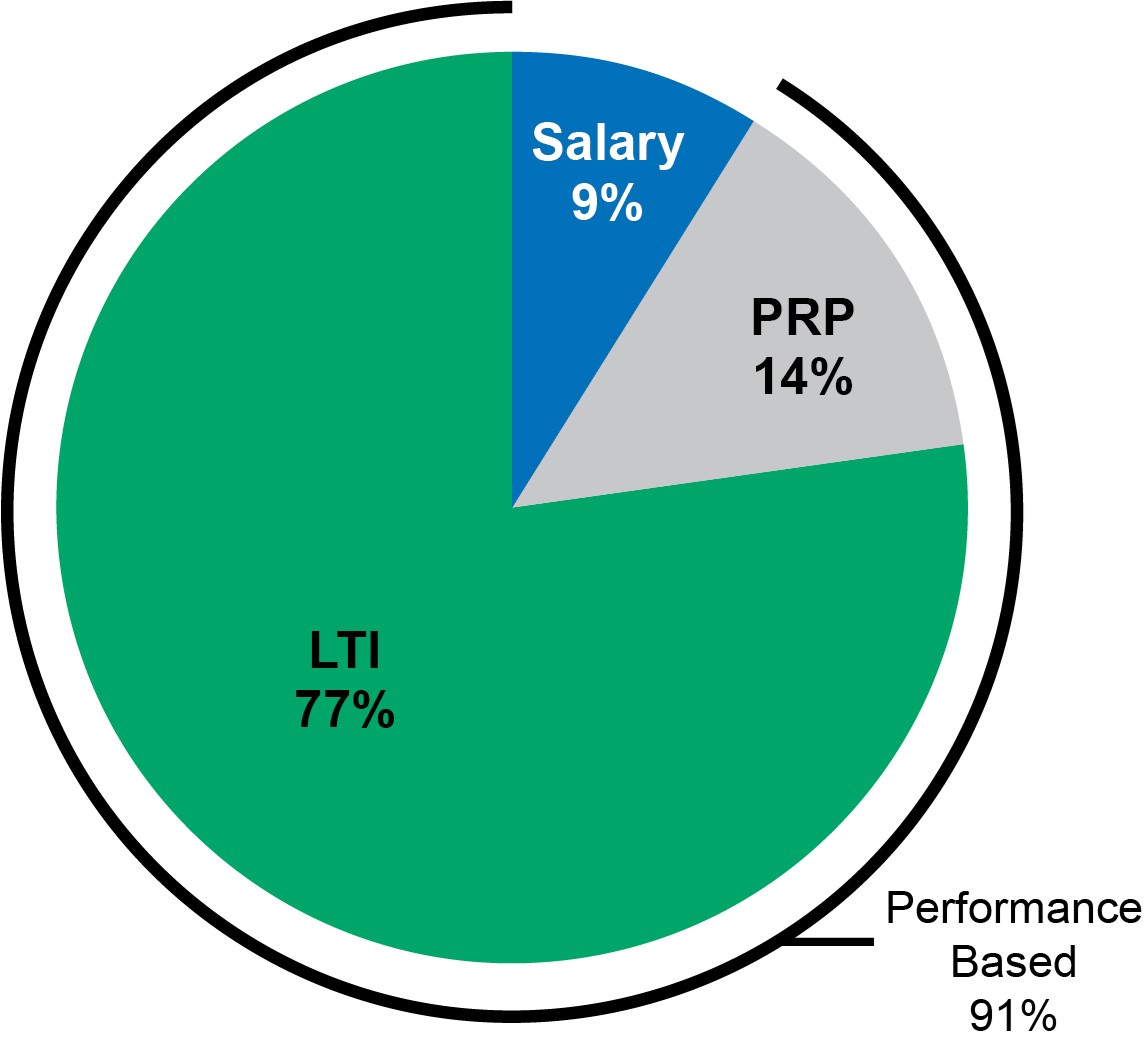
|
|
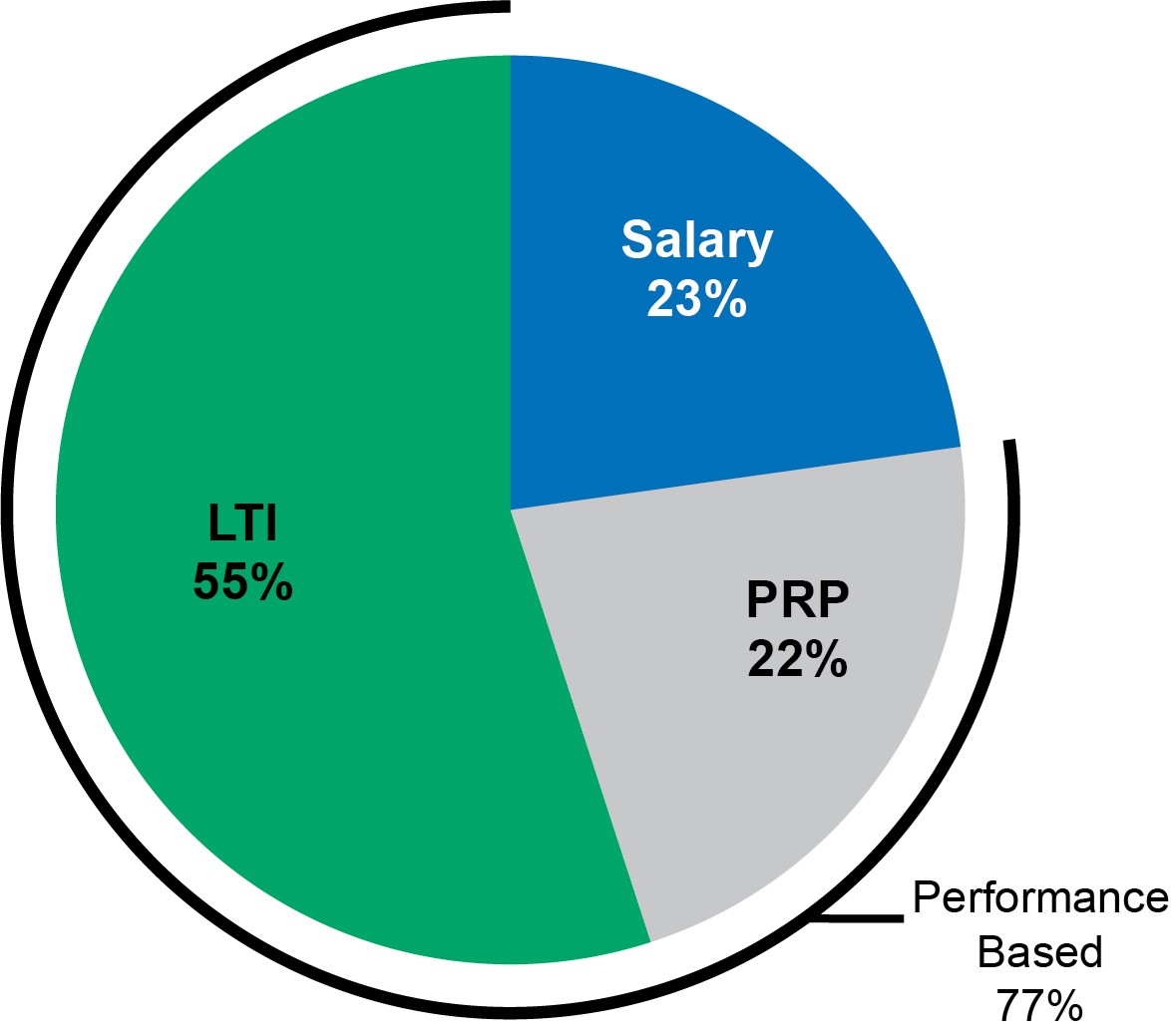
|
•91% of targeted Total Direct Compensation (“TDC”) for the CEO at risk •15% of the at-risk pay is tied to achievement of annual incentive goals,
85% is tied to achievement of financial goals and/or share price over a
multi-year period |
|
•On average 77% of TDC for the other NEOs is at risk •On average 29% of the at-risk pay is tied to achievement of annual
incentive goals, 71% is tied to achievement of financial goals and/or
share price over a multi-year period |
Benefits, Retirement and Other Compensation Components
In addition to the annual and long-term direct compensation programs designed to align pay with performance, Corteva provides our executives with additional compensation elements including: health and welfare, paid time off, and other benefits, retirement plans, and limited perquisites.
|
|
|
|
|
Pay Element |
|
Role in Program/Objectives |
|
How Amounts Are Determined |
Standard health, welfare,
paid time off, and other
benefits provided to
other employees |
|
•Same tax-qualified retirement, medical, dental, vacation benefit, life insurance, and disability plans provided to other employees |
|
Tax-qualified plans are targeted to peer group median in the aggregate |
Non-qualified retirement
and deferred
compensation plans
provided to other
employees |
|
•Nonqualified retirement plans that restore benefits above the Internal Revenue Code (“IRC”) limits for tax-qualified retirement plans as provided to other eligible employees •Nonqualified deferred compensation plan that allows for deferral of base salary, PRP and LTI awards |
|
Nonqualified retirement plans are provided to restore benefits lost due to IRC limits |
Change in Control and
Executive Severance
benefits |
|
•Severance benefits upon a change in control and qualifying termination (double-trigger) provided to ensure continuity of management in a potential change in control environment •A change in control does not automatically entitle an executive to this severance benefit. An executive must lose his/her job within a defined period surrounding the change in control (see Change in Control and Executive Severance Benefits below for more details) •Severance benefits not associated with a change in control provided as a component of overall competitive compensation and benefit employment package at senior executive levels in the organization |
|
Benefits provided are a function of both the termination reason (i.e., whether or not associated with a change in control) and the executive level |
Limited perquisites |
|
•Personal financial counseling (excluding tax preparation) at a cost of $13,000 per NEO •Relocation expenses under a Corteva relocation policy generally applicable to its management employees |
|
Amounts are determined by market rates |
Perquisites
Corteva’s general policy is to limit perquisites and other personal benefits to NEOs. However, these personal benefits may be provided to remain competitive with market practices or when they provide a benefit to Corteva. For perquisites and other personal benefits, the Corteva Committee expects to pay amounts as determined by market practices and rates, or as established by applicable Corteva security policies or benefit programs applicable to all employees or all management-level employees. For additional information on perquisite and other benefit compensation, see the “2025 Summary Compensation Table”.
Change in Control and Executive Severance Benefits
To ensure that executives remain focused on Corteva business during a period of uncertainty that may arise in the case of a potential change in control, and to maintain the competitiveness of its overall executive compensation and benefit offerings, Corteva offers a Change in Control and Executive Severance Plan. Each of the NEOs is a participant in the plan. For any benefits to be earned under the plan in association with a change in control, a change in control must occur and the executive’s employment must be terminated within two years following the change in control event, either by Corteva without cause or by the executive for good reason (often called a “double trigger”). Under the Change in Control and Executive Severance Plan the CEO severance payout factor is 2.99 times target total cash compensation.
The plan requires a release of claims as a condition to the payment of benefits and includes one-year non-competition and non-solicitation provisions and additional non-disparagement and confidentiality provisions. For additional information about benefits under the Change in Control and Executive Severance Plan see the section titled “Executive Compensation—Potential Payments Upon Termination or Change in Control”.
Management of Compensation Risk
The Corteva Committee regularly monitors its compensation programs to assess whether those programs are motivating the desired behaviors while delivering on Corteva’s performance objectives and encouraging appropriate levels of risk-taking. In 2025, the Corteva Committee engaged Cook to perform a risk assessment of its compensation programs. Cook’s review encompassed an assessment of risk pertaining to a broad range of design elements, such as mix of pay, performance metrics, goal-setting and payout curves, and payment timing and adjustments, as well as other mitigating program elements noted below. Cook’s analysis determined, and the Corteva Committee concurred, that Corteva’s compensation programs do not encourage behaviors that would create undue material risk for Corteva.
Payout Limitations or Caps
Payout limitations, or “caps,” play a vital role in risk mitigation, and all metrics in the PRP and PSU programs are capped at 200% to protect against excessive payouts.
Stock Ownership Guidelines
Corteva requires that NEOs accumulate and hold shares of Corteva Common Stock with a value equal to a specified multiple of base pay. These targets are 6, 4, and 3 times base salary for Corteva’s CEO, executive vice presidents, and senior vice presidents, respectively.
Stock ownership guidelines also include a retention ratio requirement. Under the guidelines, until the required ownership is reached, executives are required to retain 75% of net shares acquired upon any future vesting of stock units or exercise of stock options, after deducting shares used to pay applicable withholding taxes and/or exercise price, as applicable.
For purposes of the stock ownership guidelines, the direct ownership of shares and stock units held in employee plans and awards of restricted stock units (“RSUs") awards are included. Stock options and PSUs are not included in determining whether an executive has achieved the ownership levels. NEOs are generally expected to reach these targets in five years of their respective appointment date. Messrs. Magro, Johnson, and O’Connor, Dr. Eathington, and Ms. Grimm have each met their respective ownership guideline.
Vylor is also expected to adopt similar stock ownership guidelines in connection with the spin-off.
Compensation Recovery Policy (Clawback)
Corteva maintains a compensation recovery policy complying with the NYSE Listing Rules and Section 10D and Rule 10D-1 of the Exchange Act. The policy covers each current and former employee of Corteva or an affiliated company who is, or was, the recipient of incentive-based compensation (“Grantee”) awarded following the adoption of the policy, including each of our NEOs.
Under Corteva’s policy, a mandatory clawback applies to its officers subject to Section 16 of the Exchange Act, if Corteva is required to prepare an accounting restatement due to its material noncompliance with any financial reporting requirement under securities law or is required to correct an error in previously issued financial statements that is material to the previously issued financial statements, or that would result in a material misstatement if the error were corrected in the current period or left uncorrected in the current period. Except where impracticable by law, Corteva’s policy requires the reimbursement or forfeiture of any excess incentive-based compensation received by the Grantee over the amount that would have been paid to the Grantee had it been paid on the restated results. In any case, should Corteva demand reimbursement of amounts paid to a Grantee, the Grantee will be required to provide such repayment
within ten (10) business days following such demand. The Corteva Committee in its discretion may also apply such clawback to other current and former senior employees of Corteva.
Also under Corteva’s policy, if a Grantee, subject to the policy, engages in misconduct, then at the discretion of the Corteva Committee:
•He/she may forfeit any right to receive any future awards or other equity-based incentive compensation; and/or
•Corteva may demand repayment of any awards or cash payments already received by a Grantee.
“Misconduct” for purposes of our policy means any of the following:
•The Grantee’s employment or service is terminated for cause;
•There has been a breach of a noncompete or confidentiality covenant set out in any employee agreement or arrangement with Corteva; or
•There has been a willful violation of Corteva’s Code of Conduct or other company policies that causes significant financial or reputational harm to Corteva.
Vylor is also expected to adopt a similar compensation recovery policy in connection with the spin-off.
Prohibition on Hedging and Pledging of Corteva’s Common Stock
Corteva’s insider trading policy includes an “anti-hedging” provision that prohibits directors and executive officers and certain of their related persons (such as certain of their family members and entities they control) from engaging in hedging transactions and short sales with respect to its securities or those of its subsidiaries. Corteva’s insider trading policy also prohibits its directors and executive officers from holding securities of Corteva or its subsidiaries in a margin account and the pledging of any of these securities as collateral for a loan. Corteva’s insider trading policy strongly recommends that other employees not engage in hedging and pledging transactions. Vylor is expected to adopt a similar insider trading policy in connection with the spin-off.
2026 Compensation Decisions
The Corteva Committee reevaluated the design of its incentive programs for 2026 to consider the impacts of the proposed spin-off and to further align its executives' interest with those of its stockholders.
Short-Term Incentive Design
In light of the proposed spin-off, the Corteva Committee simplified Corteva’s PRP program to a single enterprise PRP to continue to drive whole company performance while executing on the proposed spin-off transaction. Additionally, for Corteva’s 2026 enterprise PRP program, the Free Cash Flow metric was eliminated, thereby limiting the enterprise PRP metrics to Operating EBITDA and Operating EBITDA Margin, weighted at 75% and 25%, respectively. While the Corteva Committee believes a cash-related metric will likely be important to both Corteva’s and Vylor’s compensation programs in the future, the Corteva Committee concluded that it was not an appropriate fit for the 2026 short-term incentive program given that the proposed spin-off is expected to occur in the second half of 2026 and that the cash-related metric was most appropriately measured on an annual basis given the seasonal dynamics of its business and industry. Additionally, a number of pending capital allocation decisions related to the proposed spin-off presented challenges to the Corteva Committee’s ability to appropriately set goals for this metric in the first quarter of 2026.
Long-Term Incentive Design
For 2026, the Corteva Committee determined it would eliminate stock options as a component of Corteva’s long-term incentive program and change its equity mix to be 50% each of PSUs and RSUs in 2026. In consideration of the proposed spin-off transaction, the Corteva Committee believed shifting more weight to RSUs would provide further retention of key executives and better align to the long-term interests of stockholders.
Treatment of Outstanding Equity Awards as of the Distribution Date
This section will be populated, in an amendment to the Form 10, to provide information regarding the treatment of outstanding equity awards.
Vylor Equity Incentive Plan
We intend to adopt an equity incentive plan (the “EIP”). The EIP will become effective as of the distribution date, subject to the occurrence of the distribution. This section will be populated, in an amendment to the Form 10, to provide information regarding the terms of the EIP.
Vylor Employee Stock Purchase Plan
We intend to adopt an employee stock purchase plan (the “ESPP”). The ESPP will become effective as of the distribution date, subject to the occurrence of the distribution. This section will be populated, in an amendment to the Form 10, to provide information regarding the terms of the ESPP.
EXECUTIVE COMPENSATION
Summary Compensation Table
The following table summarizes the compensation for the fiscal year ended December 31, 2025 of the individuals Corteva expects will be Vylor’s Chief Executive Officer and Chief Financial Officer, as well as Vylor’s three other most highly compensated executive officers (the “Vylor NEOs”) for the fiscal year ended December 31, 2025, based in each case on compensation received from Corteva. The following information for executive compensation relates to the historical compensation provided by Corteva for the fiscal year ended December 31, 2025, which is required to be included under applicable SEC regulations.
|
|
|
|
|
|
|
|
|
|
|
|
|
|
|
|
|
|
|
|
|
|
|
|
|
|
|
|
|
|
|
|
|
|
|
Name and Principal
Position (a) |
|
Year
(b) |
|
Salary
($)(c)(1) |
|
|
Bonus
($)(d)(2) |
|
|
Stock
Awards
($)(e)(3) |
|
|
Option
Awards
($)(f)(4) |
|
|
Non-equity
Incentive Plan
Compensation
($)(g)(5) |
|
|
Change in
Pension
Value and
Non-Qualified
Deferred
Compensation
Earnings
($)(h)(6) |
|
|
All other
compensation
($)(i)(7) |
|
|
Total
($)(j) |
|
Charles V. Magro |
|
2025 |
|
|
1,405,385 |
|
|
|
— |
|
|
|
9,320,078 |
|
|
|
2,330,023 |
|
|
|
3,990,000 |
|
|
|
— |
|
|
|
453,913 |
|
|
|
17,499,399 |
|
Chief Executive Officer |
|
2024 |
|
|
1,402,308 |
|
|
|
— |
|
|
|
8,800,014 |
|
|
|
2,200,018 |
|
|
|
1,671,600 |
|
|
|
— |
|
|
|
433,119 |
|
|
|
14,507,058 |
|
|
|
2023 |
|
|
1,341,923 |
|
|
|
— |
|
|
|
8,200,042 |
|
|
|
2,050,001 |
|
|
|
1,472,175 |
|
|
|
— |
|
|
|
170,731 |
|
|
|
13,234,872 |
|
David P. Johnson |
|
2025 |
|
|
748,750 |
|
|
|
— |
|
|
|
1,760,016 |
|
|
|
440,009 |
|
|
|
1,425,000 |
|
|
|
— |
|
|
|
104,863 |
|
|
|
4,478,638 |
|
EVP, Chief Financial Officer |
|
2024 |
|
|
214,712 |
|
|
|
450,000 |
|
|
|
4,560,121 |
|
|
|
440,016 |
|
|
|
168,715 |
|
|
|
— |
|
|
|
5,225 |
|
|
|
5,838,788 |
|
Samuel R. Eathington, Ph.D. |
|
2025 |
|
|
694,365 |
|
|
|
— |
|
|
|
1,320,076 |
|
|
|
330,007 |
|
|
|
1,320,500 |
|
|
|
— |
|
|
|
107,992 |
|
|
|
3,772,941 |
|
EVP, Chief Technology |
|
2024 |
|
|
675,962 |
|
|
|
— |
|
|
|
1,200,051 |
|
|
|
300,001 |
|
|
|
537,300 |
|
|
|
— |
|
|
|
141,404 |
|
|
|
2,854,718 |
|
& Digital Officer |
|
2023 |
|
|
645,962 |
|
|
|
— |
|
|
|
1,120,099 |
|
|
|
280,002 |
|
|
|
472,550 |
|
|
|
— |
|
|
|
171,551 |
|
|
|
2,690,163 |
|
Judd M. O’Connor |
|
2025 |
|
|
627,404 |
|
|
|
— |
|
|
|
960,067 |
|
|
|
240,005 |
|
|
|
1,167,500 |
|
|
|
102,736 |
|
|
|
107,507 |
|
|
|
3,205,218 |
|
EVP, Seed Business Unit |
|
|
|
|
|
|
|
|
|
|
|
|
|
|
|
|
|
|
|
|
|
|
|
|
|
|
Audrey R. Grimm |
|
2025 |
|
|
581,462 |
|
|
|
— |
|
|
|
1,040,062 |
|
|
|
260,005 |
|
|
|
944,775 |
|
|
|
— |
|
|
|
101,115 |
|
|
|
2,927,419 |
|
SVP, Chief People Officer |
|
|
|
|
|
|
|
|
|
|
|
|
|
|
|
|
|
|
|
|
|
|
|
|
|
|
(1)The salary amount for Mr. Johnson was prorated for his length of service in 2024.
(2)Amount represents the one-time cash signing bonus for Mr. Johnson to compensate for certain cash incentive compensation from his former employer that would be forfeited, in order to join Corteva.
(3)Amounts represent the aggregate grant date fair value of RSU and PSU awards in the year of grant in accordance with the same standard applied for financial accounting purposes, Financial Accounting Standards Board (“FASB”) Accounting Standards Codification (“ASC”) Topic 718. If valued assuming a maximum payout, the value of the 2025 PSU awards would be: Mr. Magro, $13,980,085; Mr. Johnson, $2,640,024; Dr. Eathington, $1,980,082; Mr. O’Connor, $1,440,036; and Ms. Grimm, $1,560,061. This column does not represent the stock-based compensation expense recognized in Corteva’s financial statements for the respective year end. See “2025 Grants of Plan-Based Awards — Grant Date Fair Value of Stock and Option Awards”.
(4)Amounts represent the aggregate grant date fair value of stock options computed in accordance with FASB ASC Topic 718 in the year of grant. A discussion of the assumptions used in calculating these values can be found in Note 18 to the Corteva Consolidated Financial Statements herein. This column does not represent the stock-based compensation expense recognized in Corteva’s financial statements for the year ended December 31, 2025.
(5)Non-Equity Incentive Plan Compensation is detailed in “Compensation Discussion and Analysis” and reflect income earned for performance achieved in the respective year.
(6)This column reports the estimated change in the actuarial present value of an NEO’s accumulated pension benefits and any above-market earnings on nonqualified deferred compensation balances. Corteva does not credit participants in the nonqualified plans with above-market earnings, therefore, only the change in the pension value is reflected here. Where the overall change in pension value is negative, no value is reported.
(7)Amounts shown in this column include Corteva contributions to both qualified and non-qualified defined contribution plans, as applicable, as well as the value of certain perquisites or other personal benefits. For a detailed discussion of the items and amounts reported in this column, refer to the “Executive Compensation —Narrative Discussion of Summary Compensation Table —All Other Compensation”.
Narrative Discussion of Summary Compensation Table
Salary
Amounts shown in the “Salary” column of the table above represent base salary earned from Corteva during 2025.
Stock Awards
Amounts shown in the “Stock Awards” column of the table above represent the aggregate grant date fair value of Corteva RSUs and PSUs computed in accordance with FASB ASC Topic 718. For PSUs, the aggregate grant date fair value is based upon the probable outcome of the performance conditions. This amount is consistent with the estimate of aggregate compensation cost to be recognized over the service period determined as of the grant date under FASB ASC Topic 718, excluding the effect of estimated forfeitures. See “Executive Compensation—Grants of Plan-Based Awards — Grant Date Fair Value of Stock and Option Awards” for a detailed discussion of the grant date fair value of stock awards.
Option Awards
Amounts shown in the “Option Awards” column of the table above represent the aggregate grant date fair value of stock options computed in accordance with FASB ASC Topic 718. Refer to “Executive Compensation—Grants of Plan-Based Awards — Grant Date Fair Value of Stock and Option Awards” for a detailed discussion of the grant date fair value of option awards.
Non-Equity Incentive Plan Compensation
Amounts shown in this column of the table above represent Corteva cash-based annual incentives under the PRP. Refer to “Compensation Discussion and Analysis ” for a detailed discussion of the calculation of individual results for payouts under the PRP for our NEOs.
Change in Pension Value and Nonqualified Deferred Compensation Earnings
Amounts shown in this column of the table above represent the estimated change in the actuarial present value of accumulated Corteva pension benefits for Mr. O’Connor at retirement at age 65. Key actuarial assumptions for the present value of accumulated benefit calculation can be found in Note 17 (“Pension Plans and Other Post-Employment Benefits”) to the Corteva Consolidated Financial Statements herein. Assumptions are further described in the narrative discussion following the Pension Benefits table.
There were no above-market or preferential earnings during 2025 on Corteva nonqualified deferred compensation. Generally, earnings on nonqualified deferred compensation include returns on investments in seven core investment alternatives, interest accruals on cash balances, Corteva common stock returns, and dividend reinvestments. Interest is accrued on cash balances based on a rate that is traditionally less than 120% of the applicable federal long-term rate, and dividend equivalents are accrued at a non-preferential rate. In addition, the other core investment alternatives are a subset of the investment alternatives available to all employees under the Corteva’s Retirement Savings Plan (“RSP”). Accordingly, these amounts are not considered above-market or preferential earnings for purposes of, and are not included in, the "Summary Compensation Table".
Accordingly, all amounts shown in this column reflect the change in the pension value under the Pension Plan (as defined below). The change in pension value represents the change in the present value from the prior measurement date of an NEO’s accumulated benefit as of the applicable pension measurement date.
All Other Compensation
Amounts shown in the “All Other Compensation” column of the table for 2025 above include Corteva’s perquisites and personal benefits and Corteva’s contributions to both qualified and nonqualified defined contribution plans. These amounts are described in the table below.
|
|
|
|
|
|
|
|
|
|
Name |
|
Perquisites and Other Personal Benefits ($)(a) |
|
|
Registrant Contributions to Qualified Defined Contribution Plans ($)(b) |
|
|
Registrant Contributions to Nonqualified Defined Contribution Plans ($)(c) |
|
Charles V. Magro |
|
183,735 |
|
|
31,350 |
|
|
238,829 |
|
David P. Johnson |
|
78,007 |
|
|
26,856 |
|
|
— |
|
Samuel R. Eathington, Ph.D. |
|
— |
|
|
31,350 |
|
|
76,642 |
|
Judd M. O'Connor |
|
13,000 |
|
|
31,350 |
|
|
63,157 |
|
Audrey R. Grimm |
|
18,000 |
|
|
31,350 |
|
|
51,765 |
|
(a)Amounts for Messrs. Magro and Johnson include the value of the personal use of Corteva’s aircraft in amounts of $183,735 and $2,103, respectively. Mr. Magro under the Company’s security policies is required for his personal safety to use Corteva’s aircraft for both business and personal flights. Corteva allows executives and directors, when accompanying the executive their immediate family members, to use its corporate aircraft for personal use for reasons in order to comply with the Company's securities policies, as well as for Corteva’s preference and convenience. The value of personal aircraft usage reported above is based on the actual direct operating costs for operating the aircraft, including jet fuel, maintenance, crew travel, catering, in-flight wi-fi data usage, and airport related fees. Since the corporate aircraft is used primarily for business travel, the methodology excludes fixed costs which do not change based on usage, such as pilots’ and other employees’ salaries, purchase costs of the aircraft and non-trip-related hangar expenses. Amounts for Mr. Johnson include the value of relocation costs of $75,904 provided to the executive at the Company’s expense to relocate them to Corteva’s headquarters. Corteva’s relocation policies applicable to all management-level employees typically provide reimbursement for, among other items, the costs of identifying a new residence, real estate commissions and certain other costs associated with the sale of the home, and the storage and shipment of belongings. The relocation expenses do not include any home loss buyout for Mr. Johnson. Perquisites for Mr. O'Connor and Ms. Grimm include $13,000 each for financial counseling. Ms. Grimm’s perquisites also include $5,000 for an executive physical.
(b)Amounts represent Corteva’s match to the RSP on the same basis as provided to U.S. parent company employees. For 2025, the RSP provided a Company match of 100% of the first 6% of the employee’s contribution. Amounts also include an additional Company contribution of 3%.
(c)Amounts represent Corteva’s match to the Retirement Savings Restoration Plan (“RSRP”) on the same basis as provided to U.S. parent company employees who fall above the applicable IRC limits. For 2025, the RSRP provided a Company match of 100% of the first 6% of the employee’s eligible contributions. Amounts also include an additional Company contribution of 3% of eligible contributions.
Grants of Plan-Based Awards
The following table provides additional information about plan-based compensation disclosed in the Summary Compensation Table for 2025. This table includes both equity and non-equity awards.
|
|
|
|
|
|
|
|
|
|
|
|
|
|
|
|
|
|
|
|
|
|
|
|
|
|
|
|
|
|
|
|
|
|
|
|
|
|
|
|
|
|
|
|
|
|
|
|
|
|
|
|
|
|
|
|
|
|
|
|
|
|
|
|
|
All Other |
|
|
All Other |
|
|
|
|
|
|
|
|
|
|
|
|
|
|
|
|
|
|
|
|
|
|
|
|
|
|
|
|
|
Stock |
|
|
Option |
|
|
|
|
|
|
|
|
|
|
|
|
|
|
|
|
|
|
|
|
|
|
|
|
|
|
|
|
|
Awards: |
|
|
Awards: |
|
|
Exercise or |
|
|
Grant Date |
|
|
|
|
|
Estimated Future Payouts
Under Non-Equity Incentive
Plan Awards |
|
|
Under Equity Incentive
Estimated Future Payouts
Plan Awards |
|
|
Number of
Shares of
Stock or |
|
|
Number of
Securities
Underlying |
|
|
Base
Price of
Option |
|
|
Fair Value
of Stock
and Option |
|
Name |
|
Grant
Date |
|
Threshold
($) |
|
|
Target
($) |
|
|
Maximum
($) |
|
|
Threshold
(#) |
|
|
Target
(#) |
|
|
Maximum
(#) |
|
|
Units
(#) |
|
|
Options
(#) |
|
|
Awards
($/Sh) |
|
|
Awards
($) |
|
Charles V. Magro |
|
|
|
|
— |
|
|
|
2,100,000 |
|
|
|
4,200,000 |
|
|
|
— |
|
|
|
— |
|
|
|
— |
|
|
|
— |
|
|
|
— |
|
|
|
— |
|
|
|
|
|
|
2/18/2025 |
|
|
— |
|
|
|
— |
|
|
|
— |
|
|
|
— |
|
|
|
108,440 |
|
|
|
216,880 |
|
|
|
— |
|
|
|
— |
|
|
|
— |
|
|
|
6,990,042 |
|
|
|
2/18/2025 |
|
|
— |
|
|
|
— |
|
|
|
— |
|
|
|
— |
|
|
|
— |
|
|
|
— |
|
|
|
36,147 |
|
|
|
— |
|
|
|
— |
|
|
|
2,330,036 |
|
|
|
2/18/2025 |
|
|
— |
|
|
|
— |
|
|
|
— |
|
|
|
— |
|
|
|
— |
|
|
|
— |
|
|
|
— |
|
|
|
97,859 |
|
|
$ |
64.46 |
|
|
|
2,330,023 |
|
David P. Johnson |
|
|
|
|
— |
|
|
|
750,000 |
|
|
|
1,500,000 |
|
|
|
— |
|
|
|
— |
|
|
|
— |
|
|
|
— |
|
|
|
— |
|
|
|
— |
|
|
|
|
|
|
2/18/2025 |
|
|
— |
|
|
|
— |
|
|
|
— |
|
|
|
— |
|
|
|
20,478 |
|
|
|
40,956 |
|
|
|
— |
|
|
|
— |
|
|
|
— |
|
|
|
1,320,012 |
|
|
|
2/18/2025 |
|
|
— |
|
|
|
— |
|
|
|
— |
|
|
|
— |
|
|
|
— |
|
|
|
— |
|
|
|
6,826 |
|
|
|
— |
|
|
|
— |
|
|
|
440,004 |
|
|
|
2/18/2025 |
|
|
— |
|
|
|
— |
|
|
|
— |
|
|
|
— |
|
|
|
— |
|
|
|
— |
|
|
|
— |
|
|
|
18,480 |
|
|
$ |
64.46 |
|
|
|
440,009 |
|
Samuel R. |
|
|
|
|
— |
|
|
|
695,000 |
|
|
|
1,390,000 |
|
|
|
— |
|
|
|
— |
|
|
|
— |
|
|
|
— |
|
|
|
— |
|
|
|
— |
|
|
|
|
Eathington, Ph.D. |
|
2/18/2025 |
|
|
— |
|
|
|
— |
|
|
|
— |
|
|
|
— |
|
|
|
15,359 |
|
|
|
30,718 |
|
|
|
— |
|
|
|
— |
|
|
|
— |
|
|
|
990,041 |
|
|
|
2/18/2025 |
|
|
— |
|
|
|
— |
|
|
|
— |
|
|
|
— |
|
|
|
— |
|
|
|
— |
|
|
|
5,120 |
|
|
|
— |
|
|
|
— |
|
|
|
330,035 |
|
|
|
2/18/2025 |
|
|
— |
|
|
|
— |
|
|
|
— |
|
|
|
— |
|
|
|
— |
|
|
|
— |
|
|
|
— |
|
|
|
13,860 |
|
|
$ |
64.46 |
|
|
|
330,007 |
|
Judd M. O’Connor |
|
|
|
|
— |
|
|
|
625,000 |
|
|
|
1,250,000 |
|
|
|
— |
|
|
|
— |
|
|
|
— |
|
|
|
— |
|
|
|
— |
|
|
|
— |
|
|
|
|
|
|
2/18/2025 |
|
|
— |
|
|
|
— |
|
|
|
— |
|
|
|
— |
|
|
|
11,170 |
|
|
|
22,340 |
|
|
|
— |
|
|
|
— |
|
|
|
— |
|
|
|
720,018 |
|
|
|
2/18/2025 |
|
|
— |
|
|
|
— |
|
|
|
— |
|
|
|
— |
|
|
|
— |
|
|
|
— |
|
|
|
3,724 |
|
|
|
— |
|
|
|
— |
|
|
|
240,049 |
|
|
|
2/18/2025 |
|
|
— |
|
|
|
— |
|
|
|
— |
|
|
|
— |
|
|
|
— |
|
|
|
— |
|
|
|
— |
|
|
|
10,080 |
|
|
$ |
64.46 |
|
|
|
240,005 |
|
Audrey R. Grimm |
|
|
|
|
— |
|
|
|
497,250 |
|
|
|
994,500 |
|
|
|
— |
|
|
|
— |
|
|
|
— |
|
|
|
— |
|
|
|
— |
|
|
|
— |
|
|
|
|
|
|
2/18/2025 |
|
|
— |
|
|
|
— |
|
|
|
— |
|
|
|
— |
|
|
|
12,101 |
|
|
|
24,202 |
|
|
|
— |
|
|
|
— |
|
|
|
— |
|
|
|
780,030 |
|
|
|
2/18/2025 |
|
|
— |
|
|
|
— |
|
|
|
— |
|
|
|
— |
|
|
|
— |
|
|
|
— |
|
|
|
4,034 |
|
|
|
— |
|
|
|
— |
|
|
|
260,032 |
|
|
|
2/18/2025 |
|
|
— |
|
|
|
— |
|
|
|
— |
|
|
|
— |
|
|
|
— |
|
|
|
— |
|
|
|
— |
|
|
|
10,920 |
|
|
$ |
64.46 |
|
|
|
260,005 |
|
Narrative Discussion of Grants of Plan-Based Awards Table
Estimated Future Payouts Under Non-Equity Incentive Plan Awards
Amounts shown in this column of the table above represent PRP award opportunities for 2025 under the OIP. A target PRP award is established for each NEO at the beginning of the relevant fiscal year based on a percentage of the NEO’s base salary. To the extent that the Corteva Committee approves changes to a NEO’s base salary or the PRP target (as a percentage of base salary) during a fiscal year, the PRP is designed such that the base salary and PRP target as a percentage of base salary in effect at the end of the fiscal year are assumed to have been in effect for the entire fiscal year. The Corteva Committee (and, in the case of the Corteva CEO, the Corteva board) approved the PRP targets for its NEOs in February 2025 as shown above. The actual PRP payout for NEOs, which can range from 0% to 200% of target, is based on corporate financial performance and modified for sustainability performance as applicable. Refer to “Compensation Discussion and Analysis” for more details.
Estimated Future Payouts Under Equity Incentive Plan Awards
Amounts shown in this column of the table above represent the potential payout range of Corteva PSUs granted in 2025. Vesting was based upon performance against RONA and Cumulative Operating EPS growth targets applicable to Corteva. At the conclusion of the three-year performance period, the actual award, vested and delivered as Corteva common stock, can range from 0% to 200% of the original grant. Dividend equivalents are applied after the final performance determination only to the extent that the underlying awards vest based upon performance. For a discussion of the impact on Corteva PSUs of any termination, see the section titled “Executive Compensation—Potential Payments Upon Termination or Change in Control.”
Grant Date Fair Value of Stock Options and Stock Awards
Except with respect to PSUs, amounts shown in this column of the table above reflect the grant date fair value of the Corteva equity award computed in accordance with FASB ASC Topic 718. For Corteva PSUs, the grant date fair value is based upon the probable outcome of the performance conditions as of the grant date. This amount is consistent with the estimate of aggregate compensation cost to be recognized over the service period determined as of the grant date under FASB ASC Topic 718, excluding the effect of estimated forfeitures.
Outstanding Equity Awards
The following table lists outstanding equity grants for each Vylor NEO as of December 31, 2025, including outstanding equity grants made in previous years.
|
|
|
|
|
|
|
|
|
|
|
|
|
|
|
|
|
|
|
|
|
|
|
|
|
|
|
|
|
|
|
|
|
|
|
|
|
Option Awards |
|
Stock Awards |
|
Name |
|
Grant
Date |
|
Number of
Securities
Underlying
Unexercised
Options (#)
Exercisable(a) |
|
|
Number of
Securities
Underlying
Unexercised
Options (#)
Unexercisable(a) |
|
|
Option
Exercise
Price
($) |
|
|
Option
Expiration
Date |
|
Number of
Shares or
Units of
Stock That
Have Not
Vested (#)(b) |
|
|
Market
Value of
Shares or
Units of
Stock That
Have Not
Vested ($)(b)(c) |
|
|
Equity
Incentive
Plan Awards:
Number of
Unearned
Shares, Units
or Other
Rights That
Have Not
Vested (#)(d) |
|
|
Equity
Incentive
Plan Awards:
Market or
Payout Value
of Unearned
Shares, Units
or Other
Rights That
Have Not
Vested ($)(c)(d) |
|
Charles V. Magro |
|
2/18/2022 |
|
|
129,311 |
|
|
|
— |
|
|
|
50.70 |
|
|
2/18/2032 |
|
|
— |
|
|
|
— |
|
|
|
— |
|
|
|
— |
|
|
|
2/28/2023 |
|
|
63,803 |
|
|
|
31,902 |
|
|
|
62.29 |
|
|
2/28/2033 |
|
|
11,349 |
|
|
|
760,706 |
|
|
|
— |
|
|
|
— |
|
|
|
2/20/2024 |
|
|
38,986 |
|
|
|
77,974 |
|
|
|
54.36 |
|
|
2/20/2034 |
|
|
27,586 |
|
|
|
1,849,073 |
|
|
|
121,413 |
|
|
|
8,138,313 |
|
|
|
2/18/2025 |
|
|
— |
|
|
|
97,859 |
|
|
|
64.46 |
|
|
2/18/2035 |
|
|
36,523 |
|
|
|
2,448,116 |
|
|
|
108,440 |
|
|
|
7,268,733 |
|
David P. Johnson |
|
9/16/2024 |
|
|
7,868 |
|
|
|
15,738 |
|
|
|
56.27 |
|
|
9/16/2034 |
|
|
38,898 |
|
|
|
2,607,332 |
|
|
|
23,459 |
|
|
|
1,572,457 |
|
|
|
2/18/2025 |
|
|
— |
|
|
|
18,480 |
|
|
|
64.46 |
|
|
2/18/2035 |
|
|
6,897 |
|
|
|
462,302 |
|
|
|
20,478 |
|
|
|
1,372,640 |
|
Samuel R. Eathington, Ph.D. |
|
2/26/2021 |
|
|
24,829 |
|
|
|
— |
|
|
|
45.15 |
|
|
2/25/2031 |
|
|
— |
|
|
|
— |
|
|
|
— |
|
|
|
— |
|
|
|
2/18/2022 |
|
|
18,679 |
|
|
|
— |
|
|
|
50.70 |
|
|
2/18/2032 |
|
|
— |
|
|
|
— |
|
|
|
— |
|
|
|
— |
|
|
|
2/28/2023 |
|
|
8,714 |
|
|
|
4,358 |
|
|
|
62.29 |
|
|
2/28/2033 |
|
|
1,551 |
|
|
|
103,960 |
|
|
|
— |
|
|
|
— |
|
|
|
2/20/2024 |
|
|
5,316 |
|
|
|
10,633 |
|
|
|
54.36 |
|
|
2/20/2034 |
|
|
3,763 |
|
|
|
252,214 |
|
|
|
16,557 |
|
|
|
1,109,816 |
|
|
|
2/18/2025 |
|
|
— |
|
|
|
13,860 |
|
|
|
64.46 |
|
|
2/18/2035 |
|
|
5,173 |
|
|
|
346,761 |
|
|
|
15,359 |
|
|
|
1,029,514 |
|
Judd M. O’Connor |
|
2/26/2021 |
|
|
20,548 |
|
|
|
— |
|
|
|
45.15 |
|
|
2/25/2031 |
|
|
— |
|
|
|
— |
|
|
|
— |
|
|
|
— |
|
|
|
2/18/2022 |
|
|
8,621 |
|
|
|
— |
|
|
|
50.70 |
|
|
2/18/2032 |
|
|
— |
|
|
|
— |
|
|
|
— |
|
|
|
— |
|
|
|
2/28/2023 |
|
|
3,735 |
|
|
|
1,868 |
|
|
|
62.29 |
|
|
2/28/2033 |
|
|
665 |
|
|
|
44,564 |
|
|
|
— |
|
|
|
— |
|
|
|
2/20/2024 |
|
|
2,481 |
|
|
|
4,962 |
|
|
|
54.36 |
|
|
2/20/2034 |
|
|
1,756 |
|
|
|
117,709 |
|
|
|
7,727 |
|
|
|
517,941 |
|
|
|
2/18/2025 |
|
|
— |
|
|
|
10,080 |
|
|
|
64.46 |
|
|
2/18/2035 |
|
|
3,763 |
|
|
|
252,214 |
|
|
|
11,170 |
|
|
|
748,725 |
|
Audrey R. Grimm |
|
2/15/2018 |
|
|
666 |
|
|
|
— |
|
|
|
41.94 |
|
|
2/15/2028 |
|
|
— |
|
|
|
— |
|
|
|
— |
|
|
|
— |
|
|
|
2/18/2022 |
|
|
1,437 |
|
|
|
— |
|
|
|
50.70 |
|
|
2/18/2032 |
|
|
— |
|
|
|
— |
|
|
|
— |
|
|
|
— |
|
|
|
4/4/2022 |
|
|
5,754 |
|
|
|
— |
|
|
|
58.67 |
|
|
4/4/2032 |
|
|
— |
|
|
|
— |
|
|
|
— |
|
|
|
— |
|
|
|
2/28/2023 |
|
|
5,446 |
|
|
|
2,724 |
|
|
|
62.29 |
|
|
2/28/2033 |
|
|
969 |
|
|
|
64,950 |
|
|
|
— |
|
|
|
— |
|
|
|
2/20/2024 |
|
|
3,721 |
|
|
|
7,444 |
|
|
|
54.36 |
|
|
2/20/2034 |
|
|
2,633 |
|
|
|
176,496 |
|
|
|
11,590 |
|
|
|
776,878 |
|
|
|
2/18/2025 |
|
|
— |
|
|
|
10,920 |
|
|
|
64.46 |
|
|
2/18/2035 |
|
|
4,076 |
|
|
|
273,209 |
|
|
|
12,101 |
|
|
|
811,130 |
|
(a)Stock option awards vest in three equal installments on the first, second and third anniversaries of the grant date.
(b)RSUs granted under the OIP generally vest in three equal installments on the first, second and third anniversaries of the grant date shown in the table.
(c)Market values based on the December 31, 2025, closing stock price of $67.03 per share of Corteva common stock.
(d)These PSUs reflect the number of shares deliverable at target performance. The actual number of shares to be delivered will be determined at the end of the respective performance period (December 31, 2026 or December 31, 2027, respectively).
Option Exercises and Stock Vested
The following table summarizes the value received from stock option exercises and stock grants vested during 2025. All shares reported are Corteva shares.
|
|
|
|
|
|
|
|
|
|
|
|
|
|
|
|
|
|
|
Option Awards |
|
|
Stock Awards |
|
Name |
|
Number of
Shares
Acquired
on Exercise
(#) |
|
|
Value
Realized
Upon
Exercise
($) |
|
|
Number of
Shares
Acquired on
Vesting
(#) |
|
|
Value
Realized
Upon
Vesting
($) |
|
Charles V. Magro |
|
|
— |
|
|
|
— |
|
|
|
95,642 |
|
|
|
6,639,642 |
|
David P. Johnson |
|
|
— |
|
|
|
— |
|
|
|
19,396 |
|
|
|
1,355,410 |
|
Samuel R. Eathington, Ph.D. |
|
|
— |
|
|
|
— |
|
|
|
13,156 |
|
|
|
912,828 |
|
Judd M. O’Connor |
|
|
— |
|
|
|
— |
|
|
|
5,768 |
|
|
|
399,526 |
|
Audrey R. Grimm |
|
|
— |
|
|
|
— |
|
|
|
8,121 |
|
|
|
558,774 |
|
Pension Benefits
The following table lists the pension program participation and actuarial present value of the defined benefit pension provided by Corteva as of December 31, 2025 for Mr. O’Connor, who is the only NEO eligible and participating in its defined benefit pension plans.
|
|
|
|
|
|
|
|
|
|
|
Name |
|
Plan Name |
|
Number of
Years Credited
Service
(#) |
|
|
Present Value
of Accumulated
Benefit
($) |
|
Judd M. O’Connor |
|
Pension and Retirement Plan |
|
|
20.0 |
|
|
|
457,609 |
|
|
|
Pioneer Hi-Bred International, Inc. GAP Retirement Plan |
|
|
20.0 |
|
|
|
520,772 |
|
Narrative Discussion of Pension Benefits
The Pension and Retirement Plan
Mr. O’Connor participates in the Pension and Retirement Plan (the “Pension Plan”), a Corteva tax-qualified defined benefit pension plan that generally covers a majority of those of Corteva's U.S. employees who were employees of historical DuPont prior to its separation from DowDuPont, Inc., except those hired or rehired by historical DuPont after December 31, 2006. The Pension Plan currently provides employees with a lifetime retirement income based on years of service and the employees’ final average pay near retirement. On November 30, 2018 (the “Effective Date”), Corteva froze the pay and service amounts used to calculate pension benefits for then-active employees who were participants in the Pension Plan.
The normal form of benefit for married individuals is a 50% qualified joint and survivor annuity. The normal form of benefit for unmarried individuals is a single life annuity, which is actuarially equivalent to the normal form for married individuals. Normal retirement age under the Pension Plan is generally age 65, and benefits are vested after five years of service.
Mr. O’Connor participates in Title IV of the Pension Plan. Under the provisions of Title IV of the Pension Plan, employees are eligible for unreduced pensions when they reach normal retirement age of age 65 or older with at least five years of service. An employee who is not eligible for retirement with an unreduced pension is eligible for retirement with a reduced pension if he or she is at least age 55 with at least five years of service. For participants with less than 30 years of service at retirement, the pension is reduced by 1/180 for each of the first 60 months prior to normal retirement age and reduced by 1/360 for each of the next 60 months that precede normal retirement age. For participants with 30 or more years of service at retirement, the pension is reduced by 1/400 for each month prior to normal retirement age. Title IV of the Pension Plan closed to new participants on January 1, 2012.
The primary pension formula under Title IV of the Pension Plan provides a monthly retirement benefit equal to:
|
|
|
|
|
|
|
|
|
|
|
|
|
|
|
|
|
|
|
|
|
|
|
|
|
|
|
|
|
|
|
|
|
|
|
|
|
|
|
|
|
|
|
|
|
|
|
|
|
|
|
|
|
|
|
|
|
|
|
|
|
|
( |
|
1.10% of Final
Average Earnings up
to Integration Level |
|
+ |
|
1.47% of Final Average
Earnings in excess of
Integration Level |
|
) |
|
× |
|
Years of Credited
Service Projected to
Normal Retirement
Date, up to 35 years |
|
|
|
× |
|
|
|
Years of Credited
Service Through
12/31/2011 |
|
|
|
|
|
|
|
|
|
|
+ |
|
|
|
|
|
|
|
|
|
|
|
÷ |
|
|
|
|
|
|
1.00% of Final Average Earnings |
|
|
|
× |
|
Years of Credited
Service Projected to
Normal Retirement
Date, in excess of 35
years, if any |
|
|
|
Total Years of
Credited Service at
Normal Retirement
Date |
|
|
|
|
|
|
|
|
|
|
|
|
|
|
|
|
|
|
|
|
|
|
|
|
|
|
|
|
|
|
|
|
|
|
|
PLUS |
|
|
|
|
|
|
|
|
|
|
|
|
|
|
|
|
|
|
|
|
|
|
|
|
|
|
|
|
|
|
|
|
|
|
|
|
|
|
|
( |
|
0.55% of Final
Average Earnings up
to Integration Level |
|
+ |
|
0.735% of Final
Average Earnings in
excess of Integration
Level |
|
) |
|
× |
|
Years of Credited
Service Projected to
Normal Retirement
Date, up to 35 years |
|
|
|
× |
|
|
|
Years of Credited
Service From
01/01/2012 Through
the Effective Date |
|
|
|
|
|
|
|
|
|
|
+ |
|
|
|
|
|
|
|
|
|
|
|
÷ |
|
|
|
|
|
|
0.50% of Final Average Earnings |
|
|
|
× |
|
Years of Credited
Service Projected to
Normal Retirement
Date, in excess of 35
years, if any |
|
|
|
Total Years of
Credited Service at
Normal Retirement
Date |
|
|
|
|
|
|
|
|
|
|
|
|
|
|
|
|
|
|
|
|
|
|
|
|
|
|
|
|
|
|
|
Final Average Earnings are based on the employee’s 60 highest consecutive months of earnings out of the last 120 months prior to the earlier of termination of employment or the Effective Date. Compensation includes regular compensation plus the PRP award. Integration Level is in accordance with IRC guidance but in no event will it increase after the Effective Date.
For the purpose of unreduced pension, employees’ age, and service post-Effective Date until termination of employment, will be counted in determining the retirement eligibility. Mr. O’Connor is eligible for a reduced pension.
The Pioneer Hi-Bred International Inc. GAP Retirement Plan
If benefits provided under the Pension Plan exceed the applicable IRC compensation or benefit limits, the excess benefit for Title IV of the Pension Plan is paid under the Pioneer Hi-Bred International Inc. GAP Retirement Plan (the “Pioneer GAP Plan”), an unfunded non-qualified plan. The form of benefit under the Pioneer GAP Plan for Mr. O’Connor would be a single life annuity. The mortality tables and interest rates used to determine lump sum payments are the Applicable Mortality Table and the Applicable Interest Rate prescribed by the Secretary of the Treasury in IRC Section 417(e)(3).
The company does not grant any extra years of credited service for pension benefit purposes. Key actuarial assumptions for the present value of accumulated benefit calculation can be found in Note 17 (“Pension Plans and Other Post-Employment Benefits”) to the Corteva Consolidated Financial Statements herein. All other assumptions are consistent with those used in Note 17, except that the present value of accumulated benefit uses a retirement age at which the NEO may retire with an unreduced benefit under the Pension Plan. The valuation method used for determining the present value of the accumulated benefit is the traditional unit credit cost method.
Non-qualified Deferred Compensation
The following table provides information on nonqualified deferred compensation of the NEOs during 2025.
|
|
|
|
|
|
|
|
|
|
|
|
|
|
|
|
|
|
|
|
|
Name |
|
Executive
Contributions
in Last Fiscal
Year
($)(1) |
|
|
Company
Contributions
in Last Fiscal
Year
($)(2) |
|
|
Aggregate
Earnings in
Last Fiscal
Year
($) |
|
|
Aggregate
Withdrawals /
Distributions
($) |
|
|
Aggregate
Balance at
Last Fiscal
Year-End
($) |
|
Charles V. Magro |
|
|
163,296 |
|
|
|
238,829 |
|
|
|
75,488 |
|
|
|
— |
|
|
|
1,102,880 |
|
David P. Johnson |
|
|
— |
|
|
|
— |
|
|
|
— |
|
|
|
— |
|
|
|
— |
|
Samuel R. Eathington, Ph.D. |
|
|
229,283 |
|
|
|
76,642 |
|
|
|
157,135 |
|
|
|
— |
|
|
|
1,430,039 |
|
Judd M. O’Connor |
|
|
44,790 |
|
|
|
63,157 |
|
|
|
200,407 |
|
|
|
— |
|
|
|
1,556,186 |
|
Audrey R. Grimm |
|
|
36,024 |
|
|
|
51,765 |
|
|
|
32,897 |
|
|
|
— |
|
|
|
285,862 |
|
(1)Executive contributions are included in salary for 2025 in the Summary Compensation Table.
(2)Corteva’s contributions for 2025 are included in All Other Compensation column of the Summary Compensation Table.
Narrative Discussion of the Nonqualified Deferred Compensation Table
Corteva offers two nonqualified deferred compensation programs under which participants may voluntarily elect to defer some portion of base salary, PRP, or LTI awards until a future date. Deferrals are credited to an account and earnings are calculated thereon in accordance with the applicable investment option or interest rate. With the exception of the Retirement Savings Restoration Plan (“RSRP”), there are no Corteva contributions or matches. The RSRP was adopted to restore Corteva contributions for certain U.S. employees that would be lost due to IRC limits on compensation under Corteva’s tax-qualified savings plan.
The following provides an overview of the various deferral options Corteva provided as of December 31, 2025.
RSRP
Under the RSRP, eligible employees can elect to defer eligible compensation (generally, base salary plus PRP) that exceeds the regulatory limits ($350,000 in 2025) in increments of 1% up to 6%. Corteva matches participant contributions on a dollar-for-dollar basis up to 6% of eligible pay. Corteva also makes an additional contribution of 3% of eligible compensation to participants in the RSRP as of December 31. The additional 3% contribution is made during the first quarter of the following calendar year. Participant investment options under the RSRP mirror the options available under the qualified plan. Distributions may be made in the form of a lump sum or annual installments after separation from service.
Management Deferred Compensation Program (“MDCP”)
Under the MDCP, a NEO can elect to defer the receipt of up to 60% of his base salary and/or PRP award. Corteva does not match deferrals under the MDCP. Participants may select from among seven core investment options under the MDCP, including Corteva common stock units with dividend equivalents credited as additional stock units. In general, distributions may be made in the form of a lump sum at a specified future date prior to separation from service or a lump sum or annual installments after separation from service.
In addition, under the MDCP, a NEO can elect to defer the receipt of 100% of his LTI awards (RSUs and/or PSUs). Corteva does not match LTI deferrals under the MDCP. LTI deferrals under the MDCP are in the form of Corteva common stock units with dividend equivalents credited as additional stock units.
Potential Payments Upon Termination or Change in Control
As described in the Compensation Discussion and Analysis, Corteva maintains a Change in Control and Executive Severance Plan. For a description of the plan, see the section titled “Compensation Discussion and Analysis — Components of Our Executive Compensation Program — Change in Control and Executive Severance Benefits.”
Benefits provided under the plan are highlighted in the table below.
|
|
|
|
|
Benefit Element |
|
Qualifying Termination Associated with a Change in Control |
|
Qualifying Termination NOT Associated with a Change in Control |
Severance benefit |
|
Lump sum cash payment equal to two times (2.99 times for the CEO) the sum of the executive’s base salary and target annual PRP award |
|
Lump sum cash payment equal to one and one-half times (two times for the CEO) the sum of the executive’s base salary and target annual PRP award |
PRP in year of termination |
|
Lump sum cash payment equal to the pro-rated portion of the executive’s target annual PRP award |
|
Lump sum cash payment equal to the pro-rated portion of the executive’s target annual PRP award |
Benefit continuation |
|
Continued health and welfare benefits, financial counseling (as applicable) and outplacement services for two years (2.99 years for the CEO) |
|
Continued health and welfare benefits and outplacement services for one and one-half years (two years for the CEO) |
Equity award treatment |
|
Acceleration of all unvested equity awards, with unexercised stock options remaining exercisable for their full term |
|
Treatment of awards subject to terms and conditions of each specific grant |
Potential payments under the plan are reflected in the table below. The table also includes potential payments under the OIP. The treatment of benefits under each plan on termination or change in control is detailed in the footnotes to the table.
The following information does not quantify payments under plans that are generally available to all salaried employees, similarly situated to the NEOs, including in age, years of service, date of hire, and that do not discriminate in scope, terms, or operation in favor of executive officers. For example, all participating employees who terminated on December 31, 2025, are entitled to receive any PRP awards for the 2025 performance year. See also the Pension Benefits and Nonqualified Deferred Compensation tables and accompanying narrative discussions for benefits or balances, as the case may be, under those plans as of December 31, 2025.
Due to the number of factors that affect the nature and amount of any benefits provided upon the events discussed below, any actual amounts paid or distributed may be different. Factors that could affect those amounts include the timing during the year of any such event, Corteva’s stock price and the executive’s age.
If an individual engages in misconduct, Corteva may demand that he/she repay any long-term or short-term incentive award, or cash payments received as a result of such an award, within 10 days following written demand by Corteva. See the section titled “Compensation Discussion and Analysis — How We Manage Compensation Risk — Compensation Recovery Policy (Clawback)” for further discussion.
For the CEO and other NEOs, the benefits that would become payable upon termination of employment, death, disability, or change in control as of December 31, 2025, are outlined below. The value of Corteva long-term incentives that would accelerate or otherwise continue to vest as a result of the executive’s termination is based in part in reference to Corteva’s closing stock price of $67.03 on December 31, 2025, as reported on the NYSE.
|
|
|
|
|
|
|
|
|
|
|
|
|
|
|
|
|
|
|
Name |
|
Benefit |
|
Termination
without Cause
or for Good
Reason 24
months following
a Change in
Control
($) |
|
|
Other
Termination
without Cause
of for
Good Reason
($)(1) |
|
|
Death or
Disability
($) |
|
|
Voluntary
Separation
($)(2) |
|
Charles V. Magro |
|
Severance(3) |
|
|
10,465,000 |
|
|
|
7,000,000 |
|
|
|
— |
|
|
|
— |
|
|
|
LTI Acceleration / Vesting(4) |
|
|
21,855,585 |
|
|
|
11,078,769 |
|
|
|
14,296,992 |
|
|
|
— |
|
|
|
Health & Welfare Benefits(5) |
|
|
88,761 |
|
|
|
59,274 |
|
|
|
— |
|
|
|
— |
|
|
|
Outplacement & Financial Planning(6) |
|
|
9,900 |
|
|
|
9,900 |
|
|
|
— |
|
|
|
— |
|
David P. Johnson |
|
Severance(3) |
|
|
3,000,000 |
|
|
|
2,250,000 |
|
|
|
— |
|
|
|
— |
|
|
|
LTI Acceleration / Vesting(4) |
|
|
6,231,566 |
|
|
|
3,064,117 |
|
|
|
4,792,320 |
|
|
|
— |
|
|
|
Health & Welfare Benefits(5) |
|
|
38,531 |
|
|
|
29,573 |
|
|
|
— |
|
|
|
— |
|
|
|
Outplacement & Financial Planning(6) |
|
|
9,900 |
|
|
|
9,900 |
|
|
|
— |
|
|
|
— |
|
Samuel R. |
|
Severance(3) |
|
|
2,780,000 |
|
|
|
2,085,000 |
|
|
|
— |
|
|
|
— |
|
Eathington, Ph.D. |
|
LTI Acceleration / Vesting(4) |
|
|
3,033,262 |
|
|
|
1,528,531 |
|
|
|
1,976,981 |
|
|
|
— |
|
|
|
Health & Welfare Benefits(5) |
|
|
13,176 |
|
|
|
9,684 |
|
|
|
— |
|
|
|
— |
|
|
|
Outplacement & Financial Planning(6) |
|
|
9,900 |
|
|
|
9,900 |
|
|
|
— |
|
|
|
— |
|
Judd M. O’Connor |
|
Severance(3) |
|
|
2,500,000 |
|
|
|
1,875,000 |
|
|
|
— |
|
|
|
— |
|
|
|
LTI Acceleration / Vesting(4) |
|
|
1,778,782 |
|
|
|
831,249 |
|
|
|
1,106,985 |
|
|
|
831,249 |
|
|
|
Health & Welfare Benefits(5) |
|
|
57,792 |
|
|
|
44,019 |
|
|
|
— |
|
|
|
— |
|
|
|
Outplacement & Financial Planning(6) |
|
|
35,900 |
|
|
|
29,400 |
|
|
|
— |
|
|
|
— |
|
Audrey R. Grimm |
|
Severance(3) |
|
|
2,164,500 |
|
|
|
1,623,375 |
|
|
|
— |
|
|
|
— |
|
|
|
LTI Acceleration / Vesting(4) |
|
|
2,237,954 |
|
|
|
1,101,707 |
|
|
|
1,438,242 |
|
|
|
— |
|
|
|
Health & Welfare Benefits(5) |
|
|
79,274 |
|
|
|
55,131 |
|
|
|
— |
|
|
|
— |
|
|
|
Outplacement & Financial Planning(6) |
|
|
35,900 |
|
|
|
29,400 |
|
|
|
— |
|
|
|
— |
|
(1)Generally represents Corteva-initiated terminations not associated with a Change in Control, but in certain cases may also be applicable to terminations associated with a mutually-agreed retirement.
(2)Per the provisions of Corteva’s OIP and of the terms and conditions of awards granted under the OIP, employees who voluntarily terminate their employment with Corteva after having reached age 55, and who have a minimum of 10 years of service with Corteva, are eligible to continue to vest in all or a portion of the outstanding equity awards they hold at the time of their separation.
(3)Per the provisions of Corteva’s Change in Control and Executive Severance Plan, amounts represent a lump sum payment equal to two times (or, in the case of the CEO, 2.99 times) the sum of an executive’s base salary plus target bonus in the case of a termination with respect to a Change in Control, or one and one-half times (two times, in the case of the CEO) the sum of the base salary plus target bonus in the case of a termination not with respect to a Change in Control. In each case, the plan also calls for a lump sum payment equal to the prorated portion of the executive’s target bonus in the year of termination (prorated for the number of months of service rendered during the year). However, because Corteva’s PRP provides for the payment of any bonus earned by an eligible employee who is an active employee through the last day of the fiscal year, and because the table above assumes the termination of employment occurs on such date, the amount due under the Change in Control and Executive Severance Plan with respect to a prorated bonus in year of termination is not incremental to the PRP, and as such is not included in the amounts above.
(4)In the case of termination with respect to a Change in Control, amounts include the value of all outstanding and unvested stock options, outstanding RSUs and outstanding and unearned PSUs, all of which immediately accelerate and become vested upon termination, with performance for the unearned PSUs deemed achieved at target performance levels. In the case of a termination without Cause or for Good Reason, amounts represent the value of those outstanding and unvested stock options which are scheduled to vest within 12 months of the assumed termination (and which would continue to vest during that period under the terms of the awards), as well as the value of all outstanding RSUs and of a prorated portion of outstanding PSUs, which would be earned at the end of the applicable performance period to the extent that performance metrics are achieved at a minimum of threshold performance levels. In the case of a termination related to Death or Disability, the amounts represent the value of all outstanding and unvested stock options and RSUs, as well as a prorated portion of unearned PSUs. In the case of a Voluntary Separation of employment, the amounts represent the value of those outstanding and unvested stock options which are scheduled to vest within 12 months of the assumed termination (and which would continue to vest during that period under the terms of the awards), the value of all outstanding RSUs and a prorated portion of PSUs. For purposes of the table above, performance of the prorated PSUs is assumed at target.
(5)Amounts represent the cost to Corteva of health and welfare benefits under the Consolidated Omnibus Budget Reconciliation Act (COBRA), the amount of which is payable to the executive for a period of months equal to the length of time implied by the severance multiple. Amount also includes the estimated cost of participating in the diagnostic executive physical program, but only to the extent that the executive was actively participating in the program at the time of their termination.
(6)Represents the cost of outplacement services, as applicable, provided to executives during the period equal to the length of time implied by the severance multiple, in addition to the annual cost of financial counseling services over the same period, but only to the extent that the executive was actively participating in the financial counseling program at the time of their termination.
CERTAIN RELATIONSHIPS AND RELATED PERSON TRANSACTIONS
Agreements with New Corteva
In connection with the spin-off, we will enter into certain agreements that will effect the separation, provide for the allocation of Corteva’s assets, employees, liabilities and obligations (including its investments, property and employee benefits and tax-related assets and liabilities) among us and New Corteva, and provide a framework for our relationship with New Corteva following the spin-off. For a summary of the terms of certain of the agreements that we will enter into with New Corteva prior to the spin-off, see the section entitled “Our Relationship with New Corteva.”
Review and Approval of Transactions with Related Persons
Our board of directors will adopt written policies and procedures relating to the approval or ratification of “Related Person Transactions.”
Under such policies and procedures, the Governance and Compliance Committee will review the relevant facts of all reported transactions involving Corteva that may qualify as a Related Person Transactions to determine whether the transaction is a Related Person Transaction. If such committee determines that the transaction is a Related Party Transaction, it will either approve, disapprove or ratify the Related Person Transaction, by taking into account, among other factors it deems appropriate: (i) the commercial reasonableness of the transaction; (ii) the materiality of the Related Person’s direct or indirect interest in the transaction; (iii) whether the transaction may involve an actual conflict of interest or the appearance thereof; (iv) whether the transaction was in the ordinary course of business; (v) the availability to us of other sources of comparable products and services; and (vi) for independent directors, the impact of the transaction on the Related Person’s independence under the Corporate Governance Guidelines and applicable rules of the NYSE.
No director will participate in any discussion or approval of a Related Person Transaction for which such director or any of such director’s immediate family members is a Related Person, except that the director will provide material information concerning the Related Person Transaction to the committee reviewing the Related Party Transaction. Related Person Transactions will be approved or ratified only if they are determined in good faith to be in the best interests of us and our stockholders.
If a Related Person Transaction that has not been previously approved or previously ratified is discovered, then the Related Person Transaction will be presented for review to the Governance and Compliance Committee. If such Related Person Transaction is not ratified by the reviewing committee, then we will make all appropriate disclosures regarding the transaction, and, if appropriate, take all reasonable actions to attempt to terminate our participation in such transaction.
Under such policies and procedures, a “Related Person Transaction” will be any financial transaction, arrangement or relationship (including any indebtedness or guarantee of indebtedness), or any series of similar transactions, arrangements or relationships, in which (i) the aggregate amount involved will or may be expected to exceed $100,000 in any calendar year, (ii) we are a participant, and (iii) any Related Person has or will have a direct or indirect material interest (other than solely as a result of being a director or trustee or a less than 10% beneficial owner of another entity). This also includes any material amendment or modification to an existing Related Party Transaction.
In addition, under such policies and procedures, a “Related Person” will be any (i) person who is or was (since the beginning of our last fiscal year for which we have filed a Form 10-K and proxy statement, even if they do not presently serve in that role) an executive officer, director or nominee for election as a director of Corteva, (ii) person who is a greater than 5% beneficial owner of our outstanding common stock or (iii) immediate family member of any of the foregoing.
The Governance and Compliance Committee will be charged with reviewing issues involving independence and all Related Person Transactions. If Vylor and its subsidiaries purchase products and services from and/or sell products and services to companies of which certain of our directors or executive officers, or their immediate family members, are employees, the Governance and Compliance Committee will review such transactions and relationships and make a determination as to the materiality of such transactions.
Restrictions on Certain Types of Transactions
We expect to adopt an insider trading policy that, among other things, prohibits directors and certain officers from engaging in the following types of transactions with respect to our stock: short-term trading; short sales; hedging transactions; margin accounts and pledging securities. This policy will also strongly recommend that all other insiders refrain from entering into these types of transactions as well as engaging in transactions with puts, calls, options, and other derivative instruments related to our securities.
SECURITY OWNERSHIP OF CERTAIN BENEFICIAL OWNERS AND MANAGEMENT
Before the distribution, all the outstanding shares of Vylor common stock will be owned beneficially and of record by Corteva. The following table sets forth information with respect to the expected beneficial ownership of Vylor common stock by: (1) each person who is expected to beneficially own more than five percent of Vylor common stock, (2) each expected director, director nominee and NEOs and (3) all our expected directors, director nominees and executive officers as a group. Except as noted below, we based the share amounts on each person’s beneficial ownership of Corteva common stock on , 2026, giving effect to a distribution ratio of share[s] of Vylor common stock for every share[s] of Corteva common stock. Immediately following the distribution, we estimate that million of our shares of common stock will be issued and outstanding based on Corteva common stock expected to be outstanding as of the record date. The actual number of our outstanding shares of Vylor common stock following the distribution will be determined on , 2026, the record date.
Security Ownership of Certain Beneficial Owners
Based solely on the information filed on Schedule 13G as of , 2026, reporting beneficial ownership of Corteva common stock, we anticipate the following stockholders will beneficially own more than five percent of Vylor common stock following the distribution.
|
|
|
|
|
|
|
|
Name and Address of Beneficial Owner |
|
Number of Shares
of Corteva
Common Stock |
|
Number of
Shares of Vylor
common stock |
|
Percent of
Shares
Outstanding |
|
|
|
|
|
|
|
|
|
|
|
|
|
|
|
|
|
|
|
|
|
|
|
|
|
Security Ownership of Directors and Executive Officers
The following table provides information regarding beneficial ownership of our NEOs, our expected directors, director nominees and all our expected directors, director nominees and executive officers as a group.
|
|
|
|
|
|
|
|
|
|
|
Name and Address of Beneficial Owner |
|
Number of
Shares of
Corteva
Common Stock |
|
Right to
Acquire
Beneficial
Ownership of
Corteva
Shares |
|
Corteva
Beneficial
Ownership
Total |
|
Number of
Shares of
Vylor
Common stock |
|
Percent of
Vylor Shares
Outstanding |
|
|
|
|
|
|
|
|
|
|
|
|
|
|
|
|
|
|
|
|
|
|
* Less than one percent of the total Vylor shares expected to be issued and outstanding.
.
OUR RELATIONSHIP WITH NEW CORTEVA FOLLOWING THE SPIN-OFF
Following the spin-off, we and Corteva (which we refer to, after the spin-off, as New Corteva) will operate separately, each as an independent, publicly traded company. To effect the spin-off and govern our ongoing relationship with New Corteva thereafter, we intend to enter into certain agreements with Corteva that will, among other matters, provide for the allocation between us and New Corteva of Corteva’s assets, employees, liabilities and obligations (including investments, property, employee benefits, intellectual property and tax-related assets and liabilities), and provide a framework for our relationship with New Corteva following the spin-off. The following is a summary of the material terms of certain of these agreements.
The terms of the agreements described below that will be in effect immediately prior to, or following, the spin-off have not yet been finalized; changes to these agreements, some of which may be material, may be made prior to the spin-off. Following the spin-off, however, no changes to such agreements may be made without the mutual agreement of New Corteva and Vylor.
Separation and Distribution Agreement
Prior to the distribution, we intend to enter into a separation and distribution agreement with Corteva (which we refer to, after the spin-off, as New Corteva) and, solely for the purpose of effectuating certain spin-off transactions, EIDP (the “Separation and Distribution Agreement”). The Separation and Distribution Agreement will set forth our agreements with New Corteva regarding the principal actions to be taken in connection with the spin-off, including those related to the internal reorganization. It will also set forth other agreements that will govern certain aspects of our relationship with New Corteva following the distribution. This summary of the Separation and Distribution Agreement is qualified in its entirety by reference to the full text of the agreement, the form of which is incorporated by reference herein and is filed as Exhibit 2.1 to the Form 10 of which this information statement forms a part.
Transfer of Assets and Allocation of Liabilities. The Separation and Distribution Agreement will identify the assets and liabilities to be contractually allocated to each of us and New Corteva as part of the spin-off. We note, however, that (x) the contractual allocation of employee-related liabilities (including pension liabilities) and related assets is set forth in the Employee Matters Agreement (see the section below entitled “–Employee Matters Agreement” for a summary of such allocation) and (y) the contractual allocation of tax liabilities and assets is set forth in the Tax Matters Agreement (see the section below entitled “–Tax Matters Agreement” for a summary of such allocation). In particular, the Separation and Distribution Agreement will provide that, among other things, subject to the terms and conditions contained in the Separation and Distribution Agreement:
Assets
•Generally, assets exclusively or primarily related to the Seed Business will be contractually allocated to us, and assets exclusively or primarily related to the Crop Protection Business will be contractually allocated to New Corteva.
•Generally, any asset that is not related to either the Seed Business or the Crop Protection Business (other than in a de minimis respect) will be retained by the owner or holder of such asset immediately prior to the distribution.
•We and New Corteva will each be contractually allocated the equity interests of the subsidiaries that are intended to be our or New Corteva’s respective subsidiaries following the distribution.
•Generally, New Corteva will be contractually allocated the Prior Transaction Agreements (as defined below), and we will be contractually allocated all third-party beneficiary rights held by us or our subsidiaries under such agreements following the distribution.
•We and New Corteva will each be contractually allocated certain specified intellectual property that is related to the Seed Business or the Crop Protection Business, respectively, as well as joint interests in certain other specified intellectual property.
•We and New Corteva will each be contractually allocated accruals, counterclaims, insurance claims, rights to coverage under applicable insurance policies, warranties, contractual indemnities, control rights and other similar rights, in each case, to the extent related to any of our or New Corteva’s contractually allocated liabilities, respectively.
•We will be contractually allocated certain specified information technology assets and all information technology assets that are primarily related to the Seed Business (subject to certain limited exceptions), and New Corteva will be contractually allocated certain specified information technology assets and all information technology assets that are not primarily related to the Seed Business (subject to certain limited exceptions).
•We and New Corteva will each be contractually allocated all information, content and data exclusively related to the Seed Business or Crop Protection Business, as applicable, and all information, content and data to the extent related to our or New Corteva’s respective contractually allocated assets or liabilities.
•We and New Corteva will each be contractually allocated all of the cash, cash equivalents and other financial assets owned by it or its subsidiaries.
•We and New Corteva will each be allocated all accounts and notes receivable to the extent related to the Seed Business or the Crop Protection Business, respectively, subject to certain de minimis exceptions.
•We and New Corteva will each be allocated all credits, prepaid expenses, rebates, deferred charges, advance payments, security deposits and prepaid items, in each case, to the extent used, held for use in, or arising out of the Seed Business or the Crop Protection Business, respectively.
•We and New Corteva will each be contractually allocated certain specified corporate or enterprise-wide assets that are not related to either the Seed Business or the Crop Protection Business (other than in a de minimis respect).
•In addition, we and New Corteva will each be contractually allocated certain specified assets set forth on schedules to the Separation and Distribution Agreement.
Liabilities
•Generally, liabilities exclusively or primarily related to the Seed Business will be contractually allocated to us, and liabilities exclusively or primarily related to the Crop Protection Business will be contractually allocated to New Corteva.
•We and New Corteva will generally each be contractually allocated, based on the Applicable Percentage, any liabilities (including under applicable federal and state securities laws) relating to (i) any disclosure document filed or furnished with the SEC in connection with the distribution (including the Form 10 of which this information statement forms a part) and (ii) any prospectus, offering memorandum, offering circular or similar disclosure document, whether or not filed with the SEC, which offers for sale or registration of the transfer or distribution of securities or indebtedness of Vylor in connection with the Vylor financing arrangements.
•We will be contractually allocated all liabilities relating to the Vylor financing arrangements (other than any liabilities described in the preceding bullet).
•We and New Corteva will each be contractually allocated, based on the Applicable Percentage, certain out-of-pocket costs and expenses related to the spin-off transactions incurred by us, New Corteva or any of our respective subsidiaries, other than certain specified out-of-pocket costs and expenses related to the spin-off transactions incurred by us, New Corteva or any of our respective subsidiaries, which will be contractually allocated to us or New Corteva, as applicable.
•New Corteva will retain certain liabilities to the extent Corteva is responsible under the Prior Transaction Agreements, including obligations relating to historical PFAS and other environmental liabilities associated with legacy EIDP businesses, other than any such liabilities that are primarily related to the Seed Business, which will be contractually allocated to us.
•Liabilities related to businesses and operations of Corteva (or any of its predecessors) that were previously discontinued or divested will be contractually allocated between us and New Corteva as set forth on the schedules to the Separation and Distribution Agreement (with each of us and New Corteva retaining or being allocated our and its applicable liabilities) and if not set forth on the schedule, such liabilities that, at the time of such discontinuance or divestment, were primarily related to the Seed Business will be contractually allocated to us, and such liabilities that, at the time of such discontinuance or divestment, primarily related to the Crop Protection Business will be contractually allocated to New Corteva. To the extent any liability related to businesses and operations of Corteva (or any of its predecessors) that were previously discontinued or divested is not set forth on a schedule to the Separation and Distribution Agreement and, at the time of such discontinuance or divestment, was not primarily related to either the Seed Business or the Crop Protection Business, such liability will be contractually allocated to us and New Corteva based on the Applicable Percentage.
•We and New Corteva will each be contractually allocated (i) certain specified environmental liabilities, (ii) certain environmental liabilities to the extent relating to (x) the Seed Business or the Crop Protection Business, respectively, (y) the operations and activities of such company or (z) the ownership, leasing or occupancy of such company’s real property, (iii) certain environmental liabilities to the extent relating to, arising out of or resulting from certain specified real property that is shared by the Crop Protection Business and the Seed Business that are primarily or exclusively related to, arising out of or resulting from the business, operations or activities of us or New Corteva, respectively, at such shared real property and (iv) the Applicable Percentage of certain environmental liabilities to the extent relating to, arising out of or resulting from such shared real property that are not (or that cannot feasibly or cost-effectively be determined to be) primarily or exclusively related to, arising out of or resulting from the business, operations or activities of us, on the one hand, or New Corteva, on the other hand, at such shared real property.
•We will be allocated liabilities for borrowed money that were incurred or guaranteed by us or our subsidiaries, and New Corteva will be allocated liabilities for borrowed money that were incurred or guaranteed by New Corteva or its subsidiaries (including EIDP).
•We and New Corteva will each be allocated all accounts payable to the extent related to the Seed Business or the Crop Protection Business, respectively, subject to certain de minimis exceptions.
•We and New Corteva will each be certain general corporate liabilities of Corteva relating to occurrences at or prior to the spin-off, including liabilities of Corteva related to (i) claims made by or on behalf of holders of any of Corteva’s securities, (ii) Corteva’s
filings with the SEC, at or prior to the spin-off, (iii) any prospectus, offering memorandum, offering circular or similar disclosure document, whether or not filed with the SEC, which offers for sale or registration of the transfer or distribution of securities or indebtedness of Corteva, (iv) the Current Report on Form 8-K filed with the SEC by New Corteva in connection with the consummation of the spin-off, setting forth carve-out financial statements relating to the Crop Protection Business, (v) Corteva’s maintenance of the books and records, corporate compliance and other corporate-level actions and oversight and (vi) subject to certain exceptions, indemnification obligations to, and claims for breaches of fiduciary duties brought against, any current or former director or officer of Corteva.
•In addition, we and New Corteva will each be contractually allocated certain specified liabilities set forth on schedules to the Separation and Distribution Agreement.
Except as may expressly be set forth in the Separation and Distribution Agreement or any ancillary agreement, all assets will be transferred on an “as is”, “where is” basis and the respective transferees will bear the economic and legal risks that (i) any conveyance will prove to be insufficient to vest in the transferee good title, free and clear of any security interest, and (ii) any necessary consents or governmental approvals are not obtained or that any requirements of laws or judgments are not complied with. In general, neither we nor New Corteva will make any representations or warranties regarding any assets or liabilities transferred or contractually allocated pursuant to the Separation and Distribution Agreement, any consents or governmental approvals that may be required in connection with such transfers or contractual allocations, or any other matters.
Information in this information statement with respect to the assets and liabilities of Vylor and New Corteva following the spin-off is presented based on the contractual allocation of such assets and liabilities pursuant to the Separation and Distribution Agreement, unless the context otherwise requires. Certain of the liabilities and obligations contractually allocated to one party or for which one party will have an indemnification obligation under the Separation and Distribution Agreement and the other agreements relating to the spin-off are, and following the spin-off may continue to be, the legal or contractual liabilities or obligations of another party. Each such party that continues to be subject to such legal or contractual liability or obligation will rely on the applicable party that was contractually allocated the liability or obligation or the applicable party that undertook an indemnification obligation with respect to the liability or obligation, as applicable, under the Separation and Distribution Agreement, to satisfy the performance and payment obligations or indemnification obligations with respect to such legal or contractual liability or obligation.
Further Assurances. To the extent that any transfers of assets or contractual allocations of liabilities contemplated by the Separation and Distribution Agreement have not been consummated at or prior to the distribution, we and New Corteva will agree to cooperate with each other to effect such transfers or allocations while holding such assets or liabilities for the benefit of the appropriate party so that all the benefits and burdens relating to such asset or liability inure to the party contractually allocated such asset or liability. We and New Corteva will each agree to use commercially reasonable efforts to take or to cause to be taken all actions, and to do, or to cause to be done, all things reasonably necessary under applicable law or contractual obligations to consummate and make effective the transactions contemplated by the Separation and Distribution Agreement.
The Distribution. The Separation and Distribution Agreement will govern the rights and obligations of the parties regarding the distribution and certain actions that must occur prior to the distribution.
Corteva will cause the distribution agent to distribute to holders of record of Corteva common stock as of the record date all of the then issued and outstanding shares of Vylor common stock. Corteva will have the sole and absolute discretion to determine the terms of, and whether to proceed with, the distribution and, to the extent it determines to so proceed, to determine the distribution date.
Conditions to the Distribution. The Separation and Distribution Agreement will provide that the distribution is subject to several conditions that must be satisfied or waived by the Corteva board of directors in its sole discretion. For further information regarding these conditions, see the section entitled “The Spin-Off–Conditions to the Distribution”.
Shared Contracts. Generally, shared contracts will be assigned in part if so assignable, or amended, bifurcated, replicated or otherwise modified to facilitate the spin-off so that we or New Corteva, as applicable, is allocated the rights, benefits and the related portion of any liabilities inuring to the Seed Business or the Crop Protection Business, respectively, and we and New Corteva will each use commercially reasonable efforts to obtain the consents required to partially assign, amend, bifurcate, replicate or otherwise modify any shared contract.
Non-Compete. For a period of twelve months following the date of the distribution, we and New Corteva will each be prohibited from directly or indirectly owning, managing, operating or engaging in the business of developing, designing, manufacturing, marketing, distributing or selling any product for use in the other company’s specified fields of use, subject to certain exceptions. As further described in the Separation and Distribution Agreement, our specified fields of use will include animal nutrition, biofuels and plant genetics, and New Corteva’s specified fields of use will include animal health, biologicals, crop protection, industrial biosciences and seed applied technologies. Neither we nor New Corteva will be prohibited from, among other things, (i) acquiring or investing in any
company if less than 15% of such company’s revenues, assets and income are derived from the restricted activities (subject to certain restrictions on the integration of businesses) and (ii) acquiring passive ownership of 5% or less of the outstanding equity securities of any company engaged in the restricted activities. The non-competition provisions further provide that, under certain circumstances, third parties acquiring us or New Corteva may become subject to the non-competition obligations to the same extent they apply prior to such acquisition.
Prior Transaction Agreements. The Separation and Distribution Agreement will provide that, subject to certain specified exceptions, Corteva is not required to assign or use any level of efforts to attempt to assign or otherwise transfer any agreement related to (i) the separation of DowDuPont’s material science business into a separate and independent public company by way of a distribution of Dow Inc. through a pro rata dividend in-kind of all of the then issued and outstanding shares of Dow Inc.’s common stock on April 1, 2019 and (ii) the separation of DowDuPont’s agriculture business into a separate and independent public company by way of a distribution of Corteva through a pro rata dividend in-kind of all of the then issued and outstanding shares of Corteva’s common stock on June 1, 2019 (such agreements, the “Prior Transaction Agreements”). The Separation and Distribution Agreement will further provide that, following the distribution, with respect to certain Prior Transaction Agreements, unless the benefits of such Prior Transaction Agreements are conveyed by an ancillary agreement, and subject to certain exceptions, New Corteva will, at New Corteva’s election, either (A) enforce at our request (or will cause its applicable subsidiary to enforce) or (B) allow us or our applicable subsidiaries to enforce in a commercially reasonable manner, any and all rights of New Corteva or any of its subsidiaries (after giving effect to the spin-off) under certain applicable Prior Transaction Agreements, to the extent related to the Seed Business or the assets or liabilities transferred or contractually allocated to us pursuant to the Separation and Distribution Agreement. We will (x) directly bear the out of pocket costs and expenses of such enforcement to the extent related to the rights being enforced for the benefit of Vylor and its subsidiaries, (y) indemnify New Corteva against any indemnifiable losses arising out of such enforcement to the extent related to the rights being enforced for the benefit of Vylor and its subsidiaries and (z) for the avoidance of doubt, be entitled to any recovery to the extent (1) related to the Seed Business or the assets or liabilities allocated to us pursuant to the Separation and Distribution Agreement and (2) related to, arising out of or resulting from such enforcement.
The Separation and Distribution Agreement requires that New Corteva will, or will cause its applicable subsidiary to, pay, perform and discharge fully all of the obligations and liabilities of New Corteva, Vylor or any of New Corteva’s or our respective subsidiaries under the Prior Transaction Agreements to the extent constituting a liability contractually allocated to New Corteva pursuant to the Separation and Distribution Agreement and will otherwise use commercially reasonable efforts to pay, perform and discharge such obligations and liabilities related to the Crop Protection Business or an asset or any obligation contractually allocated to New Corteva pursuant to the Separation and Distribution Agreement that Vylor is obligated to cause its affiliates to perform as if it were a party thereto.
The Separation and Distribution Agreement further requires that we will, or will cause our applicable subsidiary to, pay, perform and discharge fully all of the obligations and liabilities of New Corteva, Vylor or any of New Corteva’s or our respective subsidiaries under certain shared Prior Transaction Agreements to the extent constituting a liability contractually allocated to us pursuant to the Separation and Distribution Agreement and will otherwise use commercially reasonable efforts to pay, perform and discharge such obligations and liabilities related to the Seed Business or an asset or any obligation contractually allocated to Vylor pursuant to the Separation and Distribution Agreement that New Corteva is obligated to cause its affiliates to perform as if it were a party thereto. To the extent any such performance by Vylor is not permitted by any applicable counterparty, and subject to any separate arrangement reached in any ancillary agreement, New Corteva will continue to pay, perform and discharge fully all such obligations in coordination with us and at our direction, and any and all costs, expenses and liabilities incurred by New Corteva or its affiliates in connection with the performance by New Corteva or its affiliates of its obligations will be borne solely by us. To the extent New
Corteva is required to continue to pay, perform and discharge such obligations, New Corteva will, or will cause its applicable subsidiary to, act in coordination with and at our commercially reasonable direction with respect thereto, including by executing and delivering all documents and permitting us or any of our subsidiaries to pay, perform and discharge such obligations in the name of New Corteva or its applicable subsidiary, in each case to the extent reasonably necessary to pay, perform and discharge such obligations.
Intercompany Accounts. The Separation and Distribution Agreement will provide that, subject to certain specified exceptions in the Separation and Distribution Agreement, schedules or any ancillary agreement, certain accounts that were formerly intercompany accounts within Corteva will be settled prior to the distribution.
Release of Claims and Indemnification. Except as otherwise provided in the Separation and Distribution Agreement, we and New Corteva will each release and forever discharge the other company and its subsidiaries and affiliates from all liabilities existing or arising from any acts or events occurring or failing to occur or alleged to have occurred or to have failed to occur or any conditions existing or alleged to have existed on or before the spin-off. The releases will not extend to obligations or liabilities under any agreements between the parties that remain in effect following the spin-off pursuant to the Separation and Distribution Agreement or any ancillary agreement. These releases will be subject to certain exceptions set forth in the Separation and Distribution Agreement.
The Separation and Distribution Agreement will provide for cross-indemnities that, except as otherwise provided in the Separation and Distribution Agreement, are principally designed to place financial responsibility for the obligations and liabilities contractually
allocated to us under the Separation and Distribution Agreement with us and financial responsibility for the obligations and liabilities contractually allocated to New Corteva under the Separation and Distribution Agreement with New Corteva. Specifically, we and New Corteva will each indemnify, defend and hold harmless the other company, its affiliates and subsidiaries and each of their respective officers, directors, employees and agents for any losses to the extent relating to, arising out of or resulting from:
•the liabilities we or New Corteva, as applicable, will be contractually allocated pursuant to the Separation and Distribution Agreement (or any third-party claim that would, if resolved in favor of the claimant, constitute such a liability); and
•any breach by us or New Corteva, as applicable, of any provision of the Separation and Distribution Agreement.
Our and New Corteva’s respective indemnification obligations with respect to such liabilities pursuant to the Separation and Distribution Agreement or such breach will be uncapped; provided that the amount of our or New Corteva’s respective indemnification obligations will be subject to reduction by any insurance proceeds or other third-party proceeds received by the company being indemnified that reduce the amount of the loss. The Separation and Distribution Agreement will also specify procedures with respect to claims subject to indemnification and related matters, including the control provisions with respect to certain historical liabilities allocated to New Corteva under the Prior Transaction Agreements, as described in the section entitled “–Separation and Distribution Agreement–Legal Matters”. Indemnification with respect to taxes is governed by the Tax Matters Agreement.
Legal Matters. Except as otherwise set forth in the Separation and Distribution Agreement or any ancillary agreement, we and New Corteva will be allocated as of the distribution the liability (or a share of the liability) for, and control of, all pending and threatened legal matters related to the respective liabilities we or New Corteva will be allocated pursuant to the Separation and Distribution Agreement, and will indemnify the other company for its respective indemnifiable losses, if any, arising out of or resulting from such allocated legal matters. We and New Corteva will agree to cooperate in defending any claims against both parties for events that took place prior to or after the distribution, subject to certain exceptions.
With respect to certain historical liabilities retained by New Corteva under the Separation and Distribution Agreement, New Corteva will have, on behalf of us and our subsidiaries (and our and their respective past, present and future affiliates), sole and exclusive authority to, among other things, commence, notice, prosecute, manage, control, conduct, administer, handle, defend (or assume the defense of), litigate, arbitrate, mediate, settle, resolve, dispose of, cover or otherwise determine all matters whatsoever (including, as applicable, litigation strategy and choice of legal counsel or other professionals and any amendment, modification or supplement to any contract (including contracts with third parties) related to such liabilities) with respect to any claims related to, arising out of or resulting from any such liabilities. If we or any of our subsidiaries incur any indemnifiable losses to the extent related to, arising out of or resulting from any action commenced by a third party other than New Corteva with respect to such liabilities, New Corteva will be required to indemnify us for all such indemnifiable losses.
Vylor Cash Distribution. The Separation and Distribution Agreement provides that, as a condition to the distribution, Vylor will distribute approximately $ to New Corteva, funded by a portion of the proceeds from the Vylor financing arrangements.
Insurance. Following the spin-off, we will generally be responsible for obtaining and maintaining, at our own cost, our own insurance coverage for liabilities for which we are being allocated pursuant to the Separation and Distribution Agreement, although we will continue to have coverage under certain insurance policies issued to Corteva or other entities for certain matters that are related to occurrences prior to the spin-off, subject to the terms, conditions and exclusions of such policies.
Dispute Resolution. Except as otherwise set forth in the Separation and Distribution Agreement, if a dispute arises between us and New Corteva under the Separation and Distribution Agreement, the general counsels of the parties and/or such other executive officers as the parties may designate will negotiate to resolve such dispute for a reasonable period of time. If the parties are unable to resolve the dispute in this manner within 90 days (or 15 days if either party reasonably determines that the dispute would reasonably be expected to cause such party to suffer irreparable harm), then the dispute will be resolved through binding arbitration. If either company files an action in contravention of the arbitration provisions included in the Separation and Distribution Agreement, the other company will be entitled to any costs it may incur in defending such action, including a $25 million fee (subject to an annual adjustment of 5%), and any additional punitive, exemplary, treble or similar damages as may be awardable under applicable law.
Term, Termination and Amendment. Prior to the distribution, the Corteva board of directors has the unilateral right to terminate or modify the terms of the Separation and Distribution Agreement, without the prior written consent of us or the Corteva stockholders. After the distribution, the term of the Separation and Distribution Agreement is indefinite and it may only be terminated or modified with the prior written consent of both New Corteva and us.
Certain Matters Governed by the Separation and Distribution Agreement. Other matters governed by the Separation and Distribution Agreement will include access to financial and other information, confidentiality, access to and provision of records and separation of guarantees and other credit support instruments.
Tax Matters Agreement
Prior to the distribution, we intend to enter into a tax matters agreement with Corteva (which we refer to, after the spin-off, as New Corteva) (the “Tax Matters Agreement”) that will govern the parties’ respective rights, responsibilities and obligations with respect to tax liabilities and assets, the preparation and filing of tax returns, the control of audits and other tax proceedings, and certain restrictions imposed on us to preserve the tax-free status of the spin-off. This summary of the Tax Matters Agreement is qualified in its entirety by reference to the full text of the agreement, the form of which is incorporated by reference herein and is filed as Exhibit 10.1 to the Form 10 of which this information statement forms a part.
The party allocated any tax liability under the Tax Matters Agreement will generally indemnify the other party for such taxes.
Allocation of Historic Taxes. Under the Tax Matters Agreement, following the distribution, tax liabilities of New Corteva and Vylor will be contractually allocated between New Corteva and Vylor as follows:
•Ordinary Taxes. Taxes other than transfer taxes and transaction taxes (as described below) (“Ordinary Taxes”) will be allocated to New Corteva to the extent such taxes relate exclusively to the Crop Protection Business, to Vylor to the extent such taxes relate exclusively to the Seed Business, and otherwise to New Corteva and to Vylor, in accordance with each party’s Applicable Percentage. In addition, certain taxes will be specially allocated to New Corteva or Vylor in accordance with mutually agreed schedules to the Tax Matters Agreement..
•Transfer Taxes. Transfer taxes (defined as transfer, sales, use, stamp, value-added and similar taxes incurred in connection with the spin-off transactions) that are paid after the distribution date shall be allocated to New Corteva and to Vylor, in accordance with each party’s Applicable Percentage.
•Transaction Taxes. Vylor or New Corteva will be responsible for transaction taxes (defined as taxes resulting from the failure of any step of the spin-off to qualify for its intended tax treatment) to the extent such transaction taxes would not have been imposed but for: (i) the failure of any of the representations made by such party or members of its group to be true, correct or complete when made; (ii) the breach by such party of any covenant in the Tax Matters Agreement, the Separation and Distribution Agreement or any ancillary agreement; (iii) the application of certain sections of the Code to the distribution by virtue of any acquisition of stock or assets of such party or members of its group, or (iv) any other act or omission by such party or members of its group that it knows or reasonably should have expected could give rise to transaction taxes. If transaction taxes would be allocated to both parties under any of the foregoing circumstances, such taxes shall be allocated in proportion to the relative contribution of each group to the circumstances giving rise to such taxes, subject to certain exceptions. Transaction taxes not otherwise allocated will be allocated to New Corteva and to Vylor, in accordance with each party’s Applicable Percentage.
•Foreign Transaction Taxes. Foreign transaction taxes will be allocated to New Corteva, unless attributable to certain actions by Vylor or its group.
•Miscellaneous Taxes. Specified other taxes will be allocated to New Corteva or Vylor in accordance with mutually agreed schedules to the Tax Matters Agreement.
Tax Refunds. All refunds of taxes shall be allocated to New Corteva, to the extent such refunds are of taxes for which New Corteva is responsible under the Tax Matters Agreement, and to Vylor, to the extent such refunds are of taxes for which Vylor is responsible. In addition, certain refunds will be specially allocated to New Corteva or Vylor in accordance with mutually agreed schedules to the Tax Matters Agreement.
Rights and Obligations Pursuant to Prior Tax Matters Agreements. The Tax Matters Agreement will also contractually allocate certain rights to receive payments and obligations to make payments under the amended and restated tax matters agreement, dated as of April 1, 2019, by and among DuPont de Nemours, Inc. (then known as DowDuPont Inc.), Dow Inc. and Corteva Inc. and the tax matters agreement, dated as of June 26, 2015, by and among E.I. du Pont de Nemours and Company and The Chemours Company. Amounts payable or receivable under such agreements will be treated as Ordinary Taxes (or refunds of Ordinary Taxes), for purposes of the Tax Matters Agreement and shall be allocated as described above in “Allocation of Historic Taxes—Ordinary Taxes” and “Tax Refunds”.
Responsibility for Filing Tax Returns. The Tax Matters Agreement will also assign responsibilities for administrative matters, such as the filing of returns and payment of taxes due. For certain tax returns, the parties assign filing rights in accordance with mutually agreed schedules to the Tax Matters Agreement. For all other tax returns, New Corteva and Vylor shall prepare and file any tax return required to be filed by it or a member of its group under applicable law. To the extent any tax return relates to taxes for which another party may be liable pursuant to the Tax Matters Agreement, the party responsible for the taxes will have review and comment rights and, for returns reflecting liabilities in excess of a stated threshold, consent rights.
The Tax Matters Agreement will require all tax returns for the pre-distribution period to be prepared and filed in a manner consistent with past practices. In addition, no party will be permitted to amend any tax return if doing so would reasonably be expected to obligate the other party to make an indemnity payment, cause the other party to incur additional taxes for which it is not indemnified, or adversely affect a refund or tax attribute to which the other party is entitled, without the prior written consent of the other party.
Preservation of the Tax-Free Status of the Spin-Off. The spin-off is intended to be tax-free to Corteva stockholders for United States federal income tax purposes, except for cash received in lieu of fractional shares. The spin-off is subject to the satisfaction or waiver by Corteva of certain conditions, including the receipt of the tax opinion of Cravath, Swaine & Moore LLP confirming that the distribution and certain transactions entered into in connection with the spin-off generally qualify as tax-free to Corteva and its stockholders for U.S. federal income tax purposes. This opinion will rely on the continued validity of certain representations regarding the past and future conduct of Corteva’s and Vylor’s respective businesses and certain other matters.
Under the Tax Matters Agreement, Vylor will agree to certain covenants that contain restrictions intended to preserve the intended tax treatment of the spin-off. During the time period ending two years after the date of the distribution, these covenants will include specific restrictions (subject to certain exceptions) on the ability of Vylor and certain specified subsidiaries of Vylor to: (i) undertake or permit any transaction relating to Vylor stock, including issuances, redemptions or repurchases, other than certain limited permitted issuances and repurchases; (ii) merge, consolidate or liquidate; (iii) enter into any transaction resulting in acquisitions of a certain percentage of our assets, whether by merger or otherwise; (iv) affect the relative voting rights of Vylor stock, whether by amending Vylor’s certificate of incorporation or otherwise; or (v) cease to actively conduct Vylor’s business.
Vylor may take certain actions prohibited by these covenants only if New Corteva consents in writing. New Corteva may not withhold its consent if Vylor has received satisfactory guidance in the form of a ruling from a taxing authority or an unqualified “will” opinion of a tax advisor concluding that the proposed action will not cause the spin-off to fail to qualify for its intended tax treatment. In all other cases, New Corteva’s consent shall be at its sole discretion.
Tax Contests. If a party receives notice of an audit, examination or similar proceeding (each, a “Tax Contest”) relating to taxes for which it expects to be indemnified under the Tax Matters Agreement, it shall promptly notify the other party. Subject to certain exceptions, the party bearing the liability shall have the right to participate in all proceedings with respect to such Tax Contest, and if that party participates in good faith, the other party shall not settle any such Tax Contest without the participating party’s prior written consent. The parties shall have the right to jointly control any Tax Contest that relates to transaction taxes (as defined above in “Allocation of Historic Taxes—Transaction Taxes”), and no party shall compromise or settle any such Tax Contest without the other party’s consent.
Cooperation and Document Retention. The Tax Matters Agreement also provides for cooperation and information sharing with respect to tax matters, including that each party shall retain all tax records until the expiration of the relevant statute of limitations and give each other reasonable access to such records and personnel.
Term and Amendment. The Tax Matters Agreement shall terminate without further action at any time prior to the distribution upon termination of the Separation and Distribution Agreement. If terminated, no party shall have any liability of any kind to the other party or any other person on account of the Tax Matters Agreement. After the distribution, the term of the Tax Matters Agreement is indefinite and any provision may only be amended, supplemented or modified if such change is in writing and signed by the authorized representative of each party.
Employee Matters Agreement
Prior to the distribution, we intend to enter into an employee matters agreement with Corteva (which we refer to, after the spin-off, as New Corteva) (the “Employee Matters Agreement”). The Employee Matters Agreement will allocate certain employee and employee-related liabilities (and attributable assets) to us and New Corteva as part of the spin-off and describe when and how the relevant transfers and assignments occur or will occur. This summary of the Employee Matters Agreement is qualified in its entirety by reference to the full text of the agreement, the form of which is incorporated by reference herein and is filed as Exhibit 10.2 to the Form 10 of which this information statement forms a part. The terms described in this summary are also subject to exceptions with respect to applicable law, applicable labor agreements and certain other situations.
Employees will be allocated to either New Corteva or Vylor and, with certain exceptions, will transfer to their specified employer prior to the distribution date. With certain exceptions, New Corteva and Vylor will offer employment to any employee who is receiving long-term disability benefits from the other company but was allocated to New Corteva or Vylor, as applicable, and returns to work within 12 months following the distribution date.
With certain exceptions, New Corteva and Vylor will generally be contractually allocated liabilities arising out of or in connection with the employment or termination of their respective employees, whether arising before or after the distribution. New Corteva and Vylor
will generally retain liabilities relating to their respective former employees; however, liabilities relating to former employees or directors who were U.S.-based at the time of termination of employment or service will be allocated to New Corteva other than
certain litigation liabilities relating to former employees.
Vylor will honor all labor agreements covering its employees in accordance with the terms of those agreements notwithstanding any provisions in the Employee Matters Agreement to the contrary. Vylor will engage in, and cooperate with New Corteva to satisfy, any consultation or information obligations with respect to unions and works councils that may arise under applicable law or labor agreement prior to the distribution date. Vylor will cause its employees to commence participation in its benefit plans, on or prior to the date of the distribution, and will recognize prior years of service.
If New Corteva or Vylor terminates an employee’s employment within 12 months following the distribution and such employee is entitled to severance under the terms of the severance plan then applicable to the employee, the amount of severance will be not less than the cash severance to which the employee would have been entitled under the severance plan applicable to him or her immediately before the distribution (taking into account any service and changes in eligible compensation following the distribution).
New Corteva and Vylor will cooperate in good faith to effect a transfer of all assets and liabilities under the New Corteva U.S. tax-qualified defined contribution plan with respect to Vylor employees. In addition, the Employee Matters Agreement describes the transfer of assets and allocation of liabilities between or in respect of defined benefit pension plans, defined contribution plans and other post-employment pension benefit plans. With respect to defined benefit pension plans, Vylor will be contractually allocated all liabilities with respect to Vylor employees under any U.S. nonqualified defined benefit pension plan and Canadian and Brazilian defined benefit pension plans, New Corteva will generally retain all assets and liabilities relating to any U.S. tax-qualified defined benefit pension plan and all Argentinian pension liabilities, and all other non-U.S. defined benefit plan liabilities will generally remain with the applicable sponsoring entities.
With certain exceptions, the Employee Matters Agreement provides for the equitable adjustment of existing equity incentive compensation awards denominated in the common stock of Corteva to reflect the occurrence of the distribution. Vylor will cause its employees to cease participation in Corteva’s employee stock purchase plan and will adopt its replacement plan on or before the distribution date. For a discussion of the treatment of outstanding equity awards and equity-based compensation, see the section entitled “Executive Compensation–Treatment of Outstanding Equity Awards as of the Distribution Date”.
For a period commencing on the distribution date and ending 12 months following the distribution date, neither New Corteva nor Vylor will solicit for employment (not including through non-targeted public advertisements or job postings) or hire or engage for services any of the other companies’ current employees or the other companies’ former employees during the six months following the applicable termination (but excluding former employees whose employment was involuntarily terminated by the other company).
Intellectual Property Matters Agreement
Prior to the distribution, we intend to enter into an intellectual property matters agreement with Corteva (which we refer to, after the spin-off, as New Corteva) and certain of our and New Corteva’s respective affiliates (the “Intellectual Property Matters Agreement”) that will govern the cross-licensing of certain intellectual property that is not addressed by the other ancillary agreements. This summary of the Intellectual Property Matters Agreement is qualified in its entirety by reference to the full text of the Intellectual Property Matters Agreement, the form of which is incorporated by reference herein and is filed as Exhibit 10.4 to the Form 10 of which this information statement forms a part.
Under the Intellectual Property Matters Agreement, New Corteva and certain New Corteva affiliates will grant to Vylor and certain Vylor affiliates an irrevocable, perpetual, royalty-free, sublicensable (to affiliates, third parties in the ordinary course for the benefit of and in connection with the products and services of the Vylor group, and third parties in connection with the sale or transfer by the Vylor group of any business, product line, or division (solely in connection with such business, product line, or division and its natural extensions or evolutions)), transferable (to affiliates and successors to all or part of the business or assets to which the Intellectual Property Matters Agreement relates), worldwide license to scheduled patents and patent applications, patents and patent applications that claim priority to or share priority with a scheduled patent or patent application, scheduled environmental, health and safety standards and engineering standards, and know-how, copyrights and software controlled by New Corteva as of the spin-off, solely in Vylor’s designated field of operation (consisting of animal nutrition, biofuels and plant genetics) and, with respect to the scheduled standards, solely for use at any facility where Vylor assets are situated as of the spin-off or any substantial replication of such facilities. Vylor and certain Vylor affiliates will grant to New Corteva and certain New Corteva affiliates an irrevocable, perpetual, royalty-free, sublicensable (to affiliates, third parties in the ordinary course for the benefit of and in connection with the products and services of the New Corteva group, and third parties in connection with the sale or transfer by the New Corteva group of any business, product line, or division (solely in connection with such business, product line, or division and its natural extensions or evolutions)), transferable (to affiliates and successors to all or part of the business or assets to which the Intellectual Property Matters Agreement relates), worldwide license to scheduled patents and patent applications,patents and patent applications that claim priority to or share priority with a scheduled
patent or patent application, and know-how, copyrights and software controlled by Vylor as of the spin-off, solely in New Corteva’s designated field of operation (consisting of animal health, biologicals, crop protection, industrial biosciences and seed applied technologies). Each license excludes certain scheduled intellectual property, unscheduled patents and patent applications (other than any that claim priority to or share priority with a scheduled patent or patent application), regulatory data, trademarks and trademark applications, information technology assets (other than software), and intellectual property licensed or otherwise provided under the other ancillary agreements.
Each license will be non-exclusive to the licensee within the licensee’s field of use, except that until five years after the spin-off, the licensor group may not use or license its owned intellectual property that is licensed to the licensee group under the Intellectual Property Matters Agreement in connection with certain third-party collaborations with certain identified third parties (or their affiliates, subsidiaries or successors, or entities in which an identified third party or its affiliate, subsidiary or successor owns more than five percent of the outstanding equity interests) in the licensee’s field of use. Each license is subject to third-party contracts existing as of the spin-off that bind the licensor group; the licensee group is responsible for any payments owed by the licensor group to a third party as a result of the grant to or exercise by the licensee group of a license under the Intellectual Property Matters Agreement. If New Corteva or Vylor determines that it intends to cease prosecution or maintenance of, or intends to permit to become abandoned, withdrawn, lapsed or expired, a patent or patent application licensed to the other under the Intellectual Property Matters Agreement, the other party will have a right of first refusal to acquire the applicable patent or patent application free of charge.
The Intellectual Property Matters Agreement specifies that New Corteva and Vylor each own an equal, undivided joint ownership interest in scheduled joint intellectual property and an equal, undivided joint ownership interest in the ownership interests held by New Corteva and Vylor, taken together, in scheduled joint studies immediately prior to the spin-off. Each of New Corteva and Vylor may exploit its interest in joint intellectual property in all fields of use (including the other company’s field of use), except that until five years after the spin-off, neither company may use or license its interest in joint intellectual property in connection with certain third-party collaborations with certain identified third parties (or their affiliates, subsidiaries or successors, or entities in which an identified third party or its affiliate, subsidiary or successor owns more than five percent of the outstanding equity interests) in the other company’s field of use. Each of New Corteva and Vylor agrees to cooperate on patent prosecution and maintenance relating to joint intellectual property. Each of New Corteva and Vylor may exploit its interest in joint studies in all fields of use (including the other company’s field of use). Each of New Corteva and Vylor may sell or transfer its ownership interest in any joint study solely to affiliates and successors to all or part of the business or assets to which the Intellectual Property Matters Agreement relates, and each company shall notify the other company prior to submitting a joint study to a governmental entity. Each of New Corteva and Vylor agrees to use reasonable best efforts to facilitate continued access by the other company to any joint studies it co-owns with a third party. If a third party sends the identified owner of a joint study submitted to a governmental entity an inquiry, proposal or offer to rely on the joint study for a third-party registration, the identified owner shall bear the costs and expenses of any related negotiations and actions and shall be entitled to any third-party payments resulting from the negotiations or actions.
Transition Services Agreements
Prior to the distribution, we intend to enter into transition services agreements with New Corteva (the “Transition Services Agreements”) pursuant to which (i) New Corteva will provide certain transitional services to us, and (ii) we will provide certain transitional services to New Corteva. The services that are anticipated to be provided under the Transition Services Agreements include finance support, information technology services, human resources services, regulatory support and research and development support. The services will be provided for a limited time, generally for an initial term no longer than 24 months following the distribution date, and will be provided for specified fees, which are generally based on the cost of providing the applicable service plus a mutually agreed markup.
This summary of the Transition Services Agreements is qualified in its entirety by reference to the full text of the Transition Services Agreement under which New Corteva will provide transitional services to us, the form of which is incorporated by reference herein and is filed as Exhibit 10.3 to the Form 10 of which this information statement forms a part. The Transition Services Agreement under which we will provide transitional services to New Corteva will be on substantially similar terms as such form.
Seed Applied Technologies Supply Agreement
Prior to the distribution, we intend to enter into a supply agreement (the “Seed Applied Technologies Supply Agreement”) with New Corteva, pursuant to which New Corteva will be required to sell, and we will be required to exclusively purchase, certain seed applied technology products in accordance with the terms and conditions of such agreement. The terms and conditions and costs of the Seed Applied Technologies Supply Agreement are intended to be on an arm’s-length basis and on market terms. We will be required to meet certain minimum purchase requirements for products supplied under the Seed Applied Technologies Supply Agreement. Such minimums are determined by country and crop based on the total volume of seed treatment product required to treat an agreed percentage
of our seeds of such crop in the relevant country. The Seed Applied Technologies Supply Agreement will also contain quality, pricing and other terms.
The Seed Applied Technologies Supply Agreement will continue until a specified date for current products and the term for certain pipeline products will continue for a specified period following the commercialization of such product on a country-and-crop basis. Either party may terminate the Seed Applied Technologies Supply Agreement following a material breach of the Seed Applied Technologies Supply Agreement by the other party (which breach is not cured within 60 days of notice of such breach) or upon a change of control of the other party.
The Seed Applied Technologies Supply Agreement will restrict Vylor from selling or supplying any seed treatment product for a specified period of time (excluding to Vylor’s authorized representatives in the United States and Canada to apply seed treatment products to its seeds).
This summary of the Seed Applied Technologies Supply Agreement is qualified in its entirety by reference to the full text of the agreement, the form of which is incorporated by reference herein and is filed as Exhibit 10.5 to the Form 10 of which this information statement forms a part.
Other Agreements
Prior to the distribution, we intend to enter into certain confidentiality, promotion, collaboration, research and development, licensing and other commercial agreements with New Corteva, the terms and conditions and costs of which will be specified in each such agreement, which are intended to be on an arm’s-length basis and on market terms.
MATERIAL U.S. FEDERAL INCOME TAX CONSEQUENCES OF THE SPIN-OFF
The following is a summary of the material U.S. federal income tax consequences to Corteva, New Corteva and Corteva stockholders in connection with the spin-off. This summary is based on the Code, the Treasury Regulations promulgated thereunder, and judicial and administrative interpretations thereof, all as in effect as of the date of this information statement and all of which are subject to differing interpretations and may change at any time, possibly with retroactive effect. Any such change could affect the tax consequences described below. This summary assumes that the spin-off will be consummated in accordance with the Separation and Distribution Agreement and as described in this information statement.
Except as specifically described below, this summary is limited to Corteva stockholders that are “U.S. Holders,” as defined immediately below. For purposes of this summary, a U.S. Holder is a beneficial owner of Corteva common stock that is, for U.S. federal income tax purposes:
•an individual who is a citizen or a resident of the U.S.;
•a corporation, or other entity taxable as a corporation for U.S. federal income tax purposes, created or organized under the laws of the U.S. or any state thereof or the District of Columbia;
•an estate, the income of which is subject to U.S. federal income taxation regardless of its source; or
•a trust, if (1) a court within the U.S. is able to exercise primary jurisdiction over its administration and one or more U.S. persons have the authority to control all its substantial decisions, or (2) in the case of a trust that was treated as a domestic trust under the law in effect before 1997, a valid election is in place under applicable Treasury Regulations.
This summary also does not discuss all tax considerations that may be relevant to Corteva stockholders in light of their particular circumstances, nor does it address the consequences to Corteva stockholders subject to special treatment under the U.S. federal income tax laws, such as:
•dealers or traders in securities or currencies;
•banks, trusts, financial institutions, or insurance companies;
•persons who acquired shares of Corteva common stock pursuant to the exercise of employee stock options or otherwise as compensation;
•stockholders who own, or are deemed to own, at least 10 percent or more, by voting power or value, of Corteva’s equity;
•holders owning Corteva common stock as part of a position in a straddle or as part of a hedging, conversion, constructive sale, synthetic security, integrated investment, or other risk reduction transaction for U.S. federal income tax purposes;
•certain former citizens or former long-term residents of the U.S.;
•persons who hold Corteva common stock through an individual retirement account, tax-qualified retirement plan or other tax-deferred account;
•persons whose functional currency is not the U.S. dollar;
•holders who are subject to the alternative minimum tax; or
•persons that own Corteva common stock through partnerships or other pass-through entities.
This summary does not address the U.S. federal income tax consequences to stockholders who do not hold shares of Corteva common stock as a capital asset. Moreover, this summary does not address any state, local, or foreign tax consequences or any estate, gift or other non-income tax consequences.
If a partnership (or any other entity treated as a partnership for U.S. federal income tax purposes) holds shares of Corteva common stock, the tax treatment of a partner in that partnership generally will depend on the status of the partner and the activities of the partnership. Such a partner or partnership should consult its own tax advisor as to the tax consequences of the distribution.
YOU SHOULD CONSULT YOUR OWN TAX ADVISOR WITH RESPECT TO THE SPECIFIC U.S. FEDERAL, STATE AND LOCAL, AND NON-U.S. TAX CONSEQUENCES OF THE SPIN-OFF IN LIGHT OF YOUR PARTICULAR CIRCUMSTANCES AND THE EFFECT OF POSSIBLE CHANGES IN LAW THAT MIGHT AFFECT THE TAX CONSEQUENCES DESCRIBED IN THIS INFORMATION STATEMENT.
1.1.1.Treatment of the Distribution
It is a condition to the distribution that Corteva receives the Tax Opinion, in form and substance acceptable to Corteva, substantially to the effect that the spin-off qualifies for its expected tax treatment.
Assuming the spin-off qualifies as tax-free under the Code, for U.S. federal income tax purposes:
•no gain or loss will be recognized by Corteva as a result of the spin-off;
•no gain or loss will be recognized by, or be includible in the income of, a Corteva stockholder solely as a result of the receipt of Vylor common stock in the distribution;
•the aggregate tax basis of the shares of New Corteva common stock and shares of Vylor common stock in the hands of each Corteva stockholder immediately after the distribution (including any fractional shares deemed received, as discussed below) will be the same as the aggregate tax basis of the shares of Corteva common stock held by such holder immediately before the distribution, allocated between the shares of New Corteva common stock and shares of Vylor common stock (including any fractional shares deemed received) in proportion to their relative fair market values immediately following the distribution; and
•the holding period with respect to shares of Vylor common stock received by Corteva stockholders (including any fractional shares deemed received) will include the holding period of their shares of Corteva common stock.
Corteva stockholders that have acquired different blocks of Corteva common stock at different times or at different prices should consult their tax advisors regarding the allocation of their aggregate adjusted basis among, and their holding period of, our shares distributed with respect to blocks of Corteva common stock.
The Tax Opinion will be based on, among other things, certain assumptions as well as on the accuracy of certain factual representations and statements that Vylor and Corteva make. In rendering the Tax Opinion, external counsel will also rely on certain covenants that Vylor and Corteva enter into, including the adherence by New Corteva and Vylor to certain restrictions on their future actions. The Tax Opinion will be expressed as of the distribution date and will not cover subsequent periods.
An opinion of counsel represents counsel’s best judgment based on current law and is not binding on the IRS or any court. We cannot assure you that the IRS will agree with the conclusions expected to be set forth in the Tax Opinion, and it is possible that the IRS or another tax authority could adopt a position contrary to one or all those conclusions and that a court could sustain that contrary position.
If, notwithstanding the conclusions that we expect to be included in the Tax Opinion, it is ultimately determined that the spin-off does not qualify as tax-free under the Code for U.S. federal income tax purposes, then New Corteva could incur significant income tax liabilities. In particular, if it is ultimately determined that the distribution does not qualify as tax-free under the Code for U.S. federal income tax purposes, then New Corteva would recognize corporate level taxable gain on the distribution in an amount equal to the excess, if any, of the fair market value of Vylor common stock distributed to Corteva stockholders on the distribution date over Corteva’s tax basis in such stock. In addition, if the distribution is ultimately determined not to qualify as tax-free under the Code for U.S. federal income tax purposes, each Corteva stockholder that receives shares of Vylor common stock in the distribution would be treated as receiving a distribution in an amount equal to the fair market value of Vylor common stock that was distributed to the stockholder, which generally would be taxed as a dividend to the extent of the stockholder’s pro rata share of New Corteva’s current and accumulated earnings and profits, including New Corteva’s taxable gain, if any, on the distribution, then treated as a non-taxable return of capital to the extent of the stockholder’s basis in Corteva stock and thereafter treated as capital gain from the sale or exchange of Corteva stock.
Even if the distribution otherwise qualifies for tax-free treatment under the Code, the distribution may result in corporate level taxable gain to New Corteva under Section 355(e) of the Code if either Vylor or New Corteva undergoes a 50 percent or greater ownership change as part of a plan or series of related transactions that includes the distribution, including transactions occurring after the distribution. The process for determining whether one or more acquisitions or issuances triggering this provision has occurred, the extent to which any such acquisitions or issuances results in a change of ownership and the cumulative effect of any such acquisitions or issuances together with any prior acquisitions or issuances is complex, inherently factual and subject to interpretation of the facts and circumstances of a particular case. If an acquisition or issuance of stock triggers the application of Section 355(e) of the Code, New Corteva would recognize taxable gain as described above, but the distribution would be tax-free to Corteva stockholders (except for tax on any cash received in lieu of fractional shares). In certain cases, Vylor may be required to indemnify New Corteva for all or part of the tax liability resulting from the application of Section 355(e). For further details regarding our potential indemnity obligation, see the section entitled “Our Relationship with New Corteva Following the Spin-Off—Tax Matters Agreement.”
A U.S. Holder that receives cash instead of fractional shares of Vylor common stock should be treated as though the U.S. Holder first received a distribution of a fractional share of Vylor common stock, and then sold it for the amount of cash. Such U.S. Holder should recognize capital gain or loss, measured by the difference between the cash received for such fractional share and the U.S. Holder’s
basis in the fractional share, as determined above. Such capital gain or loss should generally be a long-term capital gain or loss if the U.S. Holder’s holding period for such U.S. Holder’s Corteva common stock exceeds one year.
U.S. Treasury Regulations require certain stockholders that receive stock in a distribution to attach a detailed statement setting forth certain information relating to the distribution to their respective U.S. federal income tax returns for the year in which the distribution occurs. Within 45 days after the distribution, New Corteva will provide stockholders who receive Vylor common stock in the distribution with the information necessary to comply with such requirement. In addition, all stockholders are required to retain permanent records relating to the amount, basis, and fair market value of Vylor common stock received in the distribution and to make those records available to the IRS upon request of the IRS.
SOURCES AND USES OF CAPITAL
We are committed to maintaining liquidity and financial flexibility in order to finance our activities and pursue our strategy.
Following the consummation of the spin-off, Vylor will no longer participate in Corteva’s centralized cash management and operational financing program. Our ability to fund our capital needs will be affected by our ongoing ability to generate cash from operations and other sources, including commercial paper, syndicated credit lines, long-term debt markets and bank financing. We consider the borrowing costs and lending terms when selecting the source to fund our operations and working capital needs. Our current cash balance, together with cash we expect to generate from future operations and other sources of liquidity, are expected to be sufficient to finance our short- and long-term capital requirements. See the section entitled “Description of Material Indebtedness” for further details.
As part of our financial strategy, we intend to operate with a capital structure that we expect will allow us to maintain investment-grade credit ratings. We currently expect our debt to EBITDA leverage ratio to be approximately 0.8x to 1.1x at December 31, 2026, and in the longer term we are currently targeting a credit profile with a debt to EBITDA leverage ratio not to exceed 2.5x. However, we cannot assure you what our credit ratings will be following consummation of the spin-off or at any time in the future, or that we will be able to maintain our debt leverage ratio below our target maximum leverage ratio in the future. See “Risk Factors––Risks Related to Our Operations––Vylor’s liquidity, business, results of operations and financial condition could be impaired if it is unable to raise capital through the capital markets or short-term debt borrowings” and “Risk Factors – Risks Related to the Spin-Off — We will incur indebtedness in connection with the spin-off and the Vylor cash distribution, and the degree to which we will be leveraged following the spin-off may materially and adversely affect our business, financial condition and results of operations”.
Vylor has meaningful seasonal working capital needs based in part on providing financing to our customers. Working capital is expected to be funded through multiple methods including cash, the Commercial Paper Program (as defined in the section entitled “Description of Material Indebtedness”), the Five-Year Revolving Credit Facility (as defined in the section entitled “Description of Material Indebtedness”), the 364-Day Revolving Credit Facility (as defined in the section entitled “Description of Material Indebtedness”) and factoring. For more information regarding our credit facilities and Commercial Paper Program, see the section entitled “Description of Material Indebtedness.”
For illustrative purposes, the following table summarizes Vylor’s estimated consolidated cash and cash equivalents and consolidated borrowings (excluding any lease obligations) as of the anticipated closing date of the spin-off. The estimated financial information presented in this table has not been prepared in accordance with Article 11 of Regulation S-X. Rather, the figures presented below reflect management’s estimates of expected account balances at the time of the spin-off based on current assumptions and are subject to change. For additional financial information, see “Unaudited Pro Forma Consolidated Financial Statements” and certain supplemental historical combined financial and other data for the Seed Business included elsewhere in this document, “Management’s Discussion and Analysis of Financial Condition and Results of Operations of Seed Business (Supplemental)” and the historical consolidated financial and other data for Corteva included elsewhere in this document. You should not assume that the information presented in this table is consistent with or derived from the information presented in those sections.
|
|
|
|
|
(In millions) |
As of October 1, 2026 |
|
Cash and cash equivalents |
|
$ |
1,100 |
|
Borrowings: (1) |
|
|
|
Short-term (2) |
|
$ |
3,143 |
|
Long-term (3) |
|
|
2,436 |
|
Total borrowings |
|
$ |
5,579 |
|
(1)Borrowings presented without giving effect to debt issuance costs.
(2)Our short-term borrowings are initially expected to be comprised mostly of our drawings under the PHI Bilateral Facility, which is expected to be drawn prior to the anticipated closing date of the spin-off by Pioneer Hi-Bred International, Inc. (“PHI”), our wholly-owned subsidiary following the consummation of the spin-off, and which is intended to be used for the repayment of a portion of the outstanding borrowings under EIDP’s commercial paper program (see Note 11 to the interim Consolidated Financial Statements of Corteva). Upon consummation of the spin-off, the PHI Bilateral Facility is intended to be repaid in full with the proceeds from drawings under the Five-Year Revolving Credit Facility and the 364-Day Revolving Credit Facility. See the section entitled “Description of Material Indebtedness.”
(3)As of the anticipated closing date of the spin-off, total anticipated long-term borrowings are expected to be $2.436 billion. Our long-term borrowings are expected to comprise (i) $1.280 billion aggregate principal amount of Vylor Notes to be issued in connection with the settlement of the Exchange Offers and Consent Solicitations and (ii) $1.156 billion of other long-term indebtedness, which may be incurred through the Delayed Draw Term Facility (as defined in the section entitled “Description
of Material Indebtedness”) or as Capital Markets Indebtedness (as defined in the section entitled “Description of Material Indebtedness”), in each case, assuming that 80% of the $1.600 billion aggregate principal amount of EIDP Notes have been validly tendered and not validly withdrawn in the applicable Exchange Offers and Consent Solicitations prior to the Expiration Date and that the conditions for the completion of the Exchange Offers and Consent Solicitations are satisfied or (to the extent permitted) waived. The Delayed Draw Term Facility is intended to serve as a backstop to the Exchange Offers and potential Capital Markets Indebtedness, with commitments thereunder automatically and permanently reduced by the aggregate principal amount of Vylor Notes issued in the Exchange Offers and by the aggregate principal amount of Capital Markets Indebtedness incurred. For every $10 million aggregate principal amount of additional EIDP Notes validly tendered and not validly withdrawn in the Exchange Offers and Consent Solicitations, the long-term borrowings balance is expected to remain at $2.436 billion, but the aggregate principal amount of Vylor Notes will be increased by $10 million and borrowings in the form of Capital Markets Indebtedness or under the Delayed Draw Term Facility will be decreased by $10 million. See the section entitled “Description of Material Indebtedness.”
DESCRIPTION OF MATERIAL INDEBTEDNESS
The following is a summary of certain provisions of the terms of our material indebtedness which we expect to incur in connection with the spin-off. The terms of such indebtedness are subject to change prior to or in connection with the spin-off. The description below does not purport to be complete and is subject to, and qualified in its entirety by reference to, the underlying agreements.
Credit Facilities
On August 6, 2026, Vylor entered into (a) a five-year senior unsecured revolving credit facility in an aggregate principal amount equal to $3,000 million (the “Five-Year Revolving Credit Facility” and the definitive documentation in respect thereof, the “Five-Year Revolving Credit Agreement”), (b) a 364-day senior unsecured revolving credit facility in an aggregate principal amount equal to $1,500 million (the “364-Day Revolving Credit Facility” and, together with the Five-Year Revolving Credit Facility, the “Revolving Credit Facilities”, and the definitive documentation in respect of the 364-Day Revolving Credit Facility, the “364-Day Revolving Credit Agreement” and, together with the Five-Year Revolving Credit Agreement, the “Revolving Credit Agreements”) and (c) a senior unsecured delayed draw term loan facility in an original principal amount equal to $2,750 million (the “Delayed Draw Term Facility” and, together with the Revolving Credit Facilities, the “Credit Facilities”, and the definitive documentation in respect of the Delayed Draw Term Facility, the “Delayed Draw Term Loan Credit Agreement” and, together with the Revolving Credit Agreements, the “Credit Agreements”).
The effectiveness of each of the Credit Agreements, and the funding of loans thereunder, are subject to the satisfaction of customary closing and funding conditions, including consummation of the spin-off. No assurance can be given that these conditions will be satisfied, or that any facility will become available to Vylor on the terms described herein, or at all.
Five-Year Revolving Credit Facility
Vylor, along with its subsidiary, Pioneer Hi-Bred International, Inc. (“PHI”), are initially co-borrowers under the Five-Year Revolving Credit Facility. Prior to the Five-Year RCF PHI Release Date (as defined below), each of Vylor and PHI is entitled to request loans under the Five-Year Revolving Credit Facility, in each case subject to the terms and conditions thereof, and each of Vylor and PHI guarantees, on a joint and several basis, obligations of the other co-borrower under the Five-Year Revolving Credit Facility.
Upon the earlier of (a) December 31, 2026 and (b) the first date on which all obligations of PHI under the Five-Year Revolving Credit Facility are paid in full in cash (such date, the “Five-Year RCF PHI Release Date”), PHI will automatically cease to be a borrower under the Five-Year Revolving Credit Facility and will be automatically released as a guarantor thereunder. From and after the Five-Year RCF PHI Release Date, Vylor will be the sole borrower under the Five-Year Revolving Credit Facility, and immediately thereafter no subsidiaries of Vylor will guarantee such facility.
Upon the completion of the spin-off, the proceeds from the Five-Year Revolving Credit Facility, together with the proceeds from the 364-Day Revolving Credit Facility (described below), are intended to be used to repay the PHI Bilateral Facility (described below). Proceeds of the Five-Year Revolving Credit Facility are otherwise intended to be used for general corporate purposes of Vylor and its subsidiaries. The Five-Year Revolving Credit Facility is also intended to serve as a backstop to the Commercial Paper Program.
The maturity date of the Five-Year Revolving Credit Facility is five years from its closing date.
Amounts borrowed under the Five-Year Revolving Credit Facility are subject to an interest rate per annum equal to Term SOFR plus the applicable margin.
Vylor is permitted to voluntarily prepay loans, and to voluntarily reduce commitments, without a penalty.
The Five-Year Revolving Credit Agreement contains customary representations and warranties, affirmative and negative covenants and events of default that are typical for companies with similar credit ratings. Additionally, the Five-Year Revolving Credit Agreement contains a financial covenant requiring that the ratio of total indebtedness to total capitalization for Vylor and its consolidated subsidiaries not exceed 0.60.
364-Day Revolving Credit Facility
Vylor, along with its subsidiary, PHI, are initially co-borrowers under the 364-Day Revolving Credit Facility. Prior to the 364-Day RCF PHI Release Date (as defined below), each of Vylor and PHI is entitled to request loans under the 364-Day Revolving Credit Facility, in each case subject to the terms and conditions thereof, and each of Vylor and PHI guarantees, on a joint and several basis, obligations of the other co-borrower under the 364-Day Revolving Credit Facility.
Upon the earlier of (a) December 31, 2026 and (b) the first date on which all obligations of PHI under the 364-Day Revolving Credit Facility are paid in full in cash (such date, the “364-Day RCF PHI Release Date”), PHI will automatically cease to be a borrower under the 364-Day Revolving Credit Facility and to be automatically released as a guarantor thereunder. From and after the 364-Day RCF PHI
Release Date, Vylor will be the sole borrower under the 364-Day Revolving Credit Facility, and immediately thereafter no subsidiaries of Vylor will guarantee such facility.
Upon the completion of the spin-off, the proceeds from the 364-Day Revolving Credit Facility, together with the proceeds from the Five-Year Revolving Credit Facility, are intended to be used to repay the PHI Bilateral Facility (described below). Proceeds of the 364-Day Revolving Credit Facility are intended to be used for general corporate purposes of Vylor and its subsidiaries.
The maturity date of the 364-Day Revolving Credit Facility is 364 days from its closing date.
Amounts borrowed under the 364-Day Revolving Credit Facility are subject to an interest rate per annum equal to Term SOFR plus the applicable margin.
Vylor is permitted to voluntarily prepay loans, and to voluntarily reduce commitments, without a penalty.
The 364-Day Revolving Credit Agreement includes a provision under which Vylor may convert any advances outstanding prior to the maturity date into term loans having a maturity date up to one year later. The 364-Day Revolving Credit Agreement contains customary representations and warranties, affirmative and negative covenants and events of default that are typical for companies with similar credit ratings. Additionally, the 364-Day Revolving Credit Agreement contains a financial covenant requiring that the ratio of total indebtedness to total capitalization for Vylor and its consolidated subsidiaries not exceed 0.60.
PHI Bilateral Facility
PHI expects to enter into a loan facility up to an aggregate principal amount between $3,000 and $3,500 million (the “PHI Bilateral Facility”), which is intended to be used for the repayment of a portion of the outstanding borrowings under EIDP’s commercial paper program (see Note 11 - Short-Term Borrowings, Long-Term Debt and Available Credit Facilities, to the interim Consolidated Financial Statements of Corteva, included in this information statement).
The PHI Bilateral Facility is expected to be effective from September 1, 2026 through October 1, 2026 and is the only Credit Facility expected to be funded prior to consummation of the spin-off. The PHI Bilateral Facility is expected to serve as a bridge to the Five-Year Revolving Credit Facility and 364-Day Revolving Credit Facility, each of which is expected to fund upon consummation of the spin-off.
PHI is expected to be the sole borrower under the PHI Bilateral Facility.
Amounts borrowed under the PHI Bilateral Facility are expected to be subject to an interest rate per annum equal to Term SOFR plus the applicable margin.
The credit agreement governing the PHI Bilateral Facility is expected to contain covenants and events of default substantially similar in scope and terms to those described above for the Revolving Credit Agreements.
Delayed Draw Term Facility
Vylor is the sole borrower under the Delayed Draw Term Facility.
The Delayed Draw Term Facility is intended to serve as a backstop to the Exchange Offers (as defined below) and potential Capital Markets Indebtedness (as defined below). Accordingly, upon the completion of the spin-off, Vylor intends to draw under the Delayed Draw Term Facility up to $2,750 million, less the amount of Vylor Notes issued in the Exchange Offers and less any new Capital Markets Indebtedness that may be issued by Vylor. The commitments under the Delayed Draw Term Facility will be automatically and permanently reduced, on a dollar-for-dollar basis, by an amount equal to the aggregate principal amount of Vylor Notes issued in the Exchange Offers and by the aggregate principal amount of Capital Markets Indebtedness incurred. As of the anticipated closing date of the spin-off, total anticipated long-term borrowings are expected to be $2,436 million. For every $10 million aggregate principal amount of additional EIDP Notes validly tendered and not validly withdrawn in the Exchange Offers and Consent Solicitations, the long-term borrowings balance is expected to remain at $2,436 million but will be comprised of an additional $10 million aggregate principal amount of Vylor Notes and $10 million less of borrowings under other long-term indebtedness from the Delayed Draw Term Facility or Capital Markets Indebtedness. See the section entitled "Sources and Uses of Capital."
Proceeds of loans under the Delayed Draw Term Facility are intended to be used to finance the spin-off and to pay fees, costs and expenses related thereto.
The maturity date of the Delayed Draw Term Facility is approximately one year from its closing date.
Amounts borrowed under the Delayed Draw Term Facility are subject to an interest rate per annum equal to Term SOFR plus the applicable margin.
The Delayed Draw Term Facility is subject to mandatory prepayment (and, prior to funding, automatic and permanent commitment reduction) requirements from the net cash proceeds of debt and equity issuances by Vylor. Vylor is permitted to voluntarily prepay delayed draw term loans, and to voluntarily reduce undrawn commitments, without a penalty.
The Delayed Draw Term Loan Credit Agreement contains covenants and events of default substantially similar in scope and terms to those described above for the Revolving Credit Agreements.
Commercial Paper Program
Vylor is expected to establish a commercial paper program (the “Commercial Paper Program”) that authorizes the issuance of unsecured commercial paper notes in an aggregate principal amount of up to $3,500 million at any time outstanding. The Commercial Paper Program is expected to become effective following the completion of the spin-off. Vylor expects to utilize the Commercial Paper Program from time to time after the spin-off to fund short-term liquidity needs and for general corporate purposes. Vylor does not currently expect to have any borrowings outstanding under the Commercial Paper Program as of the date of the spin-off. The Five-Year Revolving Credit Facility is intended to serve as a backstop to the Commercial Paper Program.
Exchange Offers
On August 6, 2026, Vylor commenced the Exchange Offers. Concurrently with the Exchange Offers, with respect to each series of EIDP Notes, Vylor is soliciting the consents of Eligible Noteholders, on behalf of EIDP, to amend the indentures governing the EIDP Notes (together, the "Consent Solicitations") to eliminate substantially all of the restrictive covenants and events of default (other than payment and bankruptcy related events of default) therefrom.
The Exchange Offers and Consent Solicitations are being made upon the terms and conditions set forth in an exchange offer memorandum and consent solicitation statement, dated August 6, 2026 (the "Offering Memorandum"). The Vylor Notes will be subject to covenants and events of default that are typical for companies with similar credit ratings, and which are described in the Offering Memorandum.
Capital Markets Indebtedness
From time to time, including prior to the date of the spin-off, Vylor may seek to incur capital markets indebtedness, which may include the issuance of bonds, notes or other debt securities (collectively, “Capital Markets Indebtedness”), in order to implement its capital structure in connection with the spin-off. See the section entitled "Sources and Uses of Capital" for further details. Any such issuance would be subject to market conditions and other factors at the time of issuance.
Pre-Spin-Off EIDP Guarantee
Obligations under any Credit Facility or other indebtedness funded prior to the completion of the spin-off may benefit from a guarantee provided by EIDP. Any such guarantee, if applicable, will be automatically released upon the completion of the spin-off. Following the completion of the spin-off, EIDP will have no continuing obligation with respect to any indebtedness of Vylor or its subsidiaries.
DESCRIPTION OF OUR CAPITAL STOCK
Our certificate of incorporation and bylaws will be amended and restated prior to the spin-off. The following is a summary of the material terms of our capital stock that will be contained in our amended and restated certificate of incorporation and amended and restated bylaws, and is qualified in its entirety by reference to such documents. This description does not purport to be complete and is qualified in its entirety by reference to the full text of the DGCL, as it may be amended from time to time, and our amended and restated certificate of incorporation and amended and restated bylaws, which are included as exhibits to the Form 10. Prior to the distribution date, Corteva, as our sole stockholder, will approve and adopt our amended and restated certificate of incorporation, and our board of directors will approve and adopt our amended and restated bylaws. For additional information on how you can obtain our amended and restated certificate of incorporation and amended and restated bylaws, see the section entitled “Where You Can Find More Information.” We urge you to read our amended and restated certificate of incorporation and amended and restated bylaws in their entirety.
Authorized Capital Stock
Immediately following the distribution, our authorized capital stock will consist of shares of common stock, par value $0.01 per share, and shares of preferred stock, par value $0.01 per share. The number of authorized shares of any class may be increased or decreased by an amendment to our certificate of incorporation proposed by our board of directors and approved by a majority of voting shares voted on the issue at a meeting at which a quorum exists.
Common Stock
Immediately following the distribution, we expect that approximately shares of our common stock will be issued and outstanding based on approximately shares of Corteva common stock outstanding as of , 2026.
Voting Rights
Each holder of a share of our common stock will be entitled to one vote for each such share held upon all questions presented to our stockholders (other than those reserved to the holders of our preferred stock as may be set forth in the applicable certificate of designation), and our common stock will have the exclusive right to vote for the election of directors and for all other purposes. All corporate actions, other than the election of directors and amendment of our certificate of incorporation and bylaws, are decided by a plurality vote by holders of our common stock.
Quorum
The holders of our common stock entitled to cast a majority of votes at a stockholders’ meeting constitute a quorum at such meeting.
Election of Directors
Directors are generally elected by a majority of the votes cast by holders of our common stock. However, directors are elected by a plurality of the votes cast by holders of our common stock if, as of the record date for such meeting, the number of nominees exceeds the number of directors to be elected. A majority of the votes cast means that the number of votes cast “for” a director’s election exceeds the number of votes cast “against” that director’s election.
Dividends and Liquidation Rights
Holders of common stock are entitled to dividends as may be declared by our board of directors whenever full accumulated dividends for all past dividend periods and for the current dividend period have been paid, or declared and set apart for payment, on then-outstanding preferred stock. Upon liquidation, dissolution or winding-up of Vylor, whether voluntary or involuntary, and after satisfaction of the rights of the holders of our preferred stock, our remaining assets and funds will be divided and paid to holders of our common stock according to their respective shares.
Miscellaneous
The shares of our common stock will be fully paid and non-assessable upon issuance and payment therefor. Holders of common stock will not have any conversion rights or preemptive rights to subscribe for any additional shares of capital stock or other obligations convertible into or exercisable for shares of capital stock that we may issue in the future. There will not be any redemption or sinking fund provisions applicable to our common stock.
Preferred Stock
Our amended and restated certificate of incorporation will authorize our board of directors to provide for the issuance of preferred stock in multiple series without the approval of stockholders. With respect to each series of our preferred stock, the shares of such series will have such voting powers, full or limited, if any, and such designations, preferences and relative, participating, optional or other special rights, and qualifications, limitations or restrictions thereof, as are stated and expressed in the resolution or resolutions providing for the issue of such series, adopted by our board of directors. The authority of our board of directors with respect to such series includes, but is not limited to, the determination or fixing of the following:
•the designation of the series;
•the number of shares within the series, which number the board of directors may thereafter (except where otherwise provided in the certificate of designation for such series) increase or decrease (but not below the number of shares of such series then outstanding);
•the dividend rate, if any, payable to holders of shares of such series, any conditions and dates upon which such dividends will be payable, the relation which such dividends will bear to the dividends payable on any other class or classes of capital stock or any other series of any class of capital stock of Vylor, and whether such dividends will be cumulative or non-cumulative;
•whether the shares of such series will be subject to redemption by Vylor, in whole or in part, at the option of Vylor or of the holders thereof, and, if made subject to such redemption, the times, prices, form of payment and other terms and conditions of such redemption;
•the terms and amount of any sinking fund provided for the purchase or redemption of the shares of such series;
•whether or not the shares of such series will be convertible into or exchangeable for shares of any other class or classes of any capital stock or any other series of any class of capital stock of Vylor or any other security, and, if provision is made for conversion or exchange, the times, prices, rates, adjustments and other terms and conditions of such conversion or exchange;
•the extent, if any, to which the holders of shares of such series will be entitled to vote generally, with respect to the election of directors, upon specified events or otherwise;
•the restrictions, if any, on the issue or reissue of any additional preferred stock; and
•the rights and preferences of the holders of the shares of such series upon any voluntary or involuntary liquidation or dissolution of, or upon the distribution of assets of, Vylor.
Therefore, depending on the nature of any preferred stock issued, such issuance may diminish the relative voting power of holders of our common stock, or upon its conversion to Vylor common stock be dilutive to existing common stock holders. We will file a copy of the certificate of amendment to our certificate of incorporation that contains the terms of each new series of preferred stock with the Secretary of the State of Delaware and with the SEC each time we issue a new series of preferred stock. Each such certificate of amendment will establish the number of shares included in a designated series and fix the designation, powers, privileges, preferences and rights of the shares of each series as well as any applicable qualifications, limitations or restrictions. The right of a holder of preferred stock to receive payment in respect thereof upon any liquidation, dissolution or winding up of us will be subordinate to the rights of our general creditors.
The authority possessed by our board of directors to issue preferred stock could potentially be used to discourage attempts by third parties to obtain control of Vylor through a merger, tender offer, proxy contest or otherwise by making such attempts more difficult or more costly. Our board of directors may issue preferred stock with voting rights or conversion rights that, if exercised, could adversely affect the voting power of the holders of our common stock. There are no current agreements or understandings with respect to the issuance of preferred stock and our board of directors has no present intention to issue any shares of preferred stock.
Miscellaneous
Any shares of our preferred stock will be fully paid and non-assessable upon issuance and payment therefor. Unless otherwise stated in the certificate of designations, holders of preferred stock do not have any conversion rights or preemptive rights to subscribe for any additional shares of preferred stock or other obligations convertible into or exercisable for shares of preferred stock that we may issue in the future. Unless otherwise stated in the certificate of designations, there are no redemption or sinking fund provisions applicable to our preferred stock.
Anti-Takeover Considerations
The provisions of the DGCL, our amended and restated certificate of incorporation and our amended and restated bylaws contain provisions that could serve to discourage or to make more difficult a change in control of us without the support of our board of directors or without meeting various other conditions. These provisions, summarized below, are expected to discourage certain types of coercive takeover practices and takeover bids that our board of directors may consider inadequate and to encourage persons seeking to acquire control of us to first negotiate with our board of directors. We believe that the benefits of increased protection of our board of directors’ ability to negotiate with the proponent of an unfriendly or unsolicited takeover or acquisition proposal outweigh the disadvantages of discouraging such proposals because, among other things, negotiation of these proposals could result in an improvement of their terms.
Stockholder Action by Written Consent
Delaware law provides that, unless otherwise stated in the certificate of incorporation, any action which may be taken at an annual meeting or special meeting of stockholders may be taken without a meeting, if a consent in writing is signed by the holders of the outstanding stock having the minimum number of votes necessary to authorize the action at a meeting of stockholders. Our amended and restated certificate of incorporation will expressly eliminate the right of its stockholders to act by written consent and, as such, stockholder action must take place at the annual meeting or a special meeting of our stockholders.
Undesignated Preferred Stock
The authority that our board of directors will possess to issue preferred stock could potentially be used to discourage attempts by third parties to obtain control of Vylor through a merger, tender offer, proxy contest or otherwise by making such attempts more difficult or more costly. Our board of directors may be able to issue preferred stock with voting rights or conversion rights that, if exercised, could adversely affect the voting power of the holders of common stock.
Structure of Board
Our board of directors will be elected annually. Our amended and restated bylaws will provide that each director will hold office for a term expiring at the next succeeding annual meeting of stockholders and until such director’s successor is duly elected and qualified. The Vylor board, in accordance with our bylaws, will consist of between 6 and 16 directors, with the number of directors to be determined only by resolution adopted by a majority of the entire board. Furthermore, subject to the provisions of our amended and restated certificate of incorporation and the rights of the holders of any class or series of preferred stock to elect directors, any vacancies on the board caused by death, removal or resignation of any director or any other cause, and any newly created directorships resulting from an increase in the authorized number of directors, will be permitted to be filled only by a majority vote of the directors then in office, even if less than a quorum, or by a sole remaining director, and shall not be filled by stockholders. This provision could prevent a stockholder from obtaining majority representation on our board of directors by allowing our board of directors to enlarge and fill the new directorships with our board of director’s own nominees.
Removal of Directors
In accordance with the DGCL and subject to the rights of the holders of any class or series of preferred stock, the entire board of directors or any individual director will be able to be removed at any time, with or without cause, only by the affirmative vote of the holders of a majority of the voting power of all of the shares of capital stock of Vylor then entitled to vote generally in the election of directors, voting as a single class.
Advance Notice of Proposals and Nominations
Our amended and restated bylaws will provide that stockholders must give timely written notice to bring business before an annual meeting of stockholders or to nominate candidates for election as directors at an annual meeting of stockholders. Generally, to be timely, a stockholder’s notice will be required to be delivered to the Secretary of Vylor not later than the close of business on the 90th day nor earlier than the close of business on the 120th day prior to the first anniversary of the date we first distributed our proxy materials for the preceding year’s annual meeting. Our amended and restated bylaws will also specify the form and content of a stockholder’s notice. For purposes of the first annual meeting, first anniversary of the date we first distributed our proxy materials for the preceding year's annual meeting shall be deemed to be March 19, 2027.
These advance-notice provisions may have the effect of precluding a contest for the election of our directors or the consideration of stockholder proposals if the proper procedures are not followed, and of discouraging or deterring a third party from conducting a solicitation of proxies to elect its own slate of directors or to approve its own proposal, without regard to whether consideration of those nominees or proposals might be harmful or beneficial to us and our stockholders.
Limits on Special Meetings
Our amended and restated bylaws will provide that special meetings of our stockholders may be called by by order of our board of directors or by written request of stockholders holding together at least 25% of the voting power of all shares of our capital stock then entitled to vote on the matter or matters to be brought before the proposed special meeting. These provisions may prevent stockholders from bringing matters before an annual meeting of stockholders or from nominating candidates for election as directors at an annual meeting of stockholders.
Takeover Statutes
Upon the distribution, we will be subject to Section 203 of the DGCL, an anti-takeover statute. Section 203 of the DGCL generally prohibits “business combinations,” including mergers, sales and leases of assets, issuances of securities and similar transactions by a corporation or a subsidiary with an interested stockholder who beneficially owns 15% or more of a corporation’s voting stock, within three years after the person or entity becomes an interested stockholder, unless: (i) the board of directors of the target corporation has approved, before the acquisition time, either the business combination or the transaction that resulted in the person becoming an interested stockholder, (ii) upon consummation of the transaction that resulted in the person becoming an interested stockholder, the person owns at least 85% of the corporation’s voting stock (excluding shares owned by directors who are officers and shares owned by employee stock plans in which participants do not have the right to determine confidentially whether shares will be tendered in a tender or exchange offer) or (iii) after the person or entity becomes an interested stockholder, the business combination is approved by the board of directors and authorized at a meeting of stockholders by the affirmative vote of at least 66 2∕3% of the outstanding voting stock not owned by the interested stockholder.
The provisions of Section 203 of the DGCL may encourage persons interested in acquiring us to negotiate in advance with our board of directors, because the stockholder approval requirement would be avoided if a majority of the directors then in office approve either the business combination or the transaction which results in any such person becoming an interested stockholder. These provisions also may have the effect of preventing changes in our management. It is possible that these provisions could make it more difficult to accomplish transactions which our stockholders may otherwise deem to be in their best interests.
Limitations on Liability, Indemnification and Insurance
The DGCL authorizes corporations to limit or eliminate the personal liability of directors and officers to corporations and their stockholders for monetary damages for breaches of fiduciary duty as a director or officer to the full extent permitted by the DGCL, and our amended and restated certificate of incorporation will include such an exculpation provision. Under the provisions of our amended and restated certificate of incorporation and amended and restated bylaws, each of our directors, officers and employees shall be indemnified by us as of right to the full extent permitted by the DGCL.
As permitted by Delaware law, our amended and restated certificate of incorporation will authorize us to purchase and maintain insurance to protect any current or former director, officer, employee or agent against claims and liabilities that such persons may incur in such capacities.
The limitation of liability and indemnification provisions that will be in our amended and restated certificate of incorporation and amended and restated bylaws may discourage stockholders from bringing a lawsuit against directors for breach of their fiduciary duty. These provisions may also have the effect of reducing the likelihood of derivative litigation against our directors and officers, even though such an action, if successful, might otherwise benefit Vylor and our stockholders. However, these provisions will not limit or eliminate our rights, or those of any stockholder, to seek non-monetary relief such as an injunction or rescission in the event of a breach of a director’s duty of care. The provisions will not alter the liability of directors under the federal securities laws. In addition, your investment may be adversely affected to the extent that, in a class action or direct suit, we pay the costs of settlement and damage awards against directors and officers pursuant to these indemnification provisions. There is currently no pending material litigation or proceeding against any of our directors, officers, employees or agents for which indemnification is sought.
Exclusive Forum
Our amended and restated bylaws will provide that unless we consent in writing to the selection of an alternative forum, the Court of Chancery of the State of Delaware shall be the sole and exclusive forum for (i) any derivative action or proceeding brought on behalf of Vylor, (ii) any action asserting a claim of breach of a fiduciary duty owed by any Vylor director, officer or other employee to Vylor or our stockholders, (iii) any action asserting a claim arising pursuant to any provision of the DGCL, or (iv) any action asserting a claim governed by the internal affairs doctrine. Our amended and restated bylaws will also provide that unless we consent in writing to the selection of an alternative forum, the federal district courts of the United States shall be the sole and exclusive forum for the resolution of any complaint asserting a cause of action arising under the Securities Act or any rules or regulations promulgated thereunder. Our amended and restated bylaws will provide that the exclusive forum provision will not preclude or contract the scope of exclusive federal jurisdiction for actions brought under the Exchange Act or any rules or regulations promulgated thereunder. Our amended and restated bylaws will also provide that we are entitled to equitable relief, including injunctive relief and specific performance, to enforce such provisions regarding forum.
Sale of Unregistered Securities
On November 13, 2025, we issued 100 shares of our common stock to EIDP, pursuant to Section 4(a)(2) of the Securities Act. We did not register the issuance of the shares under the Securities Act because the issuance did not constitute a public offering.
Transfer Agent and Registrar
After the distribution, the transfer agent and registrar for our common stock will be Computershare.
Exchange Listing
We intend to apply to list Vylor common stock on the NYSE under the symbol “ .”
WHERE YOU CAN FIND MORE INFORMATION
We have filed the Form 10 with the SEC with respect to the shares of Vylor common stock being distributed as contemplated by this information statement. This information statement is a part of, and does not contain all of the information set forth in, the Form 10, including its exhibits. For further information with respect to us and Vylor common stock, please refer to the Form 10, including its exhibits. Statements made in this information statement relating to any contract or other document are not necessarily complete, and you should refer to the exhibits to the Form 10 for copies of the actual contract or document. You may review a copy of the Form 10, including its exhibits, at the SEC’s public reference room, located at 100 F Street, N.E., Washington, D.C. 20549, by calling the SEC at 1-800-SEC-0330 as well as on the Internet website maintained by the SEC at www.sec.gov.
As a result of the spin-off, we will become subject to the information and reporting requirements of the Exchange Act and, in accordance with the Exchange Act, we will file periodic reports, proxy statements and other information with the SEC, which will be available on the Internet website maintained by the SEC at www.sec.gov.
You can also find a copy of this Form 10, of which this information statement is a part, on our website, www. , which Vylor will make available free of charge. Vylor also plans to make available its annual report on Form 10-K, quarterly reports on Form 10-Q, current reports on Form 8-K and amendments to those reports, in each case, filed with or furnished to the SEC pursuant to the Exchange Act, on our website, www. , which Vylor will make available free of charge as soon as reasonably practicable after Vylor electronically files such material with, or furnishes it to, the SEC.
Information contained on any website referenced in this information statement is not incorporated by reference in this information statement.
Unless we have received contrary instructions, if multiple Corteva stockholders share an address, only one copy of this information statement is being delivered to such address. This practice, known as “householding,” is designed to reduce printing and postage costs.
We undertake to deliver promptly upon written or oral request a separate copy of this information statement to Corteva stockholders at a shared address to which a single copy of this information statement was delivered. If you are a holder of record of Corteva common stock, you may request such separate copy by contacting the Office of the Corporate Secretary at 1000 N. West Street, Suite 900, Wilmington DE, 19801. If you hold Corteva common stock with a bank or broker, you may request such separate copy by contacting or by calling . If you are a holder of record of Corteva common stock receiving multiple copies at the same address or if you have a number of accounts at a single brokerage firm, you may submit a request to receive a single copy in the future by contacting the Office of the Corporate Secretary. If you hold Corteva common stock with a bank or broker, contact at the address and telephone number provided above.
We intend to furnish holders of Vylor common stock with annual reports containing consolidated financial statements prepared in accordance with GAAP and audited and reported on, with an opinion expressed, by an independent registered public accounting firm.
You should rely only on the information contained in this information statement or to which this information statement has referred you. We have not authorized any person to provide you with different information or to make any representation not contained in this information statement.
INDEX TO FINANCIAL STATEMENTS
Corteva, Inc.
Interim Consolidated Financial Statements (Unaudited)
|
|
Consolidated Statements of Operations for the three and six months ended June 30, 2026 and 2025 |
F-2 |
Consolidated Statements of Comprehensive (Loss) Income for the three and six months ended June 30, 2026 and 2025 |
F-3 |
Consolidated Balance Sheets as of June 30, 2026, December 31, 2025, and June 30, 2025 |
F-4 |
Consolidated Statements of Cash Flows for the three and six months ended June 30, 2026 and 2025 |
F-5 |
Consolidated Statements of Equity as of June 30, 2026 and June 30, 2025 |
F-6 |
Notes to the Interim Consolidated Financial Statements (Unaudited) |
F-7 |
Audited Consolidated Financial Statements
|
|
|
|
Report of Independent Registered Public Accounting Firm |
F-38 |
Consolidated Statements of Operations for years ended December 31, 2025, 2024, and 2023 |
F-40 |
Consolidated Statements of Comprehensive Income (Loss) for the years ended December 31, 2025, 2024, and 2023 |
F-41 |
Consolidated Balance Sheets as of December 31, 2025 and 2024 |
F-42 |
Consolidated Statements of Cash Flows for the years ended December 31, 2025, 2024, and 2023 |
F-43 |
Consolidated Statements of Equity for the years ended December 31, 2025, 2024, and 2023 |
F-44 |
Notes to the Consolidated Financial Statements |
F-45 |
Schedule II—Valuation and Qualifying Accounts |
F-104 |
The Seed Business (Supplemental)
Interim Combined Financial Statements (Unaudited)
|
|
|
|
Combined Statements of Operations for the six months ended June 30, 2026 and 2025 |
F-105 |
Combined Statements of Comprehensive (Loss) Income for the six months ended June 30, 2026 and 2025 |
F-106 |
Combined Balance Sheets as of June 30, 2026, December 31, 2025, and June 30, 2025 |
F-107 |
Combined Statements of Cash Flows for the six months ended June 30, 2026 and 2025 |
F-108 |
Combined Statements of Equity for the six months ended June 30, 2026 and June 30, 2025 |
F-109 |
Notes to the Interim Combined Financial Statements (Unaudited) |
F-110 |
Audited Combined Financial Statements
|
|
|
|
Report of Independent Registered Public Accounting Firm |
F- |
Combined Statements of Operations for years ended December 31, 2025, 2024, and 2023 |
F-131 |
Combined Statements of Comprehensive Income (Loss) for the years ended December 31, 2025, 2024, and 2023 |
F-132 |
Combined Balance Sheets as of December 31, 2025 and 2024 |
F-133 |
Combined Statements of Cash Flows for the years ended December 31 2025, 2024, and 2023 |
F-134 |
Combined Statements of Equity for the years ended December 31, 2025, 2024, and 2023 |
F-135 |
Notes to the Combined Financial Statements |
F-136 |
Schedule II – Valuation and Qualifying Accounts |
F-177 |
Corteva, Inc.
Consolidated Statements of Operations
(Unaudited)
|
|
|
|
|
|
|
|
|
|
|
|
|
|
|
|
|
|
Three Months Ended June 30, |
|
Six Months Ended June 30, |
|
(In millions, except per share amounts) |
2026 |
|
2025 |
|
2026 |
|
2025 |
|
Net sales |
|
$ |
6,379 |
|
|
$ |
6,456 |
|
|
$ |
11,284 |
|
|
$ |
10,873 |
|
Cost of goods sold |
|
|
2,718 |
|
|
|
2,932 |
|
|
|
5,090 |
|
|
|
5,274 |
|
Research and development expense |
|
|
388 |
|
|
|
375 |
|
|
|
729 |
|
|
|
710 |
|
Selling, general and administrative expenses |
|
|
1,164 |
|
|
|
1,156 |
|
|
|
2,041 |
|
|
|
1,907 |
|
Amortization of intangibles |
|
|
194 |
|
|
|
161 |
|
|
|
354 |
|
|
|
323 |
|
Restructuring and asset related charges - net |
|
|
49 |
|
|
|
79 |
|
|
|
141 |
|
|
|
101 |
|
Separation costs |
|
|
79 |
|
|
|
— |
|
|
|
131 |
|
|
|
— |
|
Other income (expense) - net |
|
|
(115 |
) |
|
|
103 |
|
|
|
(232 |
) |
|
|
118 |
|
Interest expense |
|
|
47 |
|
|
|
52 |
|
|
|
83 |
|
|
|
88 |
|
Income (loss) from continuing operations before income taxes |
|
|
1,625 |
|
|
|
1,804 |
|
|
|
2,483 |
|
|
|
2,588 |
|
Provision for (benefit from) income taxes on continuing operations |
|
|
408 |
|
|
|
422 |
|
|
|
541 |
|
|
|
539 |
|
Income (loss) from continuing operations after income taxes |
|
|
1,217 |
|
|
|
1,382 |
|
|
|
1,942 |
|
|
|
2,049 |
|
Income (loss) from discontinued operations after income taxes |
|
|
(52 |
) |
|
|
(66 |
) |
|
|
(54 |
) |
|
|
(77 |
) |
Net income (loss) |
|
|
1,165 |
|
|
|
1,316 |
|
|
|
1,888 |
|
|
|
1,972 |
|
Net income (loss) attributable to noncontrolling interests |
|
|
4 |
|
|
|
2 |
|
|
|
7 |
|
|
|
6 |
|
Net income (loss) attributable to Corteva |
|
$ |
1,161 |
|
|
$ |
1,314 |
|
|
$ |
1,881 |
|
|
$ |
1,966 |
|
Basic earnings (loss) per share of common stock: |
|
|
|
|
|
|
|
|
|
|
|
|
Basic earnings (loss) per share of common stock from continuing operations |
|
$ |
1.81 |
|
|
$ |
2.02 |
|
|
$ |
2.89 |
|
|
$ |
2.99 |
|
Basic earnings (loss) per share of common stock from discontinued operations |
|
|
(0.08 |
) |
|
|
(0.10 |
) |
|
|
(0.08 |
) |
|
|
(0.11 |
) |
Basic earnings (loss) per share of common stock |
|
$ |
1.73 |
|
|
$ |
1.92 |
|
|
$ |
2.81 |
|
|
$ |
2.88 |
|
Diluted earnings (loss) per share of common stock: |
|
|
|
|
|
|
|
|
|
|
|
|
Diluted earnings (loss) per share of common stock from continuing operations |
|
$ |
1.81 |
|
|
$ |
2.02 |
|
|
$ |
2.88 |
|
|
$ |
2.98 |
|
Diluted earnings (loss) per share of common stock from discontinued operations |
|
|
(0.08 |
) |
|
|
(0.10 |
) |
|
|
(0.08 |
) |
|
|
(0.11 |
) |
Diluted earnings (loss) per share of common stock |
|
$ |
1.73 |
|
|
$ |
1.92 |
|
|
$ |
2.80 |
|
|
$ |
2.87 |
|
See Notes to the Interim Consolidated Financial Statements
Corteva, Inc.
Consolidated Statements of Comprehensive Income (Loss)
(Unaudited)
|
|
|
|
|
|
|
|
|
|
|
|
|
|
|
|
|
|
Three Months Ended June 30, |
|
Six Months Ended June 30, |
|
(In millions) |
2026 |
|
2025 |
|
2026 |
|
2025 |
|
Net income (loss) |
|
$ |
1,165 |
|
|
$ |
1,316 |
|
|
$ |
1,888 |
|
|
$ |
1,972 |
|
Other comprehensive income (loss) - net of tax: |
|
|
|
|
|
|
|
|
|
|
|
|
Cumulative translation adjustments |
|
|
7 |
|
|
|
683 |
|
|
|
(122 |
) |
|
|
869 |
|
Adjustments to pension benefit plans |
|
|
(2 |
) |
|
|
1 |
|
|
|
(6 |
) |
|
|
2 |
|
Adjustments to other benefit plans |
|
|
(4 |
) |
|
|
(4 |
) |
|
|
(7 |
) |
|
|
(7 |
) |
Unrealized gain (loss) on investments |
|
|
— |
|
|
|
3 |
|
|
|
1 |
|
|
|
5 |
|
Derivative instruments |
|
|
(27 |
) |
|
|
(56 |
) |
|
|
(35 |
) |
|
|
(44 |
) |
Total other comprehensive income (loss) |
|
|
(26 |
) |
|
|
627 |
|
|
|
(169 |
) |
|
|
825 |
|
Comprehensive income (loss) |
|
|
1,139 |
|
|
|
1,943 |
|
|
|
1,719 |
|
|
|
2,797 |
|
Comprehensive income (loss) attributable to noncontrolling interests - net of tax |
|
|
4 |
|
|
|
2 |
|
|
|
7 |
|
|
|
6 |
|
Comprehensive income (loss) attributable to Corteva |
|
$ |
1,135 |
|
|
$ |
1,941 |
|
|
$ |
1,712 |
|
|
$ |
2,791 |
|
See Notes to the Interim Consolidated Financial Statements
Corteva, Inc.
Consolidated Balance Sheets
(Unaudited)
|
|
|
|
|
|
|
|
|
|
|
|
|
(In millions, except share amounts) |
June 30, 2026 |
|
December 31, 2025 |
|
June 30, 2025 |
|
Assets |
|
|
|
|
|
|
|
|
|
Current assets |
|
|
|
|
|
|
|
|
|
Cash and cash equivalents |
|
$ |
2,365 |
|
|
$ |
4,521 |
|
|
$ |
2,065 |
|
Marketable securities |
|
|
— |
|
|
|
9 |
|
|
|
76 |
|
Accounts and notes receivable - net |
|
|
8,696 |
|
|
|
6,371 |
|
|
|
8,674 |
|
Inventories |
|
|
4,443 |
|
|
|
5,667 |
|
|
|
4,316 |
|
Other current assets |
|
|
853 |
|
|
|
767 |
|
|
|
873 |
|
Total current assets |
|
|
16,357 |
|
|
|
17,335 |
|
|
|
16,004 |
|
Investment in nonconsolidated affiliates |
|
|
145 |
|
|
|
160 |
|
|
|
134 |
|
Property, plant and equipment |
|
|
9,744 |
|
|
|
9,551 |
|
|
|
9,455 |
|
Less: Accumulated depreciation |
|
|
5,566 |
|
|
|
5,331 |
|
|
|
5,302 |
|
Net property, plant and equipment |
|
|
4,178 |
|
|
|
4,220 |
|
|
|
4,153 |
|
Goodwill |
|
|
10,437 |
|
|
|
10,465 |
|
|
|
10,518 |
|
Other intangible assets |
|
|
8,006 |
|
|
|
8,301 |
|
|
|
8,583 |
|
Deferred income taxes |
|
|
335 |
|
|
|
320 |
|
|
|
449 |
|
Other assets |
|
|
2,184 |
|
|
|
2,044 |
|
|
|
1,918 |
|
Total Assets |
|
$ |
41,642 |
|
|
$ |
42,845 |
|
|
$ |
41,759 |
|
Liabilities and Equity |
|
|
|
|
|
|
|
|
|
Current liabilities |
|
|
|
|
|
|
|
|
|
Short-term borrowings |
|
$ |
3,193 |
|
|
$ |
894 |
|
|
$ |
1,942 |
|
Accounts payable |
|
|
3,958 |
|
|
|
4,398 |
|
|
|
3,828 |
|
Income taxes payable |
|
|
303 |
|
|
|
155 |
|
|
|
485 |
|
Deferred revenue |
|
|
383 |
|
|
|
3,579 |
|
|
|
358 |
|
Accrued and other current liabilities |
|
|
2,952 |
|
|
|
3,099 |
|
|
|
2,903 |
|
Total current liabilities |
|
|
10,789 |
|
|
|
12,125 |
|
|
|
9,516 |
|
Long-term debt |
|
|
1,682 |
|
|
|
1,686 |
|
|
|
1,687 |
|
Other noncurrent liabilities |
|
|
|
|
|
|
|
|
|
Deferred income tax liabilities |
|
|
512 |
|
|
|
251 |
|
|
|
258 |
|
Pension and other post-employment benefits |
|
|
1,300 |
|
|
|
2,434 |
|
|
|
2,229 |
|
Other noncurrent obligations |
|
|
1,956 |
|
|
|
1,963 |
|
|
|
1,918 |
|
Total noncurrent liabilities |
|
|
5,450 |
|
|
|
6,334 |
|
|
|
6,092 |
|
Commitments and contingent liabilities |
|
|
|
|
|
|
|
|
|
Stockholders’ equity |
|
|
|
|
|
|
|
|
|
Common stock, $0.01 par value; 1,666,667,000 shares authorized; issued at June 30, 2026 - 667,018,000; December 31, 2025 - 672,163,000; and June 30, 2025 - 679,879,000 |
|
|
7 |
|
|
|
7 |
|
|
|
7 |
|
Additional paid-in capital |
|
|
26,894 |
|
|
|
27,001 |
|
|
|
27,014 |
|
Retained earnings (accumulated deficit) |
|
|
1,224 |
|
|
|
(67 |
) |
|
|
1,532 |
|
Accumulated other comprehensive income (loss) |
|
|
(2,966 |
) |
|
|
(2,797 |
) |
|
|
(2,644 |
) |
Total Corteva stockholders’ equity |
|
|
25,159 |
|
|
|
24,144 |
|
|
|
25,909 |
|
Noncontrolling interests |
|
|
244 |
|
|
|
242 |
|
|
|
242 |
|
Total equity |
|
|
25,403 |
|
|
|
24,386 |
|
|
|
26,151 |
|
Total Liabilities and Equity |
|
$ |
41,642 |
|
|
$ |
42,845 |
|
|
$ |
41,759 |
|
See Notes to the Interim Consolidated Financial Statements
Corteva, Inc.
Consolidated Statements of Cash Flows
(Unaudited)
|
|
|
|
|
|
|
|
|
(In millions) |
Six Months Ended June 30, |
|
|
2026 |
|
2025 |
|
Operating activities |
|
|
|
|
|
|
Net income (loss) |
|
$ |
1,888 |
|
|
$ |
1,972 |
|
(Income) loss from discontinued operations after income taxes |
|
|
54 |
|
|
|
77 |
|
Adjustments to reconcile net income (loss) to cash provided by (used for) operating activities: |
|
|
|
|
|
|
Depreciation and amortization |
|
|
636 |
|
|
|
597 |
|
Provision for (benefit from) deferred income tax |
|
|
232 |
|
|
|
(209 |
) |
Net periodic pension and OPEB (benefit) cost, net |
|
|
(5 |
) |
|
|
19 |
|
Pension and OPEB contributions |
|
|
(1,140 |
) |
|
|
(84 |
) |
Net (gain) loss on sales of property, businesses, consolidated companies and investments |
|
|
6 |
|
|
|
(17 |
) |
Restructuring and asset related charges - net |
|
|
141 |
|
|
|
101 |
|
Other net loss |
|
|
319 |
|
|
|
272 |
|
Changes in assets and liabilities, net |
|
|
|
|
|
|
Accounts and notes receivable |
|
|
(2,416 |
) |
|
|
(2,544 |
) |
Inventories |
|
|
1,227 |
|
|
|
1,310 |
|
Accounts payable |
|
|
(487 |
) |
|
|
(356 |
) |
Deferred revenue |
|
|
(3,187 |
) |
|
|
(2,944 |
) |
Other assets and liabilities |
|
|
(613 |
) |
|
|
667 |
|
Cash provided by (used for) operating activities - continuing operations |
|
|
(3,345 |
) |
|
|
(1,139 |
) |
Cash provided by (used for) operating activities - discontinued operations |
|
|
(12 |
) |
|
|
(23 |
) |
Cash provided by (used for) operating activities |
|
|
(3,357 |
) |
|
|
(1,162 |
) |
Investing activities |
|
|
|
|
|
|
Capital expenditures |
|
|
(203 |
) |
|
|
(212 |
) |
Proceeds from sales of property, businesses and consolidated companies - net of cash divested |
|
|
1 |
|
|
|
25 |
|
Acquisitions of businesses - net of cash acquired |
|
|
(43 |
) |
|
|
— |
|
Investments in and loans to nonconsolidated affiliates |
|
|
(6 |
) |
|
|
— |
|
Proceeds from sales and maturities of investments |
|
|
9 |
|
|
|
62 |
|
Proceeds from (payments for) settlement of net investment hedge |
|
|
— |
|
|
|
(56 |
) |
Other investing activities, net |
|
|
(5 |
) |
|
|
(17 |
) |
Cash provided by (used for) investing activities |
|
|
(247 |
) |
|
|
(198 |
) |
Financing activities |
|
|
|
|
|
|
Net change in borrowings (less than 90 days) |
|
|
2,398 |
|
|
|
28 |
|
Proceeds from debt |
|
|
868 |
|
|
|
1,214 |
|
Payments on debt |
|
|
(989 |
) |
|
|
(335 |
) |
Repurchase of common stock |
|
|
(500 |
) |
|
|
(520 |
) |
Proceeds from exercise of stock options |
|
|
31 |
|
|
|
70 |
|
Dividends paid to stockholders |
|
|
(241 |
) |
|
|
(232 |
) |
Other financing activities, net |
|
|
(37 |
) |
|
|
(38 |
) |
Cash provided by (used for) financing activities |
|
|
1,530 |
|
|
|
187 |
|
Effect of exchange rate changes on cash, cash equivalents and restricted cash equivalents |
|
|
(32 |
) |
|
|
68 |
|
Increase (decrease) in cash, cash equivalents and restricted cash equivalents |
|
|
(2,106 |
) |
|
|
(1,105 |
) |
Cash, cash equivalents and restricted cash equivalents at beginning of period |
|
|
4,725 |
|
|
|
3,422 |
|
Cash, cash equivalents and restricted cash equivalents at end of period 1 |
|
$ |
2,619 |
|
|
$ |
2,317 |
|
1.See Note 5 - Supplementary Information, to the interim Consolidated Financial Statements, for reconciliation of cash and cash equivalents and restricted cash equivalents presented in the interim Consolidated Balance Sheets to total cash, cash equivalents and restricted cash equivalents presented in the interim Consolidated Statements of Cash Flows.
See Notes to the Interim Consolidated Financial Statements
Corteva, Inc.
Consolidated Statements of Equity
(Unaudited)
|
|
|
|
|
|
|
|
|
|
|
|
|
|
|
|
|
|
|
|
|
|
|
|
|
(In millions, except per share amounts) |
Common Stock |
|
Additional Paid-in Capital |
|
Retained Earnings (Accum. Deficit) |
|
Accumulated Other Comp. Income (Loss) |
|
Non-Controlling Interests |
|
Total Equity |
|
2026 |
|
|
|
|
|
|
|
|
|
|
|
|
|
|
|
|
|
|
Balance at January 1, 2026 |
|
$ |
7 |
|
|
$ |
27,001 |
|
|
$ |
(67 |
) |
|
$ |
(2,797 |
) |
|
$ |
242 |
|
|
$ |
24,386 |
|
Net income (loss) |
|
|
|
|
|
|
|
|
720 |
|
|
|
|
|
|
3 |
|
|
|
723 |
|
Other comprehensive income (loss) |
|
|
|
|
|
|
|
|
|
|
|
(143 |
) |
|
|
|
|
|
(143 |
) |
Share-based compensation |
|
|
|
|
|
(2 |
) |
|
|
|
|
|
|
|
|
|
|
|
(2 |
) |
Common dividends ($0.18 per share) |
|
|
|
|
|
(121 |
) |
|
|
|
|
|
|
|
|
|
|
|
(121 |
) |
Issuance of Corteva stock |
|
|
|
|
|
17 |
|
|
|
|
|
|
|
|
|
|
|
|
17 |
|
Repurchase of common stock |
|
|
|
|
|
(36 |
) |
|
|
(214 |
) |
|
|
|
|
|
|
|
|
(250 |
) |
Other - net |
|
|
|
|
|
|
|
|
(3 |
) |
|
|
|
|
|
(2 |
) |
|
|
(5 |
) |
Balance at March 31, 2026 |
|
$ |
7 |
|
|
$ |
26,859 |
|
|
$ |
436 |
|
|
$ |
(2,940 |
) |
|
$ |
243 |
|
|
$ |
24,605 |
|
Net income (loss) |
|
|
|
|
|
|
|
|
1,161 |
|
|
|
|
|
|
4 |
|
|
|
1,165 |
|
Other comprehensive income (loss) |
|
|
|
|
|
|
|
|
|
|
|
(26 |
) |
|
|
|
|
|
(26 |
) |
Share-based compensation |
|
|
|
|
|
21 |
|
|
|
(1 |
) |
|
|
|
|
|
|
|
|
20 |
|
Common dividends ($0.18 per share) |
|
|
|
|
|
|
|
|
(120 |
) |
|
|
|
|
|
|
|
|
(120 |
) |
Issuance of Corteva stock |
|
|
|
|
|
14 |
|
|
|
|
|
|
|
|
|
|
|
|
14 |
|
Repurchase of common stock |
|
|
|
|
|
|
|
|
(250 |
) |
|
|
|
|
|
|
|
|
(250 |
) |
Other - net |
|
|
|
|
|
|
|
|
(2 |
) |
|
|
|
|
|
(3 |
) |
|
|
(5 |
) |
Balance at June 30, 2026 |
|
$ |
7 |
|
|
$ |
26,894 |
|
|
$ |
1,224 |
|
|
$ |
(2,966 |
) |
|
$ |
244 |
|
|
$ |
25,403 |
|
|
|
|
|
|
|
|
|
|
|
|
|
|
|
|
|
|
|
|
|
|
|
|
|
|
(In millions, except per share amounts) |
Common Stock |
|
Additional Paid-in Capital |
|
Retained Earnings (Accum. Deficit) |
|
Accumulated Other Comp. Income (Loss) |
|
Non-Controlling Interests |
|
Total Equity |
|
2025 |
|
|
|
|
|
|
|
|
|
|
|
|
|
|
|
|
|
|
Balance at January 1, 2025 |
|
$ |
7 |
|
|
$ |
27,196 |
|
|
$ |
55 |
|
|
$ |
(3,469 |
) |
|
$ |
241 |
|
|
$ |
24,030 |
|
Net income (loss) |
|
|
|
|
|
|
|
|
652 |
|
|
|
|
|
|
4 |
|
|
|
656 |
|
Other comprehensive income (loss) |
|
|
|
|
|
|
|
|
|
|
|
198 |
|
|
|
|
|
|
198 |
|
Share-based compensation |
|
|
|
|
|
(2 |
) |
|
|
|
|
|
|
|
|
|
|
|
(2 |
) |
Common dividends ($0.17 per share) |
|
|
|
|
|
(116 |
) |
|
|
|
|
|
|
|
|
|
|
|
(116 |
) |
Issuance of Corteva stock |
|
|
|
|
|
35 |
|
|
|
|
|
|
|
|
|
|
|
|
35 |
|
Repurchase of common stock |
|
|
|
|
|
(150 |
) |
|
|
(120 |
) |
|
|
|
|
|
|
|
|
(270 |
) |
Other - net |
|
|
|
|
|
(1 |
) |
|
|
|
|
|
|
|
|
(3 |
) |
|
|
(4 |
) |
Balance at March 31, 2025 |
|
$ |
7 |
|
|
$ |
26,962 |
|
|
$ |
587 |
|
|
$ |
(3,271 |
) |
|
$ |
242 |
|
|
$ |
24,527 |
|
Net income (loss) |
|
|
|
|
|
|
|
|
1,314 |
|
|
|
|
|
|
2 |
|
|
|
1,316 |
|
Other comprehensive income (loss) |
|
|
|
|
|
|
|
|
|
|
|
627 |
|
|
|
|
|
|
627 |
|
Share-based compensation |
|
|
|
|
|
17 |
|
|
|
|
|
|
|
|
|
|
|
|
17 |
|
Common dividends ($0.17 per share) |
|
|
|
|
|
|
|
|
(116 |
) |
|
|
|
|
|
|
|
|
(116 |
) |
Issuance of Corteva stock |
|
|
|
|
|
35 |
|
|
|
|
|
|
|
|
|
|
|
|
35 |
|
Repurchase of common stock |
|
|
|
|
|
|
|
|
(250 |
) |
|
|
|
|
|
|
|
|
(250 |
) |
Other - net |
|
|
|
|
|
|
|
|
(3 |
) |
|
|
|
|
|
(2 |
) |
|
|
(5 |
) |
Balance at June 30, 2025 |
|
$ |
7 |
|
|
$ |
27,014 |
|
|
$ |
1,532 |
|
|
$ |
(2,644 |
) |
|
$ |
242 |
|
|
$ |
26,151 |
|
See Notes to the Interim Consolidated Financial Statements
NOTE 1 — SUMMARY OF SIGNIFICANT ACCOUNTING POLICIES
Basis of Presentation
The accompanying unaudited interim Consolidated Financial Statements have been prepared in accordance with generally accepted accounting principles in the United States of America (“U.S. GAAP”) for interim financial information and the instructions to Form 10-Q and Rule 10-01 of Regulation S-X. In the opinion of management, all adjustments (consisting of normal recurring adjustments) considered necessary for a fair statement of the results for interim periods have been included. Results for interim periods should not be considered indicative of results for a full year. These interim Consolidated Financial Statements should be read in conjunction with the audited Consolidated Financial Statements and Notes thereto contained in the company’s Annual Report on Form 10-K for the year ended December 31, 2025, collectively referred to as the “2025 Annual Report.” The interim Consolidated Financial Statements include the accounts of the company and all of its subsidiaries in which a controlling interest is maintained. The interim Consolidated Financial Statements and other financial information included in this Form 10-Q, unless otherwise specified, have been presented to separately show the effects of discontinued operations.
Since 2018, Argentina has been considered a highly-inflationary economy under U.S. GAAP and therefore the U.S. Dollar (“USD”) is the functional currency for our related subsidiaries. Argentina contributes approximately 3 percent to the company's annual net sales and approximately 1 percent to each of the company's annual Seed and Crop Protection segment operating EBITDA. The company remeasures net monetary assets utilizing the official Argentine Peso (“Peso”) to USD exchange rate. The ability to draw down Peso cash balances is limited at this time due to government restrictions and market availability of U.S. Dollars. The devaluation of the Peso relative to the USD over the last several years has resulted in the recognition of exchange losses (refer to Note 5 – Supplementary Information, to the interim Consolidated Financial Statements, and Note 6 – Supplementary Information, to the Consolidated Financial Statements, in the company's 2025 Annual Report). The Argentina government has offered USD-denominated bonds to importers, the proceeds from which can be used to pay off outstanding intercompany payables. As of June 30, 2026, the company holds these foreign government bonds with an amortized cost of $22 million as part of its strategy to manage its net monetary asset exposure in Argentina. Refer to the “Debt Securities” section in Note 15 – Financial Instruments, to the interim Consolidated Financial Statements, for additional information. As of June 30, 2026, a further 10 percent deterioration in the official Peso to USD exchange rate would not have a significant impact on the USD value of our net monetary assets or pre-tax earnings. The company will continue to assess the implications to our operations and financial reporting.
NOTE 2 — RECENT ACCOUNTING GUIDANCE
Accounting Guidance Issued But Not Adopted as of June 30, 2026
In November 2024, the Financial Accounting Standards Board (“FASB”) issued Accounting Standards Update (“ASU”) 2024-03, Income Statement—Reporting Comprehensive Income—Expense Disaggregation Disclosures (Subtopic 220-40): Disaggregation of Income Statement Expenses. This ASU includes amendments that require entities to bifurcate specified expense line items on the income statement into underlying components, including purchases of inventory, employee compensation, depreciation, intangible asset amortization and depletion, as applicable. Qualitative descriptions of the remaining components are required. These enhanced disclosures are required for both interim and annual periods. Selling expenses must also be separately disclosed for both interim and annual periods, along with an annual qualitative description of the composition of selling expenses. In January 2025, the FASB subsequently issued ASU 2025-01, Income Statement—Reporting Comprehensive Income—Expense Disaggregation Disclosures (Subtopic 220-40): Clarifying the Effective Date, to provide clarification on the ASU's effective date. The new standard is effective for fiscal years beginning after December 15, 2026 on a prospective basis with the option to apply it retrospectively, and for interim periods within fiscal years beginning after December 15, 2027. Early adoption is permitted. The adoption of this guidance will result in the company being required to include enhanced disclosures around income statement expenses.
NOTE 3 — REVENUE
Remaining Performance Obligations
Remaining performance obligations represent the transaction price allocated to unsatisfied or partially unsatisfied performance obligations. The company applies the practical expedient to disclose the transaction price allocated to the remaining performance obligations for only those contracts with an original duration of more than one year. The transaction price allocated to remaining performance obligations with an original duration of more than one year related to material rights granted to customers for contract renewal options were $155 million, $150 million and $141 million at June 30, 2026, December 31, 2025 and June 30, 2025, respectively. The company expects revenue to be recognized for the remaining performance obligations evenly over a period of six years.
Contract Balances
Contract liabilities primarily reflect deferred revenue from prepayments under contracts with customers where the company receives advance payments for products to be delivered in future periods. Corteva classifies deferred revenue as current or noncurrent based on the timing of when the company expects to recognize revenue. Contract assets primarily include amounts related to conditional rights
to consideration for completed performance not yet invoiced. Accounts receivable are recorded when the right to consideration becomes unconditional.
|
|
|
|
|
|
|
|
|
|
|
|
|
Contract Balances |
|
|
|
|
|
|
|
|
|
(In millions) |
June 30, 2026 |
|
December 31, 2025 |
|
June 30, 2025 |
|
Contract assets - current 1 |
|
$ |
35 |
|
|
$ |
34 |
|
|
$ |
31 |
|
Contract assets - noncurrent 2 |
|
$ |
88 |
|
|
$ |
83 |
|
|
$ |
77 |
|
Deferred revenue - current |
|
$ |
383 |
|
|
$ |
3,579 |
|
|
$ |
358 |
|
Deferred revenue - noncurrent 3 |
|
$ |
119 |
|
|
$ |
125 |
|
|
$ |
118 |
|
1.Included in other current assets in the interim Consolidated Balance Sheets.
2.Included in other assets in the interim Consolidated Balance Sheets.
3.Included in other noncurrent obligations in the interim Consolidated Balance Sheets.
Revenue recognized during the six months ended June 30, 2026 and 2025 from amounts included in deferred revenue at the beginning of the period was $3,308 million and $3,091 million, respectively.
Disaggregation of Revenue
Corteva's operations are classified into two operating segments: Seed and Crop Protection. The company disaggregates its revenue by major product line and geographic region, as the company believes it best depicts the nature, amount and timing of its revenue and cash flows. Net sales by major product line are included below:
|
|
|
|
|
|
|
|
|
|
|
|
|
|
|
|
|
|
Three Months Ended June 30, |
|
Six Months Ended June 30, |
|
(In millions) |
2026 |
|
2025 |
|
2026 |
|
2025 |
|
Corn |
|
$ |
2,868 |
|
|
$ |
2,961 |
|
|
$ |
5,241 |
|
|
$ |
5,030 |
|
Soybean |
|
|
1,318 |
|
|
|
1,257 |
|
|
|
1,624 |
|
|
|
1,562 |
|
Other oilseeds |
|
|
228 |
|
|
|
186 |
|
|
|
473 |
|
|
|
409 |
|
Other |
|
|
118 |
|
|
|
133 |
|
|
|
217 |
|
|
|
243 |
|
Seed |
|
|
4,532 |
|
|
|
4,537 |
|
|
|
7,555 |
|
|
|
7,244 |
|
Herbicides |
|
|
932 |
|
|
|
995 |
|
|
|
1,959 |
|
|
|
1,855 |
|
Insecticides |
|
|
399 |
|
|
|
436 |
|
|
|
776 |
|
|
|
772 |
|
Fungicides |
|
|
263 |
|
|
|
342 |
|
|
|
597 |
|
|
|
646 |
|
Biologicals |
|
|
86 |
|
|
|
97 |
|
|
|
156 |
|
|
|
181 |
|
Other |
|
|
167 |
|
|
|
49 |
|
|
|
241 |
|
|
|
175 |
|
Crop Protection |
|
|
1,847 |
|
|
|
1,919 |
|
|
|
3,729 |
|
|
|
3,629 |
|
Total |
|
$ |
6,379 |
|
|
$ |
6,456 |
|
|
$ |
11,284 |
|
|
$ |
10,873 |
|
Sales are attributed to geographic regions based on customer location. Net sales by geographic region and segment are included below:
|
|
|
|
|
|
|
|
|
|
|
|
|
|
|
|
|
Seed |
Three Months Ended June 30, |
|
Six Months Ended June 30, |
|
(In millions) |
2026 |
|
2025 |
|
2026 |
|
2025 |
|
North America 1 |
|
$ |
3,955 |
|
|
$ |
3,954 |
|
|
$ |
5,725 |
|
|
$ |
5,551 |
|
EMEA 2 |
|
|
272 |
|
|
|
282 |
|
|
|
1,200 |
|
|
|
1,108 |
|
Latin America |
|
|
160 |
|
|
|
154 |
|
|
|
384 |
|
|
|
339 |
|
Asia Pacific |
|
|
145 |
|
|
|
147 |
|
|
|
246 |
|
|
|
246 |
|
Total |
|
$ |
4,532 |
|
|
$ |
4,537 |
|
|
$ |
7,555 |
|
|
$ |
7,244 |
|
|
|
|
|
|
|
|
|
|
|
|
|
|
|
|
|
|
Crop Protection |
Three Months Ended June 30, |
|
Six Months Ended June 30, |
|
(In millions) |
2026 |
|
2025 |
|
2026 |
|
2025 |
|
North America 1 |
|
$ |
593 |
|
|
$ |
675 |
|
|
$ |
1,262 |
|
|
$ |
1,288 |
|
EMEA 2 |
|
|
458 |
|
|
|
465 |
|
|
|
1,185 |
|
|
|
1,116 |
|
Latin America |
|
|
519 |
|
|
|
518 |
|
|
|
801 |
|
|
|
775 |
|
Asia Pacific |
|
|
277 |
|
|
|
261 |
|
|
|
481 |
|
|
|
450 |
|
Total |
|
$ |
1,847 |
|
|
$ |
1,919 |
|
|
$ |
3,729 |
|
|
$ |
3,629 |
|
1.Represents U.S. and Canada
2.Europe, Middle East and Africa ("EMEA")
NOTE 4 — RESTRUCTURING AND ASSET RELATED CHARGES - NET
2026 Restructuring Actions
On March 15, 2026, management of the company approved a restructuring program designed to align the company’s organizational structure and geographic footprint with the operational needs of each function as the company prepares for the intended separation of its businesses (the “2026 Restructuring Actions”). The restructuring actions primarily consist of workforce reductions across commercial and functional support areas and are intended to right‑size the organization and support the future standalone operating models. The restructuring actions are expected to be substantially complete by December 2026.
The company expects to incur aggregate pre‑tax restructuring and asset related charges of approximately $80 million in connection with the 2026 Restructuring Actions, consisting solely of severance and related benefit costs. Reductions in workforce are subject to local regulatory requirements. For the six months ended June 30, 2026, the company recorded pre‑tax restructuring and asset related charges of $78 million, which consist entirely of severance and related benefit costs and are classified as corporate‑related charges. At June 30, 2026, the restructuring liability was $59 million.
Cash payments related to the 2026 Restructuring Actions are expected to total approximately $80 million. Through the second quarter of 2026, the company paid $19 million associated with these charges. Cash payments are expected to be paid over the course of the next year, with substantially all payments anticipated to occur during 2026. The company does not anticipate material revisions to the estimated costs or timing of payments related to the 2026 Restructuring Actions.
Crop Protection Operations Strategy Restructuring Program
On November 5, 2023, management of the company approved a plan to further optimize its Crop Protection network of manufacturing and external partners (the "Crop Protection Operations Strategy Restructuring Program"). The plan includes the exit of the company’s production activities at its site in Pittsburg, California, as well as ceasing operations in select manufacturing lines at other locations. In October 2024, management of the company amended the Crop Protection Operations Strategy Restructuring Program to include updates to its previous estimates and decommissioning and demolition costs associated with the ceasing of operations, primarily at the Pittsburg, California site. Furthermore, on June 12, 2026, the company disclosed that its management recently committed to the next phase of the plan to include the intended cessation of the company's production activities at its site in Asturias, Spain. The intended cessation is subject to a consultation process with the applicable works council and union representatives at the facility. Management revisions were also made to previous estimates associated with the company's exit of its Pittsburg, California production activities.
The company expects to record aggregate pre-tax restructuring and asset related charges of $750 million to $815 million, comprised of $100 million to $125 million of severance and related benefit costs, $350 million to $372 million of asset related and impairment charges and $300 million to $318 million of costs related to exiting the company’s production activities and ceasing operations (inclusive of contract terminations and decommissioning and demolition costs). Decommissioning and demolition costs are expensed on an
as-incurred basis. Reductions in workforce are subject to local regulatory requirements. Through the second quarter of 2026, the company recorded net pre-tax restructuring and asset related charges of $674 million inception-to-date under the Crop Protection Operations Strategy Restructuring Program, consisting of $120 million of severance and related benefit costs, $350 million of asset related and impairment charges, $91 million of decommissioning and demolition costs, and $113 million of costs related to contract terminations.
Cash payments related to these charges are anticipated to be $400 million to $443 million, which primarily relate to the payment of severance and related benefits, decommissioning and demolition costs and contract terminations. Through the second quarter of 2026, the company paid $250 million associated with these charges. The restructuring actions associated with these charges are expected to be substantially complete by the end of 2028.
The following table is a summary of charges incurred related to the Crop Protection Operations Strategy Restructuring Program for the three and six months ended June 30, 2026 and 2025:
|
|
|
|
|
|
|
|
|
|
|
|
|
|
|
|
|
|
Three Months Ended June 30, |
|
Six Months Ended June 30, |
|
(In millions) |
2026 |
|
2025 |
|
2026 |
|
2025 |
|
Severance and related benefit costs 1 |
|
$ |
18 |
|
|
$ |
3 |
|
|
$ |
18 |
|
|
$ |
12 |
|
Asset related charges 2 |
|
|
10 |
|
|
|
1 |
|
|
|
10 |
|
|
|
13 |
|
Decommissioning and demolition costs 2 |
|
|
9 |
|
|
|
19 |
|
|
|
21 |
|
|
|
24 |
|
Contract termination charges 2 |
|
|
12 |
|
|
|
56 |
|
|
|
14 |
|
|
|
56 |
|
Total restructuring and asset related charges - net |
|
$ |
49 |
|
|
$ |
79 |
|
|
$ |
63 |
|
|
$ |
105 |
|
1.Reflects corporate-related charges.
2.Reflects charges which are substantially all associated with the Crop Protection segment
The following table summarizes changes to liability balances related to the Crop Protection Operations Strategy Restructuring Program for the six months ended June 30, 2026:
|
|
|
|
|
|
|
|
|
|
|
|
|
|
|
|
|
|
|
|
|
(In millions) |
Severance and Related Benefit Costs |
|
Asset Related Charges |
|
Decommissioning and Demolition Costs |
|
Contract Termination Charges |
|
Total |
|
Balance at December 31, 2025 |
|
$ |
32 |
|
|
$ |
— |
|
|
$ |
8 |
|
|
$ |
54 |
|
|
$ |
94 |
|
Charges to income from continuing operations |
|
|
18 |
|
|
|
10 |
|
|
|
21 |
|
|
|
14 |
|
|
|
63 |
|
Payments |
|
|
(11 |
) |
|
|
— |
|
|
|
(24 |
) |
|
|
(38 |
) |
|
|
(73 |
) |
Asset write-offs |
|
|
— |
|
|
|
(10 |
) |
|
|
— |
|
|
|
— |
|
|
|
(10 |
) |
Balance at June 30, 2026 |
|
$ |
39 |
|
|
$ |
— |
|
|
$ |
5 |
|
|
$ |
30 |
|
|
$ |
74 |
|
NOTE 5 — SUPPLEMENTARY INFORMATION
|
|
|
|
|
|
|
|
|
|
|
|
|
|
|
|
|
Other Income (Expense) - Net |
Three Months Ended June 30, |
|
Six Months Ended June 30, |
|
(In millions) |
2026 |
|
2025 |
|
2026 |
|
2025 |
|
Interest income |
|
$ |
27 |
|
|
$ |
31 |
|
|
$ |
61 |
|
|
$ |
63 |
|
Equity in earnings (losses) of affiliates - net |
|
|
(9 |
) |
|
|
(1 |
) |
|
|
7 |
|
|
|
10 |
|
Net gain (loss) on sales of businesses and other assets |
|
|
(4 |
) |
|
|
13 |
|
|
|
(7 |
) |
|
|
17 |
|
Net exchange gains (losses) 1 |
|
|
(75 |
) |
|
|
(25 |
) |
|
|
(142 |
) |
|
|
(52 |
) |
Non-operating pension and other post employment benefit credits (costs) 2 |
|
|
7 |
|
|
|
(6 |
) |
|
|
14 |
|
|
|
(12 |
) |
Miscellaneous income (expenses) - net 3 |
|
|
(61 |
) |
|
|
91 |
|
|
|
(165 |
) |
|
|
92 |
|
Other income (expense) - net |
|
$ |
(115 |
) |
|
$ |
103 |
|
|
$ |
(232 |
) |
|
$ |
118 |
|
1.Includes net pre-tax exchange gains (losses) of $3 million and $7 million associated with impacts from the devaluation of the Argentine Peso for the three and six months ended June 30, 2026, respectively and $(11) million for both the three and six months ended June 30, 2025, respectively.
2.Includes non-service related components of net periodic benefit credits (costs), comprised of interest cost, expected return on plan assets, amortization of unrecognized gain (loss), amortization of prior service benefit and settlement gain (loss).
3.The three and six months ended June 30, 2026 includes estimated settlements associated with various lawsuits filed as described in the section entitled “Federal Trade Commission Investigation” within Note 12 - Commitments and Contingent Liabilities, to the interim Consolidated Financial Statements. The three and six months ended June 30, 2025 includes the receipt of insurance proceeds and other items.
The following table summarizes the impacts of the company's foreign currency hedging program on the company's results of operations. The company routinely uses foreign currency exchange contracts to offset its net exposures, by currency, related to the foreign currency-denominated monetary assets and liabilities. The objective of this program is to maintain an approximately balanced position in foreign currencies in order to minimize, on an after-tax basis, the effects of exchange rate changes on net monetary asset positions. The hedging program gains (losses) are largely taxable (tax deductible) in the U.S., whereas the offsetting exchange gains (losses) on the remeasurement of the net monetary asset positions are often not taxable (tax deductible) in their local jurisdictions. The net pre-tax exchange gains (losses) are recorded in other income (expense) - net and the related tax impact is recorded in provision for (benefit from) income taxes on continuing operations in the interim Consolidated Statements of Operations.
|
|
|
|
|
|
|
|
|
|
|
|
|
|
|
|
|
|
Three Months Ended June 30, |
|
Six Months Ended June 30, |
|
(In millions) |
2026 |
|
2025 |
|
2026 |
|
2025 |
|
Subsidiary Monetary Position Gain (Loss) |
|
|
|
|
|
|
|
|
|
|
|
|
Pre-tax exchange gain (loss) |
|
$ |
4 |
|
|
$ |
(154 |
) |
|
$ |
89 |
|
|
$ |
(201 |
) |
Local tax (expenses) benefits |
|
|
(7 |
) |
|
|
14 |
|
|
|
(31 |
) |
|
|
13 |
|
Net after-tax impact from subsidiary exchange gain (loss) |
|
$ |
(3 |
) |
|
$ |
(140 |
) |
|
$ |
58 |
|
|
$ |
(188 |
) |
|
|
|
|
|
|
|
|
|
|
|
|
|
Hedging Program Gain (Loss) |
|
|
|
|
|
|
|
|
|
|
|
|
Pre-tax exchange gain (loss) |
|
$ |
(79 |
) |
|
$ |
129 |
|
|
$ |
(231 |
) |
|
$ |
149 |
|
Tax (expenses) benefits |
|
|
19 |
|
|
|
(25 |
) |
|
|
53 |
|
|
|
(27 |
) |
Net after-tax impact from hedging program exchange gain (loss) |
|
$ |
(60 |
) |
|
$ |
104 |
|
|
$ |
(178 |
) |
|
$ |
122 |
|
|
|
|
|
|
|
|
|
|
|
|
|
|
Total Exchange Gain (Loss) |
|
|
|
|
|
|
|
|
|
|
|
|
Pre-tax exchange gain (loss) |
|
$ |
(75 |
) |
|
$ |
(25 |
) |
|
$ |
(142 |
) |
|
$ |
(52 |
) |
Tax (expenses) benefits |
|
|
12 |
|
|
|
(11 |
) |
|
|
22 |
|
|
|
(14 |
) |
Net after-tax exchange gain (loss) |
|
$ |
(63 |
) |
|
$ |
(36 |
) |
|
$ |
(120 |
) |
|
$ |
(66 |
) |
Cash, cash equivalents and restricted cash equivalents
The following table provides a reconciliation of cash and cash equivalents and restricted cash equivalents presented in the interim Consolidated Balance Sheets to the total cash, cash equivalents and restricted cash equivalents presented in the interim Consolidated Statements of Cash Flows. Corteva classifies restricted cash equivalents as current or noncurrent based on the nature of the restrictions, and includes them within other current assets and other assets, respectively, in the interim Consolidated Balance Sheets.
|
|
|
|
|
|
|
|
|
|
|
|
|
(In millions) |
June 30, 2026 |
|
December 31, 2025 |
|
June 30, 2025 |
|
Cash and cash equivalents |
|
$ |
2,365 |
|
|
$ |
4,521 |
|
|
$ |
2,065 |
|
Restricted cash equivalents |
|
|
254 |
|
|
|
204 |
|
|
|
252 |
|
Total cash, cash equivalents and restricted cash equivalents |
|
$ |
2,619 |
|
|
$ |
4,725 |
|
|
$ |
2,317 |
|
Restricted cash equivalents primarily relates to a trust funded by EIDP for cash obligations under certain non-qualified benefit and deferred compensation plans due to the Merger, which was a change in control event, and contributions to escrow accounts established for the settlement of certain legal matters and the settlement of legacy PFAS matters and the associated qualified spend. All of the company's restricted cash equivalents are classified as current as of June 30, 2026, December 31, 2025 and June 30, 2025. See Note 12 - Commitments and Contingent Liabilities, to the interim Consolidated Financial Statements, for additional information.
Accounts payable
At June 30, 2026, December 31, 2025 and June 30, 2025, accounts payable was $3,958 million, $4,398 million and $3,828 million, respectively, which includes accounts payable - trade of $1,691 million, $2,871 million, and $1,613 million, respectively. Included in accounts payable – trade was seed grower compensation of approximately $10 million, $420 million, and $10 million at June 30, 2026, December 31, 2025 and June 30, 2025, respectively, which is measured at fair value using Level 2 inputs for each period presented. Accrued discounts and rebates, which is a component of accounts payable, was $2,081 million, $1,328 million and $2,022 million at June 30, 2026, December 31, 2025 and June 30, 2025, respectively. No other components of accounts payable were more than five percent of total current liabilities.
NOTE 6 — INCOME TAXES
The effective tax rate for the three and six months ended June 30, 2026 was 25.1 percent and 21.8 percent, respectively, and 23.4 percent and 20.8 percent for the three and six months ended June 30, 2025, respectively.
During the three and six months ended June 30, 2026, the company recognized a $50 million charge associated with the Discretionary Pension Contribution, as discussed in Note 14 - Pension Plans and Other Post Employment Benefits, to the interim Consolidated Financial Statements. During the three and six months ended June 30, 2026, the company recognized $10 million and $61 million, respectively, of net tax benefits for income taxes on continuing operations associated with changes in deferred taxes and accruals for certain prior year tax positions in various jurisdictions as well as from stock-based compensation. During the six months ended June 30, 2026, the company recognized a $31 million tax benefit related to intellectual property realignment. During the six months ended June 30, 2025, the company recognized a $55 million deferred tax benefit associated with a change in a legal entity’s U.S. tax characterization.
The company routinely uses foreign currency exchange contracts to offset its net exposures, by currency, related to the foreign currency-denominated monetary assets and liabilities. The objective of the program, which resides in the U.S., is to maintain an approximately balanced position in foreign currencies in order to minimize, on an after-tax basis, the effects of exchange rate changes on net monetary asset positions, which can drive material impacts on the company's effective tax rate. For further discussion of pre-tax and after-tax impacts of the company's foreign currency hedging program and net monetary asset programs, refer to Note 5 - Supplementary Information, to the interim Consolidated Financial Statements.
NOTE 7 — EARNINGS PER SHARE OF COMMON STOCK
The following tables provide earnings per share calculations for the periods indicated below:
|
|
|
|
|
|
|
|
|
|
|
|
|
|
|
|
|
Net Income (Loss) for Earnings (Loss) Per Share Calculations - Basic and Diluted |
Three Months Ended June 30, |
|
Six Months Ended June 30, |
|
(In millions) |
2026 |
|
2025 |
|
2026 |
|
2025 |
|
Income (loss) from continuing operations after income taxes |
|
$ |
1,217 |
|
|
$ |
1,382 |
|
|
$ |
1,942 |
|
|
$ |
2,049 |
|
Net income (loss) attributable to continuing operations noncontrolling interests |
|
|
4 |
|
|
|
2 |
|
|
|
7 |
|
|
|
6 |
|
Income (loss) from continuing operations available to Corteva common stockholders |
|
|
1,213 |
|
|
|
1,380 |
|
|
|
1,935 |
|
|
|
2,043 |
|
Income (loss) from discontinued operations available to Corteva common stockholders |
|
|
(52 |
) |
|
|
(66 |
) |
|
|
(54 |
) |
|
|
(77 |
) |
Net income (loss) available to common stockholders |
|
$ |
1,161 |
|
|
$ |
1,314 |
|
|
$ |
1,881 |
|
|
$ |
1,966 |
|
|
|
|
|
|
|
|
|
|
|
|
|
|
|
|
|
|
Earnings (Loss) Per Share Calculations - Basic |
Three Months Ended June 30, |
|
Six Months Ended June 30, |
|
(Dollars per share) |
2026 |
|
2025 |
|
2026 |
|
2025 |
|
Earnings (loss) per share of common stock from continuing operations |
|
$ |
1.81 |
|
|
$ |
2.02 |
|
|
$ |
2.89 |
|
|
$ |
2.99 |
|
Earnings (loss) per share of common stock from discontinued operations |
|
|
(0.08 |
) |
|
|
(0.10 |
) |
|
|
(0.08 |
) |
|
|
(0.11 |
) |
Earnings (loss) per share of common stock |
|
$ |
1.73 |
|
|
$ |
1.92 |
|
|
$ |
2.81 |
|
|
$ |
2.88 |
|
|
|
|
|
|
|
|
|
|
|
|
|
|
|
|
|
|
Earnings (Loss) Per Share Calculations - Diluted |
Three Months Ended June 30, |
|
Six Months Ended June 30, |
|
(Dollars per share) |
2026 |
|
2025 |
|
2026 |
|
2025 |
|
Earnings (loss) per share of common stock from continuing operations |
|
$ |
1.81 |
|
|
$ |
2.02 |
|
|
$ |
2.88 |
|
|
$ |
2.98 |
|
Earnings (loss) per share of common stock from discontinued operations |
|
|
(0.08 |
) |
|
|
(0.10 |
) |
|
|
(0.08 |
) |
|
|
(0.11 |
) |
Earnings (loss) per share of common stock |
|
$ |
1.73 |
|
|
$ |
1.92 |
|
|
$ |
2.80 |
|
|
$ |
2.87 |
|
|
|
|
|
|
|
|
|
|
|
|
|
|
|
|
|
|
Share Count Information |
Three Months Ended June 30, |
|
Six Months Ended June 30, |
|
(Shares in millions) |
2026 |
|
2025 |
|
2026 |
|
2025 |
|
Weighted-average common shares - basic |
|
|
668.6 |
|
|
|
681.7 |
|
|
|
670.4 |
|
|
|
683.3 |
|
Plus: dilutive effect of equity compensation plans 1 |
|
|
1.2 |
|
|
|
1.4 |
|
|
|
1.2 |
|
|
|
1.4 |
|
Weighted-average common shares - diluted |
|
|
669.8 |
|
|
|
683.1 |
|
|
|
671.6 |
|
|
|
684.7 |
|
Potential shares of common stock excluded from EPS calculations 2 |
|
|
2.4 |
|
|
|
2.1 |
|
|
|
2.9 |
|
|
|
2.9 |
|
1.Diluted earnings (loss) per share considers the impact of potentially dilutive securities except in periods in which there is a loss because the inclusion of the potential common shares would have an anti-dilutive effect.
2.These outstanding potential shares of common stock relating to stock options, restricted stock units and performance-based restricted stock units were excluded from the calculation of diluted earnings (loss) per share because (i) the effect of including them would have been anti-dilutive; or (ii) the performance metrics have not yet been achieved for the outstanding potential shares relating to performance-based restricted stock units, which are deemed to be contingently issuable.
NOTE 8 — ACCOUNTS AND NOTES RECEIVABLE - NET
|
|
|
|
|
|
|
|
|
|
|
|
|
(In millions) |
June 30, 2026 |
|
December 31, 2025 |
|
June 30, 2025 |
|
Accounts receivable – trade 1 |
|
$ |
5,834 |
|
|
$ |
4,881 |
|
|
$ |
5,961 |
|
Notes receivable – trade 1,2 |
|
|
1,398 |
|
|
|
153 |
|
|
|
1,397 |
|
Other 3 |
|
|
1,464 |
|
|
|
1,337 |
|
|
|
1,316 |
|
Total accounts and notes receivable - net |
|
$ |
8,696 |
|
|
$ |
6,371 |
|
|
$ |
8,674 |
|
1.Accounts and notes receivable – trade are net of allowances of $295 million, $241 million and $218 million at June 30, 2026, December 31, 2025 and June 30, 2025, respectively.
2.Notes receivable – trade primarily consists of receivables for deferred payment loan programs for the sale of seed and crop protection products to customers. These loans have terms of one year or less and are primarily concentrated in North America. The company maintains a rigid approval process for extending credit to customers in order to manage overall risk and exposure associated with credit losses. As of June 30, 2026, December 31, 2025 and June 30, 2025, there were no significant impairments related to current loan agreements.
3.Other includes receivables in relation to indemnification assets, royalties, value added tax, general sales tax and other taxes. No individual group represents more than 5 percent of total current assets. In addition, Other includes amounts due from nonconsolidated affiliates of $115 million, $117 million and $107 million as of June 30, 2026, December 31, 2025 and June 30, 2025, respectively.
Accounts and notes receivable are carried at the expected amount to be collected, which approximates fair value. The company establishes the allowance for doubtful receivables using a loss-rate method where the loss rate is developed using past events, historical experience, current conditions and forecasts that affect the collectability of the financial assets.
The following table summarizes changes in the allowance for doubtful receivables for the six months ended June 30, 2025 and 2026:
|
|
|
|
|
(In millions) |
|
|
|
2025 |
|
|
|
Balance at December 31, 2024 |
|
$ |
179 |
|
Net provision for credit losses |
|
|
45 |
|
Other - net of write-offs charged against allowance |
|
|
(6 |
) |
Balance at June 30, 2025 |
|
$ |
218 |
|
2026 |
|
|
|
Balance at December 31, 2025 |
|
$ |
241 |
|
Net provision for credit losses |
|
|
68 |
|
Other - net of write-offs charged against allowance |
|
|
(14 |
) |
Balance at June 30, 2026 |
|
$ |
295 |
|
The company enters into various factoring agreements with third-party financial institutions to sell its trade receivables under both recourse and non-recourse agreements in exchange for cash proceeds. These financing arrangements result in a transfer of the company's receivables and risks to the third party. As these transfers qualify as true sales under the applicable accounting guidance, the receivables are derecognized from the interim Consolidated Balance Sheets upon transfer, and the company receives a payment for the receivables from the third party within a mutually agreed upon time period. For arrangements involving an element of recourse, which is typically provided through a guarantee of accounts in the event of customer default, the guarantee obligation is measured using market data from similar transactions and reported as a current liability in the interim Consolidated Balance Sheets.
Trade receivables sold under these agreements were $126 million and $154 million for the three and six months ended June 30, 2026, and $63 million and $89 million for the three and six months ended June 30, 2025, respectively. The trade receivables sold that remained outstanding under these agreements which include an element of recourse as of June 30, 2026, December 31, 2025 and June 30, 2025 were $10 million, $17 million and $18 million, respectively. The net proceeds received are included in cash provided by (used for) operating activities in the interim Consolidated Statements of Cash Flows. The difference between the carrying amount of the trade receivables sold and the sum of the cash received is recorded as a loss on sale of receivables in other income (expense) - net, in the interim Consolidated Statements of Operations. The loss on sale of receivables for the six months ended June 30, 2026 and 2025 was not material. See Note 12 - Commitments and Contingent Liabilities, to the interim Consolidated Financial Statements, for additional information on the company’s guarantees.
NOTE 9 — INVENTORIES
|
|
|
|
|
|
|
|
|
|
|
|
|
(In millions) |
June 30, 2026 |
|
December 31, 2025 |
|
June 30, 2025 |
|
Finished products |
|
$ |
2,242 |
|
|
$ |
2,956 |
|
|
$ |
1,934 |
|
Semi-finished products |
|
|
1,800 |
|
|
|
2,276 |
|
|
|
1,961 |
|
Raw materials and supplies |
|
|
401 |
|
|
|
435 |
|
|
|
421 |
|
Total inventories |
|
$ |
4,443 |
|
|
$ |
5,667 |
|
|
$ |
4,316 |
|
NOTE 10 — OTHER INTANGIBLE ASSETS
The gross carrying amounts and accumulated amortization of other intangible assets by major class are as follows:
|
|
|
|
|
|
|
|
|
|
|
|
|
|
|
|
|
|
|
|
|
|
|
|
|
|
|
|
|
|
|
|
|
|
|
|
|
|
June 30, 2026 |
|
December 31, 2025 |
|
June 30, 2025 |
|
(In millions) |
Gross |
|
Accumulated
Amortization |
|
Net |
|
Gross |
|
Accumulated
Amortization |
|
Net |
|
Gross |
|
Accumulated
Amortization |
|
Net |
|
Intangible assets subject to amortization (finite-lived): |
|
|
|
|
|
|
|
|
|
|
|
|
|
|
|
|
|
|
|
|
|
|
|
|
|
|
|
Germplasm |
|
$ |
6,291 |
|
|
$ |
(1,712 |
) |
|
$ |
4,579 |
|
|
$ |
6,291 |
|
|
$ |
(1,587 |
) |
|
$ |
4,704 |
|
|
$ |
6,291 |
|
|
$ |
(1,461 |
) |
|
$ |
4,830 |
|
Customer-related |
|
|
2,399 |
|
|
|
(1,095 |
) |
|
|
1,304 |
|
|
|
2,394 |
|
|
|
(1,024 |
) |
|
|
1,370 |
|
|
|
2,392 |
|
|
|
(949 |
) |
|
|
1,443 |
|
Developed technology |
|
|
1,854 |
|
|
|
(1,346 |
) |
|
|
508 |
|
|
|
1,860 |
|
|
|
(1,283 |
) |
|
|
577 |
|
|
|
1,838 |
|
|
|
(1,230 |
) |
|
|
608 |
|
Trademarks/trade names |
|
|
2,011 |
|
|
|
(499 |
) |
|
|
1,512 |
|
|
|
2,056 |
|
|
|
(466 |
) |
|
|
1,590 |
|
|
|
2,056 |
|
|
|
(424 |
) |
|
|
1,632 |
|
Other 1 |
|
|
368 |
|
|
|
(321 |
) |
|
|
47 |
|
|
|
368 |
|
|
|
(313 |
) |
|
|
55 |
|
|
|
388 |
|
|
|
(323 |
) |
|
|
65 |
|
Total other intangible assets with finite lives |
|
|
12,923 |
|
|
|
(4,973 |
) |
|
|
7,950 |
|
|
|
12,969 |
|
|
|
(4,673 |
) |
|
|
8,296 |
|
|
|
12,965 |
|
|
|
(4,387 |
) |
|
|
8,578 |
|
Intangible assets not subject to amortization (indefinite-lived): |
|
|
|
|
|
|
|
|
|
|
|
|
|
|
|
|
|
|
|
|
|
|
|
|
|
|
|
In-process research and development |
|
|
56 |
|
|
|
— |
|
|
|
56 |
|
|
|
5 |
|
|
|
— |
|
|
|
5 |
|
|
|
5 |
|
|
|
— |
|
|
|
5 |
|
Total other intangible assets with indefinite lives |
|
|
56 |
|
|
|
— |
|
|
|
56 |
|
|
|
5 |
|
|
|
— |
|
|
|
5 |
|
|
|
5 |
|
|
|
— |
|
|
|
5 |
|
Total other intangible assets |
|
$ |
12,979 |
|
|
$ |
(4,973 |
) |
|
$ |
8,006 |
|
|
$ |
12,974 |
|
|
$ |
(4,673 |
) |
|
$ |
8,301 |
|
|
$ |
12,970 |
|
|
$ |
(4,387 |
) |
|
$ |
8,583 |
|
1.Primarily consists of sales and farmer networks, marketing and manufacturing alliances and noncompetition agreements.
The aggregate pre-tax amortization expense from continuing operations for definite-lived intangible assets was $194 million and $354 million for the three and six months ended June 30, 2026, and $161 million and $323 million for the three and six months ended June 30, 2025, respectively. The current estimated aggregate pre-tax amortization expense from continuing operations for the remainder of 2026 and each of the next five years is approximately $318 million, $576 million, $554 million, $530 million, $520 million and $520 million, respectively.
NOTE 11 — SHORT-TERM BORROWINGS, LONG-TERM DEBT AND AVAILABLE CREDIT FACILITIES
The following tables summarize Corteva's short-term borrowings and long-term debt:
|
|
|
|
|
|
|
|
|
|
|
|
|
Short-term borrowings |
|
|
|
|
|
|
|
|
|
(In millions) |
June 30, 2026 |
|
December 31, 2025 |
|
June 30, 2025 |
|
Commercial paper |
|
$ |
2,422 |
|
|
$ |
— |
|
|
$ |
460 |
|
364-Day Revolving Credit Facility |
|
|
600 |
|
|
|
— |
|
|
|
— |
|
Other loans - various currencies |
|
|
171 |
|
|
|
112 |
|
|
|
199 |
|
Long-term debt payable within one year |
|
|
— |
|
|
|
782 |
|
|
|
1,283 |
|
Total short-term borrowings |
|
$ |
3,193 |
|
|
$ |
894 |
|
|
$ |
1,942 |
|
|
|
|
|
|
|
|
|
|
|
|
|
|
|
|
|
|
|
|
|
|
|
|
|
|
Long-term debt |
|
|
June 30, 2026 |
|
December 31, 2025 |
|
June 30, 2025 |
|
(In millions) |
|
Amount |
|
|
Weighted Average Rate |
|
|
Amount |
|
|
Weighted Average Rate |
|
|
Amount |
|
|
Weighted Average Rate |
|
Promissory notes and debentures: |
|
|
|
|
|
|
|
|
|
|
|
|
|
|
|
|
|
|
Maturing in July 2025 |
|
$ |
— |
|
|
|
|
|
$ |
— |
|
|
|
|
|
$ |
500 |
|
|
|
1.70 |
% |
Maturing in May 2026 |
|
|
— |
|
|
|
|
|
|
600 |
|
|
|
4.50 |
% |
|
|
600 |
|
|
|
4.50 |
% |
Maturing in July 2030 |
|
|
500 |
|
|
|
2.30 |
% |
|
|
500 |
|
|
|
2.30 |
% |
|
|
500 |
|
|
|
2.30 |
% |
Maturing in May 2032 |
|
|
500 |
|
|
|
5.125 |
% |
|
|
500 |
|
|
|
5.125 |
% |
|
|
500 |
|
|
|
5.125 |
% |
Maturing in May 2033 |
|
|
600 |
|
|
|
4.80 |
% |
|
|
600 |
|
|
|
4.80 |
% |
|
|
600 |
|
|
|
4.80 |
% |
Other loans: |
|
|
|
|
|
|
|
|
|
|
|
|
|
|
|
|
|
|
Foreign currency loans |
|
|
— |
|
|
|
|
|
|
182 |
|
|
|
12.70 |
% |
|
|
183 |
|
|
|
12.70 |
% |
Medium-term notes, varying maturities through 2041 |
|
|
95 |
|
|
|
3.64 |
% |
|
|
102 |
|
|
|
3.76 |
% |
|
|
104 |
|
|
|
4.26 |
% |
Less: Unamortized debt discount and issuance costs |
|
|
13 |
|
|
|
|
|
|
16 |
|
|
|
|
|
|
17 |
|
|
|
|
Less: Long-term debt due within one year |
|
|
— |
|
|
|
|
|
|
782 |
|
|
|
|
|
|
1,283 |
|
|
|
|
Total long-term debt |
|
$ |
1,682 |
|
|
|
|
|
$ |
1,686 |
|
|
|
|
|
$ |
1,687 |
|
|
|
|
The estimated fair value of the company's short-term and long-term borrowings, including interest rate financial instruments, was determined using Level 2 inputs within the fair value hierarchy. Based on quoted market prices for the same or similar issuances, or on current rates offered to the company for debt of the same remaining maturities, the fair value of the company's short-term borrowings approximated carrying value.
The fair value of the company’s long-term borrowings, including debt due within one year, was $1,651 million, $2,462 million and $2,950 million as of June 30, 2026, December 31, 2025 and June 30, 2025, respectively.
Debt Offering
In May 2025, the company issued $500 million of 5.125 percent Senior Notes due in May 2032 (the “May 2025 Debt Offering”). The proceeds were used to repay the $500 million senior notes that matured in July 2025.
Foreign Currency Loans
The company enters into short-term and long-term foreign currency loans from time-to-time by accessing uncommitted revolving credit lines to fund working capital needs of foreign subsidiaries in the normal course of business. Interest rates are variable and determined at the time of borrowing. Total unused bank credit lines on the short-term and long-term foreign currency loans at June 30, 2026 was approximately $45 million. The company’s short-term foreign currency loans have varying maturities through 2026. During the first quarter of 2026, the company's long-term foreign currency loans were amended to extend the maturity date to May 2026, which resulted in a corresponding change in the interest rate. The loans were repaid at the maturity date.
Available Committed Credit Facilities
The following table summarizes the company's credit facilities:
|
|
|
|
|
|
|
|
|
|
|
|
|
|
|
Committed and available credit facilities at June 30, 2026 |
|
|
|
|
|
|
|
|
|
|
|
|
(In millions) |
|
Effective Date |
|
Committed Credit |
|
|
Credit Available |
|
|
Maturity Date |
|
Interest |
Revolving Credit Facility |
|
June 2024 |
|
$ |
2,850 |
|
|
$ |
2,850 |
|
|
June 2029 |
|
Floating Rate |
Revolving Credit Facility |
|
June 2024 |
|
|
1,900 |
|
|
|
1,900 |
|
|
June 2027 |
|
Floating Rate |
364-Day Revolving Credit Facility |
|
February 2026 |
|
|
1,250 |
|
|
|
650 |
|
|
February 2027 |
|
Floating Rate |
Total committed and available credit facilities |
|
|
|
$ |
6,000 |
|
|
$ |
5,400 |
|
|
|
|
|
Revolving Credit Facilities
In May 2022, the company entered into a $3 billion, five-year revolving credit facility and a $2 billion, three-year revolving credit facility (the “Revolving Credit Facilities”) expiring in May 2027 and May 2025, respectively. Borrowings under the Revolving Credit Facilities will have an interest rate equal to Adjusted Term SOFR, which is Term SOFR plus 0.10 percent, plus the applicable margin. In June 2024, the Revolving Credit Facilities were refinanced for purposes of extending the maturity dates for the five-year and three-year revolving credit facilities to June 2029 and June 2027, respectively, and lowering the facility amount of the five-year revolving credit facility to $2.85 billion and the three-year revolving credit facility to $1.90 billion. The Revolving Credit Facilities may serve as a substitute to the company's commercial paper program, and can be used, from time to time, for general corporate purposes including, but not limited to, the funding of seasonal working capital needs. The Revolving Credit Facilities contain customary representations and warranties, affirmative and negative covenants and events of default that are typical for companies with similar credit ratings. Additionally, the Revolving Credit Facilities contain a financial covenant requiring that the ratio of total indebtedness to total capitalization for Corteva and its consolidated subsidiaries not exceed 0.60. At June 30, 2026, the company was in compliance with these covenants.
364-Day Revolving Credit Facility
In February 2026, the company amended its January 2023 (as amended in July 2023, January 2024, February 2024 and February 2025) 364-day revolving credit agreement (the “364-Day Revolving Credit Facility”), increasing the facility amount from $750 million to $1.25 billion, extending the expiration date to February 2027 and amending the interest rate to Term SOFR plus the applicable margin. In February 2025, the company amended the 364-Day Revolving Credit Facility, decreasing the facility amount from $1 billion to $750 million and extending the expiration date to February 2026. The 364-Day Revolving Credit Facility includes a provision under which the company may convert any advances outstanding prior to the maturity date into term loans having a maturity date up to one year later. In May 2026, the company drew down $600 million under the 364-Day Revolving Credit Facility, to repay the $600 million senior notes that matured in May 2026. The 364-Day Revolving Credit Facility contains customary representations and warranties, affirmative and negative covenants and events of default that are typical for companies with similar credit ratings. Additionally, the 364-Day Revolving Credit Facility contains a financial covenant requiring that the ratio of total indebtedness to total capitalization for Corteva and its consolidated subsidiaries not exceed 0.60. At June 30, 2026, the company was in compliance with these covenants.
NOTE 12 — COMMITMENTS AND CONTINGENT LIABILITIES
Guarantees
Indemnifications
In connection with acquisitions and divestitures, the company has indemnified respective parties against certain liabilities that may arise in connection with these transactions and business activities prior to the completion of the transactions. The term of these indemnifications, which typically pertain to environmental, tax and product liabilities, is generally indefinite. In addition, the company indemnifies its duly elected or appointed directors and officers to the fullest extent permitted by Delaware law, against liabilities incurred as a result of their activities for the company, such as adverse judgments relating to litigation matters. If the indemnified party were to incur a liability or have a liability increase as a result of a successful claim, pursuant to the terms of the indemnification, the company would be required to reimburse the indemnified party. The maximum amount of potential future payments is generally unlimited. See below for additional information relating to the indemnification obligations under the Chemours Separation Agreement and the Corteva Separation Agreement.
Obligations for Supplier Finance Programs
The company enters into supplier finance programs with various finance providers in which the company agrees to pay these finance providers the stated amount of confirmed invoices from participating suppliers by the original maturity date. The company or the finance provider may terminate the agreement upon providing, in most cases, at least thirty days’ written notice. The payment terms that the
company has with its finance providers under supplier finance programs are less than one year. At June 30, 2026, December 31, 2025 and June 30, 2025, the outstanding obligations under supplier finance programs was $139 million, $121 million and $106 million, respectively, and included within accounts payable in the interim Consolidated Balance Sheets
The rollforward of the company’s outstanding obligations confirmed as valid under its supplier finance programs for the six months ended June 30, 2026 is as follows:
|
|
|
|
|
(In millions) |
|
|
|
Confirmed obligations outstanding at December 31, 2025 |
|
$ |
121 |
|
Invoices confirmed during the period |
|
|
332 |
|
Confirmed invoices paid during the period |
|
|
(314 |
) |
Confirmed obligations outstanding at June 30, 2026 |
|
$ |
139 |
|
Obligations for Customers and Other Third Parties
The company has directly guaranteed various debt obligations under agreements with third parties related to customers and other third parties. At June 30, 2026, December 31, 2025 and June 30, 2025, the company had directly guaranteed $107 million, $71 million and $68 million, respectively, of such obligations. These amounts represent the maximum potential amount of future (undiscounted) payments that the company could be required to make under the guarantees in the event of default by the guaranteed party. The maximum future payments include $5 million, $5 million and $6 million at June 30, 2026, December 31, 2025 and June 30, 2025, respectively, of guarantees related to the various factoring agreements into which the company enters with third-party financial institutions to sell its trade receivables. See Note 8 - Accounts and Notes Receivable - Net, to the interim Consolidated Financial Statements, for additional information.
The maximum future payments also include agreements with lenders to establish programs that provide financing for select customers. The terms of the guarantees are equivalent to the terms of the customer loans that are primarily made to finance customer invoices. The total amounts owed from customers to the lenders relating to these agreements was $604 million, $234 million and $600 million at June 30, 2026, December 31, 2025 and June 30, 2025, respectively.
The company assesses the payment/performance risk by assigning default rates based on the duration of the guarantees. These default rates are assigned based on the external credit rating of the counterparty or through internal credit analysis and historical default history for counterparties that do not have published credit ratings. For counterparties without an external rating or available credit history, a cumulative average default rate is used.
Indemnifications under Separation Agreements
The company has entered into various agreements where the company is indemnified for certain liabilities. The term of this indemnification is generally indefinite, with exceptions, and includes defense costs and expenses, as well as monetary and non-monetary settlements and judgments. In connection with the recognition of liabilities related to these matters, the company records an indemnification asset when recovery is deemed probable.
Chemours Separation Agreement (Performance Chemicals)
Pursuant to the Chemours Separation Agreement resulting from the 2015 spin-off of the Performance Chemicals segment from Historical DuPont, The Chemours Company (“Chemours”) indemnifies the company against certain litigation, environmental, workers' compensation and other liabilities that arose prior to the distribution. In 2017, the Chemours Separation Agreement was amended to provide for a limited sharing of potential future liabilities related to alleged historical releases of perfluorooctanoic acids and its ammonium salts (“PFOA”) for a five-year period that began on July 6, 2017. Additionally, in January 2021, a binding memorandum of understanding as described below replaced the potential future liability sharing arrangements established in the 2017 amendment to the Chemours Separation Agreement. At June 30, 2026, December 31, 2025 and June 30, 2025, the indemnification assets from Chemours were $140 million, $138 million, and $144 million, respectively, within accounts and notes receivable - net and $484 million, $470 million and $373 million, respectively, within other assets in the interim Consolidated Balance Sheets. These indemnification assets are regularly assessed for collectability and the company has concluded that these assets are recoverable. The liabilities subject to Chemours indemnification are considered stray liabilities under the Corteva Separation Agreement. Therefore, if Chemours fails to indemnify the company, these stray liabilities are subject to proportionate cost sharing between Corteva and DuPont, on a 29 percent and 71 percent basis, respectively, as further described in this footnote below.
On May 13, 2019, Chemours filed suit in the Delaware Court of Chancery against DuPont, EIDP, and Corteva, seeking, among other things, to limit its responsibility for the litigation and environmental liabilities allocated to and assumed by Chemours under the Chemours Separation Agreement (the “Delaware Litigation”). On March 30, 2020, the Court of Chancery granted a motion to dismiss. On December 15, 2020, the Delaware Supreme Court affirmed the judgment of the Court of Chancery. Meanwhile, a confidential arbitration process regarding the same and other claims proceeded (the “Arbitration”).
On January 22, 2021, Chemours, DuPont, Corteva and EIDP entered into a binding memorandum of understanding resolving legal disputes originating from the Delaware Litigation and Arbitration, and establishing a cost sharing arrangement and escrow account supporting and managing potential future legacy per- and polyfluoroalkyl substances (“PFAS”) liabilities arising out of pre-July 1, 2015 conduct (the “MOU”). The MOU replaced a prior 2017 amendment to the Chemours Separation Agreement. According to the terms of the MOU, Corteva and DuPont together, on one hand, and Chemours, on the other hand, agreed to a 50-50 split of certain qualified expenses related to PFAS liabilities incurred over a term not to exceed twenty years or $4 billion of qualified spend and escrow account contributions (see below for discussion of the escrow account) in the aggregate. DuPont’s and Corteva’s 50 percent share under the MOU will be limited to $2 billion, including qualified expenses and escrow account contributions. These expenses and escrow account contributions will be subject to the existing Letter Agreement, under which DuPont and Corteva will each bear 50 percent of the first $300 million (up to $150 million each), and thereafter DuPont bears 71 percent and Corteva bears the remaining 29 percent. Under the terms of the MOU, Corteva’s estimated aggregate share of the potential $2 billion is approximately $600 million.
In order to support and manage any potential future PFAS liabilities, the parties also agreed to establish an escrow account (“MOU Escrow Account”). The MOU provides that (1) no later than each of September 30, 2021 and September 30, 2022, Chemours shall deposit $100 million into an escrow account and DuPont and Corteva shall together deposit $100 million in the aggregate into an escrow account and (2) no later than September 30 of each subsequent year through and including 2028, Chemours shall deposit $50 million into an escrow account and DuPont and Corteva shall together deposit $50 million in the aggregate into an escrow account. Subject to the terms and conditions set forth in the MOU, each party may be permitted to defer funding in any year (excluding 2021). Over this period, Chemours will deposit a total of $500 million in the account and DuPont and Corteva will deposit an additional $500 million pursuant to the terms of the Letter Agreement. Additionally, if on December 31, 2028, the balance of the escrow account (including interest) is less than $700 million, Chemours will make 50 percent of the deposits and DuPont and Corteva together will make 50 percent of the deposits necessary to restore the balance of the escrow account to $700 million, pursuant to the terms of the Letter Agreement. Such payments will be made in a series of consecutive annual equal installments commencing on September 30, 2029, pursuant to the escrow account replenishment terms as set forth in the MOU. The MOU provides that no withdrawals from the MOU Escrow Account can be made before year six, except to fund mutually agreed upon third-party settlements in excess of $125 million. Starting with year six, withdrawals can only be made to fund qualified spend if the parties’ aggregate qualified spend in that particular year is greater than $200 million. Beginning with year 11, the amounts in the MOU Escrow Account can be used to fund any qualified spend.
In April 2024, Corteva, EIDP, DuPont, and Chemours received a final judgment resolving all drinking water claims related to PFAS of a defined class of U.S. public water systems that serve the vast majority of the United States population (the “Nationwide Water District Settlement”). In connection with the Nationwide Water District Settlement, the MOU was supplemented to waive funding due to the MOU Escrow Account by Chemours, DuPont and Corteva for 2023 provided that each party fully funds its portion of the Nationwide Water District Settlement and said settlement is consummated. The funding obligation to the MOU Escrow Account with respect to 2024 and due September 30, 2024 was to be waived if (i) between October 1, 2023 and September 30, 2024, the parties had entered into settlement agreements resolving liabilities under the MOU that in the aggregate exceed $100 million; (ii) each company had fully funded its respective share, in accordance with the MOU, of such settlements; and (iii) such settlements were consummated. No such waiver was triggered for the 2024 escrow funding obligation due September 30, 2024 and, therefore, the company made its required contribution.
The company made its annual installment deposits due to the MOU Escrow Account through June 30, 2026. The MOU escrow account contains approximately $105 million as of June 30, 2026, representing the aggregate contributions from Chemours, DuPont and Corteva, less withdrawals to fund related settlements.
After the term of this arrangement, Chemours’ indemnification obligations under the original 2015 Chemours Separation Agreement, would continue unchanged, subject in each case to certain exceptions set out in the MOU. Under the MOU, Chemours waived specified claims regarding the construct of its 2015 spin-off transaction, and the parties dismissed the pending arbitration regarding those claims. Additionally, the parties have agreed to resolve the Ohio MDL PFOA personal injury litigation (as discussed below). The parties are expected to cooperate in good faith to enter into additional agreements reflecting the terms set forth in the MOU.
The Chemours Separation Agreement obligates Chemours to defend and indemnify EIDP in legacy asbestos cases. As of June 30, 2026, there were approximately 900 pending lawsuits, with most being allegations of personal injury from Historical DuPont contractors. At June 30, 2026, an accrual and related indemnification asset have been established for this matter, substantially all of which are recorded in other noncurrent obligations and other assets, respectively.
Corteva Separation Agreement
On April 1, 2019, in connection with the Dow Distribution, Corteva, DuPont and Dow entered into the Corteva Separation Agreement, the Tax Matters Agreement (“TMA”), the Employee Matters Agreement, and certain other agreements (collectively, the “Corteva Separation Agreements”). The Corteva Separation Agreements allocate among Corteva, DuPont and Dow assets, employees, certain liabilities and obligations (including its investments, property and employee benefits and tax-related assets and liabilities) and provides for indemnification obligation among the parties. Under the Corteva Separation Agreement, DuPont indemnifies Corteva against certain
litigation, environmental, tax, workers' compensation and other liabilities that arose prior to the Corteva Distribution, Dow indemnifies Corteva against certain litigation, environmental, tax, workers' compensation and other liabilities that relate to the Historical Dow business, and Corteva indemnifies DuPont and Dow for certain liabilities.
Indemnification matters under the Corteva Separation Agreements contain dispute resolution clauses. Corteva and DuPont were pursuing a resolution of a matter under the terms of the TMA that had the potential to significantly impact the current carrying value of our indemnification liability. On September 15, 2025, the dispute resolution firm issued a decision resulting in no material impact to the current carrying value of our indemnification liability.
Under the Corteva Separation Agreements, certain legacy EIDP liabilities from discontinued and/or divested operations and businesses of EIDP (including Performance Chemicals) (a “stray liability”) were allocated to Corteva or DuPont. Costs and liabilities have been shared based on the terms of the Corteva Separation Agreement. All future stray liabilities are allocated to Corteva and DuPont proportionally on the basis of 29 percent and 71 percent, respectively, subject to a $1 million de minimis requirement.
On November 1, 2025, DuPont spun off its electronics business, Qnity Electronics, Inc. (“Qnity”). DuPont, Corteva and Qnity entered into a letter agreement, effective November 1, 2025, affirming that DuPont is not novated from its obligations with respect to Corteva for legacy liabilities allocated to Qnity in its spin-off (“Qnity Letter Agreement”). Additionally, under the Qnity Letter Agreement, Corteva has certain third-party beneficiary rights to enforce indemnity and payment obligations of DuPont's with respect to legacy liabilities allocated to Qnity subject to: (i) DuPont's consent; or (ii) Corteva's receipt of a judgment that includes payment obligations for legacy liabilities attributable to Qnity, and either DuPont does not use commercially reasonable efforts to enforce the payment obligation against Qnity, or DuPont files for bankruptcy.
At June 30, 2026, December 31, 2025 and June 30, 2025, the aggregate indemnification assets from DuPont and Dow were $101 million, $104 million and $123 million, respectively, within accounts and notes receivable - net and $314 million, $263 million and $246 million, respectively, within other assets in the interim Consolidated Balance Sheets. At June 30, 2026, December 31, 2025 and June 30, 2025, the aggregate indemnification liabilities to DuPont and Dow were $20 million, $26 million and $15 million, respectively, within accrued and other current liabilities and $106 million, $154 million and $149 million, respectively, within other noncurrent obligations in the interim Consolidated Balance Sheets.
Discontinued Operations Activity
The company recorded benefits (charges) of $(52) million and $(54) million for the three and six months ended June 30, 2026, and $(66) million and $(77) million for the three and six months ended June 30, 2025, respectively, to income (loss) from discontinued operations after income taxes, in the interim Consolidated Statements of Operations.
The after-tax charge for the three and six months ended June 30, 2026 was driven by charges recognized relating to the MOU with Chemours and DuPont, comprised of litigation charges as well as PFAS environmental remediation activities, along with other environmental matters.
The result for the three and six months ended June 30, 2025 was driven by charges recognized relating to the MOU with Chemours and DuPont, comprised of a litigation charge associated with the NJ Statewide Settlement as well as PFAS environmental remediation activities primarily at Chemours' Fayetteville Works facility, along with other environmental matters. These charges were partially offset by the prior year derecognition of an indemnification liability associated with the Water District Settlement Fund contribution.
Litigation
The company is subject to various legal proceedings, including, but not limited to, product liability, intellectual property, antitrust, commercial, property damage, personal injury, environmental and regulatory matters arising out of the normal course of its current businesses or legacy EIDP businesses unrelated to Corteva’s current businesses but allocated to Corteva as part of the Corteva Separation from DuPont. It is not possible to predict the outcome of these various proceedings, as considerable uncertainty exists. The company records accruals for legal matters when the information available indicates that it is probable that a liability has been incurred and the amount of the loss can be reasonably estimated. Accruals may reflect the impact and status of negotiations, settlements, rulings, advice from counsel and other information and events that may pertain to a particular matter. For the litigation matters discussed below, management believes that it is reasonably possible that the company could incur liabilities in excess of amounts accrued, for which the ultimate liability could be material to the results of operations and the cash flows in the period recognized. However, the company is unable to estimate the possible loss beyond amounts accrued due to various reasons, including, among others, that the underlying matters are either in early stages and/or have significant factual issues to be resolved. In addition, even when the company believes it has substantial defenses, the company may consider settlement of matters if it believes it is in the best interest of the company.
At June 30, 2026, December 31, 2025 and June 30, 2025, current accrued litigation was $468 million, $874 million and $337 million respectively, within accrued and other current liabilities. A current indemnification asset of $185 million was recorded within accounts
and notes receivable - net at June 30, 2026 in relation to the current accrued litigation. See the “Chemours Separation Agreement (Performance Chemicals)” and the “Corteva Separation Agreement” sections for further details on the indemnifications.
Bayer Dispute
As of January 2026, Corteva and Bayer agreed to settle their dispute with respect to their agrobacterium cross-license agreement. In addition, the parties resolved several other disputes regarding post-patent royalties and other matters, including post-patent regulatory support, resulting in the termination or amendment of the related licenses, as applicable. As part of the resolution of these matters, the cross-license agreement has been terminated and Corteva agreed to drop its patent claims related to AAD-1 herbicide resistance technology used in Enlist® corn against Bayer, as well as a payment of $610 million of which approximately $546 million was paid through the first quarter of 2026 and the remainder due by September 15, 2026. Also as a result of the resolution of this litigation and the related license terminations and amendments, potential royalty obligations for Corteva's Enlist E3® soybeans, as well as future royalty payments due to Bayer under other licensing agreements in dispute were terminated. The settlement agreements support Corteva's product out-licensing growth in competitive corn, cotton and canola markets, including for the out-licensing of above and below ground triple-stack corn technology. In conjunction with resolution of these matters, the companies also agreed to new cotton licensing arrangements at terms reflective of market rates. There is no remaining litigation between the parties.
Federal Trade Commission Investigation
On May 26, 2020, Corteva received a subpoena from the Federal Trade Commission (“FTC”) directing it to submit documents pertaining to its Crop Protection products generally, as well as business plans, rebate programs, offers, pricing and marketing materials specifically related to its acetochlor, oxamyl, rimsulfuron and other related products in order to determine whether Corteva engaged in unfair methods of competition through anticompetitive conduct. Corteva has fully cooperated with all requests related to this subpoena. On September 29, 2022, the FTC, along with ten state attorneys general in California, Colorado, Illinois, Indiana, Iowa, Minnesota, Nebraska, Oregon, Wisconsin, and Texas, filed a lawsuit against Corteva and another competitor alleging the parties engaged in unfair methods of competition, unlawful conditioning of payments, unreasonably restrained trade, and have an unlawful monopoly (the “FTC lawsuit”). In December 2022, attorneys general in Tennessee and Washington joined the FTC lawsuit and the Arkansas state attorney general filed a separate lawsuit against Corteva and another competitor based on the allegations set forth in the FTC lawsuit. In July 2025, the Arkansas state attorney general amended the complaint to include methoxyfenozide, cyhalofop, picloram, triclopyr, and aminopyralid products. Several proposed private class action lawsuits were also filed in federal court alleging anticompetitive conduct based on the allegations set forth in the FTC lawsuit.
Virtually all of these private lawsuits were centralized into a multi-district litigation in the U.S. District Court for the Middle District of North Carolina. In January 2025, federal court for the multi-district litigation granted in part, and denied in part, Corteva's motion to dismiss. Specifically, the court order dismissed the plaintiff's federal damages claims and 13 of the 27 state consumer protection act claims. The plaintiffs amended their complaint to include methoxyfenozide products. Corteva reached agreements to settle the lawsuits brought by the FTC, the State of Arkansas and the multi-district litigation plaintiffs. These settlements were entered into by Corteva without admitting any wrongdoing. The settlements of the FTC lawsuit and the multi-district litigation are subject to federal court approval. The State of Arkansas settlement is subject to state court approval. As of June 30, 2026, an accrual has been established for the estimated resolution of claims.
Chlorpyrifos Lawsuits
As of June 30, 2026, there were asserted claims for personal injury against the former Dow Agrosciences LLC, alleging injuries related to chlorpyrifos exposure, the active ingredient in Lorsban®, an insecticide used by commercial farms for field fruit, nut and vegetable crops. Corteva ended its production of Lorsban® in 2020. Chlorpyrifos products are restricted-use pesticides, which are not available for purchase or use by the general public, and may only be sold to, and used by, certified applicators or someone under the certified applicator's direct supervision. These lawsuits do not relate to Dursban®, a residential type chlorpyrifos product that was authorized for indoor purposes, which was discontinued over two decades ago prior to the Merger and Corteva’s formation and Separation. Claimants allege personal injury, including autism, parkinsonism, developmental delays and/or decreased neurologic function, resulting from farm worker exposure and bystander drift and in utero exposure to chlorpyrifos. Certain claimants have also put forth remediation claims due to alleged property contamination from chlorpyrifos. As of June 30, 2026, an accrual has been established for the estimated resolution of certain claims.
Separately, additional personal injury lawsuits were filed and threatened against Dow, Corteva and other defendants related to chlorpyrifos exposure. Corteva is pursuing Dow for indemnification under the Corteva Separation Agreement, as applicable.
Litigation related to legacy EIDP businesses unrelated to Corteva’s current businesses
For purposes of this report, the term PFOA means collectively perfluorooctanoic acid and its salts, including the ammonium salt and does not distinguish between the two forms, and PFAS, including PFOA, PFOS (perfluorooctanesulfonic acid), GenX and other perfluorinated chemicals and compounds (“PFCs”).
EIDP is a party to various legal proceedings relating to the use of PFOA by its former Performance Chemicals segment for which potential liabilities would be subject to the cost sharing arrangement under the MOU as long as it remains effective.
Leach Settlement and Ohio MDL Settlement
EIDP has residual liabilities under its 2004 settlement of a West Virginia state court class action, Leach v. EIDP, which alleged that PFOA from EIDP’s former Washington Works facility had contaminated area drinking water supplies and affected the health of area residents. The settlement class has about 80,000 members. In addition to relief that was provided to class members years ago, the settlement requires EIDP to continue providing PFOA water treatment to six area water districts and private well users and to fund, through an escrow account, up to $235 million for a medical monitoring program for eligible class members. As of June 30, 2026, approximately $2 million had been disbursed from the account since its establishment in 2012 and the remaining balance is approximately $1 million.
Other PFOA Matters
EIDP is a party to other PFOA lawsuits involving claims for property damage, medical monitoring and personal injury. Defense costs and any future liabilities that may arise out of these lawsuits are subject to the MOU and the cost sharing arrangement disclosed above. Under the MOU, fraudulent conveyance claims associated with these matters are not qualified expenses, unless Corteva, Inc. and EIDP would prevail on the merits of these claims.
EIDP did not make film-forming foams, PFOS, or PFOS products. While EIDP made surfactants and intermediaries that some manufacturers used in making foams, which may have contained PFOA as an unintended byproduct or an impurity, EIDP’s products were not formulated with PFOA, nor was PFOA an ingredient of these products. EIDP has never made or sold PFOA as a commercial product.
Aqueous Film-Forming Foams. Approximately 12,000 cases filed against 3M and other defendants, including EIDP and Chemours, and some including Corteva and DuPont, alleging personal injury (primarily kidney, testicular, liver and thyroid cancer) from the use of aqueous film-forming foams (“AFFF”) or contamination, in most cases due to migration from military installations or airports, consolidated in a multi-district litigation proceeding in federal district court in South Carolina (“SC MDL”). Most of these recent cases also assert claims that the EIDP and Chemours separation constituted a fraudulent conveyance.
In August 2025, the SC MDL entered multiple case management orders requiring cases filed outside the SC MDL to be transferred to the SC MDL, establishing a 21-day window for unfiled cases to be filed, and allowing the filing of multi-plaintiff complaints. A significant number of new cases asserting personal injury were filed or transferred to the SC MDL. Many of the personal injury cases both inside and outside the SC MDL include and continue to include, as new cases are threatened, multiple plaintiffs. Therefore, the number of plaintiffs asserting such claims is substantially higher than the number of cases set forth above. The first bellwether personal injury trial is expected to be scheduled for 2027. Discussions between the parties on a resolution to these cases remain ongoing.
Nationwide Water District Settlement. In April 2024, a compromise and settlement with Corteva, EIDP, Inc, DuPont, and Chemours (collectively, the “settling companies”) was finalized to comprehensively resolve all drinking water claims related to PFAS of a defined class of U.S. public water systems that serve the vast majority of the United States population, including, but not limited to the AFFF claims in the SC MDL, under the Nationwide Water District Settlement, for $1.185 billion in the aggregate. PFAS, as defined in the settlement, includes PFOA and HFPO-DA, among a broad range of fluorinated organic substances.
The class represented by the Nationwide Water District Settlement is composed of all Public Water Systems, as defined in 42 U.S.C. § 300f, with a current detection of PFAS or that are currently required to monitor for PFAS under the Environmental Protection Agency’s Fifth Unregulated Contaminant Monitoring Rule (“UCMR 5”) or other applicable federal or state law (the “Class”). Approximately 88 percent of the U.S. is served by systems required to test under UCMR 5. The Class does not include water systems owned and operated by a State or the United States government; small systems that have not detected the presence of PFAS and are not currently required to monitor for it under federal or state requirements; and, unless they otherwise request to be included, water systems in the lower Cape Fear River Basin of North Carolina.
The total number of requests for exclusion (“opt-outs”) was approximately 900 water districts while most public water districts (approximately 93 percent of the Class) remain in the class settlement. The company has been served complaints from opt-outs, as well as water district and municipal authority claims not covered by the Nationwide Water District Settlement.
New Jersey. In late March 2019, the New Jersey State Attorney General filed four lawsuits against EIDP, Chemours, and others alleging that operations at and discharges from former EIDP sites in New Jersey (Chambers Works, Parlin, Pompton Lakes and Repauno) damaged the State’s natural resources. Two of these lawsuits (those involving the Chambers Works and Parlin sites) allege contamination from PFAS. DuPont and Corteva were subsequently added as defendants to these lawsuits. These lawsuits include claims for remediation, fraudulent conveyance, as well as claims under the New Jersey Water Pollution Control Act and the New Jersey Industrial Site Recovery Act (“ISRA”).
On August 3, 2025, the company, together with Chemours and DuPont agreed to a proposed Judicial Consent Order with the State of New Jersey (the “NJ Statewide Settlement”) to resolve all outstanding claims by the State of New Jersey pending against the companies related to the legacy use of a wide variety of substances of concern, including, but not limited to DNAPL (dense non-aqueous phase liquids), chemical solvents, and PFAS. Subject to a public notice and comment period and subject to court approval following that period, the NJ Statewide Settlement will also resolve legacy claims related to four Historical DuPont operating sites (Chambers Works, Parlin, Pompton Lakes and Repauno) in the State, including claims under ISRA, alleged statewide PFAS contamination, including from the use of AFFF, claims of fraudulent conveyance, and claims for known natural resource damages from these Historical DuPont sites that the State of New Jersey and its departments have, or may have, in the future against the companies.
The NJ Statewide Settlement, after the expiration of the public notice and comment period, is subject to court approval. After receiving objections to the NJ Statewide Settlement, the court held a hearing in June 2026 and indicated that the NJ Statewide Settlement would be approved, with the final order expected in the third quarter of 2026. The NJ Statewide Settlement includes aggregate cash payments to the State of New Jersey of $875 million, payable over a period of 25 years (net present value of approximately $500 million, using an 8 percent discount rate), responsibility for which will be allocated among the settling companies in accordance with the terms of the MOU. Of the $875 million, approximately $16 million is allocated to statewide natural resource damages unrelated to the four Historical DuPont sites, 25 percent of which relates to alleged statewide AFFF contamination. Accordingly, in the second quarter of 2025, the company recorded a pre-tax loss of $72 million ($58 million after-tax) within discontinued operations, reflecting the net present value of the company's share of the aggregate cash payment in accordance with the MOU. The settling companies have agreed to count the NJ Statewide Settlement against the MOU limit at net present value as of the date of the NJ Statewide Settlement. Entry into the NJ Statewide Settlement suspended the companies' 2025 MOU escrow funding obligations and funding of the initial payment under the NJ Statewide Settlement, expected in 2026, will be deemed to satisfy these obligations for 2025.
In addition to the cash payment, the NJ Statewide Settlement obligates certain settling companies to continue to undertake remediation at the four Historical DuPont sites, which will be determined in accordance with applicable law and the respective cost sharing arrangements between the settling companies, to the extent applicable. DuPont and Chemours will be responsible for the remediation at the sites under their current respective ownership. As part of the NJ Statewide Settlement, the companies have agreed to a binding third party review process of the remedial funding source (“RFS”) for each of the four Historical DuPont sites (in the form of a surety bond or similar financial instrument) to ensure available funds for future remediation of these sites. This review process could identify additional required remediation, and an increase to the RFS for each of these sites.
The company and DuPont will also establish a reserve fund (in the form of a surety bond or similar financial instrument) in the amount of $475 million (the “Reserve Fund”) with DuPont funding 71 percent and the company bearing the remaining 29 percent. The Reserve Fund is further financial security, separate from, and secondary to, the RFS, and the Reserve Fund will be accessible only in the event the RFS for a site has been exhausted and the party responsible for a site is not otherwise performing the required remediation. If a responsible party under the NJ Statewide Settlement defaults on their remediation or payment obligations (subject first to the cost sharing arrangements under the Corteva Separation Agreements, which provides that these obligations are “stray liabilities”), EIDP will become responsible for such obligations.
Under the NJ Statewide Settlement, no settling party admits any liability or wrongdoing or agrees to waive any defenses as to any such liability or wrongdoing.
Pursuant to a separate agreement among the company, DuPont, and Chemours, DuPont and the company will purchase Chemours' future interest, if any, in certain insurance proceeds. DuPont and the company will make the purchase by contributing a total of $150 million, with $106 million from DuPont and $44 million from the company, into an escrow fund, with funds to be released to pay Chemours' share of the NJ Statewide Settlement. DuPont and the company will pay Chemours, as additional contingent consideration, amounts received from the acquired insurance proceeds in excess of $150 million plus an accrued fee. The accrued fee will equal the lesser of (a) $35 million, and (b) $3 million plus interest (at prime minus 2 percent) on an initial balance of $150 million, as reduced by any amounts received by DuPont and Corteva from the acquired insurance proceeds, until DuPont and the company have so received $150 million, plus the accrued fee. The purchase price to be paid to Chemours, and the insurance proceeds recovered, by DuPont and the company from the insurance proceeds acquired from Chemours, are subject to the sharing percentages under the Letter Agreement.
Ohio. EIDP is a defendant in two lawsuits, including an action by the State of Ohio based on alleged damage to natural resources. The natural resources damage claim was preliminarily resolved in December 2023. As of the second quarter of 2026, the company made all required payments under the settlement agreement. The second, a putative nationwide class action (the “Hardwick Class Action”) brought on behalf of anyone who has detectable levels of PFAS in their blood serum seeks declaratory and injunctive relief, including the establishment of a “PFAS Science Panel.” In December 2023, the Sixth Circuit Court of Appeals dismissed the Hardwick Class Action due to lack of standing by Mr. Hardwick. With further opportunities for appeals expired, the plaintiffs filed a new case, narrowing their original claims, in June 2024. EIDP's motion to dismiss the new case on the grounds it remains similar to the original claim was
denied, but immediately certified an appeal to the Sixth Circuit and stayed all merits and class proceedings pending the Sixth Circuit's review of the district court's decision. The appellate review is expected to be as early as the fourth quarter of 2026.
New York. EIDP is a defendant in a putative class action (the “Baker Class Action”), brought by persons who live in and around Hoosick Falls, New York. These lawsuits assert claims for medical monitoring, property damage and personal injury based on alleged PFOA releases from manufacturing facilities owned and operated by co-defendants in Hoosick Falls. The lawsuits allege that EIDP and others supplied materials used at these facilities resulting in PFOA air and water contamination. A court approved settlement was reached between the plaintiffs and the other co-defendants regarding the Baker Class Action case. In September 2022, the class certification of the Baker Class Action was granted, with the court certifying three separate classes consisting of a private well property damage class, a medical monitoring class and a nuisance class. A settlement in principle of the Baker Class Action was reached in June 2025. As of June 30, 2026, an accrual for Corteva’s share of the expected settlement under the MOU has been established.
EIDP is a defendant in a lawsuit brought by the Town of East Hampton, New York alleging PFOA and PFOS contamination of the town’s well water. This district submitted a timely opt-out request from the Nationwide Water District Settlement. EIDP and Chemours are also defendants in two lawsuits by a private water utility provider in New Jersey and New York alleging damages from PFAS releases into the environment, that impacted water sources that the utilities use to provide water, as well as product liability, negligence, nuisance, and trespass claims. The court dismissed the New York plaintiff's trespass claims and limited plaintiffs’ nuisance claims to abatement damages. In July 2026, the attorney general of the State of New York filed a lawsuit including public nuisance and other consumer protection claims against 3M, DuPont, Chemours, Corteva and EIDP for PFAS contamination.
Other Natural Resource Damage Cases. In addition to the natural resource damage cases in New Jersey and New York, natural resource damage lawsuits against EIDP, Chemours, and others, claiming, among other things, PFC (including PFOA) contamination of groundwater and drinking water, have been filed by attorneys general in 31 states, the District of Columbia and three U.S. territories. Certain cases also name DuPont and Corteva as defendants and include claims of fraudulent conveyance. The complaints seek reimbursement for past and future costs to monitor and remediate the alleged contamination and compensation for the loss of value and use of the state’s natural resources, as well as punitive damages. Due to overlapping AFFF allegations, virtually all of these cases have been transferred, or are pending transfer to the SC MDL. Additionally, fourteen attorneys general have threatened Corteva with potential actions to delay or prevent its intended separation subject to the receipt of documentation related to its plans for the allocation of assets and potential historical liabilities in the transaction.
On July 13, 2021, Chemours, DuPont, EIDP and Corteva entered into a settlement agreement with the State of Delaware reflecting the companies' and the State's agreement to settle and fully resolve claims alleged against the companies regarding their historical Delaware operations, manufacturing, use and disposal of all chemical compounds, including PFAS. Under the settlement, if the companies, individually or jointly, within 8 years of the settlement, enter into a proportionally similar agreement to settle or resolve claims of another state for PFAS-related natural resource damages, for an amount greater than $50 million, the companies shall make a supplemental payment directly to the Natural Resources and Sustainability Trust (the “NRS Trust”) in an amount equal to such other states’ recovery in excess of $50 million (“Supplemental Payment”). Supplemental Payment(s), if any, will not exceed $25 million in the aggregate. All amounts paid by the companies under the settlement are subject to the MOU and the Corteva Separation Agreement. Due to the settlement of natural resource damages claims with the State of Ohio, the one-time Supplemental Payment will be triggered when the further opportunity for appeals expires under the Ohio judicial consent order process. As of June 30, 2026, an accrual has been established for Corteva's share under the MOU. Under the settlement, if the state sues other parties and those parties seek contribution from the companies, the companies will have protection from contribution up to the amounts previously paid under the settlement agreement. The companies will also receive a credit up to the amount of the payment if the state seeks natural resource damage claims against the companies outside the scope of the settlement’s release of claims.
Canada. The Province of British Columbia, filed a class action against various defendants, including 3M, DuPont Canada, EIDP, and Chemours alleging harms caused by PFAS/AFFF. The class consists of all municipalities, regional districts, and other governance authorities and other persons in Canada that were responsible for a “Drinking Water System” from 1970 to the present. The plaintiff seeks to recover costs for the treatment and restoration of natural resources, as well as property, economic, and punitive damages. A putative class action was also filed in July 2024 on behalf of citizens of Quebec, Canada seeking class certification to recover for alleged PFAS and AFFF contamination of private wells and public water treatment facilities. In January 2024, a class action was also filed in Canada against 3M and other defendants, including EIDP and Chemours, alleging PFOS and PFOA environmental contamination and personal injury from use of AFFF. Additionally, several lawsuits on behalf of consumers of PFAS-infused products in the Province of British Columbia for personal injury and PFAS contamination in Manitoba, Canada have been filed.
Netherlands. In April 2021, four municipalities in the Netherlands filed complaints alleging contamination of land and groundwater resulting from the emission of PFOA and GenX by Corteva, DuPont and Chemours. The municipalities seek to recover costs incurred due to the alleged emissions, including damages for investigation costs, construction project delays, depreciation of land, soil remediation, liabilities to contractors, and attorneys’ fees. In September 2023, the court entered a second interlocutory judgment, ruling, inter alia, that defendants were liable to the municipalities for PFOA emissions during a certain time period, and the removal costs of
deposited emissions on the municipalities' land infringes their property rights by an objective standard. In June 2024, Chemours and these Dutch municipalities signed a letter of intent that included the implementation of a specific remediation plan for the restoration of restricted vegetable gardens in certain areas of those municipalities to be funded by Chemours, sampling and developing a program to address a recreational lake, and further settlement discussions, including a potential fund to cover certain other expenditures aimed at environmental-related activities. While the letter of intent contemplates the possibility of settlement, discussions between the parties related to the resolution to these matters remain ongoing. Although the company believes a loss is probable, it is not estimable at this time due to various reasons including, among others, the status of discussions between the parties. As of June 30, 2026, an accrual has been established for the estimated environmental remediation set forth in the letter of intent. Additionally, the Office of Public Prosecutor in the Netherlands opened a criminal investigation against certain Dutch subsidiaries of Chemours and Historical DuPont, as well as each subsidiary's directors, alleging unlawful PFOA and GenX emissions from Chemours' Dordrecht Works facility. Also, a private foundation formed in the Netherlands notified Chemours, DuPont, and Corteva that it intends to commence a claim during the third quarter of 2026 on behalf of approximately 1,700 residents residing near the Dordrecht plant, including claims for remediation costs, loss of property value, and loss of living enjoyment.
Carpet Mill Cases. The city of Centre, Alabama water district alleged defendants, including EIDP, Chemours, other chemical suppliers and large carpet mills, discharged PFAS in their industrial wastewater, and that this wastewater after treatment, resulted in PFAS contamination of drinking water supplies. The Centre, Alabama water district carpet mill case settled in February 2026 and all required settlement payments were completed in the second quarter of 2026. In July 2024, the town of Lyerly, Georgia filed a case making similar allegations as those brought in the Centre, Alabama case. Numerous carpet, textile, and paper manufacturers, their alleged suppliers and former suppliers, including EIDP and Chemours, and certain municipal or utility defendants are also subject to several lawsuits in Georgia, Alabama and South Carolina, alleging negligence, nuisance and trespass, and other claims related to the release of PFOA, and requesting injunctive relief related to PFOA contamination.
Fayetteville Works Facility, North Carolina
Prior to the separation of Chemours, EIDP introduced GenX as a polymerization processing aid and a replacement for PFOA at the Fayetteville Works facility in Bladen County, North Carolina. The Historical DuPont facility is now owned and operated by Chemours, which continues to manufacture and use GenX. The current natural resources damage claims in North Carolina allege that direct discharges from this legacy facility are a source of PFOA contamination.
As of June 30, 2026, several actions, including personal injury, are pending in the North Carolina federal court against Chemours and EIDP relating to PFC discharges from the Fayetteville Works facility. One of these is a consolidated putative class action that asserts claims for medical monitoring and property damage on behalf of putative classes of property owners and residents in areas near or who draw drinking water from the Cape Fear River. Another action is a consolidated action brought by various North Carolina water authorities, including the Cape Fear Public Utility Authority (“CFPUA”) and Brunswick County, that seek actual and punitive damages as well as injunctive relief. EIDP and Chemours filed a motion for summary judgment on this consolidated action in March 2025. Cumberland County, North Carolina, which is not part of the forgoing consolidation action or the Nationwide Water District Settlement, filed an action for alleged PFOA contamination to its groundwater sources used in drinking water and seeking recovery for costs associated with water filtration, monitoring, and compliance costs. The pending mediation and trial for this matter are no longer scheduled.
In March 2023, CFPUA filed a Delaware Chancery Court action claiming the spin-off of Chemours and the Dow and Historical DuPont merger were unlawful and should be voided, so CFPUA is not precluded from recovering amounts it is entitled in its pending litigation. EIDP filed a motion to dismiss the Delaware Chancery Court action based upon failure to state a claim under Delaware law in June 2023, along with a counterclaim in October 2023. CFPUA’s motion to stay the case was granted in January 2024.
In a state court action, approximately 2,400 private property owners near the Fayetteville Works facility seek compensatory and punitive damages for their claims of private nuisance, trespass, negligence, water monitoring and property damage allegedly caused by release of certain PFCs. In July 2026, the company reached an agreement in principle to settle the property owners’ claims, and therefore, an accrual for this matter was established as of June 30, 2026. In addition, several personal injury cases have been filed in the North Carolina federal court alleging thyroid disease, and prostate, breast and kidney cancers as a result of PFAS exposure.
Generally, site-related expenses related to GenX claims are subject to the cost sharing arrangements as defined in the MOU.
Chemours, DuPont, Corteva, and EIDP have been engaged in settlement discussions relating to claims asserted by certain North Carolina governmental entities. As of June 30, 2026, an accrual has been established for these claims.
Environmental
Accruals for environmental matters are recorded when it is probable that a liability has been incurred and the amount of the liability can be reasonably estimated based on current law and existing technologies. These obligations are included in accrued and other current liabilities and other noncurrent obligations in the interim Consolidated Balance Sheets. It is reasonably possible that environmental
remediation and restoration costs in excess of amounts accrued could have a material impact on the company’s results of operations, financial condition and cash flows. Inherent uncertainties exist in these estimates primarily due to unknown conditions, changing governmental regulations and legal standards regarding liability, and emerging remediation technologies for handling site remediation and restoration.
Refer to the allocation of environmental liabilities, which is discussed under the header “Chemours Separation Agreement (Performance Chemicals)” and “Corteva Separation Agreement” within Note 12 - Commitments and Contingent Liabilities, to the interim Consolidated Financial Statements.
The accrued environmental obligations and indemnification assets include the following:
|
|
|
|
|
|
|
|
|
|
|
|
|
|
As of June 30, 2026 |
|
(In millions) |
Indemnification asset |
|
Accrual balance 3 |
|
Potential
exposure above
amount accrued 3 |
|
Environmental Remediation Stray Liabilities |
|
|
|
|
|
|
|
|
|
Chemours related obligations - subject to indemnity 1,2 |
|
$ |
277 |
|
|
$ |
294 |
|
|
$ |
204 |
|
Other discontinued or divested businesses obligations 1 |
|
|
36 |
|
|
|
73 |
|
|
|
202 |
|
|
|
|
|
|
|
|
|
|
|
Environmental remediation liabilities primarily related to DuPont - subject to indemnity from DuPont 2 |
|
|
50 |
|
|
|
54 |
|
|
|
53 |
|
|
|
|
|
|
|
|
|
|
|
Environmental remediation liabilities not subject to indemnity |
|
|
— |
|
|
|
104 |
|
|
|
116 |
|
|
|
|
|
|
|
|
|
|
|
Indemnification liabilities related to the MOU 4 |
|
|
— |
|
|
|
55 |
|
|
|
11 |
|
Total |
|
$ |
363 |
|
|
$ |
580 |
|
|
$ |
586 |
|
1.Represents liabilities that are subject to the $200 million threshold and sharing arrangements as discussed in the section entitled “Corteva Separation Agreement” within Note 12 - Commitments and Contingent Liabilities, to the interim Consolidated Financial Statements.
2.The company has recorded an indemnification asset related to these accruals, including $21 million related to the Superfund sites.
3.Accrual balance represents management’s best estimate of the costs of remediation and restoration, although it is reasonably possible that the potential exposure, as indicated, could range above the amounts accrued, as there are inherent uncertainties in these estimates. Accrual balance includes $48 million for remediation of Superfund sites. Amounts do not include possible impacts from the remediation elements of the EPA’s October 2021 PFAS Strategic Roadmap (as applicable), except as disclosed in the section entitled “Fayetteville Works Facility, North Carolina” within Note 12 - Commitments and Contingent Liabilities, to the interim Consolidated Financial Statements, relating to Chemours' remediation activities at the Fayetteville Works Facility pursuant to the Consent Order with the North Carolina Department of Environmental Quality (“NC DEQ”).
4.Represents liabilities that are subject to the $150 million threshold and sharing agreements as discussed in the section entitled “Chemours Separation Agreement (Performance Chemicals)” within Note 12 - Commitments and Contingent Liabilities, to the interim Consolidated Financial Statements.
Nebraska Department of Environment and Energy, AltEn Facility
The EPA and the Nebraska Department of Environment and Energy (“NDEE”) are pursuing investigations, response and removal actions, litigation and enforcement action related to an ethanol plant located near Mead, Nebraska that is owned and operated by AltEn LLC (“AltEn”). The agencies have alleged violations under the Resource Conservation and Recovery Act (“RCRA”) and other federal and state laws stemming from AltEn’s lack of compliance with the terms and conditions of its operating permits and other regulatory requirements. Corteva is one of six seed companies, who were customers of AltEn (collectively, the “Facility Response Group”), participating in the NDEE’s Voluntary Cleanup Program to address certain interim remediation needs at the site. In March 2025, the Facility Response Group reached an agreement to settle its lawsuit against AltEn and certain of its affiliates to preserve certain contractual and common law indemnification claims. The settlement agreement, among other things, limits AltEn’s ability to dispose of the property or take any adverse action with respect to its property or assets. As of June 30, 2026, an accrual was established for Corteva’s estimated voluntary contribution to the solid waste and wastewater remedial action plans for the AltEn location.
California Department of Toxic Substances Control, Pittsburg Plant
The California Department of Toxic Substances Control (“DTSC”) has filed a state court lawsuit over challenging whether the Pittsburg plant’s high purity water system (“HPWS”), as operated by Dow and now Corteva, required a permit pursuant to the RCRA. Discussions between the parties remain ongoing and further litigation, including discovery, is stayed.
NOTE 13 — STOCKHOLDERS' EQUITY
Share Buyback Plan
On November 19, 2024, Corteva, Inc. announced that its Board of Directors authorized a $3 billion share repurchase program to purchase Corteva, Inc.’s common stock, par value $0.01 per share, without an expiration date (“2024 Share Buyback Plan”). The timing, price and volume of purchases will be based on market conditions, relevant securities laws and other factors. In connection with the 2024 Share Buyback Plan, the company repurchased and retired 3,095,000 and 6,285,000 shares in the open market for a total cost (excluding excise taxes) of $250 million and $500 million during the three and six months ended June 30, 2026, respectively, and 280,000 shares in the open market for a total cost (excluding excise taxes) of $20 million during the three and six months ended June 30, 2025.
On September 13, 2022, Corteva, Inc. announced that its Board of Directors authorized a $2 billion share repurchase program to purchase Corteva, Inc.’s common stock, par value $0.01 per share, without an expiration date (“2022 Share Buyback Plan”). The timing, price and volume of purchases were based on market conditions, relevant securities laws and other factors. The company completed the 2022 Share Buyback Plan during the second quarter of 2025 and repurchased and retired 7,815,000, 17,909,000, and 10,026,000 shares in the open market and through privately-negotiated transactions for a cost (excluding excise taxes) of $500 million, $1 billion and $500 million during the years ended December 31, 2025, 2024 and 2023, respectively. Included within the shares repurchased during the years ended December 31, 2025 and 2024 were $145 million and $125 million, respectively, of shares from the master trust fund of the principal U.S. pension plan, as part of the Pension Investment Committee's periodic portfolio rebalancing process. Shares were repurchased by the company at the prevailing market rate authorized and agreed to by a third-party independent fiduciary for the plan.
Shares repurchased pursuant to Corteva's share buyback plans are immediately retired upon repurchase. Repurchased common stock is reflected as a reduction of stockholders' equity. The company's accounting policy related to its share repurchases is to reduce its common stock based on the par value of the shares and to reduce its retained earnings for the excess of the repurchase price over the par value. When Corteva has an accumulated deficit balance, the excess over the par value is applied to additional paid-in capital (“APIC”). When Corteva has retained earnings, the excess is charged entirely to retained earnings.
Noncontrolling Interest
Corteva, Inc. owns 100 percent of the outstanding common shares of EIDP. However, EIDP has preferred stock outstanding to third parties which is accounted for as a non-controlling interest in Corteva's interim Consolidated Balance Sheets. Each share of EIDP Preferred Stock - $4.50 Series and EIDP Preferred Stock - $3.50 Series issued and outstanding at the effective date of the Corteva Distribution remains issued and outstanding as to EIDP and was unaffected by the Corteva Distribution.
Below is a summary of the EIDP Preferred Stock at June 30, 2026, December 31, 2025 and June 30, 2025, which is classified as noncontrolling interests in Corteva's interim Consolidated Balance Sheets.
|
|
|
|
|
(Shares in thousands) |
Number of Shares |
|
Authorized |
|
|
23,000 |
|
$4.50 Series, callable at $120 |
|
|
1,673 |
|
$3.50 Series, callable at $102 |
|
|
700 |
|
Other Comprehensive Income (Loss)
The changes and after-tax balances of components comprising accumulated other comprehensive income (loss) are summarized below:
|
|
|
|
|
|
|
|
|
|
|
|
|
|
|
|
|
|
|
|
|
|
|
|
|
(In millions) |
Cumulative Translation Adjustment 1 |
|
Derivative Instruments |
|
Pension Benefit Plans |
|
Other Benefit Plans |
|
Unrealized Gain (Loss) on Investments |
|
Total |
|
2025 |
|
|
|
|
|
|
|
|
|
|
|
|
|
|
|
|
|
|
Balance at January 1, 2025 |
|
$ |
(3,472 |
) |
|
$ |
16 |
|
|
$ |
(226 |
) |
|
$ |
219 |
|
|
$ |
(6 |
) |
|
$ |
(3,469 |
) |
Other comprehensive income (loss) before reclassifications |
|
|
869 |
|
|
|
(89 |
) |
|
|
3 |
|
|
|
— |
|
|
|
5 |
|
|
|
788 |
|
Amounts reclassified from accumulated other comprehensive income (loss) |
|
|
— |
|
|
|
45 |
|
|
|
(1 |
) |
|
|
(7 |
) |
|
|
— |
|
|
|
37 |
|
Net other comprehensive income (loss) |
|
|
869 |
|
|
|
(44 |
) |
|
|
2 |
|
|
|
(7 |
) |
|
|
5 |
|
|
|
825 |
|
Balance at June 30, 2025 |
|
$ |
(2,603 |
) |
|
$ |
(28 |
) |
|
$ |
(224 |
) |
|
$ |
212 |
|
|
$ |
(1 |
) |
|
$ |
(2,644 |
) |
2026 |
|
|
|
|
|
|
|
|
|
|
|
|
|
|
|
|
|
|
Balance at January 1, 2026 |
|
$ |
(2,605 |
) |
|
$ |
(7 |
) |
|
$ |
(378 |
) |
|
$ |
193 |
|
|
$ |
— |
|
|
$ |
(2,797 |
) |
Other comprehensive income (loss) before reclassifications |
|
|
(122 |
) |
|
|
(39 |
) |
|
|
(2 |
) |
|
|
(1 |
) |
|
|
1 |
|
|
|
(163 |
) |
Amounts reclassified from accumulated other comprehensive income (loss) |
|
|
— |
|
|
|
4 |
|
|
|
(4 |
) |
|
|
(6 |
) |
|
|
— |
|
|
|
(6 |
) |
Net other comprehensive income (loss) |
|
|
(122 |
) |
|
|
(35 |
) |
|
|
(6 |
) |
|
|
(7 |
) |
|
|
1 |
|
|
|
(169 |
) |
Balance at June 30, 2026 |
|
$ |
(2,727 |
) |
|
$ |
(42 |
) |
|
$ |
(384 |
) |
|
$ |
186 |
|
|
$ |
1 |
|
|
$ |
(2,966 |
) |
1.The cumulative translation adjustment loss for the six months ended June 30, 2026 was primarily driven by the strengthening of the USD against the Euro ("EUR") and Indian Rupee ("INR"), partially offset by the weakening of the USD against the Brazilian Real ("BRL"). The cumulative translation adjustment gain for the six months ended June 30, 2025 was primarily driven by the weakening of the USD against the Euro, Brazilian Real and Mexican Peso ("MXN")
The tax (expense) benefit on the net activity related to each component of other comprehensive income (loss) was as follows:
|
|
|
|
|
|
|
|
|
|
|
|
|
|
|
|
|
|
Three Months Ended June 30, |
|
Six Months Ended June 30, |
|
(In millions) |
2026 |
|
2025 |
|
2026 |
|
2025 |
|
Derivative instruments |
|
$ |
3 |
|
|
$ |
16 |
|
|
$ |
(3 |
) |
|
$ |
3 |
|
Pension benefit plans - net |
|
|
— |
|
|
|
— |
|
|
|
(1 |
) |
|
|
1 |
|
Other benefit plans - net |
|
|
1 |
|
|
|
— |
|
|
|
2 |
|
|
|
2 |
|
Unrealized gains (losses) on investments |
|
|
— |
|
|
|
— |
|
|
|
— |
|
|
|
— |
|
(Provision for) benefit from income taxes related to other comprehensive income (loss) items |
|
$ |
4 |
|
|
$ |
16 |
|
|
$ |
(2 |
) |
|
$ |
6 |
|
A summary of the reclassifications out of accumulated other comprehensive income (loss) is provided as follows:
|
|
|
|
|
|
|
|
|
|
|
|
|
|
|
|
|
|
Three Months Ended June 30, |
|
Six Months Ended June 30, |
|
(In millions) |
2026 |
|
2025 |
|
2026 |
|
2025 |
|
Derivative instruments 1: |
|
$ |
— |
|
|
$ |
55 |
|
|
$ |
3 |
|
|
$ |
68 |
|
Tax (benefit) expense 2 |
|
|
1 |
|
|
|
(12 |
) |
|
|
1 |
|
|
|
(23 |
) |
After-tax |
|
$ |
1 |
|
|
$ |
43 |
|
|
$ |
4 |
|
|
$ |
45 |
|
Amortization of pension benefit plans: |
|
|
|
|
|
|
|
|
|
|
|
|
Prior service (benefit) cost 3,4 |
|
$ |
(1 |
) |
|
$ |
(1 |
) |
|
$ |
(2 |
) |
|
$ |
(2 |
) |
Actuarial (gains) losses3,4 |
|
|
(2 |
) |
|
|
— |
|
|
|
(2 |
) |
|
|
— |
|
Total before tax |
|
|
(3 |
) |
|
|
(1 |
) |
|
|
(4 |
) |
|
|
(2 |
) |
Tax (benefit) expense 2 |
|
|
— |
|
|
|
— |
|
|
|
— |
|
|
|
1 |
|
After-tax |
|
$ |
(3 |
) |
|
$ |
(1 |
) |
|
$ |
(4 |
) |
|
$ |
(1 |
) |
Amortization of other benefit plans: |
|
|
|
|
|
|
|
|
|
|
|
|
Actuarial (gains) losses 3,4 |
|
$ |
(4 |
) |
|
$ |
(4 |
) |
|
$ |
(8 |
) |
|
$ |
(9 |
) |
Total before tax |
|
|
(4 |
) |
|
|
(4 |
) |
|
|
(8 |
) |
|
|
(9 |
) |
Tax (benefit) expense 2 |
|
|
1 |
|
|
|
— |
|
|
|
2 |
|
|
|
2 |
|
After-tax |
|
$ |
(3 |
) |
|
$ |
(4 |
) |
|
$ |
(6 |
) |
|
$ |
(7 |
) |
Total reclassifications for the period, after-tax |
|
$ |
(5 |
) |
|
$ |
38 |
|
|
$ |
(6 |
) |
|
$ |
37 |
|
1.Reflected in cost of goods sold in the interim Consolidated Statements of Operations.
2.Reflected in provision for (benefit from) income taxes from continuing operations in the interim Consolidated Statements of Operations.
3.These accumulated other comprehensive income (loss) components are included in the computation of net periodic benefit (credit) cost of the company's pension and other benefit plans. See Note 14 - Pension Plans and Other Post Employment Benefits, to the interim Consolidated Financial Statements, for additional information.
4.Reflected in other income (expense) - net in the interim Consolidated Statements of Operations.
NOTE 14 — PENSION PLANS AND OTHER POST EMPLOYMENT BENEFITS
The following sets forth the components of the company's net periodic benefit (credit) cost for defined benefit pension plans and other post employment benefits (“OPEB”):
|
|
|
|
|
|
|
|
|
|
|
|
|
|
|
|
|
|
Three Months Ended June 30, |
|
Six Months Ended June 30, |
|
(In millions) |
2026 |
|
2025 |
|
2026 |
|
2025 |
|
Defined Benefit Pension Plans: |
|
|
|
|
|
|
|
|
|
|
|
|
Service cost |
|
$ |
5 |
|
|
$ |
3 |
|
|
$ |
9 |
|
|
$ |
7 |
|
Interest cost |
|
|
138 |
|
|
|
156 |
|
|
|
276 |
|
|
|
313 |
|
Expected return on plan assets |
|
|
(147 |
) |
|
|
(155 |
) |
|
|
(295 |
) |
|
|
(310 |
) |
Amortization of unrecognized (gain) loss |
|
|
(2 |
) |
|
|
— |
|
|
|
(2 |
) |
|
|
— |
|
Amortization of prior service (benefit) cost |
|
|
(1 |
) |
|
|
(1 |
) |
|
|
(2 |
) |
|
|
(2 |
) |
Net periodic benefit (credit) cost |
|
$ |
(7 |
) |
|
$ |
3 |
|
|
$ |
(14 |
) |
|
$ |
8 |
|
Other Post Employment Benefits: |
|
|
|
|
|
|
|
|
|
|
|
|
Interest cost |
|
|
9 |
|
|
|
10 |
|
|
|
17 |
|
|
|
20 |
|
Amortization of unrecognized (gain) loss |
|
|
(4 |
) |
|
|
(4 |
) |
|
|
(8 |
) |
|
|
(9 |
) |
Net periodic benefit (credit) cost |
|
$ |
5 |
|
|
$ |
6 |
|
|
$ |
9 |
|
|
$ |
11 |
|
In April 2026, the company’s Board of Directors approved a discretionary contribution to the principal U.S. pension plan of approximately $1.5 billion to be made on or before July 31, 2026. An initial contribution of $1,061 million was made in June 2026, and a supplemental contribution of $399 million was made in July 2026 (collectively, the “Discretionary Pension Contribution”).
NOTE 15 — FINANCIAL INSTRUMENTS
Time Deposits and Money Market Funds
At June 30, 2026, December 31, 2025 and June 30, 2025, the company held investments in held-to-maturity securities at amortized cost, which approximates fair value. At June 30, 2026, December 31, 2025 and June 30, 2025, the company also held available-for-sale securities, consisting of investments in foreign government bonds which are discussed further in the section entitled “Debt Securities.”
Reclassifications of certain prior year held-to-maturity balances have been made in the current year to disaggregate between those that are time deposits and foreign government bonds.
The following table summarizes investments in time deposits and money market funds classified as held-to-maturity securities at June 30, 2026, December 31, 2025 and June 30, 2025:
|
|
|
|
|
|
|
|
|
|
|
|
|
|
|
Held-to-Maturity Securities |
Amortized Cost |
|
(in millions) |
Balance Sheet Location |
June 30, 2026 |
|
December 31, 2025 |
|
June 30, 2025 |
|
Time deposits and money market funds |
|
Cash equivalents 1 |
|
$ |
1,356 |
|
|
$ |
3,431 |
|
|
$ |
1,122 |
|
Time deposits |
|
Marketable securities 2 |
|
$ |
— |
|
|
$ |
1 |
|
|
$ |
1 |
|
1.Maturity at time of purchase was three months or less.
2.Maturity at time of purchase was more than three months to less than one year.
Derivative Instruments
Objectives and Strategies for Holding Derivative Instruments
In the ordinary course of business, the company enters into contractual arrangements (derivatives) to reduce its exposure to foreign currency and commodity price risks. The company has established a variety of derivative programs to be utilized for financial risk management. These programs reflect varying levels of exposure coverage and time horizons based on an assessment of risk.
Derivative programs have procedures and controls and are approved by the Corporate Financial Risk Management Committee, consistent with the company's financial risk management policies and guidelines. Derivative instruments used are forwards, options, futures and swaps. The company has not designated any non-derivatives as hedging instruments.
The company's financial risk management procedures also address counterparty credit approval, limits and routine exposure monitoring and reporting. The counterparties to these contractual arrangements are major financial institutions and major commodity exchanges, and multinational grain exporters. The company is exposed to credit loss in the event of nonperformance by these counterparties. The company utilizes collateral support annex agreements with certain counterparties to limit its exposure to credit losses. The company anticipates performance by counterparties to these contracts and therefore no material loss is expected. Market and counterparty credit risks associated with these instruments are regularly reported to management.
The aggregate notional amounts for the company's derivative instruments (both designated and not designated) was a net buy position of $1,041 million, $1,280 million and $1,745 million at June 30, 2026, December 31, 2025 and June 30, 2025, respectively.
Foreign Currency Risk
The company's objective in managing exposure to foreign currency fluctuations is to reduce earnings and cash flow volatility associated with foreign currency rate changes and to mitigate the exposure of certain investments in foreign subsidiaries against changes in the EUR/USD exchange rate. Accordingly, the company enters into various contracts that change in value as foreign exchange rates change to protect the value of its existing foreign currency-denominated assets, liabilities, commitments, investments and cash flows.
The company uses foreign currency exchange contracts to offset its net exposures, by currency, related to the foreign currency denominated monetary assets and liabilities of its operations. The primary business objective of this hedging program is to maintain an approximately balanced position in foreign currencies so that exchange gains and losses resulting from exchange rate changes, after related tax effects, are minimized. The company also uses foreign currency exchange contracts to offset a portion of the company’s exposure to certain forecasted transactions as well as the translation of foreign currency-denominated earnings. The company also frequently uses commodity contracts to offset risks associated with foreign currency devaluation in certain countries.
Commodity Price Risk
Commodity price risk management programs serve to reduce exposure to price fluctuations on purchases of inventory such as corn and soybeans. The company enters into over-the-counter and exchange-traded derivative commodity instruments to hedge the commodity price risk associated with agricultural commodity exposures.
Derivatives Designated as Cash Flow Hedges
Commodity Contracts
The company enters into over-the-counter and exchange-traded derivative commodity instruments, including options, futures and swaps, to hedge the commodity price risk associated with agricultural commodity exposures.
While each risk management program has a different maturity period, most programs currently do not extend beyond the next two years. Cash flow hedge results are reclassified into earnings during the same period in which the related exposure impacts earnings. Reclassifications are made sooner if it appears that a forecasted transaction is not probable of occurring.
The following table summarizes the after-tax effect of commodity contract cash flow hedges on accumulated other comprehensive income (loss):
|
|
|
|
|
|
|
|
|
|
|
|
|
|
|
|
|
|
Three Months Ended June 30, |
|
Six Months Ended June 30, |
|
(In millions) |
2026 |
|
2025 |
|
2026 |
|
2025 |
|
Beginning balance |
|
$ |
33 |
|
|
$ |
(32 |
) |
|
$ |
9 |
|
|
$ |
(49 |
) |
Additions and revaluations of derivatives designated as cash flow hedges |
|
|
(15 |
) |
|
|
(12 |
) |
|
|
6 |
|
|
|
(10 |
) |
Clearance of hedge results to earnings |
|
|
(2 |
) |
|
|
43 |
|
|
|
1 |
|
|
|
58 |
|
Ending balance |
|
$ |
16 |
|
|
$ |
(1 |
) |
|
$ |
16 |
|
|
$ |
(1 |
) |
At June 30, 2026, an after-tax net gain of $19 million is expected to be reclassified from accumulated other comprehensive income (loss) into earnings over the next twelve months.
Foreign Currency Contracts
The company enters into forward contracts to hedge the foreign currency risk associated with forecasted transactions within certain foreign subsidiaries.
While each risk management program has a different time maturity period, most programs currently do not extend beyond the next two years. Cash flow hedge results are reclassified into earnings during the same period in which the related exposure impacts earnings. Reclassifications are made sooner if it appears that a forecasted transaction is not probable of occurring.
The following table summarizes the after-tax effect of foreign currency cash flow hedges on accumulated other comprehensive income (loss):
|
|
|
|
|
|
|
|
|
|
|
|
|
|
|
|
|
|
Three Months Ended June 30, |
|
Six Months Ended June 30, |
|
(In millions) |
2026 |
|
2025 |
|
2026 |
|
2025 |
|
Beginning balance |
|
$ |
(27 |
) |
|
$ |
— |
|
|
$ |
5 |
|
|
$ |
13 |
|
Additions and revaluations of derivatives designated as cash flow hedges |
|
|
(13 |
) |
|
|
— |
|
|
|
(45 |
) |
|
|
— |
|
Clearance of hedge results to earnings |
|
|
3 |
|
|
|
— |
|
|
|
3 |
|
|
|
(13 |
) |
Ending balance |
|
$ |
(37 |
) |
|
$ |
— |
|
|
$ |
(37 |
) |
|
$ |
— |
|
At June 30, 2026, an after-tax net loss of $37 million is expected to be reclassified from accumulated other comprehensive income (loss) into earnings over the next twelve months.
Derivatives Designated as Net Investment Hedges
Foreign Currency Contracts
In March 2025, the company designated €1.7 billion of forward contracts to exchange Euro as net investment hedges. Of these hedges, €1.2 billion expired and were settled in May 2025, while the remaining €500 million expired and were settled in December 2025. The purpose of these forward contracts is to mitigate foreign exchange exposure related to a portion of the company’s Euro net investments in certain foreign subsidiaries against changes in EUR/USD exchange rates. The company elected to apply the spot method in testing for effectiveness of the hedging relationship
Derivatives not Designated in Hedging Relationships
Foreign Currency Contracts
The company uses foreign exchange contracts to reduce its net exposure, by currency, related to foreign currency-denominated monetary assets and liabilities of its operations so that exchange gains and losses resulting from exchange rate changes are minimized. The netting of such exposures precludes the use of hedge accounting; however, the required revaluation of the forward contracts and the associated foreign currency-denominated monetary assets and liabilities intends to achieve a minimal earnings impact, after taxes. The company also frequently uses foreign currency exchange contracts to offset a portion of the company’s exposure to the translation of certain foreign currency-denominated earnings so that gains and losses on the contracts offset changes in the USD value of the related foreign currency-denominated earnings over the relevant aggregate period.
Commodity Contracts
The company utilizes options, futures and swaps that are not designated as hedging instruments to reduce exposure to commodity price fluctuations on purchases of inventory such as corn and soybeans. The company uses commodity contracts to offset a portion of the company’s exposure to commodity price fluctuations so that gains and losses on the contracts offset changes in the commodity price over the relevant aggregate period. The company uses forward agreements, with durations of less than one year, to buy and sell USD-priced commodities in order to reduce its exposure to currency devaluation for a portion of its local currency cash balances. Counterparties to the forward sales agreements are multinational grain exporters and subject to the company’s financial risk management procedures
Fair Value of Derivative Instruments
Asset and liability derivatives subject to an enforceable master netting arrangement with the same counterparty are presented on a net basis in the interim Consolidated Balance Sheets. The presentation of the company's derivative assets and liabilities is as follows:
|
|
|
|
|
|
|
|
|
|
|
|
|
|
|
|
|
|
June 30, 2026 |
|
(In millions) |
Balance Sheet Location |
Gross |
|
Counterparty and Cash Collateral Netting 1 |
|
Net Amounts Included in the Interim Consolidated Balance Sheets |
|
Asset derivatives: |
|
|
|
|
|
|
|
|
|
|
|
Derivatives designated as hedging instruments: |
|
|
|
|
|
|
|
|
|
|
|
Foreign currency contracts |
|
Other current assets |
|
$ |
2 |
|
|
$ |
— |
|
|
$ |
2 |
|
Commodity contracts |
|
Other current assets |
|
|
5 |
|
|
|
— |
|
|
|
5 |
|
Derivatives not designated as hedging instruments: |
|
|
|
|
|
|
|
|
|
|
|
Foreign currency contracts |
|
Other current assets |
|
|
29 |
|
|
|
(24 |
) |
|
|
5 |
|
Commodity contracts |
|
Other current assets |
|
|
3 |
|
|
|
— |
|
|
|
3 |
|
Total asset derivatives |
|
|
|
$ |
39 |
|
|
$ |
(24 |
) |
|
$ |
15 |
|
|
|
|
|
|
|
|
|
|
|
|
|
Liability derivatives: |
|
|
|
|
|
|
|
|
|
|
|
Derivatives designated as hedging instruments: |
|
|
|
|
|
|
|
|
|
|
|
Foreign currency contracts |
|
Accrued and other current liabilities |
|
$ |
19 |
|
|
$ |
— |
|
|
$ |
19 |
|
Commodity contracts |
|
Accrued and other current liabilities |
|
|
1 |
|
|
|
— |
|
|
|
1 |
|
Derivatives not designated as hedging instruments: |
|
|
|
|
|
|
|
|
|
|
|
Foreign currency contracts |
|
Accrued and other current liabilities |
|
|
74 |
|
|
|
(24 |
) |
|
|
50 |
|
Commodity contracts |
|
Accrued and other current liabilities |
|
|
3 |
|
|
|
— |
|
|
|
3 |
|
Total liability derivatives |
|
|
|
$ |
97 |
|
|
$ |
(24 |
) |
|
$ |
73 |
|
|
|
|
|
|
|
|
|
|
|
|
|
|
|
|
|
|
|
December 31, 2025 |
|
(In millions) |
Balance Sheet Location |
Gross |
|
Counterparty and Cash Collateral Netting 1 |
|
Net Amounts Included in the Consolidated Balance Sheets |
|
Asset derivatives: |
|
|
|
|
|
|
|
|
|
|
|
Derivatives designated as hedging instruments: |
|
|
|
|
|
|
|
|
|
|
|
Foreign currency contracts |
|
Other current assets |
|
$ |
5 |
|
|
$ |
— |
|
|
$ |
5 |
|
Commodity contracts |
|
Other current assets |
|
|
1 |
|
|
|
— |
|
|
|
1 |
|
Derivatives not designated as hedging instruments: |
|
|
|
|
|
|
|
|
|
|
|
Foreign currency contracts |
|
Other current assets |
|
|
23 |
|
|
|
(21 |
) |
|
|
2 |
|
Commodity contracts |
|
Other current assets |
|
|
3 |
|
|
|
— |
|
|
|
3 |
|
Total asset derivatives |
|
|
|
$ |
32 |
|
|
$ |
(21 |
) |
|
$ |
11 |
|
|
|
|
|
|
|
|
|
|
|
|
|
Liability derivatives: |
|
|
|
|
|
|
|
|
|
|
|
Derivatives designated as hedging instruments: |
|
|
|
|
|
|
|
|
|
|
|
Foreign currency contracts |
|
Accrued and other current liabilities |
|
$ |
1 |
|
|
$ |
— |
|
|
$ |
1 |
|
Commodity contracts |
|
Accrued and other current liabilities |
|
|
3 |
|
|
|
— |
|
|
|
3 |
|
Derivatives not designated as hedging instruments: |
|
|
|
|
|
|
|
|
|
|
|
Foreign currency contracts |
|
Accrued and other current liabilities |
|
|
40 |
|
|
|
(21 |
) |
|
|
19 |
|
Commodity contracts |
|
Accrued and other current liabilities |
|
|
6 |
|
|
|
— |
|
|
|
6 |
|
Total liability derivatives |
|
|
|
$ |
50 |
|
|
$ |
(21 |
) |
|
$ |
29 |
|
|
|
|
|
|
|
|
|
|
|
|
|
|
|
|
|
|
|
June 30, 2025 |
|
(In millions) |
Balance Sheet Location |
Gross |
|
Counterparty and Cash Collateral Netting 1 |
|
Net Amounts Included in the Interim Consolidated Balance Sheets |
|
Asset derivatives: |
|
|
|
|
|
|
|
|
|
|
|
Derivatives not designated as hedging instruments: |
|
|
|
|
|
|
|
|
|
|
|
Foreign currency contracts |
|
Other current assets |
|
$ |
146 |
|
|
$ |
(115 |
) |
|
$ |
31 |
|
Commodity contracts |
|
Other current assets |
|
|
2 |
|
|
|
— |
|
|
|
2 |
|
Total asset derivatives |
|
|
|
$ |
148 |
|
|
$ |
(115 |
) |
|
$ |
33 |
|
|
|
|
|
|
|
|
|
|
|
|
|
Liability derivatives: |
|
|
|
|
|
|
|
|
|
|
|
Derivatives designated as hedging instruments: |
|
|
|
|
|
|
|
|
|
|
|
Foreign currency contracts |
|
Accrued and other current liabilities |
|
$ |
41 |
|
|
$ |
— |
|
|
$ |
41 |
|
Commodity contracts |
|
Accrued and other current liabilities |
|
|
2 |
|
|
|
— |
|
|
|
2 |
|
Derivatives not designated as hedging instruments: |
|
|
|
|
|
|
|
|
|
|
|
Foreign currency contracts |
|
Accrued and other current liabilities |
|
|
149 |
|
|
|
(115 |
) |
|
|
34 |
|
Commodity contracts |
|
Accrued and other current liabilities |
|
|
2 |
|
|
|
— |
|
|
|
2 |
|
Total liability derivatives |
|
|
|
$ |
194 |
|
|
$ |
(115 |
) |
|
$ |
79 |
|
1.Counterparty and cash collateral amounts represent the estimated net settlement amount when applying netting and set-off rights included in master netting arrangements between the company and its counterparties and the payable or receivable for cash collateral held or placed with the same counterparty.
Effect of Derivative Instruments
|
|
|
|
|
|
|
|
|
|
|
|
|
|
|
|
|
|
Amount of Gain (Loss) Recognized in OCI - Pre-Tax1 |
|
|
Three Months Ended June 30, |
|
Six Months Ended June 30, |
|
(In millions) |
2026 |
|
2025 |
|
2026 |
|
2025 |
|
Derivatives designated as hedging instruments: |
|
|
|
|
|
|
|
|
|
|
|
|
Net investment hedges: |
|
|
|
|
|
|
|
|
|
|
|
|
Foreign currency contracts |
|
$ |
— |
|
|
$ |
(113 |
) |
|
$ |
— |
|
|
$ |
(103 |
) |
Cash flow hedges: |
|
|
|
|
|
|
|
|
|
|
|
|
Foreign currency contracts |
|
|
(13 |
) |
|
|
— |
|
|
|
(45 |
) |
|
|
— |
|
Commodity contracts |
|
|
(17 |
) |
|
|
(14 |
) |
|
|
10 |
|
|
|
(12 |
) |
Total derivatives designated as hedging instruments |
|
$ |
(30 |
) |
|
$ |
(127 |
) |
|
$ |
(35 |
) |
|
$ |
(115 |
) |
1.OCI is defined as other comprehensive income (loss).
|
|
|
|
|
|
|
|
|
|
|
|
|
|
|
|
|
|
Amount of Gain (Loss) Recognized in Income - Pre-Tax1 |
|
|
Three Months Ended June 30, |
|
Six Months Ended June 30, |
|
(In millions) |
2026 |
|
2025 |
|
2026 |
|
2025 |
|
Derivatives designated as hedging instruments: |
|
|
|
|
|
|
|
|
|
|
|
|
Cash flow hedges: |
|
|
|
|
|
|
|
|
|
|
|
|
Foreign currency contracts 2 |
|
$ |
(3 |
) |
|
$ |
— |
|
|
$ |
(3 |
) |
|
$ |
6 |
|
Commodity contracts 2 |
|
|
3 |
|
|
|
(55 |
) |
|
|
— |
|
|
|
(74 |
) |
Total derivatives designated as hedging instruments |
|
$ |
— |
|
|
$ |
(55 |
) |
|
$ |
(3 |
) |
|
$ |
(68 |
) |
Derivatives not designated as hedging instruments: |
|
|
|
|
|
|
|
|
|
|
|
|
Foreign currency contracts 3 |
|
$ |
(79 |
) |
|
$ |
129 |
|
|
$ |
(231 |
) |
|
$ |
149 |
|
Foreign currency contracts 2 |
|
|
(29 |
) |
|
|
(60 |
) |
|
|
(40 |
) |
|
|
(69 |
) |
Commodity contracts 2,4 |
|
|
— |
|
|
|
2 |
|
|
|
8 |
|
|
|
9 |
|
Commodity contracts 3 |
|
|
— |
|
|
|
— |
|
|
|
— |
|
|
|
— |
|
Total derivatives not designated as hedging instruments |
|
$ |
(108 |
) |
|
$ |
71 |
|
|
$ |
(263 |
) |
|
$ |
89 |
|
Total derivatives |
|
$ |
(108 |
) |
|
$ |
16 |
|
|
$ |
(266 |
) |
|
$ |
21 |
|
1.For cash flow hedges, this represents the portion of the gain (loss) reclassified from accumulated OCI into income during the period.
2.Recorded in cost of goods sold in the interim Consolidated Statements of Operations.
3.Recognized in other income (expense) - net in the interim Consolidated Statements of Operations. Note that net gain (loss) from foreign currency contracts was partially offset by the related gain (loss) on the foreign currency-denominated monetary assets and liabilities of the company's operations. See Note 5 - Supplementary Information, to the interim Consolidated Financial Statements, for additional information.
4.The net gain (loss) relating to commodity contracts that are not designated as hedging instruments that were recorded in cost of goods sold, in the interim Consolidated Statements of Operations, are mostly offset by the related net gain (loss) on third-party grower contracts denominated as liabilities.
Debt Securities
The company held debt securities, which consisted of foreign government bonds classified as available-for-sale securities, at June 30, 2026, December 31, 2025 and June 30, 2025. The company's investments in available-for-sale securities are recorded at fair value with unrealized gains and losses recorded in accumulated other comprehensive income (loss), within the interim Consolidated Statements of Equity, or current period earnings if an allowance for credit losses has been established, within the interim Consolidated Statements of Operations.
|
|
|
|
|
|
|
|
|
|
|
|
|
|
|
Available-for-Sale Securities |
Fair Value |
|
(in millions) |
Balance Sheet Location |
June 30, 2026 |
|
December 31, 2025 |
|
June 30, 2025 |
|
Foreign government bonds |
|
Marketable securities 1 |
|
$ |
— |
|
|
$ |
8 |
|
|
$ |
75 |
|
Foreign government bonds |
|
Other assets 2 |
|
$ |
23 |
|
|
$ |
22 |
|
|
$ |
27 |
|
1.Maturity at time of purchase was more than three months to less than one year.
2.Maturity at time of purchase was more than one year.
At June 30, 2026, available-for-sale debt securities with contractual maturities of less than one year and of one year through five years included gross unrealized gains (losses) of $— million and $1 million, respectively.
The estimated fair value of the available-for-sale securities as of June 30, 2026, December 31, 2025 and June 30, 2025 was determined using Level 2 inputs within the fair value hierarchy. Level 2 measurements were based on the end of period quoted closing market prices in active markets for identical assets and liabilities.
NOTE 16 — FAIR VALUE MEASUREMENTS
The following tables summarize the basis used to measure certain assets and liabilities at fair value on a recurring basis:
|
|
|
|
|
|
|
|
|
|
|
|
|
|
June 30, 2026 |
|
December 31, 2025 |
|
June 30, 2025 |
|
(In millions) |
Level 2 1 |
|
Level 2 1 |
|
Level 2 1 |
|
Assets at fair value: |
|
|
|
|
|
|
|
|
|
Marketable securities |
|
$ |
— |
|
|
$ |
1 |
|
|
$ |
1 |
|
Debt securities: |
|
|
|
|
|
|
|
|
|
Foreign government bonds 2 |
|
|
23 |
|
|
|
30 |
|
|
|
102 |
|
Derivatives relating to: 3 |
|
|
|
|
|
|
|
|
|
Foreign currency |
|
|
31 |
|
|
|
28 |
|
|
|
146 |
|
Commodity contracts |
|
|
8 |
|
|
|
4 |
|
|
|
2 |
|
Total assets at fair value |
|
$ |
62 |
|
|
$ |
63 |
|
|
$ |
251 |
|
Liabilities at fair value: |
|
|
|
|
|
|
|
|
|
Derivatives relating to: 3 |
|
|
|
|
|
|
|
|
|
Foreign currency |
|
|
93 |
|
|
|
41 |
|
|
|
190 |
|
Commodity contracts |
|
|
4 |
|
|
|
9 |
|
|
|
4 |
|
Total liabilities at fair value |
|
$ |
97 |
|
|
$ |
50 |
|
|
$ |
194 |
|
1.Reflects significant other observable inputs.
2.Represents the company's investments in debt securities that are classified as available-for-sale, which are included in marketable securities and other assets in the interim Consolidated Balance Sheets.
3.See Note 15 - Financial Instruments, to the interim Consolidated Financial Statements, for the classification of derivatives in the interim Consolidated Balance Sheets.
NOTE 17 — SEGMENT INFORMATION
Corteva’s reportable segments reflects the manner in which its chief operating decision maker (“CODM”) allocates resources and assesses performance, which is at the operating segment level (Seed and Crop Protection). The company's CODM is the Chief Executive Officer. The primary measure used by Corteva's CODM for purposes of allocating resources to the segments and assessing segment performance is segment operating EBITDA.
Segment operating EBITDA is primarily utilized in the annual planning and monthly forecasting processes. On a monthly basis, the CODM considers variances between comparable prior year actual results and current year actual or forecasted results when evaluating the company's success in delivering its innovative proprietary technology to farmers and monitoring of expected savings from cost and productivity actions. The CODM also utilizes segment operating EBITDA when evaluating the impacts of market-driven trends on segment performance, such as input costs and inflationary and currency impacts. The CODM does not use segment assets to inform resource allocation decisions or assess segment performance.
The company defines segment operating EBITDA as earnings (loss) (i.e., income (loss) from continuing operations before income taxes) before interest, depreciation, amortization, corporate expenses, non-operating benefits (costs), foreign exchange gains (losses), and net unrealized gain or loss from mark-to-market activity for certain foreign currency derivative instruments that do not qualify for hedge accounting, excluding the impact of significant items and separation costs. Non-operating benefits (costs) consists of non-operating pension and other post-employment benefit (OPEB) credits (costs), tax indemnification adjustments and environmental remediation and legal costs associated with legacy businesses and sites. Tax indemnification adjustments relate to changes in indemnification balances, as a result of the application of the terms of the Tax Matters Agreement, between Corteva and Dow and/or DuPont that are recorded by the company as pre-tax income or expense. Net unrealized gain or loss from mark-to-market activity for certain foreign currency derivative instruments that do not qualify for hedge accounting represents the non-cash net gain (loss) from changes in fair value of certain undesignated foreign currency derivative contracts. Upon settlement, which is within the same calendar year of execution of the contract, the realized gain (loss) from the changes in fair value of the non-qualified foreign currency derivative contracts will be reported in the respective segment results to reflect the economic effects of the foreign currency derivative contracts without the resulting unrealized mark to fair value volatility.
|
|
|
|
|
|
|
|
|
|
|
|
|
As of and for the Three Months Ended June 30,
(In millions) |
Seed |
|
Crop Protection |
|
Total |
|
2026 |
|
|
|
|
|
|
|
|
|
Net sales |
|
$ |
4,532 |
|
|
$ |
1,847 |
|
|
$ |
6,379 |
|
Segment operating EBITDA |
|
|
1,966 |
|
|
|
342 |
|
|
|
2,308 |
|
Depreciation and amortization |
|
|
233 |
|
|
|
106 |
|
|
|
339 |
|
Purchases of property, plant and equipment |
|
|
81 |
|
|
|
41 |
|
|
|
122 |
|
|
|
|
|
|
|
|
|
|
|
2025 |
|
|
|
|
|
|
|
|
|
Net sales |
|
$ |
4,537 |
|
|
$ |
1,919 |
|
|
$ |
6,456 |
|
Segment operating EBITDA |
|
|
1,863 |
|
|
|
334 |
|
|
|
2,197 |
|
Depreciation and amortization |
|
|
200 |
|
|
|
101 |
|
|
|
301 |
|
Purchases of property, plant and equipment |
|
|
72 |
|
|
|
46 |
|
|
|
118 |
|
|
|
|
|
|
|
|
|
|
|
As of and for the Six Months Ended June 30,
(In millions) |
Seed |
|
Crop Protection |
|
Total |
|
2026 |
|
|
|
|
|
|
|
|
|
Net sales |
|
$ |
7,555 |
|
|
$ |
3,729 |
|
|
$ |
11,284 |
|
Segment operating EBITDA |
|
|
3,000 |
|
|
|
776 |
|
|
|
3,776 |
|
Depreciation and amortization |
|
|
425 |
|
|
|
211 |
|
|
|
636 |
|
Purchases of property, plant and equipment |
|
|
132 |
|
|
|
71 |
|
|
|
203 |
|
|
|
|
|
|
|
|
|
|
|
2025 |
|
|
|
|
|
|
|
|
|
Net sales |
|
$ |
7,244 |
|
|
$ |
3,629 |
|
|
$ |
10,873 |
|
Segment operating EBITDA |
|
|
2,705 |
|
|
|
711 |
|
|
|
3,416 |
|
Depreciation and amortization |
|
|
391 |
|
|
|
206 |
|
|
|
597 |
|
Purchases of property, plant and equipment |
|
|
119 |
|
|
|
93 |
|
|
|
212 |
|
Reconciliation of Segment Profitability
|
|
|
|
|
|
|
|
|
|
|
|
|
(In millions) |
Seed |
|
Crop Protection |
|
Total |
|
For the Three Months Ended June 30, 2026 |
|
|
|
|
|
|
|
|
|
Net sales |
|
$ |
4,532 |
|
|
$ |
1,847 |
|
|
$ |
6,379 |
|
Cost of goods sold |
|
|
1,587 |
|
|
|
1,105 |
|
|
|
2,692 |
|
Other expenses 1 |
|
|
979 |
|
|
|
400 |
|
|
|
1,379 |
|
Segment operating EBITDA |
|
$ |
1,966 |
|
|
$ |
342 |
|
|
$ |
2,308 |
|
|
|
|
|
|
|
|
|
|
|
(In millions) |
Seed |
|
Crop Protection |
|
Total |
|
For the Three Months Ended June 30, 2025 |
|
|
|
|
|
|
|
|
|
Net sales |
|
$ |
4,537 |
|
|
$ |
1,919 |
|
|
$ |
6,456 |
|
Cost of goods sold |
|
|
1,704 |
|
|
|
1,181 |
|
|
|
2,885 |
|
Other expenses 1 |
|
|
970 |
|
|
|
404 |
|
|
|
1,374 |
|
Segment operating EBITDA |
|
$ |
1,863 |
|
|
$ |
334 |
|
|
$ |
2,197 |
|
|
|
|
|
|
|
|
|
|
|
(In millions) |
Seed |
|
Crop Protection |
|
Total |
|
For the Six Months Ended June 30, 2026 |
|
|
|
|
|
|
|
|
|
Net sales |
|
$ |
7,555 |
|
|
$ |
3,729 |
|
|
$ |
11,284 |
|
Cost of goods sold |
|
|
2,893 |
|
|
|
2,162 |
|
|
|
5,055 |
|
Other expenses 1 |
|
|
1,662 |
|
|
|
791 |
|
|
|
2,453 |
|
Segment operating EBITDA |
|
$ |
3,000 |
|
|
$ |
776 |
|
|
$ |
3,776 |
|
|
|
|
|
|
|
|
|
|
|
(In millions) |
Seed |
|
Crop Protection |
|
Total |
|
For the Six Months Ended June 30, 2025 |
|
|
|
|
|
|
|
|
|
Net sales |
|
$ |
7,244 |
|
|
$ |
3,629 |
|
|
$ |
10,873 |
|
Cost of goods sold |
|
|
2,979 |
|
|
|
2,199 |
|
|
|
5,178 |
|
Other expenses 1 |
|
|
1,560 |
|
|
|
719 |
|
|
|
2,279 |
|
Segment operating EBITDA |
|
$ |
2,705 |
|
|
$ |
711 |
|
|
$ |
3,416 |
|
1.Other expenses consisted primarily of selling, general and administrative expenses and research and development expense, net of depreciation add-back.
Reconciliation to Interim Consolidated Financial Statements
|
|
|
|
|
|
|
|
|
|
|
|
|
|
|
|
|
Income (loss) from continuing operations after income taxes to segment operating EBITDA |
Three Months Ended June 30, |
|
Six Months Ended June 30, |
|
(In millions) |
2026 |
|
2025 |
|
2026 |
|
2025 |
|
Income (loss) from continuing operations after income taxes |
|
$ |
1,217 |
|
|
$ |
1,382 |
|
|
$ |
1,942 |
|
|
$ |
2,049 |
|
Provision for (benefit from) income taxes on continuing operations |
|
|
408 |
|
|
|
422 |
|
|
|
541 |
|
|
|
539 |
|
Income (loss) from continuing operations before income taxes |
|
$ |
1,625 |
|
|
$ |
1,804 |
|
|
$ |
2,483 |
|
|
$ |
2,588 |
|
Depreciation and amortization |
|
|
339 |
|
|
|
301 |
|
|
|
636 |
|
|
|
597 |
|
Interest income |
|
|
(27 |
) |
|
|
(31 |
) |
|
|
(61 |
) |
|
|
(63 |
) |
Interest expense |
|
|
47 |
|
|
|
52 |
|
|
|
83 |
|
|
|
88 |
|
Exchange (gains) losses - net |
|
|
75 |
|
|
|
25 |
|
|
|
142 |
|
|
|
52 |
|
Non-operating (benefits) costs - net |
|
|
17 |
|
|
|
3 |
|
|
|
(1 |
) |
|
|
13 |
|
Mark-to-market (gains) losses on certain foreign currency contracts not designated as hedges |
|
|
21 |
|
|
|
43 |
|
|
|
24 |
|
|
|
52 |
|
Significant items (benefit) charge |
|
|
85 |
|
|
|
(33 |
) |
|
|
262 |
|
|
|
26 |
|
Separation costs 1 |
|
|
79 |
|
|
|
— |
|
|
|
131 |
|
|
|
— |
|
Corporate expenses |
|
|
47 |
|
|
|
33 |
|
|
|
77 |
|
|
|
63 |
|
Segment operating EBITDA |
|
$ |
2,308 |
|
|
$ |
2,197 |
|
|
$ |
3,776 |
|
|
$ |
3,416 |
|
1. Separation costs include costs incurred to prepare for the Proposed Separation of the company’s Seed and Crop Protection businesses. These costs primarily consist of financial advisory, information technology, legal, accounting, consulting and other professional advisory fees
Significant Pre-tax (Charges) Benefits Not Included in Segment Operating EBITDA
The three and six months ended June 30, 2026 and 2025, respectively, included the following significant pre-tax (charges) benefits which are excluded from segment operating EBITDA:
|
|
|
|
|
|
|
|
|
|
|
|
|
|
|
|
|
(In millions) |
Seed |
|
Crop Protection |
|
Corporate |
|
Total |
|
For the Three Months Ended June 30, 2026 |
|
|
|
|
|
|
|
|
|
|
|
|
Restructuring and asset related charges - net 1 |
|
$ |
— |
|
|
$ |
(31 |
) |
|
$ |
(18 |
) |
|
$ |
(49 |
) |
Litigation settlement 2 |
|
|
— |
|
|
|
(36 |
) |
|
|
— |
|
|
|
(36 |
) |
Total |
|
$ |
— |
|
|
$ |
(67 |
) |
|
$ |
(18 |
) |
|
$ |
(85 |
) |
|
|
|
|
|
|
|
|
|
|
|
|
|
(In millions) |
Seed |
|
Crop Protection |
|
Corporate |
|
Total |
|
For the Three Months Ended June 30, 2025 |
|
|
|
|
|
|
|
|
|
|
|
|
Restructuring and asset related charges - net 1 |
|
$ |
(1 |
) |
|
$ |
(75 |
) |
|
$ |
(3 |
) |
|
$ |
(79 |
) |
Gain (loss) on sale of assets 3 |
|
|
— |
|
|
|
14 |
|
|
|
— |
|
|
$ |
14 |
|
Insurance proceeds 5 |
|
|
— |
|
|
|
98 |
|
|
|
— |
|
|
$ |
98 |
|
Total |
|
$ |
(1 |
) |
|
$ |
37 |
|
|
$ |
(3 |
) |
|
$ |
33 |
|
|
|
|
|
|
|
|
|
|
|
|
|
|
|
|
|
|
(In millions) |
Seed |
|
Crop Protection |
|
Corporate |
|
Total |
|
For the Six Months Ended June 30, 2026 |
|
|
|
|
|
|
|
|
|
|
|
|
Restructuring and asset related charges - net 1 |
|
$ |
— |
|
|
$ |
(45 |
) |
|
$ |
(96 |
) |
|
$ |
(141 |
) |
Litigation settlement 2 |
|
|
— |
|
|
|
(121 |
) |
|
|
— |
|
|
$ |
(121 |
) |
Total |
|
$ |
— |
|
|
$ |
(166 |
) |
|
$ |
(96 |
) |
|
$ |
(262 |
) |
|
|
|
|
|
|
|
|
|
|
|
|
|
(In millions) |
Seed |
|
Crop Protection |
|
Corporate |
|
Total |
|
For the Six Months Ended June 30, 2025 |
|
|
|
|
|
|
|
|
|
|
|
|
Restructuring and asset related charges - net 1 |
|
$ |
(4 |
) |
|
$ |
(89 |
) |
|
$ |
(8 |
) |
|
$ |
(101 |
) |
Gain (loss) on sale of assets 3 |
|
|
— |
|
|
|
14 |
|
|
|
— |
|
|
|
14 |
|
AltEn facility remediation charges 4 |
|
|
(37 |
) |
|
|
— |
|
|
|
— |
|
|
|
(37 |
) |
Insurance proceeds 5 |
|
|
— |
|
|
|
98 |
|
|
|
— |
|
|
|
98 |
|
Total |
|
$ |
(41 |
) |
|
$ |
23 |
|
|
$ |
(8 |
) |
|
$ |
(26 |
) |
1.Includes restructuring plans and asset related charges. See Note 4 - Restructuring and Asset Related Charges - Net, to the interim Consolidated Financial Statements, for additional information.
2.Relates to estimated settlements associated with various lawsuits filed as described in the section entitled “Federal Trade Commission Investigation” within Note 12 - Commitments and Contingent Liabilities, to the interim Consolidated Financial Statements.
3.Incremental gains (losses) associated with activities related to the 2022 Restructuring Actions.
4.Relates to a charge to increase the remediation accrual at the AltEn facility relating to Corteva's estimated voluntary contribution to the solid waste and wastewater remedial action plans. See Note 12 - Commitments and Contingent Liabilities, to the interim Consolidated Financial Statements, for additional information.
5.Includes proceeds received related to prior significant items.
Report of Independent Registered Public Accounting Firm
To the Board of Directors and Stockholders of Corteva, Inc
Opinion on the Financial Statements
We have audited the accompanying consolidated balance sheets of Corteva, Inc. and its subsidiaries (the “Company”) as of December 31, 2025 and 2024, and the related consolidated statements of operations, of comprehensive income (loss), of equity and of cash flows for each of the three years in the period ended December 31, 2025, including the related notes and schedule of valuation and qualifying accounts for each of the three years in the period ended December 31, 2025 listed in the accompanying index (collectively referred to as the “consolidated financial statements”). In our opinion, the consolidated financial statements present fairly, in all material respects, the financial position of the Company as of December 31, 2025 and 2024, and the results of its operations and its cash flows for each of the three years in the period ended December 31, 2025 in conformity with accounting principles generally accepted in the United States of America.
Basis for Opinion
These consolidated financial statements are the responsibility of the Company's management. Our responsibility is to express an opinion on the Company’s consolidated financial statements based on our audits. We are a public accounting firm registered with the Public Company Accounting Oversight Board (United States) (PCAOB) and are required to be independent with respect to the Company in accordance with the U.S. federal securities laws and the applicable rules and regulations of the Securities and Exchange Commission and the PCAOB.
We conducted our audits of these consolidated financial statements in accordance with the standards of the PCAOB. Those standards require that we plan and perform the audits to obtain reasonable assurance about whether the consolidated financial statements are free of material misstatement, whether due to error or fraud.
Our audits included performing procedures to assess the risks of material misstatement of the consolidated financial statements, whether due to error or fraud, and performing procedures that respond to those risks. Such procedures included examining, on a test basis, evidence regarding the amounts and disclosures in the consolidated financial statements. Our audits also included evaluating the accounting principles used and significant estimates made by management, as well as evaluating the overall presentation of the consolidated financial statements. We believe that our audits provide a reasonable basis for our opinion.
Critical Audit Matters
The critical audit matter communicated below is a matter arising from the current period audit of the consolidated financial statements that was communicated or required to be communicated to the audit committee and that (i) relates to accounts or disclosures that are material to the consolidated financial statements and (ii) involved our especially challenging, subjective, or complex judgments. The communication of critical audit matters does not alter in any way our opinion on the consolidated financial statements, taken as a whole, and we are not, by communicating the critical audit matter below, providing a separate opinion on the critical audit matter or on the accounts or disclosures to which it relates.
Revenue Recognition - Product Sales
As described in Notes 2 and 4 to the consolidated financial statements, net sales were $17.401 billion for the year ended December 31, 2025. Substantially all of Corteva’s revenue is derived from product sales. Revenue is recognized from product sales when the customer obtains control of promised goods or services, in an amount that reflects the consideration which the Company expects to receive in exchange for those goods or services. Control transfer occurs at a point in time according to shipping terms. The transaction price includes estimates of variable consideration, such as rights of return, rebates, and discounts, that are reductions in revenue. All estimates are based on the Company’s historical experience, anticipated performance, and management’s best judgment at the time the estimate is made. Estimates of variable consideration included in the transaction price primarily utilize the expected value method based on historical experience. These estimates are reassessed each reporting period and are included in the transaction price to the extent it is probable that a significant reversal of cumulative revenue recognized will not occur upon resolution of uncertainty associated with the variable consideration. The majority of contracts have a single performance obligation satisfied at a point in time and the transaction price is stated in the contract, usually as quantity times price per unit.
The principal consideration for our determination that performing procedures relating to revenue recognition for product sales is a critical audit matter is a high degree of auditor effort in performing procedures related to the Company’s revenue recognition.
Addressing the matter involved performing procedures and evaluating audit evidence in connection with forming our overall opinion on the consolidated financial statements. These procedures included testing the effectiveness of controls relating to the revenue recognition process. These procedures also included, among others (i) evaluating revenue transactions by testing, on a sample basis, the revenue recognized by obtaining and inspecting source documents, such as purchase orders, invoices, shipment or delivery documents, and cash receipts, as applicable; (ii) testing, on a sample basis, the recognition of variable consideration for rebates issued and discounts granted during the year by obtaining and inspecting source documents, such as support for the nature of the variable consideration, amount, and agreement with the customer; and (iii) confirming, on a sample basis, outstanding customer invoice balances as of year-end, and, for confirmations not returned, obtaining and inspecting source documents, including invoices, shipment or delivery documents, and subsequent cash receipts, as applicable.
/s/ PricewaterhouseCoopers LLP
Philadelphia, Pennsylvania
February 12, 2026
We have served as the Company’s or its predecessor’s auditor since 1946.
Corteva, Inc.
Consolidated Statements of Operations
|
|
|
|
|
|
|
|
|
|
|
|
|
(In millions, except per share amounts) |
For the Year Ended December 31, |
|
|
2025 |
|
2024 |
|
2023 |
|
Net sales |
|
$ |
17,401 |
|
|
$ |
16,908 |
|
|
$ |
17,226 |
|
Cost of goods sold |
|
|
9,172 |
|
|
|
9,529 |
|
|
|
9,920 |
|
Research and development expense |
|
|
1,474 |
|
|
|
1,402 |
|
|
|
1,337 |
|
Selling, general and administrative expenses |
|
|
3,492 |
|
|
|
3,196 |
|
|
|
3,176 |
|
Amortization of intangibles |
|
|
644 |
|
|
|
685 |
|
|
|
683 |
|
Restructuring and asset related charges - net |
|
|
146 |
|
|
|
288 |
|
|
|
336 |
|
Separation costs |
|
|
35 |
|
|
|
— |
|
|
|
— |
|
Other income (expense) - net |
|
|
(570 |
) |
|
|
(300 |
) |
|
|
(448 |
) |
Interest expense |
|
|
180 |
|
|
|
233 |
|
|
|
233 |
|
Income (loss) from continuing operations before income taxes |
|
|
1,688 |
|
|
|
1,275 |
|
|
|
1,093 |
|
Provision for (benefit from) income taxes on continuing operations |
|
|
484 |
|
|
|
412 |
|
|
|
152 |
|
Income (loss) from continuing operations after income taxes |
|
|
1,204 |
|
|
|
863 |
|
|
|
941 |
|
Income (loss) from discontinued operations after income taxes |
|
|
(99 |
) |
|
|
56 |
|
|
|
(194 |
) |
Net income (loss) |
|
|
1,105 |
|
|
|
919 |
|
|
|
747 |
|
Net income (loss) attributable to noncontrolling interests |
|
|
11 |
|
|
|
12 |
|
|
|
12 |
|
Net income (loss) attributable to Corteva |
|
$ |
1,094 |
|
|
$ |
907 |
|
|
$ |
735 |
|
Basic earnings (loss) per share of common stock: |
|
|
|
|
|
|
|
|
|
Basic earnings (loss) per share of common stock from continuing operations |
|
$ |
1.75 |
|
|
$ |
1.23 |
|
|
$ |
1.31 |
|
Basic earnings (loss) per share of common stock from discontinued operations |
|
|
(0.15 |
) |
|
|
0.08 |
|
|
|
(0.27 |
) |
Basic earnings (loss) per share of common stock |
|
$ |
1.60 |
|
|
$ |
1.31 |
|
|
$ |
1.04 |
|
Diluted earnings (loss) per share of common stock: |
|
|
|
|
|
|
|
|
|
Diluted earnings (loss) per share of common stock from continuing operations |
|
$ |
1.75 |
|
|
$ |
1.22 |
|
|
$ |
1.30 |
|
Diluted earnings (loss) per share of common stock from discontinued operations |
|
|
(0.15 |
) |
|
|
0.08 |
|
|
|
(0.27 |
) |
Diluted earnings (loss) per share of common stock |
|
$ |
1.60 |
|
|
$ |
1.30 |
|
|
$ |
1.03 |
|
See Notes to the Consolidated Financial Statements
Corteva, Inc.
Consolidated Statements of Comprehensive Income (Loss)
|
|
|
|
|
|
|
|
|
|
|
|
|
|
For the Year Ended December 31, |
|
(In millions) |
2025 |
|
2024 |
|
2023 |
|
Net Income (loss) |
|
$ |
1,105 |
|
|
$ |
919 |
|
|
$ |
747 |
|
Other comprehensive income (loss) - net of tax: |
|
|
|
|
|
|
|
|
|
Cumulative translation adjustments |
|
|
867 |
|
|
|
(1,014 |
) |
|
|
425 |
|
Adjustments to pension benefit plans |
|
|
(152 |
) |
|
|
127 |
|
|
|
(190 |
) |
Adjustments to other benefit plans |
|
|
(26 |
) |
|
|
30 |
|
|
|
29 |
|
Unrealized gain (loss) on investments |
|
|
6 |
|
|
|
(6 |
) |
|
|
— |
|
Derivative instruments |
|
|
(23 |
) |
|
|
71 |
|
|
|
(135 |
) |
Total other comprehensive income (loss) |
|
|
672 |
|
|
|
(792 |
) |
|
|
129 |
|
Comprehensive income (loss) |
|
|
1,777 |
|
|
|
127 |
|
|
|
876 |
|
Comprehensive income (loss) attributable to noncontrolling interests - net of tax |
|
|
11 |
|
|
|
12 |
|
|
|
12 |
|
Comprehensive income (loss) attributable to Corteva |
|
$ |
1,766 |
|
|
$ |
115 |
|
|
$ |
864 |
|
See Notes to the Corteva Consolidated Financial Statements
Corteva, Inc.
Consolidated Balance Sheets
|
|
|
|
|
|
|
|
|
(In millions) |
December 31, 2025 |
|
December 31, 2024 |
|
Assets |
|
|
|
|
|
|
Current assets |
|
|
|
|
|
|
Cash and cash equivalents |
|
$ |
4,521 |
|
|
$ |
3,106 |
|
Marketable securities |
|
|
9 |
|
|
|
63 |
|
Accounts and notes receivable - net |
|
|
6,371 |
|
|
|
5,676 |
|
Inventories |
|
|
5,667 |
|
|
|
5,432 |
|
Other current assets |
|
|
767 |
|
|
|
820 |
|
Total current assets |
|
|
17,335 |
|
|
|
15,097 |
|
Investment in nonconsolidated affiliates |
|
|
160 |
|
|
|
134 |
|
Property, plant and equipment |
|
|
9,551 |
|
|
|
9,074 |
|
Less: Accumulated depreciation |
|
|
5,331 |
|
|
|
4,975 |
|
Net property, plant and equipment |
|
|
4,220 |
|
|
|
4,099 |
|
Goodwill |
|
|
10,465 |
|
|
|
10,408 |
|
Other intangible assets |
|
|
8,301 |
|
|
|
8,876 |
|
Deferred income taxes |
|
|
320 |
|
|
|
401 |
|
Other assets |
|
|
2,044 |
|
|
|
1,810 |
|
Total Assets |
|
$ |
42,845 |
|
|
$ |
40,825 |
|
Liabilities and Equity |
|
|
|
|
|
|
Current liabilities |
|
|
|
|
|
|
Short-term borrowings and finance lease obligations |
|
$ |
894 |
|
|
$ |
750 |
|
Accounts payable |
|
|
4,398 |
|
|
|
4,039 |
|
Income taxes payable |
|
|
155 |
|
|
|
207 |
|
Deferred revenue |
|
|
3,579 |
|
|
|
3,287 |
|
Accrued and other current liabilities |
|
|
3,099 |
|
|
|
2,103 |
|
Total current liabilities |
|
|
12,125 |
|
|
|
10,386 |
|
Long-term debt |
|
|
1,686 |
|
|
|
1,953 |
|
Other noncurrent liabilities |
|
|
|
|
|
|
Deferred income tax liabilities |
|
|
251 |
|
|
|
478 |
|
Pension and other post-employment benefits |
|
|
2,434 |
|
|
|
2,271 |
|
Other noncurrent obligations |
|
|
1,963 |
|
|
|
1,707 |
|
Total noncurrent liabilities |
|
|
6,334 |
|
|
|
6,409 |
|
Commitments and contingent liabilities |
|
|
|
|
|
|
Stockholders' equity |
|
|
|
|
|
|
Common stock, $0.01 par value;1,666,667,000 shares authorized;
issued at December 31, 2025 - 672,163,000 and December 31, 2024 - 685,595,000 |
|
|
7 |
|
|
|
7 |
|
Additional paid-in capital |
|
|
27,001 |
|
|
|
27,196 |
|
Retained earnings (accumulated deficit) |
|
|
(67 |
) |
|
|
55 |
|
Accumulated other comprehensive income (loss) |
|
|
(2,797 |
) |
|
|
(3,469 |
) |
Total Corteva stockholders' equity |
|
|
24,144 |
|
|
|
23,789 |
|
Noncontrolling interests |
|
|
242 |
|
|
|
241 |
|
Total equity |
|
|
24,386 |
|
|
|
24,030 |
|
Total Liabilities and Equity |
|
$ |
42,845 |
|
|
$ |
40,825 |
|
See Notes to the Consolidated Financial Statements
Corteva, Inc.
Consolidated Statements of Cash Flows
|
|
|
|
|
|
|
|
|
|
|
|
|
|
For the Year Ended December 31, |
|
(In millions) |
2025 |
|
2024 |
|
2023 |
|
Operating activities |
|
|
|
|
|
|
|
|
|
Net income (loss) |
|
$ |
1,105 |
|
|
$ |
919 |
|
|
$ |
747 |
|
(Income) loss from discontinued operations after income taxes |
|
|
99 |
|
|
|
(56 |
) |
|
|
194 |
|
Adjustments to reconcile net income (loss) to cash provided by (used for) operating activities: |
|
|
|
|
|
|
|
|
|
Depreciation and amortization |
|
|
1,203 |
|
|
|
1,227 |
|
|
|
1,211 |
|
Provision for (benefit from) deferred income tax |
|
|
(41 |
) |
|
|
(365 |
) |
|
|
(438 |
) |
Net periodic pension and OPEB (benefit) cost, net |
|
|
36 |
|
|
|
160 |
|
|
|
138 |
|
Pension and OPEB contributions |
|
|
(136 |
) |
|
|
(151 |
) |
|
|
(149 |
) |
Net (gain) loss on sales of property, businesses, consolidated companies and investments |
|
|
(41 |
) |
|
|
(17 |
) |
|
|
(22 |
) |
Restructuring and asset related charges – net |
|
|
146 |
|
|
|
288 |
|
|
|
336 |
|
Other net loss |
|
|
545 |
|
|
|
383 |
|
|
|
578 |
|
Changes in assets and liabilities, net |
|
|
|
|
|
|
|
|
|
Accounts and notes receivable |
|
|
(261 |
) |
|
|
(705 |
) |
|
|
358 |
|
Inventories |
|
|
(35 |
) |
|
|
1,110 |
|
|
|
57 |
|
Accounts payable |
|
|
231 |
|
|
|
(115 |
) |
|
|
(663 |
) |
Deferred revenue |
|
|
270 |
|
|
|
(86 |
) |
|
|
(11 |
) |
Other assets and liabilities |
|
|
336 |
|
|
|
(296 |
) |
|
|
(527 |
) |
Cash provided by (used for) operating activities - continuing operations |
|
|
3,457 |
|
|
|
2,296 |
|
|
|
1,809 |
|
Cash provided by (used for) operating activities - discontinued operations |
|
|
(51 |
) |
|
|
(151 |
) |
|
|
(40 |
) |
Cash provided by (used for) operating activities |
|
|
3,406 |
|
|
|
2,145 |
|
|
|
1,769 |
|
Investing activities |
|
|
|
|
|
|
|
|
|
Capital expenditures |
|
|
(591 |
) |
|
|
(597 |
) |
|
|
(595 |
) |
Proceeds from sales of property, businesses and consolidated companies - net of cash divested |
|
|
54 |
|
|
|
5 |
|
|
|
57 |
|
Acquisitions of businesses - net of cash acquired |
|
|
— |
|
|
|
— |
|
|
|
(1,456 |
) |
Investments in and loans to nonconsolidated affiliates |
|
|
(20 |
) |
|
|
(7 |
) |
|
|
(32 |
) |
Purchases of investments |
|
|
— |
|
|
|
(144 |
) |
|
|
(148 |
) |
Proceeds from sales and maturities of investments |
|
|
135 |
|
|
|
130 |
|
|
|
147 |
|
Proceeds from (payments for) settlement of net investment hedge |
|
|
(83 |
) |
|
|
63 |
|
|
|
42 |
|
Other investing activities, net |
|
|
(38 |
) |
|
|
(39 |
) |
|
|
(2 |
) |
Cash provided by (used for) investing activities |
|
|
(543 |
) |
|
|
(589 |
) |
|
|
(1,987 |
) |
Financing activities |
|
|
|
|
|
|
|
|
|
Net change in borrowings (less than 90 days) |
|
|
— |
|
|
|
53 |
|
|
|
(6 |
) |
Proceeds from debt |
|
|
1,730 |
|
|
|
3,072 |
|
|
|
3,429 |
|
Payments on debt |
|
|
(1,871 |
) |
|
|
(2,885 |
) |
|
|
(2,309 |
) |
Repurchase of common stock |
|
|
(1,071 |
) |
|
|
(1,009 |
) |
|
|
(756 |
) |
Proceeds from exercise of stock options |
|
|
88 |
|
|
|
60 |
|
|
|
31 |
|
Dividends paid to stockholders |
|
|
(475 |
) |
|
|
(458 |
) |
|
|
(439 |
) |
Other financing activities, net |
|
|
(45 |
) |
|
|
(32 |
) |
|
|
(49 |
) |
Cash provided by (used for) financing activities |
|
|
(1,644 |
) |
|
|
(1,199 |
) |
|
|
(99 |
) |
Effect of exchange rate changes on cash, cash equivalents and restricted cash equivalents |
|
|
84 |
|
|
|
(93 |
) |
|
|
(143 |
) |
Increase (decrease) in cash, cash equivalents and restricted cash equivalents |
|
|
1,303 |
|
|
|
264 |
|
|
|
(460 |
) |
Cash, cash equivalents and restricted cash equivalents at beginning of period |
|
|
3,422 |
|
|
|
3,158 |
|
|
|
3,618 |
|
Cash, cash equivalents and restricted cash equivalents at end of period |
|
$ |
4,725 |
|
|
$ |
3,422 |
|
|
$ |
3,158 |
|
Supplemental cash flow information |
|
|
|
|
|
|
|
|
|
Cash paid during the period for: |
|
|
|
|
|
|
|
|
|
Interest, net of amounts capitalized |
|
$ |
191 |
|
|
$ |
244 |
|
|
$ |
234 |
|
Income taxes |
|
|
750 |
|
|
|
707 |
|
|
|
535 |
|
1. See Note 6 - Supplemental Information, to the Corteva Consolidated Financial Statements for reconciliation of cash and cash equivalents and restricted cash equivalents presented in the Consolidated Balance Sheets to total cash, cash equivalents and restricted cash equivalents presented in the Consolidated Statements of Cash Flows.
See Notes to the Consolidated Financial Statements
Corteva, Inc.
Consolidated Statements of Equity
|
|
|
|
|
|
|
|
|
|
|
|
|
|
|
|
|
|
|
|
|
|
|
|
|
(In millions) |
Common Stock |
|
Additional Paid-in Capital |
|
Retained Earnings (Accum. Deficit) |
|
Accumulated
Other
Comp.
Income (Loss) |
|
Non-Controlling
Interests |
|
Total
Equity |
|
Balance at January 1, 2023 |
|
$ |
7 |
|
|
$ |
27,851 |
|
|
$ |
250 |
|
|
$ |
(2,806 |
) |
|
$ |
239 |
|
|
$ |
25,541 |
|
Net income (loss) |
|
|
|
|
|
|
|
|
735 |
|
|
|
|
|
|
12 |
|
|
|
747 |
|
Other comprehensive income (loss) |
|
|
|
|
|
|
|
|
|
|
|
129 |
|
|
|
|
|
|
129 |
|
Share-based compensation |
|
|
|
|
|
28 |
|
|
|
(2 |
) |
|
|
|
|
|
|
|
|
26 |
|
Common dividends ($0.62 per share) |
|
|
|
|
|
|
|
|
(439 |
) |
|
|
|
|
|
|
|
|
(439 |
) |
Repurchase of common stock |
|
|
|
|
|
(171 |
) |
|
|
(585 |
) |
|
|
|
|
|
|
|
|
(756 |
) |
Issuance of Corteva stock |
|
|
|
|
|
40 |
|
|
|
|
|
|
|
|
|
|
|
|
40 |
|
Other - net |
|
|
|
|
|
|
|
|
|
|
|
|
|
|
(9 |
) |
|
|
(9 |
) |
Balance at December 31, 2023 |
|
$ |
7 |
|
|
$ |
27,748 |
|
|
$ |
(41 |
) |
|
$ |
(2,677 |
) |
|
$ |
242 |
|
|
$ |
25,279 |
|
Net income (loss) |
|
|
|
|
|
|
|
|
907 |
|
|
|
|
|
|
12 |
|
|
|
919 |
|
Other comprehensive income (loss) |
|
|
|
|
|
|
|
|
|
|
|
(792 |
) |
|
|
|
|
|
(792 |
) |
Share-based compensation |
|
|
|
|
|
47 |
|
|
|
(2 |
) |
|
|
|
|
|
|
|
|
45 |
|
Common dividends ($0.66 per share) |
|
|
|
|
|
(229 |
) |
|
|
(229 |
) |
|
|
|
|
|
|
|
|
(458 |
) |
Repurchase of common stock |
|
|
|
|
|
(430 |
) |
|
|
(579 |
) |
|
|
|
|
|
|
|
|
(1,009 |
) |
Issuance of Corteva stock |
|
|
|
|
|
60 |
|
|
|
|
|
|
|
|
|
|
|
|
60 |
|
Other - net |
|
|
|
|
|
|
|
|
(1 |
) |
|
|
|
|
|
(13 |
) |
|
|
(14 |
) |
Balance at December 31, 2024 |
|
$ |
7 |
|
|
$ |
27,196 |
|
|
$ |
55 |
|
|
$ |
(3,469 |
) |
|
$ |
241 |
|
|
$ |
24,030 |
|
Net income (loss) |
|
|
|
|
|
|
|
|
1,094 |
|
|
|
|
|
|
11 |
|
|
|
1,105 |
|
Other comprehensive income (loss) |
|
|
|
|
|
|
|
|
|
|
|
672 |
|
|
|
|
|
|
672 |
|
Share-based compensation |
|
|
|
|
|
57 |
|
|
|
(2 |
) |
|
|
|
|
|
|
|
|
55 |
|
Common dividends ($0.70 per share) |
|
|
|
|
|
(116 |
) |
|
|
(359 |
) |
|
|
|
|
|
|
|
|
(475 |
) |
Repurchase of common stock |
|
|
|
|
|
(221 |
) |
|
|
(850 |
) |
|
|
|
|
|
|
|
|
(1,071 |
) |
Issuance of Corteva stock |
|
|
|
|
|
88 |
|
|
|
|
|
|
|
|
|
|
|
|
88 |
|
Other - net |
|
|
|
|
|
(3 |
) |
|
|
(5 |
) |
|
|
|
|
|
(10 |
) |
|
|
(18 |
) |
Balance at December 31, 2025 |
|
$ |
7 |
|
|
$ |
27,001 |
|
|
$ |
(67 |
) |
|
$ |
(2,797 |
) |
|
$ |
242 |
|
|
$ |
24,386 |
|
See Notes to the Consolidated Financial Statements
Corteva, Inc.
Notes to Consolidated Financial Statements
NOTE 1 - BACKGROUND AND BASIS OF PRESENTATION
Corteva, Inc. is a leading global provider of seed and crop protection solutions focused on the agriculture industry. The company intends to leverage its rich heritage of scientific achievement to advance its robust innovation pipeline and continue to shape the future of responsible agriculture. The company's broad portfolio of agriculture solutions fuels farmer productivity around the globe. Corteva has two operating segments: Seed and Crop Protection. See Note 22 - Segment Information, to the Consolidated Financial Statements, for additional information on the company's operating segments.
Throughout these financial statements, except as otherwise noted by the context, the terms "Corteva" or "company" used herein mean Corteva, Inc. and its consolidated subsidiaries (including EIDP) and the term “EIDP” used herein means EIDP, Inc. (formerly known as E. I. du Pont de Nemours and Company) and its consolidated subsidiaries or EIDP, Inc. excluding its consolidated subsidiaries, as the context may indicate.
Principles of Consolidation and Basis of Presentation
The consolidated financial statements contained in this Annual Report were prepared in accordance with accounting principles generally accepted in the United States of America ("U.S. GAAP") for all periods presented and include the accounts of the company, its majority owned subsidiaries over which the company exercises control. The Consolidated Financial Statements and other financial information included in this Annual Report, unless otherwise specified, have been presented to separately show the effects of discontinued operations.
On June 1, 2019, Corteva, Inc. became an independent, publicly traded company through the completed separation of the agriculture business (the “Corteva Separation”) of DuPont de Nemours, Inc. (formerly known as DowDuPont Inc.) (“DowDuPont” or “DuPont”). The Corteva Separation was effectuated through a pro rata distribution (the “Corteva Distribution”) of all of the then-issued and outstanding shares of common stock of Corteva, Inc.
Prior to the Corteva Separation, subsequent to the Merger, Historical Dow and EIDP engaged in a series of internal reorganization and realignment steps to realign their businesses into three subgroups: agriculture, materials science and specialty products ("Internal Reorganization"). On April 1, 2019, DowDuPont completed the separation of its materials science business into a separate and independent public company by way of a distribution of Dow common stock to holders of DowDuPont's common stock (the “Dow Distribution” and together with the Corteva Distribution, the “Distributions”).
On April 1, 2019, Historical Dow entities, which held certain assets and liabilities aligned with Historical Dow’s agriculture business and the assets and liabilities associated with its specialty products business, respectively, were transferred and conveyed to DowDuPont.
On April 1, 2019 and May 1, 2019, EIDP’s materials science and specialty products entities, along with their respective assets and liabilities, were conveyed to Dow and DowDuPont, respectively. On May 2, 2019, DowDuPont conveyed Historical Dow agricultural entities to EIDP.
On May 6, 2019, the Board of Directors of DowDuPont approved the distribution of all the then issued and outstanding shares of common stock of Corteva, Inc., then a wholly-owned subsidiary of DowDuPont, to DowDuPont stockholders. On May 31, 2019, DowDuPont contributed EIDP to Corteva, Inc. and on June 1, 2019, the Corteva Separation was completed. Information related to the Corteva Distribution and its effect on the company's financial statements is discussed throughout these Notes to the Consolidated Financial Statements.
Since 2018, Argentina has been considered a highly-inflationary economy under U.S. GAAP and, therefore, the U.S. Dollar (“USD”) is the functional currency for our related subsidiaries. Argentina contributes approximately 3 percent to the company's annual net sales and approximately 1 percent to each of the company's annual Seed and Crop Protection segment operating EBITDA. The company remeasures net monetary assets and translates the financial statements utilizing the official Argentine Peso (“Peso”) to USD exchange rate. The ability to draw down Peso cash balances is limited at this time due to government restrictions and market availability of U.S. Dollars. The devaluation of the Peso relative to the USD over the last several years has resulted in the recognition of exchange losses (refer to Note 6 – Supplementary Information, to the Consolidated Financial Statements). The Argentina government has offered USD-denominated bonds to importers, the proceeds from which could be used to pay off outstanding intercompany payables. As of December 31, 2025, the company holds these foreign government bonds with an amortized cost of $30 million as part of its strategy to manage its net monetary asset exposure in Argentina. Refer to the “Debt Securities” section in Note 19 - Financial Instruments, to the Consolidated Financial Statements, for additional information. As of December 31, 2025, a further 10 percent deterioration in the official Peso to USD exchange rate would not have a significant impact on the USD value of our net monetary assets or pre-tax earnings. The company will continue to assess the implications to its operations and financial reporting.
NOTE 2 - SUMMARY OF SIGNIFICANT ACCOUNTING POLICIES
The Consolidated Financial Statements include the accounts of the company and subsidiaries in which a controlling interest is maintained. For those consolidated subsidiaries in which the company's ownership is less than 100 percent, the outside stockholders' interests are shown as noncontrolling interests. Investments in affiliates over which the company has the ability to exercise significant influence but does not have a controlling interest are accounted for under the equity method.
The company is also involved with certain joint ventures accounted for under the equity method of accounting that are variable interest entities ("VIEs"). The company is not the primary beneficiary, as the nature of the company's involvement with each VIE does not provide it the power to direct the VIE's significant activities. Future events may require these VIEs to be consolidated if the company becomes the primary beneficiary. At December 31, 2025 and 2024, the maximum exposure to loss related to the nonconsolidated VIEs is not considered material to the Consolidated Financial Statements.
Use of Estimates in Financial Statement Preparation
The preparation of financial statements in accordance with U.S. GAAP requires the use of estimates and assumptions that affect the reported amounts of assets and liabilities, the disclosure of contingent assets and liabilities at the date of the financial statements, and the reported amounts of revenues and expenses during the reporting period. The company’s consolidated financial statements include amounts that are based on management’s best estimates and judgments. Actual results could differ from those estimates.
Cash and Cash Equivalents
Cash equivalents represent highly liquid investments with maturities of three months or less from time of purchase. They are carried at cost plus accrued interest.
Restricted Cash Equivalents
Restricted cash equivalents primarily relates to a trust funded by EIDP for cash obligations under certain non-qualified benefit and deferred compensation plans due to the Merger, which was a change in control event, and contributions to escrow accounts established for the settlement of certain legal matters and the settlement of legacy PFAS matters and the associated qualified spend. Corteva classifies restricted cash equivalents as current or noncurrent based on the nature of the restrictions, which are included in other current assets and other assets, respectively, in the Consolidated Balance Sheets. See Note 6 - Supplementary Information, to the Consolidated Financial Statements, for further information.
Marketable Securities
Marketable securities represent investments in fixed and floating rate financial instruments with maturities greater than three months and up to twelve months at time of purchase. Investments classified as held-to-maturity are recorded at amortized cost. The carrying value approximates fair value due to the short-term nature of the investments. Investments classified as debt securities that are available-for-sale are carried at estimated fair value with unrealized gains and losses recorded as a component of accumulated other comprehensive income (loss) or current period earnings if an allowance for credit losses has been established. The cost of investments sold is determined by specific identification.
Fair Value Measurements
Under the accounting guidance for fair value measurements and disclosures, a fair value hierarchy was established that prioritizes the inputs to valuation techniques used to measure fair value. A financial instrument's level within the fair value hierarchy is based on the lowest level of any input that is significant to the fair value measurement.
The company uses the following hierarchy to classify assets and liabilities measured at fair value:
|
|
|
Level 1 |
– |
Quoted market prices in active markets for identical assets or liabilities. |
|
|
|
Level 2 |
– |
Significant other observable inputs (e.g., quoted prices for similar items in active markets, quoted prices for identical or similar items in markets that are not active, inputs other than quoted prices that are observable such as interest rate and yield curves, and market-corroborated inputs). |
|
|
|
Level 3 |
– |
Unobservable inputs for the asset or liability, which are valued based on management's estimates of assumptions that market participants would use in pricing the asset or liability. |
Foreign Currency Translation
The company's worldwide operations utilize the USD or a related foreign currency as the functional currency, where applicable. The company identifies its separate and distinct foreign entities and groups the foreign entities into two categories: (i) extension of the parent or foreign subsidiaries operating in a highly-inflationary environment (USD functional currency) and (ii) self-contained (related foreign
functional currency). If a foreign entity does not align with either category, factors are evaluated and a judgment is made to determine the functional currency.
For foreign entities where the USD is the functional currency, all foreign currency-denominated asset and liability amounts are re-measured into USD at end-of-period exchange rates, except for inventories, prepaid expenses, property, plant and equipment, goodwill and other intangible assets, which are re-measured at historical rates. Foreign currency income and expenses are re-measured at average exchange rates in effect during each month, except for expenses related to balance sheet amounts re-measured at historical exchange rates. Exchange gains and losses arising from re-measurement of foreign currency-denominated monetary assets and liabilities are included in income in the period in which they occur.
For foreign entities where a related foreign currency is the functional currency, assets and liabilities denominated in the related foreign currencies are translated into USD at end-of-period exchange rates and the resultant translation adjustments are reported, net of their related tax effects, as a component of accumulated other comprehensive income (loss) in equity. Assets and liabilities denominated in other than the functional currency are re-measured into the functional currency prior to translation into USD and the resultant exchange gains or losses are included in income in the period in which they occur. Income and expenses are translated into USD at average exchange rates in effect during each month.
The company changes the functional currency of its separate and distinct foreign entities only when significant changes in economic facts and circumstances indicate clearly that the functional currency has changed.
Inventories
The company's inventories are valued at the lower of cost or net realizable value. Elements of cost in inventories include raw materials, direct labor and manufacturing overhead. Stores and supplies are valued at cost or net realizable value, whichever is lower; cost is generally determined by the average cost method.
As of both December 31, 2025 and 2024, approximately 60 percent and 40 percent of the company's inventories were accounted for under the first-in, first-out ("FIFO") and average cost methods, respectively. Inventories accounted for under the FIFO method are primarily comprised of products with shorter shelf lives such as seeds. See Note 10 - Inventories, to the Consolidated Financial Statements, for further information.
The company establishes an obsolescence reserve for inventory based upon quality considerations and assumptions about future demand and market conditions.
Goodwill and Other Intangible Assets
The company records goodwill when the purchase price of a business acquisition exceeds the estimated fair value of net identified tangible and intangible assets acquired. Goodwill is tested for impairment at the reporting unit level at least annually, or more frequently when events or changes in circumstances indicate that the fair value of a reporting unit has more likely than not declined below its carrying value. The company performs an annual goodwill impairment test in the fourth quarter at the reporting unit level, which is defined as the operating segment or one level below the operating segment. One level below the operating segment, or component, is a business in which discrete financial information is available and regularly reviewed by segment management. The company aggregates certain components into reporting units based on economic similarities. The company’s reporting units are Seed and Crop Protection.
When testing goodwill for impairment, the company has the option to first perform qualitative testing to determine whether it is more likely than not that the fair value of a reporting unit is less than its carrying value. If the company chooses not to complete a qualitative assessment for a given reporting unit or if the initial assessment indicates that it is more likely than not that the carrying value of a reporting unit exceeds its estimated fair value, additional quantitative testing is required. If additional quantitative testing is required, the reporting unit's fair value is compared with its carrying amount, and an impairment charge, if any, is recognized for the amount by which the carrying amount exceeds the reporting unit's fair value, limited to the amount of goodwill associated with the reporting unit. The company determines fair values for each of the reporting units using a discounted cash flow model (a form of the income approach). Under the income approach, fair value is determined based on the present value of estimated future cash flows, discounted at an appropriate risk-adjusted rate. The company's significant assumptions in this analysis include future cash flow projections, weighted average cost of capital, the terminal growth rate, and the tax rate. See Note 12 - Goodwill and Other Intangible Assets, to the Consolidated Financial Statements, for further information on goodwill.
Definite-lived intangible assets are amortized over their estimated useful lives, generally on a straight-line basis for periods ranging primarily from 2 years to 25 years. The company continually evaluates the reasonableness of the useful lives of these assets. Once these assets are no longer considered held and used, they are removed from the Consolidated Balance Sheets.
Acquisitions
Acquisitions are recorded using the acquisition method of accounting which recognizes and measures the identifiable assets acquired and liabilities assumed as of the acquisition date at fair value, where applicable. The excess, if any, of total consideration transferred in a business combination over the fair value of identifiable assets acquired and liabilities assumed is recognized as goodwill. Costs incurred as a result of a business combination other than costs related to the issuance of debt or equity securities are recorded in the period the costs are incurred. The company includes the operating results of acquired entities from their respective dates of acquisition.
Leases
The company determines whether an arrangement is a lease at the inception of the arrangement based on the terms and conditions in the contract. A contract contains a lease if there is an identified asset and the company has the right to control the asset. Operating lease right-of-use ("ROU") assets are included in other assets on the company’s Consolidated Balance Sheets. Operating lease liabilities are included in accrued and other current liabilities and other noncurrent obligations on the company’s Consolidated Balance Sheets. Finance lease assets are included in property, plant and equipment on the company’s Consolidated Balance Sheets. Finance lease liabilities are included in short-term borrowings and finance lease obligations and long-term debt on the company’s Consolidated Balance Sheets.
Operating lease ROU assets represent the company’s right to use an underlying asset for the lease term and lease liabilities represent the company’s obligation to make lease payments arising from the lease. Operating lease ROU assets and liabilities are recognized at the commencement date based on the present value of lease payments over the lease term. As most of the company’s leases do not provide the lessor's implicit rate, the company uses its incremental borrowing rate at the commencement date in determining the present value of lease payments. Lease terms include options to extend the lease when it is reasonably certain those options will be exercised. Leases with an initial term of 12 months or less are not recorded on the Consolidated Balance Sheets. The company recognizes lease expense for these leases on a straight-line basis over the lease term.
The company has lease agreements with lease and non-lease components, which are accounted for as a single lease component for all asset classes. In the Consolidated Statements of Operations, lease expense for operating leases is recognized on a straight-line basis over the lease term. For finance leases, interest expense is recognized on the lease liability and the ROU asset is amortized over the lease term. See Note 13 - Leases, to the Consolidated Financial Statements, for further information.
Impairment of Long-Lived Assets
The company evaluates the carrying value of long-lived assets to be held and used when events or changes in circumstances indicate the carrying value may not be recoverable. The carrying value of a long-lived asset group is considered impaired when the total projected undiscounted cash flows from the assets are separately identifiable and are less than its carrying value. In that event, a loss is recognized based on the amount by which the carrying value exceeds the fair value of the long-lived asset group. The company's fair value methodology is an estimate of fair market value which is made based on prices of similar assets or other valuation methodologies including present value techniques. Long-lived assets to be disposed of by sale, if material, are classified as held for sale and reported at the lower of carrying amount or fair value less cost to sell, and depreciation is ceased. Long-lived assets to be disposed of other than by sale are classified as held and used until they are disposed of and reported at the lower of carrying amount or fair value. Depreciation is recognized over the remaining useful life of the assets.
Derivative Instruments
Derivative instruments are reported in the Consolidated Balance Sheets at their fair values. The company utilizes derivatives to manage exposures to foreign currency exchange rates and commodity prices. Changes in the fair values of derivative instruments that are not designated as hedges are recorded in current period earnings. For derivative instruments designated as cash flow hedges, the gain (loss) is reported in accumulated other comprehensive income (loss) until it is cleared to earnings during the same period in which the hedged item affects earnings. For derivative instruments designated as net investment hedges, the gain (loss) is reported within accumulated other comprehensive income (loss) until the subsidiary is divested.
In the event that a derivative designated as a hedge of a firm commitment or an anticipated transaction is terminated prior to the maturation of the hedged transaction, the net gain or loss in accumulated other comprehensive income (loss) generally remains in accumulated other comprehensive income (loss) until the item that was hedged affects earnings. If a hedged transaction matures, or is sold, extinguished, or terminated prior to the maturity of a derivative designated as a hedge of such transaction, gains or losses associated with the derivative through the date the transaction matured are included in the measurement of the hedged transaction and the derivative is reclassified as for trading purposes. Derivatives designated as hedges of anticipated transactions are reclassified as for trading purposes if the anticipated transaction is no longer probable.
The company included foreign currency exchange contract settlements within cash flows from operating activities, regardless of hedge accounting qualification. See Note 19 - Financial Instruments, to the Consolidated Financial Statements, for additional discussion regarding the company's objectives and strategies for derivative instruments.
Environmental Matters
Accruals for environmental matters are recorded when it is probable that a liability has been incurred and the amount of the liability can be reasonably estimated. These accruals are adjusted periodically as assessment and remediation efforts progress or as additional technical or legal information becomes available. Accruals for environmental liabilities are included in the Consolidated Balance Sheets in accrued and other current liabilities and other noncurrent obligations at undiscounted amounts. Accruals for related insurance or other third-party recoveries for environmental liabilities are recorded when it is probable that a recovery will be realized and are included in the Consolidated Balance Sheets as accounts and notes receivable - net.
Environmental costs are capitalized if the costs extend the life of the property, increase its capacity, and/or mitigate or prevent contamination from future operations. Environmental costs are also capitalized in recognition of legal asset retirement obligations resulting from the acquisition, construction and/or normal operation of a long-lived asset. Costs related to environmental contamination treatment and cleanup are charged to expense. Estimated future incremental operations, maintenance and management costs directly related to remediation are accrued when such costs are probable and reasonably estimable.
Revenue Recognition
The company recognizes revenue when its customer obtains control of promised goods or services, in an amount that reflects the consideration which the company expects to receive in exchange for those goods or services. To determine the revenue recognition for an arrangement considered to be a contract with a customer, the company performs the following five steps: (1) identify the contract(s) with a customer, (2) identify the performance obligations in the contract, (3) determine the transaction price, (4) allocate the transaction price to the performance obligations in the contract, and (5) recognize revenue when (or as) the entity satisfies a performance obligation. See Note 4 - Revenue, to the Consolidated Financial Statements, for additional information on revenue recognition.
Cost of Goods Sold
Cost of goods sold primarily includes the cost of manufacture and delivery, ingredients or raw materials, direct salaries, wages and benefits and overhead, non-capitalizable costs associated with capital projects, royalties and other operational expenses. No amortization of intangibles is included within cost of goods sold.
Research and Development
Research and development costs are expensed as incurred. Research and development expense includes costs (primarily consisting of employee costs, materials, contract services, research agreements, and other external spend) relating to the discovery and development of new products.
Selling, General and Administrative Expenses
Selling, general and administrative expenses primarily include selling and marketing expenses, commissions, functional costs, and business management expenses.
Litigation and Other Contingencies
Accruals for legal matters and other contingencies are recorded when it is probable that a liability has been incurred and the amount of the liability can be reasonably estimated. Legal costs, such as outside counsel fees and expenses, are charged to expense in the period incurred.
Severance Costs
Severance benefits are provided to employees under the company's ongoing benefit arrangements. Severance costs are accrued when management commits to a plan of termination and it becomes probable that employees will be entitled to benefits at amounts that can be reasonably estimated.
Insurance/Self-Insurance
The company self-insures certain risks where permitted by law or regulation, including workers' compensation, vehicle liability and employee related benefits. Liabilities associated with these risks are estimated in part by considering historical claims experience, demographic factors and other actuarial assumptions. For other risks, the company uses a combination of insurance and self-insurance, reflecting comprehensive reviews of relevant risks. A receivable for an insurance recovery is generally recognized when the loss has occurred and collection is considered probable.
Income Taxes
The company accounts for income taxes using the asset and liability method. Under this method, deferred tax assets and liabilities are recognized for the future tax consequences of temporary differences between the carrying amounts and tax bases of assets and liabilities using enacted tax rates. The effect of a change in tax rates on deferred tax assets or liabilities is recognized in income in the period that includes the enactment date.
The company recognizes the financial statement effects of an uncertain income tax position when it is more likely than not, based on the technical merits, that the position will be sustained upon examination. The current portion of uncertain income tax positions is included in income taxes payable or accounts and notes receivable - net, and the long-term portion is included in other noncurrent obligations or other assets in the Consolidated Balance Sheets.
Income tax related penalties are included in the provision for (benefit from) income taxes in the Consolidated Statements of Operations. Interest accrued related to unrecognized tax benefits is included within the provision for (benefit from) income taxes from continuing operations in the Consolidated Statements of Operations.
Earnings per Common Share
The calculation of earnings per common share is based on the weighted-average number of the company’s common shares outstanding for the applicable period. The calculation of diluted earnings per common share reflects the effect of all potential common shares that were outstanding during the respective periods, unless the effect of doing so is antidilutive.
NOTE 3 - RECENT ACCOUNTING GUIDANCE
Recently Adopted Accounting Guidance
In December 2023, the Financial Accounting Standards Board (“FASB”) issued Accounting Standards Update ("ASU") 2023-09, Income Taxes (Topic 740): Improvements to Income Tax Disclosures. The ASU requires that an entity disclose specific categories in the effective tax rate reconciliation as well as reconciling items that meet a quantitative threshold. Further, the ASU requires additional disclosures on income tax expense and taxes paid, net of refunds received, by jurisdiction. The new standard is effective for annual periods beginning after December 15, 2024 on a prospective basis with the option to apply it retrospectively. Early adoption is permitted. The company adopted this guidance on a prospective basis and has included enhanced income tax related disclosures in Note 7 - Income Taxes, to the Consolidated Financial Statements.
In November 2023, the FASB issued ASU 2023-07, Segment Reporting (Topic 280): Improvements to Reportable Segment Disclosures. This ASU includes amendments that expand the existing reportable segment disclosure requirements and requires disclosure of (i) significant expense categories and amounts by reportable segment as well as the segment’s profit or loss measure(s) that are regularly provided to the chief operating decision maker (the “CODM”) to allocate resources and assess performance; (ii) how the CODM uses each reported segment profit or loss measure to allocate resources and assess performance; (iii) the nature of other segment balances contributing to reported segment profit or loss that are not captured within segment revenues or expenses; and (iv) the title and position of the individual or name of the group or committee identified as the CODM. This guidance requires retrospective application to all prior periods presented in the financial statements and is effective for fiscal years beginning after December 15, 2023 and interim periods within fiscal years beginning after December 15, 2024. Early adoption is permitted. The company adopted this guidance and has included enhanced disclosures relating to its reportable segments. See Note 22 - Segment Information, to the Consolidated Financial Statements, for the company's updated disclosure.
Accounting Guidance Issued But Not Adopted as of December 31, 2025
In November 2024, the FASB issued ASU 2024-03, Income Statement—Reporting Comprehensive Income—Expense Disaggregation Disclosures (Subtopic 220-40): Disaggregation of Income Statement Expenses. This ASU includes amendments that require entities to bifurcate specified expense line items on the income statement into underlying components, including purchases of inventory, employee compensation, depreciation, intangible asset amortization and depletion, as applicable. Qualitative descriptions of the remaining components are required. These enhanced disclosures are required for both interim and annual periods. Selling expenses must also be separately disclosed for both interim and annual periods, along with an annual qualitative description of the composition of selling expenses. In January 2025, the FASB subsequently issued ASU 2025-01, Income Statement—Reporting Comprehensive Income—Expense Disaggregation Disclosures (Subtopic 220-40): Clarifying the Effective Date, to provide clarification on the ASU's effective date. The new standard is effective for fiscal years beginning after December 15, 2026 on a prospective basis with the option to apply it retrospectively, and for interim periods within fiscal years beginning after December 15, 2027. Early adoption is permitted. The adoption of this guidance will result in the company being required to include enhanced disclosures around income statement expenses.
NOTE 4 - REVENUE
Revenue Recognition
Products
Substantially all of Corteva's revenue is derived from product sales, which consist of sales of Corteva's products to farmers, distributors, and manufacturers. Corteva considers purchase orders, which in some cases are governed by master supply agreements, to be a contract with a customer. Contracts with customers are considered to be short-term when the time between order confirmation and satisfaction of the performance obligations is equal to or less than one year. However, the company has some long-term contracts which can span multiple years.
Revenue from product sales is recognized when the customer obtains control of the company's product, which occurs at a point in time according to shipping terms. Payment terms are generally less than one year from invoicing. The company elected the practical expedient and does not adjust the promised amount of consideration for the effects of a significant financing component when the company expects it will be one year or less between when a customer obtains control of the company's product and when payment is due. When the company performs shipping and handling activities after the transfer of control to the customer (e.g., when control transfers prior to or at shipment), these are considered fulfillment activities, and accordingly, the costs are accrued when the related revenue is recognized. Taxes collected from customers relating to product sales and remitted to governmental authorities are excluded from revenues. In addition, the company elected the practical expedient to expense any costs to obtain contracts as incurred, as the amortization period for these costs would have been one year or less.
The transaction price includes estimates of variable consideration, such as rights of return, rebates, and discounts, that are reductions in revenue. All estimates are based on the company's historical experience, anticipated performance, and the company's best judgment at the time the estimate is made. Estimates of variable consideration included in the transaction price primarily utilize the expected value method based on historical experience. These estimates are reassessed each reporting period and are included in the transaction price to the extent it is probable that a significant reversal of cumulative revenue recognized will not occur upon resolution of uncertainty associated with the variable consideration. The majority of contracts have a single performance obligation satisfied at a point in time and the transaction price is stated in the contract, usually as quantity times price per unit. For contracts with multiple performance obligations, the company allocates the transaction price to each performance obligation based on the relative standalone selling price. The standalone selling price is the observable price which depicts the price as if sold to a similar customer in similar circumstances.
Licenses of Intellectual Property
Corteva enters into licensing arrangements with customers to license its intellectual property. Revenue from the majority of intellectual property licenses is derived from sales-based royalties. Revenue for licensing agreements that contain sales-based royalties is recognized at the later of (i) when the subsequent sale occurs or (ii) when the performance obligation to which some or all of the royalty has been allocated is satisfied.
Remaining Performance Obligations
Remaining performance obligations represent the transaction price allocated to unsatisfied or partially unsatisfied performance obligations. The company applies the practical expedient to disclose the transaction price allocated to the remaining performance obligations for only those contracts with an original duration of more than one year. The transaction price allocated to remaining performance obligations with an original duration of more than one year related to material rights granted to customers for contract renewal options were $150 million and $139 million at December 31, 2025 and December 31, 2024, respectively. The company expects revenue to be recognized for the remaining performance obligations evenly over a period of six years.
Contract Balances
Contract liabilities primarily reflect deferred revenue from prepayments under contracts with customers where the company receives advance payments for products to be delivered in future periods. Corteva classifies deferred revenue as current or noncurrent based on the timing of when the company expects to recognize revenue. Contract assets primarily include amounts related to conditional rights to consideration for completed performance not yet invoiced. Accounts receivable are recorded when the right to consideration becomes unconditional.
|
|
|
|
|
|
|
|
|
Contract Balances |
December 31, 2025 |
|
December 31, 2024 |
|
(In millions) |
|
|
|
|
Accounts and notes receivable - trade 1 |
|
$ |
5,034 |
|
|
$ |
4,615 |
|
Contract assets — current 2 |
|
|
34 |
|
|
|
30 |
|
Contract assets — noncurrent 3 |
|
|
83 |
|
|
|
74 |
|
Deferred revenue — current |
|
|
3,579 |
|
|
|
3,287 |
|
Deferred revenue — noncurrent 4 |
|
|
125 |
|
|
|
114 |
|
1.Included in accounts and notes receivable - net in the Consolidated Balance Sheets.
2.Included in other current assets in the Consolidated Balance Sheets.
3.Included in other assets in the Consolidated Balance Sheets.
4.Included in other noncurrent obligations in the Consolidated Balance Sheets.
Revenue recognized during the years ended December 31, 2025, 2024 and 2023 from amounts included in deferred revenue at the beginning of the period was $3,247 million, $3,359 million and $3,342 million, respectively.
Disaggregation of Revenue
Corteva's operations are classified into two operating segments: Seed and Crop Protection. The company disaggregates its revenue by major product line and geographic region, as the company believes it best depicts the nature, amount and timing of its revenue and cash flows. Net sales by major product line are included below:
|
|
|
|
|
|
|
|
|
|
|
|
|
|
For the Year Ended December 31, |
|
(In millions) |
2025 |
|
2024 |
|
2023 |
|
Corn |
|
$ |
7,002 |
|
|
$ |
6,496 |
|
|
$ |
6,447 |
|
Soybean |
|
|
1,878 |
|
|
|
1,927 |
|
|
|
1,858 |
|
Other oilseeds |
|
|
644 |
|
|
|
653 |
|
|
|
708 |
|
Other |
|
|
374 |
|
|
|
469 |
|
|
|
459 |
|
Seed |
|
|
9,898 |
|
|
|
9,545 |
|
|
|
9,472 |
|
Herbicides |
|
|
3,730 |
|
|
|
3,599 |
|
|
|
4,034 |
|
Insecticides |
|
|
1,669 |
|
|
|
1,715 |
|
|
|
1,598 |
|
Fungicides |
|
|
1,140 |
|
|
|
1,081 |
|
|
|
1,112 |
|
Biologicals |
|
|
519 |
|
|
|
476 |
|
|
|
491 |
|
Other |
|
|
445 |
|
|
|
492 |
|
|
|
519 |
|
Crop Protection |
|
|
7,503 |
|
|
|
7,363 |
|
|
|
7,754 |
|
Total |
|
$ |
17,401 |
|
|
$ |
16,908 |
|
|
$ |
17,226 |
|
Sales are attributed to geographic regions based on customer location. Net sales by geographic region and segment are included below:
|
|
|
|
|
|
|
|
|
|
|
|
|
Seed |
For the Year Ended December 31, |
|
(In millions) |
2025 |
|
2024 |
|
2023 |
|
North America 1 |
|
$ |
6,271 |
|
|
$ |
6,033 |
|
|
$ |
5,768 |
|
EMEA 2 |
|
|
1,560 |
|
|
|
1,581 |
|
|
|
1,622 |
|
Latin America |
|
|
1,614 |
|
|
|
1,523 |
|
|
|
1,637 |
|
Asia Pacific |
|
|
453 |
|
|
|
408 |
|
|
|
445 |
|
Total |
|
$ |
9,898 |
|
|
$ |
9,545 |
|
|
$ |
9,472 |
|
|
|
|
|
|
|
|
|
|
|
|
|
|
Crop Protection |
For the Year Ended December 31, |
|
(In millions) |
2025 |
|
2024 |
|
2023 |
|
North America 1 |
|
$ |
2,753 |
|
|
$ |
2,627 |
|
|
$ |
2,822 |
|
EMEA 2 |
|
|
1,550 |
|
|
|
1,543 |
|
|
|
1,745 |
|
Latin America |
|
|
2,314 |
|
|
|
2,253 |
|
|
|
2,269 |
|
Asia Pacific |
|
|
886 |
|
|
|
940 |
|
|
|
918 |
|
Total |
|
$ |
7,503 |
|
|
$ |
7,363 |
|
|
$ |
7,754 |
|
1.Represents U.S. & Canada.
2.Europe, Middle East, and Africa ("EMEA").
Refer to Note 21 - Geographic Information, to the Consolidated Financial Statements, for the breakout of consolidated net sales by geographic area.
NOTE 5 - RESTRUCTURING AND ASSET RELATED CHARGES – NET
Crop Protection Operations Strategy Restructuring Program
On November 5, 2023, management of the company approved a plan to further optimize its Crop Protection network of manufacturing and external partners (the "Crop Protection Operations Strategy Restructuring Program"). The plan includes the exit of the company’s production activities at its site in Pittsburg, California, as well as ceasing operations in select manufacturing lines at other locations. In October 2024, management of the company amended the Crop Protection Operations Strategy Restructuring Program to include updates to its previous estimates and decommissioning and demolition costs associated with the ceasing of operations, primarily at the Pittsburg, California site.
The company expects to record aggregate pre-tax restructuring and asset related charges of $650 million to $700 million, comprised of $85 million to $105 million of severance and related benefit costs, $320 million to $340 million of asset-related and impairment charges, and $245 million to $255 million of costs related to exiting the company's production activities and ceasing operations (inclusive of decommissioning and demolition costs and contract terminations). Decommissioning and demolition costs are expensed on an as-incurred basis. Reductions in workforce are subject to local regulatory requirements. Through the year ended December 31, 2025, the
company recorded net pre-tax restructuring and asset related charges of $611 million inception-to-date under the Crop Protection Operations Strategy Restructuring Program, consisting of $102 million of severance and related benefit costs, $340 million of asset-related and impairment charges, $70 million of decommissioning and demolition costs and $99 million of costs related to contract terminations. The pre-tax restructuring and asset related charges noted above include charges relating to spare parts write-offs recognized during the fourth quarter of 2023, which impacted the Crop Protection segment, and were included in cost of goods sold, in the company's Consolidated Statements of Operations for the year ended December 31, 2023. See Note 22 - Segment Information, to the Consolidated Financial Statements, for additional information.
Cash payments related to these charges are anticipated to be $330 million to $360 million, which primarily relate to the payment of severance and related benefits, decommissioning and demolition costs and contract terminations. Through December 31, 2025, the company paid $177 million associated with these charges. The restructuring actions associated with these charges are expected to be substantially complete by the end of 2026.
The following table is a summary of charges incurred related to the Crop Protection Operations Strategy Restructuring Program for the years ended December 31, 2025, 2024 and 2023:
|
|
|
|
|
|
|
|
|
|
|
|
|
|
For the Year Ended December 31, |
|
(In millions) |
2025 |
|
2024 |
|
2023 |
|
Severance and related benefit costs 1 |
|
$ |
11 |
|
|
$ |
91 |
|
|
$ |
— |
|
Asset related charges 2,3 |
|
|
13 |
|
|
|
101 |
|
|
|
214 |
|
Decommissioning and demolition costs 2 |
|
|
60 |
|
|
|
10 |
|
|
|
— |
|
Contract termination charges 2 |
|
|
66 |
|
|
|
30 |
|
|
|
3 |
|
Total restructuring and asset related charges - net 4 |
|
$ |
150 |
|
|
$ |
232 |
|
|
$ |
217 |
|
1.Reflects corporate related charges.
2.Reflects charges which are substantially all associated with the Crop Protection segment.
3.Asset-related charges includes impairment charges related to operating lease assets and property, plant and equipment.
4.This amount excludes charges relating to spare parts write-offs included in cost of goods sold for the year ended December 31, 2023, in the company's Consolidated Statement of Operations.
The following table summarizes changes to liability balances related to the Crop Protection Operations Strategy Restructuring Program for the years ended December 31, 2024 and 2025, respectively:
|
|
|
|
|
|
|
|
|
|
|
|
|
|
|
|
(In millions) |
Severance and Related Benefit Costs |
Asset Related Charges1 |
Decommissioning and Demolition Costs |
Contract Termination Charges |
Total |
Balance at December 31, 2023 |
|
$ |
— |
|
$ |
— |
|
$ |
— |
|
$ |
— |
|
$ |
— |
Charges to income from continuing operations |
|
|
91 |
|
|
101 |
|
|
10 |
|
|
30 |
|
|
232 |
Payments |
|
|
(21) |
|
|
— |
|
|
(10) |
|
|
(30) |
|
|
(61) |
Asset write-offs |
|
|
— |
|
|
(101) |
|
|
— |
|
|
— |
|
|
(101) |
Balance at December 31, 2024 |
|
$ |
70 |
|
$ |
— |
|
$ |
— |
|
$ |
— |
|
$ |
70 |
Charges to income from continuing operations |
|
|
11 |
|
|
13 |
|
|
60 |
|
|
66 |
|
|
150 |
Payments |
|
|
(49) |
|
|
— |
|
|
(52) |
|
|
(12) |
|
|
(113) |
Asset write-offs |
|
|
— |
|
|
(13) |
|
|
— |
|
|
— |
|
|
(13) |
Balance at December 31, 2025 |
|
$ |
32 |
|
$ |
— |
|
$ |
8 |
|
$ |
54 |
|
$ |
94 |
1.Asset-related charges includes impairment charges related to operating lease assets and property, plant and equipment.
Other Asset Related Charges
The company holds a non-exclusive license in the United States and Canada for the Monsanto Company's Genuity® Roundup Ready 2 Yield®glyphosate tolerance trait and Roundup Ready 2 Xtend® glyphosate and dicamba tolerance trait for soybeans, which was obtained by the company’s wholly owned subsidiary, Pioneer Hi-Bred International, Inc. (“Pioneer”) (“Roundup Ready 2 License Agreement”). Each of these licensed technologies are now trademarks of the Bayer Group, which acquired the Monsanto Company in 2018. The prepaid royalty asset relates to a series of up-front, fixed and variable royalty payments to utilize the traits in Pioneer’s soybean product mix. The company’s historical expectation was that the technology licensed under the Roundup Ready 2 License Agreement would be used as the primary herbicide tolerance trait platform in the Pioneer® brand soybean through the term of the agreement. Dow Agrosciences LLC and MS Technologies, L.L.C. jointly developed and own the Enlist E3TM herbicide tolerance trait for soybeans which provides tolerance to 2,4-D choline in Enlist Duo® and Enlist One® herbicides, as well as glyphosate and glufosinate herbicides. In connection with the validation of breeding plans and large-scale product development timelines, during 2019 the company committed
to accelerate the ramp up of the Enlist E3TM trait platform in the company’s soybean portfolio mix across all brands, including Pioneer® brands. Due to the five-year ramp-up of Enlist E3TM, the company significantly reduced the volume of products with the Roundup Ready 2 Yield® and Roundup Ready 2 Xtend® herbicide tolerance traits, with expected minimal use of the trait platform thereafter for the remainder of the Roundup Ready 2 License Agreement (the “Transition Plan”). The rate of royalty expense had therefore increased significantly through higher amortization of the prepaid royalty as fewer seeds containing the respective trait were expected to be utilized.
In connection with the departure from these traits, beginning January 1, 2020 the company presents and discloses the non-cash accelerated prepaid royalty amortization expense as a component of restructuring and asset related charges - net, in the Consolidated Statements of Operations. For the years ended December 31, 2025, 2024 and 2023, the company recognized $— million, $55 million and $72 million, respectively, in restructuring and asset related charges - net in the Consolidated Statements of Operations, from non-cash accelerated prepaid royalty amortization expense related to Roundup Ready 2 Yield® and Roundup Ready 2 Xtend® herbicide tolerance traits, which as of the end of the second quarter of 2024 was complete.
NOTE 6 - SUPPLEMENTARY INFORMATION
|
|
|
|
|
|
|
|
|
|
|
|
|
Other Income (Expense) - Net |
For the Year Ended December 31, |
|
(In millions) |
2025 |
|
2024 |
|
2023 |
|
Interest income |
|
$ |
136 |
|
|
$ |
132 |
|
|
$ |
283 |
|
Equity in earnings (losses) of affiliates - net |
|
|
13 |
|
|
|
15 |
|
|
|
10 |
|
Net gain (loss) on sales of businesses and other assets |
|
|
41 |
|
|
|
17 |
|
|
|
22 |
|
Net exchange gains (losses) 1 |
|
|
(181 |
) |
|
|
(284 |
) |
|
|
(397 |
) |
Non-operating pension and other post-employment benefit credits (costs) 2 |
|
|
(23 |
) |
|
|
(144 |
) |
|
|
(119 |
) |
Miscellaneous income (expenses) - net 3 |
|
|
(556 |
) |
|
|
(36 |
) |
|
|
(247 |
) |
Other income (expense) - net |
|
$ |
(570 |
) |
|
$ |
(300 |
) |
|
$ |
(448 |
) |
1.Includes net pre-tax exchange gains (losses) of $(34) million, $(66) million and $(284) million, associated with impacts from the devaluation of the Argentine peso for the years ended December 31, 2025, 2024 and 2023, respectively.
2.Includes non-service related components of net periodic benefit credits (costs) (interest cost, expected return on plan assets, amortization of unrecognized gain (loss), amortization of prior service benefit and settlement gain (loss)).
3.Includes losses from sale of receivables, tax indemnification adjustments related to changes in indemnification balances as a result of the application of the terms of the Tax Matters Agreement between Corteva and Dow and/or DuPont, and other items. The year ended December 31, 2025 includes a charge related to the Bayer resolution offset by the receipt of insurance proceeds. The year ended December 31, 2024 includes the receipt of insurance proceeds and an indemnification payment negotiated with the prior Stoller owners. The years ended December 31, 2024 and 2023 also include estimated settlement reserves. The year ended December 31, 2023 also includes an Employee Retention Credit pursuant to the Coronavirus Aid, Relief, and Economic Security (“CARES”) Act as enhanced by the Consolidated Appropriations Act (“CAA”) and American Rescue Plan Act (“ARPA”). See Note 22 - Segment Information, to the Consolidated Financial Statements, for additional information on significant items.
The following table summarizes the impacts of the company's foreign currency hedging program on the company's results of operations. The company routinely uses foreign currency exchange contracts to offset its net exposures, by currency, related to the foreign currency-denominated monetary assets and liabilities. The objective of this program is to maintain an approximately balanced position in foreign currencies in order to minimize, on an after-tax basis, the effects of exchange rate changes on net monetary asset positions. The hedging program gains (losses) are largely taxable (tax deductible) in the United States, whereas the offsetting exchange gains (losses) on the remeasurement of the net monetary asset positions are often not taxable (tax deductible) in their local jurisdictions. The net pre-tax exchange gains (losses) are recorded in other income (expense) - net and the related tax impact is recorded in provision for (benefit from) income taxes on continuing operations in the Consolidated Statements of Operations.
|
|
|
|
|
|
|
|
|
|
|
|
|
|
For the Year Ended December 31, |
|
(In millions) |
2025 |
|
2024 |
|
2023 |
|
Subsidiary Monetary Position Gain (Loss) |
|
|
|
|
|
|
|
|
|
Pre-tax exchange gain (loss) |
|
$ |
(254 |
) |
|
$ |
(152 |
) |
|
$ |
(371 |
) |
Local tax (expenses) benefits |
|
|
11 |
|
|
|
11 |
|
|
|
55 |
|
Net after-tax impact from subsidiary exchange gain (loss) |
|
$ |
(243 |
) |
|
$ |
(141 |
) |
|
$ |
(316 |
) |
|
|
|
|
|
|
|
|
|
|
Hedging Program Gain (Loss) |
|
|
|
|
|
|
|
|
|
Pre-tax exchange gain (loss) |
|
$ |
73 |
|
|
$ |
(132 |
) |
|
$ |
(26 |
) |
Tax (expenses) benefits |
|
|
(8 |
) |
|
|
26 |
|
|
|
7 |
|
Net after-tax impact from hedging program exchange gain (loss) |
|
$ |
65 |
|
|
$ |
(106 |
) |
|
$ |
(19 |
) |
|
|
|
|
|
|
|
|
|
|
Total Exchange Gain (Loss) |
|
|
|
|
|
|
|
|
|
Pre-tax exchange gain (loss) |
|
$ |
(181 |
) |
|
$ |
(284 |
) |
|
$ |
(397 |
) |
Tax (expenses) benefits |
|
|
3 |
|
|
|
37 |
|
|
|
62 |
|
Net after-tax exchange gain (loss) |
|
$ |
(178 |
) |
|
$ |
(247 |
) |
|
$ |
(335 |
) |
|
|
|
|
|
|
|
|
|
|
Noncontrolling interest adjustment |
|
|
— |
|
|
|
1 |
|
|
|
— |
|
|
|
|
|
|
|
|
|
|
|
Net after-tax exchange gain (loss) attributable to Corteva |
|
$ |
(178 |
) |
|
$ |
(246 |
) |
|
$ |
(335 |
) |
Cash, Cash Equivalents and Restricted Cash Equivalents
The following table provides a reconciliation of cash and cash equivalents and restricted cash equivalents presented in the Consolidated Balance Sheets to the total cash, cash equivalents and restricted cash equivalents presented in the Consolidated Statements of Cash Flows. Corteva classifies restricted cash equivalents as current or noncurrent based on the nature of the restrictions, which are included in other current assets and other assets, respectively, in the Consolidated Balance Sheets.
|
|
|
|
|
|
|
|
|
(In millions) |
December 31, 2025 |
|
December 31, 2024 |
|
Cash and cash equivalents |
|
$ |
4,521 |
|
|
$ |
3,106 |
|
Restricted cash equivalents |
|
|
204 |
|
|
|
316 |
|
Total cash, cash equivalents and restricted cash equivalents |
|
$ |
4,725 |
|
|
$ |
3,422 |
|
Restricted cash equivalents primarily relates to a trust funded by EIDP for cash obligations under certain non-qualified benefit and deferred compensation plans due to the Merger, which was a change in control event, and contributions to escrow accounts established for the settlement of certain legal matters and the settlement of legacy PFAS matters and the associated qualified spend. During the second quarter of 2024, the company's previously-restricted cash in the Water District Settlement Fund, which was established by Corteva, EIDP, Inc., DuPont and Chemours in September 2023 under the Nationwide Water District Settlement, was released. All of the company's restricted cash equivalents are classified as current as of December 31, 2025 and 2024, except for the $15 million MOU Escrow Account balance at December 31, 2024.
Accounts Payable
Accounts payable was $4,398 million and $4,039 million at December 31, 2025 and 2024, respectively. Accounts payable - trade, which is a component of accounts payable, was $2,871 million and $2,632 million at December 31, 2025 and 2024, respectively. Included in accounts payable – trade was seed grower compensation of approximately $420 million and $410 million at December 31, 2025 and 2024, respectively, which is measured at fair value using Level 2 inputs. Accrued discounts and rebates, which is a component of accounts payable, was $1,328 million and $1,207 million at December 31, 2025 and 2024, respectively. No other components of accounts payable were more than five percent of total current liabilities.
NOTE 7 - INCOME TAXES
Domestic and foreign components of income (loss) from continuing operations before income taxes and the provision for (benefit from) current and deferred tax expense (benefit) are shown below:
|
|
|
|
|
|
|
|
|
|
|
|
|
Geographic Allocation of Income (Loss) and Provision for (Benefit from) Income Taxes |
For the Year Ended December 31, |
|
(In millions) |
2025 |
|
2024 |
|
2023 |
|
Income (loss) from continuing operations before income taxes |
|
|
|
|
|
|
|
|
|
Domestic |
|
$ |
325 |
|
|
$ |
324 |
|
|
$ |
(414 |
) |
Foreign |
|
|
1,363 |
|
|
|
951 |
|
|
|
1,507 |
|
Income (loss) from continuing operations before income taxes |
|
$ |
1,688 |
|
|
$ |
1,275 |
|
|
$ |
1,093 |
|
Current tax expense (benefit) |
|
|
|
|
|
|
|
|
|
Federal |
|
$ |
87 |
|
|
$ |
285 |
|
|
$ |
143 |
|
State and local |
|
|
26 |
|
|
|
45 |
|
|
|
40 |
|
Foreign |
|
|
412 |
|
|
|
447 |
|
|
|
407 |
|
Total current tax expense (benefit) |
|
$ |
525 |
|
|
$ |
777 |
|
|
$ |
590 |
|
Deferred tax expense (benefit) |
|
|
|
|
|
|
|
|
|
Federal |
|
$ |
(139 |
) |
|
$ |
(300 |
) |
|
$ |
(326 |
) |
State and local |
|
|
(24 |
) |
|
|
(28 |
) |
|
|
(50 |
) |
Foreign |
|
|
122 |
|
|
|
(37 |
) |
|
|
(62 |
) |
Total deferred tax expense (benefit) |
|
$ |
(41 |
) |
|
$ |
(365 |
) |
|
$ |
(438 |
) |
Provision for (benefit from) income taxes on continuing operations |
|
|
484 |
|
|
|
412 |
|
|
|
152 |
|
Net income (loss) from continuing operations after taxes |
|
$ |
1,204 |
|
|
$ |
863 |
|
|
$ |
941 |
|
The table below provides the updated disclosure requirements of ASU 2023-09, which was adopted on a prospective basis for the year ended December 31, 2025. See Note 3 - Recent Accounting Guidance, to the Consolidated Financial Statements, for a description of the relevant disclosure requirements.
The effective income tax rate applicable to income (loss) from continuing operations before income taxes was different from the statutory U.S. federal income tax rate due to the factors listed in the following table:
|
|
|
|
|
|
|
|
|
Reconciliation to U.S. Statutory Rate |
For the Year Ended December 31, |
|
|
2025 |
|
($ In millions) |
$ |
|
% |
|
U.S. Federal statutory tax rate |
|
$ |
354 |
|
|
|
21.0 |
% |
State and local income tax, net of federal (national) income tax effect 1 |
|
|
5 |
|
|
|
0.3 |
% |
Foreign tax effects |
|
|
|
|
|
|
Argentina |
|
|
|
|
|
|
Statutory tax rate differential |
|
|
(17 |
) |
|
|
(1.0 |
)% |
Withholding tax |
|
|
18 |
|
|
|
1.1 |
% |
Exchange gains/losses |
|
|
(31 |
) |
|
|
(1.8 |
)% |
Changes in valuation allowances |
|
|
73 |
|
|
|
4.3 |
% |
Other |
|
|
(3 |
) |
|
|
(0.2 |
)% |
Brazil |
|
|
|
|
|
|
Withholding tax |
|
|
37 |
|
|
|
2.2 |
% |
Changes in valuation allowances 2 |
|
|
153 |
|
|
|
9.1 |
% |
Other |
|
|
(4 |
) |
|
|
(0.2 |
)% |
India |
|
|
|
|
|
|
Statutory tax rate differential |
|
|
17 |
|
|
|
1.0 |
% |
Agriculture exemption |
|
|
(41 |
) |
|
|
(2.4 |
)% |
Withholding tax |
|
|
31 |
|
|
|
1.8 |
% |
Other |
|
|
1 |
|
|
|
0.1 |
% |
Switzerland |
|
|
|
|
|
|
Statutory tax rate differential |
|
|
(91 |
) |
|
|
(5.4 |
)% |
Cantonal income tax, net |
|
|
59 |
|
|
|
3.5 |
% |
Other |
|
|
(1 |
) |
|
|
(0.1 |
)% |
Other foreign jurisdictions |
|
|
49 |
|
|
|
2.9 |
% |
Effect of cross-border tax laws (net of related foreign tax credits) |
|
|
|
|
|
|
Global Intangible Low-Taxed Income (GILTI) |
|
|
24 |
|
|
|
1.4 |
% |
Other |
|
|
12 |
|
|
|
0.7 |
% |
Tax credits |
|
|
|
|
|
|
U.S. research and development credit |
|
|
(47 |
) |
|
|
(2.8 |
)% |
Other foreign tax credits |
|
|
(52 |
) |
|
|
(3.1 |
)% |
Changes in valuation allowances 3 |
|
|
74 |
|
|
|
4.4 |
% |
Nontaxable or nondeductible items |
|
|
31 |
|
|
|
1.8 |
% |
Changes in unrecognized tax benefits |
|
|
(19 |
) |
|
|
(1.1 |
)% |
Other |
|
|
|
|
|
|
Capital loss 3 |
|
|
(77 |
) |
|
|
(4.6 |
)% |
Legal entity tax characterization 4 |
|
|
(49 |
) |
|
|
(2.9 |
)% |
Other |
|
|
(22 |
) |
|
|
(1.3 |
)% |
Effective tax rate |
|
$ |
484 |
|
|
|
28.7 |
% |
1.State taxes in Minnesota made up the majority (greater than 50%) of the tax effect in this category.
2.For the year ended December 31, 2025, the company established a valuation allowance recorded against the net deferred tax asset position of a legal entity in Brazil (Crop Protection business) in the amount of $132 million.
3.For the year ended December 31, 2025, a U.S. federal tax benefit of $(27) million, net of valuation allowance, was recorded to recognize a capital loss in a wholly owned foreign investment.
4.For the year ended December 31, 2025, a U.S. federal deferred tax benefit was recorded associated with a change in a legal entity's U.S. tax characterization in the amount of $(49) million.
As previously disclosed for the years ended December 31, 2024 and 2023, prior to the adoption of ASU 2023-09, the effective income tax rate differs from the statutory federal income tax rate as follows:
|
|
|
|
|
|
|
|
|
Reconciliation to U.S. Statutory Rate |
For the Year Ended December 31, |
|
|
2024 |
|
2023 |
|
Statutory U.S. federal income tax rate |
|
|
21.0 |
% |
|
|
21.0 |
% |
Effective tax rates on international operations - net 1 |
|
|
4.8 |
|
|
|
(1.8 |
) |
Acquisitions, divestitures and ownership restructuring activities 2 |
|
|
(1.1 |
) |
|
|
3.6 |
|
U.S. research and development credit |
|
|
(4.7 |
) |
|
|
(5.9 |
) |
Exchange gains/losses 3 |
|
|
1.7 |
|
|
|
2.0 |
|
State and local incomes taxes - net |
|
|
1.3 |
|
|
|
0.9 |
|
Impact of Swiss Tax Changes 4 |
|
|
— |
|
|
|
(7.9 |
) |
Excess tax benefits/deficiencies from stock compensation |
|
|
(0.2 |
) |
|
|
(0.5 |
) |
Tax settlements and expiration of statute of limitations |
|
|
(1.7 |
) |
|
|
(0.3 |
) |
Impact of Brazil valuation allowance 6 |
|
|
9.4 |
|
|
|
— |
|
Repatriation of foreign earnings 5 |
|
|
1.7 |
|
|
|
2.9 |
|
Other – net |
|
|
0.1 |
|
|
|
(0.1 |
) |
Effective tax rate on income from continuing operations |
|
|
32.3 |
% |
|
|
13.9 |
% |
1.Includes the effects of local and U.S. taxes related to earnings of non-U.S. subsidiaries, changes in the amount of unrecognized tax benefits associated with these earnings, losses at non-U.S. subsidiaries without local tax benefits due to valuation allowances, and other permanent differences between tax and U.S. GAAP results.
2.Includes net tax charge of $46 million for the year ended December 31, 2023, associated with intellectual property realignment.
3.Principally reflects the impact of foreign exchange gains and losses on net monetary assets for which no corresponding tax impact is realized. Further information about the company's foreign currency hedging program is included in Note 6 - Supplementary Information, and Note 19 - Financial Instruments, to the Consolidated Financial Statements, under the heading "Foreign Currency Risk."
4.Includes net tax benefits of $(62) million and $(24) million for the year ended December 31, 2023, related to changes in deferred taxes and a tax currency change, respectively.
5.Includes the effect of withholding tax on distribution of foreign earnings to the U.S., net of U.S. foreign tax credits.
6.For the year ended December 31, 2024, a charge of $120 million was recorded to establish a valuation allowance against the net deferred tax asset position of a legal entity in Brazil (Seed business).
Significant jurisdictions in which income taxes were paid (net of refunds received) are shown below:
|
|
|
|
|
Income Taxes Paid, Net |
For the Year Ended December 31, |
|
(In millions) |
2025 |
|
US Federal |
|
$ |
195 |
|
US State and Local |
|
|
49 |
|
Brazil |
|
|
72 |
|
India |
|
|
42 |
|
Switzerland, Federal |
|
|
59 |
|
Switzerland, Geneva |
|
|
46 |
|
Other Foreign |
|
|
287 |
|
Total |
|
$ |
750 |
|
Significant components of the company's net deferred tax asset (liability) were attributable to:
|
|
|
|
|
|
|
|
|
|
|
|
|
|
|
|
|
Deferred Tax Balances |
December 31, 2025 |
|
December 31, 2024 |
|
(In millions) |
Assets |
|
Liabilities |
|
Assets |
|
Liabilities |
|
Property |
|
$ |
— |
|
|
$ |
347 |
|
|
$ |
— |
|
|
$ |
278 |
|
Operating loss and tax credit carryforwards 1 |
|
631 |
|
|
|
— |
|
|
|
552 |
|
|
|
— |
|
Accrued employee benefits |
|
678 |
|
|
|
— |
|
|
|
671 |
|
|
|
— |
|
Other accruals and reserves |
|
767 |
|
|
|
— |
|
|
|
590 |
|
|
|
— |
|
Intangibles |
|
|
— |
|
|
|
1,828 |
|
|
|
— |
|
|
|
1,950 |
|
Inventory |
|
275 |
|
|
|
— |
|
|
|
184 |
|
|
|
— |
|
Research and development capitalization |
|
689 |
|
|
|
— |
|
|
|
761 |
|
|
|
— |
|
Investments |
|
53 |
|
|
|
— |
|
|
|
69 |
|
|
|
— |
|
Unrealized exchange gains/losses |
|
|
— |
|
|
4 |
|
|
|
— |
|
|
|
50 |
|
Other — net |
|
42 |
|
|
|
— |
|
|
|
40 |
|
|
|
— |
|
Subtotal |
|
$ |
3,135 |
|
|
$ |
2,179 |
|
|
$ |
2,867 |
|
|
$ |
2,278 |
|
Valuation allowances 2 |
|
|
(887 |
) |
|
|
— |
|
|
|
(666 |
) |
|
|
— |
|
Total |
|
$ |
2,248 |
|
|
$ |
2,179 |
|
|
$ |
2,201 |
|
|
$ |
2,278 |
|
Net deferred tax asset (liability) |
|
$ |
69 |
|
|
|
|
|
$ |
(77 |
) |
|
|
|
1.Primarily related to tax loss and credit carryforwards from operations in the United States, Argentina, Brazil, Switzerland, and Spain.
2.During the year ended December 31, 2025, the company established a valuation allowance recorded against the net deferred tax asset position of a legal entity in Brazil (Crop Protection business) in the amount of $132 million. During the year ended December 31, 2024, the company established a valuation allowance against the net deferred tax asset position of a legal entity in Brazil (Seed business) in the amount of $120 million.
Details of the company’s operating loss and tax credit carryforwards are shown in the following table:
|
|
|
|
|
|
|
|
|
Operating Loss and Tax Credit Carryforwards |
Deferred Tax Asset |
|
(In millions) |
December 31, 2025 |
|
December 31, 2024 |
|
Operating loss carryforwards |
|
|
|
|
|
|
Expire within 5 years |
|
$ |
290 |
|
|
$ |
222 |
|
Expire after 5 years or indefinite expiration |
|
|
213 |
|
|
|
226 |
|
Total operating loss carryforwards |
|
$ |
503 |
|
|
$ |
448 |
|
Tax credit carryforwards |
|
|
|
|
|
|
Expire within 5 years |
|
$ |
25 |
|
|
$ |
13 |
|
Expire after 5 years or indefinite expiration |
|
|
103 |
|
|
|
91 |
|
Total tax credit carryforwards |
|
$ |
128 |
|
|
$ |
104 |
|
Total operating loss and tax credit carryforwards |
|
$ |
631 |
|
|
$ |
552 |
|
A reconciliation of the beginning and ending amount of gross unrecognized tax benefits is as follows:
|
|
|
|
|
|
|
|
|
|
|
|
|
Total Gross Unrecognized Tax Benefits |
For the Year Ended December 31, |
|
(In millions) |
2025 |
|
2024 |
|
2023 |
|
Total unrecognized tax benefits as of beginning of period |
|
$ |
263 |
|
|
$ |
390 |
|
|
$ |
357 |
|
Decreases related to positions taken on items from prior years |
|
|
(1 |
) |
|
|
(4 |
) |
|
|
— |
|
Increases related to positions taken on items from prior years |
|
|
94 |
|
|
|
13 |
|
|
|
23 |
|
Increases related to positions taken in the current year |
|
|
9 |
|
|
|
12 |
|
|
|
16 |
|
Settlement of uncertain tax positions with tax authorities |
|
|
(24 |
) |
|
|
(140 |
) |
|
|
(4 |
) |
Decreases due to expiration of statutes of limitations |
|
|
(5 |
) |
|
|
(5 |
) |
|
|
(2 |
) |
Exchange (gain) loss |
|
|
(1 |
) |
|
|
(3 |
) |
|
|
— |
|
Total unrecognized tax benefits as of end of period |
|
$ |
335 |
|
|
$ |
263 |
|
|
$ |
390 |
|
Total unrecognized tax benefits that, if recognized, would impact the effective tax rate |
|
$ |
243 |
|
|
$ |
176 |
|
|
$ |
173 |
|
Total amount of interest and penalties (benefits) recognized in provision for (benefit from) income taxes on continuing operations |
|
$ |
(9 |
) |
|
$ |
(4 |
) |
|
$ |
1 |
|
Total accrual (receivable) for interest and penalties associated with unrecognized tax benefits at end of period |
|
$ |
(15 |
) |
|
$ |
(2 |
) |
|
$ |
11 |
|
Each year the company files hundreds of tax returns in the various national, state and local income taxing jurisdictions in which it operates. These tax returns are subject to examination and possible challenge by the tax authorities. Positions challenged by the tax authorities may be settled or appealed by the company. As a result, there is an uncertainty in income taxes recognized in the company's financial statements in accordance with accounting for income taxes and accounting for uncertainty in income taxes. As of December 31, 2025 and 2024, the company has an advance deposit balance of $95 million and $100 million, respectively, to a foreign taxing authority, partially as a prerequisite to petition the court related to an open tax examination. These payments are accounted for as a prepaid asset, included in other assets in the Consolidated Balance Sheets.
Tax years that remain subject to examination for the company’s major tax jurisdictions are shown below:
|
|
Tax Years Subject to Examination by Major Tax Jurisdiction at December 31, 2025 |
Earliest Open Year |
Jurisdiction |
|
Argentina |
2018 |
Brazil |
2018 |
Canada |
2017 |
China |
2015 |
France |
2023 |
India |
2023 |
Italy |
2019 |
Spain |
2020 |
Switzerland |
2020 |
United States: |
|
Federal income tax |
2012 |
State and local income tax |
2012 |
Undistributed earnings of foreign subsidiaries and related companies that are deemed to be indefinitely invested amounted to $4,158 million at December 31, 2025. Distributions of profits from non-U.S. subsidiaries are subject to certain taxes upon repatriation, primarily where foreign withholding taxes apply; these taxes are partially offset by U.S. foreign tax credits. The company is asserting indefinite reinvestment related to certain investments in foreign subsidiaries. Determination of the amount of unrecognized deferred tax liability related to indefinitely reinvested profits is not feasible primarily due to our legal entity structure and the complexity of U.S. and local tax laws.
For periods between the Merger on August 31, 2017, and the Corteva Distribution, Corteva and its subsidiaries were included in DowDuPont's consolidated federal income tax group and consolidated tax return. Generally, the consolidated tax liability of the DowDuPont U.S. tax group for each year was apportioned among the members of the consolidated group based on each member’s separate taxable income. Corteva, DuPont and Dow intend that to the extent federal and/or state corporate income tax liabilities are reduced through the utilization of tax attributes of the other, settlement of any receivable and payable generated from the use of the other party’s sub-group attributes will be in accordance with a tax sharing agreement and/or Tax Matters Agreement. See Note 15 -
Commitments and Contingent Liabilities, to the Consolidated Financial Statements for further information related to indemnifications between Corteva, DuPont and Dow.
On July 4, 2025, the One Big Beautiful Bill Act ("OBBBA") was signed into law, enacting changes in a wide array of policy areas, including federal tax law. The impacts of OBBBA are included in the financial statements for the year ended December 31, 2025, including the reinstatement of expensing of domestic research and development expenditures.
On August 16, 2022, the U.S. federal government enacted the Inflation Reduction Act of 2022 (“the Act”). The Act includes tax provisions, among other things, which implement (i) a 15 percent minimum tax on book income of certain large corporations and (ii) a one percent excise tax on net stock repurchases. The Act did not have a material impact on the company’s financial position, results of operations or cash flows.
In December 2021, the Organization for Economic Cooperation and Development ("OECD") released the Pillar Two Model rules (also referred to as the global minimum tax or Global Anti-Base Erosion "GloBE" rules), which were designed to ensure multinational enterprises pay a certain level of tax within every jurisdiction in which they operate. Several jurisdictions in which we operate have enacted these rules. For the year ended December 31, 2025, there is no material tax charge associated with these rules. The company will continue to monitor and evaluate legislative developments.
NOTE 8 - EARNINGS PER SHARE OF COMMON STOCK
The following tables provide earnings per share calculations for the periods indicated below:
|
|
|
|
|
|
|
|
|
|
|
|
|
Net Income (Loss) for Earnings Per Share Calculations - Basic and Diluted |
For the Year Ended December 31, |
|
(In millions) |
2025 |
|
2024 |
|
2023 |
|
Income (loss) from continuing operations after income taxes |
|
$ |
1,204 |
|
|
$ |
863 |
|
|
$ |
941 |
|
Net income (loss) attributable to continuing operations noncontrolling interests |
|
|
11 |
|
|
|
12 |
|
|
|
12 |
|
Income (loss) from continuing operations available to Corteva common stockholders |
|
$ |
1,193 |
|
|
$ |
851 |
|
|
$ |
929 |
|
Income (loss) from discontinued operations available to Corteva common stockholders |
|
|
(99 |
) |
|
|
56 |
|
|
|
(194 |
) |
Net income (loss) available to common stockholders |
|
$ |
1,094 |
|
|
$ |
907 |
|
|
$ |
735 |
|
|
|
|
|
|
|
|
|
|
|
|
|
|
Earnings (Loss) Per Share Calculations - Basic |
For the Year Ended December 31, |
|
(Dollars per share) |
2025 |
|
2024 |
|
2023 |
|
Earnings (loss) per share of common stock from continuing operations |
|
$ |
1.75 |
|
|
$ |
1.23 |
|
|
$ |
1.31 |
|
Earnings (loss) per share of common stock from discontinued operations |
|
|
(0.15 |
) |
|
|
0.08 |
|
|
|
(0.27 |
) |
Earnings (loss) per share of common stock |
|
$ |
1.60 |
|
|
$ |
1.31 |
|
|
$ |
1.04 |
|
|
|
|
|
|
|
|
|
|
|
|
|
|
Earnings (Loss) Per Share Calculations - Diluted |
For the Year Ended December 31, |
|
(Dollars per share) |
2025 |
|
2024 |
|
2023 |
|
Earnings (loss) per share of common stock from continuing operations |
|
$ |
1.75 |
|
|
$ |
1.22 |
|
|
$ |
1.30 |
|
Earnings (loss) per share of common stock from discontinued operations |
|
|
(0.15 |
) |
|
|
0.08 |
|
|
|
(0.27 |
) |
Earnings (loss) per share of common stock |
|
$ |
1.60 |
|
|
$ |
1.30 |
|
|
$ |
1.03 |
|
|
|
|
|
|
|
|
|
|
|
|
|
|
Share Count Information |
For the Year Ended December 31, |
|
(Shares in millions) |
2025 |
|
2024 |
|
2023 |
|
Weighted-average common shares - basic |
|
|
680.0 |
|
|
|
693.7 |
|
|
|
709.0 |
|
Plus dilutive effect of equity compensation plans 1 |
|
|
1.4 |
|
|
|
2.3 |
|
|
|
2.9 |
|
Weighted-average common shares - diluted |
|
|
681.4 |
|
|
|
696.0 |
|
|
|
711.9 |
|
Potential shares of common stock excluded from EPS calculations 2 |
|
|
2.3 |
|
|
|
3.1 |
|
|
|
2.3 |
|
1.Diluted earnings (loss) per share considers the impact of potentially dilutive securities except in periods in which there is a loss because the inclusion of the potential common shares would have an anti-dilutive effect.
2.These outstanding potential shares of common stock relating to stock options, restricted stock units and performance-based restricted stock units were excluded from the calculation of diluted earnings (loss) per share because (i) the effect of including them would have been anti-dilutive; or (ii) the performance metrics have not yet been achieved for the outstanding potential shares relating to performance-based restricted stock units, which are deemed to be contingently issuable.
NOTE 9 - ACCOUNTS AND NOTES RECEIVABLE - NET
|
|
|
|
|
|
|
|
|
(In millions) |
December 31, 2025 |
|
December 31, 2024 |
|
Accounts receivable – trade 1 |
|
$ |
4,881 |
|
|
$ |
4,448 |
|
Notes receivable – trade 1,2 |
|
|
153 |
|
|
|
167 |
|
Other 3 |
|
|
1,337 |
|
|
|
1,061 |
|
Total accounts and notes receivable - net |
|
$ |
6,371 |
|
|
$ |
5,676 |
|
1.Accounts and notes receivable – trade are net of allowances of $241 million and $179 million at December 31, 2025 and 2024, respectively.
2.Notes receivable – trade primarily consists of receivables for deferred payment loan programs for the sale of seed and crop protection products to customers. These loans have terms of one year or less and are primarily concentrated in North America. The company maintains a rigid pre-approval process for extending credit to customers in order to manage overall risk and exposure associated with credit losses. As of December 31, 2025 and 2024, there were no significant impairments related to current loan agreements.
3.Other includes receivables in relation to indemnification assets, royalties, value added tax, general sales tax and other taxes. No individual group represents more than 5 percent of total current assets. In addition, Other includes amounts due from nonconsolidated affiliates of $117 million and $144 million as of December 31, 2025 and 2024, respectively.
Accounts and notes receivable are carried at the expected amount to be collected, which approximates fair value. The company establishes the allowance for doubtful receivables using a loss-rate method where the loss rate is developed using past events, historical experience, current conditions and forecasts that affect the collectability of the financial assets.
The following table summarizes changes in the allowance for doubtful receivables for the years ended December 31, 2024 and 2025, respectively:
|
|
|
|
|
(In millions) |
|
|
Balance at December 31, 2023 |
|
$ |
205 |
|
Net provision for credit losses |
|
|
39 |
|
Other - net of write-offs charged against allowance |
|
|
(65 |
) |
Balance at December 31, 2024 |
|
$ |
179 |
|
Net provision for credit losses |
|
|
104 |
|
Other - net of write-offs charged against allowance |
|
|
(42 |
) |
Balance at December 31, 2025 |
|
$ |
241 |
|
The company enters into various factoring agreements with third-party financial institutions to sell its trade receivables under both recourse and non-recourse agreements in exchange for cash proceeds. These financing arrangements result in a transfer of the company's receivables and risks to the third-party. As these transfers qualify as true sales under the applicable accounting guidance, the receivables are derecognized from the Consolidated Balance Sheets upon transfer, and the company receives a payment for the receivables from the third-party within a mutually agreed upon time period. For arrangements involving an element of recourse, which is typically provided through a guarantee of accounts in the event of customer default, the guarantee obligation is measured using market data from similar transactions and reported as a current liability in the Consolidated Balance Sheets.
Trade receivables sold under these agreements were $166 million, $131 million, and $112 million for the years ended December 31, 2025, 2024 and 2023, respectively. The trade receivables sold that remained outstanding under these agreements which include an element of recourse as of December 31, 2025 and 2024 were $17 million and $15 million, respectively. The net proceeds received were included in cash provided by (used for) operating activities, in the Consolidated Statements of Cash Flows. The difference between the carrying amount of the trade receivables sold and the sum of the cash received is recorded as a loss on sale of receivables in other income (expense) - net in the Consolidated Statements of Operations. The loss on sale of receivables were $5 million, $9 million and $17 million
for the years ended December 31, 2025, 2024 and 2023, respectively. See Note 15 - Commitments and Contingent Liabilities, to the Consolidated Financial Statements, for additional information on the company’s guarantees.
NOTE 10 - INVENTORIES
|
|
|
|
|
|
|
|
|
(In millions) |
December 31, 2025 |
|
December 31, 2024 |
|
Finished products |
|
$ |
2,956 |
|
|
$ |
2,649 |
|
Semi-finished products |
|
|
2,276 |
|
|
|
2,297 |
|
Raw materials and supplies |
|
|
435 |
|
|
|
486 |
|
Total inventories |
|
$ |
5,667 |
|
|
$ |
5,432 |
|
NOTE 11 - PROPERTY, PLANT AND EQUIPMENT
|
|
|
|
|
|
|
|
|
(In millions) |
December 31, 2025 |
|
December 31, 2024 |
|
Land and land improvements |
|
$ |
449 |
|
|
$ |
425 |
|
Buildings |
|
|
1,867 |
|
|
|
1,715 |
|
Machinery and equipment |
|
|
6,849 |
|
|
|
6,472 |
|
Construction in progress |
|
|
386 |
|
|
|
462 |
|
Total property, plant, and equipment |
|
$ |
9,551 |
|
|
$ |
9,074 |
|
Accumulated depreciation |
|
|
(5,331 |
) |
|
|
(4,975 |
) |
Total property, plant, and equipment - net |
|
$ |
4,220 |
|
|
$ |
4,099 |
|
Buildings, machinery and equipment and land improvements are depreciated over useful lives on a straight-line basis ranging from 2 to 25 years. Capitalizable costs associated with computer software for internal use are amortized on a straight-line basis over 2 to 7 years.
|
|
|
|
|
|
|
|
|
|
|
|
|
|
For the Year Ended December 31, |
|
(In millions) |
2025 |
|
2024 |
|
2023 |
|
Depreciation expense |
|
$ |
559 |
|
|
$ |
542 |
|
|
$ |
528 |
|
NOTE 12 - GOODWILL AND OTHER INTANGIBLE ASSETS
Goodwill
The following table summarizes changes in the carrying amount of goodwill by segment for the years ended December 31, 2024 and 2025, respectively.
|
|
|
|
|
|
|
|
|
|
|
|
|
(In millions) |
Seed |
|
Crop Protection |
|
Total |
|
Balance at December 31, 2023 |
|
$ |
5,422 |
|
|
$ |
5,183 |
|
|
$ |
10,605 |
|
Currency translation adjustment |
|
|
(96 |
) |
|
|
(139 |
) |
|
|
(235 |
) |
Other goodwill adjustments 1 |
|
|
— |
|
|
|
38 |
|
|
|
38 |
|
Balance at December 31, 2024 |
|
$ |
5,326 |
|
|
$ |
5,082 |
|
|
$ |
10,408 |
|
Currency translation adjustment |
|
|
(14 |
) |
|
|
71 |
|
|
|
57 |
|
Balance at December 31, 2025 |
|
$ |
5,312 |
|
|
$ |
5,153 |
|
|
$ |
10,465 |
|
1.Includes measurement period adjustments related to the acquisitions of Stoller and Symborg, which were not material.
The company performed annual qualitative testing on all of its reporting units in 2025 and 2024, determining that no goodwill impairments existed in either year. As of December 31, 2025, accumulated impairment losses on goodwill were $4,503 million.
Other Intangible Assets
The gross carrying amounts and accumulated amortization of other intangible assets by major class are as follows:
|
|
|
|
|
|
|
|
|
|
|
|
|
|
|
|
|
|
|
|
|
|
|
|
|
|
December 31, 2025 |
|
December 31, 2024 |
|
(In millions) |
Gross |
|
Accumulated
Amortization |
|
Net |
|
Gross |
|
Accumulated
Amortization |
|
Net |
|
Intangible assets subject to amortization (finite-lived): |
|
|
|
|
|
|
|
|
|
|
|
|
|
|
|
|
|
|
Germplasm |
|
$ |
6,291 |
|
|
$ |
(1,587 |
) |
|
$ |
4,704 |
|
|
$ |
6,291 |
|
|
$ |
(1,336 |
) |
|
$ |
4,955 |
|
Customer-related |
|
|
2,394 |
|
|
|
(1,024 |
) |
|
|
1,370 |
|
|
|
2,350 |
|
|
|
(863 |
) |
|
|
1,487 |
|
Developed technology |
|
|
1,860 |
|
|
|
(1,283 |
) |
|
|
577 |
|
|
|
1,838 |
|
|
|
(1,161 |
) |
|
|
677 |
|
Trademarks/trade names |
|
|
2,056 |
|
|
|
(466 |
) |
|
|
1,590 |
|
|
|
2,056 |
|
|
|
(380 |
) |
|
|
1,676 |
|
Other 1 |
|
|
368 |
|
|
|
(313 |
) |
|
|
55 |
|
|
|
388 |
|
|
|
(312 |
) |
|
|
76 |
|
Total other intangible assets with finite lives |
|
$ |
12,969 |
|
|
$ |
(4,673 |
) |
|
$ |
8,296 |
|
|
$ |
12,923 |
|
|
$ |
(4,052 |
) |
|
$ |
8,871 |
|
|
|
|
|
|
|
|
|
|
|
|
|
|
|
|
|
|
|
|
Intangible assets not subject to amortization (indefinite-lived): |
|
|
|
|
|
|
|
|
|
|
|
|
|
|
|
|
|
|
In-process research and development |
|
|
5 |
|
|
|
— |
|
|
|
5 |
|
|
|
5 |
|
|
|
— |
|
|
|
5 |
|
Total other intangible assets with indefinite lives |
|
|
5 |
|
|
|
— |
|
|
|
5 |
|
|
|
5 |
|
|
|
— |
|
|
|
5 |
|
Total other intangible assets |
|
$ |
12,974 |
|
|
$ |
(4,673 |
) |
|
$ |
8,301 |
|
|
$ |
12,928 |
|
|
$ |
(4,052 |
) |
|
$ |
8,876 |
|
1.Primarily consists of sales and farmer networks, marketing and manufacturing alliances and noncompetition agreements.
The aggregate pre-tax amortization expense from continuing operations for finite-lived intangible assets was $644 million, $685 million, and $683 million for the years ended December 31, 2025, 2024 and 2023, respectively.
Total estimated amortization expense for the next five fiscal years is as follows:
|
|
|
|
|
(In millions) |
|
|
|
2026 |
|
$ |
637 |
|
2027 |
|
|
576 |
|
2028 |
|
|
555 |
|
2029 |
|
|
531 |
|
2030 |
|
|
521 |
|
NOTE 13 - LEASES
The company has operating and finance leases for real estate, transportation, certain machinery and equipment, and information technology assets. The company’s leases have remaining lease terms of approximately 1 to 37 years. For purposes of calculating operating lease liabilities, lease terms may be deemed to include options to extend the lease when it is reasonably certain that the company will exercise that option. Some leasing arrangements require variable payments that are dependent on usage, output, or may vary for other reasons, such as insurance and tax payments. The variable lease payments are not presented as part of the initial ROU asset or lease liability.
Certain of the company's leases include residual value guarantees. These residual value guarantees are based on a percentage of the lessor's asset acquisition price and the amount of such guarantee generally declines over the course of the lease term. The portion of residual value guarantees that are probable of payment are included in the related lease liability. At December 31, 2025, the company has future maximum payments for residual value guarantees in operating leases of $183 million with final expirations through 2035. The company's lease agreements do not contain any material restrictive covenants.
The components of lease cost for the years ended December 31, 2025, 2024 and 2023 were as follows:
|
|
|
|
|
|
|
|
|
|
|
|
|
|
For the Year Ended December 31, |
|
(In millions) |
2025 |
|
2024 |
|
2023 |
|
Operating lease cost |
|
$ |
161 |
|
|
$ |
176 |
|
|
$ |
169 |
|
Finance lease cost |
|
|
|
|
|
|
|
|
|
Amortization of right-of-use assets |
|
|
— |
|
|
|
1 |
|
|
|
1 |
|
Total finance lease cost |
|
$ |
— |
|
|
$ |
1 |
|
|
$ |
1 |
|
Short-term lease cost |
|
|
37 |
|
|
|
27 |
|
|
|
23 |
|
Variable lease cost |
|
|
7 |
|
|
|
8 |
|
|
|
11 |
|
Total lease cost |
|
$ |
205 |
|
|
$ |
212 |
|
|
$ |
204 |
|
Supplemental cash flow information related to leases for the years ended December 31, 2025, 2024 and 2023 was as follows:
|
|
|
|
|
|
|
|
|
|
|
|
|
|
For the Year Ended December 31, |
|
(In millions) |
2025 |
|
2024 |
|
2023 |
|
Cash paid for amounts included in the measurement of lease liabilities: |
|
|
|
|
|
|
|
|
|
Operating cash outflows from operating leases |
|
$ |
166 |
|
|
$ |
188 |
|
|
$ |
169 |
|
Financing cash outflows from finance leases |
|
$ |
— |
|
|
$ |
1 |
|
|
$ |
1 |
|
New leases entered into during the years ended December 31, 2025 and 2024 were not material, on an individual basis.
Supplemental balance sheet information related to leases is as follows:
|
|
|
|
|
|
|
|
|
(In millions) |
December 31, 2025 |
|
December 31, 2024 |
|
Operating Leases |
|
|
|
|
|
|
Operating lease right-of-use assets 1 |
|
$ |
411 |
|
|
$ |
414 |
|
Current operating lease liabilities 2 |
|
|
122 |
|
|
|
134 |
|
Noncurrent operating lease liabilities 3 |
|
|
293 |
|
|
|
342 |
|
Total operating lease liabilities |
|
$ |
415 |
|
|
$ |
476 |
|
|
|
|
|
|
|
|
Finance Leases |
|
|
|
|
|
|
Property, plant, and equipment, gross |
|
$ |
14 |
|
|
$ |
14 |
|
Accumulated depreciation |
|
|
(14 |
) |
|
|
(14 |
) |
Property, plant, and equipment, net |
|
$ |
— |
|
|
$ |
— |
|
Short-term borrowings and finance lease obligations |
|
|
— |
|
|
|
— |
|
Long-term debt |
|
|
— |
|
|
|
— |
|
Total finance lease liabilities |
|
$ |
— |
|
|
$ |
— |
|
1.Included in other assets in the Consolidated Balance Sheets.
2.Included in accrued and other current liabilities in the Consolidated Balance Sheets.
3.Included in other noncurrent obligations in the Consolidated Balance Sheets.
The company utilizes the incremental borrowing rate in determining the present value of lease payments unless the implicit rate is readily determinable.
|
|
|
|
|
|
|
|
|
Lease Term and Discount Rate |
December 31, 2025 |
|
December 31, 2024 |
|
Weighted-average remaining lease term (years) |
|
|
|
|
|
|
Operating leases |
|
|
6.20 |
|
|
|
6.44 |
|
Finance leases |
|
|
0 |
|
|
|
0.38 |
|
Weighted average discount rate |
|
|
|
|
|
|
Operating leases |
|
|
3.85 |
% |
|
|
3.32 |
% |
Finance leases |
|
|
— |
% |
|
|
3.29 |
% |
Maturities of lease liabilities are as follows:
|
|
|
|
|
Maturity of Lease Liabilities at December 31, 2025
(In millions) |
Operating Leases |
|
2026 |
|
$ |
136 |
|
2027 |
|
|
95 |
|
2028 |
|
|
71 |
|
2029 |
|
|
51 |
|
2030 |
|
|
33 |
|
2031 and thereafter |
|
|
87 |
|
Total lease payments |
|
$ |
473 |
|
Less: Interest |
|
|
58 |
|
Present value of lease liabilities |
|
$ |
415 |
|
NOTE 14 - SHORT-TERM BORROWINGS, LONG-TERM DEBT AND AVAILABLE CREDIT FACILITIES
The following tables summarize Corteva's short-term borrowings and finance lease obligations and long-term debt:
|
|
|
|
|
|
|
|
|
Short-Term Borrowings and Finance Lease Obligations |
|
|
|
|
|
|
(In millions) |
December 31, 2025 |
|
December 31, 2024 |
|
364-Day Revolving Credit Facility |
|
$ |
— |
|
|
$ |
— |
|
Other loans - various currencies |
|
|
112 |
|
|
|
250 |
|
Long-term debt payable within one year |
|
|
782 |
|
|
|
500 |
|
Finance lease obligations payable within one year |
|
|
— |
|
|
|
— |
|
Total short-term borrowings and finance lease obligations |
|
$ |
894 |
|
|
$ |
750 |
|
|
|
|
|
|
|
|
|
|
|
|
|
|
|
|
|
|
Long-Term Debt |
|
|
|
|
|
|
|
|
|
|
|
|
|
December 31, 2025 |
|
December 31, 2024 |
|
(In millions) |
Amount |
|
Weighted Average Rate |
|
Amount |
|
Weighted Average Rate |
|
Promissory notes and debentures: |
|
|
|
|
|
|
|
|
|
|
|
|
Maturing in July 2025 |
|
$ |
— |
|
|
|
— |
% |
|
$ |
500 |
|
|
|
1.70 |
% |
Maturing in May 2026 |
|
|
600 |
|
|
|
4.50 |
% |
|
|
600 |
|
|
|
4.50 |
% |
Maturing in July 2030 |
|
|
500 |
|
|
|
2.30 |
% |
|
|
500 |
|
|
|
2.30 |
% |
Maturing in May 2032 |
|
|
500 |
|
|
|
5.125 |
% |
|
|
— |
|
|
|
— |
% |
Maturing in May 2033 |
|
|
600 |
|
|
|
4.80 |
% |
|
|
600 |
|
|
|
4.80 |
% |
Other loans: |
|
|
|
|
|
|
|
|
|
|
|
|
Foreign currency loans, various rates and maturities |
|
|
182 |
|
|
|
12.70 |
% |
|
|
161 |
|
|
|
12.70 |
% |
Medium-term notes, varying maturities through 2041 |
|
|
102 |
|
|
|
3.76 |
% |
|
|
104 |
|
|
|
4.41 |
% |
Finance lease obligations |
|
|
— |
|
|
|
|
|
|
— |
|
|
|
|
Less: Unamortized debt discount and issuance costs |
|
|
16 |
|
|
|
|
|
|
12 |
|
|
|
|
Less: Long-term debt due within one year |
|
|
782 |
|
|
|
|
|
|
500 |
|
|
|
|
Total long-term debt |
|
$ |
1,686 |
|
|
|
|
|
$ |
1,953 |
|
|
|
|
Principal payments of long-term debt are $782 million and $500 million for debt maturing in 2026 and 2030, respectively. There is no debt maturing in 2027, 2028 or 2029.
The estimated fair value of the company's short-term and long-term borrowings, including interest rate financial instruments was determined using Level 2 inputs within the fair value hierarchy, as described in Note 2 - Summary of Significant Accounting Policies. Based on quoted market prices for the same or similar issues, or on current rates offered to the company for debt of the same remaining maturities, the fair value of the company's short-term borrowings and finance lease obligations was approximately carrying value.
The fair value of the company's long-term borrowings, including long-term debt due within one year, was $2,462 million and $2,366 million at December 31, 2025 and 2024, respectively.
Debt Offering
In May 2025, the company issued $500 million of 5.125 percent Senior Notes due in May 2032 (the “May 2025 Debt Offering”). The proceeds were used to repay the $500 million senior notes that matured in July 2025.
In May 2023, the company issued $600 million of 4.5 percent Senior Notes due in 2026 and $600 million of 4.8 percent Senior Notes due in 2033 (the “May 2023 Debt Offering”). The proceeds of this offering are intended to be used for general corporate purposes, which may include funding of working capital, capital expenditures and share repurchases.
Foreign Currency Loans
The company enters into short-term and long-term foreign currency loans from time-to-time by accessing uncommitted revolving credit lines to fund working capital needs of foreign subsidiaries in the normal course of business ("Foreign Currency Loans"). Interest rates are variable and determined at the time of borrowing. Total unused bank credit lines on the Foreign Currency Loans at December 31, 2025 was approximately $86 million. The company's long-term Foreign Currency Loans are maturing in March 2026.
Available Committed Credit Facilities
The following table summarizes the company's credit facilities:
|
|
|
|
|
|
|
|
|
|
|
|
|
|
|
Committed and Available Credit Facilities at December 31, 2025 |
(In millions) |
Effective Date |
Committed Credit |
|
Credit Available |
|
Maturity Date |
Interest |
Revolving Credit Facility |
|
June 2024 |
|
$ |
2,850 |
|
|
$ |
2,850 |
|
|
June 2029 |
|
Floating Rate |
Revolving Credit Facility |
|
June 2024 |
|
|
1,900 |
|
|
|
1,900 |
|
|
June 2027 |
|
Floating Rate |
364-Day Revolving Credit Facility |
|
February 2025 |
|
|
750 |
|
|
|
750 |
|
|
February 2026 |
|
Floating Rate |
Total committed and available credit facilities |
|
|
|
$ |
5,500 |
|
|
$ |
5,500 |
|
|
|
|
|
Revolving Credit Facilities
In May 2022, the company entered into a $3 billion, five year revolving credit facility and a $2 billion, three-year revolving credit facility (the "Revolving Credit Facilities”) expiring in May 2027 and May 2025, respectively. Borrowings under the revolving credit facilities have an interest rate equal to Adjusted Term SOFR, which is Term SOFR plus 0.10 percent, plus the applicable margin. In June 2024, the Revolving Credit Facilities were refinanced for purposes of extending the maturity dates for the five-year and three-year revolving credit facilities to June 2029 and June 2027, respectively, and lowering the facility amount of the five-year revolving credit facility to $2.85 billion and the three-year revolving credit facility to $1.9 billion. The Revolving Credit Facilities may serve as a substitute to the company's commercial paper program, and can be used from time to time, for general corporate purposes including, but not limited to, the funding of seasonal working capital needs. The Revolving Credit Facilities contain customary representations and warranties, affirmative and negative covenants and events of default that are typical for companies with similar credit ratings. Additionally, the Revolving Credit Facilities contain a financial covenant requiring that the ratio of total indebtedness to total capitalization for Corteva and its consolidated subsidiaries not exceed 0.60. At December 31, 2025, the company was in compliance with these covenants.
364-Day Revolving Credit Facility
In January 2023, the company amended and restated its May 2022 364-day revolving credit agreement (the “364-Day Revolving Credit Facility”) increasing the facility amount to $1 billion and extending the expiration date to January 2024. Borrowings under the 364-Day Revolving Credit Facility have an interest rate equal to Adjusted Term SOFR, which is Term SOFR plus 0.10 percent, plus the applicable margin. The 364-Day Revolving Credit Facility includes a provision under which the company may convert any advances outstanding prior to the maturity date into term loans having a maturity date up to one year later. In February 2023, the company drew down $1 billion under the 364-Day Revolving Credit Facility, which was used for general corporate purposes, including funding seasonal working capital needs, capital spending, dividend payments, share repurchases and to partially fund the Stoller and Symborg acquisitions. In May 2023, the company repaid the $1 billion loan using the proceeds from the May 2023 Debt Offering and subsequently, in July 2023 reduced the available credit from $1 billion to $500 million. In February 2024, the company amended and restated the 364-Day Revolving Credit Facility, increasing the facility amount to $1 billion and extending the expiration date to February 2025. In February 2025, the company amended and restated the 364-Day Revolving Credit Facility, decreasing the facility amount from $1 billion to $750 million and extending the expiration date to February 2026. In February 2026, the company amended and restated the 364-Day Revolving Credit Facility, increasing the facility amount from $750 million to $1.25 billion, extended the expiration date to February 2027 and amended the interest rate to Term SOFR plus the applicable margin. The 364-Day Revolving Credit Facility contains customary representations and warranties, affirmative and negative covenants and events of default that are typical for companies with similar credit ratings. Additionally, the 364-Day Revolving Credit Facility contains a financial covenant requiring that the ratio of total indebtedness to total capitalization for Corteva and its consolidated subsidiaries not exceed 0.60. At December 31, 2025, the company was in compliance with these covenants.
Uncommitted Credit Facilities and Outstanding Letters of Credit
Unused bank credit lines on uncommitted credit facilities were $696 million at December 31, 2025. These lines are available to support short-term liquidity needs and general corporate purposes, including letters of credit. Outstanding letters of credit were $248 million at December 31, 2025. These letters of credit support commitments made in the ordinary course of business.
NOTE 15 - COMMITMENTS AND CONTINGENT LIABILITIES
Guarantees
Indemnifications
In connection with acquisitions and divestitures, the company has indemnified respective parties against certain liabilities that may arise in connection with these transactions and business activities prior to the completion of the transactions. The term of these indemnifications, which typically pertain to environmental, tax and product liabilities, is generally indefinite. In addition, the company indemnifies its duly elected or appointed directors and officers to the fullest extent permitted by Delaware law, against liabilities incurred as a result of their activities for the company, such as adverse judgments relating to litigation matters. If the indemnified party were to incur a liability or have a liability increase as a result of a successful claim, pursuant to the terms of the indemnification, the company would be required to reimburse the indemnified party. The maximum amount of potential future payments is generally unlimited. See below for additional information relating to the indemnification obligations under the Chemours Separation Agreement and the Corteva Separation Agreement.
Obligations for Supplier Finance Programs
The company enters into supplier finance programs with various finance providers in which the company agrees to pay these finance providers the stated amount of confirmed invoices from participating suppliers by the original maturity date. The company or the finance provider may terminate the agreement upon providing at least thirty days’ written notice. The payment terms that the company has with its finance providers under supplier finance programs are less than one year. At December 31, 2025 and 2024, the outstanding obligations under supplier finance programs was approximately $121 million and $88 million, respectively, and included within accounts payable in the Consolidated Balance Sheets.
The rollforward of the company’s outstanding obligations confirmed as valid under its supplier finance programs for the years ended December 31, 2024 and 2025 is as follows:
|
|
|
|
|
(In millions) |
|
|
Confirmed obligations outstanding at December 31, 2023 |
|
$ |
115 |
|
Invoices confirmed during the year |
|
|
571 |
|
Confirmed invoices paid during the year |
|
|
(598 |
) |
Confirmed obligations outstanding at December 31, 2024 |
|
$ |
88 |
|
Invoices confirmed during the year |
|
|
690 |
|
Confirmed invoices paid during the year |
|
|
(657 |
) |
Confirmed obligations outstanding at December 31, 2025 |
|
$ |
121 |
|
Obligations for Customers and Other Third Parties
The company has directly guaranteed various debt obligations under agreements with third parties related to customers and other third parties. At December 31, 2025 and 2024, the company had directly guaranteed $71 million and $64 million, respectively, of such obligations. These amounts represent the maximum potential amount of future (undiscounted) payments that the company could be required to make under the guarantees in the event of default by the guaranteed party. The maximum future payments include $5 million and $4 million of guarantees related to the various factoring agreements that the company enters into with third-party financial institutions to sell its trade receivables at December 31, 2025 and 2024, respectively. See Note 9 - Accounts and Notes Receivable - Net, to the Consolidated Financial Statements, for additional information.
The maximum future payments also include agreements with lenders to establish programs that provide financing for select customers. The terms of the guarantees are equivalent to the terms of the customer loans that are primarily made to finance customer invoices. The total amounts owed from customers to the lenders relating to these agreements was $234 million and $223 million at December 31, 2025 and 2024, respectively.
The company assesses the payment/performance risk by assigning default rates based on the duration of the guarantees. These default rates are assigned based on the external credit rating of the counterparty or through internal credit analysis and historical default history for counterparties that do not have published credit ratings. For counterparties without an external rating or available credit history, a cumulative average default rate is used.
Indemnifications under Separation Agreements
The company has entered into various agreements where the company is indemnified for certain liabilities. The term of this indemnification is generally indefinite, with exceptions, and includes defense costs and expenses, as well as monetary and non-monetary settlements and judgments. In connection with the recognition of liabilities related to these matters, the company records an indemnification asset when recovery is deemed probable.
Chemours Separation Agreement (Performance Chemicals)
Pursuant to the Chemours Separation Agreement resulting from the 2015 spin-off of the Performance Chemicals segment from Historical DuPont, Chemours indemnifies the company against certain litigation, environmental, workers' compensation and other liabilities that arose prior to the distribution.
In 2017, the Chemours Separation Agreement was amended to provide for a limited sharing of potential future liabilities related to alleged historical releases of perfluorooctanoic acids and its ammonium salts (“PFOA”) for a five-year period that began on July 6, 2017. Additionally, in January 2021, a binding memorandum of understanding as described below replaced the potential future liability sharing arrangements established in the 2017 amendment to the Chemours Separation Agreement. At December 31, 2025 and December 31, 2024, the indemnification assets from Chemours were $138 million and $43 million, respectively, within accounts and notes receivable - net and $470 million and $280 million, respectively, within other assets in the interim Consolidated Balance Sheets. These indemnification assets are regularly assessed for collectability and the company has concluded that these assets are recoverable. The liabilities subject to Chemours indemnification are considered stray liabilities under the Corteva Separation Agreement. Therefore, if Chemours fails to indemnify the company, these stray liabilities are subject to proportionate cost sharing between Corteva and DuPont, on a 29 percent and 71 percent basis, respectively, as further described in this footnote below.
On May 13, 2019, Chemours filed suit in the Delaware Court of Chancery against DuPont, EIDP, and Corteva, seeking, among other things, to limit its responsibility for the litigation and environmental liabilities allocated to and assumed by Chemours under the Chemours Separation Agreement (the “Delaware Litigation”). On March 30, 2020, the Court of Chancery granted a motion to dismiss. On December 15, 2020, the Delaware Supreme Court affirmed the judgment of the Court of Chancery. Meanwhile, a confidential arbitration process regarding the same and other claims proceeded (the “Arbitration”).
On January 22, 2021, Chemours, DuPont, Corteva and EIDP entered into a binding memorandum of understanding resolving legal disputes originating from the Delaware Litigation and Arbitration, and establishing a cost sharing arrangement and escrow account supporting and managing potential future legacy per- and polyfluoroalkyl substances (“PFAS”) liabilities arising out of pre-July 1, 2015 conduct (the “MOU”). The MOU replaced a prior 2017 amendment to the Chemours Separation Agreement. According to the terms of the MOU, Corteva and DuPont together, on one hand, and Chemours, on the other hand, agreed to a 50-50 split of certain qualified expenses related to PFAS liabilities incurred over a term not to exceed twenty years or $4 billion of qualified spend and escrow account contributions (see below for discussion of the escrow account) in the aggregate. DuPont’s and Corteva’s 50 percent share under the MOU will be limited to $2 billion, including qualified expenses and escrow account contributions. These expenses and escrow account contributions will be subject to the existing Letter Agreement, under which DuPont and Corteva will each bear 50 percent of the first $300 million (up to $150 million each), and thereafter DuPont bears 71 percent and Corteva bears the remaining 29 percent. Under the terms of the MOU, Corteva’s estimated aggregate share of the potential $2 billion is approximately $600 million.
In order to support and manage any potential future PFAS liabilities, the parties also agreed to establish an escrow account (“MOU Escrow Account”). The MOU provides that (1) no later than each of September 30, 2021 and September 30, 2022, Chemours shall deposit $100 million into an escrow account and DuPont and Corteva shall together deposit $100 million in the aggregate into an escrow account and (2) no later than September 30 of each subsequent year through and including 2028, Chemours shall deposit $50 million into an escrow account and DuPont and Corteva shall together deposit $50 million in the aggregate into an escrow account. Subject to the terms and conditions set forth in the MOU, each party may be permitted to defer funding in any year (excluding 2021). Over this period, Chemours will deposit a total of $500 million in the account and DuPont and Corteva will deposit an additional $500 million pursuant to the terms of the Letter Agreement. Additionally, if on December 31, 2028, the balance of the escrow account (including interest) is less than $700 million, Chemours will make 50 percent of the deposits and DuPont and Corteva together will make 50 percent of the deposits necessary to restore the balance of the escrow account to $700 million, pursuant to the terms of the Letter Agreement. Such payments will be made in a series of consecutive annual equal installments commencing on September 30, 2029, pursuant to the escrow account replenishment terms as set forth in the MOU. The MOU provides that no withdrawals from the MOU Escrow Account can be made before year six, except to fund mutually agreed upon third-party settlements in excess of $125 million. Starting with year six, withdrawals can only be made to fund qualified spend if the parties’ aggregate qualified spend in that particular year is greater than $200 million. Beginning with year 11, the amounts in the MOU Escrow Account can be used to fund any qualified spend.
In April 2024, Corteva, EIDP, DuPont, and Chemours received a final judgment resolving all drinking water claims related to PFAS of a defined class of U.S. public water systems that serve the vast majority of the United States population (the “Nationwide Water District Settlement”). In connection with the Nationwide Water District Settlement, the MOU was supplemented to waive funding due to the MOU Escrow Account by Chemours, DuPont and Corteva for 2023 provided that each party fully funds its portion of the Nationwide Water District Settlement and said settlement is consummated. The funding obligation to the MOU Escrow Account with respect to 2024 and due September 30, 2024 was to be waived if (i) between October 1, 2023 and September 30, 2024, the parties had entered into settlement agreements resolving liabilities under the MOU that in the aggregate exceed $100 million; (ii) each company had fully funded its respective share, in accordance with the MOU, of such settlements; and (iii) such settlements were consummated. No such waiver was triggered for the 2024 escrow funding obligation due September 30, 2024 and, therefore, the company made its required contribution.
The company made its annual installment deposits due to the MOU Escrow Account through December 31, 2025. The MOU escrow account contains $105 million as of December 31, 2025, representing the aggregate contributions from Chemours, DuPont and Corteva, less withdrawals to fund related settlements.
After the term of this arrangement, Chemours’ indemnification obligations under the original 2015 Chemours Separation Agreement, would continue unchanged, subject in each case to certain exceptions set out in the MOU. Under the MOU, Chemours waived specified claims regarding the construct of its 2015 spin-off transaction, and the parties dismissed the pending arbitration regarding those claims. Additionally, the parties have agreed to resolve the Ohio MDL PFOA personal injury litigation (as discussed below). The parties are expected to cooperate in good faith to enter into additional agreements reflecting the terms set forth in the MOU.
The Chemours Separation Agreement obligates Chemours to defend and indemnify EIDP in legacy asbestos cases. As of December 31, 2025, there were approximately 900 pending lawsuits, with most being allegations of personal injury from Historical DuPont contractors. At December 31, 2025 and 2024, the company has a litigation accrual of $88 million and $38 million, respectively, and related indemnification assets of $87 million and $38 million, respectively, recorded.
Corteva Separation Agreement
On April 1, 2019, in connection with the Dow Distribution, Corteva, DuPont and Dow entered into the Corteva Separation Agreement, the Tax Matters Agreement ("TMA"), the Employee Matters Agreement, and certain other agreements (collectively, the “Corteva Separation Agreements”). The Corteva Separation Agreements allocate among Corteva, DuPont and Dow assets, employees, certain liabilities and obligations (including its investments, property and employee benefits and tax-related assets and liabilities) and provides for indemnification obligation among the parties. Under the Corteva Separation Agreement, DuPont indemnifies Corteva against certain litigation, environmental, tax, workers' compensation and other liabilities that arose prior to the Corteva Distribution, Dow indemnifies Corteva against certain litigation, environmental, tax, workers' compensation and other liabilities that relate to the Historical Dow business, and Corteva indemnifies DuPont and Dow for certain liabilities.
Under the Corteva Separation Agreements, certain legacy EIDP liabilities from discontinued and/or divested operations and businesses of EIDP (including Performance Chemicals) (a “stray liability”) were allocated to Corteva or DuPont. Costs and liabilities have been shared based on the terms of the Corteva Separation Agreement. All future stray liabilities are allocated to Corteva and DuPont proportionally on the basis of 29 percent and 71 percent, respectively, subject to a $1 million de minimis requirement.
On November 1, 2025, DuPont spun off its electronics business, Qnity Electronics, Inc. ("Qnity"). DuPont, Corteva and Qnity entered into a letter agreement, effective November 1, 2025, affirming that DuPont is not novated from its obligations with respect to Corteva for legacy liabilities allocated to Qnity in its spin-off ("Qnity Letter Agreement"). Additionally, under the Qnity Letter Agreement, Corteva has certain third-party beneficiary rights to enforce indemnity and payment obligations of DuPont's with respect to legacy liabilities allocated to Qnity subject to: (i) DuPont's consent; or (ii) Corteva's receipt of a judgment that includes payment obligations for legacy liabilities attributable to Qnity, and either DuPont does not use commercially reasonable efforts to enforce the payment obligation against Qnity, or DuPont files for bankruptcy.
At December 31, 2025 and 2024, the aggregate indemnification assets from DuPont and Dow were $104 million and $47 million, respectively, within accounts and notes receivable - net and $263 million and $143 million, respectively, within other assets in the Consolidated Balance Sheets. At December 31, 2025 and December 31, 2024, the aggregate indemnification liabilities were $26 million and $9 million, respectively, within accrued and other current liabilities and $154 million and $149 million, respectively, within other noncurrent obligations in the Consolidated Balance Sheets.
Discontinued Operations Activity
For the years ended December 31, 2025 and 2024, the company recorded benefits (charges) of $(99) million and $56 million, to income (loss) from discontinued operations after income taxes, in the Consolidated Statement of Operations. The after-tax charge recognized during the year ended December 31, 2025 was driven by charges relating to the MOU with Chemours and DuPont, comprised of a litigation charge associated with the NJ Statewide Settlement as well as PFAS environmental remediation activities primarily at Chemours' Fayetteville Works facility, along with other environmental matters. The after-tax benefit recognized during the year ended December 31, 2024 was driven by charges pursuant to the MOU with Chemours and DuPont relating to PFAS remediation activities primarily at Chemours' Fayetteville Works facility and litigation activity, which were more than offset by a favorable adjustment of certain prior year tax positions for previously divested businesses, the derecognition of an indemnification liability associated with the Water District Settlement Fund contribution, and insurance proceeds related to legacy matters.
Litigation
The company is subject to various legal proceedings, including, but not limited to, product liability, intellectual property, antitrust, commercial, property damage, personal injury, environmental and regulatory matters arising out of the normal course of its current businesses or legacy EIDP businesses unrelated to Corteva’s current businesses but allocated to Corteva as part of the Corteva Separation
from DuPont. It is not possible to predict the outcome of these various proceedings, as considerable uncertainty exists. The company records accruals for legal matters when the information available indicates that it is probable that a liability has been incurred and the amount of the loss can be reasonably estimated. Accruals may reflect the impact and status of negotiations, settlements, rulings, advice from counsel and other information and events that may pertain to a particular matter. For the litigation matters discussed below, management believes that it is reasonably possible that the company could incur liabilities in excess of amounts accrued, for which the ultimate liability could be material to the results of operations and the cash flows in the period recognized. However, the company is unable to estimate the possible loss beyond amounts accrued due to various reasons, including, among others, that the underlying matters are either in early stages and/or have significant factual issues to be resolved. In addition, even when the company believes it has substantial defenses, the company may consider settlement of matters if it believes it is in the best interest of the company. At December 31, 2025 and 2024, current accrued litigation was $874 million and $228 million, respectively, within accrued and other current liabilities. A current indemnification asset of $188 million was recorded within accounts and notes receivable - net at December 31, 2025 in relation to the current accrued litigation. See the "Chemours Separation Agreement (Performance Chemicals)" and the "Corteva Separation Agreement" sections for further details on the indemnifications.
Bayer Dispute
In August 2022, Bayer filed a breach of contract/declaratory judgment lawsuit in Delaware state court against Corteva relating to an agrobacterium cross-license agreement and Enlist E3® soybeans. Bayer alleged that Corteva practiced two Bayer patents in developing Enlist E3® soybeans, and therefore, is entitled pursuant to the terms of the cross-license agreement to royalties for sales between 2019 through 2029, along with interest. In January 2025, the court issued several rulings precluding Corteva's invalidity and inequitable conduct defenses, while also aligning on key aspects of Corteva's patent claim construction. In May 2025, the Delaware state court granted Corteva’s motion for partial summary judgment agreeing that U.S. Supreme Court precedent precludes the collection of royalties after patent expiration. Bayer’s motion for reconsideration was denied in June 2025. In July 2025, a stipulated order allowed Bayer to appeal the summary judgment finding, while also allowing Corteva’s cross-appeal of the dismissal of its invalidity and inequitable conduct defenses.
In August 2022, Corteva filed a lawsuit against Bayer CropScience LLP and Monsanto Company (collectively “Bayer”) in federal court in Delaware for alleged infringement of Corteva’s patented AAD-1 herbicide resistance technology used in Enlist® corn. The complaint for this lawsuit was amended to include additional patents that are closely related to this patented technology for soybeans. Corteva seeks to enjoin Bayer from continuing to infringe, as well as appropriate monetary damages. Bayer has filed an answer to the complaint and has asserted various affirmative defenses including invalidity. In August 2023, the court issued a decision adopting Corteva’s claim construction for all five disputed patent terms subject to this litigation.
In December 2023, the Patent Trial and Appeal Board ("PTAB") authorized an Inter Partes Review (“IPR”) proceeding initiated by Bayer to review the patentability of three patents subject to the AAD-1 litigation. Inari joined the IPR proceeding. In December 2024, the PTAB issued a decision invalidating these patents on the basis they were unpatentable. Corteva appealed this decision and Corteva's AAD-1 lawsuit remains stayed during pendency of the IPR appeal. Corteva holds numerous additional patents covering its Enlist® traits or Enlist® weed control system. Therefore, the IPR process is not expected to impact its ability to license and protect Enlist E3® traits.
In October 2022, Corteva filed a lawsuit against Bayer in Delaware state court seeking a declaration that, under the terms of Corteva’s licensing agreement and the law, Bayer is not entitled to collect patent royalties on the Roundup Ready® Corn 2 trait after Bayer’s U.S. patent protection expires, and therefore is no longer required to pay royalties under the licensing agreement and entitled to recover relevant royalties paid. In September 2024, the court granted Bayer’s motion for summary judgment. Corteva’s appeal was heard by the Delaware Supreme Court, en banc, in May 2025. Additionally, Corteva initiated arbitration of two additional agreements with Bayer seeking similar relief. The Delaware Supreme Court stayed the appeal proceedings pending resolution discussions between Corteva and Bayer.
As of January 2026, the parties agreed to settle the agrobacterium cross-license agreement dispute. In addition, Corteva and Bayer resolved several other disputes regarding post-patent royalties and other matters, including post-patent regulatory support, resulting in the termination or amendment of the related licenses, as applicable. As part of the resolution of these matters, the cross-license agreement has been terminated and Corteva has agreed to a payment of $610 million and to drop its AAD-1 patent claims against Bayer. Also as a result of the resolution of this litigation and the related license terminations and amendments, potential royalty obligations for Corteva's Enlist E3® soybeans, as well as future royalty payments due to Bayer under other licensing agreements in dispute were terminated. The settlement agreements support Corteva's product out-licensing growth in competitive corn, cotton and canola markets, including for the out-licensing of above and below ground triple-stack corn technology. In conjunction with resolution of these matters, the companies also agreed to new cotton licensing arrangements at terms reflective of market rates. There is no remaining litigation between the parties.
Federal Trade Commission Investigation
On May 26, 2020, Corteva received a subpoena from the Federal Trade Commission (“FTC”) directing it to submit documents pertaining to its Crop Protection products generally, as well as business plans, rebate programs, offers, pricing and marketing materials specifically
related to its acetochlor, oxamyl, rimsulfuron and other related products in order to determine whether Corteva engaged in unfair methods of competition through anticompetitive conduct. Corteva has fully cooperated with all requests related to this subpoena. On September 29, 2022, the FTC, along with ten state attorneys general in California, Colorado, Illinois, Indiana, Iowa, Minnesota, Nebraska, Oregon, Wisconsin, and Texas, filed a lawsuit against Corteva and another competitor alleging the parties engaged in unfair methods of competition, unlawful conditioning of payments, unreasonably restrained trade, and have an unlawful monopoly (the “FTC lawsuit”). In December 2022, attorneys general in Tennessee and Washington joined the FTC lawsuit and the Arkansas state attorney general filed a separate lawsuit against Corteva and another competitor based on the allegations set forth in the FTC lawsuit. In July 2025, the Arkansas state attorney general amended the complaint to include methoxyfenozide, cyhalofop, picloram, triclopyr, and aminopyralid products. Several proposed private class action lawsuits were also filed in federal court alleging anticompetitive conduct based on the allegations set forth in the FTC lawsuit.
Virtually all of these private lawsuits were centralized into a multi-district litigation in the U.S. District Court for the Middle District of North Carolina. In January 2025, federal court for the multi-district litigation granted in part, and denied in part, Corteva's motion to dismiss. Specifically, the court order dismissed the plaintiff's federal damages claims and 13 of the 27 state consumer protection act claims. The plaintiffs amended their complaint to include methoxyfenozide products. The trials for these claims are expected to begin in 2027.
Lorsban® Lawsuits
As of December 31, 2024, there were asserted claims for personal injury against the former Dow Agrosciences LLC, alleging injuries related to chlorpyrifos exposure, the active ingredient in Lorsban®, an insecticide used by commercial farms for field fruit, nut and vegetable crops. Corteva ended its production of Lorsban® in 2020. Chlorpyrifos products are restricted-use pesticides, which are not available for purchase or use by the general public, and may only be sold to, and used by, certified applicators or someone under the certified applicator's direct supervision. These lawsuits do not relate to Dursban®, a residential type chlorpyrifos product that was authorized for indoor purposes, which was discontinued over two decades ago prior to the merger of Dow and Historical DuPont and Corteva’s formation and Separation. Claimants allege personal injury, including autism, developmental delays and/or decreased neurologic function, resulting from farm worker exposure and bystander drift and in utero exposure to chlorpyrifos. Certain claimants have also put forth remediation claims due to alleged property contamination from chlorpyrifos. As of December 31, 2025, an accrual has been established for the estimated resolution of certain claims.
Litigation related to legacy EIDP businesses unrelated to Corteva’s current businesses
For purposes of this report, the term PFOA means collectively perfluorooctanoic acid and its salts, including the ammonium salt and does not distinguish between the two forms, and PFAS, including PFOA, PFOS (perfluorooctanesulfonic acid), GenX and other perfluorinated chemicals and compounds ("PFCs").
EIDP is a party to various legal proceedings relating to the use of PFOA by its former Performance Chemicals segment for which potential liabilities would be subject to the cost sharing arrangement under the MOU as long as it remains effective.
Leach Settlement and Ohio MDL Settlement
EIDP has residual liabilities under its 2004 settlement of a West Virginia state court class action, Leach v. EIDP, which alleged that PFOA from EIDP’s former Washington Works facility had contaminated area drinking water supplies and affected the health of area residents. The settlement class has about 80,000 members. In addition to relief that was provided to class members years ago, the settlement requires EIDP to continue providing PFOA water treatment to six area water districts and private well users and to fund, through an escrow account, up to $235 million for a medical monitoring program for eligible class members. As of December 31, 2025, approximately $2 million had been disbursed from the account since its establishment in 2012 and the remaining balance is approximately $1 million.
PFOA Personal Injury Claims
In December 2024, the defendants reached a settlement of all of the currently filed and unfiled personal injury cases in the Ohio MDL for $59 million. The settlement was payable in two installments, with $8 million contributed in aggregate by Corteva. The final installment was paid upon the court dissolving the MDL in March 2025.
Other PFOA Matters
EIDP is a party to other PFOA lawsuits involving claims for property damage, medical monitoring and personal injury. Defense costs and any future liabilities that may arise out of these lawsuits are subject to the MOU and the cost sharing arrangement disclosed above. Under the MOU, fraudulent conveyance claims associated with these matters are not qualified expenses, unless Corteva, Inc. and EIDP would prevail on the merits of these claims.
EIDP did not make film-forming foams, PFOS, or PFOS products. While EIDP made surfactants and intermediaries that some manufacturers used in making foams, which may have contained PFOA as an unintended byproduct or an impurity, EIDP’s products
were not formulated with PFOA, nor was PFOA an ingredient of these products. EIDP has never made or sold PFOA as a commercial product.
Aqueous Film-Forming Foams. Approximately 10,100 cases filed against 3M and other defendants, including EIDP and Chemours, and some including Corteva and DuPont, alleging personal injury (primarily kidney, testicular, liver and thyroid cancer) from the use of aqueous film-forming foams (“AFFF”) or contamination, in most cases due to migration from military installations or airports, consolidated in a multi-district litigation proceeding in federal district court in South Carolina (“SC MDL”). Most of these recent cases also assert claims that the EIDP and Chemours separation constituted a fraudulent conveyance.
In August 2025, the SC MDL entered multiple case management orders requiring cases filed outside the SC MDL to be transferred to the SC MDL, establishing a 21-day window for unfiled cases to be filed, and allowing the filing of multi-plaintiff complaints. A significant number of new cases asserting personal injury were filed or transferred to the SC MDL. Many of the personal injury cases both inside and outside the SC MDL include and continue to include, as new cases are threatened, multiple plaintiffs. Therefore, the number of plaintiffs asserting such claims is substantially higher than the number of cases set forth above. The first bellwether personal injury trial is expected to be scheduled for 2026. Discussions between the parties on a resolution to these cases remain ongoing.
Nationwide Water District Settlement. On June 1, 2023, Corteva, EIDP, Inc., DuPont, and Chemours (collectively, the “settling companies”) entered into a binding agreement in principle to comprehensively resolve all drinking water claims related to PFAS of a defined class of U.S. public water systems that serve the vast majority of the United States population, including, but not limited to the AFFF claims in the SC MDL, under the Nationwide Water District Settlement, for $1.185 billion in the aggregate. PFAS, as defined in the settlement, includes PFOA and HFPO-DA, among a broad range of fluorinated organic substances. In April 2024, the settlement was deemed final resulting in the release of the previously restricted cash in the Water District Settlement Fund and derecognition of the associated liability. The Nationwide Water District Settlement was entered into solely by way of compromise and settlement and is not in any way an admission of liability or fault by Corteva or EIDP.
The class represented by the Nationwide Water District Settlement is composed of all Public Water Systems, as defined in 42 U.S.C. § 300f, with a current detection of PFAS or that are currently required to monitor for PFAS under the Environmental Protection Agency’s Fifth Unregulated Contaminant Monitoring Rule (“UCMR 5”) or other applicable federal or state law (the “Class”). Approximately 88 percent of the U.S. is served by systems required to test under UCMR 5. The Class does not include water systems owned and operated by a State or the United States government; small systems that have not detected the presence of PFAS and are not currently required to monitor for it under federal or state requirements; and, unless they otherwise request to be included, water systems in the lower Cape Fear River Basin of North Carolina.
The total number of requests for exclusion (“opt-outs”) was approximately 900 water districts while most public water districts (approximately 93 percent of the Class) remain in the class settlement. The company has been served complaints from opt-outs, as well as water district and municipal authority claims not covered by the Nationwide Water District Settlement.
New Jersey. In late March 2019, the New Jersey State Attorney General filed four lawsuits against EIDP, Chemours, and others alleging that operations at and discharges from former EIDP sites in New Jersey (Chambers Works, Parlin, Pompton Lakes, and Repauno) damaged the State’s natural resources. Two of these lawsuits (those involving the Chambers Works and Parlin sites) allege contamination from PFAS. DuPont and Corteva were subsequently added as defendants to these lawsuits. These lawsuits include claims for remediation, fraudulent conveyance, as well as claims under the New Jersey Water Pollution Control Act and the New Jersey Industrial Site Recovery Act (“ISRA”).
On August 3, 2025, the company, together with Chemours and DuPont agreed to a proposed Judicial Consent Order with the State of New Jersey (the "NJ Statewide Settlement") to resolve all outstanding claims by the State of New Jersey pending against the companies related to the legacy use of a wide variety of substances of concern, including, but not limited to DNAPL (dense non-aqueous phase liquids), chemical solvents, and PFAS. Subject to a public notice and comment period and subject to court approval following that period, the NJ Statewide Settlement will also resolve legacy claims related to four Historical DuPont operating sites (Chambers Works, Parlin, Pompton Lakes and Repauno) in the State, including claims under ISRA, alleged statewide PFAS contamination, including from the use of AFFF, claims of fraudulent conveyance, and claims for known natural resource damages from these Historical DuPont sites that the State of New Jersey and its departments have, or may have, in the future against the companies.
The NJ Statewide Settlement, after the expiration of the public notice and comment period, is subject to court approval. The court hearing for this approval occurred in January 2026 with a conclusion on the approval expected during the first half of 2026. The NJ Statewide Settlement includes aggregate cash payments to the State of New Jersey of $875 million, payable over a period of 25 years (net present value of approximately $500 million, using an 8 percent discount rate), responsibility for which will be allocated among the settling companies in accordance with the terms of the MOU. Of the $875 million, approximately $16 million is allocated to statewide natural resource damages unrelated to the four Historical DuPont sites, 25 percent of which relates to alleged statewide AFFF contamination. Accordingly, in the second quarter of 2025, the company recorded a pre-tax loss of $72 million ($58 million after-tax)
within discontinued operations, reflecting the net present value of the company's share of the aggregate cash payment in accordance with the MOU. The settling companies have agreed to count the NJ Statewide Settlement against the MOU limit at net present value as of the date of the NJ Statewide Settlement. Entry into the NJ Statewide Settlement suspended the companies' 2025 MOU escrow funding obligations and funding of the initial payment under the NJ Statewide Settlement, expected in 2026, will be deemed to satisfy these obligations for 2025.
In addition to the cash payment, the NJ Statewide Settlement obligates certain settling companies to continue to undertake remediation at the four Historical DuPont sites, which will be determined in accordance with applicable law and the respective cost sharing arrangements between the settling companies, to the extent applicable. DuPont and Chemours will be responsible for the remediation at the sites under their current respective ownership. As part of the NJ Statewide Settlement, the companies have agreed to a binding third party review process of the remedial funding source ("RFS") for each of the four Historical DuPont sites (in the form of a surety bond or similar financial instrument) to ensure available funds for future remediation of these sites. This review process could identify additional required remediation, and an increase to the RFS for each of these sites.
The company and DuPont will also establish a reserve fund (in the form of a surety bond or similar financial instrument) in the amount of $475 million (the "Reserve Fund") with DuPont funding 71 percent and the company bearing the remaining 29 percent. The Reserve Fund is further financial security, separate from, and secondary to, the RFS, and the Reserve Fund will be accessible only in the event the RFS for a site has been exhausted and the party responsible for a site is not otherwise performing the required remediation. If a responsible party under the NJ Statewide Settlement defaults on their remediation or payment obligations (subject first to the cost sharing arrangements under the Corteva Separation Agreements, which provides that these obligations are "stray liabilities"), EIDP will become responsible for such obligations.
Under the NJ Statewide Settlement, no settling party admits any liability or wrongdoing or agrees to waive any defenses as to any such liability or wrongdoing.
Pursuant to a separate agreement among the company, DuPont, and Chemours, DuPont and the company will purchase Chemours' future interest, if any, in certain insurance proceeds. DuPont and the company will make the purchase by contributing a total of $150 million, with $106 million from DuPont and $44 million from the company, into an escrow fund, with funds to be released to pay Chemours' share of the NJ Statewide Settlement. DuPont and the company will pay Chemours, as additional contingent consideration, amounts received from the acquired insurance proceeds in excess of $150 million plus an accrued fee. The accrued fee will equal the lesser of (a) $35 million, and (b) $3 million plus interest (at prime minus 2 percent) on an initial balance of $150 million, as reduced by any amounts received by DuPont and Corteva from the acquired insurance proceeds, until DuPont and the company have so received $150 million, plus the accrued fee. The purchase price to be paid to Chemours, and the insurance proceeds recovered, by DuPont and the company from the insurance proceeds acquired from Chemours, are subject to the sharing percentages under the Letter Agreement.
Ohio. EIDP is a defendant in two lawsuits, including an action by the State of Ohio based on alleged damage to natural resources. The natural resources damage claim was preliminarily resolved in December 2023 for $110 million, with Corteva’s share of the settlement under the MOU being approximately $16 million of which $13 million has been paid. As of December 31, 2025, an accrual has been established. The second, a putative nationwide class action ("the Hardwick Class Action") brought on behalf of anyone who has detectable levels of PFAS in their blood serum seeks declaratory and injunctive relief, including the establishment of a “PFAS Science Panel.” In December 2023, the Sixth Circuit Court of Appeals dismissed the Hardwick Class Action due to lack of standing by Mr. Hardwick. With further opportunities for appeals expired, the plaintiffs filed a new case, narrowing their original claims, in June 2024. In January 2025, EIDP filed a motion to dismiss the new case on the grounds it remains similar to the original claim.
New York. EIDP is a defendant in a putative class action (the "Baker Class Action"), brought by persons who live in and around Hoosick Falls, New York. These lawsuits assert claims for medical monitoring, property damage and personal injury based on alleged PFOA releases from manufacturing facilities owned and operated by co-defendants in Hoosick Falls. The lawsuits allege that EIDP and others supplied materials used at these facilities resulting in PFOA air and water contamination. A court approved settlement was reached between the plaintiffs and the other co-defendants regarding the Baker Class Action case. In September 2022, the class certification of the Baker Class Action was granted, with the court certifying three separate classes consisting of a private well property damage class, a medical monitoring class and a nuisance class. A settlement in principle of the Baker Class Action was reached in June 2025 for $22 million, plus funding $1 million annually to a medical monitoring fund for five years. As of December 31, 2025, an accrual for Corteva’s share of the expected settlement under the MOU was established.
EIDP is a defendant in a lawsuit brought by the Town of East Hampton, New York alleging PFOA and PFOS contamination of the town’s well water. This district submitted a timely opt-out request from the Nationwide Water District Settlement. EIDP and Chemours are also defendants in two lawsuits by a private water utility provider in New Jersey and New York alleging damages from PFAS releases into the environment, that impacted water sources that the utilities use to provide water, as well as product liability, negligence, nuisance, and trespass claims. The court dismissed the New York plaintiff's trespass claims and limited plaintiffs’ nuisance claims to abatement damages
Other Natural Resource Damage Cases. In addition to the natural resource damage cases in New Jersey and New York, natural resource damage lawsuits against EIDP, Chemours, and others, claiming, among other things, PFC (including PFOA) contamination of groundwater and drinking water, have been filed by attorneys general in 31 states, the District of Columbia and three U.S. territories. Certain cases also name DuPont and Corteva as defendants and include claims of fraudulent conveyance. The complaints seek reimbursement for past and future costs to monitor and remediate the alleged contamination and compensation for the loss of value and use of the state’s natural resources, as well as punitive damages. Due to overlapping AFFF allegations, virtually all of these cases have been transferred, or are pending transfer to the SC MDL. These cases are largely in the discovery phase.
On July 13, 2021, Chemours, DuPont, EIDP and Corteva entered into a settlement agreement with the State of Delaware reflecting the companies' and the State's agreement to settle and fully resolve claims alleged against the companies regarding their historical Delaware operations, manufacturing, use and disposal of all chemical compounds, including PFAS. Under the settlement, if the companies, individually or jointly, within 8 years of the settlement, enter into a proportionally similar agreement to settle or resolve claims of another state for PFAS-related natural resource damages, for an amount greater than $50 million, the companies shall make a supplemental payment directly to the Natural Resources and Sustainability Trust (the “NRS Trust”) in an amount equal to such other states’ recovery in excess of $50 million ("Supplemental Payment"). Supplemental Payment(s), if any, will not exceed $25 million in the aggregate. All amounts paid by the companies under the settlement are subject to the MOU and the Corteva Separation Agreement. Due to the settlement of natural resource damages claims with the State of Ohio, the one-time Supplemental Payment will be triggered when the further opportunity for appeals expires under the Ohio judicial consent order process. As of December 31, 2025, an accrual has been established for Corteva's share under the MOU. Under the settlement, if the state sues other parties and those parties seek contribution from the companies, the companies will have protection from contribution up to the amounts previously paid under the settlement agreement. The companies will also receive a credit up to the amount of the payment if the state seeks natural resource damage claims against the companies outside the scope of the settlement’s release of claims.
Canada. The Province of British Columbia, filed a class action against various defendants, including 3M, DuPont Canada, EIDP, and Chemours alleging harms caused by PFAS/AFFF. The class consists of all municipalities, regional districts, and other governance authorities and other persons in Canada that were responsible for a “Drinking Water System” from 1970 to the present. The plaintiff seeks to recover costs for the treatment and restoration of natural resources, as well as property, economic, and punitive damages. A putative class action was also filed in July 2024 on behalf of citizens of Quebec, Canada seeking class certification to recover for alleged PFAS and AFFF contamination of private wells and public water treatment facilities. In January 2024, a class action was also filed in Canada against 3M and other defendants, including EIDP and Chemours, alleging PFOS and PFOA environmental contamination and personal injury from use of AFFF. Additionally, several lawsuits on behalf of consumers of PFAS-infused products in the Province of British Columbia for personal injury and PFAS contamination in Manitoba, Canada have been filed.
Netherlands. In April 2021, four municipalities in the Netherlands filed complaints alleging contamination of land and groundwater resulting from the emission of PFOA and GenX by Corteva, DuPont and Chemours. The municipalities seek to recover costs incurred due to the alleged emissions, including damages for investigation costs, construction project delays, depreciation of land, soil remediation, liabilities to contractors, and attorneys’ fees. In September 2023, the court entered a second interlocutory judgment, ruling, inter alia, that defendants were liable to the municipalities for PFOA emissions during a certain time period, and the removal costs of deposited emissions on the municipalities' land infringes their property rights by an objective standard. In June 2024, Chemours and these Dutch municipalities signed a letter of intent that included the implementation of a specific remediation plan for the restoration of restricted vegetable gardens in certain areas of those municipalities to be funded by Chemours, sampling and developing a program to address a recreational lake, and further settlement discussions, including a potential fund to cover certain other expenditures aimed at environmental-related activities. While the letter of intent contemplates the possibility of settlement, discussions between the parties related to the resolution to these matters remain ongoing. Although the company believes a loss is probable, it is not estimable at this time due to various reasons including, among others, the status of discussions between the parties. As of December 31, 2025, an accrual has been established for the estimated environmental remediation set forth in the letter of intent. Additionally, the Office of Public Prosecutor in the Netherlands opened a criminal investigation against certain Dutch subsidiaries of Chemours and Historical DuPont, as well as each subsidiary's directors, alleging unlawful PFOA and GenX emissions from Chemours' Dordrecht Works facility.
Carpet Mill Cases. The city of Centre, Alabama water district alleged defendants, including EIDP, Chemours, other chemical suppliers and large carpet mills, discharged PFAS in their industrial wastewater, and that this wastewater after treatment, resulted in PFAS contamination of drinking water supplies. The trial for the Centre, Alabama water district carpet mill case is set to begin January 2026. In July 2024, the town of Lyerly, Georgia filed a case making similar allegations as those brought in the Centre, Alabama case. Numerous carpet, textile and paper manufacturers, their alleged suppliers and former suppliers, including EIDP and Chemours, and certain municipal or utility defendants are also subject to several lawsuits in Georgia, Alabama and South Carolina, alleging negligence, nuisance and trespass related to the release of PFOA, and requesting injunctive relief related to PFOA contamination.
Fayetteville Works Facility, North Carolina
Prior to the separation of Chemours, EIDP introduced GenX as a polymerization processing aid and a replacement for PFOA at the Fayetteville Works facility in Bladen County, North Carolina. This Historical DuPont facility is now owned and operated by Chemours, which continues to manufacture and use GenX. The current natural resources damage claims in North Carolina allege that direct discharges from this legacy facility are a source of PFOA contamination.
At December 31, 2025, several actions, including personal injury, are pending in the North Carolina federal court against Chemours and EIDP relating to PFC discharges from the Fayetteville Works facility. One of these is a consolidated putative class action that asserts claims for medical monitoring and property damage on behalf of putative classes of property owners and residents in areas near or who draw drinking water from the Cape Fear River. Another action is a consolidated action brought by various North Carolina water authorities, including the Cape Fear Public Utility Authority (“CFPUA”) and Brunswick County, that seek actual and punitive damages as well as injunctive relief. EIDP and Chemours filed a motion for summary judgment on this consolidated action in March 2025. Cumberland County, North Carolina, which is not part of the forgoing consolidation action or the Nationwide Water District Settlement, filed an action for alleged PFOA contamination to its groundwater sources used in drinking water and seeking recovery for costs associated with water filtration, monitoring, and compliance costs. The pending mediation and trial for this matter are no longer scheduled.
In March 2023, CFPUA filed a Delaware Chancery Court action claiming the spin-off of Chemours and the Dow and Historical DuPont merger were unlawful and should be voided, so CFPUA is not precluded from recovering amounts it is entitled in its pending litigation. EIDP filed a motion to dismiss the Delaware Chancery Court action based upon failure to state a claim under Delaware law in June 2023, along with a counterclaim in October 2023. CFPUA’s motion to stay the case was granted in January 2024.
In a state court action approximately 2,400 private property owners near the Fayetteville Works facility seek compensatory and punitive damages for their claims of private nuisance, trespass, negligence, water monitoring and property damage allegedly caused by release of certain PFCs. In addition, several personal injury cases have been filed in the North Carolina federal court alleging thyroid disease, and prostate, breast and kidney cancers as a result of PFAS exposure.
Generally, site-related expenses related to GenX claims are subject to the cost sharing arrangements as defined in the MOU.
Environmental
Accruals for environmental matters are recorded when it is probable that a liability has been incurred and the amount of the liability can be reasonably estimated based on current law and existing technologies. These obligations are included in accrued and other current liabilities and other noncurrent obligations in the Consolidated Balance Sheets. It is reasonably possible that environmental remediation and restoration costs in excess of amounts accrued could have a material impact on the company’s results of operations, financial condition and cash flows. Inherent uncertainties exist in these estimates primarily due to unknown conditions, changing governmental regulations and legal standards regarding liability, and emerging remediation technologies for handling site remediation and restoration.
For a discussion of the allocation of environmental liabilities under the Chemours Separation Agreement and the Corteva Separation Agreement, see page F-70-71
The accrued environmental obligations and indemnification assets include the following:
|
|
|
|
|
|
|
|
|
|
|
|
|
|
As of December 31, 2025 |
|
(In millions) |
Indemnification asset |
|
Accrual balance 3 |
|
Potential exposure above amount accrued 3 |
|
Environmental Remediation Stray Liabilities |
|
|
|
|
|
|
|
|
|
Chemours related obligations - subject to indemnity 1,2 |
|
$ |
254 |
|
|
$ |
264 |
|
|
$ |
204 |
|
Other discontinued or divested businesses obligations 1 |
|
|
33 |
|
|
|
71 |
|
|
|
201 |
|
|
|
|
|
|
|
|
|
|
|
Environmental remediation liabilities primarily related to DuPont - subject to indemnity from DuPont 2 |
|
|
50 |
|
|
|
55 |
|
|
|
55 |
|
|
|
|
|
|
|
|
|
|
|
Environmental remediation liabilities not subject to indemnity |
|
|
— |
|
|
|
112 |
|
|
|
86 |
|
|
|
|
|
|
|
|
|
|
|
Indemnification liabilities related to the MOU 4 |
|
|
— |
|
|
|
60 |
|
|
|
7 |
|
Total |
|
$ |
337 |
|
|
$ |
562 |
|
|
$ |
553 |
|
1.Represents liabilities that are subject to the $200 million threshold and sharing arrangements as discussed on page F-71, under the header "Corteva Separation Agreement."
2.The company has recorded an indemnification asset related to these accruals, including $22 million related to the Superfund sites.
3.Accrual balance represents management’s best estimate of the costs of remediation and restoration, although it is reasonably possible that the potential exposure, as indicated, could range above the amounts accrued, as there are inherent uncertainties in these estimates. Accrual balance includes $49 million for remediation of Superfund sites. Amounts do not include possible impacts from the remediation elements of the EPAs October 2021 PFAS Strategic Roadmap (as applicable), except as disclosed on page F-77 relating to Chemours' remediation activities at the Fayetteville Works Facility pursuant to the Consent Order with the North Carolina Department of Environmental Quality ("NC DEQ").
4.Represents liabilities that are subject to the $150 million threshold and sharing agreements as discussed on page F-70, under the header "Chemours Separation Agreement (Performance Chemicals).
Nebraska Department of Environment and Energy, AltEn Facility
The EPA and the Nebraska Department of Environment and Energy (“NDEE”) are pursuing investigations, response and removal actions, litigation and enforcement action related to an ethanol plant located near Mead, Nebraska that is owned and operated by AltEn LLC (“AltEn”). The agencies have alleged violations under the Resource Conservation and Recovery Act (“RCRA”) and other federal and state laws stemming from AltEn’s lack of compliance with the terms and conditions of its operating permits and other regulatory requirements. Corteva is one of six seed companies, who were customers of AltEn (collectively, the "Facility Response Group"), participating in the NDEE’s Voluntary Cleanup Program to address certain interim remediation needs at the site. In March 2025, the Facility Response Group reached an agreement to settle its lawsuit against AltEn and certain of its affiliates to preserve certain contractual and common law indemnification claims. The settlement agreement, among other things, limits AltEn’s ability to dispose of the property or take any adverse action with respect to its property or assets. As of December 31, 2025, an accrual was established for Corteva’s estimated voluntary contribution to the solid waste and wastewater remedial action plans for the AltEn location.
California Department of Toxic Substances Control, Pittsburg Plant
The California Department of Toxic Substances Control (“DTSC”) has filed a state court lawsuit over challenging whether the Pittsburg plant’s high purity water system (“HPWS”), as operated by Dow and now Corteva, required a permit pursuant to the RCRA. Discussions between the parties remain ongoing and further litigation, including discovery, is stayed.
NOTE 16 - STOCKHOLDERS' EQUITY
Common Stock
Set forth below is a reconciliation of common stock share activity for the years ended December 31, 2025, 2024, and 2023:
|
|
|
|
|
Shares of common stock |
Issued |
|
Balance at December 31, 2022 |
|
|
713,419,000 |
|
Issued |
|
|
1,965,000 |
|
Repurchased and retired |
|
|
(14,124,000 |
) |
Balance at December 31, 2023 |
|
|
701,260,000 |
|
Issued |
|
|
2,244,000 |
|
Repurchased and retired |
|
|
(17,909,000 |
) |
Balance at December 31, 2024 |
|
|
685,595,000 |
|
Issued |
|
|
2,701,000 |
|
Repurchased and retired |
|
|
(16,133,000 |
) |
Balance at December 31, 2025 |
|
|
672,163,000 |
|
Share Buyback Plan
On November 19, 2024, Corteva, Inc. announced that its Board of Directors authorized a $3 billion share repurchase program to purchase Corteva, Inc.'s common stock, par value $0.01 per share, without an expiration date ("2024 Share Buyback Plan"). The timing, price and volume of purchases will be based on market conditions, relevant securities laws and other factors. In connection with the 2024 Share Buyback Plan, the company repurchased and retired 8,318,000 shares in the open market for a cost (excluding excise taxes) of $571 million during the year ended December 31, 2025.
On September 13, 2022, Corteva, Inc. announced that its Board of Directors authorized a $2 billion share repurchase program to purchase Corteva, Inc.'s common stock, par value $0.01 per share, without an expiration date ("2022 Share Buyback Plan"). The company completed the 2022 Share Buyback Plan during the second quarter of 2025 and repurchased and retired 7,815,000, 17,909,000 and 10,026,000 shares in the open market and through privately-negotiated transactions for a cost (excluding excise taxes) of $500 million, $1 billion and $500 million during the years ended December 31, 2025, 2024 and 2023, respectively. Included within the shares repurchased during the years ended December 31, 2025 and 2024 were $145 million and $125 million, respectively, of shares from the master trust fund of the principal U.S. pension plan, as part of the Pension Investment Committee's periodic portfolio rebalancing process. Shares were repurchased by the company at the prevailing market rate authorized and agreed to by a third-party independent fiduciary for the plan.
On August 5, 2021, Corteva, Inc. announced that its Board of Directors authorized a $1.5 billion share repurchase program to purchase Corteva, Inc.'s common stock, par value $0.01 per share, without an expiration date ("2021 Share Buyback Plan"). The company completed the 2021 Share Buyback Plan during the first quarter of 2023 and repurchased and retired 4,098,000, 17,425,000 and 5,572,000 shares in the open market for a total cost of $250 million, $1 billion and $250 million during the years ended December 31, 2023, 2022 and 2021, respectively.
Shares repurchased pursuant to Corteva's share buyback plans are immediately retired upon repurchase. Repurchased common stock is reflected as a reduction of stockholders' equity. The company's accounting policy related to its share repurchases is to reduce its common stock based on the par value of the shares and to reduce its retained earnings for the excess of the repurchase price over the par value. When Corteva has an accumulated deficit balance, the excess over the par value is applied to additional paid-in capital ("APIC"). When Corteva has retained earnings, the excess is charged entirely to retained earnings.
Noncontrolling Interest
Corteva, Inc. owns 100 percent of the outstanding common shares of EIDP. However, EIDP has preferred stock outstanding to third parties which is accounted for as a non-controlling interest in Corteva's Consolidated Balance Sheets. Each share of EIDP Preferred Stock - $4.50 Series and EIDP Preferred Stock - $3.50 Series issued and outstanding at the effective date of the Corteva Distribution remains issued and outstanding as to EIDP and was unaffected by the Corteva Distribution.
Below is a summary of the EIDP Preferred Stock at December 31, 2025 and 2024 which is classified as noncontrolling interests in the Corteva Consolidated Balance Sheets.
|
|
|
|
|
(Shares in thousands) |
Number of Shares |
|
Authorized |
|
|
23,000 |
|
$4.50 Series, callable at $120 |
|
|
1,673 |
|
$3.50 Series, callable at $102 |
|
|
700 |
|
Other Comprehensive Income (Loss)
The changes and after-tax balances of components comprising accumulated other comprehensive income (loss) are summarized below:
|
|
|
|
|
|
|
|
|
|
|
|
|
|
|
|
|
|
|
|
|
|
|
|
|
(In millions) |
Cumulative Translation Adjustment1 |
|
Derivative Instruments |
|
Pension Benefit Plans |
|
Other Benefit Plans |
|
Unrealized Gain (Loss) on Investments |
|
Total |
|
2023 |
|
|
|
|
|
|
|
|
|
|
|
|
|
|
|
|
|
|
Balance at January 1, 2023 |
|
$ |
(2,883 |
) |
|
$ |
80 |
|
|
$ |
(163 |
) |
|
$ |
160 |
|
|
|
— |
|
|
$ |
(2,806 |
) |
Other comprehensive income (loss) before reclassifications |
|
|
425 |
|
|
|
(123 |
) |
|
|
(188 |
) |
|
|
38 |
|
|
|
— |
|
|
|
152 |
|
Amounts reclassified from accumulated other comprehensive income (loss) |
|
|
— |
|
|
|
(12 |
) |
|
|
(2 |
) |
|
|
(9 |
) |
|
|
— |
|
|
|
(23 |
) |
Net other comprehensive income (loss) |
|
$ |
425 |
|
|
$ |
(135 |
) |
|
$ |
(190 |
) |
|
$ |
29 |
|
|
$ |
— |
|
|
$ |
129 |
|
Balance at December 31, 2023 |
|
$ |
(2,458 |
) |
|
$ |
(55 |
) |
|
$ |
(353 |
) |
|
$ |
189 |
|
|
$ |
— |
|
|
$ |
(2,677 |
) |
2024 |
|
|
|
|
|
|
|
|
|
|
|
|
|
|
|
|
|
|
Other comprehensive income (loss) before reclassifications |
|
|
(1,014 |
) |
|
|
27 |
|
|
|
127 |
|
|
|
40 |
|
|
|
(6 |
) |
|
|
(826 |
) |
Amounts reclassified from accumulated other comprehensive income (loss) |
|
|
— |
|
|
|
44 |
|
|
|
— |
|
|
|
(10 |
) |
|
|
— |
|
|
|
34 |
|
Net other comprehensive income (loss) |
|
$ |
(1,014 |
) |
|
$ |
71 |
|
|
$ |
127 |
|
|
$ |
30 |
|
|
$ |
(6 |
) |
|
$ |
(792 |
) |
Balance at December 31, 2024 |
|
$ |
(3,472 |
) |
|
$ |
16 |
|
|
$ |
(226 |
) |
|
$ |
219 |
|
|
$ |
(6 |
) |
|
$ |
(3,469 |
) |
2025 |
|
|
|
|
|
|
|
|
|
|
|
|
|
|
|
|
|
|
Other comprehensive income (loss) before reclassifications |
|
|
867 |
|
|
|
(65 |
) |
|
|
(149 |
) |
|
|
(12 |
) |
|
|
6 |
|
|
|
647 |
|
Amounts reclassified from accumulated other comprehensive income (loss) |
|
|
— |
|
|
|
42 |
|
|
|
(3 |
) |
|
|
(14 |
) |
|
|
— |
|
|
|
25 |
|
Net other comprehensive income (loss) |
|
$ |
867 |
|
|
$ |
(23 |
) |
|
$ |
(152 |
) |
|
$ |
(26 |
) |
|
$ |
6 |
|
|
$ |
672 |
|
Balance at December 31, 2025 |
|
$ |
(2,605 |
) |
|
$ |
(7 |
) |
|
$ |
(378 |
) |
|
$ |
193 |
|
|
$ |
— |
|
|
$ |
(2,797 |
) |
1.The cumulative translation adjustment gain for the year ended December 31, 2025 was primarily driven by the weakening of the U.S. Dollar ("USD") against the Euro ("EUR"), Brazilian Real ("BRL"), South African Rand (“ZAR”) and Mexican Peso ("MXN"). The cumulative translation adjustment loss for the year ended December 31, 2024 was primarily driven by the strengthening of the U.S. Dollar against the Brazilian Real, Euro, Swiss Franc ("CHF") and Mexican Peso. The cumulative translation adjustment gain for the year ended December 31, 2023 was primarily driven by the weakening of the U.S. Dollar against the Swiss Franc, Brazilian Real and Euro.
The tax (expense) benefit on the net activity related to each component of other comprehensive income (loss) was as follows:
|
|
|
|
|
|
|
|
|
|
|
|
|
|
For the Year Ended December 31, |
|
(In millions) |
2025 |
|
2024 |
|
2023 |
|
Derivative instruments |
|
$ |
(5 |
) |
|
$ |
(12 |
) |
|
$ |
50 |
|
Pension benefit plans - net |
|
|
51 |
|
|
|
(35 |
) |
|
|
60 |
|
Other benefit plans - net |
|
|
7 |
|
|
|
(8 |
) |
|
|
(9 |
) |
Unrealized gains (losses) on investments |
|
|
— |
|
|
|
— |
|
|
|
— |
|
(Provision for) benefit from income taxes related to other comprehensive income (loss) items |
|
$ |
53 |
|
|
$ |
(55 |
) |
|
$ |
101 |
|
A summary of the reclassifications out of accumulated other comprehensive income (loss) is provided as follows:
|
|
|
|
|
|
|
|
|
|
|
|
|
(In millions) |
For the Year Ended December 31, |
|
|
2025 |
|
2024 |
|
2023 |
|
Derivative instruments 1: |
|
$ |
66 |
|
|
$ |
65 |
|
|
$ |
(8 |
) |
Tax (benefit) expense 2 |
|
|
(24 |
) |
|
|
(21 |
) |
|
|
(4 |
) |
After-tax |
|
$ |
42 |
|
|
$ |
44 |
|
|
$ |
(12 |
) |
Amortization of pension benefit plans: |
|
|
|
|
|
|
|
|
|
Prior service (benefit) cost 3,4 |
|
$ |
(4 |
) |
|
$ |
(4 |
) |
|
$ |
(3 |
) |
Actuarial (gains) losses 3,4 |
|
|
— |
|
|
|
1 |
|
|
|
— |
|
Settlement (gain) loss 3,4 |
|
|
— |
|
|
|
2 |
|
|
|
— |
|
Total before tax |
|
$ |
(4 |
) |
|
$ |
(1 |
) |
|
$ |
(3 |
) |
Tax (benefit) expense 2 |
|
|
1 |
|
|
|
1 |
|
|
|
1 |
|
After-tax |
|
$ |
(3 |
) |
|
$ |
— |
|
|
$ |
(2 |
) |
Amortization of other benefit plans: |
|
|
|
|
|
|
|
|
|
Prior service (benefit) cost 3,4 |
|
$ |
(1 |
) |
|
$ |
(1 |
) |
|
$ |
(2 |
) |
Actuarial (gains) losses 3,4 |
|
|
(17 |
) |
|
|
(13 |
) |
|
|
(10 |
) |
Total before tax |
|
$ |
(18 |
) |
|
$ |
(14 |
) |
|
$ |
(12 |
) |
Tax (benefit) expense 2 |
|
|
4 |
|
|
|
4 |
|
|
|
3 |
|
After-tax |
|
$ |
(14 |
) |
|
$ |
(10 |
) |
|
$ |
(9 |
) |
Total reclassifications for the period, after-tax |
|
$ |
25 |
|
|
$ |
34 |
|
|
$ |
(23 |
) |
1.Reflected in cost of goods sold in the Consolidated Statements of Operations.
2.Reflected in provision for (benefit from) income taxes from continuing operations in the Consolidated Statements of Operations.
3.These accumulated other comprehensive income (loss) components are included in the computation of net periodic benefit (credit) cost of the company's pension and other benefit plans. See Note 17 - Pension Plans and Other Post-Employment Benefits, to the Consolidated Financial Statements, for additional information.
4.Reflected in other income (expense) - net in the Consolidated Statements of Operations.
NOTE 17 - PENSION PLANS AND OTHER POST-EMPLOYMENT BENEFITS
The company offers various long-term benefits to its employees. Where permitted by applicable law, the company reserves the right to change, modify or discontinue the plans.
Defined Benefit Pension Plans
The company has both funded and unfunded noncontributory defined benefit pension plans covering employees in the U.S. and non-U.S. countries. The principal U.S. pension plan is the largest pension plan held by Corteva. Effective January 1, 2007, most new hires were no longer eligible to participate in the U.S. defined benefit pension plans. On November 30, 2018, the company froze the pay and service amounts used to calculate the pension benefits for active employees who participate in the pension plan. As a result, no participants are currently accruing additional benefits in the pension plan.
The company's funding policy is consistent with the funding requirements of federal laws and regulations. Pension coverage for employees of the company's non-U.S. consolidated subsidiaries is provided, to the extent deemed appropriate, through separate plans. Obligations under such plans are funded by depositing funds with trustees, covered by insurance contracts, or remain unfunded.
The company made total contributions of $40 million, $50 million and $52 million to its pension plans other than the principal U.S. pension plan for the years ended December 31, 2025, 2024 and 2023, respectively. Corteva expects to contribute approximately $40 million to its pension plans other than the principal U.S. pension plan in 2026. In planning for the Proposed Separation, including the future capital structures of the two new companies, the company expects to evaluate discretionary contributions to its principal U.S. pension plan in 2026.
The weighted-average assumptions used to determine pension plan obligations for all pension plans are summarized in the table below:
|
|
|
|
|
|
|
|
|
Weighted-Average Assumptions used to Determine Benefit Obligations |
December 31, 2025 |
|
December 31, 2024 |
|
Discount rate |
|
|
5.31 |
% |
|
|
5.59 |
% |
Rate of increase in future compensation levels 1 |
|
|
2.82 |
% |
|
|
2.87 |
% |
1.The rate of compensation increase excludes U.S. pension plans since the employees who participate in the U.S. pension plans no longer accrue additional benefits for future service and eligible compensation.
The weighted-average assumptions used to determine net periodic benefit costs for all pension plans are summarized in the table below:
|
|
|
|
|
|
|
|
|
|
|
|
|
|
For the Year Ended December 31, |
|
Weighted-Average Assumptions used to Determine Net Periodic Benefit Cost |
2025 |
|
2024 |
|
2023 |
|
Discount rate |
|
|
5.59 |
% |
|
|
4.97 |
% |
|
|
5.17 |
% |
Rate of increase in future compensation levels 1 |
|
|
2.87 |
% |
|
|
2.87 |
% |
|
|
2.83 |
% |
Expected long-term rate of return on plan assets |
|
|
4.56 |
% |
|
|
4.57 |
% |
|
|
4.55 |
% |
1.The rate of compensation increase excludes U.S. pension plans since the employees who participate in the U.S. pension plans no longer accrue additional benefits for future service and eligible compensation.
Other Post-Employment Benefits
The company has historically provided medical, dental and life insurance benefits to certain pensioners and survivors. The majority of U.S. employees hired on or after January 1, 2007, and eligible employees under the age of 50 as of November 30, 2018, are not eligible to participate in the post-employment medical, dental and life insurance plans. Substantially all of the cost and liabilities for these retiree benefit plans are attributable to the U.S. benefit plans. The non-Medicare eligible retiree medical plan is contributory with costs shared between the company and pensioners and survivors. For Medicare eligible pensioners and survivors, Corteva provides a company-funded Health Reimbursement Arrangement ("HRA"). In December 2020, the company amended its retiree medical, dental and life insurance plans to no longer provide retiree dental and life insurance benefits effective January 1, 2022 and to cap Corteva’s portion of the cost of non-Medicare retiree medical coverage to the level in effect as of December 31, 2021 ("2020 OPEB Plan Amendments").
The company also provides disability benefits to employees. In most countries, employee disability benefit plans are insured. In the U.S., these plans are generally self-insured. Obligations and expenses for self-insured plans are reflected in the change in projected benefit obligations table on page F-84.
The company's OPEB plans are unfunded and the cost of the approved claims is paid from operating cash flows. Pre-tax cash requirements to cover actual net claims costs and related administrative expenses were $96 million, $101 million, and $97 million for the years ended December 31, 2025, 2024 and 2023, respectively. Changes in cash requirements reflect the net impact of per capita health care costs, demographic changes, plan amendments and changes in participant premiums, co-payments and deductibles. In 2026, the company expects to contribute approximately $100 million for its OPEB plans.
The weighted-average assumptions used to determine benefit obligations for OPEB plans are summarized in the table below:
|
|
|
|
|
|
|
|
|
Weighted-Average Assumptions used to Determine Benefit Obligations |
December 31, 2025 |
|
December 31, 2024 |
|
Discount rate |
|
|
5.14 |
% |
|
|
5.50 |
% |
The weighted-average assumptions used to determine net periodic benefit costs for the OPEB plans are summarized in the table below:
|
|
|
|
|
|
|
|
|
|
|
|
|
Weighted-Average Assumptions used to Determine Net Periodic Benefit Cost |
For the Year Ended December 31, |
|
|
2025 |
|
2024 |
|
2023 |
|
Discount rate |
|
|
5.50 |
% |
|
|
4.92 |
% |
|
|
5.09 |
% |
As of December 31, 2025, 2024 and 2023, health care cost trend rates do not impact the benefit obligations for the OPEB plans because of the 2020 OPEB Plan Amendments.
Assumptions
For the U.S. plan, the company establishes strategic asset allocation percentage targets and appropriate benchmarks for significant asset classes with the aim of achieving a prudent balance between return and risk. Where appropriate, asset-liability studies are also taken into consideration. The expected long-term rate of return on plan assets is based upon historical real returns (net of inflation) for the asset classes covered by the investment policy, expected performance, and projections of inflation and interest rates over the long-term period during which benefits are payable to plan participants. For non-U.S. plans, assumptions reflect economic assumptions applicable to each country.
In the U.S., Corteva calculates service costs and interest costs by applying individual spot rates from a yield curve (based on high-quality corporate bond yields) to the separate expected cash flows components of service cost and interest cost. Service cost and interest cost for all other plans are determined based on the single equivalent discount rates derived in determining those plan obligations.
For U.S. benefit plans, the discount rates utilized to measure the pension and other post-employment benefit obligations are based on the yield of high-quality corporate fixed income investments at the measurement date. Future expected actuarially determined cash flows are individually discounted at the spot rates under the Aon AA_Above Median yield curve (based on high-quality corporate bond yields) to arrive at the plan’s obligations as of the measurement date. For non-U.S. benefit plans, historically the company utilized prevailing long-term high quality corporate bond indices to determine the discount rate, applicable to each country, at the measurement date.
The company adopts the most recently published mortality tables and mortality improvement scale released by the Society of Actuaries in measuring its U.S. pension and other post-employment benefit obligations. The effect of these adoptions is amortized into net periodic benefit cost for the years following the adoption.
Summarized information on the company's pension and other post-employment benefit plans is as follows:
|
|
|
|
|
|
|
|
|
|
|
|
|
|
|
|
|
|
Change in Projected Benefit Obligations, Plan Assets and Funded Status |
|
|
|
|
|
|
|
|
|
|
|
|
|
|
Defined Benefit Pension Plans |
|
|
Other Post-Employment Benefits |
|
|
For the Year Ended December 31, |
|
|
For the Year Ended December 31, |
|
(In millions) |
2025 |
|
2024 |
|
|
2025 |
|
2024 |
|
Change in benefit obligations: |
|
|
|
|
|
|
|
|
|
|
|
|
|
Benefit obligation at beginning of the period |
|
$ |
12,222 |
|
|
$ |
13,440 |
|
|
|
$ |
812 |
|
|
$ |
925 |
|
Service cost |
|
|
13 |
|
|
|
16 |
|
|
|
|
— |
|
|
|
— |
|
Interest cost |
|
|
627 |
|
|
|
648 |
|
|
|
|
40 |
|
|
|
42 |
|
Plan participants' contributions |
|
|
1 |
|
|
|
2 |
|
|
|
|
16 |
|
|
|
18 |
|
Actuarial (gain) loss |
|
|
383 |
|
|
|
(580 |
) |
|
|
|
15 |
|
|
|
(51 |
) |
Benefits paid |
|
|
(1,228 |
) |
|
|
(1,241 |
) |
|
|
|
(112 |
) |
|
|
(120 |
) |
Plan amendments |
|
|
1 |
|
|
|
— |
|
|
|
|
— |
|
|
|
(1 |
) |
New plans/merger |
|
|
1 |
|
|
|
— |
|
|
|
|
— |
|
|
|
— |
|
Effect of foreign exchange rates |
|
|
37 |
|
|
|
(63 |
) |
|
|
|
1 |
|
|
|
(1 |
) |
Benefit obligations at end of the period |
|
$ |
12,057 |
|
|
$ |
12,222 |
|
|
|
$ |
772 |
|
|
$ |
812 |
|
|
|
|
|
|
|
|
|
|
|
|
|
|
|
Change in plan assets: |
|
|
|
|
|
|
|
|
|
|
|
|
|
Fair value of plan assets at beginning of the period |
|
$ |
10,630 |
|
|
$ |
11,755 |
|
|
|
$ |
— |
|
|
$ |
— |
|
Actual return on plan assets |
|
|
805 |
|
|
|
116 |
|
|
|
|
— |
|
|
|
— |
|
Employer contributions |
|
|
40 |
|
|
|
50 |
|
|
|
|
96 |
|
|
|
101 |
|
Plan participants' contributions |
|
|
1 |
|
|
|
2 |
|
|
|
|
16 |
|
|
|
18 |
|
Benefits paid |
|
|
(1,228 |
) |
|
|
(1,241 |
) |
|
|
|
(112 |
) |
|
|
(120 |
) |
Effect of foreign exchange rates |
|
|
27 |
|
|
|
(52 |
) |
|
|
|
— |
|
|
|
1 |
|
Fair value of plan assets at end of the period |
|
$ |
10,275 |
|
|
$ |
10,630 |
|
|
|
$ |
— |
|
|
$ |
— |
|
Funded status |
|
|
|
|
|
|
|
|
|
|
|
|
|
U.S. plan with plan assets |
|
$ |
(1,463 |
) |
|
$ |
(1,268 |
) |
|
|
$ |
— |
|
|
$ |
— |
|
Non-U.S. plans with plan assets |
|
|
(32 |
) |
|
|
(41 |
) |
|
|
— |
|
|
|
— |
|
All other plans 1,2 |
|
|
(287 |
) |
|
|
(283 |
) |
|
|
|
(772 |
) |
|
|
(812 |
) |
Funded status at end of the period |
|
$ |
(1,782 |
) |
|
$ |
(1,592 |
) |
|
|
$ |
(772 |
) |
|
$ |
(812 |
) |
1.As of December 31, 2025 and 2024, $112 million and $131 million, respectively, of the benefit obligations are supported by funding under the Trust agreement, defined in the "Trust Assets" section below.
2.Includes pension plans maintained around the world where funding is not customary.
|
|
|
|
|
|
|
|
|
|
|
|
|
|
|
|
|
|
Defined Benefit Pension Plans |
|
Other Post-Employment Benefits |
|
|
December 31, |
|
December 31, |
|
(In millions) |
2025 |
|
2024 |
|
2025 |
|
2024 |
|
Amounts recognized in the Consolidated Balance Sheets: |
|
|
|
|
|
|
|
|
|
|
|
|
Other assets |
|
$ |
10 |
|
|
$ |
2 |
|
|
$ |
— |
|
|
$ |
— |
|
Accrued and other current liabilities |
|
|
(32 |
) |
|
|
(32 |
) |
|
|
(98 |
) |
|
|
(103 |
) |
Pension and other post-employment benefits |
|
|
(1,760 |
) |
|
|
(1,562 |
) |
|
|
(674 |
) |
|
|
(709 |
) |
Net amount recognized |
|
$ |
(1,782 |
) |
|
$ |
(1,592 |
) |
|
$ |
(772 |
) |
|
$ |
(812 |
) |
|
|
|
|
|
|
|
|
|
|
|
|
|
Pre-tax amounts recognized in accumulated other comprehensive income (loss): |
|
|
|
|
|
|
|
|
|
|
|
|
Net gain (loss) |
|
$ |
(518 |
) |
|
$ |
(320 |
) |
|
$ |
244 |
|
|
$ |
276 |
|
Prior service benefit (cost) |
|
|
14 |
|
|
|
17 |
|
|
|
13 |
|
|
|
14 |
|
Pre-tax balance in accumulated other comprehensive income (loss) at end of year |
|
$ |
(504 |
) |
|
$ |
(303 |
) |
|
$ |
257 |
|
|
$ |
290 |
|
The loss related to the change in pension benefit obligations for the period ended December 31, 2025 is primarily due to the decrease in discount rates, net of asset returns above the expected long-term rate.
The accumulated benefit obligation for all pension plans was $12.0 billion and $12.2 billion at December 31, 2025 and 2024, respectively.
|
|
|
|
|
|
|
|
|
Pension Plans with Projected Benefit Obligations in Excess of Plan Assets |
December 31, 2025 |
|
December 31, 2024 |
|
(In millions) |
|
|
|
|
Projected benefit obligations |
|
$ |
11,821 |
|
|
$ |
12,094 |
|
Fair value of plan assets |
|
$ |
10,028 |
|
|
$ |
10,500 |
|
|
|
|
|
|
|
|
Pension Plans with Accumulated Benefit Obligations in Excess of Plan Assets |
December 31, 2025 |
|
December 31, 2024 |
|
(In millions) |
|
|
|
|
Accumulated benefit obligations |
|
$ |
11,806 |
|
|
$ |
11,995 |
|
Fair value of plan assets |
|
$ |
10,027 |
|
|
$ |
10,414 |
|
|
|
|
|
|
|
|
|
|
|
|
|
|
|
|
|
|
|
|
|
|
|
|
|
|
|
(In millions) |
Defined Benefit Pension Plans |
|
|
Other Post-Employment Benefits |
|
|
For the Year Ended December 31, |
|
|
For the Year Ended December 31, |
|
Components of net periodic benefit (credit) cost and amounts recognized in other comprehensive income (loss) |
2025 |
|
2024 |
|
2023 |
|
|
2025 |
|
2024 |
|
2023 |
|
Net Periodic Benefit (Credit) Cost: |
|
|
|
|
|
|
|
|
|
|
|
|
|
|
|
|
|
|
|
Service cost |
|
$ |
13 |
|
|
$ |
16 |
|
|
$ |
18 |
|
|
|
$ |
— |
|
|
$ |
— |
|
|
$ |
1 |
|
Interest cost |
|
|
627 |
|
|
|
648 |
|
|
|
690 |
|
|
|
|
40 |
|
|
|
42 |
|
|
|
49 |
|
Expected return on plan assets |
|
|
(622 |
) |
|
|
(531 |
) |
|
|
(605 |
) |
|
|
|
— |
|
|
|
— |
|
|
|
— |
|
Amortization of unrecognized loss (gain) |
|
|
— |
|
|
|
1 |
|
|
|
— |
|
|
|
|
(17 |
) |
|
|
(13 |
) |
|
|
(10 |
) |
Amortization of prior service (benefit) cost |
|
|
(4 |
) |
|
|
(4 |
) |
|
|
(3 |
) |
|
|
|
(1 |
) |
|
|
(1 |
) |
|
|
(2 |
) |
Settlement loss |
|
|
— |
|
|
|
2 |
|
|
|
— |
|
|
|
|
— |
|
|
|
— |
|
|
|
— |
|
Net periodic benefit (credit) cost - Total |
|
$ |
14 |
|
|
$ |
132 |
|
|
$ |
100 |
|
|
|
$ |
22 |
|
|
$ |
28 |
|
|
$ |
38 |
|
Changes in plan assets and benefit obligations recognized in other comprehensive income (loss): |
|
|
|
|
|
|
|
|
|
|
|
|
|
|
|
|
|
|
|
Net gain (loss) |
|
$ |
(199 |
) |
|
$ |
164 |
|
|
$ |
(255 |
) |
|
|
$ |
(15 |
) |
|
$ |
51 |
|
|
$ |
49 |
|
Amortization of unrecognized (gain) loss |
|
|
— |
|
|
|
1 |
|
|
|
— |
|
|
|
|
(17 |
) |
|
|
(13 |
) |
|
|
(10 |
) |
Prior service benefit (cost) |
|
|
(1 |
) |
|
|
— |
|
|
|
— |
|
|
|
|
— |
|
|
|
1 |
|
|
|
— |
|
Amortization of prior service (benefit) cost |
|
|
(4 |
) |
|
|
(4 |
) |
|
|
(3 |
) |
|
|
|
(1 |
) |
|
|
(1 |
) |
|
|
(2 |
) |
Settlement loss |
|
|
— |
|
|
|
2 |
|
|
|
— |
|
|
|
|
— |
|
|
|
— |
|
|
|
— |
|
Effect of foreign exchange rates |
|
|
1 |
|
|
|
(1 |
) |
|
|
8 |
|
|
|
|
— |
|
|
|
— |
|
|
|
1 |
|
Total benefit (loss) recognized in other comprehensive income (loss), attributable to Corteva |
|
$ |
(203 |
) |
|
$ |
162 |
|
|
$ |
(250 |
) |
|
|
$ |
(33 |
) |
|
$ |
38 |
|
|
$ |
38 |
|
Total recognized in net periodic benefit (credit) cost and other comprehensive income (loss) |
|
$ |
(217 |
) |
|
$ |
30 |
|
|
$ |
(350 |
) |
|
|
$ |
(55 |
) |
|
$ |
10 |
|
|
$ |
— |
|
Estimated Future Benefit Payments
The estimated future benefit payments, reflecting expected future service, as appropriate, are presented in the following table:
|
|
|
|
|
|
|
|
|
Estimated Future Benefit Payments at December 31, 2025 |
|
|
|
|
|
|
(In millions) |
Defined Benefit Pension Plans |
|
Other Post-Employment Benefits |
|
2026 |
|
$ |
1,199 |
|
|
$ |
98 |
|
2027 |
|
|
1,162 |
|
|
|
91 |
|
2028 |
|
|
1,126 |
|
|
|
85 |
|
2029 |
|
|
1,088 |
|
|
|
79 |
|
2030 |
|
|
1,048 |
|
|
|
73 |
|
Years 2031 - 2035 |
|
|
4,644 |
|
|
|
293 |
|
Total |
|
$ |
10,267 |
|
|
$ |
719 |
|
Plan Assets
All pension plan assets in the U.S. are invested through a single master trust fund. The general principles guiding U.S. pension asset investment policies are those embodied in the Employee Retirement Income Security Act of 1974 ("ERISA"). These principles include discharging Corteva's investment responsibilities for the exclusive benefit of plan participants and in accordance with the "prudent expert" standard and other ERISA rules and regulations. Corteva establishes strategic asset allocation percentage targets and appropriate benchmarks for significant asset classes with the aim of achieving a prudent balance between return and risk. The strategic asset allocation for this trust fund is approved by the Pension Investment Committee. Strategic asset allocations in other countries are selected in accordance with the laws and practices of those countries. Where appropriate, asset-liability studies are utilized in this process.
U.S. plan assets are managed by investment professionals employed by Corteva, and plan assets for non-U.S. plans are managed by professional investment firms unrelated to the company. Corteva's pension investment professionals have discretion to manage the assets within established asset allocation ranges approved by the Pension Investment Committee. Additionally, pension trust funds are permitted to enter into certain contractual arrangements generally described as "derivatives." Derivatives are primarily used to reduce specific market risks, hedge currency and adjust portfolio duration and asset allocation in a cost-effective manner.
The weighted-average allocation for plan assets of the company's pension plans is summarized as follows:
|
|
|
|
|
|
|
|
|
Allocation for Plan Assets |
December 31, 2025 |
|
December 31, 2024 |
|
Asset Category |
|
|
|
|
U.S. equity securities |
|
|
8 |
% |
|
|
9 |
% |
Non-U.S. equity securities |
|
5 |
|
|
5 |
|
Fixed income securities |
|
67 |
|
|
67 |
|
Hedge funds |
|
|
— |
|
|
|
— |
|
Private market securities |
|
13 |
|
|
12 |
|
Real estate |
|
7 |
|
|
7 |
|
Cash and cash equivalents |
|
|
— |
|
|
|
— |
|
Total |
|
|
100 |
% |
|
|
100 |
% |
U.S. equity investments are primarily large-cap companies. Non-U.S. equity securities include varying market capitalization levels. Fixed income securities include corporate-issued, government-issued and asset-backed securities of both U.S. and non-U.S. issuers. Corporate debt investments include a range of credit risk and industry diversification. U.S. fixed income investments are weighted heavier than non-U.S. fixed income securities. Other investments include cash and cash equivalents, hedge funds, real estate and private market securities such as interests in private equity and venture capital partnerships.
Fair value calculations may not be indicative of net realizable value or reflective of future fair values. Furthermore, although the company believes its valuation methods are appropriate and consistent with other market participants, the use of different methodologies or assumptions to determine the fair value of certain financial instruments could result in a different fair value measurement at the reporting date.
For pension plan assets classified as Level 1 measurements (measured using quoted prices in active markets), total fair value is either the price of the most recent trade at the time of the market close or the official close price, as defined by the exchange on which the asset is most actively traded on the last trading day of the period, multiplied by the number of units held without consideration of transaction costs.
For pension plan assets classified as Level 2 measurements, where the security is frequently traded in less active markets, fair value is based on the closing price at the end of the period; where the security is less frequently traded, fair value is based on the price a dealer would pay for the security or similar securities, adjusted for any terms specific to that asset or liability. Market inputs are obtained from well-established and recognized vendors of market data and subjected to tolerance and quality checks. For derivative assets and liabilities, standard industry models are used to calculate the fair value of the various financial instruments based on significant observable market inputs, such as foreign exchange rates, commodity prices, swap rates, interest rates and implied volatilities obtained from various market sources.
For pension plan assets classified as Level 3 measurements, total fair value is based on significant unobservable inputs including assumptions where there is little, if any, market activity for the investment. Investment managers, fund managers, or investment contract issuers provide valuations of the investment on a monthly or quarterly basis. These valuations are reviewed for reasonableness based on applicable sector, benchmark and company performance. Adjustments to valuations are made where appropriate. Where available, audited financial statements are obtained and reviewed for the investments as support for the manager’s investment valuation.
The tables below present the fair values of the company's pension assets by level within the fair value hierarchy, as described in Note 2 - Summary of Significant Accounting Policies, in the Consolidated Financial Statements:
|
|
|
|
|
|
|
|
|
|
|
|
|
|
|
|
|
Basis of Fair Value Measurements |
Total |
|
Level 1 |
|
Level 2 |
|
Level 3 |
|
For the year ended December 31, 2025 |
|
|
|
|
|
|
|
|
(In millions) |
|
|
|
|
|
|
|
|
Cash and cash equivalents |
|
$ |
876 |
|
|
$ |
876 |
|
|
$ |
— |
|
|
$ |
— |
|
U.S. equity securities 1 |
|
|
837 |
|
|
|
836 |
|
|
|
1 |
|
|
|
— |
|
Non-U.S. equity securities |
|
|
417 |
|
|
|
417 |
|
|
|
— |
|
|
|
— |
|
Debt – government-issued |
|
|
1,540 |
|
|
|
— |
|
|
|
1,540 |
|
|
|
— |
|
Debt – corporate-issued |
|
|
3,728 |
|
|
|
— |
|
|
|
3,728 |
|
|
|
— |
|
Debt – asset-backed |
|
|
440 |
|
|
|
— |
|
|
|
440 |
|
|
|
— |
|
Hedge funds |
|
|
5 |
|
|
|
— |
|
|
|
2 |
|
|
|
3 |
|
Private market securities |
|
|
5 |
|
|
|
— |
|
|
|
— |
|
|
|
5 |
|
Real estate funds |
|
|
4 |
|
|
|
— |
|
|
|
— |
|
|
|
4 |
|
Other |
|
|
62 |
|
|
|
— |
|
|
|
— |
|
|
|
62 |
|
Subtotal |
|
$ |
7,914 |
|
|
$ |
2,129 |
|
|
$ |
5,711 |
|
|
$ |
74 |
|
Investments measured at net asset value |
|
|
|
|
|
|
|
|
|
|
|
|
Debt - government issued |
|
$ |
42 |
|
|
|
|
|
|
|
|
|
|
Debt - corporate-issued |
|
|
3 |
|
|
|
|
|
|
|
|
|
|
U.S. equity securities |
|
|
23 |
|
|
|
|
|
|
|
|
|
|
Non-U.S. equity securities |
|
|
22 |
|
|
|
|
|
|
|
|
|
|
Hedge funds |
|
|
3 |
|
|
|
|
|
|
|
|
|
|
Private market securities |
|
|
1,750 |
|
|
|
|
|
|
|
|
|
|
Real estate funds |
|
|
647 |
|
|
|
|
|
|
|
|
|
|
Total investments measured at net asset value |
|
$ |
2,490 |
|
|
|
|
|
|
|
|
|
|
Other items to reconcile to fair value of plan assets |
|
|
|
|
|
|
|
|
|
|
|
|
Pension trust receivables 2 |
|
|
79 |
|
|
|
|
|
|
|
|
|
|
Pension trust payables 3 |
|
|
(208 |
) |
|
|
|
|
|
|
|
|
|
Total |
|
$ |
10,275 |
|
|
|
|
|
|
|
|
|
|
1.The Corteva pension plans directly held no Corteva, Inc. common stock at December 31, 2025.
2.Primarily receivables for investment securities sold.
3.Primarily payables for investment securities purchased.
|
|
|
|
|
|
|
|
|
|
|
|
|
|
|
|
|
Basis of Fair Value Measurements |
Total |
|
Level 1 |
|
Level 2 |
|
Level 3 |
|
For the year ended December 31, 2024 |
|
|
|
|
|
|
|
|
(In millions) |
|
|
|
|
|
|
|
|
Cash and cash equivalents |
|
$ |
1,030 |
|
|
$ |
1,030 |
|
|
$ |
— |
|
|
$ |
— |
|
U.S. equity securities 1 |
|
|
1,030 |
|
|
|
1,026 |
|
|
|
1 |
|
|
|
3 |
|
Non-U.S. equity securities |
|
|
389 |
|
|
388 |
|
|
|
— |
|
|
|
1 |
|
Debt – government-issued |
|
|
1,628 |
|
|
|
— |
|
|
|
1,628 |
|
|
|
— |
|
Debt – corporate-issued |
|
|
3,540 |
|
|
|
— |
|
|
|
3,540 |
|
|
|
— |
|
Debt – asset-backed |
|
|
590 |
|
|
|
— |
|
|
|
590 |
|
|
|
— |
|
Hedge funds |
|
|
5 |
|
|
|
— |
|
|
|
2 |
|
|
|
3 |
|
Private market securities |
|
|
3 |
|
|
|
— |
|
|
|
— |
|
|
|
3 |
|
Real estate funds |
|
|
101 |
|
|
|
— |
|
|
|
— |
|
|
|
101 |
|
Other |
|
|
51 |
|
|
|
— |
|
|
|
— |
|
|
|
51 |
|
Subtotal |
|
$ |
8,367 |
|
|
$ |
2,444 |
|
|
$ |
5,761 |
|
|
$ |
162 |
|
Investments measured at net asset value |
|
|
|
|
|
|
|
|
|
|
|
|
Debt - government issued |
|
$ |
39 |
|
|
|
|
|
|
|
|
|
|
Debt - corporate-issued |
|
|
3 |
|
|
|
|
|
|
|
|
|
|
U.S. equity securities |
|
|
21 |
|
|
|
|
|
|
|
|
|
|
Non-U.S. equity securities |
|
|
20 |
|
|
|
|
|
|
|
|
|
|
Hedge funds |
|
|
11 |
|
|
|
|
|
|
|
|
|
|
Private market securities |
|
|
1,810 |
|
|
|
|
|
|
|
|
|
|
Real estate funds |
|
|
642 |
|
|
|
|
|
|
|
|
|
|
Total investments measured at net asset value |
|
$ |
2,546 |
|
|
|
|
|
|
|
|
|
|
Other items to reconcile to fair value of plan assets |
|
|
|
|
|
|
|
|
|
|
|
|
Pension trust receivables 2 |
|
|
79 |
|
|
|
|
|
|
|
|
|
|
Pension trust payables 3 |
|
|
(362 |
) |
|
|
|
|
|
|
|
|
|
Total |
|
$ |
10,630 |
|
|
|
|
|
|
|
|
|
|
1.The Corteva pension plans directly held $132 million (approximately 1 percent of total plan assets) of Corteva, Inc. common stock at December 31, 2024.
2.Primarily receivables for investments securities sold.
3.Primarily payables for investment securities purchased.
The following table summarizes the changes in fair value of Level 3 pension plan assets for the years ended December 31, 2025 and 2024:
|
|
|
|
|
|
|
|
|
|
|
|
|
|
|
|
|
|
|
|
|
|
|
|
|
|
|
|
|
|
|
|
|
Fair Value Measurement of |
U.S. equity securities |
|
Non-U.S. equity securities |
|
Debt – corporate-issued |
|
Hedge funds |
|
Private market securities |
|
Real estate funds |
|
Other |
|
Total |
|
Level 3 Pension Plan Assets |
|
|
|
|
|
|
|
|
|
|
|
|
|
|
|
|
(In millions) |
|
|
|
|
|
|
|
|
|
|
|
|
|
|
|
|
Balance at January 1, 2024 |
|
$ |
1 |
|
|
$ |
2 |
|
|
$ |
2 |
|
|
$ |
3 |
|
|
$ |
6 |
|
|
$ |
52 |
|
|
$ |
55 |
|
|
$ |
121 |
|
Actual return on assets: |
|
|
|
|
|
|
|
|
|
|
|
|
|
|
|
|
|
|
|
|
|
|
|
|
Relating to assets sold during the year ended December 31, 2024 |
|
|
— |
|
|
|
3 |
|
|
|
(14 |
) |
|
|
— |
|
|
|
— |
|
|
|
— |
|
|
|
— |
|
|
|
(11 |
) |
Relating to assets held at December 31, 2024 |
|
|
2 |
|
|
|
— |
|
|
|
14 |
|
|
|
— |
|
|
|
(3 |
) |
|
|
(68 |
) |
|
|
(2 |
) |
|
|
(57 |
) |
Purchases, sales and settlements, net |
|
|
— |
|
|
|
(4 |
) |
|
|
— |
|
|
|
— |
|
|
|
— |
|
|
|
1 |
|
|
|
(2 |
) |
|
|
(5 |
) |
Transfers in or out of Level 3, net |
|
|
— |
|
|
|
— |
|
|
|
(2 |
) |
|
|
— |
|
|
|
— |
|
|
|
116 |
|
|
|
— |
|
|
|
114 |
|
Balance at December 31, 2024 |
|
$ |
3 |
|
|
$ |
1 |
|
|
$ |
0 |
|
|
$ |
3 |
|
|
$ |
3 |
|
|
$ |
101 |
|
|
$ |
51 |
|
|
$ |
162 |
|
Actual return on assets: |
|
|
|
|
|
|
|
|
|
|
|
|
|
|
|
|
|
|
|
|
|
|
|
|
Relating to assets sold during the year ended December 31, 2025 |
|
|
(1 |
) |
|
|
(1 |
) |
|
|
— |
|
|
|
— |
|
|
|
— |
|
|
|
— |
|
|
|
— |
|
|
|
(2 |
) |
Relating to assets held at December 31, 2025 |
|
|
1 |
|
|
|
— |
|
|
|
— |
|
|
|
— |
|
|
|
2 |
|
|
|
(3 |
) |
|
|
9 |
|
|
|
9 |
|
Purchases, sales and settlements, net |
|
|
(3 |
) |
|
|
— |
|
|
|
— |
|
|
|
— |
|
|
|
— |
|
|
|
— |
|
|
|
2 |
|
|
|
(1 |
) |
Transfers in or out of Level 3, net |
|
|
— |
|
|
|
— |
|
|
|
— |
|
|
|
— |
|
|
|
— |
|
|
|
(94 |
) |
|
|
— |
|
|
|
(94 |
) |
Balance at December 31, 2025 |
|
$ |
— |
|
|
$ |
— |
|
|
$ |
— |
|
|
$ |
3 |
|
|
$ |
5 |
|
|
$ |
4 |
|
|
$ |
62 |
|
|
$ |
74 |
|
Trust Assets
EIDP entered into a trust agreement in 2013 (as amended and restated in 2017, "the Trust") that established and requires EIDP to fund the Trust for cash obligations under certain non-qualified benefit and deferred compensation plans upon a change in control event as defined in the Trust agreement. Under the Trust agreement, the consummation of the Merger was a change in control event and resulted in a contribution to the Trust by EIDP. Additionally, the Corteva Separation resulted in Corteva transferring a portion of the balance of the Trust to DuPont at the Corteva Separation date. During the years ended December 31, 2025 and 2024, $37 million and $48 million, respectively, was distributed by EIDP according to the Trust agreement, and at December 31, 2025 and 2024, the balance in the Trust was $147 million and $176 million, respectively. The Trust Assets are classified as current restricted cash equivalents and included within other current assets in the Consolidated Balance Sheets. See Note 6 - Supplementary Information, to the Consolidated Financial Statements, for further information.
Defined Contribution Plans
Corteva provides defined contribution benefits to its employees. The most significant is the U.S. Retirement Savings Plan ("the Plan"), which covers almost all of the U.S. full-service employees. This Plan includes a non-leveraged Employee Stock Ownership Plan ("ESOP"). Employees are not required to participate in the ESOP and those who do are free to diversify out of the ESOP. The purpose of the Plan is to provide retirement savings benefits for employees and to provide employees an opportunity to become stockholders of the company. The Plan is a tax qualified contributory profit sharing plan, with cash or deferred arrangement and any eligible employee of Corteva may participate. Currently, Corteva contributes 100 percent of the first six percent of the employee's contribution election and also contributes three percent of each eligible employee's eligible compensation regardless of the employee's contribution.
Corteva's contributions to the Plan were $99 million, $100 million and $101 million for the years ended December 31, 2025, 2024 and 2023, respectively. Corteva's matching contributions vest immediately upon contribution. The three percent nonmatching company contribution vests after employees complete three years of service. In addition, Corteva made contributions to other defined contribution plans of $51 million, $46 million and $45 million for the years ended December 31, 2025, 2024 and 2023, respectively.
NOTE 18 - STOCK-BASED COMPENSATION
Prior to the Corteva Separation, Corteva employees held equity awards, including stock options, share appreciation rights (“SARs”), restricted stock units (“RSUs”) and performance-based restricted stock units (“PSUs”), which were denominated in DowDuPont common stock and, in some cases, in Dow Inc. common stock, and which had originally been issued under the DuPont Equity and Incentive Plan ("EIP"), the Dow Chemical Company 2012 Stock Incentive Plan or the Dow Chemical Company 1988 Award and Option Plan.
As discussed in Note 15 - Commitments and Contingent Liabilities, to the Consolidated Financial Statements, on April 1, 2019 the company entered into an Employee Matters Agreement (the "EMA") with DuPont and Dow that identifies employees and employee-related liabilities (and attributable assets) to be allocated (either retained, transferred and accepted, or assigned and assumed, as applicable) to the Parties as part of the Distributions and describes when and how the relevant transfers and assignments were to occur. With some exceptions, the EMA provides for the equitable adjustment of existing equity incentive compensation awards denominated in the common stock of DowDuPont to reflect the occurrence of the Distributions.
In connection with the Corteva Separation on June 1, 2019, outstanding DowDuPont-denominated stock options, SARs, RSU and PSU awards were converted into Corteva-denominated awards under the “Employer Method,” or into both DuPont-denominated awards and Corteva-denominated awards under the “Shareholder Method,” using a formula designed to preserve the intrinsic value of the awards immediately prior to and subsequent to the Corteva Separation. The awards have the same terms and conditions under the applicable plans and award agreements prior to the Corteva Separation transactions. The conversions of equity awards did not have a material impact on the company's Consolidated Financial Statements.
On June 1, 2019 (“Adoption Date”), in connection with the Corteva Separation, the Omnibus Incentive Plan (the "OIP") became effective. Under the OIP, the company may grant incentive awards, including stock options (both “incentive stock options” and nonqualified stock options), share appreciation rights, restricted shares, restricted stock units, other share-based awards and cash awards, to its and its subsidiaries’ eligible employees, non-employee directors, independent contractors and consultants following the Corteva Separation until the tenth anniversary of the Adoption Date, subject to an aggregate limit and annual individual limits. Under the OIP, the maximum number of shares reserved for the grant or settlement of awards is 20 million shares, excluding shares underlying certain exempt awards, such as the awards converted to Corteva-denominated awards pursuant to the Corteva Separation. At December 31, 2025, approximately 8 million shares were authorized for future grants under the OIP. The company generally satisfies stock option exercises and the vesting of RSUs and PSUs with newly issued shares of Corteva common stock, although RSU awards granted under Historical Dow plans in certain countries are settled in cash.
The Board of Directors' Compensation Committee determines the long-term incentive mix, including stock options, RSUs and PSUs and may authorize new grants annually. The company estimates expected forfeitures.
The total stock-based compensation cost included in income (loss) from continuing operations before income taxes within the Consolidated Statement of Operations was $78 million, $64 million and $54 million for the years ended December 31, 2025, 2024 and 2023, respectively. The income tax benefits related to stock-based compensation arrangements were $(15) million, $(12) million and $(10) million for the years ended December 31, 2025, 2024 and 2023, respectively.
Stock Options
The exercise price of shares subject to option is equal to the market price of the company's common stock on the date of grant. All options vest serially over a period of three years. Stock option awards granted under the EIP (previous plan) between 2016 and May 2019 and the OIP between June 2019 and December 31, 2025 expire 10 years after the grant date.
To measure the fair value of the awards on the date of grant, the company uses the Black-Scholes option pricing model and the assumptions set forth in the table below. The weighted-average grant-date fair value of options granted for the years ended December 31, 2025, 2024 and 2023 was $23.83, $18.80 and $21.42, respectively.
|
|
|
|
|
|
|
|
|
|
|
|
|
|
For the Year ended December 31, |
|
Weighted-Average Assumptions |
2025 |
|
2024 |
|
2023 |
|
Dividend yield |
|
|
1.05 |
% |
|
|
1.18 |
% |
|
|
0.96 |
% |
Expected volatility |
|
|
34.09 |
% |
|
|
32.17 |
% |
|
|
31.07 |
% |
Risk-free interest rate |
|
|
4.40 |
% |
|
|
4.20 |
% |
|
|
4.10 |
% |
Expected life of stock options granted during period (years) |
|
|
6.0 |
|
|
|
6.0 |
|
|
|
6.0 |
|
The company determined the dividend yield by dividing the annualized dividend on Corteva’s common stock by the option exercise price. A historical daily measurement of volatility is determined based on the expected life of the option granted. For the year ended December 31, 2025, the measurement of volatility is based on the historical volatility of Corteva. For the years ended December 31,
2024, and 2023, the measurement of volatility is based on the average volatility of eight of Corteva's peer companies. Corteva's peer volatility is based on the historical volatility of each business respectively. The risk-free interest rate is determined by reference to the yield on an outstanding U.S. Treasury note with a term equal to the expected life of the option granted. Expected life is determined by utilizing the simplified method for estimating expected term.
The following table summarizes stock option activity for the year ended December 31, 2025:
|
|
|
|
|
|
|
|
|
|
|
|
|
|
|
|
|
Stock Options |
For the Year Ended December 31, 2025 |
|
|
Number of Shares
(in thousands) |
|
Weighted Average Exercise Price (per share) |
|
Weighted Average Remaining Contractual Term (in years) |
|
Aggregate Intrinsic Value
(in thousands) |
|
Outstanding at January 1, 2025 |
|
|
3,257 |
|
|
$ |
43.97 |
|
|
|
4.46 |
|
|
$ |
43,761 |
|
Granted |
|
|
288 |
|
|
|
64.70 |
|
|
|
|
|
|
|
Exercised |
|
|
(1,606 |
) |
|
|
40.40 |
|
|
|
|
|
|
|
Forfeited/Expired |
|
|
(58 |
) |
|
|
58.31 |
|
|
|
|
|
|
|
Outstanding at December 31, 2025 |
|
|
1,881 |
|
|
$ |
49.74 |
|
|
|
5.08 |
|
|
$ |
32,565 |
|
Exercisable at December 31, 2025 |
|
|
1,299 |
|
|
$ |
44.95 |
|
|
|
3.70 |
|
|
$ |
28,689 |
|
The aggregate intrinsic values in the table above represent the total pre-tax intrinsic value (the difference between the closing stock price on the last trading day of the period ended December 31, 2025 and the exercise price, multiplied by the number of in-the-money options) that would have been received by the option holders had all option holders exercised their in-the-money options at period end. The total intrinsic value of options exercised for the years ended December 31, 2025, 2024 and 2023 were $42 million, $20 million, and $14 million, respectively. The company recognized tax benefits from options exercised for the years ended December 31, 2025, 2024 and 2023 of $(8) million, $(4) million and $(3) million, respectively.
As of December 31, 2025, $7 million of total unrecognized pre-tax compensation expense related to nonvested stock options is expected to be recognized over a weighted-average period of about 1.14 years.
Restricted Stock Units and Performance Share Units
RSUs granted serially vest over three years. Upon vesting, these RSUs convert one-for-one to Corteva Common Stock. A retirement-eligible employee retains any granted awards upon retirement for one year provided the employee has rendered at least six months of service following the grant date. Additional RSUs are also granted periodically to key senior management employees. These RSUs generally vest over periods ranging from three years to five years. The fair value of all stock-settled RSUs is based upon the market price of the underlying common stock as of the grant date.
The company grants PSUs to senior leadership. In 2025, there were 292,890 PSUs granted. Vesting for PSUs granted in 2025, 2024 and 2023 is partially based on the realization of the company’s improvement of its Return on Net Assets (“RONA”) and Operating Earnings Per Share ("EPS") during the Performance Period. Performance and payouts are determined independently for each metric. The actual award, delivered in Corteva common stock, can range from zero percent to 200 percent of the original grant. The weighted-average grant date fair value of the PSUs granted in 2025 of $64.71 was based upon the market price of the underlying common stock as of the grant date.
Nonvested awards of RSUs and PSUs are shown below.
|
|
|
|
|
|
|
|
|
RSUs and PSUs |
For the Year Ended December 31, 2025 |
|
|
Number of Shares
(in thousands) |
|
Weighted Average Grant Date Fair Value (per share) |
|
Nonvested at January 1, 2025 |
|
|
3,643 |
|
|
$ |
55.12 |
|
Granted |
|
|
1,344 |
|
|
|
64.49 |
|
Vested |
|
|
(1,352 |
) |
|
|
53.99 |
|
Forfeited |
|
|
(272 |
) |
|
|
58.04 |
|
Nonvested at December 31, 2025 |
|
|
3,363 |
|
|
$ |
59.10 |
|
The total fair value of stock units vested for the years ended December 31, 2025, 2024 and 2023 was $73 million, $63 million and $58 million, respectively. The weighted-average grant-date fair value of stock units granted for the years ended December 31, 2025, 2024 and 2023 was $64.49, $54.56 and $62.22, respectively.
As of December 31, 2025, $65 million of total unrecognized pre-tax compensation expense related to RSUs and PSUs is expected to be recognized over a weighted average period of 1.07 years.
NOTE 19 - FINANCIAL INSTRUMENTS
Time Deposits and Money Market Funds
At December 31, 2025 and 2024, the company held investments in held-to-maturity securities at amortized cost, which approximates fair value. At these periods, the company held additional held-to-maturity securities, as well as available-for-sale securities, consisting of investments in foreign government bonds which are discussed further in the "Debt Securities" section. Reclassifications of prior year held-to-maturity balances have been made in the current year to disaggregate between those that are time deposits and foreign government bonds.
The following table summarizes investments in time deposits and money market funds classified as held-to-maturity securities at December 31, 2025 and 2024:
|
|
|
|
|
|
|
|
|
|
Held-to-Maturity Securities |
Amortized Cost |
|
(in millions) |
Balance Sheet Location |
December 31, 2025 |
|
December 31, 2024 |
|
Time deposits and money market funds |
Cash equivalents 1 |
|
$ |
3,431 |
|
|
$ |
2,179 |
|
Time deposits |
Marketable securities 2 |
|
$ |
1 |
|
|
$ |
8 |
|
1.Maturity at time of purchase was three months or less.
2.Maturity at time of purchase was more than three months to less than one year.
Derivative Instruments
Objectives and Strategies for Holding Derivative Instruments
In the ordinary course of business, the company enters into contractual arrangements (derivatives) to reduce its exposure to foreign currency and commodity price risks. The company has established a variety of derivative programs to be utilized for financial risk management. These programs reflect varying levels of exposure coverage and time horizons based on an assessment of risk.
Derivative programs have procedures and controls and are approved by the Corporate Financial Risk Management Committee, consistent with the company's financial risk management policies and guidelines. Derivative instruments used are forwards, options, futures and swaps. The company has not designated any non-derivatives as hedging instruments.
The company's financial risk management procedures also address counterparty credit approval, limits and routine exposure monitoring and reporting. The counterparties to these contractual arrangements are major financial institutions and major commodity exchanges, and multinational grain exporters. The company is exposed to credit losses in the event of nonperformance by these counterparties. The company utilizes collateral support annex agreements with certain counterparties to limit its exposure to credit losses. The company anticipates performance by counterparties to these contracts and therefore no material loss is expected. Market and counterparty credit risks associated with these instruments are regularly reported to management.
The aggregate notional amounts for the company's derivative instruments that are designated and not designated as hedging instruments was a net buy (sell) position of $1,280 million and $(1,056) million at December 31, 2025 and 2024, respectively.
Foreign Currency Risk
The company's objective in managing exposure to foreign currency fluctuations is to reduce earnings and cash flow volatility associated with foreign currency rate changes and to mitigate the exposure of certain investments in foreign subsidiaries against
changes in the Euro/USD exchange rate. Accordingly, the company enters into various contracts that change in value as foreign
exchange rates change to protect the value of its existing foreign currency-denominated assets, liabilities, commitments, investments and cash flows.
The company uses foreign currency exchange contracts to offset its net exposures, by currency, related to the foreign currency denominated monetary assets and liabilities of its operations. The primary business objective of this hedging program is to maintain an approximately balanced position in foreign currencies so that exchange gains and losses resulting from exchange rate changes, after related tax effects, are minimized. The company also uses foreign currency exchange contracts to offset a portion of the company's exposure to certain forecasted transactions as well as the translation of foreign currency-denominated earnings. The company also uses commodity contracts to offset risks associated with foreign currency devaluation in certain countries.
Commodity Price Risk
Commodity price risk management programs serve to reduce exposure to price fluctuations on purchases of inventory such as corn and soybeans. The company enters into over-the-counter and exchange-traded derivative commodity instruments to hedge the commodity price risk associated with agricultural commodity exposures.
Derivatives Designated as Cash Flow Hedges
Commodity Contracts
The company enters into over-the-counter and exchange-traded derivative commodity instruments, including options, futures and swaps, to hedge the commodity price risk associated with agriculture commodity exposures.
While each risk management program has a different time maturity period, most programs currently do not extend beyond the next two years. Cash flow hedge results are reclassified into earnings during the same period in which the related exposure impacts earnings. Reclassifications are made sooner if it appears that a forecasted transaction is not probable of occurring.
The following table summarizes the after-tax effect of commodity contract cash flow hedges on accumulated other comprehensive income (loss):
|
|
|
|
|
|
|
|
|
|
|
|
|
|
For the Year Ended December 31, |
|
(In millions) |
2025 |
|
2024 |
|
2023 |
|
Beginning balance |
|
$ |
(49 |
) |
|
$ |
(71 |
) |
|
$ |
55 |
|
Additions and revaluations of derivatives designated as cash flow hedges |
|
|
3 |
|
|
|
(29 |
) |
|
|
(87 |
) |
Clearance of hedge results to earnings |
|
|
55 |
|
|
|
51 |
|
|
|
(39 |
) |
Ending balance |
|
$ |
9 |
|
|
$ |
(49 |
) |
|
$ |
(71 |
) |
At December 31, 2025, an after-tax net gain of $19 million is expected to be reclassified from accumulated other comprehensive income (loss) into earnings over the next twelve months.
Foreign Currency Contracts
The company enters into forward contracts to hedge the foreign currency risk associated with forecasted transactions within certain foreign subsidiaries.
While each risk management program has a different time maturity period, most programs currently do not extend beyond the next two years. Cash flow hedge results are reclassified into earnings during the same period in which the related exposure impacts earnings. Reclassifications are made sooner if it appears that a forecasted transaction is not probable of occurring.
The following table summarizes the after-tax effect of foreign currency cash flow hedges on accumulated other comprehensive
income (loss):
|
|
|
|
|
|
|
|
|
|
|
|
|
|
For the Year Ended December 31, |
|
(In millions) |
2025 |
|
2024 |
|
2023 |
|
Beginning balance |
|
$ |
13 |
|
|
$ |
1 |
|
|
$ |
10 |
|
Additions and revaluations of derivatives designated as cash flow hedges |
|
|
5 |
|
|
|
19 |
|
|
|
(36 |
) |
Clearance of hedges results to earnings |
|
|
(13 |
) |
|
|
(7 |
) |
|
|
27 |
|
Ending balance |
|
$ |
5 |
|
|
$ |
13 |
|
|
$ |
1 |
|
At December 31, 2025, an after-tax net gain of $5 million is expected to be reclassified from accumulated other comprehensive income (loss) into earnings over the next twelve months.
Derivatives Designated as Net Investment Hedges
Foreign Currency Contracts
In March 2025, the company designated €1.7 billion of forward contracts to exchange Euro as net investment hedges. Of these hedges, €1.2 billion expired and were settled in May 2025, while the remaining €500 million expired and were settled in December 2025. The purpose of these forward contracts was to mitigate foreign exchange exposure related to a portion of the company’s Euro net investments in certain foreign subsidiaries against changes in EUR/USD exchange rates.
In May 2024, the company designated €500 million of forward contracts to exchange Euro as net investment hedges. An additional tranche of €500 million of forward contracts to exchange Euro were executed in July 2024 and also designated as net investment hedges. These hedges expired and were settled in December 2024. The company had previously designated €1.2 billion and €450 million of forward contracts to exchange Euro as net investment hedges, which expired and were settled in May 2024 and March 2023, respectively.
Prior to maturity, the company had elected to apply the spot method in testing for effectiveness of the hedging relationship.
Derivatives not Designated in Hedging Relationships
Foreign Currency Contracts
The company uses foreign exchange contracts to reduce its net exposure, by currency, related to foreign currency-denominated monetary assets and liabilities of its operations so that exchange gains and losses resulting from exchange rate changes are minimized. The netting of such exposures precludes the use of hedge accounting; however, the required revaluation of the forward contracts and the associated foreign currency-denominated monetary assets and liabilities intends to achieve a minimal earnings impact, after taxes. The company also uses foreign currency exchange contracts to offset a portion of the company’s exposure to the translation of certain foreign currency-denominated earnings so that gains and losses on the contracts offset changes in the USD value of the related foreign currency-denominated earnings over the relevant aggregate period.
Commodity Contracts
The company utilizes options, futures and swaps that are not designated as hedging instruments to reduce exposure to commodity price fluctuations on purchases of inventory such as corn and soybeans. The company uses commodity contracts to offset a portion of the company’s exposure to commodity price fluctuations so that gains and losses on the contracts offset changes in the commodity price over the relevant aggregate period. The company uses forward agreements, with durations less than one year, to buy and sell USD priced commodities in order to reduce its exposure to currency devaluation for a portion of its local currency cash balances. Counterparties to the forward sales agreements are multinational grain exporters and subject to the company’s financial risk management procedures.
Fair Value of Derivative Instruments
Asset and liability derivatives subject to an enforceable master netting arrangement with the same counterparty are presented on a net basis in the Consolidated Balance Sheets.
The presentation of the company's derivative assets and liabilities is as follows:
|
|
|
|
|
|
|
|
|
|
|
|
|
|
|
|
December 31, 2025 |
|
(In millions) |
Balance Sheet Location |
Gross |
|
Counterparty and Cash Collateral Netting 1 |
|
Net Amounts Included in the Consolidated Balance Sheet |
|
Asset derivatives: |
|
|
|
|
|
|
|
|
|
|
Derivatives designated as hedging instruments: |
|
|
|
|
|
|
|
|
|
|
Foreign currency contracts |
Other current assets |
|
$ |
5 |
|
|
$ |
— |
|
|
$ |
5 |
|
Commodity contracts |
Other current assets |
|
|
1 |
|
|
|
— |
|
|
|
1 |
|
Derivatives not designated as hedging instruments: |
|
|
|
|
|
|
|
|
|
|
Foreign currency contracts |
Other current assets |
|
|
23 |
|
|
|
(21 |
) |
|
|
2 |
|
Commodity contracts |
Other current assets |
|
|
3 |
|
|
|
— |
|
|
|
3 |
|
Total asset derivatives |
|
|
$ |
32 |
|
|
$ |
(21 |
) |
|
$ |
11 |
|
|
|
|
|
|
|
|
|
|
|
|
Liability derivatives: |
|
|
|
|
|
|
|
|
|
|
Derivatives designated as hedging instruments: |
|
|
|
|
|
|
|
|
|
|
Foreign currency contracts |
Accrued and other current liabilities |
|
$ |
1 |
|
|
$ |
— |
|
|
$ |
1 |
|
Commodity contracts |
Accrued and other current liabilities |
|
|
3 |
|
|
|
— |
|
|
|
3 |
|
Derivatives not designated as hedging instruments: |
|
|
|
|
|
|
|
|
|
|
Foreign currency contracts |
Accrued and other current liabilities |
|
|
40 |
|
|
|
(21 |
) |
|
|
19 |
|
Commodity contracts |
Accrued and other current liabilities |
|
|
6 |
|
|
|
— |
|
|
|
6 |
|
Total liability derivatives |
|
|
$ |
50 |
|
|
$ |
(21 |
) |
|
$ |
29 |
|
|
|
|
|
|
|
|
|
|
|
|
|
|
|
|
|
December 31, 2024 |
|
(In millions) |
Balance Sheet Location |
Gross |
|
Counterparty and Cash Collateral Netting1 |
|
Net Amounts Included in the Consolidated Balance Sheet |
|
Asset derivatives: |
|
|
|
|
|
|
|
|
|
|
Derivatives designated as hedging instruments: |
|
|
|
|
|
|
|
|
|
|
Foreign currency contracts |
Other current assets |
|
$ |
— |
|
|
$ |
— |
|
|
$ |
— |
|
Commodity contracts |
Other current assets |
|
|
8 |
|
|
|
— |
|
|
|
8 |
|
Derivatives not designated as hedging instruments: |
|
|
|
|
|
|
|
|
|
|
Foreign currency contracts |
Other current assets |
|
|
71 |
|
|
|
(45 |
) |
|
|
26 |
|
Commodity contracts |
Other current assets |
|
|
12 |
|
|
|
— |
|
|
|
12 |
|
Total asset derivatives |
|
|
$ |
91 |
|
|
$ |
(45 |
) |
|
$ |
46 |
|
|
|
|
|
|
|
|
|
|
|
|
Liability derivatives: |
|
|
|
|
|
|
|
|
|
|
Derivatives designated as hedging instruments: |
|
|
|
|
|
|
|
|
|
|
Foreign currency contracts |
Accrued and other current liabilities |
|
$ |
— |
|
|
$ |
— |
|
|
$ |
— |
|
Commodity contracts |
Accrued and other current liabilities |
|
|
2 |
|
|
|
— |
|
|
|
2 |
|
Derivatives not designated as hedging instruments: |
|
|
|
|
|
|
|
|
|
|
Foreign currency contracts |
Accrued and other current liabilities |
|
|
104 |
|
|
|
(45 |
) |
|
|
59 |
|
Commodity contracts |
Accrued and other current liabilities |
|
|
5 |
|
|
|
— |
|
|
|
5 |
|
Total liability derivatives |
|
|
$ |
111 |
|
|
$ |
(45 |
) |
|
$ |
66 |
|
1.Counterparty and cash collateral amounts represent the estimated net settlement amount when applying netting and set-off rights included in master netting arrangements between the company and its counterparties and the payable or receivable for cash collateral held or placed with the same counterparty.
Effect of Derivative Instruments
|
|
|
|
|
|
|
|
|
|
|
|
|
|
Amount of Gain (Loss) Recognized in OCI 1 - Pre-Tax |
|
|
For the Year Ended December 31, |
|
(In millions) |
2025 |
|
2024 |
|
2023 |
|
Derivatives designated as hedging instruments: |
|
|
|
|
|
|
|
|
|
Net investment hedges: |
|
|
|
|
|
|
|
|
|
Foreign currency contracts |
|
$ |
(94 |
) |
|
$ |
48 |
|
|
$ |
— |
|
Cash flow hedges: |
|
|
|
|
|
|
|
|
|
Foreign currency contracts |
|
|
5 |
|
|
|
29 |
|
|
|
(54 |
) |
Commodity contracts |
|
|
5 |
|
|
|
(59 |
) |
|
|
(123 |
) |
Total derivatives designated as hedging instruments |
|
$ |
(84 |
) |
|
$ |
18 |
|
|
$ |
(177 |
) |
1.OCI is defined as other comprehensive income (loss).
|
|
|
|
|
|
|
|
|
|
|
|
|
|
Amount of Gain (Loss) Recognized in Income - Pre-Tax 1 |
|
(In millions) |
For the Year Ended December 31, |
|
|
2025 |
|
2024 |
|
2023 |
|
Derivatives designated as hedging instruments: |
|
|
|
|
|
|
|
|
|
Cash flow hedges: |
|
|
|
|
|
|
|
|
|
Foreign currency contracts 2 |
|
$ |
6 |
|
|
$ |
9 |
|
|
$ |
(41 |
) |
Commodity contracts 2 |
|
|
(72 |
) |
|
|
(74 |
) |
|
|
49 |
|
Total derivatives designated as hedging instruments |
|
|
(66 |
) |
|
|
(65 |
) |
|
|
8 |
|
Derivatives not designated as hedging instruments: |
|
|
|
|
|
|
|
|
|
Foreign currency contracts 3 |
|
|
73 |
|
|
|
(130 |
) |
|
|
(28 |
) |
Foreign currency contracts 2 |
|
|
(103 |
) |
|
|
23 |
|
|
|
(77 |
) |
Commodity contracts 2,4 |
|
— |
|
|
|
(34 |
) |
|
|
(20 |
) |
Commodity contracts 3 |
|
— |
|
|
|
(2 |
) |
|
|
2 |
|
Total derivatives not designated as hedging instruments |
|
|
(30 |
) |
|
|
(143 |
) |
|
|
(123 |
) |
Total derivatives |
|
$ |
(96 |
) |
|
$ |
(208 |
) |
|
$ |
(115 |
) |
1.For cash flow hedges, this represents the portion of the gain (loss) reclassified from accumulated OCI into income during the period.
2.Recorded in cost of goods sold, in the Consolidated Statement of Operations.
3.Recognized in other income (expense) - net, in the Consolidated Statement of Operations. Note that the net loss from foreign currency contracts was partially offset by the related gain on the foreign currency-denominated monetary assets and liabilities of the company's operations. See Note 6 - Supplementary Information, to the Consolidated Financial Statements for additional information.
4.The net gain (loss) relating to commodity contracts that are not designated as hedging instruments that were recorded in cost of goods sold, in the Consolidated Statement of Operations, are mostly offset by the related net gain (loss) on third-party grower contracts denominated as liabilities.
Debt Securities
At December 31, 2025 and 2024, the company held investments in held-to-maturity debt securities consisting of foreign government bonds. The company's investments in held-to-maturity securities are held at amortized cost, which approximates fair value. These foreign government bonds are held by certain foreign subsidiaries in which the USD is the functional currency.
|
|
|
|
|
|
|
|
|
|
Held-to-Maturity Securities |
Amortized Cost |
|
(in millions) |
Balance Sheet Location |
December 31, 2025 |
|
December 31, 2024 |
|
Foreign government bonds |
Marketable securities 1 |
|
$ |
— |
|
|
$ |
55 |
|
1.Maturity at time of purchase was more than three months to less than one year.
The company also held debt securities, which consisted of foreign government bonds classified as available-for-sale securities, at December 31, 2025 and 2024. The company's investments in available-for-sale securities are recorded at fair value with unrealized gains and losses recorded in accumulated other comprehensive income (loss), within the Consolidated Statements of Equity, or current period earnings if an allowance for credit losses has been established, within the Consolidated Statements of Operations.
|
|
|
|
|
|
|
|
|
|
Available-for-Sale Securities |
Fair Value |
|
(in millions) |
Balance Sheet Location |
December 31, 2025 |
|
December 31, 2024 |
|
Foreign government bonds |
Marketable securities 1 |
|
$ |
8 |
|
|
$ |
— |
|
Foreign government bonds |
Other assets 2 |
|
$ |
22 |
|
|
$ |
97 |
|
1.Maturity at time of purchase was more than three months to less than one year.
2.Maturity at time of purchase was more than one year.
At December 31, 2025, available for sale debt securities with a contractual maturities of less than one year and of one to five years included gross unrealized gains (losses) of $— million and $— million, respectively.
The estimated fair value of the available-for-sale securities as of December 31, 2025 and 2024 was determined using Level 2 inputs within the fair value hierarchy. Level 2 measurements were based on the closing price at the end of the period quoted market prices in active markets for identical assets and liabilities.
NOTE 20 - FAIR VALUE MEASUREMENTS
The table below summarizes the basis used to measure certain assets and liabilities relating to marketable securities and derivative assets and liabilities at fair value on a recurring basis.
|
|
|
|
|
|
|
|
|
Significant Other Observable Inputs |
December 31, 2025 |
|
December 31, 2024 |
|
(In millions) |
Level 2 1 |
|
Level 2 1 |
|
Assets at fair value: |
|
|
|
|
|
|
Marketable securities |
|
$ |
1 |
|
|
$ |
63 |
|
Debt securities: |
|
|
|
|
|
|
Foreign government bonds 2 |
|
|
30 |
|
|
|
97 |
|
Derivatives relating to:3 |
|
|
|
|
|
|
Foreign currency |
|
|
28 |
|
|
|
71 |
|
Commodity contracts |
|
|
4 |
|
|
|
20 |
|
Total assets at fair value |
|
$ |
63 |
|
|
$ |
251 |
|
Liabilities at fair value: |
|
|
|
|
|
|
Derivatives relating to:3 |
|
|
|
|
|
|
Foreign currency |
|
$ |
41 |
|
|
$ |
104 |
|
Commodity contracts |
|
|
9 |
|
|
|
7 |
|
Total liabilities at fair value |
|
$ |
50 |
|
|
$ |
111 |
|
1.Reflects significant other observable inputs.
2.Represents the company's investments in debt securities that are classified as available-for-sale, which are included in the Consolidated Balance Sheets.
3.See Note 19 - Financial Instruments, to the Consolidated Financial Statements, for the classification of derivatives in the Consolidated Balance Sheets.
For assets and liabilities classified as Level 1 measurements (measured using quoted prices in active markets), total fair value is either the price of the most recent trade at the time of the market close or the official close price, as defined by the exchange on which the asset is most actively traded on the last trading day of the period, multiplied by the number of units held without consideration of transaction costs.
For assets and liabilities classified as Level 2 measurements, where the security is frequently traded in less active markets, fair value is based on the closing price at the end of the period; where the security is less frequently traded, fair value is based on the price a dealer would pay for the security or similar securities, adjusted for any terms specific to that asset or liability, or by using observable market data points of similar, more liquid securities to imply the price. For time deposits classified as held-to-maturity investments and reported at amortized cost, fair value is based on an observable interest rate for similar securities. Market inputs are obtained from well-established and recognized vendors of market data and subjected to tolerance and quality checks.
For derivative assets and liabilities, standard industry models are used to calculate the fair value of the various financial instruments based on significant observable market inputs, such as foreign exchange rates, commodity prices, swap rates and implied volatilities obtained from various market sources. Market inputs are obtained from well-established and recognized vendors of market data and subjected to tolerance/quality checks.
For all other assets and liabilities for which observable inputs are used, fair value is derived through the use of fair value models, such as a discounted cash flow model or other standard pricing models. See Note 19 - Financial Instruments, to the Consolidated Financial Statements, for further information on the types of instruments used by the company for risk management.
There were no transfers between Levels 1 and 2 during the years ended December 31, 2025 and 2024.
For assets classified as Level 3 measurements, the fair value is based on significant unobservable inputs including assumptions where there is little, if any, market activity. The fair value of the company’s interests held in trade receivable conduits is determined by calculating the expected amount of cash to be received using the key input of anticipated credit losses in the portfolio of receivables sold that have not yet been collected. Given the short-term nature of the underlying receivables, discount rate and prepayments are not factors in determining the fair value of the interests.
Fair Value Measurements on a Nonrecurring Basis
As part of the Crop Protection Operations Strategy Restructuring Program, the company plans to exit its production activities at its site in Pittsburg, California, as well as cease operations in select manufacturing lines at other locations. During the year ended December 31, 2023, the company recognized a pre-tax non-cash impairment charge of $152 million to restructuring and asset related charges –
net, in the Consolidated Statement of Operations, consisting of a charge of $92 million and $60 million relating to operating lease assets and property, plant and equipment, respectively, which were classified as Level 3 measurements using unobservable inputs.
See Note 5 - Restructuring and Asset Related Charges - Net, to the Consolidated Financial Statements, for additional information.
NOTE 21 - GEOGRAPHIC INFORMATION
Sales are attributed to geographic areas based on customer location; long-lived assets are attributed to geographic areas based on asset location.
|
|
|
|
|
|
|
|
|
|
|
|
|
|
Net Sales |
|
|
For the Year Ended December 31, |
|
(In millions) |
2025 |
|
2024 |
|
2023 |
|
United States |
|
$ |
8,269 |
|
|
$ |
7,866 |
|
|
$ |
7,783 |
|
Canada |
|
|
755 |
|
|
|
794 |
|
|
|
807 |
|
EMEA |
|
|
3,110 |
|
|
|
3,124 |
|
|
|
3,367 |
|
Latin America 1 |
|
|
3,928 |
|
|
|
3,776 |
|
|
|
3,906 |
|
Asia Pacific |
|
|
1,339 |
|
|
|
1,348 |
|
|
|
1,363 |
|
Total |
|
$ |
17,401 |
|
|
$ |
16,908 |
|
|
$ |
17,226 |
|
1.Net sales for Brazil for the years ended December 31, 2025, 2024 and 2023 were $2,900 million, $2,618 million and $2,523 million, respectively.
|
|
|
|
|
|
|
|
|
|
|
|
|
|
Net Property |
|
|
As of December 31, |
|
(In millions) |
2025 |
|
2024 |
|
2023 |
|
United States |
|
$ |
2,879 |
|
|
$ |
2,878 |
|
|
$ |
2,922 |
|
Canada |
|
|
100 |
|
|
|
101 |
|
|
|
119 |
|
EMEA |
|
|
573 |
|
|
|
522 |
|
|
|
548 |
|
Latin America |
|
|
586 |
|
|
|
514 |
|
|
|
608 |
|
Asia Pacific |
|
|
82 |
|
|
|
84 |
|
|
|
90 |
|
Total |
|
$ |
4,220 |
|
|
$ |
4,099 |
|
|
$ |
4,287 |
|
NOTE 22 - SEGMENT INFORMATION
Corteva’s reportable segments reflect the manner in which its chief operating decision maker ("CODM") allocates resources and assesses performance, which is at the operating segment level (Seed and Crop Protection). The company's CODM is the Chief Executive Officer. The primary measure used by Corteva's CODM for purposes of allocating resources to the segments and assessing segment performance is segment operating EBITDA.
Segment operating EBITDA is primarily utilized in the annual planning and monthly forecasting processes. On a monthly basis, the CODM considers variances between comparable prior year actual results and current year actual or forecasted results when evaluating the company's success in delivering its innovative proprietary technology to farmers and monitoring of expected savings from cost and productivity actions. The CODM also utilizes segment operating EBITDA when evaluating the impacts of market-driven trends on segment performance, such as input costs and inflationary and currency impacts.
The company defines segment operating EBITDA as earnings (loss) (i.e., income (loss) from continuing operations before income taxes) before interest, depreciation, amortization, corporate expenses, non-operating (benefits) costs, foreign exchange gains (losses), and net unrealized gain or loss from mark-to-market activity for certain foreign currency derivative instruments that do not qualify for hedge accounting, excluding the impact of significant items and separation costs. Non-operating (benefits) costs consists of non-operating pension and other post-employment benefit (OPEB) credits (costs), tax indemnification adjustments and environmental remediation and legal costs associated with legacy businesses and sites. Tax indemnification adjustments relate to changes in indemnification balances, as a result of the application of the terms of the Tax Matters Agreement, between Corteva and Dow and/or DuPont that are recorded by the company as pre-tax income or expense. Net unrealized gain or loss from mark-to-market activity for certain foreign currency derivative instruments that do not qualify for hedge accounting represents the non-cash net gain (loss) from changes in fair value of certain undesignated foreign currency derivative contracts. Upon settlement, which is within the same calendar year of execution of the contract, the realized gain (loss) from the changes in fair value of the non-qualified foreign currency derivative contracts will be reported in the respective segment results to reflect the economic effects of the foreign currency derivative contracts without the resulting unrealized mark to fair value volatility.
Corporate Profile
The company conducts its global operations through the following reportable segments:
Seed
The company's Seed segment is a global leader in developing and supplying commercial seed combining advanced germplasm and traits that offer maximum yield potential for farmers around the world. The segment is a leader in many key seed markets, including North America corn and soybeans, Europe corn and sunflower, as well as Brazil, India, South Africa and Argentina corn. The company offers seed and trait technologies that boost resilience to weather, pests, diseases, and herbicides used to manage weeds. Its digital solutions provide data-driven insights to help farmers optimize yield and profitability.
Crop Protection
The Crop Protection segment serves the global agricultural input industry with products that protect against weeds, insects and other pests, and disease, and that support overall crop health both above and below ground via nitrogen management and seed-applied technologies. The segment offers crop protection solutions and digital solutions that provide farmers tools to improve productivity and profitability, and help keep fields free of weeds, insects and diseases. The segment is a leader in global herbicides, insecticides, nitrogen stabilizers, pasture and range management herbicides and biologicals and other nature-based products.
|
|
|
|
|
|
|
|
|
|
|
|
|
(In millions) |
Seed |
|
Crop Protection |
|
Total |
|
As of and for the Year Ended December 31, 2025 |
|
|
|
|
|
|
|
|
|
Net sales |
|
$ |
9,898 |
|
|
$ |
7,503 |
|
|
$ |
17,401 |
|
Segment operating EBITDA |
|
|
2,636 |
|
|
|
1,350 |
|
|
|
3,986 |
|
Depreciation and amortization |
|
|
780 |
|
|
|
423 |
|
|
|
1,203 |
|
Purchases of property, plant and equipment |
|
|
377 |
|
|
|
214 |
|
|
|
591 |
|
As of and for the Year Ended December 31, 2024 |
|
|
|
|
|
|
|
|
|
Net sales |
|
$ |
9,545 |
|
|
$ |
7,363 |
|
|
$ |
16,908 |
|
Segment operating EBITDA |
|
|
2,219 |
|
|
|
1,272 |
|
|
|
3,491 |
|
Depreciation and amortization |
|
|
805 |
|
|
|
422 |
|
|
|
1,227 |
|
Purchases of property, plant and equipment |
|
|
365 |
|
|
|
232 |
|
|
|
597 |
|
As of and for the Year Ended December 31, 2023 |
|
|
|
|
|
|
|
|
|
Net sales |
|
$ |
9,472 |
|
|
$ |
7,754 |
|
|
$ |
17,226 |
|
Segment operating EBITDA |
|
|
2,117 |
|
|
|
1,374 |
|
|
|
3,491 |
|
Depreciation and amortization |
|
|
814 |
|
|
|
397 |
|
|
|
1,211 |
|
Purchases of property, plant and equipment |
|
|
332 |
|
|
|
263 |
|
|
|
595 |
|
|
|
|
|
|
|
|
|
|
|
|
|
|
Reconciliation of Segment Profitability |
|
|
|
|
|
|
|
|
|
(In millions) |
Seed |
|
Crop Protection |
|
Total |
|
For the Year Ended December 31, 2025 |
|
|
|
|
|
|
|
|
|
Net sales |
|
$ |
9,898 |
|
|
$ |
7,503 |
|
|
$ |
17,401 |
|
Cost of goods sold |
|
|
4,533 |
|
|
|
4,585 |
|
|
|
9,118 |
|
Other expenses 1 |
|
|
2,729 |
|
|
|
1,568 |
|
|
|
4,297 |
|
Segment operating EBITDA |
|
$ |
2,636 |
|
|
$ |
1,350 |
|
|
$ |
3,986 |
|
|
|
|
|
|
|
|
|
|
|
(In millions) |
Seed |
|
Crop Protection |
|
Total |
|
For the Year Ended December 31, 2024 |
|
|
|
|
|
|
|
|
|
Net sales |
|
$ |
9,545 |
|
|
$ |
7,363 |
|
|
$ |
16,908 |
|
Cost of goods sold |
|
|
4,876 |
|
|
|
4,636 |
|
|
|
9,512 |
|
Other expenses 1 |
|
|
2,450 |
|
|
|
1,455 |
|
|
|
3,905 |
|
Segment operating EBITDA |
|
$ |
2,219 |
|
|
$ |
1,272 |
|
|
$ |
3,491 |
|
|
|
|
|
|
|
|
|
|
|
(In millions) |
Seed |
|
Crop Protection |
|
Total |
|
For the Year Ended December 31, 2023 |
|
|
|
|
|
|
|
|
|
Net sales |
|
$ |
9,472 |
|
|
$ |
7,754 |
|
|
$ |
17,226 |
|
Cost of goods sold |
|
|
4,982 |
|
|
|
4,913 |
|
|
|
9,895 |
|
Other expenses 1 |
|
|
2,373 |
|
|
|
1,467 |
|
|
|
3,840 |
|
Segment operating EBITDA |
|
$ |
2,117 |
|
|
$ |
1,374 |
|
|
$ |
3,491 |
|
1.Other expenses consist primarily of selling, general and administrative expenses and research and development expense, net of depreciation add-back.
Reconciliation to Consolidated Financial Statements
|
|
|
|
|
|
|
|
|
|
|
|
|
Income (loss) from continuing operations after income taxes to segment operating EBITDA |
For the Year Ended December 31, |
|
(In millions) |
2025 |
|
2024 |
|
2023 |
|
Income (loss) from continuing operations after income taxes |
|
$ |
1,204 |
|
|
$ |
863 |
|
|
$ |
941 |
|
Provision for (benefit from) income taxes on continuing operations |
|
|
484 |
|
|
|
412 |
|
|
|
152 |
|
Income (loss) from continuing operations before income taxes |
|
$ |
1,688 |
|
|
$ |
1,275 |
|
|
$ |
1,093 |
|
Depreciation and amortization |
|
|
1,203 |
|
|
|
1,227 |
|
|
|
1,211 |
|
Interest income |
|
|
(136 |
) |
|
|
(132 |
) |
|
|
(283 |
) |
Interest expense |
|
|
180 |
|
|
|
233 |
|
|
|
233 |
|
Exchange (gains) losses - net |
|
|
181 |
|
|
|
284 |
|
|
|
397 |
|
Non-operating (benefits) costs - net |
|
|
39 |
|
|
|
174 |
|
|
|
151 |
|
Mark-to-market (gains) losses on certain foreign currency contracts not designated as hedges |
|
— |
|
|
|
— |
|
|
|
— |
|
Significant items |
|
|
658 |
|
|
|
315 |
|
|
|
579 |
|
Separation costs |
|
|
35 |
|
|
|
— |
|
|
|
— |
|
Corporate expenses |
|
|
138 |
|
|
|
115 |
|
|
|
110 |
|
Segment operating EBITDA |
|
$ |
3,986 |
|
|
$ |
3,491 |
|
|
$ |
3,491 |
|
Significant Pre-tax (Charges) Benefits Not Included in Segment Operating EBITDA
The years ended December 31, 2025, 2024 and 2023, respectively, included the following significant pre-tax (charges) benefits which are excluded from segment operating EBITDA:
|
|
|
|
|
|
|
|
|
|
|
|
|
|
|
|
|
(In millions) |
Seed |
|
Crop Protection |
|
Corporate |
|
Total |
|
For the Year Ended December 31, 2025 |
|
|
|
|
|
|
|
|
|
|
|
|
Restructuring and asset related charges - net 1 |
|
$ |
(4 |
) |
|
$ |
(135 |
) |
|
$ |
(7 |
) |
|
$ |
(146 |
) |
Bayer resolution 2 |
|
|
(610 |
) |
|
|
— |
|
|
|
— |
|
|
|
(610 |
) |
Gain (loss) on sale of business, assets and equity investments 3,4 |
|
|
— |
|
|
|
37 |
|
|
|
— |
|
|
|
37 |
|
AltEn facility remediation charges 5 |
|
|
(37 |
) |
|
|
— |
|
|
|
— |
|
|
|
(37 |
) |
Insurance proceeds 6 |
|
|
— |
|
|
|
98 |
|
|
|
— |
|
|
|
98 |
|
Total |
|
$ |
(651 |
) |
|
$ |
— |
|
|
$ |
(7 |
) |
|
$ |
(658 |
) |
|
|
|
|
|
|
|
|
|
|
|
|
|
(In millions) |
Seed |
|
Crop Protection |
|
Corporate |
|
Total |
|
For the Year Ended December 31, 2024 |
|
|
|
|
|
|
|
|
|
|
|
|
Restructuring and asset related charges - net 1 |
|
$ |
(55 |
) |
|
$ |
(142 |
) |
|
$ |
(91 |
) |
|
$ |
(288 |
) |
Gain (loss) on sale of business, assets and equity investments 4 |
|
|
4 |
|
|
|
3 |
|
|
|
— |
|
|
|
7 |
|
Inventory write-offs 4 |
|
|
2 |
|
|
|
— |
|
|
|
— |
|
|
|
2 |
|
Insurance proceeds 6 |
|
|
— |
|
|
|
71 |
|
|
|
— |
|
|
|
71 |
|
Estimated settlement expense 7 |
|
|
— |
|
|
|
(101 |
) |
|
|
— |
|
|
|
(101 |
) |
Acquisition-related costs 8 |
|
|
— |
|
|
|
(6 |
) |
|
|
— |
|
|
|
(6 |
) |
Total |
|
$ |
(49 |
) |
|
$ |
(175 |
) |
|
$ |
(91 |
) |
|
$ |
(315 |
) |
|
|
|
|
|
|
|
|
|
|
|
|
|
(In millions) |
Seed |
|
Crop Protection |
|
Corporate |
|
Total |
|
For the Year Ended December 31, 2023 |
|
|
|
|
|
|
|
|
|
|
|
|
Restructuring and asset related charges - net 1 |
|
$ |
(86 |
) |
|
$ |
(228 |
) |
|
$ |
(22 |
) |
|
$ |
(336 |
) |
Gain (loss) on sale of business, assets and equity investments 4 |
|
|
4 |
|
|
|
10 |
|
|
|
— |
|
|
|
14 |
|
Inventory write-offs 4 |
|
|
(7 |
) |
|
|
— |
|
|
|
— |
|
|
|
(7 |
) |
Spare parts write-off 3 |
|
|
— |
|
|
|
(12 |
) |
|
|
— |
|
|
|
(12 |
) |
Estimated settlement expense 7 |
|
|
— |
|
|
|
(204 |
) |
|
|
— |
|
|
|
(204 |
) |
Acquisition-related costs 8 |
|
|
— |
|
|
|
(45 |
) |
|
|
— |
|
|
|
(45 |
) |
AltEn facility remediation charges 5 |
|
|
(10 |
) |
|
|
— |
|
|
|
— |
|
|
|
(10 |
) |
Employee Retention Credit |
|
|
— |
|
|
|
3 |
|
|
|
— |
|
|
|
3 |
|
Seed sale associated with Russia Exit 4,9 |
|
|
18 |
|
|
|
— |
|
|
|
— |
|
|
|
18 |
|
Total |
|
$ |
(81 |
) |
|
$ |
(476 |
) |
|
$ |
(22 |
) |
|
$ |
(579 |
) |
1.Includes restructuring plans and asset related charges as well as accelerated prepaid amortization expense. See Note 5 - Restructuring and Asset Related Charges - Net, to the Consolidated Financial Statements, for additional information.
2.Consists of a charge relating to the resolution of litigation with Bayer. See Note 15 - Commitments and Contingent Liabilities, to the Consolidated Financial Statements, for additional information.
3.Incremental gains (losses) associated with activities related to the Crop Protection Operations Strategy Restructuring Program. Within gain (loss) on sale of business, assets and equity investments, a $23 million benefit was recorded for the year ended December 31, 2025.
4.Incremental gains (losses) associated with activities related to the 2022 Restructuring Actions. Within gain (loss) on sale of business, assets and equity investments, such benefits are $14 million, $7 million and $14 million for the years ended December 31, 2025, 2024 and 2023, respectively.
5.Relates to a charge to increase the remediation accrual at the AltEn facility relating to Corteva's estimated voluntary contribution to the solid waste and wastewater remedial action plans. See Note 15 - Commitments and Contingent Liabilities, to the Consolidated Financial Statements, for additional information.
6.Includes proceeds received related to prior significant items.
7.Consists of estimated Lorsban® related charges.
8.Relates to acquisition-related costs, including transaction and third-party integration costs associated with the completed acquisitions of Stoller and Symborg as well as the recognition of the inventory fair value step-up.
9.Includes a benefit of $18 million for the year ended December 31, 2023, relating to the sale of seeds already under production in Russia when the decision to exit the country was made and that the company was contractually required to purchase. It consists of $71 million of net sales and $53 million of cost of goods sold for the year ended December 31, 2023.
Schedule II—Valuation and Qualifying Accounts
|
|
|
|
|
|
|
|
|
|
|
|
|
(In millions) |
For the Year Ended December 31, |
|
|
2025 |
|
2024 |
|
2023 |
|
Accounts Receivable—Allowance for Doubtful Receivables |
|
|
|
|
|
|
|
|
|
Balance at beginning of period |
|
$ |
179 |
|
|
$ |
205 |
|
|
$ |
194 |
|
Additions charged to expenses |
|
|
132 |
|
|
|
55 |
|
|
|
24 |
|
Deductions from reserves 1 |
|
|
(70 |
) |
|
(81) |
|
|
|
(13 |
) |
Balance at end of period |
|
$ |
241 |
|
|
$ |
179 |
|
|
$ |
205 |
|
Deferred Tax Assets—Valuation Allowance |
|
|
|
|
|
|
|
|
|
Balance at beginning of period |
|
$ |
666 |
|
|
$ |
510 |
|
|
$ |
342 |
|
Additions to reserves 2 |
|
|
283 |
|
|
|
301 |
|
|
|
225 |
|
Purchase accounting adjustments |
|
|
— |
|
|
|
— |
|
|
|
8 |
|
Deductions from reserves 3 |
|
|
(62 |
) |
|
|
(145 |
) |
|
|
(65 |
) |
Balance at end of period |
|
$ |
887 |
|
|
$ |
666 |
|
|
$ |
510 |
|
1.Deductions include write-offs, recoveries collected and currency translation adjustments.
2.Additions include currency translation adjustments.
3.Deductions include amounts recorded to other comprehensive income and currency translation adjustments.
The Seed Business
Interim Combined Statements of Operations (Unaudited)
|
|
|
|
|
|
|
|
|
|
Six Months Ended June 30, |
|
(In millions) |
2026 |
|
2025 |
|
Net sales |
|
$ |
7,555 |
|
|
$ |
7,244 |
|
Cost of goods sold |
|
|
3,046 |
|
|
|
3,131 |
|
Research and development expense |
|
|
513 |
|
|
|
495 |
|
Selling, general and administrative expenses |
|
|
1,339 |
|
|
|
1,254 |
|
Amortization of intangibles |
|
|
276 |
|
|
|
246 |
|
Restructuring and asset related charges - net |
|
|
33 |
|
|
|
3 |
|
Separation costs |
|
|
129 |
|
|
|
— |
|
Other income (expense) - net |
|
|
(139 |
) |
|
|
(5 |
) |
Interest expense |
|
|
4 |
|
|
|
2 |
|
Income (loss) before income taxes |
|
|
2,076 |
|
|
|
2,108 |
|
Provision for (benefit from) income taxes |
|
|
550 |
|
|
|
555 |
|
Net income (loss) |
|
|
1,526 |
|
|
|
1,553 |
|
Net income (loss) attributable to noncontrolling interests |
|
|
2 |
|
|
|
1 |
|
Net income (loss) attributable to the Seed Business |
|
$ |
1,524 |
|
|
$ |
1,552 |
|
See Notes to the Interim Combined Financial Statements
The Seed Business
Interim Combined Statements of Comprehensive Income (Unaudited)
|
|
|
|
|
|
|
|
|
|
Six Months Ended June 30, |
|
(In millions) |
2026 |
|
2025 |
|
Net income (loss) |
|
$ |
1,526 |
|
|
$ |
1,553 |
|
Other comprehensive income (loss) - net of tax: |
|
|
|
|
|
|
Cumulative translation adjustments |
|
|
(17 |
) |
|
|
193 |
|
Adjustments to pension benefit plans |
|
|
(4 |
) |
|
|
2 |
|
Adjustments to other benefit plans |
|
|
(1 |
) |
|
|
— |
|
Derivative instruments |
|
|
7 |
|
|
|
48 |
|
Total other comprehensive income (loss) |
|
|
(15 |
) |
|
|
243 |
|
Comprehensive income (loss) |
|
|
1,511 |
|
|
|
1,796 |
|
Comprehensive income (loss) attributable to noncontrolling interests - net of tax |
|
|
2 |
|
|
|
1 |
|
Comprehensive income (loss) attributable to the Seed Business |
|
$ |
1,509 |
|
|
$ |
1,795 |
|
See Notes to the Interim Combined Financial Statements
The Seed Business
Interim Combined Balance Sheets (Unaudited)
|
|
|
|
|
|
|
|
|
|
|
|
|
(In millions) |
June 30, 2026 |
|
December 31, 2025 |
|
June 30, 2025 |
|
Assets |
|
|
|
|
|
|
|
|
|
Current assets |
|
|
|
|
|
|
|
|
|
Cash and cash equivalents |
|
$ |
460 |
|
|
$ |
835 |
|
|
$ |
438 |
|
Marketable securities |
|
|
— |
|
|
|
1 |
|
|
|
2 |
|
Accounts and notes receivable - net |
|
|
3,917 |
|
|
|
1,854 |
|
|
|
3,921 |
|
Inventories |
|
|
1,964 |
|
|
|
3,338 |
|
|
|
1,838 |
|
Other current assets |
|
|
220 |
|
|
|
186 |
|
|
|
227 |
|
Total current assets |
|
$ |
6,561 |
|
|
$ |
6,214 |
|
|
$ |
6,426 |
|
Investment in nonconsolidated affiliates |
|
|
77 |
|
|
|
75 |
|
|
|
60 |
|
Property, plant and equipment |
|
|
4,591 |
|
|
|
4,463 |
|
|
|
4,266 |
|
Less: Accumulated depreciation |
|
|
(2,132 |
) |
|
|
(2,002 |
) |
|
|
(1,869 |
) |
Net property, plant and equipment |
|
|
2,459 |
|
|
|
2,461 |
|
|
|
2,397 |
|
Goodwill |
|
|
5,275 |
|
|
|
5,312 |
|
|
|
5,308 |
|
Other intangible assets |
|
|
6,987 |
|
|
|
7,265 |
|
|
|
7,471 |
|
Deferred income taxes |
|
|
68 |
|
|
|
72 |
|
|
|
76 |
|
Other assets |
|
|
583 |
|
|
|
620 |
|
|
|
609 |
|
Total Assets |
|
$ |
22,010 |
|
|
$ |
22,019 |
|
|
$ |
22,347 |
|
Liabilities and Equity |
|
|
|
|
|
|
|
|
|
Current liabilities |
|
|
|
|
|
|
|
|
|
Short-term borrowings |
|
$ |
101 |
|
|
$ |
112 |
|
|
$ |
5 |
|
Accounts payable |
|
|
1,367 |
|
|
|
2,140 |
|
|
|
1,202 |
|
Income taxes payable |
|
|
51 |
|
|
|
74 |
|
|
|
84 |
|
Deferred revenue |
|
|
314 |
|
|
|
3,232 |
|
|
|
292 |
|
Accrued and other current liabilities |
|
|
1,424 |
|
|
|
1,691 |
|
|
|
1,395 |
|
Total current liabilities |
|
$ |
3,257 |
|
|
$ |
7,249 |
|
|
$ |
2,978 |
|
Long-term debt |
|
|
— |
|
|
|
— |
|
|
|
— |
|
Other noncurrent liabilities |
|
|
|
|
|
|
|
|
|
Deferred income tax liabilities |
|
|
918 |
|
|
|
826 |
|
|
|
999 |
|
Pension and other post-employment benefits |
|
|
220 |
|
|
|
226 |
|
|
|
228 |
|
Other noncurrent obligations |
|
|
465 |
|
|
|
480 |
|
|
|
511 |
|
Total noncurrent liabilities |
|
$ |
1,603 |
|
|
$ |
1,532 |
|
|
$ |
1,738 |
|
Commitments and contingent liabilities |
|
|
|
|
|
|
|
|
|
Equity |
|
|
|
|
|
|
|
|
|
Net Parent investment |
|
|
18,424 |
|
|
|
14,499 |
|
|
|
18,929 |
|
Accumulated other comprehensive income (loss) |
|
|
(1,280 |
) |
|
|
(1,265 |
) |
|
|
(1,302 |
) |
Total Seed Business equity |
|
$ |
17,144 |
|
|
$ |
13,234 |
|
|
$ |
17,627 |
|
Noncontrolling interests |
|
|
6 |
|
|
|
4 |
|
|
|
4 |
|
Total equity |
|
$ |
17,150 |
|
|
$ |
13,238 |
|
|
$ |
17,631 |
|
Total Liabilities and Equity |
|
$ |
22,010 |
|
|
$ |
22,019 |
|
|
$ |
22,347 |
|
See Notes to the Interim Combined Financial Statements
The Seed Business
Interim Combined Statements of Cash Flows (Unaudited)
|
|
|
|
|
|
|
|
|
|
Six Months Ended June 30, |
|
(In millions) |
2026 |
|
2025 |
|
Operating activities |
|
|
|
|
|
|
Net income (loss) |
|
$ |
1,526 |
|
|
$ |
1,553 |
|
Adjustments to reconcile net income (loss) to net cash provided by (used for) operating activities: |
|
|
|
|
|
|
Depreciation and amortization |
|
|
440 |
|
|
|
403 |
|
Provision for (benefit from) deferred income tax |
|
|
85 |
|
|
|
(26 |
) |
Net periodic pension and OPEB (benefit) cost, net |
|
|
5 |
|
|
|
7 |
|
Pension and OPEB contributions |
|
|
(14 |
) |
|
|
(14 |
) |
Net (gain) loss on sales of property, businesses, consolidated companies and investments |
|
|
4 |
|
|
|
(2 |
) |
Restructuring and asset related charges - net |
|
|
33 |
|
|
|
3 |
|
Other net loss |
|
|
209 |
|
|
|
95 |
|
Changes in assets and liabilities, net |
|
|
|
|
|
|
Accounts and notes receivable |
|
|
(2,084 |
) |
|
|
(1,982 |
) |
Inventories |
|
|
1,375 |
|
|
|
1,458 |
|
Accounts payable |
|
|
(809 |
) |
|
|
(864 |
) |
Deferred revenue |
|
|
(2,919 |
) |
|
|
(2,624 |
) |
Other assets and liabilities |
|
|
(322 |
) |
|
|
436 |
|
Cash provided by (used for) operating activities |
|
|
(2,471 |
) |
|
|
(1,557 |
) |
Investing activities |
|
|
|
|
|
|
Capital expenditures |
|
|
(119 |
) |
|
|
(115 |
) |
Proceeds from sales of property, businesses and consolidated companies - net of cash divested |
|
|
1 |
|
|
|
10 |
|
Proceeds from sales and maturities of investments |
|
|
1 |
|
|
|
7 |
|
Other investing activities, net |
|
|
(6 |
) |
|
|
(1 |
) |
Cash provided by (used for) investing activities |
|
|
(123 |
) |
|
|
(99 |
) |
Financing activities |
|
|
|
|
|
|
Net change in borrowings (less than 90 days) |
|
|
1 |
|
|
|
5 |
|
Proceeds from debt |
|
|
30 |
|
|
|
— |
|
Payments on debt |
|
|
(42 |
) |
|
|
(14 |
) |
Net transfers from (to) Parent |
|
|
2,238 |
|
|
|
1,498 |
|
Cash provided by (used for) financing activities |
|
|
2,227 |
|
|
|
1,489 |
|
Effect of exchange rate changes on cash and cash equivalents |
|
|
(8 |
) |
|
|
13 |
|
Increase (decrease) in cash and cash equivalents |
|
|
(375 |
) |
|
|
(154 |
) |
Cash and cash equivalents at beginning of period |
|
|
835 |
|
|
|
592 |
|
Cash and cash equivalents at end of period |
|
$ |
460 |
|
|
$ |
438 |
|
See Notes to the Interim Combined Financial Statements
The Seed Business
Interim Combined Statements of Equity (Unaudited)
|
|
|
|
|
|
|
|
|
|
|
|
|
|
|
|
|
|
|
|
|
(In millions) |
Net Parent Investment |
|
Accumulated Other Comprehensive Income (Loss) |
|
Total Corteva
Net Investment |
|
Non-Controlling Interests |
|
Total Equity |
|
2026 |
|
|
|
|
|
|
|
|
|
|
|
|
|
|
|
Balance at January 1, 2026 |
|
$ |
14,499 |
|
|
$ |
(1,265 |
) |
|
$ |
13,234 |
|
|
$ |
4 |
|
|
$ |
13,238 |
|
Net income (loss) |
|
|
1,524 |
|
|
|
|
|
|
1,524 |
|
|
|
2 |
|
|
|
1,526 |
|
Other comprehensive income (loss) |
|
|
|
|
|
(15 |
) |
|
|
(15 |
) |
|
|
|
|
|
(15 |
) |
Share-based compensation |
|
|
23 |
|
|
|
|
|
|
23 |
|
|
|
|
|
|
23 |
|
Net transfers from (to) Parent |
|
|
2,378 |
|
|
|
|
|
|
2,378 |
|
|
|
|
|
|
2,378 |
|
Balance at June 30, 2026 |
|
$ |
18,424 |
|
|
$ |
(1,280 |
) |
|
$ |
17,144 |
|
|
$ |
6 |
|
|
$ |
17,150 |
|
|
|
|
|
|
|
|
|
|
|
|
|
|
|
|
|
|
|
|
|
|
(In millions) |
Net Parent Investment |
|
Accumulated Other Comprehensive Income (Loss) |
|
Total Corteva
Net Investment |
|
Non-Controlling Interests |
|
Total Equity |
|
2025 |
|
|
|
|
|
|
|
|
|
|
|
|
|
|
|
Balance at January 1, 2025 |
|
$ |
15,869 |
|
|
$ |
(1,545 |
) |
|
$ |
14,324 |
|
|
$ |
3 |
|
|
$ |
14,327 |
|
Net income (loss) |
|
|
1,552 |
|
|
|
|
|
|
1,552 |
|
|
|
1 |
|
|
|
1,553 |
|
Other comprehensive income (loss) |
|
|
|
|
|
243 |
|
|
|
243 |
|
|
|
|
|
|
243 |
|
Share-based compensation |
|
|
18 |
|
|
|
|
|
|
18 |
|
|
|
|
|
|
18 |
|
Net transfers from (to) Parent |
|
|
1,490 |
|
|
|
|
|
|
1,490 |
|
|
|
|
|
|
1,490 |
|
Balance at June 30, 2025 |
|
$ |
18,929 |
|
|
$ |
(1,302 |
) |
|
$ |
17,627 |
|
|
$ |
4 |
|
|
$ |
17,631 |
|
See Notes to the Interim Combined Financial Statements
NOTE 1 — SUMMARY OF SIGNIFICANT ACCOUNTING POLICIES
The accompanying interim Combined Financial Statements present the combined results of operations, financial position and cash flows of the Seed business (the “Seed Business” or the “Company”) of Corteva, Inc. (“Corteva” or “Parent”). The Seed Business is a global leader in developing and supplying commercial seed combining advanced germplasm and traits that offer maximum yield potential for farmers around the world. It is a leader in many key seed markets, including North America corn and soybeans, Europe corn and sunflower, as well as Brazil, India, South Africa and Argentina corn. The Company offers trait technologies that improve resistance to weather, disease, insects, herbicides used to control weeds and enhance food and nutritional characteristics. As a separate company, the Seed Business plans to grow through opportunities in gene editing, biofuels, hybrid wheat, expanded crop offerings, and mergers and acquisitions.
On October 1, 2025, Corteva announced its intention to pursue, subject to the approval of the Corteva Board of Directors and any required regulatory approvals, its separation into two independent publicly traded companies — one comprising its current Crop Protection business ("New Corteva") and the other comprising its current Seed business (“Vylor Inc.,” “Vylor” or “the Seed Business”) — by distributing all outstanding shares of Vylor common stock to Corteva shareholders in a transaction that is intended to be a tax-free spin-off for U.S. federal income tax purposes.
Basis of Presentation
The accompanying interim Combined Financial Statements and notes present the results of operations, financial position, and cash flows of the Seed Business and have been derived from the consolidated financial statements and accounting records of Corteva using the historical results of operations and historical basis of assets and liabilities of the Seed Business. As the Seed Business has historically operated as an operating segment of Corteva, separate financial statements for the Seed Business have not historically been prepared. These interim Combined Financial Statements may not reflect the financial statements had the Seed Business been a stand-alone company. The interim Combined Financial Statements have been prepared in accordance with generally accepted accounting principles in the United States of America ("U.S. GAAP") for interim financial information. In the opinion of management, all adjustments (consisting of normal recurring adjustments) considered necessary for a fair statement of the results for interim periods have been included. Results for interim periods should not be considered indicative of results for a full year. These interim Combined Financial Statements should be read in conjunction with the audited Combined Financial Statements and Notes thereto for the year ended December 31, 2025. The interim Combined Financial Statements include the accounts of the company and all of its subsidiaries in which a controlling interest is maintained.
The interim Combined Statements of Operations include all income and expenses directly attributable to the Seed Business, along with allocations of certain expenses for services from Corteva including, but not limited to, general corporate expenses related to finance, legal, information technology, human resources, ethics and compliance, shared services, employee benefits and incentives, insurance and stock-based compensation. These expenses have been allocated on a pro rata basis using net sales as a measure. The Seed Business and Corteva consider the basis on which the expenses have been allocated to be a reasonable reflection of the utilization of services provided. Management does not believe that it is practicable to estimate the expense the Seed Business would have incurred as a stand-alone company. The amount of actual costs that may have been incurred if the Seed Business were a stand-alone company would depend on a number of factors, including the Seed Business’ chosen organizational structure, which functions were outsourced or performed by Seed Business employees, contract terms negotiated with third party providers, and strategic decisions made in areas such as information technology and infrastructure.
The interim Combined Balance Sheets include all assets and liabilities specifically attributable to the Seed Business and certain assets and liabilities held by Corteva that are specifically identifiable or otherwise attributable to the Seed Business. Corteva uses a centralized approach to cash management and financing of its operations, including funding of required operating and investing activities of the Seed Business. Transfers of cash between Corteva and the Seed Business are reflected within net transfers from (to) Parent in the interim Combined Statements of Cash Flows and the interim Combined Statements of Equity. Any cash maintained in accounts for which the Seed Business subsidiary owns and retains the right to control the cash has been recorded as cash and cash equivalents on the interim Combined Balance Sheets. All debt and debt-related interest cost incurred by the Seed Business as the legal obligor has been recorded in the interim Combined Financial Statements. Additionally, the interim Combined Balance Sheets include a net Parent investment comprised of financial support received from Corteva for which repayment was not required and the net effect of cost allocations from transactions with Corteva, net of the Seed Business' accumulated earnings and any dividends paid to Corteva.
The Seed Business' operations are included in the consolidated U.S. federal, and certain state, local and foreign income tax returns filed by Corteva, where applicable. The Seed Business also files certain separate state, local and foreign income tax returns. Income tax expense and other income tax related information contained in these interim Combined Financial Statements are presented on a separate return basis as if the Seed Business filed its own tax returns. The Seed Business' tax results as presented in the interim Combined Financial Statements may not be reflective of the results that the Seed Business would generate in the future. In jurisdictions where the
Seed Business has been included in the tax returns filed by Corteva, any income taxes payable resulting from the related income tax provision have been reflected in the Combined Balance Sheets within net Parent investment.
All intercompany transactions and accounts within the Seed Business have been eliminated in the interim Combined Financial Statements. Transactions between the Seed Business and Corteva are deemed to have been settled in the period incurred through net Parent investment, the net effect of which is reflected within financing activities in the interim Combined Statements of Cash Flows as net transfers from (to) Parent and in the interim Combined Balance Sheets as net Parent investment.
Since 2018, Argentina has been considered a highly-inflationary economy under U.S. GAAP and therefore the U.S. Dollar (“USD”) is the functional currency for the Seed Business' related subsidiaries. Argentina contributes approximately 3 percent to annual Americas segment net sales and approximately 2 percent to annual Americas segment operating EBITDA. The Seed Business remeasures net monetary assets and translates the financial statements utilizing the official Argentine Peso (“Peso”) to USD exchange rate. The ability to draw down Peso cash balances is limited at this time due to government restrictions and market availability of U.S. Dollars. The devaluation of the Peso relative to the USD over the last several years has resulted in the recognition of exchange losses (refer to Note 5 – Supplementary Information, to the interim Combined Financial Statements, and Note 6 - Supplementary Information, to the Combined Financial Statements). As of June 30, 2026, a further 10 percent deterioration in the official Peso to USD exchange rate would not have a significant impact on the USD value of the Seed Business' net monetary assets or pre-tax earnings. The Seed Business will continue to assess the implications to its operations and financial reporting.
NOTE 2 — RECENT ACCOUNTING GUIDANCE
Accounting Guidance Issued But Not Adopted as of June 30, 2026
In November 2024, the Financial Accounting Standards Board ("FASB") issued Accounting Standards Update ("ASU") 2024-03, Income Statement—Reporting Comprehensive Income—Expense Disaggregation Disclosures (Subtopic 220-40): Disaggregation of Income Statement Expenses. This ASU includes amendments that require entities to bifurcate specified expense line items on the income statement into underlying components, including purchases of inventory, employee compensation, depreciation, intangible asset amortization and depletion, as applicable. Qualitative descriptions of the remaining components are required. These enhanced disclosures are required for both interim and annual periods. Selling expenses must also be separately disclosed for both interim and annual periods, along with an annual qualitative description of the composition of selling expenses. In January 2025, the FASB subsequently issued ASU 2025-01, Income Statement—Reporting Comprehensive Income—Expense Disaggregation Disclosures (Subtopic 220-40): Clarifying the Effective Date, to provide clarification on the ASU's effective date. The new standard is effective for fiscal years beginning after December 15, 2026 on a prospective basis with the option to apply it retrospectively, and for interim periods within fiscal years beginning after December 15, 2027. Early adoption is permitted. The adoption of this guidance will result in the Company being required to include enhanced disclosures around income statement expenses.
NOTE 3 — REVENUE
Contract Balances
Contract liabilities primarily reflect deferred revenue from prepayments under contracts with customers where the Company receives advance payments for products to be delivered in future periods. The Seed Business classifies deferred revenue as current or noncurrent based on the timing of when the company expects to recognize revenue. Deferred revenue - current was $314 million, $3,232 million and $292 million at June 30, 2026, December 31, 2025 and June 30, 2025, respectively. Revenue recognized during the six months ended June 30, 2026 and 2025 from amounts included in deferred revenue at the beginning of the period was $2,977 million and $2,758 million, respectively.
Disaggregation of Revenue
The Seed Business’ operations are classified into two operating segments: Americas and Rest of World. The Seed Business disaggregates its revenue by major product line and geographic region, as the Company believes it best depicts the nature, amount and timing of its revenue and cash flows. Net sales by major product line are included below:
|
|
|
|
|
|
|
|
|
|
Six Months Ended June 30, |
|
(In millions) |
2026 |
|
2025 |
|
Corn |
|
$ |
5,241 |
|
|
$ |
5,030 |
|
Soybean |
|
|
1,624 |
|
|
|
1,562 |
|
Other oilseeds |
|
|
473 |
|
|
|
409 |
|
Other |
|
|
217 |
|
|
|
243 |
|
Total |
|
$ |
7,555 |
|
|
$ |
7,244 |
|
Sales are attributed to geographic regions based on customer location. Net sales by geographic region are included below:
|
|
|
|
|
|
|
|
|
|
Six Months Ended June 30, |
|
(In millions) |
2026 |
|
2025 |
|
North America 1 |
|
$ |
5,725 |
|
|
$ |
5,551 |
|
EMEA 2 |
|
|
1,200 |
|
|
|
1,108 |
|
Latin America |
|
|
384 |
|
|
|
339 |
|
Asia Pacific |
|
|
246 |
|
|
|
246 |
|
Total |
|
$ |
7,555 |
|
|
$ |
7,244 |
|
1.Represents U.S. and Canada.
2.Europe, Middle East and Africa ("EMEA").
NOTE 4 — RESTRUCTURING AND ASSET RELATED CHARGES - NET
Corteva periodically assesses its business priorities and operational structure to maximize the customer experience and deliver on growth and earnings potential. The Seed Business records charges attributable to it in association with these committed restructuring actions. The restructuring actions associated with these programs are expected to be substantially complete by December 2026. At June 30, 2026 and 2025, the liability associated with these programs was $25 million and $13 million, respectively. The remaining cash payments related to these charges, which primarily consist of severance and related benefits payments, are expected to be paid over the remainder of the year.
The following table is a summary of charges incurred related to the restructuring actions for the six months ended June 30, 2026 and 2025:
|
|
|
|
|
|
|
|
|
|
Six Months Ended June 30, |
|
(In millions) |
2026 |
|
2025 |
|
Severance and related benefit costs 1 |
|
$ |
33 |
|
|
$ |
(1 |
) |
Asset related charges 2 |
|
|
— |
|
|
|
4 |
|
Total restructuring and asset related charges - net |
|
$ |
33 |
|
|
$ |
3 |
|
1.Represents corporate-related charges
2.Reflects charges which are substantially all associated with the Americas segment.
NOTE 5 — SUPPLEMENTARY INFORMATION
|
|
|
|
|
|
|
|
|
Other Income (Expense) - Net |
Six Months Ended June 30, |
|
(In millions) |
2026 |
|
2025 |
|
Interest income |
|
$ |
20 |
|
|
$ |
21 |
|
Equity in earnings (losses) of affiliates - net |
|
|
15 |
|
|
|
10 |
|
Net gain (loss) on sales of businesses and other assets |
|
|
(4 |
) |
|
|
2 |
|
Net exchange gains (losses) 1 |
|
|
(132 |
) |
|
|
(20 |
) |
Non-operating pension and other post employment benefit credits (costs) 2 |
|
|
(3 |
) |
|
|
(5 |
) |
Miscellaneous income (expenses) - net 3 |
|
|
(35 |
) |
|
|
(13 |
) |
Other income (expense) - net |
|
$ |
(139 |
) |
|
$ |
(5 |
) |
1.Includes net pre-tax exchange gains (losses) of $1 million and $3 million associated with impacts from the devaluation of the Argentine peso for the six months ended June 30, 2026 and 2025, respectively.
2.Includes non-service related components of net periodic benefit credits (costs) (interest cost, expected return on plan assets, amortization of unrecognized gain (loss), amortization of prior service benefit and settlement gain (loss)).
3.Includes losses from sale of receivables and other items. The six months ended June 30, 2026 also includes a tax indemnification adjustment related to a change in an indemnification balance as a result of the application of the terms of the Tax Matters Agreement between Corteva and Dow and/or DuPont. There were no income or expense amounts that were individually significant for the six months ended June 30, 2026 or 2025.
The following table summarizes the impacts of the Company's foreign currency hedging program on the Company's results of operations. The Company routinely uses foreign currency exchange contracts to offset its net exposures, by currency, related to the foreign currency-denominated monetary assets and liabilities. The objective of this program is to maintain an approximately balanced position in foreign currencies in order to minimize, on an after-tax basis, the effects of exchange rate changes on net monetary asset positions. The hedging program gains (losses) are largely taxable (tax deductible) in the U.S., whereas the offsetting exchange gains (losses) on the
remeasurement of the net monetary asset positions are often not taxable (tax deductible) in their local jurisdictions. The net pre-tax exchange gains (losses) are recorded in other income (expense) - net and the related tax impact is recorded in provision for (benefit from) income taxes in the interim Combined Statements of Operations.
|
|
|
|
|
|
|
|
|
|
Six Months Ended June 30, |
|
(In millions) |
2026 |
|
2025 |
|
Subsidiary Monetary Position Gain (Loss) |
|
|
|
|
|
|
Pre-tax exchange gain (loss) |
|
$ |
(7 |
) |
|
$ |
(76 |
) |
Local tax (expenses) benefits |
|
|
(2 |
) |
|
|
12 |
|
Net after-tax impact from subsidiary exchange gain (loss) |
|
$ |
(9 |
) |
|
$ |
(64 |
) |
|
|
|
|
|
|
|
Hedging Program Gain (Loss) |
|
|
|
|
|
|
Pre-tax exchange gain (loss) |
|
$ |
(125 |
) |
|
$ |
56 |
|
Tax (expenses) benefits |
|
|
31 |
|
|
|
(14 |
) |
Net after-tax impact from hedging program exchange gain (loss) |
|
$ |
(94 |
) |
|
$ |
42 |
|
|
|
|
|
|
|
|
Total Exchange Gain (Loss) |
|
|
|
|
|
|
Pre-tax exchange gain (loss) |
|
$ |
(132 |
) |
|
$ |
(20 |
) |
Tax (expenses) benefits |
|
|
29 |
|
|
|
(2 |
) |
Net after-tax exchange gain (loss) attributable to the Seed Business |
|
$ |
(103 |
) |
|
$ |
(22 |
) |
Accounts payable
At June 30, 2026, December 31, 2025 and June 30, 2025, accounts payable was $1,367 million, $2,140 million and $1,202 million, respectively, which includes accounts payable - trade of $703 million, $1,806 million, and $583 million, respectively. Included in accounts payable - trade was seed grower compensation of approximately $10 million, $420 million, and $10 million at June 30, 2026, December 31, 2025 and June 30, 2025, respectively, which is measured at fair value using Level 2 inputs for each period presented. Accrued discounts and rebates, which is a component of accounts payable, was $640 million, $288 million and $606 million at June 30, 2026, December 31, 2025 and June 30, 2025, respectively. No other components of accounts payable were more than five percent of total current liabilities.
NOTE 6 — INCOME TAXES
The effective tax rate for the six months ended June 30, 2026, and 2025 was 26.5 percent and 26.3 percent, respectively.
During the six months ended June 30, 2026 and 2025, the company recognized $69 million and $11 million, respectively, of net tax benefits for income taxes associated with changes in deferred taxes and accruals for certain prior year tax positions in various jurisdictions.
The Company routinely uses foreign currency exchange contracts to offset its net exposures, by currency, related to the foreign currency-denominated monetary assets and liabilities. The objective of the program, which resides in the U.S., is to maintain an approximately balanced position in foreign currencies in order to minimize, on an after-tax basis, the effects of exchange rate changes on net monetary asset positions, which can drive material impacts on the Company's effective tax rate. For further discussion of pre-tax and after-tax impacts of the Company's foreign currency hedging program and net monetary asset programs, see Note 5 - Supplementary Information, to the interim Combined Financial Statements.
NOTE 7 — ACCOUNTS AND NOTES RECEIVABLE - NET
|
|
|
|
|
|
|
|
|
|
|
|
|
(In millions) |
June 30, 2026 |
|
December 31, 2025 |
|
June 30, 2025 |
|
Accounts receivable – trade 1 |
|
$ |
2,068 |
|
|
$ |
1,263 |
|
|
$ |
2,165 |
|
Notes receivable – trade 1,2 |
|
|
1,258 |
|
|
|
104 |
|
|
|
1,205 |
|
Other 3 |
|
|
591 |
|
|
|
487 |
|
|
|
551 |
|
Total accounts and notes receivable - net |
|
$ |
3,917 |
|
|
$ |
1,854 |
|
|
$ |
3,921 |
|
1.Accounts and notes receivable – trade are net of allowances of $171 million, $144 million and $127 million at June 30, 2026, December 31, 2025 and June 30, 2025, respectively.
2.Notes receivable – trade primarily consists of receivables for deferred payment loan programs for the sale of Seed products to customers. These loans have terms of one year or less and are primarily concentrated in the United States. The Company maintains a rigid pre-approval process for extending credit to customers in order to manage overall risk and exposure associated with credit losses. As of June 30, 2026, December 31, 2025 and June 30, 2025, there were no significant impairments related to current loan agreements.
3.Other includes receivables in relation to royalties, value added tax, general sales tax and other taxes. No individual group represents more than 5 percent of total current assets. In addition, Other includes amounts due from nonconsolidated affiliates of $63 million, $63 million and $47 million as of June 30, 2026, December 31, 2025 and June 30, 2025, respectively.
Accounts and notes receivable are carried at the expected amount to be collected, which approximates fair value. The Seed Business establishes the allowance for doubtful receivables using a loss-rate method where the loss rate is developed using past events, historical experience, current conditions and forecasts that affect the collectability of the financial assets.
The following table summarizes changes in the allowance for doubtful receivables for the six months ended June 30, 2026 and 2025:
|
|
|
|
|
(In millions) |
|
|
|
2025 |
|
|
|
Balance at December 31, 2024 |
|
$ |
110 |
|
Net provision for credit losses |
|
|
16 |
|
Other - net of write-offs charged against allowance |
|
|
1 |
|
Balance at June 30, 2025 |
|
$ |
127 |
|
2026 |
|
|
|
Balance at December 31, 2025 |
|
$ |
144 |
|
Net provision for credit losses |
|
|
33 |
|
Other - net of write-offs charged against allowance |
|
|
(6 |
) |
Balance at June 30, 2026 |
|
$ |
171 |
|
The Seed Business enters into various factoring agreements with third-party financial institutions to sell its trade receivables under both recourse and non-recourse agreements in exchange for cash proceeds. These financing arrangements result in a transfer of the Seed Business’ receivables and risks to the third party. As these transfers qualify as true sales under the applicable accounting guidance, the receivables are derecognized from the interim Combined Balance Sheets upon transfer, and the Company receives a payment for the receivables from the third party within a mutually agreed upon time period. For arrangements involving an element of recourse, which is typically provided through a guarantee of accounts in the event of customer default, the guarantee obligation is measured using market data from similar transactions and reported as a current liability in the interim Combined Balance Sheets.
Trade receivables sold under these agreements were $47 million and $45 million for the six months ended June 30, 2026 and 2025, respectively. The trade receivables sold that remained outstanding under these agreements which include an element of recourse as of June 30, 2026, December 31, 2025 and June 30, 2025 were $4 million, $4 million and $11 million, respectively. The net proceeds received are included in cash provided by (used for) operating activities in the interim Combined Statements of Cash Flows. The difference between the carrying amount of the trade receivables sold and the sum of the cash received is recorded as a loss on sale of receivables in other income (expense) - net, in the interim Combined Statements of Operations. The loss on sale of receivables for the six months ended June 30, 2026 and 2025, was not material. See Note 11 - Commitments and Contingent Liabilities, to the interim Combined Financial Statements, for additional information on the Company’s guarantees.
NOTE 8 — INVENTORIES
|
|
|
|
|
|
|
|
|
|
|
|
|
(In millions) |
June 30, 2026 |
|
December 31, 2025 |
|
June 30, 2025 |
|
Finished products |
|
$ |
1,168 |
|
|
$ |
1,946 |
|
|
$ |
1,008 |
|
Semi-finished products |
|
|
631 |
|
|
|
1,144 |
|
|
|
656 |
|
Raw materials and supplies |
|
|
165 |
|
|
|
248 |
|
|
|
174 |
|
Total inventories |
|
$ |
1,964 |
|
|
$ |
3,338 |
|
|
$ |
1,838 |
|
NOTE 9 — OTHER INTANGIBLE ASSETS
The gross carrying amounts and accumulated amortization of other intangible assets by major class are as follows:
|
|
|
|
|
|
|
|
|
|
|
|
|
|
|
|
|
|
|
|
|
|
|
|
|
|
|
|
|
|
|
|
|
|
|
|
|
|
June 30, 2026 |
|
December 31, 2025 |
|
June 30, 2025 |
|
(In millions) |
Gross |
|
Accumulated
Amortization |
|
Net |
|
Gross |
|
Accumulated
Amortization |
|
Net |
|
Gross |
|
Accumulated
Amortization |
|
Net |
|
Intangible assets subject to amortization (finite-lived): |
|
|
|
|
|
|
|
|
|
|
|
|
|
|
|
|
|
|
|
|
|
|
|
|
|
|
|
Germplasm |
|
$ |
6,291 |
|
|
$ |
(1,712 |
) |
|
$ |
4,579 |
|
|
$ |
6,291 |
|
|
$ |
(1,587 |
) |
|
$ |
4,704 |
|
|
$ |
6,291 |
|
|
$ |
(1,461 |
) |
|
$ |
4,830 |
|
Customer-related |
|
|
1,654 |
|
|
|
(768 |
) |
|
|
886 |
|
|
|
1,659 |
|
|
|
(726 |
) |
|
|
933 |
|
|
|
1,660 |
|
|
|
(684 |
) |
|
|
976 |
|
Developed technology |
|
|
1,001 |
|
|
|
(882 |
) |
|
|
119 |
|
|
|
1,007 |
|
|
|
(854 |
) |
|
|
153 |
|
|
|
981 |
|
|
|
(832 |
) |
|
|
149 |
|
Trademarks/trade names |
|
|
1,823 |
|
|
|
(420 |
) |
|
|
1,403 |
|
|
|
1,868 |
|
|
|
(393 |
) |
|
|
1,475 |
|
|
|
1,868 |
|
|
|
(355 |
) |
|
|
1,513 |
|
Other 1 |
|
|
143 |
|
|
|
(143 |
) |
|
|
— |
|
|
|
143 |
|
|
|
(143 |
) |
|
|
— |
|
|
|
152 |
|
|
|
(149 |
) |
|
|
3 |
|
Total other intangible assets |
|
$ |
10,912 |
|
|
$ |
(3,925 |
) |
|
$ |
6,987 |
|
|
$ |
10,968 |
|
|
$ |
(3,703 |
) |
|
$ |
7,265 |
|
|
$ |
10,952 |
|
|
$ |
(3,481 |
) |
|
$ |
7,471 |
|
1.Primarily consists of sales and farmer networks, marketing and manufacturing alliances and noncompetition agreements.
The aggregate pre-tax amortization expense from continuing operations for definite-lived intangible assets was $276 million and $246 million for the six months ended June 30, 2026 and 2025, respectively. The current estimated aggregate pre-tax amortization expense for the remainder of 2026, and each of the next five years, is approximately $239 million, $425 million, $425 million, $425 million, $425 million, and $425 million, respectively.
NOTE 10 — SHORT-TERM BORROWINGS AND AVAILABLE CREDIT FACILITIES
The following table summarizes the Seed Business’ short-term borrowings:
|
|
|
|
|
|
|
|
|
|
|
|
|
Short-term borrowings |
|
|
|
|
|
|
|
|
|
(In millions) |
June 30, 2026 |
|
December 31, 2025 |
|
June 30, 2025 |
|
Foreign loans |
|
$ |
100 |
|
|
$ |
112 |
|
|
$ |
— |
|
Domestic loans |
|
|
1 |
|
|
|
— |
|
|
|
5 |
|
Total short-term borrowings |
|
$ |
101 |
|
|
$ |
112 |
|
|
$ |
5 |
|
Short-term borrowings consist of loans originated locally to finance subsidiary working capital needs and capital expenditures. The weighted average interest rate related to these loans was 4.28 percent, 6.02 percent, and 5.38 percent at June 30, 2026, December 31, 2025 and June 30, 2025, respectively.
Uncommitted Credit Facilities and Outstanding Letters of Credit
Unused bank credit lines on uncommitted credit facilities were $346 million at June 30, 2026. These lines are available to support short-term liquidity needs and general corporate purposes, including letters of credit.
NOTE 11 — COMMITMENTS AND CONTINGENT LIABILITIES
Guarantees
Obligations for Supplier Finance Programs
The Seed Business enters into supplier finance programs with various finance providers in which the Seed Business agrees to pay these finance providers the stated amount of confirmed invoices from participating suppliers by the original maturity date. The Seed Business or the finance provider may terminate the agreement upon providing, in most cases, at least thirty days’ written notice. The payment terms that the company has with its finance providers under supplier finance programs are less than one year. At June 30, 2026, December 31, 2025 and June 30, 2025, the outstanding obligations under supplier finance programs was $42 million, $53 million and $42 million, respectively, and included within accounts payable in the interim Combined Balance Sheets.
The rollforward of the Company’s outstanding obligations confirmed as valid under its supplier finance programs for the period ended June 30, 2026 is as follows:
|
|
|
|
|
(In millions) |
|
|
|
Confirmed obligations outstanding at December 31, 2025 |
|
$ |
53 |
|
Invoices confirmed during the period |
|
|
85 |
|
Confirmed invoices paid during the period |
|
|
(96 |
) |
Confirmed obligations outstanding at June 30, 2026 |
|
$ |
42 |
|
Obligations for Customers and Other Third Parties
The Seed Business has directly guaranteed various debt obligations under agreements with third parties related to customers and other third parties. At June 30, 2026, December 31, 2025 and June 30, 2025, the Company had directly guaranteed $42 million, $10 million and $3 million, respectively, of such obligations. These amounts represent the maximum potential amount of future (undiscounted) payments that the Seed Business could be required to make under the guarantees in the event of default by the guaranteed party. The maximum future payments include $2 million, $1 million and $3 million at June 30, 2026, December 31, 2025 and June 30, 2025, respectively, of guarantees related to the various factoring agreements into which the Company enters with third-party financial institutions to sell its trade receivables. See Note 7 - Accounts and Notes Receivable - Net, to the interim Combined Financial Statements, for additional information.
The Seed Business assesses the payment/performance risk by assigning default rates based on the duration of the guarantees. These default rates are assigned based on the external credit rating of the counterparty or through internal credit analysis and historical default history for counterparties that do not have published credit ratings. For counterparties without an external rating or available credit history, a cumulative average default rate is used.
Litigation
The Seed Business is subject to various legal proceedings, including, but not limited to, product liability, intellectual property, antitrust, commercial, property damage, personal injury, environmental and regulatory matters arising out of the normal course of its current businesses. It is not possible to predict the outcome of these various proceedings, as considerable uncertainty exists. The Seed Business records accruals for legal matters when the information available indicates that it is probable that a liability has been incurred and the amount of the loss can be reasonably estimated. Accruals may reflect the impact and status of negotiations, settlements, rulings, advice from counsel and other information and events that may pertain to a particular matter. For the litigation matters discussed below, management believes that it is reasonably possible that the Seed Business could incur liabilities in excess of amounts accrued, for which the ultimate liability could be material to the results of operations and the cash flows in the period recognized. However, the Seed Business is unable to estimate the possible loss beyond amounts accrued due to various reasons, including, among others, that the underlying matters are either in early stages and/or have significant factual issues to be resolved. In addition, even when the Seed Business believes it has substantial defenses, the company may consider settlement of matters if it believes it is in the best interest of the Company. At June 30, 2026, December 31, 2025 and June 30, 2025, current accrued litigation was $72 million, $598 million and $9 million, respectively, within accrued and other current liabilities. The balance at June 30, 2026 and December 31, 2025 was comprised primarily of the Bayer resolution payment discussed in the section entitled "Bayer Dispute."
Bayer Dispute
As of January 2026, Bayer CropScience LLP ("Bayer") and Corteva agreed to settle the agrobacterium cross-license agreement dispute. In addition, Corteva and Bayer resolved several other disputes regarding post-patent royalties and other matters, including post-patent regulatory support, resulting in the termination or amendment of the related licenses, as applicable. As part of the resolution of these matters, the cross-license agreement has been terminated and Corteva agreed to drop its AAD-1 patent claims against Bayer, as well as a payment of $610 million of which approximately $546 million was paid through the second quarter of 2026 and the remainder due by September 15, 2026. Also as a result of the resolution of this litigation and the related license terminations and amendments, potential
royalty obligations for Corteva's Enlist E3® soybeans, as well as future royalty payments due to Bayer under other licensing agreements in dispute were terminated. The settlement agreements support Corteva's product out-licensing growth in competitive corn, cotton and canola markets, including for the out-licensing of above and below ground triple-stack corn technology. In conjunction with resolution of these matters, the companies also agreed to new cotton licensing arrangements at terms reflective of market rates. There is no remaining litigation between the parties.
Environmental
Accruals for environmental matters are recorded when it is probable that a liability has been incurred and the amount of the liability can be reasonably estimated based on current law and existing technologies. These obligations are included in accrued and other current liabilities and other noncurrent obligations in the interim Combined Balance Sheets. It is reasonably possible that environmental remediation and restoration costs in excess of amounts accrued could have a material impact on the Company’s results of operations, financial condition and cash flows. Inherent uncertainties exist in these estimates primarily due to unknown conditions, changing governmental regulations and legal standards regarding liability, and emerging remediation technologies for handling site remediation and restoration. At June 30, 2026, December 31, 2025 and June 30, 2025, the Seed Business’ accruals for environmental remediation obligations were $34 million, $42 million and $50 million, respectively, substantially all of which relates to the AltEn Facility matter discussed in the section entitled "Nebraska Department of Environment and Energy, AltEn Facility."
Nebraska Department of Environment and Energy, AltEn Facility
The EPA and the Nebraska Department of Environment and Energy (“NDEE”) are pursuing investigations, response and removal actions, litigation and enforcement action related to an ethanol plant located near Mead, Nebraska that is owned and operated by AltEn LLC (“AltEn”). The agencies have alleged violations under the Resource Conservation and Recovery Act (“RCRA”) and other federal and state laws stemming from AltEn’s lack of compliance with the terms and conditions of its operating permits and other regulatory requirements. Corteva’s Seed Business is one of six seed companies, who were customers of AltEn (collectively, the "Facility Response Group"), participating in the NDEE’s Voluntary Cleanup Program to address certain interim remediation needs at the site. In March 2025, the Facility Response Group reached an agreement to settle its lawsuit against AltEn and certain of its affiliates to preserve certain contractual and common law indemnification claims. The settlement agreement, among other things, limits AltEn’s ability to dispose of the property or take any adverse action with respect to its property or assets. As of June 30, 2026, an accrual was established for Corteva’s estimated voluntary contribution to the solid waste and wastewater remedial action plans for the AltEn location.
NOTE 12 — ACCUMULATED OTHER COMPREHENSIVE INCOME (LOSS)
Other Comprehensive Income (Loss)
The changes and after-tax balances of components comprising accumulated other comprehensive income (loss) are summarized below:
|
|
|
|
|
|
|
|
|
|
|
|
|
|
|
|
|
|
|
|
|
(In millions) |
Cumulative Translation Adjustment |
|
Derivative Instruments |
|
Pension Benefit Plans |
|
Other Benefit Plans |
|
Total |
|
2025 |
|
|
|
|
|
|
|
|
|
|
|
|
|
|
|
Balance at January 1, 2025 |
|
$ |
(1,532 |
) |
|
$ |
(49 |
) |
|
$ |
15 |
|
|
$ |
21 |
|
|
$ |
(1,545 |
) |
Other comprehensive income (loss) before reclassifications |
|
|
193 |
|
|
|
(10 |
) |
|
|
1 |
|
|
|
1 |
|
|
|
185 |
|
Amounts reclassified from accumulated other comprehensive income (loss) |
|
|
— |
|
|
|
58 |
|
|
|
1 |
|
|
|
(1 |
) |
|
|
58 |
|
Net other comprehensive income (loss) |
|
|
193 |
|
|
|
48 |
|
|
|
2 |
|
|
|
— |
|
|
|
243 |
|
Balance at June 30, 2025 |
|
$ |
(1,339 |
) |
|
$ |
(1 |
) |
|
$ |
17 |
|
|
$ |
21 |
|
|
$ |
(1,302 |
) |
2026 |
|
|
|
|
|
|
|
|
|
|
|
|
|
|
|
Balance at January 1, 2026 |
|
$ |
(1,314 |
) |
|
$ |
9 |
|
|
$ |
23 |
|
|
$ |
17 |
|
|
$ |
(1,265 |
) |
Other comprehensive income (loss) before reclassifications |
|
|
(17 |
) |
|
|
6 |
|
|
|
(3 |
) |
|
|
— |
|
|
|
(14 |
) |
Amounts reclassified from accumulated other comprehensive income (loss) |
|
|
— |
|
|
|
1 |
|
|
|
(1 |
) |
|
|
(1 |
) |
|
|
(1 |
) |
Net other comprehensive income (loss) |
|
|
(17 |
) |
|
|
7 |
|
|
|
(4 |
) |
|
|
(1 |
) |
|
|
(15 |
) |
Balance at June 30, 2026 |
|
$ |
(1,331 |
) |
|
$ |
16 |
|
|
$ |
19 |
|
|
$ |
16 |
|
|
$ |
(1,280 |
) |
The tax (expense) benefit on the net activity related to each component of other comprehensive income (loss) was as follows:
|
|
|
|
|
|
|
|
|
|
Six Months Ended June 30, |
|
(In millions) |
2026 |
|
2025 |
|
Derivative instruments |
|
$ |
(3 |
) |
|
$ |
(14 |
) |
Pension benefit plans - net |
|
|
(1 |
) |
|
|
1 |
|
(Provision for) benefit from income taxes related to other comprehensive income (loss) items |
|
$ |
(4 |
) |
|
$ |
(13 |
) |
A summary of the reclassifications out of accumulated other comprehensive income (loss) is provided as follows:
|
|
|
|
|
|
|
|
|
|
Six Months Ended June 30, |
|
(In millions) |
2026 |
|
2025 |
|
Derivative instruments: 1 |
|
$ |
— |
|
|
$ |
74 |
|
Tax (benefit) expense 2 |
|
|
1 |
|
|
|
(16 |
) |
After-tax |
|
|
1 |
|
|
|
58 |
|
Amortization of pension benefit plans: |
|
|
|
|
|
|
Prior service (benefit) cost 3,4 |
|
|
(1 |
) |
|
|
(1 |
) |
Actuarial (gains) losses 3,4 |
|
|
— |
|
|
|
1 |
|
Total before tax |
|
|
(1 |
) |
|
|
— |
|
Tax (benefit) expense 2 |
|
|
— |
|
|
|
1 |
|
After-tax |
|
$ |
(1 |
) |
|
$ |
1 |
|
Amortization of other benefit plans: |
|
|
|
|
|
|
Prior service (benefit) cost 3,4 |
|
|
— |
|
|
|
— |
|
Actuarial (gains) losses 3,4 |
|
|
(1 |
) |
|
|
(1 |
) |
Total before tax |
|
|
(1 |
) |
|
|
(1 |
) |
Tax (benefit) expense 2 |
|
|
— |
|
|
|
— |
|
After-tax |
|
|
(1 |
) |
|
|
(1 |
) |
Total reclassifications for the period, after-tax |
|
$ |
(1 |
) |
|
$ |
58 |
|
1.Reflected in cost of goods sold in the interim Combined Statements of Operations.
2.Reflected in provision for (benefit from) income taxes in the interim Combined Statements of Operations.
3.These accumulated other comprehensive income (loss) components are included in the computation of net periodic benefit (credit) cost of the Company's pension and other benefit plans. See Note 13 - Pension Plans and Other Post Employment Benefits, to the interim Combined Financial Statements, for additional information.
4.Reflected in other income (expense) - net in the interim Combined Statements of Operations.
NOTE 13 — PENSION PLANS AND OTHER POST EMPLOYMENT BENEFITS
The following sets forth the components of the Company's net periodic benefit (credit) cost for defined benefit pension plans and other post employment benefits ("OPEB"):
|
|
|
|
|
|
|
|
|
|
Six Months Ended June 30, |
|
(In millions) |
2026 |
|
2025 |
|
Defined Benefit Pension Plans: |
|
|
|
|
|
|
Service cost |
|
$ |
2 |
|
|
$ |
2 |
|
Interest cost |
|
|
14 |
|
|
|
12 |
|
Expected return on plan assets |
|
|
(12 |
) |
|
|
(9 |
) |
Amortization of unrecognized (gain) loss |
|
|
— |
|
|
|
1 |
|
Amortization of prior service (benefit) cost |
|
|
(1 |
) |
|
|
(1 |
) |
Net periodic benefit (credit) cost |
|
$ |
3 |
|
|
$ |
5 |
|
Other Post Employment Benefits: |
|
|
|
|
|
|
Interest cost |
|
|
3 |
|
|
|
3 |
|
Amortization of unrecognized (gain) loss |
|
|
(1 |
) |
|
|
(1 |
) |
Net periodic benefit (credit) cost |
|
$ |
2 |
|
|
$ |
2 |
|
NOTE 14 — FINANCIAL INSTRUMENTS
Time Deposits and Money Market Funds
At June 30, 2026, December 31, 2025 and June 30, 2025, the Company held investments in held-to-maturity securities at amortized cost, which approximates fair value.
The following table summarizes investments in time deposits and money market funds classified as held-to-maturity securities at June 30, 2026, December 31, 2025 and June 30, 2025:
|
|
|
|
|
|
|
|
|
|
|
|
|
|
|
Held-to-Maturity Securities |
Amortized Cost |
|
(in millions) |
Balance Sheet Location |
June 30, 2026 |
|
December 31, 2025 |
|
June 30, 2025 |
|
Time deposits and money market funds |
|
Cash equivalents 1 |
|
$ |
87 |
|
|
$ |
358 |
|
|
$ |
127 |
|
Time deposits |
|
Marketable securities 2 |
|
$ |
— |
|
|
$ |
— |
|
|
$ |
1 |
|
1.Maturity at time of purchase was three months or less.
2.Maturity at time of purchase was more than three months to less than one year.
Derivative Instruments
Objectives and Strategies for Holding Derivative Instruments
In the ordinary course of business, the Seed Business enters into contractual arrangements (derivatives) to reduce its exposure to foreign currency and commodity price risks. The Seed Business has established a variety of derivative programs to be utilized for financial risk management. These programs reflect varying levels of exposure coverage and time horizons based on an assessment of risk.
Derivative programs have procedures and controls and are approved by Corteva’s Corporate Financial Risk Management Committee, consistent with its financial risk management policies and guidelines. Derivative instruments used are forwards, options, futures and swaps. The Seed Business has not designated any non-derivatives as hedging instruments.
The Seed Business’ financial risk management procedures also address counterparty credit approval, limits and routine exposure monitoring and reporting. The counterparties to these contractual arrangements are major financial institutions and major commodity exchanges, and multinational grain exporters. The Seed Business is exposed to credit loss in the event of nonperformance by these counterparties. The Seed Business utilizes collateral support annex agreements with certain counterparties to limit its exposure to credit losses. The Seed Business anticipates performance by counterparties to these contracts and therefore no material loss is expected. Market and counterparty credit risks associated with these instruments are regularly reported to management.
The aggregate notional amounts for the Seed Business’ derivative instruments (both designated and not designated) was a net buy (sell) position of $765 million, $904 million and $420 million at June 30, 2026, December 31, 2025 and June 30, 2025, respectively.
Foreign Currency Risk
Corteva’s objective in managing exposure to foreign currency fluctuations is to reduce earnings and cash flow volatility associated with foreign currency rate changes. Accordingly, Corteva enters into various contracts that change in value as foreign exchange rates change to protect the value of its existing foreign currency-denominated assets, liabilities, commitments and cash flows, including those of the Seed Business.
Through its participation in Corteva's hedging program, the Seed Business uses foreign currency exchange contracts to offset its net exposures, by currency, related to the foreign currency denominated monetary assets and liabilities of its operations. The primary business objective of this hedging program is to maintain an approximately balanced position in foreign currencies so that exchange gains and losses resulting from exchange rate changes, after related tax effects, are minimized. The Seed Business also uses foreign currency exchange contracts to offset a portion of the Seed Business’ exposure to the translation of foreign currency-denominated earnings. In addition, the Seed Business uses commodity contracts to offset risks associated with foreign currency devaluation in certain countries. Since these hedging instruments mitigate combined Corteva exposures as opposed to assets, liabilities and cash flows attributed only to the Seed Business, the Seed Business has been allocated a pro rata share of the income statement activity related to these hedges.
In 2026, the Seed Business began executing its own foreign currency contracts to offset a portion of the Seed Business’ exposure to the translation of foreign currency-denominated earnings. All activity related to such hedging instruments is recorded in the interim Combined Statements of Operations and interim Combined Balance Sheets in its entirety.
Commodity Price Risk
Commodity price risk management programs serve to reduce exposure to price fluctuations on purchases of inventory such as corn and soybeans. The Seed Business enters into over-the-counter and exchange-traded derivative commodity instruments to hedge the commodity price risk associated with agricultural commodity exposures.
Derivatives Designated as Cash Flow Hedges
Commodity Contracts
The Seed Business enters into over-the-counter and exchange-traded derivative commodity instruments, including options, futures and swaps, to hedge the commodity price risk associated with agricultural commodity exposures.
While each risk management program has a different time maturity period, most programs currently do not extend beyond the next two years. Cash flow hedge results are reclassified into earnings during the same period in which the related exposure impacts earnings. Reclassifications are made sooner if it appears that a forecasted transaction is not probable of occurring.
The following table summarizes the after-tax effect of commodity contract cash flow hedges on accumulated other comprehensive income (loss):
|
|
|
|
|
|
|
|
|
|
Six Months Ended June 30, |
|
(In millions) |
2026 |
|
2025 |
|
Beginning balance |
|
$ |
9 |
|
|
$ |
(49 |
) |
Additions and revaluations of derivatives designated as cash flow hedges |
|
|
6 |
|
|
|
(10 |
) |
Clearance of hedge results to earnings |
|
|
1 |
|
|
|
58 |
|
Ending balance |
|
$ |
16 |
|
|
$ |
(1 |
) |
At June 30, 2026, an after-tax net gain of $19 million is expected to be reclassified from accumulated other comprehensive income (loss) into earnings over the next twelve months.
Derivatives not Designated in Hedging Relationships
Foreign Currency Contracts
Through its participation in Corteva’s hedging programs, the Seed Business uses foreign exchange contracts to reduce its net exposure, by currency, related to foreign currency-denominated monetary assets and liabilities of its operations so that exchange gains and losses resulting from exchange rate changes are minimized. The netting of such exposures precludes the use of hedge accounting; however, the required revaluation of the forward contracts and the associated foreign currency-denominated monetary assets and liabilities intends to achieve a minimal earnings impact, after taxes. The Seed Business also frequently uses foreign currency exchange contracts to offset a portion of the Seed Business’ exposure to the translation of certain foreign currency-denominated earnings so that gains and losses on the contracts offset changes in the USD value of the related foreign currency-denominated earnings over the relevant aggregate period. Since these hedging instruments mitigate combined Corteva exposures as opposed to assets, liabilities and cash flows attributed only to the Seed Business, the Seed Business has been allocated a pro rata share of the income statement activity related to these hedges.
In 2026, the Seed Business began executing its own foreign currency contracts to offset a portion of the Seed Business’ exposure to the translation of foreign currency-denominated earnings. All activity related to such hedging instruments is recorded in the interim Combined Statements of Operations and interim Combined Balance Sheets in its entirety.
Commodity Contracts
The Seed Business utilizes options, futures and swaps that are not designated as hedging instruments to reduce exposure to commodity price fluctuations on purchases of inventory such as corn and soybeans. The Company uses commodity contracts to offset a portion of the Company’s exposure to commodity price fluctuations so that gains and losses on the contracts offset changes in the commodity price over the relevant aggregate period. The Seed Business uses forward agreements, with durations of less than one year, to buy and sell USD-priced commodities in order to reduce its exposure to currency devaluation for a portion of its local currency cash balances. Counterparties to the forward sales agreements are multinational grain exporters and subject to the Seed Business’ financial risk management procedures.
Fair Value of Derivative Instruments
Asset and liability derivatives subject to an enforceable master netting arrangement with the same counterparty are presented on a net basis in the interim Combined Balance Sheets. The presentation of the Company's derivative assets and liabilities is as follows:
|
|
|
|
|
|
|
|
|
|
|
|
|
|
|
|
|
|
June 30, 2026 |
|
(In millions) |
Balance Sheet Location |
Gross |
|
Counterparty and Cash Collateral Netting 1 |
|
Net Amounts Included in the Interim Combined Balance Sheets |
|
Asset derivatives: |
|
|
|
|
|
|
|
|
|
|
|
Derivatives designated as hedging instruments: |
|
|
|
|
|
|
|
|
|
|
|
Commodity contracts |
|
Other current assets |
|
$ |
5 |
|
|
$ |
— |
|
|
$ |
5 |
|
Derivatives not designated as hedging instruments: |
|
|
|
|
|
|
|
|
|
|
|
Foreign currency contracts |
|
Other current assets |
|
|
1 |
|
|
|
(1 |
) |
|
|
— |
|
Commodity contracts |
|
Other current assets |
|
|
1 |
|
|
|
— |
|
|
|
1 |
|
Total asset derivatives |
|
|
|
$ |
7 |
|
|
$ |
(1 |
) |
|
$ |
6 |
|
|
|
|
|
|
|
|
|
|
|
|
|
Liability derivatives: |
|
|
|
|
|
|
|
|
|
|
|
Derivatives designated as hedging instruments: |
|
|
|
|
|
|
|
|
|
|
|
Commodity contracts |
|
Accrued and other current liabilities |
|
$ |
1 |
|
|
$ |
— |
|
|
$ |
1 |
|
Derivatives not designated as hedging instruments: |
|
|
|
|
|
|
|
|
|
|
|
Foreign currency contracts |
|
Accrued and other current liabilities |
|
|
17 |
|
|
|
(1 |
) |
|
|
16 |
|
Commodity contracts |
|
Accrued and other current liabilities |
|
|
1 |
|
|
|
— |
|
|
|
1 |
|
Total liability derivatives |
|
|
|
$ |
19 |
|
|
$ |
(1 |
) |
|
$ |
18 |
|
|
|
|
|
|
|
|
|
|
|
|
|
|
|
|
|
|
|
December 31, 2025 |
|
(In millions) |
Balance Sheet Location |
Gross |
|
Counterparty and Cash Collateral Netting 1 |
|
Net Amounts Included in the Combined Balance Sheets |
|
Asset derivatives: |
|
|
|
|
|
|
|
|
|
|
|
Derivatives designated as hedging instruments: |
|
|
|
|
|
|
|
|
|
|
|
Commodity contracts |
|
Other current assets |
|
$ |
1 |
|
|
$ |
— |
|
|
$ |
1 |
|
Derivatives not designated as hedging instruments: |
|
|
|
|
|
|
|
|
|
|
|
Commodity contracts |
|
Other current assets |
|
|
1 |
|
|
|
— |
|
|
|
1 |
|
Total asset derivatives |
|
|
|
$ |
2 |
|
|
$ |
— |
|
|
$ |
2 |
|
|
|
|
|
|
|
|
|
|
|
|
|
Liability derivatives: |
|
|
|
|
|
|
|
|
|
|
|
Derivatives designated as hedging instruments: |
|
|
|
|
|
|
|
|
|
|
|
Commodity contracts |
|
Accrued and other current liabilities |
|
$ |
3 |
|
|
$ |
— |
|
|
$ |
3 |
|
Derivatives not designated as hedging instruments: |
|
|
|
|
|
|
|
|
|
|
|
Commodity contracts |
|
Accrued and other current liabilities |
|
|
4 |
|
|
|
— |
|
|
|
4 |
|
Total liability derivatives |
|
|
|
$ |
7 |
|
|
$ |
— |
|
|
$ |
7 |
|
|
|
|
|
|
|
|
|
|
|
|
|
|
|
|
|
|
|
June 30, 2025 |
|
(In millions) |
Balance Sheet Location |
Gross |
|
Counterparty and Cash Collateral Netting 1 |
|
Net Amounts Included in the Interim Combined Balance Sheets |
|
Asset derivatives: |
|
|
|
|
|
|
|
|
|
|
|
Derivatives not designated as hedging instruments: |
|
|
|
|
|
|
|
|
|
|
|
Commodity contracts |
|
Other current assets |
|
$ |
2 |
|
|
$ |
— |
|
|
$ |
2 |
|
Total asset derivatives |
|
|
|
$ |
2 |
|
|
$ |
— |
|
|
$ |
2 |
|
|
|
|
|
|
|
|
|
|
|
|
|
Liability derivatives: |
|
|
|
|
|
|
|
|
|
|
|
Derivatives designated as hedging instruments: |
|
|
|
|
|
|
|
|
|
|
|
Commodity contracts |
|
Accrued and other current liabilities |
|
$ |
2 |
|
|
$ |
— |
|
|
$ |
2 |
|
Derivatives not designated as hedging instruments: |
|
|
|
|
|
|
|
|
|
|
|
Commodity contracts |
|
Accrued and other current liabilities |
|
|
2 |
|
|
|
— |
|
|
|
2 |
|
Total liability derivatives |
|
|
|
$ |
4 |
|
|
$ |
— |
|
|
$ |
4 |
|
1.Counterparty and cash collateral amounts represent the estimated net settlement amount when applying netting and set-off rights included in master netting arrangements between the Company and its counterparties and the payable or receivable for cash collateral held or placed with the same counterparty.
Effect of Derivative Instruments
|
|
|
|
|
|
|
|
|
|
Amount of Gain (Loss) Recognized in OCI - Pre-Tax 1 |
|
|
Six Months Ended June 30, |
|
(In millions) |
2026 |
|
2025 |
|
Derivatives designated as hedging instruments: |
|
|
|
|
|
|
Cash flow hedges: |
|
|
|
|
|
|
Commodity contracts |
|
$ |
10 |
|
|
$ |
(12 |
) |
Total derivatives designated as hedging instruments |
|
$ |
10 |
|
|
$ |
(12 |
) |
1. OCI is defined as other comprehensive income (loss).
|
|
|
|
|
|
|
|
|
|
Amount of Gain (Loss) Recognized in Income - Pre-Tax 1 |
|
|
Six Months Ended June 30, |
|
(In millions) |
2026 |
|
2025 |
|
Derivatives designated as hedging instruments: |
|
|
|
|
|
|
Cash flow hedges: |
|
|
|
|
|
|
Commodity contracts 2 |
|
$ |
— |
|
|
$ |
(74 |
) |
Total derivatives designated as hedging instruments |
|
$ |
— |
|
|
$ |
(74 |
) |
Derivatives not designated as hedging instruments: |
|
|
|
|
|
|
Foreign currency contracts 3 |
|
$ |
(125 |
) |
|
$ |
56 |
|
Foreign currency contracts 2 |
|
|
(18 |
) |
|
|
(35 |
) |
Commodity contracts 2,4 |
|
|
8 |
|
|
|
9 |
|
Total derivatives not designated as hedging instruments |
|
$ |
(135 |
) |
|
$ |
30 |
|
Total derivatives |
|
$ |
(135 |
) |
|
$ |
(44 |
) |
1.For cash flow hedges, this represents the portion of the gain (loss) reclassified from accumulated OCI into income during the period.
2.Recorded in cost of goods sold in the interim Combined Statements of Operations.
3.Recognized in other income (expense) - net in the interim Combined Statements of Operations. Note that net gain (loss) from foreign currency contracts was partially offset by the related gain (loss) on the foreign currency-denominated monetary assets and liabilities of the Company's operations. See Note 5 - Supplementary Information, to the interim Combined Financial Statements, for additional information.
4.The net gain (loss) relating to commodity contracts that are not designated as hedging instruments that were recorded in cost of goods sold, in the interim Combined Statements of Operations, are mostly offset by the related net gain (loss) on third-party grower contracts denominated as liabilities.
NOTE 15 — FAIR VALUE MEASUREMENTS
The table below summarizes the basis used to measure certain assets and liabilities relating to marketable securities and derivative assets and liabilities at fair value on a recurring basis:
|
|
|
|
|
|
|
|
|
|
|
|
|
|
June 30, 2026 |
|
December 31, 2025 |
|
June 30, 2025 |
|
(In millions) |
Level 2 1 |
|
Level 2 1 |
|
Level 2 1 |
|
Assets at fair value: |
|
|
|
|
|
|
|
|
|
Marketable securities |
|
$ |
— |
|
|
$ |
— |
|
|
$ |
1 |
|
Debt securities: |
|
|
|
|
|
|
|
|
|
Foreign government bonds 2 |
|
$ |
— |
|
|
$ |
1 |
|
|
$ |
1 |
|
Derivatives relating to: 3 |
|
|
|
|
|
|
|
|
|
Foreign currency contracts |
|
|
1 |
|
|
|
— |
|
|
|
— |
|
Commodity contracts |
|
|
6 |
|
|
|
2 |
|
|
|
2 |
|
Total assets at fair value |
|
$ |
7 |
|
|
$ |
3 |
|
|
$ |
4 |
|
Liabilities at fair value: |
|
|
|
|
|
|
|
|
|
Derivatives relating to: 3 |
|
|
|
|
|
|
|
|
|
Foreign currency contracts |
|
$ |
17 |
|
|
$ |
— |
|
|
$ |
— |
|
Commodity contracts |
|
|
2 |
|
|
|
7 |
|
|
|
4 |
|
Total liabilities at fair value |
|
$ |
19 |
|
|
$ |
7 |
|
|
$ |
4 |
|
1.Reflects significant other observable inputs.
2.Represents the Company's investments in debt securities that are classified as available-for-sale, which are included in marketable securities and other assets in the interim Combined Balance Sheets.
3.See Note 14 - Financial Instruments, to the interim Combined Financial Statements, for the classification of derivatives in the interim Combined Balance Sheets.
NOTE 16 — RELATED PATRIES
The Seed Business has historically operated as an operating segment of Corteva. Allocations of certain expenses for services from Corteva including, but not limited to, general corporate expenses related to finance, legal, information technology, human resources, ethics and compliance, shared services, employee benefits and incentives, insurance and stock-based compensation, are included in the interim Combined Financial Statements. These expenses have been allocated on a pro rata basis using net sales as a measure. The Seed Business and Corteva consider the basis on which the expenses have been allocated to be a reasonable reflection of the utilization of
services provided. Management does not believe that it is practicable to estimate the expense the Seed Business would have incurred as a stand-alone company. The amount of actual costs that may have been incurred if the Seed Business were a stand-alone company would depend on a number of factors, including the Seed Business’ chosen organizational structure, which functions were outsourced or performed by Seed Business employees, contract terms negotiated with third party providers, and strategic decisions made in areas such as information technology and infrastructure.
Corporate Expense Allocations
The Seed Business' interim Combined Financial Statements include an allocation of expenses incurred by Corteva for specified functions, primarily general corporate activities, delivered centrally. Such costs specifically identifiable to the Seed Business were first quantified, after which the allocation methodology was used.
The following corporate expense allocations are included in the interim Combined Statements of Operations:
|
|
|
|
|
|
|
|
|
|
Six Months Ended June 30, |
|
(In millions) |
2026 |
|
2025 |
|
Research and development expense |
|
$ |
1 |
|
|
$ |
1 |
|
Selling, general and administrative expenses |
|
|
35 |
|
|
|
34 |
|
Restructuring and asset related charges - net |
|
|
6 |
|
|
|
— |
|
Total |
|
$ |
42 |
|
|
$ |
35 |
|
Related Party Purchases
During the six months ended June 30, 2026 and 2025, the Seed Business purchased seed treatment products used in production from Corteva's Crop Protection operating segment in the amount of $121 million and $102 million, respectively. The Seed Business recognized the cost of such products in cost of goods sold upon the sale of the treated seed to the customer. In preparing the Seed Business' interim Combined Financial Statements, it was determined that the steps necessary to bifurcate between intercompany payable balances that are settled routinely and those settled on an ad hoc basis, or not at all, were extensive in nature and would not result in a material impact to the accounts payable balances reported on the Seed Business' interim Combined Financial Statements. Therefore, all related party purchases were treated as those which are not settled in cash, which are recorded as equity transactions and included within the net Parent investment amount in the interim Combined Balance Sheets.
Net Parent Investment
Net transfers between Corteva and the Seed Business are reflected within net transfers from (to) Parent in the interim Combined Statements of Cash Flows and the interim Combined Statements of Equity.
Transactions with Nonconsolidated Affiliates
The Seed Business holds investments in entities under the equity method ("nonconsolidated affiliates"). Such investments in nonconsolidated affiliates aggregated to $77 million, $75 million and $60 million at June 30, 2026, December 31, 2025 and June 30, 2025, respectively. Transactions during the periods consisted primarily of capital contributions to or distributions from the entities. The Seed Business held receivables from these nonconsolidated affiliates of $63 million, $63 million and $47 million at June 30, 2026, December 31, 2025 and June 30, 2025, respectively, and payables to these nonconsolidated affiliates of $4 million, $4 million and $— million at June 30, 2026, December 31, 2025 and June 30, 2025, respectively. See Note 5 - Supplementary Information, to the interim Combined Financial Statements, for further details on equity earnings from these affiliates.
NOTE 17 — SEGMENT INFORMATION
The Seed Business’ operating segments reflect the manner in which its chief operating decision maker ("CODM") allocates resources and assesses performance, which is at the operating segment level (Americas and Rest of World). In April 2026, in anticipation of the proposed separation, the Seed Business realigned its segment structure. As a result, the Seed Business consists of two operating segments: Americas and Rest of World. All periods presented have been adjusted to conform to the new segment reporting structure. The Seed Business’ CODM is the Executive Vice President, Seed Business Unit. The primary measure used by the Seed Business’ CODM for purposes of allocating resources to the segments and assessing segment performance is segment operating EBITDA.
Segment operating EBITDA is primarily utilized in the annual planning and monthly forecasting processes. On a monthly basis, the CODM considers variances between comparable prior year actual results and current year actual or forecasted results when evaluating the Seed Business’ success in delivering its innovative proprietary technology to farmers and monitoring of expected savings from cost
and productivity actions. The CODM also utilizes segment operating EBITDA when evaluating the impacts of market-driven trends on segment performance, such as input costs and inflationary and currency impacts.
The Seed Business defines segment operating EBITDA as earnings (loss) (i.e., income (loss) before income taxes) before interest, depreciation, amortization, research and development expense, corporate expenses, non-operating benefits (costs), foreign exchange gains (losses), and net unrealized gain or loss from mark-to-market activity for certain foreign currency derivative instruments that do not qualify for hedge accounting, excluding the impact of significant items and separation costs. Non-operating (benefits) costs consists of non-operating pension and other post-employment benefit (OPEB) credits (costs) and tax indemnification adjustments. Tax indemnification adjustments relate to changes in indemnification balances, as a result of the application of the terms of the Tax Matters Agreement between Corteva and Dow and/or DuPont, that are recorded by the Company as pre-tax income or expense. Net unrealized gain or loss from mark-to-market activity for certain foreign currency derivative instruments that do not qualify for hedge accounting represents the non-cash net gain (loss) from changes in fair value of certain undesignated foreign currency derivative contracts. Upon settlement, which is within the same calendar year of execution of the contract, the realized gain (loss) from the changes in fair value of the non-qualified foreign currency derivative contracts will be reported in the respective segment results to reflect the economic effects of the foreign currency derivative contracts without the resulting unrealized mark to fair value volatility.
Corporate Profile
The Seed Business conducts its global operations through the following operating segments: Americas and Rest of World. The Company is a leader in many key seed markets, including North America corn and soybeans, Europe corn and sunflower, as well as Brazil, India, South Africa and Argentina corn.
|
|
|
|
|
|
|
|
|
|
|
|
|
As of and for the Six Months Ended June 30,
(In millions) |
Americas |
|
Rest of World |
|
Total |
|
2026 |
|
|
|
|
|
|
|
|
|
Net sales |
|
$ |
6,109 |
|
|
$ |
1,446 |
|
|
$ |
7,555 |
|
Segment operating EBITDA |
|
|
2,894 |
|
|
|
443 |
|
|
|
3,337 |
|
Depreciation and amortization 1 |
|
|
316 |
|
|
|
82 |
|
|
|
398 |
|
Purchases of property, plant and equipment 2 |
|
|
73 |
|
|
|
11 |
|
|
|
84 |
|
|
|
|
|
|
|
|
|
|
|
2025 |
|
|
|
|
|
|
|
|
|
Net sales |
|
$ |
5,890 |
|
|
$ |
1,354 |
|
|
$ |
7,244 |
|
Segment operating EBITDA |
|
|
2,659 |
|
|
|
416 |
|
|
|
3,075 |
|
Depreciation and amortization 1 |
|
|
288 |
|
|
|
76 |
|
|
|
364 |
|
Purchases of property, plant and equipment 2 |
|
|
84 |
|
|
|
7 |
|
|
|
91 |
|
1.Depreciation and amortization excludes depreciation expense incurred by the research and development function, which amounted to $42 million and $39 million for the six months ended June 30, 2026 and 2025, respectively.
2.Purchases of property, plant and equipment excludes purchases made by the research and development function, which amounted to $35 million and $24 million for the six months ended June 30, 2026 and 2025, respectively.
Reconciliation of Segment Profitability
|
|
|
|
|
|
|
|
|
|
|
|
|
(In millions) |
Americas |
|
Rest of World |
|
Total |
|
For the Six Months Ended June 30, 2026 |
|
|
|
|
|
|
|
|
|
Net sales |
|
$ |
6,109 |
|
|
$ |
1,446 |
|
|
$ |
7,555 |
|
Cost of goods sold |
|
|
2,236 |
|
|
|
810 |
|
|
|
3,046 |
|
Other expenses 1 |
|
|
979 |
|
|
|
193 |
|
|
|
1,172 |
|
Segment operating EBITDA |
|
$ |
2,894 |
|
|
$ |
443 |
|
|
$ |
3,337 |
|
|
|
|
|
|
|
|
|
|
|
(In millions) |
Americas |
|
Rest of World |
|
Total |
|
For the Six Months Ended June 30, 2025 |
|
|
|
|
|
|
|
|
|
Net sales |
|
$ |
5,890 |
|
|
$ |
1,354 |
|
|
$ |
7,244 |
|
Cost of goods sold |
|
|
2,372 |
|
|
|
759 |
|
|
|
3,131 |
|
Other expenses 1 |
|
|
859 |
|
|
|
179 |
|
|
|
1,038 |
|
Segment operating EBITDA |
|
$ |
2,659 |
|
|
$ |
416 |
|
|
$ |
3,075 |
|
1. Other expenses consisted primarily of selling, general and administrative expenses, net of depreciation add-back.
Reconciliation to Interim Combined Financial Statements
|
|
|
|
|
|
|
|
|
Income (loss) after income taxes to segment operating EBITDA |
Six Months Ended June 30, |
|
(In millions) |
2026 |
|
2025 |
|
Net income (loss) |
|
$ |
1,526 |
|
|
$ |
1,553 |
|
Provision for (benefit from) income taxes |
|
|
550 |
|
|
|
555 |
|
Income (loss) before income taxes |
|
$ |
2,076 |
|
|
$ |
2,108 |
|
Depreciation and amortization |
|
|
440 |
|
|
|
403 |
|
Interest income |
|
|
(20 |
) |
|
|
(21 |
) |
Interest expense |
|
|
4 |
|
|
|
2 |
|
Research and development expense, net of depreciation |
|
|
471 |
|
|
|
455 |
|
Exchange (gains) losses - net |
|
|
132 |
|
|
|
20 |
|
Non-operating (benefits) costs - net |
|
|
21 |
|
|
|
5 |
|
Mark-to-market (gains) losses on certain foreign currency contracts not designated as hedges |
|
|
15 |
|
|
|
28 |
|
Significant items (benefit) charge |
|
|
33 |
|
|
|
40 |
|
Separation costs 1 |
|
|
129 |
|
|
|
— |
|
Corporate expenses |
|
|
36 |
|
|
|
35 |
|
Segment operating EBITDA |
|
$ |
3,337 |
|
|
$ |
3,075 |
|
1.Separation costs include costs incurred to prepare for the separation of the Seed Business from Corteva. These costs primarily consist of financial advisory, information technology, legal, accounting, consulting and other professional advisory fees.
Significant Pre-tax (Charges) Benefits Not Included in Segment Operating EBITDA
The six months ended June 30, 2026 and 2025, respectively, included the following significant pre-tax (charges) benefits which are excluded from segment operating EBITDA:
|
|
|
|
|
|
|
|
|
|
|
|
|
|
|
|
|
(In millions) |
Americas |
|
Rest of World |
|
Corporate |
|
Total |
|
For the Six Months Ended June 30, 2026 |
|
|
|
|
|
|
|
|
|
|
|
|
Restructuring and asset related charges - net 1 |
|
$ |
— |
|
|
$ |
— |
|
|
$ |
(33 |
) |
|
$ |
(33 |
) |
Total |
|
$ |
— |
|
|
$ |
— |
|
|
$ |
(33 |
) |
|
$ |
(33 |
) |
|
|
|
|
|
|
|
|
|
|
|
|
|
(In millions) |
Americas |
|
Rest of World |
|
Corporate |
|
Total |
|
For the Six Months Ended June 30, 2025 |
|
|
|
|
|
|
|
|
|
|
|
|
Restructuring and asset related charges - net 1 |
|
$ |
(3 |
) |
|
$ |
(1 |
) |
|
$ |
1 |
|
|
$ |
(3 |
) |
AltEn facility remediation charges 2 |
|
|
(37 |
) |
|
|
— |
|
|
|
— |
|
|
|
(37 |
) |
Total |
|
$ |
(40 |
) |
|
$ |
(1 |
) |
|
$ |
1 |
|
|
$ |
(40 |
) |
1.Includes restructuring plans and asset related charges. See Note 4 - Restructuring and Asset Related Charges - Net, to the interim Combined Financial Statements, for additional information.
2.Relates to a charge to increase the remediation accrual at the AltEn facility relating to Corteva's estimated voluntary contribution to the solid waste and wastewater remedial action plans. See Note 11 - Commitments and Contingent Liabilities, to the interim Combined Financial Statements, for additional information.
NOTE 18 — SUBSEQUENT EVENTS
No recognizable subsequent events have occurred after June 30, 2026, but before July 31, 2026, which is the date the interim Consolidated Financial Statements of Corteva for the quarter ended June 30, 2026, from which these interim Combined Financial Statements are derived, were issued.
August 2026 Exchange Offers and Consent Solicitations
On August 6, 2026, Vylor commenced private offers to exchange any and all of the outstanding $500 million principal amount of 2.300% Senior Notes due 2030, the $500 million principal amount of 5.125% Senior Notes due 2032, and the $600 million principal amount of 4.800% Senior Notes due 2033, in each case, issued by EIDP, Inc., a Delaware corporation and a wholly owned subsidiary of Corteva (“EIDP” and such notes, collectively, the “EIDP Notes”), to the extent held by eligible holders ("Eligible Noteholders"), for a corresponding series of notes to be newly issued by Vylor (collectively, the “Vylor Notes”), having the same interest payment dates, maturity date and interest rate as the respective EIDP Notes (with respect to each series, an "Exchange Offer" and together, the "Exchange Offers"). Concurrently with the Exchange Offers, with respect to each series of EIDP Notes, Vylor is soliciting the consents
of Eligible Noteholders, on behalf of EIDP, to amend the indentures governing the EIDP Notes (together, the "Consent Solicitations") to eliminate substantially all of the restrictive covenants and events of default (other than payment and bankruptcy related events of default) therefrom.
The Exchange Offers and Consent Solicitations are being made upon the terms and conditions set forth in an exchange offer memorandum and consent solicitation statement, dated August 6, 2026 (the “Offering Memorandum”). The Vylor Notes will be subject to covenants and events of default that are typical for companies with similar credit ratings, and which are described in the Offering Memorandum.
Credit Facilities
On August 6, 2026, Vylor entered into (a) a five-year senior unsecured revolving credit facility in an aggregate principal amount equal to $3.0 billion (the “Five-Year Revolving Credit Facility”), (b) a 364-day senior unsecured revolving credit facility in an aggregate principal amount equal to $1.5 billion (the “364-Day Revolving Credit Facility” and, together with the Five-Year Revolving Credit Facility, the “Revolving Credit Facilities”), and (c) a senior unsecured delayed draw term loan facility in an original principal amount equal to $2.75 billion (the “Delayed Draw Term Facility” and, together with the Revolving Credit Facilities, the “Credit Facilities”).
Five-Year Revolving Credit Facility
Vylor, along with its subsidiary, Pioneer Hi-Bred International, Inc. (“PHI”), are initially co-borrowers under the Five-Year Revolving Credit Facility. Prior to the Five-Year RCF PHI Release Date (as defined below), each of Vylor and PHI is entitled to request loans under the Five-Year Revolving Credit Facility, in each case subject to the terms and conditions thereof, and each of Vylor and PHI guarantees, on a joint and several basis, obligations of the other co-borrower under the Five-Year Revolving Credit Facility.
Upon the earlier of (a) December 31, 2026 and (b) the first date on which all obligations of PHI under the Five-Year Revolving Credit Facility are paid in full in cash (such date, the “Five-Year RCF PHI Release Date”), PHI will automatically cease to be a borrower under the Five-Year Revolving Credit Facility and will be automatically released as a guarantor thereunder. From and after the Five-Year RCF PHI Release Date, Vylor will be the sole borrower under the Five-Year Revolving Credit Facility, and immediately thereafter no subsidiaries of Vylor will guarantee such facility.
Proceeds of the Five-Year Revolving Credit Facility are otherwise intended to be used for general corporate purposes of Vylor and its subsidiaries. The Five-Year Revolving Credit Facility is also intended to serve as a backstop to the Commercial Paper Program. The maturity date of the Five-Year Revolving Credit Facility is five years from its closing date. Amounts borrowed under the Five-Year Revolving Credit Facility are subject to an interest rate per annum equal to Term SOFR plus the applicable margin. Vylor is permitted to voluntarily prepay loans, and to voluntarily reduce commitments, without a penalty.
The Five-Year Revolving Credit Agreement contains customary representations and warranties, affirmative and negative covenants and events of default that are typical for companies with similar credit ratings. Additionally, the Five-Year Revolving Credit Agreement contains a financial covenant requiring that the ratio of total indebtedness to total capitalization for Vylor and its consolidated subsidiaries not exceed 0.60.
364-Day Revolving Credit Facility
Vylor, along with its subsidiary, PHI, are initially co-borrowers under the 364-Day Revolving Credit Facility. Prior to the 364-Day RCF PHI Release Date (as defined below), each of Vylor and PHI is entitled to request loans under the 364-Day Revolving Credit Facility, in each case subject to the terms and conditions thereof, and each of Vylor and PHI guarantees, on a joint and several basis, obligations of the other co-borrower under the 364-Day Revolving Credit Facility.
Upon the earlier of (a) December 31, 2026 and (b) the first date on which all obligations of PHI under the 364-Day Revolving Credit Facility are paid in full in cash (such date, the “364-Day RCF PHI Release Date”), PHI will automatically cease to be a borrower under the 364-Day Revolving Credit Facility and to be automatically released as a guarantor thereunder. From and after the 364-Day RCF PHI Release Date, Vylor will be the sole borrower under the 364-Day Revolving Credit Facility, and immediately thereafter no subsidiaries of Vylor will guarantee such facility.
Proceeds of the 364-Day Revolving Credit Facility are intended to be used for general corporate purposes of Vylor and its subsidiaries. The maturity date of the 364-Day Revolving Credit Facility is 364 days from its closing date. Amounts borrowed under the 364-Day Revolving Credit Facility are subject to an interest rate per annum equal to Term SOFR plus the applicable margin. Vylor is permitted to voluntarily prepay loans, and to voluntarily reduce commitments, without a penalty.
The 364-Day Revolving Credit Agreement includes a provision under which Vylor may convert any advances outstanding prior to the
maturity date into term loans having a maturity date up to one year later. The 364-Day Revolving Credit Agreement contains customary representations and warranties, affirmative and negative covenants and events of default that are typical for companies with similar credit ratings. Additionally, the 364-Day Revolving Credit Agreement contains a financial covenant requiring that the ratio of total indebtedness to total capitalization for Vylor and its consolidated subsidiaries not exceed 0.60.
Delayed Draw Term Facility
Vylor is the sole borrower under the Delayed Draw Term Facility.
The Delayed Draw Term Facility, with a capacity of up to $2.75 billion, is intended to serve as a backstop to the Exchange Offers and potential Capital Markets Indebtedness (as defined in the “Description of Material Indebtedness” section of this information statement). The commitments under the Delayed Draw Term Facility will be automatically and permanently reduced, on a dollar-for-dollar basis, by an amount equal to the aggregate principal amount of Vylor Notes issued in the Exchange Offers and by the aggregate principal amount of Capital Markets Indebtedness incurred.
Proceeds of loans under the Delayed Draw Term Facility are intended to be used to finance the Separation and to pay fees, costs and expenses related thereto. The maturity date of the Delayed Draw Term Facility is approximately one year from its closing date. Amounts borrowed under the Delayed Draw Term Facility are subject to an interest rate per annum equal to Term SOFR plus the applicable margin.
The Delayed Draw Term Facility is subject to mandatory prepayment (and, prior to funding, automatic and permanent commitment reduction) requirements from the net cash proceeds of debt and equity issuances by Vylor. Vylor is permitted to voluntarily prepay delayed draw term loans, and to voluntarily reduce undrawn commitments, without a penalty.
The Delayed Draw Term Loan Credit Agreement contains covenants and events of default substantially similar in scope and terms to those described above for the Revolving Credit Agreements.
Report of Independent Registered Public Accounting Firm
To the Board of Directors and Stockholders of Corteva, Inc.
Opinion on the Financial Statements
We have audited the accompanying combined balance sheets of the Seed Business of Corteva Inc. (the “Company”) as of December 31, 2025 and 2024, and the related combined statements of operations, comprehensive income, equity and cash flows for each of the three years in the period ended December 31, 2025, including the related notes and schedule of valuation and qualifying accounts for each of the three years in the period ended December 31, 2025 listed in the index to the financial statements (collectively referred to as the “combined financial statements”). In our opinion, the combined financial statements present fairly, in all material respects, the financial position of the Company as of December 31, 2025 and 2024, and the results of its operations and its cash flows for each of the three years in the period ended December 31, 2025 in conformity with accounting principles generally accepted in the United States of America.
Basis for Opinion
These combined financial statements are the responsibility of the Company’s management. Our responsibility is to express an opinion on the Company’s combined financial statements based on our audits. We are a public accounting firm registered with the Public Company Accounting Oversight Board (United States) (PCAOB) and are required to be independent with respect to the Company in accordance with the U.S. federal securities laws and the applicable rules and regulations of the Securities and Exchange Commission and the PCAOB.
We conducted our audits of these combined financial statements in accordance with the standards of the PCAOB and in accordance with auditing standards generally accepted in the United States of America. Those standards require that we plan and perform the audits to obtain reasonable assurance about whether the combined financial statements are free of material misstatement, whether due to error or fraud.
Our audits included performing procedures to assess the risks of material misstatement of the combined financial statements, whether due to error or fraud, and performing procedures that respond to those risks. Such procedures included examining, on a test basis, evidence regarding the amounts and disclosures in the combined financial statements. Our audits also included evaluating the accounting principles used and significant estimates made by management, as well as evaluating the overall presentation of the combined financial statements. We believe that our audits provide a reasonable basis for our opinion.
Critical Audit Matters
The critical audit matter communicated below is a matter arising from the current period audit of the combined financial statements that was communicated or required to be communicated to the audit committee and that (i) relates to accounts or disclosures that are material to the combined financial statements and (ii) involved our especially challenging, subjective, or complex judgments. The communication of critical audit matters does not alter in any way our opinion on the combined financial statements, taken as a whole, and we are not, by communicating the critical audit matter below, providing a separate opinion on the critical audit matter or on the accounts or disclosures to which it relates.
Revenue Recognition - Product Sales
As described in Notes 2 and 4 to the combined financial statements, net sales were $9.898 billion for the year ended December 31, 2025. Substantially, all of the Company’s revenue is derived from product sales. Revenue from product sales is recognized when the customer obtains control of the product, which occurs at a point in time according to shipping terms. The transaction price includes estimates of variable consideration, such as rights of return, rebates, and discounts, that are reductions in revenue. All estimates are based on the Company's historical experience, anticipated performance, and management’s best judgment at the time the estimate is made. Estimates of variable consideration included in the transaction price primarily utilize the expected value method based on historical experience. These estimates are reassessed each reporting period and are included in the transaction price to the extent it is probable that a significant reversal of cumulative revenue recognized will not occur upon resolution of uncertainty associated with the variable consideration. Nearly all contracts have a single performance obligation satisfied at a point in time and the transaction price is stated in the contract, usually as quantity times price per unit.
The principal consideration for our determination that performing procedures relating to revenue recognition for product sales is a critical audit matter is a high degree of auditor effort in performing procedures related to the Company’s revenue recognition.
Addressing the matter involved performing procedures and evaluating audit evidence in connection with forming our overall opinion on the combined financial statements. These procedures included, among others (i) testing revenue recognized for a sample of revenue transactions by obtaining and inspecting source documents, such as purchase orders, invoices, proof of shipment or delivery documents, and cash receipts, as applicable; (ii) testing, on a sample basis, the recognition of variable consideration for rebates issued and discounts granted during the year by obtaining and inspecting source documents, such as support for the nature of the variable consideration, amount, and agreement with the customer; and (iii) confirming a sample of outstanding customer invoice balances as of year-end, and, for confirmations not returned, obtaining and inspecting source documents, such as invoices, proof of shipment or delivery documents, and subsequent cash receipts, as applicable.
/s/ PricewaterhouseCoopers LLP
Philadelphia, Pennsylvania
April 16, 2026, except for the change in composition of reportable segments described in Note 22 to the combined financial statements, as to which the date is August 14, 2026
We have served as the Company's auditor since 2025.
The Seed Business
Combined Statements of Operations
|
|
|
|
|
|
|
|
|
|
|
|
|
|
For the Year Ended December 31, |
|
(In millions) |
2025 |
|
2024 |
|
2023 |
|
Net sales |
|
$ |
9,898 |
|
|
$ |
9,545 |
|
|
$ |
9,472 |
|
Cost of goods sold |
|
|
4,711 |
|
|
|
4,944 |
|
|
|
5,153 |
|
Research and development expense |
|
|
995 |
|
|
|
915 |
|
|
|
842 |
|
Selling, general and administrative expenses |
|
|
2,102 |
|
|
|
1,909 |
|
|
|
1,877 |
|
Amortization of intangibles |
|
|
489 |
|
|
|
525 |
|
|
|
538 |
|
Restructuring and asset related charges - net |
|
|
4 |
|
|
|
70 |
|
|
|
98 |
|
Separation costs |
|
|
35 |
|
|
|
— |
|
|
|
— |
|
Other income (expense) - net |
|
|
(712 |
) |
|
|
(64 |
) |
|
|
(12 |
) |
Interest expense |
|
|
5 |
|
|
|
2 |
|
|
|
1 |
|
Income (loss) before income taxes |
|
$ |
845 |
|
|
$ |
1,116 |
|
|
$ |
951 |
|
Provision for (benefit from) income taxes |
|
|
270 |
|
|
|
342 |
|
|
|
297 |
|
Net income (loss) |
|
$ |
575 |
|
|
$ |
774 |
|
|
$ |
654 |
|
Net income (loss) attributable to noncontrolling interests |
|
|
1 |
|
|
|
2 |
|
|
|
2 |
|
Net income (loss) attributable to the Seed Business |
|
$ |
574 |
|
|
$ |
772 |
|
|
$ |
652 |
|
See Notes to the Combined Financial Statements
The Seed Business
Combined Statements of Comprehensive Income
|
|
|
|
|
|
|
|
|
|
|
|
|
|
For the Year Ended December 31, |
|
(In millions) |
2025 |
|
2024 |
|
2023 |
|
Net income (loss) |
|
$ |
575 |
|
|
$ |
774 |
|
|
$ |
654 |
|
Other comprehensive income (loss) - net of tax: |
|
|
|
|
|
|
|
|
|
Cumulative translation adjustments |
|
|
218 |
|
|
|
(433 |
) |
|
|
195 |
|
Adjustments to pension benefit plans |
|
|
8 |
|
|
|
4 |
|
|
|
(12 |
) |
Adjustments to other benefit plans |
|
|
(4 |
) |
|
|
6 |
|
|
|
2 |
|
Unrealized gain (loss) on investments |
|
|
— |
|
|
|
— |
|
|
|
— |
|
Derivative instruments |
|
|
58 |
|
|
|
22 |
|
|
|
(126 |
) |
Total other comprehensive income (loss) |
|
|
280 |
|
|
|
(401 |
) |
|
|
59 |
|
Comprehensive income (loss) |
|
|
855 |
|
|
|
373 |
|
|
|
713 |
|
Comprehensive income (loss) attributable to noncontrolling interests - net of tax |
|
|
1 |
|
|
|
2 |
|
|
|
2 |
|
Comprehensive income (loss) attributable to the Seed Business |
|
$ |
854 |
|
|
$ |
371 |
|
|
$ |
711 |
|
See Notes to the Combined Financial Statements
The Seed Business
Combined Balance Sheets
|
|
|
|
|
|
|
|
|
(In millions) |
December 31, 2025 |
|
December 31, 2024 |
|
Assets |
|
|
|
|
|
|
Current assets |
|
|
|
|
|
|
Cash and cash equivalents |
|
$ |
835 |
|
|
$ |
592 |
|
Marketable securities |
|
|
1 |
|
|
|
7 |
|
Accounts and notes receivable - net |
|
|
1,854 |
|
|
|
1,804 |
|
Inventories |
|
|
3,338 |
|
|
|
3,204 |
|
Other current assets |
|
|
186 |
|
|
|
225 |
|
Total current assets |
|
$ |
6,214 |
|
|
$ |
5,832 |
|
Investment in nonconsolidated affiliates |
|
|
75 |
|
|
|
59 |
|
Property, plant and equipment |
|
|
4,463 |
|
|
|
4,059 |
|
Less: Accumulated depreciation |
|
|
(2,002 |
) |
|
|
(1,715 |
) |
Net property, plant and equipment |
|
|
2,461 |
|
|
|
2,344 |
|
Goodwill |
|
|
5,312 |
|
|
|
5,326 |
|
Other intangible assets |
|
|
7,265 |
|
|
|
7,719 |
|
Deferred income taxes |
|
|
72 |
|
|
|
58 |
|
Other assets |
|
|
620 |
|
|
|
631 |
|
Total Assets |
|
$ |
22,019 |
|
|
$ |
21,969 |
|
Liabilities and Equity |
|
|
|
|
|
|
Current liabilities |
|
|
|
|
|
|
Short-term borrowings and finance lease obligations |
|
$ |
112 |
|
|
$ |
15 |
|
Accounts payable |
|
|
2,140 |
|
|
|
1,992 |
|
Income taxes payable |
|
|
74 |
|
|
|
82 |
|
Deferred revenue |
|
|
3,232 |
|
|
|
2,902 |
|
Accrued and other current liabilities |
|
|
1,691 |
|
|
|
933 |
|
Total current liabilities |
|
$ |
7,249 |
|
|
$ |
5,924 |
|
Long-term debt |
|
|
— |
|
|
|
— |
|
Other noncurrent liabilities |
|
|
|
|
|
|
Deferred income tax liabilities |
|
|
826 |
|
|
|
996 |
|
Pension and other post-employment benefits |
|
|
226 |
|
|
|
224 |
|
Other noncurrent obligations |
|
|
480 |
|
|
|
498 |
|
Total noncurrent liabilities |
|
$ |
1,532 |
|
|
$ |
1,718 |
|
Commitments and contingent liabilities |
|
|
|
|
|
|
Equity |
|
|
|
|
|
|
Net Parent investment |
|
|
14,499 |
|
|
|
15,869 |
|
Accumulated other comprehensive income (loss) |
|
|
(1,265 |
) |
|
|
(1,545 |
) |
Total Seed Business equity |
|
$ |
13,234 |
|
|
$ |
14,324 |
|
Noncontrolling interests |
|
|
4 |
|
|
|
3 |
|
Total equity |
|
$ |
13,238 |
|
|
$ |
14,327 |
|
Total Liabilities and Equity |
|
$ |
22,019 |
|
|
$ |
21,969 |
|
See Notes to the Combined Financial Statements
The Seed Business
Combined Statements of Cash Flows
|
|
|
|
|
|
|
|
|
|
|
|
|
|
For the Year Ended December 31, |
|
(In millions) |
2025 |
|
2024 |
|
2023 |
|
Operating activities |
|
|
|
|
|
|
|
|
|
Net income (loss) |
|
$ |
575 |
|
|
$ |
774 |
|
|
$ |
654 |
|
Adjustments to reconcile net income (loss) to net cash provided by (used for) operating activities: |
|
|
|
|
|
|
|
|
|
Depreciation and amortization |
|
|
806 |
|
|
|
829 |
|
|
|
832 |
|
Provision for (benefit from) deferred income tax |
|
|
(211 |
) |
|
|
(213 |
) |
|
|
(239 |
) |
Net periodic pension and OPEB (benefit) cost, net |
|
|
15 |
|
|
|
13 |
|
|
|
17 |
|
Pension and OPEB contributions |
|
|
(26 |
) |
|
|
(27 |
) |
|
|
(29 |
) |
Net (gain) loss on sales of property, businesses, consolidated companies and investments |
|
|
(2 |
) |
|
|
(6 |
) |
|
|
(7 |
) |
Restructuring and asset related charges – net |
|
|
4 |
|
|
|
70 |
|
|
|
98 |
|
Other net loss |
|
|
210 |
|
|
|
202 |
|
|
|
(4 |
) |
Changes in assets and liabilities, net |
|
|
|
|
|
|
|
|
|
Accounts and notes receivable |
|
|
30 |
|
|
|
(235 |
) |
|
|
11 |
|
Inventories |
|
|
(28 |
) |
|
|
690 |
|
|
|
(85 |
) |
Accounts payable |
|
|
104 |
|
|
|
(152 |
) |
|
|
(324 |
) |
Deferred revenue |
|
|
314 |
|
|
|
(11 |
) |
|
|
(80 |
) |
Other assets and liabilities |
|
|
715 |
|
|
|
(157 |
) |
|
|
(112 |
) |
Cash provided by (used for) operating activities |
|
|
2,506 |
|
|
|
1,777 |
|
|
|
732 |
|
Investing activities |
|
|
|
|
|
|
|
|
|
Capital expenditures |
|
|
(346 |
) |
|
|
(338 |
) |
|
|
(303 |
) |
Proceeds from sales of property, businesses and consolidated companies - net of cash divested |
|
|
13 |
|
|
|
8 |
|
|
|
18 |
|
Investments in and loans to nonconsolidated affiliates |
|
|
(11 |
) |
|
|
(7 |
) |
|
|
— |
|
Purchases of investments |
|
|
— |
|
|
|
(21 |
) |
|
|
(34 |
) |
Proceeds from sales and maturities of investments |
|
|
8 |
|
|
|
24 |
|
|
|
64 |
|
Other investing activities, net |
|
|
(16 |
) |
|
|
(28 |
) |
|
|
(4 |
) |
Cash provided by (used for) investing activities |
|
|
(352 |
) |
|
|
(362 |
) |
|
|
(259 |
) |
Financing activities |
|
|
|
|
|
|
|
|
|
Proceeds from debt |
|
|
112 |
|
|
|
— |
|
|
|
— |
|
Payments on debt |
|
|
(14 |
) |
|
|
— |
|
|
|
— |
|
Net transfers to Parent |
|
|
(2,042 |
) |
|
|
(1,382 |
) |
|
|
(569 |
) |
Other financing activities, net |
|
|
(1 |
) |
|
|
(1 |
) |
|
|
(1 |
) |
Cash provided by (used for) financing activities |
|
|
(1,945 |
) |
|
|
(1,383 |
) |
|
|
(570 |
) |
Effect of exchange rate changes on cash and cash equivalents |
|
|
34 |
|
|
|
(70 |
) |
|
|
(43 |
) |
Increase (decrease) in cash and cash equivalents |
|
|
243 |
|
|
|
(38 |
) |
|
|
(140 |
) |
Cash and cash equivalents at beginning of period |
|
|
592 |
|
|
|
630 |
|
|
|
770 |
|
Cash and cash equivalents at end of period |
|
$ |
835 |
|
|
$ |
592 |
|
|
$ |
630 |
|
Supplemental cash flow information |
|
|
|
|
|
|
|
|
|
Cash paid during the period for: |
|
|
|
|
|
|
|
|
|
Interest, net of amounts capitalized |
|
$ |
2 |
|
|
$ |
— |
|
|
$ |
— |
|
Income taxes |
|
$ |
235 |
|
|
$ |
155 |
|
|
$ |
118 |
|
See Notes to the Combined Financial Statements
The Seed Business
Combined Statements of Equity
|
|
|
|
|
|
|
|
|
|
|
|
|
|
|
|
|
|
|
|
|
(In millions) |
|
Net Parent
Investment |
|
|
Accumulated
Other
Comprehensive
Income (Loss) |
|
|
Total Corteva Net Investment |
|
|
Non-controlling
Interests |
|
|
Total
Equity |
|
Balance at January 1, 2023 |
|
$ |
16,284 |
|
|
$ |
(1,203 |
) |
|
$ |
15,081 |
|
|
$ |
1 |
|
|
$ |
15,082 |
|
Net income (loss) |
|
|
652 |
|
|
|
|
|
|
652 |
|
|
|
2 |
|
|
|
654 |
|
Other comprehensive income (loss) |
|
|
|
|
|
59 |
|
|
|
59 |
|
|
|
|
|
|
59 |
|
Share-based compensation |
|
|
30 |
|
|
|
|
|
|
30 |
|
|
|
|
|
|
30 |
|
Net transfers to Parent |
|
|
(590 |
) |
|
|
|
|
|
(590 |
) |
|
|
|
|
|
(590 |
) |
Other - net |
|
|
|
|
|
|
|
|
— |
|
|
|
|
|
|
— |
|
Balance at December 31, 2023 |
|
$ |
16,376 |
|
|
$ |
(1,144 |
) |
|
$ |
15,232 |
|
|
$ |
3 |
|
|
$ |
15,235 |
|
Net income (loss) |
|
|
772 |
|
|
|
|
|
|
772 |
|
|
|
2 |
|
|
|
774 |
|
Other comprehensive income (loss) |
|
|
|
|
|
(401 |
) |
|
|
(401 |
) |
|
|
|
|
|
(401 |
) |
Share-based compensation |
|
|
34 |
|
|
|
|
|
|
34 |
|
|
|
|
|
|
34 |
|
Net transfers to Parent |
|
|
(1,313 |
) |
|
|
|
|
|
(1,313 |
) |
|
|
|
|
|
(1,313 |
) |
Other - net |
|
|
|
|
|
|
|
|
|
|
|
(2 |
) |
|
|
(2 |
) |
Balance at December 31, 2024 |
|
$ |
15,869 |
|
|
$ |
(1,545 |
) |
|
$ |
14,324 |
|
|
$ |
3 |
|
|
$ |
14,327 |
|
Net income (loss) |
|
|
574 |
|
|
|
|
|
|
574 |
|
|
|
1 |
|
|
|
575 |
|
Other comprehensive income (loss) |
|
|
|
|
|
280 |
|
|
|
280 |
|
|
|
|
|
|
280 |
|
Share-based compensation |
|
|
42 |
|
|
|
|
|
|
42 |
|
|
|
|
|
|
42 |
|
Net transfers to Parent |
|
|
(1,986 |
) |
|
|
|
|
|
(1,986 |
) |
|
|
|
|
|
(1,986 |
) |
Other - net |
|
|
|
|
|
|
|
|
— |
|
|
|
|
|
|
— |
|
Balance at December 31, 2025 |
|
$ |
14,499 |
|
|
$ |
(1,265 |
) |
|
$ |
13,234 |
|
|
$ |
4 |
|
|
$ |
13,238 |
|
See Notes to the Combined Financial Statements
NOTE 1 — DESCRIPTION OF THE BUSINESS AND BASIS OF PRESENTATION
The accompanying Combined Financial Statements present the combined results of operations, financial position and cash flows of the Seed business (the “Seed Business” or the "Company") of Corteva, Inc. (“Corteva” or “Parent”). The Seed Business is a global leader in developing and supplying commercial seed combining advanced germplasm and traits that offer maximum yield potential for farmers around the world. It is a leader in many key seed markets, including North America corn and soybeans, Europe corn and sunflower, as well as Brazil, India, South Africa and Argentina corn. The Company offers trait technologies that improve resistance to weather, disease, insects, herbicides used to control weeds and enhance food and nutritional characteristics. As a separate company, the Seed Business plans to grow through opportunities in gene editing, biofuels, hybrid wheat, expanded crop offerings, and mergers and acquisitions.
On October 1, 2025, Corteva announced its intention to pursue, subject to the approval of the Corteva Board of Directors and any required regulatory approvals, its separation into two independent publicly traded companies - one comprising its current Crop Protection business ("New Corteva") and the other comprising its current Seed business (“SpinCo” or "the Seed Business") - by distributing all outstanding shares of SpinCo common stock to Corteva shareholders in a transaction that is intended to be a tax-free spin-off for U.S. federal income tax purposes.
Basis of Presentation
The accompanying Combined Financial Statements and notes present the results of operations, financial position, and cash flows of the Seed Business and have been derived from the consolidated financial statements and accounting records of Corteva using the historical results of operations and historical basis of assets and liabilities of the Seed Business. As the Seed Business has historically operated as an operating segment of Corteva, separate financial statements for the Seed Business have not historically been prepared. These Combined Financial Statements may not reflect the financial statements had the Seed Business been a stand-alone company. The Combined Financial Statements of the Seed Business have been prepared in accordance with accounting principles generally accepted in the United States of America (“U.S. GAAP”).
The Combined Statements of Operations include all income and expenses directly attributable to the Seed Business, along with allocations of certain expenses for services from Corteva including, but not limited to, general corporate expenses related to finance, legal, information technology, human resources, ethics and compliance, shared services, employee benefits and incentives, insurance and stock-based compensation. These expenses have been allocated on a pro rata basis using net sales as a measure. The Seed Business and Corteva consider the basis on which the expenses have been allocated to be a reasonable reflection of the utilization of services provided. Management does not believe that it is practicable to estimate the expense the Seed Business would have incurred as a stand-alone company. The amount of actual costs that may have been incurred if the Seed Business were a stand-alone company would depend on a number of factors, including the Seed Business’ chosen organizational structure, which functions were outsourced or performed by Seed Business employees, contract terms negotiated with third party providers, and strategic decisions made in areas such as information technology and infrastructure.
The Combined Balance Sheets include all assets and liabilities specifically attributable to the Seed Business and certain assets and liabilities held by Corteva that are specifically identifiable or otherwise attributable to the Seed Business. Corteva uses a centralized approach to cash management and financing of its operations, including funding of required operating and investing activities of the Seed Business. Transfers of cash between Corteva and the Seed Business are reflected within Net transfers to Parent in the Combined Statements of Cash Flows and the Combined Statements of Equity. Any cash maintained in accounts for which the Seed Business subsidiary owns and retains the right to control the cash has been recorded as cash and cash equivalents on the Combined Balance Sheets. All debt and debt-related interest cost incurred by the Seed Business as the legal obligor has been recorded in the Combined Financial Statements. Additionally, the Combined Balance Sheets include a Net Parent investment comprised of financial support received from Corteva for which repayment was not required and the net effect of cost allocations from transactions with Corteva, net of the Seed Business' accumulated earnings and any dividends paid to Corteva.
The Seed Business' operations are included in the consolidated U.S. federal, and certain state, local and foreign income tax returns filed by Corteva, where applicable. The Seed Business also files certain separate state, local and foreign income tax returns. Income tax expense and other income tax related information contained in these Combined Financial Statements are presented on a separate return basis as if the Seed Business filed its own tax returns. The Seed Business' tax results as presented in the Combined Financial Statements may not be reflective of the results that the Seed Business would generate in the future. In jurisdictions where the Seed Business has been included in the tax returns filed by Corteva, any income taxes payable resulting from the related income tax provision have been reflected in the Combined Balance Sheets within Net Parent investment.
All intercompany transactions and accounts within the Seed Business have been eliminated in the Combined Financial Statements. Transactions between the Seed Business and Corteva are deemed to have been settled in the period incurred through Net Parent investment, the net effect of which is reflected within financing activities in the Combined Statements of Cash Flows as Net transfers to Parent and in the Combined Balance Sheets as Net Parent investment.
NOTE 2 — SUMMARY OF SIGNIFICANT ACCOUNTING POLICIES
The Combined Financial Statements include the accounts of the Seed Business in which a controlling interest is maintained. For those combined subsidiaries in which the Company's ownership is less than 100 percent, the outside stockholders' interests are shown as noncontrolling interests. Investments in affiliates over which the Seed Business has the ability to exercise significant influence but does not have a controlling interest are accounted for under the equity method.
The Seed Business is also involved with certain joint ventures accounted for under the equity method of accounting that are variable interest entities ("VIEs"). The Seed Business is not the primary beneficiary, as the nature of the Seed Business' involvement with each VIE does not provide it the power to direct the VIE's significant activities. Future events may require these VIEs to be consolidated if the Seed Business becomes the primary beneficiary. At December 31, 2025 and 2024, the maximum exposure to loss related to the nonconsolidated VIEs is not considered material to the Combined Financial Statements.
Since 2018, Argentina has been considered a highly-inflationary economy under U.S. GAAP and therefore the U.S. Dollar (“USD”) is the functional currency for the Seed Business' related subsidiaries. Argentina contributes approximately 3 percent to annual Americas segment net sales and approximately 2 percent to annual Americas segment operating EBITDA. The Seed Business remeasures net monetary assets and translates the financial statements utilizing the official Argentine Peso (“Peso”) to USD exchange rate. The ability to draw down Peso cash balances is limited at this time due to government restrictions and market availability of U.S. Dollars. The devaluation of the Peso relative to the USD over the last several years has resulted in the recognition of exchange losses (refer to Note 6 – Supplementary Information, to the Combined Financial Statements). As of December 31, 2025, a further 10 percent deterioration in the official Peso to USD exchange rate would not have a significant impact on the USD value of the Seed Business' net monetary assets or pre-tax earnings. The Seed Business will continue to assess the implications to its operations and financial reporting.
Use of Estimates in Financial Statement Preparation
The preparation of financial statements in accordance with U.S. GAAP requires the use of estimates and assumptions that affect the reported amounts of assets and liabilities, the disclosure of contingent assets and liabilities at the date of the financial statements, and the reported amounts of revenues and expenses during the reporting period. The Seed Business' Combined Financial Statements include amounts that are based on management’s best estimates and judgments. Actual results could differ from those estimates.
Cash and Cash Equivalents
Cash equivalents represent highly liquid investments with maturities of three months or less from time of purchase. They are carried at cost plus accrued interest.
Marketable Securities
Marketable securities represent investments in fixed and floating rate financial instruments with maturities greater than three months and up to twelve months at time of purchase. Investments classified as held-to-maturity are recorded at amortized cost. The carrying value approximates fair value due to the short-term nature of the investments. Investments classified as debt securities that are available-for-sale are carried at estimated fair value with unrealized gains and losses recorded as a component of accumulated other comprehensive income (loss) or current period earnings if an allowance for credit losses has been established. The cost of investments sold is determined by specific identification.
Fair Value Measurements
Under the accounting guidance for fair value measurements and disclosures, a fair value hierarchy was established that prioritizes the inputs to valuation techniques used to measure fair value. A financial instrument's level within the fair value hierarchy is based on the lowest level of any input that is significant to the fair value measurement.
The Seed Business uses the following hierarchy to classify assets and liabilities measured at fair value:
|
|
|
Level 1 |
– |
Quoted market prices in active markets for identical assets or liabilities. |
|
|
|
Level 2 |
– |
Significant other observable inputs (e.g., quoted prices for similar items in active markets, quoted prices for identical or similar items in markets that are not active, inputs other than quoted prices that are observable such as interest rate and yield curves, and market-corroborated inputs). |
|
|
|
Level 3 |
– |
Unobservable inputs for the asset or liability, which are valued based on management's estimates of assumptions that market participants would use in pricing the asset or liability. |
Foreign Currency Translation
The Seed Business' worldwide operations utilize the U.S. Dollar or a related foreign currency as the functional currency, where applicable. The Seed Business identifies its separate and distinct foreign entities and groups the foreign entities into two categories: (i) extension of the parent or foreign subsidiaries operating in a highly-inflationary environment (U.S. Dollar functional currency) and (ii) self-contained (related foreign functional currency). If a foreign entity does not align with either category, factors are evaluated and a judgment is made to determine the functional currency.
For foreign entities where the U.S. Dollar is the functional currency, all foreign currency-denominated asset and liability amounts are re-measured into U.S. Dollars at end-of-period exchange rates, except for inventories, prepaid expenses, property, plant and equipment, goodwill and other intangible assets, which are re-measured at historical rates. Foreign currency income and expenses are re-measured at average exchange rates in effect during each month, except for expenses related to balance sheet amounts re-measured at historical exchange rates. Exchange gains and losses arising from re-measurement of foreign currency-denominated monetary assets and liabilities are included in income in the period in which they occur.
For foreign entities where a related foreign currency is the functional currency, assets and liabilities denominated in the related foreign currencies are translated into U.S. Dollars at end-of-period exchange rates and the resultant translation adjustments are reported, net of their related tax effects, as a component of Accumulated other comprehensive income (loss) in equity. Assets and liabilities denominated in other than the functional currency are re-measured into the functional currency prior to translation into U.S. Dollars, and the resultant exchange gains or losses are included in income in the period in which they occur. Income and expenses are translated into U.S. Dollars at average exchange rates in effect during each month.
The Seed Business changes the functional currency of its separate and distinct foreign entities only when significant changes in economic facts and circumstances indicate clearly that the functional currency has changed.
Inventories
The Seed Business' inventories are valued at the lower of cost or net realizable value. Elements of cost in inventories include raw materials, supplies, direct labor and manufacturing overhead. Inventories are accounted for under the first-in, first-out ("FIFO") method. Refer to Note 9 - Inventories, to the Combined Financial Statements, for further information.
The Seed Business establishes an obsolescence reserve for inventory based upon quality considerations and assumptions about future demand and market conditions.
Goodwill and Other Intangible Assets
The Seed Business records goodwill when the purchase price of a business acquisition exceeds the estimated fair value of net identified tangible and intangible assets acquired. Goodwill is tested for impairment at the reporting unit level at least annually, or more frequently when events or changes in circumstances indicate that the fair value of a reporting unit has more likely than not declined below its carrying value. The Seed Business performs an annual goodwill impairment test in the fourth quarter at the reporting unit level, which is defined as the operating segment or one level below the operating segment. One level below the operating segment, or component, is a business in which discrete financial information is available and regularly reviewed by segment management. The Seed Business aggregates certain components into reporting units based on economic similarities. The Seed Business' reporting units are Americas and Rest of World.
When testing goodwill for impairment, the Seed Business has the option to first perform qualitative testing to determine whether it is more likely than not that the fair value of a reporting unit is less than its carrying value. If the Seed Business chooses not to complete a qualitative assessment for a given reporting unit or if the initial assessment indicates that it is more likely than not that the carrying value of a reporting unit exceeds its estimated fair value, additional quantitative testing is required. If additional quantitative testing is required, the reporting unit's fair value is compared with its carrying amount, and an impairment charge, if any, is recognized for the amount by which the carrying amount exceeds the reporting unit's fair value, limited to the amount of goodwill associated with the reporting unit.
The Seed Business determines fair values for each of the reporting units using a combination of a discounted cash flow model (a form of the income approach) and the market approach. Under the income approach, fair value is determined based on the present value of estimated future cash flows, discounted at an appropriate risk-adjusted rate. The Seed Business' significant assumptions in this analysis include future cash flow projections, weighted average cost of capital, the terminal growth rate, and the tax rate. Under the market approach, the Seed Business uses metrics of publicly traded companies or historically completed transactions for comparable companies. Refer to Note 11 - Goodwill and Other Intangible Assets, to the Combined Financial Statements, for further information on goodwill.
Definite-lived intangible assets are amortized over their estimated useful lives, generally on a straight-line basis for periods ranging primarily from 2 to 25 years. The Seed Business continually evaluates the reasonableness of the useful lives of these assets. Once these assets are no longer considered held and used, they are removed from the Combined Balance Sheets.
Leases
The Seed Business determines whether an arrangement is a lease at the inception of the arrangement based on the terms and conditions in the contract. A contract contains a lease if there is an identified asset and the Seed Business has the right to control the asset. Operating lease right-of-use ("ROU") assets are included in other assets on the Company’s Combined Balance Sheets. Operating lease liabilities are included in accrued and other current liabilities and other noncurrent obligations on the Seed Business' Combined Balance Sheets. Finance lease assets are included in property, plant and equipment on the Seed Business' Combined Balance Sheets. Finance lease liabilities are included in short-term borrowings and finance lease obligations and long-term debt on the Seed Business' Combined Balance Sheets.
Operating lease ROU assets represent the Seed Business' right to use an underlying asset for the lease term and lease liabilities represent the Seed Business' obligation to make lease payments arising from the lease. Operating lease ROU assets and liabilities are recognized at the commencement date based on the present value of lease payments over the lease term. As most of the Seed Business' leases do not provide the lessor's implicit rate, the Seed Business uses Corteva's incremental borrowing rate at the commencement date in determining the present value of lease payments. Lease terms include options to extend the lease when it is reasonably certain those options will be exercised. Leases with an initial term of 12 months or less are not recorded on the balance sheet. The Seed Business recognizes lease expense for these leases on a straight-line basis over the lease term.
The Seed Business has lease agreements with lease and non-lease components, which are accounted for as a single lease component for all asset classes. In the Combined Statements of Operations, lease expense for operating leases is recognized on a straight-line basis over the lease term. For finance leases, interest expense is recognized on the lease liability and the ROU asset is amortized over the lease term. Refer to Note 12 - Leases, to the Combined Financial Statements, for further information.
Impairment of Long-Lived Assets
The Seed Business evaluates the carrying value of long-lived assets to be held and used when events or changes in circumstances indicate the carrying value may not be recoverable. The carrying value of a long-lived asset group is considered impaired when the total projected undiscounted cash flows from the assets are separately identifiable and are less than its carrying value. In that event, a loss is recognized based on the amount by which the carrying value exceeds the fair value of the long-lived asset group. The Seed Business' fair value methodology is an estimate of fair market value which is made based on prices of similar assets or other valuation methodologies including present value techniques. Long-lived assets to be disposed of by sale, if material, are classified as held for sale and reported at the lower of carrying amount or fair value less cost to sell, and depreciation is ceased. Long-lived assets to be disposed of other than by sale are classified as held and used until they are disposed of and reported at the lower of carrying amount or fair value. Depreciation is recognized over the remaining useful life of the assets.
Derivative Instruments
Derivative instruments are reported in the Combined Balance Sheets at their fair values. The Seed Business utilizes derivatives to manage exposures to foreign currency exchange rates and commodity prices. Changes in the fair values of derivative instruments that are not designated as hedges are recorded in current period earnings. For derivative instruments designated as cash flow hedges, the gain (loss) is reported in Accumulated other comprehensive income (loss) until it is cleared to earnings during the same period in which the hedged item affects earnings.
In the event that a derivative designated as a hedge of a firm commitment or an anticipated transaction is terminated prior to the maturation of the hedged transaction, the net gain or loss in Accumulated other comprehensive income (loss) generally remains in Accumulated other comprehensive income (loss) until the item that was hedged affects earnings. If a hedged transaction matures, or is sold, extinguished, or terminated prior to the maturity of a derivative designated as a hedge of such transaction, gains or losses associated with the derivative through the date the transaction matured are included in the measurement of the hedged transaction and the derivative is reclassified as for trading purposes. Derivatives designated as hedges of anticipated transactions are reclassified as for trading purposes if the anticipated transaction is no longer probable.
The Seed Business included foreign currency exchange contract settlements within cash flows from operating activities, regardless of hedge accounting qualification. See Note 17 - Financial Instruments, to the Combined Financial Statements, for additional discussion regarding the Seed Business' objectives and strategies for derivative instruments.
Environmental Matters
Accruals for environmental matters related to the Seed Business are recorded when it is probable that a liability has been incurred and the amount of the liability can be reasonably estimated. These accruals are adjusted periodically as assessment and remediation efforts progress or as additional technical or legal information becomes available. Accruals for environmental liabilities are included in the Combined Balance Sheets in accrued and other current liabilities and other noncurrent obligations at undiscounted amounts. Accruals for related insurance or other third-party recoveries for environmental liabilities are recorded when it is probable that a recovery will be realized and are included in the Combined Balance Sheets as Accounts and notes receivable - net.
Environmental costs are capitalized if the costs extend the life of the property, increase its capacity, and/or mitigate or prevent contamination from future operations. Environmental costs are also capitalized in recognition of legal asset retirement obligations resulting from the acquisition, construction and/or normal operation of a long-lived asset. Costs related to environmental contamination treatment and cleanup are charged to expense. Estimated future incremental operations, maintenance and management costs directly related to remediation are accrued when such costs are probable and reasonably estimable.
Revenue Recognition
The Seed Business recognizes revenue when its customer obtains control of promised goods or services, in an amount that reflects the consideration which the Seed Business expects to receive in exchange for those goods or services. To determine the revenue recognition for an arrangement considered to be a contract with a customer, the Seed Business performs the following five steps: (1) identifies the contract(s) with a customer, (2) identifies the performance obligations in the contract, (3) determines the transaction price, (4) allocates the transaction price to the performance obligations in the contract and (5) recognizes revenue when (or as) the entity satisfies a performance obligation. Refer to Note 4 - Revenue, to the Combined Financial Statements, for additional information on revenue recognition.
Prepaid Royalties
The Seed Business currently has certain third-party biotechnology trait license agreements, which require up-front and variable payments subject to the licensor meeting certain conditions. These payments are reflected as other current assets and other assets and are amortized to cost of goods sold as seeds containing the respective trait technology are utilized over the term of the license. The rate of royalty amortization expense recognized is based on the Seed Business' strategic plans which include various assumptions and estimates including product portfolio, market dynamics, farmer preferences, growth rates and projected planted acres. Changes in factors and assumptions included in the strategic plans, including potential changes to the product portfolio in favor of internally developed biotechnology, could impact the rate of recognition of the relevant prepaid royalty.
The Seed Business holds a non-exclusive license in the United States and Canada for the Monsanto Company's Genuity® Roundup Ready 2 Yield® glyphosate tolerance trait and Roundup Ready 2 Xtend® glyphosate and dicamba tolerance trait for soybeans, which was obtained by the Seed Business' wholly owned subsidiary, Pioneer Hi-Bred International, Inc. (“Pioneer”) (“Roundup Ready 2 License Agreement”). Each of these licensed technologies are now trademarks of the Bayer Group, which acquired the Monsanto Company in 2018. The prepaid royalty asset relates to a series of up-front, fixed and variable royalty payments to utilize the traits in Pioneer’s soybean product mix. The Seed Business' historical expectation was that the technology licensed under the Roundup Ready 2 License Agreement would be used as the primary herbicide tolerance trait platform in the Pioneer® brand soybean through the term of the agreement. Dow Agrosciences LLC and MS Technologies, L.L.C. jointly developed and own the Enlist E3TM herbicide tolerance trait for soybeans which provides tolerance to 2,4-D choline in Enlist Duo® and Enlist One® herbicides, as well as glyphosate and glufosinate herbicides. In connection with the validation of breeding plans and large-scale product development timelines, during 2019 the Seed Business committed to accelerate the ramp up of the Enlist E3TM trait platform in its soybean portfolio mix across all brands, including Pioneer® brands. Due to the five-year ramp-up of Enlist E3TM, the Seed Business significantly reduced the volume of products with the Roundup Ready 2 Yield® and Roundup Ready 2 Xtend® herbicide tolerance traits, with expected minimal use of the trait platform thereafter for the remainder of the Roundup Ready 2 License Agreement (the “Transition Plan”). The rate of royalty expense had therefore increased significantly through higher amortization of the prepaid royalty as fewer seeds containing the respective trait were expected to be utilized.
In connection with the departure from these traits in the Seed Business' product portfolio in favor of the Enlist E3TM trait platform, beginning January 1, 2020 the Seed Business presents and discloses accelerated prepaid royalty amortization expense associated with these prepaid royalties as a component of restructuring and asset related charges - net in the Combined Statement of Operations. The accelerated prepaid royalty amortization expense represents the difference between the rate of amortization based on the revised number of units expected to contain the Roundup Ready 2 Yield® and Roundup Ready 2 Xtend® trait technology and the per unit cash rate per the Roundup Ready 2 License Agreement. Charges relating to non-cash accelerated prepaid royalty amortization expense were complete as of the end of the second quarter of 2024.
Cost of Goods Sold
Cost of goods sold primarily includes the cost of production and delivery, materials, direct salaries, wages and benefits and overhead, non-capitalizable costs associated with capital projects, royalties and other operational expenses. No amortization of intangible assets is included within cost of goods sold.
Research and Development
Research and development costs are expensed as incurred. Research and development expense includes costs (primarily consisting of employee costs, materials, contract services, research agreements, and other external spend) relating to the discovery and development of new products.
Selling, General and Administrative Expenses
Selling, general and administrative expenses primarily include selling and marketing expenses, commissions, functional costs, and business management expenses.
Litigation and Other Contingencies
Accruals for legal matters and other contingencies are recorded when it is probable that a liability has been incurred and the amount of the liability can be reasonably estimated. Legal costs, such as outside counsel fees and expenses, are charged to expense in the period incurred.
Severance Costs
Severance benefits are provided to employees under the Company's ongoing benefit arrangements. Severance costs are accrued when management commits to a plan of termination and it becomes probable that employees will be entitled to benefits at amounts that can be reasonably estimated.
Insurance/Self-Insurance
The Seed Business self-insures certain risks where permitted by law or regulation, including workers' compensation, vehicle liability and employee related benefits. Liabilities associated with these risks are estimated in part by considering historical claims experience, demographic factors and other actuarial assumptions. For other risks, the Seed Business uses a combination of insurance and self-insurance, reflecting comprehensive reviews of relevant risks. A receivable for an insurance recovery is generally recognized when the loss has occurred and collection is considered probable.
Income Taxes
Income taxes as presented herein attribute current and deferred income taxes of Corteva to the Seed Business' standalone financial statements in a manner that is systematic, rational and consistent with the asset and liability method prescribed by Accounting Standards Codification ("ASC") 740, Income Taxes, issued by the Financial Accounting Standards Board. Accordingly, the Seed Business' income tax provision was prepared following the separate return method. The separate return method applies ASC 740 to the standalone financial statements of each member of the consolidated group as if the group member were a separate taxpayer and a standalone enterprise. As a result, actual tax transactions included in the consolidated financial statements of Corteva may not be included in the Seed Business' Combined Financial Statements. Similarly, the tax treatment of certain items reflected in the Seed Business' Combined Financial Statements may not be reflected in the consolidated financial statements and tax returns of Corteva. Additionally, certain current income tax liabilities related to the Seed Business' activities included in Corteva's income tax returns were assumed to be immediately settled with Corteva through the Net parent investment account. Following the Separation, the Seed Business' operating footprint as well as tax return elections and assertions may be different and, therefore, the Seed Business' hypothetical income taxes, as presented in the Seed Business' Combined Financial Statements, may not be indicative of the Seed Business' future income taxes.
Under the asset and liability method, deferred tax assets and liabilities are recognized for the future tax consequences of temporary differences between the carrying amounts and tax bases of assets and liabilities using enacted tax rates. The effect of a change in tax rates on deferred tax assets or liabilities is recognized in income in the period that includes the enactment date.
The Seed Business recognizes the financial statement effects of an uncertain income tax position when it is more likely than not, based on the technical merits, that the position will be sustained upon examination. The current portion of uncertain income tax positions is included in Income taxes payable or Accounts and notes receivable - net, and the long-term portion is included in Other noncurrent obligations or Other assets in the Combined Balance Sheets.
Income tax-related penalties are included in the Provision for (benefit from) income taxes in the Combined Statements of Operations. Interest accrued related to unrecognized tax benefits is included within the Provision for (benefit from) income taxes in the Combined Statements of Operations.
NOTE 3 — RECENT ACCOUNTING GUIDANCE
Recently Adopted Accounting Guidance
In December 2023, the Financial Accounting Standards Board (“FASB”) issued Accounting Standards Update ("ASU") 2023-09, Income Taxes (Topic 740): Improvements to Income Tax Disclosures. The ASU requires that an entity disclose specific categories in the effective tax rate reconciliation as well as reconciling items that meet a quantitative threshold. Further, the ASU requires additional disclosures on income tax expense and taxes paid, net of refunds received, by jurisdiction. The new standard is effective for annual periods beginning after December 15, 2024 on a prospective basis with the option to apply it retrospectively. Early adoption is permitted. The Company adopted this guidance on a prospective basis and has included enhanced income tax related disclosures in Note 7 - Income Taxes, to the Combined Financial Statements.
In November 2023, the FASB issued ASU 2023-07, Segment Reporting (Topic 280): Improvements to Reportable Segment Disclosures. This ASU includes amendments that expand the existing reportable segment disclosure requirements and requires disclosure of (i) significant expense categories and amounts by reportable segment as well as the segment’s profit or loss measure(s) that are regularly provided to the chief operating decision maker (the “CODM”) to allocate resources and assess performance; (ii) how the CODM uses each reported segment profit or loss measure to allocate resources and assess performance; (iii) the nature of other segment balances contributing to reported segment profit or loss that are not captured within segment revenues or expenses; and (iv) the title and position of the individual or name of the group or committee identified as the CODM. This guidance requires retrospective application to all prior periods presented in the financial statements and is effective for fiscal years beginning after December 15, 2023 and interim periods within fiscal years beginning after December 15, 2024. Early adoption is permitted. The Company adopted this guidance and has included enhanced disclosures relating to its reportable segments. See Note 22 - Segment Information, to the Combined Financial Statements, for the Company's updated disclosure.
Accounting Guidance Issued But Not Adopted as of December 31, 2025
In November 2024, the FASB issued ASU 2024-03, Income Statement—Reporting Comprehensive Income—Expense Disaggregation Disclosures (Subtopic 220-40): Disaggregation of Income Statement Expenses. This ASU includes amendments that require entities to bifurcate specified expense line items on the income statement into underlying components, including purchases of inventory, employee compensation, depreciation, intangible asset amortization and depletion, as applicable. Qualitative descriptions of the remaining components are required. These enhanced disclosures are required for both interim and annual periods. Selling expenses must also be separately disclosed for both interim and annual periods, along with an annual qualitative description of the composition of selling expenses. In January 2025, the FASB subsequently issued ASU 2025-01, Income Statement—Reporting Comprehensive Income—Expense Disaggregation Disclosures (Subtopic 220-40): Clarifying the Effective Date, to provide clarification on the ASU's effective date. The new standard is effective for fiscal years beginning after December 15, 2026 on a prospective basis with the option to apply it retrospectively, and for interim periods within fiscal years beginning after December 15, 2027. Early adoption is permitted. The adoption of this guidance will result in the Company being required to include enhanced disclosures around income statement expenses.
NOTE 4 — REVENUE
Revenue Recognition
Products
Substantially all of the Seed Business' revenue is derived from product sales, which consist of sales of the Seed Business' products to farmers and distributors. The Seed Business considers purchase orders to be a contract with a customer. Contracts with customers are considered to be short-term when the time between order confirmation and satisfaction of the performance obligations is equal to or less than one year. The Seed Business applies the practical expedient to disclose the transaction price allocated to unsatisfied or partially unsatisfied performance obligations for only those contracts with an original duration of more than one year, of which there were none as of December 31, 2025 and 2024, respectively.
Revenue from product sales is recognized when the customer obtains control of the Seed Business' product, which occurs at a point in time according to shipping terms. Payment terms are generally less than one year from invoicing. The Seed Business elected the practical expedient and does not adjust the promised amount of consideration for the effects of a significant financing component when the Seed Business expects it will be one year or less between when a customer obtains control of the Seed Business' product and when payment is due. When the Seed Business performs shipping and handling activities after the transfer of control to the customer (e.g., when control transfers prior to or at shipment), these are considered fulfillment activities, and accordingly, the costs are accrued when the related revenue is recognized. Taxes collected from customers relating to product sales and remitted to governmental authorities are excluded from revenues. In addition, the Seed Business elected the practical expedient to expense any costs to obtain contracts as incurred, as the amortization period for these costs would have been one year or less.
The transaction price includes estimates of variable consideration, such as rights of return, rebates, and discounts, that are reductions in revenue. All estimates are based on the Seed Business' historical experience, anticipated performance, and the Seed Business' best judgment at the time the estimate is made. Estimates of variable consideration included in the transaction price primarily utilize the expected value method based on historical experience. These estimates are reassessed each reporting period and are included in the transaction price to the extent it is probable that a significant reversal of cumulative revenue recognized will not occur upon resolution of uncertainty associated with the variable consideration. Nearly all contracts have a single performance obligation satisfied at a point in time and the transaction price is stated in the contract, usually as quantity times price per unit.
Licenses of Intellectual Property
The Seed Business enters into licensing arrangements with customers to license its intellectual property. Revenue from the majority of intellectual property licenses is derived from sales-based royalties. Revenue for licensing agreements that contain sales-based royalties is recognized at the later of (i) when the subsequent sale occurs or (ii) when the performance obligation to which some or all of the royalty has been allocated is satisfied.
Contract Balances
Contract assets include amounts related to conditional rights to consideration for completed performance not yet invoiced, of which there were none at December 31, 2025 and 2024. Accounts receivable are recorded when the right to consideration becomes unconditional.
Contract liabilities primarily reflect deferred revenue from prepayments under contracts with customers where the Company receives advance payments for products to be delivered in future periods. The Seed Business classifies deferred revenue as current or noncurrent based on the timing of when the Seed Business expects to recognize revenue. Deferred revenue - current was $3,232 million and $2,902 million at December 31, 2025 and 2024, respectively. Revenue recognized during the years ended December 31, 2025, 2024, and 2023 from amounts included in deferred revenue at the beginning of the period was $2,865 million, $2,903 million and $2,960 million, respectively.
Disaggregation of Revenue
The Seed Business' operations are classified into two operating segments: Americas and Rest of World. The Seed Business disaggregates its revenue by major product line and geographic region, as the Company believes it best depicts the nature, amount and timing of its revenue and cash flows. Net sales by major product line are included below:
|
|
|
|
|
|
|
|
|
|
|
|
|
|
For the Year Ended December 31, |
|
(In millions) |
2025 |
|
2024 |
|
2023 |
|
Corn |
|
$ |
7,002 |
|
|
$ |
6,496 |
|
|
$ |
6,447 |
|
Soybean |
|
|
1,878 |
|
|
|
1,927 |
|
|
|
1,858 |
|
Other oilseeds |
|
|
644 |
|
|
|
653 |
|
|
|
708 |
|
Other |
|
|
374 |
|
|
|
469 |
|
|
|
459 |
|
Total |
|
$ |
9,898 |
|
|
$ |
9,545 |
|
|
$ |
9,472 |
|
Sales are attributed to geographic regions based on customer location. Net sales by geographic region and segment are included below:
|
|
|
|
|
|
|
|
|
|
|
|
|
|
For the Year Ended December 31, |
|
(In millions) |
2025 |
|
2024 |
|
2023 |
|
North America 1 |
|
$ |
6,271 |
|
|
$ |
6,033 |
|
|
$ |
5,768 |
|
EMEA 2 |
|
|
1,560 |
|
|
|
1,581 |
|
|
|
1,622 |
|
Latin America |
|
|
1,614 |
|
|
|
1,523 |
|
|
|
1,637 |
|
Asia Pacific |
|
|
453 |
|
|
|
408 |
|
|
|
445 |
|
Total |
|
$ |
9,898 |
|
|
$ |
9,545 |
|
|
$ |
9,472 |
|
1.Represents U.S. & Canada.
2.Europe, Middle East and Africa ("EMEA").
Refer to Note 21 - Geographic Information, to the Combined Financial Statements, for the breakout of Seed Business net sales by geographic area.
NOTE 5 — RESTRUCTURING AND ASSET RELATED CHARGES – NET
Corteva periodically assesses its business priorities and operational structure to maximize the customer experience and deliver on growth and earnings potential. The Seed Business records charges attributable to it in association with these committed restructuring actions.
The restructuring actions associated with these programs are substantially complete. At December 31, 2025 and 2024, the liability associated with these programs was $3 million and $25 million, respectively. The remaining cash payments related to these charges will be paid out over the course of 2026, and primarily relate to the payment of severance and related benefits.
The following table is a summary of charges incurred related to the restructuring actions for the years ended December 31, 2025, 2024 and 2023:
|
|
|
|
|
|
|
|
|
|
|
|
|
(In millions) |
For the Year Ended December 31, 2025 |
|
For the Year Ended December 31, 2024 |
|
For the Year Ended December 31, 2023 |
|
Severance and related benefit costs 1 |
|
$ |
— |
|
|
$ |
15 |
|
|
$ |
11 |
|
Asset related charges 2 |
|
|
4 |
|
|
|
(2 |
) |
|
|
— |
|
Contract termination charges 2 |
|
|
— |
|
|
|
2 |
|
|
|
15 |
|
Total restructuring and asset related charges - net |
|
$ |
4 |
|
|
$ |
15 |
|
|
$ |
26 |
|
1.Reflects corporate related charges.
2.Reflects charges which are substantially all associated with the Americas segment.
Other Asset Related Charges
For the years ended December 31, 2024 and 2023, the Seed Business recognized $55 million and $72 million, respectively, in Restructuring and asset related charges - net in the Combined Statements of Operations, from non-cash accelerated prepaid royalty amortization expense related to Roundup Ready 2 Yield® and Roundup Ready 2 Xtend® herbicide tolerance traits, which as of the end of the second quarter of 2024 was complete.
NOTE 6 — SUPPLEMENTARY INFORMATION
|
|
|
|
|
|
|
|
|
|
|
|
|
Other Income (Expense) - Net |
For the Year Ended December 31, |
|
(In millions) |
2025 |
|
2024 |
|
2023 |
|
Interest income |
|
$ |
50 |
|
|
$ |
42 |
|
|
$ |
87 |
|
Equity in earnings (losses) of affiliates - net |
|
|
13 |
|
|
|
14 |
|
|
|
12 |
|
Net gain (loss) on sales of businesses and other assets |
|
|
2 |
|
|
|
6 |
|
|
|
7 |
|
Net exchange gains (losses) 1 |
|
|
(120 |
) |
|
|
(114 |
) |
|
|
(97 |
) |
Non-operating pension and other post-employment benefit credits (costs) 2 |
|
|
(11 |
) |
|
|
(7 |
) |
|
|
(7 |
) |
Miscellaneous income (expenses) - net 3 |
|
|
(646 |
) |
|
|
(5 |
) |
|
|
(14 |
) |
Other income (expense) - net |
|
$ |
(712 |
) |
|
$ |
(64 |
) |
|
$ |
(12 |
) |
1.Includes net pre-tax exchange gains (losses) of $(10) million, $(26) million and $(119) million, associated with impacts from the devaluation of the Argentine peso for the years ended December 31, 2025, 2024 and 2023, respectively.
2.Includes non-service related components of net periodic benefit credits (costs) (interest cost, expected return on plan assets, amortization of unrecognized gain (loss), amortization of prior service benefit and settlement gain (loss)).
3.Includes losses from sale of receivables and other items. The year ended December 31, 2025 includes a $610 million charge related to the Bayer resolution. There were no income or expense amounts that were individually significant for the years ended December 31, 2024 or 2023. Refer to Note 22 - Segment Information, to the Combined Financial Statements, for additional information on significant items.
The following table summarizes the impacts of the Company's foreign currency hedging program on the Company's results of operations. The Company routinely uses foreign currency exchange contracts to offset its net exposures, by currency, related to the foreign currency-denominated monetary assets and liabilities. The objective of this program is to maintain an approximately balanced position in foreign currencies in order to minimize, on an after-tax basis, the effects of exchange rate changes on net monetary asset positions. The hedging program gains (losses) are largely taxable (tax deductible) in the United States (U.S.), whereas the offsetting exchange gains (losses) on the remeasurement of the net monetary asset positions are often not taxable (tax deductible) in their local jurisdictions. The net pre-tax exchange gains (losses) are recorded in other income (expense) – net and the related tax impact is recorded in provision for (benefit from) income taxes on continuing operations in the Combined Statements of Operations.
|
|
|
|
|
|
|
|
|
|
|
|
|
|
For the Year Ended December 31, |
|
(In millions) |
2025 |
|
2024 |
|
2023 |
|
Subsidiary Monetary Position Gain (Loss) |
|
|
|
|
|
|
|
|
|
Pre-tax exchange gain (loss) |
|
$ |
(116 |
) |
|
$ |
(70 |
) |
|
$ |
(159 |
) |
Local tax (expenses) benefits |
|
|
16 |
|
|
|
16 |
|
|
|
(4 |
) |
Net after-tax impact from subsidiary exchange gain (loss) |
|
$ |
(100 |
) |
|
$ |
(54 |
) |
|
$ |
(163 |
) |
|
|
|
|
|
|
|
|
|
|
Hedging Program Gain (Loss) |
|
|
|
|
|
|
|
|
|
Pre-tax exchange gain (loss) |
|
$ |
(4 |
) |
|
$ |
(44 |
) |
|
$ |
62 |
|
Tax (expenses) benefits |
|
|
1 |
|
|
|
11 |
|
|
|
(15 |
) |
Net after-tax impact from hedging program exchange gain (loss) |
|
$ |
(3 |
) |
|
$ |
(33 |
) |
|
$ |
47 |
|
|
|
|
|
|
|
|
|
|
|
Total Exchange Gain (Loss) |
|
|
|
|
|
|
|
|
|
Pre-tax exchange gain (loss) |
|
$ |
(120 |
) |
|
$ |
(114 |
) |
|
$ |
(97 |
) |
Tax (expenses) benefits |
|
|
17 |
|
|
|
27 |
|
|
|
(19 |
) |
Net after-tax exchange gain (loss) |
|
$ |
(103 |
) |
|
$ |
(87 |
) |
|
$ |
(116 |
) |
|
|
|
|
|
|
|
|
|
|
Noncontrolling interest adjustment |
|
|
— |
|
|
|
1 |
|
|
|
— |
|
|
|
|
|
|
|
|
|
|
|
Net after-tax exchange gain (loss) attributable to the Seed Business |
|
$ |
(103 |
) |
|
$ |
(86 |
) |
|
$ |
(116 |
) |
Accounts Payable
Accounts payable was $2,140 million and $1,992 million at December 31, 2025 and 2024, respectively. Accounts payable - trade, which is a component of accounts payable, was $1,806 million and $1,745 million at December 31, 2025 and 2024, respectively. Included in accounts payable – trade was seed grower compensation of approximately $420 million and $410 million at December 31, 2025 and 2024, respectively, which is measured at fair value using Level 2 inputs. Accrued discounts and rebates, which is a component of accounts payable, was approximately $288 million and $218 million at December 31, 2025 and 2024, respectively. No other components of accounts payable were more than five percent of total current liabilities.
NOTE 7 — INCOME TAXES
During the periods presented in the Combined Financial Statements, the Seed Business’ operations are included in the consolidated U.S. federal, certain state and local and foreign income tax returns filed by Corteva, where applicable. The Seed Business also files certain separate state and local and foreign income tax returns. The income tax provision (benefit) included in these Combined Financial Statements has been calculated using the separate return basis, as if the Seed Business entities filed separate tax returns. It is possible that the Seed Business will make different tax accounting elections and assertions subsequent to separation; therefore, the Seed Business’ income taxes, as presented in the Combined Financial Statements, may not be indicative of the income taxes that the Seed Business will generate in the future.
Domestic and foreign components of Income (loss) before income taxes and Provision for (benefit from) current and deferred tax expense (benefit) are shown below:
|
|
|
|
|
|
|
|
|
|
|
|
|
Geographic Allocation of Income (Loss) and Provision for (Benefit from) Income Taxes |
For the Year Ended December 31, |
|
(In millions) |
2025 |
|
2024 |
|
2023 |
|
Income (loss) before income taxes |
|
|
|
|
|
|
|
|
|
Domestic |
|
$ |
333 |
|
|
$ |
738 |
|
|
$ |
561 |
|
Foreign |
|
|
512 |
|
|
|
378 |
|
|
|
390 |
|
Income (loss) before income taxes |
|
$ |
845 |
|
|
$ |
1,116 |
|
|
$ |
951 |
|
Current tax expense (benefit) |
|
|
|
|
|
|
|
|
|
Federal |
|
$ |
182 |
|
|
$ |
301 |
|
|
$ |
288 |
|
State and local |
|
|
74 |
|
|
|
86 |
|
|
|
84 |
|
Foreign |
|
|
225 |
|
|
|
168 |
|
|
|
164 |
|
Total current tax expense (benefit) |
|
$ |
481 |
|
|
$ |
555 |
|
|
$ |
536 |
|
Deferred tax expense (benefit) |
|
|
|
|
|
|
|
|
|
Federal |
|
$ |
(165 |
) |
|
$ |
(204 |
) |
|
$ |
(209 |
) |
State and local |
|
|
(36 |
) |
|
|
(56 |
) |
|
|
(48 |
) |
Foreign |
|
|
(10 |
) |
|
|
47 |
|
|
|
18 |
|
Total deferred tax expense (benefit) |
|
$ |
(211 |
) |
|
$ |
(213 |
) |
|
$ |
(239 |
) |
Provision for (benefit from) income taxes |
|
|
270 |
|
|
|
342 |
|
|
|
297 |
|
Net income (loss) |
|
$ |
575 |
|
|
$ |
774 |
|
|
$ |
654 |
|
The table below provides the updated disclosure requirements of ASU 2023-09, which was adopted on a prospective basis for the year ended December 31, 2025. See Note 3 - Recent Accounting Guidance, to the Combined Financial Statements, for a description of the relevant disclosure requirements.
The effective income tax rate applicable to Income (loss) before income taxes was different from the statutory U.S. federal income tax rate due to the factors listed in the following table:
|
|
|
|
|
|
|
|
|
Reconciliation to U.S. Statutory Rate |
For the Year Ended December 31, |
|
|
2025 |
|
($ In millions) |
$ |
|
% |
|
U.S. Federal statutory tax rate |
|
$ |
177 |
|
|
|
21.0 |
% |
State and local income tax, net of federal (national) income tax effect 1 |
|
|
29 |
|
|
|
3.5 |
% |
Foreign tax effects |
|
|
|
|
|
|
Argentina |
|
|
|
|
|
|
Statutory tax rate differential |
|
|
(6 |
) |
|
|
(0.7 |
)% |
Withholding tax |
|
|
17 |
|
|
|
2.0 |
% |
Exchange gains/losses |
|
|
(24 |
) |
|
|
(2.9 |
)% |
Changes in valuation allowances |
|
|
42 |
|
|
|
5.0 |
% |
Other |
|
|
(4 |
) |
|
|
(0.4 |
)% |
Brazil |
|
|
|
|
|
|
Statutory tax rate differential |
|
|
6 |
|
|
|
0.7 |
% |
Withholding tax |
|
|
37 |
|
|
|
4.4 |
% |
Interest on net equity |
|
|
(12 |
) |
|
|
(1.4 |
)% |
Changes in valuation allowances |
|
|
26 |
|
|
|
3.1 |
% |
Other |
|
|
6 |
|
|
|
0.7 |
% |
India |
|
|
|
|
|
|
Statutory tax rate differential |
|
|
5 |
|
|
|
0.6 |
% |
Agriculture exemption |
|
|
(33 |
) |
|
|
(3.9 |
)% |
Withholding tax |
|
|
23 |
|
|
|
2.7 |
% |
Other |
|
|
2 |
|
|
|
0.2 |
% |
Other foreign jurisdictions |
|
|
24 |
|
|
|
2.8 |
% |
Effect of cross-border tax laws (net of related foreign tax credits) |
|
|
|
|
|
|
Branch Income |
|
|
(11 |
) |
|
|
(1.3 |
)% |
Other |
|
|
12 |
|
|
|
1.4 |
% |
Tax credits |
|
|
|
|
|
|
U.S. research and development credit |
|
|
(27 |
) |
|
|
(3.2 |
)% |
Other foreign tax credits |
|
|
(56 |
) |
|
|
(6.6 |
)% |
Changes in valuation allowances |
|
|
45 |
|
|
|
5.3 |
% |
Nontaxable or nondeductible items |
|
|
6 |
|
|
|
0.7 |
% |
Changes in unrecognized tax benefits |
|
|
(6 |
) |
|
|
(0.7 |
)% |
Other |
|
|
(8 |
) |
|
|
(1.0 |
)% |
Effective tax rate |
|
$ |
270 |
|
|
|
32.0 |
% |
1.State taxes in Iowa, Illinois, Kansas, and Minnesota made up the majority (greater than 50%) of the tax effect in this category.
For the years ended December 31, 2024 and 2023, prior to the adoption of ASU 2023-09, the effective income tax rate differs from the statutory federal income tax rate as follows:
|
|
|
|
|
|
|
|
|
Reconciliation to U.S. Statutory Rate |
|
|
|
2024 |
|
2023 |
|
Statutory U.S. federal income tax rate |
|
|
21.0 |
% |
|
|
21.0 |
% |
Effective tax rates on international operations - net 1 |
|
|
2.1 |
|
|
|
7.0 |
|
U.S. research and development credit |
|
|
(3.3 |
) |
|
|
(4.1 |
) |
Foreign derived intangible income 2 |
|
|
(1.1 |
) |
|
|
0.1 |
|
Exchange gains/losses 3 |
|
|
0.3 |
|
|
|
2.4 |
|
State and local incomes taxes - net |
|
|
2.1 |
|
|
|
2.9 |
|
Excess tax benefits/deficiencies from stock compensation |
|
|
— |
|
|
|
(0.3 |
) |
Tax settlements and expiration of statute of limitations |
|
|
(0.8 |
) |
|
|
— |
|
Impact of Brazil valuation allowance 4 |
|
|
7.9 |
|
|
|
— |
|
Repatriation of foreign earnings 5 |
|
|
1.8 |
|
|
|
2.0 |
|
Other – net |
|
|
0.6 |
|
|
|
0.2 |
|
Effective tax rate |
|
|
30.6 |
% |
|
|
31.2 |
% |
1.Includes the effects of local and U.S. taxes related to earnings of non-U.S. subsidiaries, changes in the amount of unrecognized tax benefits associated with these earnings, losses at non-U.S. subsidiaries without local tax benefits due to valuation allowances, and other permanent differences between tax and U.S. GAAP results.
2.Includes the impact of certain non-deductible royalties for the year ended December 31, 2023.
3.Principally reflects the impact of foreign exchange gains and losses on net monetary assets for which no corresponding tax impact is realized. Further information about the Company's foreign currency hedging program is included in Note 6 - Supplementary Information, and Note 17 - Financial Instruments, to the Combined Financial Statements, under the heading "Foreign Currency Risk."
4.For the year ended December 31, 2024, a charge of $88 million was recorded to establish a valuation allowance against the net deferred tax asset position of a legal entity in Brazil.
5.Includes the effect of withholding tax on distribution of foreign earnings to the U.S., net of U.S. foreign tax credits.
Significant jurisdictions in which income taxes were paid (net of refunds received) are shown below:
|
|
|
|
|
Income Taxes Paid, Net |
For the Year Ended December 31, |
|
(In millions) |
2025 |
|
Argentina |
|
$ |
43 |
|
Brazil |
|
|
35 |
|
Canada |
|
|
26 |
|
India |
|
|
24 |
|
South Africa |
|
|
25 |
|
Turkey |
|
|
13 |
|
Other Foreign |
|
|
69 |
|
Total |
|
$ |
235 |
|
The significant components of the Seed Business' net deferred tax assets (liabilities) were attributable to:
|
|
|
|
|
|
|
|
|
|
|
|
|
Deferred Tax Balances |
December 31, 2025 |
|
December 31, 2024 |
|
(In millions) |
Assets |
|
Liabilities |
|
Assets |
|
Liabilities |
|
Property |
$ |
— |
|
$ |
146 |
|
$ |
— |
|
$ |
87 |
|
Operating loss and tax credit carryforwards 1 |
|
274 |
|
|
— |
|
|
209 |
|
|
— |
|
Accrued employee benefits |
|
87 |
|
|
— |
|
|
103 |
|
|
— |
|
Other accruals and reserves |
|
260 |
|
|
— |
|
|
120 |
|
|
— |
|
Intangibles |
|
— |
|
|
1,693 |
|
|
— |
|
|
1,791 |
|
Inventory |
|
179 |
|
|
— |
|
|
132 |
|
|
— |
|
Research and development capitalization |
|
530 |
|
|
— |
|
|
568 |
|
|
— |
|
Investments |
|
38 |
|
|
— |
|
|
39 |
|
|
— |
|
Unrealized exchange gains/losses |
|
— |
|
|
3 |
|
|
— |
|
|
2 |
|
Other — net |
|
123 |
|
|
— |
|
|
72 |
|
|
— |
|
Subtotal |
$ |
1,491 |
|
$ |
1,842 |
|
$ |
1,243 |
|
$ |
1,880 |
|
Valuation allowances 2 |
|
(403 |
) |
|
— |
|
|
(301 |
) |
|
— |
|
Total |
$ |
1,088 |
|
$ |
1,842 |
|
$ |
942 |
|
$ |
1,880 |
|
Net deferred tax asset (liability) |
$ |
(754 |
) |
|
|
$ |
(938 |
) |
|
|
1.Primarily related to tax loss and credit carryforwards from operations in the United States, Argentina, Brazil, Mexico, and Switzerland.
2.During the year ended December 31, 2024, the Company established a valuation allowance against the net deferred tax asset position of a legal entity in Brazil in the amount of $88 million.
Details of the Seed Business' operating loss and tax credit carryforwards are shown in the following table:
|
|
|
|
|
|
|
|
|
Operating Loss and Tax Credit Carryforwards |
Deferred Tax Asset |
|
(In millions) |
December 31, 2025 |
|
December 31, 2024 |
|
Operating loss carryforwards |
|
|
|
|
|
|
Expire within 5 years |
|
$ |
58 |
|
|
$ |
57 |
|
Expire after 5 years or indefinite expiration |
|
|
111 |
|
|
|
85 |
|
Total operating loss carryforwards |
|
$ |
169 |
|
|
$ |
142 |
|
Tax credit carryforwards |
|
|
|
|
|
|
Expire within 5 years |
|
$ |
— |
|
|
$ |
— |
|
Expire after 5 years or indefinite expiration |
|
|
105 |
|
|
|
67 |
|
Total tax credit carryforwards |
|
$ |
105 |
|
|
$ |
67 |
|
Total operating loss and tax credit carryforwards |
|
$ |
274 |
|
|
$ |
209 |
|
A reconciliation of the beginning and ending amount of gross unrecognized tax benefits is as follows:
|
|
|
|
|
|
|
|
|
|
|
|
|
Total Gross Unrecognized Tax Benefits |
For the Year Ended December 31, |
|
(In millions) |
2025 |
|
2024 |
|
2023 |
|
Total unrecognized tax benefits as of beginning of period |
|
$ |
67 |
|
|
$ |
81 |
|
|
$ |
77 |
|
Decreases related to positions taken on items from prior years |
|
|
- |
|
|
|
(2 |
) |
|
|
— |
|
Increases related to positions taken on items from prior years |
|
|
74 |
|
|
|
1 |
|
|
|
— |
|
Increases related to positions taken in the current year |
|
|
3 |
|
|
|
4 |
|
|
|
6 |
|
Settlement of uncertain tax positions with tax authorities |
|
|
(8 |
) |
|
|
(15 |
) |
|
|
(2 |
) |
Decreases due to expiration of statutes of limitations |
|
|
- |
|
|
|
— |
|
|
|
— |
|
Exchange (gain) loss |
|
|
(1 |
) |
|
|
(2 |
) |
|
|
— |
|
Total unrecognized tax benefits as of end of period |
|
$ |
135 |
|
|
$ |
67 |
|
|
$ |
81 |
|
Total unrecognized tax benefits that, if recognized, would impact the effective tax rate |
|
$ |
135 |
|
|
$ |
67 |
|
|
$ |
81 |
|
Total amount of interest and penalties (benefits) recognized in Provision for (benefit from) income taxes |
|
$ |
(5 |
) |
|
$ |
1 |
|
|
$ |
3 |
|
Total accrual for interest and penalties associated with unrecognized tax benefits at end of period |
|
$ |
20 |
|
|
$ |
25 |
|
|
$ |
23 |
|
Each year the Seed Business files hundreds of tax returns in the various national, state and local income taxing jurisdictions in which it operates. These tax returns are subject to examination and possible challenge by the tax authorities. Positions challenged by the tax authorities may be settled or appealed by the Company. As a result, there is an uncertainty in income taxes recognized in the Seed Business' financial statements in accordance with accounting for income taxes and accounting for uncertainty in income taxes. As of December 31, 2025 and 2024, the Company has an advance deposit balance of $95 million and $100 million, respectively, to a foreign taxing authority, partially as a prerequisite to petition the court related to an open tax examination. These payments are accounted for as a prepaid asset, included in Other assets in the Combined Balance Sheets.
Tax years that remain subject to examination for the Seed Business' major tax jurisdictions are shown below:
|
|
Tax Years Subject to Examination by Major Tax Jurisdiction at December 31, 2025 |
Earliest Open Year |
Jurisdiction |
|
Argentina |
2018 |
Brazil |
2019 |
Canada |
2017 |
France |
2023 |
India |
2023 |
Italy |
2019 |
South Africa |
2022 |
Spain |
2023 |
Switzerland |
2020 |
United States: |
|
Federal income tax |
2012 |
State and local income tax |
2012 |
Distributions of profits from non-U.S. subsidiaries are subject to certain taxes upon repatriation, primarily where foreign withholding taxes apply; these taxes are partially offset by U.S. foreign tax credits. The Seed Business is asserting indefinite reinvestment related to certain investments in foreign subsidiaries. Determination of the amount of unrecognized deferred tax liability related to indefinitely reinvested profits is not feasible primarily due to the Seed Business' legal entity structure and the complexity of U.S. and local tax laws.
On July 4, 2025, the One Big Beautiful Bill Act ("OBBBA") was signed into law, enacting changes in a wide array of policy areas, including federal tax law. The impacts of OBBBA are included in the financial statements for the year ended December 31, 2025, including the reinstatement of expensing of domestic research and development expenditures.
In December 2021, the Organization for Economic Cooperation and Development ("OECD") released the Pillar Two Model rules (also referred to as the global minimum tax or Global Anti-Base Erosion "GloBE" rules), which were designed to ensure multinational enterprises pay a certain level of tax within every jurisdiction they operate. Several jurisdictions in which the Seed Business operates
have enacted these rules, with a January 1, 2024 effective date. For the year ended December 31, 2025, there is no material tax charge associated with these rules. The Seed Business will continue to monitor and evaluate legislative developments.
NOTE 8 — ACCOUNTS AND NOTES RECEIVABLE — NET
|
|
|
|
|
|
|
|
|
(In millions) |
December 31, 2025 |
|
December 31, 2024 |
|
Accounts receivable – trade 1 |
|
$ |
1,263 |
|
|
$ |
1,192 |
|
Notes receivable – trade 1,2 |
|
|
104 |
|
|
|
128 |
|
Other 3 |
|
|
487 |
|
|
|
484 |
|
Total accounts and notes receivable - net |
|
$ |
1,854 |
|
|
$ |
1,804 |
|
1.Accounts and notes receivable – trade are net of allowances of $144 million and $110 million at December 31, 2025 and 2024, respectively.
2.Notes receivable – trade primarily consists of receivables for deferred payment loan programs for the sale of Seed products to customers. These loans have terms of one year or less and are primarily concentrated in the United States. The Company maintains a rigid pre-approval process for extending credit to customers in order to manage overall risk and exposure associated with credit losses. As of December 31, 2025 and 2024, there were no significant impairments related to current loan agreements.
3.Other includes receivables in relation to royalties, value added tax, general sales tax and other taxes. No individual group represents more than five percent of total current assets. In addition, Other includes amounts due from nonconsolidated affiliates of $63 million and $85 million as of December 31, 2025 and 2024, respectively.
Accounts and notes receivable are carried at the expected amount to be collected, which approximates fair value. The Seed Business establishes the allowance for doubtful receivables using a loss-rate method where the loss rate is developed using past events, historical experience, current conditions and forecasts that affect the collectability of the financial assets.
The following table summarizes changes in the allowance for doubtful receivables for the years ended December 31, 2025 and 2024 respectively:
|
|
|
|
|
(In millions) |
|
|
Balance at December 31, 2023 |
|
$ |
117 |
|
Net provision for credit losses |
|
|
25 |
|
Other - net of write-offs charged against allowance |
|
|
(32 |
) |
Balance at December 31, 2024 |
|
$ |
110 |
|
Net provision for credit losses |
|
|
64 |
|
Other - net of write-offs charged against allowance |
|
|
(30 |
) |
Balance at December 31, 2025 |
|
$ |
144 |
|
The Seed Business enters into various factoring agreements with third-party financial institutions to sell its trade receivables under both recourse and non-recourse agreements in exchange for cash proceeds. These financing arrangements result in a transfer of the Seed Business' receivables and risks to the third party. As these transfers qualify as true sales under the applicable accounting guidance, the receivables are derecognized from the Combined Balance Sheets upon transfer, and the Seed Business receives a payment for the receivables from the third party within a mutually agreed-upon time period. For arrangements involving an element of recourse, which is typically provided through a guarantee of accounts in the event of customer default, the guarantee obligation is measured using market data from similar transactions and reported as a current liability in the Combined Balance Sheets.
Trade receivables sold under these agreements were $59 million, $61 million and $55 million for the years ended December 31, 2025, 2024 and 2023, respectively. The trade receivables sold that remained outstanding under these agreements which include an element of recourse as of December 31, 2025 and 2024 were $4 million and $13 million, respectively. The net proceeds received were included in cash provided by (used for) operating activities, in the Combined Statements of Cash Flows. The difference between the carrying amount of the trade receivables sold and the sum of the cash received is recorded as a loss on sale of receivables in Other income (expense) - net in the Combined Statements of Operations. The loss on sale of receivables were $1 million, $5 million and $12 million for the years ended December 31, 2025, 2024 and 2023, respectively. See Note 14 - Commitments and Contingent Liabilities, to the Combined Financial Statements, for additional information on the Company’s guarantees.
NOTE 9 — INVENTORIES
|
|
|
|
|
|
|
|
|
(In millions) |
December 31, 2025 |
|
December 31, 2024 |
|
Finished products |
|
$ |
1,946 |
|
|
$ |
1,855 |
|
Semi-finished products |
|
|
1,144 |
|
|
|
1,076 |
|
Raw materials and supplies |
|
|
248 |
|
|
|
273 |
|
Total inventories |
|
$ |
3,338 |
|
|
$ |
3,204 |
|
NOTE 10 — PROPERTY, PLANT AND EQUIPMENT
|
|
|
|
|
|
|
|
|
(In millions) |
December 31, 2025 |
|
December 31, 2024 |
|
Land and land improvements |
|
$ |
288 |
|
|
$ |
273 |
|
Buildings |
|
|
1,060 |
|
|
|
981 |
|
Machinery and equipment |
|
|
2,889 |
|
|
|
2,574 |
|
Construction in progress |
|
|
226 |
|
|
|
231 |
|
Total property, plant, and equipment |
|
$ |
4,463 |
|
|
$ |
4,059 |
|
Accumulated depreciation |
|
|
(2,002 |
) |
|
|
(1,715 |
) |
Total property, plant, and equipment - net |
|
$ |
2,461 |
|
|
$ |
2,344 |
|
Buildings, machinery and equipment and land improvements are depreciated over useful lives on a straight-line basis ranging from 2 to 25 years. Capitalizable costs associated with computer software for internal use are amortized on a straight-line basis over 2 to 7 years.
|
|
|
|
|
|
|
|
|
|
|
|
|
|
For the Year Ended December 31, |
|
(In millions) |
2025 |
|
2024 |
|
2023 |
|
Depreciation expense |
|
$ |
317 |
|
|
$ |
304 |
|
|
$ |
294 |
|
NOTE 11 — GOODWILL AND OTHER INTANGIBLE ASSETS
Goodwill
The following table summarizes changes in the carrying amount of goodwill by segment for the years ended December 31, 2025, 2024 and 2023, respectively:
|
|
|
|
|
|
|
|
|
|
|
|
|
(In millions) |
Americas |
|
Rest of World |
|
Total |
|
Balance at December 31, 2022 |
|
$ |
4,856 |
|
|
$ |
489 |
|
|
$ |
5,345 |
|
Currency translation adjustment |
|
|
70 |
|
|
|
7 |
|
|
|
77 |
|
Balance at December 31, 2023 |
|
$ |
4,926 |
|
|
$ |
496 |
|
|
$ |
5,422 |
|
Currency translation adjustment |
|
|
(94 |
) |
|
|
(2 |
) |
|
$ |
(96 |
) |
Balance at December 31, 2024 |
|
$ |
4,832 |
|
|
$ |
494 |
|
|
$ |
5,326 |
|
Currency translation adjustment |
|
|
(14 |
) |
|
|
— |
|
|
|
(14 |
) |
Balance at December 31, 2025 |
|
$ |
4,818 |
|
|
$ |
494 |
|
|
$ |
5,312 |
|
The Company tests goodwill and other indefinite-lived intangible assets for impairment annually (during the fourth quarter), or more frequently when events or changes in circumstances indicate it is more likely than not that the fair value of a reporting unit has declined below its carrying value. Goodwill is evaluated for impairment using qualitative and / or quantitative testing procedures. The Company performs goodwill impairment testing at the reporting unit level, which is defined as the operating segment or one level below the operating segment. One level below the operating segment, or component, is a business in which discrete financial information is available and regularly reviewed by segment management. The Company aggregates certain components into reporting units based on economic similarities.
The Company performed annual quantitative testing on both of its reporting units for the years ended December 31, 2024 and 2023. The assessment was performed using a combination of the discounted cash flow model (a form of the income approach) and the market approach. No goodwill impairment charges were necessary for the years ended December 31, 2024 or 2023.
Based on the annual qualitative goodwill impairment analyses performed for the year ended December 31, 2025, it was concluded more likely than not that the fair value of each reporting unit exceeded its respective carrying value and, therefore, a quantitative test was not performed. No goodwill impairment charge was necessary for the year ended December 31, 2025.
As of December 31, 2025, accumulated impairment losses on goodwill were $2,500 million.
Other Intangible Assets
The gross carrying amounts and accumulated amortization of other intangible assets by major class are as follows:
|
|
|
|
|
|
|
|
|
|
|
|
|
|
|
|
|
|
|
|
|
|
|
|
|
(In millions) |
December 31, 2025 |
|
December 31, 2024 |
|
|
Gross |
|
Accumulated
Amortization |
|
Net |
|
Gross |
|
Accumulated
Amortization |
|
Net |
|
Intangible assets subject to amortization (finite-lived): |
|
|
|
|
|
|
|
|
|
|
|
|
|
|
|
|
|
|
Germplasm |
|
$ |
6,291 |
|
|
$ |
(1,587 |
) |
|
$ |
4,704 |
|
|
$ |
6,291 |
|
|
$ |
(1,336 |
) |
|
$ |
4,955 |
|
Customer-related |
|
|
1,659 |
|
|
|
(726 |
) |
|
|
933 |
|
|
|
1,666 |
|
|
|
(642 |
) |
|
|
1,024 |
|
Developed technology |
|
|
1,007 |
|
|
|
(854 |
) |
|
|
153 |
|
|
|
981 |
|
|
|
(798 |
) |
|
|
183 |
|
Trademarks/trade names |
|
|
1,868 |
|
|
|
(393 |
) |
|
|
1,475 |
|
|
|
1,868 |
|
|
|
(317 |
) |
|
|
1,551 |
|
Other 1 |
|
|
143 |
|
|
|
(143 |
) |
|
|
— |
|
|
|
152 |
|
|
|
(146 |
) |
|
|
6 |
|
Total other intangible assets |
|
$ |
10,968 |
|
|
$ |
(3,703 |
) |
|
$ |
7,265 |
|
|
$ |
10,958 |
|
|
$ |
(3,239 |
) |
|
$ |
7,719 |
|
1.Primarily consists of sales and farmer networks, marketing and manufacturing alliances and noncompetition agreements.
The aggregate pre-tax amortization expense for finite-lived intangible assets was $489 million, $525 million and $538 million for the years ended December 31, 2025, 2024 and 2023, respectively.
Total estimated amortization expense for the next five fiscal years is as follows:
|
|
|
|
|
(In millions) |
|
|
|
2026 |
|
$ |
481 |
|
2027 |
|
|
427 |
|
2028 |
|
|
427 |
|
2029 |
|
|
427 |
|
2030 |
|
|
427 |
|
NOTE 12 — LEASES
The Seed Business has operating and finance leases for real estate, transportation, certain machinery and equipment, and information technology assets. The Seed Business' leases have remaining lease terms of approximately 1 to 26 years. For purposes of calculating operating lease liabilities, lease terms may be deemed to include options to extend the lease when it is reasonably certain that the Seed Business will exercise that option. Some leasing arrangements require variable payments that are dependent on usage, output, or may vary for other reasons, such as insurance and tax payments. The variable lease payments are not presented as part of the initial right-of-use asset or lease liability.
Certain of the Seed Business' leases include residual value guarantees. These residual value guarantees are based on a percentage of the lessor's asset acquisition price and the amount of such guarantee generally declines over the course of the lease term. The portion of residual value guarantees that are probable of payment are included in the related lease liability. At December 31, 2025, the Seed Business has future maximum payments for residual value guarantees in operating leases of $56 million with final expirations through 2035. The Seed Business' lease agreements do not contain any material restrictive covenants.
The components of lease cost for the years ended December 31, 2025, 2024 and 2023 were as follows:
|
|
|
|
|
|
|
|
|
|
|
|
|
|
For the Year Ended December 31, |
|
(In millions) |
2025 |
|
2024 |
|
2023 |
|
Operating lease cost |
|
$ |
106 |
|
|
$ |
121 |
|
|
$ |
118 |
|
Finance lease cost |
|
|
|
|
|
|
|
|
|
Amortization of right-of-use assets |
|
|
— |
|
|
|
1 |
|
|
|
1 |
|
Total finance lease cost |
|
$ |
— |
|
|
$ |
1 |
|
|
$ |
1 |
|
Short-term lease cost |
|
|
30 |
|
|
|
21 |
|
|
|
18 |
|
Variable lease cost |
|
|
5 |
|
|
|
7 |
|
|
|
9 |
|
Total lease cost |
|
$ |
141 |
|
|
$ |
150 |
|
|
$ |
146 |
|
Supplemental cash flow information related to leases for the years ended December 31, 2025, 2024 and 2023 was as follows:
|
|
|
|
|
|
|
|
|
|
|
|
|
|
For the Year Ended December 31, |
|
(In millions) |
2025 |
|
2024 |
|
2023 |
|
Cash paid for amounts included in the measurement of lease liabilities: |
|
|
|
|
|
|
|
|
|
Operating cash outflows from operating leases |
|
$ |
110 |
|
|
$ |
133 |
|
|
$ |
121 |
|
Financing cash outflows from finance leases |
|
$ |
— |
|
|
$ |
1 |
|
|
$ |
1 |
|
New leases entered into during the years ended December 31, 2025 and 2024 were not material, on an individual basis. Supplemental balance sheet information related to leases is as follows:
|
|
|
|
|
|
|
|
|
(In millions) |
December 31, 2025 |
|
December 31, 2024 |
|
Operating Leases |
|
|
|
|
|
|
Operating lease right-of-use assets 1 |
|
$ |
297 |
|
|
$ |
291 |
|
Current operating lease liabilities 2 |
|
|
85 |
|
|
|
82 |
|
Noncurrent operating lease liabilities 3 |
|
|
212 |
|
|
|
214 |
|
Total operating lease liabilities |
|
$ |
297 |
|
|
$ |
296 |
|
|
|
|
|
|
|
|
Finance Leases |
|
|
|
|
|
|
Property, plant, and equipment, gross |
|
$ |
8 |
|
|
$ |
8 |
|
Accumulated depreciation |
|
|
(8 |
) |
|
|
(7 |
) |
Property, plant, and equipment, net |
|
$ |
— |
|
|
$ |
1 |
|
Short-term borrowings and finance lease obligations |
|
|
— |
|
|
|
— |
|
Long-term debt |
|
|
— |
|
|
|
— |
|
Total finance lease liabilities |
|
$ |
— |
|
|
$ |
— |
|
1.Included in Other assets in the Combined Balance Sheets.
2.Included in Accrued and other current liabilities in the Combined Balance Sheets.
3.Included in Other noncurrent obligations in the Combined Balance Sheets.
The Seed Business utilizes the incremental borrowing rate in determining the present value of lease payments unless the implicit rate is readily determinable.
|
|
|
|
|
|
|
|
|
Lease Term and Discount Rate |
December 31, 2025 |
|
December 31, 2024 |
|
Weighted-average remaining lease term (years) |
|
|
|
|
|
|
Operating leases |
|
|
5.33 |
|
|
|
5.80 |
|
Finance leases |
|
|
— |
|
|
|
0.38 |
|
Weighted average discount rate |
|
|
|
|
|
|
Operating leases |
|
|
3.89 |
% |
|
|
3.24 |
% |
Finance leases |
|
|
— |
% |
|
|
3.29 |
% |
Maturities of lease liabilities are as follows:
|
|
|
|
|
Maturity of Lease Liabilities at December 31, 2025
(In millions) |
Operating Leases |
|
2026 |
|
$ |
91 |
|
2027 |
|
|
64 |
|
2028 |
|
|
52 |
|
2029 |
|
|
41 |
|
2030 |
|
|
27 |
|
2031 and thereafter |
|
|
47 |
|
Total lease payments |
|
$ |
322 |
|
Less: Interest |
|
|
25 |
|
Present value of lease liabilities |
|
$ |
297 |
|
NOTE 13 — SHORT-TERM BORROWINGS AND AVAILABLE CREDIT FACILITIES
The following table summarizes the Seed Business' short-term borrowings:
|
|
|
|
|
|
|
|
|
Short-Term Borrowings |
|
|
|
|
|
|
(In millions) |
December 31, 2025 |
|
December 31, 2024 |
|
Foreign loans |
|
$ |
112 |
|
|
$ |
— |
|
Domestic loans |
|
|
— |
|
|
|
15 |
|
Total short-term borrowings |
|
$ |
112 |
|
|
$ |
15 |
|
Short-term borrowings consist of loans originated locally to finance subsidiary working capital needs and capital expenditures. The weighted average interest rate related to these loans was 6.02% and 5.35% at December 31, 2025 and 2024, respectively.
Uncommitted Credit Facilities and Outstanding Letters of Credit
Unused bank credit lines on uncommitted credit facilities were $413 million at December 31, 2025. These lines are available to support short-term liquidity needs and general corporate purposes, including letters of credit. Outstanding letters of credit were $32 million at December 31, 2025. These letters of credit support commitments that are made in the ordinary course of business.
NOTE 14 — COMMITMENTS AND CONTINGENT LIABILITIES
Guarantees
Obligations for Supplier Finance Programs
The Seed Business enters into supplier finance programs with various finance providers in which the Seed Business agrees to pay these finance providers the stated amount of confirmed invoices from participating suppliers by the original maturity date. The Seed Business or the finance provider may terminate the agreement upon providing at least thirty days’ written notice. The payment terms that the Seed Business has with its finance providers under supplier finance programs are less than one year. At December 31, 2025 and 2024, the outstanding obligations under supplier finance programs were approximately $53 million and $51 million, respectively, and included within Accounts payable in the Combined Balance Sheets.
The rollforward of the Seed Business’outstanding obligations confirmed as valid under its supplier finance programs for the periods ended December 31, 2025 and 2024 is as follows:
|
|
|
|
|
(In millions) |
|
|
Confirmed obligations outstanding at December 31, 2023 |
|
$ |
44 |
|
Invoices confirmed during the year |
|
|
176 |
|
Confirmed invoices paid during the year |
|
|
(169 |
) |
Confirmed obligations outstanding at December 31, 2024 |
|
$ |
51 |
|
Invoices confirmed during the year |
|
|
209 |
|
Confirmed invoices paid during the year |
|
|
(207 |
) |
Confirmed obligations outstanding at December 31, 2025 |
|
$ |
53 |
|
Obligations for Customers and Other Third Parties
The Seed Business has directly guaranteed various debt obligations under agreements with third parties related to customers and other third parties. At December 31, 2025 and 2024, the Seed Business had directly guaranteed $10 million and $5 million, respectively, of such obligations. These amounts represent the maximum potential amount of future (undiscounted) payments that the Seed Business could be required to make under the guarantees in the event of default by the guaranteed party. The maximum future payments include $1 million and $4 million of guarantees related to the various factoring agreements that the Seed Business enters into with third-party financial institutions to sell its trade receivables at December 31, 2025 and 2024, respectively. Refer to Note 8 - Accounts and Notes Receivable - Net, to the Combined Financial Statements, for additional information.
The Seed Business assesses the payment/performance risk by assigning default rates based on the duration of the guarantees. These default rates are assigned based on the external credit rating of the counterparty or through internal credit analysis and historical default history for counterparties that do not have published credit ratings. For counterparties without an external rating or available credit history, a cumulative average default rate is used.
Litigation
The Seed Business is subject to various legal proceedings, including, but not limited to, product liability, intellectual property, antitrust, commercial, property damage, personal injury, environmental and regulatory matters arising out of the normal course of its current businesses. It is not possible to predict the outcome of these various proceedings, as considerable uncertainty exists. The Seed Business records accruals for legal matters when the information available indicates that it is probable that a liability has been incurred and the amount of the loss can be reasonably estimated. Accruals may reflect the impact and status of negotiations, settlements, rulings, advice from counsel and other information and events that may pertain to a particular matter. For the litigation matters discussed below, management believes that it is reasonably possible that the Seed Business could incur liabilities in excess of amounts accrued, for which the ultimate liability could be material to the results of operations and the cash flows in the period recognized. However, the Seed Business is unable to estimate the possible loss beyond amounts accrued due to various reasons, including, among others, that the underlying matters are either in early stages and/or have significant factual issues to be resolved. In addition, even when the Seed Business believes it has substantial defenses, the Seed Business may consider settlement of matters if it believes it is in the best interest of the Company. At December 31, 2025 and 2024, current accrued litigation was $598 million and $9 million, respectively, within accrued and other current liabilities. The balance at December 31, 2025 was comprised primarily of the Bayer resolution payment discussed in the section entitled "Bayer Dispute.".
Bayer Dispute
In August 2022, Bayer CropScience LLP (“Bayer”) filed a breach of contract/declaratory judgment lawsuit in Delaware state court against Corteva relating to an agrobacterium cross-license agreement and Enlist E3® soybeans. Bayer alleged that Corteva practiced two Bayer patents in developing Enlist E3® soybeans, and therefore, is entitled pursuant to the terms of the cross-license agreement to royalties for sales between 2019 through 2029, along with interest. Also in August 2022, Corteva filed a lawsuit against Bayer in federal court in Delaware for alleged infringement of Corteva’s patented AAD-1 herbicide resistance technology used in Enlist® corn and eventually amended its complaints to include allegations related to additional patents that are closely related to this patented technology for soybeans.
In October 2022, Corteva also filed a lawsuit against Bayer in Delaware state court seeking a declaration that, under the terms of Corteva’s licensing agreement and the law, Bayer is not entitled to collect patent royalties on the Roundup Ready® Corn 2 trait after Bayer’s U.S. patent protection expires, and therefore is no longer required to pay royalties under the licensing agreement and entitled to recover relevant royalties paid.
In December 2023, the Patent Trial and Appeal Board ("PTAB") authorized an Inter Partes Review (“IPR”) proceeding initiated by Bayer to review the patentability of three patents subject to the AAD-1 litigation. Inari Agriculture, Inc. joined the IPR proceeding. In December 2024, the PTAB issued a decision invalidating these patents on the basis they were unpatentable. Corteva appealed this decision and Corteva's AAD-1 lawsuit remains stayed during pendency of the IPR appeal. Corteva holds numerous additional patents covering its Enlist® traits or Enlist® weed control system. Therefore, the IPR process is not expected to impact our ability to license and protect Enlist E3® traits.
As of January 2026, the parties agreed to settle the agrobacterium cross-license agreement dispute. In addition, Corteva and Bayer resolved several other disputes regarding post-patent royalties and other matters, including post-patent regulatory support, resulting in the termination or amendment of the related licenses, as applicable. As part of the resolution of these matters, the cross-license agreement has been terminated and Corteva agreed to drop its AAD-1 patent claims against Bayer, as well as a payment of $610 million of which approximately $546 million was paid through the first quarter of 2026 and the remainder due by September 15, 2026. Also as a result of the resolution of this litigation and the related license terminations and amendments, potential royalty obligations for Corteva’s Enlist E3® soybeans, as well as future royalty payments due to Bayer under other licensing agreements in dispute were terminated. The settlement agreements support Corteva’s product out-licensing growth in competitive corn, cotton and canola markets, including for the out-licensing of above and below ground triple-stack corn technology. In conjunction with resolution of these matters, the companies also agreed to new cotton licensing arrangements at terms reflective of market rates. There is no remaining litigation between the parties.
Environmental
Accruals for environmental matters are recorded when it is probable that a liability has been incurred and the amount of the liability can be reasonably estimated based on current law and existing technologies. These obligations are included in Accrued and other current liabilities and Other noncurrent obligations in the Combined Balance Sheets. It is reasonably possible that environmental remediation and restoration costs in excess of amounts accrued could have a material impact on the Company’s results of operations, financial condition and cash flows. Inherent uncertainties exist in these estimates primarily due to unknown conditions, changing governmental regulations and legal standards regarding liability, and emerging remediation technologies for handling site remediation and restoration. At December 31, 2025 and 2024, the Seed Business’ accruals for environmental remediation obligations were $42 million and $16 million, respectively, substantially all of which relates to the AltEn Facility matter.
Nebraska Department of Environment and Energy, AltEn Facility
The EPA and the Nebraska Department of Environment and Energy (“NDEE”) are pursuing investigations, response and removal actions, litigation and enforcement action related to an ethanol plant located near Mead, Nebraska that is owned and operated by AltEn LLC (“AltEn”). The agencies have alleged violations under the Resource Conservation and Recovery Act (“RCRA”) and other federal and state laws stemming from AltEn’s lack of compliance with the terms and conditions of its operating permits and other regulatory requirements. Corteva's Seed Business is one of six seed companies, who were customers of AltEn (collectively, the “Facility Response Group”), participating in the NDEE’s Voluntary Cleanup Program to address certain interim remediation needs at the site. In February 2022, the Facility Response Group filed a lawsuit against AltEn and certain of its affiliates to preserve certain contractual and common law indemnification claims. In March 2025, the Facility Response Group reached an agreement to settle this lawsuit with AltEn. The agreement, among other things, limits AltEn’s ability to dispose of the property or take any adverse action with respect to its property or assets. As of December 31, 2025, an accrual was established for the Seed Business’ estimated voluntary contribution to the solid waste and wastewater remedial action plans for the AltEn location.
NOTE 15 — PENSION PLANS AND OTHER POSTRETIREMENT BENEFITS
The Seed Business offers various long-term benefits to its employees. Where permitted by applicable law, the Seed Business reserves the right to change, modify or discontinue the plans.
Defined Benefit Pension Plans
The Seed Business has both funded and unfunded noncontributory defined benefit pension plans covering employees in the U.S. and non-U.S. countries. The Seed Business’ funding policy is consistent with the funding requirements of federal laws and regulations. Pension coverage for employees of the Seed Business' non-U.S. consolidated subsidiaries is provided, to the extent deemed appropriate, through separate plans. Obligations under such plans are funded by depositing funds with trustees, covered by insurance contracts, or remain unfunded.
The Seed Business' U.S. defined benefit pension plans (the “U.S. pension plans”) are unfunded. Effective January 1, 2007, most new hires were no longer eligible to participate in the U.S. pension plans. On November 30, 2018, the pay and service amounts used to calculate the pension benefits for active employees who participate in the U.S. pension plans were frozen. As a result, no participants are currently accruing additional benefits in the U.S. pension plans.
The Seed Business made total contributions of $15 million, $17 million and $18 million to its pension plans for the years ended December 31, 2025, 2024 and 2023, respectively. The Seed Business expects to contribute approximately $15 million to its pension plans in 2026.
The weighted-average assumptions used to determine pension plan obligations for all pension plans are summarized in the table below:
|
|
|
|
|
|
|
|
|
Weighted-Average Assumptions used to Determine Benefit Obligations |
December 31, 2025 |
|
December 31, 2024 |
|
Discount rate |
|
|
7.09 |
% |
|
|
6.85 |
% |
Rate of increase in future compensation levels 1 |
|
|
2.82 |
% |
|
|
2.83 |
% |
1.The rate of compensation increase excludes U.S. pension plans since the employees who participate in the U.S. pension plans no longer accrue additional benefits for future service and eligible compensation.
The weighted-average assumptions used to determine net periodic benefit costs for all pension plans are summarized in the table below:
|
|
|
|
|
|
|
|
|
|
|
|
|
|
For the Year Ended December 31, |
|
Weighted-Average Assumptions used to Determine Net Periodic Benefit Cost |
2025 |
|
2024 |
|
2023 |
|
Discount rate |
|
|
6.85 |
% |
|
|
6.36 |
% |
|
|
6.81 |
% |
Rate of increase in future compensation levels 1 |
|
|
2.83 |
% |
|
|
2.89 |
% |
|
|
2.88 |
% |
Expected long-term rate of return on plan assets |
|
|
7.96 |
% |
|
|
8.06 |
% |
|
|
7.91 |
% |
1.The rate of compensation increase excludes U.S. pension plans since the employees who participate in the U.S. pension plans no longer accrue additional benefits for future service and eligible compensation.
Other Post-Employment Benefits
The Seed Business has historically provided medical, dental and life insurance benefits to certain pensioners and survivors. The majority of U.S. employees hired on or after January 1, 2007, and eligible employees under the age of 50 as of November 30, 2018, are not eligible to participate in the post-employment medical, dental and life insurance plans. Substantially all of the cost and liabilities for these retiree benefit plans are attributable to the U.S. benefit plans. The non-Medicare eligible retiree medical plan is contributory with costs shared between the Company and pensioners and survivors. For Medicare eligible pensioners and survivors, the Seed Business provides a company-funded Health Reimbursement Arrangement (“HRA”). In December 2020, the Seed Business amended its retiree medical, dental and life insurance plans to no longer provide retiree dental and life insurance benefits effective January 1, 2022 and to cap the Seed Business' portion of the cost of non-Medicare retiree medical coverage to the level in effect as of December 31, 2021.
The Seed Business also provides disability benefits to employees. In most countries, employee disability benefit plans are insured. In the U.S., these plans are generally self-insured. Obligations and expenses for self-insured plans are reflected in the change in projected benefit obligations table within this Note (Note 15).
The Seed Business' OPEB plans are unfunded and the cost of the approved claims is paid from operating cash flows. Pre-tax cash requirements to cover actual net claims costs and related administrative expenses were $11 million, $10 million and $11 million for the years ended December 31, 2025, 2024 and 2023, respectively. Changes in cash requirements reflect the net impact of per capita health care costs, demographic changes, plan amendments and changes in participant premiums, co-payments and deductibles. In 2026, the Seed Business expects to contribute approximately $11 million for its OPEB plans.
The weighted-average assumptions used to determine benefit obligations for OPEB plans are summarized in the table below:
|
|
|
|
|
|
|
|
|
Weighted-Average Assumptions used to Determine Benefit Obligations |
December 31, 2025 |
|
December 31, 2024 |
|
Discount rate |
|
|
5.60 |
% |
|
|
5.70 |
% |
The weighted-average assumptions used to determine net periodic benefit costs for the OPEB plans are summarized in the table below:
|
|
|
|
|
|
|
|
|
|
|
|
|
Weighted-Average Assumptions used to Determine Net Periodic Benefit Cost |
For the Year Ended December 31, |
|
|
2025 |
|
2024 |
|
2023 |
|
Discount rate |
|
|
5.70 |
% |
|
|
5.16 |
% |
|
|
5.36 |
% |
As of December 31, 2025, 2024 and 2023, health care cost trend rates do not impact the benefit obligations for the OPEB plans because of the 2020 OPEB Plan Amendments.
Assumptions
The Seed Business' U.S. plans are unfunded. For non-U.S. plans, assumptions for expected long-term rate of return on plan assets reflect economic assumptions applicable to each country.
In the U.S., the Seed Business calculates service costs and interest costs by applying individual spot rates from a yield curve (based on high-quality corporate bond yields) to the separate expected cash flows components of service cost and interest cost. Service cost and interest cost for all other plans are determined based on the single equivalent discount rates derived in determining those plan obligations.
For U.S. benefit plans, the discount rates utilized to measure the pension and other post-employment benefit obligations are based on the yield of high-quality corporate fixed income investments at the measurement date. Future expected actuarially determined cash flows are individually discounted at the spot rates under the Aon AA_Above Median yield curve (based on high-quality corporate bond yields) to arrive at the plan’s obligations as of the measurement date. For non-U.S. benefit plans, historically the Company utilized prevailing long-term high quality corporate bond indices to determine the discount rate, applicable to each country, at the measurement date.
The Seed Business adopts the most recently published mortality tables and mortality improvement scale released by the Society of Actuaries in measuring its U.S. pension and other post-employment benefit obligations. The effect of these adoptions is amortized into net periodic benefit cost for the years following the adoption.
Summarized information on the Seed Business' pension and other post-employment benefit plans is as follows:
|
|
|
|
|
|
|
|
|
|
|
|
|
|
|
|
|
|
Change in Projected Benefit Obligations, Plan Assets and Funded Status |
|
|
|
|
|
|
|
|
|
|
|
|
|
|
Defined Benefit Pension Plans |
|
|
Other Post-Employment Benefits |
|
|
For the Year Ended December 31, |
|
|
For the Year Ended December 31, |
|
(In millions) |
2025 |
|
2024 |
|
|
2025 |
|
2024 |
|
Change in benefit obligations: |
|
|
|
|
|
|
|
|
|
|
|
|
|
Benefit obligation at beginning of the period |
|
$ |
359 |
|
|
$ |
436 |
|
|
|
$ |
102 |
|
|
$ |
117 |
|
Service cost |
|
|
4 |
|
|
|
6 |
|
|
|
|
— |
|
|
|
— |
|
Interest cost |
|
|
26 |
|
|
|
23 |
|
|
|
|
5 |
|
|
|
6 |
|
Plan participants' contributions |
|
|
1 |
|
|
|
1 |
|
|
|
|
2 |
|
|
|
2 |
|
Actuarial (gain) loss |
|
|
(3 |
) |
|
|
(23 |
) |
|
|
|
3 |
|
|
|
(9 |
) |
Benefits paid |
|
|
(28 |
) |
|
|
(31 |
) |
|
|
|
(13 |
) |
|
|
(12 |
) |
Plan amendments |
|
|
1 |
|
|
|
(1 |
) |
|
|
|
— |
|
|
|
— |
|
New Plans/merger |
|
|
2 |
|
|
|
— |
|
|
|
|
— |
|
|
|
— |
|
Effect of foreign exchange rates |
|
|
29 |
|
|
|
(52 |
) |
|
|
|
1 |
|
|
|
(2 |
) |
Benefit obligation at end of the period |
|
$ |
391 |
|
|
$ |
359 |
|
|
|
$ |
100 |
|
|
$ |
102 |
|
|
|
|
|
|
|
|
|
|
|
|
|
|
|
Change in plan assets: |
|
|
|
|
|
|
|
|
|
|
|
|
|
Fair value of plan assets at beginning of the period |
|
$ |
217 |
|
|
$ |
276 |
|
|
|
$ |
— |
|
|
$ |
— |
|
Actual return on plan assets |
|
|
24 |
|
|
|
1 |
|
|
|
|
— |
|
|
|
— |
|
Employer contributions |
|
|
15 |
|
|
|
17 |
|
|
|
|
11 |
|
|
|
10 |
|
Plan participants' contributions |
|
|
1 |
|
|
|
1 |
|
|
|
|
2 |
|
|
|
2 |
|
Benefits paid |
|
|
(28 |
) |
|
|
(31 |
) |
|
|
|
(13 |
) |
|
|
(12 |
) |
Effect of foreign exchange rates |
|
|
21 |
|
|
|
(47 |
) |
|
|
|
— |
|
|
|
— |
|
Fair value of plan assets at end of the period |
|
$ |
250 |
|
|
$ |
217 |
|
|
|
$ |
— |
|
|
$ |
— |
|
Funded status |
|
|
|
|
|
|
|
|
|
|
|
|
|
Non-U.S. plans with plan assets |
|
$ |
3 |
|
|
$ |
(6 |
) |
|
|
$ |
— |
|
|
$ |
— |
|
All other plans 2,3 |
|
|
(144 |
) |
|
|
(136 |
) |
|
|
|
(100 |
) |
|
|
(102 |
) |
Funded status at end of the period |
|
$ |
(141 |
) |
|
$ |
(142 |
) |
|
|
$ |
(100 |
) |
|
$ |
(102 |
) |
|
|
|
|
|
|
|
|
|
|
|
|
|
|
|
|
|
|
Defined Benefit Pension Plans |
|
Other Post-Employment Benefits |
|
|
December 31, |
|
December 31, |
|
(In millions) |
2025 |
|
2024 |
|
2025 |
|
2024 |
|
Amounts recognized in the Combined Balance Sheets: |
|
|
|
|
|
|
|
|
|
|
|
|
Other assets |
|
$ |
8 |
|
|
$ |
1 |
|
|
$ |
— |
|
|
$ |
— |
|
Accrued and other current liabilities |
|
|
(12 |
) |
|
|
(9 |
) |
|
|
(11 |
) |
|
|
(12 |
) |
Pension and other post-employment benefits |
|
|
(137 |
) |
|
|
(134 |
) |
|
|
(89 |
) |
|
|
(90 |
) |
Net amount recognized |
|
$ |
(141 |
) |
|
$ |
(142 |
) |
|
$ |
(100 |
) |
|
$ |
(102 |
) |
|
|
|
|
|
|
|
|
|
|
|
|
|
Pretax amounts recognized in accumulated other comprehensive income (loss): |
|
|
|
|
|
|
|
|
|
|
|
|
Net gain (loss) |
|
$ |
27 |
|
|
$ |
17 |
|
|
$ |
24 |
|
|
$ |
28 |
|
Prior service benefit (cost) |
|
|
3 |
|
|
|
4 |
|
|
|
5 |
|
|
|
5 |
|
Pretax balance in accumulated other comprehensive income (loss) at end of year |
|
$ |
30 |
|
|
$ |
21 |
|
|
$ |
29 |
|
|
$ |
33 |
|
The gain related to the change in the pension benefit obligation for the period ended December 31, 2025 is primarily due to asset returns above the expected long-term rate and the increase in the discount rates
The accumulated benefit obligation for all pension plans was $381 million and $359 million at December 31, 2025 and 2024, respectively.
|
|
|
|
|
|
|
|
|
Pension Plans with Projected Benefit Obligations in Excess of Plan Assets |
December 31, 2025 |
|
December 31, 2024 |
|
(In millions) |
|
|
|
|
Projected benefit obligations |
|
$ |
164 |
|
|
$ |
241 |
|
Fair value of plan assets |
|
$ |
15 |
|
|
$ |
98 |
|
|
|
|
|
|
|
|
Pension Plans with Accumulated Benefit Obligations in Excess of Plan Assets |
December 31, 2025 |
|
December 31, 2024 |
|
(In millions) |
|
|
|
|
Accumulated benefit obligations |
|
$ |
160 |
|
|
$ |
151 |
|
Fair value of plan assets |
|
$ |
15 |
|
|
$ |
12 |
|
|
|
|
|
|
|
|
|
|
|
|
|
|
|
|
|
|
|
|
|
|
|
|
|
|
|
(In millions) |
Defined Benefit Pension Plans |
|
|
Other Post-Employment Benefits |
|
|
For the Year Ended December 31, |
|
|
For the Year Ended December 31, |
|
Components of net periodic benefit (credit) cost and amounts recognized in other comprehensive income (loss) |
2025 |
|
2024 |
|
2023 |
|
|
2025 |
|
2024 |
|
2023 |
|
Net Periodic Benefit (Credit) Cost: |
|
|
|
|
|
|
|
|
|
|
|
|
|
|
|
|
|
|
|
Service cost |
|
$ |
4 |
|
|
$ |
6 |
|
|
$ |
10 |
|
|
|
$ |
— |
|
|
$ |
— |
|
|
$ |
— |
|
Interest cost |
|
|
26 |
|
|
|
23 |
|
|
|
23 |
|
|
|
|
5 |
|
|
|
6 |
|
|
|
7 |
|
Expected return on plan assets |
|
|
(18 |
) |
|
|
(20 |
) |
|
|
(19 |
) |
|
|
|
— |
|
|
|
— |
|
|
|
— |
|
Amortization of unrecognized loss (gain) |
|
|
— |
|
|
|
— |
|
|
|
(1 |
) |
|
|
|
(1 |
) |
|
|
(1 |
) |
|
|
(1 |
) |
Amortization of prior service (benefit) cost |
|
|
(1 |
) |
|
|
(1 |
) |
|
|
(1 |
) |
|
|
|
— |
|
|
|
— |
|
|
|
— |
|
Settlement loss |
|
|
— |
|
|
|
— |
|
|
|
(1 |
) |
|
|
|
— |
|
|
|
— |
|
|
|
— |
|
Net periodic benefit (credit) cost - Total |
|
$ |
11 |
|
|
$ |
8 |
|
|
$ |
11 |
|
|
|
$ |
4 |
|
|
$ |
5 |
|
|
$ |
6 |
|
Changes in plan assets and benefit obligations recognized in other comprehensive income (loss): |
|
|
|
|
|
|
|
|
|
|
|
|
|
|
|
|
|
|
|
Net gain (loss) |
|
$ |
9 |
|
|
$ |
4 |
|
|
$ |
(14 |
) |
|
|
$ |
(3 |
) |
|
$ |
9 |
|
|
$ |
4 |
|
Amortization of unrecognized (gain) loss |
|
|
— |
|
|
|
— |
|
|
|
(1 |
) |
|
|
|
(1 |
) |
|
|
(1 |
) |
|
|
(1 |
) |
Prior service benefit (cost) |
|
|
(1 |
) |
|
|
1 |
|
|
|
— |
|
|
|
|
— |
|
|
|
— |
|
|
|
— |
|
Amortization of prior service (benefit) cost |
|
|
(1 |
) |
|
|
(1 |
) |
|
|
(1 |
) |
|
|
|
— |
|
|
|
— |
|
|
|
— |
|
Settlement loss |
|
|
— |
|
|
|
— |
|
|
|
(1 |
) |
|
|
|
— |
|
|
|
— |
|
|
|
— |
|
Effect of foreign exchange rates |
|
|
2 |
|
|
|
— |
|
|
|
3 |
|
|
|
|
— |
|
|
|
— |
|
|
|
— |
|
Total benefit (loss) recognized in other comprehensive income (loss), attributable to Seed Business |
|
$ |
9 |
|
|
$ |
4 |
|
|
$ |
(14 |
) |
|
|
$ |
(4 |
) |
|
$ |
8 |
|
|
$ |
3 |
|
Total recognized in net periodic benefit (credit) cost and other comprehensive income (loss) |
|
$ |
2 |
|
|
$ |
4 |
|
|
$ |
25 |
|
|
|
$ |
8 |
|
|
$ |
(3 |
) |
|
$ |
3 |
|
Estimated Future Benefit Payments
The estimated future benefit payments, reflecting expected future service, as appropriate, are presented in the following table:
|
|
|
|
|
|
|
|
|
Estimated Future Benefit Payments at December 31, 2025 |
|
|
|
|
|
|
(In millions) |
Defined Benefit Pension Plans |
|
Other Post-Employment Benefits |
|
2026 |
|
$ |
31 |
|
|
$ |
11 |
|
2027 |
|
|
31 |
|
|
|
11 |
|
2028 |
|
|
31 |
|
|
|
11 |
|
2029 |
|
|
32 |
|
|
|
10 |
|
2030 |
|
|
32 |
|
|
|
9 |
|
Years 2031 - 2035 |
|
|
167 |
|
|
|
38 |
|
Total |
|
$ |
324 |
|
|
$ |
90 |
|
Plan Assets
The U.S. pension plans are unfunded. Plan assets for non-U.S. plans are managed by professional investment firms unrelated to the Company. Pension trust funds are permitted to enter into certain contractual arrangements generally described as "derivatives." Derivatives are primarily used to reduce specific market risks, hedge currency and adjust portfolio duration and asset allocation in a cost-effective manner.
The weighted-average allocation for plan assets of the Company's pension plans is summarized as follows:
|
|
|
|
|
|
|
|
|
Allocation for Plan Assets |
December 31, 2025 |
|
December 31, 2024 |
|
Asset Category |
|
|
|
|
U.S. equity securities |
|
|
9 |
% |
|
|
7 |
% |
Non-U.S. equity securities |
|
9 |
|
|
7 |
|
Fixed income securities |
|
80 |
|
|
83 |
|
Hedge funds |
|
|
— |
|
|
1 |
|
Private market securities |
|
2 |
|
|
2 |
|
Total |
|
|
100 |
% |
|
|
100 |
% |
U.S. equity investments are primarily large-cap companies. Non-U.S. equity securities include varying market capitalization levels. Fixed income securities include corporate-issued, government-issued and asset-backed securities of both U.S. and non-U.S. issuers. Corporate debt investments include a range of credit risk and industry diversification. As the plan assets fund non-U.S. plans, non-U.S. fixed income securities are weighted heavier than U.S. fixed income securities. Other investments include hedge funds and private market securities such as interests in private equity and venture capital partnerships.
Fair value calculations may not be indicative of net realizable value or reflective of future fair values. Furthermore, although the Seed Business believes its valuation methods are appropriate and consistent with other market participants, the use of different methodologies or assumptions to determine the fair value of certain financial instruments could result in a different fair value measurement at the reporting date.
For pension plan assets classified as Level 1 measurements (measured using quoted prices in active markets), total fair value is either the price of the most recent trade at the time of the market close or the official close price, as defined by the exchange on which the asset is most actively traded on the last trading day of the period, multiplied by the number of units held without consideration of transaction costs.
For pension plan assets classified as Level 2 measurements, where the security is frequently traded in less active markets, fair value is based on the closing price at the end of the period; where the security is less frequently traded, fair value is based on the price a dealer would pay for the security or similar securities, adjusted for any terms specific to that asset or liability. Market inputs are obtained from well-established and recognized vendors of market data and subjected to tolerance and quality checks. For derivative assets and liabilities, standard industry models are used to calculate the fair value of the various financial instruments based on significant observable market inputs, such as foreign exchange rates, commodity prices, swap rates, interest rates and implied volatilities obtained from various market sources.
For pension plan assets classified as Level 3 measurements, total fair value is based on significant unobservable inputs including assumptions where there is little, if any, market activity for the investment. Investment managers, fund managers, or investment contract issuers provide valuations of the investment on a monthly or quarterly basis. These valuations are reviewed for reasonableness based on applicable sector, benchmark and company performance. Adjustments to valuations are made where appropriate. Where available, audited financial statements are obtained and reviewed for the investments as support for the manager’s investment valuation.
The tables below present the fair values of the Seed Business' pension assets by level within the fair value hierarchy, as described in Note 2 - Summary of Significant Accounting Policies, to the Combined Financial Statements:
|
|
|
|
|
|
|
|
|
|
|
|
|
|
|
|
|
Basis of Fair Value Measurements |
Total |
|
Level 1 |
|
Level 2 |
|
Level 3 |
|
For the year ended December 31, 2025 |
|
|
|
|
|
|
|
|
(In millions) |
|
|
|
|
|
|
|
|
Debt – government-issued |
|
|
141 |
|
|
|
— |
|
|
|
141 |
|
|
|
— |
|
Other |
|
|
14 |
|
|
|
— |
|
|
|
— |
|
|
|
14 |
|
Subtotal |
|
$ |
155 |
|
|
$ |
— |
|
|
$ |
141 |
|
|
$ |
14 |
|
Investments measured at net asset value |
|
|
|
|
|
|
|
|
|
|
|
|
Debt - government issued |
|
$ |
42 |
|
|
|
|
|
|
|
|
|
|
Debt - corporate-issued |
|
|
4 |
|
|
|
|
|
|
|
|
|
|
U.S. equity securities |
|
|
23 |
|
|
|
|
|
|
|
|
|
|
Non-U.S. equity securities |
|
|
22 |
|
|
|
|
|
|
|
|
|
|
Private market securities |
|
|
4 |
|
|
|
|
|
|
|
|
|
|
Total investments measured at net asset value |
|
$ |
95 |
|
|
|
|
|
|
|
|
|
|
Total |
|
$ |
250 |
|
|
|
|
|
|
|
|
|
|
|
|
|
|
|
|
|
|
|
|
|
|
|
|
|
|
|
Basis of Fair Value Measurements |
Total |
|
Level 1 |
|
Level 2 |
|
Level 3 |
|
For the year ended December 31, 2024 |
|
|
|
|
|
|
|
|
(In millions) |
|
|
|
|
|
|
|
|
U.S. equity securities 1 |
|
$ |
1 |
|
|
$ |
1 |
|
|
$ |
— |
|
|
$ |
— |
|
Non-U.S. equity securities |
|
|
2 |
|
|
|
2 |
|
|
|
— |
|
|
|
— |
|
Debt – government-issued |
|
|
117 |
|
|
|
— |
|
|
|
117 |
|
|
|
— |
|
Other |
|
|
11 |
|
|
|
— |
|
|
|
— |
|
|
|
11 |
|
Subtotal |
|
$ |
131 |
|
|
$ |
3 |
|
|
$ |
117 |
|
|
$ |
11 |
|
Investments measured at net asset value |
|
|
|
|
|
|
|
|
|
|
|
|
Debt - government issued |
|
$ |
39 |
|
|
|
|
|
|
|
|
|
|
Debt - corporate-issued |
|
|
3 |
|
|
|
|
|
|
|
|
|
|
U.S. equity securities |
|
|
20 |
|
|
|
|
|
|
|
|
|
|
Non-U.S. equity securities |
|
|
20 |
|
|
|
|
|
|
|
|
|
|
Hedge funds |
|
|
2 |
|
|
|
|
|
|
|
|
|
|
Private market securities |
|
|
2 |
|
|
|
|
|
|
|
|
|
|
Total investments measured at net asset value |
|
$ |
86 |
|
|
|
|
|
|
|
|
|
|
Total |
|
$ |
217 |
|
|
|
|
|
|
|
|
|
|
The following table summarizes the changes in fair value of Level 3 pension plan assets for the years ended December 31, 2025 and 2024:
|
|
|
|
|
|
|
|
|
Fair Value Measurement of |
Other |
|
Total |
|
Level 3 Pension Plan Assets |
|
|
|
|
(In millions) |
|
|
|
|
Balance at January 1, 2024 |
|
$ |
11 |
|
|
$ |
11 |
|
Actual return on assets: |
|
|
|
|
|
|
Relating to assets sold during the year ended December 31, 2024 |
|
|
— |
|
|
|
— |
|
Relating to assets held at December 31, 2024 |
|
|
— |
|
|
|
— |
|
Purchases, sales and settlements, net |
|
|
— |
|
|
|
— |
|
Transfers in or out of Level 3, net |
|
|
— |
|
|
|
— |
|
Balance at December 31, 2024 |
|
$ |
11 |
|
|
$ |
11 |
|
Actual return on assets: |
|
|
|
|
|
|
Relating to assets sold during the year ended December 31, 2025 |
|
|
— |
|
|
|
— |
|
Relating to assets held at December 31, 2025 |
|
|
2 |
|
|
|
2 |
|
Purchases, sales and settlements, net |
|
|
1 |
|
|
|
1 |
|
Transfers in or out of Level 3, net |
|
|
— |
|
|
|
— |
|
Balance at December 31, 2025 |
|
$ |
14 |
|
|
$ |
14 |
|
Defined Contribution Plans
The Seed Business provides defined contribution benefits to its employees, through its participation in Corteva's sponsored defined contribution plans. The most significant is the U.S. Retirement Savings Plan ("the Plan"), which covers almost all of the U.S. full-service employees. This Plan includes a non-leveraged Employee Stock Ownership Plan ("ESOP"). Employees are not required to participate in the ESOP and those who do are free to diversify out of the ESOP. The purpose of the Plan is to provide retirement savings benefits for employees and to provide employees an opportunity to become stockholders of the Company. The Plan is a tax qualified contributory profit sharing plan, with cash or deferred arrangement and any eligible employee of Corteva may participate. Currently, Corteva contributes 100 percent of the first six percent of the employee's contribution election and also contributes three percent of each eligible employee's eligible compensation regardless of the employee's contribution.
Corteva's contributions to the Plan on behalf of the Seed Business were $52 million, $52 million and $50 million for the years ended December 31, 2025, 2024 and 2023, respectively. Corteva's matching contributions vest immediately upon contribution. The three percent nonmatching Company contribution vests after employees complete three years of service. In addition, Corteva made contributions to other defined contribution plans on behalf of the Seed Business of $23 million, $20 million, and $17 million for the years ended December 31, 2025, 2024 and 2023, respectively.
NOTE 16 — STOCK-BASED COMPENSATION
Corteva grants to its employees stock-based compensation awards in the form of stock options, restricted stock units (“RSUs”) and performance share units (“PSUs”). The stock options and RSUs vest over a specified period, while vesting for the PSUs, which are granted to Corteva’s senior leadership, is partially based on the realization of Corteva’s improvement against identified financial metrics during a specified performance period. A retirement-eligible employee retains any granted awards upon retirement for one year provided the employee has rendered at least six months of service following the grant date. The fair value of stock options granted is measured using the Black-Scholes option pricing model. The fair value of RSUs and PSUs granted is based upon the market price of the underlying common stock as of the grant date. Corteva estimates expected forfeitures.
The total stock-based compensation cost included in Income (loss) before income taxes within the Combined Statement of Operations was $43 million, $35 million and $31 million for the years ended December 31, 2025, 2024 and 2023, respectively. The income tax benefits related to stock-based compensation arrangements were $(8) million, $(7) million and $(6) million for the years ended December 31, 2025, 2024 and 2023, respectively.
NOTE 17 — FINANCIAL INSTRUMENTS
Time Deposits and Money Market Funds
At December 31, 2025 and 2024, the Company held investments in held-to-maturity securities at amortized cost, which approximates fair value. At these periods, the Company held additional held-to-maturity securities consisting of investments in foreign government bonds which are discussed further in the "Debt Securities" section.
The following table summarizes investments in time deposits and money market funds classified as held-to-maturity securities at December 31, 2025 and 2024:
|
|
|
|
|
|
|
|
|
|
Held-to-Maturity Securities |
Amortized Cost |
|
(In millions) |
Balance Sheet Location |
December 31, 2025 |
|
December 31, 2024 |
|
Time deposits and money market funds |
Cash equivalents 1 |
|
$ |
358 |
|
|
$ |
210 |
|
Time deposits |
Marketable securities 2 |
|
$ |
— |
|
|
$ |
7 |
|
1.Maturity at time of purchase was three months or less.
2.Maturity at time of purchase was more than three months to less than one year.
Derivative Instruments
Objectives and Strategies for Holding Derivative Instruments
In the ordinary course of business, the Seed Business enters into contractual arrangements (derivatives) to reduce its exposure to foreign currency and commodity price risks. The Seed Business has established a variety of derivative programs to be utilized for financial risk management. These programs reflect varying levels of exposure coverage and time horizons based on an assessment of risk.
Derivative programs have procedures and controls and are approved by Corteva's Corporate Financial Risk Management Committee, consistent with its financial risk management policies and guidelines. Derivative instruments used are forwards, options, futures and swaps. The Seed Business has not designated any non-derivatives as hedging instruments.
The Seed Business' financial risk management procedures also address counterparty credit approval, limits and routine exposure monitoring and reporting. The counterparties to these contractual arrangements are major financial institutions and major commodity exchanges, and multinational grain exporters. The Seed Business is exposed to credit losses in the event of nonperformance by these counterparties. The Seed Business utilizes collateral support annex agreements with certain counterparties to limit its exposure to credit losses. The Seed Business anticipates performance by counterparties to these contracts and therefore no material loss is expected. Market and counterparty credit risks associated with these instruments are regularly reported to management.
The aggregate notional amounts for the Seed Business' derivative instruments that are designated and not designated as hedging instruments was a net buy (sell) position of $904 million and $810 million at December 31, 2025 and 2024, respectively.
Foreign Currency Risk
Corteva's objective in managing exposure to foreign currency fluctuations is to reduce earnings and cash flow volatility associated with foreign currency rate changes. Accordingly, Corteva enters into various contracts that change in value as foreign exchange rates change to protect the value of its existing foreign currency-denominated assets, liabilities, commitments and cash flows, including those of the Seed Business.
Through its participation in Corteva's hedging program, the Seed Business uses foreign currency exchange contracts to offset its net exposures, by currency, related to the foreign currency denominated monetary assets and liabilities of its operations. The primary business objective of this hedging program is to maintain an approximately balanced position in foreign currencies so that exchange gains and losses resulting from exchange rate changes, after related tax effects, are minimized. The Seed Business also uses foreign currency exchange contracts to offset a portion of the Seed Business' exposure to certain forecasted transactions as well as the translation of foreign currency-denominated earnings. In addition, the Seed Business uses commodity contracts to offset risks associated with foreign currency devaluation in certain countries.
Since the hedging instruments mitigate combined Corteva exposures as opposed to assets, liabilities and cash flows attributed only to the Seed Business, the Seed Business has been allocated a pro rata share of the income statement activity related to these hedges.
Commodity Price Risk
Commodity price risk management programs serve to reduce exposure to price fluctuations on purchases of inventory such as corn and soybeans. The Seed Business enters into over-the-counter and exchange-traded derivative commodity instruments to hedge the commodity price risk associated with agricultural commodity exposures.
Derivatives Designated as Cash Flow Hedges
Commodity Contracts
The Seed Business enters into over-the-counter and exchange-traded derivative commodity instruments, including options, futures and swaps, to hedge the commodity price risk associated with agriculture commodity exposures.
While each risk management program has a different time maturity period, most programs currently do not extend beyond the next two years. Cash flow hedge results are reclassified into earnings during the same period in which the related exposure impacts earnings. Reclassifications are made sooner if it appears that a forecasted transaction is not probable of occurring.
The following table summarizes the after-tax effect of commodity contract cash flow hedges on accumulated other comprehensive income (loss):
|
|
|
|
|
|
|
|
|
|
|
|
|
|
For the Year Ended December 31, |
|
(In millions) |
2025 |
|
2024 |
|
2023 |
|
Beginning balance |
|
$ |
(49 |
) |
|
$ |
(71 |
) |
|
$ |
55 |
|
Additions and revaluations of derivatives designated as cash flow hedges |
|
|
3 |
|
|
|
(29 |
) |
|
|
(87 |
) |
Clearance of hedge results to earnings |
|
|
55 |
|
|
|
51 |
|
|
|
(39 |
) |
Ending balance |
|
$ |
9 |
|
|
$ |
(49 |
) |
|
$ |
(71 |
) |
At December 31, 2025, an after-tax net gain of $19 million is expected to be reclassified from accumulated other comprehensive income (loss) into earnings over the next twelve months.
Derivatives not Designated in Hedging Relationships
Foreign Currency Contracts
Through its participation in Corteva's hedging programs, the Seed Business uses foreign exchange contracts to reduce its net exposure, by currency, related to foreign currency-denominated monetary assets and liabilities of its operations so that exchange gains and losses resulting from exchange rate changes are minimized. The netting of such exposures precludes the use of hedge accounting; however, the required revaluation of the forward contracts and the associated foreign currency-denominated monetary assets and liabilities intends to achieve a minimal earnings impact, after taxes. The Seed Business also uses foreign currency exchange contracts to offset a portion of the Seed Business' exposure to the translation of certain foreign currency-denominated earnings so that gains and losses on the contracts offset changes in the USD value of the related foreign currency-denominated earnings over the relevant aggregate period. Since the hedging instruments mitigate combined Corteva exposures as opposed to assets, liabilities and cash flows attributed only to the Seed Business, the Seed Business has been allocated a pro rata share of the income statement activity related to these hedges.
Commodity Contracts
The Seed Business utilizes options, futures and swaps that are not designated as hedging instruments to reduce exposure to commodity price fluctuations on purchases of inventory such as corn and soybeans. The Seed Business uses commodity contracts to offset a portion of the Seed Business' exposure to commodity price fluctuations so that gains and losses on the contracts offset changes in the commodity price over the relevant aggregate period. The Seed Business uses forward agreements, with durations less than one year, to buy and sell USD priced commodities in order to reduce its exposure to currency devaluation for a portion of its local currency cash balances. Counterparties to the forward sales agreements are multinational grain exporters and subject to the Seed Business' financial risk management procedures.
Fair Value of Derivative Instruments
Asset and liability derivatives subject to an enforceable master netting arrangement with the same counterparty are presented on a net basis in the Combined Balance Sheets.
The presentation of the Seed Business' derivative assets and liabilities is as follows:
|
|
|
|
|
|
|
|
|
|
|
|
|
|
|
|
December 31, 2025 |
|
(In millions) |
Balance Sheet Location |
Gross |
|
Counterparty and Cash Collateral Netting1 |
|
Net Amounts Included in the Combined Balance Sheet |
|
Asset derivatives: |
|
|
|
|
|
|
|
|
|
|
Derivatives designated as hedging instruments: |
|
|
|
|
|
|
|
|
|
|
Commodity contracts |
Other current assets |
|
$ |
1 |
|
|
$ |
— |
|
|
$ |
1 |
|
Derivatives not designated as hedging instruments: |
|
|
|
|
|
|
|
|
|
|
Commodity contracts |
Other current assets |
|
|
1 |
|
|
|
— |
|
|
|
1 |
|
Total asset derivatives |
|
|
$ |
2 |
|
|
$ |
— |
|
|
$ |
2 |
|
|
|
|
|
|
|
|
|
|
|
|
Liability derivatives: |
|
|
|
|
|
|
|
|
|
|
Derivatives designated as hedging instruments: |
|
|
|
|
|
|
|
|
|
|
Commodity contracts |
Accrued and other current liabilities |
|
$ |
3 |
|
|
$ |
— |
|
|
$ |
3 |
|
Derivatives not designated as hedging instruments: |
|
|
|
|
|
|
|
|
|
|
Commodity contracts |
Accrued and other current liabilities |
|
|
4 |
|
|
|
— |
|
|
|
4 |
|
Total liability derivatives |
|
|
$ |
7 |
|
|
$ |
— |
|
|
$ |
7 |
|
|
|
|
|
|
|
|
|
|
|
|
|
|
|
|
|
December 31, 2024 |
|
(In millions) |
Balance Sheet Location |
Gross |
|
Counterparty and Cash Collateral Netting1 |
|
Net Amounts Included in the Combined Balance Sheet |
|
Asset derivatives: |
|
|
|
|
|
|
|
|
|
|
Derivatives designated as hedging instruments: |
|
|
|
|
|
|
|
|
|
|
Commodity contracts |
Other current assets |
|
$ |
8 |
|
|
$ |
— |
|
|
$ |
8 |
|
Derivatives not designated as hedging instruments: |
|
|
|
|
|
|
|
|
|
|
Commodity contracts |
Other current assets |
|
|
10 |
|
|
|
— |
|
|
|
10 |
|
Total asset derivatives |
|
|
$ |
18 |
|
|
$ |
— |
|
|
$ |
18 |
|
|
|
|
|
|
|
|
|
|
|
|
Liability derivatives: |
|
|
|
|
|
|
|
|
|
|
Derivatives designated as hedging instruments: |
|
|
|
|
|
|
|
|
|
|
Commodity contracts |
Accrued and other current liabilities |
|
$ |
2 |
|
|
$ |
— |
|
|
$ |
2 |
|
Derivatives not designated as hedging instruments: |
|
|
|
|
|
|
|
|
|
|
Commodity contracts |
Accrued and other current liabilities |
|
|
3 |
|
|
|
— |
|
|
|
3 |
|
Total liability derivatives |
|
|
$ |
5 |
|
|
$ |
— |
|
|
$ |
5 |
|
1. Counterparty and cash collateral amounts represent the estimated net settlement amount when applying netting and set-off rights included in master netting arrangements between the Company and its counterparties and the payable or receivable for cash collateral held or placed with the same counterparty.
Effect of Derivative Instruments
|
|
|
|
|
|
|
|
|
|
|
|
|
|
Amount of Gain (Loss) Recognized in OCI 1 - Pre-Tax |
|
|
For the Year Ended December 31, |
|
(In millions) |
2025 |
|
2024 |
|
2023 |
|
Derivatives designated as hedging instruments: |
|
|
|
|
|
|
|
|
|
Cash flow hedges: |
|
|
|
|
|
|
|
|
|
Commodity contracts |
|
$ |
5 |
|
|
$ |
(59 |
) |
|
$ |
(123 |
) |
Total derivatives designated as hedging instruments |
|
$ |
5 |
|
|
$ |
(59 |
) |
|
$ |
(123 |
) |
1.OCI is defined as other comprehensive income (loss).
|
|
|
|
|
|
|
|
|
|
|
|
|
|
Amount of Gain (Loss) Recognized in Income - Pre-Tax 1 |
|
|
For the Year Ended December 31, |
|
(In millions) |
2025 |
|
2024 |
|
2023 |
|
Derivatives designated as hedging instruments: |
|
|
|
|
|
|
|
|
|
Cash flow hedges: |
|
|
|
|
|
|
|
|
|
Commodity contracts 2 |
|
$ |
(72 |
) |
|
$ |
(74 |
) |
|
$ |
49 |
|
Total derivatives designated as hedging instruments |
|
$ |
(72 |
) |
|
$ |
(74 |
) |
|
$ |
49 |
|
Derivatives not designated as hedging instruments: |
|
|
|
|
|
|
|
|
|
Foreign currency contracts 3 |
|
$ |
(3 |
) |
|
$ |
(44 |
) |
|
$ |
62 |
|
Foreign currency contracts 2 |
|
|
(30 |
) |
|
|
1 |
|
|
|
(11 |
) |
Commodity contracts 2,4 |
|
|
— |
|
|
|
(34 |
) |
|
|
(20 |
) |
Commodity contracts 3 |
|
|
— |
|
|
|
— |
|
|
|
— |
|
Total derivatives not designated as hedging instruments |
|
$ |
(33 |
) |
|
$ |
(77 |
) |
|
$ |
31 |
|
Total derivatives |
|
$ |
(105 |
) |
|
$ |
(151 |
) |
|
$ |
80 |
|
1.For cash flow hedges, this represents the portion of the gain (loss) reclassified from accumulated OCI into income during the period.
2.Recorded in cost of goods sold, in the Combined Statement of Operations.
3.Recognized in other income (expense) - net, in the Combined Statement of Operations. Note that the net loss from foreign currency contracts was partially offset by the related gain on the foreign currency-denominated monetary assets and liabilities of the Company's operations. See Note 6 - Supplementary Information, to the Combined Financial Statements for additional information.
4.The net gain (loss) relating to commodity contracts that are not designated as hedging instruments that were recorded in cost of goods sold, in the Combined Statement of Operations, are mostly offset by the related net gain (loss) on third-party grower contracts denominated as liabilities.
NOTE 18 — FAIR VALUE MEASUREMENTS
The table below summarizes the basis used to measure certain assets and liabilities relating to marketable securities and derivative assets and liabilities at fair value on a recurring basis:
|
|
|
|
|
|
|
|
|
Significant Other Observable Inputs |
December 31, 2025 |
|
December 31, 2024 |
|
(In millions) |
Level 2 1 |
|
Level 2 1 |
|
Assets at fair value: |
|
|
|
|
|
|
Marketable securities |
|
$ |
— |
|
|
$ |
7 |
|
Debt securities: |
|
|
|
|
|
|
Foreign government bonds 2 |
|
|
1 |
|
|
|
— |
|
Derivatives relating to: 3 |
|
|
|
|
|
|
Commodity contracts |
|
|
2 |
|
|
|
18 |
|
Total assets at fair value |
|
$ |
3 |
|
|
$ |
25 |
|
Liabilities at fair value: |
|
|
|
|
|
|
Derivatives relating to: 3 |
|
|
|
|
|
|
Commodity contracts |
|
|
7 |
|
|
|
5 |
|
Total liabilities at fair value |
|
$ |
7 |
|
|
$ |
5 |
|
1.Reflects significant other observable inputs.
2.Represents the Seed Business' investments in debt securities that are classified as available-for-sale, which are included in the Combined Balance Sheets.
3.Refer to Note 17 - Financial Instruments, to the Combined Financial Statements, for the classification of derivatives in the Combined Balance Sheets.
For assets and liabilities classified as Level 1 measurements (measured using quoted prices in active markets), total fair value is either the price of the most recent trade at the time of the market close or the official close price, as defined by the exchange on which the asset is most actively traded on the last trading day of the period, multiplied by the number of units held without consideration of transaction costs.
For assets and liabilities classified as Level 2 measurements, where the security is frequently traded in less active markets, fair value is based on the closing price at the end of the period; where the security is less frequently traded, fair value is based on the price a dealer would pay for the security or similar securities, adjusted for any terms specific to that asset or liability, or by using observable market data points of similar, more liquid securities to imply the price. For time deposits classified as held-to-maturity investments and reported at amortized cost, fair value is based on an observable interest rate for similar securities. Market inputs are obtained from well-established and recognized vendors of market data and subjected to tolerance and quality checks.
For derivative assets and liabilities, standard industry models are used to calculate the fair value of the various financial instruments based on significant observable market inputs, such as foreign exchange rates, commodity prices, swap rates and implied volatilities obtained from various market sources. Market inputs are obtained from well-established and recognized vendors of market data and subjected to tolerance/quality checks.
For all other assets and liabilities for which observable inputs are used, fair value is derived through the use of fair value models, such as a discounted cash flow model or other standard pricing models. See Note 17 - Financial Instruments, to the Combined Financial Statements, for further information on the types of instruments used by the Seed Business for risk management.
There were no transfers between Levels 1 and 2 during the years ended December 31, 2025 and 2024.
For assets classified as Level 3 measurements, the fair value is based on significant unobservable inputs including assumptions where there is little, if any, market activity. The fair value of the Seed Business' interests held in trade receivable conduits is determined by calculating the expected amount of cash to be received using the key input of anticipated credit losses in the portfolio of receivables sold that have not yet been collected. Given the short-term nature of the underlying receivables, discount rate and prepayments are not factors in determining the fair value of the interests.
NOTE 19 — RELATED PARTY TRANSACTIONS
The Seed Business has historically operated as an operating segment of Corteva. Allocations of certain expenses for services from Corteva including, but not limited to, general corporate expenses related to finance, legal, information technology, human resources, ethics and compliance, shared services, employee benefits and incentives, insurance and stock-based compensation, are included in the Combined Financial Statements. These expenses have been allocated on a pro rata basis using net sales as a measure. The Seed Business and Corteva consider the basis on which the expenses have been allocated to be a reasonable reflection of the utilization of services provided. Management does not believe that it is practicable to estimate the expense the Seed Business would have incurred as a stand-alone company. The amount of actual costs that may have been incurred if the Seed Business were a stand-alone company would depend on a number of factors, including the Seed Business’ chosen organizational structure, which functions were outsourced or performed by Seed Business employees, contract terms negotiated with third party providers, and strategic decisions made in areas such as information technology and infrastructure.
Corporate Expense Allocations
The Seed Business' Combined Financial Statements include an allocation of expenses incurred by Corteva for specified functions, primarily general corporate activities, delivered centrally. Such costs specifically identifiable to the Seed Business were first quantified, after which the allocation methodology was used.
The following corporate expense allocations are included in the Combined Statements of Operations:
|
|
|
|
|
|
|
|
|
|
|
|
|
(In millions) |
2025 |
|
2024 |
|
2023 |
|
Research and development expense |
|
$ |
1 |
|
|
$ |
1 |
|
|
$ |
1 |
|
Selling, general and administrative expenses |
|
|
75 |
|
|
|
62 |
|
|
|
57 |
|
Restructuring and asset related charges - net |
|
|
— |
|
|
|
— |
|
|
|
2 |
|
Total |
|
$ |
76 |
|
|
$ |
63 |
|
|
$ |
60 |
|
Related Party Purchases
During the years ended December 31, 2025, 2024 and 2023, the Seed Business purchased seed treatment products used in production from Corteva's Crop Protection operating segment in the amount of $337 million, $190 million, and $300 million, respectively. The Seed Business recognized the cost of such products in Cost of goods sold upon the sale of the treated seed to the customer. In preparing the Seed Business' Combined Financial Statements, it was determined that the steps necessary to bifurcate between intercompany payable balances that are settled routinely and those settled on an ad hoc basis, or not at all, were extensive in nature and would not result in a material impact to the accounts payable balances reported on the Seed Business' Combined Financial Statements. Therefore, all related party purchases were treated as those which are not settled in cash, which are recorded as equity transactions and included within the Net Parent investment amount in the Combined Balance Sheets.
Net Parent Investment
Net transfers between Corteva and the Seed Business are reflected within Net transfers to Parent in the Combined Statements of Cash Flows and the Combined Statements of Equity.
Transactions with Nonconsolidated Affiliates
The Seed Business holds investments in entities under the equity method ("nonconsolidated affiliates"). Such investments in nonconsolidated affiliates aggregated to $75 million and $59 million at December 31, 2025 and 2024, respectively. Transactions during the periods consisted primarily of capital contributions. The Seed Business held receivables from these nonconsolidated affiliates of $63 million and $85 million at December 31, 2025 and 2024, respectively, and payables to these nonconsolidated affiliates of $4 million and $3 million at December 31, 2025 and 2024, respectively. Refer to Note 6 - Supplementary Information, to the Combined Financial Statements, for further details on equity earnings from these affiliates.
NOTE 20 — ACCUMULATED OTHER COMPREHENSIVE INCOME (LOSS)
The following table summarizes the changes and after-tax balances of each component of accumulated other comprehensive income (loss) for the years ended December 31, 2025, 2024, and 2023:
|
|
|
|
|
|
|
|
|
|
|
|
|
|
|
|
|
|
|
|
|
|
|
|
|
(In millions) |
Cumulative Translation Adjustment |
|
Derivative Instruments |
|
Pension Benefit Plans |
|
Other Benefit Plans |
|
Unrealized Gain (Loss) on Investments |
|
Total |
|
2023 |
|
|
|
|
|
|
|
|
|
|
|
|
|
|
|
|
|
|
Balance at January 1, 2023 |
|
$ |
(1,294 |
) |
|
$ |
55 |
|
|
$ |
23 |
|
|
$ |
13 |
|
|
|
— |
|
|
$ |
(1,203 |
) |
Other comprehensive income (loss) before reclassifications |
|
|
195 |
|
|
|
(87 |
) |
|
|
(9 |
) |
|
|
3 |
|
|
|
— |
|
|
|
102 |
|
Amounts reclassified from accumulated other comprehensive income (loss) |
|
|
— |
|
|
|
(39 |
) |
|
|
(3 |
) |
|
|
(1 |
) |
|
|
— |
|
|
|
(43 |
) |
Net other comprehensive income (loss) |
|
|
195 |
|
|
|
(126 |
) |
|
|
(12 |
) |
|
|
2 |
|
|
|
— |
|
|
|
59 |
|
Balance at December 31, 2023 |
|
$ |
(1,099 |
) |
|
$ |
(71 |
) |
|
$ |
11 |
|
|
$ |
15 |
|
|
$ |
— |
|
|
$ |
(1,144 |
) |
2024 |
|
|
|
|
|
|
|
|
|
|
|
|
|
|
|
|
|
|
Other comprehensive income (loss) before reclassifications |
|
|
(433 |
) |
|
|
(29 |
) |
|
|
5 |
|
|
|
7 |
|
|
|
— |
|
|
|
(450 |
) |
Amounts reclassified from accumulated other comprehensive income (loss) |
|
|
— |
|
|
|
51 |
|
|
|
(1 |
) |
|
|
(1 |
) |
|
|
— |
|
|
|
49 |
|
Net other comprehensive income (loss) |
|
|
(433 |
) |
|
|
22 |
|
|
|
4 |
|
|
|
6 |
|
|
|
— |
|
|
|
(401 |
) |
Balance at December 31, 2024 |
|
$ |
(1,532 |
) |
|
$ |
(49 |
) |
|
$ |
15 |
|
|
$ |
21 |
|
|
$ |
— |
|
|
$ |
(1,545 |
) |
2025 |
|
|
|
|
|
|
|
|
|
|
|
|
|
|
|
|
|
|
Other comprehensive income (loss) before reclassifications |
|
|
218 |
|
|
|
3 |
|
|
|
9 |
|
|
|
(3 |
) |
|
|
— |
|
|
|
227 |
|
Amounts reclassified from accumulated other comprehensive income (loss) |
|
|
— |
|
|
|
55 |
|
|
|
(1 |
) |
|
|
(1 |
) |
|
|
— |
|
|
|
53 |
|
Net other comprehensive income (loss) |
|
|
218 |
|
|
|
58 |
|
|
|
8 |
|
|
|
(4 |
) |
|
|
— |
|
|
|
280 |
|
Balance at December 31, 2025 |
|
$ |
(1,314 |
) |
|
$ |
9 |
|
|
$ |
23 |
|
|
$ |
17 |
|
|
$ |
— |
|
|
$ |
(1,265 |
) |
The tax (expense) benefit on the net activity related to each component of other comprehensive income (loss) was as follows:
|
|
|
|
|
|
|
|
|
|
|
|
|
|
For the Year Ended December 31, |
|
(In millions) |
2025 |
|
2024 |
|
2023 |
|
Derivative instruments |
|
$ |
(19 |
) |
|
$ |
7 |
|
|
$ |
46 |
|
Pension benefit plans - net |
|
|
(1 |
) |
|
|
— |
|
|
|
2 |
|
Other benefit plans - net |
|
|
— |
|
|
|
(2 |
) |
|
|
(1 |
) |
Unrealized gains (losses) on investments |
|
|
— |
|
|
|
— |
|
|
|
— |
|
(Provision for) benefit from income taxes related to other comprehensive income (loss) items |
|
$ |
(20 |
) |
|
$ |
5 |
|
|
$ |
47 |
|
A summary of the reclassifications out of accumulated other comprehensive income (loss) is provided as follows:
|
|
|
|
|
|
|
|
|
|
|
|
|
(In millions) |
For the Year Ended December 31, |
|
|
2025 |
|
2024 |
|
2023 |
|
Derivative Instruments 1: |
|
$ |
72 |
|
|
$ |
74 |
|
|
$ |
(49 |
) |
Tax (benefit) expense 2 |
|
|
(17 |
) |
|
|
(23 |
) |
|
|
10 |
|
After-tax |
|
|
55 |
|
|
|
51 |
|
|
|
(39 |
) |
Amortization of pension benefit plans: |
|
|
|
|
|
|
|
|
|
Prior service (benefit) cost 3,4 |
|
|
(1 |
) |
|
|
(1 |
) |
|
|
(1 |
) |
Actuarial (gains) losses 3,4 |
|
|
— |
|
|
|
— |
|
|
|
(1 |
) |
Settlement (gain) loss 3,4 |
|
|
— |
|
|
|
— |
|
|
|
(1 |
) |
Total before tax |
|
|
(1 |
) |
|
|
(1 |
) |
|
|
(3 |
) |
Tax (benefit) expense 2 |
|
|
— |
|
|
|
— |
|
|
|
— |
|
After-tax |
|
|
(1 |
) |
|
|
(1 |
) |
|
|
(3 |
) |
Amortization of other benefit plans: |
|
|
|
|
|
|
|
|
|
Prior service (benefit) cost 3,4 |
|
|
— |
|
|
|
— |
|
|
|
— |
|
Actuarial (gains) losses 3,4 |
|
|
(1 |
) |
|
|
(1 |
) |
|
|
(1 |
) |
Curtailment (gain) loss |
|
|
— |
|
|
|
— |
|
|
|
— |
|
Total before tax |
|
|
(1 |
) |
|
|
(1 |
) |
|
|
(1 |
) |
Tax (benefit) expense 2 |
|
|
— |
|
|
|
— |
|
|
|
— |
|
After-tax |
|
|
(1 |
) |
|
|
(1 |
) |
|
|
(1 |
) |
Unrealized (gain) loss on investments 4: |
|
|
|
|
|
|
|
|
|
Tax (benefit) expense 2 |
|
|
— |
|
|
|
— |
|
|
|
— |
|
After-tax |
|
|
— |
|
|
|
— |
|
|
|
— |
|
Total reclassifications for the period, after-tax |
|
$ |
53 |
|
|
$ |
49 |
|
|
$ |
(43 |
) |
1.Reflected in cost of goods sold in the Combined Statements of Operations.
2.Reflected in Provision for (benefit from) income taxes in the Combined Statements of Operations.
3.These Accumulated other comprehensive income (loss) components are included in the computation of net periodic benefit (credit) cost of the Seed Business' pension and other benefit plans. Refer to Note 15 - Pension Plans and Other Post-Employment Benefits, to the Combined Financial Statements, for additional information.
4.Reflected in other income (expense) - net in the Combined Statements of Operations.
NOTE 21 — GEOGRAPHIC INFORMATION
Sales are attributed to geographic areas based on customer location; long-lived assets are attributed to geographic areas based on asset location.
|
|
|
|
|
|
|
|
|
|
|
|
|
|
Net Sales |
|
|
For the Year Ended December 31, |
|
(In millions) |
2025 |
|
2024 |
|
2023 |
|
United States |
|
$ |
5,776 |
|
|
$ |
5,504 |
|
|
$ |
5,264 |
|
Canada |
|
|
495 |
|
|
|
529 |
|
|
|
504 |
|
EMEA |
|
|
1,560 |
|
|
|
1,581 |
|
|
|
1,622 |
|
Latin America 1 |
|
|
1,614 |
|
|
|
1,523 |
|
|
|
1,637 |
|
Asia Pacific |
|
|
453 |
|
|
|
408 |
|
|
|
445 |
|
Total |
|
$ |
9,898 |
|
|
$ |
9,545 |
|
|
$ |
9,472 |
|
1.Net sales for Brazil for the years ended December 31, 2025, 2024 and 2023 were $1,160 million, $1,017 million and $1,002 million, respectively.
|
|
|
|
|
|
|
|
|
|
|
|
|
|
Net Property |
|
|
As of December 31, |
|
(In millions) |
2025 |
|
2024 |
|
2023 |
|
United States |
|
$ |
1,591 |
|
|
$ |
1,547 |
|
|
$ |
1,494 |
|
Canada |
|
|
99 |
|
|
|
99 |
|
|
|
117 |
|
EMEA |
|
|
337 |
|
|
|
308 |
|
|
|
320 |
|
Latin America |
|
|
385 |
|
|
|
340 |
|
|
|
391 |
|
Asia Pacific |
|
|
49 |
|
|
|
50 |
|
|
|
54 |
|
Total |
|
$ |
2,461 |
|
|
$ |
2,344 |
|
|
$ |
2,376 |
|
NOTE 22 — SEGMENT INFORMATION
The Seed Business' operating segments reflect the manner in which its chief operating decision maker ("CODM") allocates resources and assesses performance, which is at the operating segment level (Americas and Rest of World). In April 2026, in anticipation of the proposed separation, the Seed Business realigned its segment structure. As a result, the Seed Business consists of two operating segments: Americas and Rest of World. All periods presented have been adjusted to conform to the new segment reporting structure. The Seed Business' CODM is the Executive Vice President, Seed Business Unit. The primary measure used by the Seed Business' CODM for purposes of allocating resources to the segments and assessing segment performance is segment operating EBITDA.
Segment operating EBITDA is primarily utilized in the annual planning and monthly forecasting processes. On a monthly basis, the CODM considers variances between comparable prior year actual results and current year actual or forecasted results when evaluating the Seed Business' success in delivering its innovative proprietary technology to farmers and monitoring of expected savings from cost and productivity actions. The CODM also utilizes segment operating EBITDA when evaluating the impacts of market-driven trends on segment performance, such as input costs and inflationary and currency impacts.
The Seed Business defines segment operating EBITDA as earnings (loss) (i.e., income (loss) before income taxes) before interest, depreciation, amortization, research and development expense, corporate expenses, non-operating (benefits) costs, foreign exchange gains (losses), and net unrealized gain or loss from mark-to-market activity for certain foreign currency derivative instruments that do not qualify for hedge accounting, excluding the impact of significant items and separation costs. Non-operating (benefits) costs consists of non-operating pension and other post-employment benefit (OPEB) credits (costs). Net unrealized gain or loss from mark-to-market activity for certain foreign currency derivative instruments that do not qualify for hedge accounting represents the non-cash net gain (loss) from changes in fair value of certain undesignated foreign currency derivative contracts. Upon settlement, which is within the same calendar year of execution of the contract, the realized gain (loss) from the changes in fair value of the non-qualified foreign currency derivative contracts will be reported in the respective segment results to reflect the economic effects of the foreign currency derivative contracts without the resulting unrealized mark to fair value volatility.
Corporate Profile
The Seed Business conducts its global operations through the following operating segments: Americas and Rest of World. The Company is a leader in many key seed markets, including North America corn and soybeans, Europe corn and sunflower, as well as Brazil, India, South Africa and Argentina corn.
|
|
|
|
|
|
|
|
|
|
|
|
|
|
Americas |
|
Rest of World |
|
Total |
|
(In millions) |
|
|
|
|
|
|
As of and for the Year Ended December 31, 2025 |
|
|
|
|
|
|
|
|
|
Net sales |
|
$ |
7,885 |
|
|
$ |
2,013 |
|
|
$ |
9,898 |
|
Segment operating EBITDA |
|
|
2,813 |
|
|
|
600 |
|
|
|
3,413 |
|
Depreciation and amortization 1 |
|
|
574 |
|
|
|
152 |
|
|
|
726 |
|
Purchases of property, plant and equipment 2 |
|
|
233 |
|
|
|
21 |
|
|
|
254 |
|
As of and for the Year Ended December 31, 2024 |
|
|
|
|
|
|
|
|
|
Net sales |
|
$ |
7,556 |
|
|
$ |
1,989 |
|
|
$ |
9,545 |
|
Segment operating EBITDA |
|
|
2,422 |
|
|
|
573 |
|
|
|
2,995 |
|
Depreciation and amortization 1 |
|
|
593 |
|
|
|
163 |
|
|
|
756 |
|
Purchases of property, plant and equipment 2 |
|
|
216 |
|
|
|
36 |
|
|
|
252 |
|
As of and for the Year Ended December 31, 2023 |
|
|
|
|
|
|
|
|
|
Net sales |
|
$ |
7,405 |
|
|
$ |
2,067 |
|
|
$ |
9,472 |
|
Segment operating EBITDA |
|
|
2,185 |
|
|
|
552 |
|
|
|
2,737 |
|
Depreciation and amortization 1 |
|
|
605 |
|
|
|
171 |
|
|
|
776 |
|
Purchases of property, plant and equipment 2 |
|
|
176 |
|
|
|
30 |
|
|
|
206 |
|
1.Depreciation and amortization excludes depreciation expense incurred by the research and development function, which amounted to $80 million, $73 million and $56 million for the years ended December 31, 2025, 2024 and 2023, respectively.
2.Purchases of property, plant and equipment excludes purchases made by the research and development function, which amounted to $92 million, $86 million and $97 million for the years ended December 31, 2025, 2024 and 2023, respectively.
|
|
|
|
|
|
|
|
|
|
|
|
|
Reconciliation of Segment Profitability |
|
|
|
|
|
|
|
|
|
(In millions) |
Americas |
|
Rest of World |
|
Total |
|
For the Year Ended December 31, 2025 |
|
|
|
|
|
|
|
|
|
Net sales |
|
$ |
7,885 |
|
|
$ |
2,013 |
|
|
$ |
9,898 |
|
Cost of goods sold |
|
|
3,642 |
|
|
|
1,069 |
|
|
|
4,711 |
|
Other expenses 1 |
|
|
1,430 |
|
|
|
344 |
|
|
|
1,774 |
|
Segment operating EBITDA |
|
$ |
2,813 |
|
|
$ |
600 |
|
|
$ |
3,413 |
|
|
|
|
|
|
|
|
|
|
|
(In millions) |
Americas |
|
Rest of World |
|
Total |
|
For the Year Ended December 31, 2024 |
|
|
|
|
|
|
|
|
|
Net sales |
|
$ |
7,556 |
|
|
$ |
1,989 |
|
|
$ |
9,545 |
|
Cost of goods sold |
|
|
3,832 |
|
|
|
1,112 |
|
|
|
4,944 |
|
Other expenses 1 |
|
|
1,302 |
|
|
|
304 |
|
|
|
1,606 |
|
Segment operating EBITDA |
|
$ |
2,422 |
|
|
$ |
573 |
|
|
$ |
2,995 |
|
|
|
|
|
|
|
|
|
|
|
(In millions) |
Americas |
|
Rest of World |
|
Total |
|
For the Year Ended December 31, 2023 |
|
|
|
|
|
|
|
|
|
Net sales |
|
$ |
7,405 |
|
|
$ |
2,067 |
|
|
$ |
9,472 |
|
Cost of goods sold |
|
|
3,947 |
|
|
|
1,206 |
|
|
|
5,153 |
|
Other expenses 1 |
|
|
1,273 |
|
|
|
309 |
|
|
|
1,582 |
|
Segment operating EBITDA |
|
$ |
2,185 |
|
|
$ |
552 |
|
|
$ |
2,737 |
|
1.Other expenses consist primarily of selling, general and administrative expenses, net of depreciation add-back.
|
|
|
|
|
|
|
|
|
|
|
|
|
Income (loss) after income taxes to segment operating EBITDA |
For the Year Ended December 31, |
|
(In millions) |
2025 |
|
2024 |
|
2023 |
|
Net income (loss) |
|
$ |
575 |
|
|
$ |
774 |
|
|
$ |
654 |
|
Provision for (benefit from) income taxes |
|
|
270 |
|
|
|
342 |
|
|
|
297 |
|
Income (loss) before income taxes |
|
$ |
845 |
|
|
$ |
1,116 |
|
|
$ |
951 |
|
Depreciation and amortization |
|
|
806 |
|
|
|
829 |
|
|
|
832 |
|
Interest income |
|
|
(50 |
) |
|
|
(42 |
) |
|
|
(87 |
) |
Interest expense |
|
|
5 |
|
|
|
2 |
|
|
|
1 |
|
Research and development expense, net of depreciation |
|
|
914 |
|
|
|
842 |
|
|
|
785 |
|
Exchange (gains) losses - net |
|
|
120 |
|
|
|
114 |
|
|
|
97 |
|
Non-operating (benefits) costs - net |
|
|
11 |
|
|
|
7 |
|
|
|
7 |
|
Mark-to-market (gains) losses on certain foreign currency contracts not designated as hedges |
|
|
— |
|
|
|
— |
|
|
|
— |
|
Significant items |
|
|
651 |
|
|
|
64 |
|
|
|
93 |
|
Separation costs |
|
|
35 |
|
|
|
— |
|
|
|
— |
|
Corporate expenses |
|
|
76 |
|
|
|
63 |
|
|
|
58 |
|
Segment operating EBITDA |
|
$ |
3,413 |
|
|
$ |
2,995 |
|
|
$ |
2,737 |
|
Significant Pre-tax (Charges) Benefits Not Included in Segment Operating EBITDA
The years ended December 31, 2025, 2024 and 2023, respectively, included the following significant pre-tax (charges) benefits which are excluded from segment operating EBITDA:
|
|
|
|
|
|
|
|
|
|
|
|
|
|
|
|
|
(In millions) |
Americas |
|
Rest of World |
|
Corporate |
|
Total |
|
As of and for the Year Ended December 31, 2025 |
|
|
|
|
|
|
|
|
|
|
|
|
Restructuring and asset related charges - net 1 |
|
$ |
(3 |
) |
|
$ |
(1 |
) |
|
$ |
— |
|
|
$ |
(4 |
) |
Bayer resolution 2 |
|
|
(610 |
) |
|
|
— |
|
|
|
— |
|
|
|
(610 |
) |
AltEn facility remediation charges 3 |
|
|
(37 |
) |
|
|
— |
|
|
|
— |
|
|
|
(37 |
) |
Total |
|
$ |
(650 |
) |
|
$ |
(1 |
) |
|
$ |
— |
|
|
$ |
(651 |
) |
|
|
|
|
|
|
|
|
|
|
|
|
|
(In millions) |
Americas |
|
Rest of World |
|
Corporate |
|
Total |
|
As of and for the Year Ended December 31, 2024 |
|
|
|
|
|
|
|
|
|
|
|
|
Restructuring and asset related charges - net 1 |
|
$ |
(54 |
) |
|
$ |
(1 |
) |
|
|
(15 |
) |
|
$ |
(70 |
) |
Inventory write-offs 4 |
|
|
— |
|
|
|
2 |
|
|
|
— |
|
|
|
2 |
|
Gain (loss) on sale of business, assets and equity investments 4 |
|
|
4 |
|
|
|
— |
|
|
|
— |
|
|
|
4 |
|
Total |
|
$ |
(50 |
) |
|
$ |
1 |
|
|
$ |
(15 |
) |
|
$ |
(64 |
) |
|
|
|
|
|
|
|
|
|
|
|
|
|
(In millions) |
Americas |
|
Rest of World |
|
Corporate |
|
Total |
|
As of and for the Year Ended December 31, 2023 |
|
|
|
|
|
|
|
|
|
|
|
|
Restructuring and asset related charges - net 1 |
|
$ |
(82 |
) |
|
$ |
(4 |
) |
|
$ |
(12 |
) |
|
$ |
(98 |
) |
Inventory write-offs 4 |
|
|
2 |
|
|
|
(9 |
) |
|
|
— |
|
|
|
(7 |
) |
Gain (loss) on sale of business, assets and equity investments 4 |
|
|
4 |
|
|
|
— |
|
|
|
— |
|
|
|
4 |
|
AltEn facility remediation charges 3 |
|
|
(10 |
) |
|
|
— |
|
|
|
— |
|
|
|
(10 |
) |
Seed sale associated with Russia Exit 4,5 |
|
|
— |
|
|
|
18 |
|
|
|
— |
|
|
|
18 |
|
Total |
|
$ |
(86 |
) |
|
$ |
5 |
|
|
$ |
(12 |
) |
|
$ |
(93 |
) |
1.Includes restructuring plans and asset related charges as well as accelerated prepaid amortization expense. Refer to Note 5 - Restructuring and Asset Related Charges - Net, to the Combined Financial Statements, for additional information.
2.Consists of a charge relating to the resolution of litigation with Bayer. Refer to Note 14 - Commitments and Contingent Liabilities, to the Combined Financial Statements, for additional information.
3.Relates to a charge to increase the remediation accrual at the AltEn facility relating to the Seed Business' estimated voluntary contribution to the solid waste and wastewater remedial action plans. Refer to Note 14 - Commitments and Contingent Liabilities, to the Combined Financial Statements, for additional information.
4.Incremental gains (losses) associated with activities related to restructuring actions.
5.Includes a benefit of $18 million for the year ended December 31, 2023, relating to the sale of seeds already under production in Russia when the decision to exit the country was made and that the Company was contractually required to purchase. It consists of $71 million of net sales and $53 million of cost of goods sold for the year ended December 31, 2023.
NOTE 23 — SUBSEQUENT EVENTS
Other than those described in the notes to the Combined Financial Statements, no recognizable subsequent events have occurred after December 31, 2025, but before February 12, 2026, which is the date the Consolidated Financial Statements of Corteva for the year ended December 31, 2025, from which these Combined Financial Statements are derived, were issued. In addition, no non-recognizable subsequent events were identified through April 16, 2026, the date these Combined Financial Statements were available for issuance.
SCHEDULE II—VALUATION AND QUALIFYING ACCOUNTS (SEED BUSINESS)
|
|
|
|
|
|
|
|
|
|
|
|
|
(In millions) |
For the Year Ended December 31, |
|
|
2025 |
|
2024 |
|
2023 |
|
Accounts Receivable—Allowance for Doubtful Receivables |
|
|
|
|
|
|
|
|
|
Balance at beginning of period |
|
$ |
110 |
|
|
$ |
117 |
|
|
$ |
115 |
|
Additions charged to expenses |
|
|
64 |
|
|
|
25 |
|
|
|
15 |
|
Deductions from reserves 1 |
|
|
(30 |
) |
|
|
(32 |
) |
|
|
(13 |
) |
Balance at end of period |
|
$ |
144 |
|
|
$ |
110 |
|
|
$ |
117 |
|
Deferred Tax Assets—Valuation Allowance |
|
|
|
|
|
|
|
|
|
Balance at beginning of period |
|
$ |
301 |
|
|
$ |
201 |
|
|
$ |
112 |
|
Additions to reserves 2 |
|
|
199 |
|
|
|
158 |
|
|
|
100 |
|
Deductions from reserves 3 |
|
|
(97 |
) |
|
|
(58 |
) |
|
|
(11 |
) |
Balance at end of period |
|
$ |
403 |
|
|
$ |
301 |
|
|
$ |
201 |
|
1.Deductions include write-offs, recoveries collected and currency translation adjustments.
2.Additions include currency translation adjustments.
3.Deductions include amounts recorded to other comprehensive income and currency translation adjustments.
EX-99.2
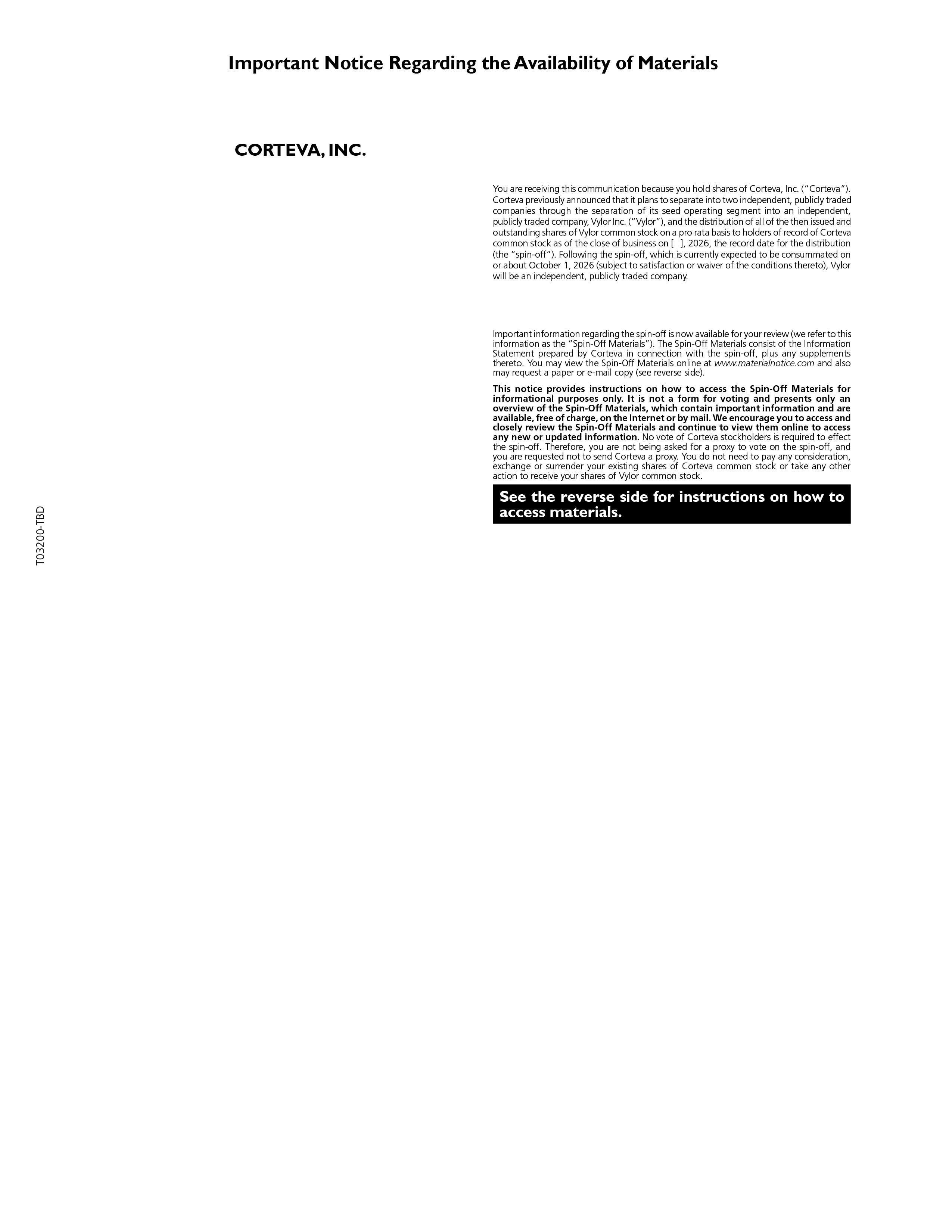
Important Notice Regarding the Availability of Materials CORTEVA, INC. You are receiving this communication because you hold shares of Corteva, Inc. (“Corteva”). Corteva previously announced that it plans to separate into two independent, publicly traded companies through the separation of its seed operating segment into an independent, publicly traded company, Vylor Inc. (“Vylor”), and the distribution of all of the then issued and outstanding shares of Vylor common stock on a pro rata basis to holders of record of Corteva common stock as of the close of business on [ ], 2026, the record date for the distribution (the “spin-off”). Following the spin-off, which is currently expected to be consummated on or about October 1, 2026 (subject to satisfaction or waiver of the conditions thereto), Vylor will be an independent, publicly traded company. Important information regarding the spin-off is now available for your review (we refer to this information as the “Spin-Off Materials”). The Spin-Off Materials consist of the Information Statement prepared by Corteva in connection with the spin-off, plus any supplements thereto. You may view the Spin-Off Materials online at www.materialnotice.com and also may request a paper or e-mail copy (see reverse side). This notice provides instructions on how to access the Spin-Off Materials for informational purposes only. It is not a form for voting and presents only an overview of the Spin-Off Materials, which contain important information and are available, free of charge, on the Internet or by mail. We encourage you to access and closely review the Spin-Off Materials and continue to view them online to access any new or updated information. No vote of Corteva stockholders is required to effect the spin-off. Therefore, you are not being asked for a proxy to vote on the spin-off, and you are requested not to send Corteva a proxy. You do not need to pay any consideration, exchange or surrender your existing shares of Corteva common stock or take any other action to receive your shares of Vylor common stock. See the reverse side for instructions on how to access materials. T03200-TBD
Materials Available to VIEW or RECEIVE: How to View Online: Visit: www.materialnotice.com. Have the information that is printed in the box marked by the arrow above. How to Request and Receive a PAPER or E-MAIL Copy: If you want to receive a paper or e-mail copy of these materials, you must request one. There is NO charge for requesting a copy. Please choose one of the following methods to make your request: 1) BY INTERNET:www.materialnotice.com 2) BY TELEPHONE: 1-800-579-1639 3) BY E-MAIL*: sendmaterial@materialnotice.com *If requesting materials by e-mail, please send a blank e-mail with the information that is printed in the box markedby the arrow above in the subject line. Requests, instructions and other inquiries sent to this e-mail address will NOT be forwarded to your investment advisor. T03201-TBD

THIS NOTICE WILL ENABLE YOU TO ACCESSMATERIALS FOR INFORMATIONAL PURPOSES ONLY T03201-TBD

THIS PAGE WAS INTENTIONALLY LEFT BLANK T03201-TBD

